
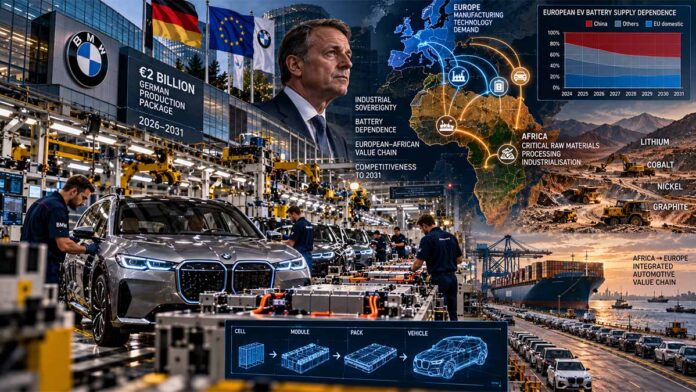

Scope: Germany, the wider European production system, the full African automotive and battery-materials geography specified in the tasking, China as the principal cell/process/capital node, and Mexico, Brazil, Thailand, Indonesia and Uzbekistan where those locations alter production economics, sourcing resilience or rules-of-origin calculations, assessed from 1 October 2026 through 31 December 2031.
The analytical architecture below follows the user-supplied Universal Institutional Intelligence Report Protocol, Academic Governance Edition V9.0, including its requirement to distinguish established fact, corporate assertion, analytical judgment and unresolved proposition; to preserve conflicting figures rather than silently reconcile them; and to organize a full dossier around an executive judgment, exactly three thematic pillars and an auditable evidence structure. Testo incollato
Executive Summary / BLUF
BMW’s approximately €2 billion German production package is substantially real capital deployment rather than a newly announced €2 billion future spending programme, but the headline aggregates investments made over different periods and in different industrial functions: BMW states that approximately €1 billion has been spent developing the Munich and Dingolfing vehicle plants, while approximately €1 billion has been invested in the new Irlbach-Straßkirchen battery plant. The available 30 September 2026 corporate record does not provide an auditable decomposition between buildings, production equipment, automation, supplier tooling and other capitalised expenditure, which means that the €2 billion headline is verified as BMW’s aggregate investment statement but is not yet independently decomposable as a single homogeneous capex programme. BMW Group PressClub
BMW’s central industrial claim is therefore simultaneously true and incomplete: Munich is becoming an electric-only vehicle plant from 2027, Dingolfing retains combustion-engine and plug-in-hybrid production for the eighth-generation 3 Series, and Irlbach-Straßkirchen is producing Gen6 high-voltage battery systems, but Irlbach-Straßkirchen is not a cell gigafactory. BMW explicitly states that externally supplied cylindrical cells arrive at the site before clustering, welding, structural integration and final battery assembly, while the company has established five Gen6 high-voltage battery assembly locations at Irlbach-Straßkirchen, Debrecen, Shenyang, Woodruff and San Luis Potosí. BMW Group PressClub
The most strategically consequential distinction is consequently between BMW-controlled battery architecture and pack industrialisation and supplier-controlled electrochemical cell manufacturing. CATL’s documented supply agreement provides for 46-mm cylindrical cells from one future European and one Chinese plant, each associated with up to 20 GWh per year dedicated to BMW, while EVE Energy states that its cylindrical cells equip the Neue Klasse iX3 and its Hungarian project documentation describes a planned 30 GWh cell facility primarily supplying neighbouring BMW production. CATL’s Debrecen cell facility only entered trial production on 22 September 2026, making the localisation trajectory real but still operationally immature at the cut-off date. CATL
BMW’s Germany narrative is also supported in several important respects: the company states that its German plants produce more than one million vehicles annually, approximately 55% of BMW Group employees work in Germany, approximately 760 supplier locations support Munich and Dingolfing during the new 3 Series ramp-up, more than 70% of those supplier locations are European and more than 30% are German, while roughly 40 new or updated models incorporating Neue Klasse technologies are planned by the end of 2027. These figures are current BMW disclosures and should be classified as verified corporate disclosures rather than independently audited industrial-system facts until plant-level production and employment series have been reconciled against the 2025 report and 2026 plant data. BMW Group PressClub
The transformation nevertheless extends far beyond Germany. The European regulatory system is moving from a simple “where was the vehicle assembled?” question toward traceable battery provenance, subsidy exposure, component origin and economic substance: under Regulation (EU) 2023/1542, EV batteries placed on the EU market require a digital battery passport from 18 February 2027, while the Commission’s definitive countervailing regime on China-origin BEVs remains active, with company-specific additional duties in the underlying regime and a 2026 process for considering price undertakings. Eur-Lex
Africa must not be treated as a single near-shoring strategy. Morocco is developing into an EU-connected vehicle-and-battery-materials production platform, with Stellantis declaring Kénitra capacity of 535,000 vehicles per year including micromobility, while the African Development Bank approved €100 million in July 2026 for Gotion Power Morocco and described phase one of the project as a 10 GWh integrated cathode-to-cell-and-pack LFP facility, notwithstanding an earlier AfDB environmental record describing the phase-one project as 20 GWh plus 100,000 tonnes of cathode material; that discrepancy is material and will be preserved rather than harmonised. Stellantis Media
The Moroccan case also establishes why nominal geographic relocation does not automatically extinguish trade-defence exposure. In March 2025 the European Commission imposed countervailing duties of 5.6% to 31.4% on aluminium road wheels from Morocco after finding Moroccan subsidies and, for one producer, direct Chinese cross-border financial contributions under Belt and Road cooperation; those duties were additional to pre-existing anti-dumping duties of 9% to 17.5%. This does not establish that future Moroccan batteries or vehicles will be denied Moroccan origin, but it demonstrates that the Commission is prepared to investigate subsidy transmission and Chinese financial support embedded in Moroccan industrial production rather than accepting third-country assembly as dispositive. Trade and Economic Security
The controlling 2031 judgment is therefore that BMW is re-localising a meaningful share of system integration, pack assembly, vehicle production, software/electronics integration and industrial know-how without fully re-localising the underlying electrochemical value chain. Germany remains important because BMW controls product architecture, vehicle engineering, battery-system design and high-value industrialisation there; Hungary becomes disproportionately important because BMW, CATL and EVE are creating overlapping vehicle, pack and cell capacity around Debrecen; China remains structurally relevant because Chinese companies retain major positions in cell technology, manufacturing know-how and upstream materials processing; and Morocco is emerging as the most consequential African bridge between Chinese capital/process capability and European market access, although South Africa, Egypt, Ethiopia, Algeria, Kenya and the rest of the continent represent fundamentally different industrial models and will therefore be assessed separately.
Pillar I — BMW and the European Production-Control Architecture
Chapter 1 — The €2 Billion German Package: What Was Spent, Where, When and on What
Munich, Dingolfing and Irlbach-Straßkirchen; sunk versus committed capex; buildings, plant equipment and supplier tooling; operating status; production transitions; employment exposure.
Chapter 2 — BMW Gen6: From Cell Chemistry to Vehicle Integration
Cell suppliers and manufacturing locations; CATL, EVE and other documented suppliers; cell versus pack production; Debrecen, Irlbach-Straßkirchen, Shenyang, Woodruff and San Luis Potosí; chemistry, watt-hours and residual Chinese dependence.
Chapter 3 — European OEM Production and Control Matrix
BMW Group, Volkswagen Group/PowerCo, Mercedes-Benz Group, Stellantis and Renault Group across Germany, Spain, Hungary, Slovakia, Poland, Czechia, Italy, France, the United Kingdom, Sweden and Turkey; vehicle plants, actual output, drivetrain mix, battery assets, employment, announced changes and EU export exposure.
Chapter 4 — Chinese Capital Inside the European Automotive System
Gotion–Volkswagen, Leapmotor–Stellantis, Stellantis–Dongfeng, Mercedes and Renault relationships, Chery’s European manufacturing footprint, BYD Hungary and Turkey, SAIC/MG localisation, XPeng proposals and other Chinese equity, JV, licensing, off-take and contract-manufacturing structures.
Pillar II — Africa as Distinct Industrial Systems, Not a Single Near-Shoring Geography
Chapter 5 — Morocco: EU-Export Platform and Battery-Materials Bridge
Renault Tangier and SOMACA, Stellantis Kénitra, Gotion, BTR, CNGR/COBCO–Al Mada, Tinci, Hailiang, Sentury and associated materials/logistics assets; EU trade access, Tanger Med and subsidy-origin exposure.
Chapter 6 — South Africa: Established Full-Process Vehicle Base Under Trade and Cost Pressure
Toyota, Volkswagen, BMW Rosslyn, Mercedes-Benz East London, Ford and Isuzu; Nissan’s departure; Chery’s Rosslyn acquisition and restart programme; EU–SADC EPA exposure, AGOA exposure and prospective Chinese investment.
Chapter 7 — Egypt and North Africa Beyond Morocco
Egyptian MG/Al Mansour, CATL-related battery activity and BESS manufacturing, Geely, Chery, BAIC, Dongfeng, FAW/El Nasr and GAC; Algeria’s restarted assembly system; Tunisia’s component base; separation of domestic-market CKD from export-grade vehicle industrialisation.
Chapter 8 — Sub-Saharan CKD Markets and the AfCFTA Origin Test
Ethiopia, Kenya, Nigeria, Ghana, Tanzania and all additional operating or announced sites; full-process versus CKD/SKD classification; African-content rules; battery and mineral projects; export plausibility versus protected domestic-market assembly.
Chapter 9 — Minerals to Materials to Cells to Packs to Vehicles
DRC cobalt, Zimbabwe lithium, Mozambique graphite, Moroccan phosphate, South African manganese and PGM resources, together with the actual jurisdiction in which refining, precursor manufacture, cathode/anode production, cell manufacture, pack assembly and final vehicle production occur.
Pillar III — Rules of Origin, Capital Control and the 2031 Industrial Settlement
Chapter 10 — Trade Architecture and the Economics of Origin
EU–Morocco, EU–SADC/South Africa, EU–Egypt, EU–Tunisia, EU–Algeria, Turkey customs union, AfCFTA, EU Battery Regulation, CBAM where applicable, Chinese-BEV countervailing duties, anti-dumping and anti-subsidy precedent, and the legal status of the proposed Industrial Accelerator Act.
Chapter 11 — Capital and Control: Who Owns What and Who Actually Decides
Equity percentages, governance, board rights, plant management, joint ventures, supply contracts, technology licensing, off-take agreements and contract assembly, with corporate ownership separated from industrial dependence.
Chapter 12 — Employment, Value Capture and the Five-Year Industrial Balance
German net employment, engine and Tier-1 exposure, vehicle and battery labour, OEM-specific 2031 value capture across design, cells, packs, e-motors, software and final assembly, and the distribution of margins between European OEMs, Chinese cell/material companies and host-country industrial systems.
Chapter 13 — 2026–2031 Scenarios, Circumvention Tests and Quarterly Indicators
Base/upside/downside pathways, country-specific trade-defence exposure, quarterly production and capacity indicators, Chinese equity expansion, EU investigations and the share of EU Chinese-brand BEV registrations supplied from production outside China.
Master Abstract
The €2 Billion Headline Is Correct, but It Describes Three Different Industrial Decisions
BMW’s 30 September 2026 announcement establishes a defensible numerical baseline: approximately €1 billion has been spent on the further development of Munich and Dingolfing, while approximately €1 billion has been invested in Irlbach-Straßkirchen, producing the “around €2 billion” headline. The wording is important because BMW uses past-tense formulations—”has been spent” and “has invested”—rather than announcing a fresh €2 billion appropriation beginning on 1 October 2026. The balance of public evidence therefore supports classifying most of the headline as sunk or already committed programme capex, although final commissioning, ramp-up expenditure and subsequent model-related tooling can continue beyond the announcement date. BMW has not publicly provided sufficient project-accounting detail in the retrieved record to divide the figure reliably between civil works, body-shop and assembly equipment, logistics systems, battery equipment, digitalisation, automation, supplier tooling and other capitalised items. BMW Group PressClub
Munich and Dingolfing are also being transformed in fundamentally different ways. Munich entered BMW i3 series production in August 2026 after four years of redevelopment that included a new body shop, new assembly hall and logistics areas across approximately one-third of the plant, and BMW states that from 2027 Munich will produce only fully electric vehicles. Dingolfing instead adds the eighth-generation combustion-engine and plug-in-hybrid 3 Series to a flexible multi-model plant, including a dedicated new body-shop production line while using existing paint and assembly infrastructure. The investment is therefore not a uniform German electrification programme; it is a portfolio hedge in which Munich specialises in BEV production while Dingolfing preserves combustion and PHEV manufacturing capability. BMW Group PressClub
Irlbach-Straßkirchen Localises Battery-System Production, Not Cell Sovereignty
Irlbach-Straßkirchen began series production by 1 October 2026 and BMW states that it is already supplying Munich, initially operating two shifts and eventually employing approximately 1,600 people while producing several hundred high-voltage batteries per day across two lines. Yet the actual manufacturing sequence is decisive: BMW says the battery cells are supplied by external cell manufacturers and then inspected, clustered, welded, foamed, enclosed, sealed, integrated with the Energy Master and subjected to final inspection. The plant therefore performs sophisticated, high-value battery-system integration and pack manufacturing, but it does not manufacture the electrochemical cells contained inside those packs. BMW Group PressClub
This distinction substantially changes the sovereignty assessment. BMW controls the Gen6 battery architecture, has filed more than 500 patent applications relating to the generation, develops the Energy Master hardware and software internally, and maintains cell R&D and near-series pilot competence in Bavaria, but its large-volume series cells remain supplier-manufactured. CATL’s supply framework explicitly provided for new 46-mm cylindrical cells manufactured at one Chinese and one European plant, each with up to 20 GWh annually dedicated to BMW, while EVE Energy identifies BMW as a major customer and states that its large cylindrical cells are used in the iX3. EVE’s Hungarian project documentation places a planned 30 GWh cell plant next to BMW’s Debrecen site, while CATL’s much larger Debrecen complex began trial cell production only on 22 September 2026. CATL
The resulting industrial model is consequently European pack localisation resting on a mixed European/Chinese cell-production architecture whose corporate control remains materially Chinese. A cell manufactured in Hungary by CATL or EVE is European in manufacturing geography but not European in corporate ownership; conversely, a BMW-designed pack assembled in Bavaria around supplier cells represents German control over integration without German ownership of the principal cell factory. Any 2031 value-capture calculation that classifies all Hungarian cell production as “European battery sovereignty” would therefore obscure the ownership and margin question that the tasking explicitly requires.
The Five-Pack-Plant Network Reveals BMW’s Actual Resilience Strategy
BMW has established or announced Gen6 high-voltage battery assembly at Debrecen, Irlbach-Straßkirchen, Shenyang, Woodruff and San Luis Potosí, creating a regional architecture in which bulky finished batteries can be assembled close to vehicle production while cell supply remains contracted to specialist manufacturers. That design lowers battery transport distances, reduces logistics exposure and gives BMW control of pack architecture and assembly processes without requiring the company to assume the technological, capital and utilisation risks of becoming a large-scale cell manufacturer itself. BMW Group PressClub
This is strategically different from Volkswagen’s PowerCo approach and is one reason the final 2031 OEM value-capture comparison must distinguish design authority, electrochemistry, cell-manufacturing ownership, pack integration, power electronics, e-motors, software and final assembly rather than treating an EV as a single manufacturing activity. BMW’s strategy currently appears to maximise control over those layers where vehicle-system integration creates differentiation while outsourcing a significant share of capital-intensive electrochemistry to suppliers; whether that produces a durable advantage or a persistent strategic dependency will depend principally on the geographical and ownership structure of cell supply during the 2027–2031 volume ramp.
Morocco Demonstrates Why Africa Must Be Analysed as Industrial Functions Rather Than Geography
Morocco already combines large-scale European OEM production, component manufacturing, free-zone logistics and rapidly emerging battery-material and cell projects, but even within a single Moroccan location those activities must remain analytically distinct. Stellantis announced that Kénitra’s conventional Smart Car platform capacity would rise from 200,000 to 400,000 vehicles annually from February 2026, while total installed capacity including micromobility would reach 535,000 units, and the group targeted Moroccan supplier purchases exceeding €6 billion annually by 2030 with a stated 75% local-integration target. These are COMPANY CLAIMS concerning future capacity and localisation rather than independently verified realised output. Stellantis Media
Gotion represents an entirely different activity. The African Development Bank’s July 2026 financing announcement describes a €100 million AfDB loan, prospective mobilisation of up to another €141 million, and a phase-one integrated LFP cathode-to-cell-and-pack plant at 10 GWh, with eventual expansion plans reaching 100 GWh; the AfDB’s earlier project documentation, however, described phase one as 20 GWh and 100,000 tonnes of cathode material per year. Because both documents are first-order AfDB records and concern what appears to be the same project, the capacity difference cannot be silently normalised and will be tested against financing agreements, project revisions and Gotion filings in the Morocco chapter. Banca Africana di Sviluppo
The ownership chain is equally important: Gotion High-Tech is a Chinese battery manufacturer and Volkswagen’s relationship with Gotion must be classified separately as an equity relationship with the parent company rather than misdescribed as Volkswagen ownership of the Moroccan factory unless the Moroccan project’s shareholder documents establish such ownership. This distinction between indirect strategic shareholding and direct project equity will govern the capital-and-control matrix throughout the dossier.
Morocco’s Trade Advantage Is Material but Not Immune from EU Enforcement
The March 2025 Moroccan aluminium-wheel decision provides a concrete precedent for a more forensic European approach to third-country industrial localisation. The Commission found subsidisation involving Moroccan measures and, in one producer’s case, direct Chinese cross-border financial contributions associated with Belt and Road cooperation, leading to definitive countervailing duties between 5.6% and 31.4%, on top of already-existing anti-dumping duties between 9% and 17.5%. Trade and Economic Security
The case must not be overextended: it does not establish that Moroccan vehicles, batteries or cathode products using Chinese capital will automatically lose Moroccan preferential origin, and subsidy law is analytically separate from customs-origin law. It does establish, however, that moving Chinese-controlled production into Morocco does not place that production beyond EU scrutiny, particularly where financial contributions, economic substance, local processing and injury to European industry can be investigated through existing trade-defence instruments. The future circumvention assessment for Morocco, South Africa and Egypt therefore requires separate legal tests rather than one continental probability.
Battery Traceability Becomes an Industrial Variable from 2027
Regulation (EU) 2023/1542 requires each EV battery placed on the EU market or put into service from 18 February 2027 to have an electronic battery passport containing model-specific and individual-battery information. That requirement does not itself create a local-content threshold, but it materially increases traceability of battery characteristics and supply-chain information and must therefore be incorporated into any assessment of localisation, carbon footprint, recycled content and industrial provenance after 2027. Eur-Lex
At the same time, the EU’s countervailing regime on China-origin BEVs remains strategically relevant. The Commission’s January 2026 guidance recalls definitive additional countervailing duties ranging from 7.8% to 35.3% under the existing investigation while establishing a process for considering individual price undertakings containing minimum-price, sales-channel, cross-compensation and future-investment elements. Relocating Chinese-brand final assembly into Europe, Turkey, Morocco or another third country can therefore change tariff exposure, but only after origin, value added, subsidy transmission and specific trade-defence rules are tested rather than inferred from a final-assembly address. Trade and Economic Security
BMW Claim-Verification Table
| BMW proposition | Assessment at 1 Oct 2026 | Evidentiary finding | Classification |
|---|---|---|---|
| ~€2 bn total German package | SUPPORTED WITH DEFINITIONAL QUALIFICATION | BMW states approximately €1 bn was spent developing Munich and Dingolfing and approximately €1 bn was invested in Irlbach-Straßkirchen; the source does not provide a project-accounting breakdown. BMW Group PressClub | VERIFIED COMPANY DISCLOSURE |
| ~€1 bn Munich + Dingolfing | SUPPORTED | BMW explicitly states approximately €1 bn has been spent on further development of the two vehicle plants. BMW Group PressClub | VERIFIED COMPANY DISCLOSURE |
| ~€1 bn Irlbach-Straßkirchen | SUPPORTED | BMW’s 1 October opening release repeats an investment of approximately €1 bn. BMW Group PressClub | VERIFIED COMPANY DISCLOSURE |
| Munich becomes electric-only | SUPPORTED | BMW states that Munich will exclusively produce fully electric vehicles from 2027. BMW Group PressClub | ANNOUNCED OPERATING PLAN |
| Munich produces Neue Klasse i3 using Gen6 batteries | SUPPORTED | i3 series production began in August 2026; Irlbach supplies sixth-generation batteries to Munich. BMW Group PressClub | OPERATING |
| Dingolfing produces 8th-generation ICE/PHEV 3 Series with new body-shop line | SUPPORTED | BMW identifies combustion and plug-in-hybrid production at Dingolfing and a new 3 Series line in the body shop. BMW Group PressClub | OPERATING / RAMP-UP |
| Irlbach supplies Munich from October 2026 | SUPPORTED AND ALREADY OPERATING | BMW’s 1 October release states series production has started and batteries are already being supplied to Munich. BMW Group PressClub | OPERATING |
| Irlbach is a cell gigafactory | FALSE | BMW explicitly says externally supplied cells are received and assembled into high-voltage battery systems. BMW Group PressClub | NOT A CELL PLANT |
| German plants >1 million vehicles/year | SUPPORTED AS BMW DISCLOSURE | BMW states German plants produce more than one million vehicles each year. BMW Group PressClub | COMPANY DISCLOSURE — plant reconciliation pending |
| ~55% of Group employees in Germany | SUPPORTED AS BMW DISCLOSURE | BMW explicitly reports approximately 55% of employees in Germany; the 2025 Group workforce was 154,540. BMW Group PressClub | COMPANY DISCLOSURE |
| ~40 new/updated Neue Klasse-technology models by end-2027 | SUPPORTED, but wording matters | BMW describes more than/about 40 new or updated models incorporating Neue Klasse technologies, not forty entirely new Neue Klasse-native vehicles. BMW Group | ANNOUNCED PRODUCT PLAN |
| Cell origin for German Gen6 packs is completely German/EU | NOT ESTABLISHED | BMW identifies external cell manufacturers but does not disclose the plant-of-origin mix for Irlbach cells in the 1 October release; CATL’s supply agreement explicitly includes European and Chinese production. BMW Group PressClub | OPEN RECORD |
| All Gen6 production is localised near vehicle plants | TRUE FOR PACK ASSEMBLY, NOT NECESSARILY CELLS | BMW identifies five regional high-voltage battery assembly plants, while cells remain externally sourced. BMW Group PressClub | VERIFIED WITH QUALIFICATION |
| German transition necessarily increases net automotive employment | NOT ESTABLISHED | Irlbach is projected at approximately 1,600 employees, but no retrieved BMW disclosure establishes the net 2026–2031 effect after engine, transmission, supplier and productivity changes. BMW Group PressClub | UNRESOLVED |
Key Evidence Table
| Indicator | Value/status | Reference date | Definition / scope | Issuer | Exact source |
|---|---|---|---|---|---|
| BMW German investment headline | ~€2 bn | 30 Sep 2026 | Munich + Dingolfing + Irlbach-Straßkirchen | BMW Group | “Made in Germany”: BMW investing around two billion euros in the production of the new BMW 3 Series |
| Munich + Dingolfing investment | ~€1 bn | 30 Sep 2026 | Further development of vehicle plants | BMW Group | BMW Group PressClub |
| Irlbach investment | ~€1 bn | 1 Oct 2026 | New high-voltage battery assembly plant | BMW Group | Series production gets underway: BMW Group officially opens Plant Irlbach-Straßkirchen |
| Irlbach employment at full operation | ~1,600 | 1 Oct 2026 | BMW direct plant employment | BMW Group | BMW Group PressClub |
| Gen6 global pack network | 5 plants | 1 Oct 2026 | Debrecen, Irlbach, Shenyang, Woodruff, San Luis Potosí | BMW Group | BMW Group PressClub |
| CATL BMW supply commitment | up to 20 GWh p.a. at each of two plants | Agreement 9 Sep 2022; still relevant to Gen6 supply architecture | One European and one Chinese CATL plant dedicated to BMW | CATL | CATL and BMW Group reach framework agreement on cylindrical battery supply |
| CATL Debrecen status | Trial production started | 22 Sep 2026 | Cell-manufacturing building | CATL | CATL Debrecen Kicks Off Trial Operations in its New Cell Building |
| EVE Hungary planned cell capacity | 30 GWh p.a. | project documentation available 2026 | Large cylindrical lithium-ion battery cells, primarily BMW supply | EVE Energy project documentation | Eve Battery |
| BMW German vehicle production | >1 million vehicles/year | 30 Sep 2026 statement | BMW Group German production system | BMW Group | BMW Group PressClub |
| BMW workforce | 154,540 worldwide | 31 Dec 2025 | Group employees | BMW Group | BMW Group Report 2025 |
| Germany share of BMW workforce | ~55% | 30 Sep 2026 | Share of global BMW Group employees working in Germany | BMW Group | BMW Group PressClub |
| Morocco Gotion financing | €100m AfDB + mobilisation target up to €141m | 24 Jul 2026 | Integrated LFP project | African Development Bank | African Development Bank Approves €100 Million to Gotion Power Morocco |
| Gotion Morocco phase-one capacity | 10 GWh in July 2026 financing release; 20 GWh in earlier project file | 2025–2026 | Cell/pack plus cathode integration | AfDB | Banca Africana di Sviluppo |
| Stellantis Kénitra planned capacity | 535,000 incl. micromobility | announced 2025, ramp into 2026 | 400,000 Smart Car + 135,000 micromobility | Stellantis | Stellantis and Moroccan Government consolidate Kénitra industrial partnership |
| Morocco aluminium-wheel CVD | 5.6%–31.4% | 14 Mar 2025 | Countervailing duty following Moroccan and Chinese subsidy findings | European Commission | Commission imposes duties on unfairly subsidised imports of aluminium road wheels from Morocco |
| EU EV battery passport | Mandatory from 18 Feb 2027 | Regulation in force | EV batteries placed on market / put into service | European Union | Regulation (EU) 2023/1542 — Article 77 |
| China BEV countervailing regime | additional duties within 7.8%–35.3% range cited by Commission in Jan 2026 | 12 Jan 2026 | China-origin BEV anti-subsidy regime | European Commission | Commission issues Guidance Document on submission of price undertaking offers for battery electric vehicles from China |
Competing Industrial Pathways
The public evidence already supports three genuinely different pathways, although numerical scenario probabilities will be assigned only after the European production census, African plant census, ownership matrix and rules-of-origin analysis establish reproducible base conditions rather than manufacturing precision from an incomplete first-stage record.
| Pathway | Diagnostic support | Disconfirming evidence | Indicators | Current standing |
|---|---|---|---|---|
| Regionalised production with persistent Chinese electrochemical control | BMW localises packs while CATL/EVE retain cell production; Chinese-controlled materials investments expand in Europe and Morocco. | European-owned cell projects scale successfully and upstream localisation accelerates materially. | EU cell utilisation; ownership of operating GWh; cathode/anode localisation; OEM procurement changes. | Strongly supported by present evidence. |
| European localisation deepens into genuine cell and materials sovereignty | Battery Regulation, industrial policy, trade defence and OEM risk-management favour local sourcing. | Cost, technology, utilisation and financing disadvantages prevent European projects from matching Chinese suppliers. | European-controlled cell GWh; material-processing start-ups reaching commercial utilisation; supplier switching. | Plausible but not demonstrated at sufficient scale. |
| Third-country production becomes the principal China–EU bridge | Morocco, Turkey and other locations can combine Chinese industrial capital with preferential or lower-friction market access. | Rules-of-origin enforcement, subsidy investigations, local-content rules and EU industrial-policy conditions constrain the model. | Chinese FDI outside China; EU origin rulings; anti-circumvention cases; non-China Chinese-brand EU registrations. | Increasingly material but jurisdiction-specific. |
Principal Gaps and Watch Indicators
The first unresolved record concerns BMW Gen6 cell allocation by plant and year: CATL and EVE supply relationships are documented, but the public record retrieved for 1 October 2026 does not establish precisely which cell factory supplies Irlbach-Straßkirchen, what percentage of its 2026–2031 watt-hours comes from China, Hungary or other locations, or whether allocations can change dynamically between suppliers; this information is necessary before assigning defensible 2027, 2029 and 2031 European-cell shares.
The second unresolved record concerns the €2 billion capex decomposition: BMW’s aggregate figures are verified, but the accounting split between land/buildings, body-shop systems, assembly equipment, logistics infrastructure, battery equipment, automation/digital systems and supplier tooling is not contained in the retrieved releases, so no artificial allocation will be manufactured.
The third unresolved record concerns net German employment, because the approximately 1,600 jobs at Irlbach-Straßkirchen and continuing Munich/Dingolfing employment cannot be treated as the net industrial effect without simultaneously measuring engine and transmission exposure, attrition, productivity gains, automation, component substitution and Tier-1 labour effects.
The fourth unresolved record concerns the Gotion Morocco phase-one capacity discrepancy, where AfDB documents currently support both a 20 GWh project description and a later 10 GWh financing-release description; the operative financed phase, commissioning schedule and any staged subdivision require reconciliation from project and corporate filings rather than inference. Banca Africana di Sviluppo
The fifth unresolved record concerns several late-September 2026 European Chinese-equity transactions specified in the tasking, including the reported PowerCo/Gotion structures in Spain, Slovakia and Morocco, together with any XPeng plant arrangement, SAIC/MG Spanish project and Chery European-plant transactions, all of which will remain RUMOURED or UNVERIFIED unless the relevant corporate filing, exchange filing, government approval or signed transaction disclosure establishes closure, ownership percentage and governance rights.
Quarterly Indicator Dashboard — Measurement Architecture
The operational dashboard developed in Chapter 13 will track measures that can be reproduced from official or first-party records rather than composite sentiment scores.
| Indicator | Unit | Why it changes the assessment |
|---|---|---|
| German OEM vehicle output | vehicles / quarter | Tests whether investment converts into actual German industrial utilisation |
| BMW German BEV / PHEV / ICE production | vehicles and % mix | Measures Munich specialisation against Dingolfing flexibility |
| EU/EEA operating cell output | GWh, not announced nameplate | Separates functioning industrial capacity from announcements |
| EU/EEA cell output under Chinese corporate control | GWh and % | Measures localisation geography separately from ownership |
| African full-process vehicle output | vehicles by country | Distinguishes export-grade manufacturing from CKD/SKD activity |
| African CKD/SKD assembly | vehicles by country | Measures protected-market assembly separately from full manufacturing |
| African operating cell capacity | realised GWh | Avoids counting announced gigafactories as production |
| African cathode/anode/precursor production | tonnes | Measures actual upstream value capture |
| Chinese equity in European auto/battery assets | € value and ownership % | Measures capital-control expansion |
| Chinese equity in African auto/battery assets | € value and ownership % | Measures ownership behind nominal African localisation |
| EU trade-defence cases involving auto/battery chains | cases opened / measures imposed | Tests tightening enforcement |
| Chinese-brand EU BEV registrations built outside China | vehicles and share | Measures industrial relocation as distinct from Chinese-brand market penetration |
| BMW Gen6 European-sourced cells | GWh and % of BMW European demand | Directly tests reduction of China-origin watt-hour dependency |
| Battery-passport compliance | share of relevant EV batteries | Provides post-February-2027 traceability baseline |
BMW’s €2 Billion German Production Package: Where Industrial Control Actually Sits
The decisive distinction is not simply whether production is located in Germany or Europe, but which layer of the electric-vehicle value chain is controlled locally: vehicle engineering, cell manufacturing, battery-pack integration, software and final assembly belong to different industrial actors and cannot be aggregated into a single claim of localisation.
What the €2 billion headline actually contains
Verified corporate aggregation; the public record does not yet provide an auditable allocation between buildings, machinery, digital systems, supplier tooling and other capitalised expenditure.
Munich + Dingolfing
- Vehicle-production transformation.
- Munich transition toward electric-only production from 2027.
- Dingolfing retains ICE and PHEV capability for the eighth-generation 3 Series.
- New body-shop capacity forms part of the Dingolfing programme.
Irlbach-Straßkirchen
- Gen6 high-voltage battery-system production.
- Series supply to Munich began by 1 October 2026.
- Externally manufactured cylindrical cells enter the plant.
- The site performs integration and pack assembly rather than cell manufacturing.
The Gen6 control chain
Manufacturing geography, corporate ownership and technological control are shown separately. A European production address does not automatically imply European corporate control.
Vehicle & battery architecture
BMW-controlled system design, vehicle integration and Gen6 architecture.
Cell manufacturing
External suppliers include CATL and EVE; corporate control remains outside BMW.
Cell geography
Documented sourcing architecture includes both European and Chinese manufacturing. Exact BMW European watt-hour allocation remains unresolved.
BMW pack integration
BMW clusters, welds and integrates cylindrical cells into Gen6 high-voltage systems.
Energy Master
BMW-developed hardware and software sit inside the integrated battery system.
Vehicle assembly
Regional vehicle manufacturing includes Munich and the broader Neue Klasse production network.
2031 value capture
Final distribution of cell margin, software value, labour and upstream materials value remains to be measured.
BMW Gen6 regional battery-pack network
These locations must not be described automatically as cell gigafactories. BMW identifies them as regional high-voltage battery production or assembly nodes.
Irlbach-Straßkirchen
Series production operating by 1 October 2026; first supply directed to Munich.
Pack / battery-system assemblyDebrecen
BMW regional Gen6 high-voltage battery production associated with its Hungarian vehicle footprint.
Pack / battery-system assemblyShenyang
Regional Gen6 battery production within BMW’s Chinese industrial system.
Pack / battery-system assemblyWoodruff
Regional battery-system node supporting BMW’s North American manufacturing architecture.
Pack / battery-system assemblySan Luis Potosí
Regional Gen6 battery-system node linked to BMW’s Mexican vehicle-production footprint.
Pack / battery-system assemblyCell supply: what is established and what is not
No unsupported BMW watt-hour allocation has been inserted. The chart contains only disclosed capacity relationships and explicitly marks unresolved supply allocation.
| Actor / asset | Activity | Documented figure | Geography | Corporate control | BMW relationship | Evidence status |
|---|---|---|---|---|---|---|
| CATL BMW supply framework | Cell manufacturing | Up to 20 GWh/year dedicated to BMW at each of two plants | One European plant + one Chinese plant | CATL | Cell supply | Verified supplier disclosure |
| CATL Debrecen | Cell manufacturing | Trial cell production began 22 Sep 2026 | Hungary | CATL | Relevant European supply node | Operating trial phase |
| EVE Hungary | Large cylindrical cell manufacturing | 30 GWh/year planned capacity | Hungary | EVE Energy | Project documentation identifies BMW as primary neighbouring customer | Project disclosure |
| Irlbach-Straßkirchen | Pack / battery-system assembly | Several hundred batteries/day disclosed by BMW | Germany | BMW Group | Supplies Munich | Operating |
| BMW European Gen6 cell-origin share | Cell sourcing allocation | Not publicly established | EU / China | Mixed supplier architecture | Required for 2027 / 2029 / 2031 dependency calculation | Open record |
Africa is not one industrial strategy
Country roles are classified by the functions supported in the verified record rather than by continent-wide generalisation.
Morocco
Established vehicle-export manufacturing combined with rapidly expanding battery-material, cell and component investment; increasingly important as a bridge between European market access and Chinese industrial capital.
EU-export platform Battery-materials nodeSouth Africa
Mature full-process vehicle-manufacturing system with BMW, Mercedes-Benz, Toyota, Volkswagen, Ford and Isuzu production, structurally distinct from Morocco’s emerging battery-material ecosystem.
Established vehicle baseEgypt
Expanding domestic and regional assembly platform with Chinese OEM participation and emerging battery-related projects; EU-export relevance must be established asset by asset rather than assumed.
Regional assembly marketEthiopia
EV assembly is shaped by protected-market policy and the ICE import restriction; plants must be classified as CKD/SKD unless evidence demonstrates export-grade full-process manufacturing.
Protected-market CKDMorocco: verified industrial signals
Capacity announcements, financing commitments and trade-defence findings remain separate categories.
Regulatory architecture changes the localisation test
| Instrument / measure | Verified status | Relevant date / figure | Industrial implication |
|---|---|---|---|
| EU Battery Regulation — battery passport | In force | EV battery passport mandatory from 18 Feb 2027 | Increases traceability of battery-specific information; does not by itself create a general EU local-content threshold. |
| China-origin BEV countervailing regime | Definitive EU trade-defence regime active | Commission cited additional duties within a 7.8%–35.3% range in Jan 2026 guidance | Makes production origin, subsidy exposure and localisation architecture economically material. |
| Moroccan aluminium-wheel countervailing case | Definitive measure | 5.6%–31.4% CVD, Mar 2025 | Demonstrates that Chinese-linked financial support embedded in third-country production can remain subject to EU scrutiny. |
| Industrial Accelerator Act local-content concepts | Draft / policy-development stage | No final adopted threshold inserted here | Must not be represented as binding law until adopted. |
Net industrial judgment
BMW’s German programme materially localises vehicle production, battery-system engineering and pack integration, but the verified record does not support the stronger proposition that Germany or BMW has localised electrochemical cell sovereignty. The industrial system instead combines BMW-controlled design and integration with externally manufactured cells, including suppliers under Chinese corporate control, while Hungary is becoming a critical European cell-production geography and Morocco is emerging as the most consequential African intersection between European vehicle manufacturing, Chinese battery capital and EU trade-access considerations.
Primary sources — accessed 1 October 2026
- BMW Group — “Made in Germany”: BMW investing around two billion euros in the production of the new BMW 3 Series — 30 Sep 2026
- BMW Group — Series production gets underway: BMW Group officially opens Plant Irlbach-Straßkirchen — 1 Oct 2026
- BMW Group — BMW Plant Munich launches BMW i3 series production — 2026
- CATL — CATL and BMW Group reach framework agreement on cylindrical battery supply
- CATL — Debrecen trial operations in the new cell building — 22 Sep 2026
- EVE Power Hungary — Social Impact Assessment Non-Technical Summary
- African Development Bank — €100 million Gotion Power Morocco financing — 24 Jul 2026
- Stellantis — Kénitra industrial expansion
- European Commission — Countervailing duties on Moroccan aluminium road wheels — 14 Mar 2025
- Regulation (EU) 2023/1542 concerning batteries and waste batteries
- European Commission — Guidance on price-undertaking offers for battery electric vehicles from China — 12 Jan 2026
Data discipline: figures in this visual are either explicitly disclosed by the cited institution, classified as company/project claims, shown as conflicting first-order records, or marked as unresolved. No BMW European cell-origin percentage, future China-dependency percentage, synthetic sovereignty index, German net-employment estimate or unsupported 2031 capacity assumption has been inserted.
Pillar I — BMW and the European Production-Control Architecture
Chapter 1 — The €2 Billion German Package: What Was Spent, Where, When and on What
Principal judgment
The approximately €2 billion German production package is not best understood as a new €2 billion investment programme beginning in autumn 2026. The documentary record instead shows a package assembled from capital programmes that were already substantially executed by the time BMW presented them together on 30 September 2026: approximately €650 million for the transformation of Munich, an undisclosed residual share of the approximately €1 billion BMW assigns jointly to Munich and Dingolfing, and approximately €1 billion for the newly opened Irlbach-Straßkirchen high-voltage-battery plant. BMW’s own wording is retrospective—capital “has been spent” or “has been invested”—and both Munich and Irlbach were already producing in series by the reference date, while Dingolfing was preparing to add the new combustion-engine 3 Series in November 2026. The evidence therefore supports classifying most of the package as sunk or irreversibly committed industrial capital rather than a discretionary 2027–2031 envelope, although BMW does not disclose project-level cash-flow timing sufficiently to determine what portion remained payable after 1 October 2026. BMW Group PressClub
BMW Group — “Made in Germany”: BMW investing around two billion euros in production of the new BMW 3 Series, 30 September 2026
BMW Group — The new BMW Group Plant Munich, 2 April 2026
BMW Group — Series production gets underway at Irlbach-Straßkirchen, 1 October 2026
The strategic significance is greater than the headline implies because BMW is not merely replacing one 3 Series generation with another. It is deliberately distributing different powertrain futures across different German industrial assets: Munich becomes an exclusively battery-electric vehicle plant from 2027, while Dingolfing retains mixed-powertrain flexibility and adds the combustion-engine 3 Series, and Irlbach-Straßkirchen becomes the central German Gen6 high-voltage-battery assembly platform supplying Munich and subsequently other German vehicle plants. This allocation preserves German competence in BEV production without forcing BMW to abandon combustion-engine and PHEV manufacturing capability before demand and regulation make that economically rational, which converts the €2 billion package into a portfolio-resilience investment rather than a simple electrification programme. BMW Group PressClub
The package is three capital programmes presented as one industrial narrative
The first important correction concerns accounting interpretation. BMW’s approximately €1 billion figure for Munich plus Dingolfing cannot be treated as though each plant received €500 million, because BMW separately disclosed that the Munich transformation alone required approximately €650 million. Mathematically, subtracting €650 million from the rounded €1 billion combined figure produces an implied residual of approximately €350 million, but that is only a calculated residual from two rounded corporate disclosures and is not a verified Dingolfing investment figure. BMW has not published a contemporaneous project-level breakdown that would justify recording €350 million as Dingolfing capex, and the correct evidentiary treatment is therefore: Munich approximately €650 million verified; Munich+Dingolfing approximately €1 billion verified; exact Dingolfing share OPEN RECORD. BMW Group PressClub
Capital-status matrix
| Asset / programme | Public figure | What the figure actually establishes | Status at 1 Oct 2026 | Analytical classification |
|---|---|---|---|---|
| Munich Neue Klasse transformation | ~€650m | BMW states that Munich invested approximately €650m to transform into an all-electric production location, including major new production structures and equipment. BMW Group PressClub | i3 series production operating since 6 Aug 2026 | Largely sunk / commissioned capex |
| Munich + Dingolfing package | ~€1bn | BMW’s 30 Sep statement aggregates development of the two vehicle plants; no complete site-by-site accounting schedule is published. BMW Group PressClub | Munich operating; Dingolfing new 3 Series launch scheduled Nov 2026 | Mostly sunk or committed; exact cash timing undisclosed |
| Implied Dingolfing residual | ~€350m arithmetic residual | Calculation only: ~€1bn combined less ~€650m disclosed Munich investment. Because both source values are rounded, this is not a disclosed Dingolfing figure. BMW Group PressClub | New body-shop capacity being introduced for new programme | ESTIMATE — not suitable as audited capex |
| Irlbach-Straßkirchen | ~€1bn | BMW states approximately €1bn was invested in the new high-voltage-battery plant. BMW Group PressClub | Officially opened and in series production 1 Oct 2026 | Predominantly sunk / commissioned capex |
| Total German package | ~€2bn | Corporate aggregation of the vehicle-production and high-voltage-battery programmes above. BMW Group PressClub | Majority of physical assets already operational | Investment stock, not a fresh five-year spending envelope |
| Supplier tooling | Not separately disclosed | BMW identifies approximately 760 supplier locations supporting Munich and Dingolfing but does not publish the associated supplier-tooling value. BMW Group PressClub | Supplier industrialisation active | OPEN RECORD |
| Remaining post-Oct-2026 cash expenditure | Not disclosed | No public source found provides remaining payable capex by project or year. | Some ramp and ancillary work can continue | OPEN RECORD |
The accounting distinction matters because a reader interpreting the announcement as “BMW will spend €2 billion in Germany from now through 2031” would substantially overstate incremental future investment. Munich’s physical transformation had already taken four years and culminated in August 2026 series production; Irlbach construction began in April 2024, produced pre-series batteries from March 2026 and entered series production on 1 October; Dingolfing’s new-model industrialisation was already sufficiently advanced for production to start in November. The package therefore represents capital already converted into productive capability plus final committed ramp expenditure, rather than a new capital-authorisation decision occurring on the announcement date. BMW Group PressClub
Munich: €650 million bought a structural conversion, not merely a model change
Munich is the clearest site for which the public record permits physical attribution of investment. BMW states that approximately one third of the plant footprint was extensively redeveloped, with old halls removed and a new body shop, new vehicle-assembly facilities and new logistics areas installed while production of as many as 1,000 vehicles per day continued. New and retained production technologies were incorporated into BMW’s digital production environment, including virtual planning and functional validation, while automation, standardisation, AI and real-time data applications were incorporated into the production architecture. BMW Group PressClub
This means the €650 million investment cannot be treated as tooling exclusively attributable to the i3. A substantial portion created plant-level fixed infrastructure with multi-model usefulness: body-shop structures, assembly infrastructure, material flow, logistics space, digitally integrated equipment and upgraded existing technologies. BMW explicitly states that further Neue Klasse models, including an i3 Touring, are to follow in Munich, demonstrating that the investment has a platform horizon beyond the initial sedan. BMW Group PressClub
Munich physical-asset ledger
| Industrial layer | Verified change | Capital attribution possible? | Operational status | Strategic effect |
|---|---|---|---|---|
| Buildings | New production structures replacing former halls across roughly one third of the plant | Included within ~€650m, but no separate building value disclosed | Complete for i3 launch | Creates long-duration fixed industrial capacity |
| Body shop | Entirely new body shop | No separate € figure | Operational | Neue Klasse body architecture industrialised in Munich |
| Assembly | New / state-of-the-art assembly infrastructure | No separate € figure | Operational | Enables dedicated Neue Klasse production |
| Logistics | New associated production-logistics areas | No separate € figure | Operational | Reconfigures material flow around new architecture |
| Press shop | Existing systems retained and digitally integrated | No separate € figure | Operational | Reduces unnecessary replacement capex |
| Paint shop | Existing installations incorporated into digital production planning | No separate € figure | Operational | Existing capital retained rather than fully rebuilt |
| Digital twin / virtual factory | New production assets and existing areas digitally modelled and tested | No separate € figure | Operating | Reduces commissioning and changeover risk |
| Automation / AI | Targeted automation and data-driven production systems | No separate € figure | Operating | Contributes to claimed cost reduction |
| Vehicle tooling | Neue Klasse-specific equipment necessarily present, but BMW does not isolate tooling value | OPEN RECORD | Operating | Product-specific component of capex |
| Supplier tooling | No monetary disclosure | OPEN RECORD | Ramp underway | Cannot be added to €650m without evidence |
BMW’s strongest quantitative efficiency claim is a further 10% reduction in Munich manufacturing costs associated with the i3 production launch. This is a company-reported production-cost change, not an audited plant cost statement, and BMW does not disclose the euro denominator, labour contribution, depreciation treatment, energy assumptions or unit-volume assumptions underlying the figure. It should therefore be used directionally—evidence that the investment is intended to improve structural manufacturing economics—rather than converted into an invented annual euro saving. BMW Group PressClub
The site also marks a deliberate break with BMW’s previous universal German “flex plant” doctrine. In 2025 BMW presented all four German automobile plants—Munich, Dingolfing, Regensburg and Leipzig—as capable of producing ICE, PHEV and BEV vehicles, whereas Munich becomes the first established BMW production plant to abandon that drivetrain flexibility and move to BEV-only manufacturing from 2027. Dingolfing, Regensburg and Leipzig therefore acquire greater strategic importance as hedging assets if European EV adoption evolves more slowly or unevenly than Munich’s dedicated architecture presupposes. BMW Group PressClub
Dingolfing: BMW is preserving the option value of mixed-powertrain production
Dingolfing is not being converted into the combustion-engine counterweight to Munich in a simplistic sense, because it is already one of BMW’s most electrified sites. Approximately 280,000 vehicles were produced there in 2025, the site employed around 18,000 people, and BMW reported in May 2026 that more than 320,000 BEVs had been produced there since 2021; more than one quarter of Dingolfing’s 2025 vehicle production was fully electric. The new combustion-engine 3 Series is therefore entering a plant that simultaneously manufactures BEVs, ICE vehicles and PHEVs, not a legacy ICE-only facility. BMW Group PressClub
Its strategic value comes from manufacturing optionality. BMW states that different models and powertrain variants can be produced on a common Dingolfing line, allowing the production mix to change with customer demand; the new 3 Series production architecture adds a dedicated new body-shop production line while continuing to exploit existing downstream plant infrastructure. The capital logic differs sharply from Munich: rather than specialising the entire site around one powertrain family, Dingolfing preserves capacity to absorb heterogeneous demand and therefore acts as a hedge against errors in the timing of the European powertrain transition. BMW Group PressClub
Dingolfing industrial baseline
| Variable | Verified position | Decision significance |
|---|---|---|
| 2025 vehicle output | ~280,000 vehicles. BMW Group PressClub | Gives a realised-output baseline rather than nameplate capacity |
| Direct site employment | ~18,000 employees. BMW Group PressClub | Makes model allocation materially important for regional employment |
| BEV penetration in 2025 output | More than one quarter. BMW Group PressClub | Demonstrates existing electric industrial capability |
| Cumulative BEV output since 2021 | >320,000 vehicles by May 2026. BMW Group PressClub | Dingolfing is already a mature BEV production location |
| New 3 Series start | November 2026 for the new combustion-engine model. BMW Group PressClub | Retains ICE industrial workload as Munich exits ICE |
| Powertrain architecture | BEV + ICE + PHEV on flexible manufacturing structures | Maintains demand-response capability |
| New fixed asset | Dedicated new body-shop line for the new 3 Series | Explains part of the Munich+Dingolfing capital programme |
| Other industrial functions | Pressings, chassis/drive components, e-drive production, Rolls-Royce bodies and aftersales logistics are also present at the wider Dingolfing site. BMW Group PressClub | Employment exposure extends beyond final vehicle assembly |
| Exact new-3-Series capex | Not disclosed independently | Prevents precise return-on-investment calculation |
This architecture also changes the interpretation of “technology openness.” BMW’s German strategy is no longer identical plant-by-plant technology openness; instead, it becomes network-level technology openness, with Munich specialising in BEVs while Dingolfing, Regensburg and Leipzig preserve mixed-powertrain flexibility. That distinction is industrially important because resilience can be achieved through the portfolio of plants even when one individual factory becomes technologically specialised.
Irlbach-Straßkirchen: €1 billion created a high-automation battery-system factory, not a gigafactory
Irlbach-Straßkirchen is the largest individual component of the package by disclosed capital value and the site where terminology requires the greatest discipline. BMW officially opened the plant on 1 October 2026, approximately two and a half years after construction started; pre-series battery production had already begun in March 2026, and series production immediately moved to a two-shift system because BMW said the Neue Klasse ramp was progressing faster than originally planned. The factory is situated on a 60-hectare site, with approximately 50,000 m² of production area, two production lines and around 500 robots, and BMW says full operation will employ approximately 1,600 people and manufacture several hundred high-voltage batteries per day. BMW Group PressClub
Those figures describe a very large industrial asset, but not electrochemical cell manufacturing. The site’s industrial function begins with externally supplied cells and proceeds through battery-system manufacturing and integration; the high-voltage battery becomes an integral structural element of the vehicle under BMW’s “pack-to-open-body” architecture. The factory therefore captures significant manufacturing value—cell inspection, mechanical and electrical integration, automation, quality control, structural battery production and final system testing—but the high-value upstream processes of electrode manufacture, cell coating, formation and electrochemical cell production remain outside Irlbach. That distinction is central to Chapter 2 and prevents the €1 billion investment from being misclassified as German cell-production sovereignty. BMW Group PressClub
Irlbach-Straßkirchen asset and operating profile
| Variable | Verified record at 1 Oct 2026 | Classification |
|---|---|---|
| Investment | ~€1bn. BMW Group PressClub | BMW disclosed |
| Construction start | April 2024. BMW Group PressClub | Verified company record |
| Pre-series batteries | From March 2026. BMW Group PressClub | Verified |
| Series-production start | 1 October 2026. BMW Group PressClub | Operating |
| Initial shift pattern | Two shifts immediately. BMW Group PressClub | Operating |
| Site area | 60 hectares in the commissioned project described on opening day. BMW Group PressClub | Physical site |
| Production area | ~50,000 m². BMW Group PressClub | Production footprint |
| Production lines | 2. BMW Group PressClub | Installed lines |
| Robots | ~500. BMW Group PressClub | Automation stock |
| Full-operation employment | ~1,600. BMW Group PressClub | COMPANY TARGET |
| Stated production rate | Several hundred high-voltage batteries/day at full operation. BMW Group PressClub | COMPANY CLAIM; no exact unit rate |
| Initial customer plant | Munich | Operating supply |
| Wider function | Central platform intended to supply additional German BMW vehicle plants | Announced network role |
| Cell manufacture | No | Pack / high-voltage-battery assembly |
| Cell provenance | Not disclosed in plant-opening release | OPEN RECORD; Chapter 2 |
There is another useful capital-intensity observation that should not be exaggerated into a precise productivity comparison. Using BMW’s disclosed €1 billion investment and targeted 1,600 full-operation jobs gives approximately €625,000 of disclosed project investment per targeted direct job, but this derived figure is not a measure of labour productivity because the investment also buys land, buildings, automation, logistics infrastructure and two production lines, while the employment number describes future full operation rather than current staffing. It is nevertheless directionally important: Irlbach is plainly a capital-intensive, highly automated manufacturing asset, with 500 robots and extensive AI-based inline monitoring rather than a labour-intensive assembly hall. BMW Group PressClub
Land use reveals that BMW preserved future expansion optionality
BMW’s earlier site-acquisition record adds information that the opening-day release does not capture. In February 2023 the company acquired approximately 105 hectares across Straßkirchen and Irlbach and held purchase rights over another approximately 29 hectares, whereas the commissioned plant described in October 2026 occupies a 60-hectare site. BMW explicitly stated in the earlier planning phase that the additional option area was not then planned for construction, so the difference must not be represented as approved expansion capacity; it does, however, show that BMW deliberately secured significantly more land than the first commissioned production footprint requires, preserving physical optionality for future phases if German Gen6 battery-system demand justifies them. BMW Group PressClub
Land and expansion geometry
| Land category | Area | Status | What can legitimately be inferred |
|---|---|---|---|
| Land acquired in 2023 | ~105 ha | BMW-owned according to 2023 disclosure. BMW Group PressClub | Secured industrial land |
| Additional purchase rights | ~29 ha | Optioned; BMW stated the area was not planned at that time. BMW Group PressClub | Expansion optionality, not approved capacity |
| Commissioned 2026 plant site | ~60 ha | Operating site described at opening. BMW Group PressClub | First industrial phase |
| Production floor area | ~50,000 m² | Operating manufacturing space. BMW Group PressClub | Current battery-production footprint |
| Future line count beyond two | Not disclosed | OPEN RECORD | No additional lines should be assumed |
The €2 billion must be placed beside the electric-drive investment BMW does not include in the headline
The package also understates the capital actually required to industrialise the new 3 Series in the wider German-Austrian production network because the €2 billion headline excludes major associated investments elsewhere. BMW’s Steyr plant in Austria manufactures key components of the new i3 electric drive—rotor, stator, transmission and inverter—on two newly created production lines, while Landshut in Germany supplies the aluminium electric-motor housing; BMW states that by 2030 it will have invested more than €1 billion at Steyr since the project’s 2022 launch to expand electric-drive development and manufacturing expertise. That capital is economically relevant to the i3 programme but is not part of the German €2 billion package and must not be silently added to it because the geography and project accounting are different. BMW Group PressClub
This exposes the difference between announcement perimeter and industrial-system perimeter. The headline counts Munich, Dingolfing and Irlbach-Straßkirchen because BMW chose those German projects for the 30 September communication, but the actual industrial chain extends through Steyr, Landshut, supplier plants across Europe and the cell-manufacturing locations analysed in Chapter 2. Cabinet-level analysis should therefore treat €2 billion as the narrow German project perimeter, not as the total capital cost of industrialising the eighth-generation 3 Series and its Gen6 electric architecture.
Supplier geography is European-heavy, but the headline does not quantify supplier value
BMW states that approximately 760 supplier production locations are supporting Munich and Dingolfing at the new 3 Series production launch, with more than 70% located in Europe and more than 30% in Germany. These are counts of supplier locations, not shares of purchasing value, bill-of-material value, employment or vehicle value added; a low-value German supplier location and a high-value non-European battery-cell facility each count as one location in that statistic. The figures consequently support BMW’s assertion of a dense regional supplier network but cannot demonstrate that 70% of the vehicle’s economic value is European or that 30% is German. BMW Group PressClub
What the 760-site supplier figure does and does not prove
| BMW disclosure | Supported conclusion | Unsupported conclusion |
|---|---|---|
| ~760 supplier locations serve Munich and Dingolfing at ramp-up | Broad supplier network | 760 separate corporate suppliers |
| >70% of those production locations are in Europe | Geographic concentration of supplier sites | >70% of vehicle value is European |
| >30% are in Germany | Significant German supplier-site base | >30% of component value or jobs are German |
| Supplier sites provide components and materials | Local/regional sourcing is operationally important | Exact supplier capex or tooling amount |
| No procurement-value weighting published | Site counts cannot measure value capture | No defensible euro-localisation share can yet be calculated |
This distinction will become especially important once battery cells are incorporated into the value-capture calculation: a European final-assembly and pack network can coexist with non-European corporate control over a disproportionate share of electrochemical value. Supplier-site arithmetic is therefore an insufficient measure of industrial sovereignty.
Employment exposure: the visible job additions do not yet establish the net German effect
The most defensible employment statement at this stage is that BMW is redistributing industrial employment rather than simply creating 1,600 incremental German jobs. Irlbach’s approximately 1,600 full-operation positions are a genuine new site-level employment target, but BMW stated during site planning that approximately 7,500 existing BMW employees already lived within roughly 20 kilometres of the future plant, explicitly presenting shorter commuting opportunities for existing personnel as one advantage of the site. This demonstrates that at least part of future staffing can come through internal mobility rather than net external recruitment, and it prevents the 1,600 figure from being treated automatically as 1,600 net new BMW Group jobs. BMW Group PressClub
At group level, BMW employed 154,540 people at year-end 2025, while the company states that around 55% of BMW Group employees work in Germany, implying roughly 85,000 German employees if the two corporate figures are mechanically combined; because “around 55%” is rounded and may refer to a slightly different reporting date, approximately 85,000 should be treated as a derived order-of-magnitude figure rather than an audited German headcount. BMW Group
Dingolfing alone represents approximately 18,000 direct jobs, while Munich remains a major employment centre, although BMW’s currently retrievable contemporary transformation releases do not provide a comparably precise 2026 workforce count. Older BMW fact sheets cite roughly 9,000 employees at Munich, but because that figure does not satisfy the report’s preferred recency threshold it should not be used as the current employment baseline without a newer first-party record. BMW Group PressClub
Employment evidence ledger
| Employment variable | Figure | Evidentiary status | Treatment in 2026–2031 net-effect model |
|---|---|---|---|
| BMW Group global workforce, 31 Dec 2025 | 154,540. BMW Group | Audited/group reporting baseline | Use |
| BMW employees located in Germany | ~55%. BMW Group PressClub | Current BMW disclosure | Use as rounded share |
| Derived German employment | ~85,000 | Calculation from 154,540 × ~55% | Use only as approximate analytical baseline |
| Dingolfing employment | ~18,000. BMW Group PressClub | Current BMW product release | Use |
| Irlbach full-operation employment | ~1,600. BMW Group PressClub | Future operating target | Do not equate with net new jobs |
| Existing BMW employees living within ~20 km of Irlbach during site planning | ~7,500. BMW Group PressClub | BMW planning disclosure | Evidence of internal-transfer potential |
| Munich current employment | No sufficiently recent figure identified in this chapter’s official-source set | OPEN RECORD | Do not substitute old fact-sheet figure |
| Engine-related employment displacement | Not separately quantified by BMW | OPEN RECORD | Required for Chapter 12 |
| Tier-1 net employment effect | Not disclosed | OPEN RECORD | Requires supplier-level modelling |
| Automation displacement / productivity contribution | Not disclosed in headcount terms | OPEN RECORD | Cannot be inferred from robot count alone |
The principal employment risk lies not in final assembly alone but in powertrain substitution. Munich’s transition to BEV-only manufacturing eliminates ICE/PHEV final-assembly workload at that plant, while Dingolfing retains combustion-engine and PHEV production and Steyr continues to manufacture both electric-drive components and combustion engines for the 3 Series. The network therefore does not produce an immediate one-directional employment shock; instead, it spreads the transition over locations and technologies. Quantifying the German net effect requires model-level production forecasts, labour-hours per drivetrain, engine and transmission employment, attrition, automation and supplier exposure, none of which BMW has disclosed in sufficient granularity to justify a numerical net employment forecast in Chapter 1. BMW Group PressClub
Production exposure: the German footprint remains economically large enough for the investment to matter
BMW produced more than one million vehicles in Germany during 2025, against approximately 4.15 million vehicles produced nationally, making BMW responsible for roughly one quarter of German passenger-car production according to BMW’s comparison with VDA data. BMW also states that German production exceeds its total European vehicle sales and that German-built vehicles are predominantly destined for European markets. This means the Munich-Dingolfing-Irlbach package is not merely a Bavarian plant-modernisation programme; it affects a production system responsible for a material share of national automotive output and deeply connected to intra-European vehicle demand. BMW Group PressClub
The exposure is also asymmetric. Munich’s approximately 650-million-euro conversion commits the site increasingly to the BEV demand curve, whereas Dingolfing retains the ability to shift production among drivetrain types. If European BEV demand grows rapidly, Munich’s specialisation can yield process simplicity and utilisation advantages; if the transition is slower or segmented, the value of Dingolfing’s flexibility rises. BMW is therefore placing two different industrial bets inside the same model family rather than choosing one technological forecast for its entire German system.
Sunk capex versus committed capex: final classification
The public record permits a relatively high-confidence classification of the package even without BMW’s internal fixed-asset register. Munich is overwhelmingly sunk capex because the new structures and equipment were installed and i3 series production began in August 2026; Irlbach is overwhelmingly sunk or irrevocably committed capex because the plant was physically complete enough for series production on 1 October; Dingolfing is predominantly committed capex because the new body-shop infrastructure and vehicle programme were in the immediate pre-series/ramp phase ahead of November production. The remaining uncertainty concerns invoice timing, final commissioning expenditure, supplier tooling and later model derivatives rather than whether the core investments will occur. BMW Group PressClub
Capital maturity assessment
| Programme | Physical completion | Production status | Reversibility on 1 Oct 2026 | Classification | Confidence |
|---|---|---|---|---|---|
| Munich Neue Klasse transformation | Core production structures complete | i3 in series production | Very low | SUNK / COMMISSIONED | HIGH |
| Dingolfing new 3 Series industrialisation | New production systems substantially installed | Series launch imminent in Nov 2026 | Low | COMMITTED, partially sunk | HIGH |
| Irlbach plant construction | First phase commissioned | Series production operating | Very low | SUNK / COMMISSIONED | HIGH |
| Supplier tooling | Unknown | Suppliers ramping | Unknown | UNRESOLVED | LOW |
| Future derivatives / later adaptations | Not fully disclosed | Future | Greater | FUTURE COMMITTED / POSSIBLE | MEDIUM–LOW |
What BMW’s announcement proves, and what remains corporate framing
BMW can substantiate the central industrial proposition behind the announcement: the company has committed very large amounts of capital to German vehicle and battery-system production, the new physical assets exist, Munich and Irlbach are operating, Dingolfing’s next 3 Series programme is about to begin, and the supplier network is geographically concentrated in Europe. The phrase “Made in Germany” is therefore not empty branding when applied to final vehicle production, body manufacture, high-voltage-battery integration and significant powertrain value creation. BMW Group PressClub
The phrase becomes materially less complete when interpreted as a statement about full battery sovereignty or full German value capture. The disclosed €1 billion Irlbach investment buys battery-system manufacturing rather than cell manufacturing; the 760 supplier-site statistic is unweighted by procurement value; the exact Dingolfing capex is not separately published; supplier tooling remains unquantified; and the employment benefit cannot yet be stated on a net basis. Those are not minor accounting details but the variables that determine how much of the new 3 Series’ economic value remains under BMW or German control once the vehicle is decomposed into cells, battery materials, electric drive, electronics, software and final assembly.
Key judgments
The €2 billion figure is credible as BMW’s aggregate German investment statement, but it is analytically misleading if presented as a fresh 2026–2031 spending envelope because substantial portions were already physically deployed and operating by the announcement date. BMW Group PressClub
Munich is the best-documented component: approximately €650 million financed a structural conversion encompassing body shop, assembly, logistics and digital production infrastructure, and the site entered i3 series production in August 2026 before moving toward BEV-only operation from 2027. BMW Group PressClub
The exact Dingolfing portion of the combined approximately €1 billion vehicle-plant investment remains undisclosed; approximately €350 million is merely an arithmetic residual and must not be promoted to a verified capex figure.
Irlbach-Straßkirchen represents approximately €1 billion of genuine new German battery-system manufacturing capacity, but it is a high-voltage-battery assembly and integration facility, not an electrochemical cell plant. BMW Group PressClub
The investment package intentionally creates different technological roles rather than a uniform German production model: Munich specialises in BEVs, Dingolfing preserves mixed-powertrain flexibility, and Irlbach centralises German Gen6 battery-pack industrialisation.
BMW’s disclosed 760 supplier locations, with more than 70% in Europe and more than 30% in Germany, demonstrate geographic density but do not establish equivalent percentages of vehicle value, procurement expenditure or technology ownership. BMW Group PressClub
The approximately 1,600 planned Irlbach jobs cannot be recorded as 1,600 net new German BMW jobs, because BMW has not published the offsetting effects of internal transfers, productivity, engine-component contraction, automation or Tier-1 restructuring. BMW Group PressClub
What would change the assessment
A BMW fixed-asset or investment schedule separating Munich and Dingolfing by building construction, body-shop machinery, assembly equipment, logistics, software/digital systems and vehicle-specific tooling would allow the approximately €1 billion vehicle-production package to be reconstructed accurately and would remove the largest capex-allocation gap.
Supplier tooling agreements or procurement disclosures weighting BMW’s 760 supplier production locations by annual purchasing value or bill-of-material contribution would determine whether geographic localisation corresponds to economic value localisation rather than simply to a large number of European supplier sites.
A plant-level German workforce bridge for 2026–2031 covering recruitment, retirement, transfers, productivity gains, automation, engine/transmission employment and supplier labour would permit a defensible net-employment estimate rather than a gross-jobs narrative.
The exact cell supply allocated to Irlbach-Straßkirchen would materially alter the assessment of German value capture, but that question belongs to the next chapter because it requires separation of cell chemistry, manufacturing location, supplier ownership, annual GWh and pack assembly.
Open official record
| Missing record | Why it matters |
|---|---|
| Dingolfing-specific capex for the eighth-generation 3 Series | Separates verified investment from arithmetic residual |
| Munich €650m asset-class breakdown | Determines building versus machinery versus tooling intensity |
| Irlbach €1bn asset-class breakdown | Determines land/building/robotics/equipment contribution |
| Supplier-tooling expenditure | Establishes whether material capex sits outside BMW’s €2bn headline |
| Weighted procurement value by supplier geography | Tests the economic substance behind the 760-site localisation claim |
| Current Munich direct headcount | Required for plant-level employment bridge |
| Irlbach recruitment versus internal-transfer split | Determines gross versus net job creation |
| German ICE/PHEV powertrain employment exposure | Necessary for 2031 labour assessment |
| Exact annual Irlbach battery-system output | Required to move from “several hundred/day” to auditable capacity |
| Future expansion decision on acquired/optioned Irlbach land | Determines whether the first phase becomes a larger battery-system campus |
Chapter 3 — European OEM Production and Control Matrix
Principal judgment
The European manufacturing contest is no longer adequately described by counting vehicle factories, because the five groups examined here are moving toward structurally different production models. BMW is concentrating proprietary control in vehicle engineering, software, e-drive integration and pack architecture while retaining a comparatively flexible German plant base; Volkswagen is pursuing the deepest direct battery-cell vertical integration through PowerCo while simultaneously consolidating vehicle production across brands; Mercedes-Benz is preserving unusually high multi-powertrain flexibility while concentrating premium electric architectures in Germany and Hungary; Stellantis possesses the broadest geographically dispersed European assembly footprint but is simultaneously the most exposed to utilisation pressure and external battery partnerships; Renault is building the most geographically compact mass-market EV ecosystem around northern France while retaining Spain, Romania and Türkiye as high-volume cost-competitive hybrid and combustion production bases.
These models have different implications for industrial sovereignty. Volkswagen’s direct ownership of PowerCo gives it considerably greater formal control over cell manufacturing than BMW, Mercedes-Benz or Renault, although commercial success still depends on successful ramp-up and cost competitiveness. Renault captures less cell manufacturing directly but increasingly concentrates vehicle, motor, pack and supplier activity around ElectriCity. Mercedes-Benz retains battery-system manufacturing while generally purchasing cells externally, preserving control at system level rather than electrochemical-manufacturing level. Stellantis follows a portfolio approach combining ACC, CATL and other external battery relationships, leaving control distributed among multiple joint ventures and suppliers.
The second finding is that European production is becoming more specialised geographically rather than simply shrinking or expanding uniformly. Spain is emerging as the strongest high-volume location for affordable European EV manufacturing through Volkswagen Group and Stellantis; Hungary is becoming a premium EV and battery node through BMW, Mercedes-Benz and Chinese cell manufacturers; France is increasingly specialised around Renault’s electric ecosystem and Stellantis’ multi-energy plants; Germany retains the densest engineering and premium-production concentration but faces the largest fixed-cost restructuring challenge; Poland and Slovakia remain critical high-volume manufacturing nodes; while Italy’s problem is increasingly one of plant utilisation rather than absence of physical manufacturing capability.
The third finding concerns the data itself. No major European OEM publishes a single harmonised table containing nameplate capacity, actual output, powertrain mix, employment and export-to-EU share for every factory. Where contemporary audited or first-party plant-level production exists, it is reproduced below. Where it does not, the table states NOT DISCLOSED rather than replacing actual production with nameplate capacity or third-party estimates.
Comparative industrial architecture
| Group | Principal European manufacturing model | Cell-production ownership | Pack-control position | Vehicle-production structure | Main strategic exposure |
|---|---|---|---|---|---|
| BMW Group | Premium, flexible plant network with selective BEV-only nodes | No BMW-owned series gigafactory; cells externally sourced | Strong direct BMW control | German core + Hungary + UK; powertrain flexibility remains outside Munich/Debrecen | Chinese-controlled cell suppliers despite increasing EU cell geography |
| Volkswagen Group | Multi-brand scale with deeper vertical integration | Direct through PowerCo | Strong group control | Largest distributed European footprint among the five | High German fixed-cost base and complex multi-brand restructuring |
| Mercedes-Benz Group | Premium, flexible, increasingly software-linked manufacturing | Cells predominantly externally sourced | Strong Mercedes system integration | German premium core + Hungarian expansion | Cell supplier dependence and premium-volume sensitivity |
| Stellantis | Broadest cross-country platform-sharing network | ACC JV + CATL JV + external suppliers | Mixed direct/JV control | Large Spain-France-Italy-Poland-Slovakia footprint | Low utilisation at selected Italian/French plants; governance complexity |
| Renault Group | Concentrated French EV cluster plus high-volume Spain/Romania/Türkiye plants | External cell suppliers | Strong pack/system integration; limited cell ownership | More compact than Stellantis/VW | Smaller scale but greater geographic concentration |
Primary network baselines: BMW Group Report 2025, Volkswagen Group Annual Report 2025, Mercedes-Benz production network, Stellantis 2025 Annual Report and Form 20-F, and Renault Group industrial locations.
BMW Group: Germany remains the productive core, Hungary becomes the new BEV pole
BMW produced 2,456,561 BMW, MINI and Rolls-Royce automobiles globally in 2025, while its four principal German automobile plants—Dingolfing, Leipzig, Munich and Regensburg—collectively produced more than one million vehicles. BMW consequently accounted for roughly one quarter of German passenger-car production according to its comparison with national industry data. BMW Group Report 2025 BMW Group — more than one million vehicles produced in Germany
Unlike Volkswagen, BMW has not responded to electrification by separating most ICE and BEV production into different factories. Dingolfing, Leipzig and Regensburg remain multi-powertrain plants, while Munich becomes BEV-only from 2027 and Debrecen is BEV-only from launch. The result is a two-tier architecture: specialised electric sites at Munich and Debrecen, supported by flexible plants capable of protecting utilisation if powertrain demand diverges from forecasts.
BMW European vehicle-plant matrix
| Country | Plant | 2025 actual output | Current drivetrain architecture | Employment / workforce evidence | 2026–2031 industrial change | EU-market exposure |
|---|---|---|---|---|---|---|
| Germany | Regensburg | 356,901 vehicles | ICE / PHEV / BEV | Plant-level current comparable figure not required in retrieved source | Neue Klasse technologies to be introduced in coming years | Primarily European production orientation |
| Germany | Dingolfing | ~280,000 | ICE / PHEV / BEV | ~18,000 | New ICE/PHEV 3 Series from late 2026; flexible premium production retained | High European exposure plus global premium exports |
| Germany | Munich | Exact 2025 total not separately disclosed in current source; plant operated at up to ~1,000 cars/day during conversion | ICE / PHEV / BEV in 2025; BEV transition in 2026 | Current exact workforce not established in retrieved recent source | BEV-only from 2027; i3 from Aug 2026 | European core plus exports |
| Germany | Leipzig | Exact 2025 plant total not disclosed in retrieved current source | ICE / PHEV / BEV | >6,600 BMW jobs created cumulatively since opening, not a current workforce proxy | Flexible production continues | Predominantly European |
| Hungary | Debrecen | Ramp-up plant; not meaningful to substitute capacity for 2025 launch-year output | BEV only | New greenfield workforce ramp | iX3/Neue Klasse; BMW’s first dedicated EV plant | European production plus global exports |
| UK | Oxford | Current annual output not disclosed in the retrieved 2026 release | MINI ICE production; future EV allocation revised over time | Oxford + Swindon: >3,000 employees | Continued MINI manufacturing; future platform allocations subject to BMW programme decisions | UK + EU + global |
| UK | Goodwood | Low-volume Rolls-Royce production; plant output not separately stated here | ICE + BEV | Current plant figure not included in retrieved dataset | Spectre and future Rolls-Royce electrification | Predominantly global luxury export |
Regensburg produced a record 356,901 vehicles in 2025, making it BMW’s highest-volume European vehicle plant, while Dingolfing produced approximately 280,000. BMW Group — Regensburg record production BMW Group — Dingolfing 2025 production
BMW’s UK manufacturing base remains strategically relevant even though the company’s newest battery architecture is centred elsewhere. Oxford and Swindon together employ more than 3,000 people, with Oxford producing a MINI approximately every 78 seconds under normal stated production rhythm. BMW Group UK — 25 years of MINI production
BMW control structure
| Layer | European control |
|---|---|
| Vehicle engineering | BMW-controlled |
| Final assembly | BMW-owned at principal plants |
| E-drive components | Significant internal BMW production |
| Gen6 pack assembly | BMW-owned |
| Energy Master / battery software | BMW-controlled |
| Gen6 cells | External suppliers |
| Principal European Gen6 cell manufacturers | CATL / EVE in Hungary |
| Mass cell-factory ownership | Not BMW-controlled |
BMW’s model therefore combines high OEM integration with comparatively low direct cell-manufacturing ownership. This is almost the mirror image of Volkswagen’s PowerCo strategy.
Volkswagen Group: the deepest European vertical-integration strategy
Volkswagen’s European position is structurally different because PowerCo represents a deliberate attempt to bring cell development and cell manufacturing directly inside the group. PowerCo’s Salzgitter factory produced its first cells for validation in 2025, with series production scheduled for 2026; Valencia remains the second European cell-production pillar, while St. Thomas in Canada completes the originally announced three-factory architecture. Volkswagen Group Annual Report 2025 — Technology
This moves Volkswagen further upstream than BMW, Mercedes-Benz or Renault: instead of merely specifying cells and assembling packs, Volkswagen is attempting to capture part of the electrochemical-manufacturing margin and process competence itself. Whether that produces strategic autonomy depends on factory ramp, chemistry competitiveness, utilisation and the group’s continuing relationships with CATL, Gotion and other external suppliers, but formal ownership of cell capacity is materially greater.
Volkswagen AG alone produced 836,623 vehicles in Wolfsburg, Hanover and Emden during 2025, up 8.3%, while the broader group adds major production through Škoda, SEAT/CUPRA, Audi, Porsche and Volkswagen subsidiaries across Germany, Spain, Slovakia, Czechia, Poland and Hungary. Volkswagen Group Annual Report 2025 — Volkswagen AG business development
Volkswagen Group European production matrix — mandatory geography
| Country | Major group plant / operator | Current production role | Recent actual data available | 2026–2031 change | Battery role |
|---|---|---|---|---|---|
| Germany | Wolfsburg — Volkswagen | High-volume ICE / hybrid core, future electric models | Included with Hanover + Emden in 836,623 VW AG vehicles in 2025 | German network rationalisation; future EV allocation | Packs/components; PowerCo elsewhere |
| Germany | Emden — Volkswagen | Strong BEV role plus transition portfolio | Included in VW AG aggregate | EV concentration maintained | Battery-system integration |
| Germany | Hanover — Volkswagen Commercial Vehicles | Commercial vehicles / ID. Buzz | Included in VW AG aggregate | Multi-energy commercial-vehicle production | Pack integration |
| Germany | Zwickau — Volkswagen Group | Dedicated MEB EV complex | Current 2025 plant total not disclosed in retrieved source | Network role under restructuring as EV capacity redistributed | Pack assembly |
| Germany | Ingolstadt / Neckarsulm — Audi | Premium ICE/PHEV/BEV | Plant-level comparable 2025 output not in current retrieved record | PPE / premium electrification | System/pack integration |
| Germany | Leipzig / Zuffenhausen — Porsche | Premium / sports ICE, hybrid, BEV | Not harmonised in source set | Flexible premium transition | System integration |
| Germany | Salzgitter — PowerCo | Cell manufacturing | Validation cells in 2025 | Series Unified Cell production from 2026 | CELL PLANT |
| Spain | Martorell — SEAT/CUPRA | ICE/PHEV plus new affordable BEVs | 470,347 vehicles in 2025 at Martorell | Raval + Volkswagen ID. Polo from 2026 | New pack plant: 1,200 batteries/day planned |
| Spain | Pamplona — VW Navarra | High-volume B-segment vehicles + BEV | Current exact 2025 output not in retrieved source | Škoda Epiq BEV entered series production June 2026 | Pack integration |
| Spain | Valencia/Sagunto — PowerCo | Cell manufacturing | Under construction / ramp programme | Major Unified Cell hub | CELL PLANT |
| Slovakia | Bratislava | Multi-brand large-SUV / premium production | Exact 2025 output not established in current source set | Continued cross-brand allocation | Pack activity; no PowerCo cell plant confirmed here in this chapter |
| Czechia | Mladá Boleslav — Škoda | ICE, hybrid and BEV | Škoda delivered >1m globally, plant-specific output not equivalent | Expanded EV range | Battery-system/components |
| Czechia | Kvasiny — Škoda | SUV production | Not disclosed here | Portfolio transition | Pack/system |
| Poland | Poznań / Września — VW Commercial Vehicles | LCVs | Exact 2025 plant figures not disclosed here | Continued commercial-vehicle role | No series cell plant |
| Hungary | Győr — Audi | Vehicles + major powertrain/e-drive production | Plant total not established in current source set | Increasing electric-drive importance | E-motor / powertrain rather than cell |
| Italy | Lamborghini Sant’Agata | Low-volume premium / hybrid | Not comparable with mass-market plants | Hybridisation / later electrification | No mass cell production |
| UK | Bentley Crewe | Low-volume premium | Not comparable with volume plants | Hybrid/BEV transition | Pack/system integration |
| France | No major VW Group full vehicle plant in mandatory scope | — | — | — | — |
| Sweden | No major VW Group vehicle assembly plant | — | — | — | — |
| Türkiye | No current large VW Group vehicle plant | — | — | — | — |
SEAT/CUPRA’s Martorell operation is particularly important because it produced 470,347 vehicles in 2025, despite temporary closure of Line 1 for electrification, while SEAT S.A.’s global production reached 584,693 vehicles. Volkswagen Group — SEAT/CUPRA 2025 results
In June 2026 Martorell began series production of the CUPRA Raval and Volkswagen ID. Polo, establishing Spain as the manufacturing base for part of Volkswagen’s affordable electric-car strategy. Volkswagen Group — Martorell EV production launch
Pamplona simultaneously entered BEV production with the Škoda Epiq in June 2026, so the four-model Electric Urban Car Family is deliberately split between two Spanish plants rather than concentrated in Germany. Volkswagen Group — Škoda Epiq production in Pamplona
Martorell as an integrated affordable-EV node
| Variable | Verified figure/status |
|---|---|
| Martorell 2025 vehicle production | 470,347 |
| SEAT S.A. global production 2025 | 584,693 |
| Battery-system plant footprint | 64,000 m² |
| Battery-plant workforce | ~500 |
| Installed machines | 206 |
| Battery-system planned production rhythm | 1,200 packs/day |
| Battery-to-vehicle transport | Internal 600-metre automated bridge |
| Vehicle programmes | CUPRA Raval + VW ID. Polo plus continuing conventional/hybrid production |
Source: Volkswagen Group — battery journey at Martorell.
This is a pack plant, not a cell plant. Its cells ultimately depend on cell suppliers, while PowerCo’s Spanish industrial strategy is centred separately on Valencia/Sagunto.
Mercedes-Benz: flexibility rather than dedicated EV-only factories
Mercedes-Benz has deliberately preserved a highly flexible production model in which electric, hybrid and combustion models can increasingly share plants and sometimes production lines, limiting the risk of stranded plant capacity if EV demand evolves non-linearly. The company operated around 30 production sites on four continents, employed approximately 164,000 people at December 2025, and produced more than 2 million vehicles in 2025. Mercedes-Benz — production network
The core European passenger-car plants remain Sindelfingen, Bremen, Rastatt and Kecskemét. The network strategy allows model allocation to move between locations: Mercedes stated in 2026 that the future electric GLC could be produced in both Bremen and Kecskemét according to demand, demonstrating that cross-border flexibility has become a deliberate capacity-management tool rather than simply an emergency measure. Mercedes-Benz — Kecskemét expansion and electric C-Class production
Mercedes-Benz European production matrix
| Country | Plant | Current role | Current workforce evidence | Drivetrain position | 2026–2031 change |
|---|---|---|---|---|---|
| Germany | Sindelfingen | S-Class / luxury / premium vehicle centre, Factory 56 | Current comparable plant figure not extracted here | ICE / PHEV / BEV | Lead role for top-end architectures |
| Germany | Bremen | Broad high-volume premium portfolio | Current plant workforce not harmonised here | ICE / PHEV / BEV | Electric GLC flexibility shared with Kecskemét |
| Germany | Rastatt | Compact vehicles | ~7,000 employees in Sep 2026 | ICE / hybrid / BEV on flexible lines | New GLA generation; electric version already in production |
| Hungary | Kecskemét | Compact + core segment production | >5,000 employees in 2026 | ICE + BEV, including dedicated electric hall | Electric C-Class; GLB; electric GLC capability; compact G-Class future allocation |
| Germany | Untertürkheim | Powertrain / battery-system centre | Industrial workforce, not final-vehicle plant | ICE + e-drive + battery | Greater e-drive and battery-system content |
| Germany | Kamenz — Accumotive | High-voltage battery systems | Not a vehicle plant | PACK / BATTERY-SYSTEM ASSEMBLY | Continues system production |
| Poland | Jawor | Engines, electric drive / battery systems | Not vehicle assembly | Powertrain / battery | Expanding electric powertrain role |
| Spain | Vitoria | Vans | Separate Mercedes-Benz Vans system | ICE + electric | Major electric van transformation |
| France | No major Mercedes passenger-car assembly plant | — | — | — | — |
| Italy | No Mercedes passenger-car assembly plant | — | — | — | — |
| UK | No Mercedes passenger-car assembly plant | — | — | — | — |
| Sweden | No vehicle assembly plant | — | — | — | — |
| Türkiye | Bus/chassis and commercial activities exist, but not a principal passenger-car assembly node in this comparison | — | — | — | — |
Rastatt illustrates Mercedes’ hedge particularly clearly. When production of the new GLA began in September 2026, the fully electric version was already running while hybrid models were scheduled to follow, with the plant retaining the ability to manufacture different drivetrains on the same industrial system. Mercedes-Benz — GLA production launch, 17 September 2026
Kecskemét follows a dual architecture: an existing hall supports flexible ICE and BEV production, while a new hall is optimised for full-electric vehicles. Mercedes reported more than 5,000 skilled employees at the site during the 2026 expansion. Mercedes-Benz — Kecskemét expansion
Mercedes control profile
| Layer | Mercedes position |
|---|---|
| Vehicle engineering | Strong internal control |
| Final vehicle manufacturing | Internal |
| Pack / battery-system manufacturing | Significant internal production |
| Cell manufacture | Predominantly supplier-sourced |
| Software / MB.OS | Increasingly internal strategic control |
| e-drive production | Significant internal European footprint |
| Manufacturing flexibility | Very high |
| Dedicated European cell ownership | Lower than Volkswagen/PowerCo |
Mercedes consequently resembles BMW more than Volkswagen at the cell layer, but differs from BMW in preserving greater plant-level drivetrain flexibility rather than creating a Munich-style BEV-only legacy factory.
Stellantis: Europe’s widest assembly footprint, but utilisation is the central issue
Stellantis’ European production geography is the most extensive among the five groups under review. Its 2025 regulatory filing identifies major assembly plants in France, Germany, Italy, Poland, Slovakia, Serbia, Spain and the United Kingdom, including Hordain, Mulhouse, Poissy, Rennes, Sochaux, Eisenach, Rüsselsheim, Mirafiori, Cassino, Pomigliano, Melfi, Val di Sangro, Gliwice, Tychy, Trnava, Madrid, Vigo, Zaragoza and Ellesmere Port. Stellantis — 2025 Annual Report and Form 20-F
This breadth provides platform-allocation flexibility but also produces an unusually difficult fixed-cost challenge because many plants compete internally for model volumes. The strategic question for Stellantis is therefore not whether Europe still contains enough factories; it is whether each plant receives enough platform volume to justify its fixed industrial base.
Stellantis European production matrix
| Country | Plant | Principal current/future role | Recent quantitative evidence | Powertrain architecture | 2027–2031 direction |
|---|---|---|---|---|---|
| France | Sochaux | Peugeot / C-segment production | Exact comparable 2025 output not disclosed in retrieved current primary record | ICE / hybrid / BEV transition | STLA-era product renewals |
| France | Mulhouse | Peugeot/DS multi-energy production | Not disclosed here | Multi-energy | Product renewal |
| France | Rennes | D-segment / SUV production | Not disclosed here | Hybrid / electrified | Portfolio adaptation |
| France | Hordain | LCVs | Not disclosed here | ICE + BEV | Electrified commercial vehicles |
| France | Poissy | B-segment legacy production | Not disclosed here | Multi-energy | Long-term utilisation under restructuring pressure |
| Germany | Eisenach | Opel Grandland production | Not disclosed here | ICE / hybrid / BEV | STLA Medium |
| Germany | Rüsselsheim | Opel / engineering and production | Not disclosed here | Multi-energy | Platform and engineering role |
| Spain | Vigo | Compact LCVs + passenger vehicles | 1,200 compact vans/day stated in 2025 | ICE + BEV | STLA Small awarded |
| Spain | Zaragoza | Corsa / crossover production; future EV hub | Exact current output not in source set | ICE / hybrid / BEV | STLA Small + CATL/Stellantis LFP cell project |
| Spain | Madrid | Citroën production | Exact current output not disclosed | Multi-energy | Portfolio allocation |
| Italy | Mirafiori | Fiat 500e + 500 Hybrid, engineering/battery-related activities | >6,000 500 Hybrid planned by end-2025 during restart | BEV + hybrid | Output recovery programme |
| Italy | Melfi | STLA Medium centre | Product ramp rather than comparable output | BEV + hybrid | DS N°8, Compass, Lancia Gamma, DS7 and related programme |
| Italy | Cassino | Premium Alfa Romeo / Maserati | Low-utilisation exposure | ICE / future hybrid/BEV | STLA Large |
| Italy | Pomigliano | Alfa Romeo Tonale / Fiat Panda family | Current exact output not in primary source set | ICE / hybrid | New product allocation needed for utilisation |
| Italy | Val di Sangro | LCV production | Not disclosed | ICE + electrified LCV | Continues commercial-vehicle role |
| Poland | Tychy | B-SUV hub | 500,000 B-SUVs cumulative by June 2026 | ICE / hybrid / BEV | Core B-SUV export platform |
| Poland | Gliwice | LCV production | Not disclosed | ICE + BEV | Commercial vehicles |
| Slovakia | Trnava | B-segment / STLA platform production | Not disclosed | Multi-energy | Continued platform role |
| UK | Ellesmere Port | Electric LCV manufacturing | Current annual output not established here | BEV-focused | UK’s electric van node |
| UK | Luton | Production restructuring / van history | Plant status must be treated according to current Stellantis programme decisions, not historical capacity | — | Transition/restructuring |
| Sweden | ABSENT — no Stellantis vehicle assembly plant | — | — | — | — |
| Türkiye | Stellantis-linked production principally through Tofaş rather than wholly owned European assembly structure | Governance differs from wholly owned plants | — | Multi-energy | Strategic Fiat/Stellantis manufacturing relationship |
Vigo illustrates the export orientation of Stellantis’ Iberian system. Its compact-van line produced approximately 1,200 vehicles per day in 2025, with vehicles sold in more than 70 markets, and the current generation includes both thermal and battery-electric versions. Stellantis — Vigo compact-van production
The Opel Combo family provides one measurable export proxy: by March 2026, 92% of the 370,000 Opel Combos produced at Vigo since 2018 had been destined for international markets, although that is not equivalent to an EU-27 export share because “international” includes non-EU destinations. Stellantis — Vigo 17-millionth vehicle
Tychy has evolved into a highly important B-SUV export plant. By June 2026 it had manufactured 500,000 Jeep Avenger, Fiat 600 and Alfa Romeo Junior family vehicles, covering combustion, hybrid and fully electric derivatives. Stellantis — Tychy 500,000 B-SUV milestone
Stellantis battery control is deliberately plural rather than vertically uniform
Stellantis does not use a single battery industrial model. Its European strategy includes ACC, jointly created with partners for European cell manufacturing, alongside external suppliers and the major Stellantis-CATL LFP project in Zaragoza. This means “Stellantis battery ownership” cannot be represented by one percentage across the group.
Spain is becoming particularly important. Stellantis stated that its three Spanish plants accounted for 41.3% of Spanish vehicle production and 93.5% of fully electric vehicles assembled in Spain in the referenced 2025 company communication, while Vigo and Zaragoza were awarded future STLA Small production. Stellantis Spain — industrial position
The company also identifies a Zaragoza LFP gigafactory structured as a 50/50 joint venture with CATL, with investment of up to €4.1 billion. Because cell-project timing has moved during the broader European battery correction, commissioning status must be checked continuously rather than inferred from investment announcements. Stellantis Spain — CATL/Stellantis Zaragoza reference
Italy is Stellantis’ largest European utilisation problem, not a technology-absence problem
Italy retains extensive press, body, paint and final-assembly assets, but the strategic weakness is insufficient volume at several plants rather than absence of industrial capability. Mirafiori’s launch of the Fiat 500 Hybrid in November 2025 was explicitly intended to rebuild workload, with more than 6,000 units planned by year-end 2025, a second shift scheduled from March 2026 and approximately 400 hires associated with the ramp. Stellantis — Fiat 500 Hybrid at Mirafiori
Melfi has the opposite problem: rather than lack of future product, it is undergoing a major platform transition. Stellantis confirmed multiple STLA Medium products, including the Lancia Gamma, with both fully electric and hybrid variants depending on model. Stellantis — Lancia Gamma at Melfi
Italy therefore remains technologically capable but must recover utilisation and volume economics if its large physical footprint is to remain competitive against Spain, Poland, Slovakia, Morocco and Türkiye.
Renault Group: the most geographically concentrated European EV ecosystem
Renault’s strategy differs from Stellantis’ broad network and Volkswagen’s group-wide scale. The company has concentrated much of its European BEV industrial system into the ElectriCity cluster in northern France, centred on Douai, Maubeuge and Ruitz, while Spain remains focused heavily on hybrid vehicles and Türkiye/Romania provide cost-competitive high-volume production.
Douai is now a dedicated electric vehicle plant producing the Mégane E-Tech electric, Scénic E-Tech electric, Renault 5 E-Tech electric, Alpine A290, plus partner vehicles including Mitsubishi and Nissan models. In 2025 Renault reports production of 17,660 Mégane E-Tech, 35,687 Scénic E-Tech, 87,522 Renault 5 E-Tech and 9,608 Alpine A290, giving at least 150,477 specified Renault/Alpine units before partner models are added. The plant employed 2,815 people at 31 December 2025. Renault Group — Douai plant
Renault Group European matrix
| Country | Plant | 2025 actual output available | Drivetrain role | Workforce | Export / strategic role | 2027–2031 direction |
|---|---|---|---|---|---|---|
| France | Douai | ≥150,477 specified Renault/Alpine units, excluding partner output | BEV dedicated | 2,815 | European EV hub | More EV programmes / partner manufacturing |
| France | Maubeuge | Current product-specific total not reproduced here | ICE + BEV LCV/passenger derivatives | 1,749 | Electricity cluster / LCV expertise | Renault 4 and Kangoo family |
| France | Batilly | 100,033 vehicles derived from disclosed 2025 model totals | ICE + BEV large vans | 1,938 | European large-van hub | Master 4 expansion |
| France | Sandouville | 114,112 vehicles from disclosed categories | ICE + BEV LCV | 1,865 | LCV exports | Trafic family |
| France | Dieppe | Low-volume Alpine | BEV | Smaller specialist workforce | Performance EV | A390 + future A110 generation |
| Spain | Palencia | 138,702 vehicles in 2024 from disclosed model totals; newer full-year plant output not published on current page | Hybrid-oriented C/D segment | 1,927 at end-2024 | 85–90% exported | Austral/Espace/Rafale ecosystem |
| Spain | Valladolid Assembly | 210,435 vehicles in 2024 from disclosed categories | ICE / HEV / PHEV / LPG | 2,895 at end-2024 | European Captur/Symbioz hub | Continued multi-energy role |
| Türkiye | Bursa / Oyak Renault | 336,336 vehicles in 2025 at Oyak Renault, plus 50,777 Karsan contract-built vehicles | ICE / hybrid; battery assembly | 5,413 Jul 2026 | Major domestic + export production | Clio VI, Duster, Boreal and further models |
| Germany | No Renault Group vehicle assembly plant | — | — | — | Sales/R&D only | — |
| Hungary | No principal Renault vehicle plant | — | — | — | — | — |
| Slovakia | No Renault Group vehicle plant | — | — | — | — | — |
| Poland | No principal Renault vehicle assembly plant | — | — | — | — | — |
| Czechia | No Renault Group vehicle plant | — | — | — | — | — |
| Italy | No Renault vehicle assembly plant | — | — | — | — | — |
| UK | No Renault Group vehicle assembly plant | — | — | — | — | — |
| Sweden | No Renault Group vehicle assembly plant | — | — | — | — | — |
For Batilly, Renault reports 68,533 Master 4, 9,632 Master E-Tech electric and 21,868 partner vehicles in 2025, producing a calculated total of 100,033. Renault Group — Batilly plant
For Sandouville, Renault reports 93,883 Trafic 3, 2,063 Trafic E-Tech and 18,166 other vehicles, giving 114,112 vehicles in 2025. Renault Group — Sandouville
Palencia’s strategic importance derives from exports: Renault states that 85–90% of its output is exported to more than 50 countries, which makes it one of the clearest documented export plants in the five-group comparison. Renault Group — Palencia
Bursa combines much larger scale with different ownership. Oyak Renault is 51% Renault / 49% Oyak, has installed vehicle capacity of 390,000 units annually, employed 5,413 people in July 2026, and Renault reports 336,336 units produced in 2025 at the Oyak Renault site plus 50,777 Megane vehicles contract-manufactured by Karsan. Renault Group — Bursa/Oyak Renault
This is precisely the kind of structure that must not be collapsed into “Renault production”: Renault directly controls the majority of Oyak Renault, while Karsan production is contract manufacturing, not Renault ownership of the Karsan factory.
Türkiye is structurally different from EU plant geography
Türkiye’s customs-union relationship with the EU makes its vehicle plants strategically more relevant to European production architecture than its non-EU status suggests, but the industrial relationships differ by OEM.
Renault’s Bursa operation represents a long-established 51/49 equity joint venture with Oyak, high realised volume and direct integration into Renault’s production network. Renault Group — Oyak Renault ownership
Stellantis’ position is structurally different because Fiat-branded Turkish manufacturing is associated principally with Tofaş, whose ownership and governance are not equivalent to a wholly owned Stellantis European assembly plant. Volkswagen Group does not currently operate the large Turkish vehicle plant once discussed in previous investment cycles, while BMW and Mercedes passenger-car production is not centred in Türkiye.
Türkiye therefore cannot be labelled generically a “low-cost European plant base”; its role varies by ownership, product and customs treatment.
Spain is emerging as the clearest volume winner in the next European EV allocation cycle
Across the five groups, Spain stands out because it combines existing high-volume vehicle production, competitive industrial costs, export logistics and multiple new electric-platform allocations.
Volkswagen Group has placed its Electric Urban Car Family across Martorell and Pamplona; Stellantis has awarded STLA Small production to Vigo and Zaragoza; Renault maintains substantial C/D-segment and B-segment hybrid manufacturing in Palencia and Valladolid; and Stellantis plans major battery-cell capacity in Zaragoza with CATL. Volkswagen Group — Electric Urban Car Family Stellantis Spain — future STLA Small allocation
The implication is not that German production disappears. Germany remains dominant in premium engineering, higher-value vehicles, software, R&D and powertrain capabilities. The change is that the marginal unit of affordable European BEV production is increasingly being allocated to Spain rather than Germany.
Hungary is equally distinctive, but for different reasons. BMW’s Debrecen plant is a greenfield BEV-only factory with in-house Gen6 pack production; Mercedes-Benz is expanding Kecskemét with an electric-focused hall while retaining flexible ICE/BEV production; CATL and EVE are establishing cell production around Debrecen; and Audi Győr remains an important vehicle and powertrain node within Volkswagen Group.
The country therefore increasingly captures vehicle assembly + battery packs + battery cells + e-drive production across several independent corporate groups. This is a deeper industrial stack than simply hosting final assembly.
The weakness is ownership structure: a large share of new Hungarian cell capacity is controlled by Chinese companies, so Hungarian value capture and European strategic autonomy do not rise in identical proportions.
Germany remains the control centre but no longer monopolises incremental production
Germany still contains the largest concentration of the five groups’ engineering, corporate, premium-vehicle, powertrain and technology functions, but investment allocation increasingly distinguishes between control activities and volume manufacturing.
BMW demonstrates this clearly: Germany retains vehicle engineering, Munich i3, Dingolfing, Regensburg, Leipzig, Energy Master production and pack integration, while the first Neue Klasse vehicle was industrialised in Debrecen.
Volkswagen similarly retains Wolfsburg and core technical control while assigning much of its new affordable electric-car family to Spain.
Mercedes continues to use Germany as its premium and technical centre but expands production capacity in Kecskemét.
The resulting European pattern is therefore not a simple deindustrialisation of Germany. It is a rebalancing in which Germany retains disproportionate control over higher-value engineering and system architecture while incremental high-volume production is increasingly allocated to lower-cost EU sites.
France is becoming more specialised rather than universally dominant
Renault’s Douai transformation demonstrates one version of French re-specialisation: a conventional multi-model plant has become an EV-focused site integrated with the wider ElectriCity ecosystem. Stellantis retains a much broader French network, but individual plants must compete internally for product allocation.
France consequently retains deep engineering and manufacturing capability, but the two French OEM systems are moving in different directions: Renault is concentrating, while Stellantis remains geographically distributed.
This distinction matters for government industrial exposure. Renault’s concentration increases local ecosystem density but creates greater cluster dependence. Stellantis’ distribution provides optionality but makes sustained utilisation harder.
Italy has extensive production assets but weaker utilisation momentum
Italy remains home to some of Europe’s most complete automotive industrial assets—stamping, body, paint, powertrain, assembly, engineering and premium manufacturing—but Stellantis dominates its mass-market plant base, making the country unusually exposed to one group’s allocation decisions.
Melfi is being repositioned as an STLA Medium hub, Mirafiori has regained hybrid workload, Cassino is positioned for STLA Large and Pomigliano remains active; nevertheless, announced model allocation cannot substitute for realised volume.
The central 2031 Italian variable is therefore utilisation, not nominal capacity.
Poland and Slovakia remain strategic scale nodes
Poland combines Stellantis Tychy and Gliwice with Volkswagen’s commercial-vehicle operations and Mercedes-Benz powertrain investment. Tychy’s multi-powertrain B-SUV family demonstrates the continuing attractiveness of Polish production for high-volume European vehicle programmes.
Slovakia remains important through Volkswagen Bratislava and Stellantis Trnava. Both sit inside a highly automotive-intensive national economy and derive value from cross-border Central European supplier integration.
Neither Poland nor Slovakia currently occupies the same battery-cell ownership position as Hungary or Spain’s announced CATL/PowerCo projects, making them more strongly vehicle-assembly and component nodes than cell-control centres.
Czechia remains Volkswagen Group’s most important non-German full-spectrum manufacturing base
Škoda gives the Czech Republic an unusually complete automotive structure: vehicle development, engine and component production, battery-system activity, high-volume manufacturing and brand responsibility remain concentrated domestically.
Škoda delivered 1,043,900 vehicles worldwide in 2025, with European electrified models accounting for 25.7% of deliveries in EU27+4, although deliveries cannot be substituted for Czech plant output. Volkswagen Group — Škoda 2025 results
The Czech system consequently has more domestic engineering and brand-control content than most Central European assembly economies.
Within the five groups, the UK exposure is concentrated in BMW/MINI/Rolls-Royce, Volkswagen/Bentley and Stellantis commercial vehicles rather than high-volume European mass-market passenger-car platforms.
The absence of Mercedes-Benz and Renault passenger-car manufacturing limits breadth, while Brexit adds a rules-of-origin dimension that does not apply to plants inside the EU customs territory.
UK production remains strategically relevant where product value is sufficiently high—Rolls-Royce, Bentley and premium MINI manufacturing—or where specialised commercial-vehicle industrialisation can justify the separate trade regime.
Sweden is effectively absent from the five-group vehicle-manufacturing architecture
None of the five groups has a major Swedish final-vehicle assembly plant within the relevant European production network. Sweden remains highly important to the broader European automotive industry through Volvo Cars, Polestar, Scania and battery/materials developments, but those companies lie outside the five OEM groups specified for this chapter.
The correct entry in this matrix is therefore ABSENT, not zero European automotive relevance.
Plant ownership, production geography and market destination must remain separate
Three variables repeatedly diverge throughout this chapter.
A vehicle can be manufactured in Hungary by a German-controlled OEM using cells made in Hungary by a Chinese-controlled supplier.
A vehicle can be manufactured in Türkiye by a Renault-majority joint venture and exported into the EU under customs-union arrangements.
A Stellantis vehicle can be manufactured in Poland on a multinational platform using battery cells supplied through a joint venture whose control differs from the vehicle factory itself.
A Volkswagen Group EV can be built in Spain using a pack assembled by SEAT/CUPRA while the cell manufacturing activity resides in a separate PowerCo or supplier structure.
This is why plant location alone cannot serve as a proxy for industrial sovereignty.
European production-site comparison
| Strategic variable | BMW | Volkswagen Group | Mercedes-Benz | Stellantis | Renault Group |
|---|---|---|---|---|---|
| German manufacturing concentration | High | Very high | Very high | Medium | Low |
| Spain production exposure | Low | High and increasing | Vans only | Very high | High |
| Hungary production exposure | High / growing | Audi/powertrain | High / growing | Limited | Absent |
| France production exposure | None | None | None | High | Very high |
| Italy passenger-car manufacturing | None | Lamborghini only | None | Very high | None |
| Poland | None | LCVs | Powertrain | High | None |
| Slovakia | None | High | No major passenger plant | High | None |
| Czechia | Testing only | Very high | No principal vehicle plant | No major plant | None |
| UK | High premium/specialist | Bentley | No passenger plant | LCV | None |
| Türkiye | No major vehicle plant | No major plant | No passenger-car node | JV/partner exposure | Very high |
| Direct European cell ownership | Low | Highest | Low | Medium/JV | Low |
| Dedicated BEV-only vehicle plants | Munich 2027 + Debrecen | Zwickau and selected allocations | Limited; flexibility preferred | Selected lines/plants | Douai |
| Multi-powertrain flexibility | High | High | Very high | Very high | High outside Douai |
| Cross-brand manufacturing | Limited | Very high | Low | Very high | Alliance/partner production significant |
2025 production figures that can be compared without substituting capacity
| Group / plant | Actual production | Period | Evidentiary scope |
|---|---|---|---|
| BMW Group global | 2,456,561 | 2025 | BMW/MINI/Rolls-Royce vehicles |
| BMW Regensburg | 356,901 | 2025 | Plant output |
| BMW Dingolfing | ~280,000 | 2025 | Plant output |
| BMW German plants combined | >1,000,000 | 2025 | Four German automobile plants |
| Volkswagen AG Wolfsburg + Hanover + Emden | 836,623 | 2025 | VW AG only, not whole VW Group |
| SEAT/CUPRA Martorell | 470,347 | 2025 | Includes Audi A1 |
| SEAT S.A. global production | 584,693 | 2025 | Company production |
| Mercedes-Benz global | >2 million | 2025 | Group vehicle production statement |
| Renault Douai identified Renault/Alpine models | 150,477 minimum | 2025 | Excludes partner models |
| Renault Batilly | 100,033 calculated | 2025 | Sum of Renault-reported categories |
| Renault Sandouville | 114,112 calculated | 2025 | Sum of reported categories |
| Renault Bursa Oyak | 336,336 | 2025 | Oyak Renault site |
| Renault / Karsan Megane contract production | 50,777 | 2025 | Contract manufacture, separate from Bursa ownership |
| Renault Mioveni | 297,182 calculated | 2025 | Sum of Renault-reported model outputs |
| Stellantis Vigo | No comparable calendar-year total in retrieved current release | — | Current documented rhythm: 1,200 compact vans/day on relevant line |
| Stellantis Tychy | No 2025 total disclosed in retrieved release | — | 500,000 B-SUV cumulative milestone by Jun 2026 |
Mioveni’s 2025 total above is calculated from Renault’s disclosed model production of 5,022 Sandero, 6,769 Logan, 9,698 Jogger, 175,318 Duster and 100,375 Bigster, which sums to 297,182 vehicles. Renault Group — Mioveni plant
The table deliberately leaves several cells blank rather than mixing actual output with installed capacity.
Capacity is becoming less useful than utilisation
The European restructuring increasingly turns on the distinction between installed capacity and realised throughput. A nominal 300,000-unit plant producing 120,000 vehicles creates a fundamentally different employment and cost structure from a 250,000-unit plant producing close to rated capacity.
This is especially relevant for Stellantis in Italy and selected French sites, Volkswagen’s German restructuring, and certain low-volume premium plants.
Conversely, Renault Bursa illustrates high utilisation: 336,336 vehicles against 390,000 units of installed capacity represents approximately 86% arithmetic utilisation, before accounting for shutdown schedules and product-specific constraints. Renault Group — Bursa
That ratio is calculated from corporate production and installed-capacity figures and should not be compared mechanically with plants whose stated capacities use different shift assumptions.
Pack manufacturing is already far more Europeanised than cell ownership
Across all five groups, Europe has retained or rebuilt substantial battery-pack and battery-system assembly capability. The more difficult sovereignty problem lies one layer upstream.
| OEM | European pack/system assembly | European cell ownership/control |
|---|---|---|
| BMW | BMW-owned plants including Debrecen and Irlbach | External; CATL/EVE principal identified suppliers |
| Volkswagen | Extensive internal pack assembly | PowerCo provides direct group cell ownership |
| Mercedes-Benz | Internal battery-system facilities including Kamenz / powertrain network | Cells predominantly external |
| Stellantis | Multiple plants and JVs | ACC plus CATL and other external/JV structures |
| Renault | ElectriCity-linked pack ecosystem and supplier localisation | Cells external / partner controlled |
This is the main reason Volkswagen presently possesses the strongest formal claim to European-owned cell industrialisation, although ownership does not by itself prove economic competitiveness or production yield.
Export orientation also differs sharply by plant
OEMs rarely publish an EU-27-only export share, so national or “international market” export percentages must not be relabelled as EU shares.
Renault Palencia exports 85–90% of its output to more than 50 countries, but those countries extend beyond the EU. Renault Group — Palencia
Renault Mioveni exports more than 88% of its production internationally, again not exclusively into the EU. Renault Group — Mioveni
Stellantis reports that 92% of Opel Combo production from Vigo was destined for international markets, but the plant serves more than 70 global markets. Stellantis — Vigo
BMW states that vehicles from its German plants are primarily destined for the European market, but does not provide a plant-level EU-27 percentage in the cited release. BMW Group — German production
The correct matrix therefore distinguishes international export share, European orientation, and EU-27-specific export share rather than treating them as interchangeable.
2027–2031 production-control trajectory
BMW
BMW is moving toward a production network in which Debrecen and Munich become specialised BEV centres, while Dingolfing, Regensburg and Leipzig preserve drivetrain flexibility. European pack production deepens, but mass cell manufacturing remains externally owned.
Industrial direction: greater BMW control over system integration; less control over cell-manufacturing capital.
Volkswagen
Volkswagen’s strategic distinction is the combination of vehicle-platform consolidation and PowerCo cell vertical integration. Spain gains incremental affordable-EV volume while Germany retains development, premium production and major volume capacity.
Industrial direction: highest potential internal value capture, but also highest execution burden.
Mercedes-Benz
Mercedes is expanding electrification without abandoning manufacturing flexibility. Rastatt and Kecskemét exemplify production systems in which BEVs and hybrids can be adjusted according to demand.
Industrial direction: protect premium margins and avoid dedicated capacity becoming stranded.
Stellantis
Stellantis is reallocating model families across a very large inherited footprint while layering STLA Small, Medium and Large platforms onto existing factories.
Industrial direction: technologically flexible but highly dependent on restoring plant utilisation, especially in Italy.
Renault
Renault is concentrating BEV manufacturing and ecosystem integration in northern France while maintaining high-volume hybrid and combustion production in Spain, Romania and Türkiye.
Industrial direction: smaller network with higher functional specialisation and potentially lower coordination complexity.
Industrial-control comparison
The critical distinction by 2031 will not be how many plants each group owns, but how much of the economically critical EV stack it controls.
| Layer | BMW | Volkswagen | Mercedes | Stellantis | Renault |
|---|---|---|---|---|---|
| Vehicle design | Internal | Internal | Internal | Internal | Internal |
| Platforms | Internal | Internal | Internal | Internal | Internal |
| Software strategic control | High | High / evolving | High through MB.OS | Mixed / internal + partners | High through Ampere |
| E-motor integration | High | High | High | High | High |
| Pack assembly | Internal | Internal | Internal | Internal / JV | Internal / ecosystem |
| Cell design competence | High | Very high | High | Medium-high/JV | Medium |
| Cell-factory ownership | Low | Very high through PowerCo | Low | Medium through JVs | Low |
| Upstream material ownership | Low | Increasing strategic stakes | Low | Low-medium | Low |
| Final assembly | High | High | High | High | High |
| European low-cost manufacturing exposure | Moderate | High | Hungary | Very high | Very high |
| Dependence on external Asian cell firms | High | Medium | High | Medium-high | High |
This table is a structural assessment rather than a numerical score and does not imply that maximum vertical integration is necessarily the most profitable strategy.
What changes the BMW comparison
The European matrix demonstrates why BMW’s €2 billion German package must not be assessed in isolation.
Against Volkswagen, BMW retains less cell-factory ownership but avoids the capital burden associated with building and filling multiple gigafactories.
Against Mercedes-Benz, BMW is taking a more aggressive step toward plant specialisation by making Munich BEV-only, while Mercedes continues to maximise drivetrain flexibility.
Against Stellantis, BMW operates a much smaller and more premium European production footprint with fewer utilisation problems but less low-cost high-volume capacity.
Against Renault, BMW captures more premium engineering and software value but Renault’s ElectriCity structure creates a geographically tighter EV production ecosystem.
The most meaningful BMW industrial advantage is therefore not absolute European manufacturing scale; it is high-value system control combined with flexible premium manufacturing and limited balance-sheet exposure to cell-factory ownership. The corresponding weakness is that the electrochemical manufacturing layer remains largely outside BMW corporate control.
Key judgments
European automotive restructuring is producing specialised national roles rather than one unified EU manufacturing system: Germany remains the principal engineering and premium-control centre; Spain is gaining affordable-EV volume; Hungary is becoming a battery and premium-EV convergence node; France is strengthening specialised electric ecosystems; Italy’s principal problem is utilisation; and Central Europe remains essential for cost-competitive high-volume manufacturing.
BMW’s German network remains unusually productive, with more than one million vehicles manufactured domestically in 2025, but its European cell-manufacturing ownership is materially weaker than Volkswagen’s. BMW Group — German production
Volkswagen presently possesses the deepest formal vertical integration because PowerCo directly controls cell industrialisation, with Salzgitter moving from validation cells toward series production and Valencia forming the next European pillar. Volkswagen Group Annual Report 2025 — battery technology
Mercedes-Benz is preserving greater plant-level drivetrain flexibility than BMW, exemplified by Rastatt and Kecskemét, reducing stranded-capacity risk if BEV adoption deviates from a linear transition. Mercedes-Benz — Rastatt
Stellantis owns the widest cross-country production footprint but therefore faces the greatest internal allocation problem: physical manufacturing capability is extensive, but the economic question is whether plants receive enough product volume to remain competitive.
Renault has constructed the clearest geographically concentrated EV vehicle-production cluster around Douai–Maubeuge–Ruitz, while retaining Spain, Romania and Türkiye for large-scale hybrid and conventional manufacturing. Renault Group — Douai/ElectriCity
The evidence does not support treating “European-made battery” as equivalent to “European-owned battery”. BMW’s Hungarian cells can be European in origin while produced by Chinese-owned CATL or EVE; PowerCo cells can be both European-manufactured and Volkswagen-owned; Stellantis cells can be JV-controlled; and Renault or Mercedes packs can be assembled internally around externally manufactured cells.
What would change the assessment
A harmonised disclosure by any of the five OEM groups showing plant nameplate capacity, annual realised production, shift pattern and utilisation would materially improve cross-group comparisons because current corporate disclosures remain inconsistent.
PowerCo’s actual 2026–2028 Salzgitter production yield, unit cost and utilisation will determine whether Volkswagen’s deeper vertical integration creates an advantage or becomes a capital burden.
CATL and EVE’s Hungarian ramp will determine whether BMW can reduce physical China-origin cell imports while remaining dependent on Chinese corporate suppliers.
The actual output trajectory of Mirafiori, Melfi and Cassino will determine whether Stellantis succeeds in converting announced Italian model allocation into meaningful utilisation.
Production and order data for the Renault 5/Scénic/Mégane/A290 cluster will determine whether ElectriCity reaches the density advantages its architecture is designed to capture.
Any major change in European CO₂ targets, local-content rules or trade-defence treatment could reallocate production between Germany, Spain, Hungary, Türkiye and North Africa more quickly than conventional model cycles would otherwise permit.
Open official record
| Missing comparable record | Why it matters |
|---|---|
| Nameplate capacity for every OEM plant on a common shift basis | Required for utilisation comparison |
| 2025 actual output for every VW Group European plant | Prevents full cross-brand plant ranking |
| 2025 Mercedes plant-level vehicle volumes | Current official network data are not harmonised publicly |
| 2025 Stellantis plant-level output across Europe | Essential for Italy/France utilisation analysis |
| 2025 Renault Palencia and Valladolid totals | Current plant pages still expose 2024 production data |
| EU-27-specific export share by individual factory | “International exports” cannot substitute |
| Pack output in GWh by vehicle plant | Needed for battery-value mapping |
| Cell-source shares by plant | Needed to separate EU origin from corporate control |
| Labour hours per vehicle / drivetrain | Required for employment-value comparison |
| Fixed-cost base by plant | Required for break-even analysis |
| Supplier value sourced within 300 km / national borders | Required for genuine local-value calculation |
| Energy cost per vehicle by plant | Important for Germany/Spain/Hungary competitiveness |
| Automation-capital intensity per plant | Required to distinguish job creation from output growth |
| 2027–2031 binding model allocation | Announced allocations remain subject to demand and capital decisions |
Chapter 4 — Chinese Capital Inside the European Automotive System
Principal judgment
Chinese participation in the European automotive system has moved well beyond simple vehicle imports. By 1 October 2026, the more important development is the emergence of a multi-layered capital and industrial-control architecture in which Chinese firms participate through minority equity stakes, majority-controlled joint ventures, technology licensing, supplier relationships, contract manufacturing and direct greenfield investment inside Europe. These structures are not equivalent and must not be described generically as “Chinese ownership.”
The most consequential current case is the deepened relationship between Volkswagen/PowerCo and Gotion, because it combines cross-shareholding, joint industrial production and battery-material localisation. Volkswagen originally acquired approximately 26% of Gotion High-Tech in 2020–21, becoming its largest shareholder, and on 28 September 2026 Volkswagen, PowerCo and Gotion signed a new arrangement covering Valencia in Spain, Šurany in Slovakia and Kénitra in Morocco. Under that structure, PowerCo is to retain 51% of the Valencia joint venture and Gotion acquire 49%, while Gotion will hold 51% and PowerCo 49% at Šurany and Kénitra. PowerCo is expected to contribute approximately €470 million in total for its 49% positions in the Slovak and Moroccan assets, while Gotion is expected to invest approximately €1.1 billion for its 49% stake in Valencia. These transactions are signed but not yet closed, because Volkswagen explicitly states that they remain subject to regulatory approvals and customary closing conditions. Volkswagen Group, PowerCo and Gotion deepen strategic partnership — 28 September 2026
The second major pattern is European OEM participation in Chinese companies without corresponding European control of the underlying technology. Stellantis owns approximately 21% of Leapmotor and controls 51% of Leapmotor International, but Stellantis itself states that it does not own the Leapmotor brand or intellectual property and does not design Leapmotor vehicles. Leapmotor International is therefore a Stellantis-controlled internationalisation vehicle built around Chinese-origin product and technology, not a conventional Stellantis acquisition. Stellantis and Leapmotor strategic partnership — 8 May 2026 Stellantis SEC filing — first half 2026
The third pattern runs in the opposite direction: Chinese capital is already embedded inside major European OEM share registers. As of 30 June 2026, BAIC Group held 9.98% of Mercedes-Benz Group, while investor Li Shufu held 9.69% through Tenaciou3 Prospect Investment Limited. Mercedes-Benz simultaneously owned 9.55% of BAIC Motor and 49% of Beijing Benz Automotive, producing one of the deepest reciprocal Sino-European automotive equity structures among the large European OEMs. Mercedes-Benz Group shareholder structure — 30 June 2026 Mercedes-Benz Group Annual Report 2025
The fourth pattern is direct Chinese industrial localisation without an incumbent European OEM partner. BYD, SAIC/MG and XPeng illustrate three different entry models: BYD is building its own European manufacturing system; SAIC/MG has announced its own Spanish production facility; XPeng is using contract manufacturing through Magna in Graz, Austria. Chery uses yet another configuration, combining a majority-Spanish joint venture in Barcelona, an established 50:50 Chinese JV with JLR in China and a non-binding manufacturing study with Nissan in Sunderland. These cases show that “Chinese localisation in Europe” is not one model but at least five.
Capital-control taxonomy
The relationships in this chapter should be read using the following definitions.
| Structure | Meaning | Control implication |
|---|---|---|
| Equity stake | One company owns shares in another | Does not automatically convey operational control |
| Majority JV | One shareholder owns >50% of JV equity | Usually strong formal control, subject to shareholder agreement |
| 50:50 JV | Equal ownership | Joint control; board/reserved-matter rules decisive |
| Minority JV stake | <50% in project vehicle | Influence but not unilateral control |
| Offtake agreement | Contractual right/obligation to purchase output | Supply security without ownership |
| Technology licence | Right to use another party’s IP/platform | No transfer of underlying IP unless contract says so |
| Contract manufacturing | Third-party factory builds vehicle for OEM | OEM owns product/brand; manufacturer owns plant |
| Platform sharing | Architecture or component system used by multiple firms | Control depends on IP ownership and licence |
| Direct greenfield investment | OEM builds and owns new plant | Highest ownership/control clarity |
| Memorandum of Understanding | Intention to explore transaction | Not a closed deal |
Volkswagen’s relationship with Gotion began as a strategic battery-supply and technology investment rather than a European production joint venture. In May 2020 Volkswagen announced that Volkswagen (China) Investment would acquire approximately 26% of Gotion High-Tech for about €1.1 billion, becoming Gotion’s largest shareholder and the first global automotive manufacturer to make a direct strategic equity investment in a Chinese battery producer. Volkswagen’s subsequent 2021 shareholding disclosure recorded the exact stake at 26.47%, with approximately €1.2 billion ultimately invested. Volkswagen intensifies e-mobility activities in China — 29 May 2020 Volkswagen Group Annual Report 2021 — Gotion investment
That relationship has now changed structurally. On 28 September 2026 Volkswagen announced three intended joint ventures spanning Europe and Morocco rather than simply a supplier relationship. The transaction is asymmetric by design.
PowerCo–Gotion 2026 transaction matrix
| Asset | Country | Industrial function | PowerCo intended equity | Gotion intended equity | Investment disclosed | Control position | Status 1 Oct 2026 |
|---|---|---|---|---|---|---|---|
| Valencia / Sagunto battery project | Spain | LFP cell production / European production hub | 51% | 49% | Gotion ~€1.1bn for 49% | PowerCo majority; jointly managed | SIGNED / PENDING CLOSE |
| Šurany project | Slovakia | LFP battery-cell production | 49% | 51% | Part of PowerCo’s combined ~€470m contribution | Gotion majority; jointly managed | SIGNED / PENDING CLOSE |
| Kénitra project | Morocco | Battery/cathode industrial activity | 49% | 51% | Part of PowerCo’s combined ~€470m contribution | Gotion majority; jointly managed | SIGNED / PENDING CLOSE |
Source: Volkswagen Group, PowerCo and Gotion deepen strategic partnership — 28 September 2026
The transaction therefore does not support the claim that Volkswagen now directly owns 49% of Gotion’s Moroccan factory as a completed fact. The correct statement is that PowerCo has agreed to acquire 49% of the Kénitra JV, subject to closing. Similarly, Gotion has agreed to acquire 49% of Valencia, but PowerCo remains the intended majority shareholder there.
The governance language is also important. Volkswagen states that PowerCo and Gotion will manage the joint ventures together, even where one partner formally holds 51%. The public release does not disclose all reserved matters, board composition, veto thresholds or plant-manager appointment rules. It is therefore possible to establish economic majority ownership but not full operational-control mechanics.
As part of the September 2026 package, Volkswagen entered definitive agreements to sell 5.3 percentage points of equity in Gotion. Volkswagen states that it had previously agreed not to exercise voting rights for part of its shareholding and that the proposed sale will therefore not reduce the voting rights it currently exercises, while its board representation and nomination rights remain unaffected. The sale itself remains subject to regulatory clearance. Volkswagen–Gotion September 2026 transaction details
Using the last precisely disclosed historical holding of 26.47%, a 5.3-percentage-point sale would mechanically imply approximately 21.17% economic ownership after closing, but this is an analytical calculation rather than a company-reported post-closing percentage, because intervening capital changes or treasury transactions could affect the exact figure.
The strategic meaning is counterintuitive: Volkswagen is reducing direct equity in the Chinese parent while increasing direct joint industrial ownership with Gotion in Europe and Morocco. Financial ownership of Gotion therefore declines while operational interdependence increases.
Volkswagen–Gotion is not Chinese takeover of PowerCo
The Valencia arrangement is particularly important because a superficial reading could imply that Gotion is acquiring half of Volkswagen’s battery business. It is not.
Gotion is to acquire 49% of the Valencia project entity, while PowerCo retains the majority position. PowerCo itself remains a Volkswagen-controlled battery company.
Conversely, Šurany and Kénitra are structured with Gotion at 51% and PowerCo at 49%.
The correct conclusion is therefore that Volkswagen and Gotion are creating a reciprocal project-ownership model in which the European OEM accepts minority positions in selected Chinese-led assets while allowing the Chinese supplier to take a large minority position inside a major European battery project.
This is deeper industrial integration than an offtake agreement and materially stronger than ordinary supplier localisation.
Stellantis–Leapmotor: minority equity at the parent level, majority control outside China
Stellantis’ Leapmotor structure is almost the inverse of Volkswagen–Gotion.
In October 2023 Stellantis invested approximately €1.5 billion and acquired approximately 21% of Zhejiang Leapmotor, becoming its largest external shareholder. At the same time, the two companies created Leapmotor International, owned 51% by Stellantis and 49% by Leapmotor, with exclusive rights for the export, sale and manufacturing of Leapmotor products outside Greater China. Stellantis–Leapmotor partnership structure — updated May 2026
The governance structure therefore operates at two different levels:
| Entity | Stellantis position | Leapmotor position | Control |
|---|---|---|---|
| Zhejiang Leapmotor parent | ~21% Stellantis minority | Remaining ownership not controlled by Stellantis | Leapmotor remains independent Chinese OEM |
| Leapmotor International | 51% Stellantis | 49% Leapmotor | Stellantis-controlled JV |
| Leapmotor brand | No Stellantis ownership | Leapmotor | Leapmotor |
| Core Leapmotor IP | No Stellantis ownership | Leapmotor | Leapmotor |
| International distribution | Through LPMI | Shared structure | Stellantis-controlled |
| International manufacturing rights | Through LPMI | Shared structure | Stellantis-controlled |
Stellantis explicitly states in its 2026 SEC filing that it does not design or manufacture Leapmotor-branded vehicles and does not own the Leapmotor brand or intellectual property. Stellantis first-half 2026 SEC filing
That disclosure is decisive. The relationship is not a technology acquisition. It is a commercial and industrial-control partnership around the international deployment of Chinese-origin products and platforms.
Leapmotor’s European industrialisation is moving from distribution to manufacturing
The European phase changed materially in 2026.
In May Stellantis and Leapmotor stated that they were evaluating B10 production at Figueruelas/Zaragoza, a future electric Opel C-SUV using components drawn from the LPMI ecosystem, and transfer of Stellantis’ Madrid Villaverde plant to an LPMI Spanish subsidiary, with future Leapmotor models intended for European and global markets. Those elements were announced as intentions rather than completed asset transfers. Stellantis–Leapmotor European industrial expansion — 8 May 2026
By June 2026, however, Leapmotor International had opened a battery workshop at Mallén near Zaragoza, dedicated to battery-module assembly and processes supporting EV production. This is pack/module activity and must not be classified as cell manufacturing. Leapmotor International battery workshop, Mallén — 23 June 2026
By late September, pre-series/industrial assembly of the B10 had begun at Figueruelas according to Spanish industry reporting, but Stellantis had not yet published a detailed plant-opening statement confirming full-rate series production. The defensible classification at the cut-off is therefore industrial ramp / pre-series production, not mature volume production. Motor
Stellantis–Leapmotor European control matrix
| Asset/activity | Location | Ownership/control | Technology origin | Status |
|---|---|---|---|---|
| Leapmotor parent stake | China | Stellantis ~21% minority | Leapmotor | CLOSED |
| Leapmotor International | Netherlands/international | Stellantis 51%, Leapmotor 49% | Leapmotor products; Stellantis-controlled commercial JV | OPERATING |
| Mallén battery workshop | Spain | LPMI | Leapmotor/LPMI | OPERATING |
| B10 assembly | Zaragoza, Spain | Stellantis plant / LPMI programme | Leapmotor architecture | RAMP / PRE-SERIES as of Sep 2026 |
| Future Opel C-SUV | Zaragoza | Stellantis | Planned use of LPMI-sourced components | ANNOUNCED / UNDER EVALUATION |
| Villaverde transfer to LPMI subsidiary | Madrid | Intended transfer | Future Leapmotor products | NOT CLOSED in cited record |
The significance is substantial because the collaboration is beginning to transmit Chinese component economics and architecture into Stellantis’ own European manufacturing system, not merely place Leapmotor badges in Stellantis dealerships.
Stellantis–Dongfeng: an older joint venture remains active, but the control logic is different
The Stellantis relationship with Dongfeng is structurally older and less directly relevant to European manufacturing than Leapmotor, but it remains important because it demonstrates reciprocal equity and licensing relationships.
Dongfeng Peugeot Citroën Automobile Company, or DPCA, remains a 50:50 joint venture between Dongfeng and Stellantis, according to Dongfeng’s exchange filings. Dongfeng HKEX disclosure — DPCA ownership
Stellantis’ 2025 annual report confirms that Dongfeng Peugeot and Dongfeng Citroën vehicles continue to be manufactured in China through DPCA under various licence agreements, and sold through Dongfeng Peugeot Citroën Automobile Sales. Stellantis 2025 Annual Report and Form 20-F
In May 2026 the two groups expanded the partnership, announcing new Peugeot and Jeep products for Chinese production and exports while also signing a non-binding strategic memorandum of understanding for wider cooperation. The manufacturing agreement and the broader MoU must be separated: the latter is not a closed transaction. Stellantis and Dongfeng strengthen partnership — 15 May 2026
Dongfeng also continued to hold 49,223,907 Stellantis shares at 30 June 2025, according to its HKEX interim accounts, but stated that it did not exercise significant influence over Stellantis and therefore treated the holding as a financial asset. Dongfeng Motor Group 2025 interim report — Stellantis shareholding
That position is well below the original strategic stakes associated with the PSA/FCA merger period and below the ≥5% threshold specified for the principal equity matrix; its relevance today is therefore secondary to the 50:50 DPCA operating JV.
Mercedes-Benz: Chinese capital sits directly inside the European parent
Mercedes-Benz presents the strongest example among the major European OEMs of large Chinese strategic shareholdings directly in the European parent company.
Mercedes-Benz’s shareholder register dated 30 June 2026 identifies:
- BAIC Group: 9.98%
- Tenaciou3 Prospect Investment Limited, controlled by investor Li Shufu: 9.69%
- Kuwait Investment Authority: 5.33%
Mercedes-Benz shareholder structure — 30 June 2026
Li Shufu is the founder/chairman associated with Geely Holding, but the stake is legally disclosed as being held through Tenaciou3 Prospect Investment Limited. It should therefore not be simplistically described as “Geely owns 9.69% of Mercedes-Benz” without preserving the legal holder distinction.
At the same time, Mercedes-Benz retains important equity positions in China. Its 2025 annual report records 9.55% of BAIC Motor and 49% of Beijing Benz Automotive Co., the vehicle-manufacturing joint venture. Mercedes-Benz Group Annual Report 2025
Mercedes reciprocal equity structure
| Relationship | European-side holding | Chinese-side holding | Control implication |
|---|---|---|---|
| BAIC → Mercedes-Benz Group AG | 9.98% | — | Strategic minority shareholding |
| Li Shufu / Tenaciou3 → Mercedes-Benz Group AG | 9.69% | — | Strategic minority shareholding |
| Mercedes-Benz → BAIC Motor | 9.55% | — | Minority investment |
| Mercedes-Benz → Beijing Benz Automotive | 49% | Chinese partner retains counterpart control | Joint venture |
| Mercedes China operations | Multiple JVs/partners | Chinese industrial partners | Shared operating structure |
These holdings do not mean Chinese investors control Mercedes-Benz Group. Neither 9.98% nor 9.69% represents majority ownership, and public voting-rights disclosures do not establish unilateral management control.
Their strategic importance lies elsewhere: approximately one fifth of Mercedes-Benz’s registered capital is associated with two major Chinese strategic investors if the BAIC and Tenaciou3 stakes are considered together, creating a deeper capital link than exists at BMW, Renault or Volkswagen parent-company level.
Renault–Geely: control has moved into powertrain manufacturing rather than Renault equity
Renault’s most significant Chinese industrial relationship does not involve Geely acquiring a major stake in Renault Group. Instead, Renault transferred significant combustion-engine, transmission and hybrid-powertrain activities into Horse Powertrain Limited.
Horse was created on 31 May 2024 as a 50:50 Renault–Geely company, but the final ownership changed when Aramco completed its acquisition of 10% in December 2024. The current structure is:
- Renault Group: 45%
- Geely: 45%
- Aramco: 10%
Aramco completes acquisition of 10% of Horse Powertrain — 2 December 2024
Renault’s financial reporting states that the Horse board contains seven directors: three from Renault, three from Geely and one from Aramco, and that decisions on relevant activities require majority approval, leading Renault to account for the business as a jointly controlled entity. Renault Group Assets
This is a different model from Stellantis–Leapmotor. Renault and Geely have placed industrial assets and know-how into a common Tier-1-scale powertrain company rather than establishing an international sales subsidiary around one partner’s vehicle technology.
Horse’s stated industrial perimeter includes engines, transmissions, hybrid systems and battery-related solutions, with an intended annual output scale of approximately 5 million powertrain units and historical corporate expectations of roughly €15 billion in annual revenue. These are company targets rather than realised 2026 results. Renault and Geely create Horse Powertrain Limited
Renault–Geely control profile
| Layer | Renault | Geely | Aramco |
|---|---|---|---|
| Horse equity | 45% | 45% | 10% |
| Board appointments | 3 | 3 | 1 |
| Control | Joint | Joint | Minority |
| Vehicle brands | Renault retains Renault/Dacia brands | Geely retains own brands | None |
| Powertrain assets | Contributed | Contributed | Strategic investor |
| IP ownership | Mixed within Horse structure; legacy rights subject to agreements | Mixed | No general vehicle IP ownership |
| Renault Group parent ownership | No major Geely equity disclosed | — | — |
This structure means Geely has acquired substantial industrial participation in European legacy and hybrid powertrain manufacturing without acquiring Renault Group itself.
Chery in Spain: majority Spanish ownership, Chinese technology input
Chery’s Barcelona structure is often described inaccurately as a Chinese acquisition of the former Nissan plant. The legal and industrial position is different.
EBRO EV Motors and Chery formed an industrial joint venture around the former Nissan Zona Franca facility. EBRO’s own communication states that the JV is majority-owned by EBRO, while Spanish investment authorities later quantified the structure as approximately 60% EBRO / 40% Chery. EBRO–Chery industrial agreement Invest in Spain — EBRO Motors Barcelona expansion, 2 July 2026
The plant began producing vehicles in November 2024, according to Spain’s Ministry of Industry, and by July 2026 the alliance had invested more than €150 million in reindustrialisation, modernisation and robotisation. A new M1 line added capacity of 250 vehicles per day, described by Invest in Spain as approximately tripling the plant’s previous production capability. Spanish Ministry of Industry — Chery and EBRO Barcelona plant, March 2025 Invest in Spain — new EBRO Barcelona line, July 2026
Barcelona control and industrial substance
| Variable | Position |
|---|---|
| Plant/operator | EBRO Factory / associated JV entities |
| EBRO ownership | ~60% in cited Spanish investment record |
| Chery ownership | ~40% |
| Plant origin | Former Nissan Barcelona industrial site |
| Production start | Nov 2024 |
| Investment by Jul 2026 | >€150m |
| New M1 line | 250 vehicles/day additional capacity |
| Chinese role | Platforms, vehicle technology, industrial expertise |
| Spanish role | Majority ownership, plant management and EBRO brand |
| Classification | Joint industrial manufacturing — not wholly Chinese-owned plant |
Chery therefore contributes technology and global platform competence without controlling the JV economically.
Chery in the United Kingdom: Sunderland remains an MoU, not a factory deal
The UK case requires even stricter status discipline.
On 3 June 2026, Nissan and Chery International UK signed a non-binding memorandum of understanding to study contract manufacturing of Chery vehicles at Nissan’s Sunderland plant. Nissan explicitly stated that:
- Sunderland would remain fully owned by Nissan;
- plant employees would remain Nissan employees;
- production could potentially begin on Line One in financial year 2027;
- the MoU is non-binding;
- discussions were still ongoing.
Nissan and Chery study Sunderland contract manufacturing — 3 June 2026
Accordingly, as of 1 October 2026:
Chery does not own Sunderland.
Chery does not have a closed UK manufacturing contract at Sunderland.
Nissan has agreed only to study contract manufacturing.
The correct classification is ANNOUNCED / NON-BINDING MoU.
Any table describing Chery as already manufacturing in the United Kingdom would be factually wrong.
Chery–JLR is a China-based JV, not Chinese control of JLR’s British plants
Chery Jaguar Land Rover Automotive is an established 50:50 joint venture created in 2012 between Chery and Jaguar Land Rover. Its Changshu plant in China has stated nominal production capacity of 200,000 vehicles annually. Chery Jaguar Land Rover company overview
The relationship deepened through the Freelander programme. JLR states that CJLR is using Chery electrified architecture to revive Freelander, while JLR contributes design and brand expertise; production is centred in the Changshu JV operation. JLR Annual Report 2026 — Chery/Freelander partnership
This has no evidentiary connection to Chinese ownership of Solihull, Halewood or JLR’s other UK factories.
JLR states that its principal UK vehicle manufacturing facilities remain its own industrial assets and that future Jaguar production remains in the UK, including Solihull. JLR production strategy — June 2026
BYD Hungary: the cleanest example of direct Chinese ownership inside the EU
BYD’s Hungarian model differs from all of the joint-venture structures above because it is fundamentally direct Chinese greenfield investment.
BYD announced in December 2023 that it would establish its first European passenger-car manufacturing plant in Szeged, Hungary, describing the site as a fully fledged new-energy passenger-vehicle manufacturing centre rather than a CKD contract-assembly operation. BYD announces Szeged passenger-car plant
BYD subsequently added a European headquarters and R&D centre in Budapest, placing commercial management, engineering and vehicle manufacturing inside the same country. BYD commits to European headquarters and R&D in Hungary — 15 May 2025
The plant’s exact production timing has changed. BYD originally indicated readiness by late 2025, but by June 2026 Executive Vice-President Stella Li said vehicle production would begin in the fourth quarter of 2026, demonstrating delay against the earlier schedule. Reuters
BYD Hungary control structure
| Variable | Position |
|---|---|
| Owner | BYD |
| European JV partner | None disclosed for plant ownership |
| Plant | Szeged |
| Activity | Full passenger-vehicle manufacturing |
| Technology/IP | BYD |
| Local supplier integration | Increasing; voestalpine steel contract documented |
| European R&D | Budapest |
| Production start | Q4 2026 according to June 2026 executive update |
| Classification | DIRECT CHINESE GREENFIELD OEM INVESTMENT |
BYD also disclosed Austrian steel supplier voestalpine as an early major supplier for Szeged, illustrating that Chinese ownership does not preclude increasing European component localisation. BYD–voestalpine supplier agreement
BYD Türkiye: signed investment, but schedule risk has increased materially
Türkiye signed an investment agreement with BYD in July 2024 for an approximately $1 billion project in Manisa involving a planned 150,000-vehicle annual-capacity EV/PHEV plant, an R&D centre and up to 5,000 direct jobs, with production originally targeted for the end of 2026. Türkiye Ministry of Industry and Technology — BYD Manisa agreement
This was not merely press speculation; it was a formal investment agreement signed with the Turkish Ministry of Industry and Technology.
However, by June 2026 BYD management indicated that the Turkish project had been paused without a definitive restart timetable, while the company prioritised Szeged. Reuters
The correct status therefore becomes:
SIGNED GOVERNMENT INVESTMENT AGREEMENT / EXECUTION DELAYED
rather than operating, commissioning or cancelled.
BYD Europe/Türkiye comparison
| Asset | Hungary | Türkiye |
|---|---|---|
| Location | Szeged | Manisa |
| Ownership | BYD | BYD |
| Announced vehicle capacity | No current official number used here because BYD has not maintained one consistent current figure in retrieved primary releases | 150,000/year |
| Investment | Not reduced here to an unsupported current aggregate | ~$1bn |
| Direct jobs | Thousands | Up to 5,000 |
| Current status | Near production / Q4 2026 target | Signed but delayed |
| EU customs territory | Yes | No, but EU–Türkiye customs union materially affects trade treatment |
| Industrial role | First direct BYD European passenger-car factory | Potential second regional platform |
Türkiye must therefore remain in the strategic map, but it cannot be counted as available 2027 production capacity until execution resumes.
SAIC/MG Spain: direct Chinese plant, announced but not yet constructed into production
MG announced on 1 June 2026 that Galicia had been selected for its first mainland European manufacturing facility, representing approximately €200 million of investment, more than 2,000 intended jobs across Europe, and production planned from 2028 with nominal annual capacity of up to 120,000 vehicles. MG announces first mainland European manufacturing facility — June 2026
MG states that the site is intended to integrate:
- vehicle R&D;
- advanced manufacturing;
- key-component sourcing;
- logistics.
The project is therefore more ambitious than a simple imported-kit assembly operation.
However, as of 1 October 2026 it remains an ANNOUNCED future manufacturing facility, not operating or commissioning production.
SAIC/MG Galicia
| Parameter | Verified position |
|---|---|
| Parent | SAIC Motor |
| Brand | MG |
| Location | Galicia, Spain |
| Investment | ~€200m |
| Announced employment | ~2,000 jobs across Europe |
| Announced annual capacity | Up to 120,000 vehicles |
| SOP | 2028 planned |
| Industrial functions | R&D + manufacturing + supply + logistics |
| Ownership | Direct MG/SAIC project; no European OEM JV disclosed |
| Status | ANNOUNCED |
The plant should not yet be included in realised European Chinese-brand production.
XPeng: European localisation through contract manufacturing rather than factory ownership
XPeng has adopted the lowest-capital route among the major Chinese entrants examined here.
In September 2025 Magna announced that XPeng had selected its Graz, Austria contract-manufacturing operation to assemble two fully electric vehicle models for Europe, with production beginning in the third quarter of 2025. Magna explicitly described this as its first Chinese OEM complete-vehicle assembly programme in Europe. Magna awarded XPeng European assembly business
By September 2026 XPeng itself stated that the G6, G9 and P7+ were being built at Graz and that the new G9L would become the fourth XPeng model manufactured there. XPeng G9L and Graz production — September 2026
This is no longer RUMOURED.
The correct classification is:
OPERATING CONTRACT MANUFACTURING
Magna owns and operates the plant; XPeng owns the vehicle brand, product architecture and associated IP.
XPeng–Magna structure
| Variable | Position |
|---|---|
| Factory | Magna Graz |
| Factory ownership | Magna |
| Vehicle IP | XPeng |
| Vehicle brand | XPeng |
| Assembly relationship | Contract manufacturing |
| Equity cross-holding | None established |
| European models | G6, G9, P7+, G9L announced |
| Production status | OPERATING |
| Industrial-control interpretation | European labour/plant; Chinese product/brand/IP |
This model is especially significant because it allows a Chinese OEM to gain European origin/manufacturing substance without acquiring a plant or creating a JV.
The XPeng case shows why rumours must be retired when the evidence changes
Earlier discussions of an “XPeng European plant” were often framed as possible future investment. That description is now obsolete.
There is still no evidence that XPeng owns a European factory, but there is verified evidence that it manufactures vehicles in Europe under contract.
The distinction is therefore:
European manufacturing: YES.
European factory ownership: NO.
SAIC, BYD, XPeng and Chery represent four different European-entry economics
| Chinese OEM | European model | Capital intensity | European ownership position | Technology ownership |
|---|---|---|---|---|
| BYD | Own greenfield plant | Very high | Direct Chinese ownership | BYD |
| SAIC/MG | Own announced greenfield plant | High | Direct Chinese ownership | SAIC |
| XPeng | Magna contract manufacturing | Low–medium | No factory ownership | XPeng |
| Chery Barcelona | JV with EBRO | Medium | Minority Chery stake | Chery contributes architecture/technology |
| Chery Sunderland | Proposed Nissan contract manufacturing | Low if closed | No plant ownership | Chery |
| Leapmotor | Stellantis-controlled international JV | Shared | Stellantis controls LPMI | Leapmotor retains product/IP |
| Gotion | Battery JVs with PowerCo | Very high | Mixed majority/minority by project | Shared industrialisation; Gotion cell expertise |
This diversity is strategically important because trade policy that targets direct Chinese greenfield ownership would not capture contract manufacturing, minority JVs or European-majority distribution structures.
Capital does not map cleanly onto technology control
The transactions demonstrate four different combinations.
European majority capital + Chinese technology
Examples:
- Leapmotor International, where Stellantis owns 51% but Leapmotor retains vehicle IP;
- Valencia PowerCo/Gotion, where PowerCo is intended to own 51% but Gotion provides essential LFP industrial capability;
- EBRO–Chery Barcelona, where Spanish ownership is majority but Chery contributes technology and platforms.
Chinese majority capital + European industrial participation
Examples:
- planned Šurany Gotion/PowerCo;
- planned Kénitra Gotion/PowerCo.
Chinese capital inside a European OEM
Examples:
- BAIC 9.98% Mercedes-Benz;
- Li Shufu/Tenaciou3 9.69% Mercedes-Benz.
European capital inside a Chinese company
Examples:
- Volkswagen’s Gotion stake;
- Stellantis’ approximately 21% of Leapmotor;
- Mercedes-Benz’s 9.55% of BAIC Motor.
The direction of the capital flow therefore no longer determines who controls the critical technology.
Consolidated capital-and-control matrix
| European/Chinese relationship | Equity | Control mechanism | Industrial function | Geographic relevance | Status |
|---|---|---|---|---|---|
| VW → Gotion High-Tech | historically 26.47%; agreement to sell 5.3 percentage points | Strategic minority; board/nominating rights retained | Cells / battery technology | China/global | Stake reduction pending |
| PowerCo–Gotion Valencia | 51% PowerCo / 49% Gotion intended | Joint management | LFP cell manufacture | Spain | SIGNED / PENDING CLOSE |
| Gotion–PowerCo Šurany | 51% Gotion / 49% PowerCo intended | Joint management | LFP cells | Slovakia | SIGNED / PENDING CLOSE |
| Gotion–PowerCo Kénitra | 51% Gotion / 49% PowerCo intended | Joint management | Battery/cathode chain | Morocco | SIGNED / PENDING CLOSE |
| Stellantis → Leapmotor | ~21% | Strategic minority | OEM equity | China | CLOSED |
| Leapmotor International | 51% Stellantis / 49% Leapmotor | Stellantis-controlled | International sales/manufacturing | Europe/global ex-China | OPERATING |
| DPCA | 50% Stellantis / 50% Dongfeng | Joint control | Vehicle manufacture | China/export | OPERATING |
| Dongfeng → Stellantis | <5% current strategic threshold | Financial shareholding | Parent-company equity | Europe/China | Existing small stake |
| BAIC → Mercedes-Benz | 9.98% | Strategic minority | Parent-company equity | Germany/China | CURRENT |
| Li Shufu/Tenaciou3 → Mercedes-Benz | 9.69% | Strategic minority | Parent-company equity | Germany/China | CURRENT |
| Mercedes-Benz → BAIC Motor | 9.55% | Strategic minority | Parent-company equity | China | CURRENT |
| Mercedes-Benz → Beijing Benz | 49% | JV | Vehicle manufacturing | China | OPERATING |
| Renault → Horse | 45% | Joint control | ICE/hybrid powertrains | Europe/global | OPERATING |
| Geely → Horse | 45% | Joint control | ICE/hybrid powertrains | Europe/global | OPERATING |
| Aramco → Horse | 10% | Minority | Powertrain technology | Global | OPERATING |
| EBRO–Chery Barcelona | ~60% EBRO / 40% Chery | Spanish majority JV | Vehicle production | Spain | OPERATING |
| Chery–JLR | 50:50 | Joint control | Vehicle/platform manufacture | China | OPERATING |
| Nissan–Chery Sunderland | No equity | Potential contract manufacturing | Vehicle assembly | UK | NON-BINDING MoU |
| BYD Szeged | 100% BYD project structure in available record | Direct ownership | Vehicle manufacture | Hungary | COMMISSIONING / SOP 2026 |
| BYD Manisa | Direct BYD project | Direct ownership | Vehicle manufacture + R&D | Türkiye | SIGNED / DELAYED |
| MG Galicia | SAIC/MG | Direct ownership | Vehicle manufacture + R&D | Spain | ANNOUNCED |
| XPeng–Magna Graz | No equity | Contract manufacturing | Vehicle assembly | Austria | OPERATING |
The largest structural shift is occurring in batteries, not final assembly
Vehicle-production localisation receives the most political attention because a factory is visible and employment is easy to count, but the more consequential ownership changes are occurring in batteries.
Volkswagen is permitting Gotion to acquire 49% of Valencia, while PowerCo is entering Chinese-led projects in Slovakia and Morocco.
BMW relies on CATL and EVE for European Gen6 cells without owning those plants.
Stellantis has created joint battery structures with Chinese suppliers while simultaneously bringing Leapmotor components and battery-module activity into Spain.
These developments mean Chinese industrial participation is penetrating the European value chain upstream of the vehicle badge.
A European-built car can therefore contain:
- Chinese-owned cell production;
- European-owned pack assembly;
- Chinese-origin software or electronic architecture;
- European final assembly;
- mixed-nationality capital at the project level.
The binary category “European car” is becoming analytically insufficient.
Board rights matter more than nominal equity in several cases
The Volkswagen–Gotion transaction illustrates why nominal percentages cannot be interpreted mechanically.
Volkswagen is reducing its economic stake in Gotion while stating that:
- its currently exercisable voting rights will not fall;
- its Gotion board representation remains intact;
- its nomination rights remain intact.
Volkswagen–Gotion governance statement — 28 September 2026
That is a strong example of economic ownership and governance influence diverging.
By contrast, Stellantis holds only a minority economic position in Leapmotor itself but has formal majority control of Leapmotor International.
Mercedes’ Chinese shareholders hold large minority blocks but have no disclosed majority rights over Mercedes-Benz Group.
Renault and Geely hold equal 45% positions in Horse and share board representation.
The analysis must therefore distinguish at least four things:
capital percentage
voting rights
board representation
operational management
Plant-manager appointment remains largely undisclosed
The tasking requires identification of who appoints the plant manager wherever the public record allows it.
For the major relationships examined here, that information is generally not publicly disclosed at project-contract level.
Volkswagen states that PowerCo and Gotion will manage the new joint ventures together, but does not disclose which shareholder appoints the Valencia, Šurany or Kénitra plant manager.
Stellantis does not publish a plant-manager nomination formula for Leapmotor International manufacturing assets.
Horse discloses board representation but not plant-manager appointment rights for each manufacturing site.
EBRO/Chery’s Spanish-majority structure indicates EBRO management control of the Barcelona operation, but the underlying shareholder agreement is not public.
A specific answer assigning plant-manager nomination rights without documentary evidence would therefore violate the evidence standard.
European localisation is increasingly designed to change tariff exposure
Chinese OEM localisation in Europe is not only an industrial-development decision. It also changes the legal and economic relationship with EU trade-defence instruments.
A Chinese-brand BEV manufactured wholly in China falls within the EU’s China-origin BEV countervailing regime, while a vehicle genuinely manufactured in Spain, Hungary or Austria is not automatically the same China-origin import.
However, relocation does not guarantee immunity from scrutiny. Origin rules, subsidy investigations and anti-circumvention mechanisms remain relevant where assembly is shallow or subsidised inputs dominate.
This creates a strong economic incentive for Chinese companies to move from importing finished vehicles toward:
- direct EU factories;
- majority/minority JVs;
- contract manufacturing;
- local battery assembly;
- local cell plants;
- European supplier procurement.
The industrial structures described in this chapter are therefore also adaptations to trade architecture.
Contract manufacturing may be the fastest localisation channel
XPeng’s Magna model and Chery’s proposed Nissan model demonstrate the advantages of contract manufacturing.
A Chinese OEM does not need to:
- acquire land;
- construct a body and paint shop;
- train an entire workforce;
- obtain full plant permitting;
- absorb years of underutilised fixed costs.
Instead, it can use existing European capacity while retaining brand and platform ownership.
For European manufacturers, the incentive is equally clear: idle plant capacity can be converted into external manufacturing revenue.
This creates a plausible 2027–2031 pathway in which more Chinese-branded vehicles become “European manufactured” without corresponding Chinese acquisition of European factories.
Spain is becoming the principal Sino-European integration laboratory
Spain now contains or is scheduled to contain:
- EBRO–Chery manufacturing in Barcelona;
- Stellantis–Leapmotor industrialisation around Zaragoza;
- Leapmotor battery-module activity at Mallén;
- the planned PowerCo–Gotion Valencia cell JV;
- the announced MG/SAIC Galicia factory;
- CATL/Stellantis battery activity outside the direct scope of this chapter.
No other western European country currently combines as many distinct forms of Chinese-European automotive industrial participation.
The result is not simply “Chinese FDI in Spain.” It is a layered system containing:
- Spanish-majority JV manufacturing;
- European-majority Chinese technology integration;
- Chinese minority ownership of European battery factories;
- direct Chinese greenfield investment;
- Chinese component sourcing inside incumbent European production.
Spain is therefore becoming a laboratory for how EU local-production rules interact with Chinese technology and capital.
Hungary represents direct Chinese industrial depth rather than JV integration
Hungary’s pattern is different.
Its principal Chinese automotive exposure is direct investment through:
- BYD vehicle manufacturing;
- CATL cell manufacturing;
- EVE cell manufacturing.
European OEMs such as BMW and Mercedes then consume or coexist with this industrial ecosystem.
The Hungarian model therefore creates Chinese-owned industrial capacity physically embedded inside the EU, whereas Spain more often combines Chinese capital with European partners and pre-existing European plants.
Germany has Chinese capital exposure but less Chinese factory ownership
Germany’s direct manufacturing system remains overwhelmingly controlled by European OEMs, but Chinese capital penetration occurs through different channels:
- BAIC and Li Shufu/Tenaciou3 shareholdings in Mercedes-Benz;
- Volkswagen’s strategic investment in Gotion;
- Chinese cell suppliers feeding German vehicle and pack plants;
- Geely participation in Horse Powertrain assets linked to the European industrial network.
The German model is therefore primarily one of capital and supply-chain interdependence, rather than Chinese ownership of German mass-market assembly plants.
France’s major Chinese linkage is indirect through Renault–Geely and Stellantis
France currently presents fewer examples of Chinese direct final-vehicle factory ownership than Spain or Hungary.
Its major structural exposures arise from:
- Renault’s 45:45 Horse relationship with Geely;
- Stellantis’ 21% Leapmotor stake and 51% LPMI control;
- Chinese cell and battery suppliers feeding French vehicle production.
This means Chinese influence enters French industrial architecture more through powertrain structures, technology partnerships and supplier economics than through direct takeover of French assembly plants.
The United Kingdom is moving toward contract and technology partnerships rather than ownership transfers
The UK currently presents three distinct Chinese relationships:
- Li Shufu/Tenaciou3’s 9.69% Mercedes-Benz stake is relevant to a German company rather than British industry.
- Chery and JLR operate a 50:50 Chinese JV, but the production site is in Changshu, not Britain.
- Chery and Nissan have a non-binding contract-manufacturing study for Sunderland.
JLR’s own British production remains under JLR/Tata control.
The public record therefore does not support claims that Chery has bought or acquired a British vehicle factory.
2031 control architecture: the likely dividing line is no longer Europe versus China
The emerging system is more complex.
By 2031 a battery-electric vehicle sold in France or Germany may be:
- designed by a European OEM;
- use cells manufactured in Hungary by a Chinese company;
- incorporate cathode material produced in Morocco by a Chinese-majority JV partly owned by PowerCo;
- use battery software owned by the European OEM;
- be assembled in Spain in a European-controlled plant;
- contain electronic modules sourced through a Chinese technology ecosystem.
Conversely, a Chinese-brand car may be:
- designed in China;
- built by Magna in Austria;
- contain European steel and locally sourced components;
- qualify as European manufactured for some trade purposes;
- remain entirely Chinese in brand, vehicle IP and product margin.
The controlling industrial question becomes:
Which party controls each value layer?
not:
Which national flag appears on the bonnet?
Strategic-control matrix by relationship type
| Relationship | European capital control | Chinese technology control | European manufacturing substance | Chinese margin capture | Overall structure |
|---|---|---|---|---|---|
| PowerCo–Gotion Valencia | High | High/shared cell know-how | High | Significant | Reciprocal JV |
| Gotion–PowerCo Šurany | Minority European | High | High | Majority project exposure | Chinese-majority JV |
| Gotion–PowerCo Kénitra | Minority European | High | Moroccan | Majority project exposure | Chinese-majority JV |
| Stellantis–Leapmotor | International JV controlled by Stellantis | Very high at vehicle/IP layer | Increasing | High through Leapmotor/IP/components | European-controlled internationalisation of Chinese platform |
| Mercedes–BAIC | Mercedes operational control in Europe | No direct European production control | High | Financial return on minority stake | Cross-shareholding |
| Renault–Geely Horse | Joint | Joint | High | Shared | Equal industrial JV |
| EBRO–Chery | Spanish majority | Chery architecture/technology | High | Shared | European-majority JV |
| BYD Hungary | Chinese | Chinese | High physical EU production | Chinese | Direct FDI |
| MG Galicia | Chinese | Chinese | Future high | Chinese | Direct FDI |
| XPeng–Magna | Magna plant, XPeng product | Chinese | High assembly content | XPeng retains product margin | Contract manufacturing |
| Chery–Nissan UK | Nissan if closed | Chinese | Would be UK manufacturing | Chery brand/product margin | Proposed contract manufacturing |
What is true and what is spin
It is true that European manufacturing localisation by Chinese firms is accelerating.
It is not true that this necessarily means Chinese companies are acquiring European OEMs.
It is true that Chinese capital is entering European battery and vehicle assets.
It is not true that minority ownership automatically constitutes control.
It is true that Volkswagen, Stellantis, Mercedes-Benz and Renault now possess significant strategic relationships with Chinese automotive companies.
It is not true that all those relationships transfer technology in the same direction.
In several of the most important cases, technology flows from China into Europe while capital control remains European or shared.
It is true that direct manufacturing in Europe can reduce exposure to tariffs on China-origin finished vehicles.
It is not established that European assembly automatically protects a Chinese-controlled production chain from future origin, subsidy or circumvention scrutiny.
Key judgments
Volkswagen–Gotion is currently the deepest European example of reciprocal battery capital integration. Volkswagen moved from a 26% strategic stake in Gotion toward a structure in which Gotion enters PowerCo Valencia at 49%, while PowerCo enters Gotion-led Slovakia and Morocco projects at 49%. The new transactions are signed but not closed. Volkswagen–Gotion September 2026 agreement
Stellantis–Leapmotor represents a different model: Stellantis owns only approximately 21% of Leapmotor parent, yet controls 51% of Leapmotor International. Leapmotor retains product and IP ownership, while Stellantis supplies distribution, manufacturing access and European industrial infrastructure. Stellantis–Leapmotor structure
Mercedes-Benz has the most substantial direct Chinese strategic capital inside the parent company among the five principal European OEM groups assessed here, with BAIC at 9.98% and Li Shufu/Tenaciou3 at 9.69% as of 30 June 2026. Mercedes-Benz shareholder structure
Renault–Geely Horse is not a Chinese takeover of Renault. It is a jointly controlled industrial company currently owned 45% Renault, 45% Geely and 10% Aramco, with board representation divided 3–3–1. Horse current ownership structure
Chery’s Barcelona operation is not majority Chinese-owned: available Spanish records describe approximately 60% EBRO / 40% Chery ownership, while Chery supplies major technology and platform input. Invest in Spain — EBRO/Chery ownership and 2026 expansion
Chery’s proposed Sunderland manufacturing arrangement remains non-binding and would leave the plant entirely owned and staffed by Nissan. Nissan–Chery Sunderland MoU
XPeng’s European manufacturing is no longer rumoured: Magna is contract-manufacturing XPeng vehicles in Graz, Austria, while XPeng retains vehicle brand and technology ownership. Magna–XPeng European manufacturing
BYD represents the strongest form of Chinese industrial control in Europe because the Szeged factory, European headquarters and R&D architecture are direct BYD investments rather than European-majority joint ventures. BYD European localisation strategy
SAIC/MG’s Galicia factory is a real announced project—approximately €200 million and up to 120,000 vehicles annually from 2028—but it remains ANNOUNCED, not operational. MG Galicia factory announcement
The broad structural conclusion is that European manufacturing localisation and European corporate control are no longer synonymous. Europe can gain employment, plant utilisation and customs-origin substance while Chinese firms retain technology, cell-manufacturing know-how and significant profit pools.
What would change the assessment
Closing documents for the PowerCo–Gotion Valencia, Šurany and Kénitra JVs would determine whether the 28 September structure becomes legally effective and would allow board, veto and plant-management rights to be assessed.
A completed transfer of the Madrid Villaverde plant to Leapmotor International’s Spanish subsidiary would materially deepen Stellantis–Leapmotor integration because it would move LPMI from using Stellantis capacity toward direct control of a European manufacturing asset.
Full-rate B10 series production at Zaragoza would confirm the transition from distribution partnership to genuine European industrial localisation.
Execution of the Nissan–Chery Sunderland agreement would create another important European contract-manufacturing pathway; until a binding agreement is signed, it remains a study.
Restart of the BYD Manisa project would materially strengthen Türkiye’s position as a Chinese EV export platform linked to the EU customs union; prolonged suspension would increase Szeged’s importance.
Construction commencement at MG Galicia would move the project from announcement to committed physical industrialisation.
Any Chinese acquisition of a majority interest in an incumbent European OEM or major full-process European vehicle plant would represent a qualitatively different phase of integration from the patterns currently documented.
Open official record
| Missing record | Why it matters |
|---|---|
| Closing certificates for Valencia, Šurany and Kénitra Gotion/PowerCo transactions | Establish legal ownership rather than intended ownership |
| Exact post-sale Volkswagen percentage in Gotion | Determines final economic stake after 5.3-point disposal |
| Gotion/PowerCo JV board composition | Determines governance beyond 51/49 percentages |
| Plant-manager appointment rights in Valencia | Tests operational control |
| Plant-manager appointment rights in Šurany | Same |
| Plant-manager appointment rights in Kénitra | Same |
| Villaverde asset-transfer agreement to LPMI | Determines whether announced transfer becomes binding |
| Final Zaragoza B10 full-rate SOP declaration | Separates pre-series ramp from mature manufacturing |
| Exact Leapmotor component local-content percentage in Spain | Required for origin/value-added assessment |
| Current Dongfeng percentage of Stellantis voting capital | Historical financial stake persists but is below key strategic threshold |
| BAIC/Tenaciou3 board or formal governance rights at Mercedes-Benz parent level | Determines influence beyond equity |
| Horse shareholder agreement reserved matters | Required to model control beyond board arithmetic |
| EBRO–Chery detailed shareholder agreement | Required for reserved matters and plant-manager rights |
| Nissan–Chery binding Sunderland contract | Current MoU remains non-binding |
| BYD Szeged confirmed annual nameplate capacity | Needed for 2031 European Chinese-brand output modelling |
| BYD Manisa revised construction/SOP timetable | Project execution currently delayed |
| MG Galicia site-level construction permits and final industrial timetable | Announcement not yet equal to committed production |
| XPeng–Magna contract duration and annual volume | Required to calculate European localisation scale |
| Chinese component content of European-built XPeng vehicles | Needed for origin and value-capture analysis |
| EU customs-origin rulings for each localisation architecture | Necessary for tariff comparison in Pillar III |
Chapter 5 — Morocco: EU-Export Platform and Battery-Materials Bridge
Principal judgment
Morocco is the only African automotive system that, as of 1 October 2026, combines large-scale full-process passenger-vehicle manufacturing, established export logistics into Europe, rapidly expanding battery-materials production, an operating precursor-material plant, a financed lithium-iron-phosphate cell project, and a growing cluster of Chinese-owned intermediate-material suppliers. That combination makes Morocco qualitatively different from South Africa, Egypt, Ethiopia or the African CKD markets examined later in this dossier. The country’s strategic importance does not derive from low-cost vehicle assembly alone; it derives from the increasing possibility of linking phosphate, refined metals, pCAM/cathode production, anodes, electrolytes, copper products, battery cells, packs and final vehicle assembly within one customs-connected industrial geography close to the European Union. Moroccan Ministry of Industry — COBCO battery-materials complex African Development Bank — Gotion Power Morocco project summary, July 2026
The automotive base is already substantial rather than prospective. Renault produced more than 394,000 vehicles in Morocco in 2025, making Morocco Renault Group’s second-largest global production platform by volume, while Tangier and SOMACA are both genuine body-and-assembly plants rather than CKD halls. Renault’s Tangier plant alone produced 299,386 vehicles in 2025 when its disclosed model outputs are summed, while SOMACA produced 95,079 vehicles. Renault Group — Morocco industrial and logistics hub, June 2026 Renault Group — Tangier plant Renault Group — SOMACA Casablanca
Stellantis is simultaneously expanding Kénitra from an initial 200,000-vehicle annual capacity to 400,000 conventional vehicles, while installed micromobility capacity rises to 135,000 units, producing the company’s headline of 535,000 vehicles and mobility objects per year when both categories are combined. That headline must be handled carefully: 535,000 is installed capacity including micromobility, not realised passenger-car output, and the 135,000 micromobility component includes Citroën Ami, Opel Rocks-e, Fiat Topolino and the electric Fiat TRIS rather than conventional passenger cars. Stellantis — Kénitra expansion, 18 July 2025
The battery system is no longer merely announced. COBCO, the Al Mada–CNGR platform at Jorf Lasfar, commissioned its first NMC precursor-cathode-material lines in 2025, while Gotion Power Morocco has entered the financed construction and commissioning phase for an integrated LFP cell-and-pack facility at Kénitra. However, the Gotion project contains a material official-source discrepancy: AfDB environmental documentation from December 2025 describes 20 GWh of LFP cells and 100,000 tonnes of cathode material for Phase I, whereas the AfDB financing decision of July 2026 defines the financed first phase as 10 GWh of cells and packs. The later financing record should receive greater weight for the immediately financed scope, while the earlier 20 GWh environmental approval remains valid evidence of the wider first-phase project design. Neither figure should be silently discarded. AfDB — Gotion 20 GWh environmental project record AfDB — €100 million Gotion financing, 24 July 2026
The central strategic conclusion is therefore that Morocco is evolving from European vehicle-production satellite into a cross-regional battery-materials and vehicle-production platform, but the country still does not control most of the core battery technology or capital. Renault and Stellantis own the principal vehicle plants; Chinese firms such as Gotion, CNGR, BTR, Hailiang and Tinci control or co-control much of the emerging battery-material manufacturing know-how; Moroccan capital participates materially through Al Mada and the wider industrial ecosystem; and European market access remains dependent on rules of origin and exposure to EU trade-defence enforcement rather than simply on the physical fact that production occurs in Morocco.
Morocco already operates two different automotive production systems
Renault and Stellantis have created industrial systems with different historical roots, product structures and export logic.
Renault’s Moroccan system is split between Tangier-Melloussa, a large greenfield integrated plant connected directly to Tanger Med, and SOMACA Casablanca, an older urban factory now producing modern Dacia and Renault products. Tangier is wholly owned by Renault SA and performs bodywork, final assembly, logistics, chassis and subassembly operations, while SOMACA is 99% Renault-owned and performs body-and-assembly manufacturing. Renault Group — Tangier plant ownership and activity Renault Group — SOMACA ownership and activity
Renault Morocco production census
| Plant | Ownership | Industrial depth | 2025 product output | Calculated 2025 total | Workforce | Export role |
|---|---|---|---|---|---|---|
| Tangier-Melloussa | Renault SA 100% | Body, assembly, chassis/subassembly, logistics | Sandero 222,257; Jogger 53,647; Express 20,401; Duo 3,077; Bento 4 | 299,386 | 6,230 at June 2026 | Major Europe/export platform |
| SOMACA Casablanca | Renault Group 99%; private shareholders 1% | Body and assembly | Sandero 49,538; Logan 32,038; Kardian 13,503 | 95,079 | 2,167 at end-2025 | Domestic + export production |
| Morocco total | Renault-controlled | Full automotive manufacturing | — | 394,465 calculated | >8,300 direct at the two plants | Renault’s second global production platform by volume |
Sources: Renault Group — Tangier plant 2025 production and Renault Group — SOMACA 2025 production.
The Renault numbers permit a useful consistency check. The model-level disclosures sum to 394,465 vehicles, while Renault’s June 2026 corporate communication describes Moroccan production as more than 394,000 vehicles in 2025, meaning the plant disclosures and corporate aggregate are internally consistent. Renault Group — Morocco supply-chain hub
This is not CKD production. Tangier’s manufacturing system includes body operations, assembly and chassis/subassembly, while the plant has operated a high-speed stamping line since 2021. It therefore belongs in the full-process manufacturing category for this dossier rather than the protected-market kit-assembly category used later for several sub-Saharan sites. Renault Group — Tangier plant history and industrial processes
Tangier is increasingly a mixed-powertrain export plant
Tangier was originally associated mainly with low-cost combustion vehicles, but that characterization is becoming outdated. Renault added the Dacia Jogger Hybrid in 2024, the first hybrid vehicle assembled at Tangier, while electric Duo production gives the plant a small but real BEV/micromobility component. The dominant production volume nevertheless remains combustion and hybrid passenger vehicles rather than battery-electric cars. Renault Group — Tangier product and hybrid-production history
The 2025 production mix also shows how concentrated the plant remains around the Sandero family: approximately 222,257 of 299,386 disclosed units, or roughly 74% of production, were Sandero vehicles. This derived percentage demonstrates that Tangier’s industrial utilisation remains heavily tied to the economics and European demand profile of Renault Group’s value-oriented Dacia products rather than to the EV transition alone. Renault Group — Tangier 2025 model output
SOMACA remains industrially important despite its smaller scale
SOMACA’s 2025 output of 95,079 vehicles is materially smaller than Tangier’s, but the Casablanca factory remains strategically significant because it provides Renault with a second full-process Moroccan manufacturing node and increasingly manufactures products designed for wider international markets, including the Renault Kardian. Renault Group — SOMACA
Its ownership structure is also unusually clear: Renault Group owns 99%, consisting of 91% held by Renault SAS and 8% through Renault Maroc, leaving only 1% with private shareholders. This is direct European OEM ownership, not a Moroccan contract-assembly structure. Renault Group — SOMACA ownership
Stellantis Kénitra is moving from one-car factory to multi-layer industrial platform
Kénitra is evolving more rapidly in functional breadth than either Renault site.
The first industrial phase reached 200,000 vehicles/year capacity, while Stellantis’ 2025 expansion programme doubles conventional vehicle capacity to 400,000 vehicles/year through the Smart Car platform and raises micromobility capacity to 135,000 units/year, producing the stated total installed figure of 535,000. The plant also has annual engine output of approximately 350,000 units, with assembly of a new MHEV engine generation having started in May 2025 and machining planned from November 2026. Stellantis — Kénitra expansion
In July 2026 Stellantis officially launched production of the Smart Car platform at Kénitra, beginning with the Fiat Fastback and Grizzly programmes, meaning the 400,000 conventional-vehicle capacity expansion moved beyond announcement into production industrialisation during the current year. Stellantis — Smart Car production launch at Kénitra, 15 July 2026
Kénitra industrial layers
| Activity | Status | Verified scale |
|---|---|---|
| Conventional vehicle assembly | OPERATING / expanding | 400,000 vehicles/year installed target |
| Smart Car platform | OPERATING from July 2026 | Fastback + Grizzly initial models |
| Micromobility — Ami/Rocks-e/Topolino | OPERATING | 70,000/year |
| Fiat TRIS electric three-wheeler | OPERATING since July 2025 | 65,000/year |
| Total micromobility | OPERATING | 135,000/year |
| Combined vehicle + micromobility headline | Installed capacity | 535,000/year |
| Engine production | OPERATING | 350,000/year |
| MHEV engine assembly | OPERATING since May 2025 | Included in engine system |
| MHEV machining | Planned | From Nov 2026 |
| EV charging-point production | OPERATING | 204,000 units capacity |
| AGV production for internal industrial use | OPERATING | 1,000 AGVs/year planned capacity |
| Direct employment before expansion | ~3,500 disclosed in July 2025 programme | >3,000 additional jobs planned |
Sources: Stellantis — Kénitra expansion programme, Stellantis — Smart Car production launch, and Stellantis — local AGV manufacturing.
The table shows why the headline 535,000 should never be compared directly with Renault’s approximately 394,000 realised vehicle output. Renault’s figure is actual 2025 production, whereas Stellantis’ figure is installed future capacity combining conventional cars and micromobility objects. Treating them as directly comparable would inflate the Moroccan Stellantis production base.
Stellantis is also building engineering capability in Morocco rather than only manufacturing capacity
The Stellantis system extends beyond Kénitra. The company states that its Automotive Technical Center in Casablanca is embedded within an engineering ecosystem of more than 4,000 engineers and senior technicians, and the Fiat TRIS was developed through the Moroccan ATC even though the styling work was centred in Turin. Stellantis — Kénitra expansion and ATC engineering ecosystem Stellantis — Fiat TRIS development and production
That does not make Morocco a substitute for European core engineering, but it changes the value-capture profile. A country performing vehicle engineering, powertrain industrialisation, final assembly and component localisation captures a structurally larger share of automotive value than a country limited to kit assembly.
The vehicle-production base is already export-grade
Tanger Med provides unusually precise evidence of Moroccan vehicle-export flows.
The port’s two vehicle terminals handled 600,872 vehicles in 2024, including 368,843 vehicles exported from Renault’s Melloussa/Tangier and SOMACA factories, 170,519 vehicles exported from Stellantis Kénitra, 34,100 transshipment vehicles and 27,410 imports. The vehicle terminal system has approximately one million vehicles/year of handling capacity. Tanger Med — vehicle activity
These figures prove three things.
First, Morocco is not principally producing vehicles for a protected domestic market. The scale of port exports is comparable with realised factory production.
Second, Renault and Stellantis are both using Morocco as a genuine international manufacturing location rather than a regional CKD base.
Third, the port system already possessed spare theoretical handling capacity before the full Kénitra expansion and battery-material investments mature, although future throughput requirements will depend on actual factory utilisation rather than announced capacity.
2024 Tanger Med vehicle flow
| Flow | Vehicles | Share of terminal throughput |
|---|---|---|
| Renault Morocco exports | 368,843 | ~61.4% |
| Stellantis Kénitra exports | 170,519 | ~28.4% |
| Transshipment | 34,100 | ~5.7% |
| Imports | 27,410 | ~4.6% |
| Total | 600,872 | 100% |
Calculated from Tanger Med official vehicle-terminal data.
Approximately 89.8% of the vehicle terminal’s 2024 throughput consisted of exports from Moroccan Renault and Stellantis factories, calculated from the official Tanger Med figures. This is one of the clearest quantitative demonstrations that Morocco is an export-manufacturing platform, not merely an assembly market.
Logistics proximity is a structural advantage, not simply a wage advantage
Renault describes the Tangier ecosystem as one in which the factory, supplier base and port are separated by only a few kilometres, and it treats Morocco as its second global industrial platform by volume. The logistics model materially shortens the physical distance between production and European distribution compared with East Asian supply routes. Renault Group — Tangier logistics integration, June 2026
The competitive logic therefore combines several variables rather than one:
| Competitive variable | Moroccan position |
|---|---|
| Labour cost | Lower than major Western European production locations |
| Distance to EU | Very short maritime route |
| Ro-Ro infrastructure | Large dedicated vehicle-terminal system |
| OEM ecosystem | Renault + Stellantis established |
| Supplier ecosystem | Mature conventional automotive components |
| Battery-material ecosystem | Rapidly expanding |
| Rules of origin | Preferential architecture exists, subject to compliance |
| Port scalability | Tanger Med vehicle terminal capacity ~1m vehicles/year |
| Engineering capability | Increasing through Stellantis/other local centres |
| Raw-material potential | Phosphate and access to African critical-mineral flows |
| Chinese investment | High and increasing |
| EU trade-defence exposure | Material and demonstrated |
The strategic advantage is therefore an integrated industrial-logistics-customs proposition, not simply inexpensive labour.
Gotion moves Morocco from battery materials toward actual cell manufacture
The Gotion project is the point at which Morocco’s battery story crosses from precursor/materials processing into electrochemical cell manufacturing.
AfDB’s December 2025 environmental record describes Gotion Power Morocco’s Phase I at Atlantic Free Zone, Kénitra as an integrated project comprising:
- a 20 GWh cell line;
- a 20 GWh pack line;
- 100,000 tonnes/year of cathode material, mainly LFP;
- diaphragm/separator-related production;
- carbon-coated aluminium foil;
- conductive slurry;
- aluminium cell can and lid production.
AfDB — Gotion environmental and social compliance documentation
The same AfDB file describes Phase I across approximately 156 hectares, with subsequent phases potentially expanding the project footprint toward 635 hectares. Construction had begun in July 2025. AfDB — Gotion Phase I environmental record
However, the later AfDB financing decision of July 2026 defines the bank-financed first phase as 10 GWh of LFP cells and packs, with expansion ultimately planned toward 100 GWh. AfDB approved a €100 million loan and stated that it intended to mobilise up to an additional €141 million from financial partners. AfDB — Gotion financing decision
Gotion capacity discrepancy
| Official AfDB record | Date | Cell capacity | Cathode/material capacity | Interpretation |
|---|---|---|---|---|
| Environmental / compliance project documentation | Dec 2025 / updated Apr 2026 | 20 GWh | 100,000 t/year cathode material | Wider Phase I design/permitted project |
| AfDB financing approval | 24 Jul 2026 | 10 GWh cells + packs | Integrated cathode-to-cell project, but 100,000-t figure not repeated in financing headline | Bank-financed first operating tranche |
| AfDB project summary | 30 Jul 2026 | up to 10 GWh | Integrated iron-based cathode activity | Most current financing definition |
| Long-term expansion | Current project statements | up to 100 GWh | Future | ANNOUNCED, not installed |
Sources: AfDB — 20 GWh environmental record and AfDB — 10 GWh financing project summary.
The correct current classification is therefore:
Gotion Kénitra: COMMISSIONING / financed integrated LFP cell project
Financed initial cell scope: 10 GWh
Wider documented Phase I design: 20 GWh
Long-term ambition: up to 100 GWh
No 100 GWh figure should be counted as existing Moroccan capacity.
Gotion is a Chinese-controlled industrial project, not a Volkswagen factory
The Gotion project also illustrates why corporate relationships must not be collapsed.
Gotion Power Morocco is a subsidiary of Gotion High-Tech, according to AfDB project documentation. Volkswagen’s strategic equity relationship with Gotion High-Tech does not make the Kénitra factory a Volkswagen plant. AfDB — Gotion Power Morocco corporate description
The 28 September 2026 PowerCo–Gotion agreement adds a new layer because PowerCo has agreed to acquire 49% of the Kénitra battery-material project structure, while Gotion is intended to retain 51%, subject to regulatory approvals and closing. Until completion, the Morocco project remains legally classified according to the existing Gotion structure, with the PowerCo transaction SIGNED / PENDING CLOSE rather than completed. Volkswagen Group — PowerCo/Gotion strategic partnership, 28 September 2026
This means the eventual Kénitra structure could become a Chinese-majority / Volkswagen-minority battery asset, but it is still inaccurate to call it a Volkswagen Moroccan gigafactory.
COBCO is already operating upstream of the cell
COBCO is structurally different from Gotion because it is primarily a battery-materials platform, not a cell factory.
The project is a strategic partnership between Morocco’s Al Mada investment group and China’s CNGR Advanced Materials, located at Jorf Lasfar. Morocco’s Ministry of Industry confirmed in 2025 that the first NMC precursor cathode-active-material lines had entered service. Moroccan Ministry of Industry — COBCO commissioning
The wider complex carries a stated investment of approximately MAD 20 billion / around $2 billion, spans more than 238 hectares, and has long-term target capacities of:
- 120,000 tonnes/year NMC precursor material;
- 60,000 tonnes/year LFP cathode material;
- 30,000 tonnes/year black-mass recycling;
- critical-metal refining for nickel, cobalt and manganese.
The Moroccan ministry describes the total system as eventually equivalent to material for around 70 GWh of batteries per year, enough in its own calculation for approximately one million EVs. These are target capacities and should not be confused with current output. Moroccan Ministry of Industry — COBCO capacity architecture
COBCO industrial stack
| Process | Status | Target capacity | Product destination |
|---|---|---|---|
| NMC pCAM | OPERATING first lines | 120,000 t/year eventual target | Cathode manufacturers |
| LFP CAM | Planned / staged build-out | 60,000 t/year | LFP batteries |
| Nickel/cobalt/manganese refining | Planned / integrated | Not individually disclosed | Internal pCAM feed |
| Black-mass recycling | Planned / integrated | 30,000 t/year | Recovery of Li/Ni/Co |
| Total implied battery-equivalent | Long-term target | ~70 GWh/year | Europe/North America |
COBCO also signed a long-term supply agreement with Umicore for NCM precursor cathode active materials from Jorf Lasfar, explicitly linking Moroccan upstream production to an international cathode-manufacturing customer base. COBCO — Umicore pCAM supply agreement
This is strategically more significant than an announcement of local content alone because it establishes an identifiable offtake path from Moroccan precursor manufacture into downstream cathode production.
Morocco’s battery strategy spans both NMC and LFP
The Moroccan ecosystem is not dependent on one chemistry.
COBCO’s commissioned precursor lines are NMC-focused, while the same platform plans LFP cathode-material capacity. Gotion’s Kénitra cell project is explicitly LFP. BTR’s announced material projects include cathode and anode activities, while Tinci’s Moroccan footprint is tied to electrolytes and supporting materials compatible with multiple lithium-ion chemistries. Moroccan Ministry of Industry — COBCO NMC and LFP capacities AfDB — Gotion LFP project Tinci Materials — battery-material business
That chemistry diversification matters because European affordable-EV production is increasingly interested in LFP economics, whereas NMC remains important in longer-range and higher-energy-density applications.
BTR creates both cathode and anode capability at Tanger Tech
BTR New Material Group is developing two distinct material activities in Morocco.
The original investment agreement signed in March 2024 covered a 50,000-tonne/year cathode-material plant at Mohammed VI Tanger Tech, developed in two phases, with the first 25,000-tonne phase originally scheduled for September 2026. Morocco’s investment ministry put the project value at approximately MAD 3 billion. Moroccan Ministry of Investment — BTR cathode agreement
BTR’s own corporate site separately confirms its Moroccan cathode programme and its investment in a Moroccan lithium-ion battery anode-material project. BTR New Material Group — Morocco projects
By January 2025 Morocco’s investment ministry stated that BTR was advancing both the cathode plant and a second anode facility, with the two projects representing combined investment of more than MAD 6 billion and more than 1,100 highly skilled jobs, with completion targeted in 2026. Moroccan Ministry of Investment — BTR cathode and anode follow-up
BTR Morocco
| Asset | Location | Function | Capacity / scale | Status at cut-off |
|---|---|---|---|---|
| BTR cathode project | Tanger Tech | Cathode active material | 50,000 t/year design, first phase 25,000 t/year | Construction/ramp; first-phase start targeted 2026 |
| BTR anode project | Tanger Tech | Anode material | Exact first-party capacity not established in retrieved record | Under development |
| Combined investment | Tanger Tech | Cathode + anode | >MAD 6bn according to Moroccan ministry | Committed projects |
| Employment | Tanger Tech | Skilled industrial employment | >1,100 jobs | COMPANY/GOVERNMENT PROJECT TARGET |
The significance is that BTR is not merely adding a single cathode line; it is creating the possibility of both positive-electrode and negative-electrode material production within the same northern Moroccan industrial zone.
Hailiang localises copper processing, but it should not automatically be called battery foil
Zhejiang Hailiang has established Hailiang (Morocco) New Material Science and Technology Industrial Park at Mohammed VI Tangier Technology City, which the company’s own global production map lists as a Moroccan industrial base. Zhejiang Hailiang — global manufacturing footprint
Its 2026 semi-annual filing states that the Moroccan production base remained under construction as of 30 June 2026 and is intended to serve European, African and Middle Eastern customers. Zhejiang Hailiang — 2026 semi-annual report
Public descriptions have frequently grouped the plant with battery copper-foil projects, but the first-party filing describes the Moroccan project more broadly as a copper-processing production base. Unless a current Hailiang filing explicitly separates battery copper foil from tubes, bars or other copper products, the correct dossier label is therefore copper/new-material processing with potential battery-chain relevance, not automatically “battery copper-foil gigafactory.”
That distinction matters because copper foil used as an anode current collector is a specialised battery product and should not be inferred merely from the company’s general copper expertise.
Tinci brings the electrolyte layer into Morocco
Tinci Materials’ official corporate footprint now lists Morocco among its overseas production bases and projects, and the company describes its battery-material business as including lithium-ion electrolytes, electrolyte salts such as LiPF₆, additives and cathode materials. Tinci Materials — global production layout Tinci Materials — battery-material portfolio
Tinci’s own corporate communication stated that its Moroccan base was designed around battery-material localisation, including electrolyte and supporting materials, while its corporate reporting confirms wholly owned Moroccan entities including Morocco Tinci and Tinci Materials Jorf Lasfar. Tinci Materials — overseas localisation strategy Tinci Materials — annual-report disclosure of Moroccan subsidiaries
The project is strategically important because electrolyte is a high-specification chemical component that cannot be substituted by ordinary local chemical manufacturing. Morocco is therefore attracting not only high-volume structural battery materials but also specialised electrochemical inputs.
The exact 2026 commercial production rate of the Moroccan Tinci project is not established in the accessible first-party record used here and is therefore left OPEN RECORD rather than filled with secondary-source capacity estimates.
Sentury adds a complete non-battery automotive input: tyres
Morocco’s automotive ecosystem is broader than the EV battery chain.
Sentury Tire confirmed in early 2025 that its Moroccan tyre manufacturing facility had entered operation and was increasing the group’s international production capability. Sentury Tire USA — Morocco manufacturing facility
This is strategically relevant because tyres are a large recurring vehicle input and because Sentury’s Moroccan investment demonstrates that Chinese localisation is not confined to batteries. A vehicle assembled by Renault or Stellantis in Morocco can progressively source a wider range of conventional components from the same national ecosystem, raising domestic value capture and reducing inbound logistics.
Public secondary records describe the Tangier project as designed for up to 12 million tyres annually, but because Sentury’s accessible company release does not itself reproduce that exact capacity, the present table retains the facility as OPERATING while leaving the current verified annual capacity NOT ESTABLISHED FROM FIRST-PARTY RECORD.
The battery ecosystem is increasingly geographically bifurcated between Tangier and Jorf Lasfar/Kénitra
Three Moroccan battery-industrial poles are emerging.
Northern pole — Tangier / Tanger Tech
The northern cluster contains:
- BTR cathode and anode projects;
- Hailiang copper/new-material processing;
- Sentury tyres;
- Renault Tangier;
- Tanger Med export infrastructure;
- additional automotive electronics and component suppliers.
BTR — Morocco investment Hailiang — Morocco industrial park Renault — Tangier industrial hub
Atlantic battery pole — Kénitra
Kénitra combines:
- Stellantis full-process vehicle manufacturing;
- engine production;
- micromobility;
- Gotion’s integrated LFP cell/pack/cathode project;
- Atlantic Free Zone industrial infrastructure.
Stellantis — Kénitra AfDB — Gotion Kénitra
Jorf Lasfar materials pole
Jorf Lasfar combines:
- COBCO NMC precursor lines;
- planned LFP cathode material;
- metal refining;
- black-mass recycling;
- Tinci battery-material / electrolyte activities;
- proximity to Morocco’s phosphate-industrial infrastructure.
Moroccan Ministry of Industry — COBCO Tinci Materials — Moroccan production footprint
This geographic separation is not necessarily a weakness. Battery materials are chemical-industrial activities requiring water, energy, ports and chemical handling, while vehicle assembly depends more heavily on automotive supplier density and Ro-Ro logistics.
Morocco is already producing several battery-chain layers, but not yet a fully closed domestic chain
The country should be mapped by actual activity rather than by investment announcements.
Morocco battery-value-chain status at 1 October 2026
| Value-chain layer | Principal actor | Location | Status | Verified scale |
|---|---|---|---|---|
| Phosphate resource / chemical feedstock | Moroccan industrial base / OCP-linked ecosystem | Morocco | OPERATING resource base | Not reduced here to battery-specific tonnes |
| Nickel/cobalt/manganese refining | COBCO | Jorf Lasfar | Developing / integrated build-out | Target, not separately quantified |
| NMC precursor pCAM | COBCO | Jorf Lasfar | OPERATING first lines | Eventual 120,000 t/year target |
| LFP cathode material | COBCO | Jorf Lasfar | Planned / staged | 60,000 t/year target |
| Cathode material | BTR | Tanger Tech | Construction/ramp | 50,000 t/year design |
| Anode material | BTR | Tanger Tech | Under development | Capacity open record |
| Electrolyte / electrolyte materials | Tinci | Jorf Lasfar / Morocco | Project/industrial footprint established | Commercial 2026 capacity open record |
| Copper products / possible battery-current-collector chain | Hailiang | Tanger Tech | Under construction in H1 2026 | Product-specific battery capacity open record |
| LFP cell manufacture | Gotion | Kénitra | COMMISSIONING / financed | 10 GWh financed tranche; 20 GWh wider documented Phase I |
| Pack manufacture | Gotion | Kénitra | COMMISSIONING / financed | Matched to cell project |
| Battery packs inside Renault/Stellantis vehicles | OEM/supplier systems | Morocco | Vehicle-dependent | Not equivalent to cell manufacture |
| Vehicle manufacturing | Renault / Stellantis | Tangier, Casablanca, Kénitra | OPERATING | >394k Renault actual 2025; Stellantis capacity expanding |
| Battery recycling / black mass | COBCO | Jorf Lasfar | Planned/integrated | 30,000 t/year target |
This table demonstrates why Morocco can legitimately be described as an emerging integrated battery ecosystem, but not yet as a completely operating mine-to-cell-to-vehicle chain.
Morocco does not produce all of the minerals implied by its battery ambitions
The country’s advantage is not mineral self-sufficiency.
Morocco possesses globally significant phosphate resources and local access to cobalt and manganese-related industrial streams, but high-volume nickel, lithium and graphite inputs required by NMC and LFP/anode production must be evaluated by actual source country. COBCO explicitly states that it intends to use both Moroccan and international raw materials, while its own project emphasises refining and recycling rather than claiming complete domestic extraction. COBCO — battery-material supply-chain approach Moroccan Ministry of Industry — COBCO refining and recycling
Morocco’s strategic model is therefore better described as resource-plus-processing gateway than as a self-contained mineral producer.
That distinction becomes crucial in Chapter 9, where DRC cobalt, Zimbabwean lithium and Mozambican graphite must be followed into the jurisdiction where actual chemical upgrading occurs.
Local content at Stellantis is a company target, not proof of 75% Moroccan value added
Stellantis states that purchases from suppliers installed in Morocco are intended to exceed €6 billion annually by 2030, with a targeted 75% local integration rate. Stellantis — Morocco supplier and localisation targets
Those figures should not be interpreted as proof that 75% of a Kénitra vehicle’s customs value will be Moroccan in 2030. “Local integration” is an OEM industrial metric whose denominator and treatment of imported subcomponents can differ from customs-origin rules.
The distinction is essential:
OEM local-content metric ≠ customs preferential-origin calculation ≠ domestic value-added share.
A Moroccan supplier can itself import Chinese intermediate material; a locally assembled pack can contain Chinese cells; and a Moroccan legal entity can be wholly Chinese-owned. Each measurement answers a different question.
EU trade access is real, but preferential origin is conditional
EU–Morocco trade relations operate under the Euro-Mediterranean Association Agreement, which entered into force on 1 March 2000, together with Protocol 4 governing the definition of originating products and administrative cooperation. The European Commission’s customs framework identifies Morocco as participating in preferential origin arrangements involving bilateral and diagonal cumulation. European Commission — preferential rules-of-origin arrangements EUR-Lex — EU–Morocco Protocol 4 framework
This gives qualifying Moroccan industrial products preferential access compared with ordinary third-country MFN treatment, but it does not mean that every product assembled in Morocco automatically becomes Moroccan-origin.
Origin depends on the applicable tariff classification, sufficient working or processing, non-originating material rules, cumulation provisions and documentary compliance.
The distinction becomes more important as Chinese components and Chinese-owned companies enter the Moroccan battery chain.
Rules of origin and trade defence are separate legal tests
A battery cell or vehicle can satisfy preferential rules of origin and still be exposed to a countervailing investigation if the Commission finds actionable subsidies.
Conversely, Chinese ownership of a Moroccan plant does not automatically mean the product is legally Chinese-origin.
This separation is essential to avoid a common analytical error.
| Legal question | Core test |
|---|---|
| Preferential origin | Where sufficient production/transformation took place under Protocol 4 |
| Non-preferential origin | Customs rules governing substantial transformation |
| Anti-dumping | Whether product is dumped and injures EU industry |
| Countervailing duty | Whether actionable subsidy benefits imports and causes injury |
| Anti-circumvention | Whether trade patterns/processes circumvent an existing measure |
| Corporate ownership | Who owns/control the producer |
| Subsidy origin | Which government/public body supplied benefit |
These tests can point in different directions.
The aluminium-wheel case is the strongest warning against assuming immunity through Morocco
In March 2025 the European Commission imposed definitive countervailing duties of 5.6% to 31.4% on aluminium road wheels imported from Morocco after finding that Moroccan subsidies benefited producers and that one exporting producer had additionally benefited from direct Chinese cross-border financial contributions associated with Belt and Road cooperation. European Commission — Moroccan aluminium-wheel countervailing duties, 14 March 2025
These countervailing duties came on top of existing Moroccan aluminium-wheel anti-dumping duties of 9% to 17.5%. European Commission — Moroccan aluminium-wheel trade-defence measures
This precedent is more important than a generic statement about circumvention because the Commission explicitly investigated Chinese financial contributions transmitted into Moroccan industrial production.
It demonstrates that:
- Moroccan production does not automatically insulate an exporter from EU subsidy scrutiny;
- Chinese cross-border financial support can become part of the subsidy analysis;
- the EU can distinguish the physical origin of production from the origin of financial support;
- Moroccan industrial policy itself can also be investigated independently of Chinese involvement.
The case does not prove that Gotion, BTR, COBCO, Hailiang, Tinci or Sentury will face equivalent measures.
It does prove that the legal pathway already exists.
Morocco has already appeared in a separate EU anti-circumvention case involving Chinese products
The Commission’s official Morocco trade page also records its 2022 decision extending EU anti-dumping and countervailing measures on Chinese glass-fibre fabrics to products consigned from Morocco after finding circumvention. European Commission — EU trade relations with Morocco and trade-defence cases
This creates an additional precedent distinct from aluminium wheels.
The wheel case concerns Moroccan production and subsidy findings.
The glass-fibre case concerns circumvention of measures originally imposed on Chinese goods.
Taken together, they establish that the Commission has already used more than one trade-defence mechanism when Chinese-linked production or trade flows pass through Morocco.
This does not justify treating Chinese-controlled Moroccan production as automatically non-originating
The evidence supports a risk, not an automatic legal conclusion.
A Chinese-owned factory operating substantial chemical conversion, electrode-material production, cell manufacture or full vehicle manufacturing in Morocco can create genuine Moroccan industrial transformation.
Ownership nationality is not, by itself, the customs rule of origin.
For example, a Gotion LFP cell chemically manufactured in Kénitra from imported active materials is legally different from a completed Chinese cell merely relabelled or minimally processed in Morocco. The applicable origin test depends on the specific tariff classification and processing rules.
The Commission can nevertheless investigate whether subsidy benefits, imported Chinese inputs or production structures undermine EU industry through trade-defence channels even where Moroccan origin is accepted.
Morocco’s battery advantage depends on processing depth
The more production stages Morocco localises, the stronger its industrial and origin position becomes.
Consider four hypothetical structures:
| Production structure | Moroccan industrial substance |
|---|---|
| Chinese completed cell imported → Moroccan pack assembly | Low-to-medium battery value capture |
| Imported cathode/anode → cell manufactured in Morocco → pack assembled locally | High cell-manufacturing substance |
| Moroccan/international refined metals → Moroccan pCAM/CAM/anode → Moroccan cell → pack | Very high processing depth |
| Moroccan/regionally sourced minerals → local refining → materials → cell → vehicle | Maximum regional integration |
Morocco is moving from the first and second structures toward the third, but has not yet demonstrated the fourth at commercial scale.
The COBCO–Gotion combination could create unusually deep local processing
If COBCO’s targeted material capacities, Gotion’s Kénitra cell production and associated electrolyte/anode/copper investments reach commercial output, Morocco could host a sequence resembling:
critical-metal refining → NMC precursor / LFP cathode → electrolyte/anode/copper inputs → cell production → battery pack → vehicle assembly → EU export
No African country currently demonstrates this complete operating sequence at comparable announced scale.
However, several links remain under construction or unproven at commercial utilisation, so the correct classification is emerging integrated chain, not completed chain.
Capacity comparisons reveal the scale of the battery-material ambition
COBCO’s long-term target of 120,000 tonnes of NMC precursor plus 60,000 tonnes of LFP cathode material is economically much larger than the initial Gotion 10 GWh financed cell tranche. Moroccan Ministry of Industry — COBCO capacity targets AfDB — Gotion 10 GWh project
That implies the Moroccan materials strategy is not designed solely to feed one domestic cell plant.
COBCO itself explicitly targets European and North American markets, and its Umicore agreement demonstrates an export route for precursor material. COBCO — Umicore strategic pCAM supply agreement
Morocco is therefore positioning itself as a materials exporter even before domestic cell demand can absorb planned material output.
The vehicle base and battery base are not yet fully connected commercially
No primary source currently establishes that Renault Tangier, SOMACA or Stellantis Kénitra has signed a binding contract to use cells manufactured by Gotion Morocco or cathode material produced by COBCO/BTR.
This is a critical distinction.
Geographic co-location does not prove supply-chain linkage.
At the cut-off date:
- Renault manufactures vehicles in Morocco;
- Stellantis manufactures vehicles and engines in Morocco;
- COBCO manufactures battery precursor material;
- Gotion is developing cell production;
- BTR, Tinci and Hailiang are localising additional inputs.
But the dossier does not yet have first-party evidence that these Moroccan vehicle factories will source batteries locally from the new Moroccan cell/material plants.
The correct description is therefore potentially integrated national ecosystem, not vertically integrated OEM battery chain.
Chinese capital is substantial, but Morocco has preserved multiple ownership models
The Moroccan automotive and battery ecosystem contains several different capital structures.
Capital-and-control matrix
| Asset | Principal owner / structure | Chinese capital | Moroccan capital | European capital | Control classification |
|---|---|---|---|---|---|
| Renault Tangier | Renault SA 100% | None | None material at equity level | 100% Renault | European-controlled OEM |
| SOMACA | Renault Group 99% | None | 1% private minority | 99% Renault | European-controlled OEM |
| Stellantis Kénitra | Stellantis | None at plant ownership level | Government partnership, not plant equity in cited record | Stellantis | European-controlled OEM |
| Gotion Power Morocco | Gotion High-Tech subsidiary; PowerCo 49% deal pending | Gotion majority | Host-state/financing support | PowerCo intended 49% after closing | Chinese-majority / pending mixed structure |
| COBCO | Al Mada + CNGR strategic JV | CNGR | Al Mada | None at JV ownership level | Sino-Moroccan JV |
| BTR cathode/anode | BTR | Chinese | Host-state investment agreement | None disclosed | Chinese-controlled |
| Hailiang | Hailiang | Chinese | None disclosed | None | Chinese-controlled |
| Tinci | Tinci Materials subsidiaries | Chinese | None disclosed | None | Chinese-controlled |
| Sentury | Sentury | Chinese | None disclosed | None | Chinese-controlled |
The system is therefore not accurately described either as “European automotive Morocco” or “Chinese battery Morocco.”
It is becoming a hybrid capital system in which European firms dominate vehicle manufacturing and Chinese firms dominate much of the new battery-material investment.
Morocco’s strategic value is therefore bridge value
The country sits between three industrial systems.
Europe provides
- principal vehicle-market demand;
- incumbent OEM ownership;
- engineering standards;
- regulatory requirements;
- financing and downstream battery demand.
China provides
- battery-cell manufacturing technology;
- cathode/anode industrial processes;
- electrolyte technology;
- copper-processing capacity;
- large-scale capital deployment.
Morocco provides
- industrial land;
- logistics;
- preferential trade architecture;
- renewable-energy potential;
- phosphate and selected critical-resource advantages;
- labour;
- increasingly capable engineering;
- geographic proximity to Europe;
- access to African supply corridors.
This triangular structure is more important than any individual factory.
The principal vulnerability is that value capture may rise faster than technology control
Morocco is unquestionably moving up the value chain, but the location of production must be separated from ownership of the technology.
A Moroccan worker may produce a cathode precursor in a plant using CNGR technology.
A Moroccan industrial zone may host a Gotion cell plant whose key process IP remains Chinese.
A vehicle can be assembled locally by Renault or Stellantis with high local purchasing content while important electronics or cells are still imported.
This is nevertheless economically different from simple CKD assembly because Morocco captures:
- labour;
- industrial infrastructure;
- supplier activity;
- tax base;
- logistics;
- utilities demand;
- engineering employment;
- increasingly complex chemical manufacturing.
Industrial control and industrial value capture therefore need separate metrics.
Morocco’s greatest advantage over European battery locations may be cross-chain concentration
European battery investment is often geographically fragmented:
- raw materials imported;
- pCAM in one country;
- CAM in another;
- cells elsewhere;
- pack assembly next to the vehicle factory.
Morocco’s projects increasingly cluster these functions inside a comparatively compact geography spanning Tangier, Jorf Lasfar and Kénitra.
If commercial utilisation follows announced capacity, the country’s competitive advantage may therefore derive from reduced intra-chain logistics and integrated industrial zoning, not solely from lower labour costs.
The risk is overcapacity if European demand or policy changes
The same concentration creates exposure.
Morocco is simultaneously adding:
- potentially tens of GWh of cell capacity;
- large pCAM/cathode capacity;
- anode projects;
- electrolyte production;
- copper-processing capacity;
- major vehicle capacity expansion.
If European BEV growth underperforms or European local-content rules privilege EU-member production more strongly than Moroccan content, individual projects could operate below nameplate capacity.
The risk should therefore be measured through actual utilisation rather than announced capacity.
Morocco’s role under a future EU local-content regime cannot yet be assumed
The existing EU–Morocco preferential framework does not guarantee that future industrial-policy incentives will treat Moroccan value identically to EU-manufactured value.
A proposed European local-content measure could distinguish:
- EU production;
- EEA production;
- preferential-trade-partner production;
- originating content;
- ownership/control;
- subsidised foreign investment.
Until the relevant Industrial Accelerator Act or successor instrument is adopted, any assumption that Moroccan production will count automatically as equivalent to EU domestic content would be speculative.
This is especially important for batteries because policy increasingly targets economic security and strategic dependencies, not customs tariffs alone.
Morocco’s most defensible classification is EU-export platform plus battery-materials node
Using the dossier’s Africa classification framework, Morocco belongs simultaneously in two categories.
EU-export platform
This classification is HIGH confidence because actual Renault and Stellantis vehicle exports through Tanger Med exceed half a million vehicles annually in the latest official port data. Tanger Med — vehicle exports
Battery-materials node
This classification is HIGH confidence because COBCO is operating pCAM production and BTR, Tinci, Hailiang and related projects are developing additional materials capacity. Moroccan Ministry of Industry — COBCO BTR — Morocco projects Tinci Materials — global production network Hailiang — Moroccan industrial park
Cell-manufacturing node
This classification is COMMISSIONING / emerging, not yet equivalent to mature production, because Gotion’s project is moving through its financed start-up phase. AfDB — Gotion project summary
Regional CKD market
This classification would be incorrect for Morocco’s principal vehicle plants because Renault Tangier, SOMACA and Stellantis Kénitra represent deeper industrial processes than CKD kit assembly.
Morocco industrial census — mandatory nodes
| Site | Owner / operator | Activity | Status 1 Oct 2026 | Current / target scale | Export orientation |
|---|---|---|---|---|---|
| Renault Tangier-Melloussa | Renault SA | Full-process vehicle manufacturing | OPERATING | 299,386 vehicles actual 2025 | Strong EU/international |
| SOMACA Casablanca | Renault Group 99% | Body + vehicle assembly | OPERATING | 95,079 actual 2025 | Domestic + export |
| Stellantis Kénitra | Stellantis | Full-process vehicle, engines, micromobility | OPERATING / EXPANDING | 400k conventional capacity + 135k micro | EU/MEA/international |
| Gotion Power Morocco | Gotion High-Tech; PowerCo stake pending | LFP cathode → cell → pack | COMMISSIONING | 10 GWh financed initial tranche; 20 GWh wider Phase I record | Primarily export-oriented |
| COBCO Jorf Lasfar | Al Mada + CNGR | NMC pCAM, LFP CAM, refining, recycling | OPERATING first lines / EXPANDING | 120k t pCAM target; 60k t LFP CAM; 30k t recycling | Europe/North America |
| BTR Tanger Tech cathode | BTR | Cathode material | CONSTRUCTION / RAMP | 50k t/year design | International |
| BTR Tanger Tech anode | BTR | Anode material | ANNOUNCED / DEVELOPING | Public verified capacity unresolved | International |
| Tinci Morocco/Jorf Lasfar | Tinci | Electrolyte and related battery materials | DEVELOPING | Current commercial capacity unresolved | International |
| Hailiang Tanger Tech | Hailiang | Copper/new materials | UNDER CONSTRUCTION in H1 2026 filing | Battery-specific capacity unresolved | Europe/Africa/Middle East |
| Sentury Tanger Tech | Sentury | Tyres | OPERATING | Current first-party verified capacity unresolved | Europe/Africa/global |
| Tanger Med vehicle terminals | Tanger Med | Ro-Ro logistics | OPERATING | 1m vehicles/year handling capacity | Export infrastructure |
What is structurally decisive
Morocco has passed the threshold beyond which it can be analysed merely as an offshore vehicle-assembly location for Europe.
It now possesses:
- two Renault factories;
- an expanded Stellantis factory;
- export-port capacity;
- engineering capability;
- precursor-material production;
- planned cathode/anode production;
- electrolyte projects;
- copper-processing projects;
- an LFP cell-and-pack project;
- tyre manufacturing;
- recycling ambition.
The next industrial threshold is not attracting another announcement.
It is demonstrating commercial utilisation and cross-linkage between these assets.
If Gotion buys Moroccan materials from COBCO/BTR/Tinci/Hailiang and supplies Moroccan or European vehicle plants, the national ecosystem becomes structurally integrated.
If each plant imports its key inputs and exports an intermediate product independently, Morocco remains an efficient co-located export platform, but captures less cross-chain value than the map of announced projects suggests.
Key judgments
Morocco is already a full-process vehicle-export economy, not a CKD market. Renault Tangier and SOMACA produced a calculated 394,465 vehicles in 2025, while Tanger Med handled 368,843 Renault exports and 170,519 Stellantis exports in 2024. Renault Group — Tangier Renault Group — SOMACA Tanger Med — vehicle activity
Stellantis Kénitra’s 535,000-unit headline is capacity including 135,000 micromobility units, not realised passenger-car output; conventional vehicle capacity is being expanded to approximately 400,000/year. Stellantis — Kénitra expansion
Morocco now has operating NMC precursor production through COBCO and is moving toward domestic LFP cell manufacture through Gotion, making it the most advanced African battery-materials-and-cell industrial ecosystem identified in the present record. Moroccan Ministry of Industry — COBCO AfDB — Gotion 10 GWh project
The Gotion Phase I capacity must remain dual-reported: 20 GWh in the December 2025 environmental project record versus 10 GWh in the July 2026 AfDB financing definition. The later 10 GWh figure is weighted for the financed initial scope, while the 20 GWh figure remains relevant to the wider authorised design. AfDB — 20 GWh record AfDB — 10 GWh financing record
Chinese companies increasingly control the technology and capital of the battery-material layer, while European OEMs control the country’s principal vehicle factories; Morocco is therefore a Sino-European industrial bridge rather than a purely European near-shoring platform.
The EU–Morocco preferential trade framework provides a real structural advantage, but Moroccan production does not automatically guarantee immunity from EU trade defence. The 2025 aluminium-wheel case demonstrated that the Commission can countervail both Moroccan subsidies and direct Chinese cross-border financial contributions embedded in Moroccan production. European Commission — Morocco aluminium-wheel case
The aluminium-wheel case should not be misused as proof that Chinese-owned Moroccan battery production is automatically non-originating. Origin, subsidy and circumvention are distinct legal tests.
Morocco’s decisive unresolved issue is now industrial linkage: the country has assembled most of the individual pieces of a battery-to-vehicle chain, but the public record does not yet prove that its new battery-material and cell plants are contractually feeding Renault or Stellantis Moroccan vehicle production.
What would change the assessment
Binding Gotion offtake agreements identifying the customer plants for Moroccan cells would determine whether Kénitra becomes primarily an export cell hub, a domestic OEM supplier or both.
A confirmed commercial-start declaration showing actual Gotion cell output in GWh, rather than project capacity, would move Morocco from commissioning status to operating cell-manufacturing status.
BTR confirmation that its first 25,000-tonne cathode phase entered commercial production would materially deepen the northern materials cluster.
Commercial output data from Tinci and Hailiang would clarify whether electrolyte and copper-related projects have moved from construction into usable battery-chain supply.
A Renault or Stellantis procurement announcement linking Moroccan vehicles directly to Moroccan cells or battery materials would convert the present co-located ecosystem into a documented vertically linked chain.
EU origin determinations or trade-defence proceedings involving Moroccan battery cells, cathode material or Chinese-controlled vehicle production would materially change the trade-access assessment.
Implementation of the PowerCo 49% Gotion Kénitra transaction would change the project’s capital structure from Chinese-controlled subsidiary to Chinese-majority Sino-European JV. Volkswagen Group — PowerCo/Gotion agreement
Open official record
| Missing record | Why it matters |
|---|---|
| Gotion Kénitra actual series-production start | Separates commissioned capacity from operating output |
| Gotion 2026/27 actual cell production | Necessary for African operating-GWh dashboard |
| Reconciliation of AfDB 10 GWh and 20 GWh Phase I definitions | Determines true first-stage industrial scope |
| Gotion cell customers / offtake contracts | Determines linkage with Renault/Stellantis/European OEMs |
| PowerCo–Gotion Kénitra transaction closing | Determines final project ownership |
| COBCO actual 2026 pCAM tonnage | Target capacity is not realised output |
| COBCO LFP CAM commissioning date | Determines chemistry breadth at commercial scale |
| BTR first-phase production start | Establishes current cathode output |
| BTR anode project capacity | Required for complete anode map |
| Tinci Morocco exact installed electrolyte capacity | Required for battery-material census |
| Tinci commercial production start | Determines operating status |
| Hailiang Morocco final product mix | Distinguishes copper processing from battery copper foil |
| Hailiang commercial-production date | Determines operating status |
| Sentury audited/current Moroccan tyre capacity | Required for component census |
| Renault Morocco supplier-value localisation | Site-count/production alone does not measure Moroccan value capture |
| Stellantis Kénitra actual 2026 output | Capacity cannot substitute for production |
| Stellantis 75% integration metric methodology | Needed to compare with customs-origin rules |
| EU-27-only destination share for Renault Morocco output | Port exports are broader than EU-27 |
| EU-27-only destination share for Stellantis Kénitra | Same |
| Battery-material customs-origin treatment by specific HS code | Needed for tariff-gap calculations |
| EU treatment of Chinese-controlled Moroccan battery production under future industrial-policy rules |
Chapter 6 — South Africa: Established Full-Process Vehicle Base Under Trade and Cost Pressure
Principal judgment
South Africa is structurally different from Morocco because its automotive strength rests on a mature, diversified, full-process vehicle-manufacturing system with seven major OEMs, more than 500 component suppliers, deep export integration and an established national production architecture spanning Gauteng, KwaZulu-Natal and the Eastern Cape, rather than on a rapidly emerging battery-material cluster. In 2025 the country exported 414,271 vehicles, a record, while automotive exports of vehicles and components reached R291.0 billion, equal to 15.6% of total South African exports; 70.5% of light-vehicle production was exported, and the EU plus United Kingdom absorbed 80.3% of light-vehicle exports and R182.8 billion, or 62.8%, of total automotive export value. naamsa.net naamsa — 2026 Automotive Trade Manual release, 15 May 2026
That industrial base is not homogeneous. Toyota Prospecton, Volkswagen Kariega, BMW Rosslyn, Mercedes-Benz East London, Ford Silverton and Isuzu Struandale are genuine full-process production assets, supported by stamping, body, paint, final assembly, powertrain manufacturing and export logistics, whereas Nissan has exited local manufacturing and transferred its Rosslyn manufacturing assets to Chery. Nissan remains commercially present in South Africa, but the physical plant, associated land, buildings and nearby stamping facility were sold to Chery, which formally inaugurated the Rosslyn operation in July 2026 and expects first production in mid-2027. Global Nissan Newsroom cherybruma.co.za Nissan — Chery acquisition of Nissan South Africa manufacturing assets, 23 January 2026
South Africa’s central strategic advantage remains export-grade process depth, not low-cost assembly. The country’s plants produce left- and right-hand-drive vehicles for Europe, the United Kingdom, Africa, Australia, Asia-Pacific and other global markets; Volkswagen’s Kariega plant is the sole global exporter of the Polo to 38 countries, BMW Rosslyn is the sole global producer of the X3 plug-in hybrid, Ford Silverton is the global manufacturing hub for the Ranger PHEV, Mercedes-Benz East London exports left- and right-hand-drive C-Class sedans, and Toyota’s new Hilux programme remains explicitly export-oriented. vw.co.za BMW Group PressClub ford.co.za Mercedes-Benz Group
The corresponding vulnerability is that South Africa’s current industrial system remains more strongly anchored in ICE, hybrid and PHEV manufacturing than in mass BEV cell production. The country has demonstrated battery-pack assembly, notably Ford’s Ranger PHEV battery facility, and local battery-system capability through companies such as Balancell, but no operating large-scale passenger-EV cell gigafactory comparable with CATL Debrecen, PowerCo Salzgitter or Gotion Kénitra is established in the verified record. BYD is exploring local battery and component production according to July 2026 reporting, but no binding plant investment, site, capacity or start date has been disclosed by BYD in a first-party manufacturing announcement; the proposition must therefore remain EXPLORATORY, not a committed battery factory. thedtic.gov.za Moneyweb
The decisive 2031 question is therefore not whether South Africa possesses a real automotive manufacturing industry; it unquestionably does. The question is whether that mature ICE/PHEV export complex can retain European and global market relevance while upgrading quickly enough into battery systems, electric drivetrains, software, new-energy vehicles and locally processed critical materials, before competitors in Morocco, Hungary, Spain, Türkiye and China capture the next generation of investment.
South Africa is Africa’s deepest operating vehicle-manufacturing system
South Africa’s automotive industrial base remains broader in operating process depth than any other African country. InvestSA describes the country as hosting seven global OEMs and more than 500 component suppliers, with more than 115,000 direct manufacturing jobs supported by the sector; naamsa’s 2026 trade assessment records automotive manufacturing as accounting for 23.8% of total domestic manufacturing value addition in 2025, while the broader automotive economy contributed 5.2% of GDP, split between 3.3% manufacturing and 1.9% retail. investsa.gov.za naamsa.net InvestSA — Automotive and Components sector profile
This scale is qualitatively different from protected-market CKD systems because the principal plants perform multiple stages of industrial transformation and sustain global export programmes.
South African operating vehicle-plant census
| OEM / plant | Location | Industrial depth | Current principal products | Latest verified output / scale | Export orientation | 2026–2031 direction |
|---|---|---|---|---|---|---|
| Toyota Prospecton | Durban, KwaZulu-Natal | Full process | Hilux, Fortuner, Corolla Cross incl. HEV, Hiace | New Hilux programme targets roughly 140,000/year once ramped; current plant total not disclosed in the verified 2026 Toyota source set | Africa, Europe and other markets | R10.4bn ninth-generation Hilux investment; supplier/tooling localisation |
| Volkswagen Kariega | Eastern Cape | Full process | Polo, Polo Vivo; future Tengo/A0 SUV | 167,084 vehicles in 2024, plant record; 2025 Polo cumulative milestones continue | Extremely high Polo export exposure | Third model from 2027 |
| BMW Rosslyn | Pretoria, Gauteng | Full process | BMW X3 ICE, diesel and PHEV | >79,000 vehicles in 2025 | Very high global export share | X3 multi-powertrain hub |
| Mercedes-Benz East London | Eastern Cape | Full process | C-Class sedan | Current plant output not publicly disclosed in comparable 2025/26 company record | Global LHD/RHD export | Premium export manufacturing maintained |
| Ford Silverton | Pretoria, Gauteng | Full process | Ranger + Ranger PHEV | 200,000/year installed capacity | >100 markets; Europe major | Global Ranger PHEV hub |
| Isuzu Struandale | Gqeberha, Eastern Cape | Full process / commercial vehicles | D-Max + medium/heavy trucks | FY to Mar 2026: >27,400 D-Max + >3,800 trucks | Africa-focused exports | Localisation and supplier expansion |
| Former Nissan Rosslyn / Chery | Pretoria, Gauteng | Full-process plant and stamping assets | Future Chery / Jetour / Jaecoo programmes | Exact Chery nameplate capacity not publicly established | Intended South Africa + Africa + export | Initial production expected mid-2027 |
| Nissan South Africa manufacturing | Rosslyn | Former OEM manufacturing | Previous Nissan production | Exited manufacturing asset ownership | Brand remains in market | Sales/distribution only after asset transfer |
Sources: Toyota global manufacturing footprint — South Africa products, May 2026; Volkswagen — Kariega record output and Polo exports; BMW — Rosslyn 2025 production; Mercedes-Benz — East London plant profile; Ford — Silverton Ranger PHEV production; Isuzu — record 2025/26 production; Nissan — Chery Rosslyn asset acquisition.
Toyota Prospecton remains the country’s largest strategic anchor
Toyota’s Prospecton complex remains one of the most consequential industrial assets in the South African automotive system because it combines high-volume pickup manufacturing, SUV production, hybrid capability, minibus production and a dense domestic supplier network. Toyota Motor Corporation’s current manufacturing registry identifies South African production of the Hilux, Fortuner, Corolla Cross including hybrid variants and Hiace. トヨタ自動車株式会社 公式企業サイト Toyota Motor Corporation — Africa manufacturing facilities
The ninth-generation Hilux programme materially deepens that position. South African President Cyril Ramaphosa confirmed a R10.4 billion investment for the new-generation Hilux during the July 2026 official line-off ceremony, while approximately one-third of that investment was described as supporting local supplier capability and tooling; suppliers themselves had invested an additional approximately R2 billion in localisation. La Presidenza South African Presidency — ninth-generation Hilux line-off, 16 July 2026
Contemporary project reporting places the programme’s eventual production objective around 140,000 Hilux units annually, with Europe and Africa among the intended export destinations; because that precise annual target appears in contemporaneous reporting rather than Toyota’s accessible primary press page, it should be treated as MEDIA-REPORTED PROJECT TARGET, not Toyota audited capacity. Reuters
The Toyota programme also illustrates why South Africa remains more deeply industrialised than simple assembly markets. The investment encompasses:
- plant infrastructure;
- production equipment;
- logistics facilities;
- chassis treatment and coating;
- supplier tooling;
- future chassis-frame welding capacity.
The programme therefore broadens fixed industrial capability rather than merely introducing imported kits.
Toyota Prospecton programme
| Variable | Verified / attributed position |
|---|---|
| Principal current products | Hilux, Fortuner, Corolla Cross/HEV, Hiace |
| New programme | Ninth-generation Hilux |
| Investment | R10.4bn official government/Toyota event figure |
| Supplier/localisation component | Approximately one-third of investment directed toward supplier capability/tooling according to presidential address |
| Additional supplier investment | ~R2bn |
| Process depth | Full production, not CKD |
| Propulsion | ICE + HEV in plant portfolio |
| BEV series production | Not established |
| Battery-cell production | ABSENT |
| Strategic risk | Hilux remains combustion-heavy as export markets decarbonise |
The key tension is that Toyota is investing heavily in a world-class export pickup programme while major destination markets progressively tighten emissions regulation. The investment protects Prospecton’s global role in the medium term, but South Africa still requires a credible path from HEV capability into deeper BEV industrialisation if future Toyota export programmes shift away from combustion and conventional hybrid architectures.
Volkswagen Kariega is South Africa’s most Europe-dependent mass-production plant
Volkswagen’s Kariega plant is one of the clearest examples of South Africa functioning as a European supply node.
The plant produced a record 167,084 vehicles in 2024, of which 131,485 were exported Polos and 35,599 were vehicles for the domestic market. Volkswagen became the sole global exporter of the Polo to Europe and Asia-Pacific from July 2024, with the vehicle supplied to 38 international markets. vw.co.za vw.co.za Volkswagen Group Africa — 2024 Kariega production record
The dependence on external demand is structurally high. Volkswagen reported that around 86% of the current-generation Polo production represented exports, with Germany and the United Kingdom among the largest destinations, while the plant is the sole global manufacturer of the Polo GTI. vw.co.za
A particularly revealing statistic is the flow to Europe: between July 2024 and June 2025, Kariega exported 119,336 Polos to Europe and Asia-Pacific, with Germany, France and the United Kingdom identified among the leading destinations. vw.co.za
Kariega export architecture
| Variable | Verified figure |
|---|---|
| 2024 production | 167,084 vehicles |
| 2024 exported Polos | 131,485 |
| 2024 domestic Polo/Polo Vivo | 35,599 |
| Current Polo export destinations | 38 countries |
| Current-generation Polo export share | ~86% |
| Global export role | Sole exporter of Polo from July 2024 |
| Germany exports, 2020–2026 current Polo series | 124,711 vehicles |
| UK exports, 2020–2026 current Polo series | 113,171 vehicles |
Sources: Volkswagen Group Africa — 2026 Polo export milestone and Volkswagen Group Africa — Polo production history.
The next product is strategically important because it will diversify Kariega beyond the Polo/Polo Vivo family. Volkswagen is preparing a third A0 SUV Entry, later branded Tengo, for production from 2027, and had completed major upgrades across body shop, paint shop and final assembly by May 2025 before entering commissioning. vw.co.za
Volkswagen’s South African investment is therefore not withdrawing from full manufacturing; it is reinforcing the plant. The vulnerability lies instead in drivetrain transition. Kariega remains dominated by combustion vehicles and has not announced a large-scale battery-electric series programme comparable with Volkswagen’s European MEB/SSP production.
BMW Rosslyn has already shifted deeper into electrified export production
BMW Rosslyn demonstrates a different transition path because the plant already exports a high-value plug-in hybrid vehicle globally.
Plant Rosslyn produced more than 79,000 vehicles in 2025, operating on a full three-shift schedule. The fourth-generation X3 entered production in October 2024, and Rosslyn is the only BMW plant manufacturing the X3 plug-in hybrid for global markets. BMW Group PressClub BMW Group South Africa — 2025 production performance
BMW invested R4.2 billion to electrify and digitalise the plant for the new X3 programme. Rosslyn now produces the X3 20 petrol, 20d diesel, 30e xDrive PHEV and 40d xDrive, with the PHEV and 40d produced exclusively there for global markets. BMW Group PressClub BMW Group — Rosslyn X3 production transformation
The preceding X3 generation provides a useful export benchmark: approximately 96% of Rosslyn output was exported, and the plant served more than 50 African and global markets. BMW Group PressClub
Rosslyn propulsion and export position
| Attribute | Current position |
|---|---|
| Full vehicle process | Yes |
| ICE petrol | Yes |
| Diesel | Yes |
| PHEV | Yes |
| BEV | No current series BEV production |
| Cell manufacture | No |
| Pack production | PHEV battery integration exists within vehicle programme; no cell gigafactory |
| 2025 output | >79,000 |
| Three-shift operation | Yes |
| Global exclusivity | X3 PHEV and X3 40d variants |
| Principal structural risk | PHEV/ICE export economics under later European decarbonisation |
Rosslyn therefore enters the transition from a stronger position than a pure ICE plant because it has already industrialised high-voltage vehicle systems. It nevertheless remains one technological layer below a BEV cell/pack manufacturing cluster comparable with Hungary or Morocco’s emerging battery system.
Mercedes-Benz’s East London factory is one of South Africa’s longest-established automotive production sites and remains part of the global C-Class production network. Mercedes-Benz states that approximately 2,400 people work at the manufacturing operation and that the plant produces left- and right-hand-drive C-Class sedans for export. Mercedes-Benz Group Mercedes-Benz Group — East London plant profile
The site qualifies unequivocally as a full-process automotive plant, but Mercedes-Benz does not publish a current 2025 or 2026 production total in its accessible plant profile. A precise output figure should therefore remain OPEN RECORD rather than be reconstructed from port exports or third-party estimates.
East London evidence ledger
| Variable | Status |
|---|---|
| Vehicle | Mercedes-Benz C-Class sedan |
| Steering configuration | LHD + RHD |
| Export function | Explicit global export role |
| Workforce | ~2,400 |
| Current annual output | Not disclosed in verified current Mercedes source |
| BEV production | Not established |
| PHEV production | Model derivatives may include electrified variants, but plant-specific current mix not disclosed sufficiently for quantification |
| Cell plant | Absent |
| Battery-material plant | Absent |
| Strategic exposure | Premium sedan demand + European powertrain transition |
Its importance is therefore qualitative as well as quantitative: South Africa remains capable of manufacturing premium passenger cars to Mercedes’ global standards, but the plant requires future product allocation to avoid becoming stranded as Mercedes shifts more of its global portfolio to dedicated electric architectures.
Ford Silverton is the strongest current example of South African battery-pack industrialisation
Ford’s Silverton operation is significant because it has moved beyond electrified vehicle assembly into dedicated PHEV battery-pack assembly.
Ford states that Silverton has installed capacity of 200,000 vehicles annually, equivalent to approximately 720 vehicles per day, and is the global production hub for the Ranger PHEV as well as a major source of conventional Ranger variants. The plant exports to more than 100 markets, and Ford explicitly identifies Europe as the principal export region for the Ranger. ford.co.za Ford South Africa — Ranger PHEV production at Silverton
The battery asset must be classified precisely. Ford built a 1,376 m² battery assembly line plus a 2,116 m² logistics warehouse, with stated annual capacity for approximately 62,000 battery packs. This is pack assembly, not electrochemical cell manufacturing. ford.co.za
Ford Silverton battery/vehicle stack
| Layer | Activity | Status | Scale |
|---|---|---|---|
| Stamping | Ford-owned local press operations | OPERATING | 10,320 m² stamping plant |
| Body | Ranger body manufacturing | OPERATING | 44,000 m² body shop |
| Engine | Ford Struandale, Gqeberha | OPERATING | Ranger diesel engines manufactured locally |
| PHEV pack assembly | Silverton | OPERATING | 62,000 packs/year stated capacity |
| Cell manufacture | South Africa | ABSENT at Ford | — |
| Final vehicle | Ranger / Ranger PHEV | OPERATING | 200,000 vehicles/year installed capacity |
| Export | Global | OPERATING | >100 markets |
| Europe | Major destination | OPERATING | Ranger PHEV deliveries underway |
Ford’s European exposure is unusually direct. The Ranger remained Europe’s best-selling pickup for a tenth consecutive year in 2024, with more than 43% segment share, while Silverton-built PHEV deliveries were already reaching European customers in 2025. Ford From the Road
This makes Silverton strategically important to Europe even though South Africa lies outside the EU customs territory.
Ford also retains local engine manufacturing, deepening domestic process content
Ford’s Struandale Engine Plant in Gqeberha manufactures the diesel engines used in Silverton-built Rangers, including the 3.0-litre V6 diesel and 2.0-litre single- and bi-turbo programmes, while also producing legacy Duratorq engines. ford.co.za Ford South Africa — Ranger engine production at Struandale
This makes Ford’s South African system a multi-site industrial chain rather than final assembly:
engine production in Gqeberha → chassis/component integration → PHEV battery pack assembly → full vehicle production in Silverton → export
That is a materially deeper structure than CKD manufacturing.
Isuzu is the clearest Africa-focused commercial-vehicle manufacturing model
Isuzu’s Struandale plant serves a different strategic market. It is less dependent on Europe than Volkswagen, BMW, Mercedes-Benz or Ford and more strongly aligned with South African and sub-Saharan African demand.
For the financial year ending 31 March 2026, Isuzu produced more than 27,400 D-Max pickups and more than 3,800 trucks, a 21% year-on-year production increase and the highest annual production recorded by Isuzu Motors South Africa. Isuzu South Africa Isuzu Motors South Africa — record annual production, May 2026
Isuzu’s process depth includes pickup and truck assembly, while an adjacent R750 million VSL Manufacturing facility commissioned in December 2025 strengthened local component supply. Isuzu South Africa
The current D-Max programme is engineered substantially for African operating environments, and Isuzu also exports SKD kits to Kenya, which is analytically important because the South African source plant is full process while the Kenyan destination operation belongs to the CKD/SKD category assessed in Chapter 8. Isuzu South Africa
Isuzu Struandale
| Variable | Position |
|---|---|
| Full vehicle manufacture | Yes |
| D-Max FY2025/26 output | >27,400 |
| Truck output | >3,800 |
| Principal destination | South Africa + sub-Saharan Africa |
| Europe exposure | Limited relative to BMW/VW/Ford/Mercedes |
| Local supply deepening | Yes |
| BEV passenger production | No |
| Large battery cell production | No |
| Strategic role | Regional African commercial-vehicle node |
The plant therefore faces less direct EU tariff risk than Kariega or Silverton, but it is more exposed to the pace of African market growth and AfCFTA implementation.
Nissan’s exit is a plant-ownership exit, not a market withdrawal
Nissan’s South African story must be stated precisely.
On 23 January 2026, Nissan and Chery SA announced an agreement under which Chery would acquire Nissan’s Rosslyn factory, associated land, buildings and a nearby stamping plant, subject to regulatory approvals. Nissan simultaneously stated that it would continue selling and servicing Nissan vehicles in South Africa. Global Nissan Newsroom
By 3–4 July 2026, Chery publicly celebrated the completed acquisition and official opening of the Rosslyn plant, meaning the transaction had moved from signed agreement to transferred industrial control. Chery stated that all 692 existing employees would be retained and that the investment would ultimately support nearly 3,000 direct and indirect jobs. cherybruma.co.za
The correct industrial conclusion is therefore:
Nissan exited South African vehicle manufacturing ownership.
Nissan did not exit the South African market.
Chery acquired the factory and stamping assets.
Chery Rosslyn is a real Chinese plant acquisition, but its final capacity is not yet established
Chery’s Rosslyn transaction is more strategically significant than a greenfield announcement because the company has acquired a pre-existing full-process automotive production asset with stamping capability and an experienced workforce.
Chery states that:
- the Rosslyn facility is now intended to become its African manufacturing, export, R&D and operational hub;
- all 692 existing employees were retained;
- initial production is expected in mid-2027;
- localisation milestones are targeted by 2028;
- the company aims to exceed 100,000 annual vehicle sales in South Africa.
cherybruma.co.za Chery South Africa — Rosslyn acquisition and future mobility showcase, 4 July 2026
The 100,000 figure is a sales ambition, not verified plant capacity.
Contemporary reporting indicates an initial production ramp around 15,000 vehicles and targets roughly 40% local content, but because those figures are not reproduced in the primary Chery acquisition release, they should be classified MEDIA-REPORTED, not incorporated as plant-certified capacity. Reuters
Chery Rosslyn status
| Variable | Verified position |
|---|---|
| Asset ownership | Chery SA |
| Previous owner | Nissan South Africa |
| Stamping plant included | Yes |
| Existing employees retained | 692 |
| Initial production | Expected mid-2027 |
| Final installed capacity | OPEN RECORD |
| 100,000 figure | Sales ambition, not factory capacity |
| Drivetrain intent | ICE + new-energy products signalled |
| Specific initial production models | Chery/Jetour/Jaecoo programmes reported; final locked production list not fully disclosed in primary plant statement |
| Export ambition | Africa and international |
| Classification | ACQUIRED / RE-TOOLING |
This is the most important new Chinese vehicle-manufacturing asset in South Africa because it converts an incumbent Japanese OEM’s plant into a Chinese-controlled African industrial platform.
Rosslyn BMW and Rosslyn Chery are separate industrial stories
The geographic coincidence should not create analytical conflation.
BMW Rosslyn is a long-established German-controlled premium export factory, with more than 79,000 vehicles produced in 2025 and global exclusivity for a PHEV X3 derivative. Chery Rosslyn is the former Nissan facility, newly acquired in 2026 and not expected to begin Chery production until mid-2027. BMW Group PressClub cherybruma.co.za
They differ in:
- ownership;
- product segment;
- current operating status;
- export history;
- technology base;
- supply chain;
- workforce;
- future drivetrain strategy.
They should never be merged under a single “Rosslyn factory” label.
South Africa’s 2025 export record shows why Europe matters more than any single OEM
The national export picture is structurally decisive.
In 2025 South Africa exported 414,271 vehicles to 109 countries, while automotive exports reached R291 billion. Germany remained the largest national export destination, followed by the United Kingdom, France, Belgium and Italy. naamsa.net
The EU and UK together accounted for:
- R182.8 billion in automotive exports;
- 62.8% of total South African automotive export value;
- 80.3% of light-vehicle exports. naamsa.net
South African automotive export structure, 2025
| Indicator | 2025 |
|---|---|
| Vehicles exported | 414,271 |
| Countries receiving vehicles | 109 |
| Automotive export value | R291.0bn |
| Vehicle export value | R229.8bn |
| Component export value | R61.2bn |
| EU + UK automotive export value | R182.8bn |
| EU + UK share of automotive export value | 62.8% |
| Light vehicles exported to EU + UK | 80.3% of total light-vehicle exports |
| Light-vehicle production exported globally | 70.5% |
Source: naamsa — 2026 Automotive Trade Manual summary.
This exposure makes South Africa more dependent on European rules, emissions standards and consumer demand than a superficial Africa classification would suggest.
The EU–SADC EPA is a structural production advantage
The EU–SADC Economic Partnership Agreement has governed South Africa’s goods trade with the EU since provisional application in October 2016. The European Commission states that the EU had fully or partially removed duties on 97.8% of imports from South Africa by 2022. Trade and Economic Security European Commission — EU trade relations with South Africa
South African originating vehicles can therefore enjoy materially more favourable access than equivalent vehicles exported from countries without comparable preferential treatment, subject to the Protocol 1 rules of origin.
For Chapter 6 the most important vehicle rule is the product-specific rule for most Chapter 87 vehicles: the EU-SADC origin annex specifies manufacture in which the value of non-originating materials does not exceed 40% of the ex-works price for the relevant vehicle category. Trade dell’UE
This implies, in simplified terms, that a vehicle cannot qualify merely because final assembly occurs in South Africa if imported non-originating content exceeds the permitted threshold.
EU-SADC origin implications
| Production configuration | Origin implication |
|---|---|
| Deep South African body/paint/assembly + substantial local/EPA originating components | Stronger basis for South African preferential origin |
| Imported complete vehicle + minor finishing | Insufficient transformation |
| High imported Chinese component value | Can threaten origin if non-originating-material threshold exceeded |
| Local engine / body / chassis / pack integration | Improves originating value structure |
| Locally manufactured pack using imported cells | Local pack work counts industrially, but imported cells remain non-originating unless cumulation/rules provide otherwise |
| Chinese ownership of South African plant | Does not itself determine origin |
This is critical for Chery. A Chinese-owned Rosslyn vehicle can potentially qualify as South African-origin if it satisfies the EPA’s production rules; Chinese ownership by itself does not make it Chinese-origin.
South Africa’s EU exposure is different from Morocco’s
Morocco’s strategic proposition combines geographic proximity, European OEM plants and fast-growing Chinese battery-material investment.
South Africa’s proposition is different:
- longer maritime distance;
- deeper established OEM manufacturing;
- much larger historical component sector;
- significant ICE/PHEV manufacturing;
- mature EU export relationships;
- less advanced mass battery-cell investment.
South Africa therefore has greater operating manufacturing depth, while Morocco currently has faster battery-material ecosystem formation.
The countries are complementary competitors, not variants of one near-shoring model.
AGOA exposure must be separated from EU exposure
AGOA provides a second external-market advantage, but it is legally and commercially distinct from the EU-SADC EPA.
The United States reauthorised AGOA initially through 31 December 2026 in February 2026, and the law was subsequently amended in September 2026 to substitute 2028 for 2026, meaning the statutory programme currently extends through 31 December 2028. United States Trade Representative Codice degli Stati Uniti U.S. Code — AGOA extension through 2028
The South African Cabinet’s August 2026 statement is therefore consistent with the subsequent U.S. statutory amendment in reporting continuation through 2028. Governo del Sudafrica
AGOA matters significantly to automotive exports. A Congressional Research Service assessment states that passenger vehicles and parts represented 64% of South Africa’s AGOA-eligible products in 2024, showing that automotive manufacturing is one of the programme’s principal South African beneficiaries. Congresso.gov
Yet AGOA exposure is structurally different from EU exposure:
EU-SADC EPA versus AGOA
| Variable | EU–SADC EPA | AGOA |
|---|---|---|
| Legal structure | Reciprocal negotiated trade agreement | Unilateral U.S. preference programme |
| Current horizon | Open-ended treaty framework | Statutory extension currently to 31 Dec 2028 |
| South African auto dependence | Very high | Material but lower |
| Primary OEM exposure | VW, BMW, Mercedes, Ford, Toyota | Selected vehicle/components exporters |
| Rules of origin | EPA Protocol 1 | AGOA/US customs rules |
| Policy stability | Relatively high | More politically reviewable |
| Strategic use | Core export architecture | Diversification / US-market access |
South Africa therefore should not treat AGOA as equivalent in durability to the EU-SADC EPA.
European dependence is simultaneously an asset and transition risk
Europe is South Africa’s largest export-value destination because the country has spent decades integrating into European OEM production systems.
That integration provides:
- global quality accreditation;
- high plant utilisation;
- supplier scale;
- technology transfer;
- export revenue;
- high-value employment.
But it also creates an exposure to Europe’s propulsion transition.
Volkswagen Kariega is primarily ICE.
Mercedes East London is centred on the C-Class.
Toyota’s Hilux remains predominantly combustion-driven.
Ford Silverton has introduced PHEV production.
BMW Rosslyn produces PHEV and combustion variants.
The system therefore contains electrification competence but is not yet primarily BEV-driven.
If Europe shifts demand materially faster toward BEVs after 2027, South Africa requires new electric model allocations rather than simply continued export preferences.
Ford demonstrates that South Africa can localise pack manufacturing without cell production
The Ford Ranger PHEV programme provides the most concrete current example of the battery distinction.
South Africa performs:
engine production
stamping
body manufacture
vehicle assembly
battery-pack assembly
PHEV systems integration
testing
export
but the country does not manufacture the electrochemical cells inside the Ranger PHEV packs.
This is substantial electrified manufacturing value, but it is not cell sovereignty.
Any dashboard counting Ford’s 62,000-pack annual capacity as 62,000 battery cells or as a gigafactory would therefore be wrong. ford.co.za
South Africa has local battery-system companies, but not yet an automotive gigafactory
The battery industry does contain indigenous capability.
The Department of Trade, Industry and Competition identifies Cape Town-based Balancell as a designer and manufacturer of advanced lithium-ion battery systems serving electric mobility, mining and industrial applications, with products already deployed domestically and exported. thedtic.gov.za South African DTIC — Balancell battery manufacturing, 10 June 2026
This should be classified as:
battery-system design and pack manufacturing
not automatically:
cell manufacturing
unless cell-electrode manufacturing is explicitly documented.
The absence of a mature mass automotive cell factory remains one of South Africa’s largest value-chain gaps relative to its vehicle-production scale.
BYD is commercially embedded, but industrial manufacturing remains exploratory
BYD already has a meaningful South African commercial presence and is expanding its ecosystem through finance and infrastructure partnerships.
In July 2025, Absa and BYD formally launched a partnership to expand EV and PHEV vehicle finance, dealer support and green-mobility adoption. Absa Group Absa — BYD green vehicle finance partnership
That partnership was broadened in 2026 into BYD Finance and wider retail/dealer financing. It is a financial-commercial partnership, not a manufacturing JV.
The manufacturing question remains separate. July 2026 reporting states that BYD is evaluating a South African battery and EV-component manufacturing operation, potentially prioritising battery/components rather than conventional final vehicle assembly. However, no primary BYD investment announcement currently establishes:
- a plant site;
- equity structure;
- investment value;
- battery chemistry;
- GWh capacity;
- start of production;
- customer/offtake;
- board or management control.
The correct status is therefore EXPLORATORY / COMPANY DISCUSSION REPORTED, not ANNOUNCED PLANT. Moneyweb
BYD South Africa status matrix
| Activity | Status |
|---|---|
| Vehicle sales | OPERATING |
| Dealer network | OPERATING / expanding |
| Absa vehicle finance | OPERATING |
| Eskom cooperation | SIGNED MoC |
| Public charging exploration | MoC / exploratory |
| Battery recycling discussion | Exploratory under Eskom MoC |
| Battery manufacturing | EXPLORATORY, no committed plant |
| Vehicle assembly | No verified committed South African plant |
| Cell gigafactory | ABSENT |
Eskom–BYD is an infrastructure memorandum, not a battery-factory agreement
Eskom signed a Memorandum of Cooperation with BYD Auto South Africa on 16 September 2025. The MoC covers potential collaboration on public charging infrastructure, skills, SMMEs, future ultra-fast charging hubs, battery recycling/repurposing and grid integration. Eskom Eskom — BYD electric-mobility cooperation
The document does not establish a battery manufacturing facility.
This distinction is necessary because public discussions of BYD, Eskom and Absa can otherwise be conflated into a single industrial project that does not exist in the official record.
Chery changes the Chinese role from imports to industrial ownership
Before 2026, Chinese vehicle groups had strong South African sales positions but comparatively limited direct ownership of the country’s legacy high-volume vehicle plants.
Chery’s Rosslyn transaction changes that.
The acquisition gives Chery:
- land;
- vehicle-production buildings;
- a stamping plant;
- skilled employees;
- established automotive zoning;
- access to the Gauteng supply base;
- potential use of existing logistics structures.
That is far more strategically significant than CKD assembly or dealership expansion.
The acquisition also lowers Chery’s industrialisation time because it is retooling an existing factory rather than building a completely new greenfield body-and-paint complex.
Chery’s local-content strategy will determine whether Rosslyn becomes a genuine export hub
The key unknown is not whether Chery owns the plant. It does.
The critical unresolved question is the depth of localisation.
Three pathways are possible:
| Chery Rosslyn model | Industrial depth | Origin strength | South African value capture |
|---|---|---|---|
| Imported Chinese kits + assembly | Low | Weakest | Low |
| Local body/paint/assembly + imported powertrain/electronics | Medium | Stronger | Medium |
| Local body/paint + regional components + batteries/powertrain localisation | High | Strong | High |
The acquired stamping asset provides a basis for deeper production than basic CKD, but actual sourcing contracts and local-content percentages must be verified after production begins.
Chinese vehicle investment creates both opportunity and a rules-of-origin test
A future Chery vehicle built in Rosslyn could obtain South African origin under the EU-SADC EPA if it satisfies the applicable rules.
The fact that Chery is Chinese-owned does not legally disqualify it.
However, if a high share of ex-works value consists of imported Chinese:
- battery cells;
- motors;
- inverters;
- electronics;
- body structures;
- completed subassemblies,
the vehicle may face a more difficult originating-content calculation.
The relevant test is therefore production substance, not the shareholder’s nationality.
South Africa’s energy constraint has improved, but cost remains a competitiveness variable
Energy reliability has improved materially since 2025. By August 2026 the South African government reported 467 consecutive days without load shedding from 16 May 2025, alongside improved Eskom generation performance. Governo del Sudafrica
This is a meaningful improvement for automotive production, where paint shops, stamping, welding, robotics and just-in-time logistics are sensitive to interruptions.
However, industrial electricity cost remains relevant. NERSA approved an 8.76% electricity-price increase from April 2026, followed by 8.83% in April 2027. SAnews
South Africa’s industrial challenge is therefore shifting from acute availability risk toward cost competitiveness and grid reform rather than disappearing entirely.
Logistics remain the second structural constraint
The export model is deeply dependent on port performance.
During the ten months to February 2026, South African vehicle terminals in Durban, Gqeberha and East London handled more than 792,000 fully built vehicles, according to the Presidency. La Presidenza
The same source explicitly identifies improved rail and port performance as necessary for automotive competitiveness.
This is especially relevant because:
- Toyota depends heavily on Durban;
- Volkswagen and Isuzu depend on Eastern Cape ports;
- Mercedes-Benz depends on East London;
- Ford and BMW use inland-to-port logistics from Gauteng.
South Africa’s export advantage therefore depends on infrastructure outside OEM factory gates to a greater extent than Morocco’s Tangier model, where plant and port are physically concentrated.
Component depth is a major advantage, but the mix remains exposed to ICE decline
South Africa retains more than 500 automotive component suppliers, and its component exports were worth R61.2 billion in 2025. investsa.gov.za naamsa.net
Yet the largest component export remains the catalytic converter, accounting for 26% of component-export value in 2025, followed by engine parts, tyres and transmission shafts/cranks. naamsa.net
This creates a structural transition risk because catalytic converters and many combustion-engine components lose relevance as BEV penetration rises.
South Africa’s challenge is therefore not only winning electric vehicle assembly. It must migrate supplier employment from:
catalytic converters
ICE engine components
exhaust systems
combustion driveline parts
toward:
battery packs
cells or active materials
e-motors
power electronics
thermal management
high-voltage wiring
vehicle software/electronics
if it wants to preserve manufacturing depth.
South Africa’s mineral base does not yet translate automatically into battery value capture
Government policy increasingly emphasises manganese, nickel, platinum-group metals and broader critical-mineral beneficiation, but a mineral endowment is not the same thing as an automotive battery industry.
South Africa has:
- manganese resources;
- PGM processing expertise;
- nickel-related industrial capabilities;
- chemical and metallurgical know-how.
Yet it still lacks, at large passenger-EV commercial scale:
- cathode precursor output linked to major cell factories;
- large-volume automotive anode production;
- large-scale lithium-ion automotive cell production.
The gap between mineral potential and cell manufacturing is therefore materially larger than in Morocco’s emerging battery cluster.
The PGM economy remains relevant even during electrification
South Africa’s platinum-group-metals position creates a distinctive transition issue.
PGMs are central to catalytic converters, meaning large portions of the existing automotive-mineral value chain are linked to ICE exhaust treatment.
At the same time, PGM capabilities may retain strategic relevance through:
- hydrogen fuel cells;
- electrolysers;
- industrial catalysts;
- advanced chemical processes.
South Africa’s transition therefore need not mean abandoning PGM industrialisation, but it does require diversification beyond traditional exhaust catalyst demand.
Trade concentration remains South Africa’s largest external vulnerability
The national data show unusually strong concentration:
80.3% of exported light vehicles went to the EU and UK in 2025. naamsa.net
This concentration is economically beneficial while European demand remains strong.
It also means that a change in:
- EU CO₂ regulation;
- UK ZEV rules;
- battery-origin requirements;
- local-content incentives;
- Chinese competition;
- carbon accounting;
can affect South African production more strongly than the domestic market alone would suggest.
South Africa is therefore an EU-linked platform even though it is geographically remote
The country should not be classified as a European near-shoring platform in the same physical sense as Morocco or Türkiye.
Its relationship is better described as:
long-distance integrated export platform embedded in European OEM production networks.
The distinction matters because South Africa competes on:
- industrial competence;
- scale;
- mature suppliers;
- preferential trade access;
- model exclusivity;
- quality;
- relatively lower manufacturing cost;
rather than principally on short shipping distance.
South Africa versus Morocco — the distinction that must be preserved
| Variable | South Africa | Morocco |
|---|---|---|
| Mature full-process vehicle base | Very high | High |
| Historical OEM depth | Very high | Medium-high |
| Supplier depth | Very high | High / rapidly growing |
| EU proximity | Low | Very high |
| EU export dependency | Very high | Very high |
| Large-scale cell project | Not yet operating/committed at comparable scale | Gotion commissioning |
| pCAM/CAM cluster | Limited | Rapidly expanding |
| Pack manufacturing | Operating | Operating/emerging |
| Chinese final-vehicle plant ownership | Chery Rosslyn | None among principal Renault/Stellantis plants |
| Chinese battery-material ownership | Limited/emerging | High |
| Engine manufacturing | Deep | Significant at Stellantis |
| PHEV production | BMW + Ford | More limited |
| BEV production | Limited | Micromobility / emerging |
| Resource position | Manganese, PGM and wider mineral base | Phosphate + imported African critical minerals |
| Core classification | Established global export manufacturing base | EU-export + battery-material bridge |
The comparison demonstrates why neither country should be used as a proxy for the other.
South Africa’s 2026 battery and electrification census
| Site / actor | Activity | Status | Scale | Classification |
|---|---|---|---|---|
| Ford Silverton | Ranger PHEV battery-pack assembly | OPERATING | 62,000 packs/year | Pack plant |
| BMW Rosslyn | X3 PHEV vehicle integration | OPERATING | >79,000 total vehicles in 2025 | Vehicle plant |
| Toyota Prospecton | Corolla Cross HEV / broader hybrid production | OPERATING | Plant total not disclosed here | Hybrid vehicle plant |
| Balancell | Lithium-ion battery systems | OPERATING | Current automotive-equivalent GWh not disclosed | Battery-system manufacturer |
| BYD | Battery/component manufacturing study | EXPLORATORY | No capacity | Not a plant yet |
| Eskom–BYD | Charging/recycling/energy collaboration | MoC | No manufacturing capacity | Infrastructure collaboration |
| Chery Rosslyn | Future ICE/NEV production | RETOOLING | Capacity open record | Full vehicle plant |
| Automotive cell gigafactory | — | ABSENT | — | Major value-chain gap |
BYD battery exploration should not be overstated
The strongest current first-party South African evidence concerning BYD is commercial and infrastructural:
- Absa vehicle finance partnership;
- Eskom cooperation on charging and battery reuse;
- expanding EV sales network.
The battery-factory proposition appears in credible July 2026 business reporting, but BYD has not issued a corresponding investment announcement specifying a committed South African production project.
The dossier therefore classifies:
BYD battery manufacturing: EXPLORATORY
and not:
ANNOUNCED / COMMISSIONING / OPERATING.
That distinction should remain until a site, investment amount, manufacturing scope and timetable are formally disclosed.
The new-energy-vehicle incentive regime is beginning to change the investment economics
South Africa’s government announced a 150% tax deduction for qualifying investment in new-energy vehicle manufacturing from March 2026, explicitly intended to support domestic NEV and battery-value-chain investment. Governo del Sudafrica
The policy is strategically important because the country previously faced a timing problem: its export plants were deeply integrated into ICE production while new battery/BEV investments were increasingly being allocated to jurisdictions offering targeted electrification incentives.
The effectiveness of the tax deduction will depend on whether it produces:
- new BEV model allocations;
- cell or battery-material investment;
- e-drive production;
- supplier conversion.
The policy itself is therefore a necessary but not sufficient condition for transition.
Chery may become the first major Chinese OEM to test South Africa’s full-process model at scale
Chery’s Rosslyn acquisition is particularly important because Chinese OEMs have historically entered many African markets through imports, SKD or CKD.
Rosslyn offers Chery the possibility of moving directly into:
- stamping;
- body manufacture;
- paint;
- final assembly;
- local supplier integration;
- export.
If that path is executed, South Africa will become an important test of whether Chinese OEMs can use a mature African manufacturing base to access:
- domestic demand;
- AfCFTA markets;
- SADC;
- potentially European markets.
That is strategically more consequential than simply increasing Chinese-brand sales in South Africa.
EU-origin compliance will be the decisive Chery test
For a Chery vehicle to exploit the same European market-access architecture used by incumbent OEMs, it must satisfy the origin rules rather than merely be assembled in Rosslyn.
If the relevant product rule limits non-originating materials to 40% of ex-works price, then local/regional value creation becomes an industrial imperative, not merely a government localisation preference. Trade dell’UE
Chery’s plant therefore has incentives to localise:
- body parts;
- seats;
- glass;
- tyres;
- wiring;
- metal components;
- plastics;
- potentially pack components.
A model heavily dependent on imported Chinese high-value batteries, power electronics and drivetrains would face a much more difficult origin equation.
South Africa is more exposed to electrification timing than Morocco
Morocco’s newest battery investments are being made into the transition itself.
South Africa’s major factories were built around an older industrial architecture and must be converted.
That creates a legacy advantage / legacy burden paradox:
Legacy advantage
South Africa already possesses:
- skilled labour;
- stamping;
- paint shops;
- supplier parks;
- ports;
- export contracts;
- engineering;
- testing.
Legacy burden
It also possesses:
- ICE engine investments;
- catalytic-converter capacity;
- combustion driveline suppliers;
- sunk tooling tied to current platforms.
The transition is therefore more industrially disruptive than building a new battery-material complex on a greenfield site.
2026–2031 South African industrial pathways
Base pathway — managed multi-powertrain transition
Probability: 55% — MEDIUM confidence
South Africa retains high export volumes through Toyota, VW, BMW, Mercedes, Ford and Isuzu, while Chery successfully restarts Rosslyn. PHEV and hybrid production expands before large-scale BEV production becomes material. Battery-pack capability grows faster than cell manufacturing.
Drivers: existing OEM sunk assets, EU-SADC access, 150% NEV investment incentive, Chery acquisition, improving energy reliability.
Upside pathway — new-energy manufacturing breakthrough
Probability: 25% — MEDIUM-LOW confidence
At least one major OEM assigns a high-volume BEV platform to South Africa, a commercial battery-material/cell project reaches financial close, and Chinese or other Asian capital adds substantial e-drive/battery manufacturing. Chery uses Rosslyn as a genuine African export hub.
Drivers: localisation incentives, critical-mineral strategy, successful grid/logistics reform, EU/UK demand.
Downside pathway — export-platform erosion
Probability: 20% — MEDIUM confidence
European electrification accelerates faster than South African model allocation, conventional component exports decline, Chinese imports erode domestic scale, and future platform investments favour Spain, Türkiye, Morocco, Eastern Europe or Asia.
Drivers: inadequate BEV allocation, high electricity/logistics costs, slow supplier transition, insufficient battery industrialisation.
Scenario probabilities sum to 100%.
Circumvention and origin exposure is lower than Morocco’s current Chinese-material case, but rising
South Africa has not yet become the same trade-defence test case as Morocco’s aluminium-wheel sector because its principal export plants are long-established OEM operations with mature process depth.
However, future Chinese-controlled Rosslyn production changes the exposure.
The probability that the European Commission would simply deem South African production from Chinese-controlled lines “Chinese-origin” solely because of ownership is very low, because ownership is not the legal origin test.
The risk instead emerges if production has:
- shallow transformation;
- abnormal trade shifts;
- very high Chinese input content;
- subsidy structures linked to measures already imposed on China;
- evidence of circumvention.
For 2028–2030, a preliminary scenario assessment for formal EU scrutiny of Chinese-controlled South African vehicle production is:
| Outcome | Probability | Confidence |
|---|---|---|
| Normal South African origin accepted where EPA rules are met | 65% | MEDIUM |
| Enhanced Commission scrutiny / origin verification without loss of origin | 25% | MEDIUM |
| Anti-circumvention or trade-defence measure materially affecting a Chinese-controlled South African line | 10% | LOW-MEDIUM |
These percentages refer to a defined future Chinese-controlled production case, principally Chery, and are analytical estimates rather than legal forecasts.
South Africa’s strongest industrial moat is not cheap labour
The country’s defensible advantage comes from accumulated industrial competence.
A new investor can access:
- experienced OEM labour;
- existing supplier networks;
- stamping and tooling capability;
- vehicle testing;
- engine manufacturing;
- port export infrastructure;
- recognised global quality systems;
- incentive structures.
That explains why Chery chose to acquire Nissan’s plant rather than begin with a small CKD hall.
The weakest layer is cell manufacturing
Across the chain:
vehicle assembly — strong
engines — strong
PHEV packs — emerging/operating
components — strong
cells — weak/absent
active materials — underdeveloped
software/electronics — mixed
critical minerals — strong resource potential
This is almost the inverse of Morocco’s current trajectory, where cell/material capacity is expanding faster than legacy vehicle-production depth.
Five-year industrial outcome: who controls value in South Africa
If the current trajectory persists to 2031:
European/Japanese/American OEMs will continue to control
- vehicle architecture;
- major model allocation;
- final assembly at incumbent plants;
- brand margin;
- export-market access relationships.
South Africa will capture
- labour;
- plant utilisation;
- supplier manufacturing;
- port/logistics income;
- local component value;
- some battery-pack manufacturing;
- taxes and industrial spillovers.
Chinese firms could increasingly control
- Chery vehicle platform/IP at Rosslyn;
- imported battery-cell/electronics content;
- potentially future battery/component manufacturing if BYD or other firms commit.
The missing value pool remains
- large-scale local cell production;
- cathode/anode active-material production;
- battery-process IP at gigafactory scale.
That is the layer South Africa must add if it wants to avoid becoming an increasingly sophisticated vehicle assembly and pack-integration economy dependent on imported electrochemical value.
South Africa industrial census at the cut-off date
| Site / programme | Owner | Activity | Status 1 Oct 2026 | Verified scale | Primary market logic |
|---|---|---|---|---|---|
| Toyota Prospecton | Toyota | Full vehicle manufacturing | OPERATING / NEW HILUX RAMP | R10.4bn programme | Domestic + Africa + global/EU exports |
| Volkswagen Kariega | Volkswagen | Full vehicle manufacturing | OPERATING | 167,084 in 2024 | EU/UK/Asia-Pacific exports |
| BMW Rosslyn | BMW | Full vehicle/PHEV manufacturing | OPERATING | >79,000 in 2025 | Global premium export |
| Mercedes East London | Mercedes-Benz | Full vehicle manufacturing | OPERATING | Output not disclosed; ~2,400 employees | Global C-Class export |
| Ford Silverton | Ford | Full vehicle/PHEV manufacturing | OPERATING | 200k installed vehicle capacity | Global Ranger export |
| Ford Silverton battery line | Ford | Pack assembly | OPERATING | 62k packs/year | Ranger PHEV |
| Ford Struandale | Ford | Engine manufacturing | OPERATING | Multiple diesel programmes | Ranger/global |
| Isuzu Struandale | Isuzu | Pickup/truck manufacturing | OPERATING | >31,200 combined FY2025/26 | South Africa + Africa |
| Chery Rosslyn | Chery | Future full vehicle manufacturing | ACQUIRED / RETOOLING | Capacity open | South Africa/Africa/export |
| Nissan Rosslyn manufacturing | Nissan | Former vehicle manufacture | EXITED | Assets sold | Nissan remains sales/distribution |
| Balancell | South African | Battery systems | OPERATING | GWh open record | Industrial/mobility |
| BYD battery/component study | BYD | Potential battery/components | EXPLORATORY | No committed capacity | Future |
| Eskom–BYD | Eskom/BYD | Charging/reuse collaboration | MoC | No manufacturing | EV ecosystem |
What is structurally decisive
South Africa is not at risk of becoming a CKD economy in the short term; its factories are too deeply integrated and too strongly connected to global OEM production systems for that description to be accurate.
Its strategic risk is different:
the automotive world can move technologically faster than its existing industrial base.
The country can continue producing hundreds of thousands of high-quality ICE and PHEV vehicles and still lose relative value capture if:
- Europe electrifies faster;
- battery value stays imported;
- new electric platforms go elsewhere;
- catalytic-converter demand declines;
- local suppliers fail to transition.
South Africa therefore has industrial depth but transition exposure.
Morocco has less legacy depth but faster battery-material momentum.
That is the essential distinction between Chapters 5 and 6.
Key judgments
South Africa remains Africa’s most mature operating full-process automotive system in breadth, with seven major OEMs, more than 500 component suppliers and record 2025 exports of 414,271 vehicles. investsa.gov.za naamsa.net
Europe and the United Kingdom remain structurally decisive because 80.3% of exported light vehicles went to those markets in 2025, while EU/UK automotive export value reached R182.8 billion. naamsa.net
Volkswagen Kariega, BMW Rosslyn, Ford Silverton and Mercedes East London are genuine global export factories, not African protected-market assembly sites. vw.co.za BMW Group PressClub ford.co.za Mercedes-Benz Group
Ford currently provides the clearest battery-system industrialisation case through 62,000 packs/year of Ranger PHEV pack-assembly capacity, but South Africa does not yet operate a large automotive cell gigafactory. ford.co.za
Nissan’s manufacturing exit is real, but Nissan has not exited the South African market. Chery acquired Nissan’s Rosslyn factory, associated assets and stamping facility and formally inaugurated the plant in July 2026. Global Nissan Newsroom cherybruma.co.za
Chery’s initial production is expected in mid-2027, but an exact plant nameplate capacity is not established in Chery’s primary acquisition release; the company’s >100,000 figure refers to annual South African sales ambition, not factory capacity. cherybruma.co.za
The EU-SADC EPA provides meaningful preferential access, but qualifying origin depends on substantive manufacturing and rules of origin; most Chapter 87 vehicles face a rule limiting non-originating materials to 40% of ex-works price. Trade dell’UE
AGOA remains a separate United States exposure and, after the September 2026 statutory amendment, is currently extended to 31 December 2028. Codice degli Stati Uniti
BYD’s South African battery-manufacturing concept remains EXPLORATORY, while its Absa and Eskom relationships concern finance, charging, skills and possible battery reuse rather than an approved manufacturing plant. Absa Group Eskom
South Africa’s greatest structural weakness is not final assembly but the absence of large-scale local cell and active-material manufacturing relative to the enormous value of its vehicle-production base.
What would change the assessment
A confirmed BEV model allocation by Toyota, Volkswagen, BMW, Mercedes-Benz or Ford would materially strengthen the outlook because it would demonstrate that South Africa is moving beyond hybrid/PHEV transition technologies into high-volume BEV manufacturing.
A binding BYD, CATL, Gotion, EVE or other cell-manufacturer investment agreement with disclosed GWh capacity would fundamentally alter the assessment of South Africa’s electrochemical value capture.
Actual Chery Rosslyn production data after the 2027 start will determine whether the plant becomes deep full-process manufacturing or operates with high imported-kit/component dependence.
A disclosed Chery local-content share measured against the EU-SADC origin rule would materially change the assessment of European export plausibility.
A major deterioration in EU/UK demand for South African ICE vehicles would materially reduce plant utilisation, particularly where alternative markets cannot absorb equivalent volume.
Sustained electricity-cost escalation above competing manufacturing jurisdictions, even without load shedding, would weaken the country’s cost position.
Continued logistics improvement at Durban, Gqeberha and East London would strengthen the base case by reducing one of the most persistent non-factory cost penalties.
Open official record
| Missing record | Why it matters |
|---|---|
| Toyota Prospecton complete 2025 production by model | Required for comparable plant-output matrix |
| Ninth-generation Hilux final certified annual nameplate capacity | Media reports ≠ audited plant figure |
| Volkswagen Kariega full 2025 total output | Current primary releases provide milestones but not a final harmonised annual plant total |
| Mercedes East London 2025 production | Needed for export and utilisation comparison |
| Mercedes East London drivetrain mix | Required for transition-risk calculation |
| Ford Silverton 2025 actual output | Installed capacity does not equal production |
| Ford PHEV cell supplier and cell origin | Required to quantify imported electrochemical value |
| Isuzu exact export volumes by African market | Required for AfCFTA analysis |
| Chery Rosslyn installed nameplate capacity | 100,000 sales target is not plant capacity |
| Chery first production models formally locked for Rosslyn | Determines drivetrain and export potential |
| Chery local-content methodology | Necessary for EPA origin assessment |
| Chery battery-cell source | Determines Chinese input exposure |
| BYD manufacturing investment decision | Current project remains exploratory |
| BYD potential battery-plant site | Not disclosed |
| BYD potential GWh capacity | Not disclosed |
| South African mass automotive cell-project pipeline | Needed for 2031 cell-capacity scenario |
| Balancell annual battery-system output in MWh/GWh | Required for operating battery dashboard |
| OEM-specific EU-27 destination share | EU+UK aggregate cannot substitute |
| Future EU rules treatment of Chinese-controlled South African production | Critical to Chery export case |
| Actual electricity cost paid by each OEM | Necessary for plant-cost comparison |
| Port dwell time and vehicle-terminal productivity by OEM | Required for logistics competitiveness model |
Chapter 7 — Egypt and North Africa Beyond Morocco
Principal judgment
Egypt, Algeria and Tunisia are developing along three fundamentally different automotive trajectories that should not be collapsed into a single North African manufacturing category. Egypt is building a large domestic-market assembly system with ambitions to become a regional export base and has begun adding battery-pack manufacturing, but much of its current passenger-car industrialisation remains CKD-based and domestically oriented rather than comparable with Morocco’s export-led full-process model. Algeria has restarted automotive production after years of regulatory disruption and is moving deliberately from SKD toward deeper CKD, stamping, paint and component localisation, but the sector remains heavily policy-managed and overwhelmingly focused on domestic demand. Tunisia, by contrast, has no verified large passenger-vehicle assembly industry in the present official-source set; its strength lies in a dense, highly export-oriented component industry supplying European OEMs, with more than 250 automotive companies, more than 100,000 employees and automotive-component exports exceeding €2.2 billion in 2024. Egyptian Ministry of Industry — strategy to move beyond assembly toward integrated automotive manufacturing, 5 August 2026 Stellantis — Tafraoui expansion and deep localisation, 7 April 2026 FIPA Tunisia — automotive sector profile
Egypt is the most diversified of the three in terms of active brands and industrial partnerships. Geely has operated CKD production since January 2025; GB Auto has approximately 110,000 vehicles/year of total production capacity across its Egyptian operations and continues assembling Chinese and other brands; El Nasr Automotive resumed passenger-vehicle production and passed its 1,000th locally manufactured passenger car in May 2026; Mansour Group is constructing a new $135–150 million MG/SAIC plant designed for 50,000 vehicles in Phase I and 100,000 in Phase II; BAIC has signed an EV-manufacturing agreement; and Volkswagen is evaluating Egyptian EV production using existing Egyptian German Automotive infrastructure before a future East Port Said programme. Geely — Egypt CKD plant launch Egyptian Ministry of Industry — GB Auto capacity, 17 April 2026 El Nasr Automotive — 1,000th locally manufactured passenger car, 20 May 2026 Egyptian State Information Service — MG plant groundbreaking, 3 November 2025 Egyptian Ministry of Industry — BAIC manufacturing agreement Egyptian Ministry of Industry — Volkswagen manufacturing discussions, 30 April 2026
The battery development is strategically important but must be classified accurately. CATL has not announced an Egyptian cell gigafactory. Instead, CATL signed a September 2026 technology-licensing agreement with Egyptian company BME under which CATL cells will be imported and BME will assemble battery packs locally using CATL technology, equipment and training. Phase I capacity is 1 GWh/year, principally for heavy commercial vehicles, with a longer-term plan to reach 5 GWh/year and extend into passenger-vehicle packs and stationary energy storage. The Egyptian government states that the initial investment exceeds EGP 2 billion, with a 40% targeted local-content ratio. CATL — BME battery-pack manufacturing agreement, 16 September 2026 Egyptian State Information Service — BME battery project, 13 September 2026
This is an important new industrial capability, but it remains pack manufacturing dependent on imported cells, not electrochemical cell production.
Algeria’s restart is narrower but increasingly substantive. Stellantis’ Fiat Tafraoui plant increased production from 17,000 vehicles in 2024 to 53,000 in 2025, targets 90,000 in 2026, and has launched an expansion toward 135,000 vehicles annually by 2028. Welding and paint facilities have been operating since September 2025, while stamping, deeper component localisation and future engine production are progressively being added. Stellantis — Tafraoui expansion, 7 April 2026
Tunisia occupies almost the opposite position. It does not currently need a large vehicle plant to be strategically relevant to Europe’s automotive system because the country is already deeply embedded upstream through wiring, electronics, safety systems, interiors, cable manufacturing, mechatronics and engineering services. FIPA reports more than 250 automotive companies, more than 100,000 jobs and exports exceeding TND 5 billion, while newer investment-promotion data put sectoral employment above 120,000 and automotive-component exports above €2.2 billion in 2024. FIPA Tunisia — automotive component sector, April 2025 FIPA Tunisia — Autoliv expansion, December 2025
The three countries therefore belong to different categories:
Egypt — regional CKD and emerging battery-pack platform
Algeria — protected domestic manufacturing system moving toward deeper localisation
Tunisia — European component-export platform
That distinction is more analytically useful than grouping all three under “North African automotive manufacturing.”
Egypt is rapidly adding factories, but the industrial depth varies widely by project
Egypt’s current automotive system consists of several different production models.
At one end, there are CKD assembly facilities with body welding and varying local content.
At the other, the new Mansour/SAIC plant is designed from the start with dedicated body, paint and general-assembly shops, which gives it the potential to move beyond basic kit assembly once local sourcing expands.
The government itself recognises this gap. In August 2026 the Egyptian Minister of Industry explicitly stated that the national strategy seeks to move beyond vehicle assembly toward an integrated automotive industry covering the full value chain, including complete vehicle-body manufacture and deeper local component production. Egyptian Ministry of Industry — integrated automotive strategy, 5 August 2026
That official language is significant because it implicitly acknowledges that a substantial share of Egypt’s current vehicle production still does not capture the same manufacturing depth as mature export plants in Morocco or South Africa.
Geely is the clearest operating Chinese CKD platform in Egypt
Geely formally inaugurated CKD production at the BAMC plant in 6th of October City in January 2025, initially manufacturing the Emgrand sedan and Coolray SUV.
Geely itself calls the plant its first CKD facility in Africa and the Middle East, which removes ambiguity over process classification. The site has an annual production capacity of approximately 30,000 units over the initial three-year period, and the manufacturing line can produce sedans and SUVs using a flexible dual-platform architecture. Geely Auto — Egypt CKD plant launch, 15 January 2025
The site uses:
- laser welding;
- industrial robotics;
- flexible dual-model production;
- CKD inputs;
- local assembly and selected local components.
It should therefore be classified as advanced CKD, not as a fully vertically integrated manufacturing complex.
Geely Egypt
| Variable | Position |
|---|---|
| Plant | BAMC, 6th of October City |
| Industrial form | CKD assembly |
| Start of production | January 2025 |
| Initial models | Emgrand, Coolray |
| Annual capacity | ~30,000 vehicles |
| Vehicle segments | Sedan + SUV |
| China technology ownership | Geely |
| Egyptian industrial partner | Auto Mobility / BAMC |
| Body welding | Yes |
| Paint | Integrated within existing BAMC industrial environment |
| Cell production | No |
| Battery-pack production | No Geely-specific local pack plant verified |
| Principal market | Egypt; export ambition exists |
| Current export volumes | Not publicly established |
Geely stated at the plant launch that it intended to expand localisation and develop Egypt as a regional platform, while Egyptian officials discussed future exports. Egyptian government reporting referred to ambitions to export approximately 30,000 vehicles, but this should be treated as a future objective rather than realised export performance. Egyptian State Information Service — Geely export ambition
GB Auto is larger than any single Chinese brand operation
GB Corp is one of Egypt’s most important automotive industrial groups because it already aggregates several international brands under a common assembly and distribution system.
The Egyptian Ministry of Industry stated in April 2026 that GB Auto had:
- investments exceeding EGP 10 billion;
- annual production capacity of approximately 110,000 vehicles;
- cumulative production of approximately 550,000 vehicles;
- around 3,000 engineers and workers;
- multiple production sites including ITAMCO and a forthcoming Sadat plant.
Egyptian Ministry of Industry — GB Auto expansion and production base
GB Corp’s own current investor materials identify approximately 80,000 passenger-car units/year of CKD capacity, and list Hyundai, Chery, Mazda, Changan and Haval among the brands within its Egyptian passenger-car portfolio. GB Corp — current passenger-car industrial profile
The distinction between the two figures is important:
~80,000 passenger-car CKD capacity
versus
~110,000 broader group vehicle capacity
The wider number includes a broader industrial perimeter than passenger cars alone.
GB Auto industrial profile
| Industrial activity | Status |
|---|---|
| Passenger-car CKD assembly | OPERATING |
| Approximate passenger-car CKD capacity | ~80,000/year |
| Wider group annual production capacity | ~110,000 vehicles/year |
| Chery assembly | OPERATING |
| Hyundai assembly | OPERATING |
| Chinese-brand assembly portfolio | Chery, Changan, Haval and others depending on programme |
| Commercial vehicles | OPERATING |
| Buses | OPERATING |
| Components | OPERATING |
| Future Sadat expansion | Developing |
| Full Chinese-owned factory | No; Egyptian industrial ownership with brand licensing/partnerships |
GB Auto’s relationship with Chery therefore should not be described as a Chery-owned Egyptian factory. GB Auto is the local industrial operator, while Chery provides vehicles, technology and CKD systems. GB Corp — Chery local production history
Chery is already manufactured locally, but through an Egyptian partner
GB Auto states that it has locally produced Chery vehicles in Egypt, including the Arrizo 5 and Tiggo programmes. GB Corp — local Chery manufacturing
The ownership classification is therefore:
Chinese brand / technology
Egyptian manufacturing operator
CKD industrial model
rather than:
Chinese-owned Egyptian plant.
This distinction becomes especially important when comparing Egypt with Chery’s direct ownership of the former Nissan Rosslyn plant in South Africa.
Mansour–SAIC/MG represents Egypt’s most ambitious new private passenger-car plant
The Mansour Group and SAIC relationship is structurally different from GB Auto’s existing plants because it involves a new greenfield factory.
The original December 2024 agreement specified:
- $135 million investment;
- 126,000 m² allocated industrial land;
- 50,000 vehicles/year Phase I;
- expansion to 100,000 vehicles/year Phase II;
- more than 45% targeted local content;
- an 8,000 m² body shop;
- a 12,000 m² paint shop;
- a 10,000 m² general assembly shop;
- a 5,000 m² covered warehouse.
Egyptian General Authority for Land and Dry Ports — MG manufacturing agreement Mansour Group — SAIC technical-licensing agreement
By November 2025, when the government formally laid the foundation stone, the project was described as involving more than $150 million, indicating an increase from the original $135 million announcement. Egyptian State Information Service — MAC vehicle plant groundbreaking
These figures should both be retained:
MG Egypt investment evolution
| Source/date | Investment figure | Interpretation |
|---|---|---|
| December 2024 agreements | $135m | Original signed investment plan |
| November 2025 groundbreaking | >$150m | Updated project investment |
| Phase I capacity | 50,000/year | Initial installed target |
| Phase II capacity | 100,000/year | Expansion target |
| Local content | >45% targeted | COMPANY/GOVERNMENT TARGET |
The planned initial production schedule moved between corporate and government documents. The original record referred to Q2 2026; Mansour’s November 2024 announcement referred to H2 2026. The latest first-party source set used here does not establish full series production by 1 October 2026.
The correct status is therefore:
UNDER CONSTRUCTION / COMMISSIONING — NOT YET VERIFIED AS SERIES-OPERATING
rather than operating simply because the original schedule indicated 2026.
The MG project is more than simple assembly if the planned body and paint systems are completed
The planned process chain includes:
body shop → paint shop → general assembly
which is industrially deeper than a basic imported-kit assembly operation.
However, actual process depth depends on whether:
- stamping is local;
- body panels are locally produced;
- high-value electronics remain imported;
- engines/powertrains are local;
- battery cells/packs are local.
No evidence yet demonstrates that MG Egypt has achieved those deeper stages.
The appropriate classification is therefore:
planned full body/paint/assembly manufacturing with imported technology and substantial imported content
not yet:
fully localised Egyptian vehicle manufacturing.
El Nasr Automotive has returned to passenger-car production
El Nasr Automotive is strategically important because it represents the revival of a state-owned Egyptian vehicle-manufacturing asset.
On 20 May 2026, El Nasr announced production of its 1,000th locally manufactured passenger car at its Wadi Hof facility. El Nasr Automotive — 1,000th locally manufactured passenger vehicle
The milestone confirms that passenger-car production is operational, but El Nasr’s public announcement does not provide enough detail to classify the process as equivalent to Morocco’s full-scale high-volume production.
The plant therefore belongs in the census as:
OPERATING LOCAL ASSEMBLY / MANUFACTURING
with exact process depth still requiring model-specific confirmation.
The FAW–El Nasr relationship is a new strategic partnership, not yet proof of FAW volume production
In June 2026 Egypt announced a strategic partnership between El Nasr Automotive and FAW Group for manufacture of a range of vehicles under the Nasr brand. Egyptian State Information Service — El Nasr/FAW partnership, 17 June 2026
This is a significant industrial agreement, but the document does not establish:
- annual production volume;
- model list;
- battery chemistry;
- exact local-content share;
- export allocation;
- start-of-series date.
The correct status is therefore:
SIGNED STRATEGIC MANUFACTURING PARTNERSHIP / INDUSTRIALISATION PENDING
The arrangement should not be represented as existing FAW mass production until a line-off or SOP announcement is issued.
The earlier Dongfeng electric-car project should not be treated as current operating capacity
Egypt previously announced a Dongfeng-linked project for a Nasr-branded electric vehicle with proposed capacity of 25,000 units/year and a 50% localisation ambition. Egyptian State Information Service — El Nasr/Dongfeng EV localisation project
That project dates from 2021 and does not appear in the current 2026 El Nasr manufacturing announcements as an operating Dongfeng mass-production programme.
It therefore fails the report’s current-evidence threshold.
The correct treatment is:
HISTORICAL PROJECT / NOT VERIFIED AS CURRENT OPERATING DONGFENG PRODUCTION
It should not be counted as active Egyptian EV capacity.
BAIC has a signed EV manufacturing agreement, but no verified operating plant yet
In October 2024 BAIC and Alkan Auto signed an agreement to establish an electric-vehicle manufacturing plant in Egypt. Egyptian Ministry of Industry — BAIC/Alkan EV manufacturing agreement
The current official record used here establishes the agreement, but not:
- construction completion;
- factory location in operational form;
- current annual production;
- series-production start;
- battery-cell origin;
- local-content achievement.
Therefore:
BAIC Egypt: ANNOUNCED / AGREEMENT SIGNED — NOT VERIFIED OPERATING
This is materially different from Geely’s confirmed operating CKD line.
GAC remains an investment intention rather than a verified manufacturing project
Egyptian government records show that the Prime Minister met GAC management and encouraged the company to establish manufacturing in Egypt, offering potential incentives including the Golden License. GAC management expressed interest in future investment, but no binding plant investment was confirmed in the current public record. Egyptian State Information Service — GAC investment discussions
The correct status is:
GAC manufacturing — EXPLORATORY / NO CLOSED PLANT PROJECT
Any statement that GAC already assembles vehicles in Egypt would therefore be unsupported.
Egypt’s vehicle census should separate operating, constructing and exploratory programmes
Egypt passenger-vehicle and battery industrial census
| Actor/site | Activity | Industrial depth | Status 1 Oct 2026 | Verified capacity / scale | Principal market orientation |
|---|---|---|---|---|---|
| Geely / BAMC | Emgrand, Coolray | CKD | OPERATING | ~30,000/year | Egypt; regional export ambition |
| GB Auto / ITAMCO + plants | Hyundai, Chery and other programmes | CKD / assembly + local components | OPERATING | ~80k passenger-car CKD capacity; ~110k broader group capacity | Domestic + export potential |
| El Nasr Wadi Hof | Passenger cars | Local assembly/manufacturing | OPERATING | 1,000th car reached May 2026 | Domestic initially |
| El Nasr–FAW | Future Nasr-branded vehicles | To be determined | SIGNED / INDUSTRIALISING | Not disclosed | Domestic + regional ambition |
| Mansour/SAIC MG | MG vehicles | Body + paint + assembly planned | CONSTRUCTION / COMMISSIONING | 50k Phase I; 100k Phase II | Domestic + export ambition |
| BAIC/Alkan | EV production | Planned manufacturing | ANNOUNCED / AGREED | Current capacity not verified | Domestic / regional |
| Dongfeng–El Nasr historical EV | EV programme | Planned localisation | NOT VERIFIED CURRENT | Historic 25k target | Do not count as current |
| GAC | Potential production | None verified | EXPLORATORY | — | — |
| Mercedes Egypt | Premium passenger assembly | Local assembly | OPERATING | ~5,000/year; 45% local-content figure reported by ministry | Domestic/regional potential |
| VW–EGA | Potential EV production | Existing lines under study | STUDY / PRE-INVESTMENT | Government target discussions, not plant capacity | Domestic + export |
| BME/CATL | Battery packs | PACK ASSEMBLY | SIGNED / INDUSTRIALISING | 1 GWh Phase I; 5 GWh long-term | Domestic + export |
| CATL Egypt cell manufacturing | Cell manufacturing | — | ABSENT | 0 verified local cell GWh | — |
Sources: Geely Egypt, GB Auto, El Nasr, Mansour/SAIC, BAIC, Mercedes-Benz Egypt, Volkswagen Egypt discussions and CATL/BME.
Egypt’s BME project is the most important new battery development, but it is not a CATL JV cell plant
The contractual structure deserves careful separation.
CATL states that:
- BME is an Egyptian company;
- BME was created by MCV and Auto D;
- BME will fund the plant;
- CATL will provide technology licensing;
- CATL will provide production equipment and training;
- BME intends to buy cells from CATL;
- BME will assemble and manufacture battery packs in Egypt.
This means:
CATL equity ownership in BME plant: not established
CATL cell production in Egypt: no
CATL cell supply: yes
CATL technology licence: yes
BME pack ownership/manufacturing: yes
BME/CATL control matrix
| Layer | Control |
|---|---|
| Plant financing | BME |
| Plant ownership | BME |
| Cell manufacturing | CATL outside Egypt |
| Cell supply | CATL |
| Pack technology | CATL licensed |
| Production equipment | CATL-supported |
| Workforce | Egyptian/BME |
| Pack assembly | Egypt |
| Phase I capacity | 1 GWh/year |
| Long-term target | 5 GWh/year |
| Initial application | Heavy commercial vehicles |
| Phase II applications | Passenger vehicles + energy storage |
| Target local content | 40% |
The distinction makes Egypt’s battery strategy fundamentally different from Morocco’s Gotion project.
Morocco is moving toward cell production.
Egypt is currently moving toward pack production using imported cells.
The 5 GWh BME figure is a long-term plan, not current capacity
The Egyptian government states that Phase I will be 1 GWh/year, while Phase II is intended to reach 5 GWh/year. Egyptian State Information Service — BME project
The 5 GWh number should therefore be recorded as:
ANNOUNCED FUTURE CAPACITY
rather than:
operating Egyptian battery capacity.
The current operating capacity at the October 2026 cut-off is not yet established through a series-production announcement.
Egypt’s battery localisation is designed first for buses and heavy vehicles
BME’s first phase is intended principally for heavy-duty commercial vehicle batteries, which aligns with MCV’s commercial-vehicle manufacturing base.
This is industrially rational because:
- fleet operators can tolerate more controlled charging infrastructure;
- buses and heavy vehicles offer larger battery demand per vehicle;
- localisation can be coordinated with domestic fleet contracts;
- public procurement can create predictable demand.
The passenger-car battery market enters only in later phases.
Egypt is therefore building electrification capability from commercial vehicles outward, not beginning with mass BEV passenger production.
Sungrow should not be conflated with automotive battery manufacturing
Egypt hosts large renewable-energy and storage projects involving companies such as Sungrow, but BESS manufacturing or renewable-energy infrastructure should not be counted as automotive cell production unless the plant physically manufactures the relevant battery product.
The core Chapter 7 classification therefore remains:
BESS / power electronics activity ≠ automotive cell gigafactory
and any Sungrow-related project should be placed in the energy-storage layer unless a first-party source confirms battery-cell or automotive-pack manufacturing.
Egypt remains primarily a domestic-market industrialisation story
The Egyptian government repeatedly frames its automotive programme around both domestic substitution and future exports, but current vehicle production remains far more domestically oriented than Morocco or South Africa.
Geely’s plant serves the local market first.
GB Auto’s large CKD system is principally linked to Egyptian demand.
Mansour MG is explicitly designed to reduce imports and later expand into African, regional and global export markets. Mansour Group — MG manufacturing strategy
The export strategy is therefore aspirational and emerging, not yet proven by large passenger-car export volumes comparable with Tangier or Kariega.
Egypt nevertheless possesses meaningful EU trade access
The EU–Egypt Association Agreement has been in force since 2004 and establishes a free-trade area that removes tariffs on industrial products, subject to origin rules. In 2025 the EU was Egypt’s largest trade partner, accounting for 24.6% of total Egyptian trade and 27.7% of Egyptian exports. European Commission — EU trade relations with Egypt
Egypt also participates in the Pan-Euro-Mediterranean rules-of-origin system and the Agadir Agreement with Morocco, Tunisia and Jordan. European Commission — EU-Egypt Association Agreement and PEM origin rules
This gives Egypt the legal architecture needed to support EU-oriented industrial exports, but physical origin must still be earned through qualifying transformation.
A vehicle assembled from high-value Chinese CKD content does not automatically acquire preferential Egyptian origin simply because final assembly occurs in Egypt.
Egypt’s main strategic weakness is still imported high-value content
The country’s manufacturing growth is real, but many programmes rely on imported:
- engines;
- transmissions;
- electronics;
- battery cells;
- drive modules;
- high-value CKD assemblies.
Egyptian industrial policy is explicitly trying to correct this by increasing local component manufacture and complete vehicle-body production. Egyptian Ministry of Industry — localisation strategy
Until this occurs, plant-count growth can overstate actual domestic value capture.
Algeria: the sector has moved beyond the failed assembly model, but remains highly regulated
Algeria’s current automotive system is defined by the government’s determination to prevent a return to the shallow SKD assembly model that characterised parts of the previous industrial cycle.
Stellantis’ Fiat Tafraoui plant is currently the only large passenger-car industrial project with a verified production ramp and deepening process integration in the primary-source set.
The plant opened in December 2023.
Production evolved from:
- 17,000 vehicles in 2024
- 53,000 in 2025
- 90,000 target in 2026
- 135,000 target by 2028
Stellantis — Tafraoui expansion
That trajectory represents genuine industrial scale-up rather than a simple licensing announcement.
Tafraoui has progressed from SKD toward CKD with welding, paint and stamping
The original 2023 industrial plan explicitly differentiated the stages:
- 2024: SKD production;
- 2026 objective: CKD production;
- paint;
- welding;
- stamping;
- 35% localisation.
Stellantis — start of Tafraoui production, December 2023
By September 2025, new welding and paint facilities were fully operational, enabling the Grande Panda CKD programme. FIAT — Grande Panda CKD at Tafraoui
By April 2026 Stellantis confirmed that:
- welding and paint lines had been operational since September 2025;
- stamping components were being localised;
- further expansion of welding and assembly was underway;
- another paint shop was planned.
Stellantis — Tafraoui expansion, April 2026
Tafraoui therefore should no longer be classified simply as SKD.
Its correct current classification is:
CKD / increasingly full-process local manufacturing
although local content remains materially lower than in mature European or South African plants.
Grande Panda is the first major test of Algeria’s deeper-localisation model
Stellantis introduced Grande Panda CKD production with an initial 20% local integration rate, targeting more than 30% during 2026. FIAT — Grande Panda Algeria
The rate must be treated as a company localisation metric, not automatically as a customs-origin percentage.
Still, it shows a real shift from previous kit assembly toward local body and component processing.
The supplier base is also beginning to deepen
By late 2024 Stellantis had selected Algerian suppliers including:
- FERRUZ;
- IRIS TYRES;
- IDE-NET;
- GHAZAL;
- SAREL INDUSTRIES.
Stellantis — Tafraoui supplier localisation
By September 2026 Algeria inaugurated General Plastic Injection, a domestic plant for automotive plastic components and accessories, while the Industry Ministry pushed approved vehicle manufacturers to provide tooling so that GPI could supply their factories locally. Algérie Presse Service — GPI automotive component plant, 24 September 2026 Algérie Presse Service — localisation of plastic automotive components
This supplier development is strategically more important than announcing additional assembly brands because it determines whether Algeria captures real manufacturing value.
Algeria’s policy framework is explicitly designed to force local integration
In February 2026 Algeria established a national working group to create a formal national integration reference framework for cars, buses and motorcycles. Algérie Presse Service — national automotive integration framework
This reflects a clear industrial policy lesson from the country’s earlier assembly boom: nominal local assembly without meaningful local content can consume foreign currency without building a competitive supplier base.
The new system therefore imposes stronger expectations on:
- local components;
- tooling;
- welding;
- paint;
- stamping;
- supplier qualification.
Algeria has not yet demonstrated a comparable Chinese passenger-car manufacturing restart
Chinese brands are active commercially in Algeria, and numerous industrial proposals have circulated, but the current first-party/official-source set used for this chapter does not establish operating Chery, Geely, JAC or Jetour passenger-car production comparable with Fiat Tafraoui.
They should therefore be classified:
commercial presence / announced or discussed industrial ambitions where applicable — not verified operating plants
until a company or Algerian industrial authority confirms SOP, plant ownership and output.
This is precisely the type of distinction required by the report protocol.
Opel engine production is another step toward process depth, but remains an MoU
In July 2026 Opel Automobile GmbH and Algerian AGM Holding signed a memorandum of understanding to localise Opel engine production in Algeria. Algérie Presse Service — Opel engine-production MoU
This could significantly deepen Algeria’s powertrain value chain, but an MoU is not:
- an operating engine factory;
- a closed investment;
- installed annual capacity.
The correct status is therefore:
MoU / PRE-INVESTMENT
Algeria remains overwhelmingly a domestic-market production system
Stellantis’ own language is revealing: Tafraoui initially exists “in Algeria for Algeria.” FIAT — Grande Panda Algeria
The current project economics are centred on satisfying suppressed domestic vehicle demand rather than using Algeria as an EU export platform.
That distinguishes Algeria sharply from Morocco and South Africa.
Algeria industrial position
| Variable | Current position |
|---|---|
| Principal verified passenger-car plant | FIAT Tafraoui |
| 2025 output | 53,000 vehicles |
| 2026 target | 90,000 |
| 2028 target | 135,000 |
| SKD | Historical initial stage |
| CKD | Operating / expanding |
| Welding | Operating |
| Paint | Operating |
| Stamping | Expanding/localising |
| Local-content target | >30% / toward >35% depending programme |
| Engine project | Opel MoU |
| EV cell production | ABSENT |
| Automotive battery pack plant | No major verified passenger-EV project |
| Principal market | Algerian domestic market |
| EU export integration | Limited at present |
Algeria has formal EU trade access but lacks Morocco’s export industrial architecture
The EU–Algeria Association Agreement entered into force in September 2005 and provides preferential trade treatment, with almost all intended industrial tariff dismantling completed. In 2025 the EU accounted for 49.6% of Algeria’s international trade. European Commission — EU trade relations with Algeria
However, trade structure matters.
Algeria’s EU exports remain overwhelmingly energy commodities rather than manufactured vehicles.
The country therefore possesses the legal framework for closer industrial trade but not yet the physical export-oriented automotive ecosystem required to exploit it.
Algeria’s main constraint is policy credibility as much as industrial capability
Automotive production was previously disrupted by abrupt regulatory changes and assembly-policy reversals.
The present strategy is more demanding in localisation terms, but long-term investors will judge:
- policy stability;
- import authorisations;
- foreign-currency availability;
- component-import procedures;
- supplier incentives;
- taxation;
- repatriation conditions.
A plant can be technically viable and still fail as a regional export hub if the regulatory environment is unpredictable.
This governance variable differentiates Algeria from Morocco’s more stable export-manufacturing trajectory.
Tunisia: components rather than vehicle nameplates
Tunisia’s automotive significance is often underestimated because conventional industry rankings focus on vehicle-production volumes.
That is the wrong metric for Tunisia.
FIPA states that the automotive sector includes more than 263 national and international companies and at least 80,000 direct jobs under one current sector profile, while more recent investment-promotion material cites more than 250 companies and more than 100,000 employees. FIPA Tunisia — automotive sector FIPA Tunisia — Sabelt investment note
A December 2025 FIPA note gives an even broader industry estimate of approximately 300 automotive component companies and more than 120,000 jobs, with component exports above €2.2 billion in 2024. FIPA Tunisia — Autoliv expansion
These figures use differing sector definitions and dates, so they should not be silently merged.
Tunisia sector-size evidence
| FIPA source | Companies | Employment | Export figure | Interpretation |
|---|---|---|---|---|
| Automotive sector page | 263+ | 80,000+ direct | Not stated in same metric | Narrower automotive classification |
| April 2025 investment note | 250+ | 100,000+ | >TND 5bn | Broader automotive manufacturing |
| Dec 2025 Autoliv note | ~300 | 120,000+ | >€2.2bn in 2024 | Broader component ecosystem |
The broader conclusion is robust despite definitional variation:
Tunisia is a large automotive-component production platform.
No large passenger-vehicle factory is verified in the current official source set
The current FIPA industrial map highlights automotive-component manufacturing, electrical/electronic industries, mechatronics, safety systems and R&D.
It does not identify a large operating passenger-vehicle assembly complex comparable with:
- Renault Tangier;
- Stellantis Kénitra;
- Fiat Tafraoui;
- Toyota Prospecton.
The correct census treatment is therefore:
large passenger-vehicle assembly plant: ABSENT / not identified
until evidence demonstrates otherwise.
Small specialist or commercial assembly activity should not be inflated into a national passenger-car manufacturing base.
Tunisia’s strongest automotive segment is electrical and electronic content
FIPA reports 372 electrical/electronics companies with at least 10 employees, employing 87,702 people, with 240 fully export-oriented units accounting for 77,881 jobs. FIPA Tunisia — electrical/electronics industrial base
This is particularly relevant to the automotive transition because EVs and software-defined vehicles contain more:
- high-voltage wiring;
- low-voltage harnesses;
- connectors;
- sensors;
- power electronics;
- control modules;
- data cabling.
Tunisia’s existing supplier structure therefore has a plausible path into higher electric/electronic value even without final vehicle assembly.
Wiring and cable production are the backbone of Tunisia’s European integration
Tunisia hosts a large wiring-harness and cable industry serving European vehicle manufacturers.
Companies with major Tunisian footprints include:
- LEONI;
- DRÄXLMAIER;
- COFICAB;
- Aptiv and peers;
- numerous tier suppliers supporting European OEM programmes.
COFICAB, a Tunisian-headquartered multinational automotive-cable producer, retains manufacturing operations in Tunisia as part of its global network. COFICAB — Tunisia and global manufacturing network
DRÄXLMAIER’s 2025 sustainability report confirms continuing Tunisian operations including Zaouiet Sousse, Jemmal and the new Sousse-Hub, demonstrating that Tunisia remains integrated into premium-European electrical and interior supply chains. DRÄXLMAIER Group Sustainability Report 2025
This is structurally different from CKD production because these plants often produce components directly to OEM specifications for European export.
Autoliv demonstrates the scale of the safety-component cluster
FIPA reported in December 2025 that Autoliv already operated two Tunisian sites, at Fahs and Nadhour, employing more than 4,500 people, and that approximately 4 million of the company’s 7 million annual steering-wheel output were manufactured in Tunisia and destined entirely for major European brands. FIPA Tunisia — Autoliv expansion
Autoliv also announced an additional Tunisian plant focused on magnesium-based steering-wheel manufacturing using clean-energy and Industry 4.0 processes.
Autoliv Tunisia
| Variable | Position |
|---|---|
| Existing sites | Fahs, Nadhour |
| Employees | >4,500 |
| Steering wheels made in Tunisia | ~4m/year according to FIPA note |
| Customer base | Major European automotive brands |
| New plant | Announced 2025 |
| Product | Safety/steering systems |
| Classification | High-value component manufacturing, not vehicle assembly |
This is a strong example of Tunisia capturing value through specialised components rather than final vehicle manufacture.
Tunisia is moving toward higher-value interiors and mechanical components as well
The investment pipeline is not limited to wiring.
In July 2026 German GRAMMER AG studied a new industrial project expected to create approximately 1,200 direct jobs in automotive interiors and seating systems. FIPA Tunisia — GRAMMER investment study
Japanese NTN Corporation also selected Tunisia for its first African industrial project, focused on automotive components including precision equipment and drivetrain-related products. FIPA Tunisia — NTN African project
Italian Sabelt has explored local production of automotive safety equipment. FIPA Tunisia — Sabelt project
These projects reinforce Tunisia’s comparative advantage in specialised Tier-1/Tier-2 manufacturing, not vehicle nameplates.
Tunisia’s R&D base is unusually important for an African component economy
FIPA identifies the Sousse Mechatronics Cluster and multiple technology centres as part of the country’s automotive innovation infrastructure, together with microelectronics and nanotechnology capabilities. FIPA Tunisia — automotive R&D infrastructure
Tunisia also produces approximately 10,000 engineers annually, according to the investment agency, with around 20% of annual higher-education graduates specialising in engineering and ICT fields. FIPA Tunisia — engineering talent base
This makes Tunisia more than a labour-cost location for wire harnesses.
The country can increasingly participate in:
- engineering support;
- software;
- electronic testing;
- mechatronic design;
- prototyping;
- industrialisation.
Tunisia is highly dependent on Europe by design
The EU is Tunisia’s dominant commercial partner.
In 2025:
- 73.2% of Tunisian exports went to the EU;
- 59.5% of total Tunisian trade involved the EU;
- EU imports from Tunisia were €13.4 billion;
- machinery and appliances represented €6 billion, or 44.5%, of EU imports from Tunisia.
European Commission — EU trade relations with Tunisia
That export structure directly supports the interpretation of Tunisia as a European industrial-supply platform.
EU-Tunisia tariff architecture strongly supports component exports
The EU–Tunisia Association Agreement entered into force in 1998 and established a free-trade area under which two-way trade in industrial products is tariff-free. European Commission — EU trade relations with Tunisia
This is especially valuable for automotive suppliers because intermediate goods can flow into European OEM production networks without the tariff structure faced by ordinary third-country producers, provided origin conditions are satisfied.
Tunisia also participates in Pan-Euro-Mediterranean cumulation arrangements. European Commission — preferential rules-of-origin arrangements
Its trade architecture is therefore well suited to component integration.
Tunisia’s strategic vulnerability is precisely its European concentration
The same European integration that makes Tunisia attractive also creates exposure to European plant closures and platform reallocations.
If a European OEM:
- closes a plant;
- changes wiring architecture;
- consolidates suppliers;
- shifts production to Eastern Europe;
- changes EV platform;
- reduces labour-intensive harness content,
Tunisian suppliers can lose programme volume without any decline in local competitiveness.
The risk is therefore customer-platform concentration, rather than weak industrial capability.
Tunisia may benefit from EV transition in electronics but lose value in ICE-linked components
The impact of electrification is mixed.
Potential beneficiaries include:
- high-voltage wiring;
- automotive cables;
- connectors;
- electronics;
- safety systems;
- sensors;
- thermal management.
Potentially exposed products include:
- combustion-engine-specific components;
- exhaust-related systems;
- mechanical driveline parts.
Tunisia’s existing electronics intensity makes its transition starting point relatively favourable compared with component economies dominated by exhaust systems or engine machining.
Tunisia should not be classified as a battery-manufacturing node at this stage
No verified large-scale Tunisian automotive cell plant appears in the current official/first-party source set.
No major cathode or anode project comparable with Morocco’s COBCO/BTR system is established either.
The correct classification remains:
component/electronics node
not:
battery-cell node.
This is another important distinction from Morocco.
Egypt, Algeria and Tunisia form three different links to Europe
Egypt
Has formal EU free-trade access for industrial goods and potential export geography, but current vehicle manufacturing is still dominated by domestic-market CKD and import substitution. European Commission — EU-Egypt trade relations
Algeria
Has an EU Association Agreement and preferential industrial trade framework, but automotive production is currently designed primarily for the Algerian market and has not yet become an EU-oriented export system. European Commission — EU-Algeria trade relations
Tunisia
Has the deepest direct component integration with European manufacturing, with 73.2% of exports going to the EU in 2025. European Commission — EU-Tunisia trade relations
Comparative North African industrial matrix
| Variable | Egypt | Algeria | Tunisia |
|---|---|---|---|
| Large domestic vehicle market | High | High / supply-constrained historically | Low |
| Operating passenger-vehicle assembly | Multiple plants | Fiat Tafraoui dominant verified plant | No major verified mass passenger plant |
| Full process depth | Mixed | Increasing | Not vehicle-focused |
| CKD dependence | High | Declining from initial SKD toward CKD | Not relevant to main sector |
| Vehicle export maturity | Low / emerging | Low | Not main industrial model |
| EU component exports | Moderate | Low | Very high |
| Cell manufacturing | Absent | Absent | Absent |
| Pack manufacturing | BME 1 GWh project | No large verified project | No large verified automotive project |
| Chinese OEM industrial presence | Very high | Commercial/announced beyond Fiat restart | Primarily supplier rather than OEM vehicle manufacturing |
| European OEM manufacturing | Mercedes + potential VW studies | Stellantis Fiat | Supplier-facing rather than assembly |
| Automotive engineering | Growing | Developing | Strong component/R&D base |
| Principal category | Regional CKD / pack node | Domestic localisation platform | EU component-export platform |
Egypt’s first strategic threshold is export viability, not more assembly announcements
Egypt already has a large list of manufacturing agreements.
The issue is no longer whether brands are willing to announce Egyptian assembly.
The next threshold is whether local plants can achieve:
- reliable high-volume output;
- deeper body and component production;
- export-grade cost;
- stable local supplier quality;
- sufficient origin value to benefit from trade agreements.
Without that transition, Egypt could end up with many brands but limited utilisation at each plant.
Egypt risks over-fragmentation of capacity
The cumulative announced capacity across:
- Geely;
- GB Auto;
- Mansour/MG;
- BAIC;
- El Nasr;
- potential Volkswagen programmes;
is substantial relative to Egypt’s passenger-car market.
If all projects mature simultaneously, the country will require significant export volume to avoid low utilisation.
That produces a strategic paradox:
industrial diversification reduces dependence on one manufacturer, but too many low-volume brands can prevent individual factories from reaching efficient scale.
The Egyptian industrial strategy therefore needs export discipline, not merely brand count.
Algeria’s first strategic threshold is supplier localisation
Algeria’s problem is almost the opposite.
Its domestic demand is large enough to absorb substantial local production.
The key question is whether local production can reach sufficient depth to avoid becoming high-cost kit assembly.
Stellantis’ movement into:
- welding;
- paint;
- stamping;
- local plastics;
- supplier parts;
is therefore the correct metric for Algeria.
Tunisia’s first strategic threshold is moving from labour intensity into technology intensity
Tunisia already has export integration.
Its next challenge is increasing value per worker through:
- embedded electronics;
- software;
- engineering;
- EV wiring;
- power electronics;
- advanced safety systems;
- higher-value mechatronics.
The country does not need to build a passenger-car factory to succeed industrially.
Chinese involvement means different things in each country
Egypt
Chinese brands and technology are directly embedded in passenger-car assembly.
Algeria
Chinese brands are important commercially and potential industrial investors, but verified large-scale current passenger-car production remains dominated by Stellantis Fiat in the official evidence set.
Tunisia
Chinese participation is far less central to the automotive model; the ecosystem remains strongly linked to European component manufacturers and European end customers.
This difference matters when analysing future EU trade-defence exposure.
Circumvention risk differs materially between Egypt and Tunisia
Egypt could become a relevant circumvention test if a Chinese brand begins using shallow Egyptian assembly specifically to avoid EU measures.
However, the current Egyptian system remains principally domestic-market oriented, which limits immediate exposure.
Tunisia’s component trade is long-established and deeply integrated into European supply chains, making circumvention concerns structurally less acute unless a specific Chinese-controlled product chain is relocated there.
Algeria currently lacks significant EU vehicle exports, so the issue is even less immediate.
Preliminary 2028–2030 EU scrutiny assessment
These probabilities refer specifically to the possibility that Chinese-controlled automotive production in each country becomes subject to material EU origin/circumvention scrutiny, not the probability that products automatically lose origin.
| Country | Normal preferential/origin treatment where rules are satisfied | Enhanced scrutiny | Material anti-circumvention/trade-defence action | Confidence |
|---|---|---|---|---|
| Egypt | 65% | 25% | 10% | LOW-MEDIUM |
| Algeria | 80% | 15% | 5% | LOW |
| Tunisia | 85% | 12% | 3% | LOW |
The lower Egyptian normal-treatment probability reflects the combination of rapidly growing Chinese brand participation and potentially high imported Chinese content if export manufacturing scales.
These are analytical scenarios, not legal findings.
Five-year industrial outcome — Egypt
Base pathway — domestic manufacturing deepens
Probability: 55% — MEDIUM confidence
Geely, GB Auto and El Nasr continue production; MG enters series production; BME reaches initial pack production; local content gradually rises, but passenger-car exports remain secondary.
Upside pathway — regional export hub
Probability: 25% — LOW-MEDIUM confidence
MG, Geely and other manufacturers develop meaningful African/Middle Eastern exports; BME expands toward 5 GWh; Volkswagen or another large global OEM adds EV production.
Downside pathway — fragmented low-utilisation assembly
Probability: 20% — MEDIUM confidence
Too many programmes compete for insufficient domestic volume; utilisation stays low; high-value CKD imports remain dominant; export competitiveness fails to materialise.
Probabilities sum to 100%.
Five-year industrial outcome — Algeria
Base pathway — Stellantis-led domestic localisation
Probability: 65% — MEDIUM-HIGH confidence
Tafraoui reaches higher utilisation and deeper local content, supported by local suppliers and gradual engine/component industrialisation.
Upside pathway — multi-OEM restart
Probability: 20% — LOW-MEDIUM confidence
Additional global and Chinese manufacturers secure stable regulatory approval and establish genuine CKD/full-process plants.
Downside pathway — policy disruption returns
Probability: 15% — MEDIUM confidence
Import and industrial policy instability again disrupts investment and supply.
Probabilities sum to 100%.
Five-year industrial outcome — Tunisia
Base pathway — European supplier platform deepens
Probability: 65% — MEDIUM-HIGH confidence
Wiring, electronics, safety and mechatronics exports continue expanding, with additional high-value component investment.
Upside pathway — engineering and EV-component upgrade
Probability: 25% — MEDIUM confidence
Tunisia captures significantly more e-mobility electronics, engineering and R&D activity.
Downside pathway — European platform rationalisation
Probability: 10% — MEDIUM confidence
European production consolidation reduces programme volumes and labour-intensive component demand.
Probabilities sum to 100%.
North African plant and component census — Chapter 7 scope
| Country | Site/company | Activity | Status | Verified capacity/output | Classification |
|---|---|---|---|---|---|
| Egypt | Geely/BAMC | Passenger cars | OPERATING | ~30k/year | CKD |
| Egypt | GB Auto | Passenger cars / CV / buses | OPERATING | ~80k PC CKD; ~110k wider group capacity | CKD/manufacturing |
| Egypt | El Nasr | Passenger cars | OPERATING | 1,000th car May 2026 | Local assembly/manufacturing |
| Egypt | El Nasr–FAW | Future vehicles | SIGNED | Not disclosed | Industrialisation pending |
| Egypt | Mansour–SAIC/MG | Passenger cars | CONSTRUCTION/COMMISSIONING | 50k → 100k | Planned body/paint/assembly |
| Egypt | BAIC–Alkan | EVs | ANNOUNCED | Not verified | Future manufacturing |
| Egypt | GAC | Potential vehicles | EXPLORATORY | — | No plant yet |
| Egypt | Dongfeng historical project | EVs | NOT CURRENTLY VERIFIED | Historic 25k target | Do not count |
| Egypt | BME–CATL | Battery packs | SIGNED/INDUSTRIALISING | 1 GWh → 5 GWh | Pack plant, not cells |
| Algeria | FIAT Tafraoui | Passenger/CV | OPERATING | 53k actual 2025; 90k target 2026; 135k 2028 | CKD/deepening full process |
| Algeria | GPI | Automotive plastics | OPERATING | Capacity not stated here | Components |
| Algeria | Opel–AGM | Engines | MoU | Not disclosed | Planned powertrain |
| Algeria | Chinese-brand passenger plants | Passenger vehicles | NOT VERIFIED OPERATING | — | Do not count |
| Tunisia | LEONI/DRÄXLMAIER/COFICAB ecosystem | Wiring/cables/electronics | OPERATING | Sector-scale data only | Component export |
| Tunisia | Autoliv | Steering/safety systems | OPERATING/EXPANDING | ~4m steering wheels/year reported by FIPA | Components |
| Tunisia | NTN | Components | ANNOUNCED/DEVELOPING | Not disclosed | Components |
| Tunisia | GRAMMER | Interiors/seats | STUDY | ~1,200 jobs proposed | Components |
| Tunisia | Sabelt | Safety systems | STUDY | Not disclosed | Components |
| Tunisia | Mass passenger-car factory | Vehicle assembly | ABSENT in verified current record | — | — |
What is structurally decisive
Egypt is building industrial breadth.
Algeria is building industrial depth after a disrupted policy cycle.
Tunisia already possesses supplier integration and must move upward technologically.
Those are three different strategic problems.
The most important comparative insight is that vehicle assembly volume alone does not measure automotive strength.
Egypt may soon assemble substantially more brands than Tunisia but still capture less value per exported vehicle component.
Algeria may have fewer active manufacturers than Egypt but achieve greater localisation inside one scaled plant.
Tunisia may produce almost no passenger cars but remain more deeply integrated into European OEM supply chains than either.
Key judgments
Egypt’s automotive expansion is real, but much of the current system remains CKD-led and domestic-market oriented, with Geely operating a 30,000-unit CKD plant and GB Auto maintaining approximately 80,000 units of passenger-car CKD capacity. Geely — Egypt CKD plant GB Corp — passenger-car CKD capacity
The Mansour/SAIC MG plant is Egypt’s most ambitious new passenger-car industrial project, with body, paint and assembly shops, updated investment exceeding $150 million, initial capacity of 50,000 vehicles and planned expansion to 100,000, but full series production is not yet verified at the 1 October 2026 cut-off. Egyptian State Information Service — MG plant
CATL’s Egyptian project is not a cell gigafactory. BME owns and funds the plant, purchases CATL cells and uses CATL technology to manufacture 1 GWh/year of battery packs initially, potentially rising to 5 GWh/year. CATL — BME pack partnership
BAIC manufacturing is announced but not verified operating; GAC remains exploratory; the earlier Dongfeng EV project should not be counted as current industrial capacity.
El Nasr has genuinely restarted passenger-car manufacturing, reaching its 1,000th locally produced passenger vehicle in May 2026, while the June 2026 FAW agreement represents an additional future programme rather than verified volume production. El Nasr Automotive — 1,000th car Egyptian State Information Service — FAW partnership
Algeria’s Fiat Tafraoui plant is no longer merely an SKD facility. Production reached 53,000 vehicles in 2025, with welding and paint operational, CKD Grande Panda production underway and a target of 135,000 vehicles/year by 2028. Stellantis — Tafraoui expansion
Algeria’s greatest industrial progress is supplier localisation, while its largest unresolved issue remains regulatory continuity and the absence of multiple independently verified high-volume OEM plants.
Tunisia should not be assessed through vehicle output. Its automotive sector comprises hundreds of component companies and more than 100,000 workers under broader FIPA definitions, with exports strongly linked to European OEMs. FIPA Tunisia — automotive sector FIPA Tunisia — component investment profile
Tunisia’s strategic advantage is particularly strong in wiring, electrical/electronic systems, steering/safety equipment and mechatronics, making it structurally relevant to Europe’s EV transition even without a large passenger-car plant.
The EU trade architectures of all three countries are potentially useful, but only Tunisia currently demonstrates automotive integration with Europe at scale through component exports. Egypt’s and Algeria’s future EU vehicle-export relevance depends on substantially deeper local value creation and origin qualification.
What would change the assessment
A verified full-series start at the Mansour/SAIC MG plant would move Egypt’s new greenfield project from construction to operating status.
Actual export volumes from Geely, MG or El Nasr would demonstrate whether Egypt is crossing from import substitution into regional export manufacturing.
A CATL/BME line-start announcement would establish Egypt’s first verified commercial 1 GWh automotive/heavy-vehicle pack capacity.
Any decision to manufacture cells rather than import them would materially upgrade Egypt’s battery classification.
A verified operating BAIC EV line would materially change the Chinese EV manufacturing census.
A binding Volkswagen production decision would materially strengthen Egypt’s European-OEM industrial role.
Additional OEM plant approvals in Algeria, especially if accompanied by welding, paint and stamping rather than SKD, would determine whether Tafraoui becomes one plant inside a genuine multi-OEM ecosystem.
Completion of an Opel engine plant would materially increase Algerian powertrain value capture.
A significant Tunisian high-voltage/e-power electronics investment would strengthen its position in the EV transition.
A genuine Tunisian full vehicle assembly plant would change the country’s classification, but no such major project is established in the current official-source set.
Open official record
| Missing record | Why it matters |
|---|---|
| MG Egypt full series-production start | Determines operating status |
| MG actual 2027 output | Capacity ≠ production |
| MG local-content calculation methodology | Needed for EU-origin assessment |
| Geely actual 2025/26 plant output | Nameplate capacity ≠ realised volume |
| Geely export volumes | Determines regional-hub credibility |
| GB Auto plant-by-plant output | Needed for utilisation analysis |
| Chery model-specific Egyptian production | Required for Chinese-brand census |
| El Nasr current model and process depth | Needed to classify full-process versus assembly |
| FAW El Nasr annual capacity | Not disclosed |
| BAIC plant location/capacity/SOP | Project remains announced |
| GAC binding investment | Still exploratory |
| BME commercial start | Needed for operating-GWh dashboard |
| BME actual cell supplier plant | Determines Chinese-origin watt-hours |
| BME cell chemistry | Not disclosed |
| Any Egyptian cell-manufacturing project | None verified |
| Algeria additional Chinese OEM plant SOP | None verified at comparable primary-source standard |
| Tafraoui 2026 actual output | Target is 90k, actual not yet full-year |
| Tafraoui exact local-content audited share | Company metric requires verification |
| Opel engine project final investment | MoU only |
| Tunisia company-by-company employment/current output | FIPA aggregates use varying definitions |
| Tunisian current wiring/cable export value | Needed for precise EU supplier exposure |
| Any Tunisian automotive cell or cathode project | None established in current record |
| EU-27-specific vehicle export share from Egypt | Not publicly established |
| EU-27-specific automotive export share from Algeria | Currently immaterial but needed if exports start |
| Customer concentration of Tunisian suppliers | Critical to transition risk |
Chapter 8 — Sub-Saharan CKD Markets and the AfCFTA Origin Test
Principal judgment
The sub-Saharan automotive systems examined in this chapter — Ethiopia, Kenya, Nigeria, Ghana, Tanzania and additional operating or formally developing nodes such as Rwanda, Uganda and Senegal — should not be described collectively as an emerging African vehicle-manufacturing industry without qualification, because the overwhelming majority of current activity remains SKD, CKD, contract assembly or low-volume specialist production rather than full-process press-body-paint-assembly manufacturing. The key strategic change in 2026 is that this distinction has become commercially more consequential: in February 2026 the African Union completed the outstanding automotive Rules of Origin under the African Continental Free Trade Area, creating a framework under which qualifying vehicles must contain at least 40% African originating content, equivalent to a maximum 60% value of non-originating materials, in order to benefit from AfCFTA preferences. African Union — Rules of Origin, June 2026 AfCFTA legal-text summary — automotive Rules of Origin adopted in February 2026
That decision changes the industrial logic of African assembly. A company that imports a welded and painted body, powertrain, electronics, battery and most high-value systems from China, India, Europe or another non-African source and performs only final assembly in Nairobi, Accra, Lagos or Addis Ababa cannot automatically convert the vehicle into AfCFTA-origin simply by attaching tyres, seats, fluids or minor local components. The new rule creates an explicit economic incentive to move from kit assembly toward African value accumulation, including local or regional body fabrication, glass, seats, tyres, wiring, plastics, metal components, batteries, frames, interiors and, eventually, drivetrain systems. The rule therefore gives African automotive policy a continental industrial logic that did not previously exist at comparable legal scale.
The present production geography remains highly uneven. Ethiopia has become Africa’s most aggressive policy-driven EV assembly market, reporting approximately 17 EV assembly plants in operation and a government ambition of 60 by 2030, supported by the prohibition on domestic production/importation of new combustion vehicles and substantial tax advantages for locally assembled EVs; however, available evidence indicates that much of this activity remains dependent on imported Chinese kits, cells and drivetrains, making Ethiopia principally a protected domestic EV-assembly market, not yet an export-grade full-process automotive base. Fana Media Corporation — Ethiopia EV assembly policy, 30 March 2026 Addis Media Network — approximately 17 EV assembly plants, March 2026
Kenya possesses one of East Africa’s deepest contract-assembly infrastructures, centred on Associated Vehicle Assemblers and Kenya Vehicle Manufacturers, and is adding electric buses, vans and prospective Dongfeng passenger EV assembly; but the structure remains predominantly CKD or SKD. Toyota’s own global manufacturing register describes its Kenyan activities at AVA and KVM as consignment production, confirming that the plants manufacture for global OEMs without becoming Toyota-owned full-process factories. Toyota Motor Corporation — Africa manufacturing facilities, 8 May 2026
Nigeria has the largest nominal assembly ecosystem, with 85 licensed companies recorded by the National Automotive Design and Development Council in 2024 and 37 meeting annual quality standards, but the same official policy framework explicitly states that the national objective is still to move from SKD to CKD/CBU manufacturing, raise local content to 40%, reach 200,000 vehicles and make EVs 30% of domestic production. The large plant count therefore materially overstates effective full-process industrial capacity. NADDC — official automotive-industry policy and 2024 assembler statistics NADDC — 2024 scorecard listing operating assemblers
Ghana has built a disciplined policy regime that explicitly distinguishes SKD, enhanced SKD and CKD, with Toyota/Suzuki, Volkswagen, Nissan and other brands assembling locally, but Toyota Tsusho still identifies its Ghanaian Toyota and Suzuki operation as SKD production in January 2026. Ghana therefore remains an assembly platform progressing toward deeper localisation rather than a mature full-manufacturing node. Ghana Ministry of Trade — Ghana Automotive Development Policy Toyota Tsusho — Ghana production remains SKD, 5 January 2026
Tanzania is even earlier in the cycle: its investment authority still describes the country as heavily reliant on imported vehicles, but operating CKD truck assembly now exists through GF Vehicle Assemblers and Sinotruk-linked Saturn Corporation, whose HOWO plant reported output capability of up to 22 tractor units per day in 2026. Tanzania Investment Centre — manufacturing-sector profile Tanzania Investment Centre — GF Vehicle Assemblers CKD plant
The structural conclusion is therefore that AfCFTA has created a continental industrial incentive before the continent has created a sufficiently deep common automotive supply chain. In the near term, many existing kit plants will fail the 40%-origin threshold unless they materially increase African component sourcing or rely on cumulation across qualifying African suppliers. The rule is consequently more likely to stimulate regional component production than to make every current African assembly hall automatically eligible for tariff preferences.
AfCFTA changes the definition of a genuinely African vehicle
The February 2026 decision is one of the most important industrial-policy developments affecting this dossier.
The African Union’s updated Rules of Origin complete the previously outstanding automotive negotiations, and the adopted framework sets a 60% ceiling on the value of non-originating materials, implying a minimum 40% African originating content for the relevant automotive products. The 60% VNOM ceiling is intended as an interim threshold and is subject to review after five years. African Union — updated Rules of Origin framework AfCFTA automotive-rule summary
This is not equivalent to saying that every vehicle must contain precisely 40% components physically made in the final assembly country.
AfCFTA allows originating inputs from qualifying State Parties to accumulate within the continental origin framework, meaning that a Kenyan-assembled vehicle could in principle combine:
- Kenyan assembly;
- South African seats;
- Moroccan battery material;
- Egyptian wiring;
- Ghanaian aluminium;
- African tyres;
and use the originating status of those inputs as part of the final vehicle-origin calculation, provided the relevant rules and documentation are satisfied.
That possibility is the economic core of the AfCFTA automotive concept.
Automotive origin test
| Variable | AfCFTA implication |
|---|---|
| Maximum non-originating material value | 60% of qualifying value basis |
| Minimum implied African originating content | 40% |
| Chinese CKD kit | Non-originating unless qualifying transformation occurs in Africa |
| European engine | Non-originating unless covered by relevant cumulation provision |
| South African component | Potentially originating AfCFTA input |
| Moroccan component | Potentially originating if AfCFTA and product-specific requirements satisfied |
| Local assembly labour | Contributes to domestic value, subject to applicable calculation |
| Local paint/body processing | Stronger industrial transformation than simple final assembly |
| Fully imported welded/painted body | Large non-originating value remains embedded |
| Certificate of Origin | Required proof mechanism for preferences |
| Ownership nationality | Does not determine origin |
The African Union Rules of Origin Manual also establishes the absorption principle, under which an intermediate product that has already obtained originating status can be treated as originating when used in a later manufacturing stage, instead of reopening all of the non-originating inputs contained within it. African Union — AfCFTA Rules of Origin Manual
This can become extremely important to a future African automotive supply chain.
A battery pack, wiring harness or seat manufactured in one AfCFTA State and qualifying as originating can become an originating input to a vehicle assembled in another.
The rule therefore encourages continental supplier specialisation rather than requiring every country to reproduce the entire automobile value chain domestically.
A CKD hall does not automatically meet the AfCFTA test
The distinction becomes easiest to understand through process depth.
Industrial-depth test
| Process structure | Manufacturing substance | AfCFTA-origin plausibility |
|---|---|---|
| FBU imported and accessories added | Minimal | Very low |
| SKD: welded/painted body imported, major components fitted | Low | Low unless substantial African component value is added |
| CKD: body parts imported, local welding/paint/final assembly | Medium | Possible, but imported high-value content can still exceed VNOM limit |
| CKD + local seats/glass/tyres/plastics/wiring | Medium-high | Increasingly plausible |
| Local stamping/body + African components + imported drivetrain | High | Strong |
| African drivetrain/battery/components + local body manufacture | Very high | Strongest |
Ghana’s own policy definitions illustrate the problem particularly clearly. Toyota Tsusho defines its Ghana SKD system as importing the vehicle body already welded and painted, after which major components are assembled locally. Toyota Tsusho — definition of Ghana SKD production
That creates real labour and industrial activity.
It does not by itself create 40% African origin.
Ethiopia is the continent’s most radical EV-demand experiment
Ethiopia took a policy path that differs from every other country in this chapter.
Beginning in 2024 the government stopped new combustion-vehicle imports, and by March 2026 the Ministry of Transport and Logistics stated that domestic production of petrol-powered vehicles had also been prohibited and that all vehicle assembly lines were being directed toward EV production. Fana Media Corporation — Ethiopian EV industrial policy
The government reported:
- more than 100,000 EVs already operating by March 2026;
- another official count of approximately 140,000 in the same period;
- approximately 17 EV assembly plants;
- a target of 60 assembly plants;
- 500,000 EVs as a future fleet objective;
- tax incentives for locally assembled EVs;
- a 15% customs duty on fully imported EVs;
- a 5% duty on partially assembled EVs.
Fana Media Corporation — EV policy and duty structure Addis Media Network — 140,000 EV figure and 17 assembly plants
The difference between the “>100,000” and “140,000” fleet figures reflects differing official statements and dates; neither should be silently normalised.
Ethiopia EV evidence ledger
| Indicator | Current public figure | Evidentiary treatment |
|---|---|---|
| EVs in operation | >100,000 / ~140,000 | Conflicting or differently dated government statements |
| EV assembly plants | ~17 | Government statement |
| Government target | 60 plants | Target, not capacity |
| Fully imported EV customs duty | 15% | Policy statement |
| Partially assembled EV duty | 5% | Policy statement |
| ICE new-vehicle imports | Prohibited | Policy operating since 2024 |
| Domestic ICE production | Government states banned | Current policy |
| Fast-charging programme | 2,300 planned nationally | Future infrastructure target |
| Assembly mode | Predominantly imported-kit based | Evidence from operating ecosystem, not full-process factories |
| Cell production | No large automotive cell plant verified | Major gap |
The industrial response is therefore being driven by policy-created demand, not by an export pull similar to Morocco or South Africa.
Ethiopia’s 17 plants should not be treated as 17 factories equivalent to BMW Rosslyn or Renault Tangier
The word “plant” is particularly dangerous in the Ethiopian context.
Contemporary government and industry reporting consistently describes many EV operations as assembly centres using imported vehicle kits, principally from Chinese manufacturers. Energy for Growth Hub — Ethiopia EV industrialisation assessment, 2026
This means the appropriate default classification is:
CKD/SKD / protected-market EV assembly
unless an individual site demonstrates:
- press-shop capability;
- body manufacture;
- paint;
- substantial local component production;
- export-standard homologation;
- large-scale vehicle throughput.
The number 17 therefore measures assembly-site proliferation, not 17 integrated vehicle factories.
GAC/Huajian illustrates Ethiopia’s Chinese-partner model, but process depth must be evidenced site by site
Chinese vehicle groups and Ethiopian investors have played a central role in the EV-assembly expansion, including GAC-linked and Huajian-linked projects.
However, the currently accessible primary-source set does not provide a complete current GAC/Huajian factory-level disclosure detailing:
- equity percentages;
- annual output;
- body-shop process;
- paint-shop process;
- local-content ratio;
- export volume;
- battery-cell sourcing.
These operations should therefore be counted as part of the Ethiopian EV assembly ecosystem, but they should not be promoted to full-process manufacturing without site-specific evidence.
The key policy signal is stronger than the individual plant data: Ethiopia is actively converting an assembly system into an EV-only protected domestic production ecosystem.
The ICE ban creates demand certainty but also creates an imported-battery dependency
Ethiopia’s strategy has a powerful economic logic.
The country imports petroleum and possesses significant domestic hydropower potential.
Substituting EVs for combustion vehicles can therefore:
- reduce imported-fuel demand;
- use domestically generated electricity;
- reduce foreign-exchange pressure;
- stimulate assembly employment.
The industrial trade-off is that EV assembly requires imported high-value components, particularly:
- battery cells;
- packs or modules;
- motors;
- inverters;
- controllers;
- semiconductors.
Unless these layers are localised regionally, Ethiopia can exchange one import dependency — petroleum — for another — Chinese electrochemical and electronic systems.
Ethiopia currently fails the export-grade test
There is no evidence in the present record that Ethiopian passenger EV assembly operates at large-scale export volumes comparable with:
- Morocco;
- South Africa;
- Türkiye.
Its industrial model is primarily:
protected domestic demand → imported EV kits → local assembly → Ethiopian market
This does not make it economically irrelevant.
It does mean that the current system should be classified as regional/protected CKD, not an EU-export or continental-export platform.
Ethiopia’s AfCFTA challenge is severe
An Ethiopian EV assembled from a Chinese body structure, Chinese battery, Chinese motor, Chinese inverter and imported electronics will struggle to reach 40% African originating content even if local labour, tyres, glass or seats are added.
The threshold therefore creates incentives for Ethiopia to source more from Africa.
Potential future originating inputs could include:
- Moroccan battery materials;
- South African automotive components;
- Tunisian wiring;
- Kenyan body components;
- regional tyres, seats and plastics.
But that network is not yet commercially mature enough to assume qualification.
Ethiopia origin assessment
| Manufacturing configuration | Likely AfCFTA position |
|---|---|
| Chinese FBU EV | Non-originating |
| Chinese near-complete SKD EV | Very unlikely to satisfy 40% African content |
| Chinese CKD + Ethiopian assembly | Still difficult without deeper local input |
| CKD + Ethiopian body/paint + African tyres/seats/wiring | Improved |
| African-origin pack/components + local manufacturing | Potentially qualifying |
| Current industry overall | Origin qualification must be demonstrated vehicle by vehicle |
Kenya has deeper assembly infrastructure than Ethiopia, but remains largely contract manufacturing
Kenya’s advantage is historical.
Associated Vehicle Assemblers in Mombasa has operated since the 1970s and assembles vehicles under contract for several international manufacturers.
Toyota’s global manufacturing registry lists:
- Associated Vehicle Assemblers — Land Cruiser, Hilux, Hiace and Fortuner
- Kenya Vehicle Manufacturers — Hiace, with Toyota consignment production beginning in April 2026.
Toyota Motor Corporation — African manufacturing operations
The footnote is important: Toyota explicitly describes these Kenyan activities as consignment production.
The plant is not a Toyota-owned Kenyan manufacturing subsidiary.
Kenya is now adding multiple EV-assembly programmes
Several electric-mobility initiatives are converging around the existing Mombasa assembly ecosystem.
ePureMotion publicly states that local assembly is part of its operating strategy, alongside EV sales, charging networks and public-mobility contracts. ePureMotion — corporate operating model
Associated Vehicle Assemblers has publicly confirmed collaboration with ePureMotion and Dongfeng for local EV assembly. Associated Vehicle Assemblers — Dongfeng/ePureMotion local assembly
However, the timeline requires a qualification. When Dongfeng passenger EVs first entered the Kenyan market in December 2025, the initial vehicles were fully built imports, while local assembly was planned for subsequent phases. Business Daily Africa — Dongfeng Kenya market entry, 15 December 2025
Dongfeng then confirmed in August 2026 that its first East African batch-assembly programme had produced its first vehicle in Kenya, and Dongfeng’s technical team had audited the plant’s processes and confirmed stable batch-production capability. Dongfeng Motor Corporation — first East African batch-assembly project, 24 August 2026
This is significantly stronger evidence than the earlier marketing announcements.
Kenya Dongfeng/ePure chronology
| Date | Event | Status |
|---|---|---|
| Dec 2025 | Dongfeng passenger EVs enter Kenya | Initial vehicles FBU |
| 2025/26 | ePureMotion/AVA announce local assembly | Planned |
| Aug 2026 | Dongfeng confirms first Kenya-assembled vehicle | Assembly operating |
| Current process depth | Batch assembly | CKD/SKD detail not fully disclosed in Dongfeng source |
| Cell production | None verified | Imported battery dependency |
The Dongfeng project does not yet qualify as full vehicle manufacture
Dongfeng’s August 2026 statement confirms manufacturing process control and stable batch-production capability.
It does not establish:
- local stamping;
- body panel manufacture;
- paint shop;
- local cell production;
- high African component share.
The correct classification is therefore:
OPERATING LOCAL ASSEMBLY
not:
full-process vehicle factory.
Chery/Caetano represents another Kenyan localisation channel, but process status must be treated cautiously
Chery’s Kenyan market expansion has included industrial discussions with Caetano and local partners, while wider Kenyan policy strongly favours local assembly.
However, the current accessible first-party record does not provide sufficient plant-level evidence to certify a mature Chery passenger-car CKD line with audited annual output at the cut-off date.
The programme should therefore be listed as:
ANNOUNCED / INDUSTRIAL DEVELOPMENT
unless a company line-off announcement establishes operating status.
This illustrates an important broader rule: local distribution agreement, assembly memorandum and actual line production are three different states.
Jetour Mombasa must be treated the same way
Jetour/Global Motors has promoted local Kenyan assembly and Mombasa industrialisation, but the currently verified primary-source evidence does not establish a current audited annual production rate or deep process structure.
The correct dossier treatment is:
ANNOUNCED / DEVELOPING LOCAL ASSEMBLY
rather than assuming full operation.
Kenya’s strongest established manufacturing asset remains AVA, not any single EV brand
AVA provides a platform on which several OEMs can industrialise products without each constructing:
- their own assembly hall;
- their own workforce;
- their own test infrastructure;
- their own logistics systems.
This contract-manufacturing structure can accelerate localisation.
The cost is that individual brand volumes remain low, reducing incentives for suppliers to build dedicated component plants.
Kenya therefore faces the classic multi-brand / low-volume problem.
Kenya’s AfCFTA opportunity is stronger than Ethiopia’s if AVA becomes a regional contract hub
If AVA can assemble multiple brands while sourcing components regionally, Kenya could exploit AfCFTA more efficiently than if each OEM operates a small independent line.
A potential Kenyan regional architecture could combine:
- local labour and assembly;
- Kenyan glass/tyres/seats;
- South African powertrain or component inputs;
- regional wiring;
- African-origin batteries over time.
This would allow output aggregation across brands.
But the present system is not yet at that stage.
Nigeria has enormous nominal assembly capacity but weak utilisation
Nigeria illustrates why licensed plant counts are not manufacturing output.
The National Automotive Design and Development Council reported in its 2024 policy statistics:
- 85 licensed automotive companies;
- 37 companies maintaining annual production-quality standards;
- multiple operating assembly plants;
- a policy objective to raise production to 200,000 vehicles;
- a target of 40% local content;
- a target for EVs to represent 30% of domestic vehicle production.
NADDC — official 2024 sector statistics and NAIDP targets
The council’s operating-company list includes, among others:
- Innoson;
- Honda Automobile Western Africa;
- Dangote Sinotruk West Africa;
- Stallion;
- Hyundai;
- Nissan/Stallion;
- CIG Motors;
- Mikano;
- JET Systems;
- Nord;
- Toyota Nigeria;
- Tata;
- Coscharis.
NADDC — operating assembler list
That list demonstrates industrial breadth.
It does not establish that 34 or 85 plants are producing at commercially meaningful volume.
Nigeria’s own policy confirms that SKD remains the structural problem
The NADDC explicitly defines local-content development around the transition from SKD toward CKD, with CKD involving joining, welding, priming and painting, supplemented by locally produced components. NADDC — Local Content Development Programme
This is unusually important evidence because the regulator itself acknowledges that Nigerian automotive industrialisation is incomplete.
The national policy target is not merely to increase assembly volume.
It is to increase manufacturing depth.
Innoson is the closest case to indigenous Nigerian OEM manufacturing
Innoson Vehicle Manufacturing remains structurally different from multinational kit assemblers because it operates under a Nigerian-owned brand and has developed local vehicle-manufacturing capability.
However, current audited plant-level output and component-origin data required for an exact 2026 AfCFTA-origin calculation are not publicly available in a sufficiently complete first-party record.
The correct analytical treatment is therefore:
INDIGENOUS MANUFACTURING / ASSEMBLY PLATFORM — PROCESS DEPTH HIGHER THAN BASIC SKD, BUT CURRENT ORIGIN SHARE NOT AUDITED PUBLICLY
Ownership alone does not establish 40% AfCFTA origin.
Nigeria’s EV industrialisation remains early
Nigeria has locally branded EV initiatives including JET and other assemblers, while NADDC explicitly targets EV production at 30% of local production.
However, no operating large-scale passenger-EV cell factory is established in the current official record.
The EV chain remains dependent on imported:
- cells;
- modules;
- motors;
- electronics;
- kits.
Nigeria’s opportunity is therefore primarily in:
- pack assembly;
- buses;
- fleet vehicles;
- CNG/EV dual transition;
- local body/component manufacture.
Nigeria’s AfCFTA opportunity is potentially the largest in West Africa
Nigeria has the region’s largest consumer base and one of its broadest assembly ecosystems.
If utilisation rises and plants source:
- Ghanaian assembled/components;
- regional aluminium/steel;
- Nigerian plastics;
- locally produced glass and foams;
- African tyres;
- locally manufactured vehicle bodies;
Nigeria could become a major AfCFTA vehicle hub.
But current fragmented volumes make supplier economics difficult.
Nigeria industrial position
| Variable | Current evidence |
|---|---|
| Licensed companies | 85 in 2024 NADDC statistics |
| Quality-standard revalidating companies | 37 |
| Fully operational assemblers in 2024 list | 34 listed |
| Policy production target | 200,000 vehicles |
| Local-content target | 40% |
| EV production target | 30% of local production |
| Dominant process | SKD/CKD mix |
| Large operating cell plant | Absent |
| Principal challenge | Low utilisation + imported component dependence |
| AfCFTA potential | High if localisation occurs |
Ghana has a more tightly designed automotive policy than Nigeria but remains SKD-heavy
Ghana’s Automotive Development Policy explicitly differentiates:
- SKD;
- Enhanced SKD;
- CKD;
- fully built vehicles.
Ghana Ministry of Trade — Automotive Development Policy
The accreditation framework also requires an assembler to demonstrate a plant layout, expansion plan toward CKD, human-resource plan and installed capacity of at least 5,000 vehicles per year for pre-assembly status. Ghana Ministry of Trade — assembler requirements
This is good policy design because it does not pretend that SKD is the end state.
Toyota/Suzuki Ghana is explicitly SKD
Toyota Tsusho’s January 2026 filing is unambiguous: Toyota Tsusho Manufacturing Ghana assembles Toyota and Suzuki vehicles using SKD production, defined by Toyota Tsusho as importing welded and painted bodies and assembling major components locally. Toyota Tsusho — Ghana manufacturing structure
Toyota’s global manufacturing register identifies Ghana production as:
- Toyota Tsusho Manufacturing Ghana;
- start of consignment production June 2021;
- main product: Hilux.
Toyota Motor Corporation — Ghana manufacturing operation
Toyota Tsusho separately confirms that Suzuki Swift SKD production began in September 2022. Toyota Tsusho — Suzuki Swift Ghana assembly
Toyota/Suzuki Ghana
| Variable | Position |
|---|---|
| Operator | Toyota Tsusho Manufacturing Ghana |
| Toyota model | Hilux |
| Suzuki model | Swift |
| Process | SKD |
| Body | Imported welded/painted |
| Cell manufacturing | No |
| Battery manufacturing | No |
| Current AfCFTA qualification | Must be demonstrated; SKD alone insufficient |
| Strategic role | Domestic production / future West African exports |
Volkswagen Ghana remains local assembly rather than deep manufacturing
Ghana’s Ministry of Trade records Volkswagen Ghana as the first assembler registered under the Automotive Development Programme and states that it had assembled around 1,000 vehicles by mid-2024, including Polo, Tiguan, Passat, Teramont, Amarok, Caddy and later T-Cross programmes. Ghana Ministry of Trade — Volkswagen Ghana
That figure shows genuine local activity but also demonstrates the scale problem.
An output measured in the low thousands over multiple years is not sufficient on its own to justify a deep local supplier ecosystem.
Nissan Ghana is also assembly, not Nissan-owned full-process manufacturing
Nissan’s current global Africa operations identify Japan Motors Trading Company Ltd. in Accra as the OEM operation for Navara, rather than a Nissan-owned Ghana manufacturing subsidiary. Nissan Motor Corporation — Africa operations, June 2026
The correct structure is therefore:
Nissan brand/product
Ghanaian/local partner operation
local assembly
not:
Nissan-owned Ghana factory.
Ghana’s policy succeeds in attracting brands, but industrial depth remains the next threshold
The Ghana programme has established a credible institutional framework.
The difficult transition is now:
SKD → CKD → local component manufacture
because AfCFTA makes the origin question more important than the number of assembled brands.
Ghana origin position
| Operation | Current status | 40% African-origin challenge |
|---|---|---|
| Toyota Hilux SKD | Operating | High |
| Suzuki Swift SKD | Operating | High |
| Volkswagen assembly | Operating | Material, local-content evidence needed |
| Nissan Navara assembly | Operating | Material, origin evidence needed |
| Kantanka | Indigenous/local brand | Potentially stronger, but audited component share required |
| Future CKD expansion | Policy objective | Critical for AfCFTA qualification |
Ghana’s EU EPA does not solve the AfCFTA origin problem
Ghana also operates under an interim Economic Partnership Agreement with the EU, which gives it a separate European trade framework. Ghana Ministry of Trade — EU Interim EPA
But EU preferential origin and AfCFTA origin are separate legal calculations.
A Ghana-assembled vehicle could theoretically:
- qualify under one regime;
- fail under another;
depending on applicable product-specific rules and input origins.
The country therefore needs a component industry, not just multiple trade agreements.
Tanzania is developing commercial-vehicle assembly before passenger-car manufacturing
Tanzania’s Investment Centre still describes the country as heavily reliant on imported automotive products and explicitly promotes the establishment of vehicle assembly and parts factories as an investment opportunity. Tanzania Investment Centre — manufacturing profile
That description is consistent with the operating factory structure.
The strongest local assembly cases are commercial vehicles rather than mass passenger cars.
GF Vehicle Assemblers is genuine CKD contract manufacturing
Tanzania Investment Centre describes GF Vehicle Assemblers in Kibaha as a CKD assembly operation providing services to vehicle distributors for Tanzanian, SADC, COMESA and EAC markets.
The first line was designed for approximately 1,200 vehicles/year, with Phase II expansion toward 2,600/year. Tanzania Investment Centre — GF Vehicle Assemblers
This is not SKD in the narrow Ghanaian sense.
It is officially described as CKD assembly.
However, that still does not imply a 40% African-origin share.
Saturn/Sinotruk has become a significant truck-assembly node
Tanzania’s Saturn Corporation opened a truck and tipper assembly plant in Kigamboni in May 2024, with the government formally documenting the inauguration. Tanzania Investment Centre — Saturn truck plant inauguration
The original investment framework described:
- approximately $11 million investment;
- around 320 jobs;
- initial capacity of approximately 3,000 trucks annually.
Tanzania Investment Centre — original HOWO/Saturn investment
By March 2026, the plant reported:
- more than 330 Tanzanian employees;
- up to 22 tractor trucks/day;
- approximately 536 vehicles/month under current operating rhythm;
- expansion plans covering one-tonne to 50-tonne commercial vehicles;
- a cumulative target of 10,000 heavy-duty vehicles by 2027.
The Guardian Tanzania — Saturn/Sinotruk assembly expansion, 28 March 2026
The daily/monthly figures are company-reported operating claims, not audited annual output.
Still, they demonstrate that Tanzania now has meaningful commercial-vehicle assembly.
Tanzania does not yet have a verified mass passenger-car manufacturing base
The Tanzania Investment Centre’s own current sector profile continues to describe passenger vehicles as predominantly imported. Tanzania Investment Centre — manufacturing sector
The correct classification is therefore:
commercial-vehicle CKD node
not:
large passenger-car manufacturing economy.
AfCFTA could be more important to Tanzania’s truck plants than the domestic passenger market
Commercial vehicles offer a plausible regional industrialisation pathway because:
- specifications can be standardised across African logistics markets;
- regional road freight demand is growing;
- fleet procurement can aggregate demand;
- CKD can progressively localise bodies, tanks, trailers, tyres and metalwork.
Tanzania could therefore reach the 40%-origin threshold more plausibly in selected commercial-vehicle configurations than in imported passenger-car kits.
Rwanda demonstrates that two-wheel electrification may scale faster than car assembly
Rwanda’s most important automotive/e-mobility industrial asset is not a passenger-car factory.
It is Ampersand’s electric motorcycle and battery system.
Ampersand states that:
- it assembles motorcycles and batteries locally;
- series production began at 30 motorcycles/week in 2022;
- its fleet passed 5,700 electric motorcycles by May 2025;
- it had more than 500 employees across Rwanda, Kenya and Germany;
- BYD was selected as a primary cell supplier;
- the BYD partnership aims to support around 40,000 electric motorcycles by the end of 2026.
Ampersand — company manufacturing history Ampersand — BYD cell-supply partnership
This is highly relevant to Chapter 8 because it demonstrates a different African EV industrial pathway:
imported cells → locally assembled battery systems → locally assembled motorcycles → battery-swap network
rather than passenger-car CKD.
Ampersand is not a cell manufacturer
The BYD agreement states that Ampersand will purchase BYD battery cells to support its motorcycle fleet. Ampersand — BYD partnership
Accordingly:
battery-system assembly: Rwanda
cell manufacture: external/BYD
This is another example of why African “battery manufacturing” claims require technical decomposition.
Uganda is developing an indigenous bus-assembly platform
Uganda’s Kiira Motors project is structurally important because it is a state-backed effort to establish a domestic automotive platform rather than merely host imported-brand kit assembly.
Government investment documents describe the Jinja Kiira Vehicle Plant as having an initial design capacity of 5,000 vehicles/year over two shifts, while more recent budget-monitoring documents describe the completed Phase I facilities as capable initially of 11 buses/day, approximately 2,500/year, scalable to 22 buses/day or 5,000/year. Uganda National Planning Authority — Kiira Vehicle Plant investment plan Uganda Ministry of Finance — Kiira Vehicle Plant implementation monitoring
The project includes:
- assembly;
- testing;
- R&D;
- vehicle-production infrastructure;
- plans for supply-chain localisation.
The current evidence supports classification as:
BUS/EV MANUFACTURING-AND-ASSEMBLY PLATFORM
rather than a mass passenger-car factory.
Senegal is another low-utilisation assembly case
Senegal’s Ministry of Industry reported in 2025 that Seniran-Auto in Thiès possessed nominal capacity of 10,000 vehicles/year but was operating at only approximately 15% of capacity, while the state owns 25% of the company. Senegal Ministry of Industry — Seniran-Auto utilisation
The government ordered 1,500 vehicles to support plant revival and import substitution. Senegal Ministry of Industry — 2026 industrial budget programme
This is a clear example of the central African assembly problem:
nameplate capacity exists, but demand and utilisation do not necessarily justify a supplier ecosystem.
Senegal’s Mercedes-Benz truck project is CKD by design
The Senegalese government also confirmed an agreement with Daimler Truck/Global Truck Systems for a future Mercedes-Benz truck and utility-vehicle assembly plant at Diamniadio.
The official description explicitly states that Daimler Truck will supply vehicles in CKD kits, while Global Truck Systems will manage plant installation, production, recruitment and training. Senegal Ministry of Industry — Mercedes-Benz CKD project
The initial programme is oriented toward:
- military vehicles;
- security services;
- construction;
- logistics;
- municipal/special vehicles.
This is strategically interesting but should remain classified:
ANNOUNCED CKD COMMERCIAL/SPECIAL-VEHICLE PROJECT
until production begins.
Additional West and East African systems remain small relative to the mandatory-country nodes
The review of primary and government sources does not establish a large export-grade passenger-car manufacturing base in Côte d’Ivoire, while current government policy continues to focus primarily on industrial development and imported/new-vehicle market infrastructure rather than a major operating car plant. Government of Côte d’Ivoire — industrial cooperation and automotive-component learning mission, May 2026
The absence of a verified major plant should be stated as ABSENT in the current official-source set, not filled with small workshops or speculative projects.
Sub-Saharan operating and announced census
| Country | Site / company | Vehicle/activity | Process | Status 1 Oct 2026 | Verified scale | AfCFTA-origin outlook |
|---|---|---|---|---|---|---|
| Ethiopia | Multiple EV assemblers | Passenger EVs / buses | Mainly SKD/CKD | OPERATING | ~17 assembly plants reported | Difficult without deeper African content |
| Ethiopia | GAC/Huajian-related programmes | EVs | Assembly | OPERATING/DEVELOPING | Site-specific capacity unresolved | Must be tested individually |
| Kenya | AVA | Toyota + multiple OEM programmes | Contract CKD/SKD | OPERATING | Multi-brand; no single current aggregate | Moderate if regional sourcing grows |
| Kenya | KVM | Toyota Hiace | Consignment assembly | OPERATING from Apr 2026 | Toyota capacity not disclosed | Must be demonstrated |
| Kenya | Dongfeng/ePure/AVA | EVs | Local batch assembly | OPERATING from 2026 | First vehicle confirmed Aug 2026 | Currently high imported-content risk |
| Kenya | Chery/Caetano | Passenger vehicles | Proposed local assembly | ANNOUNCED/DEVELOPING | Open | Unknown |
| Kenya | Jetour/Global Motors | Passenger/SUV | Proposed assembly | ANNOUNCED/DEVELOPING | Open | Unknown |
| Nigeria | Innoson | Passenger/CV | Local manufacturing/assembly | OPERATING | Current audited 2026 output open | Potentially strongest indigenous case |
| Nigeria | CIG Motors | Passenger/SUV | Assembly | OPERATING | Current output open | Requires origin audit |
| Nigeria | Dangote Sinotruk | Trucks | Assembly | OPERATING | Current output open | Regional opportunity |
| Nigeria | Honda / Stallion / Hyundai / others | Vehicles | Mainly assembly | OPERATING/VARIABLE | 34 operating companies listed in 2024 | Origin must be product-specific |
| Nigeria | JET / EV assemblers | EVs | Assembly | OPERATING/DEVELOPING | Current output open | Imported battery exposure high |
| Ghana | Toyota Tsusho | Hilux / Suzuki | SKD | OPERATING | ≥5k-policy plant scale; actual current output open | Weak until CKD/local content deepens |
| Ghana | Volkswagen Ghana | Passenger/SUV | Assembly | OPERATING | ~1,000 cumulative reported by mid-2024 | Current 40% origin not established |
| Ghana | Japan Motors / Nissan | Navara | Assembly | OPERATING | Current volume open | Must demonstrate origin |
| Ghana | Kantanka | Local-brand vehicles | Assembly/manufacturing | OPERATING | Current audited output open | Potential but requires component audit |
| Tanzania | GF Vehicle Assemblers | Trucks/CVs | CKD | OPERATING | 1,200 → 2,600 design progression | Moderate with regional components |
| Tanzania | Saturn/Sinotruk HOWO | Trucks | Assembly | OPERATING | up to 22/day company claim | Potential regional AfCFTA use |
| Rwanda | Ampersand | E-motorcycles / batteries | Local motorcycle + pack assembly | OPERATING | >5,700 fleet May 2025; 40k BYD-cell ambition | Origin depends on battery/import content |
| Uganda | Kiira Motors | Electric/conventional buses | Assembly/manufacturing | OPERATING/SCALING | 2,500 → 5,000 bus design capacity | Potentially strong if local supply expands |
| Senegal | Seniran-Auto | Passenger/CV | Assembly | OPERATING at low utilisation | 10k nominal; ~15% utilisation in 2025 | Weak at low local depth |
| Senegal | Mercedes/GTS | Trucks/special vehicles | CKD | ANNOUNCED | Current capacity undisclosed | Can improve through localisation |
| Côte d’Ivoire | Major passenger-car plant | — | — | ABSENT in verified current source set | — | — |
Ghana, Nigeria, Kenya and Ethiopia face the same arithmetic problem
The problem can be simplified.
Assume a vehicle’s ex-works value is 100.
Under the agreed AfCFTA automotive framework, non-originating materials must remain within the applicable 60% ceiling.
A CKD operation that imports:
- body: 20;
- battery/powertrain: 25;
- electronics: 15;
- transmission/drive systems: 10;
already contains 70 of non-African material value before other imports are included.
Even substantial local labour cannot automatically repair the origin deficit.
The strategic answer is therefore not “more assembly.”
It is regional component substitution.
Which components can realistically be Africanised first?
The first wave does not need African semiconductors or locally designed battery cells.
The most attainable components are:
| Component | Localisation difficulty | African potential |
|---|---|---|
| Seats | Low-medium | High |
| Tyres | Medium | High |
| Glass | Medium | High |
| Wiring harnesses | Medium | High |
| Plastics | Low-medium | High |
| Rubber components | Low-medium | High |
| Exhaust systems | Medium | High for ICE |
| Batteries / lead-acid | Medium | Existing |
| Battery packs | Medium-high | Growing |
| Stamped metal parts | High | Regional clusters possible |
| Wheels | Medium | Possible |
| Interior trims | Medium | High |
| Brake components | Medium-high | Possible |
| EV motors | High | Limited |
| Inverters | High | Limited |
| Lithium-ion cells | Very high | Morocco emerging; elsewhere limited |
| Semiconductors | Very high | Very low current African base |
AfCFTA’s near-term success therefore depends more on component regionalisation than on every country acquiring a complete car factory.
Morocco and South Africa become potential suppliers to the CKD markets
The origin rule creates a strategic relationship between Chapters 5–8.
Morocco can potentially supply:
- battery materials;
- cells;
- tyres;
- automotive components.
South Africa can supply:
- seats;
- engines;
- metal parts;
- tyres;
- wiring;
- catalytic systems;
- commercial-vehicle components.
Tunisia can potentially supply:
- wiring;
- electronics;
- steering/safety systems.
These products can increase originating content in vehicles assembled elsewhere in Africa if they satisfy AfCFTA origin requirements themselves.
The continent therefore does not require 40% Ghanaian content in Ghana, 40% Kenyan content in Kenya, or 40% Nigerian content in Nigeria.
It requires qualifying African originating content under the relevant product rules.
That distinction is transformational.
Ghana may benefit disproportionately from its policy discipline
Ghana’s current SKD structure is shallow, but its policy framework already requires assemblers to show a path toward CKD.
The Ghana Automotive Development Programme also uses differentiated incentives depending on assembly depth, with the framework explicitly rewarding progression from SKD toward enhanced SKD and CKD. Ghana Ministry of Trade — Automotive Programme framework
That makes Ghana institutionally better prepared for the AfCFTA localisation requirement than a country that treats all assembly as equivalent.
Nigeria may benefit disproportionately from domestic-market scale
Nigeria has the opposite advantage.
Its policy administration is more fragmented, but domestic demand creates the possibility of volumes large enough to justify:
- plastic moulding;
- glass;
- seats;
- batteries;
- tyres;
- stampings;
- metal fabrication.
If policy stability improves, Nigeria can generate the scale required for 40% African origin more easily than very small markets.
Kenya may benefit disproportionately from multi-OEM contract manufacturing
Kenya can aggregate volumes through AVA/KVM rather than requiring every OEM to construct a separate small facility.
This can increase utilisation of:
- body/assembly equipment;
- paint;
- testing;
- training;
- logistics.
It also makes the Kenyan plants possible regional hubs under the East African Community and AfCFTA.
The unresolved issue remains whether total volume becomes large enough for component localisation.
Ethiopia may be the most difficult origin case despite its rapid EV growth
Ethiopia’s EV policy creates extraordinary demand-side momentum.
But EVs concentrate a high proportion of value in imported components:
- battery;
- motor;
- inverter;
- electronics.
That makes the 40% African-origin threshold harder to reach than for a relatively simple ICE commercial vehicle using locally fabricated body components and regional mechanical systems.
Ethiopia could therefore become one of Africa’s largest EV markets while still producing relatively few AfCFTA-origin EVs unless its supply chain deepens substantially.
Tanzania’s commercial-vehicle model may have an easier localisation path
Heavy trucks, buses and specialised commercial vehicles contain many structures that can be localised regionally:
- frames;
- bodies;
- trailers;
- tanks;
- seats;
- tyres;
- metal structures;
- auxiliary equipment.
This creates a potential advantage for Tanzania, Senegal and Uganda.
A commercial-vehicle plant may reach qualifying African value through fabricated structures more readily than a highly electronic imported passenger EV kit.
Ghana’s Toyota plant illustrates why SKD is insufficient
Toyota Tsusho’s own definition says the Ghanaian body arrives already welded and painted.
That means some of the most capital-intensive and value-generating manufacturing steps occur outside Ghana.
The country adds:
- final assembly;
- labour;
- certain components;
- logistics.
That is useful industrial activity.
It is also precisely why AfCFTA’s 40% test matters.
Nigeria’s regulator already targets the same 40% local-content figure
The coincidence is strategically useful.
NADDC’s national automotive policy already targets 40% local content, the same broad percentage now associated with the AfCFTA automotive-origin threshold. NADDC — revised National Automotive Industry Development Plan
The underlying methodologies are not necessarily identical.
But the alignment reduces policy contradiction: Nigerian manufacturers already face a domestic-policy push broadly in the direction required for continental trade.
No major automotive cell-manufacturing network exists in the countries covered by Chapter 8
This is one of the clearest findings.
Automotive battery status
| Country | Cell production | Pack assembly | Principal status |
|---|---|---|---|
| Ethiopia | No large verified cell plant | EV packs often imported / some local systems possible | Cell-dependent assembly |
| Kenya | No large verified cell plant | EV/bus pack systems developing | Imported-cell dependence |
| Nigeria | No large automotive cell plant verified | Emerging EV pack/vehicle assembly | Imported-cell dependence |
| Ghana | Absent | Limited | SKD automotive base |
| Tanzania | Absent | No large automotive pack plant verified | Commercial vehicle assembly |
| Rwanda | Absent | Ampersand local battery assembly | BYD cells imported |
| Uganda | Absent | EV bus systems developing | Imported-cell dependence |
| Senegal | Absent | No large project verified | Vehicle assembly only |
This matters because battery value can represent a very large share of an EV’s cost.
A 40% African-origin requirement is therefore inherently harder for battery-electric vehicles if the battery pack and especially cells remain non-African.
Morocco’s emerging cell base could become strategically important to AfCFTA EV origin
If Gotion Morocco ultimately produces qualifying African-origin cells and packs, those products could theoretically become one of the first large-scale African battery inputs available to EV assemblers elsewhere on the continent, subject to the final applicable rules and certification.
That would create a potentially powerful continental chain:
Moroccan cell → Kenyan/Ethiopian/Ghanaian vehicle → AfCFTA-origin vehicle
The same logic applies to future African cathode, anode, wiring and pack assets.
This is why Chapter 5’s battery projects matter far beyond Morocco.
South African components could be equally important to ICE/hybrid origin
For ICE, hybrid and commercial vehicles, South Africa’s existing component industry provides a more immediate African-origin pool.
Potentially relevant products include:
- catalytic converters;
- tyres;
- seats;
- engine components;
- driveline components;
- metal structures;
- harnesses.
South Africa is therefore more important to immediate AfCFTA vehicle-origin compliance than plant-count comparisons suggest.
The economic geography could evolve toward specialised regional hubs
A viable 2031 African vehicle value chain does not require every state to become vertically integrated.
A more rational configuration could be:
Morocco — battery materials/cells + vehicles
South Africa — full vehicle + engines/components
Tunisia — wiring/electronics/safety systems
Egypt — packs + CKD/full-process transition
Nigeria — West African assembly/component scale
Ghana — disciplined multi-brand assembly
Kenya — East African contract assembly
Ethiopia — EV demand/assembly
Rwanda — two-wheel EV systems
Uganda — electric/commercial buses
Tanzania — trucks/commercial vehicles
AfCFTA can make this geography economically coherent if the rules are actually implemented and customs documentation is reliable.
The largest risk is that governments confuse localisation targets with originating content
A plant can report:
30% local integration
while customs calculate:
22% originating African value
because definitions differ.
Conversely, regional cumulation can produce more AfCFTA-origin value than a narrow domestic local-content metric suggests.
Governments and OEMs therefore need three separate dashboards:
domestic local content
African originating content
non-African imported content
Anything less risks serious analytical error.
The second risk is nominal local content created by low-value components
A vehicle can have many locally sourced parts by count while most economic value remains imported.
For example:
- hundreds of local plastic clips;
- seats;
- tyres;
- simple metal components;
may still represent much less value than:
- imported battery;
- motor;
- electronics;
- body structure.
Parts-count localisation is therefore not enough.
AfCFTA’s value-based structure is materially more demanding.
The third risk is low plant utilisation
This is visible in Senegal and historically in several Nigerian plants.
A 10,000-unit factory operating at 15% utilisation has only around 1,500 units of annual output.
That scale rarely justifies:
- local stamping;
- dedicated Tier-1 suppliers;
- battery plants;
- engineering centres.
The path to origin therefore requires fewer viable plants with higher utilisation, not simply a larger count of licensed assemblers.
Five-year industrial pathway — Ethiopia
Base pathway — protected EV assembly expands
Probability: 60% — MEDIUM-HIGH confidence
The EV fleet grows rapidly, the number of assemblers increases and domestic demand absorbs kit-based vehicles, but battery cells, motors and electronics remain imported.
Upside pathway — deeper EV localisation
Probability: 20% — MEDIUM-LOW confidence
Several plants move into body, paint, pack and component production, and Ethiopia uses AfCFTA sourcing to achieve qualifying origin for selected models.
Downside pathway — fragmented low-volume assembly
Probability: 20% — MEDIUM confidence
Too many plants compete for limited effective demand and foreign exchange, producing poor utilisation and continued dependence on imported components.
Probabilities sum to 100%.
Five-year industrial pathway — Kenya
Base pathway — regional contract-assembly hub
Probability: 55% — MEDIUM confidence
AVA and KVM remain central, while Dongfeng and additional EV/commercial programmes broaden the portfolio.
Upside pathway — East African manufacturing cluster
Probability: 25% — MEDIUM-LOW confidence
Regional sourcing deepens enough for selected vehicles to qualify under AfCFTA and East African trade regimes.
Downside pathway — used imports constrain scale
Probability: 20% — MEDIUM confidence
Used-vehicle imports prevent new locally assembled vehicles from reaching sufficient volume for supplier localisation.
Probabilities sum to 100%.
Five-year industrial pathway — Nigeria
Base pathway — consolidation among assemblers
Probability: 55% — MEDIUM confidence
A smaller group of credible assemblers captures most production while weak licence holders remain inactive or marginal.
Upside pathway — West African production hub
Probability: 25% — MEDIUM-LOW confidence
Large domestic demand, local suppliers and AfCFTA combine to lift utilisation and reach meaningful African content.
Downside pathway — policy and currency constraints persist
Probability: 20% — MEDIUM confidence
FX constraints and imported-kit economics continue to suppress utilisation.
Probabilities sum to 100%.
Five-year industrial pathway — Ghana
Base pathway — gradual SKD-to-CKD progression
Probability: 60% — MEDIUM-HIGH confidence
Registered assemblers gradually increase process depth but volumes remain moderate.
Upside pathway — AfCFTA West African assembly hub
Probability: 25% — MEDIUM confidence
Ghana leverages its policy system, Tema logistics and continental trade to serve neighbouring markets.
Downside pathway — low volumes prevent localisation
Probability: 15% — MEDIUM confidence
Plants remain subscale and continue relying heavily on imported welded bodies and systems.
Probabilities sum to 100%.
Five-year industrial pathway — Tanzania
Base pathway — commercial-vehicle assembly grows
Probability: 60% — MEDIUM confidence
Truck and bus assembly expands faster than passenger-car manufacturing.
Upside pathway — East African commercial-vehicle hub
Probability: 25% — MEDIUM-LOW confidence
Truck plants localise bodies, frames and auxiliary systems and increasingly exploit AfCFTA/EAC trade.
Downside pathway — imports remain dominant
Probability: 15% — MEDIUM confidence
Domestic production remains too small relative to imported vehicles.
Probabilities sum to 100%.
AfCFTA origin-risk assessment by country
This assessment refers to typical current vehicle assembly structures, not every individual model.
| Country | Current typical process | Probability that existing kit-heavy models fail 40% African-content test without further localisation | Confidence |
|---|---|---|---|
| Ethiopia | EV SKD/CKD | 75% | MEDIUM |
| Kenya | Multi-brand CKD/SKD | 60% | MEDIUM |
| Nigeria | Mixed SKD/CKD/local manufacture | 55% | MEDIUM-LOW |
| Ghana | Predominantly SKD / early CKD | 70% | MEDIUM |
| Tanzania | Commercial CKD | 55% | MEDIUM-LOW |
| Rwanda e-motorcycles | Local assembly + imported cells | 50% | LOW-MEDIUM |
| Uganda buses | Assembly + local engineering | 45% | LOW-MEDIUM |
| Senegal | Low-volume CKD/assembly | 65% | LOW-MEDIUM |
These percentages are analytical scenarios, not customs rulings, because AfCFTA certification occurs product by product and the public record does not disclose full bills of materials.
What is structurally decisive
The new AfCFTA automotive rule means the continent no longer needs another hundred assembly halls as its primary industrial objective.
It needs origin-generating component production.
The scarce assets are:
- high-utilisation stamping;
- body manufacture;
- regional tyre capacity;
- automotive glass;
- seating;
- wiring;
- plastics;
- batteries;
- electronics;
- drivetrain components.
A country assembling 2,000 vehicles with 90% imported value contributes less to a continental automotive system than a component factory producing high-origin-value inputs for 200,000 vehicles assembled elsewhere.
That is the central industrial implication of the 2026 rules.
Key judgments
The February 2026 AfCFTA automotive agreement establishes a fundamentally more demanding framework than simple “assembled in Africa” branding: qualifying products must meet the applicable automotive origin rule, summarised in the adopted framework as a maximum 60% value of non-originating materials and therefore at least 40% African originating content. African Union — updated Rules of Origin AfCFTA automotive RoO adoption
Ethiopia is the fastest-growing policy-driven EV assembly system in sub-Saharan Africa, with government statements pointing to approximately 17 EV assembly plants and a target of 60, but the industry remains principally a protected-market kit-assembly system with no verified large automotive cell plant. Fana Media Corporation — Ethiopia EV strategy
Kenya has a stronger historical contract-manufacturing base through AVA and KVM, and Dongfeng confirmed its first East African batch-assembly line-off in Kenya in August 2026, but current evidence still supports assembly rather than full press-body-paint vehicle manufacturing. Dongfeng Motor Corporation — Kenya assembly project
Nigeria possesses the continent’s largest nominal plant ecosystem among the countries examined here, with 85 licensed companies in 2024, but the NADDC’s own policy objective remains to transition from SKD to CKD and achieve 40% local content, demonstrating that licence count is not equivalent to industrial depth. NADDC — automotive sector policy and statistics
Ghana’s industrial policy is comparatively disciplined, but Toyota Tsusho explicitly describes its Toyota/Suzuki activity as SKD production using welded and painted imported bodies, meaning the country’s principal assembly operations cannot automatically be treated as AfCFTA-origin vehicles. Toyota Tsusho — Ghana SKD production
Tanzania’s strongest current automotive activity lies in commercial-vehicle CKD/assembly, particularly GF Vehicle Assemblers and Saturn/Sinotruk, rather than large passenger-car manufacturing. Tanzania Investment Centre — GF Vehicle Assemblers
Rwanda demonstrates that African e-mobility industrialisation can occur outside passenger cars: Ampersand assembles electric motorcycles and batteries locally but imports BYD cells, proving again that pack/system assembly is not cell manufacture. Ampersand — BYD battery-cell agreement
Uganda’s Kiira programme provides a potentially important bus-manufacturing platform, with infrastructure designed around approximately 2,500 buses/year initially and 5,000 after expansion, but it remains a specialised commercial/public-transport system rather than a mass passenger-car industry. Uganda Ministry of Finance — Kiira Vehicle Plant
The strongest 2031 AfCFTA automotive configuration is therefore not likely to be vertically self-sufficient national industries. It is a continental division of labour in which Morocco supplies batteries/materials, South Africa supplies components and full vehicles, Tunisia supplies wiring/electronics, and countries such as Nigeria, Ghana, Kenya, Ethiopia, Tanzania and Uganda provide regional assembly and specialised production.
What would change the assessment
A published AfCFTA Appendix IV automotive product-rule schedule with vehicle-level worked examples would allow the 40%/60% framework to be applied more precisely to specific passenger cars, buses and trucks.
Actual AfCFTA Certificates of Origin issued for assembled vehicles from Ghana, Kenya, Nigeria, Ethiopia or Tanzania would establish which current models already satisfy the rule rather than merely aspire to it.
A shift by Toyota Ghana or Volkswagen Ghana from SKD toward local welding, paint and component sourcing would materially strengthen Ghana’s origin position.
Audited Innoson and Nigerian assembler bills of material showing >40% African originating content would materially strengthen Nigeria’s claim to continental manufacturing status.
A Kenyan plant adding a full body and paint operation for EVs or mainstream passenger cars would materially upgrade Kenya from assembly hub toward manufacturing hub.
Any Ethiopian cell, pack or e-drive plant with substantial African value addition would materially improve Ethiopia’s origin economics.
Commercial supply of Moroccan Gotion cells into East or West African assembly plants could be transformational because battery value is currently one of the largest obstacles to African-origin EV qualification.
A continent-scale supplier network for wiring, seats, tyres, glass, metal structures and battery systems would be more consequential to AfCFTA automotive trade than another series of small national SKD projects.
Open official record
| Missing record | Why it matters |
|---|---|
| Final HS-level automotive AfCFTA origin schedule by vehicle category | Needed for exact model-level assessment |
| First vehicle-specific AfCFTA origin certificates | Would demonstrate real-world application |
| Ethiopia plant-by-plant list of 17 EV assemblers | Needed for complete census |
| Ethiopian plant capacities | “17 plants” does not reveal output |
| Ethiopian SKD/CKD classification by plant | Required for origin test |
| Ethiopian battery-cell source by assembler | Critical to EV value calculation |
| GAC/Huajian current equity and capacity | Not sufficiently disclosed |
| Kenya AVA annual output by brand | Required for utilisation analysis |
| Kenya Dongfeng exact kit form | Determines process depth |
| Kenya Dongfeng local-content percentage | Required for AfCFTA origin |
| Chery/Caetano Kenyan SOP | Current operating status unresolved |
| Jetour Mombasa SOP and capacity | Same |
| Kenya battery manufacturing capacity | No large verified cell project |
| Nigeria actual annual vehicle output by assembler | Licence count ≠ output |
| Innoson current African-origin share | Required for AfCFTA qualification |
| CIG Motors model-level local content | Needed for origin |
| Nigerian EV battery origin | Imported-content exposure |
| Ghana plant-level output by VW/Toyota/Nissan | Required for utilisation |
| Ghana progression from SKD to CKD by brand | Essential to origin qualification |
| Ghana current automotive local-content percentage | Needed for AfCFTA model |
| Tanzania GF actual 2025/26 production | Nameplate ≠ realised output |
| Tanzania Saturn audited annual output | Daily company claim not audited |
| Rwanda Ampersand African-origin percentage | Imported BYD cells materially affect calculation |
| Uganda Kiira current series output | Design capacity ≠ production |
| Senegal Seniran current production after state order | Tests utilisation recovery |
| Mercedes Senegal CKD plant construction/SOP | Remains announced |
| Côte d’Ivoire major passenger-vehicle plant | None verified in current source set |
| Cross-border component supplier map under AfCFTA | Necessary to model continental cumulation |
Chapter 9 — Minerals to Materials to Cells to Packs to Vehicles
Principal judgment
Africa’s strategic position in the electric-vehicle value chain is much stronger at the mineral-extraction stage than at the electrochemical-conversion, cell-manufacturing and vehicle-integration stages, but that generalisation now requires an important qualification: several African jurisdictions are beginning to capture the intermediate processing steps that historically occurred almost entirely outside the continent. The most advanced transition is occurring in Morocco, where phosphate resources, NMC precursor production, planned LFP cathode material, emerging anode and electrolyte projects, and Gotion’s financed LFP cell factory are beginning to create a physically connected battery-industrial chain; Zimbabwe has progressed from lithium-concentrate production toward domestic lithium-sulphate conversion; South Africa is demonstrating battery-grade manganese sulphate at pilot scale; while the Democratic Republic of the Congo and Mozambique remain predominantly mineral and concentrate exporters despite their exceptional cobalt and graphite positions. OCP Group — LFP battery-material strategy Huayou — Zimbabwe lithium-sulphate project South African Government — battery-grade manganese sulphate, 26 August 2026 Syrah Resources — Balama graphite operation, June 2026
The controlling industrial distinction is therefore between where the ore is mined and where the battery-grade chemical transformation actually occurs. The DRC produces cobalt hydroxide at operations such as Kamoto Copper Company and Mutanda, but more than 70% of global refined cobalt processing capacity remains in China, according to the European Commission’s Joint Research Centre. Mozambique’s Balama mine produces high-grade natural graphite concentrate, but Syrah’s downstream active-anode-material plant is located at Vidalia, Louisiana, not in Mozambique. Zimbabwe is now moving one step further by converting lithium material into lithium sulphate domestically, while Morocco is attempting to capture several subsequent stages in the chain. European Commission JRC — battery raw-material supply chain, 2026 Glencore — DRC cobalt assets U.S. DFC — Balama graphite mine and Vidalia anode facility
The strategic implication is that Africa currently captures very different shares of value depending on the mineral. Cobalt extraction is heavily African but refining remains predominantly external; graphite extraction is African but active-anode-material production is largely external; lithium mining in Zimbabwe is increasingly being followed by domestic chemical conversion; manganese beneficiation in South Africa remains at pilot scale for battery-grade sulphate; phosphate in Morocco is moving into LFP intellectual property and industrial development; and only Morocco currently has a financed large-scale integrated cathode-to-cell project in Africa. African Development Bank — Gotion Power Morocco, 24 July 2026
Africa therefore does not yet possess a single continental mine-to-cell-to-vehicle chain operating at commercial scale. It possesses complementary fragments that could form such a chain if AfCFTA origin rules, regional logistics, processing investment and offtake contracts link them together.
The value chain must be read as a sequence of industrial transformations
The battery and vehicle chain is frequently compressed into the word “battery”, obscuring where value, technology and margin actually accumulate.
The physically relevant sequence is:
mineral extraction → concentration → refining / chemical conversion → precursor active material → cathode/anode active material → cell manufacture → module/pack integration → vehicle manufacture
Each step changes both economic value and technological complexity.
Industrial transformation ladder
| Stage | Typical output | Relative process complexity | African current position |
|---|---|---|---|
| Mining | Ore | Low-medium | Very strong |
| Concentration | Spodumene, graphite concentrate, cobalt hydroxide intermediates | Medium | Strong in selected minerals |
| Chemical refining | Lithium sulphate/carbonate/hydroxide, cobalt sulphate, manganese sulphate | High | Limited but increasing |
| Precursor material | NMC pCAM | High | Operating in Morocco |
| Cathode active material | LFP/NMC CAM | Very high | Emerging |
| Anode active material | Coated spherical purified graphite / synthetic graphite | Very high | Very limited |
| Cell manufacturing | Electrochemical cells | Very high / capital intensive | Morocco emerging |
| Pack assembly | Battery system | High | Morocco, Egypt, South Africa, Rwanda and others |
| Vehicle assembly | CKD/SKD → full process | Medium-high | Wide spectrum |
| Vehicle engineering/software | System integration | Very high | Concentrated in established OEM ecosystems |
The critical African industrial-policy opportunity lies in the middle four stages, because that is where mineral value can increase dramatically without requiring every country to become a vehicle OEM.
DRC cobalt: extraordinary mining power, limited downstream capture
The Democratic Republic of the Congo remains the world’s dominant cobalt-mining jurisdiction. The European Commission’s Raw Materials Information System estimates that the DRC accounts for roughly 74% of global mined cobalt output, while China controls more than 70% of global refined cobalt-processing capacity. European Commission JRC — battery raw-material supply, 2026
That single comparison captures the fundamental value-capture problem:
mine geography: DRC
refining geography: predominantly China
The DRC therefore controls a strategically important geological resource but not the majority of the downstream chemical and cathode value associated with it.
The DRC does perform more processing than the phrase “raw ore exporter” suggests
Glencore’s Kamoto Copper Company and Mutanda Mining operations do not simply export untreated ore.
Glencore states that both operations produce:
- cobalt hydroxide;
- copper cathode.
Glencore — cobalt operations in the DRC
Cobalt hydroxide is an intermediate product produced after ore concentration and hydrometallurgical processing.
The correct chain is therefore:
DRC ore → DRC hydrometallurgical processing → cobalt hydroxide → export → external refining into cobalt sulphate/metal → cathode precursor / CAM
rather than:
DRC raw ore → China
That distinction matters because the DRC already captures some metallurgical value.
It still does not capture most battery-grade refining.
Glencore demonstrates the scale and policy leverage of the DRC cobalt system
Glencore produced 36,100 tonnes of cobalt globally in 2025, predominantly through its DRC assets, while the Congolese government introduced export quotas after lifting the 2025 export ban.
For 2026, Glencore’s allocated cobalt-export quota is 22,800 tonnes, consisting of:
- KCC: 16,100 tonnes, including carry-over;
- Mutanda: 6,700 tonnes.
Glencore — Full Year 2025 Production Report
The quota regime is strategically relevant because it demonstrates that the DRC is beginning to use its geological dominance as an industrial-policy lever, rather than accepting unrestricted export volume.
However, restricting exports does not automatically create local refining capacity.
If domestic conversion infrastructure does not emerge, material can simply accumulate in inventory, which Glencore has already reported occurring inside the DRC. Glencore — Q1 2026 DRC cobalt update
CMOC adds even greater Chinese corporate exposure to DRC cobalt
CMOC reported 117,500 tonnes of cobalt production in 2025 across its operations, primarily driven by the Tenke Fungurume and Kisanfu assets in the DRC. CMOC — 2025 results
CMOC is Chinese-controlled.
This creates a different value-chain structure from Glencore:
mineral extracted in DRC
mine controlled by Chinese corporation
intermediate processing in DRC
downstream refining frequently connected to Chinese industrial system
The distinction matters because African physical production and African corporate value capture are not equivalent.
DRC cobalt chain
| Stage | Country | Principal actors | Current status |
|---|---|---|---|
| Mining | DRC | CMOC, Glencore and others | Very large-scale operating |
| Initial hydrometallurgy | DRC | KCC, Mutanda, TFM, Kisanfu | Operating |
| Intermediate cobalt hydroxide | DRC | Multiple | Operating |
| Battery-grade cobalt sulphate/refining | Predominantly China | Chinese refiners | Global dominant position |
| NMC precursor manufacture | Predominantly China / increasingly Morocco & other jurisdictions | CNGR etc. | Limited DRC presence |
| Cathode manufacture | Mainly China/Asia/Europe | Multiple | Minimal DRC position |
| Cell manufacture | Primarily China/Asia/Europe | CATL, EVE, others | No large DRC cell plant |
| Pack | External | OEM/system suppliers | No large vehicle-battery industry |
| Vehicle | DRC | Small assembly/import market | Not a major production node |
The DRC therefore captures geological scarcity and first-stage metallurgy, but not yet the majority of electrochemical margin.
The Lobito Corridor is strategically important because logistics can determine where processing occurs
The EU’s strategic raw-material partnership with the DRC explicitly includes development of the Lobito Corridor, linking the Congolese Copperbelt by rail to Angola’s Atlantic port. European Commission — EU–DRC raw-material partnership
A logistics corridor can produce two opposite outcomes.
Extraction-corridor model
Minerals move more efficiently out of Africa.
Industrial-corridor model
Refineries, precursor plants and component industries develop around the transport infrastructure.
The physical railway does not determine which model emerges.
Investment policy and offtake structures do.
Zambia is strategically relevant because regional cobalt/copper processing can complement the DRC
Although not one of the minerals explicitly listed in the chapter title, Zambia is necessary to the actual DRC-to-battery flow because the EU and Zambia signed a strategic raw-material partnership in 2023 explicitly supporting Zambia’s ambition to develop local transformation capacity for battery minerals together with African neighbours. EU–Zambia strategic partnership on sustainable raw-material value chains
The DRC and Zambia should therefore increasingly be analysed as a potential Copperbelt processing system, not solely as separate mining jurisdictions.
Zimbabwe lithium: Africa’s clearest current move from concentrate toward chemical conversion
Zimbabwe’s lithium industry has developed rapidly around hard-rock deposits.
Historically, the main industrial product was lithium concentrate, meaning:
ore → beneficiation/concentrate in Zimbabwe → chemical conversion elsewhere
That structure is beginning to change.
Zimbabwe’s National Development Strategy 2 explicitly states that the country is progressing from lithium ore to:
- lithium concentrate;
- lithium sulphate;
and presents domestic battery manufacturing as a longer-term industrial objective. Zimbabwe Ministry of Mines — National Development Strategy 2
This is significant because lithium sulphate is already a battery-chemical intermediate rather than a simple mineral concentrate.
Huayou has moved the Arcadia chain into domestic lithium-salt production
Huayou New Energy announced in October 2025 that its Zimbabwe lithium-salt project at the Arcadia mining area had entered partial commissioning.
The project is designed to produce 50,000 tonnes of lithium sulphate annually. Huayou — Zimbabwe lithium-salt project
This changes the chain materially:
Zimbabwe mine → Zimbabwe concentrate → Zimbabwe lithium sulphate
rather than exporting all lithium as spodumene concentrate.
The next missing steps remain:
lithium sulphate → lithium carbonate/hydroxide → cathode active material → cell
which are not yet demonstrated at equivalent commercial scale inside Zimbabwe.
Zimbabwe lithium chain
| Stage | Location | Status |
|---|---|---|
| Lithium mining | Zimbabwe | OPERATING |
| Spodumene/concentrate | Zimbabwe | OPERATING |
| Lithium sulphate | Zimbabwe | COMMENCING / COMMISSIONING |
| Lithium carbonate/hydroxide battery grade | Not yet established at comparable scale | GAP |
| Cathode material | Not established | GAP |
| Cell manufacturing | Not established | GAP |
| Vehicle pack | Limited/import-dependent | GAP |
| Large EV assembly | Not major continental node | GAP |
Zimbabwe has therefore moved one significant industrial stage forward but remains several stages away from a complete battery chain.
Chinese capital is central to Zimbabwe’s lithium upgrade
Huayou’s Arcadia interests and other Chinese-controlled lithium projects mean that chemical processing can be located in Zimbabwe while:
- project ownership;
- process technology;
- offtake;
- downstream integration;
remain strongly linked to Chinese corporate networks.
This creates the same distinction seen in Hungary and Morocco:
African manufacturing geography does not automatically imply African corporate control.
Nevertheless, domestic chemical conversion captures more:
- labour;
- energy demand;
- infrastructure;
- skills;
- tax base;
- industrial learning;
than concentrate export alone.
Mozambique graphite: exceptional resource, limited domestic anode conversion
Mozambique is one of the world’s major natural-graphite resource jurisdictions.
Syrah Resources’ Balama resource contained approximately 1.035 billion tonnes of mineral resource at 11.6% total graphitic carbon at end-2025, with approximately 109.6 million tonnes of ore reserves containing 17.8 million tonnes of graphite. Syrah Resources — Balama reserves and resources, 31 December 2025
The physical resource is therefore enormous.
The industrial question is what happens after concentrate production.
Balama produces graphite concentrate, not battery-ready anode active material
Syrah states that Balama performs mineral processing in Mozambique and exports high-grade graphite concentrate. Syrah Resources — June 2026 operating report
The active-anode-material processing step occurs elsewhere.
Syrah’s most important downstream asset is Vidalia in Louisiana, which converts graphite into active anode material. The U.S. Development Finance Corporation explicitly identifies Syrah as the owner of both:
- the Balama graphite mine in Mozambique;
- the Vidalia Active Anode Material facility in the United States.
U.S. DFC — Balama/Vidalia supply chain
This creates a clear cross-border chain:
Mozambique graphite ore → Mozambique concentrate → United States purification/spheronisation/coating → active anode material → cell factory
Some Balama product also enters Asian supply chains rather than Vidalia.
Syrah’s 2024 reporting recorded shipments to Indonesia and South Korea, as well as historical sales to Chinese anode customers. Syrah Resources — 2024 operational report
Balama’s capacity should not be confused with current production
Balama has a 350,000-tonne/year nameplate capacity, but Syrah’s 2026 strategy anticipates campaign-mode operations initially around 100,000–120,000 tonnes/year, with substantial spare capacity. Syrah Resources — 2026 AGM operational plan
During Q2 2026 Balama produced only 2,300 tonnes of graphite, after much higher production in previous quarters, illustrating the extreme difference between nameplate and realised output. Syrah Resources — June 2026 Quarterly Activities Report
Balama operating distinction
| Measure | Value |
|---|---|
| Nameplate capacity | 350,000 t/year |
| 2026 intended campaign rate | 100,000–120,000 t/year |
| Q1 2026 graphite production | 23,500 t |
| Q2 2026 graphite production | 2,300 t |
| End-2025 graphite reserves | 17.8 Mt contained graphite |
| Downstream AAM location | Louisiana, USA |
The resource is world-scale.
Current industrial utilisation is not.
Mozambique therefore exports carbon value before the highest-value anode step
Graphite concentrate still requires:
- purification;
- micronisation;
- spheronisation;
- coating;
before it becomes battery-grade active anode material.
Those steps carry significant technological and economic value.
Mozambique captures mining and concentrate production.
It currently does not capture the majority of active-anode-material processing.
That is the central graphite value-chain gap.
Morocco phosphate: a different mineral advantage because LFP does not require nickel or cobalt
Morocco’s phosphate endowment becomes strategically more important as LFP chemistry gains market share.
OCP Group states explicitly that phosphate is a critical input for emerging battery chemistries and that it is developing battery-grade phosphate products for LFP batteries. OCP Group — LFP battery strategy
OCP also states that it and Mohammed VI Polytechnic University are developing LFP materials derived from phosphoric acid, with proprietary intellectual property covering production processes and material characteristics now moving toward scale-up and future industrialisation. OCP Group — LFP battery materials and proprietary technology
The Moroccan phosphate chain is therefore potentially:
phosphate rock → phosphoric acid → battery-grade phosphate → LFP cathode material → LFP cell
This is structurally important because the first two steps already exist at enormous Moroccan industrial scale.
OCP already mines and chemically transforms phosphate domestically
OCP extracts phosphate at major Moroccan basins including:
- Khouribga;
- Gantour/Benguerir;
- Youssoufia;
- Boucraa.
The company then transforms phosphate rock into phosphoric acid and downstream phosphate products. OCP Group — phosphate and phosphoric acid
This means Morocco’s LFP strategy begins from an already-industrialised domestic chemical feedstock rather than from an undeveloped mine.
That is a different starting position from DRC cobalt or Mozambican graphite.
Morocco now has three separate paths into cathode chemistry
The Moroccan battery-material system is beginning to support three parallel chains.
OCP phosphate / LFP route
Moroccan phosphate → phosphoric acid → future battery-grade phosphate/LFP material
COBCO NMC route
imported and regional Ni/Co/Mn inputs → Moroccan refining → NMC precursor → export/downstream cathode
Gotion integrated LFP route
iron/phosphate feedstock → LFP cathode material → cell → pack
Gotion’s 2026 AfDB-financed project is explicitly described as an integrated cathode-to-cell LFP battery plant, with 10 GWh of Phase I cell and pack capacity. African Development Bank — Gotion 10 GWh project
This is the deepest currently financed African battery transformation sequence.
COBCO moves imported African metals into Moroccan precursor processing
COBCO’s Jorf Lasfar complex provides Morocco with NMC precursor capability despite the country not being a major producer of all required nickel, cobalt and manganese ores.
The industrial model is therefore:
African/international mineral feed → Moroccan refining → Moroccan NMC pCAM
rather than:
Moroccan mine → Moroccan pCAM
This matters because Morocco’s strategic advantage is increasingly processing geography, not raw-material self-sufficiency.
The country can import cobalt intermediates from the DRC, manganese from South Africa and nickel from third countries, perform higher-value conversion at Jorf Lasfar, and export precursor material into European battery supply chains.
The DRC-to-Morocco pathway could become one of Africa’s most important industrial corridors
A potentially coherent African battery chain would be:
DRC cobalt hydroxide → Morocco refining/pCAM → European cathode/cell or Moroccan downstream processing
This would capture more value within Africa than the conventional:
DRC cobalt hydroxide → China refining → China cathode → China cell → Europe
However, the public record does not yet establish a specific binding COBCO–DRC mine offtake chain sufficient to quantify how much Congolese cobalt will follow this route.
The pathway is strategically plausible.
The exact tonnes remain OPEN RECORD.
BTR adds a potential Morocco-based anode and cathode route
As established in Chapter 5, BTR is developing a 50,000-tonne/year cathode-material project at Tanger Tech together with a separate anode project. Moroccan Ministry of Investment — BTR cathode project Moroccan Ministry of Investment — BTR cathode/anode expansion
The anode project becomes especially significant when linked to African graphite.
A future chain could theoretically be:
Mozambique graphite concentrate → Morocco anode processing → Morocco/European cell
but no verified BTR–Balama offtake agreement currently establishes this specific flow.
The distinction between industrial possibility and documented supply contract must be preserved.
South African manganese: enormous mineral position, early battery-grade conversion
South Africa possesses globally significant manganese reserves and production capability, but historically most value has been captured in:
- ore;
- ferroalloys;
- steel-related applications;
rather than battery-grade manganese chemicals.
The government is now attempting to change this.
In August 2026 the South African Department of Science, Technology and Innovation reported that the University of Limpopo and Manganese Metal Company had successfully demonstrated pilot-scale battery-grade manganese sulphate production from South African manganese resources. South African Government — battery-grade manganese sulphate
The programme is also developing manganese-rich cathode materials for lithium-ion batteries.
This is genuine electrochemical-value-chain progress.
It is not yet commercial-scale cathode production.
South African manganese chain
| Stage | Status |
|---|---|
| Manganese mining | Large-scale operating |
| Manganese alloy/metal processing | Established |
| Battery-grade MnSO₄ | Pilot-scale demonstrated |
| Manganese-rich cathode material | R&D / development |
| Commercial pCAM/CAM | Not yet established at major scale |
| Cell manufacture | No large operating automotive gigafactory |
| Pack assembly | Operating in selected applications |
| Vehicle electrification | HEV/PHEV operating; BEV limited |
South Africa therefore has the mineral base and metallurgical expertise but still needs the investment bridge from pilot chemistry to commercial battery-material manufacturing.
South Africa’s 2025 Critical Minerals Strategy explicitly targets beneficiation
The government approved a Critical Minerals and Metals Strategy in May 2025, with the stated objective of shifting from raw-mineral exports toward:
- beneficiation;
- high-tech manufacturing;
- local ownership;
- EV value chains;
- battery storage.
South African Government — implementation of Critical Minerals Strategy
By September 2026 Trade, Industry and Competition Minister Parks Tau reiterated that South Africa wanted industrial partnerships covering:
- mining;
- refining;
- processing;
- advanced materials;
- component manufacturing.
South African Government — Critical Minerals Roundtable, 24 September 2026
The policy direction is therefore clear.
The commercial scale remains the unresolved issue.
South African PGMs belong to a different propulsion chain
Platinum-group metals should not be inserted directly into a lithium-ion battery-material flow merely because they are critical minerals.
Their principal automotive relevance remains:
- catalytic converters in ICE vehicles;
- hydrogen fuel cells;
- electrolysers;
- industrial catalysts.
South Africa’s current PGM advantage therefore connects more directly to:
ICE emissions systems
hydrogen economy
fuel-cell vehicles
than to conventional BEV lithium-ion cells.
The distinction is technically essential.
PGM chain
South African PGM ore → concentration/refining → catalyst/fuel-cell/electrolyser material → ICE exhaust treatment or hydrogen systems
not:
PGM → conventional lithium-ion cathode
The shift toward BEVs can therefore weaken one major PGM automotive market while hydrogen and industrial-electrochemistry applications create alternative demand.
Zimbabwe PGMs are also increasingly beneficiated domestically
Zimbabwe’s National Development Strategy 2 states that Zimplats, Unki and Mimosa expanded local smelting capacity during the preceding development cycle so that all PGM concentrate could be processed domestically. Zimbabwe Ministry of Mines — National Development Strategy 2
This is another example of Africa capturing an intermediate transformation stage without necessarily capturing final component manufacture.
The industrial ladder is therefore:
mine → smelter
but not yet necessarily:
smelter → catalyst/fuel-cell component → vehicle
The mineral map and the cell map remain geographically disconnected
This is one of the most important findings in the entire Pillar II assessment.
Where selected African battery minerals are concentrated
Cobalt: DRC
Lithium: Zimbabwe among major emerging African nodes
Graphite: Mozambique
Manganese: South Africa
Phosphate: Morocco
Where large-scale African cell production is emerging
Morocco
The physical distance between extraction and cell manufacture is therefore not inherently the problem.
The problem is the missing intermediate industrial capacity:
- refining;
- sulphates;
- precursor;
- cathode;
- anode.
Morocco is currently the country doing most to fill that gap.
Mineral-to-vehicle flow map
| Mineral / material | Extraction country | First substantial processing | Battery-grade conversion | Cell manufacture | Pack manufacture | Vehicle integration |
|---|---|---|---|---|---|---|
| Cobalt | DRC | DRC cobalt hydroxide | Predominantly China; emerging Morocco potential | China / Europe / other Asia; Morocco future | Europe/Africa/global | Global |
| Lithium | Zimbabwe | Zimbabwe concentrate | Zimbabwe lithium sulphate emerging; further refining largely external | External | External/African packs | External |
| Natural graphite | Mozambique | Mozambique concentrate | USA/Asia; not predominantly Mozambique | External | External | External |
| Manganese | South Africa | South African ore/alloy/metal | Pilot MnSO₄ in South Africa | No major local cell plant | Some local packs | SA vehicle industry |
| Phosphate | Morocco | Morocco phosphoric acid | Moroccan LFP material R&D/scale-up | Gotion Morocco emerging | Gotion/BMW? no BMW Morocco; local/future | Renault/Stellantis local vehicle base not yet contract-linked |
| NMC precursor | Imported African/global metals | Morocco COBCO | Morocco | Downstream cell plants | Multiple | Multiple |
| Anode material | Mozambique graphite potentially relevant | Morocco BTR project / foreign AAM plants | Morocco project emerging | Morocco/future Europe | Multiple | Multiple |
The table reveals the core structural gap:
Africa possesses almost every required mineral, but those minerals do not yet move through an African industrial chain end to end.
China remains the principal external integrating system
China’s competitive advantage is not merely that it mines some battery materials.
Its deeper advantage is that it connects:
- mineral procurement;
- chemical refining;
- precursor manufacture;
- cathode/anode production;
- separators;
- electrolyte;
- cells;
- packs;
- vehicle manufacturing.
The European Commission JRC’s finding that China controls over 70% of refined cobalt processing capacity is one example of this broader industrial position. European Commission JRC — cobalt processing
The consequence is that African minerals often enter a Chinese integrated value chain before returning to Europe or Africa embedded in high-value battery products.
Africa’s industrial objective is therefore not simply “keep minerals in Africa”
A mineral-export ban can increase pressure for local processing.
It can also:
- reduce mine utilisation;
- trap inventories;
- deter investment;
- shift projects elsewhere;
if processing infrastructure is unavailable.
The DRC cobalt experience demonstrates this risk: Glencore accumulated cobalt inventory during the export-control period because domestic downstream absorption was insufficient. Glencore — DRC cobalt inventory and quota system
The economically superior strategy is therefore:
build processing first or simultaneously, then increase local transformation requirements
rather than simply restricting exports.
Zimbabwe demonstrates a more direct value-addition policy
Zimbabwe has already restricted export of unbeneficiated lithium ore and is moving toward higher-value conversion.
The country’s progression from concentrate toward lithium sulphate demonstrates a more operational form of beneficiation because physical conversion capacity is being built.
The next test is whether Zimbabwe reaches:
battery-grade lithium carbonate/hydroxide
rather than stopping at sulphate intermediate.
Mozambique faces the clearest graphite value-loss problem
Balama’s geology is world-class.
Yet the high-value anode steps remain abroad.
The DFC’s March 2026 strategic investment in Syrah explicitly links the Mozambican mine and American Vidalia anode plant as a single U.S.-aligned critical-mineral supply chain. U.S. DFC — Syrah investment
From an American supply-security perspective, that is strategic diversification away from China.
From a Mozambican industrial-value perspective, it means the most technologically sophisticated processing remains offshore.
Those two objectives are not identical.
Morocco is currently best positioned to become the continental processor
Morocco’s advantage is not that it owns all battery minerals.
It does not.
Its advantage is that it combines:
- chemical industry;
- ports;
- free zones;
- European trade access;
- Chinese battery investors;
- European OEMs;
- phosphate;
- renewable-energy ambitions;
- existing engineering talent.
That makes it a plausible African processing hub for minerals sourced elsewhere on the continent.
The strongest future model is therefore not necessarily:
Moroccan mineral → Moroccan battery
but:
African mineral → Moroccan advanced material → Moroccan/European cell → European/African vehicle
This creates competition between African jurisdictions for the processing stage
DRC officials naturally want more cobalt refining at home.
Zimbabwe wants lithium conversion at home.
Mozambique can seek anode processing at home.
South Africa wants manganese chemicals and cell value chains.
Morocco wants to become the continental chemical and battery-processing hub.
All cannot necessarily capture every stage at efficient scale.
Industrial economics may favour regional specialisation.
A rational continental division of labour would look different from national self-sufficiency
One plausible efficient chain is:
DRC — cobalt extraction and first-stage hydrometallurgy
Zimbabwe — lithium mining and chemical conversion
Mozambique — graphite concentrate and future purification
South Africa — manganese chemistry, metals and components
Morocco — cathode/anode processing and cell manufacture
Tunisia — wiring/electronics
Egypt — pack manufacture
South Africa/Morocco — full vehicle manufacture
Kenya/Nigeria/Ghana/Ethiopia — regional vehicle assembly
AfCFTA can make such a structure economically meaningful if rules of origin permit cumulation and logistics costs remain competitive.
The continental flow should be judged on value retained, not tonnes moved
One tonne of raw ore and one tonne of battery-grade active material have radically different economic values.
A country can therefore reduce mineral-export tonnage while increasing export value through beneficiation.
The correct dashboard should track:
- tonnes mined;
- tonnes concentrated;
- tonnes chemically converted;
- tonnes pCAM;
- tonnes CAM;
- tonnes AAM;
- cell GWh;
- pack GWh;
- vehicle units.
Without this separation, apparent African growth can merely represent increased extraction.
Battery chemistry changes which African minerals matter
The rise of LFP is especially important.
NMC batteries depend heavily on:
- nickel;
- cobalt;
- manganese.
LFP depends on:
- lithium;
- iron;
- phosphate.
Therefore, greater LFP adoption reduces the strategic dependence of the cell industry on DRC cobalt but increases the potential strategic relevance of Moroccan phosphate.
At the same time, both chemistries still require:
- lithium;
- graphite or other anode material;
- electrolyte;
- copper;
- aluminium;
- separator materials.
This means no single African mineral jurisdiction dominates the full battery system.
Sodium-ion could further strengthen phosphate-linked and diversified chemistry pathways
OCP explicitly states that it is also developing phosphate-based materials for sodium-ion batteries, not just LFP. OCP Group — battery innovation
Sodium-ion remains earlier in the automotive adoption curve than lithium-ion, but its development matters strategically because it could:
- reduce lithium dependency in some applications;
- increase demand for different cathode materials;
- create additional uses for Morocco’s phosphate chemistry capabilities.
No significant automotive-scale African sodium-ion cell plant is established at the cut-off date.
Recycling is the missing future mineral source
As African vehicle fleets electrify, battery recycling eventually creates a second resource stream independent of mining.
COBCO’s long-term Jorf Lasfar plan includes approximately 30,000 tonnes/year of black-mass recycling capacity, making Morocco one of the first African countries positioning recycling inside the battery-material chain. Moroccan Ministry of Industry — COBCO integrated battery-material complex
Recycling can recover:
- lithium;
- nickel;
- cobalt;
- manganese;
- copper.
That becomes strategically important after 2030 as first-generation EV batteries begin entering larger end-of-life volumes.
The African mineral advantage is strongest when paired with low-carbon processing
Battery buyers increasingly care not only about origin but also embedded carbon.
Africa possesses several potential advantages:
- Moroccan solar/wind resources;
- Ethiopian hydropower;
- DRC hydropower potential;
- South African renewable build-out;
- Mozambique hydropower/gas mix depending project.
OCP’s battery strategy is explicitly linked to a large renewable-energy investment programme, with the company targeting 5 GW of renewable capacity by 2027 for its broader industrial system. OCP Group — renewable-energy and industrial strategy
Low-carbon processing could become as important as wage cost when EU battery carbon-footprint requirements tighten.
The EU is actively trying to shorten the Africa-Europe raw-material chain
The EU has formal strategic raw-material partnerships with:
- DRC;
- Zambia;
- Namibia;
- Rwanda;
- South Africa;
among other jurisdictions. European Commission — raw-material diplomacy partnerships
These partnerships explicitly aim to support:
- sustainable extraction;
- refining;
- processing;
- recycling;
- industrial value chains.
Their strategic objective is not simply access to African mines.
It is diversification away from excessive processing concentration in China.
Whether the capital actually follows the policy rhetoric is the unresolved question.
Africa therefore sits between Chinese and European industrial strategies
China’s historical model has been highly integrated:
mine investment → offtake → Chinese refining → Chinese materials → Chinese cell
Europe’s emerging strategy seeks:
African mine → more African processing → European/African materials → diversified cell manufacturing
Morocco is the main African jurisdiction where those two strategies currently overlap directly.
Chinese firms supply:
- battery expertise;
- capital;
- equipment;
- project execution.
European OEMs and markets supply:
- demand;
- trade access;
- vehicle integration.
That makes Morocco the clearest current strategic bridge.
Continental mineral-to-vehicle matrix
| Resource / stage | DRC | Zimbabwe | Mozambique | South Africa | Morocco | Egypt | Vehicle destination |
|---|---|---|---|---|---|---|---|
| Cobalt mining | Major | — | — | Minor/not central | — | — | Global |
| Cobalt hydroxide | Operating | — | — | — | — | — | Mainly external refining |
| Lithium mining | Emerging/minor relative | Major African node | — | Limited | Limited | — | External |
| Lithium sulphate | — | Emerging 50kt/year Huayou project | — | — | — | — | Further refining external |
| Graphite mining | — | — | Major | — | — | — | USA/Asia |
| Active anode material | — | — | Not major domestic | — | BTR project emerging | — | Cell plants |
| Manganese mining | — | — | — | Major | — | — | Global |
| Battery-grade MnSO₄ | — | — | — | Pilot demonstrated | — | — | Future CAM |
| Phosphate mining | — | — | — | — | Major | — | Agriculture + emerging battery |
| NMC precursor | — | — | — | — | COBCO operating first lines | — | Europe/global |
| LFP CAM | — | — | — | — | Emerging / planned | — | Future cells |
| Cell production | — | — | — | — | Gotion emerging | — | Packs |
| Pack production | — | Limited | — | Operating selected systems | Emerging/operating ecosystem | BME 1 GWh project | Vehicles |
| Full-process vehicle | — | Limited | — | Major | Major | Developing/mixed | Africa/EU/global |
| CKD/SKD vehicle | Small | Small | Small | Not principal model | Not principal model | Major | Domestic/regional |
The continent currently exports scarcity and imports complexity
This is the most concise description of the present system.
Africa exports:
- cobalt;
- lithium;
- graphite;
- manganese;
- phosphate.
Africa frequently imports:
- refined battery chemicals;
- cathode/anode materials;
- cells;
- power electronics;
- integrated packs;
- vehicle electronics.
The strategic objective is to reverse that gradient.
The next industrial threshold is chemical conversion, not another mine
For cobalt, the threshold is:
hydroxide → sulphate/pCAM
For lithium:
concentrate → sulphate/carbonate/hydroxide
For graphite:
concentrate → spherical purified coated AAM
For manganese:
ore/metal → battery-grade MnSO₄
For phosphate:
phosphoric acid → battery-grade LFP precursor/CAM
Only after these steps does cell manufacturing become economically plausible.
African cell manufacturing will naturally concentrate in few locations
Gigafactories require:
- reliable electricity;
- industrial water;
- chemical suppliers;
- logistics;
- trained engineers;
- large customers;
- environmental permitting;
- multibillion-dollar capital.
It is economically unrealistic for every African mineral producer to build a competitive cell industry.
The likely outcome is therefore a small number of continental cell hubs, supplied by mineral-processing nodes elsewhere.
Morocco currently has the strongest position to become one of those hubs.
South Africa remains a plausible second node if investment follows its automotive scale and mineral base.
Egypt has the market and pack capability but lacks cell investment.
The most valuable continental chain is not necessarily domestic mine-to-car
A Moroccan vehicle does not need Moroccan cobalt, Moroccan lithium and Moroccan graphite to represent deep African industrialisation.
A much stronger continental chain would be:
DRC cobalt
Zimbabwe lithium
Mozambique graphite
South African manganese
Moroccan phosphate/material processing
Moroccan cell manufacture
South African/Moroccan/Egyptian pack and vehicle manufacture
That would represent African value accumulation across multiple jurisdictions.
AfCFTA is theoretically capable of supporting that structure.
Who controls the margin remains as important as where the factory stands
The industrial ownership picture remains mixed.
DRC cobalt
Large value controlled by:
- CMOC;
- Glencore;
- other foreign mining groups;
- DRC state/minority structures.
Zimbabwe lithium
Major Chinese capital and technology.
Mozambique graphite
Syrah is Australian-controlled; downstream Vidalia processing is in the United States.
South Africa manganese
Mining base includes domestic and international capital; battery-material development is increasingly state-industry-academic.
Morocco
Battery industrialisation is heavily influenced by:
- Gotion;
- CNGR;
- BTR;
- Tinci;
- Hailiang;
alongside Moroccan capital and European OEM demand.
The geography of industrial production is therefore becoming more African faster than the geography of corporate control.
2031 African value-capture scenarios
Base case — processing grows faster than cell manufacture
Probability: 55% — MEDIUM confidence
Zimbabwe expands lithium chemical conversion; Morocco scales pCAM/CAM and Gotion cells; South Africa commercialises selected manganese precursors; DRC and Mozambique remain major intermediate exporters; only one or two large African cell hubs operate meaningfully.
Named driver: capital intensity and concentration economics of cell manufacturing.
Upside case — continental processing chain emerges
Probability: 25% — MEDIUM-LOW confidence
AfCFTA cumulation, EU/US diversification finance and Chinese industrial investment combine to create cross-border mineral-to-material supply chains, with meaningful African pCAM, CAM, AAM and cell output.
Named driver: strategic competition for non-Chinese battery supply chains plus continental market integration.
Downside case — extraction growth without transformation
Probability: 20% — MEDIUM confidence
Mineral production rises but low commodity prices, infrastructure constraints and financing risk keep most high-value processing outside Africa.
Named driver: insufficient scale/utilisation and cheaper established Asian processing ecosystems.
Probabilities sum to 100%.
2031 stage-by-stage outlook
| Stage | Base-case African position by 2031 | Confidence |
|---|---|---|
| Mineral extraction | Very strong | HIGH |
| Concentration | Very strong | HIGH |
| Battery-grade refining | Meaningfully stronger than 2026 | MEDIUM |
| NMC precursor | Morocco established; other projects possible | MEDIUM |
| LFP CAM | Morocco likely significant | MEDIUM |
| Anode active material | Still weak unless Mozambique/Morocco projects mature | LOW-MEDIUM |
| Cell manufacturing | Concentrated in 1–3 hubs | MEDIUM-LOW |
| Pack manufacture | Broad expansion | MEDIUM-HIGH |
| BEV full-process manufacture | Morocco/South Africa strongest; Egypt possible | MEDIUM |
| CKD EV assembly | Widespread | HIGH |
The flow of each strategic mineral
Cobalt
DRC mine → DRC hydroxide → China/other refining → NMC pCAM/CAM → cell → vehicle
Potential alternative by 2031:
DRC hydroxide → Morocco refining/pCAM → European/Moroccan cell → vehicle
Lithium
Current Zimbabwe pathway:
Zimbabwe mine → concentrate → increasing Zimbabwe lithium sulphate → external downstream conversion → cathode/cell
Potential pathway:
Zimbabwe sulphate → African carbonate/hydroxide plant → African cathode/cell
Graphite
Current:
Mozambique Balama → graphite concentrate → US/Asian anode processing → cell
Potential:
Mozambique concentrate → Morocco/South Africa AAM plant → African/European cell
Manganese
Current:
South Africa ore/alloy/metal → global industrial markets
Emerging:
South African manganese → battery-grade MnSO₄ → manganese-rich CAM → cell
Phosphate
Current:
Moroccan phosphate → phosphoric acid / fertilizer chain
Emerging:
Moroccan phosphate → battery-grade phosphate → LFP CAM → Moroccan cell
What is structurally decisive
Africa already possesses enough mineral diversity to participate in most major lithium-ion chemistries.
What it does not yet possess is enough chemical and electrochemical processing at scale.
That distinction determines whether African countries remain raw-material suppliers or become industrial participants.
The most strategically valuable investments between now and 2031 are therefore not necessarily new mines.
They are:
- sulphate plants;
- pCAM plants;
- cathode plants;
- anode purification/coating;
- electrolyte plants;
- separator plants;
- cell factories;
- recycling plants.
Those are the assets that convert geological advantage into industrial power.
Key judgments
The DRC remains the dominant global cobalt-mining geography, with roughly 74% of global mine output, while China retains more than 70% of global refined cobalt-processing capacity, making cobalt the clearest example of African resource dominance without equivalent downstream control. European Commission JRC — battery raw-material supply
DRC operations already perform meaningful first-stage processing: Glencore’s KCC and Mutanda produce cobalt hydroxide, not merely raw ore, but battery-grade refining remains largely offshore. Glencore — cobalt operations
Zimbabwe has moved materially further down the lithium chain through Huayou’s Arcadia-area project designed for 50,000 tonnes/year of lithium sulphate, creating one of Africa’s clearest current transitions from mineral concentrate into battery-chemical intermediates. Huayou — Zimbabwe lithium-sulphate project
Mozambique’s Balama operation is a world-scale graphite resource with 350,000 tonnes/year nameplate capacity, but it exports graphite concentrate and the higher-value active-anode-material transformation occurs mainly outside Mozambique, including at Syrah’s Vidalia facility in Louisiana. Syrah Resources — Balama operating strategy U.S. DFC — Balama/Vidalia chain
South Africa has successfully demonstrated pilot-scale battery-grade manganese sulphate, but commercial pCAM/CAM and cell manufacturing have not yet emerged at scale. South African Government — manganese sulphate programme
South African PGMs must not be treated as conventional lithium-ion battery inputs; their principal automotive relevance remains catalytic converters and prospective hydrogen/fuel-cell applications.
Morocco currently has the strongest African position in advanced battery conversion because it combines phosphate processing, operating NMC precursor production, emerging cathode/anode/electrolyte projects and a financed 10 GWh integrated LFP cathode-to-cell plant. OCP Group — battery-grade phosphate strategy African Development Bank — Gotion Morocco
The African battery chain therefore remains fragmented across countries, but the fragments are increasingly complementary rather than redundant.
The most important 2031 industrial question is whether those fragments become commercially linked through regional offtake and AfCFTA cumulation, or whether African minerals continue to leave the continent before the highest-value chemical and electrochemical transformations occur.
What would change the assessment
A commercial DRC cobalt-sulphate or NMC precursor facility operating at material scale would substantially improve Congolese value capture.
A Zimbabwean battery-grade lithium carbonate or hydroxide refinery would move the country beyond lithium sulphate into a more directly cathode-ready product.
A Mozambican spherical purified graphite/anode facility would materially alter the current Balama-to-overseas-processing structure.
Commercialisation of South Africa’s battery-grade manganese-sulphate programme would create a genuine African manganese-to-cathode chain.
A binding African graphite-to-BTR Morocco supply agreement would establish one of the first documented cross-African anode-material chains.
A DRC-cobalt-to-COBCO Morocco offtake agreement would create a similarly important African NMC precursor pathway.
Gotion Morocco entering verified commercial cell production would move Africa from announced/emerging cell capacity into operating industrial-scale lithium-ion cell manufacturing.
An African OEM procurement agreement using African-origin cells would finally link the mineral/material chain directly to vehicle production.
Open official record
| Missing record | Why it matters |
|---|---|
| DRC cobalt exported to China versus other refiners by destination | Needed for exact refining-dependency share |
| DRC battery-grade cobalt sulphate capacity | Determines domestic value capture |
| CMOC DRC cobalt output by TFM vs Kisanfu | Needed for mine-level chain |
| Binding DRC–Morocco cobalt offtake | Would prove intra-African precursor flow |
| Zimbabwe lithium sulphate actual 2026 output | Nameplate 50kt ≠ realised production |
| Zimbabwe battery-grade carbonate/hydroxide projects | Determines next conversion stage |
| Zimbabwe lithium product destination | Needed to map China/Europe/Africa flows |
| Mozambique Balama 2026 full-year graphite output | Campaign mode creates large utilisation swings |
| Mozambique domestic anode-processing project | Current AAM value remains offshore |
| BTR Morocco graphite feed source | Determines whether Mozambican graphite enters African AAM production |
| South Africa MnSO₄ commercial plant decision | Pilot production ≠ commercial capacity |
| South Africa manganese-rich CAM commercialisation | Required for battery-material scale |
| South African automotive cell investment | Remains absent |
| OCP battery-grade phosphate commercial capacity | R&D/scale-up not yet industrial output |
| COBCO actual pCAM tonnes in 2026 | Installed/target ≠ realised production |
| Gotion Morocco commercial-cell SOP | Required to establish operating African cell GWh |
| African-origin status of future Moroccan cells under AfCFTA | Critical to continental EV assembly |
| African battery-recycling feedstock and black-mass volumes | Required for circular-material modelling |
| Continental mineral-to-material freight costs | Determines whether intra-African chains beat China/Europe processing |
| Binding cross-African offtake contracts | The principal evidence needed to prove a real continental battery chain |
Pillar III — Rules of Origin, Capital Control and the 2031 Industrial Settlement
Chapter 10 — Trade Architecture and the Economics of Origin
Principal judgment
The 2026–2031 restructuring of the European automotive value chain will be governed increasingly by three different tests that are frequently and incorrectly treated as one: customs origin determines whether a vehicle or component qualifies for preferential tariff treatment; trade-defence law determines whether imports benefit from actionable subsidies, dumping or circumvention; and the emerging EU industrial-policy framework determines whether production qualifies as sufficiently European for procurement, incentives or regulatory advantages. A Moroccan, South African, Turkish or Egyptian vehicle can therefore be legally originating under an EU trade agreement while still becoming subject to a countervailing investigation, and a vehicle can circulate customs-duty-free from Türkiye while failing the proposed Industrial Accelerator Act’s much more demanding definition of what counts as “made in the EU.”
This separation is already visible in Morocco. Under the EU–Morocco Association Agreement, originating Moroccan industrial products enter the EU free of customs duties, while the revised October 2025 origin protocol provides that most Chapter 87 vehicles obtain origin only where the value of non-originating materials does not exceed 45% of the ex-works price, implying approximately 55% originating value under that specific rule. Yet in March 2025 the Commission nevertheless imposed 5.6%–31.4% countervailing duties on Moroccan aluminium road wheels after identifying Moroccan subsidies and, for one producer, Chinese cross-border financial contributions linked to Belt and Road cooperation. Preferential origin therefore did not immunise Moroccan production from trade defence. Eur-Lex
The same distinction applies to South Africa. The EU–SADC Economic Partnership Agreement has applied provisionally since October 2016 and provides South Africa with extensive preferential EU market access, while the Commission states that by 2022 the EU had fully or partially removed customs duties on 97.8% of imports from South Africa. South African vehicle production therefore enjoys a structurally different tariff position from China-built vehicles where the product satisfies the relevant origin rule, but the legal advantage derives from qualifying manufacturing substance rather than from plant location or OEM nationality. Trade and Economic Security
Türkiye presents a still more powerful customs position because its relationship with the EU is a customs union for industrial goods, not an ordinary FTA. Decision No 1/95 removes customs duties and quantitative restrictions on industrial goods in free circulation between the parties, while Türkiye aligns substantially with the EU Common Customs Tariff toward third countries. This creates a uniquely strong location for vehicle production serving Europe, but free circulation under the customs union must not be confused with EU origin for industrial-policy measures or preferential exports onward to third countries. Taxation and Customs Union
The regulatory environment becomes more demanding again at battery level. Regulation (EU) 2023/1542 creates product-level traceability, carbon-footprint, recycled-content and due-diligence obligations and requires the battery passport from 18 February 2027 for EV batteries. This does not impose a general EU battery-localisation requirement, but it makes the actual manufacturing plant, chemistry, carbon footprint, material composition and sourcing chain increasingly auditable. Eur-Lex
The strongest potential policy discontinuity comes from the Industrial Accelerator Act proposed by the Commission on 4 March 2026, which is not adopted law at the dossier cut-off date. For qualifying passenger EVs, plug-in hybrids and fuel-cell vehicles, the Commission proposal defines one possible EU-origin test as at least 70% of the ex-works price of vehicle components excluding the battery being of Union origin, or alternatively a traction battery containing at least three principal battery components, including the cells, originating in the Union. The proposal therefore reaches far beyond ordinary customs origin and would create a policy distinction between an EU-assembled vehicle with Chinese batteries and one whose battery components and cells are European-origin. Eur-Lex
The 2031 contest is consequently not simply over tariffs. It is over the ability of an industrial system to satisfy customs origin, subsidy scrutiny, carbon traceability and industrial-localisation rules simultaneously.
Five legal concepts that must never be collapsed
| Concept | Governing question | What it does not establish |
|---|---|---|
| Preferential origin | Does the product satisfy the FTA/EPA origin rule and qualify for reduced/zero tariff? | Corporate ownership |
| Non-preferential origin | Where was the last substantial transformation for ordinary customs/trade-policy purposes? | Preferential tariff eligibility |
| Free circulation | Has the product entered a customs union legally with duties/formalities satisfied? | EU industrial origin |
| Trade-defence exposure | Was the import dumped, subsidised or used to circumvent measures? | Nationality of shareholder alone |
| Industrial-policy origin/local content | Does production meet a policy-defined local/EU-content threshold? | Customs origin unless legislation explicitly links them |
This distinction becomes decisive when Chinese-controlled capital moves into Morocco, Türkiye, Hungary, Spain, South Africa or Egypt.
A CATL cell manufactured in Hungary is physically produced in the EU but remains manufactured by a Chinese-controlled company.
A Gotion cell manufactured in Morocco may become Moroccan-origin if the processing rules are satisfied, but it does not become EU-origin merely because Morocco has preferential access.
A BYD vehicle manufactured in Hungary is EU-manufactured, but whether it satisfies a future 70% Union-origin component criterion is a separate calculation.
A Chery vehicle manufactured in South Africa can potentially become South African-origin under the EU-SADC EPA despite Chery being Chinese-owned.
Ownership, origin and industrial-policy eligibility must therefore remain separate columns throughout the dossier.
EU–Morocco: the strongest Maghreb combination of tariff access and origin discipline
The EU–Morocco Association Agreement entered into force on 1 March 2000 and established a free-trade area. The Commission states that trade in industrial products is entirely liberalised, while Article 9 of the Association Agreement provides that products originating in Morocco are imported into the EU free of customs duties and charges having equivalent effect. Trade and Economic Security
This means a qualifying Moroccan passenger vehicle can eliminate the ordinary EU third-country passenger-car tariff.
The legal gateway, however, is origin.
The revised Protocol 4 adopted in October 2025 applies a specific rule to ex Chapter 87 vehicles under which manufacture confers origin when the value of non-originating materials does not exceed 45% of the ex-works price. Eur-Lex
Morocco vehicle-origin arithmetic
For a vehicle with an ex-works price of €30,000:
- maximum non-originating materials under the 45% rule = €13,500;
- implied minimum originating value under the simplified arithmetic = €16,500.
This does not mean €16,500 must consist entirely of Moroccan raw materials, because qualifying cumulation and origin rules can affect the calculation.
It does mean that simple assembly of a nearly complete Chinese vehicle containing more than €13,500 of non-originating inputs would not qualify under the straightforward 45% VNOM test.
Morocco’s revised origin rule makes battery localisation economically important
For an EV, the battery can represent a large fraction of ex-works value.
If a Moroccan vehicle imports:
- completed Chinese battery pack;
- e-motor;
- inverter;
- electronics;
- major body modules;
the non-originating value can rise rapidly toward the 45% ceiling.
This creates a direct economic reason for the Moroccan ecosystem described in Chapters 5 and 9:
- Gotion cells;
- COBCO precursors;
- BTR cathode/anode;
- Tinci electrolyte;
- Hailiang copper-related material;
- local tyres;
- Moroccan body/assembly operations.
The deeper the chain becomes Moroccan or qualifying PEM-origin, the stronger the vehicle’s preferential-origin position.
Preferential Moroccan origin creates a potential 10 percentage-point basic tariff advantage
The EU’s standard third-country customs duty for passenger vehicles under heading 8703 is generally 10%; current Access2Markets records continue to show a 10% erga-omnes third-country rate for relevant passenger-car classifications. Trade dell’UE
Because qualifying Moroccan-origin industrial products enter the EU duty-free, the basic customs-tariff differential can therefore reach approximately 10 percentage points:
| Production origin | Basic EU passenger-car duty |
|---|---|
| China, absent preference | 10% |
| Morocco, qualifying preferential origin | 0% |
| Tariff advantage from accepted Moroccan origin | 10 percentage points |
This comparison excludes VAT and any additional trade-defence duties.
For a €30,000 customs value, the ordinary customs-duty difference alone is approximately:
China: €3,000 basic duty
Morocco: €0 preferential basic duty
Difference: €3,000 per vehicle
before the Chinese BEV countervailing regime is considered.
The China-BEV countervailing regime makes the real differential much larger
The Commission finalised its China BEV anti-subsidy investigation on 29 October 2024, imposing definitive additional countervailing duties. Its January 2026 guidance states that the measures range from 7.8% to 35.3%, depending on the producer/exporter and applicable treatment. Trade and Economic Security
The important point is that these are additional to the ordinary customs tariff.
A simplified tariff comparison therefore becomes:
| Vehicle | Ordinary duty | Additional China BEV CVD | Nominal combined tariff burden before VAT |
|---|---|---|---|
| Qualifying Moroccan-origin BEV | 0% | Normally not China-origin BEV measure | 0% under stated assumptions |
| China-built BEV at lowest cited CVD rate | 10% | 7.8% | 17.8% nominal additive comparison |
| China-built BEV at highest cited CVD rate | 10% | 35.3% | 45.3% nominal additive comparison |
The table is a tariff-rate comparison, not a customs-payment calculation including valuation interactions, company-specific undertakings, VAT or later measures.
At €30,000 customs value, the nominal tariff differential relative to zero-duty qualifying Moroccan origin would be approximately:
- €5,340 at a 17.8% combined comparison;
- €13,590 at a 45.3% combined comparison.
That magnitude explains why Chinese automotive groups have strong incentives to establish substantive production outside China.
Morocco does not automatically escape EU trade defence
The aluminium-wheel case is the controlling precedent.
On 14 March 2025, the Commission imposed countervailing duties of 5.6%–31.4% on Moroccan aluminium road wheels after finding Moroccan subsidies and, for one exporter, direct Chinese cross-border financial contributions associated with Belt and Road cooperation. Those duties came on top of existing 9%–17.5% anti-dumping duties. Trade and Economic Security
The case establishes four relevant principles.
First, accepted Moroccan production does not immunise the product from anti-subsidy action.
Second, the Commission can investigate financial contributions originating outside the exporting country.
Third, Chinese financing can therefore remain relevant even after the production asset moves into Morocco.
Fourth, preferential customs origin and countervailing law perform different legal functions.
The Morocco wheel precedent is not proof that future Moroccan batteries will be penalised
The legal test remains product-specific.
A Gotion battery cell produced in Kénitra is not an aluminium wheel.
A Renault or Stellantis vehicle assembled in Morocco is not automatically subject to a measure imposed on another product.
The precedent establishes enforcement capability and legal doctrine, not automatic liability.
Any future measure would require:
- an investigation;
- evidence of a countervailable subsidy or circumvention;
- injury;
- causal link;
- applicable procedural findings.
The correct assessment is increased regulatory exposure, not presumed violation.
EU–South Africa: preferential access built on mature manufacturing
The EU-SADC EPA was signed in June 2016 and provisionally applied from 10 October 2016. The Commission states that the EU fully or partially removed duties on 97.8% of South African imports by 2022, and that the agreement gives South Africa improved EU market access, more flexible rules of origin and safeguards. Trade and Economic Security
The South African case is structurally stronger than a shallow third-country assembly model because the established OEM plants already conduct significant manufacturing processes:
- stamping;
- body;
- paint;
- drivetrain;
- final assembly;
- local components.
This gives BMW Rosslyn, Volkswagen Kariega, Ford Silverton and other mature plants a materially stronger factual origin base than a basic kit hall.
South Africa’s tariff advantage can also approach the ordinary 10% vehicle tariff
For qualifying South African-origin vehicles benefiting from EPA treatment, the ordinary EU tariff can be reduced substantially or eliminated according to the relevant tariff line and EPA concession, while equivalent non-preferential passenger vehicles face the ordinary third-country rate.
At a simplified 10% versus zero-duty comparison for a qualifying vehicle:
€30,000 customs value × 10% = €3,000 basic customs advantage
before any China-specific additional measure.
For a Chinese-controlled South African line, the economics can therefore be substantial if the vehicle genuinely meets South African preferential-origin rules.
Chery Rosslyn creates the future legal test
Chery’s acquisition of the former Nissan Rosslyn facility will test whether a Chinese-controlled OEM can use a mature South African manufacturing base to obtain:
- local manufacturing economics;
- African market access;
- potentially EU preferential access.
The decisive variable will not be Chery’s nationality.
It will be the composition of each vehicle.
If Rosslyn performs substantial body/paint/assembly but imports a battery, motor, inverter, electronics and high-value structures from China, the origin calculation becomes much more difficult.
If Chery progressively sources:
- stamped parts;
- seats;
- glass;
- tyres;
- wiring;
- metal structures;
- battery packs/components;
inside South Africa or qualifying regional supply chains, the legal position strengthens.
EU–South Africa’s 2025 Clean Trade and Investment Partnership adds another layer
On 20 November 2025, the EU and South Africa signed a Clean Trade and Investment Partnership, building on the EU-SADC EPA and targeting clean supply chains, raw materials, renewable energy, grids, clean fuels and industrial decarbonisation. The first senior-level implementation dialogue followed in July 2026. Trade and Economic Security
The CTIP is not a replacement automotive FTA.
Its strategic relevance lies in creating an additional framework for:
- critical-mineral processing;
- clean industrial investment;
- battery materials;
- decarbonisation.
South Africa may therefore become increasingly valuable to European automotive policy even before it hosts a large cell factory.
EU–Egypt: trade access exists, but industrial depth is the bottleneck
The EU–Egypt Association Agreement entered into force in June 2004, creating a free-trade framework for goods between the parties and integrating Egypt into the Pan-Euro-Mediterranean origin system. Egypt is also part of the Agadir Agreement with Morocco, Tunisia and Jordan. Trade and Economic Security
The legal architecture therefore exists for Egyptian vehicles and automotive components to gain preferential access where the applicable origin rules are satisfied.
Egypt’s challenge is industrial rather than diplomatic.
As Chapter 7 established, much current production remains:
- CKD;
- heavily dependent on imported high-value systems;
- oriented primarily to domestic demand.
This means the customs agreement is more advanced than the industrial supply chain needed to exploit it at scale.
Egypt’s imported battery-cell dependence makes EV origin particularly difficult
The BME/CATL project is a good example.
Egypt will manufacture battery packs locally under CATL technology, but CATL cells are to be imported.
That creates Egyptian industrial value through:
- housing;
- electrical integration;
- BMS/pack systems;
- labour;
- testing.
However, the cell remains a high-value non-originating input unless the relevant origin framework permits its treatment otherwise.
For a passenger BEV, this can consume a significant portion of the permitted non-originating-material threshold.
Egypt’s strategic path toward EU EV exports therefore requires more than pack assembly.
EU–Tunisia: almost ideal for components, less relevant for complete vehicles
The EU–Tunisia Association Agreement entered into force in 1998 and created a free-trade area under which all two-way trade in industrial products is tariff-free. Trade and Economic Security
This architecture aligns almost perfectly with Tunisia’s industrial structure.
Tunisia specialises in:
- wiring;
- electrical systems;
- steering/safety systems;
- interiors;
- mechatronics;
- electronics.
These goods can enter European production systems under a mature preferential framework, subject to origin compliance.
Tunisia therefore does not require a passenger-car factory to benefit strategically from EU trade integration.
Pan-Euro-Mediterranean cumulation is a major but underappreciated industrial asset
Morocco, Egypt, Tunisia, Türkiye and other Euro-Mediterranean partners participate in the broader Pan-Euro-Mediterranean origin system, which allows qualifying bilateral or diagonal cumulation where the relevant conditions and agreements are in place. Trade and Economic Security
Conceptually, cumulation allows an input originating in one participating partner to be used in another partner’s product without necessarily becoming non-originating.
This can support automotive chains such as:
Tunisian wiring → Moroccan vehicle
EU component → Moroccan vehicle
Turkish component → qualifying PEM production
subject to the specific applicable legal relationships and origin rules.
Cumulation therefore creates the possibility of a Euro-Mediterranean automotive production system, not merely bilateral EU supply chains.
EU–Algeria: preferential architecture exists, but trade policy creates operational friction
The EU–Algeria Association Agreement entered into force in September 2005 and was designed to liberalise goods trade. The Commission states that the intended tariff dismantling was substantially completed by 2020, although a limited number of Algerian tariffs remain. In 2025 the EU still accounted for 49.6% of Algeria’s international trade. Trade and Economic Security
On paper, this provides Algeria with a meaningful foundation for European automotive integration.
In practice, commercial predictability has been weakened by Algerian import and investment restrictions.
The Commission launched formal dispute-settlement proceedings in June 2024 and requested an arbitration panel in July 2025, alleging measures including import licensing equivalent to bans for some goods, restrictions on foreign ownership/import operations and a broader import-substitution policy. Trade and Economic Security
The Algeria case therefore demonstrates that tariff preferences are insufficient if non-tariff barriers make cross-border industrial operation unpredictable.
Algeria is consequently the weakest Maghreb candidate for immediate EU automotive export integration
The Fiat Tafraoui plant is deepening from SKD into CKD, welding, paint and eventually greater localisation.
Yet its commercial logic remains primarily:
Algerian market first
rather than:
EU export platform first.
The Association Agreement provides legal potential, but the industrial and regulatory architecture does not yet match Morocco’s export orientation.
Türkiye: customs-union logic is stronger than a normal free-trade agreement
The EU–Türkiye customs union entered its final phase in 1996 under Decision No 1/95.
The Commission explains that the customs union covers industrial products and eliminates customs duties, quantitative restrictions and equivalent charges between the EU and Türkiye for goods in free circulation. Türkiye also applies the EU Common Customs Tariff to most industrial imports from third countries and aligns relevant parts of commercial policy. Taxation and Customs Union
This creates a highly favourable structure for automotive production.
A Turkish vehicle manufacturer can import qualifying industrial inputs into the customs-union territory, satisfy the relevant customs obligations, manufacture the vehicle and circulate the product into the EU without ordinary EU–Türkiye border tariffs under the customs-union framework.
This is stronger operational integration than Morocco’s or South Africa’s FTA model.
Free circulation is not the same thing as Turkish preferential origin
This distinction becomes critical for Chinese investment.
The EU–Türkiye customs union functions principally through free-circulation status, commonly evidenced through the A.TR movement certificate for relevant industrial goods, rather than relying exclusively on preferential origin in ordinary bilateral trade. Taxation and Customs Union
A Chinese-origin input can therefore potentially enter free circulation after appropriate customs treatment and subsequently form part of a product manufactured in Türkiye.
That does not automatically transform the input into Turkish origin for every third-country FTA or EU industrial-policy programme.
A Turkish-built BYD vehicle may therefore:
- circulate tariff-free to the EU under the customs-union rules if legal requirements are satisfied;
- still contain substantial Chinese-origin components;
- fail a separate EU-origin/local-content test under another instrument.
That is why Türkiye is strategically powerful but legally distinct from EU membership.
BYD’s Turkish investment illustrates the customs-union attraction
The planned BYD Manisa plant was designed around Türkiye’s combination of:
- large domestic market;
- manufacturing capability;
- proximity to Europe;
- customs-union access.
Even though the project has faced execution delays, the original industrial logic remains clear: Türkiye offers a route to European-scale production without locating the plant inside the EU itself.
If the Industrial Accelerator Act or future incentive programmes privilege Union origin rather than customs-union free circulation, however, Türkiye could face a new relative disadvantage compared with Hungary, Spain or other EU locations.
AfCFTA introduces a different origin architecture
The AfCFTA automotive rule completed in February 2026 operates under a continental value concept rather than the EU bilateral FTA model discussed above.
As established in Chapter 8, the framework provides for approximately 40% African originating content / a maximum 60% value of non-originating materials for the relevant automotive categories.
The strategic importance lies in cumulation.
An African vehicle does not necessarily require 40% content from the final assembly country.
It requires qualifying African-origin content under the applicable rules.
This makes possible:
Moroccan batteries + Tunisian wiring + South African components + Kenyan final assembly
subject to documentation and each input satisfying its own origin rule.
AfCFTA creates an industrial incentive that national localisation rules could not create alone
Without continental cumulation, a small African market cannot economically reproduce:
- engines;
- batteries;
- wiring;
- tyres;
- glass;
- electronics;
- seats;
- steel;
- plastics.
AfCFTA allows those functions to specialise geographically.
This makes the rule economically superior to a simplistic national local-content mandate if customs administration works effectively.
The challenge is execution.
An origin rule without:
- interoperable customs systems;
- trusted certificates;
- supplier documentation;
- regional transport;
- adequate utilisation;
does not create an industrial chain by itself.
EU Battery Regulation changes the meaning of battery origin
Regulation (EU) 2023/1542 applies a fundamentally different kind of regulation from customs origin.
For EV batteries, the framework progressively requires information including:
- manufacturer;
- battery model;
- geographic location of the battery manufacturing plant;
- chemistry;
- carbon footprint;
- critical raw materials;
- recycled content;
- responsible-sourcing information;
- performance data. Eur-Lex
The battery passport becomes mandatory from 18 February 2027 for EV batteries.
This creates unprecedented visibility into the battery itself.
The battery passport does not determine customs origin
A battery passport showing:
cell plant: Debrecen
owner: CATL ecosystem
chemistry: high-nickel lithium-ion
pack plant: BMW
does not by itself establish a customs-origin ruling.
Similarly:
cell plant: Kénitra, Morocco
does not automatically establish either Moroccan preferential origin or EU origin.
The battery passport is primarily a product traceability and sustainability instrument.
Its strategic significance is that it makes provenance harder to obscure.
Carbon footprint increasingly becomes another competitive variable
The Battery Regulation requires carbon-footprint information for covered batteries according to staged implementing requirements and plant-specific methodology. The regulation explicitly requires information about the geographic location of the battery manufacturing plant and the battery carbon footprint expressed relative to energy provided. Eur-Lex
This can change the competitive economics of African production.
A Moroccan battery plant using high renewable-energy penetration could eventually have a different carbon profile from an otherwise similar coal-intensive production line.
A South African battery-material plant’s competitiveness could improve as its electricity system decarbonises.
Origin therefore increasingly has both:
customs dimension
carbon dimension
even though the legal tests remain separate.
CBAM is already operating, but complete cars and batteries are not currently blanket CBAM products
The definitive CBAM regime entered into force on 1 January 2026. The Commission’s current official sector list covers selected goods in:
- iron and steel;
- aluminium;
- cement;
- fertilisers;
- electricity;
- hydrogen. Taxation and Customs Union
The legally important conclusion is that complete passenger vehicles and lithium-ion EV batteries are not presently covered as entire finished products simply because they are cars or batteries.
It is therefore incorrect to add a generic “CBAM vehicle tariff” to every Moroccan, South African, Turkish or Chinese car.
Automotive exposure to CBAM currently operates principally through material inputs
The automotive chain is nevertheless affected because separately imported goods such as qualifying:
- steel;
- aluminium;
can fall inside CBAM depending on their CN code.
This matters for:
- body structures;
- aluminium castings;
- battery housings;
- certain metal inputs.
But the current legal framework applies at the covered-goods level.
The embedded steel inside a finished imported car should not automatically be treated as though the entire vehicle is subject to the present CBAM mechanism.
Future CBAM expansion remains a policy risk
The Commission has been considering extensions toward additional downstream products containing large quantities of CBAM materials.
At the dossier cut-off, the operative official regime remains defined by the six sectors above. Taxation and Customs Union
Automotive groups should therefore monitor downstream extension proposals, but this report will not treat a proposed expansion as current law.
Chinese BEV duties create the strongest immediate economic incentive for offshore production
The definitive EU anti-subsidy regime applies specifically to battery-electric vehicles originating in China.
The Commission’s January 2026 guidance reconfirmed additional duties ranging from 7.8% to 35.3% and created a framework for considering price undertakings. Trade and Economic Security
A critical legal word is:
originating
not:
Chinese-owned.
A BYD vehicle genuinely originating in Hungary is legally different from a BYD vehicle originating in China.
A Chery vehicle genuinely originating in South Africa is legally different from a China-origin Chery import.
A Leapmotor assembled in Spain must be analysed through the actual origin rules, process depth and applicable trade-defence law rather than the brand’s nationality alone.
The anti-subsidy regime therefore accelerates industrial relocation
The tariff arithmetic is powerful.
Assume a China-built BEV with customs value of €30,000.
Lowest currently cited China-BEV additional-duty comparison
Ordinary tariff:
€30,000 × 10% = €3,000
Additional CVD at 7.8%:
€30,000 × 7.8% = €2,340
Nominal additive tariff exposure:
€5,340
Highest cited additional-duty comparison
Ordinary tariff:
€3,000
Additional CVD at 35.3%:
€10,590
Nominal additive exposure:
€13,590
This does not include VAT, transport, customs valuation adjustments or company-specific undertakings.
The difference is still large enough to justify substantial localisation capex.
European production can economically absorb higher manufacturing costs because it avoids part of the border burden
A Chinese manufacturer deciding between:
China production + EU tariff/CVD
and
EU or preferential-partner production + higher local manufacturing cost
does not need European production to be cheaper at factory gate.
It only needs the total landed economics to be competitive.
That is why:
- BYD Hungary;
- MG Spain;
- XPeng Austria;
- Chery Spain;
- PowerCo/Gotion European projects;
- Leapmotor/Stellantis Spain;
must be analysed partly as trade-architecture responses.
Contract manufacturing presents an especially interesting origin problem
XPeng’s use of Magna Graz illustrates the issue.
The factory is Austrian.
The labour is Austrian.
The manufacturer is Magna.
The vehicle architecture and brand are XPeng.
Whether the vehicle is European-origin depends on the legal origin rules and transformation, not merely on Magna’s nationality or the factory address.
This distinction becomes even more important for proposed Chery contract production at Nissan Sunderland because the United Kingdom sits outside the EU customs union but has its own EU Trade and Cooperation Agreement.
Anti-circumvention is distinct from anti-subsidy law
EU trade-defence law can address a relocation structure through several mechanisms.
Anti-subsidy
Tests whether an actionable subsidy benefits imported goods and causes injury.
Anti-dumping
Tests whether goods are exported below the relevant normal value and injure EU industry.
Anti-circumvention
Tests whether trade patterns/processes are being altered in a manner that circumvents existing measures under applicable legal conditions.
A Chinese-owned factory in Morocco does not automatically satisfy any of these tests.
Evidence is required.
Morocco has already experienced both subsidy and circumvention scrutiny
The Commission’s official Morocco trade architecture includes both:
- the 2025 aluminium-wheel countervailing case;
- earlier extension of measures on Chinese glass-fibre fabrics consigned from Morocco in a circumvention context.
This is why Morocco deserves the highest near-term attention among African jurisdictions where Chinese-controlled production is expanding.
South Africa’s mature process depth gives it a different defence
A newly relocated, shallow assembly plant can attract suspicion because the industrial transformation may be minimal.
A decades-old plant performing:
- stamping;
- body;
- paint;
- welding;
- powertrain integration;
- testing;
- export certification;
has a much stronger factual basis for genuine transformation.
South Africa therefore begins from a stronger substantive-manufacturing position than a greenfield kit-assembly operation.
That does not make it immune to subsidy investigation.
It makes the circumvention narrative harder to establish solely from assembly depth.
Egypt sits between those two models
Egypt has:
- real local manufacturing;
- body and paint capability in selected programmes;
- many CKD projects;
- high imported content.
A future Chinese-brand EU export programme from Egypt could therefore face greater origin scrutiny than a mature South African plant until local-content depth is demonstrated.
Tunisia’s risk is different because it exports components rather than vehicles
Tunisia’s long-established wiring/electronics supply model is less naturally exposed to the China-BEV circumvention question.
Its principal legal issue is whether components qualify as Tunisian-origin and maintain preferential EU access under the Association Agreement and PEM system.
That is a conventional supply-chain origin problem rather than a relocated Chinese-vehicle problem.
The Industrial Accelerator Act is the potentially transformative instrument
The Commission published its proposed Industrial Accelerator Act on 4 March 2026, COM(2026)100. It remains a proposal for a Regulation, not binding adopted law at the cut-off date. Mercato Interno e PMI
The automotive provisions are substantially more demanding than ordinary customs rules.
The Commission proposal defines an EU-origin route for relevant passenger electrified vehicles requiring:
- the vehicle to be assembled in the Union; and
- either:
- at least 70% of the ex-works price of non-battery vehicle components to originate in the Union; or
- the traction battery to contain at least three main specific battery components originating in the Union, including the battery cells. Eur-Lex
The user’s supplied “~70% excluding batteries” description is therefore substantively supported by the Commission proposal, but it must remain labelled:
DRAFT / COMMISSION PROPOSAL
until the legislative process concludes.
The proposal deliberately separates battery from the 70% vehicle-component test
This design is strategically significant.
A simple 70% total-vehicle rule could allow a high-value foreign battery to dominate the economics of an otherwise European car.
The Commission proposal instead calculates the 70% test excluding the battery, while establishing a separate battery pathway requiring multiple Union-origin battery components including cells.
This signals that the Commission understands the battery as a distinct strategic industrial system.
The Industrial Accelerator Act would create four concentric production categories
If adopted in broadly current form, the market would effectively distinguish:
EU-assembled + high EU component origin
Strongest policy position.
EU-assembled + EU battery-content route
Potentially compliant through battery-specific pathway.
EU-assembled but heavily Chinese-component dependent
Customs-wise fully EU manufactured, but potentially unable to claim some proposed “made in EU” benefits.
Preferential-partner produced — Morocco/South Africa/Türkiye
Potentially excellent customs access but outside the literal Union-origin test unless final legislation provides recognition or alternative treatment.
This last category is strategically crucial.
Morocco could become tariff-advantaged but industrial-policy disadvantaged
A Moroccan-built vehicle can potentially enter the EU at 0% ordinary customs duty if it qualifies for Moroccan origin.
Yet if the Industrial Accelerator Act ultimately reserves procurement/incentive benefits for Union-origin vehicles and components, Morocco could still lose relative advantage to Spain, Hungary, France or Germany.
The same issue applies to:
- South Africa;
- Türkiye;
- Egypt;
- Tunisia for components.
This represents a major shift from the old tariff-centred definition of market access.
Türkiye is especially exposed to this distinction
The customs union creates almost frictionless industrial-goods circulation.
But Türkiye is not the Union.
If future European industrial incentives use Union origin rather than customs-union free circulation, a Turkish-built vehicle can be:
customs-integrated
but industrial-policy non-EU
at the same time.
This could materially affect BYD, Ford, Renault, Tofaş/Stellantis and other Turkish production decisions.
Battery cells become the decisive origin choke point under the proposal
The proposed battery alternative explicitly requires battery cells of Union origin among the main qualifying components. Eur-Lex
That has direct implications for Chapter 2.
BMW can assemble a Gen6 battery in Germany.
But if its cells are imported from China, battery-system assembly alone would not convert those cells into Union-origin cells for the proposed test.
If CATL or EVE manufacture the cells in Hungary and those cells meet the applicable Union-origin criteria, the industrial-policy position changes materially.
This makes Hungarian physical localisation much more strategically significant than merely reducing freight distance.
The proposal also creates a distinction between Chinese-owned EU cells and Chinese-origin cells
A CATL-owned cell factory in Hungary can potentially produce Union-origin cells even though the corporate owner is Chinese, provided the applicable origin criteria are satisfied.
This is one of the most important distinctions in the entire dossier:
Chinese ownership does not automatically mean Chinese origin.
Therefore EU industrial policy may simultaneously:
- reduce dependence on China-origin imports;
- increase Chinese corporate investment inside Europe.
Those are not contradictory outcomes.
Proposed origin rules can accelerate Chinese FDI inside the EU
If future incentives require EU-origin cells, the rational response for Chinese cell manufacturers is not necessarily to lose European business.
It can be to manufacture more cells in:
- Hungary;
- Spain;
- Slovakia;
- other EU jurisdictions.
Thus a localisation law designed to strengthen European resilience can simultaneously increase Chinese corporate ownership of European production assets.
The policy outcome depends on whether future rules assess:
- geography;
- origin;
- ownership;
- control;
or some combination.
The Commission proposal currently emphasises origin more than ownership
The March 2026 Industrial Accelerator Act proposal uses Union-origin content criteria rather than a blanket exclusion based on the nationality of the shareholder.
This matters because:
- CATL Hungary;
- EVE Hungary;
- Gotion Europe;
- Chinese-owned component plants;
could potentially satisfy geographic/origin criteria even while corporate control remains Chinese.
If legislators later add foreign-control or economic-security tests, the analysis would change materially.
At the cut-off date, such an outcome should not be assumed.
Origin economics by production location
| Production location | Ordinary access to EU market | Core origin mechanism | China-BEV CVD exposure if genuine local origin | Proposed IAA EU-origin status |
|---|---|---|---|---|
| EU Member State | Internal market | EU goods/origin | Normally not China-origin import | Potentially eligible if content test met |
| Türkiye | Customs-union free circulation | Customs-union status / origin rules where relevant | Depends on actual origin | Outside literal Union assembly unless final law changes |
| Morocco | Duty-free for qualifying industrial origin | EU-Morocco Protocol 4 | Not automatically subject to China-BEV CVD | Outside Union |
| South Africa | EPA preferential access | EU-SADC origin rules | Not automatically China-origin | Outside Union |
| Egypt | Association Agreement preferences | PEM/bilateral origin | Not automatically China-origin | Outside Union |
| Tunisia | Industrial products tariff-free | PEM/bilateral origin | Vehicle issue currently limited | Outside Union |
| Algeria | Preferential framework | Association Agreement origin | Limited current export relevance | Outside Union |
| China | Ordinary third-country tariff | Non-preferential origin | Yes, China-origin BEV regime | Not EU origin |
Tariff economics of a €30,000 BEV
The following comparison is intentionally simplified and assumes preferential origin has been validly established.
| Scenario | Ordinary customs tariff | Current China-BEV CVD | Indicative tariff cost on €30k |
|---|---|---|---|
| EU-manufactured vehicle | Internal | None as import | €0 border tariff |
| Qualifying Moroccan vehicle | 0% | None solely by reason of Chinese ownership | €0 |
| Qualifying South African vehicle | Preferential; product-specific treatment applies | None solely by ownership | Potentially near/at zero depending tariff line |
| Turkish free-circulation vehicle | Customs union | None solely by ownership | Normally no EU–Türkiye industrial customs duty |
| China-built BEV — low additional duty | 10% | 7.8% | ~€5,340 nominal additive comparison |
| China-built BEV — high additional duty | 10% | 35.3% | ~€13,590 nominal additive comparison |
The source for the ordinary 10% passenger-car rate is the EU’s current tariff system, while the additional China-BEV range is confirmed by the Commission’s January 2026 anti-subsidy guidance. Trade dell’UE
The South African row is deliberately not reduced to a universal 0% statement because the EPA schedules and vehicle classification must be checked at the exact CN level for a real import declaration.
A battery imported separately has a different legal treatment from a battery installed in a vehicle
This distinction matters greatly to the tariff model.
A finished vehicle is classified under Chapter 87.
A standalone lithium-ion battery is classified separately under the battery/electrical machinery nomenclature.
A cathode precursor, aluminium foil, steel housing or electrolyte each has its own tariff classification and potentially different:
- tariff rate;
- origin rule;
- trade-defence exposure;
- CBAM treatment.
The statement “Moroccan battery = zero tariff” is therefore not analytically sufficient.
Every product layer needs its own CN/HS classification.
Origin can change at each industrial stage
Consider a hypothetical chain:
DRC cobalt hydroxide → Morocco pCAM → Hungary cathode → Hungary cell → Germany pack → Germany vehicle
Different origin rules can apply to:
- cobalt intermediate;
- pCAM;
- cathode;
- cell;
- battery;
- vehicle.
The final vehicle’s origin cannot simply be read from the mine.
Likewise, Chinese ownership of one processing stage does not determine the legal origin of later stages.
Trade-defence law follows the product under investigation
If the Commission investigates:
BEVs from China
the relevant product is the vehicle.
If it investigates:
aluminium wheels from Morocco
the relevant product is the wheel.
If it later investigates:
LFP cells from a third country
the relevant product and its subsidy/origin evidence would need to be defined separately.
There is no automatic inheritance of a trade-defence duty from one product category to another.
Origin engineering is becoming an OEM-level strategic capability
By 2031, leading OEM procurement departments will need to optimise simultaneously for:
- tariff origin;
- subsidy exposure;
- carbon footprint;
- battery passport data;
- local-content thresholds;
- cost;
- logistics;
- technological control.
The cheapest component at factory gate may therefore cease to be the cheapest component once regulatory effects are incorporated.
A €100 saving on a Chinese component can be irrational if it destroys vehicle origin
Suppose a vehicle has ex-works value of €30,000 and is close to the Moroccan 45% non-originating-material threshold.
Maximum permitted non-originating material:
€13,500
Assume current non-originating material:
€13,400
Replacing a €300 Moroccan-origin component with a €200 Chinese component appears to save €100.
But the non-originating total rises to:
€13,600
If that causes the vehicle to fail preferential origin, the €100 procurement saving can expose the entire car to the ordinary EU tariff.
On a €30,000 car:
10% = €3,000
A €100 component decision could therefore theoretically destroy a €3,000 tariff advantage.
This is why origin management becomes a core commercial function.
Batteries create the largest version of this problem
A battery system worth several thousand euros can consume a large portion of the allowed non-originating value.
That means localising a €20 component matters little compared with the origin of:
- cells;
- cathode;
- pack;
- motor;
- inverter.
Automotive localisation policy therefore increasingly focuses on high-value systems, not raw part counts.
The EU battery passport will make high-value provenance increasingly measurable
From February 2027, the battery passport creates a digital record containing battery and supply-chain information, including chemistry, critical raw materials, carbon-footprint information and responsible-sourcing data. Eur-Lex
The information architecture can facilitate:
- regulatory verification;
- sustainability comparison;
- recycling;
- procurement due diligence.
It can also make a company’s claim of “European battery” much easier to interrogate.
The combination of battery passport and origin policy is more powerful than either alone
Origin law determines eligibility.
Battery traceability determines information.
Together they increasingly expose whether an OEM’s localisation claim reflects:
- cell production;
- pack assembly;
- raw-material sourcing;
- merely final vehicle assembly.
This directly supports the analytical separation applied throughout this dossier.
CBAM could eventually reinforce the same direction
Although complete cars are not blanket CBAM goods today, the mechanism creates carbon-cost parity for selected carbon-intensive industrial inputs.
A future extension deeper into downstream products would reward low-carbon steel, aluminium and battery-material supply chains.
For Morocco, access to renewable electricity could become an advantage.
For South Africa, electricity decarbonisation becomes more commercially important.
For Türkiye, EU customs integration would no longer by itself neutralise embedded-carbon costs if future scope expands.
Those are future possibilities, not current legal conclusions.
The legal hierarchy at 1 October 2026
| Instrument | Status | Automotive significance |
|---|---|---|
| EU–Morocco Association Agreement | IN FORCE | Duty-free qualifying industrial products |
| Revised Morocco Protocol 4 | IN FORCE / applicable current origin framework | 45% non-originating-material ceiling for most Chapter 87 vehicles |
| EU–SADC EPA | IN FORCE / provisionally applied | Preferential South African market access |
| EU–Egypt Association Agreement | IN FORCE | Preferential goods trade / PEM framework |
| EU–Tunisia Association Agreement | IN FORCE | Tariff-free industrial trade |
| EU–Algeria Association Agreement | IN FORCE | Preferential goods trade, despite dispute over restrictions |
| EU–Türkiye Customs Union | IN FORCE | Free circulation of most industrial goods |
| AfCFTA | IN FORCE / implementation progressing | Continental origin/cumulation framework |
| EU Battery Regulation | IN FORCE | Battery traceability and sustainability |
| Battery passport | Mandatory from 18 Feb 2027 | Digital battery provenance |
| CBAM definitive regime | IN FORCE since 1 Jan 2026 | Selected steel/aluminium/etc., not blanket complete vehicles |
| China BEV countervailing duties | IN FORCE | Additional 7.8%–35.3% cited range |
| Morocco aluminium-wheel CVD | IN FORCE | Demonstrates third-country Chinese subsidy scrutiny |
| Industrial Accelerator Act | COMMISSION PROPOSAL | Potential 70% non-battery EU component / battery-origin test |
| Proposed downstream CBAM expansion | NOT CURRENT BASELINE LAW in this assessment | Watch item |
What this means for BMW
BMW’s German vehicle production already satisfies the first geographical condition of an EU-centred industrial model.
Its largest vulnerability lies one layer upstream.
If CATL and EVE cells for European Gen6 packs are manufactured in Hungary, BMW’s physical China-origin dependency can decline substantially even though supplier ownership remains Chinese.
If cells continue to be imported from China, pack assembly in Germany does not erase that dependence.
The proposed Industrial Accelerator Act gives this distinction even greater importance because cell origin can become a specific policy criterion.
What this means for Volkswagen
Volkswagen’s PowerCo strategy has the strongest structural fit with an EU-origin regime because it creates:
- EU-owned cell-manufacturing capacity;
- EU vehicle assembly;
- EU-controlled battery architecture.
Yet the Gotion partnerships complicate ownership without necessarily undermining origin.
A Gotion minority stake in Valencia does not automatically make Valencia cells Chinese-origin.
The controlling issue remains actual manufacture and origin rules.
What this means for Stellantis
Stellantis is pursuing multiple routes simultaneously:
- European manufacturing;
- ACC;
- CATL JV;
- Leapmotor localisation;
- Moroccan production;
- Turkish partner production.
This creates maximum flexibility but also maximum origin-management complexity.
A Leapmotor architecture assembled in Spain can have a very different legal outcome depending on how much value remains Chinese.
What this means for Mercedes-Benz
Mercedes’ Chinese shareholder structure has almost no direct relevance to customs origin.
BAIC owning 9.98% of Mercedes-Benz does not change the origin of a German-built Mercedes.
The relevant variables are:
- where the vehicle is assembled;
- where its components originate;
- where cells are manufactured.
This is the clearest example of why ownership and origin cannot be collapsed.
What this means for Renault
Renault’s French EV concentration aligns relatively well with stricter EU-origin policy.
Its Turkish production, however, derives its European trade advantage principally from the customs union.
If future industrial incentives discriminate between Union production and customs-union production, Renault’s French and Turkish plants could receive different policy treatment despite frictionless goods trade.
2027–2031 trade-architecture scenarios
Base scenario — origin rules tighten without excluding foreign-owned EU production
Probability: 55% — MEDIUM confidence
The Industrial Accelerator Act or successor legislation establishes meaningful EU-origin thresholds, but eligibility remains primarily based on manufacturing/origin rather than shareholder nationality. Chinese firms respond by accelerating EU production.
Industrial effect: more CATL/EVE/Gotion/BYD/Chery/SAIC manufacturing inside Europe.
Strong sovereignty scenario — policy adds control and ownership dimensions
Probability: 25% — LOW-MEDIUM confidence
EU legislation progressively distinguishes not only place of production but foreign control, subsidy exposure or economic-security dependencies.
Industrial effect: European-controlled suppliers gain relative advantage; Chinese-EU JVs face more scrutiny.
Liberal localisation scenario — tariff origin remains more important than ownership
Probability: 20% — MEDIUM-LOW confidence
The EU prioritises rapid decarbonisation and cheap EV supply, accepting extensive Chinese-controlled EU production provided manufacturing and sustainability rules are met.
Industrial effect: Chinese corporate penetration rises while China-origin imports fall.
Probabilities sum to 100%.
The central paradox of 2031
EU trade policy can simultaneously produce:
less Chinese-origin vehicle imports
and:
more Chinese-owned factories inside Europe.
There is no contradiction.
Tariffs operate mainly against imported origin.
Local-content rules encourage local manufacturing.
Chinese firms can respond rationally by moving capital and production into the jurisdiction imposing the trade barrier.
That is already occurring.
Trade architecture therefore changes the location of competition rather than ending it
The first phase of European–Chinese automotive competition occurred through:
Chinese vehicle exports into Europe.
The second phase increasingly occurs through:
Chinese-controlled production inside Europe and preferential partner countries.
The policy question consequently shifts from:
How many Chinese cars are imported?
to:
Who owns, designs, manufactures and captures the margin from the vehicles produced inside the European trade perimeter?
That question is the subject of Chapter 11.
Key judgments
The EU’s trade architecture creates materially different automotive economics depending on production location. Morocco, South Africa, Türkiye, Egypt, Tunisia and Algeria all possess preferential relationships with the EU, but those relationships are legally distinct and cannot be treated as one generic “near-shoring tariff advantage.”
Morocco has the clearest quantified vehicle-origin rule in the current source set: most Chapter 87 vehicles must be manufactured with non-originating materials not exceeding 45% of ex-works price, while qualifying Moroccan industrial products enter the EU duty-free. Eur-Lex
This can eliminate the EU’s normal 10% passenger-car tariff, producing an approximately €3,000 basic-duty advantage on a €30,000 vehicle before trade-defence measures are considered. Trade dell’UE
For China-built BEVs, additional EU countervailing duties remain in force, with the Commission citing a range of 7.8%–35.3% in January 2026. This makes the nominal border-cost difference between a China-built BEV and a genuinely preferential-origin third-country vehicle potentially much larger than the ordinary 10% customs tariff alone. Trade and Economic Security
Moroccan origin does not provide immunity from trade defence. The 2025 aluminium-wheel case demonstrated that the Commission can countervail both Moroccan subsidies and Chinese cross-border financial contributions embedded in Moroccan industrial production. Trade and Economic Security
South Africa has a mature preferential-export structure under the EU-SADC EPA, and the EU had fully or partially removed duties on 97.8% of South African imports by 2022. Its established process depth gives qualifying South African vehicle production a stronger factual manufacturing basis than shallow CKD relocation. Trade and Economic Security
Egypt possesses meaningful EU preferential architecture but remains constrained by high imported-content dependence; Tunisia is already highly effective at exploiting its Association Agreement for component exports; Algeria possesses preferential access but is weakened by regulatory barriers and an active EU dispute over import and investment restrictions. Trade and Economic Security
Türkiye remains the strongest non-EU automotive production location from a pure customs perspective because the EU–Türkiye customs union removes customs duties and quantitative restrictions on most industrial goods in free circulation, but customs-union status must not be confused with Union origin for future industrial-policy rules. Taxation and Customs Union
AfCFTA creates a fundamentally different logic: its automotive origin architecture incentivises African regional value accumulation, making regional component supply more important than proliferation of small national assembly halls.
The EU Battery Regulation will make battery provenance substantially more visible from 18 February 2027, when the battery passport becomes mandatory for EV batteries, but the passport itself is not a customs-origin certificate. Eur-Lex
CBAM has been in its definitive phase since 1 January 2026, but its current core scope remains selected goods in six sectors — cement, iron and steel, aluminium, fertilisers, electricity and hydrogen — rather than complete passenger cars or EV batteries as blanket product categories. Taxation and Customs Union
The proposed Industrial Accelerator Act is not yet law. Its March 2026 proposal nevertheless represents a potential structural break because it introduces a 70% Union-origin requirement for non-battery vehicle components or an alternative battery route requiring at least three key Union-origin battery components including cells. Eur-Lex
If adopted in broadly this form, European automotive competition will increasingly depend not merely on where a car is assembled but on whether its high-value components and battery cells are actually of Union origin.
What would change the assessment
Final adoption, amendment or rejection of the Industrial Accelerator Act is the single most important unresolved European policy variable because the current Commission text could materially alter the relative attractiveness of EU plants versus Morocco, Türkiye, South Africa and other preferential partners.
A Council/Parliament amendment adding foreign-control, ownership or economic-security criteria would significantly change the assessment because Chinese-owned EU factories could then face a different policy position despite producing Union-origin goods.
Detailed implementation rules defining what constitutes the battery’s “three main specific components” will determine how difficult the proposed battery-origin test becomes.
Any formal extension of CBAM to complete vehicles, batteries or substantially more downstream automotive products would materially change the cost comparison between production jurisdictions.
A new EU trade-defence investigation involving Moroccan battery materials, Moroccan cells, Turkish Chinese-brand vehicles, Egyptian Chinese-brand vehicles or South African Chery production would provide direct evidence for the currently modelled circumvention risk.
Binding customs determinations for European-produced Leapmotor, XPeng, Chery, BYD or MG vehicles will clarify how much Chinese component value is compatible with European or preferential origin.
Commercial production by Gotion Morocco, CATL/EVE Hungary and other new cell facilities will determine whether origin policy can actually be satisfied at scale rather than merely on paper.
Open official record
| Missing record | Why it matters |
|---|---|
| Final Industrial Accelerator Act text | Current 70% / battery test remains proposal |
| Council position on automotive Union-origin criteria | Could weaken or tighten Commission proposal |
| European Parliament position | Same |
| Final definition of qualifying battery components | Determines cell/cathode/pack treatment |
| Treatment of Türkiye under future EU industrial-content incentives | Customs union does not automatically equal Union origin |
| Treatment of Morocco under EU strategic procurement rules | FTA origin does not equal EU industrial origin |
| Treatment of South Africa under clean-tech incentives | EPA access may not translate into industrial-policy eligibility |
| Final AfCFTA vehicle-specific origin annex and worked customs examples | Needed for country-level vehicle certification |
| Real AfCFTA Certificates of Origin issued for vehicles | Tests implementation |
| Vehicle-specific EU tariff schedules for future South African Chinese-brand exports | Needed for exact landed-cost model |
| Gotion Morocco cell CN/origin classification | Determines future battery tariff treatment |
| Egyptian BME pack origin ruling | Imported CATL cells complicate calculation |
| EU origin status of CATL/EVE Hungarian cells | Critical to proposed battery-origin test |
| EU origin status of future Gotion Valencia cells | Same |
| Origin ruling for XPeng vehicles assembled by Magna | Tests contract-manufacturing model |
| Origin ruling for Leapmotor vehicles assembled in Spain | Tests imported-platform localisation |
| Origin ruling for future Chery Rosslyn exports | Tests Chinese-owned South African manufacturing |
| Potential Nissan–Chery Sunderland contract and UK–EU origin consequences | Remains unresolved |
| CBAM downstream extension legislation | Automotive impact currently indirect |
| Battery passport implementation rules and data availability | Determines practical traceability |
| Future anti-subsidy investigations involving Chinese third-country factories | Would clarify Commission doctrine |
| Evolution of the China BEV price-undertaking framework | Can alter landed economics without changing tariff law |
Chapter 11 — Capital and Control: Who Owns What and Who Actually Decides
Principal judgment
The ownership map of the European–Chinese automotive system is now too complex to be described with simple labels such as “European company,” “Chinese plant,” “joint venture,” or “local production.” By 1 October 2026, the decisive variable is not merely who owns shares, but who controls product architecture, cell chemistry, sourcing, board appointments, plant assets, manufacturing process, brand rights, distribution, technology licences and the right to decide future capacity. In many of the most important transactions examined in this dossier, capital ownership and industrial control point in different directions.
Volkswagen’s relationship with Gotion is the clearest example. Volkswagen historically acquired 26.47% of Gotion High-Tech, later agreed to sell 5.3 percentage points, yet simultaneously preserved its exercised voting rights and board nomination rights while expanding its industrial interdependence with Gotion through three new battery JVs in Valencia, Šurany and Kénitra. PowerCo is intended to control 51% of Valencia, whereas Gotion is intended to hold 51% of Šurany and Kénitra, and Volkswagen explicitly states that the partners will manage the joint ventures together. The result is not a simple reduction of Volkswagen’s exposure to Gotion; it is a shift from parent-level equity toward project-level reciprocal industrial ownership. Volkswagen Group — PowerCo/Gotion strategic partnership, 28 September 2026
Stellantis presents the opposite configuration. It owns only approximately 21% of Leapmotor, making it the largest external shareholder but not the controlling shareholder of the Chinese OEM, while it owns 51% of Leapmotor International, the vehicle through which Leapmotor products are sold and manufactured outside Greater China. Stellantis therefore controls the international commercial and industrial vehicle around Leapmotor technology without controlling Leapmotor itself or its underlying vehicle IP. Stellantis — Leapmotor partnership, 8 May 2026
Mercedes-Benz demonstrates a third model: substantial Chinese strategic equity in the European parent without corresponding control of the European manufacturing system. BAIC Group owns 9.98% of Mercedes-Benz Group and Li Shufu holds 9.69% through Tenaciou3 Prospect Investment Limited, while Mercedes-Benz itself holds 9.55% of BAIC Motor and 49% of Beijing Benz Automotive. This is reciprocal capital interdependence, not Chinese control of Mercedes’ German plants. Mercedes-Benz Group — shareholder structure, 30 June 2026
Renault and Geely provide a fourth model through Horse Powertrain, where Renault and Geely each hold 45% and Aramco 10%, with board representation of three Renault directors, three Geely directors and one Aramco director, and Geely’s Daniel Donghui Li serving as Chairman. This is genuine joint industrial control over a major ICE/hybrid powertrain business rather than a simple supply agreement. Renault Group — Aramco completes 10% Horse acquisition and board composition
The broader conclusion is that the 2031 automotive settlement will be shaped less by ownership nationality alone than by which party controls the high-value decision rights inside each layer of the chain.
The analytical framework: six separate forms of control
A reliable control analysis must distinguish at least six separate rights.
| Control layer | Core question |
|---|---|
| Equity control | Who owns the shares? |
| Voting control | Who can approve or block shareholder decisions? |
| Board control | Who appoints directors and influences strategy? |
| Operational control | Who runs the plant and appoints management? |
| Technology control | Who owns the product, software, chemistry, process or platform IP? |
| Commercial control | Who controls sourcing, offtake, distribution and customer access? |
The error made most often in automotive analysis is to use one layer as a proxy for all six.
A 49% shareholder can possess strong veto rights.
A 51% shareholder can still share management.
A supplier with zero equity can control a critical technology bottleneck.
A contract manufacturer can own the plant but not the product.
A minority shareholder can retain board rights disproportionate to economic ownership.
Volkswagen–Gotion: parent-level equity falls while project-level industrial control deepens
Volkswagen’s original investment in Gotion began as a strategic parent-company stake. The group acquired approximately 26.47% of Gotion High-Tech and became its largest shareholder. Volkswagen Group — Gotion strategic investment history
The 28 September 2026 transaction changes the architecture materially.
Volkswagen states that:
- Gotion will acquire 49% of Valencia;
- PowerCo will retain 51% of Valencia;
- Gotion will hold 51% of Šurany;
- PowerCo will hold 49% of Šurany;
- Gotion will hold 51% of Kénitra;
- PowerCo will hold 49% of Kénitra;
- PowerCo and Gotion will manage the JVs together;
- Volkswagen will sell 5.3% of Gotion equity;
- exercised voting rights in Gotion will not be reduced by that sale;
- Volkswagen’s board representation and nomination rights in Gotion remain unaffected. Volkswagen Group — PowerCo/Gotion strategic partnership, 28 September 2026
This is a classic case where economic ownership and strategic influence diverge.
Volkswagen–Gotion control matrix
| Relationship | Economic ownership | Voting / board position | Operational implication | Status |
|---|---|---|---|---|
| Volkswagen → Gotion parent | Historically 26.47%; sale of 5.3 points agreed | Volkswagen says exercised voting rights unchanged; board representation and nomination rights preserved | Strategic influence at parent level | Sale pending approvals |
| Valencia JV | 51% PowerCo / 49% Gotion | Joint management disclosed | PowerCo majority, but no unilateral management assumption justified | SIGNED / PENDING CLOSE |
| Šurany JV | 49% PowerCo / 51% Gotion | Joint management disclosed | Gotion economic majority | SIGNED / PENDING CLOSE |
| Kénitra JV | 49% PowerCo / 51% Gotion | Joint management disclosed | Gotion economic majority | SIGNED / PENDING CLOSE |
| Joint procurement/sales | Shared arrangement | Commercial cooperation | Deepens interdependence beyond equity | AGREED |
The critical point is that Volkswagen’s reduction in parent-level Gotion equity does not represent industrial disengagement. The project-level relationship is becoming deeper.
Valencia: PowerCo majority does not mean full PowerCo autonomy
PowerCo is intended to retain 51% of Valencia, and Gotion is to invest approximately €1.1 billion for its 49% stake. Volkswagen Group — Valencia JV terms
The 51% position gives PowerCo economic majority.
However, Volkswagen explicitly states that the partners will manage the JV together.
The public record does not disclose:
- board-seat allocation;
- reserved matters;
- supermajority thresholds;
- plant-manager appointment;
- procurement vetoes;
- technology-transfer restrictions.
Therefore:
PowerCo majority ownership: VERIFIED
PowerCo unilateral operational control: NOT ESTABLISHED
That distinction must remain.
Šurany and Kénitra invert the equity position
At Šurany and Kénitra, Gotion is intended to own 51% while PowerCo holds 49%.
PowerCo is expected to contribute around €470 million in aggregate to acquire its stakes in both sites. Volkswagen Group — PowerCo investment in Šurany/Kénitra
These are therefore not Volkswagen factories.
The correct descriptions are:
Gotion-majority battery JV with PowerCo minority participation
and, in Morocco:
Chinese-majority battery/cathode project with Volkswagen-group strategic equity exposure
subject to closing.
Gotion’s technology leverage can exceed its equity percentage
Even at Valencia, where Gotion owns only 49%, its role can remain strategically strong because Gotion contributes:
- LFP industrial know-how;
- cell-manufacturing process expertise;
- existing supply ecosystem;
- battery chemistry competence.
Equity majority does not automatically equal technological independence.
This is why PowerCo’s strategic objective is not merely to buy ownership.
It is to absorb and institutionalise cell-manufacturing competence.
Stellantis–Leapmotor: minority at the parent, majority outside China
In October 2023 Stellantis acquired approximately 21% of Leapmotor, becoming the largest external shareholder. Simultaneously, the parties established Leapmotor International, owned 51% by Stellantis and 49% by Leapmotor, with exclusive rights to market and manufacture Leapmotor vehicles outside Greater China. Stellantis — Leapmotor ownership and LPMI structure
This produces two different control structures.
Parent-level control
Stellantis:
- owns a large minority;
- has strategic influence;
- does not control Leapmotor parent;
- does not own Leapmotor brand/IP.
International-level control
Stellantis:
- owns 51% of LPMI;
- leads the JV;
- controls international manufacturing/distribution structure;
- brings European capacity and distribution.
This is one of the clearest examples where commercial control is stronger than technology control.
Leapmotor retains the technology core
Stellantis’ own filings explicitly state that it does not own Leapmotor’s brand or IP and does not design Leapmotor vehicles.
Therefore, a European-produced Leapmotor can be:
- assembled in a Stellantis plant;
- distributed by a Stellantis-controlled JV;
- purchased through Stellantis-linked sourcing;
while core product architecture remains Leapmotor-controlled.
The industrial dependence is therefore real even where Stellantis holds JV majority.
Zaragoza moves the relationship from distribution into factory economics
The May 2026 expansion plan contemplates:
- B10 manufacture at Zaragoza;
- a future Opel C-SUV using components enabled by the LPMI ecosystem;
- joint purchasing;
- shared capacity;
- possible transfer of Madrid Villaverde to an LPMI Spanish subsidiary. Stellantis — Leapmotor European industrial expansion
This deepens Chinese technological influence over Stellantis’ European industrial system.
The most significant element is not Leapmotor-branded production itself.
It is the possibility that Stellantis-branded vehicles increasingly source components through the LPMI/Chinese NEV ecosystem.
That moves the relationship from product distribution toward procurement dependence.
Villaverde is not yet an LPMI-owned plant
Stellantis and Leapmotor announced the intention to transfer Villaverde ownership to LPMI’s Spanish subsidiary.
The public record does not establish that transfer as completed.
Therefore:
current ownership: Stellantis
future transfer: intended
LPMI ownership: NOT YET CLOSED
This status distinction is essential.
Stellantis–Dongfeng: established 50:50 China JV, proposed 51:49 Europe JV
Stellantis and Dongfeng already cooperate through Dongfeng Peugeot Citroën Automobile, DPCA, a long-standing Chinese manufacturing JV.
In May 2026 the two parties strengthened the partnership, with DPCA expected to produce new Peugeot and Jeep NEVs from 2027, while Stellantis separately announced a proposed European JV with Dongfeng. Stellantis — Dongfeng partnership, 15 May 2026
The European plan is materially different.
The proposed structure is:
51% Stellantis
49% Dongfeng
and would cover:
- sales;
- distribution;
- manufacturing;
- purchasing;
- engineering;
- possible localisation of Dongfeng Voyah NEVs at Rennes.
Stellantis — proposed European Dongfeng JV, 20 May 2026
This remains based on a non-binding MoU / intended JV structure, not a completed European company.
Stellantis–Dongfeng control matrix
| Structure | Equity | Control | Status |
|---|---|---|---|
| DPCA China | 50:50 historically | Joint | OPERATING |
| European Dongfeng JV | Proposed 51% Stellantis / 49% Dongfeng | Stellantis-led | NON-BINDING / INTENDED |
| Rennes Dongfeng localisation | No ownership change implied | Shared capacity concept | PROPOSED |
| Dongfeng technology | Dongfeng | Product architecture remains Chinese | Strategic dependency |
| Stellantis distribution/plant infrastructure | Stellantis | Strong European control | Existing |
Again, the strongest control Stellantis can obtain internationally is over commercialisation and manufacturing access, not necessarily core product IP.
Mercedes-Benz’s shareholder structure as of 30 June 2026 records:
- BAIC Group: 9.98%
- Tenaciou3 Prospect Investment Limited, controlled by Li Shufu: 9.69%
- Kuwait Investment Authority: 5.33%
Mercedes-Benz Group — shareholder structure
Together, BAIC and Tenaciou3 represent approximately 19.67% of registered capital, but they are legally separate shareholders and should not be treated as a coordinated voting bloc without evidence.
| Shareholder | Stake | Nature |
|---|---|---|
| BAIC Group | 9.98% | Strategic Chinese OEM investor |
| Tenaciou3 / Li Shufu | 9.69% | Strategic investor associated with Geely founder |
| Combined arithmetic share | 19.67% | Not evidence of coordinated control |
No public source establishes that either shareholder controls Mercedes-Benz Group management or German production allocation.
The correct classification is:
significant strategic minority ownership
not:
Chinese-controlled Mercedes-Benz.
Mercedes owns strategic stakes in China at the same time
Mercedes’ relationship with China is reciprocal.
The group’s 2025 reporting records:
- 9.55% of BAIC Motor
- 49% of Beijing Benz Automotive
This creates a dense two-way capital structure:
Chinese capital in Mercedes parent
Mercedes capital in Chinese OEM
shared China manufacturing JV
The relationship should therefore be seen as mutual strategic embeddedness, not one-directional capital penetration.
Beijing Benz illustrates the limits of a 49% stake
Mercedes’ 49% of Beijing Benz is economically large and strategically significant.
But 49% is not formal majority.
Without the full shareholder agreement, the public record does not justify claims that Mercedes unilaterally appoints the plant manager or controls all investment decisions.
The correct label is:
joint venture / substantial minority
with governance details beyond the public record.
Renault–Geely Horse: genuine joint industrial control
Horse Powertrain is the clearest case in which a European and Chinese automotive group have pooled industrial assets into a jointly controlled company.
Current ownership is:
- Renault Group: 45%
- Geely: 45%
- Aramco: 10%
Renault Group — Horse current ownership
The board contains:
- three Geely directors;
- three Renault directors;
- one Aramco director.
Geely’s Daniel Donghui Li serves as Chairman. Renault Group — Horse board composition
Horse states that it includes:
- 17 plants;
- 5 R&D centres;
- approximately 19,000 employees;
- around 5 million powertrain units/year expected.
This is not a lightweight JV.
It is an industrial company at Tier-1 scale.
Horse control cannot be inferred from chairmanship alone
Geely appoints the Chairman.
Renault and Geely each appoint three directors.
Aramco appoints one.
The public governance record therefore indicates balanced joint control, not Geely control simply because the Chairman is Geely-nominated.
A chairman can influence board process without possessing unilateral voting control.
The full reserved-matter schedule is not public.
Renault has transferred real industrial dependence into Horse
Horse controls significant assets related to:
- engines;
- transmissions;
- hybrid systems;
- alternative-fuel powertrains.
That means Renault no longer retains the same wholly internal control over those systems that it once had.
It gains:
- scale;
- capital sharing;
- cost leverage;
- access to Geely technology and markets.
It sacrifices some unilateral vertical control.
This is a structural trade-off, not merely financial engineering.
BMW’s Gen6 strategy shows that zero equity can still mean high dependency
BMW owns no meaningful equity in CATL or EVE in the current Gen6 supply structure.
Yet both are strategically critical suppliers.
CATL’s agreement covers up to 20 GWh/year at one European and one Chinese plant dedicated to BMW, while EVE’s Hungarian project targets 30 GWh/year and is intended primarily to supply the neighbouring BMW factory. CATL — BMW cylindrical-cell agreement EVE Power Hungary — 30 GWh BMW-adjacent project
This is a critical lesson.
No equity does not mean no dependency.
BMW can be more operationally dependent on CATL cell availability than Volkswagen is on a minority-owned component company in which it has an equity stake.
Offtake can be strategically stronger than minority ownership
A long-term offtake agreement can give an OEM:
- guaranteed volume;
- negotiated specifications;
- priority allocation;
- pricing formulae;
- sustainability conditions.
Yet it does not necessarily give:
- board control;
- plant-management rights;
- process-IP ownership;
- residual profits.
BMW’s CATL relationship is therefore a contractual supply-control mechanism without capital control.
AESC demonstrates the same structure in North America
BMW’s agreement with AESC provides for a South Carolina cell factory with up to 30 GWh/year to supply Plant Spartanburg. BMW does not own the AESC factory in the disclosed arrangement. BMW Group — AESC cell-supply agreement
The architecture is:
BMW specification
AESC capital and plant
BMW offtake
BMW pack/vehicle integration
That is industrial dependence without equity.
Offtake and ownership should therefore be treated as separate axes
| Relationship | Equity control | Supply dependency |
|---|---|---|
| BMW–CATL | Low/none | High |
| BMW–EVE | Low/none | High |
| VW–Gotion | High strategic equity/JV | High |
| Stellantis–Leapmotor | Medium at parent; high in LPMI | High technology dependence |
| Mercedes–BAIC | Cross-equity | China manufacturing dependence substantial |
| Renault–Geely Horse | Joint equity | High pooled industrial dependence |
This is why “ownership” alone is an incomplete measure of strategic autonomy.
EBRO–Chery Barcelona: European majority, Chinese technology contribution
Spain’s EBRO–Chery structure is approximately:
- 60% EBRO
- 40% Chery
according to Invest in Spain. Invest in Spain — EBRO/Chery Barcelona structure, 2 July 2026
The alliance had invested more than €150 million by July 2026.
This means the plant is not Chinese-majority owned.
However, Chery contributes:
- vehicle architecture;
- engineering;
- industrial knowledge;
- product portfolio.
The structure is therefore:
European majority capital
Chinese product/technology contribution
European physical manufacturing
Majority ownership does not prove EBRO controls every technical decision
The 60% stake gives EBRO economic majority.
The shareholder agreement is not public.
Therefore, the public record does not establish:
- technical veto rights;
- model-allocation rights;
- sourcing vetoes;
- Chery IP protections;
- plant-manager appointment.
The correct conclusion is European-majority JV, not European unilateral control.
BYD Hungary: simplest control structure in the dossier
BYD’s Szeged project is comparatively straightforward.
BYD announced that it is building its first European passenger-car factory in Hungary as its own manufacturing centre. BYD — Szeged manufacturing centre
No European OEM JV partner is disclosed for plant ownership.
Therefore:
capital control: BYD
vehicle IP: BYD
brand: BYD
plant operation: BYD
manufacturing technology: BYD
European value capture comes through:
- labour;
- supplier purchases;
- taxes;
- infrastructure;
- logistics.
But product/system margin remains under BYD control.
This is the clearest example of Chinese-controlled EU manufacturing.
MG Galicia follows a similar direct-investment model
MG/SAIC announced a €200 million Galicia facility with up to 120,000 vehicles/year capacity from 2028. MG Motor Europe — Galicia plant, 2 June 2026
No European OEM equity partner is disclosed.
The structure therefore resembles BYD more than EBRO–Chery:
Chinese corporate ownership
European physical production
Chinese brand/IP
The plant is still announced rather than operating.
XPeng–Magna: plant control and product control are split completely
Magna contract-manufactures XPeng vehicles in Graz.
This creates one of the cleanest examples of divided control:
| Layer | Controller |
|---|---|
| Factory ownership | Magna |
| Plant workforce | Magna |
| Manufacturing execution | Magna |
| Vehicle design | XPeng |
| Vehicle software | XPeng |
| Brand | XPeng |
| Product margin | Primarily XPeng/commercial structure |
| Factory utilisation margin | Magna |
| Equity cross-holding | None established |
The manufacturer that owns the factory therefore does not own the product.
The OEM that owns the product does not own the factory.
This model is important because it allows rapid localisation with minimal capital commitment.
Contract manufacturing can create high physical localisation with very low strategic control transfer
A vehicle can be:
built in Austria
by Austrian labour
in an Austrian-owned plant
while:
brand, architecture, software and product economics remain Chinese-controlled.
This is why manufacturing geography alone cannot answer the strategic-control question.
Nissan–Chery Sunderland would replicate the XPeng–Magna logic
Nissan and Chery signed a non-binding MoU to examine contract production of Chery vehicles at Sunderland.
Nissan states that:
- Sunderland would remain Nissan-owned;
- Nissan employees would remain Nissan employees;
- Chery vehicles could potentially be produced there;
- the arrangement remains non-binding.
The control structure, if completed, would therefore be:
plant control: Nissan
vehicle/product control: Chery
manufacturing relationship: contract
This is not Chery acquisition of Sunderland.
Chery Rosslyn is the opposite: Chery acquired the physical asset
In South Africa, Chery acquired Nissan’s Rosslyn manufacturing assets.
That gives Chery:
- land;
- plant;
- stamping;
- workforce;
- operating control.
This is direct industrial ownership rather than contract manufacturing.
The comparison is strategically useful.
Chery manufacturing models
| Location | Structure | Plant owner | Product/IP owner |
|---|---|---|---|
| Barcelona | JV | EBRO-majority JV structure | Chery contributes platform/tech |
| Sunderland proposed | Contract manufacture | Nissan | Chery |
| Rosslyn | Direct acquisition | Chery | Chery |
One Chinese OEM is therefore using three different control architectures in three jurisdictions.
Technology licensing: control without equity transfer
Technology licensing creates another control form.
The Egypt BME–CATL agreement is a clear case.
CATL provides:
- technology licence;
- equipment;
- training;
- cells.
BME provides:
- plant;
- financing;
- workforce;
- pack manufacturing.
This produces:
Egyptian physical asset ownership
Chinese technology dependency
Chinese cell dependency
without CATL equity ownership being established.
That is industrial dependence through licence and supply rather than capital.
A licence can lock dependence into future upgrades
Technology licences can carry risks not visible in equity tables.
Potential dependencies include:
- software updates;
- process changes;
- chemistry upgrades;
- machinery servicing;
- quality certification;
- spare parts;
- future cell compatibility.
Without access to the contract, the public record cannot establish these restrictions for BME–CATL.
The strategic implication is simply that technology licensing can create long-duration industrial dependence even where local ownership is 100%.
A supplier can possess technological competence without market access.
An OEM can possess market access without manufacturing control.
Leapmotor International demonstrates why the distribution relationship matters.
Stellantis contributes:
- dealer network;
- homologation infrastructure;
- financing;
- aftersales;
- European market access.
Leapmotor contributes:
- products;
- technology;
- Chinese NEV cost base.
The JV combines both.
That is why 51% control of LPMI is strategically valuable even though Stellantis does not own Leapmotor IP.
The most important question is often: who can replace whom?
Control should also be analysed through substitutability.
If BMW can replace CATL with another supplier relatively quickly, CATL dependence is lower.
If the Gen6 architecture is highly supplier-specific, dependence is higher.
If Stellantis can replace Leapmotor components with internal equivalents, strategic dependence is lower.
If the cost advantage depends on the Chinese ecosystem, dependence is higher.
This leads to a more useful concept:
control = ownership + decision rights + substitutability
Substitutability matrix
| Relationship | Supplier substitutability | OEM substitutability | Dependency direction |
|---|---|---|---|
| BMW–CATL | Medium over time, low during ramp | CATL can sell to many customers | BMW more exposed short-term |
| BMW–EVE | Medium | EVE has broader customer base | BMW exposed during localisation ramp |
| VW–Gotion | Lower because JVs deepen mutual commitment | Both strategically tied | Bilateral |
| Stellantis–Leapmotor | Medium-low if affordability strategy depends on LPMI | Leapmotor benefits heavily from Stellantis channels | Bilateral but asymmetric by geography |
| Renault–Geely Horse | Low | Assets physically pooled | High bilateral interdependence |
| XPeng–Magna | High-medium | Magna can serve other OEMs; XPeng can potentially contract elsewhere | Moderate |
| BME–CATL | Low during technology ramp | CATL can supply others | BME more dependent |
Parent-level ownership is least important where product control remains external
This is especially visible with Stellantis–Leapmotor.
Stellantis owns ~21% of Leapmotor.
Yet it does not own:
- Leapmotor brand;
- Leapmotor core IP;
- vehicle design authority.
Therefore the 21% stake does not convert Leapmotor into a Stellantis-controlled technology asset.
It gives:
- financial exposure;
- strategic influence;
- alignment.
That is different from control.
Conversely, no equity can coexist with strong product control
BMW can define:
- Gen6 cell dimensions;
- performance;
- pack architecture;
- battery control system;
without owning CATL.
This means BMW retains strong product control while lacking manufacturing ownership.
The distinction is essential to any value-capture analysis.
Board rights can be more valuable than small changes in equity percentage
Volkswagen’s Gotion transaction is the strongest evidence.
Volkswagen is selling 5.3 percentage points of economic ownership but explicitly preserving:
- exercised voting rights;
- board representation;
- nomination rights.
This demonstrates that a shareholder can monetise part of its equity while maintaining influence.
A purely percentage-based matrix would miss that completely.
Plant-manager appointment remains the least transparent governance variable
The tasking requires identification of who appoints plant managers where possible.
Across the major JVs examined here, public disclosures rarely provide that information.
Publicly unresolved plant-manager rights
| JV / plant | Appointment right publicly disclosed? |
|---|---|
| PowerCo–Gotion Valencia | No |
| Gotion–PowerCo Šurany | No |
| Gotion–PowerCo Kénitra | No |
| LPMI Zaragoza programme | No |
| Future LPMI Villaverde | No |
| Horse plant network | No plant-specific rule |
| EBRO–Chery Barcelona | No |
| Beijing Benz | No current public plant-manager formula identified |
| DPCA Wuhan | No plant-manager formula identified |
Any claim that a specific shareholder appoints the plant manager would therefore be unsupported unless a future shareholder agreement or corporate-governance filing is published.
Board control is clearer at Horse than at most vehicle/battery JVs
Horse publishes a particularly useful governance structure.
Horse board
| Nominating shareholder | Directors |
|---|---|
| Geely | 3 |
| Renault | 3 |
| Aramco | 1 |
Geely’s Daniel Donghui Li is Chairman. Renault Group — Horse board structure
The board therefore mirrors economic balance closely.
That degree of transparency is unusual.
Control of IP is the most strategic layer in software-defined vehicles
As vehicle economics move toward:
- software;
- ADAS;
- battery management;
- power electronics;
- central compute;
the identity of the plant owner becomes less important relative to the identity of the IP owner.
This is why XPeng can capture substantial value from an Austrian-built vehicle without owning Graz.
Leapmotor can retain technological leverage in Spain despite Stellantis JV control.
BMW can retain strong battery-system value despite outsourced cell manufacture.
Cell manufacturing remains the layer where European OEM control varies most
BMW
No mass cell-factory ownership.
Volkswagen
Direct PowerCo ownership plus Gotion JVs.
Mercedes-Benz
Predominantly supplier-based cells.
Stellantis
JV and supplier architecture, including CATL and ACC.
Renault
Predominantly external cell supply.
This makes Volkswagen structurally the most vertically integrated at the electrochemical-manufacturing layer.
It also gives Volkswagen the largest direct capital exposure to cell-factory execution risk.
Deep ownership also means deeper downside exposure
Vertical integration is not automatically superior.
Owning a cell plant means owning:
- depreciation;
- yield losses;
- technology obsolescence;
- underutilisation;
- labour;
- energy cost.
Outsourcing cells means surrendering margin and process control, but it also transfers those risks to suppliers.
BMW and Mercedes are making a different strategic trade from Volkswagen.
Chinese control in Europe should therefore be measured by layer, not nationality
A useful 2031 control dashboard should ask:
Vehicle architecture
Who owns it?
Software stack
Who controls it?
Cell process
Who owns the production know-how?
Cell plant
Who owns the asset?
Pack
Who assembles it?
Final plant
Who operates it?
Brand/distribution
Who captures the customer?
Capital return
Who receives the residual margin?
This creates a much more accurate picture than “Chinese share of European factories.”
Consolidated capital-and-control matrix
| Relationship | Equity structure | Board/governance | Technology/IP | Plant control | Commercial control | Status |
|---|---|---|---|---|---|---|
| VW → Gotion parent | Significant minority; 5.3-point sale pending | Board/nominating rights retained | Gotion cell tech | Gotion | Shared strategic relationship | CURRENT / ADJUSTING |
| Valencia | 51% PowerCo / 49% Gotion | Joint management | Shared/PowerCo+Gotion | JV | VW/PowerCo ecosystem | PENDING CLOSE |
| Šurany | 49% PowerCo / 51% Gotion | Joint management | Gotion-heavy LFP expertise | JV | Shared | PENDING CLOSE |
| Kénitra | 49% PowerCo / 51% Gotion | Joint management | Gotion-heavy | JV | Shared | PENDING CLOSE |
| Stellantis → Leapmotor | ~21% | Strategic minority | Leapmotor | Leapmotor | Parent business Leapmotor | CLOSED |
| LPMI | 51% Stellantis / 49% Leapmotor | Stellantis-led | Leapmotor vehicle IP | Shared/host plants | Stellantis-led ex-China | OPERATING |
| Stellantis–Dongfeng Europe JV | Proposed 51/49 | Stellantis-led proposed | Dongfeng NEV technology | Proposed Rennes use | Shared | NON-BINDING |
| Mercedes parent | BAIC 9.98%; Tenaciou3 9.69% | No majority | Mercedes | Mercedes | Mercedes | CURRENT |
| Beijing Benz | Mercedes 49% | JV | Mercedes/BAIC | JV | China market | OPERATING |
| Horse | Renault 45 / Geely 45 / Aramco 10 | Board 3/3/1 | Joint | Horse | Multi-customer | OPERATING |
| BMW–CATL | No equity | Contract | BMW spec / CATL process | CATL | BMW offtake | OPERATING CONTRACT |
| BMW–EVE | No equity | Contract | BMW spec / EVE process | EVE | BMW-oriented | INDUSTRIALISING |
| BMW–AESC | No BMW equity disclosed | Supply contract | BMW spec / AESC process | AESC | BMW | INDUSTRIALISING |
| EBRO–Chery | 60/40 | Not fully disclosed | Chery platform input | JV | EBRO/Chery | OPERATING |
| BYD Hungary | BYD | BYD | BYD | BYD | BYD | COMMISSIONING |
| MG Galicia | SAIC/MG | SAIC | SAIC | SAIC | MG | ANNOUNCED |
| XPeng–Magna | No equity | Contract | XPeng | Magna | XPeng | OPERATING |
| Nissan–Chery Sunderland | No equity | Contract proposed | Chery | Nissan | Chery | NON-BINDING |
| BME–CATL Egypt | No CATL equity established | Licence/supply contract | CATL | BME | BME/CATL supply relationship | INDUSTRIALISING |
Who actually decides by industrial layer
Vehicle concept and platform
Mostly:
- BMW;
- Volkswagen;
- Mercedes;
- Stellantis;
- Renault;
- BYD;
- XPeng;
- Chery;
- Leapmotor.
Cell chemistry/process
Increasingly:
- CATL;
- EVE;
- Gotion;
- AESC;
- PowerCo;
- ACC and other cell specialists.
Pack/system architecture
Mostly OEM-controlled.
Final manufacturing
Controlled by:
- OEM-owned plants;
- JVs;
- contract manufacturers.
Customer relationship
Usually controlled by the brand owner or commercial JV.
This is why different layers of one car can have different controlling companies.
European sovereignty is strongest where the OEM retains architecture and software control
A European OEM can tolerate external cell ownership more easily if it still controls:
- pack architecture;
- battery management;
- software;
- vehicle integration;
- brand;
- distribution.
BMW illustrates this model.
The greatest strategic exposure arises where the external partner controls both:
- underlying technology;
- low-cost supplier ecosystem.
Leapmotor’s role inside Stellantis procurement is therefore more strategically consequential than a passive minority shareholding.
The Chinese advantage lies increasingly in ecosystem control
Chinese companies often bring not just one product but an integrated network:
- cell;
- cathode;
- anode;
- electronics;
- power electronics;
- software;
- manufacturing equipment;
- suppliers.
That gives them leverage beyond their equity percentage.
Stellantis’ explicit intention to use LPMI’s Chinese NEV ecosystem for procurement is evidence of this broader dependence. Stellantis — LPMI joint purchasing and Chinese NEV ecosystem
Europe’s strongest defence is not necessarily ownership exclusion
One possible response would be to exclude Chinese capital.
Another is to absorb Chinese production while ensuring Europe retains:
- engineering;
- software;
- customer relationship;
- procurement alternatives;
- manufacturing skills.
The actual policy balance is unresolved.
The Industrial Accelerator Act currently emphasises origin more than ownership, which suggests the Commission is prioritising production localisation over outright ownership exclusion.
2031 control scenarios
Base scenario — mixed ownership, European system control
Probability: 55% — MEDIUM confidence
Chinese firms own substantial cell/component capacity inside Europe, while European OEMs retain brand, software, vehicle architecture and customer control.
Deeper Chinese integration scenario
Probability: 25% — MEDIUM-LOW confidence
Chinese partners gain larger equity stakes in European projects and become critical suppliers for cost-sensitive European platforms.
European re-internalisation scenario
Probability: 20% — MEDIUM-LOW confidence
European OEMs and suppliers increase direct cell, e-drive and software ownership, reducing reliance on Chinese industrial ecosystems.
Probabilities sum to 100%.
Public press releases disclose headline percentages.
They rarely disclose:
- veto rights;
- reserved matters;
- technology-transfer conditions;
- IP ownership;
- procurement exclusivity;
- dividend policy;
- management appointment;
- exit rights;
- change-of-control clauses.
These hidden contractual provisions can matter more than the headline equity split.
This is especially true for:
- PowerCo–Gotion;
- LPMI;
- Horse;
- EBRO–Chery;
- Beijing Benz.
Control therefore cannot be reduced to 51/49 arithmetic
A 51% stake often indicates majority ownership.
But strategic control can still be shared.
A 49% shareholder can possess veto rights.
A 45% shareholder can share joint control.
A 0% supplier can control a technology bottleneck.
This chapter therefore treats equity as one indicator of control, not the definition of control.
Key judgments
Volkswagen is reducing its economic stake in Gotion while deepening project-level industrial interdependence. The September 2026 arrangements create intended 51/49 Valencia, 49/51 Šurany and 49/51 Kénitra structures, while Volkswagen states that its exercised Gotion voting rights, board representation and nomination rights remain unchanged by the planned 5.3-point stake sale. Volkswagen Group — PowerCo/Gotion partnership
Stellantis’ approximately 21% Leapmotor stake does not give it control of Leapmotor technology, whereas its 51% of Leapmotor International gives it control of the international commercial and manufacturing vehicle around Leapmotor products. Stellantis — Leapmotor partnership
Mercedes-Benz has substantial Chinese strategic shareholding — 9.98% BAIC and 9.69% Tenaciou3/Li Shufu — but there is no public evidence that either shareholder controls German production, product allocation or Mercedes’ operating management. Mercedes-Benz — shareholder structure
Renault and Geely exercise genuine joint industrial control over Horse through equal 45% stakes, equal three-director representation, and shared industrial assets, with Aramco holding 10%. Renault Group — Horse ownership and board
BMW demonstrates that industrial dependence can be high without equity ownership: CATL, EVE and AESC own the mass cell plants, while BMW controls specification, pack architecture, Energy Master and vehicle integration. CATL — BMW supply agreement
EBRO–Chery Barcelona is European-majority at approximately 60/40, but Chery retains substantial technology and product leverage. Invest in Spain — EBRO/Chery structure
BYD Hungary and MG Galicia represent the clearest form of Chinese industrial control because product IP, capital and plant operation remain inside Chinese corporate structures. BYD — Hungary factory MG — Galicia factory
XPeng–Magna illustrates the opposite extreme: European plant ownership with Chinese product control.
Technology licensing, such as BME–CATL in Egypt, proves that 100% local plant ownership can coexist with deep external technology dependence.
The most important unresolved governance variable across the system remains reserved matters and plant-management appointment rights, because these are rarely disclosed in public press releases.
What would change the assessment
Publication of the PowerCo–Gotion shareholder agreements would allow real control to be measured beyond the 51/49 equity splits.
Closing of the Valencia, Šurany and Kénitra transactions would convert intended ownership into legally effective ownership.
Publication of LPMI governance rules would clarify whether Stellantis’ 51% stake gives it unilateral authority over sourcing, manufacturing and product decisions.
Completion of the Villaverde transfer would materially deepen LPMI’s asset control.
Formation of the proposed Stellantis–Dongfeng European JV would add another major Chinese-European industrial entity; until then it remains non-binding.
Publication of Beijing Benz’s current shareholder/management agreement would clarify plant-level operational rights.
Horse reserved-matter provisions would determine the actual boundary between Renault, Geely and Aramco control.
Any European policy linking incentives to foreign corporate control, rather than merely product origin, would fundamentally alter the value of Chinese-owned EU production assets.
Open official record
| Missing record | Why it matters |
|---|---|
| PowerCo–Gotion Valencia shareholder agreement | Needed for veto/reserved matters |
| Šurany shareholder agreement | Same |
| Kénitra shareholder agreement | Same |
| Exact post-sale Volkswagen Gotion stake | 5.3-point sale not yet closed |
| Gotion board-seat allocation to Volkswagen after sale | Nomination rights preserved but details matter |
| Valencia plant-manager appointment right | Operational control unresolved |
| Šurany plant-manager appointment right | Same |
| Kénitra plant-manager appointment right | Same |
| Leapmotor International shareholder agreement | Needed for decision-right analysis |
| LPMI board composition | Not publicly detailed in current source set |
| Villaverde transfer closing | Asset control not yet transferred |
| Stellantis–Dongfeng European JV incorporation | Proposed only |
| DPCA current reserved-matter structure | Needed for China control analysis |
| Mercedes/BAIC governance rights at parent level | Strategic stakes do not reveal decision rights |
| Beijing Benz plant-management rights | Unresolved |
| Horse reserved-matter schedule | Equal equity/board does not show veto mechanics |
| EBRO–Chery shareholder agreement | Needed to measure real control |
| Chery Barcelona plant-manager appointment | Not disclosed |
| BMW–CATL pricing/offtake formula | Determines contractual leverage |
| BMW–EVE volume-allocation contract | Same |
| BME–CATL licence duration and upgrade rights | Determines technology dependence |
| XPeng–Magna contract duration/volume guarantees | Determines manufacturing dependence |
| Nissan–Chery Sunderland binding contract | Current structure remains only proposed |
| BYD Hungary legal plant entity/shareholders | Direct BYD control is clear, but exact corporate vehicle remains useful |
| MG Galicia project entity | Required for final ownership audit |
Chapter 12 — Employment, Value Capture and the Five-Year Industrial Balance
Principal judgment
The European automotive transition is not producing a simple substitution in which combustion-engine jobs disappear and an equivalent number of battery-electric jobs appear in the same companies, factories and countries; it is redistributing employment and margin across the value chain, away from some mechanical powertrain and traditional supplier activities and toward battery systems, electrical architectures, software, electronics, cell manufacturing, data-intensive engineering and automated production, while the geographical and corporate beneficiaries differ substantially by OEM strategy. Germany remains capable of retaining very high automotive value because vehicle architecture, engineering, software, premium final assembly and increasingly battery-system integration remain concentrated there, but a larger proportion of the electrochemical margin can move to CATL, EVE, Gotion and other cell/material companies even when their factories are physically located inside Europe.
For BMW specifically, the public record supports a counterintuitive conclusion: Munich’s transition to electric-only production and Irlbach-Straßkirchen’s new battery production do not imply net BMW job growth in Germany between 2026 and 2031. BMW employed 154,540 people worldwide at the end of 2025, and its 30 September 2026 production statement says approximately 55% of the workforce is located in Germany, implying an approximate German baseline of 85,000 employees when the two disclosed figures are combined. At the same time, BMW has formally confirmed a personnel-structure programme affecting indirect functions in Germany, a voluntary severance programme and a 20% reduction in divisions and associated management positions by mid-2027, even while explicitly protecting and investing in domestic production capacity. BMW Group Report 2025 — workforce BMW Group — German employment share and production network, 30 September 2026 BMW Group — Capital Market Day restructuring programme, 30 September 2026
Irlbach will ultimately employ approximately 1,600 people, but BMW’s own earlier staffing disclosure states that many future employees are being recruited internally from existing BMW operations, particularly workers already experienced in Gen5 high-voltage-battery production at Dingolfing and personnel from other production areas. These 1,600 positions therefore represent gross site employment rather than 1,600 incremental German BMW jobs. BMW Group — Irlbach employee qualification and internal recruitment BMW Group — Irlbach series production, 1 October 2026
The balance of evidence consequently indicates that BMW’s German transition should be understood as employment preservation and skill substitution inside manufacturing combined with net white-collar/indirect workforce reduction, rather than as large gross industrial employment creation. Manufacturing employment is being protected by localisation of the i3, Gen6 packs, electric-drive components and continued ICE/PHEV production at Dingolfing, while administrative, management and development structures are being made materially leaner through organisational consolidation and AI-enabled process changes. BMW has not disclosed a definitive 2031 German headcount target, so no exact net figure can be labelled VERIFIED FACT.
The supplier story is more difficult. German automotive suppliers employed approximately 266,800 people in 2024, down 2% year-on-year, while VDA subsequently reported that 74,000 supplier jobs disappeared between 2019 and 2025, equal to roughly 24% of supplier employment over that period. The new BMW 3 Series draws on approximately 760 supplier production locations, more than 70% in Europe and more than 30% in Germany, but BMW does not publish employment at those sites or procurement value by location. The public record therefore supports a clear conclusion that German Tier-1 employment remains exposed, but it does not permit a defensible numerical allocation of sector-wide supplier losses specifically to BMW. VDA — German automotive employment structure VDA — supplier employment contraction through 2025 BMW Group — 760 supplier locations
The five European OEMs will therefore capture value through different industrial models by 2031. Volkswagen has the strongest formal position in cell manufacturing through PowerCo; BMW and Mercedes-Benz concentrate control in vehicle architecture, e-drive integration, software and pack systems while outsourcing the cell; Stellantis distributes control across proprietary platforms and software, joint ventures and external technology partners; Renault concentrates vehicle, e-motor, software and battery-system engineering in France while relying significantly on external cell manufacturers. The economic consequence is that European automotive manufacturing can remain large even as a growing share of battery-cell margin is booked by Chinese or other Asian companies.
Employment is moving by function before it moves by geography
The German automotive employment problem is often described as though EV production simply requires fewer workers than combustion vehicles and therefore produces a linear employment decline.
The actual mechanism is more complex.
The transition removes or reduces demand for:
- engine blocks;
- pistons;
- turbochargers;
- fuel injection;
- exhaust after-treatment;
- conventional transmissions;
- catalytic-converter systems;
- some mechanical machining.
At the same time, it increases demand for:
- battery packs;
- power electronics;
- electric motors;
- battery-management software;
- central computing;
- thermal management;
- high-voltage wiring;
- cell engineering;
- cybersecurity;
- charging systems.
The change therefore occurs at component, skill and company level before it necessarily appears as a one-for-one change in OEM vehicle-assembly employment.
VDA’s employment data illustrate this distinction. In 2024 Germany employed approximately 772,900 people directly in the automotive industry, of whom about 465,200 worked for motor-vehicle and engine manufacturers, 266,800 for parts suppliers, and 40,800 for body/trailer manufacturers. OEM employment was approximately flat year-on-year, while supplier employment fell approximately 2%, indicating that the supply base was already absorbing more of the transition pressure than final manufacturers. VDA — Workforce Developments
The subsequent deterioration was materially sharper: VDA and IG Metall stated in September 2025 that more than 50,000 German automotive jobs had disappeared between June 2024 and June 2025, while VDA’s supplier analysis records 74,000 supplier jobs lost from 2019 through 2025. VDA/IG Metall — German automotive employment, 10 September 2025 VDA — German supplier employment contraction
These figures cannot be attributed solely to electrification; weak European demand, international competition, high German operating costs and corporate restructuring also contribute. They nonetheless provide the relevant employment environment in which BMW’s German investment must be judged.
BMW’s approximately 85,000 German employees form the correct starting point
BMW reported 154,540 employees worldwide at 31 December 2025. BMW Group Report 2025
BMW’s September 2026 statement says approximately 55% of BMW Group employees work in Germany. BMW Group — “Made in Germany”, 30 September 2026
Multiplying those disclosed figures gives:
154,540 × 55% ≈ 84,997
or approximately 85,000 German employees.
This number is a derived analytical baseline, not a separately audited BMW Germany headcount, because the 55% figure is rounded and is not necessarily measured on exactly the same date as the 154,540 total.
It is nevertheless substantially more defensible than extrapolating from individual plant workforces.
BMW’s restructuring is now explicit, but its numerical job target is not
BMW formally states that it reached an agreement with the General Works Council in July 2026 on a significant adjustment of personnel structures, involving a voluntary severance programme for indirect functions in Germany. BMW also states that by mid-2027 it will reduce the number of divisions and associated management roles by 20%, with a comparable organisational reduction in the levels immediately below. BMW Group — Capital Market Day 2026 restructuring programme
BMW does not state in that official disclosure that exactly 8,000 German positions will disappear.
Contemporary reporting has placed the expected reduction at approximately 8,000 positions, mainly administrative and development functions in Germany, while production workers are excluded from the programme, but this should remain classified as MEDIA-REPORTED / NOT OFFICIALLY QUANTIFIED BY BMW rather than converted into a verified company target. Reuters — BMW workforce-reduction reporting, 29 July 2026 Tagesschau — reported BMW employment programme
BMW German employment evidence hierarchy
| Variable | Figure / status | Classification |
|---|---|---|
| BMW Group worldwide workforce, end-2025 | 154,540 | VERIFIED |
| Germany share | ~55% | VERIFIED COMPANY DISCLOSURE |
| Derived German workforce | ~85,000 | CALCULATED |
| Personnel restructuring programme | Confirmed | VERIFIED |
| Functions targeted | Indirect functions in Germany | VERIFIED |
| Reduction in divisions/management structure | 20% by mid-2027 | VERIFIED |
| Approximate 8,000 job reduction | External reporting | MEDIA-REPORTED, not official BMW numerical guidance |
| Production jobs included in voluntary programme | BMW/external reporting indicates production is excluded | Production structurally protected in current programme |
| German 2031 BMW headcount | Not disclosed | OPEN RECORD |
The €2 billion industrial package protects manufacturing jobs more than it creates new ones
Munich already had a large production workforce before Neue Klasse.
Dingolfing already had approximately 18,000 employees.
Irlbach adds a new physical site with approximately 1,600 eventual employees, but BMW’s staffing model is explicitly based partly on internal transfer and reskilling. BMW Group — Irlbach qualification programme
The industrial package should therefore be interpreted as protecting three classes of German employment:
Existing final-assembly employment
Munich retains production activity after abandoning ICE/PHEV output.
Existing multi-powertrain employment
Dingolfing receives the new combustion/PHEV 3 Series while retaining significant BEV production.
Battery-system employment
Dingolfing and Irlbach employees migrate from Gen5 battery activity toward Gen6.
This is employment conversion, not pure employment creation.
Irlbach illustrates the difference between jobs and net jobs
BMW states that approximately 1,600 employees will work at Irlbach at full operation. BMW Group — Irlbach opening
Earlier BMW documentation states explicitly that:
- employees experienced in battery manufacturing at Dingolfing were applying internally;
- employees from other production areas were applying;
- BMW had launched qualification programmes;
- apprentices were being prepared for future work at Irlbach.
BMW Group — Irlbach employment and qualification
Therefore the arithmetic:
1,600 Irlbach jobs = +1,600 BMW German jobs
would be wrong.
The site creates 1,600 workplaces, but only an undisclosed portion represents additional group employment.
The battery plant is also significantly more capital-intensive than traditional assembly
Irlbach combines approximately:
- €1 billion of investment;
- 1,600 eventual employees;
- 500 robots;
- two production lines;
- approximately 50,000 m² of production space.
BMW Group — Irlbach plant data
The simple ratio of disclosed investment to targeted employment is approximately:
€1 billion / 1,600 ≈ €625,000 investment per eventual direct workplace.
This is not a productivity statistic and does not measure employee value added, but it illustrates the capital-intensive nature of modern battery-system manufacturing.
Employment therefore does not necessarily grow in proportion to investment.
BMW’s manufacturing employment risk is lower than the headline electrification shift suggests
A major reason is that the group’s principal high-volume ICE engine production for the new 3 Series is not concentrated entirely inside the German vehicle plants.
BMW states that the Steyr plant in Austria produces both electric-drive components and combustion engines for the new 3 Series family, while Landshut provides electric-motor housings and German vehicle plants retain assembly and integration. BMW Group — new 3 Series production network
This means part of the engine-transition exposure sits outside the German headcount baseline.
Inside Germany, the more direct risk is to:
- traditional Tier-1 suppliers;
- machining suppliers;
- transmission/component producers;
- indirect engineering and administration.
BMW’s e-drive architecture replaces some German mechanical content with Austrian electrical content
BMW’s Gen6 rear electric drive uses internally designed EESM technology, while rotor, stator and inverter architecture have been redesigned for the new 800-V system; BMW states that key Gen6 e-drive components are produced at Steyr in Austria. BMW Group — Gen6 technology fact sheet
This creates an important geographic value-capture distinction.
The vehicle remains German-built.
The battery pack can be German-built.
Some critical electric-drive manufacturing is Austrian.
The cells may be Hungarian-made by Chinese-controlled firms.
“Made in Germany” therefore remains valid for final industrial manufacture without implying that every high-value subsystem is German.
Direct BMW German employment outlook, 2026–2031
No official 2031 BMW Germany headcount exists, so the following ranges are analytical scenarios, not company forecasts.
They use:
- approximately 85,000 derived German employees at end-2025;
- confirmed organisational restructuring;
- confirmed 20% management-structure reduction;
- protection of production from the current voluntary programme;
- new Irlbach production;
- increasing automation and AI;
- continued German vehicle output exceeding one million vehicles annually at the current baseline. BMW Group — German production scale BMW Group — organisational restructuring
BMW German direct-employment scenarios
| Scenario | Probability | Approximate 2031 change versus end-2025 baseline | Principal mechanism | Confidence |
|---|---|---|---|---|
| Base — leaner company, stable production | 55% | −6,000 to −10,000 | Indirect-function reduction, AI/productivity, natural attrition; production broadly protected | MEDIUM-LOW |
| Upside — German volume/technology expansion | 25% | −2,000 to −6,000 | Neue Klasse success, more software/e-drive/battery work retained, high plant utilisation | LOW-MEDIUM |
| Downside — broader structural contraction | 20% | −10,000 to −15,000 | Weak European/Chinese demand, additional white-collar reductions, lower utilisation, supplier/internalisation changes | LOW |
Probabilities sum to 100%.
The base-case range would place BMW’s German headcount at approximately 75,000–79,000 by 2031 against the derived 85,000 baseline.
That should be read as a planning range, not a prediction.
Why the base case remains negative despite Irlbach
The current BMW strategy explicitly prioritises:
- fewer organisational layers;
- AI-supported development;
- streamlined processes;
- portfolio simplification;
- purchasing efficiency.
BMW Group — Capital Market Day 2026
These productivity effects can exceed the gross employment created by one new battery site.
The industrial investment therefore serves primarily to keep manufacturing work in Germany while the company reduces overhead elsewhere.
Manufacturing headcount and total corporate headcount can move in opposite directions
BMW can simultaneously:
- increase battery-system employment;
- retain Munich assembly;
- increase software and AI capability;
while:
- reducing management;
- reducing indirect engineering duplication;
- simplifying regional organisations;
- automating planning and administrative processes.
A falling headcount therefore does not necessarily indicate industrial withdrawal.
This is especially important when comparing BMW with Volkswagen, Mercedes-Benz and Stellantis, all of which are also undergoing substantial organisational restructuring.
The supplier effect is potentially larger than the OEM effect but cannot be allocated precisely to BMW
BMW states that approximately 760 supplier production locations support Munich and Dingolfing at the new 3 Series production start, with more than 30% in Germany. BMW Group — supplier network
That implies at least approximately 228 German supplier locations on a simple 30% basis, but:
- one company can operate multiple locations;
- location size varies enormously;
- the figure says nothing about employment;
- the figure says nothing about procurement value.
It cannot therefore be converted into a BMW-specific supplier-headcount estimate.
German Tier-1 employment is already contracting faster than OEM employment
VDA reports approximately 266,800 supplier employees in 2024, down 2%, while OEM/engine-manufacturer employment remained around 465,200. VDA — Workforce Developments
VDA’s later analysis states that automotive suppliers lost approximately 74,000 German jobs between 2019 and 2025, approximately 24% of supplier employment. VDA — Mittelstand employment contraction
The sector therefore provides a strong base-rate warning:
supplier employment is structurally more vulnerable than OEM final-assembly employment.
Which BMW suppliers face the strongest downside
High exposure
- ICE-specific fuel systems;
- exhaust systems;
- complex combustion-engine machining;
- transmission components;
- turbocharger-related suppliers;
- engine thermal systems.
Transitional exposure
- hybrid transmissions;
- engine electronics;
- multi-powertrain chassis suppliers.
Potential beneficiaries
- high-voltage wiring;
- battery housings;
- thermal-management systems;
- power electronics;
- electric-machine components;
- structural castings;
- semiconductors;
- software/engineering;
- battery-recycling services.
The employment transition therefore occurs between supplier categories, not merely from suppliers to OEMs.
BMW-specific Tier-1 net employment cannot be honestly quantified from the public record
The tasking requires inclusion of Tier-1s in the German employment effect.
The public record allows a strong directional conclusion but not a defensible BMW-specific numerical net value because BMW does not disclose:
- jobs at each of 760 supplier locations;
- BMW’s share of each supplier’s employment;
- ICE versus EV employment by supplier;
- future sourcing allocations.
A numerical claim such as “BMW electrification costs exactly 12,000 supplier jobs” would therefore be fabricated.
The defensible conclusion is:
BMW direct employment: likely moderately negative by 2031.
BMW-linked German supplier employment: likely negative in traditional powertrain segments, partially offset by EV/electrical activity, magnitude unresolved.
Combined German ecosystem effect: negative in the base case, but not numerically auditable from present public data.
The relevant value-capture question is no longer how many workers build the car
Employment and value capture increasingly diverge.
A software team with 1,000 engineers can control intellectual property generating more margin than a factory with several thousand assembly workers.
A cell supplier can capture substantial battery value while employing its workers in Hungary rather than Germany.
A German battery-pack plant can preserve 1,600 industrial jobs while most cell-manufacturing margin remains with CATL or EVE.
The 2031 comparison therefore requires a control-based value framework rather than employment alone.
Value capture should be decomposed into the six layers specified in the tasking
The six mandatory dimensions are:
- design and vehicle architecture;
- cells;
- packs;
- e-motors/e-powertrain;
- software/electronic architecture;
- final assembly.
The report uses a Structural Value-Capture Control Index, designed specifically to compare the five OEMs on these six layers without pretending to know confidential component margins.
The index is not an estimate of percentage gross profit.
It measures the breadth of OEM control over major EV value layers.
Deterministic scoring rule
For each layer:
1.00 — OEM/group substantially owns and controls the layer
0.50 — material JV/shared control
0.25 — strong specification/co-development but production largely externally controlled
0.00 — predominantly external supplier control
The six user-specified dimensions are unweighted, so:
Index = sum of six control values / 6 × 100
No discretionary economic weighting is introduced.
This means the index answers:
How broad is corporate control across the EV stack?
It does not answer:
What percentage of vehicle profit does the OEM retain?
BMW 2031 structural value capture
Design / architecture — 1.00
BMW controls Neue Klasse vehicle architecture and development.
Cells — 0.25
BMW has substantial cell R&D and specification competence, but industrial series manufacturing remains with CATL, EVE, AESC and other suppliers. BMW Group — Gen6 battery architecture and Energy Master
Packs — 1.00
BMW owns Gen6 pack architecture and operates the five regional high-voltage-battery plants.
E-motors — 1.00
Gen6 motors and inverters are BMW-designed and significant production remains inside BMW’s industrial network. BMW Group — Gen6 e-drive design
Software — 1.00
BMW states that Energy Master hardware and software are fully developed in-house, while Neue Klasse central computing and vehicle functions remain strategic internal competencies. BMW Group — Energy Master
Final assembly — 1.00
BMW-owned production network.
BMW structural control result: 5.25 / 6 = 87.5
This is an analytical control index, not financial margin share.
Volkswagen 2031 structural value capture
Volkswagen differs fundamentally because of PowerCo.
Design / architecture — 1.00
Group-controlled platforms and vehicle engineering.
Cells — 1.00
PowerCo directly develops and industrialises the Unified Cell and owns the Salzgitter cell factory, while Valencia is structured around PowerCo/Gotion ownership. Salzgitter began operations in 2025 and series production was scheduled from 2026. Volkswagen Group Annual Report 2025 — battery technology
Packs — 1.00
Extensive group battery-system integration.
E-motors — 1.00
Group-controlled e-drive production and technology.
Software — 0.50
Volkswagen retains major internal software capability through CARIAD but next-generation SDV architecture is increasingly developed through the 50:50 Rivian and Volkswagen Group Technologies JV, which explicitly builds on Rivian’s existing software and electrical architecture. Volkswagen Group Annual Report 2025 — Rivian JV
Final assembly — 1.00
Group-controlled factory network.
Volkswagen structural control result: 5.50 / 6 = 91.7
The score reflects unusually broad vertical ownership, but it also implies the largest direct capital and utilisation risk among the five OEMs.
Mercedes-Benz 2031 structural value capture
Design / architecture — 1.00
Mercedes-controlled premium vehicle architectures.
Cells — 0.25
Cells remain principally supplier-manufactured; Mercedes has strong cell-development and specification competence but no PowerCo-equivalent mass cell network.
Packs — 1.00
Mercedes-owned ACCUMOTIVE in Kamenz produces batteries for new electric architectures, including the CLA, and supplies German vehicle plants. Mercedes-Benz — Kamenz battery production
E-motors — 1.00
Mercedes’ German powertrain network increasingly produces electric drive systems; the 2026 GLC production system integrates batteries from Kamenz and electric drive components from Untertürkheim. Mercedes-Benz — electric GLC production network
Software — 1.00
MB.OS and Mercedes’ vehicle-control architecture remain core strategic competencies.
Final assembly — 1.00
Mercedes-owned global vehicle manufacturing.
Mercedes-Benz structural control result: 5.25 / 6 = 87.5
The structure resembles BMW: high system control, low series-cell ownership.
Stellantis 2031 structural value capture
Design / architecture — 1.00
Stellantis controls STLA One and its broader platform family; STLA One launches from 2027 and is designed to support multiple propulsion systems and more than 30 models over time. Stellantis — STLA One
Cells — 0.50
Stellantis participates through multiple JV structures, including the CATL Zaragoza LFP plant and ACC-related capacity, rather than owning a wholly controlled cell network. The Zaragoza CATL/Stellantis investment is designed as a joint venture, with up to €4.1 billion investment and potential capacity of 50 GWh. Stellantis/CATL — Zaragoza LFP JV
Packs — 1.00
Pack and vehicle integration remain materially within Stellantis production systems.
E-motors — 0.50
Stellantis has internal and JV powertrain capabilities, but the strategy uses multiple partnerships rather than a fully unified wholly owned system.
Software — 0.50
STLA Brain is Stellantis’ architecture, but the company has expanded its strategic partnership with Applied Intuition into Vehicle OS, Cabin Intelligence and autonomy systems, meaning next-generation software control is materially co-developed. Stellantis — Applied Intuition/STLA Brain partnership
Final assembly — 1.00
Stellantis retains an extensive owned plant network.
Stellantis structural control result: 4.50 / 6 = 75.0
The lower result does not necessarily indicate lower profitability; it indicates greater use of partnership structures and external technology ecosystems.
Renault 2031 structural value capture
Design / architecture — 1.00
Renault retains vehicle architectures including AmpR Small and reintegrated the strategic Ampere engineering domains into Renault Group in 2026. Renault Group — AmpR Small and reintegration of Ampere engineering
Cells — 0.25
Renault develops battery-cell expertise at Lardy but relies on industrial partners including AESC and Verkor for mass production. Renault Group — Lardy battery-cell centre Renault Group — battery industrial partnerships
Packs — 1.00
Battery systems are integrated within Renault’s French EV ecosystem.
E-motors — 1.00
Cléon produces electric motors and electric/hybrid powertrains and employed 3,124 people at the end of 2025; Renault explicitly describes the site as shifting from combustion-engine production toward electric motors. Renault Group — Cléon plant Renault Group — Cléon skills transformation
Software — 1.00
Renault reintegrated Ampere engineering activities covering software, systems, batteries, e-powertrain and energy management during 2026. Renault Group — battery and software engineering reorganisation
Final assembly — 1.00
Renault-owned European production system.
Renault structural control result: 5.25 / 6 = 87.5
Renault’s principal external dependency therefore remains the mass cell, not the broader electric architecture.
2031 Structural Value-Capture Control Index
| OEM | Design | Cells | Packs | E-motors | Software | Final assembly | Index /100 |
|---|---|---|---|---|---|---|---|
| Volkswagen Group | 1.00 | 1.00 | 1.00 | 1.00 | 0.50 | 1.00 | 91.7 |
| BMW Group | 1.00 | 0.25 | 1.00 | 1.00 | 1.00 | 1.00 | 87.5 |
| Mercedes-Benz | 1.00 | 0.25 | 1.00 | 1.00 | 1.00 | 1.00 | 87.5 |
| Renault Group | 1.00 | 0.25 | 1.00 | 1.00 | 1.00 | 1.00 | 87.5 |
| Stellantis | 1.00 | 0.50 | 1.00 | 0.50 | 0.50 | 1.00 | 75.0 |
The index should not be read as an overall ranking of corporate quality or investment attractiveness. It measures only how many of the six specified EV value-chain layers remain directly or jointly controlled by the OEM.
It also explains why a lower value can be strategically rational.
BMW deliberately chooses not to own gigafactories.
Stellantis deliberately spreads capital risk through JVs and partnerships.
Volkswagen deliberately internalises cells.
Different scores represent different risk allocation.
Volkswagen’s higher control has a balance-sheet cost
PowerCo’s strategy can retain more battery value inside Volkswagen if:
- cell factories ramp successfully;
- utilisation is high;
- the Unified Cell remains technologically competitive.
But Volkswagen also owns more:
- factory capex;
- depreciation;
- staffing;
- yield risk;
- chemistry-obsolescence risk.
The model therefore offers greater upside value capture and greater downside capital exposure.
BMW transfers much of those risks to CATL/EVE.
BMW’s lower cell ownership does not necessarily mean lower vehicle margin
BMW’s premium economics are concentrated elsewhere.
BMW retains:
- brand;
- customer relationship;
- vehicle architecture;
- Gen6 pack architecture;
- Energy Master;
- e-drive;
- software integration;
- final premium vehicle margin.
A supplier may capture the cell manufacturing margin while BMW captures a larger absolute margin at vehicle level.
The two are compatible.
Mercedes follows a comparable selective-integration model
Mercedes’ Kamenz battery manufacturing demonstrates that it controls the battery system even where the cell is purchased externally. ACCUMOTIVE has manufactured more than two million batteries since 2012, while the latest generation supplies vehicles such as the electric CLA. Mercedes-Benz — ACCUMOTIVE Kamenz
The strategic architecture is therefore:
external cell → Mercedes battery system → Mercedes electric drive → Mercedes software → Mercedes premium vehicle
This produces high OEM value retention without cell-factory ownership.
Renault’s value-capture strategy is geographically concentrated
Renault’s French system combines:
- battery engineering at Lardy;
- cell partners around Douai;
- vehicle production through ElectriCity;
- electric motors at Cléon;
- software and engineering reintegrated from Ampere.
Renault Group — battery strategy Renault Group — Cléon
The model is therefore less vertically owned than PowerCo but geographically dense.
That density can reduce:
- logistics;
- inventory;
- coordination costs;
- engineering latency.
Stellantis trades control depth for flexibility
Stellantis’ current strategic programme explicitly presents partnerships as a mechanism to:
- share capital;
- improve sourcing competitiveness;
- increase factory utilisation;
- accelerate technology deployment.
Stellantis — FaSTLAne 2030 strategic plan
Examples include:
- Leapmotor;
- Dongfeng;
- CATL;
- Applied Intuition.
That architecture allows Stellantis to enter technologies faster without internalising every cost.
Its structural risk is increasing dependency on partners for some of the highest-growth technology layers.
Employment capture and margin capture therefore diverge by country
Consider the Hungarian BMW/CATL/EVE cluster.
Hungary captures:
- BMW assembly jobs;
- BMW pack jobs;
- CATL/EVE cell jobs;
- utilities;
- tax revenue;
- logistics;
- supplier demand.
BMW captures:
- vehicle architecture margin;
- brand;
- pack-system value;
- software;
- final vehicle profit.
CATL/EVE capture:
- cell manufacturing margin;
- process know-how;
- parts of procurement leverage.
Germany can therefore lose some industrial employment without losing equivalent corporate profit.
Hungary can gain jobs without gaining ownership of the technology.
China can retain corporate margin without physically exporting the cell from China.
This is the fundamental 2031 industrial geometry.
Morocco exhibits the same split outside Europe
Morocco captures:
- Renault/Stellantis manufacturing jobs;
- COBCO/Gotion/BTR/Tinci industrial jobs;
- infrastructure demand;
- port revenue;
- supplier development.
European OEMs capture:
- vehicle architecture;
- brands;
- distribution;
- part of final manufacturing margin.
Chinese battery companies capture:
- process IP;
- cell/material manufacturing margin;
- supplier-network leverage.
Moroccan capital participates increasingly through entities such as Al Mada, but the highest-value battery technologies remain strongly foreign-controlled.
South Africa currently captures more mature manufacturing labour but less new battery margin
South Africa has deep employment in:
- stamping;
- body;
- paint;
- engines;
- assembly;
- components.
Yet the emerging EV chain still imports much of its cell and electrochemical value.
Ford’s 62,000-pack annual Ranger PHEV capacity demonstrates local battery-system jobs without local cell manufacturing.
The transition risk is therefore not immediate loss of vehicle assembly alone.
It is failure to replace declining ICE-component value with electric-system value.
The cell is the largest common European control gap
With the exception of Volkswagen’s PowerCo and the partial JV structures of Stellantis, the European OEMs remain heavily dependent on external cell firms.
This produces a strategic asymmetry:
European OEMs dominate
- brand;
- vehicle design;
- chassis;
- integration;
- final customer relationship.
Asian cell manufacturers remain strong in
- chemistry industrialisation;
- factory process;
- yield;
- high-volume cell production.
Europe’s industrial challenge is therefore not simply preserving vehicle factories.
It is ensuring enough electrochemical competence remains inside the European production system.
Software creates the opposite dynamic
Software increasingly moves margin back toward the OEM where the OEM controls the architecture.
BMW’s Energy Master is fully developed in-house. BMW Group — Gen6 Energy Master
Mercedes has built MB.OS as a strategic control layer.
Renault has brought software and systems engineering back inside Renault Group through the Ampere reorganisation. Renault Group — Ampere reintegration
Volkswagen increasingly shares next-generation software architecture with Rivian through a 50:50 JV. Volkswagen Group — Rivian and Volkswagen Group Technologies
Stellantis increasingly develops STLA Brain with Applied Intuition support. Stellantis — STLA Brain / Applied Intuition
The software layer therefore has its own partnership structure unrelated to battery ownership.
Germany’s employment exposure by layer
| Value-chain layer | German employment direction to 2031 | Main mechanism |
|---|---|---|
| Final vehicle assembly | Broadly stable to moderately negative | Automation offset by retained high German output |
| ICE engines/transmissions | Negative | EV substitution |
| PHEV systems | Transitional support | Extends mechanical workload |
| Battery packs | Positive | Irlbach and existing German pack activity |
| Cell manufacture | Weak direct German growth outside VW/PowerCo system | BMW/Mercedes source cells externally |
| E-motors/power electronics | Positive/mixed | Increased electrification, but some production outside Germany |
| Traditional Tier-1 suppliers | Negative | Powertrain simplification and cost pressure |
| Electronics/wiring/thermal | Positive | Higher EV content |
| Software/AI | Strategically positive but employment-productivity ambiguous | High-skill jobs offset by AI-driven organisational efficiency |
| Administration/management | Negative | Delayering and automation |
Germany therefore experiences employment recomposition rather than industrial disappearance.
The direct-versus-indirect BMW employment balance
A reasonable public-record representation is:
Positive / protecting forces
- 1 million BMW vehicles still manufactured annually in Germany; BMW Group — German production
- Munich remains fully utilised as a BEV plant;
- Dingolfing receives ICE/PHEV 3 Series;
- Irlbach adds 1,600 workplaces;
- battery and software competence remains domestic;
- 760 supplier locations support the new 3 Series programme.
Negative forces
- confirmed indirect-function restructuring;
- 20% leaner management structure;
- AI-driven productivity;
- fewer mechanical components per BEV;
- supplier consolidation;
- continued German automotive-sector cost pressure.
The net balance is therefore moderately negative headcount with stronger preservation of high-value functions.
Labour quality becomes more important than labour quantity
BMW spent €377 million on employee training and development in 2025, underscoring the scale of the skill transformation. BMW Group Report 2025
Future value depends disproportionately on workers capable of:
- battery engineering;
- software;
- robotics;
- AI-supported production;
- electronics;
- data analysis;
- mechatronics.
The relevant policy objective is therefore not simply maximising manufacturing headcount.
It is retaining high-value technical labour attached to proprietary systems.
Volkswagen faces a larger German labour-adjustment burden because its workforce is much larger
Volkswagen Group employed 284,032 people in Germany at the end of 2025, down from 293,338 one year earlier; Germany still represented approximately 43% of the group’s global workforce. Volkswagen Group Annual Report 2025 — workforce
This means Volkswagen’s transition operates at a much larger German employment scale than BMW’s.
Its deeper cell integration can create new battery employment, but its plant and organisational rationalisation challenge is correspondingly greater.
Mercedes has already undergone substantial workforce contraction
Mercedes-Benz Group reported 164,120 employees at year-end 2025, down from 175,264 in 2024, a reduction of more than 11,000 employees globally in one year. Mercedes-Benz Group Annual Report 2025
This reinforces the broader European pattern:
electrification investment and workforce contraction can occur simultaneously.
A company can invest in:
- batteries;
- software;
- EV plants;
while lowering total headcount through productivity and organisational restructuring.
Stellantis’ employment issue is dominated by utilisation
Stellantis employed 259,206 people globally at the end of 2025, including 38,405 in France and 35,196 in Italy. Stellantis 2025 Annual Report and Form 20-F
The most consequential labour variable is therefore not merely EV technology.
It is whether plants such as:
- Mirafiori;
- Cassino;
- Melfi;
- Poissy;
receive sufficient model volumes to preserve productive employment.
Low utilisation can destroy more jobs than drivetrain change itself.
Renault’s French model is the clearest deliberate skill-conversion strategy
Renault’s Cléon plant employed 3,124 people at the end of 2025 and now produces thermal and electric powertrains, gearboxes and electric motor systems. Renault Group — Cléon
Renault explicitly describes Cléon’s transition as moving from combustion-engine production toward electric-motor manufacturing and has created a training factory directly on e-motor production lines. Renault Group — Cléon transformation
This is the most direct illustration among the five OEMs of:
ICE labour → reskilling → e-motor labour
within one established industrial site.
Who employs the labour by 2031
BMW
BMW employees increasingly perform:
- vehicle engineering;
- battery-system integration;
- pack manufacturing;
- electric-drive manufacturing;
- software;
- final assembly.
Cell workers increasingly remain on CATL/EVE/AESC payrolls.
Volkswagen
Volkswagen employees capture more of the cell layer through PowerCo, in addition to vehicle and battery-system manufacturing.
Mercedes
Mercedes employees retain vehicle, battery-system, e-drive, software and assembly work; suppliers retain much of cell manufacturing.
Stellantis
Employment is spread more widely across:
- Stellantis;
- ACC/CATL joint ventures;
- technology partners;
- Leapmotor-linked structures.
Renault
Renault retains vehicle, e-drive, software and final assembly, while AESC/Verkor and other suppliers carry more cell employment.
Who books the margin by 2031
A simplified value-flow structure is:
| Layer | Primary margin holder |
|---|---|
| Vehicle brand / customer relationship | OEM |
| Vehicle architecture | OEM |
| Software subscriptions/features | OEM / software partner depending system |
| E-motor | OEM or JV/supplier depending group |
| Pack | Mostly OEM |
| Cell | Cell manufacturer / JV |
| Cathode/anode | Materials companies |
| Mining/refining | Mining/material companies |
| Final labour | Host-country manufacturing ecosystem |
| Dealer/finance | OEM/dealer/financial entity |
The EV transition therefore creates more specialised profit pools than the traditional ICE model.
BMW’s 2031 German industrial settlement
The most probable outcome is not a hollowed-out German BMW.
It is a smaller but more capital- and technology-intensive German BMW.
Germany continues to perform:
- vehicle engineering;
- premium vehicle production;
- pack integration;
- advanced battery control;
- software;
- AI-intensive production;
- parts of e-drive and component manufacturing.
Germany performs less of:
- routine administration;
- duplicated engineering structures;
- some mechanical powertrain supply;
- cell manufacturing.
The headcount falls more easily than the value captured.
The critical distinction is therefore employment sovereignty versus technology sovereignty
Germany can preserve technology sovereignty in:
- software;
- pack architecture;
- e-drive;
- final integration;
even while some employment moves abroad.
Conversely, Hungary can gain thousands of cell-manufacturing jobs without owning CATL or EVE technology.
Morocco can gain battery-material employment while Gotion or CNGR retain process IP.
Employment localisation and technology control are different policy outcomes.
Five-year value-capture balance
BMW
2031 expected position: high system/control value, outsourced electrochemistry.
Labour outcome: German direct employment moderately lower; manufacturing largely preserved.
Margin shift: cell margin remains external; software/vehicle/premium integration remain BMW.
Confidence: HIGH on structure, MEDIUM-LOW on employment magnitude.
Volkswagen
2031 expected position: deepest vertically integrated European stack if PowerCo executes successfully.
Labour outcome: substantial restructuring but more in-house battery employment.
Margin shift: greater opportunity to retain cell value; greater capital risk.
Confidence: MEDIUM.
Mercedes-Benz
2031 expected position: premium selective integration similar to BMW.
Labour outcome: lower total workforce but high-value German battery/e-drive/software functions retained.
Margin shift: cell margin external, system/software margin internal.
Confidence: MEDIUM-HIGH.
Stellantis
2031 expected position: widest partnership architecture.
Labour outcome: heavily dependent on plant utilisation; Spain relatively favoured, Italy most exposed.
Margin shift: larger share potentially shared with JV/technology partners.
Confidence: MEDIUM.
Renault
2031 expected position: concentrated French EV ecosystem with external cell partnerships.
Labour outcome: substantial reskilling rather than pure replacement in French core plants.
Margin shift: Renault retains e-motor/software/vehicle value; external suppliers retain cells.
Confidence: MEDIUM-HIGH.
2031 value distribution by corporate actor
| Actor class | Value likely to retain/gain | Principal geography |
|---|---|---|
| European OEMs | Design, integration, brand, software, vehicle margin | Germany, France, Italy, Spain, Czechia |
| Chinese cell companies | Cell manufacturing, process IP, materials procurement | China + Hungary + Spain/Slovakia/Morocco |
| European cell companies / OEM cells | Growing but smaller share | Germany, Spain, France |
| Host governments / labour | Wages, taxes, local supplier activity | Hungary, Morocco, South Africa, Spain etc. |
| Materials processors | pCAM/CAM/anode/electrolyte margin | China + emerging Morocco/Europe |
| Mining states | Resource rent / first-stage processing | DRC, Zimbabwe, Mozambique, South Africa |
| Software partners | SDV/platform margin | US/Europe/China depending OEM |
| Contract manufacturers | Factory-utilisation margin | Austria, potentially UK and others |
Employment concentration is therefore not the same as strategic dependence
An OEM can employ fewer people in a value layer while exercising more control over it.
BMW’s Energy Master illustrates this principle.
A comparatively small group of hardware/software engineers can control a core battery-system function that affects every Gen6 vehicle. BMW Group — Energy Master in-house development
Conversely, a large external cell factory can employ thousands while remaining strategically subordinate to an OEM customer specification.
Both employment and control matter, but they measure different dimensions.
Key judgments
BMW begins the transition from an approximate 85,000-person German employment base, calculated from its 154,540 global employees and company disclosure that approximately 55% work in Germany. BMW Group Report 2025 BMW Group — German value creation
BMW has formally confirmed a German personnel-structure adjustment, voluntary severance for indirect functions and a 20% reduction in management structures by mid-2027, even as it continues investing heavily in German production. BMW Group — Capital Market Day 2026
The approximately 1,600 jobs at Irlbach are workplaces, not 1,600 net new BMW jobs, because BMW explicitly states that employees are being transferred and retrained from existing operations. BMW Group — Irlbach qualification campaign
The base-case public-record assessment is therefore a moderate reduction in BMW’s direct German employment by 2031 while production employment remains substantially protected, with the largest reductions concentrated in indirect functions and organisational layers rather than final assembly.
German supplier employment is more exposed than OEM employment: approximately 266,800 people worked at automotive suppliers in 2024, while VDA reports 74,000 supplier jobs lost between 2019 and 2025. VDA — employment structure VDA — supplier contraction
A BMW-specific Tier-1 job-loss number cannot be defensibly calculated from the public record because BMW publishes supplier-site counts but not BMW-attributable employment or procurement value by supplier.
The 2031 structural-control comparison gives Volkswagen the broadest control across the six mandated value layers because it directly owns cell manufacturing through PowerCo, whereas BMW, Mercedes and Renault deliberately outsource much of series cell production while retaining most downstream system control. Volkswagen Group — PowerCo strategy
BMW’s principal value-capture weakness is therefore not final assembly, e-motors, software or packs; it is the industrial cell itself.
Stellantis’ lower structural-control result reflects strategic use of JVs and partnerships rather than simple industrial weakness; this transfers capital and technology risk but also shares future margin.
Across the five OEMs, the most valuable industrial functions by 2031 will increasingly be those combining proprietary engineering, software, power electronics, battery intelligence and customer control, rather than those merely maximising assembly headcount.
The likely German automotive settlement is therefore fewer total jobs, fewer traditional mechanical supplier jobs, more battery/electrical/software intensity, and continued high corporate value capture if European OEMs retain architecture and customer ownership.
What would change the assessment
A BMW disclosure of the final numerical size of the German voluntary workforce programme would convert the current employment scenario from a range into a much firmer baseline.
A BMW plant-by-plant workforce bridge through 2031 separating production, development, administration and software would allow the Neue Klasse employment effect to be calculated directly.
Supplier employment by BMW programme would permit a genuine Tier-1 net-employment estimate; current supplier-site counts are insufficient.
A material BMW investment in its own industrial-scale cell manufacturing would raise its Structural Value-Capture Control Index materially above the current 87.5 analytical value.
Failure of PowerCo to achieve competitive cost/yield at Salzgitter and Valencia would reduce Volkswagen’s practical value capture even though formal ownership remained high.
A major non-Chinese European Gen6 supplier award would reduce BMW’s Chinese-corporate dependence without changing BMW’s own cell-ownership score.
Further integration of Leapmotor/Dongfeng components into Stellantis-branded vehicles would increase external technology dependence; conversely, deeper internalisation of STLA Brain, e-motors and cells would move Stellantis in the opposite direction.
Renault taking a larger controlling equity position in a battery-cell producer would materially change its cell-value position.
Open official record
| Missing record | Why it matters |
|---|---|
| Official BMW numerical headcount reduction target | External ~8,000 figure is not BMW-published guidance |
| BMW German workforce exact headcount at 1 Oct 2026 | Current 85k baseline is calculated from rounded 55% share |
| BMW German workforce target for 2031 | Required for definitive net employment answer |
| BMW production versus indirect-function headcount | Needed to isolate manufacturing impact |
| Irlbach internal-transfer versus external-hire split | Determines actual net job creation |
| Munich current headcount | Required for plant-level transition model |
| Dingolfing workforce by vehicle/battery/component activity | Required to distinguish powertrain effects |
| German BMW supplier workforce | 760 sites do not disclose employment |
| BMW procurement value by country | Site counts do not measure value capture |
| Tier-1 employment by ICE/BEV product category | Required for technology-specific job forecast |
| CATL/EVE BMW-specific European employment | Needed for full value-chain labour mapping |
| BMW cell procurement cost share | Required for monetary value capture |
| PowerCo realised cell cost/yield | Required to test VW vertical-integration economics |
| Mercedes cell procurement share/value | Required for monetary control analysis |
| Stellantis internal/JV e-motor value split | Current architecture remains mixed |
| Stellantis battery JV margin allocation | Needed for real value-capture share |
| Renault AESC/Verkor 2031 supplier allocation | Required for cell dependency |
| OEM software recurring-revenue contribution | Increasingly important to 2031 margin |
| Vehicle-level bill of materials by value layer | Required for actual monetary index |
| Labour hours per ICE/PHEV/BEV by plant | Required for defensible employment-productivity comparison |
| 2031 European cell utilisation by owner | Determines where cell margin is actually booked |
Chapter 13 — 2026–2031 Scenarios, Circumvention Tests and Quarterly Indicators
Principal judgment
The 2026–2031 automotive restructuring is moving toward a system in which production geography becomes more local while ownership and technology control become more transnational. European manufacturing will remain large, African manufacturing will deepen selectively, and direct imports from China will lose part of their relative importance, but this does not imply a proportional reduction in Chinese corporate influence. The more probable outcome is a redistribution from China-origin finished vehicles toward Chinese-controlled cells, materials, platforms and manufacturing assets located inside Europe, Morocco and other preferential jurisdictions.
Three forces are now moving simultaneously. First, European BEV demand is accelerating: 1,641,333 BEVs were registered in the EU in January–August 2026, equal to 21.7% of new registrations, compared with 15.8% a year earlier. Germany’s BEV registrations were up 53.1%, France’s by 74.2%, while hybrids still represented 36.6% of registrations and PHEVs 10.0%. ACEA — New car registrations, January–August 2026
Second, Chinese exposure is already embedded in European demand. In 2025 the EU imported 1,002,742 Chinese-made cars, of which 42.9% were BEVs, and Chinese-made cars represented approximately 20% of EU BEV sales. ACEA — EU-China vehicle trade, May 2026
Third, the response is increasingly industrial rather than purely commercial. PowerCo and Gotion signed the Valencia–Šurany–Kénitra battery structure on 28 September 2026; BMW’s Gen6 European cells are shifting toward Hungarian CATL and EVE production; BYD is moving toward European vehicle production in Hungary; XPeng already uses Magna in Austria; Leapmotor production is moving into Stellantis’ Spanish system; and Morocco is building an integrated battery-materials and cell chain around Gotion, COBCO, BTR and associated suppliers. Volkswagen Group — PowerCo and Gotion deepen strategic partnership, 28 September 2026 African Development Bank — Gotion Power Morocco, 24 July 2026
The most probable 2031 settlement is therefore neither a restoration of European autarky nor uncontrolled Chinese displacement. It is a hybrid industrial system in which European OEMs retain vehicle design, brand, final integration and much software value; Chinese companies remain highly influential in cell manufacturing, battery materials and low-cost EV platforms; Europe increasingly forces those activities physically inside its trade and regulatory perimeter; Morocco becomes the principal African battery-material bridge; South Africa remains the continent’s strongest legacy full-process vehicle base; Egypt expands assembly and pack production; and the rest of Africa remains predominantly an assembly and component-localisation system governed increasingly by AfCFTA origin rules.
The scenario framework
The scenario set below is mutually exclusive and collectively exhaustive for the period 1 October 2026–31 December 2031.
It is built around five variables:
- European BEV demand;
- localisation of Chinese production;
- European cell-manufacturing execution;
- regulatory tightening;
- African value-chain depth.
Scenario A — Managed localisation and mixed control
Probability: 55%
Confidence: MEDIUM
Europe succeeds in increasing local production of vehicles, packs and cells while retaining a large role for Chinese-controlled capital and technology. Chinese-brand direct imports from China decline as a share of Chinese-brand EU sales, but Chinese firms increase physical production inside Hungary, Spain, Austria, Slovakia and other European jurisdictions.
BMW progressively sources more European-manufactured Gen6 cells, principally from Hungary, but CATL and EVE remain important corporate suppliers. Volkswagen expands PowerCo and its Gotion joint ventures. Stellantis deepens Leapmotor/CATL integration. Mercedes and Renault continue selective vertical integration while sourcing cells externally.
Morocco reaches commercial cell production, COBCO and BTR expand battery-material output, and at least some of the new material capacity feeds European rather than solely Asian downstream customers. South Africa retains strong vehicle exports but does not yet establish a cell industry at Moroccan scale.
The EU adopts a material version of the Industrial Accelerator Act or equivalent localisation framework, but the central criterion remains origin/manufacturing location rather than shareholder nationality.
The result is:
less China-origin automotive dependence
but continued high Chinese corporate participation
Scenario B — European strategic re-internalisation
Probability: 25%
Confidence: MEDIUM-LOW
The EU strengthens local-content rules, foreign-subsidy enforcement and economic-security screening beyond the current Commission proposal.
European OEMs and suppliers respond by increasing direct control over:
- cells;
- battery materials;
- e-motors;
- software;
- power electronics.
PowerCo succeeds technically and financially.
Additional non-Chinese European cell suppliers survive and scale.
BMW, Mercedes or Renault obtain materially larger non-Chinese cell supply.
Chinese-controlled European factories remain present but face higher scrutiny in public procurement, incentives and strategic technologies.
Moroccan production retains customs advantages but receives less favourable treatment under Union-focused industrial subsidies.
The result is:
higher European ownership of value
slower but deeper localisation
greater cost pressure
Scenario C — Chinese industrial embedding outpaces European ownership recovery
Probability: 20%
Confidence: MEDIUM-LOW
European tariffs reduce China-origin vehicle imports, but the response is rapid relocation by Chinese firms.
CATL, EVE, Gotion, BYD, SAIC, Chery, Leapmotor and XPeng deepen their European industrial footprint through:
- greenfield plants;
- JVs;
- contract manufacturing;
- European supplier localisation.
European OEMs increasingly use Chinese-origin or Chinese-developed platforms and components to restore price competitiveness.
The EU accepts foreign-controlled local production provided it satisfies origin, carbon and regulatory requirements.
Morocco becomes an even stronger Chinese battery-material and cell platform linked to Europe.
The result is:
European physical manufacturing remains strong
but technology and manufacturing margin shift further toward Chinese corporate ecosystems
Scenario probability summary
| Scenario | Probability | Central mechanism |
|---|---|---|
| Managed localisation and mixed control | 55% | Local production rises while ownership remains internationally mixed |
| European strategic re-internalisation | 25% | Local-content and economic-security policy push control back toward European firms |
| Chinese industrial embedding | 20% | Chinese firms respond to tariffs by localising capital and technology inside Europe |
| Total | 100% | — |
What would distinguish the three scenarios by 2028
The 2028 checkpoint is more useful than waiting until 2031.
Managed localisation
By end-2028:
- CATL Debrecen operating at meaningful utilisation;
- EVE Hungary commercially producing;
- BMW European Gen6 physical cell localisation substantially above the 2026 level;
- PowerCo Salzgitter operating;
- Gotion/PowerCo Valencia transaction completed;
- Gotion Morocco cell production operating;
- BYD Hungary producing vehicles;
- Leapmotor Spanish production scaled;
- Chinese-owned production inside the EU rising faster than China-origin imports.
European re-internalisation
By end-2028:
- European-origin incentives explicitly differentiate strategic ownership/control;
- non-Chinese EU cell producers gain contracts;
- European OEMs expand direct or controlled cell ownership;
- EU state aid increasingly conditioned on corporate governance and technology location;
- Morocco/Türkiye receive less favourable industrial-policy treatment than EU locations despite customs access.
Chinese industrial embedding
By end-2028:
- Chinese-controlled factories become major contributors to EU BEV output;
- Chinese OEMs increasingly source European steel, tyres, glass and labour while retaining platform/software ownership;
- more European OEM products use Chinese NEV platforms/components;
- vehicle-import duties matter less because production has moved inside the tariff perimeter.
Market demand is already moving faster than the old industrial structure
The BEV market provides the demand-side forcing mechanism.
EU BEV registrations rose from a 15.8% share in January–August 2025 to 21.7% in January–August 2026, reaching 1.64 million units. ACEA — January–August 2026 registrations
The first quarter had been only 19.4%, meaning the share continued rising during the year. ACEA — Q1 2026 registrations
This matters industrially because every percentage point of BEV share shifts more value toward:
- cells;
- battery materials;
- packs;
- motors;
- inverters;
- software.
It simultaneously reduces the relative importance of:
- fuel systems;
- conventional transmissions;
- exhaust systems;
- catalytic converters.
South Africa’s dependence on catalytic-converter exports is a direct example: catalytic converters remained 26% of South African automotive component exports in 2025, despite their long-term structural exposure to BEV adoption. naamsa — 2026 Automotive Trade Manual
European production remains structurally weaker than before the pandemic
ACEA’s September 2026 Pocket Guide states that EU vehicle production in 2025 remained approximately 3 million vehicles below 2019 levels. ACEA — Automobile Industry Pocket Guide 2026
This is critical to the 2031 scenario.
Europe is not restructuring from a position of full plant utilisation.
It is restructuring while carrying:
- excess capacity;
- high fixed costs;
- weak legacy-model volumes;
- costly electrification investment.
That creates strong incentives for contract manufacturing and third-party use of spare plant capacity.
The XPeng–Magna model and potential Chery–Nissan Sunderland arrangement therefore fit a broader European utilisation problem rather than existing as isolated transactions.
A Chinese brand can be:
- imported from China;
- manufactured in Hungary;
- built in Spain through a JV;
- contract-manufactured in Austria.
These have different economic consequences.
The dashboard therefore needs to track:
Chinese brand share
and
Chinese-origin share
separately.
Baseline: Chinese-made vehicles represented 20% of EU BEV sales in 2025
ACEA reports that 1,002,742 Chinese-made passenger cars entered the EU in 2025, 42.9% of them BEVs, and that Chinese-made vehicles accounted for approximately 20% of EU BEV sales. ACEA — EU-China vehicle trade
This is not the same as:
Chinese-brand share
because the China-made category can include European or non-Chinese brands manufactured in China.
It is nevertheless the strongest current official industry baseline for manufacturing origin.
The missing metric is Chinese-brand BEVs built outside China
The user-required dashboard calls for:
share of EU BEV registrations from Chinese brands built outside China.
No primary EU statistical series identified in the current record publishes that variable directly.
ACEA reports:
- vehicle registrations;
- manufacturing origin for China trade flows;
but does not produce a harmonised monthly series splitting Chinese-brand registrations by individual vehicle manufacturing country.
Therefore, this metric must initially be built from:
model-level EU registration data
× VIN/manufacturing-location mapping
× Chinese-brand ownership classification
and should remain OPEN DATA CONSTRUCTION until a consistent series is available.
No percentage will be invented.
The correct dashboard architecture has four layers
Demand
What vehicles Europeans are buying.
Production
Where those vehicles and batteries are being produced.
Ownership
Who owns the plant and technology.
Policy
Which trade-defence and origin rules are changing.
This prevents a rise in European production from being misread automatically as a rise in European strategic control.
Quarterly indicator dashboard
| Indicator | Unit | 2026 baseline / latest verified point | Update source | Decision threshold |
|---|---|---|---|---|
| EU BEV registrations | units / quarter | Jan–Aug 2026: 1,641,333 | ACEA | >25% market share materially accelerates cell demand |
| EU BEV market share | % | 21.7% Jan–Aug 2026 | ACEA | >25%, >30%, >35% |
| EU PHEV share | % | 10.0% Jan–Aug 2026 | ACEA | Sustained >10% supports dual-powertrain plants |
| Chinese-made share of EU BEV sales | % | 20% in 2025 | ACEA | Decline accompanied by local Chinese production = relocation, not loss of influence |
| Chinese-brand EU BEVs built outside China | % | No harmonised primary baseline | Model/VIN construction required | >25%, >40%, >50% of Chinese-brand EU registrations |
| German BMW output | vehicles / quarter | >1m annual German output in 2025 | BMW Group | Annualised <900k would weaken German resilience thesis |
| BMW European Gen6 cell supply | GWh / quarter | No disclosed actual 2026 series | BMW/CATL/EVE | >80% EU-manufactured physical origin by 2029 supports base case |
| CATL Debrecen | realised GWh | Trial production Sep 2026 | CATL | Commercial series output is first threshold |
| EVE Hungary | realised GWh | 2027 production planned | EVE Energy | >50% of project target by end-2028 supports base localisation |
| PowerCo Salzgitter | realised GWh | Series ramp from 2026 programme | Volkswagen Group | Yield/cost competitiveness versus CATL |
| PowerCo/Gotion Valencia | legal status / GWh | SIGNED / PENDING CLOSE Sep 2026 | Volkswagen Group | Closing + commercial cell output |
| Gotion Morocco | GWh | 10 GWh financed Phase I; 20 GWh wider project record | AfDB | First verified commercial GWh |
| African pCAM/CAM | tonnes / quarter | COBCO first lines operating; commercial quarterly tonnes undisclosed | Morocco Industry / company filings | >50kt annualised operating output becomes regionally significant |
| African vehicle output — Morocco | units / quarter | Renault 394,465 actual 2025; Stellantis ramp separate | OEMs | >700k annual combined full-size vehicle output indicates stronger export hub |
| African vehicle output — South Africa | units / quarter | 616,466 total vehicles produced in 2025 | naamsa | Sustained >600k with rising NEV share supports resilience |
| South African vehicle exports | units / quarter | 414,271 in 2025 | naamsa | Decline >15% would be material warning |
| Egypt vehicle output | units / quarter | Fragmented; no harmonised official current total | National/OEM plant data | Growth must be accompanied by utilisation/export evidence |
| Algeria Tafraoui | units / quarter | 53k actual 2025; 90k 2026 target | Stellantis | >100k annual actual confirms industrial scale |
| African cell capacity | operating GWh | Morocco emerging; elsewhere limited | AfDB/company data | >25 GWh operating Africa-wide by 2030 = structural threshold |
| Chinese equity in EU auto/battery assets | € and % | Increasing; no harmonised aggregate | Corporate filings | Quarterly net increase in strategic assets |
| Chinese equity in African auto/battery assets | € and % | Concentrated Morocco + Chery SA | Corporate filings | Expansion into additional cell/vehicle nodes |
| EU trade-defence cases affecting auto/battery chains | number opened | Active China BEV regime + precedents | European Commission | New third-country battery/vehicle case is major signpost |
| EU Battery Passport compliance | share of covered batteries | Mandatory Feb 2027 | EU/OEM reporting | Non-compliance or delayed implementation changes regulatory timing |
Quarterly German OEM output should be tracked separately from European market demand
The BMW German investment case can remain industrially successful even if EU automotive demand weakens, provided:
- German plants retain global exports;
- model allocation remains strong;
- manufacturing cost improves.
The dashboard should therefore track German output independently for:
- BMW;
- Volkswagen Group;
- Mercedes-Benz.
A decline in EU registrations does not automatically imply German production contraction if exports compensate.
Conversely, EU market growth does not guarantee German industrial growth if new production is assigned to Spain, Hungary, Türkiye or China.
BMW quarterly monitoring framework
Vehicle output
Track:
- Munich i3 production;
- Dingolfing 3 Series production;
- Regensburg output;
- Leipzig output.
Battery output
Track:
- Irlbach packs/day;
- Debrecen packs;
- cell input by supplier/plant where disclosed.
Employment
Track:
- German headcount;
- indirect-function exits;
- manufacturing recruitment;
- Irlbach internal-transfer ratio.
Supplier localisation
Track:
- number of German supplier sites;
- procurement share by country;
- changes in ICE supplier allocation.
Control
Track:
- CATL share of Gen6 GWh;
- EVE share;
- non-Chinese supplier share.
The decisive BMW indicator is therefore:
EU-manufactured Gen6 cell share
versus
Chinese-controlled Gen6 cell share
Those two percentages should never be merged.
Volkswagen quarterly monitoring framework
The decisive Volkswagen variables are:
- PowerCo Salzgitter realised production;
- cell yield;
- € per kWh;
- Valencia closing;
- Šurany closing;
- Kénitra closing;
- Gotion economic stake after sale;
- PowerCo share of group cell supply.
Volkswagen Group and Gotion confirmed on 28 September 2026 that their new industrial partnership covers Valencia, Šurany and Kénitra, plus joint procurement and sales activities. Volkswagen Group — PowerCo/Gotion partnership
If these assets reach high utilisation, Volkswagen’s cell-control strategy gains credibility.
If utilisation remains weak, BMW’s supplier model may prove economically more efficient.
Stellantis quarterly monitoring framework
Track:
- Leapmotor European output;
- local component share;
- Zaragoza battery/cell progress;
- Villaverde ownership;
- Dongfeng European JV legal status;
- utilisation of Italian plants;
- French plant utilisation;
- share of Stellantis-branded vehicles using Chinese partner components.
The most important hidden variable is technology migration from Leapmotor/Dongfeng into Stellantis brands.
That can materially increase Chinese technology influence without raising Chinese-brand sales.
Mercedes-Benz quarterly monitoring framework
Track:
- German and Kecskemét EV output;
- Kamenz pack output;
- cell-supplier mix;
- MB.OS launch penetration;
- German workforce;
- Chinese strategic shareholding.
Chinese ownership of approximately 19.67% of Mercedes capital through BAIC and Tenaciou3 combined remains financially significant, but the decisive industrial indicator remains whether Mercedes retains internal software/e-drive/pack control.
Renault quarterly monitoring framework
Track:
- Douai output;
- Renault 5/Scénic/Mégane EV volumes;
- Cléon e-motor output;
- AESC and Verkor battery deliveries;
- Horse ownership/governance;
- Turkish production allocation;
- Ampere-reintegrated software/battery engineering.
Renault’s key strategic indicator is whether cell dependence narrows without fragmenting the compact ElectriCity system.
Africa should be monitored country by country
A continental aggregate such as “African vehicle production” is analytically insufficient.
The dashboard must keep separate series for:
- Morocco;
- South Africa;
- Egypt;
- Algeria;
- Ethiopia;
- Kenya;
- Nigeria;
- Ghana;
- Tanzania.
Their production structures are fundamentally different.
Morocco quarterly dashboard
Track:
Vehicles
- Renault Tangier;
- SOMACA;
- Stellantis Kénitra.
Cells
- Gotion actual GWh.
Materials
- COBCO pCAM tonnes;
- BTR CAM/AAM tonnes;
- Tinci electrolyte tonnes;
- Hailiang battery-relevant copper output.
Trade
- Tanger Med vehicle exports;
- EU trade-defence actions;
- Moroccan preferential-origin verifications.
Ownership
- PowerCo/Gotion closing;
- Chinese share of battery-asset capital.
The critical threshold is first verified commercial Gotion cell output.
Until that occurs, Morocco remains an operating materials cluster with an emerging cell industry rather than a mature gigafactory base.
South Africa quarterly dashboard
Track:
- total vehicle production;
- exports;
- EU/UK export share;
- Toyota output;
- Volkswagen Kariega;
- BMW Rosslyn;
- Ford Silverton;
- Mercedes East London;
- Isuzu;
- Chery Rosslyn commissioning;
- PHEV/BEV share;
- battery-pack output;
- BYD investment status.
South Africa produced 616,466 vehicles in 2025, of which 414,268–414,271 were exported depending on naamsa publication vintage, illustrating why production and export performance can be tracked reliably at national level. naamsa — Q4 2025 production review naamsa — 2026 Automotive Trade Manual
The three-unit difference between naamsa publications should not be artificially reconciled; 414,271 is retained as the later Trade Manual figure for the annual dashboard.
Egypt quarterly dashboard
Track:
- Geely CKD output;
- GB Auto passenger production;
- El Nasr output;
- MG commissioning;
- BME pack production;
- export units;
- local-content ratios.
The decisive Egyptian indicator is not plant count.
It is:
realised utilisation × local value added × exports
Egypt can add many assembly lines without becoming a competitive export platform if utilisation remains low.
Algeria quarterly dashboard
Track:
- Tafraoui output;
- Grande Panda local content;
- welding/paint/stamping utilisation;
- engine-project status;
- additional OEM approvals.
A sustained actual production level above 100,000 units/year at Tafraoui would mark an important transition from policy-driven restart into real industrial scale.
Ethiopia quarterly dashboard
Track:
- EV fleet;
- operating assembly plants;
- actual production;
- imported kits;
- locally assembled pack share;
- AfCFTA origin certification.
The decisive indicator is:
number of plants qualifying vehicles for AfCFTA origin
not:
number of licensed assembly plants.
Kenya quarterly dashboard
Track:
- AVA output;
- KVM output;
- Dongfeng assembled units;
- local component share;
- Chery/Jetour SOP;
- regional exports.
The threshold is first AfCFTA-certified Kenyan passenger vehicle produced at meaningful volume.
Nigeria quarterly dashboard
Track:
- active plants rather than licensed plants;
- utilisation;
- local-content percentage;
- Innoson production;
- CIG output;
- EV production;
- AfCFTA-certified exports.
The gap between 85 licensed companies and actual full-scale operators should shrink if consolidation succeeds.
Ghana quarterly dashboard
Track progression by plant:
SKD → enhanced SKD → CKD → deeper local components
The most important threshold is not Toyota, VW or Nissan brand count.
It is whether the major assemblers exceed the AfCFTA origin threshold.
Tanzania quarterly dashboard
Track:
- GF Vehicle Assemblers output;
- Saturn/Sinotruk units;
- component localisation;
- regional truck exports.
Commercial vehicles may qualify for African origin earlier than passenger EVs because more high-value body and structural content can be localised regionally.
Chinese equity should be tracked at three different levels
Parent-company equity
Examples:
- Volkswagen → Gotion;
- Stellantis → Leapmotor;
- BAIC → Mercedes;
- Tenaciou3/Li Shufu → Mercedes.
Project equity
Examples:
- Gotion/PowerCo Valencia;
- Šurany;
- Kénitra;
- CATL/Stellantis Zaragoza.
Asset ownership
Examples:
- BYD Szeged;
- Chery Rosslyn;
- future MG Galicia.
These should not be combined into one simple percentage.
Recommended quarterly Chinese-capital dashboard
| Metric | Definition |
|---|---|
| Chinese equity value in EU automotive parents | Market value of disclosed strategic stakes |
| Chinese equity value in EU battery JVs | Project-level capital invested |
| Chinese wholly owned EU plants | Number + committed capex |
| Chinese-controlled European production capacity | Vehicles/year and cell GWh |
| European equity in Chinese automotive companies | Counter-flow measure |
| Chinese equity in African battery projects | €/$ and ownership percentage |
| Chinese equity in African vehicle plants | Same |
| Chinese technology licences without equity | Count and industrial scope |
This distinguishes ownership from dependence.
Circumvention risk must be country-specific
The original task requires separate probabilities for:
- Morocco;
- Egypt;
- South Africa.
The legal question is not whether the Commission “dislikes Chinese investment.”
The relevant question is whether by 2028–2030 the Commission could find that Chinese-controlled production is:
- insufficiently transformed;
- structured to circumvent existing measures;
- benefiting from actionable subsidies;
- or otherwise falling within trade-defence rules.
Morocco — highest scrutiny exposure
Assessment
Morocco has:
- deep EU market access;
- rapid Chinese battery investment;
- Chinese-controlled material plants;
- Gotion cell localisation;
- established trade-defence precedents involving Chinese financial contributions.
The 2025 aluminium-wheel case proves that Chinese subsidies can remain legally relevant after production moves to Morocco. European Commission — Morocco aluminium-wheel case
2028–2030 outcome probabilities
| Morocco outcome | Probability |
|---|---|
| Moroccan origin broadly accepted for genuinely transformed products; no systemic vehicle/battery measure | 50% |
| Enhanced origin/subsidy scrutiny and targeted investigations | 35% |
| Material trade-defence measure affecting at least one Chinese-controlled Moroccan auto/battery product | 15% |
| Total | 100% |
Confidence: MEDIUM
The 15% figure is not a forecast that Moroccan production will lose origin.
It represents the probability of at least one material targeted measure in the specified sector/time window under continued Chinese investment expansion.
Egypt — moderate scrutiny exposure, lower immediate export relevance
Egypt has:
- numerous Chinese CKD programmes;
- imported Chinese battery cells;
- increasing manufacturing agreements;
- significant EU trade access.
But current passenger-car production remains much more domestically oriented than Morocco.
2028–2030 probabilities
| Egypt outcome | Probability |
|---|---|
| Normal preferential/origin treatment for qualifying products | 65% |
| Enhanced scrutiny of Chinese-content vehicles/batteries | 25% |
| Material anti-circumvention or trade-defence action | 10% |
| Total | 100% |
Confidence: LOW-MEDIUM
The risk rises materially if Egypt begins exporting high volumes of Chinese-brand vehicles assembled from high-value imported Chinese kits.
South Africa — strongest transformation defence
South Africa has:
- mature stamping/body/paint/assembly;
- established supplier networks;
- decades of EU export history;
- strong product-level transformation.
Chery’s future Rosslyn output therefore begins from a stronger industrial-substance position than shallow CKD assembly.
2028–2030 probabilities
| South Africa outcome | Probability |
|---|---|
| Preferential South African origin accepted for qualifying vehicles | 70% |
| Enhanced Commission verification of Chinese-controlled lines | 22% |
| Material trade-defence/circumvention action | 8% |
| Total | 100% |
Confidence: MEDIUM
The risk would increase if Chery imports near-complete high-value vehicle systems from China while performing only limited local transformation.
Türkiye deserves a separate watch even though it was not part of the mandatory circumvention trio
Türkiye’s customs-union position makes it potentially more attractive than Morocco or South Africa for Chinese OEM localisation.
However, it also means any large relocation of Chinese vehicle production could attract intense EU scrutiny because EU market access is unusually frictionless.
A future BYD Manisa restart would therefore become a major dashboard item.
Chinese-brand production outside China is the most important new registration metric
The dashboard should eventually distinguish:
Category A
Chinese brand
manufactured in China
sold in EU
Category B
Chinese brand
manufactured in EU
sold in EU
Category C
Chinese brand
manufactured in Türkiye/Morocco/South Africa/UK
sold in EU
Category D
European brand
manufactured using Chinese platform/cells/software
The last category may become strategically more important than brand nationality itself.
Brand statistics will increasingly understate Chinese technological influence
Suppose a Stellantis-branded vehicle uses:
- Leapmotor platform elements;
- Chinese battery cells;
- Chinese power electronics.
It registers as a European brand.
Yet substantial technology and value may remain Chinese-controlled.
A registration dashboard based only on Chinese marques therefore understates Chinese industrial influence.
The future monitoring system should add:
Chinese technology content inside European brands
where contractual data permit.
Trade-defence cases should be monitored by product, not nationality
The dashboard should classify every EU investigation into:
- complete vehicles;
- cells;
- cathode materials;
- anode materials;
- wheels;
- electronic components;
- steel/aluminium inputs.
The number of investigations matters less than which stage of the value chain is targeted.
A battery-cell investigation would have much broader industrial implications than another wheel case.
The first major trigger would be a third-country Chinese EV investigation
The strongest warning sign for the 2031 scenario would be an EU investigation into vehicles manufactured by a Chinese-controlled company in:
- Morocco;
- Türkiye;
- South Africa;
- Egypt;
- another preferential partner.
Such a case would clarify how aggressively the Commission intends to examine foreign-subsidised localisation.
Until that occurs, the aluminium-wheel precedent remains informative but not determinative.
Battery-material investigations would be equally consequential
If the EU begins investigating:
- Chinese-controlled Moroccan pCAM;
- cathode material;
- LFP cells;
the consequences would extend directly into European OEM sourcing.
This could produce a paradox:
European policy encourages battery localisation near Europe, then trade-defence action raises the cost of that same near-shored supply.
That tension is likely to become more important after 2028.
Watch indicators for the Industrial Accelerator Act
Quarterly monitoring should include:
- Council general approach;
- European Parliament amendments;
- final 70% threshold;
- treatment of battery cells;
- treatment of foreign-controlled EU plants;
- treatment of Türkiye;
- treatment of preferential FTA partners;
- procurement implementation dates.
The most important policy question is:
Does the final regime define resilience by origin, by ownership, or by both?
Indicator thresholds that change the central judgment
BMW European Gen6 cell localisation
>80% EU/EEA physical cell production by 2029
would support the conclusion that direct China-origin dependency has become secondary.
Chinese ownership of EU cell output
>40% of operating EU automotive cell GWh controlled by Chinese groups
would support the opposite conclusion that physical localisation has not produced equivalent European corporate control.
The exact current denominator needs to be constructed from plant-level operating output rather than announced nameplate capacity.
European cell GWh must be measured as realised output, not announced capacity
Every quarter, the dashboard should separate:
announced GWh
under-construction GWh
commissioning GWh
realised production GWh
This is essential because European battery policy has historically accumulated large announced capacity figures that did not always become operating plants.
The same discipline applies to Africa.
African cell GWh dashboard
At the cut-off:
- Morocco has the only large financed African automotive cell project established at 10 GWh initial financed capacity, with a wider 20 GWh Phase I environmental record;
- South Africa has pack activity but no comparable cell gigafactory;
- Egypt has 1 GWh pack plans, not cell manufacture;
- other African countries remain predominantly cell importers.
A verified first Gotion commercial production quarter will therefore be a continental structural milestone.
African precursor-material dashboard
The correct unit is tonnes, not GWh.
Track:
- COBCO NMC pCAM;
- COBCO LFP CAM;
- BTR CAM;
- BTR AAM;
- Tinci electrolyte;
- battery-grade manganese sulphate in South Africa;
- lithium sulphate in Zimbabwe.
This distinguishes upstream chemical production from cell production.
African vehicle output should be divided into four categories
Full-process export production
Morocco
South Africa
Domestic full/partial process
Algeria
Egypt selected plants
CKD/SKD regional production
Kenya
Nigeria
Ghana
Ethiopia
Tanzania
Specialist e-mobility/commercial production
Rwanda
Uganda
Senegal
This structure is more useful than one African total.
South Africa remains the continental production benchmark
South Africa produced 616,466 vehicles in 2025, including:
- 327,990 passenger cars;
- 255,807 LCVs;
- the remainder MCV/HCV/XHCV/buses.
This should be the continental benchmark for full-process output.
Morocco may exceed South Africa in passenger-car output depending on 2026/27 plant ramps, but their product mixes and export structures remain different.
The quarterly dashboard must include employment
A production system can grow output while reducing employment.
Track:
- BMW Germany headcount;
- Volkswagen Germany;
- Mercedes Germany;
- Stellantis France/Italy;
- Renault France;
- German supplier employment;
- battery-industry employment;
- Moroccan battery-material jobs;
- South African supplier employment.
The decisive measure is:
value added per worker alongside total employment
because automation changes the meaning of simple headcount.
The dashboard must also measure plant utilisation
For each major plant:
actual output / effective annual nameplate capacity
where definitions are comparable.
Low utilisation is a stronger warning than a simple one-year production decline.
Priority utilisation watches:
- Stellantis Italy;
- Volkswagen German legacy plants;
- Egypt’s proliferating CKD plants;
- Senegal;
- Nigerian assemblers.
2031 industrial settlement by geography
Germany
Retains:
- premium design;
- major vehicle output;
- software;
- battery-system integration;
- e-drive;
- selected cell capability through Volkswagen.
Loses relative share of:
- some volume manufacturing;
- mechanical supplier employment;
- cell manufacturing where Chinese suppliers dominate.
Spain
Gains:
- affordable BEV production;
- battery cells;
- Chinese-European JVs;
- direct Chinese OEM investment.
Spain emerges as the strongest mass-market European localisation winner.
Hungary
Gains:
- BMW vehicle production;
- CATL cells;
- EVE cells;
- BYD vehicle manufacturing;
- Mercedes expansion.
Hungary becomes the strongest Chinese-European EV manufacturing convergence zone.
France
Retains:
- Renault EV ecosystem;
- Stellantis production;
- engineering;
- battery partnerships.
Italy
Retains significant industrial assets but remains most exposed to:
- utilisation;
- model allocation;
- supplier restructuring.
Türkiye
Remains powerful because of customs-union access and manufacturing competence, but future EU industrial-origin rules create uncertainty.
Morocco
Emerges as:
- EU export platform;
- battery-material hub;
- first major African cell-manufacturing candidate.
South Africa
Remains:
- Africa’s deepest legacy full-process automotive system;
- heavily linked to EU/UK exports;
- vulnerable if EV transition outpaces new product allocation.
Egypt
Becomes:
- large multi-brand assembly market;
- pack-manufacturing node;
- potential regional exporter if utilisation/localisation deepen.
Rest of Africa
Remains predominantly:
- CKD/SKD;
- commercial vehicle;
- two-wheel EV;
- regional assembly.
AfCFTA determines whether this evolves into real manufacturing or remains fragmented assembly.
2031 industrial settlement by corporate actor
European OEMs
Still control:
- brand;
- vehicle architecture;
- homologation;
- distribution;
- customer relationship;
- much software;
- pack integration.
Chinese cell/material groups
Capture:
- cell process;
- electrochemical manufacturing margin;
- increasing EU/African employment;
- upstream procurement leverage.
Chinese vehicle OEMs
Increase:
- European/African physical production;
- local sourcing;
- direct customer access.
Host states
Capture:
- employment;
- taxes;
- infrastructure utilisation;
- supplier development.
The unresolved battle
The key unresolved value pool remains:
cell IP + software + central compute + vehicle platform
because these functions increasingly determine long-term margins and strategic dependence.
2031 who-designs / who-owns / who-employs / who-books-margin matrix
| Layer | Dominant designer | Typical plant owner | Labour location | Margin beneficiary |
|---|---|---|---|---|
| European OEM vehicle architecture | BMW/VW/Mercedes/Stellantis/Renault | OEM | Europe | European OEM |
| Chinese NEV architecture | BYD/XPeng/Chery/Leapmotor etc. | Chinese OEM/JV/contract manufacturer | Europe/China/Africa | Chinese OEM + partner |
| Cells for BMW | BMW specification; CATL/EVE industrialisation | CATL/EVE/AESC | Hungary/China/US | Cell supplier |
| VW cells | PowerCo/Gotion | VW/JV | Europe/Morocco | VW + Gotion |
| Pack | OEM | OEM | Near vehicle plant | OEM |
| Software | OEM / strategic partner | Digital rather than plant asset | Europe/US/China | OEM/partner |
| Final assembly | OEM/contract manufacturer | OEM/JV/contract producer | Host country | OEM + manufacturer |
| Battery materials | CNGR/Gotion/BTR/etc. | Materials group/JV | China/Morocco/Europe | Materials company |
| Mining | Mining group/state structures | Mining company/JV | Africa/global | Miner/state |
The central 2031 judgment
The likely industrial settlement is not deglobalisation.
It is regionalisation under mixed ownership.
The world moves from:
one globally optimised supply chain
toward:
multiple regional chains with overlapping corporate control.
BMW’s battery architecture is an archetype:
- German design;
- Hungarian or Chinese cells;
- German/Hungarian pack assembly;
- German/Hungarian vehicle production.
Volkswagen’s architecture is another:
- German corporate control;
- European cell plants;
- Chinese strategic battery partner;
- Moroccan battery extension.
The new competitive unit is therefore not the company or country alone.
It is the industrial ecosystem.
What the dossier establishes by 1 October 2026
BMW’s €2 billion German programme is real industrial capital, but it mainly protects and modernises Germany’s role rather than creating a completely German battery chain.
Gen6 localises pack integration much faster than cell ownership.
European OEMs are following different vertical-integration strategies rather than converging on one battery model.
Chinese capital and technology are already embedded inside Europe through minority stakes, JVs, wholly owned factories, licences and contract manufacturing.
Morocco has become the most advanced African bridge between European vehicle manufacturing and Chinese battery industrialisation.
South Africa remains Africa’s strongest full-process automotive base but needs faster battery/e-drive localisation.
Egypt is building industrial breadth but remains CKD- and imported-cell-dependent.
AfCFTA has created the legal mechanism necessary to convert African assembly into a continental value chain, but current component depth is still insufficient across most of sub-Saharan Africa.
The decisive European regulatory evolution is no longer tariffs alone but the interaction of:
- origin;
- trade defence;
- battery traceability;
- carbon;
- industrial-local-content rules.
Key judgments
The base-case 2026–2031 scenario is managed localisation under mixed corporate control, assigned 55% probability, in which Europe captures more physical cell and vehicle production while Chinese firms retain substantial control over cell manufacturing, materials and selected vehicle architectures.
A more sovereignty-focused European re-internalisation path is assigned 25%, while a deeper Chinese industrial-embedding scenario is assigned 20%; the three scenarios are mutually exclusive and sum to 100%.
European BEV demand has already moved materially higher: 1.641 million BEVs were registered in January–August 2026, equal to 21.7% of the EU passenger-car market, up from 15.8% a year earlier. ACEA — January–August 2026
China-origin exposure remains substantial: Chinese-made cars accounted for around 20% of EU BEV sales in 2025, but that number will become progressively less useful as Chinese companies manufacture more vehicles inside Europe. ACEA — EU-China vehicle trade
The strategically superior metric is therefore the share of Chinese-brand EU BEV registrations manufactured outside China, but no harmonised primary statistical series currently provides that number; it must be constructed from model-level registrations and manufacturing-location data rather than invented.
Morocco has the highest African 2028–2030 trade-defence scrutiny risk in this report because Chinese capital is moving rapidly into batteries/materials and the Commission has already demonstrated willingness to investigate Chinese financial contributions embedded in Moroccan production.
The current analytical probabilities for Morocco are 50% normal treatment, 35% enhanced scrutiny and 15% material trade-defence action, while Egypt is 65/25/10 and South Africa 70/22/8 respectively; these are scenario judgments, not legal determinations.
African industrial progress should be measured in actual operating output, not announced capacity. Gotion Morocco’s 10 GWh financed first phase becomes strategically meaningful only when commercial cells are produced; Egypt’s 1 GWh BME project is pack capacity, not cell capacity; Ford South Africa’s 62,000 pack capacity is also pack assembly, not gigafactory output.
South Africa remains the strongest current African operating benchmark with 616,466 vehicles produced in 2025 and approximately 414,271 exported, while Morocco is the strongest emerging battery-material/cell platform. naamsa — Q4 2025 production naamsa — 2026 Automotive Trade Manual
The most important 2031 question is therefore no longer whether production is “European,” “Chinese” or “African.” It is whether the strategic layers — design, cells, materials, software, packs and customer control — remain under the same or different corporate ownership even when they are physically located inside the same trade area.
What would change the assessment
Commercial output from CATL Debrecen, EVE Hungary, PowerCo Salzgitter, Gotion Morocco and PowerCo/Gotion Valencia will determine whether announced localisation turns into actual capacity.
A materially stronger-than-expected non-Chinese European cell industry would shift probability from the base case toward European strategic re-internalisation.
Conversely, rapid BYD, SAIC, Chery, Leapmotor and XPeng expansion inside Europe would shift probability toward deeper Chinese industrial embedding.
A final Industrial Accelerator Act that includes foreign-control criteria, rather than origin criteria alone, would materially reduce the strategic value of Chinese-owned EU factories and shift the scenario balance.
A Commission investigation into Chinese-controlled vehicles produced in Morocco, South Africa, Türkiye or Egypt would materially increase the assessed circumvention probability and clarify EU doctrine.
A verified BMW disclosure showing more than 90% EU/EEA-manufactured Gen6 cell supply by 2029 would substantially reduce its physical China-origin dependence, even if CATL/EVE remained the suppliers.
Failure of Gotion Morocco to enter commercial production would materially weaken the thesis that Africa is moving from materials into cells.
A verified African cell-to-vehicle offtake chain — for example, Moroccan cells supplying an African or European vehicle plant — would materially strengthen the continent’s industrial-integration outlook.
Open official record
| Missing record | Why it matters |
|---|---|
| Exact Chinese-brand EU BEV registrations by production country | Required for the user-mandated localisation indicator |
| Quarterly EU cell output by actual production, not nameplate | Needed to measure real localisation |
| BMW European Gen6 cell GWh by supplier and plant | Required for exact dependency calculation |
| CATL Debrecen commercial output | Trial production is insufficient |
| EVE Hungary 2027 ramp profile | Determines BMW localisation speed |
| PowerCo Salzgitter realised cost/yield | Determines VW vertical-integration success |
| Valencia JV closing | Signed ≠ completed |
| Šurany JV closing | Same |
| Kénitra PowerCo/Gotion closing | Same |
| Gotion Morocco first commercial cells | Defines Africa’s move into operating cell production |
| COBCO quarterly precursor output | Target tonnes ≠ realised output |
| BTR actual cathode/anode production | Required for African materials dashboard |
| Hailiang battery-specific product output | Needed to distinguish general copper processing |
| South African Chery 2027 local-content level | Determines EPA/origin and circumvention exposure |
| BYD South Africa investment decision | Current battery concept remains exploratory |
| Egypt BME commercial pack output | 1 GWh is planned capacity |
| MG Egypt series-production status | Needed for Egyptian utilisation |
| AfCFTA Certificates of Origin for vehicle programmes | Tests whether 40% African value rule works in practice |
| Final Industrial Accelerator Act | Most important unresolved EU industrial-policy variable |
| Final treatment of Chinese-controlled EU production | Determines ownership versus origin balance |
| New EU trade-defence cases involving third-country Chinese production | Critical signpost |
| EU battery-passport implementation data | Required for real traceability monitoring |
| Quarterly German automotive supplier employment | Needed for labour-transition dashboard |
| OEM plant utilisation on a comparable basis | Required to separate capacity from industrial health |
Final net assessment
The BMW €2 billion German package is strategically important because it demonstrates how a European premium OEM is responding to the new industrial order: retain design, premium manufacturing, pack integration, e-drive and software control at home; regionalise battery production; outsource electrochemical cells to specialist suppliers; preserve ICE/PHEV optionality at selected plants; and reduce organisational overhead while protecting manufacturing capability.
Volkswagen has chosen a deeper cell-ownership model.
Mercedes-Benz has chosen selective vertical integration.
Stellantis has chosen broad partnership and platform flexibility.
Renault has chosen geographic concentration around a French electric ecosystem.
Chinese firms have responded not by remaining outside Europe but by moving progressively inside its manufacturing perimeter.
Africa is simultaneously fragmenting into distinct roles:
Morocco — battery-material and EU-export bridge
South Africa — mature full-process export base
Egypt — regional assembly and battery-pack node
Algeria — protected localisation programme
Tunisia — European component platform
Sub-Saharan assembly markets — AfCFTA-driven localisation frontier
The five-year contest will therefore not be decided by who assembles the most vehicles alone. It will be decided by who controls the battery cell, who owns the process technology, who writes the software, who qualifies the product for origin, who retains the customer relationship and who books the margin after the vehicle has crossed the border.
Final Conclusion
The Industrial Order After the Reset
The automotive transformation examined throughout this report is not fundamentally a transition from the internal-combustion engine to the electric vehicle. That technological change is important, but it is only the visible surface of a much deeper industrial reorganisation. What is being redefined between 2026 and 2031 is the location of productive power itself: who designs the vehicle, who controls the cell chemistry, who owns the factories, where the critical materials are processed, who writes the software, which jurisdiction determines origin, who employs the labour, and ultimately who captures the economic margin after the vehicle reaches the customer.
BMW’s approximately €2 billion German production programme provides an unusually clear entry point into that wider transformation. The investment confirms that Germany remains central to BMW’s industrial architecture, but it also demonstrates how the meaning of “national production” has changed. Munich can become an electric-only plant, Dingolfing can preserve combustion and plug-in-hybrid flexibility, and Irlbach-Straßkirchen can manufacture sophisticated Gen6 high-voltage battery systems, while the electrochemical cells inside those batteries remain dependent on specialist external producers. BMW therefore retains control of the areas in which vehicle-level differentiation is increasingly created — architecture, integration, electric-drive engineering, software, battery-system intelligence and final premium manufacturing — while deliberately leaving large-scale cell production to companies such as CATL and EVE. BMW Group — German production investment BMW Group — Irlbach-Straßkirchen
This distinction between system control and component ownership runs through the entire European automotive industry. Volkswagen has chosen a more vertically integrated path through PowerCo and its increasingly complex relationship with Gotion. Mercedes-Benz retains strong control of vehicle architecture, software, battery systems and premium manufacturing while continuing to depend largely on external cell suppliers. Stellantis has adopted the most partnership-intensive model, distributing industrial and technological exposure across ACC, CATL, Leapmotor, Dongfeng and other collaborators. Renault has concentrated much of its EV industrial structure in France while relying on external cell manufacturers and retaining electric-motor, software and vehicle-system competence internally. There is no single European response to the battery transition because each group is making a different calculation between capital intensity, technological control, supplier dependence, utilisation risk and strategic autonomy.
The consequence is that European automotive sovereignty can no longer be measured by counting assembly plants. A European-built vehicle can contain cells manufactured in Hungary by a Chinese-owned company, battery materials processed in Morocco by a Chinese-Moroccan joint venture, electric-drive components produced in Austria, software developed in Germany and semiconductors fabricated outside Europe. At the same time, a Chinese-brand vehicle can be manufactured by European workers in an Austrian contract-manufacturing facility, assembled in Spain through a European-controlled joint venture or eventually produced inside a Chinese-owned factory in Hungary. The nationality of the badge increasingly reveals less about the underlying industrial structure than it did a decade ago.
China’s strategic position is consequently becoming more sophisticated rather than simply larger or smaller. The first phase of Chinese automotive expansion into Europe was dominated by finished-vehicle exports. The next phase increasingly consists of industrial embedding. Chinese firms are moving capital, cell production, battery-material processing, vehicle platforms and manufacturing technology inside Europe and its surrounding trade perimeter. CATL and EVE in Hungary, Gotion’s partnerships with PowerCo, BYD’s European manufacturing investments, Chery’s different models in Spain, South Africa and potentially the United Kingdom, Leapmotor’s relationship with Stellantis, and XPeng’s use of Magna all demonstrate different versions of the same strategic adaptation. Tariffs can reduce China-origin imports without necessarily reducing Chinese corporate influence. They can instead change the geography through which that influence operates.
This is why the distinction between origin and ownership is one of the most important conclusions of the report. A CATL cell manufactured in Hungary can become European in production origin while remaining Chinese in corporate ownership. A Gotion battery manufactured in Morocco can be Moroccan in customs terms without becoming Moroccan in technology ownership. A Mercedes-Benz vehicle remains German even though significant Chinese strategic investors hold shares in the parent company. A Leapmotor vehicle manufactured in Spain may acquire substantial European industrial content while retaining Chinese product architecture and intellectual property. Customs law, capital ownership, industrial control and technological dependence increasingly describe different realities.
The same transformation is occurring across Africa, but not uniformly. The evidence does not support any meaningful concept of a single “African automotive strategy.” Morocco and South Africa demonstrate why such a simplification is analytically dangerous.
Morocco has emerged as the continent’s most advanced Europe-facing battery and vehicle bridge. Renault and Stellantis provide an established export-grade automotive base; Tanger Med provides world-class logistics; COBCO is building precursor and cathode capability; BTR is developing cathode and anode material; Tinci, Hailiang and other suppliers are adding specialised battery-chain inputs; and Gotion is moving Morocco toward actual LFP cell manufacturing. Morocco is therefore attempting to connect vehicle assembly to chemical processing, battery materials and ultimately cell production within the same industrial geography. African Development Bank — Gotion Power Morocco Moroccan Ministry of Industry — COBCO battery-material complex
South Africa represents a fundamentally different model. Its strength lies in decades of full-process vehicle manufacturing, a dense component base, global OEM integration and large export volumes rather than in an emerging battery-material cluster. Toyota, Volkswagen, BMW, Mercedes-Benz, Ford and Isuzu already operate genuine industrial plants producing vehicles to global standards, while Chery’s acquisition of the former Nissan Rosslyn assets marks the entry of Chinese capital into an established full-process manufacturing base rather than the creation of another CKD hall. South Africa’s challenge is therefore not to build an automotive industry from zero, but to prevent a highly developed combustion-era industrial system from losing relative value as the global market moves toward cells, software and electric powertrains. naamsa — 2026 Automotive Trade Manual Nissan — Rosslyn manufacturing-asset sale
Egypt, Algeria and Tunisia occupy still different positions. Egypt is accumulating manufacturing breadth, brand by brand, but much of its current structure remains CKD-oriented and dependent on imported high-value content. Its CATL-linked BME project is important because it localises pack manufacturing, but the cells remain imported; this is industrial progress without cell sovereignty. Algeria is rebuilding its automotive base around deeper localisation requirements after a failed assembly cycle, with Stellantis’ Tafraoui plant demonstrating genuine progress from SKD toward welding, paint, stamping and local suppliers. Tunisia shows that automotive industrial relevance does not require final vehicle assembly at all: its strength lies in wiring, electronics, safety systems, mechatronics and export-oriented component manufacturing deeply integrated into European supply chains.
The wider sub-Saharan picture is even more fragmented. Ethiopia has created perhaps the continent’s most radical demand-side EV experiment through restrictions on new combustion vehicles and rapid proliferation of electric-vehicle assembly. Kenya combines long-established contract-assembly infrastructure with new EV programmes. Nigeria possesses large nominal assembly capacity but insufficient utilisation. Ghana has developed one of the continent’s clearer policy frameworks for progression from SKD to CKD. Tanzania is emerging through commercial vehicles, while Rwanda and Uganda demonstrate that two-wheel electric mobility and bus production may sometimes offer more realistic industrial paths than passenger-car assembly.
The completion of the AfCFTA automotive rules of origin in 2026 is therefore strategically more important than the number of new assembly halls announced across the continent. A vehicle assembled in Africa does not become meaningfully African merely because final assembly occurs there. The 40% African-origin requirement creates a continental incentive to build the components that actually determine value: tyres, wiring, glass, seats, metal structures, batteries, electronics and eventually drivetrain systems. The most rational African automotive system is unlikely to consist of vertically self-sufficient national industries. It is far more likely to emerge as a network in which different countries specialise in different stages and accumulate origin through continental trade.
That same logic applies to Africa’s mineral position. The continent possesses extraordinary geological leverage but still captures only a fraction of the industrial value associated with its resources. The DRC dominates cobalt extraction but not global cobalt refining. Mozambique possesses world-scale graphite resources but exports concentrate before much of the highest-value anode processing occurs. Zimbabwe is beginning to move beyond lithium concentrate toward lithium sulphate. South Africa has demonstrated battery-grade manganese sulphate at pilot scale. Morocco is moving phosphate, imported African metals and chemical-industrial capability toward precursor, cathode and cell manufacturing. The strategic contest is therefore moving from who owns the mineral to who performs the chemical transformation.
The difference is fundamental. Mineral extraction creates strategic relevance. Chemical conversion creates industrial capability. Cell manufacturing creates technological leverage. Software and system integration create recurring control over the final product.
This hierarchy also explains why employment figures alone provide an incomplete picture of the transition. Germany can lose automotive jobs while retaining a large share of automotive value. Hungary can gain thousands of battery and vehicle jobs while much of the relevant corporate margin remains with BMW, CATL, EVE, Mercedes-Benz or BYD. Morocco can gain battery-material and cell employment while much of the process technology remains Chinese-controlled. South Africa can preserve a large manufacturing workforce while losing relative value if battery cells and electric-drive systems remain imported.
BMW illustrates this dynamic especially clearly. The German workforce is likely to become smaller and more capital-intensive rather than disappear. Manufacturing is being protected through Munich, Dingolfing and Irlbach, while management structures, administrative functions and duplicated engineering processes are being reduced. The transformation is therefore less a story of industrial exit than of industrial concentration around higher-value functions. The same principle applies across the major European OEMs, although Volkswagen’s direct cell ownership exposes it to a different risk-return profile than BMW’s supplier model.
Trade policy is accelerating this reorganisation. The China BEV countervailing duties make China-origin imports materially more expensive. The EU–Morocco framework, EU–SADC EPA and EU–Türkiye customs union create powerful incentives for production to move into preferential or customs-integrated jurisdictions. But this relocation does not automatically create immunity from trade defence. The Commission’s Moroccan aluminium-wheel decision already demonstrates its willingness to investigate Chinese financial contributions embedded in third-country production. European Commission — Moroccan aluminium-wheel countervailing case
The European regulatory system is also moving beyond tariffs. The Battery Regulation and mandatory battery passport will make battery provenance increasingly visible from 2027. The proposed Industrial Accelerator Act would go further by linking industrial-policy benefits to substantial Union-origin component value and potentially to European-origin battery cells. Regulation (EU) 2023/1542 European Commission — Industrial Accelerator Act proposal, COM(2026)100
If this policy direction continues, the relevant commercial question will no longer be simply whether a car can enter Europe duty-free. OEMs will increasingly need to know whether the car qualifies as sufficiently European for incentives, procurement, sustainability rules and strategic-industry policy. A Turkish-built vehicle can therefore be customs-integrated but not necessarily Union-origin. A Moroccan vehicle can be tariff-advantaged while remaining outside an EU-only industrial subsidy. A Chinese-owned cell factory in Hungary can potentially produce European-origin cells even while the corporate profits remain Chinese.
The result is a new automotive geography in which borders matter more and corporate nationality matters differently.
By 2031, the strongest automotive groups will not necessarily be those that manufacture every component themselves. They will be those that understand exactly which layers must remain under proprietary control and which can be outsourced without surrendering strategic leverage. Volkswagen is testing whether direct cell ownership provides an advantage. BMW is testing whether superior system integration can compensate for outsourced cells. Mercedes-Benz is pursuing a similar selective-integration strategy at the premium end. Stellantis is testing whether scale and partnerships can produce competitive cost without excessive loss of control. Renault is testing whether geographic concentration and focused engineering can offset smaller corporate scale.
China is testing something larger: whether its industrial leadership in batteries, materials and affordable EV architectures can be preserved even as production moves outside China.
Africa is testing whether geological importance and assembly growth can finally be converted into chemical processing, components, cells and continental industrial integration.
Europe is testing whether it can preserve strategic control without isolating itself from the very capital, technology and cost structures on which its transition increasingly depends.
These are not separate contests. They are the same contest viewed from different parts of the value chain.
The most likely outcome is therefore neither European industrial collapse nor complete European strategic autonomy. It is a regionalised, interdependent and increasingly contested industrial order in which manufacturing moves closer to final markets, supply chains become more politically managed, Chinese companies become more physically embedded outside China, African countries capture progressively more processing and manufacturing, and European OEMs fight to retain control of the layers where the highest future margins are created.
This makes the old vocabulary of industrial power increasingly inadequate. A country cannot be considered strategically secure merely because it hosts a factory. An OEM cannot be considered vertically integrated merely because it assembles a battery pack. A battery cannot be described as European simply because the pack was closed in Germany. An African vehicle does not become regionally industrialised simply because imported kits are assembled locally. And a Chinese company manufacturing inside Europe is no longer accurately described as an external competitor.
The relevant question in every case is the same:
Who controls the decisive layer?
Who owns the architecture.
Who controls the process.
Who supplies the cell.
Who writes the software.
Who qualifies the origin.
Who can substitute the supplier.
Who owns the customer relationship.
Who carries the capital risk.
Who employs the labour.
Who ultimately retains the margin.
Those questions define the new automotive balance of power.
The €2 billion BMW investment with which this report began is therefore important not because of its headline monetary value, but because it reveals the shape of the emerging system. Germany remains indispensable, but not self-contained. Europe remains industrially powerful, but increasingly interdependent. China remains strategically influential, but progressively embedded inside the production systems of its customers. Africa is no longer only a source of minerals or a destination for vehicles, but is beginning — unevenly and with very different national models — to occupy the industrial space between those two historical roles.
The global automotive industry is entering an era in which sovereignty will not mean producing everything at home; it will mean knowing which capabilities cannot be surrendered, which dependencies can be managed, and which parts of the value chain ultimately determine economic and strategic power.
That is the industrial settlement now taking shape toward 2031.
Copyright of debugliesintel.com
Even partial reproduction of the contents is not permitted without prior authorization – Reproduction reserved