

Strategic Assessment of Energy Security, Adriatic Hydrocarbon Resources, Industrial Competitiveness and Policy Coherence Through 2035
Scope: Italy’s natural-gas supply system, domestic hydrocarbon reserves, Adriatic cross-border production, European energy-market integration and upstream regulation are assessed against the latest available official evidence, with particular attention to the economic, security and decarbonisation consequences of policy choices through 2030–2035.
Executive Summary / Bottom Line Up Front
Italy’s natural-gas paradox is measurable, but it cannot be reduced to the proposition that domestic extraction has been prohibited while neighbouring countries freely exploit the same resources. The more consequential finding is that Italy retains documented commercially recoverable gas reserves while its supply system remains overwhelmingly dependent on foreign production, and its regulatory framework has repeatedly changed the conditions under which domestic reserves can be developed.
In 2025, Snam recorded national gas demand of 63.42 billion cubic metres, up 2.0% from 2024. Its annual reporting also indicated that imports accounted for approximately 95% of gas injected into the national transmission network, demonstrating the continued dominance of foreign supply despite diversification of import routes. Snam
The Ministry of Environment and Energy Security’s published reserve assessment identified 42.502 billion standard cubic metres of proved natural-gas reserves at 31 December 2024, comprising 27.155 billion onshore and 15.347 billion offshore. A further 22.925 billion cubic metres were classified as probable reserves and 13.262 billion as possible reserves. These categories represent different confidence levels and cannot legitimately be treated as an immediately producible inventory. unmig.mase.gov.it
Croatia provides a relevant industrial comparison. INA’s 2025 reporting documents continued northern Adriatic development, including the IKA drilling programme and investment decisions concerning additional offshore discoveries. This establishes a difference in development activity, but it does not independently prove that Croatian operators are extracting gas from reservoirs extending beneath Italian jurisdiction. ina.hr
The regulatory record is similarly more complex than a single political prohibition. Italy’s 2016 offshore referendum failed to reach the participation quorum, while the PiTESAI framework approved in December 2021 was subsequently annulled by the Lazio Regional Administrative Court through judgments published beginning in February 2024. The resulting sequence is material to investment predictability and the evaluation of energy-security policy. Ministero dell‘Interno+1
Principal strategic judgment — High confidence: Italy possesses a material but finite domestic gas resource base and operates an energy system whose exposure to international markets substantially exceeds its exposure to domestic upstream production. The economic value of additional Italian extraction depends on field-specific recovery costs, development schedules, environmental obligations, fiscal arrangements and the future trajectory of European gas demand.
Decisive uncertainty — Medium confidence: The proportion of remaining reserves that could be developed competitively before 2035, and the extent to which regulatory rather than geological or commercial constraints explain foregone production, cannot be established from aggregate reserve statistics alone.
The central policy decision is therefore not simply whether to authorise more drilling. It concerns how Italy should value indigenous supply, import diversification, infrastructure resilience, industrial competitiveness and declining long-term fossil-gas demand within one coherent investment framework.
Italy’s Natural-Gas Paradox: Domestic Reserves, Foreign Dependence and the Economic Cost of Policy Inconsistency
Italy has spent the past decade reducing its domestic natural-gas production while investing in infrastructure designed to import more gas from international markets. The contradiction is not that a country pursuing decarbonisation continues to consume hydrocarbons, but that its regulatory and investment decisions have not consistently established whether domestic extraction or foreign procurement offers the lower economic, environmental and security cost. With national gas demand reaching 63.42 billion cubic metres in 2025, domestic production covering barely 5%, and substantial recoverable reserves remaining underground, the consequences extend beyond energy policy. They affect industrial competitiveness, external trade expenditure, infrastructure investment and exposure to geopolitical disruption. The central question is whether Italy can reduce its dependence on foreign suppliers without committing capital to domestic projects that become uneconomic as European gas demand declines.
Italy Produces Half the Gas It Produced a Decade Ago, but Still Needs Almost the Same Supply System
The Ministry of Environment and Energy Security (MASE) records a decline in national natural-gas production from 6.877 billion cubic metres in 2015 to 3.233 billion in 2025, a contraction of approximately 53%. Offshore production fell from 4.526 billion to 1.753 billion cubic metres, accounting for roughly three-quarters of the absolute reduction. Although the decline reflects reservoir maturity, investment decisions and regulatory constraints, the economic outcome is unequivocal: Italy now produces substantially less gas domestically while retaining extensive infrastructure and industrial demand dependent on the fuel.
According to Snam’s 2025 Annual Financial Report, national demand reached 63.42 billion cubic metres, including 26.79 billion for thermoelectric generation, 23.58 billion for residential and tertiary consumption, and 11.19 billion for industry. Foreign pipeline entries supplied 40.41 billion cubic metres, LNG terminals contributed another 20.48 billion, and domestic network injections amounted to 3.19 billion. Approximately 95% of gas entering the national transmission network originated from external supply channels, confirming that diversification has modified the geography of Italian dependence without eliminating its underlying economic exposure.
This distinction matters because Italy’s post-2022 diversification has produced genuine improvements in physical supply flexibility. In 2025, Mazara del Vallo received 20.09 billion cubic metres, Melendugno 10.00 billion and Passo Gries 8.59 billion. LNG deliveries reached 8.46 billion cubic metres at Cavarzere, 4.23 billion at Piombino, 4.21 billion at Livorno, 1.86 billion at Panigaglia and 1.72 billion at Ravenna. These facilities reduce reliance on individual supply corridors, but the security gained through additional entry capacity does not eliminate exposure to international gas prices, shipping constraints and competition for LNG cargoes.
Italy Has 42.5 Billion Cubic Metres of Proved Reserves, but Reserves Are Not Production
Italy’s officially classified gas resources challenge the proposition that domestic production has declined simply because commercially relevant hydrocarbons no longer exist. At 31 December 2024, MASE reported 42.502 billion cubic metres of proved natural-gas reserves, together with 22.925 billion classified as probable and 13.262 billion as possible. The distinction is fundamental: these categories carry different confidence levels and cannot be combined into a guaranteed production inventory.
Contrary to the widespread concentration of political attention on the Adriatic, 27.155 billion cubic metres of proved reserves were onshore, representing approximately 63.9% of the national inventory, while offshore reserves amounted to 15.347 billion. Southern Italy alone accounted for approximately 23.996 billion cubic metres of proved onshore reserves. Offshore Zone A contained 4.098 billion cubic metres and Zone B another 2.764 billion, with the remaining offshore reserves distributed across other marine zones. Any credible national upstream strategy must therefore consider southern onshore resources alongside mature Adriatic fields and other offshore developments.
The commercial distinction lies between recovering additional gas from existing installations and financing entirely new discoveries. Recompletion of wells, incremental drilling, improved reservoir management and connections to nearby accumulations may benefit from infrastructure already in place. Exploration of new acreage requires additional geological risk, capital, environmental assessment and development time. The contribution of the Argo–Cassiopea fields to increased Italian production in 2025 demonstrates that new projects can still influence the national balance, but it does not establish that every undeveloped reserve can be extracted economically.
The resource opportunity is therefore neither negligible nor equivalent to immediate self-sufficiency. At 2025 consumption levels, the entire proved national reserve inventory would represent less than one year of demand if it could be produced instantaneously, which it cannot. The economic question is how much additional production could realistically reach the market before 2035, at what total cost and under which environmental conditions.
Croatia Continues Developing Adriatic Gas While Italy’s Regulatory History Remains Unsettled
Croatian offshore activity offers a concrete comparison with Italy’s mature Adriatic resource base. According to INA’s 2025 Annual Report, the IKA A-1 R DIR well began trial production in December 2025, with testing reaching approximately 120,000 cubic metres per day and estimated reserves associated with the intervention of 220 million cubic metres. Within the Izabela concession, INA and Energean approved the Irena development, involving €71 million in planned investment, estimated reserves of 855 million cubic metres and maximum expected production of 300,000 cubic metres per day, with commissioning targeted for the first half of 2027.
These figures demonstrate that incremental offshore investment remains commercially contemplated in the northern Adriatic, particularly where new production can use existing infrastructure. They do not, however, establish that Croatia is extracting gas legally attributable to Italian jurisdiction. Geological proximity is insufficient to prove hydraulic continuity, and claims of transboundary drainage require reservoir maps, pressure measurements, production allocation and applicable commercial agreements.
The distinction is reinforced by bilateral maritime law. Italy and Croatia signed their exclusive-economic-zone delimitation agreement on 24 May 2022, which entered into force in April 2024. Italy’s Adriatic exclusive-economic-zone declaration became effective on 3 January 2026, as confirmed by the Croatian Ministry of Foreign and European Affairs. These instruments clarify jurisdiction but do not independently determine the geological characteristics of reservoirs near the boundary. Any allegation that Italy purchases at international prices gas extracted from beneath its own continental shelf remains unproven without field-specific and contractual evidence.
Greece provides a different comparison. In February 2026, HELLENiQ ENERGY and Chevron signed offshore exploration agreements covering approximately 47,000 square kilometres south of Crete and the Peloponnese, with Chevron holding 70% and HELLENiQ ENERGY 30%. These agreements demonstrate an approach to attracting international exploration capital, not evidence of commercially recoverable gas. Croatia illustrates continued production investment in a mature basin; Greece illustrates the willingness to preserve exploration options. Neither model can be transferred mechanically to Italian geology or regulation.
The 2016 Referendum Did Not Prohibit Italian Gas, but Regulatory Discontinuity Has Economic Consequences
Italy’s offshore referendum of 17 April 2016 concerned the duration of certain existing hydrocarbon concessions within twelve nautical miles of the coast, rather than a general prohibition on domestic gas extraction. According to the Ministry of the Interior, turnout reached 31.18%, below the constitutional quorum. The vote therefore did not produce the proposed legislative repeal and cannot legitimately be interpreted as a binding national decision to replace domestic production with imported hydrocarbons.
The subsequent regulatory history is more relevant to investment predictability. The Piano per la transizione energetica sostenibile delle aree idonee (PiTESAI), approved in December 2021, sought to establish a territorial framework for hydrocarbon activities. Beginning in February 2024, judgments of the Lazio Regional Administrative Court annulled the plan, requiring further administrative treatment of affected applications and authorisations. The official MASE record documents this discontinuity, which matters because offshore projects require predictable legal conditions across exploration, appraisal, financing, development and production.
The economic cost of uncertainty cannot be equated with the market value of every undeveloped reserve. Mature-field depletion and commercial capital allocation remain competing explanations for declining production. Nevertheless, a regulatory process that repeatedly changes the conditions governing potential investments can increase financing risk and discourage projects whose commercial viability depends on timing. The appropriate institutional test is whether specific viable developments were delayed or abandoned because of identifiable legal constraints, rather than attributing the entire 53% production decline to political decisions.
Import Dependence Transfers International Price Shocks Directly into Italy’s Economic System
The macroeconomic importance of imported gas becomes visible when physical volumes are translated into procurement-price sensitivity. Italy’s 60.89 billion cubic metres of foreign network entries in 2025 correspond to approximately 644.5 terawatt-hours under the standard energy conversion used in the national gas balance. A hypothetical increase of €10 per megawatt-hour applied uniformly to that volume would generate approximately €6.45 billion in additional annual gross procurement expenditure. At €20 per megawatt-hour, the corresponding sensitivity rises to approximately €12.89 billion. These are arithmetic exposures rather than observed import-bill increases; contractual hedging, repricing schedules, changes in demand and storage operations would determine the realised effect.
The transmission mechanism reaches directly into industrial competitiveness. Gas-intensive manufacturing faces higher process-energy expenditure, while gas-fired electricity generation can transmit fuel-price increases into electricity costs. Households experience a separate combination of wholesale procurement, distribution charges, taxation and retail pricing arrangements. Public finances may subsequently absorb part of the adjustment through support measures or changes in tax receipts. The financial burden is therefore distributed unevenly among industrial enterprises, consumers, suppliers and the state.
Additional domestic production could reduce foreign procurement expenditure, but it would not necessarily reduce household bills by an equivalent amount because indigenous gas remains connected to European wholesale price formation. The relevant comparison is the full cost of domestic extraction against the delivered cost of the imported supply displaced, including capital expenditure, operating costs, transportation, financing, environmental obligations and decommissioning liabilities.
The distinction also applies to LNG. Additional terminals increase the physical options available to importers, but liquefaction, maritime transport, insurance, regasification and contractual commitments remain embedded in the supply chain. A terminal can provide valuable security capacity while operating below its maximum technical throughput, yet its long-term economics still depend on the utilisation and contractual assumptions against which it was financed.
European Energy Policy Rewards Diversification, but National Supply Models Remain Fundamentally Different
Italy’s position must be evaluated against European systems whose domestic production and electricity structures differ materially. France’s official 2026 energy statistics record 518 terawatt-hours of gross natural-gas imports in 2025, of which 64% were LNG, alongside 183 terawatt-hours of exports. France’s substantial nuclear electricity-generation system changes its dependence on gas for power production, while its remaining conventional gas output is marginal.
Germany’s Federal Network Agency recorded 864 terawatt-hours of gas consumption in 2025, domestic production of 34 terawatt-hours, gross imports of 1,031 terawatt-hours and LNG imports of 106 terawatt-hours. Its continued production decline and simultaneous expansion of import diversification demonstrate that mature domestic resource depletion is not uniquely Italian.
The United Kingdom’s Department for Energy Security and Net Zero reported 332 terawatt-hours of domestic natural-gas production in 2025, down 3.3% from 2024. The British example shows that maintaining an established offshore industry does not prevent geological decline, although domestic extraction remains a materially larger component of its energy system than Italy’s.
At European level, the Commission reported that Russian gas represented approximately 12% of EU imports in 2025, compared with 45% at the beginning of the war in Ukraine. Regulation (EU) 2026/261 formalised the progressive phase-out of Russian gas, while Regulation (EU) 2024/1787 strengthened methane-emissions requirements and the storage framework continued to support winter security. These measures change the economics of domestic production and imported supply simultaneously: diversification can reduce concentration risk, methane compliance can modify production costs, and declining fossil-gas demand can shorten the period available to recover infrastructure investment. Source: European Commission — REPowerEU and Russian Energy Import Phase-Out.
The Next 24 Months Will Determine Whether Italy Prices Domestic Resources or Merely Their Absence
The period from November 2026 to November 2028 will be consequential because investment decisions taken during these two years will influence the production and infrastructure options available before 2030 and into the following decade. Italy’s official reserve inventory identifies remaining resources, but the national record does not establish a verified project-by-project schedule capable of converting them into additional annual output. Without that distinction, the economic debate risks continuing to compare known import expenditure against hypothetical domestic production costs, rather than evaluating commercially actionable projects.
The dossier’s illustrative 2035 pathways demonstrate the scale of the potential difference without presenting it as a forecast. Under an assumed national demand of 52 billion cubic metres, continued stagnation would leave domestic production at 1.5 billion cubic metres; selective redevelopment would raise it to 5.0 billion; and a broader, successful development programme could reach 8.0 billion. The corresponding residual external requirements would be 50.5, 47.0 and 44.0 billion cubic metres. At a hypothetical delivered-cost advantage of €10 per megawatt-hour, the selective pathway’s additional 3.5 billion cubic metres would represent approximately €370 million in annual gross cost difference relative to stagnation, before investment expenditure, fiscal effects and environmental obligations.
These calculations establish the financial relevance of the choice, not its outcome. During 2027–2028, the critical institutional evidence will concern actual permitting decisions, final investment commitments, field-level economics, LNG contractual exposure and revised demand expectations. If economically viable domestic developments remain delayed, the immediate burden of continuing import-price exposure will fall principally on industrial gas users, electricity consumers and households, with possible secondary consequences for public expenditure. If commercially weak projects are advanced without adequate scrutiny, investors and potentially the public sector will instead bear the costs of underperforming assets and future abandonment obligations.
Italy’s decision is therefore not whether to replace imports with domestic production at any price. It is whether the Ministry of Environment and Energy Security, competent regulators and market participants can establish which national resources merit development before changing demand and European regulation alter their commercial value. The measurable cost of inaction will be the difference between the economically justified domestic production Italy could have delivered and the external supply it must purchase instead.
PILLAR I — RESOURCE ENDOWMENT, SUPPLY STRUCTURE AND HISTORICAL CONSTRAINTS
Chapter 1. Italy’s Natural-Gas Balance, 2015–2026 : Domestic production, national consumption, import composition, producing basins, offshore activity and the structural development of import dependence.
Chapter 2. Domestic Gas Reserves, Adriatic Resources and Production Economics : Proved, probable and possible reserves; recoverability; existing-field optimisation; undeveloped discoveries; extraction costs; imported LNG and pipeline-gas cost comparisons.
Chapter 3. The 2016 Referendum and Italy’s Regulatory Architecture : Referendum scope and result, licensing restrictions, the PiTESAI framework, administrative litigation, environmental safeguards, permitting delays and investment consequences.
PILLAR II — ADRIATIC GEOPOLITICS, ENERGY SECURITY AND ECONOMIC EXPOSURE
Chapter 4. Cross-Border Adriatic Production: Italy, Croatia and Greece : Maritime jurisdictions, field geography, Croatian offshore operations, cross-border infrastructure, reservoir connectivity, contractual arrangements and the evidentiary limits of claims concerning shared resources.
Chapter 5. Import Dependence, Price Formation and Macroeconomic Transmission : Supply-route exposure, LNG economics, international price shocks, balance-of-payments effects, industrial competitiveness, household affordability, public finances and storage resilience.
Chapter 6. Policy Coherence, Institutional Incentives and European Comparisons : Italian upstream restrictions and LNG expansion; the interests and authorities of public institutions, regulators and market participants; France, Germany, the United Kingdom and European Union energy-security and decarbonisation policies.
PILLAR III — STRATEGIC OPTIONS, INVESTMENT PATHWAYS AND THE 2035 OUTLOOK
Chapter 7. Three Gas-Supply Scenarios Through 2035 : Continued domestic stagnation and expanding LNG dependence; selective reopening of existing and near-field resources; broader licensing and offshore development. Quantified supply implications, cost sensitivities, climate consistency and implementation constraints.
Chapter 8. Regulatory, Fiscal, Environmental and Diplomatic Options : Permitting reform, field-level economic screening, investment incentives, offshore environmental oversight, maritime cooperation, contractual structures and infrastructure adaptation.
Chapter 9. Strategic Net Assessment, Decision Framework and Monitoring Indicators : Principal judgments, confidence levels, unresolved evidence, intervention thresholds and the indicators most likely to change the assessment through 2035.
Master Abstract
Italy’s resource position is materially different from its production position
The fundamental characteristic of Italy’s natural-gas system is the coexistence of a mature domestic upstream industry, a finite but documented reserve base and a transmission network supplied primarily through external entry points. This situation has developed over a decade of substantial domestic production decline, notwithstanding Italy’s established offshore engineering capabilities, producing concessions and connection infrastructure. Ministry production records establish that national output fell from approximately 6.877 billion standard cubic metres in 2015 to 3.233 billion in 2025, a reduction of approximately 53.0%. Offshore production accounted for much of the contraction, declining from 4.526 billion to 1.753 billion cubic metres over the same period. These observations establish the scale of the decline, but not its complete causation: reservoir depletion, capital allocation, delayed field development and changing regulatory conditions must be examined separately before attributing the reduction to public policy. unmig.mase.gov.it+1
The distinction between geological resources and economically deliverable production is central to the assessment. At the end of 2024, the ministry reported 42.502 billion cubic metres of proved reserves, but only 36.1% of that proved inventory was offshore, with the majority located onshore. Consequently, the popular description of the Adriatic as Italy’s principal untapped gas reserve requires qualification against the official geographic distribution. The Adriatic remains strategically relevant because of existing assets, production experience and nearby infrastructure, yet neither undiscovered resources nor probable reserves should be converted into assumptions about immediately accessible supply. The economically relevant quantity is the incremental production that can be sanctioned, financed, permitted and connected within the period during which gas retains sufficient market value to justify development. unmig.mase.gov.it
Import diversification has improved route resilience without eliminating external exposure
Italy’s post-2022 supply restructuring demonstrates the distinction between diversification and domestic resource security. According to Snam’s 2025 network balance, foreign interconnections supplied 40.41 billion cubic metres, while LNG terminals injected approximately 20.48 billion cubic metres and domestic production contributed 3.19 billion cubic metres. The principal pipeline entry points were Mazara del Vallo, Melendugno and Passo Gries, representing Algerian, Azerbaijani and northern European supply corridors, although entry-point volumes are not always equivalent to definitive country-of-origin attribution. LNG increased the flexibility to obtain cargoes from multiple markets, while simultaneously strengthening the relevance of global shipping conditions, regasification capacity utilisation and international gas-price competition. Snam
Energy security cannot therefore be measured by import dependence alone. A diversified import portfolio supported by storage, functioning terminals and interconnected pipelines may withstand certain disruptions more effectively than a less diversified system with modest domestic production. Conversely, geographic diversification does not eliminate correlated price shocks, international LNG scarcity or the economic consequences of importing most national requirements. Italy’s strategic exposure consequently lies in the interaction of physical supply security, contractual flexibility, market pricing and the capacity to reduce gas demand without undermining electricity-system reliability or industrial production. The documented expansion of LNG deliveries provides evidence of supply-system adaptation, but it does not by itself establish that import-led investment offers the lowest lifetime social cost. Snam+1
The Adriatic comparison establishes development divergence, not automatic resource loss
Croatia’s continuing offshore operations constitute a useful test of claims concerning the impossibility of developing mature Adriatic resources under contemporary environmental and economic conditions. INA’s 2025 annual report records production infrastructure in the northern Adriatic, platform-life extensions, new well activity and a planned investment in the Irena field involving €71 million of capital and approximately 855 million cubic metres of estimated gas reserves. The project was scheduled to begin production in the first half of 2027. These activities demonstrate that additional Adriatic gas development remains commercially contemplated by operators, even as existing reservoirs mature and Croatia faces its own technical and regulatory constraints. ina.hr
The stronger allegation that Croatia is producing significant quantities of gas belonging to structures that Italy could otherwise exploit remains a different and more demanding proposition. Geographic proximity, shared sedimentary formations and the existence of cross-border pipelines cannot independently establish hydraulic continuity, recoverable volumes on each side of a maritime boundary or economic entitlement. Such conclusions would require reservoir-specific geological evidence, concession maps, pressure information and applicable agreements. Without those records, estimating Italian revenue losses from Croatian production would introduce a precision unsupported by the documentary basis. The same evidentiary discipline applies to comparisons with Greece, whose offshore licensing strategy is relevant to investment policy but cannot be treated as proof of equivalent geological potential or commercial productivity.
Regulatory uncertainty and climate-policy timing determine the economic value of domestic gas
The national policy problem is not exhausted by the opposition between hydrocarbon extraction and decarbonisation. It concerns the timing and compatibility of decisions that operate over different investment horizons. LNG terminals can enhance supply security relatively quickly, while offshore exploration and development may require years before delivering material production. Both forms of investment face potential underutilisation if gas demand decreases faster than their commercial assumptions require. The relevant institutional question is whether licensing restrictions, environmental conditions, import infrastructure investment and climate-policy commitments have been assessed using consistent assumptions about demand, prices, emissions, project risk and asset life.
The historical record points to regulatory discontinuity. The 2016 referendum addressed the duration of certain existing offshore concessions, rather than imposing a universal prohibition on offshore gas production. Subsequent legislation and administrative planning introduced additional restrictions and procedures, while judicial annulment of PiTESAI complicated the regulatory framework. These developments are relevant to investor expectations but cannot alone explain production decline, especially where geological maturity and international portfolio decisions offer competing explanations. A credible assessment must therefore distinguish a documented legal constraint from the incremental investment that might have occurred without that constraint. Agcom+2
The strategic outlook through 2035 is shaped by this intersection of geology, regulation and demand. Selective development of existing reserves may increase the domestic share and reduce exposure to imported volumes, while broader licensing entails greater exploration risk, longer execution periods and possible conflicts with declining gas demand under the European climate framework. Continued reliance on imports can preserve procurement flexibility and avoid some upstream commitments, but retains exposure to foreign production, global energy prices and external disruption. The decision-relevant comparison must include production costs, environmental performance, fiscal receipts, abandonment obligations, import substitution, domestic demand forecasts and the value of maintaining strategic flexibility, rather than assuming that every additional domestic cubic metre necessarily produces an equivalent reduction in national energy expenditure.
Key Evidence Table
Verified baseline indicators. Volumes are expressed in billion standard cubic metres (bcm), unless otherwise specified. Different accounting perimeters are identified rather than combined.
| Indicator | Value/status | Reference date | Definition/scope | Issuer | Exact source |
|---|---|---|---|---|---|
| Domestic gas production | 6.877 bcm | 2015 | Gross production from Italian concessions | Ministry of Economic Development | Production report, 2015 |
| Domestic gas production | 3.233 bcm | 2025 | Gross production, updated April 2026 | MASE–UNMIG | Production report, 2025 |
| Ten-year production change | −53.0% | 2015–2025 | Calculated from ministry production reports | Calculated from MASE data | Same production reports |
| Offshore gas production | 1.753 bcm | 2025 | Italian offshore concessions | MASE–UNMIG | Offshore production, 2025 |
| Domestic gas injected into network | 3.19 bcm | 2025 | Transmission-network balance, differing from gross upstream production | Snam | Annual Report 2025, p. 122 |
| National gas demand | 63.42 bcm | 2025 | Snam demand accounting perimeter | Snam | Annual Report 2025, p. 121 |
| Foreign pipeline entries | 40.41 bcm | 2025 | Gas entering through international pipeline interconnections | Snam | Annual Report 2025, p. 122 |
| LNG terminal entries | 20.48 bcm | 2025 | Sum of gas injected from five LNG terminals | Snam | Annual Report 2025, p. 122 |
| Proved domestic gas reserves | 42.502 bcm | 31 Dec 2024 | Proved reserve category, national total | MASE–UNMIG | National Hydrocarbon Reserves |
| Probable domestic gas reserves | 22.925 bcm | 31 Dec 2024 | Probable reserve category | MASE–UNMIG | Same reserve assessment |
| Possible domestic gas reserves | 13.262 bcm | 31 Dec 2024 | Possible reserve category | MASE–UNMIG | Same reserve assessment |
| Offshore proved reserves | 15.347 bcm | 31 Dec 2024 | All Italian offshore zones | MASE–UNMIG | Same reserve assessment |
| 2016 offshore referendum turnout | 31.18% | 17 Apr 2016 | National electorate including overseas voters; quorum not reached | Interior Ministry | Referendum turnout record |
| PiTESAI regulatory position | Annulled by administrative judgments | From Feb 2024 | Planning instrument approved in December 2021 | MASE / Lazio Regional Administrative Court | PiTESAI official record |
| Croatian Irena development | 855 million m³ estimated reserves; €71 million planned investment | 2025 reporting | Operator-reported offshore project estimates | INA | INA Annual Report 2025, pp. 32–34 |
The Snam figures imply that foreign gas represented approximately 95.0% of total network injections in 2025, while LNG represented 33.6% of foreign entry volumes and 32.0% of total injections. These are calculated ratios, not separate measurements of final consumption. Changes in storage, exports and the differences between upstream production and network-entry accounting must be respected when reconciling the national balance. Snam
Visualisation — The Structural Change in Italian Gas Production
Domestic gas production, selected years
Gross production reported by Italian mining authorities, billion standard cubic metres. Years are selected observations, not a continuous annual series.
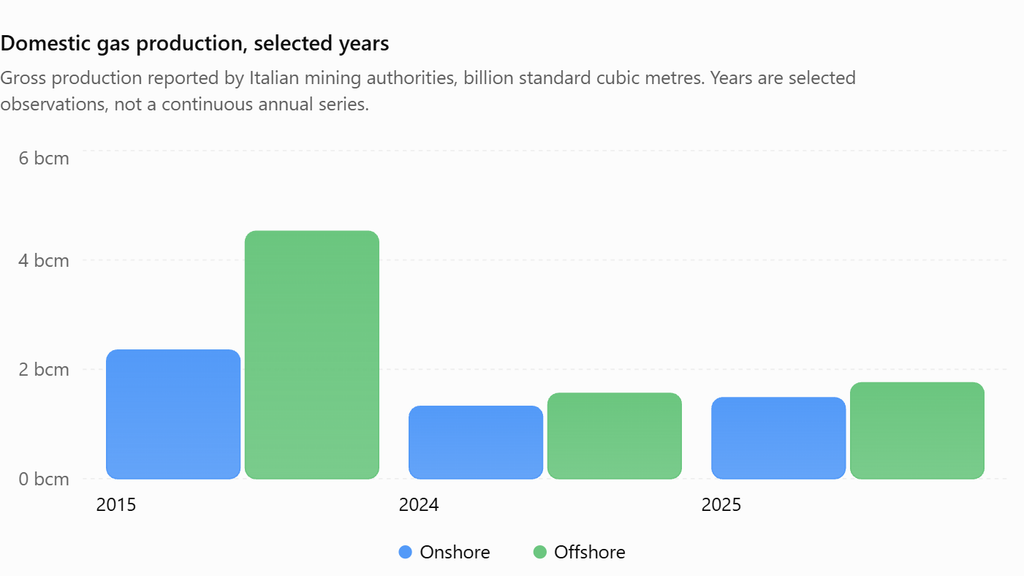
Sources: MASE–UNMIG production reports for 2015 and 2025; UNMIG DataBook 2025 for 2024. Values rounded to three decimal places. The 2015–2025 production reduction is approximately 3.644 bcm annually, with offshore production contributing approximately 2.773 bcm of the decline. unmig.mase.gov.it+2
Competing Explanations and Strategic Pathways
The available evidence supports three competing but partially overlapping explanations for Italy’s persistent domestic-production deficit. Their relative contributions cannot be assigned numerical probabilities without concession-level production, investment and permitting data.
| Hypothesis | Diagnostic support | Disconfirming evidence or limitation | Indicators | Current standing |
|---|---|---|---|---|
| H1 — Geological maturity dominates | Decade-long offshore decline; depletion of mature reservoirs; falling output from established producing areas | Remaining proved reserves and successful incremental development elsewhere demonstrate that depletion does not eliminate investment opportunities | Field decline rates, well productivity, recovery factors, redevelopment economics | Material explanation; high confidence |
| H2 — Regulatory constraints suppress recoverable output | Licensing restrictions, policy discontinuity, permitting complexity and PiTESAI annulment | Some production decline predates the principal restrictions; no comprehensive counterfactual investment series establishes their net effect | Permit duration, suspended applications, sanctioned developments, uncommitted reserves | Material contributing mechanism; medium confidence |
| H3 — Commercial and decarbonisation expectations discourage upstream investment | Long development lead times, uncertain long-term gas demand, international capital allocation and competition from imported supply | Continued Croatian offshore investment and Italy’s documented reserves indicate that certain projects can remain commercially attractive | Project hurdle rates, operator capital expenditure, gas-demand projections, new field approvals | Material explanation; medium confidence |
These explanations reinforce one another. Geological maturity increases the importance of incremental investment; uncertain permitting raises the commercial threshold for such investment; and expectations of declining demand shorten the period in which future extraction can recover its capital costs. The resulting investment environment may discourage development even when resources remain technically recoverable.
The competing explanations also establish why the distinction between proved reserves, economically sanctioned production and speculative resource potential is indispensable. The existence of reserves demonstrates geological and commercial opportunity under the conditions used for their classification. It does not establish that those reserves can be converted into immediate production at a stable cost, or that their development would necessarily reduce consumer prices.
Principal Evidence Gaps and Watch Indicators
| Strategic question | Critical evidence gap | Record or observation required | Decision significance |
|---|---|---|---|
| How much additional gas could Italy produce by 2030? | No verified national project-by-project incremental development schedule | Operator development plans, UNMIG concession records, approved investment programmes | Determines feasible import displacement |
| Does domestic gas possess a systematic cost advantage? | Insufficient comparable field-level extraction and delivered-import cost data | Audited project economics, tariff schedules, gas procurement information | Determines economic benefit rather than merely physical availability |
| Are Italian resources being depleted through Croatian extraction? | Reservoir connectivity, cross-boundary volumes and relevant commercial arrangements are not established | Geological maps, pressure data, field boundaries, agreements and production allocations | Determines whether cross-border resource claims support legal or commercial action |
| What portion of production decline is attributable to regulation? | No complete counterfactual investment record | Licensing chronology, suspended projects, company investment decisions | Distinguishes policy opportunity cost from geological depletion |
| How much LNG capacity is economically justified through 2035? | Future utilisation and contract commitments remain uncertain | Terminal bookings, capacity contracts, import forecasts, revised energy plans | Measures stranded-asset and security-of-supply risks |
| Can increased domestic extraction remain compatible with climate objectives? | Project-level methane intensity and displacement effects require verification | Measured emissions, lifecycle assessments, methane monitoring and demand scenarios | Determines climate and environmental consistency |
Indicators requiring priority monitoring
The most consequential indicators are domestic production by field and offshore zone; proved-reserve revisions; the number and value of sanctioned upstream projects; the time between licence application and final approval; LNG terminal utilisation and contractual commitments; the differential between Italian wholesale gas prices and delivered import costs; and the rate at which electricity generation, industrial processes and heating reduce their gas requirements.
The regulatory position requires parallel monitoring of new legislation, implementing measures, permitting decisions and judicial outcomes, with particular attention to whether administrative procedures establish predictable conditions for both existing-field redevelopment and new exploration.
For the Adriatic, monitoring should concentrate on officially reported Croatian offshore production, new field commissioning, concession geography, infrastructure connections and any bilateral arrangements relating to cross-border reservoir management. A documented increase in Croatian extraction, without evidence of reservoir continuity across the maritime boundary, would not independently establish an Italian resource loss.
The central question for the 2030–2035 scenarios is whether domestic production can increase sufficiently, and early enough, to replace imported gas that Italy would otherwise consume, while generating net economic and security benefits after capital costs, environmental obligations and demand-transition risks are included.
The opening record establishes the scale of import dependence and the existence of remaining reserves with high confidence. The net present value of foregone domestic output, the achievable cost differential against imported LNG, and any alleged cross-border extraction of Italian resources remain unresolved pending project-level evidence. Those uncertainties will determine the defensibility of the final strategic net assessment.
ITALY’S NATURAL-GAS PARADOX
Domestic resources, import dependence, Adriatic production and strategic policy choices through 2035.
Snam annual national demand
Gross production · MASE–UNMIG
National reserves · December 2024
Calculated from official gross production
DOMESTIC PRODUCTION · 3D VIEW
bcmSelected official observations. Click a column to inspect the onshore and offshore split.
Gross extraction, not network injection. The chart compares three selected years, not a complete annual series.
2025 NATIONAL NETWORK SUPPLY
Snam transmission-network injections by entry category. The values are not final consumption shares.
Diversified routes improve resilience but do not eliminate international supply and price exposure.
Entry total: 64.08 bcm. Ratios calculated from Snam network categories; storage movements and exports affect reconciliation with demand.
DOMESTIC GAS RESERVE STRUCTURE
National proved, probable and possible reserve classes at 31 December 2024. The categories indicate different confidence levels.
bcm. Tower heights are proportional to reported volumes. Reserve classes must not be interpreted as immediately available production.
The offshore share is approximately 36.1% of national proved reserves; not all offshore resources are necessarily located in the Adriatic.
ADRIATIC RESOURCE GEOPOLITICS
Existing production and investment on opposing Adriatic coasts must be distinguished from evidence of shared reservoirs.
855 million m³ · €71 million
Operator-reported estimated reserves and planned investment, not verified realised production or a demonstrated Italian resource loss.
SUPPLY SECURITY AND ECONOMIC EXPOSURE MATRIX
QUALITATIVE ASSESSMENT| Supply source | 2025 network volume | Cost / price exposure | Security considerations | Development constraints |
|---|---|---|---|---|
| Imported pipeline gas | 40.41 bcm | Contract and hub-market exposure; no verified common delivered-cost figure | Transit, supplier and interconnection exposure | Cross-border infrastructure and procurement arrangements |
| Imported LNG | 20.48 bcm | Global cargo prices, shipping, terminal and regasification costs | Maritime routes, cargo competition and terminal availability | Capacity contracts, terminal operations and future utilisation |
| Domestic gas | 3.19 bcm | Field-specific development, operations and abandonment costs | Less foreign procurement exposure; domestic depletion and operating risks | Geology, permits, environmental review and investment economics |
Source categories are measured network entries. Cost and security columns describe mechanisms, not audited comparative €/MWh values or ranked risk scores.
THREE STRATEGIC PATHWAYS · 2030–2035
Select a pathway to examine its likely mechanisms and constraints. No numerical production or savings forecast is asserted without a verified project model.
Continued domestic stagnation
Domestic production remains constrained by depletion and limited new investment. Imports continue to dominate supply, although LNG volumes depend on demand and competing pipeline deliveries.
Limited direct domestic substitution.
Continuing global price exposure.
Depends on gas-demand reduction and emissions performance.
EXPLANATIONS FOR PRODUCTION DECLINE
Ageing reservoirs and decline in established fields are material factors, but do not exclude incremental recovery.
Restrictions, administrative uncertainty and permitting costs may prevent otherwise viable investments.
Capital allocation, future gas demand and development lead times affect upstream investment decisions.
STRATEGIC MONITORING INDICATORS
PRIMARY OFFICIAL AND OPERATOR SOURCES
- MISE / UNMIG — Italian Hydrocarbon Production, 2015
- MASE / UNMIG — Italian Hydrocarbon Production, 2025
- MASE — National Hydrocarbon Reserves
- Snam — Annual Financial Report 2025, pp. 121–122
- MASE — PiTESAI Regulatory Record
- Italian Ministry of the Interior — Referendum, 17 April 2016
- INA — Annual Report 2025, pp. 32–34
Figures refer to the stated reporting periods, not live telemetry. Company project estimates remain attributed to their reporting operator.
PILLAR I — RESOURCE ENDOWMENT, SUPPLY STRUCTURE AND HISTORICAL CONSTRAINTS
OPEN-SOURCE ANALYTICAL ASSESSMENT | 3 November 2026
Chapter 1. Italy’s Natural-Gas Balance, 2015–2026
The structural transformation of Italian gas supply
Italy’s natural-gas balance reflects a fundamental transformation in the relationship between national resource production, energy demand and international supply networks. The country retains an established upstream industry, commercially recognised reserves, producing fields across several geological basins and extensive transmission, treatment and storage infrastructure, yet the contribution of indigenous production to national consumption has diminished substantially over the past decade. This transformation cannot be explained exclusively by the exhaustion of domestic resources or by government restrictions on exploration and production, because the production record reflects the combined influence of reservoir maturity, investment decisions, technological development, licensing policy, environmental obligations and the changing economics of European gas markets. Nevertheless, the resulting dependence on imported gas is sufficiently large to make the future treatment of domestic reserves a material question for energy security, industrial competitiveness and national economic policy.
The official production series maintained by Italy’s Ministry of Environment and Energy Security (MASE), through the National Mining Office for Hydrocarbons and Georesources (UNMIG), records 6.877 billion standard cubic metres of natural-gas production in 2015, including approximately 2.351 billion cubic metres from onshore concessions and 4.526 billion from offshore operations. By 2025, total production had fallen to 3.233 billion cubic metres, consisting of 1.480 billion onshore and 1.753 billion offshore. The corresponding reduction of approximately 3.644 billion cubic metres represents a 53.1% contraction in annual domestic production, with offshore fields accounting for approximately 76% of the absolute decline. This distribution is particularly consequential because it identifies the marine production system as the principal location of historical output losses, while also requiring an examination of different geological and regulatory conditions across the Adriatic, Ionian and Sicilian offshore areas. Sources: Italian Hydrocarbon Production, 2015 — Ministry of Economic Development / UNMIG and Italian Hydrocarbon Production, 2025 — MASE / UNMIG, updated 27 April 2026.
The relevance of this contraction becomes clearer when placed against the national demand balance rather than treated as an isolated upstream statistic. Snam’s annual financial reporting records Italian natural-gas demand of 61.73 billion cubic metres in 2023, 62.20 billion in 2024 and 63.42 billion in 2025, indicating that consumption increased modestly after the immediate adjustment to the European energy crisis. The 2025 increase of 1.22 billion cubic metres, or approximately 2.0%, was principally associated with greater thermoelectric demand, which rose by 1.08 billion cubic metres to 26.79 billion cubic metres. Residential and tertiary demand remained approximately stable at 23.58 billion cubic metres, while the industrial category reported by Snam amounted to 11.19 billion cubic metres and the residual category to 1.86 billion. The significance is that Italy’s dependence on gas remains embedded in electricity generation, industrial activity and building energy requirements, despite broader European decarbonisation efforts. Consequently, gas-system resilience cannot be evaluated exclusively through annual import volumes; it must also account for seasonal and operational demand, power-system flexibility, electricity imports, hydrological conditions and the speed at which alternative technologies displace gas consumption. Source: Snam Annual Financial Report 2025 — Gas Demand in Italy, p. 121.
The composition of imported supply and the transformation of entry corridors
Italy’s import architecture is supported by a geographically diversified network of international pipeline interconnections and LNG regasification terminals, but the distribution of physical entry volumes continues to demonstrate the country’s dependence on external production and transportation systems. In 2025, according to Snam’s transportation-network balance, foreign pipeline interconnections accounted for 40.41 billion cubic metres and LNG terminals supplied 20.48 billion cubic metres, while national production injected into the network contributed approximately 3.19 billion cubic metres. These figures total 64.08 billion cubic metres of network injections. They should not be confused with final national demand, because storage injections and withdrawals, exports, transit movements, system consumption and other accounting adjustments prevent a direct equivalence between the two totals.
The pipeline network’s detailed configuration illustrates both the strengths and the limitations of Italian diversification. Mazara del Vallo, associated with the TransMed corridor from Algeria, recorded 20.09 billion cubic metres of entries in 2025, while Melendugno, the Italian landing point of the Trans Adriatic Pipeline, recorded 10.00 billion cubic metres. Passo Gries contributed 8.59 billion cubic metres through the northern European interconnection system, whereas Gela recorded 0.96 billion cubic metres and Tarvisio 0.77 billion cubic metres. These entry points should be understood as physical delivery locations rather than universally reliable measures of ultimate geological origin, particularly where gas enters through interconnected European markets. Nevertheless, their relative volumes demonstrate the continuing importance of North African production, the Southern Gas Corridor and northern European trading infrastructure, alongside the marked decline in direct Russian-route deliveries through Tarvisio. Source: Snam Annual Financial Report 2025 — National Transmission Network Gas Balance, pp. 122–123.
The LNG system underwent an equally important change. In 2025, Cavarzere injected 8.46 billion cubic metres, Piombino 4.23 billion, Livorno 4.21 billion, Panigaglia 1.86 billion and Ravenna 1.72 billion. The aggregate LNG contribution increased by 39.7% compared with 2024, reflecting both the recovery of Livorno from its earlier maintenance-related disruption and the operation of the Ravenna floating regasification facility from May 2025. The significance of these developments is not limited to the additional import volumes: they indicate a structural enhancement of Italy’s capability to acquire maritime gas cargoes from international suppliers, while creating a new configuration of commercial commitments, terminal operating requirements, transport dependencies and potential future underutilisation risks should European gas demand decline. The economic merit of that infrastructure must therefore be assessed over its operating life rather than inferred from the emergency conditions that initially justified its expansion. Source: Snam Annual Financial Report 2025 — LNG Entry Points and Infrastructure Utilisation, pp. 122–123.
Producing basins and geographical concentration of domestic output
Italian production is distributed across geographically and geologically distinct systems. The Po Valley and its adjoining Adriatic offshore provinces constitute a mature gas-producing region with a long history of exploration, drilling and infrastructure development, whereas southern Italy, including Basilicata, provides a significant contribution through established onshore hydrocarbon operations. Sicily and the surrounding offshore zones constitute another important production area, including newer offshore developments whose contribution can materially alter the national production balance even while older fields decline. The regional structure of production therefore matters for more than geographical description: it determines the availability of processing facilities, the feasibility of connecting incremental wells, the operating costs of ageing assets, and the extent to which new investments can benefit from infrastructure already constructed and maintained.
The 2025 UNMIG production statistics indicate that Basilicata generated approximately 0.984 billion cubic metres of natural gas, Emilia-Romagna approximately 0.271 billion, Sicily 0.133 billion, and Molise approximately 0.030 billion cubic metres, with the remaining onshore volumes distributed among other regions. Offshore production was concentrated in designated marine zones, including approximately 0.528 billion cubic metres in Zone A, 0.309 billion in Zone B, 0.258 billion in Zone D and 0.655 billion in Zone G, with a much smaller contribution from Zone C. These designations are regulatory and geographical reporting categories rather than direct substitutes for named geological basins or individual fields. Their significance lies in permitting more accurate comparison between reserve locations, production performance and licensing conditions, while avoiding the assumption that all offshore reserves or production opportunities are located in the northern Adriatic. Source: National Hydrocarbon Production by Region and Offshore Zone, 2025 — MASE / UNMIG.
One qualification to the broader decline narrative is particularly important. Domestic production increased between 2024 and 2025, and Snam attributes the increase in gas injected into the national transmission network partly to the full-year contribution of the Argo and Cassiopea fields, whose development demonstrates that new production can still influence the national balance when investment, engineering execution and regulatory authorisation converge. This observation does not reverse the structural decline over the preceding decade, but it demonstrates that Italy’s production system is not characterised solely by geological exhaustion or irreversible closure. Where new developments are commercially justified and completed, measurable additions to domestic supply remain possible. Source: Snam Annual Financial Report 2025 — National Production and New Field Contributions, p. 123.
The latest official 2026 production reporting must be handled with additional chronological discipline. The ministry’s production portal identifies an update published on 27 October 2026 with data through 31 August 2026. Its text-accessible report returns approximately 1.841 billion cubic metres of cumulative natural-gas production for January–August 2026, including approximately 1.008 billion onshore and 0.834 billion offshore. However, a separately rendered version of the same public PDF displayed an earlier March 2026 data vintage. The August figures are therefore identified as the latest text-accessible values but are not treated here as a fully reconciled final 2026 production observation. In particular, annualising eight months of output into a definitive forecast would be inappropriate because field maintenance, commissioning schedules, reservoir performance and changes in monthly production can affect the year-end total. Source: Italian Hydrocarbon Production, 2026 — MASE / UNMIG, published update 27 October 2026.
The meaning of import dependence for national energy policy
The economic interpretation of the Italian gas balance requires a distinction between physical import dependence, exposure to foreign price formation and the actual cost of supply. Domestic production can reduce the need to procure an equivalent volume abroad, but it does not automatically isolate Italian consumers from international market prices, because domestic gas is generally sold within the same integrated market environment and can therefore reflect prevailing wholesale values. Consequently, the principal direct advantages of additional national production are the potential avoidance of foreign procurement expenditure, the retention of certain investment, employment and fiscal effects within the country, and reduced reliance on particular external supply chains. The amount of any net benefit depends on whether incremental domestic production can be delivered economically and whether it substitutes imports that would otherwise have been purchased, rather than adding supply during a period of declining demand.
A further qualification concerns the evolution of demand and storage. The Italian system must maintain adequate flexibility to manage winter consumption, electricity generation requirements and unexpected disruptions, but annual domestic production is not necessarily as flexible as storage withdrawals or LNG cargo scheduling. Certain gas fields may operate best under relatively stable extraction profiles, while LNG and pipeline contracts may provide flexibility subject to commercial terms and available infrastructure. The value of domestic production must therefore be assessed as one component of a wider portfolio rather than as a complete replacement for imports, storage or international interconnections. The resulting strategic question is how much domestic extraction can be supported at acceptable cost and risk while preserving the flexibility required during the transition toward a lower-gas energy system.
Chapter 1 — Key judgment: Italy’s dependence on imported gas is an established structural characteristic of its energy system, not merely a consequence of temporary market disruption. The historical decline in domestic production is similarly established, but its causes cannot be assigned exclusively to regulation without a project-specific counterfactual. The available evidence supports a distinction between declining mature-field output, commercially viable new developments and the separate contribution of import infrastructure to physical supply resilience.
Chapter 2. Domestic Gas Reserves, Adriatic Resources and Production Economics
Recoverable reserves and the limits of aggregate resource estimates
The assessment of Italy’s remaining natural-gas potential must begin with a strict distinction between geological resources, technically recoverable quantities, commercial reserves and production volumes that can realistically be delivered within a defined investment horizon. These categories are frequently combined in political and commercial discussions, creating exaggerated assumptions about either Italy’s capacity to become self-sufficient or the economic losses associated with undeveloped fields. A geological accumulation may contain substantial quantities of hydrocarbons while remaining commercially unattractive because of reservoir pressure, water production, formation characteristics, drilling difficulty, infrastructure requirements or environmental and licensing obligations. Equally, a mature field may contain smaller remaining volumes that are commercially attractive precisely because its wells, processing facilities, pipelines and market connections have already been developed. Resource volume is therefore only the starting point for identifying economic opportunity.
The official reserve classification published by MASE provides a comparatively rigorous basis for evaluating this distinction. At 31 December 2024, Italy reported 42.502 billion standard cubic metres of proved natural-gas reserves, alongside 22.925 billion cubic metres classified as probable reserves and 13.262 billion as possible reserves. Under the definitions published by UNMIG, proved reserves correspond to volumes expected to be commercially recoverable with a probability greater than 90% under the technical, contractual, economic and operating conditions considered in the assessment, while probable reserves involve a lower confidence threshold and possible reserves are associated with substantially greater uncertainty. These distinctions are important because the three classes cannot be added and presented as an equally certain supply inventory, and because any change in economic assumptions, investment commitments or field performance may alter the classification of remaining resources. Source: National Hydrocarbon Reserves — MASE / UNMIG, Reserve Classification and 2024 Assessment.
The geographical distribution of those reserves challenges the widespread assumption that Italy’s remaining gas opportunity is overwhelmingly offshore or concentrated exclusively in the Adriatic. Onshore proved reserves totalled 27.155 billion cubic metres, equivalent to 63.9% of the national proved inventory, while offshore proved reserves amounted to 15.347 billion, or 36.1%. Southern Italy accounted for approximately 23.996 billion cubic metres of onshore proved reserves, substantially exceeding the 1.656 billion recorded in northern Italy, the 407 million in central Italy and the 1.095 billion in Sicily. Offshore proved reserves were distributed between 4.098 billion cubic metres in Zone A, 2.764 billion in Zone B and 8.485 billion across Zones C, D, F and G. The geographical concentration of proved onshore reserves in southern Italy is therefore an indispensable element of any national upstream strategy, even where Adriatic development remains a major component of the policy debate. Source: National Hydrocarbon Reserves by Geographic Area and Marine Zone, 31 December 2024 — MASE / UNMIG.
The resource inventory also illustrates the importance of reserve reassessment. UNMIG reported proved gas reserves of 41.807 billion cubic metres at the end of 2023, which would have declined to 38.925 billion after deducting 2024 production of 2.882 billion cubic metres if no other changes had occurred. Instead, the reassessed inventory at the end of 2024 amounted to 42.502 billion cubic metres, representing an increase of approximately 3.577 billion relative to the production-adjusted opening stock. This does not establish that the entire increase resulted from new geological discoveries. Reserve revisions may reflect updated reservoir models, changing commercial assumptions, development plans or other technical and economic considerations. It does, however, demonstrate why treating reserves as a fixed geological quantity that declines mechanically with annual production would misrepresent the official resource account. Source: UNMIG DataBook 2025 — Reserve Reassessment for 2024, p. 40.
Geographical reserve distribution and development relevance
| Resource area | Proved reserves, bcm | Probable, bcm | Possible, bcm | Economic and strategic interpretation |
|---|---|---|---|---|
| Northern Italy, onshore | 1.656 | 1.446 | 0 | Mature basin economics, existing infrastructure, environmental and subsidence considerations |
| Central Italy, onshore | 0.407 | 0.196 | 0.039 | Limited aggregate inventory; project-specific viability |
| Southern Italy, onshore | 23.996 | 13.223 | 11.697 | Principal concentration of national proved gas reserves |
| Sicily, onshore | 1.095 | 0.349 | 0.214 | Existing production system and regional development opportunities |
| Offshore Zone A | 4.098 | 2.735 | 0.605 | Mature northern Adriatic assets, infrastructure and environmental constraints |
| Offshore Zone B | 2.764 | 1.037 | 0.015 | Relevant Adriatic and southern marine production opportunities |
| Offshore Zones C, D, F and G | 8.485 | 3.939 | 0.692 | Multiple marine areas; development characteristics cannot be treated as homogeneous |
| National total | 42.502 | 22.925 | 13.262 | Distinct reserve-confidence categories, not a guaranteed production forecast |
Source: National Hydrocarbon Reserves, 2024 — Ministry of Environment and Energy Security.
Existing-field optimisation and near-field development
The most immediate economic distinction within Italy’s domestic resource portfolio is between incremental production from existing assets and investment in entirely new offshore exploration programmes. Existing-field optimisation may involve drilling additional development wells, recompleting existing wells, modifying production equipment, improving reservoir management, reducing operational interruptions and connecting nearby accumulations to established infrastructure. These activities can have materially different capital requirements and completion schedules from frontier exploration, because significant portions of the gathering, transportation and treatment system may already exist. Nevertheless, proximity to infrastructure is not sufficient evidence of economic viability: residual reservoir pressure, gas composition, water production, mechanical integrity, pipeline condition and remaining abandonment obligations can all determine whether incremental volumes generate acceptable returns.
The alternative category of new-field development introduces different risks. A discovery may require appraisal drilling, environmental studies, engineering design, production facilities, subsea connections and the negotiation or confirmation of transportation arrangements before commercial production can commence. Offshore development also requires careful assessment of reservoir compartmentalisation, drilling risk, pressure decline and the relationship between field size and capital expenditure. These considerations are particularly important in a mature province where smaller accumulations can become commercially difficult to develop as individual projects but potentially attractive when clustered around existing infrastructure. Accordingly, a rational development assessment would distinguish between producing-field interventions, previously discovered but undeveloped accumulations, near-field exploration and new geological acreage rather than applying a single national assumption to all reserves.
The Argo–Cassiopea contribution provides an observed example of additional Italian supply entering the national balance, but it cannot be used to assign a universal recovery rate or economic return to other discoveries. Its relevance lies in showing that upstream developments can still make a measurable contribution to gas availability under current operating conditions, subject to each project’s commercial and regulatory characteristics. By contrast, a general claim that Italy could rapidly recover all offshore proved reserves through modern technology would require a level of field-specific engineering evidence that aggregate ministry statistics do not provide. Source: Snam Annual Financial Report 2025 — Domestic Production and Argo–Cassiopea Contribution.
Extraction economics versus imported pipeline gas and LNG
The proposition that domestically produced gas can be cheaper than imported LNG is economically plausible for certain established fields, but it cannot be treated as a universal conclusion without differentiating the accounting basis of the comparison. The relevant economic cost of additional production from an operating field may be its incremental expenditure on wells, maintenance, processing, transportation and environmental compliance, together with the appropriate allocation of future investment and abandonment obligations. A new offshore discovery, however, must also recover exploration and appraisal expenditure, production infrastructure, financing costs and the possibility that recoverable volumes prove insufficient to justify development. Consequently, two domestic fields producing gas at the same market price may have radically different development economics, and the historical expenditure already incurred on existing infrastructure must be distinguished from future costs relevant to an investment decision.
Imported LNG presents a different cost structure. Its delivered economic cost may comprise acquisition of the gas, liquefaction where not already incorporated in the purchase price, maritime transportation, insurance, regasification services, terminal charges, downstream transportation and any applicable contractual obligations. The actual price paid by an Italian buyer depends on contract structure, delivery terms, timing and market conditions, including whether procurement is linked to a European hub, a global LNG index or another contractual pricing formula. Pipeline gas similarly depends on purchase conditions, transportation tariffs, capacity reservations, transit arrangements and commercial flexibility. Thus, the correct comparison is not between the physical cost of extracting one cubic metre of Italian gas and the observed market price of an imported cargo alone, but between the full incremental cost of delivering usable gas into the Italian network from each available source, including the value of different delivery profiles and contractual risks.
For comparability, the analysis must also reconcile measurement units. Snam expresses standard gas volumes using a conventional higher heating value of 38.1 megajoules per standard cubic metre, equivalent to approximately 10.583 kilowatt-hours. On that convention, one billion standard cubic metres corresponds to approximately 10.583 terawatt-hours of energy, so a hypothetical difference of €5 per megawatt-hour across one billion cubic metres would correspond to about €52.9 million in gross energy-cost difference. This is an arithmetical sensitivity, not an observed domestic production saving. It excludes the possibility that imported and domestic volumes have different delivery schedules, gas qualities, taxes, transportation requirements or capital costs. Source for the gas-energy accounting convention: Snam Annual Financial Report 2025 — National Gas Balance and Measurement Basis.
A rigorous comparison must additionally distinguish private project profitability from the wider public economic interest. Domestic production can generate concession-related fiscal revenue, economic activity in engineering and services, employment and potentially lower net expenditure on imported energy. Yet part of the gas produced domestically may still be priced against international wholesale markets, while fiscal receipts, operator earnings and consumer expenditure accrue to different economic actors. A government may therefore identify an import-substitution benefit without being able to guarantee an equivalent reduction in retail energy prices. Conversely, import infrastructure that appears more expensive in normal market conditions may provide insurance value during a supply disruption, especially where it permits access to suppliers unavailable through existing pipelines. The economically relevant policy comparison requires both expected expenditure and the distribution of risks across the state, consumers, infrastructure operators and upstream investors.
Environmental performance and the development decision
An assessment of domestic extraction that omits environmental externalities would be incomplete, but it would be equally incomplete to assume that imported gas necessarily possesses a lower lifecycle environmental footprint. Methane emissions can arise during production, gathering, processing, liquefaction, shipping, regasification and distribution, and the relative significance of these stages differs by production field, operating practices and transportation route. Domestic pipeline-connected production may avoid some processes associated with LNG, particularly liquefaction and maritime transportation, but this does not establish a lower lifecycle emissions intensity in every case. Ageing assets, operational leakage, offshore methane releases and field-specific gas characteristics may alter the result, requiring measurement rather than general assumptions.
The European Union’s methane regulatory framework provides an increasingly important basis for evaluating this dimension. Regulation (EU) 2024/1787 establishes obligations relating to methane-emissions measurement, reporting, verification and mitigation within the energy sector, while extending the regulatory framework toward imported fossil energy through phased measures. The practical implication for Italy is that comparisons between domestic gas and imported gas should progressively incorporate measured methane performance alongside cost, supply security and permitting compliance. This does not eliminate the longer-term requirement to reduce fossil-fuel use under European climate policy, but it makes the environmental comparison more specific and potentially more accountable. Source: Regulation (EU) 2024/1787 on the Reduction of Methane Emissions in the Energy Sector — European Parliament and Council, June 2024.
The central commercial question through 2035 is therefore whether additional domestic production can be developed and delivered before the combined effects of demand reduction, decarbonisation obligations and reservoir decline diminish its economic value. A field with relatively low incremental investment, existing transportation capacity and predictable permitting may be economically different from an exploration prospect requiring substantial infrastructure and a long capital-recovery period. Both may contain technically recoverable gas, but only the former may offer meaningful short-term import substitution. This distinction must govern any comparison between selective redevelopment of known resources and broader exploration programmes, because the two investment classes have different uncertainties, timelines and implications for future fossil-gas infrastructure utilisation.
Chapter 2 — Key judgment: Italy’s remaining gas reserve inventory is substantial relative to its present domestic production, but much smaller than annual national consumption and unevenly distributed across onshore and offshore areas. The official data establish the existence and location of commercially classified reserves with high confidence; they do not establish a nationally applicable extraction-cost advantage or a verified volume of incremental production deliverable by 2030. A credible upstream investment strategy requires concession-level economics, production scheduling, infrastructure assessment and measured environmental performance.
Chapter 3. The 2016 Referendum and Italy’s Regulatory Architecture
The constitutional scope of the offshore referendum
The referendum held on 17 April 2016 occupies an important position in Italy’s energy-policy history, but its legal scope must be reconstructed precisely before assessing its subsequent economic or political consequences. The consultation was an abrogative referendum under Article 75 of the Italian Constitution concerning a specific provision of Legislative Decree No. 152 of 3 April 2006, as subsequently amended by the 2016 Stability Law. The provision addressed the duration of certain existing offshore hydrocarbon concessions within twelve nautical miles of the coastline, permitting their continuation for the useful life of the reservoir, subject to applicable safety and environmental standards. The referendum sought to remove the language that allowed those operations to continue on that basis. It was therefore not a general national vote on whether Italy should continue to consume natural gas, import fossil fuels, maintain its upstream industry or develop new LNG infrastructure.
The distinction is legally material because the referendum concerned a particular category of offshore authorisations and their duration, rather than the entire Italian hydrocarbon licensing system. An affirmative outcome, had it obtained the constitutionally required quorum, would have affected the legal basis for continuing specified operations beyond their relevant concession terms. It would not automatically have prohibited all other domestic gas production, nor would it have established an explicit national preference for importing rather than producing natural gas. The referendum’s political significance may legitimately be examined in relation to public attitudes toward offshore development, but its text cannot be expanded beyond the specific legislative language submitted to voters. Source: Referendum of 17 April 2016: Electoral Register, Voting and Turnout — Italian Ministry of the Interior.
The final turnout was 31.18% of eligible voters, below the participation threshold required for an abrogative referendum to take legal effect. Although affirmative votes constituted a substantial majority of valid votes cast, the result did not produce the requested legislative repeal. This outcome permits a narrow, defensible conclusion: among those casting valid votes, support for repeal was strong, but participation was insufficient to establish the referendum’s validity, and the aggregate electoral result cannot be interpreted as a conclusive preference of the entire electorate either for or against offshore hydrocarbon development. Abstention can arise from multiple motivations, including indifference, disagreement with the proposal, political mobilisation strategies or practical barriers to voting, none of which can be reliably inferred from turnout statistics alone. Source: Italian Ministry of the Interior — Official Referendum Participation Record, 17 April 2016.
The economic significance of the referendum must consequently be separated from its direct legal effect. The consultation failed to repeal the provision under consideration, but the campaign occurred within a wider environment in which the regulatory treatment of offshore exploration, coastal environmental protection and the duration of hydrocarbon concessions had already become contested. Investors considering long-lived upstream assets would reasonably evaluate the possibility of future restrictions, administrative delays or changing political priorities, even if a particular referendum did not itself modify the law. However, a durable investment deterrent cannot be established solely by observing lower subsequent production, because that same decline may reflect reservoir maturity, operating costs and changing European capital-allocation preferences. Demonstrating a referendum-specific chilling effect would require documentary evidence that particular investments were delayed, cancelled or repriced because of the referendum or the political developments associated with it.
The evolution of licensing restrictions and administrative planning
Italy’s upstream regulatory framework developed through several distinct instruments whose legal effects should not be combined into a single account of prohibition. Legislative Decree No. 152/2006 provides a central foundation for environmental protection, impact assessment and relevant offshore restrictions, while subsequent legislation altered the conditions governing hydrocarbon exploration and production. Environmental impact assessment, concession authority, technical safety and marine protection operate through overlapping but legally distinct procedures. A development may consequently possess a valid hydrocarbon title without having completed every environmental or operational authorisation necessary to begin production, just as an environmental approval does not automatically establish the project’s commercial feasibility or guarantee its implementation. Source: Legislative Decree No. 152 of 3 April 2006 — Italian Environmental Code, Official Normattiva Repository.
An important subsequent development was the introduction of the Piano per la transizione energetica sostenibile delle aree idonee, commonly referred to as PiTESAI, intended to identify areas considered suitable or unsuitable for hydrocarbon exploration, research and production in the context of environmental protection and energy transition. The plan was approved through a ministerial decree dated 28 December 2021 and was supported by geographical assessments, environmental documentation and associated planning material. Its intended function was broader than an individual licensing decision because it sought to establish a territorial framework affecting the treatment of current and future activities. This approach introduced an additional planning dimension into an already complex regulatory environment, with potential consequences for the geographic eligibility of development proposals and the predictability of investment decisions. Source: PiTESAI — Ministry of Environment and Energy Security, Official Planning and Environmental Documentation.
The subsequent judicial history is particularly relevant. The ministry’s official PiTESAI record states that judgments published beginning in February 2024 by the Lazio Regional Administrative Court annulled the plan. This development is not equivalent to a judicial declaration that all environmental restrictions on hydrocarbon activity were invalid, nor does it automatically confer permission to explore or extract gas wherever the annulled plan had restricted activity. It does, however, demonstrate that a major regulatory planning instrument was subject to successful administrative litigation, creating a need to distinguish the rules validly applicable to individual concessions from the planning approach that had been annulled. For investors, the significance lies not merely in the outcome of the litigation but in the sequence of planning approval, implementation, challenge and annulment, because development decisions can depend on the stability of the legal framework over several years. Source: PiTESAI — MASE Official Record of Approval and Administrative Annulment.
Permitting delays, environmental obligations and the cost of uncertainty
The economic effects of regulatory complexity emerge through several mechanisms, not all of which are visible in annual production statistics. An upstream operator must determine whether a prospective investment is legally eligible, environmentally acceptable, technically feasible and commercially attractive before committing the capital required for development. Uncertainty at one stage may delay subsequent expenditure, even where the physical field is already known and nearby infrastructure exists. A licensing suspension may defer appraisal drilling; unresolved environmental conditions may prevent final investment approval; and the possibility of administrative litigation may influence financing arrangements, contractual commitments or project scheduling. In each case, the economic consequence is potentially greater than the immediate administrative cost, because delayed production shifts anticipated revenue into later periods while leaving some financing and infrastructure obligations unchanged.
The resulting cost should nevertheless be evaluated as a contingent opportunity cost rather than presumed equivalent to the market value of all undeveloped reserves. A project that was never commercially viable under prevailing market conditions cannot automatically be counted as production lost because of regulation. Likewise, a project that receives all necessary authorisations but is not developed because its expected returns are inadequate cannot be treated as proof that licensing restrictions prevented gas extraction. The correct analytical procedure would identify each material project, establish its geological and commercial status, reconstruct its permitting chronology and compare the observed development outcome with a counterfactual in which the regulatory uncertainty or delay was absent. Only then can the economic effect of specific policy decisions be distinguished from the broader decline in European hydrocarbon investment.
Environmental and technical safeguards must also be treated as economically relevant components of the regulatory architecture rather than as extraneous political obstacles. Offshore production carries potential risks involving spills, uncontrolled releases, subsea infrastructure failure, marine ecological impacts and operational incidents, while some Italian producing areas require particular attention to subsidence and geomechanical conditions. Effective environmental assessment and independent technical oversight can reduce expected environmental damage and associated public liabilities, although an inefficient or unpredictable procedure can impose additional costs without necessarily improving safety outcomes. The policy-relevant distinction is therefore between the substantive environmental standard that a project must meet and the efficiency, consistency and transparency of the administrative process used to demonstrate compliance. This is especially relevant to existing-field redevelopment, where much of the physical infrastructure is already in place but additional drilling or modifications may require new technical and environmental examination.
Offshore extraction, LNG infrastructure and policy consistency
The coexistence of upstream restrictions and expanded LNG import infrastructure raises a legitimate question of policy consistency, but it does not establish a contradiction by itself. Domestic extraction and LNG imports involve different physical systems, environmental effects, capital structures and development schedules. LNG facilities can provide access to multiple foreign sources and improve supply resilience during periods of disruption, while domestic production may offer import substitution and direct national resource benefits. A government can therefore rationally support LNG diversification and maintain restrictions on particular offshore developments if those restrictions arise from specific environmental, geological or climate-related considerations. Conversely, the existence of domestic reserves creates a legitimate obligation to examine whether those restrictions impose economic and security costs that exceed the benefits they provide, especially where alternative developments could satisfy the same environmental standards.
The inconsistency would become economically demonstrable if projects capable of supplying domestic gas at a lower properly measured total social cost were prevented or indefinitely delayed by regulatory conditions that could not be justified by corresponding environmental, safety or climate benefits, while the country simultaneously committed resources to more expensive imported supply. Establishing this proposition requires a common analytical framework covering delivered cost, lifecycle emissions, supply reliability, project maturity, infrastructure utilisation, public revenue and environmental exposure. It would also require distinguishing short-term emergency measures from long-term infrastructure commitments, because an LNG terminal commissioned to address immediate supply risk may remain useful even if future domestic gas production subsequently increases.
The European climate framework adds a further constraint. A policy designed to increase domestic gas extraction must be evaluated against anticipated reductions in fossil-gas demand, not simply against today’s import balance. If gas consumption declines sufficiently, additional domestic production could displace imports without requiring an increase in total fossil-gas use; but if upstream investment creates commercial incentives to prolong consumption beyond the assumptions of climate policy, the apparent benefit to national supply security may be accompanied by transition risks. Conversely, avoiding domestic extraction while continuing to consume similar quantities of imported gas does not itself eliminate the emissions associated with that consumption. The appropriate comparison therefore concerns the full gas supply chain, the evolution of demand, the distribution of investment risks and the actual emissions associated with each alternative.
The institutional consequences of legal discontinuity
The referendum and the PiTESAI litigation reveal a broader institutional problem: the relationship between national resource policy, environmental assessment, territorial governance and the investment schedules required for gas development. Hydrocarbon projects ordinarily extend across multiple administrative and commercial periods, while regulatory frameworks can change within a shorter horizon. This asymmetry can increase uncertainty even when no permanent prohibition exists, because an operator may be unable to determine whether a development approved under one set of planning assumptions will remain eligible through the construction and production phases. The resulting effect on investment is plausible and economically significant, but its magnitude must be demonstrated through the administrative record rather than inferred from political controversy alone.
Improving regulatory predictability would not necessarily require reducing environmental protection or eliminating judicial review. More consistent definitions of eligible activities, transparent environmental criteria, fixed procedural stages where legally appropriate, clear treatment of existing concessions and accessible records of administrative decisions could permit regulators, operators and affected communities to evaluate proposals against the same requirements. Such changes would also improve the state’s capacity to determine whether undeveloped reserves reflect genuinely unacceptable environmental risks, inadequate commercial returns or avoidable administrative uncertainty. The distinction matters for public accountability because each condition implies a different policy consequence.
Chapter 3 — Key judgment: The 2016 referendum did not impose a general prohibition on domestic offshore gas production, while the subsequent history of PiTESAI demonstrates that Italy’s regulatory framework experienced significant legal discontinuity. Regulatory uncertainty is a credible contributor to upstream investment risk, but the extent of its historical effect on production remains less certain than the underlying decline in output. The defensible policy objective is a coherent, legally durable framework capable of evaluating development opportunities against transparent economic, environmental and energy-security criteria.
WordPress HTML Scheme — Pillar I: Resource Geography, Economic Sensitivity and Regulatory History
The following component is designed specifically for insertion after Chapter 3. It extends the earlier dashboard rather than repeating it, with interactive geographical reserve analysis, 3D-style proportional columns, a production-cost sensitivity calculator, a regulatory timeline and three-language switching. Quantitative sensitivity results are explicitly distinguished from observed market costs.
ITALIAN GAS: RESOURCE AND POLICY INTELLIGENCE
Interactive geographical reserve analysis, economic sensitivities and institutional chronology. Official resource data: 31 December 2024. Analytical cut-off: 3 November 2026.
GEOGRAPHICAL RESERVE INTELLIGENCE
Compare proved, probable and possible reserves by reporting area. Select a column for a detailed record.
Figures in billion standard cubic metres. Offshore zones follow Italian administrative classifications. This is a proportional 3D-style chart, not a geographical map.
IMPORT-SUBSTITUTION SENSITIVITY
Illustrative calculation using a selected displaced import volume and an assumed difference in delivered cost. This is not a measured saving or a gas-price forecast.
REGULATORY EVOLUTION · INSTITUTIONAL TIMELINE
The legal significance of each milestone differs. Referendum outcomes, statutory amendments, planning acts and judicial decisions must not be treated as equivalent.
Legislative Decree 152/2006 establishes central environmental rules relevant to offshore activities.
Turnout 31.18%; quorum not reached. The question concerned the duration of specified concessions.
The government approves the planning framework for areas suitable for hydrocarbon activities.
Judgments published from February annul the PiTESAI plan. Individual concession status requires separate examination.
RESOURCE DEVELOPMENT DECISION MATRIX
This matrix identifies the evidence required before a resource category can support an investment or policy decision. It does not rank projects without verified economics.
| Development class | Technical evidence | Economic evidence | Regulatory requirement | Main uncertainty |
|---|---|---|---|---|
| Existing producing fields | Pressure, deliverability, decline curves | Incremental operating and well costs | Modification and operating permissions | Residual recovery and ageing equipment |
| Near-field developments | Appraisal, reservoir connectivity, tie-back design | Connection investment and project returns | Development approval and environmental review | Commercial flow rates and commissioning time |
| Undeveloped discoveries | Appraised recoverable volumes and reservoir model | Full development capital and financing | Field development and infrastructure approvals | Execution costs and future gas demand |
| New exploration acreage | Geological prospects and exploration risk | Risked discovery economics and capital commitment | Licensing eligibility and environmental assessment | Discovery, timing and asset-stranding risk |
PILLAR II — ADRIATIC GEOPOLITICS, ENERGY SECURITY AND ECONOMIC EXPOSURE
Chapter 4. Cross-Border Adriatic Production: Italy, Croatia and Greece
Maritime jurisdiction and the economic significance of subsurface boundaries
The decisive legal distinction in the Adriatic is between hydrocarbons extracted within an established national jurisdiction and hydrocarbons demonstrably contained in a reservoir extending across the boundary between two jurisdictions. The first is an ordinary exercise of coastal-state resource rights; the second may raise questions concerning reservoir management, drainage effects, allocation of production and bilateral cooperation, but it cannot be established merely by observing that gas platforms operate on opposite sides of the same sea. The Italian–Croatian case is particularly sensitive to this distinction because the Adriatic is a relatively narrow and geologically interconnected marine basin, contains mature offshore gas provinces and is governed by a progressively developed framework of maritime delimitation agreements. Its geological continuity, however, does not mean that every reservoir possesses hydraulic continuity across the international boundary.
The legal framework is more complete than much of the public debate suggests. Italy and the former Yugoslavia concluded an agreement delimiting their continental shelves in 1968, followed by the Treaty of Osimo in 1975, which addressed territorial delimitation in the northern Adriatic. The continental-shelf boundary was technically clarified in 2005, while Italy and Croatia signed an agreement delimiting their exclusive economic zones on 24 May 2022, which entered into force in April 2024. The Croatian Ministry of Foreign and European Affairs confirmed on 7 January 2026 that Italy’s declaration of its Adriatic exclusive economic zone had entered into force on 3 January 2026, completing an important stage in the bilateral maritime-jurisdiction framework. This chronology matters because sovereign rights over continental-shelf resources existed independently of the later exclusive-economic-zone declarations; the 2026 development did not suddenly create Italy’s right to regulate exploitation of hydrocarbons beneath its continental shelf. Sources: Croatia–Italy Agreement on Exclusive Economic Zone Demarcation — Government of Croatia, May 2022, Croatian Ministry of Foreign Affairs — Parliamentary Ratification and Maritime Delimitation, March 2024, and Croatia Welcomes the Establishment of Italy’s Exclusive Economic Zone — Croatian Ministry of Foreign and European Affairs, January 2026.
The continental-shelf distinction has direct consequences for the assessment of alleged transboundary extraction. A maritime delimitation line establishes the geographical division of sovereign rights over the seabed and its subsoil, but it does not itself determine how an individual gas accumulation behaves when production causes pressure changes across a geological structure. Resolving that question requires identification of the reservoir’s lateral extent, fault configuration, permeability, pressure communication and economically recoverable volumes on either side of the boundary. An accumulation crossing a boundary may also contain separate geological compartments that do not communicate sufficiently for production on one side to drain the other. Conversely, a connected reservoir can exhibit pressure interference even when the production well is positioned entirely within one jurisdiction. The economic and legal assessment therefore depends on reservoir-specific evidence rather than the proximity of platforms or the shared geological history of the Adriatic basin.
For governments, the relevant investigative distinction is between a possible shared geological structure, a confirmed transboundary reservoir, demonstrated pressure interference and an established entitlement to production or compensation. These are four progressively more demanding propositions. Each requires different evidence and potentially different legal treatment, while the commercial implications may depend on concession terms, contractual arrangements and any applicable bilateral mechanisms. A claim that Italy is paying Croatia for gas extracted from beneath Italian territory would require documentation linking the physical origin of the molecules to the relevant reservoir and then establishing the commercial transaction through which the gas reaches Italy. Neither geographical proximity nor the existence of a pipeline connection satisfies that evidentiary standard.
Croatian northern Adriatic production and the industrial significance of incremental development
Croatia’s offshore industry demonstrates that mature Adriatic gas provinces can continue to attract investment in redevelopment, additional drilling and the connection of smaller accumulations to existing production infrastructure. This is an important observation because the economics of mature offshore regions differ from those of frontier exploration. Existing platforms, subsea pipelines, treatment facilities and geological information can reduce the infrastructure requirements of incremental projects, although the commercial advantage depends on remaining reservoir productivity and the condition of the assets. Croatian operations are consequently relevant not because they prove that equivalent investments would automatically succeed in Italy, but because they provide actual development cases against which claims concerning the technical and commercial limitations of mature Adriatic production can be examined.
INA’s 2025 annual reporting documents the development of the IKA A-1 R DIR well, drilled from an existing offshore platform in the northern Adriatic. Testing began in December 2025, with output reaching approximately 120,000 cubic metres of natural gas per day, while the operator estimated that the intervention would develop approximately 220 million cubic metres of gas reserves. The reported well was brought onstream under a trial-production permit on 5 December 2025, while work also continued on the IKA A-4 R development well. These are material observations because they associate an actual drilling intervention with a reported operating result, an identified reserve increment and the use of established offshore facilities, rather than relying on a general claim that substantial resources remain recoverable somewhere in the Adriatic. Source: INA Annual Report 2025 — Exploration and Production, pp. 33–37.
The Irena project offers a second, commercially distinct example. Within the Izabela concession area, INA and Energean approved a development investment of approximately €71 million, comprising €50 million from Energean and €21 million from INA, corresponding to working interests of 70% and 30% respectively. The project was designed to connect a single platform to existing Izabela infrastructure, with operator-reported reserves estimated at approximately 855 million cubic metres and maximum expected production of up to 300,000 cubic metres per day. Production was scheduled to begin in the first half of 2027. The investment therefore illustrates the development of an identified gas accumulation using existing offshore infrastructure, although the reported capital expenditure should not be divided mechanically by total reserves and presented as a complete lifecycle extraction cost, because such a calculation would omit operating expenditure, financing, production timing, fiscal terms, abandonment obligations and uncertainty surrounding actual recovery. Source: INA Annual Report 2025 — North Adriatic Offshore Development and Irena Project, pp. 38–39.
The Croatian evidence also reveals an industrial relationship that complicates simplistic descriptions of competition between entirely separate national upstream sectors. INA’s reporting identifies Energean Italy SpA as its partner in the Irena investment and records technical cooperation involving Eni in extending the operating life of the Marica–Barbara T2 pipeline connection. In other words, the operational relationship between the Italian and Croatian offshore industries includes joint investment structures, cross-border infrastructure links and shared engineering capabilities, even though the underlying concessions remain subject to their respective jurisdictions. The existence of these links should not be mistaken for evidence that all gas transported through them becomes an Italian import purchase, or that every participating Italian company produces under Italian jurisdiction. Corporate nationality, operating jurisdiction, concession ownership, pipeline ownership and the ultimate purchaser of gas are separate questions. Source: INA Annual Report 2025 — Croatian Offshore Infrastructure and Joint-Venture Operations, pp. 37–39.
Croatian offshore projects: documented operational comparison
| Croatian offshore asset or development | Documented technical or commercial evidence | Reported scale | Project status in 2025 reporting | Implication for Italy |
|---|---|---|---|---|
| IKA A-1 R DIR | Development well from existing platform; initial production test | 120,000 m³/day; 220 million m³ estimated developed reserves | Trial production began December 2025 | Demonstrates additional well productivity in a mature Adriatic setting |
| IKA A-4 R | Additional drilling and completion work | No independently verified commercial production volume in the reviewed record | Development operations continuing | Evidence of continued investment, not yet of realised incremental supply |
| Irena, Izabela concession | Platform tie-back, approved investment and operator reserve estimate | €71 million; 855 million m³ estimated reserves | Investment approved; production targeted for H1 2027 | Demonstrates a sanctioned near-infrastructure project |
| Marica–Barbara T2 connection | Extension of operating life of cross-border offshore pipeline infrastructure | No independently verified 2025 delivered-gas volume in the reviewed passage | Infrastructure life-extension work undertaken | Establishes cross-border infrastructure cooperation, not resource ownership |
| IKA offshore development programme | Well re-entry, testing, existing-platform utilisation | Multiple interventions | Operational programme active in 2025 | Relevant benchmark for field-level redevelopment economics |
Source: INA Annual Report 2025 — Exploration and Production Operations.
The distinction between the 120,000 cubic metres per day observed during IKA testing and the 300,000 cubic metres per day projected for Irena is important. The former is an operator-reported production-test result; the latter is an anticipated maximum operating rate for a future development. Neither should be converted directly into annual production without assumptions concerning operating days, reservoir decline, maintenance and actual production profiles. At the Irena maximum design rate, a purely arithmetic annualisation would produce approximately 109.5 million cubic metres, but that calculation would not constitute a verified production forecast. Similarly, the project’s 855 million cubic metres of estimated reserves cannot be interpreted as an immediately deliverable volume or as evidence of an Italian entitlement to the accumulation.
The documented existence of Italian–Croatian offshore infrastructure makes the question of commercial gas flows legitimate, but not automatically answerable from annual production and investment reports. A pipeline connecting facilities across a maritime boundary may perform several functions, including gathering, transport to treatment infrastructure, delivery into a national market or operational integration of offshore installations. Establishing the commercial destination of gas requires additional information concerning metering points, custody-transfer arrangements, transportation contracts, ownership changes and final sales. A pipeline’s direction of physical flow also does not necessarily establish the nationality of the contractual purchaser or the jurisdiction of the reservoir from which the gas originated.
The specific allegation that Croatian operators extract Italian hydrocarbons and subsequently sell them back to Italy at international market prices therefore remains unproven by the verified material. The more defensible observation is that Croatia has documented active offshore development, including projects undertaken with companies operating across the Italian–Croatian industrial system, while public annual-report information does not supply the integrated reservoir and commercial records necessary to quantify any Italian resource loss. That does not establish that no transboundary geological structures exist; it establishes the limits of what can be concluded from the accessible evidence. A conclusive assessment would require concession-coordinate data, reservoir interpretation, production allocation, pressure measurements, applicable operating agreements and commercially relevant sales information.
A bilateral technical process could address these questions through joint review of seismic interpretation, field boundaries, well-pressure measurements and reservoir-management documentation, subject to existing confidentiality, commercial and regulatory obligations. Where physical connectivity were established, the next question would concern whether existing legal and contractual arrangements already address the accumulation or whether further coordination would be required. The economic analysis would then need to identify the recoverable volumes attributable to each jurisdiction, the opportunity cost of alternative development schedules and the respective investment obligations of the relevant concession holders. None of these conclusions can be determined solely from the aggregate offshore production figures of the two countries.
Greece and the strategic difference between exploration licensing and commercial production
Greece constitutes a useful comparison of licensing strategy rather than a direct analogue of northern Adriatic resource development. On 16 February 2026, HELLENiQ ENERGY announced the signing of exploration and production lease agreements with Chevron covering four offshore blocks: South Crete 1, South Crete 2, South of Peloponnese and Block A2. The consortium assigned Chevron a 70% operating interest and HELLENiQ ENERGY a 30% interest, while the combined acreage was reported at approximately 47,000 square kilometres. The agreements followed an international licensing process initiated in 2025 and contemplated a three-phase exploration programme, including areas with water depths exceeding 1,500 metres. At the time of the announcement, the agreements were subject to parliamentary ratification. Source: HELLENiQ ENERGY — Signing of Offshore Concession Agreements, February 2026 and Chevron — Four Offshore Exploration Leases in Greece, February 2026.
The Greek licensing authority, HEREMA, identifies an active upstream concession portfolio involving international and domestic operators, including ExxonMobil, Chevron, HELLENiQ ENERGY and Energean. This illustrates a continuing willingness to offer exploration opportunities under a formal regulatory process, but it does not establish that the new acreage contains commercially recoverable gas, that future production will be competitive with imports or that development can be completed before European gas demand declines materially. Exploration rights create an option to investigate resources, not a proven reserve inventory or a guaranteed stream of future supply. Source: HEREMA — Hydrocarbon Exploration and Production Concession Portfolio.
The geographical differences are equally important. Greek deepwater acreage south of Crete and the Peloponnese involves geological settings and potential infrastructure requirements substantially different from many mature shallow-water Adriatic fields. The relevant comparison is therefore institutional: the design of licensing rounds, investor participation, contractual allocation of exploration risk and the regulatory treatment of new acreage. Croatia offers stronger operational evidence for the economics of incremental production within an established Adriatic gas province, whereas Greece offers evidence of a different approach to attracting exploration capital under conditions of considerable geological uncertainty.
Key judgments and unresolved records
High confidence: Italy and Croatia operate within an established maritime delimitation framework, and Croatian offshore operators have documented additional investment, drilling and production activity in the northern Adriatic. The bilateral legal framework was further clarified by the entry into force of their exclusive-economic-zone delimitation agreement in April 2024 and Italy’s Adriatic exclusive-economic-zone declaration in January 2026.
Medium confidence: Existing offshore infrastructure and mature-field expertise provide economically relevant opportunities for additional production, as demonstrated by Croatian development activity; however, equivalent opportunities in Italian concessions require independent field-level evaluation.
Low confidence: Publicly available evidence is insufficient to determine the volume, if any, of Italian-jurisdiction gas being drained through Croatian wells, the economic value of such drainage or the prices at which those specific molecules might subsequently reach Italian purchasers.
The principal official records capable of materially changing this assessment are concession-coordinate maps, certified reservoir-continuity studies, bilateral technical or unitisation arrangements where applicable, and documented commercial flows from identified offshore fields.
Chapter 5. Import Dependence, Price Formation and Macroeconomic Transmission
Import dependence as a balance-of-payments and industrial-cost transmission mechanism
Italy’s reliance on foreign natural gas must be assessed through the interaction of external procurement expenditure, domestic price formation, industrial competitiveness, household purchasing power and the resilience of the national electricity system. The physical share of imported gas is an important starting point, but it is not itself a complete measure of national vulnerability, because the macroeconomic impact depends on international prices, contract structures, exchange rates, the timing of deliveries and the capacity to substitute different suppliers or fuels. A diversified system can reduce exposure to the interruption of an individual route while remaining highly exposed to a general increase in international gas prices. Conversely, additional domestic production may reduce the value of imported volumes without necessarily reducing domestic wholesale prices by an equivalent amount, particularly where the marginal price continues to be established by an integrated European market.
The relationship between gas prices and the external balance is particularly significant for an economy that imports most of the fuel consumed by its industrial and thermoelectric sectors. A sustained rise in the price of imported gas increases the foreign-currency or euro-denominated expenditure required to maintain a given physical volume of supply, while potentially raising production costs for energy-intensive industries and reducing the purchasing power of households. The resulting adjustment may occur through lower corporate margins, higher output prices, reduced industrial production, changes in electricity generation, demand destruction or public expenditure designed to protect vulnerable consumers. These channels have different timing and distributional consequences, but they share a common economic mechanism: a deterioration in the terms on which the country acquires an essential intermediate input can reduce national real income even when the physical supply system continues operating without interruption.
The exposure can be illustrated transparently using Italy’s measured 2025 import-entry volume of 60.89 billion standard cubic metres, equivalent to approximately 644.5 terawatt-hours under the 38.1 megajoule-per-standard-cubic-metre conversion convention used in the preceding analysis. An illustrative increase of €10 per megawatt-hour applied uniformly to that volume would imply an approximately €6.45 billion increase in gross annual procurement expenditure, before considering contractual hedging, demand responses, exchange-rate effects, storage timing and supplier-specific price arrangements. The calculation demonstrates the order of magnitude of price sensitivity but must not be interpreted as an observed increase in Italy’s import bill, because the actual effect depends on the extent to which contracts reprice, the volume purchased at the new price and the distinction between import customs values and network entries. The underlying entry volumes are published in Snam Annual Report 2025 — Natural-Gas Transmission Balance, pp. 122–123.
The sensitivity is economically asymmetric in important respects. A price increase can immediately affect short-term procurement and collateral requirements, whereas the industrial response may take longer and can involve reduced production, changes in product prices or permanent investment decisions. Conversely, a fall in international gas prices may reduce procurement costs while simultaneously weakening the economic case for new domestic upstream investment, particularly where a project requires substantial capital expenditure and a long period of production to achieve acceptable returns. Energy-security policy must therefore distinguish the insurance value of domestic supply during high-price episodes from its expected profitability across a range of normal and adverse market conditions.
LNG price formation and the limitations of comparing supply sources
LNG import costs are determined by a sequence of physical and contractual activities that differ from those associated with pipeline gas. The gas must be acquired from a producer or portfolio supplier, liquefied, transported by specialist vessels, delivered to a compatible terminal, regasified and injected into the transmission network. Depending on contractual terms, some of those activities may already be incorporated in the agreed purchase price, while others remain the responsibility of the importing company. Long-term contracts can provide predictable access to volumes and reduce particular procurement risks, but they may also contain destination, price-indexation, flexibility and volume provisions that influence the economic value of supply over time. Spot cargoes provide a different form of flexibility but expose buyers to prevailing international competition, shipping availability and terminal scheduling.
The relevant economic issue is that physical availability and economic affordability are separate characteristics of LNG diversification. Additional terminal capacity can reduce exposure to the interruption of a pipeline supplier and allow cargoes to be acquired from alternative markets, but it cannot guarantee that those cargoes will be available at moderate prices during a global shortage. Where several importing regions compete for flexible LNG volumes, an increase in European demand can affect international market prices even if European terminal capacity is abundant. Infrastructure capacity therefore improves the ability to receive supply, while procurement contracts, market liquidity and competing demand determine whether the supply can be secured at acceptable cost.
A further distinction concerns terminal utilisation. The existence of nominal annual regasification capacity does not mean that an equivalent volume of gas will be imported, because throughput depends on commercially scheduled deliveries, upstream availability, maintenance, weather conditions and domestic demand. An underutilised terminal can still possess strategic value as insurance against disruptions, but the economic assessment must then explicitly value that insurance function rather than treating unused capacity as an ordinary productive asset. Similarly, long-term capacity reservations may support financing and security of supply while creating contractual obligations that persist if future demand falls. The correct evaluation therefore compares the cost of maintaining optional import capacity against the expected cost of supply interruptions and the availability of alternative infrastructure.
Snam’s 2025 report provides a useful distinction between physical entry volumes and contracted capacity. At Melendugno, average booked transportation capacity amounted to approximately 26.4 million cubic metres per day against available transportation capacity of 28.1 million cubic metres per day, corresponding to a reported capacity-allocation saturation of 94.0%. At Cavarzere, the equivalent figures were 26.7 million and 26.7 million cubic metres per day, giving 100% booked capacity saturation. These percentages represent allocated capacity rather than actual annual throughput, and they must not be used as proxies for terminal loading rates or the probability of physical supply interruption. Source: Snam Annual Report 2025 — Transportation Capacity and Allocation, p. 125.
Quantitative sensitivity of Italy’s imported-gas exposure
Illustrative gross import-expenditure sensitivity using 60.89 bcm of foreign network entries in 2025 and an energy-equivalence coefficient of approximately 10.583 TWh per bcm. The price changes are assumptions, not observed historical prices or forecasts.
| Assumed average price change | Gross expenditure effect, annual | Effect if only 50% of volume reprices | Interpretation |
|---|---|---|---|
| −€20/MWh | −€12.89 billion | −€6.45 billion | Lower gross procurement expenditure under the stated assumption |
| −€10/MWh | −€6.45 billion | −€3.22 billion | Reduction in international supply costs |
| +€5/MWh | +€3.22 billion | +€1.61 billion | Moderate adverse procurement-price sensitivity |
| +€10/MWh | +€6.45 billion | +€3.22 billion | Significant additional annual import expenditure |
| +€20/MWh | +€12.89 billion | +€6.45 billion | Severe price exposure under constant-volume assumptions |
| +€40/MWh | +€25.78 billion | +€12.89 billion | Extreme stress illustration, without demand adjustment |
The figures are calculated from the 2025 foreign-entry volume in Snam Annual Report 2025 — Network Injections. The calculation holds physical import volumes constant and applies a uniform hypothetical price change; it is therefore a sensitivity of gross procurement value, not a prediction of GDP losses, inflation, fiscal expenditure or consumer bills. The 50% column illustrates partial repricing of the volume and does not claim that half of Italy’s contracts actually possess such a pricing arrangement.
The distributional consequences require an additional layer of analysis. Industrial consumers exposed to wholesale gas prices may experience cost increases that are immediate or delayed depending on hedging, procurement contracts and the energy intensity of production. Producers of fertilisers, chemicals, ceramics, glass, steel and other energy-intensive products can face a double constraint when gas prices rise: direct increases in process-energy costs and indirect increases in electricity or intermediate-input prices. For internationally traded products, the ability to pass these costs to customers may be limited by foreign competitors operating under different energy-price conditions. Sustained price differences can consequently influence investment location, capacity utilisation and the longer-term composition of industrial activity, although individual sectoral effects require verified data on energy expenditure, production and export performance.
Households face different transmission mechanisms. Gas expenditure for residential heating depends on tariff structures, wholesale procurement, distribution charges, taxation, weather conditions, household characteristics and consumption volumes. A wholesale price increase may eventually raise household expenditure, but the magnitude and timing depend on retail contracts and applicable public measures. The fiscal consequences are similarly differentiated: governments may receive additional tax revenue from some energy-related transactions or domestic production while simultaneously facing expenditure pressures from social support, industrial assistance or public-service energy costs. The net impact on public finances is therefore not equivalent to the increase in import expenditure, and a defensible estimate would require explicit treatment of taxes, subsidies, regulated tariffs, corporate profits and behavioural responses.
Storage, seasonal resilience and the difference between annual availability and operational security
Italy’s import dependence is partly mitigated by storage infrastructure, pipeline interconnections and the ability to adjust international procurement. Storage is especially relevant because winter consumption can exceed contemporaneous deliveries from domestic production and international supply contracts, making previously injected gas essential to maintaining system flexibility. The European Commission describes underground gas storage as a principal instrument for managing demand peaks and supply interruptions, reporting that storage typically supplies approximately 25–30% of gas consumed in the European Union during winter. This is an EU-level observation, not a measured Italian winter-storage contribution, and it should not be applied mechanically to Italy without national withdrawal and demand data. Source: European Commission — Gas Storage and Security of Supply.
The regulatory framework also illustrates the institutional value attached to strategic flexibility. Regulation (EU) 2025/1733 extended and modified the European framework governing storage obligations, reflecting the continuing importance of maintaining adequate inventories while introducing flexibility intended to reduce the market distortions that may arise from rigid refill requirements. The underlying economic problem is that mandatory storage targets improve physical preparedness but can also concentrate purchasing demand within particular periods, potentially affecting wholesale prices and commercial incentives. Effective policy must therefore balance minimum security requirements against the cost of filling storage and the flexibility of procurement schedules. Source: European Commission — Gas Storage Rules and Regulation (EU) 2025/1733.
Storage also changes the interpretation of domestic production. A cubic metre produced within Italy may contribute to annual import substitution, but its value during a winter emergency depends on whether the producing field can maintain or increase output at the required time. Underground storage can deliver large volumes over relatively short periods, although withdrawal performance depends on inventory levels, reservoir characteristics and operating constraints. LNG terminals may provide additional supply flexibility, but only where vessels and cargoes can be secured and the infrastructure remains available. Domestic production, LNG and storage should therefore be treated as complementary components whose combined reliability is more important than their individual annual shares.
Italy’s major import corridors expose the energy system to different categories of disruption. Pipeline supply can be affected by upstream production problems, transit restrictions, political disputes, physical damage, maintenance or constraints at cross-border interconnections. LNG supply can be affected by liquefaction outages, maritime disruption, insurance costs, vessel availability, port conditions and global competition for cargoes. Domestic production faces reservoir depletion, mechanical failures, environmental incidents and infrastructure ageing. The vulnerabilities differ in origin and propagation, making geographic and technological diversification valuable even where no individual supply source is entirely free from risk.
The systemic challenge arises when multiple exposures become correlated. A geopolitical crisis affecting an important maritime corridor can increase transportation costs or reduce cargo availability while simultaneously influencing international energy prices. A severe European winter can raise regional demand and storage withdrawal requirements, increasing competition for flexible LNG volumes. A major infrastructure failure may reduce physical deliverability at a time when wholesale prices are already elevated, while additional reliance on a small number of import corridors can amplify the consequences of an interruption. Strategic resilience therefore requires analysis of simultaneous disruptions, rather than treating every pipeline or LNG terminal as an independent source of perfectly substitutable capacity.
The European Union’s response to Russian gas dependence further illustrates the distinction between removing one concentration risk and eliminating external supply vulnerability. The European Commission reported that Russian gas represented approximately 12% of EU gas imports in 2025, down from 45% at the beginning of the war in Ukraine, and confirmed the adoption of Regulation (EU) 2026/261 establishing a gradual phase-out of Russian pipeline gas and LNG imports. This represents a major change in the European supplier structure, but it necessarily increases the importance of alternative sources, cross-border capacity and the international LNG market. The strategic consequences must therefore be evaluated in terms of both reduced exposure to a particular supplier and the costs and constraints associated with replacement supply. Source: European Commission — REPowerEU and the Phase-Out of Russian Energy Imports, 2026.
Key judgments and implications for industrial and national-security planning
High confidence: Italy’s gas-import exposure creates a material channel through which international price changes affect gross procurement expenditure, industrial production costs and household energy affordability. The exact macroeconomic effect is smaller or larger than a simple gross-cost calculation depending on contractual pricing, demand adjustment, storage movements, taxes and income distribution.
High confidence: LNG capacity, international pipelines and underground storage contribute differently to physical resilience. Greater regasification capacity cannot alone guarantee affordable supply, while additional domestic production cannot substitute for the flexibility provided by storage and diversified imports.
Medium confidence: A higher domestic share could improve the external balance and reduce certain supply-chain exposures if it economically displaces imported volumes, but the magnitude of the benefit requires project-specific extraction costs, fiscal treatment and wholesale-market analysis.
The principal monitoring requirements are delivered import costs by contractual category, supplier concentration, storage injection and withdrawal performance, forward gas prices, industrial consumption and production trends, household retail expenditure, and the utilisation of import infrastructure during normal and stressed conditions.
Chapter 6. Policy Coherence, Institutional Incentives and European Comparisons
The institutional distinction between security of supply and domestic resource development
The apparent contradiction between restricting national hydrocarbon activity and expanding LNG import infrastructure becomes more intelligible when the different institutional objectives, regulatory authorities and commercial incentives are examined separately. Energy-security institutions are primarily concerned with ensuring sufficient supply under foreseeable disruption scenarios, while upstream regulators and environmental authorities must assess geological activities, project safety, ecological consequences and compliance with national and European legislation. Transmission and regasification operators invest in infrastructure according to regulated or contractual revenue frameworks, whereas exploration and production companies allocate capital according to expected recoverable reserves, development risk and commercial returns. These functions overlap within the national energy system but do not necessarily produce identical investment decisions, especially when the cost of failing to provide adequate gas during an emergency is immediate and politically consequential while the potential benefit of additional domestic extraction may materialise only after several years.
The analytical problem is therefore one of coordination rather than an assumed uniform institutional preference for imported gas. A national ministry can simultaneously support LNG infrastructure for short-term supply resilience, impose environmental conditions on domestic extraction and pursue long-term decarbonisation, provided the resulting policies are evaluated against consistent demand, cost and risk assumptions. Inconsistency arises when different measures depend on incompatible underlying projections, when their cumulative effects are not assessed or when the investment environment makes it impossible to identify which activities remain legally and commercially viable. The relevant question is not whether energy security and environmental protection should coexist, but whether the instruments selected to pursue them have been assessed for their combined effects on national supply costs, emissions, investment certainty and future infrastructure utilisation.
Italy’s regulatory structure illustrates the importance of institutional responsibilities. The Ministry of Environment and Energy Security has central functions concerning energy policy, hydrocarbon activity and environmental regulation, while competent technical and administrative offices manage information relevant to exploration and production. ARERA regulates important components of electricity, gas, water and related network markets, including tariff and market arrangements, whereas infrastructure operators such as Snam implement investments and operate assets within applicable regulatory and commercial conditions. Regional and local authorities participate in processes relevant to territorial and environmental interests according to their legal competences, while the administrative courts provide judicial review of public decisions. Environmental organisations, industrial consumers, trade associations and upstream operators participate in the broader policy environment through their respective interests and legal rights, but their different positions cannot be converted into evidence of a coordinated institutional preference for import dependence without documentary support.
The economic incentives of infrastructure investment require particular attention. Transmission and regasification facilities are capital-intensive assets whose commercial viability depends on capacity use, remuneration, contracts and the treatment of long-term risks. Investments that increase the capacity to import gas can be valuable under a security-of-supply framework even when expected annual utilisation is below maximum technical capacity. However, their financing and regulatory treatment may distribute costs among infrastructure users, consumers and investors differently from upstream extraction projects, where operators face geological uncertainty, development risk and the possibility that production will not recover the committed capital. Comparing these investment classes requires explicit consideration of who bears each risk and who receives each benefit; the fact that one category progresses more rapidly than another does not, by itself, demonstrate preferential treatment or an economically inefficient outcome.
France: import dependence moderated by a different electricity system
France provides an important comparison because its natural-gas supply structure is overwhelmingly import-dependent while its broader energy system differs substantially from Italy’s. Official French statistics for 2025 recorded approximately 518 terawatt-hours of natural-gas imports, of which LNG accounted for 64%, while gas exports reached approximately 183 terawatt-hours. The principal reported import origins were Norway at 36%, the United States at 31%, Russia at 17% and Algeria at 7%. These figures demonstrate that France plays a significant role in European gas trading and LNG regasification, rather than serving exclusively as the final consumer of every imported volume. Its gas infrastructure supports domestic demand as well as cross-border movements, making gross imports an inappropriate substitute for final national consumption. Source: Chiffres clés de l’énergie, édition 2026 — Gaz naturel, French Statistical Service for Energy and Sustainable Development.
France’s remaining commercial fossil-gas production is exceptionally limited. Its official statistical publication identifies approximately 0.2 terawatt-hours of mine gas production in 2025, while biomethane injection reached approximately 14 terawatt-hours. At the same time, French gas consumption, corrected for climatic variation, amounted to approximately 376 terawatt-hours in 2025, representing a decline of approximately 27% from 2019. This demonstrates that the French approach to reducing gas-related exposure involves demand reduction, alternative energy sources, gas-network adaptation and import diversification rather than a substantial expansion of conventional domestic gas production. The relevance to Italy is structural: countries with similar exposure to imported fossil gas can possess very different electricity-generation portfolios and therefore different economic incentives to preserve or reduce gas demand. Source: French Energy Statistics 2026 — Natural Gas Production, Imports, Biomethane and Consumption.
France’s larger nuclear electricity-generation system also influences the relationship between gas prices and the cost of electricity, although the country remains exposed to European wholesale electricity-market conditions and the availability of its generating fleet. The French example therefore does not establish that extensive domestic gas extraction is unnecessary for Italy; rather, it demonstrates the importance of evaluating import dependence within the overall energy system. A country with greater non-gas electricity generation may reduce the frequency with which gas-fired generation determines its physical electricity supply requirements, while a country with greater gas-fired generation may require different arrangements for flexibility, fuel procurement and system resilience. The relevant comparison is between the alternatives available to each country and the costs of developing them, not between import percentages in isolation.
Germany: diversification, domestic production decline and substantial cross-border trade
Germany’s experience provides a particularly relevant comparison of mature domestic production, infrastructure reconfiguration and reliance on a wider European gas network. The Federal Network Agency reported 864 terawatt-hours of German gas consumption in 2025, approximately 2.2% above the preceding year but 13.5% below the average for 2018–2021. Domestic production amounted to 34 terawatt-hours, compared with 36 terawatt-hours in 2024, indicating that Germany continues to produce natural gas but does so at a scale much smaller than national demand. The agency recorded approximately 1,031 terawatt-hours of imports and 221 terawatt-hours of exports, while LNG terminals contributed 106 terawatt-hours, equivalent to 10.3% of gross imports. Source: Bundesnetzagentur — Gas Supply Figures for 2025, January 2026.
The composition of German imports also illustrates the importance of distinguishing direct supplier origin from neighbouring entry states. The Federal Network Agency attributed 44% of imports to Norway, 24% to the Netherlands and 21% to Belgium, while the country’s cross-border trade network facilitated the re-export of considerable volumes to neighbouring markets. The result is a system in which gross import requirements substantially exceed final domestic demand because Germany also functions as a transit and trading hub. Italy’s own transmission system performs some comparable functions, but the differences in network geography, LNG entry capacity, storage and industrial gas demand limit direct comparison of physical volumes.
Germany’s response to the post-2022 energy crisis included the construction and operation of additional LNG import infrastructure, demonstrating that rapid diversification was not unique to Italy. The German regulator’s reporting also confirms that domestic production continued to decline even as the country expanded access to alternative sources. This does not prove that Italy and Germany face identical upstream restrictions, but it demonstrates that declining indigenous gas output and increasing reliance on diversified imports are broader European phenomena associated with mature fields, changing commercial conditions and national energy-transition strategies. Any claim that Italian output decline is exclusively the product of domestic political decisions must therefore account for the similar direction of production in other mature European gas provinces. Source: Bundesnetzagentur — Review of German Gas Supply in 2025.
United Kingdom: domestic production, mature fields and continuing import requirements
The United Kingdom offers a different comparison because it retains an established offshore hydrocarbon production sector supported by North Sea infrastructure, specialised engineering services and a mature licensing and regulatory framework. The country’s official Energy Trends reporting recorded 332 terawatt-hours of natural-gas production in 2025, a reduction of 3.3% from 2024 and the lowest production level since the early 1970s. The same publication identified relatively stable annual gas demand, declining by approximately 0.9%, with reductions among industrial and other final consumers partly offset by higher demand for gas-fired electricity generation. These observations demonstrate that retaining an active domestic upstream industry does not prevent geological decline or eliminate the need for imports, although it provides a materially different domestic resource contribution from that observed in Italy. Source: UK Department for Energy Security and Net Zero — Energy Trends, March 2026, Section 4: Gas.
The United Kingdom’s experience is particularly instructive for the distinction between licensing decisions and deliverable production. New exploration rights or development approvals cannot reverse reservoir maturity automatically, while continued output from established fields requires investment in maintenance, recovery, well integrity and infrastructure. The fiscal and regulatory treatment of offshore production also affects investment decisions, particularly where companies must account for future decommissioning liabilities and uncertainty over long-term hydrocarbon demand. From Italy’s perspective, the British comparison supports two simultaneous conclusions: domestic production can remain a substantial component of national supply in a mature offshore province, but it should not be treated as a guaranteed solution to import dependence when field decline and the economics of remaining resources become increasingly important.
The United Kingdom’s statistical system also provides a useful benchmark for transparency. The Department for Energy Security and Net Zero publishes detailed historical series on production, imports, exports and consumption, including regularly updated data through October 2026 and long-term energy-balance records. Such information allows analysts to distinguish production decline from demand change and external trade developments without relying on political interpretations of the upstream sector. The same level of consistency is necessary in the Italian assessment, particularly when evaluating the difference between licensed reserves, actual production, network injections and commercially sanctioned developments. Source: UK Government — Energy Trends: UK Gas, updated October 2026.
European Union: security diversification, methane obligations and the transition horizon
The European Union’s current gas-policy framework combines three objectives that must be considered simultaneously: reducing dependence on specific external suppliers, maintaining physical security of supply and lowering emissions in accordance with climate legislation. The adoption of Regulation (EU) 2026/261 on the phase-out of Russian gas imports formalised a substantial geopolitical change in the Union’s procurement strategy, while revised storage arrangements preserved an important instrument for winter resilience. At the same time, Regulation (EU) 2024/1787 introduced a stronger framework for methane emissions associated with energy-sector operations, thereby affecting both domestic production and, through phased obligations, imported fossil-energy supply chains. These measures do not establish a general prohibition on natural-gas imports or production, but they alter the commercial and regulatory conditions under which gas will be supplied during the transition. Sources: European Commission — REPowerEU Regulation and Russian Gas Phase-Out, European Commission — Gas Storage Regulation, and European Commission — Methane Emissions and Regulation (EU) 2024/1787.
The combined effect of these policies is not necessarily a straightforward increase or decrease in demand for domestic European gas. Restricting purchases from a particular foreign supplier can increase the strategic value of alternative sources, including domestic production, while stronger methane requirements can increase compliance expenditure for high-emission operations and improve the relative attractiveness of lower-emission supply chains. Simultaneously, reductions in gas consumption may weaken the commercial basis for long-lived exploration and production assets. Consequently, a field that appears strategically valuable during an immediate supply-security crisis may offer a weaker investment case if its first production occurs only after a substantial reduction in national demand. Conversely, a relatively mature and low-capital-cost development capable of delivering gas rapidly could contribute to import substitution during the period in which gas remains necessary for electricity-system flexibility and industrial processes.
The Union’s framework also introduces a question of institutional coordination among member states. National upstream decisions are made within domestic legal and administrative systems, but wholesale gas markets, cross-border transportation, LNG procurement and climate obligations operate within a broader European framework. A decision by one state to restrict domestic production may therefore alter the volume of gas it purchases from neighbouring systems or international suppliers, while a decision to expand import capacity can affect infrastructure utilisation and market flexibility beyond its national territory. These spillovers do not automatically establish a common European policy failure, but they justify assessing infrastructure investment, import diversification and demand reduction through compatible assumptions rather than treating each national measure as an isolated decision.
Comparative evidence table: national supply models and institutional implications
| Jurisdiction | Documented 2025 indicator | Supply or policy structure | Principal institutional issue | Implication for Italy |
|---|---|---|---|---|
| Italy | 63.42 bcm national gas demand; 60.89 bcm foreign network entries | Pipeline corridors, five LNG entry terminals, limited domestic output | Alignment of upstream investment, imports and declining demand | Requires integrated resource and infrastructure evaluation |
| France | 518 TWh gross gas imports; LNG 64% of imports | Import and transit system, marginal conventional gas production, substantial nuclear electricity generation | Demand reduction and import-system resilience | Electricity structure changes exposure to gas |
| Germany | 864 TWh demand; 34 TWh domestic production; 106 TWh LNG imports | Mature domestic gas fields, major European interconnections and LNG infrastructure | Import diversification and infrastructure coordination | Domestic production decline is not uniquely Italian |
| United Kingdom | 332 TWh domestic production | Established mature offshore sector and continuing international trade | Declining fields, investment incentives and decommissioning liabilities | Active production cannot eliminate geological decline |
| European Union | Russian gas approximately 12% of imports in 2025 | Supplier phase-out, storage obligations and methane regulation | Compatibility of security measures with climate objectives | National investment decisions operate within shared rules |
Sources: Snam Annual Report 2025, French Energy Statistics 2026, Bundesnetzagentur Gas Supply Figures 2025, UK Energy Trends 2026, and European Commission REPowerEU. The national figures have different definitions and are deliberately not combined into a single European gas balance.
Institutional incentives and the problem of policy accountability
The policy significance of Italy’s gas structure ultimately depends on whether public authorities can distinguish justified restrictions from avoidable investment barriers, and strategic import infrastructure from projects whose long-term economic value depends on assumptions incompatible with the anticipated transition. Upstream operators have incentives to seek commercially viable reserves and predictable permitting, while infrastructure operators seek arrangements that support the construction and utilisation of their assets. Industrial consumers generally favour affordable and reliable supply, while environmental organisations may prioritise the protection of marine ecosystems, avoidance of new fossil-fuel commitments and reduced emissions. Regional authorities face territorial and environmental considerations that may differ from national security-of-supply priorities. None of these interests is inherently illegitimate, but their interaction can produce investment outcomes that differ from a centrally planned minimum-cost supply mix.
A coherent framework would make these trade-offs explicit by requiring comparable assessments of upstream developments, import commitments, storage resilience and demand-reduction measures. Such assessments would need to identify the authority responsible for each decision, the anticipated contribution to supply, the expected cost, environmental effects, implementation timelines and the conditions under which the decision should be reviewed. The essential improvement would be evidentiary transparency: regulators and policymakers should be able to demonstrate why a given project is permitted, delayed, rejected or supported, and whether its expected effects remain consistent with updated market and climate assumptions. This does not predetermine the appropriate result for any particular project, but it creates a basis for identifying genuinely conflicting policies and avoiding the substitution of political claims for economic analysis.
Key judgments and monitoring requirements
High confidence: France, Germany and the United Kingdom demonstrate distinct combinations of domestic production, import dependence, LNG infrastructure and gas-demand management. Their experience confirms that hydrocarbon resource endowment alone does not determine energy security, and that mature domestic production can continue declining under different national regulatory systems.
Medium confidence: Italy’s upstream investment environment may be affected by regulatory uncertainty in ways that are economically relevant, but the size of the resulting opportunity cost cannot be established without concession-level evidence.
High confidence: European gas policy increasingly links import diversification, storage resilience, methane-emissions performance and the phase-out of Russian supply, creating interdependent constraints on national investment decisions.
The principal indicators capable of changing these judgments are updated gas-demand projections, project-level development costs, changes in hydrocarbon licensing and permitting, actual LNG terminal utilisation, reserve revisions, the implementation of European methane obligations and the resulting evolution of wholesale price exposure.
Pillar II: Adriatic and European Gas Intelligence Dashboard
This component is designed for insertion at the end of Pillar II, or at the specific point where an interactive analytical scheme is required. It does not replace the written chapters. It combines a cross-border evidence matrix, a 3D-style imported-gas exposure model, an interactive supply-route comparison, a European country comparison and a fully translated English–Italian–Hebrew interface. The economic model uses explicit assumptions instead of presenting hypothetical costs as observed facts.
ADRIATIC & EUROPEAN GAS INTELLIGENCE
Cross-border evidence, import price sensitivity and European energy-system comparisons. Analysis to 3 November 2026.
ITALY’S INTERNATIONAL ENTRY CORRIDORS
Select a 2025 physical entry point to inspect its volume. These are entry locations, not guaranteed final production origins.
IMPORT PRICE-SHOCK SIMULATOR
A hypothetical gross-expenditure sensitivity using the measured 2025 volume. Adjust the price change and percentage of volume exposed to repricing.
EUROPEAN COMPARATIVE GAS SYSTEMS · 2025
Change the indicator to compare officially reported values. Energy volumes are in TWh; the underlying accounting definitions differ by country and are not interchangeable.
Production: Italy 3.233 bcm converted at 10.583 TWh/bcm; Germany 34 TWh; UK 332 TWh; France 0.2 TWh conventional/mine gas. LNG: Italy 20.48 bcm converted; Germany 106 TWh; France approximately 64% of 518 TWh gross imports; UK omitted because no compatible verified figure was established for this specific comparison.
CROSS-BORDER RESERVOIR EVIDENCE CHAIN
The following evidentiary stages are not interchangeable. A reservoir-loss calculation can only be justified after geological, physical and commercial questions have been resolved.
Concession and field coordinates establish location, not hydraulic connectivity.
Seismic and geological models establish whether the structure extends across the boundary.
Dynamic reservoir measurements establish whether production affects the neighbouring compartment.
Agreements, metering and contracts establish entitlement and market destination.
STRATEGIC COMPARISON MATRIX
| Jurisdiction | Documented 2025 fact | Institutional structure | Analytical significance | Evidence limitation |
|---|---|---|---|---|
| Italy | 60.89 bcm foreign gas entries | Pipeline, LNG, storage and limited domestic production | External procurement and price exposure | Network entries are not final demand or import customs values |
| Croatia | IKA: 120,000 m³/day test; Irena: 855 million m³ estimated reserves | Active offshore redevelopment and joint ventures | Demonstrated mature-field investment activity | No verified cross-border Italian reservoir loss |
| Greece | 47,000 km² new offshore lease agreements, February 2026 | International exploration licensing | Exploration options, not proven gas output | Discovery and development economics unknown |
| France | 518 TWh gross imports; 64% LNG | Import/transit network and minimal conventional gas production | Different gas-power-system dependence | Gross imports include cross-border trading |
| Germany | 864 TWh demand; 34 TWh domestic production | Large European gas hub and LNG infrastructure | Mature production decline alongside diversification | Gross trade exceeds domestic consumption |
| United Kingdom | 332 TWh domestic gas production | Established North Sea offshore sector | Domestic production remains material despite decline | Different geology and regulatory framework |
VERIFIABLE PRIMARY SOURCES
- INA — Annual Report 2025, pp. 33–39
- Croatian Foreign Ministry — Adriatic Maritime Delimitation, 2026
- Snam — Annual Report 2025, pp. 122–125
- France SDES — Key Energy Figures 2026
- Bundesnetzagentur — Gas Supply in 2025
- UK DESNZ — Energy Trends: Gas, 2026
- European Commission — REPowerEU Gas Regulation, 2026
The interactive graphs use fixed reported observations and explicitly labelled analytical assumptions. They do not represent live market data or verified estimates of cross-border resource depletion.
PILLAR III — STRATEGIC OPTIONS, INVESTMENT PATHWAYS AND THE 2035 OUTLOOK
Chapter 7. Three Gas-Supply Scenarios Through 2035
The strategic decision horizon: separating resource availability from investable production
The central decision facing Italy through 2035 concerns the allocation of investment and regulatory capacity across three different categories of energy-security intervention: preserving access to international gas markets, developing economically recoverable national hydrocarbon resources and reducing the structural requirement for natural gas through changes in electricity generation, industrial processes, building energy systems and operational efficiency. These alternatives are not mutually exclusive, and their economic consequences depend on the relationship between the timing of investment, the production or infrastructure delivered, and the volume of gas the Italian economy will continue to require. An increase in domestic extraction can reduce physical dependence on imported gas only to the extent that the resulting production substitutes supply that would otherwise have been purchased internationally; similarly, the expansion of regasification capacity can improve the number of available procurement routes without guaranteeing a reduction in the delivered price of gas during periods of international scarcity.
The assessment must therefore distinguish what the official record establishes from what a forward-looking scenario can reasonably illustrate. Italy’s production records, published reserve classifications and national gas balance provide a historical foundation, but they do not constitute a verified schedule of field-by-field incremental production through 2035. The Ministry of Environment and Energy Security identifies 42.502 billion standard cubic metres of proved national gas reserves at 31 December 2024, alongside additional probable and possible resources, while its production portal includes reporting through August 2026. These records establish that recoverable resources remain and that domestic production continues, but they do not demonstrate how quickly additional wells could be completed, which projects would achieve final investment approval, or which reserve volumes could be placed into production at commercially sustainable costs. Those questions require concession-specific reservoir models, project economics and implementation schedules. Sources: National Hydrocarbon Reserves — MASE/UNMIG, 2024 and National Hydrocarbon Production — MASE/UNMIG, updated 27 October 2026.
The institutional planning horizon is equally consequential. Italy’s updated National Energy and Climate Plan, submitted in 2024, operates within the European Union’s framework for energy security, renewable deployment, efficiency and emissions reduction through 2030, while any investment expected to remain productive into the following decade must also account for the Union’s longer-term decarbonisation trajectory. The European Commission’s assessment framework makes it necessary to examine national energy planning as an integrated system rather than treating additional domestic gas extraction as an isolated industrial target. In particular, an upstream project with a relatively short development period and limited incremental capital requirements may be exposed to a different transition risk from a new exploration programme that requires several years before commercial production can begin. Sources: National Energy and Climate Plans 2021–2030 — European Commission, including Italy’s Updated Final Plan and Methane Emissions Regulation — European Commission.
Scenario construction and quantitative boundaries
Three pathways are examined against a common illustrative demand framework. The first assumes continued contraction of indigenous production and no sufficiently large new upstream investments to offset the decline of mature fields. The second assumes selective development of established concessions, near-field discoveries and incremental recovery opportunities that pass project-level economic and environmental screening. The third assumes broader availability of exploration acreage and investment conditions that permit a more extensive development programme, while recognising that exploration results and production commissioning are uncertain and that a broader licensing policy cannot guarantee discoveries or commercial output.
For analytical comparability, the numerical exercise adopts 60 billion cubic metres of national demand in 2030 and 52 billion in 2035. These figures are deliberately constructed planning assumptions, not official forecasts, and should not be confused with the demand projections contained in Italy’s national energy plan. They serve to isolate the implications of different domestic-production trajectories under one common consumption path. In 2030, domestic production is assumed to amount to 2.5 billion cubic metres under continued stagnation, 4.0 billion under selective development and 3.5 billion under broader licensing, reflecting the possibility that an exploration-led programme may deliver less additional output in its early years than projects involving already identified resources. By 2035, the respective production assumptions become 1.5, 5.0 and 8.0 billion cubic metres, with the broader-licensing case assuming that some discoveries or developments have become operational. These quantities are conditional scenario inputs rather than an estimate of recoverable volumes independently validated by engineering evidence.
Under those assumptions, the residual gas requirement not met by domestic production would amount to 57.5, 56.0 and 56.5 billion cubic metres in 2030, respectively, and 50.5, 47.0 and 44.0 billion cubic metres in 2035. This residual is an approximation of the volume that would need to be satisfied by net external supply after domestic production, not a forecast of gross pipeline imports or LNG deliveries. The distinction is essential because national network balances include storage movements, exports, transit and operational adjustments. A lower residual requirement could translate into reduced pipeline procurement, reduced LNG deliveries, additional exports or changes in storage flows, depending on contracts and market conditions.
Comparative scenario results
Illustrative analytical scenarios, not official Italian production or demand forecasts. All volumes in billion standard cubic metres per year.
| Indicator | 2025 observed reference | 2030 stagnation | 2030 selective | 2030 broader licensing | 2035 stagnation | 2035 selective | 2035 broader licensing |
|---|---|---|---|---|---|---|---|
| National gas demand | 63.42 | 60.0 | 60.0 | 60.0 | 52.0 | 52.0 | 52.0 |
| Domestic production | 3.233 | 2.5 | 4.0 | 3.5 | 1.5 | 5.0 | 8.0 |
| Demand less domestic production | Not directly comparable to gross imports | 57.5 | 56.0 | 56.5 | 50.5 | 47.0 | 44.0 |
| Domestic share of demand | Approximately 5.1% using gross production | 4.2% | 6.7% | 5.8% | 2.9% | 9.6% | 15.4% |
| Domestic production above stagnation case | — | — | 1.5 | 1.0 | — | 3.5 | 6.5 |
| Development structure | Existing portfolio | Mature-field decline | Existing and near-field assets | Exploration and development | Further decline | Redevelopment portfolio | Wider producing portfolio |
| Principal uncertainty | Actual reserve and field performance | Decline rates | Project sanction and recovery | Exploration lead time | Residual output | Sustained deliverability | Discoveries and commissioning |
The 2025 national-demand reference derives from Snam Annual Financial Report 2025, and the domestic-production reference derives from MASE/UNMIG National Production Statistics. All 2030 and 2035 values are expressly constructed assumptions; percentages and residual requirements are calculated from the stated inputs.
Scenario A: continued stagnation and increasing reliance on external supply flexibility
The stagnation scenario assumes that geological depletion and limited replacement investment progressively reduce domestic extraction, while the national supply system continues to depend primarily on international pipelines, LNG terminals, storage and cross-border procurement. Under the illustrative assumptions, annual domestic production declines to 2.5 billion cubic metres in 2030 and 1.5 billion in 2035. Despite the assumed reduction of national demand from 60 billion to 52 billion cubic metres over that interval, the domestic share falls from 4.2% to 2.9%, leaving approximately 50.5 billion cubic metres of annual demand to be covered by external sources in 2035. This pathway does not necessarily imply that absolute LNG imports will increase, because declining demand and changing pipeline procurement could reduce LNG requirements; it implies instead that the relative strategic importance of foreign supply flexibility remains substantial, with LNG likely to retain an important role in procurement diversification.
The macroeconomic implications would depend increasingly on demand reduction, contract management and the competitiveness of international procurement rather than on changes in indigenous resource availability. A decline in total gas demand could reduce absolute import volumes even while the proportion supplied from foreign sources remains high, meaning that the policy could succeed in lowering physical import requirements without increasing domestic extraction. Nevertheless, a system supplied predominantly through external markets would continue to experience exposure to international price shocks, shipping conditions, contractual repricing and disruptions affecting major entry corridors. The extent of vulnerability would depend on the degree of diversification, storage preparedness and the ability to reduce demand during an emergency rather than on the import share alone.
The principal financial advantage of this pathway is the avoidance of additional exploration and development capital that might fail to recover its cost under a declining demand trajectory. Its principal disadvantage is the forfeiture of any economically attractive near-term domestic import substitution that could have been achieved through investment in already identified resources. Determining which effect dominates requires project-level comparison, because abstaining from a commercially unattractive upstream project can preserve capital while abstaining from a commercially attractive project can impose an opportunity cost. The environmental evaluation is similarly conditional: lower national gas demand reduces the volume of fossil fuel consumed, but importing gas instead of producing it domestically does not automatically establish a lower lifecycle emissions intensity.
Scenario B: selective reopening and accelerated development of proven opportunities
The selective-development scenario assumes a more predictable administrative framework for existing and near-field opportunities, combined with rigorous economic screening and enforceable environmental obligations. Its central characteristic is that investment focuses on resources for which geological information and infrastructure access are relatively advanced, rather than treating a general expansion of exploration acreage as the primary short-term instrument. Under the illustrative assumptions, domestic production rises to 4.0 billion cubic metres in 2030 and 5.0 billion in 2035, while demand falls to 60.0 and 52.0 billion cubic metres, respectively. The domestic share therefore rises to 6.7% in 2030 and 9.6% in 2035, reducing the residual external requirement by 1.5 billion cubic metres relative to stagnation in 2030 and by 3.5 billion in 2035.
The economic importance of this pathway lies in the possibility of obtaining additional production without assuming the geological discovery, development and commissioning of an entirely new province. Recompletion of existing wells, optimised production facilities, development drilling and connections to nearby discovered accumulations may offer shorter investment-to-production periods than frontier exploration, although the relevant costs and timelines vary by concession. A national screening programme would therefore need to distinguish already approved investments from projects awaiting environmental review, projects with unresolved engineering requirements and assets whose remaining reserves are too limited to justify additional capital. Only the subset satisfying the full economic and environmental requirements could be treated as credible near-term supply capacity.
The fiscal consequences would also need to be assessed carefully. Additional production may generate royalties, taxable income and domestic investment expenditure, but these are not equivalent to net savings for consumers or the public sector. Operators may sell domestic gas at prevailing wholesale prices, while fiscal revenues depend on the statutory framework, production values, deductible expenditures and the applicable concession arrangements. In May 2026, the ministry published an average 2025 QE reference index of €8.886642 per gigajoule for a specific royalty-related valuation purpose under Legislative Decree No. 625/1996. That administrative valuation is not an extraction cost, a delivered import price or an estimate of operators’ profit margins. It is relevant because it demonstrates that the fiscal treatment of national production uses defined price-based accounting mechanisms that must be distinguished from the private economics of gas extraction. Sources: MASE — Ministerial Notice of 25 May 2026 and MASE — Hydrocarbon Royalties.
The principal environmental condition is that additional production must demonstrate an acceptable emissions and safety profile and remain compatible with national demand-reduction commitments. The European methane framework increases the importance of measured leakage, repair obligations, reporting and verification, while project-level environmental assessment remains necessary to evaluate impacts that cannot be captured by greenhouse-gas intensity alone. The relevant climate question is whether indigenous output substitutes imported gas that would otherwise be consumed, with measured differences in lifecycle emissions, rather than whether production is domestic as a matter of nationality. Source: European Commission — Methane Emissions and Regulation (EU) 2024/1787.
Scenario C: broader offshore licensing and a more extensive upstream investment programme
The broader-licensing scenario assumes that Italy establishes legal and administrative conditions permitting a wider programme of exploration, appraisal and field development, including opportunities outside established producing concessions where geological evidence and environmental requirements support investigation. Its principal distinguishing feature is the longer interval between policy change and potential production. New exploration licences do not create commercially recoverable reserves, and even a successful discovery must be appraised, financed, permitted and connected before contributing to the national gas balance. Consequently, the illustrative 2030 production assumption of 3.5 billion cubic metres remains below that of the selective-development pathway, while the 2035 figure of 8.0 billion reflects a conditional outcome in which some additional discoveries and development programmes have reached production.
The higher illustrative 2035 output would reduce the external residual requirement to 44.0 billion cubic metres and increase the domestic share of national demand to 15.4%, compared with 2.9% under stagnation. This comparison demonstrates the potential numerical significance of a successful investment programme but does not establish that Italy possesses an independently verified development pipeline capable of producing that volume. The geological and commercial evidence required to substantiate such a pathway would include acreage-specific exploration probabilities, identified prospects, recoverable resource ranges, drilling schedules, production profiles, development costs, infrastructure plans and evidence of financing. Without these inputs, the 8.0-billion-cubic-metre assumption remains an illustrative upside case rather than a government-ready production forecast.
The principal economic risk is that capital is committed before uncertainty concerning discovery, demand and future prices is sufficiently resolved. Exploration expenditure can fail to produce a commercially viable discovery, while successful discoveries can still become uneconomic if development costs increase or gas demand declines more rapidly than expected. A comprehensive fiscal assessment would therefore distinguish exploration risk borne by private investors from any explicit public incentives, guarantees or infrastructure support, ensuring that the state does not treat privately proposed investments as costless merely because the initial drilling expenditure is financed by a commercial operator. A broader licensing programme may increase the value of geological information and create additional investment options, but its net public benefit depends on whether commercially viable production ultimately emerges within the period during which that gas is required.
The diplomatic dimension also differs from the selective pathway. Additional offshore activity would require greater attention to environmental coordination, maritime boundaries, commercial infrastructure and the possibility of transboundary reservoirs, especially in geographically constrained marine areas. Italy’s established maritime delimitation arrangements with Croatia provide an institutional basis for assessing such questions, but the existence of the boundary does not establish reservoir connectivity or the need for a particular joint-development arrangement. Any subsequent cooperation would require technically supported identification of shared structures and an appropriate legal and commercial framework.
The economic significance of incremental production under different price conditions
The gross economic value of import substitution is sensitive to the amount of gas displaced and the difference between the full delivered cost of domestic production and the foreign supply that would otherwise have been purchased. To illustrate that sensitivity, one billion standard cubic metres of gas corresponds to approximately 10.583 terawatt-hours under the energy conversion associated with 38.1 megajoules per standard cubic metre. A hypothetical advantage of €5 per megawatt-hour therefore produces approximately €52.9 million of annual gross cost difference for every one billion cubic metres displaced, while a €10 differential produces approximately €105.8 million and a €20 differential approximately €211.7 million. These figures are arithmetic sensitivities and do not constitute observed savings, because no uniform field-level domestic extraction cost or comparable portfolio-wide landed import cost has been established.Illustrative annual gross cost difference relative to the stagnation scenario. All differential prices are hypothetical and measured in euros per megawatt-hour. Figures in € million per year.
| Pathway and year | Additional domestic production | €0/MWh | €5/MWh | €10/MWh | €20/MWh |
|---|---|---|---|---|---|
| Selective 2030 | 1.5 bcm | 0 | 79.4 | 158.8 | 317.5 |
| Broader licensing 2030 | 1.0 bcm | 0 | 52.9 | 105.8 | 211.7 |
| Selective 2035 | 3.5 bcm | 0 | 185.2 | 370.4 | 740.8 |
| Broader licensing 2035 | 6.5 bcm | 0 | 344.0 | 687.9 | 1,375.8 |
The table is a calculation from the stated scenario inputs, not a forecast of national welfare, public revenue, household savings or operators’ profits. It excludes development capital, financing, decommissioning, emissions costs, contract constraints and the possibility that a change in domestic supply influences wholesale prices or other procurement decisions. The conversion basis and historical network-accounting conventions can be reviewed in Snam Annual Financial Report 2025.
For government decision-making, the sensitivity should be interpreted as a demonstration of where additional information has the greatest value. Even a relatively modest difference in delivered cost can become economically meaningful when applied to several billion cubic metres annually, but the implied benefit may disappear if development requires excessive capital or if future domestic gas prices and imported supply costs converge. Conversely, a project producing at a slightly higher average cost than imported gas might still contribute to security of supply under certain disruption scenarios, although any such insurance value must be explicitly modelled and weighed against the cost. The correct decision criterion is consequently the project’s risk-adjusted net social value over its expected operating life, not an assumed arithmetic advantage attached to domestic origin.
Forecast confidence and climate consistency
The three pathways do not possess equal evidentiary support. Continued decline is consistent with the historical performance of mature fields, although the rate cannot be extrapolated mechanically because new developments and production interruptions alter annual output. Selective investment is supported by the existence of officially classified reserves and documented examples of incremental development, but its quantitative potential depends on the project portfolio and approval timetable. Broader licensing has the greatest geological and execution uncertainty because its production contribution depends partly on resources that have not yet been discovered or commercially sanctioned. The three scenarios should therefore be treated as conditional alternatives rather than as forecasts assigned numerical probabilities without an empirical base rate.
Climate consistency depends on the resulting total gas consumption, not solely on the proportion produced domestically. The common demand assumption of 52 billion cubic metres in 2035 represents a reduction of approximately 18% from the 2025 Snam demand figure, but that reduction is not sufficient by itself to demonstrate compliance with national or European climate objectives. Such compliance requires assessment of the electricity mix, methane intensity, total greenhouse-gas emissions, efficiency measures, renewable deployment and the broader energy transition. A higher domestic share can coexist with declining gas consumption where domestic production replaces imports; it can also create transition risks where investments depend on sustaining demand above planned levels.
Chapter 7 — Key judgment: Italy’s future gas-security position is driven by two separate variables: the rate at which total gas demand declines and the commercially achievable level of domestic output. Selective development offers a conceptually shorter path to additional production, while broader licensing creates more uncertain, longer-duration opportunities; neither establishes a quantified economic advantage without concession-level costs and verified project schedules. The policy consequence is the need to screen investments individually rather than assign economic superiority to an entire national supply category.
Chapter 8. Regulatory, Fiscal, Environmental and Diplomatic Options
From resource availability to a legally durable investment framework
The implementation problem facing Italy is not adequately described as a choice between unrestricted hydrocarbon development and the continuation of existing restrictions. It concerns the ability of public institutions to establish a predictable decision process in which each proposed investment can be evaluated against resource recoverability, commercial viability, environmental safeguards, energy-security contribution and the declining long-term requirement for fossil gas. The relationship between these objectives is particularly important for mature offshore assets because their remaining economic life may be shorter than the duration of a wholly new exploration and development programme, while delayed authorisation can materially reduce the value of projects whose production depends on infrastructure that is itself approaching refurbishment or decommissioning. A durable framework should therefore distinguish the substantive standards required for approval from the administrative sequence through which operators demonstrate compliance, with particular attention to whether different categories of activity warrant different procedural treatment without weakening environmental or operational protection.
The annulment of the PiTESAI framework by the Lazio Regional Administrative Court, documented by the ministry in 2024, establishes the practical importance of legal continuity. A subsequent official hydrocarbon bulletin published in December 2025 recorded administrative action concerning applications and titles affected by decisions adopted under the annulled planning framework, including the proposed restoration of positions existing before PiTESAI for certain research authorisations. This documentary development is particularly relevant because it demonstrates that regulatory annulment can require consequential administrative action affecting individual projects rather than operating solely at the level of abstract planning doctrine. Nevertheless, restoring the procedural position of an application does not establish environmental approval, commercial viability or an unconditional right to begin extraction. Sources: PiTESAI — MASE Official Planning and Judicial Record and Official Hydrocarbon and Georesources Bulletin, December 2025 — MASE/UNMIG.
A meaningful institutional reform would require a complete and regularly updated register of material upstream applications, recording the concession or proposed development, the procedural authority, the legal stage reached, the information requested, outstanding environmental requirements, the dates of relevant decisions and any judicial restrictions. Such a register would make it possible to measure administrative duration without automatically treating every pending application as an unjustified delay. The record would also clarify whether the obstacles affecting a project are within the control of the central ministry, regional or local authorities, technical regulators, judicial proceedings or the applicant itself. Public accessibility would improve accountability while respecting legitimate commercial confidentiality and the legal protection of sensitive technical information.
The timing of review is especially important. Regulatory predictability should not be measured only by the speed of initial authorisation; it should also encompass the durability of permits, the clarity of amendment procedures, the treatment of projects whose development assumptions change and the consistency of environmental obligations over the operating life of the asset. An operator contemplating an investment in incremental recovery may require certainty concerning modifications to existing facilities, while a developer proposing a new offshore installation may require more extensive examination of environmental consequences, emergency preparedness and financial capacity. Applying differentiated procedures can be legitimate where the underlying risks differ, but any acceleration must remain conditional on the substantive legal requirements applicable to the proposed activity.
Project-level economic screening and the allocation of geological risk
A national programme to evaluate domestic gas opportunities would need to establish a standard economic appraisal framework before determining which projects warrant further authorisation or public support. The framework should require the operator to present recoverable reserve estimates, expected production profiles, capital and operating expenditure, infrastructure connection requirements, financing assumptions, decommissioning obligations and sensitivity to future gas prices. For offshore projects, the assessment should include the condition and remaining life of production platforms, pipelines and processing facilities, together with the possibility that a new development would extend the economic use of existing infrastructure. This is particularly relevant where multiple small accumulations can be connected to a common production system, allowing shared investment in assets that would not be justified by a single field.
The valuation should distinguish sunk historical investment from future expenditure. A producing field may have required substantial capital when originally developed, but the decision to drill an additional well depends principally on its prospective incremental costs and revenues, including any additional environmental or abandonment liabilities. Conversely, a new discovery must recover the full expenditure required to bring production to market, and exploration projects must also account for the probability of unsuccessful drilling. Treating these categories as economically equivalent would produce misleading comparisons and could cause a government either to overlook attractive redevelopment opportunities or to support costly exploration on the assumption that all domestic production possesses the same structural advantage over imported gas.
The appropriate financial criterion is not simply whether a project generates positive revenue at prevailing gas prices. It should be assessed against an explicit discount rate, price range, production-decline profile and set of environmental and fiscal obligations, while recognising the difference between private financial returns and wider public economic effects. The operator’s investment decision will depend on the cash flows accruing to its shareholders and creditors, whereas the state’s assessment may incorporate fiscal revenue, import substitution, regional employment, infrastructure utilisation, emissions, environmental risk and resilience during supply interruptions. Those effects must be counted consistently, avoiding double counting between private profits, royalty receipts and the value of gas sold in the domestic market.
The official resource record provides an essential starting point for this appraisal, but not a substitute for it. UNMIG’s definitions of proved, probable and possible reserves expressly incorporate geological and engineering information alongside prevailing technical, contractual, economic and operating conditions. Consequently, a reserve classification can change when commercial assumptions or technical evidence change, and reserve growth does not necessarily imply new discovery. An investment-screening process should therefore use the underlying concession-level reserve evaluation rather than infer project viability from the aggregate national inventory. Source: MASE/UNMIG — National Hydrocarbon Reserves and Classification.
Fiscal treatment, royalties and investment incentives
The fiscal architecture of domestic extraction presents an important opportunity for improving investment appraisal without assuming that lower taxation or direct subsidies are necessarily required. Under the Italian framework described by MASE, hydrocarbon deposits form part of the state’s inalienable patrimony, while exploration and exploitation are entrusted to concession holders subject to work programmes, concession charges and royalties linked to production. The ministry publishes data on the royalty system and relevant annual proceeds, providing an institutional basis for examining how the value of extraction is distributed between public authorities and commercial operators. This distribution is material because the economic benefits of additional national production cannot be evaluated exclusively through the revenues received by the operator or the gross value of gas displaced from imports. Source: MASE — Hydrocarbon Royalties, Concession Framework and Revenue Records.
The fiscal treatment should distinguish mature-field redevelopment, discovered resources requiring additional development and high-risk exploration. A mature field may offer relatively limited incremental reserves but require expenditure to extend the life of existing infrastructure, while new exploration carries a greater probability of unrecoverable investment. An undifferentiated concession or fiscal framework can therefore affect project categories differently even where its nominal provisions are identical. Any proposed incentive would need to demonstrate that it changes a genuine investment constraint rather than transferring public revenue to a project that would have proceeded without assistance. The relevant assessment should include the effect on expected public receipts, capital expenditure, environmental liabilities, employment and the probability of successful production.
The 2025 royalty-valuation reference published in May 2026 provides an illustration of why fiscal accounting and production economics must remain separate. The ministry reported an annual average QE reference value of €8.886642 per gigajoule for the specified legal purpose, derived from quarterly values of €9.448527, €9.621813, €8.369683 and €8.106545 per gigajoule. This reference is relevant to the calculation of certain royalty obligations, but it is not an authoritative measure of the cost of extracting Italian gas or a direct comparison with imported LNG. Using it as a production-cost proxy would confound a price-linked fiscal valuation with expenditure incurred by an operator. Source: MASE Ministerial Notice — Natural-Gas Valuation for 2025 Production, 25 May 2026.
A fiscally responsible development framework would therefore examine the effect of incentives on the net present value of individual projects while making explicit which risks remain with the commercial operator. It would also need to address future decommissioning, because the extension of field life can defer abandonment expenditure but may increase ultimate liabilities if existing infrastructure deteriorates or becomes more expensive to remove. Financial assurance, environmental remediation and well-integrity obligations should remain integral to investment appraisal rather than being treated as costs external to the development decision.
Offshore environmental oversight and lifecycle emissions
The environmental evaluation of offshore gas production must extend beyond a general comparison between domestic and imported hydrocarbons. Directive 2013/30/EU establishes European requirements designed to prevent major accidents in offshore oil and gas operations and limit their consequences, including provisions concerning operator responsibility, safety and environmental risk management. The directive applies to the relevant offshore operating environment and provides a legal basis for distinguishing technical safety from broader political assessments of hydrocarbon development. Any increase in exploration or production activity must therefore satisfy the applicable safety and environmental requirements, including consideration of installation integrity, well control, emergency response and the ability of operators to meet their obligations throughout the asset’s life. Source: Directive 2013/30/EU on Safety of Offshore Oil and Gas Operations — European Parliament and Council.
A particularly important distinction concerns emissions accounting. Natural-gas production and transportation can generate methane emissions, while combustion produces carbon dioxide; the relative lifecycle emissions of domestic production, pipeline imports and LNG depend on the actual operating characteristics of the respective supply chains. The European methane regulation provides a progressively stronger framework for measurement, reporting, verification and mitigation, with obligations affecting domestic energy operations and imported fossil-energy supply chains. The European Commission’s guidance on importer requirements was updated in September 2026, illustrating that implementation details remain operationally relevant for companies managing complex international procurement arrangements. Sources: European Commission — Methane Regulation and Importer Requirements, updated September 2026 and European Commission — Methane Emissions Regulatory Framework.
For investment appraisal, these developments support a method based on measured emissions rather than broad assumptions about the inherent environmental superiority of domestic or imported gas. A domestic field connected to existing infrastructure may avoid liquefaction and maritime transport, but its emissions profile still depends on well integrity, processing, equipment performance and methane leakage. An imported supply contract may involve substantial transportation and processing stages, but the relative impact depends on the characteristics of the producer and the supply route. Environmental assessment should therefore compare specific deliverable volumes and supply chains, while also accounting for ecological risks and impacts that cannot be represented by greenhouse-gas intensity alone.
Diplomatic and cross-border resource governance
The diplomatic dimension of a more active Italian offshore policy should concentrate on legally established maritime boundaries and technically demonstrable resource relationships. Italy and Croatia have an established continental-shelf delimitation framework and subsequently clarified their exclusive-economic-zone arrangements, creating a basis for identifying the jurisdictions relevant to offshore activity. This does not eliminate every potential issue associated with a reservoir extending across a boundary, but it provides an institutional starting point for technical consultation, information exchange and any arrangements that might become appropriate when physical reservoir continuity is demonstrated. The decisive condition is evidence of the underlying geological and operational relationship, not the political attractiveness of a claim concerning gas extracted by a neighbouring state.
A technical cooperation mechanism could include procedures for requesting information on structures near the maritime boundary, exchanging non-confidential geological information, evaluating possible pressure communication and identifying when a shared reservoir-management arrangement may be warranted. Such cooperation would need to respect the rights of concession holders, applicable confidentiality requirements and the respective competences of the coastal states. Where evidence supports the existence of a shared accumulation, further discussion could concern coordinated development schedules, allocation methodologies and environmental management; where no such evidence exists, a bilateral mechanism should not presume that production on one side constitutes depletion of resources under the other state’s jurisdiction.
The wider diplomatic relevance extends to infrastructure. Offshore pipelines, gas treatment facilities and market connections can cross national boundaries or depend on the continued operation of assets located in different jurisdictions. The commercial viability of smaller discoveries may therefore be influenced by access to existing infrastructure, the allocation of transportation costs and the possibility of coordinated maintenance or decommissioning. These considerations create opportunities for technical cooperation even when no common reservoir exists, because infrastructure economics and environmental responsibilities may justify collaboration independently of resource ownership.
Infrastructure adaptation and the prevention of stranded investments
The future utilisation of Italian gas infrastructure requires assessment against a declining demand trajectory and an evolving balance between pipeline imports, LNG, domestic production and storage. Investments undertaken for short-term supply diversification can remain valuable as insurance against disruption, but their financial and economic performance may differ from the assumptions used at the time of approval. A terminal or pipeline with low average utilisation may still provide system security, although that function should be valued explicitly rather than inferred from installed capacity alone. Conversely, maintaining infrastructure whose expected security contribution is small relative to its cost may impose long-term financial burdens on consumers or investors, depending on the regulatory arrangements.
A coherent planning approach would compare the expected lifetime use of each major asset under compatible demand assumptions, identifying the conditions under which capacity should be maintained, adapted, decommissioned or reserved for strategic purposes. Existing infrastructure can sometimes support new functions, but technical compatibility, safety requirements and conversion economics must be demonstrated rather than assumed. The possibility of future use for alternative gases, including hydrogen, does not automatically justify preserving every natural-gas asset, because material compatibility, operating pressure, end-use demand and investment costs can differ substantially from those associated with methane transportation. Such conversion opportunities require separate engineering and commercial assessment.
The European storage framework reinforces the importance of coordinated planning. Regulation (EU) 2025/1733 extended the Union’s storage arrangements through 2027 while introducing flexibility intended to preserve security without unnecessarily increasing the cost of refilling inventories. This approach illustrates the broader principle that security obligations should reflect the actual operating characteristics and economic costs of energy infrastructure. Similar discipline is required when comparing domestic upstream projects with import infrastructure, because both can contribute to resilience while imposing different capital commitments, environmental obligations and utilisation risks. Source: European Commission — Gas Storage, Regulation (EU) 2025/1733 and Security-of-Supply Framework.
| Policy instrument | Responsible authority or principal participants | Intended effect | Implementation burden and time-to-effect | Reversibility and principal downside |
|---|---|---|---|---|
| Concession-level transparency register | MASE/UNMIG and competent administrative bodies | Identify actual development constraints and procedural duration | Administrative coordination; potentially near-term for existing records | High reversibility; confidentiality and data-quality risks |
| Differentiated review of existing-field modifications | Competent licensing, environmental and safety authorities | Permit proportionate assessment of incremental development | Requires legally robust procedural definitions; project dependent | Procedural changes reversible; safety standards must remain intact |
| Independent field-level economic screening | Operators, competent public authorities and qualified technical reviewers | Distinguish viable investment from speculative resource claims | Requires reservoir, cost and development data; medium implementation burden | High reversibility before investment; modelling and information-asymmetry risks |
| Fiscal sensitivity review | Ministry of Economy and Finance, MASE and competent fiscal authorities | Evaluate whether fiscal arrangements materially affect marginal investments | Legislative or administrative assessment; timing depends on instrument | Potential fiscal lock-in and unintended subsidy transfers |
| Methane measurement and verification | Operators and competent environmental authorities | Establish actual environmental performance | Monitoring equipment, reporting and audit procedures | Continuing compliance costs; benefit depends on data quality |
| Bilateral Adriatic technical consultation | Italian and Croatian competent authorities and concession holders | Clarify possible cross-border reservoir and infrastructure questions | Diplomatic and technical cooperation; case dependent | Low irreversibility for information exchange; commercial confidentiality risks |
| LNG and pipeline utilisation review | MASE, ARERA, infrastructure operators and relevant market actors | Test capacity requirements against future demand and security needs | System modelling and contract analysis | Premature capacity reduction could weaken resilience |
| Integrated national gas portfolio review | National energy, economic, environmental and regulatory institutions | Align upstream, imports, storage and demand reduction | Cross-institutional coordination and periodic updating | Risk of planning assumptions becoming obsolete |
The table identifies possible institutional instruments and relevant responsibilities; it does not represent a finding that every instrument has been adopted, legally authorised in the form described or demonstrated to be economically beneficial. Any change to existing statutory competences or binding environmental requirements would require the appropriate legal authority.
Chapter 8 — Key judgment: Italy’s institutional challenge is to establish a consistent and auditable method for evaluating domestic production and imported supply under the same demand, cost, emissions and security assumptions. The evidence supports greater transparency of development constraints and project economics, while the consequences of fiscal reform, broader licensing or infrastructure changes remain contingent on individual projects and applicable legal requirements. Environmental safeguards and diplomatic cooperation should be treated as integral design conditions rather than residual considerations following an investment decision.
Chapter 9. Strategic Net Assessment, Decision Framework and Monitoring Indicators
The net national-security and economic significance of domestic gas
The final strategic assessment rests on the distinction between the national value of preserving access to domestic resources and the economic justification for developing particular reserves. Italy has an established domestic gas resource base and an energy system whose supply depends overwhelmingly on foreign production, but these facts alone do not establish that a large expansion of extraction would be economically justified or environmentally compatible with the energy transition. The opportunity cost of undeveloped resources is real only where a credible project could have delivered production at an acceptable cost and risk under the applicable legal and environmental conditions. Similarly, import dependence produces economic and security exposure, but its significance depends on the diversification of suppliers, the flexibility of contracts, storage performance, infrastructure redundancy and the capacity to reduce demand. The proper national-security assessment must therefore consider the whole supply portfolio rather than equating the proportion of domestic production with an independently sufficient measure of resilience.
The most significant practical uncertainty concerns the quantity and timing of additional production that could be delivered through existing concessions and already discovered accumulations. Aggregate proved reserves demonstrate that economically classified resources remain, but they do not indicate how much incremental production can be placed into the network by a given year, the investment required to do so, or the extent to which it would replace imported supply. By contrast, annual network and import statistics provide strong evidence of current external exposure, but they cannot predict future vulnerability without assumptions about gas demand, international procurement and infrastructure operation. The resulting asymmetry in evidence is important for policymakers: Italy’s import dependence can be measured with relatively high confidence, while the economic benefit of materially increasing domestic production must be established through additional technical and financial information.
The distinction becomes even more consequential when the energy transition is considered. A declining national gas requirement reduces the absolute quantity of imports needed under a given domestic-production profile, while potentially weakening the commercial case for new upstream investments. This creates a timing problem in which investments intended to increase energy security may begin production only after demand has declined significantly. The same problem affects imported-gas infrastructure, particularly where long-term commitments are justified by demand or security assumptions that later prove inaccurate. A coherent decision framework should therefore consider the option value of preserving access to economically promising resources, the cost of maintaining supply flexibility and the risk of committing capital to assets whose utilisation may be lower than expected.
Principal judgments and confidence assessment
| Principal judgment | Confidence | Supporting evidence | Material limitation |
|---|---|---|---|
| Italy remains overwhelmingly dependent on externally sourced natural gas | High | Official production and Snam network-entry statistics | Gross imports, network entries and final demand have different accounting perimeters |
| Remaining national gas reserves are commercially material but finite | High | MASE reserve classification and geographical reporting | Aggregate reserve categories do not establish future production rates |
| Incremental recovery from existing assets can represent a distinct investment category from new exploration | High | Established engineering principles and documented development examples | Economic viability varies by field |
| Regulatory discontinuity can materially affect upstream investment decisions | Medium | PiTESAI litigation and documented administrative consequences | National production losses attributable specifically to regulation are not quantified |
| Selective development could reduce imports under compatible demand and project conditions | Medium | Remaining reserves and demonstrated incremental development mechanisms | Project schedules, costs and incremental volumes remain uncertain |
| Broader licensing could deliver materially higher production by 2035 | Low to medium | Potential investment mechanism and remaining resource opportunity | Discoveries, development economics and execution schedules are not established |
| Croatian production is demonstrably depleting gas belonging to Italian jurisdiction | Low | No verified reservoir-specific proof sufficient to establish the proposition | Geological continuity, pressure interference and allocation records required |
| Additional domestic production would necessarily reduce household gas prices | Low | No established uniform price-transmission mechanism | Domestic gas remains connected to wholesale-market price formation |
| Gas-demand reduction can reduce absolute import requirements independently of domestic production growth | High | Supply-balance arithmetic and European energy-planning framework | Magnitude depends on actual consumption and operational balance |
The confidence levels reflect the strength of the available evidence for each proposition, not numerical probabilities of future events. High confidence applies where the principal conclusion is directly established by competent statistical or legal records; medium confidence applies where the mechanism is supported but its national quantitative effect remains insufficiently measured; and low confidence applies where decisive technical or commercial evidence is unavailable.
Decision thresholds and the conditions for policy adjustment
A decision framework should identify observable conditions that justify further action rather than rely on broad descriptions of political urgency or industrial opportunity. The first condition concerns the availability of a credible development project: recoverable volumes must be supported by geological and reservoir evidence, and the proposed extraction schedule must be technically achievable within the relevant investment horizon. The second concerns economic viability, requiring comparison of expected delivered domestic costs with the foreign supply that would otherwise be acquired, including capital expenditure, operating costs, fiscal obligations, environmental compliance and abandonment liabilities. The third concerns resilience, which requires evaluating whether the incremental production contributes to supply security under adverse conditions or merely displaces one commercially available source under normal circumstances. The fourth concerns emissions and environmental effects, requiring measured or credibly estimated lifecycle performance and compliance with applicable safety and ecological standards.
These conditions should be evaluated together. A project can be commercially viable but have limited security value if it begins production after the relevant demand has disappeared, while another project may provide operational flexibility whose value is not captured by average annual production alone. Similarly, a field may offer a positive private return while imposing environmental or public liabilities that reduce its net social value. The analytical purpose of a common framework is not to eliminate disagreement, but to make the evidence required for a decision explicit and to ensure that competing alternatives are evaluated on compatible terms.
For a mature-field redevelopment proposal, the decisive evidence would include a certified reservoir model, an approved production programme, full incremental development costs and confirmation of the infrastructure required to deliver gas. For a new exploration proposal, the assessment would additionally require explicit geological risk, discovery probability, appraisal costs and a credible development timetable. For additional LNG capacity, the relevant evidence would include expected utilisation, capacity-reservation commitments, procurement flexibility, emergency deliverability and the consequences of lower-than-expected demand. For storage or transmission investments, the analysis would need to identify the operational security function delivered and the cost of achieving equivalent resilience through alternative measures.
Monitoring priorities through 2035
| Monitoring indicator | Primary competent record | Frequency or event trigger | Decision relevance |
|---|---|---|---|
| Domestic production by concession and offshore zone | MASE/UNMIG production reporting | Monthly or latest published period | Detects changes in decline and new-field contribution |
| Proved and contingent resource revisions | MASE/UNMIG and operator reserve reports | Annual reassessment or material development | Distinguishes reserve growth from depletion |
| Upstream applications and authorisations | Official hydrocarbon bulletins and competent authorities | New application, approval, suspension or judgment | Measures administrative continuity and project progression |
| Final investment decisions | Formal operator disclosures and regulatory filings | Project sanction | Converts development intentions into committed investment |
| Expected first gas and production ramp-up | Operator project reports and production statistics | Commissioning milestone | Tests whether projected additions become actual supply |
| Gas demand by sector | Snam and official energy statistics | Annual and seasonal | Identifies changes in import requirements |
| LNG terminal utilisation and commitments | Infrastructure operators and regulatory disclosures | Annual reporting and contract changes | Evaluates security value and underutilisation risk |
| Import price and contract exposure | Eurostat, competent market institutions and contractual disclosures | Market disruption or major repricing | Measures external procurement vulnerability |
| Storage inventories and withdrawal capability | Competent storage operators and EU reporting | Winter preparation and stress periods | Tests short-term operational resilience |
| Methane performance and offshore compliance | Competent environmental and safety authorities | Reporting and inspection cycle | Tests lifecycle and operational obligations |
| Cross-border reservoir evidence | Competent authorities and concession holders | New geological or technical evidence | Determines whether shared-resource assessment is justified |
| National gas-demand and climate-plan revisions | MASE and European Commission | Plan updates and official revisions | Tests the commercial horizon for new gas investment |
Several indicators deserve particular attention because they could change the strategic assessment more rapidly than a general movement in annual production. A new final investment decision concerning a significant previously undeveloped field would strengthen the evidence for near-term domestic supply growth, but only if supported by a credible production timetable and financing arrangements. A material upward revision in proved reserves could improve the long-term development opportunity, although it would not independently establish immediate production capacity. A substantial decline in national gas demand would reduce import requirements while potentially weakening the economics of longer-duration upstream projects. A major increase in LNG procurement costs could improve the commercial attractiveness of certain domestic investments, but only if the expected price differential persists sufficiently to justify the capital commitment. Confirmed geological connectivity across the Italian–Croatian maritime boundary would justify a more specific bilateral technical examination, but it would not automatically establish the quantity or monetary value of any resource loss.
Decision consequences under the three pathways
The continued-stagnation pathway preserves substantial dependence on external gas procurement, but it may remain compatible with declining absolute imports if demand falls sufficiently. Its principal economic exposure is the persistence of international price and supply risk, while its principal advantage is the avoidance of potentially unsuccessful new upstream investments. The selective-development pathway has the potential to reduce import requirements through projects involving established resources and infrastructure, but its contribution depends on field-specific economics, the availability of investment and legally durable approval procedures. The broader-licensing pathway may create additional resource and investment options, but its longer execution period and greater geological uncertainty mean that any contribution through 2035 remains particularly sensitive to discoveries, project finance and future gas demand.
No pathway eliminates the need for international procurement flexibility, storage resilience or demand management. Under the illustrative 2035 assumptions, even the broader-licensing pathway retains a residual external requirement of 44 billion cubic metres against national demand of 52 billion, demonstrating that a successful increase in indigenous production would reduce rather than eliminate foreign dependence. Conversely, a substantial reduction in demand could lower the absolute volume of imported gas without major upstream expansion, although it would not necessarily reduce the relative import share. These outcomes illustrate why national energy security should be evaluated through absolute exposure, system flexibility and economic cost rather than a single target for domestic production.
The economic decision also involves a distributional question. The value of additional domestic production can accrue partly through reduced foreign procurement, investment and employment within Italy, royalties, taxation or private commercial returns, while the costs may fall on investors, consumers, infrastructure users or the public sector depending on the project and regulatory arrangements. A national policy assessment should therefore distinguish total economic value from its distribution and identify circumstances in which an apparently favourable aggregate result creates concentrated costs or liabilities for particular groups. The corresponding environmental assessment must distinguish emissions associated with consumption from those associated with production and transport, avoiding assumptions that national origin alone determines environmental performance.
Final strategic net assessment
Italy’s natural-gas challenge is fundamentally one of resource governance, investment timing and economic exposure, rather than a binary choice between domestic extraction and foreign imports. The country retains a material but finite resource base while operating a highly import-dependent gas system, and this combination creates a legitimate economic and security interest in determining which domestic opportunities remain commercially and environmentally viable. The available official evidence does not justify treating all undeveloped reserves as immediately recoverable supply, attributing the entire decline in production to political restrictions, or assigning a monetary value to alleged Croatian extraction of Italian resources without reservoir-specific proof. It does, however, establish the importance of a transparent appraisal framework capable of distinguishing geological depletion from investment constraints and commercially viable developments from speculative resource estimates.
The decisive strategic requirement is consistency across policy instruments. Domestic extraction, imported pipeline supply, LNG infrastructure, storage and demand reduction should be evaluated using compatible assumptions about future consumption, delivered costs, security contributions, emissions, investment risk and infrastructure life. Regulatory certainty can improve the quality of investment decisions without removing substantive environmental safeguards, while better information concerning project economics and reservoir performance can prevent public policy from being driven by aggregate resource figures that do not establish recoverable production schedules. The national objective is not to maximise indigenous output regardless of cost, nor to minimise domestic extraction without regard to import exposure, but to maintain a supply system whose economic and security characteristics remain defensible as energy demand and European regulation evolve.
The 2030–2035 horizon makes that distinction especially important because the window in which additional domestic gas can create value may be shorter than the technical life of the underlying resources. Investments capable of delivering production relatively quickly may face different commercial conditions from projects whose principal output would occur well into the following decade. Similarly, import infrastructure built to address immediate security risks must be evaluated against its likely future utilisation rather than justified indefinitely by the circumstances prevailing at the time of construction. The strategic assessment therefore supports a continuing comparison of alternatives using verifiable evidence and explicit decision criteria, with the recognition that the appropriate allocation of investment may change as field performance, demand forecasts, gas prices and climate obligations evolve.
Final confidence judgment: The existence of Italy’s structural import dependence and remaining domestic gas reserves is established with high confidence. The availability of economically attractive incremental production is credible but cannot be quantified nationally without additional concession-level evidence. The possibility that broader exploration could materially increase production by 2035 is more uncertain, while allegations of cross-border depletion of Italian resources remain unresolved. The ultimate economic value of additional national extraction depends on project-specific evidence that must be distinguished from both the geological resource inventory and the prevailing political interpretation of Italy’s energy choices.
WordPress HTML Scheme — Pillar III: Italy Gas Strategy 2035 Decision Intelligence
This self-contained component is intended for insertion after Chapter 9. It includes a three-pathway interactive planning model, animated 3D-style supply columns, 2030/2035 selection, adjustable demand and production assumptions, an economic sensitivity engine, a regulatory implementation matrix and a monitoring framework. English, Italian and Hebrew are supported throughout the interactive interface, including dynamically generated chart labels, table headings, explanations and calculation notes. All scenario figures are identified as assumptions rather than official forecasts.
ITALY GAS STRATEGY · 2035
Interactive planning assumptions, economic sensitivities, regulatory implementation and strategic monitoring.
ANALYTICAL CUT-OFF: 03 NOVEMBER 2026INTERACTIVE GAS-SUPPLY PATHWAYS
Comparative 3D-style columns show domestic production and residual external requirements under three planning pathways.
SCENARIO ASSUMPTION ENGINE
Adjust demand and production assumptions. The resulting model is illustrative rather than an official forecast.
SCENARIO COMPARISON TABLE
Demand, domestic output and residual supply requirements are recalculated as the model inputs change.
| Pathway | Demand bcm | Domestic bcm | Residual bcm | Domestic share | Incremental output vs stagnation | Illustrative gross cost difference |
|---|
Residual supply is calculated as demand minus domestic production. It is not equivalent to measured gross imports.
GAS INVESTMENT GOVERNANCE FRAMEWORK
Five analytical conditions that should be documented before a development project enters the investment decision process.
Certified reservoir interpretation, recovery estimates and operating status.
Capital, operating costs, financing, fiscal obligations and decommissioning.
Safety, methane measurement, marine impacts and legal compliance.
Physical import displacement, deliverability and supply-shock value.
Compare risk-adjusted project value against alternatives and demand transition.
STRATEGIC IMPLEMENTATION MATRIX
| Instrument | Responsible actors | Expected function | Critical condition |
|---|---|---|---|
| Transparent licensing register | MASE / UNMIG | Track permits and administrative delays | Consistent records and confidentiality |
| Field-level economic screening | Operators and competent authorities | Separate viable projects from speculative resources | Auditable recovery and cost data |
| Methane verification | Environmental authorities and operators | Measure actual lifecycle performance | Verifiable emissions data |
| Adriatic technical cooperation | Italian and Croatian authorities | Examine possible shared reservoirs | Field-specific geological evidence |
| Infrastructure portfolio review | MASE, ARERA and operators | Compare LNG, pipeline and storage utilisation | Compatible demand and security assumptions |
STRATEGIC MONITORING AND DECISION TRIGGERS
| Indicator | Evidence source | Decision trigger |
|---|---|---|
| Field production and reserve revisions | MASE / UNMIG | Material change in output or recoverability |
| Project investment approval | Operator filings | Final investment decision and credible first-gas date |
| Permitting and litigation | Official administrative and judicial records | Binding authorisation, suspension or judgment |
| Import prices and infrastructure | Snam, ARERA, Eurostat | Sustained cost differential or deliverability change |
| European gas demand and methane rules | European Commission and national regulators | Revised demand forecast or compliance obligation |
PRIMARY SOURCE RECORD
- MASE / UNMIG — National Hydrocarbon Reserves
- MASE / UNMIG — National Hydrocarbon Production
- Snam — Annual Financial Report 2025
- MASE — Hydrocarbon Royalty Framework
- MASE — PiTESAI Regulatory Record
- European Commission — National Energy and Climate Plans
- European Commission — Methane Emissions Regulation
- European Commission — Gas Storage Framework
Historical source values and constructed scenario assumptions are deliberately separated. The dashboard has no live market connection and does not estimate unverified reserves.
Copyright of debugliesintel.com
Even partial reproduction of the contents is not permitted without prior authorization – Reproduction reserved