
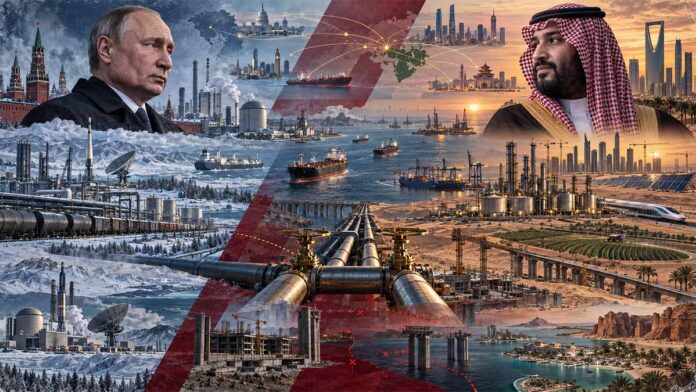

Scope: Assessment of publicly documented Russian–Saudi plans, agreements and operational cooperation across energy, investment, industry, food security, transport and diplomacy, with principal emphasis on 2025–2026 and an outlook to 2031.
Executive Summary / BLUF
- Russia and Saudi Arabia are building a selective, interest-based strategic partnership, not a formal alliance.
- The most mature component remains petroleum-market management through OPEC+, where both states possess immediate economic leverage.
- On 6 September 2026, seven participating OPEC+ states, including Russia and Saudi Arabia, maintained September production requirements for October, confirming continued coordination despite wider geopolitical tensions.
- The economic agenda has broadened: the ninth Joint Intergovernmental Commission identified at least fifteen cooperation sectors in December 2025.
- Thirteen agreements and memoranda valued collectively at SAR4.8 billion were announced in June 2026, centred on food security, biotechnology, livestock and supply-chain resilience.
- Visa liberalisation, direct air connectivity and industrial exhibitions are creating enabling infrastructure for commercial expansion.
- Saudi Arabia also offers Moscow diplomatic access and potential mediation channels concerning Ukraine, Yemen and wider Gulf security.
- Delivery remains uneven: official announcements generally disclose aggregate values and sectors, but not complete financing schedules, counterparties, milestones or implementation performance.
- Sanctions, financial compliance, technological restrictions, competition in Asian energy markets and renewed Houthi attacks limit the depth of cooperation.
- The principal judgment is that relations will expand through compartmentalised transactions, while Riyadh avoids strategic dependence on Moscow and preserves stronger security, technological and financial relationships with other partners.
Russia–Saudi Arabia: A Partnership of Leverage, Not Alignment
Russia and Saudi Arabia are building a relationship designed less to create an alliance than to increase each capital’s room for manoeuvre. Oil coordination gives them immediate influence over revenues, inflation and import costs; investment and food-security projects seek to convert political access into productive capacity; and Saudi-hosted diplomacy gives Moscow a channel to Washington while elevating Riyadh as a negotiating centre. Yet the partnership remains sharply asymmetric. Trade is growing from a modest base, announced projects still require execution, Russia’s strategic treaty with Iran constrains regional-security convergence, and the United States remains the Kingdom’s primary defence partner. The strategic significance lies precisely in this combination: cooperation is broad enough to affect markets and diplomacy, but bounded enough to preserve Saudi multi-alignment and Russian freedom of action.
Oil as Strategic Infrastructure
The core is not a bilateral supply pact but the wider OPEC+ machinery. On 5 July 2025, Saudi Arabia, Russia and six other producers agreed to raise August output by 548,000 barrels per day, within the gradual return of 2.2 million barrels per day of voluntary reductions. The increase could be paused or reversed, while monthly meetings would examine market conditions, compliance and compensation for excess production. Saudi Arabia, Russia, Iraq, UAE, Kuwait, Kazakhstan, Algeria, and Oman reaffirm commitment to market stability — OPEC — Jul 2025
That flexibility is the source of bargaining power. It changes the expected path of supply, affecting producer budgets, refinery procurement, freight, inflation forecasts and import costs. Yet Riyadh and Moscow are not economically identical. Saudi Arabia combines spare capacity with capital-intensive Vision 2030 commitments; Russia operates under sanctions, restricted technology access and war-related fiscal pressure. They can coordinate market management while disagreeing over the timing and distribution of adjustment. Compliance must therefore be measured through realised production, exports and compensation—not announced quotas.
From Commerce to Localisation
The non-oil agenda is widening. On 15 October 2025, Russian Deputy Prime Minister Alexander Novak reported that bilateral trade had risen 62.7% in the preceding year and that accumulated Russian investment in Saudi Arabia had increased sixfold. These are Russian government figures and do not, by themselves, establish the profitability or completion of individual projects. Alexander Novak: Russia and Saudi Arabia are developing multifaceted cooperation — Government of the Russian Federation — Oct 2025
The clearest subsequent industrial signal came at the 2026 St Petersburg International Economic Forum. Saudi Arabia and Russia signed 13 agreements and memoranda valued at SAR4.8 billion—approximately US$1.28 billion at the Saudi riyal’s fixed rate—covering food security, biotechnology and industrial localisation. Saudi Vice-Minister of Environment, Water and Agriculture Mansour Al-Mushaiti oversaw the signings. The projects include localisation of veterinary-vaccine manufacturing, development of broiler breeds, livestock production and supply-chain resilience. Saudi Arabia, Russia Sign 13 Strategic Agreements Worth SAR4.8 Billion — Saudi Press Agency — Jun 2026
Riyadh is seeking domestic capability, biological security and reduced exposure to disrupted food chains; Russian firms seek capital and durable positions outside Western jurisdictions. The test is conversion: a memorandum is not a factory, technology transfer is not achieved by signature, and a stated project value is not an outlay. The audit trail runs through licences, financing close, construction, local-content ratios, intellectual-property terms and commercial output.
Food Security as Industrial Policy
Agriculture links Russian export strength to Saudi exposure to water scarcity and external disruption. Cooperation is moving beyond grain purchases toward breeding, animal health, biotechnology and processing: imports provide immediate security, while vaccine production and genetics create domestic capability. These projects face fewer interoperability barriers than defence deals but remain exposed to banking restrictions, insurance, certification and sanctions screening. Riyadh must avoid replacing one concentrated dependency with another.
Connectivity Determines Delivery
The ninth Saudi–Russian Joint Commission, held in Riyadh on 25 February 2026, reviewed energy, industry, investment, agriculture, transport, logistics, communications, space, education, tourism and health. Its breadth demonstrates intent but creates a governance problem: progress must be measured project by project, not by the number of sectors listed. Saudi–Russian Joint Commission Holds 9th Meeting in Riyadh — Saudi Ministry of Energy — Feb 2026
Customs documentation, veterinary approval, cold chains and predictable maritime routes determine whether agreements become trade. Finance is harder: Russia’s restricted access to Western infrastructure raises cost and compliance exposure. Alternative settlement channels do not remove sanctions obligations for banks operating in US, UK or EU markets.
Riyadh’s Diplomatic Asset
Saudi Arabia’s value to Moscow is also diplomatic. From 23 to 25 March 2025, Riyadh hosted separate US technical talks with Russian and Ukrainian delegations. The Russia track addressed Black Sea navigation, commercial shipping, agricultural and fertiliser exports and measures for a ban on attacks against energy facilities. The Ukraine track added prisoners of war, civilian detainees and forcibly transferred children. In both statements, Washington identified itself as facilitator and thanked Crown Prince Mohammed bin Salman for enabling the discussions. Outcomes of the United States and Russia Expert Groups On the Black Sea — The White House — Mar 2025 Outcomes of the United States and Ukraine Expert Groups On the Black Sea — The White House — Mar 2025
Saudi Arabia demonstrated convening power and access; the record does not show that it authored the terms, secured a joint Russia–Ukraine instrument or controlled implementation. Territory, sanctions, European security and enforcement remain with the belligerents and competent institutions.
Iran Defines the Ceiling
Regional security exposes the partnership’s hardest constraint. China—not Russia—sponsored the March 2023 agreement under which Saudi Arabia and Iran restored diplomatic relations and undertook to implement their 2001 security-cooperation agreement. Joint Trilateral Statement by China, Saudi Arabia and Iran — Ministry of Foreign Affairs of China — Mar 2023
Russia simultaneously has a formal comprehensive comprehensive strategic partnership with Tehran. Signed on 17 January 2025, it provides for deeper security and defence cooperation, intelligence exchanges, military exercises and military-technical collaboration. Article 3 states that if either party suffers aggression, the other will not assist the aggressor in sustaining it. It is not an automatic mutual-defence guarantee, but it prevents Moscow from credibly becoming an unrestricted anti-Iran guarantor for Riyadh. Full Text of the Comprehensive Strategic Partnership Treaty between Iran and Russia — Presidency of Iran — Jan 2025
Russia can transmit messages and support de-escalation, but cannot easily coerce Iran for Riyadh without damaging a treaty-based partnership. No public instrument establishes Russian air-defence, maritime-escort or enforcement commitments to the Kingdom.
Washington Remains the Security Anchor
The scale of the US relationship sets the final boundary. On 13 May 2025, the White House announced an intended Saudi defence-sales package of nearly US$142 billion covering air and space systems, air and missile defence, maritime security, land forces, communications, training and support. On 18 November, Washington announced a US–Saudi Strategic Defense Agreement, future F-35 deliveries and an agreement for nearly 300 American tanks, while explicitly describing the United States as Saudi Arabia’s primary strategic partner. Announcements and approvals are not equivalent to completed delivery, but their breadth demonstrates the architecture within which Saudi forces will operate. Fact Sheet: President Donald J. Trump Secures Historic $600 Billion Investment Commitment in Saudi Arabia — The White House — May 2025 Fact Sheet: President Donald J. Trump Solidifies Economic and Defense Partnership with the Kingdom of Saudi Arabia — The White House — Nov 2025
Russian defence cooperation can support diversification and bargaining; it is not positioned to replace US systems, intelligence, training and sustainment. Integrating Russian equipment into sensitive American-origin networks would create interoperability and information-security risks.
Europe’s Strategic Reading
For Europe, this is neither an anti-Western axis nor a marginal affair. France and the United Kingdom have direct interests in Gulf security and Ukraine guarantees; Germany is exposed through industrial energy costs; Italy through Mediterranean shipping, energy security and Gulf capital. The EU must separate legitimate commerce from sanctions evasion. Its leverage lies in finance, insurance, technology, certification and market access; its answer to Saudi diversification must be competitive investment, not demands for exclusivity.
The Execution Test
Delivery will decide the trajectory: OPEC+ compliance; financing, construction and output under the SAR4.8 billion package; monitored diplomatic agreements rather than meetings; and Moscow’s ability to support Gulf de-escalation without colliding with its Iranian commitments.
Russia and Saudi Arabia are not constructing an alliance. They are building a portfolio of leverage—oil coordination, selective localisation, food resilience, transport links and diplomatic access—while retaining incompatible security dependencies. That model can endure because it does not require strategic trust. Its strength is flexibility; its weakness is that every major gain still depends on institutions, capital and enforcement mechanisms located partly outside the bilateral relationship.
Master Abstract
Energy remains the operating core
The bilateral relationship is broadening, but its strategic centre remains the coordination of two major hydrocarbon exporters. Russia and Saudi Arabia do not exercise exclusive control over OPEC+, yet their political weight, production volumes and recurring participation in voluntary-adjustment groups give them a central role in collective supply management. On 6 September 2026, Saudi Arabia, Russia, Iraq, Kuwait, Kazakhstan, Algeria and Oman agreed to retain their September required production levels for October and scheduled another review for 4 October. The decision followed groupwide adjustments of 188,000 barrels per day for both August and September 2026. These figures represent collective OPEC+ adjustments, not bilateral production decisions or additions attributable solely to Moscow and Riyadh. Saudi Arabia, Russia, Iraq, Kuwait, Kazakhstan, Algeria, and Oman reaffirm commitment to market stability — OPEC — Sep 2026 Saudi Arabia, Russia, Iraq, Kuwait, Kazakhstan, Algeria, and Oman adjust production and reaffirm commitment to market stability — OPEC — Aug 2026
This coordination serves overlapping but non-identical interests. Riyadh uses production flexibility to support market stability, protect fiscal receipts and preserve spare-capacity leverage. Moscow seeks export revenue, recognition as an indispensable energy power and insulation from Western economic pressure. The partnership therefore depends on continued compatibility between Saudi price-and-capacity calculations and Russian revenue requirements. It is not unconditional: quota conformity, compensation for previous overproduction, market-share competition and differing tolerances for lower prices remain structural sources of friction.
The European consequence is direct. Russian–Saudi coordination affects global benchmarks, refinery economics, inflation and import costs even where Russian-origin oil is prohibited or capped. After its twenty-first sanctions package of 23 July 2026, the European Union retained a US$47.60-per-barrel price cap on Russian seaborne crude and paused the cap’s automatic adjustment until 15 July 2027 because of exceptional conditions associated with the Strait of Hormuz. This illustrates the intersection between Gulf security, Russian revenue restrictions and European energy exposure. EU sanctions against Russia: questions and answers — Council of the European Union — Jul 2026
Expansion now targets localisation and resilience
The ninth Saudi–Russian Joint Intergovernmental Commission, convened in Riyadh on 1 December 2025 under Saudi Energy Minister Prince Abdulaziz bin Salman and Russian Deputy Prime Minister Alexander Novak, established the public architecture of the enlarged agenda. It covered energy, trade, investment, space, industry, minerals, health, education, media, culture, sport, tourism, transport, housing and agriculture. The meeting coincided with a bilateral investment forum and business-council session. This establishes the breadth of official intent, but it does not prove that every listed sector contains a funded or executing project. Saudi–Russian Joint Commission Holds 9th Meeting in Riyadh — Saudi Press Agency — Dec 2025
The clearest subsequent financial announcement came at the June 2026 St Petersburg International Economic Forum, where Saudi Arabia participated as guest country. Saudi authorities reported thirteen agreements and memoranda with a stated aggregate investment value of SAR4.8 billion, approximately US$1.28 billion at the Saudi riyal’s official dollar peg. The declared priorities included food security, biotechnology, livestock production, vital-industry localisation and supply-chain sustainability. The Saudi Press Agency did not publish, on the accessible record examined, a complete project-by-project allocation, disbursement timetable, legal status or implementation schedule. The SAR4.8 billion figure must therefore be treated as an announced portfolio value, not verified capital already deployed. Saudi Arabia, Russia Sign 13 Strategic Agreements Worth SAR4.8 Billion to Localize Vital Industries and Enhance Food Security — Saudi Press Agency — Jun 2026
The economic logic is complementary. Saudi Arabia seeks agricultural-security inputs, industrial technology, domestic production and additional suppliers compatible with Vision 2030 localisation objectives. Russia seeks alternative export markets, investment relationships and commercial channels less exposed to Western political pressure. Agriculture and food-related projects have comparatively favourable implementation conditions because food trade is generally less restricted than advanced technology or defence commerce. Conversely, nuclear energy, aerospace, mining technology, financial integration and sophisticated industrial localisation require more demanding licensing, financing, liability and sanctions-compliance structures. Their inclusion in an official agenda must not be confused with contract award or operational delivery.
Enabling measures are becoming more tangible. On 1 December 2025, the governments signed a reciprocal visa-waiver agreement covering diplomatic, special and ordinary passports and permitting tourism, business and family visits for up to 90 consecutive or non-consecutive days annually. Employment, study, residence and Hajj remain excluded. Saudi Arabia described Russia as the first state with which the Kingdom had concluded a reciprocal exemption extending to ordinary passports. Saudi Arabia and Russia Sign Agreement on mutual Visa exemption — Ministry of Foreign Affairs of Saudi Arabia — Dec 2025
The same forum produced a memorandum between the Saudi Ministry of Energy and the Russian Ministry of Economic Development concerning climate change and low-greenhouse-gas development. Its stated fields include energy efficiency, emissions reduction, abatement and removal technologies. This is a framework for exploration and technical cooperation; the published text does not establish binding emissions targets, a common carbon market or funded deployment. An archival-cooperation agreement was also signed. Energy Minister and Russian Deputy Prime Minister Inaugurate Saudi-Russian Investment and Business Forum — Saudi Press Agency — Dec 2025
Diplomacy is valuable precisely because alignment is incomplete
The relationship provides Moscow with engagement from an influential G20 and Gulf state that has declined to reduce its foreign policy to alignment with a single external bloc. For Riyadh, regular contact with Russia supports energy diplomacy, engagement with a permanent member of the UN Security Council and access to negotiations involving Ukraine, Iran, Syria, Yemen and other regional questions. This is strategic optionality rather than evidence of a Saudi geopolitical transfer from Washington to Moscow.
The statement supplied for this assessment attributes to Sergey Lavrov three connected positions: appreciation for Saudi conduct regarding Ukraine; opposition to Houthi attacks on Saudi infrastructure; and support for the agreed Yemen peace roadmap. These positions are consistent with Russia’s interest in preserving Saudi stability and maintaining Riyadh as a diplomatic channel. However, the complete official Russian transcript of the 8 September 2026 press conference—and a corresponding Saudi record reproducing the formulations—was not available in an accessible textual form at the cut-off. The quotations must therefore remain attributed to Lavrov through the supplied report rather than treated as independently corroborated bilateral language.
The underlying Yemen roadmap is independently documented. In December 2023, the UN Special Envoy reported commitments toward a nationwide ceasefire, payment of public-sector salaries, resumption of oil exports, opening roads in Taiz and elsewhere, further easing restrictions on Sana’a Airport and Hudaydah port, and preparation for a Yemeni-led political process under UN auspices. The UN expressly credited Saudi Arabia and Oman for supporting the process. Update on efforts to secure a UN roadmap to end the war in Yemen — Office of the UN Special Envoy for Yemen — Dec 2023
Renewed attacks on Saudi territory materially weaken that pathway. They raise the cost of Saudi restraint, threaten energy and aviation infrastructure and reconnect the internal Yemeni conflict with Red Sea and Gulf economic security. Russian support for the roadmap therefore protects both a diplomatic relationship and Moscow’s broader interest in avoiding disruption of energy exports and maritime commerce. It does not establish that Russia controls Houthi decision-making, can guarantee implementation, or has been accepted as a formal mediator by all Yemeni parties.
The Ukraine dimension has similar limits. Saudi Arabia can provide venues, humanitarian facilitation and channels of communication, but it cannot independently determine Russian or Ukrainian negotiating positions. Lavrov’s reference to addressing the conflict’s “root causes” represents the Russian government’s negotiating position; it is not a mutually accepted definition. Saudi diplomatic value derives from maintaining access to multiple parties without endorsing every Russian proposition.
Key Evidence Table
| Indicator | Value/status | Reference date | Definition/scope | Issuer | Exact source |
|---|---|---|---|---|---|
| Latest OPEC+ decision | September production requirements retained for October | 6 Sep 2026 | Seven participating states; not a bilateral quota | OPEC | Saudi Arabia, Russia, Iraq, Kuwait, Kazakhstan, Algeria, and Oman reaffirm commitment to market stability |
| Group production adjustment | 188,000 b/d | Sep 2026 | Aggregate adjustment by seven OPEC+ states from April 2023 voluntary adjustments | OPEC | Saudi Arabia, Russia, Iraq, Kuwait, Kazakhstan, Algeria, and Oman adjust production and reaffirm commitment to market stability |
| Industrial and food-security package | 13 agreements and memoranda; SAR4.8bn announced value | Jun 2026 | Portfolio announcement; disbursement and project-level allocation not published | Saudi Press Agency | Saudi Arabia, Russia Sign 13 Strategic Agreements Worth SAR4.8 Billion to Localize Vital Industries and Enhance Food Security |
| Bilateral institutional agenda | At least 15 named sectors | 1 Dec 2025 | Areas reviewed by the ninth Joint Intergovernmental Commission; not all confirmed as executing projects | Saudi Press Agency | Saudi–Russian Joint Commission Holds 9th Meeting in Riyadh |
| Visa liberalisation | Up to 90 days annually | 1 Dec 2025 | Tourism, business and family visits; excludes employment, study, residence and Hajj | Saudi Ministry of Foreign Affairs | Saudi Arabia and Russia Sign Agreement on mutual Visa exemption |
| Climate cooperation | Framework memorandum signed | 1 Dec 2025 | Energy efficiency, emissions reduction, abatement and removal; no published joint target | Saudi Press Agency | Energy Minister and Russian Deputy Prime Minister Inaugurate Saudi-Russian Investment and Business Forum |
| Yemen roadmap | Commitments announced; implementation incomplete | 23 Dec 2023 | Ceasefire, salaries, oil exports, transport access and UN-led political process | UN Special Envoy for Yemen | Update on efforts to secure a UN roadmap to end the war in Yemen |
| EU Russian crude price cap | US$47.60/bbl | 23 Jul 2026 package | Seaborne Russian crude; automatic adjustment paused until 15 Jul 2027 | Council of the EU | EU sanctions against Russia: questions and answers |
Competing Pathways, 2026–2031
| Pathway | Diagnostic support | Disconfirming evidence | Indicators | Current standing |
|---|---|---|---|---|
| Selective functional expansion | OPEC+ coordination continues; commission agenda is broad; visa agreement and agricultural-industrial packages reduce transactional barriers | Project-level implementation remains opaque; limited evidence of deep technological integration | Contract awards, capital disbursement, joint ventures, trade composition, direct-flight frequency | Best supported: cooperation expands where interests are complementary and exposure manageable |
| Sanctions-resilient strategic acceleration | Russia requires non-Western finance and markets; Saudi Arabia pursues diversified suppliers and strategic autonomy | Riyadh remains deeply connected to Western finance, technology and defence; secondary-sanctions and reputational exposure constrain transactions | Local-currency settlement mechanisms, new financial infrastructure, major Saudi equity commitments in Russia, sanctioned-entity participation | Possible but not established: public evidence does not show a systemic Saudi pivot into Russia-centred structures |
| Security-driven plateau or retrenchment | Houthi escalation, maritime insecurity, oil-market disruption and sanctions risks increase project costs | Both parties retain strong incentives to preserve energy coordination and diplomatic access | Attacks on Saudi infrastructure, Saudi military response, breakdown of Yemen roadmap, OPEC+ quota disputes, suspension of projects | Material downside pathway: elevated by regional escalation but not yet dominant |
Principal Gaps and Watch Indicators
- Publication of the complete 8 September 2026 Russian–Saudi ministerial transcript and any jointly approved communiqué.
- Full identification of the thirteen June 2026 agreements: counterparties, legal form, sectoral allocation and financing schedule.
- Evidence of capital actually disbursed under the stated SAR4.8 billion portfolio.
- Updated bilateral trade data disaggregated by commodity, customs valuation and reference period.
- Project-level records for nuclear energy, space, minerals, transport, housing and healthcare cooperation.
- Regulatory evidence on settlement currencies, correspondent banking, insurance and sanctions screening.
- Procurement, licensing or delivery records supporting any renewed defence-industrial cooperation.
- Implementing instruments for the climate memorandum, including methodology, finance and measurable targets.
- Verified damage assessments and official Saudi reporting concerning the September 2026 Houthi attacks.
- Evidence that the Yemen roadmap has moved from political commitment to sequenced implementation.
- Formal evidence of an agreed Saudi role in renewed Russia–Ukraine negotiations beyond venue provision or humanitarian facilitation.
- OPEC+ quota conformity, compensation schedules and any emerging Saudi–Russian divergence over production or market share.
Saudi–Russian Bilateral Alignment: Functional Expansion vs. Sanctions-Resilient Strategic Acceleration
Forensic evaluation of Riyadh–Moscow strategic interdependence across OPEC+ production quotas, agricultural-industrial localization, visa liberalisation, and regional security friction. Distinguishing selective pragmatic cooperation from unverified structural decoupling toward a Russia-centred axis.
Diagnostic Balance: Selective Functional Expansion
Tracking diagnostic consistency, opaque execution barriers, Western entanglement safeguards, and regional exposure.
Selective Functional Expansion: Pragmatic Convergence Under Managed Exposure
OPEC+ coordination continues smoothly through confirmed aggregate voluntary adjustments; the Joint Intergovernmental Commission agenda is exceptionally broad (15+ sectors); and the 90-day mutual visa exemption alongside the SAR4.8bn industrial-food package lowers transactional barriers.
Project-level execution remains opaque across all 13 announced memoranda; there is zero verified capital disbursement data under the SAR4.8bn portfolio, and substantive technological or strategic integration in high-tech, space, or nuclear sectors remains unevidenced.
Formal commercial contract awards, verified cash disbursement schedules, established joint ventures in petrochemicals and agri-processing, disaggregated non-oil bilateral trade expansion, and sustained direct-flight passenger and cargo frequency.
Key Evidence Table: Official Records, Quotas & Bilateral Instruments
Systematic reconciliation of multilateral OPEC+ production baselines, sovereign bilateral agreements, regulatory regimes, and verified source citations.
| Indicator | Value / Status | Ref. Date | Definition / Scope | Issuer | Exact Source Citation |
|---|---|---|---|---|---|
| Latest OPEC+ Decision | September production requirements retained for October | 6 Sep 2026 | Seven participating states; operates as a group baseline adjustment, not an exclusive bilateral quota. | OPEC | Saudi Arabia, Russia, Iraq, Kuwait, Kazakhstan, Algeria, and Oman reaffirm commitment to market stability |
| Group Production Adjustment | 188,000 b/d | Sep 2026 | Aggregate adjustment by seven OPEC+ states relative to the April 2023 voluntary supply reductions. | OPEC | Saudi Arabia, Russia, Iraq, Kuwait, Kazakhstan, Algeria, and Oman adjust production and reaffirm commitment to market stability |
| Industrial & Food-Security Package | 13 agreements; SAR 4.8bn announced value | Jun 2026 | Bilateral portfolio announcement; capital disbursement and project-level corporate allocations not published. | Saudi Press Agency (SPA) | Saudi Arabia, Russia Sign 13 Strategic Agreements Worth SAR4.8 Billion to Localize Vital Industries and Enhance Food Security |
| Bilateral Institutional Agenda | At least 15 named economic sectors | 1 Dec 2025 | Comprehensive sectoral review by the 9th Joint Intergovernmental Commission; non-binding project pipelines. | Saudi Press Agency (SPA) | Saudi–Russian Joint Commission Holds 9th Meeting in Riyadh |
| Visa Liberalisation Agreement | Up to 90 days annually | 1 Dec 2025 | Reciprocal entry for tourism, business, and family visits; explicitly excludes employment, study, residence, and Hajj. | Saudi Ministry of Foreign Affairs | Saudi Arabia and Russia Sign Agreement on mutual Visa exemption |
| Bilateral Climate Cooperation | Framework memorandum signed | 1 Dec 2025 | Covers energy efficiency, methane emissions reduction, carbon abatement and removal; no joint quantitative targets. | Saudi Press Agency (SPA) | Energy Minister and Russian Deputy Prime Minister Inaugurate Saudi-Russian Investment and Business Forum |
| Yemen De-Escalation Roadmap | Commitments announced; implementation incomplete | 23 Dec 2023 | Nationwide ceasefire, public-sector salary payments, oil export resumption, transport opening, UN political track. | UN Special Envoy for Yemen | Update on efforts to secure a UN roadmap to end the war in Yemen |
| EU Russian Crude Price Cap | US$ 47.60/bbl | 23 Jul 2026 package | Seaborne Russian crude oil sanctions threshold; automatic adjustment mechanism paused until 15 Jul 2027. | Council of the European Union | EU sanctions against Russia: questions and answers — Council of the European Union — Sep 2026 |
Analysis of Competing Pathways: Riyadh–Moscow Strategic Futures (2026–2031)
| Pathway | Diagnostic Support | Disconfirming Evidence | Observable Indicators | Current Standing |
|---|---|---|---|---|
| 1. Selective Functional Expansion | OPEC+ production coordination holds firm; Joint Commission covers 15+ sectors; visa waiver and SAR4.8bn agricultural/industrial deals reduce transaction friction. | Actual project-level execution remains opaque; negligible evidence of deep, sovereign technological or defense-industrial integration. | Formal contract awards, capital disbursement proof, established industrial JVs, non-oil trade diversification, direct-flight frequency. | Best Supported Baseline. Bilateral cooperation broadens where national interests align and Western sanctions exposure remains strictly manageable. |
| 2. Sanctions-Resilient Strategic Acceleration | Moscow requires alternative non-Western capital and markets; Riyadh pursues multi-aligned strategic autonomy, sovereign AI, and independent supply lines. | Saudi Arabia remains deeply anchored in Western financial markets, US defense guarantees, and dollar-cleared assets; secondary-sanctions fear limits large deals. | Riyal–ruble bilateral clearing rails, non-SWIFT financial messaging adoption, major PIF equity investments in Russia, joint sanctioned-entity consortia. | Possible but Not Established. Public evidence demonstrates zero systemic pivot by Riyadh into Moscow-centric financial or security architectures. |
| 3. Security-Driven Plateau or Retrenchment | Escalating regional proxy attacks (e.g., September 2026 Houthi strikes), Red Sea maritime instability, oil market volatility, and Western sanctions compliance costs. | Both leaderships retain paramount, non-negotiable economic imperatives to preserve global crude market discipline and direct high-level diplomatic access. | Direct kinetic damage to Saudi energy infrastructure, breakdown of the Yemen UN roadmap, sharp OPEC+ quota disputes, formal suspension of joint projects. | Material Downside Pathway. Risk elevated by Middle Eastern regional escalation, but currently subordinate to core market-management interests. |
Principal Evidentiary Gaps (Open Official Record Deficits)
- Ministerial Transcripts: Publication of the complete 8 September 2026 Russian–Saudi ministerial transcript and any jointly approved official communiqué.
- Commercial Contract Specifics: Full identification of the 13 June 2026 agreements: legal forms, corporate counterparties, sectoral allocations, and binding capital drawdowns.
- Disbursement Tracking: Documentary proof of actual capital disbursed under the headline SAR4.8 billion industrial and food-security commitment.
- Trade Data Granularity: Updated bilateral customs datasets disaggregated by HS code commodity, customs valuation, currency of settlement, and clearing venue.
- High-Tech & Nuclear Milestones: Verified project-level records for civil nuclear cooperation, satellite/space development, critical minerals, and housing infrastructure.
- Financial Settlement Mechanics: Regulatory evidence detailing banking settlement currencies, correspondent banking channels, marine reinsurance, and OFAC/EU sanctions screening.
- Defense Industrial Transparency: Procurement, licensing, or delivery verification supporting any renewed defense-technology or dual-use collaboration.
- Climate Implementation: Implementing instruments for the December 2025 climate memorandum, including baseline methodology, joint financing, and measurable emissions targets.
- Kinetic Impact Verification: Verified damage assessments and official Saudi Ministry of Defense reporting concerning the September 2026 Houthi kinetic strikes.
Observable Strategic Watch Indicators
• Inauguration of concrete manufacturing facilities under the SAR4.8bn localization portfolio.
• Year-on-year expansion in bilateral non-oil cargo volumes processed under the 90-day visa facilitation framework.
• Transition of bilateral agricultural or petrochemical contracts to direct Saudi Riyal–Russian Ruble settlement.
• Formal PIF sovereign equity investments in Russian resource extraction assets.
• Visible quota non-compliance or unilateral market-share price wars erupting within the OPEC+ ministerial committee.
• Secondary US sanctions designations against Saudi logistical or financial entities facilitating Russian trade.
Forensic Strategic Key Judgments
Energy coordination and geopolitical bargaining power
Principal judgment. Energy coordination is the most mature and strategically consequential component of the Russia–Saudi relationship. Its centre of gravity is not a bilateral oil compact but the multilateral OPEC+ Declaration of Cooperation, within which Riyadh supplies exceptional production flexibility and Moscow supplies the political and commercial weight of a major non-OPEC producer. Their coordination can influence the timing and direction of global supply adjustments, but it cannot determine prices independently of demand, non-OPEC production, producer compliance, sanctions, shipping constraints and strategic-stock policy. The relationship therefore creates bargaining power, not market control.
The 2025–2026 record indicates active management rather than a permanent price-maximisation strategy: participating producers accelerated the return of some voluntary cuts in 2025, began unwinding another layer in 2026, retained the authority to pause or reverse those increases, and held October 2026 production requirements at September levels. Sanctions create a central asymmetry. Saudi Arabia can convert withheld capacity into production flexibility, while Russia’s realised revenue also depends on discounts, freight, insurance, payment channels and access to price-cap-compliant maritime services. This makes Moscow more dependent on a functioning producer coalition, while giving Riyadh greater ability to alter the coalition’s operational direction—but not freedom to disregard Russian cooperation without weakening OPEC+ itself.
The bilateral axis operates through multilateral machinery
Russia and Saudi Arabia exercise influence through overlapping institutions:
| Mechanism | Saudi role | Russian role | Decision function | Evidentiary limitation |
|---|---|---|---|---|
| OPEC and non-OPEC ministerial process | Principal OPEC producer and holder of state-directed production capacity | Major participating non-OPEC producer | Establishes collective production policy | Published decisions do not disclose all bilateral negotiations |
| Joint Ministerial Monitoring Committee | Participates in conformity and market monitoring | Russia co-chairs the OPEC/non-OPEC ministerial and JMMC architecture, according to OPEC | Reviews production, conformity and compensation | Monitoring statements do not independently prove physical compliance |
| Monthly voluntary-adjustment group | Saudi Arabia participates in the smaller coordinating group | Russia participates alongside Saudi Arabia | Can increase, pause or reverse voluntary adjustments | Membership and published requirements can change |
| OPEC–Russia Energy Dialogue | Saudi influence is exercised through OPEC | Russian government is the state counterpart | Exchanges outlooks and prepares institutional alignment | Dialogue is consultative, not an independent production authority |
| Saudi–Russian Joint Commission | Chaired on the Saudi side by the energy minister | Chaired on the Russian side by the deputy prime minister responsible for energy | Broad bilateral economic coordination, including energy | The public communiqué does not establish implementation of specific projects |
At the June 2025 OPEC–Russia Energy Dialogue, OPEC identified Russia as a co-chair of both the OPEC and non-OPEC ministerial meetings and the JMMC. Russian Deputy Prime Minister Alexander Novak described advance comparison of positions and development of agreed approaches before ministerial decisions. This is evidence of structured coordination and agenda preparation, but not evidence that Moscow and Riyadh can impose a decision without the other participating states. 10th High-Level Meeting of the OPEC-Russia Energy Dialogue Saint Petersburg, Russian Federation — OPEC — Jun 2025
The distinction matters. Treating OPEC+ as a Russia–Saudi duopoly exaggerates bilateral command; treating the two countries as ordinary members understates their agenda-setting importance. The most defensible formulation is that they form the coalition’s principal political axis while operating through a system that requires broader participation, production reporting, conformity assessment and compensation for overproduction.
The 2025–2026 decisions show conditional supply restoration
The published sequence records repeated adjustments rather than a single settled production path.
| Decision date | Applicable period | Published group decision | Reference base | Reversibility and compliance provisions |
|---|---|---|---|---|
| 3 Apr 2025 | May 2025 | +411,000 b/d | Return of part of the 2.2 million b/d voluntary adjustments | Increase could be paused or reversed; updated compensation plans required |
| 3 Aug 2025 | Sep 2025 | +547,000 b/d from the Aug required level | Accelerated phase-out of the 2.2 million b/d adjustments | Phase-out could be paused or reversed; full conformity reiterated |
| 5 Apr 2026 | May 2026 | +206,000 b/d | Return of part of the separate 1.65 million b/d voluntary adjustments | Full flexibility to increase, pause or reverse; compensation retained |
| 2 Aug 2026 | Sep 2026 | +188,000 b/d | Further return from the Apr 2023 voluntary adjustments | Monthly review and compensation requirements continued |
| 6 Sep 2026 | Oct 2026 | No further increase; September requirements maintained | September 2026 required production | Collective conformity reaffirmed; next review scheduled for 4 Oct |
The increments are not additive measures of realised output. They refer to different decision dates, voluntary-cut layers and required-production baselines. They are announced adjustments, not independently verified production.
In April 2025, eight participating countries approved a 411,000-barrel-per-day adjustment for May—three monthly increments—while reserving the right to pause or reverse the increase. They also required compensation for overproduction since January 2024. Saudi Arabia, Russia, Iraq, UAE, Kuwait, Kazakhstan, Algeria, and Oman reaffirm commitment to market stability on healthier oil market outlook and adjust production upward — OPEC — Apr 2025
By August 2025, the same group approved a further 547,000 barrels per day for September relative to the August required-production level, again retaining reversibility and compensation obligations. Saudi Arabia, Russia, Iraq, UAE, Kuwait, Kazakhstan, Algeria, and Oman reaffirm commitment to market stability on current healthy oil market fundamentals and steady global economic outlook and adjust production — OPEC — Aug 2025
The 2026 sequence addressed another cut layer. In April, the group approved 206,000 barrels per day for May from the 1.65-million-barrel-per-day voluntary adjustments announced in April 2023. The communiqué expressly retained flexibility to reverse not only this phase-out but also previously restored volumes from the separate 2.2-million-barrel-per-day layer. Saudi Arabia, Russia, Iraq, UAE, Kuwait, Kazakhstan, Algeria, and Oman adjust production and reaffirm commitment to market stability — OPEC — Apr 2026
Seven listed participants subsequently approved 188,000 barrels per day for September 2026. On 6 September they stopped the incremental sequence for at least one month by maintaining September requirements for October. Saudi Arabia, Russia, Iraq, Kuwait, Kazakhstan, Algeria, and Oman adjust production and reaffirm commitment to market stability — OPEC — Aug 2026 Saudi Arabia, Russia, Iraq, Kuwait, Kazakhstan, Algeria, and Oman reaffirm commitment to market stability — OPEC — Sep 2026
Three conclusions follow.
First, the coalition was willing to restore supply when its participating governments judged market conditions supportive. Second, every major restoration decision remained conditional: reversibility is a policy instrument, not boilerplate, because it allows the group to respond without negotiating an entirely new framework. Third, repeated compensation provisions show that announced targets and realised compliance are distinct. The durability of Russia–Saudi influence consequently depends on their ability to obtain implementation from other producers, not merely to announce headline adjustments.
Saudi leverage rests on capacity and reversibility
Saudi Arabia’s distinctive asset is its state-directed production capacity. In January 2024, Aramco reported that the Saudi Ministry of Energy had instructed it to maintain maximum sustainable capacity at 12 million barrels per day, rather than continue an expansion to 13 million. Aramco also stated that maximum sustainable capacity is determined by the state under the Saudi Hydrocarbons Law. Aramco receives directive to maintain MSC at 12 MMBD — Saudi Arabian Oil Company — Jan 2024
This establishes a state-directed capacity ceiling; it does not establish that the full amount is immediately available, currently produced or deliverable under every operational contingency. Nonetheless, the existence of an officially maintained capacity level gives Riyadh three forms of leverage:
- Adjustment leverage. Saudi Arabia can credibly participate in both cuts and subsequent restoration because it maintains capacity above constrained production levels.
- Signalling leverage. A Saudi preference for pausing, accelerating or reversing restoration affects market expectations even before physical volumes change.
- Coalition-discipline leverage. Saudi willingness to carry a disproportionate restraint burden can stabilise an agreement temporarily; its willingness to restore production can also raise the cost of non-compliance for producers seeking to retain excess output.
The associated burden is material. Withholding usable capacity sacrifices current sales and requires continuing expenditure to preserve facilities, reservoirs and operational readiness. Saudi Arabia therefore has an incentive to prevent prolonged unilateral restraint from transferring market share to non-participating producers or persistently non-compliant OPEC+ members. Aramco’s 2025 results reported that the Marjan increment had entered service and that work at Berri supported operational flexibility, illustrating that capacity maintenance remains an industrial programme rather than a purely diplomatic commitment. Aramco announces fourth quarter and full-year 2025 results — Saudi Arabian Oil Company — Mar 2026
Riyadh’s leverage is accordingly greatest when the market is tight enough for marginal Saudi barrels to matter, but not so disrupted that infrastructure, shipping or political intervention overwhelms normal production policy.
Russian leverage rests on coalition scale—but sanctions reduce fungibility
Russia’s formal influence is substantial: OPEC describes it as a co-chair of the OPEC/non-OPEC ministerial and monitoring structures, while the recurring voluntary-group communiqués place it alongside Saudi Arabia in every reviewed 2025–2026 decision. This gives Moscow institutional access to production-policy formation and protects it from facing an OPEC production strategy designed without major non-OPEC participation.
Russia’s economic position is nevertheless different from Saudi Arabia’s. European measures prohibit most EU imports of Russian crude and petroleum products, restrict maritime transport and associated services, and permit specified services for third-country shipments only when Russian oil is sold at or below the applicable cap. As of 1 September 2026, the Council of the EU recorded a crude-oil cap of US$47.60 per barrel, alongside separate US$45 and US$100 caps for two categories of petroleum products. It also recorded more than 670 vessels listed in connection with Russia’s “shadow fleet” as of 23 July 2026. These are EU legal measures and EU institutional characterisations; they do not constitute a worldwide prohibition or establish the price obtained in every Russian transaction. EU sanctions against Russia: questions and answers — Council of the European Union — Sep 2026
The sanctions regime separates the global benchmark price from Russia’s realised netback—the amount retained after discounts, freight, insurance, financing, compliance and handling costs. Russia can therefore benefit from an OPEC+ decision that supports global prices while receiving less than the benchmark or incurring higher delivery costs. Conversely, a production increase can improve Russian sales volume but weaken prices, while sanctions or logistical constraints can prevent Moscow from fully monetising an authorised increase.
This creates a recurrent bargaining tension:
- Saudi Arabia weighs price support against withheld-capacity cost and market-share loss.
- Russia weighs price support against the need to preserve export volume and fiscal receipts under sanctions.
- Other participating producers weigh the same collective objective against domestic production, investment and revenue pressures.
- Buyers and non-OPEC suppliers respond to the resulting price signal, limiting how long the coalition can maximise both price and volume.
The two governments are therefore aligned on avoiding disorderly price collapses, but their preferred price-volume combination is not necessarily identical. Public communiqués do not disclose their reservation prices, fiscal break-even thresholds or internal negotiating positions; assertions that either state has secured a particular target price are not established by the reviewed official record.
The price cap turns energy coordination into three-sided bargaining
The interaction is not confined to producers. It links OPEC+, importing states and sanctions authorities.
The EU oil-price cap is designed to permit Russian oil to continue reaching third countries through covered service providers while constraining Russian revenue. OPEC+ policy, by contrast, affects the wider physical balance. When OPEC+ restrains supply, it can raise the market benchmark against which the Russia-specific cap operates. When it restores supply, it can reduce scarcity but also reduce Russia’s gross price opportunity.
This creates three bargaining channels.
Producer–consumer bargaining. Saudi production flexibility and collective OPEC+ adjustments affect the exposure of importing governments to inflation, fuel costs and supply interruption. Importers can counter through strategic stocks, efficiency, alternative production, fuel switching and diplomatic pressure. Producer leverage is therefore strongest in the short term, before these responses materially alter consumption or supply.
Russia–sanctions-coalition bargaining. Higher benchmark prices increase the commercial incentive to use maritime arrangements outside coalition services. Sanctions authorities can respond with vessel listings, service restrictions, financial measures and enforcement against circumvention. OPEC+ does not control these transaction costs.
Saudi–Western bargaining. Riyadh’s ability to facilitate supply restoration increases its diplomatic relevance to importing governments during disruption. That leverage does not amount to a formal exchange of production for concessions, and the public record reviewed here establishes no such agreement. It does, however, increase the value of maintaining high-level relations with Saudi decision-makers.
The strongest recent illustration of this interaction is maritime disruption. In April 2026, the participating OPEC+ states stressed the importance of protecting international maritime routes and uninterrupted energy flows. The EU later stated that, after its 23 July 2026 sanctions package, it paused automatic adjustment of the Russian crude-price cap until 15 July 2027 because of the exceptional market situation associated with closure of the Strait of Hormuz. Saudi Arabia, Russia, Iraq, UAE, Kuwait, Kazakhstan, Algeria, and Oman adjust production and reaffirm commitment to market stability — OPEC — Apr 2026 EU sanctions against Russia: questions and answers — Council of the European Union — Sep 2026
The mechanism is direct: disruption to a critical route raises the value of secure production and transport, while also forcing sanctions authorities to consider whether automatic tightening would compound a supply shock. Security of passage can therefore become more important than the nominal production requirement.
Long-term demand uncertainty limits present bargaining power
The principal strategic uncertainty is not whether Russia and Saudi Arabia will continue to coordinate, but the size and duration of the market over which that coordination will remain decisive.
OPEC’s 2026 outlook projects global oil demand reaching 124 million barrels per day by 2050 and estimates oil-sector investment requirements of US$17.7 trillion between 2026 and 2050. These are OPEC model outputs, not observed future facts. OPEC launches World Oil Outlook 2026 and sees global oil demand reaching 124 mb/d by 2050 — OPEC — Jun 2026
The International Energy Agency presents materially different pathways. Under its Stated Policies Scenario—reflecting adopted and announced policy direction rather than aspirational targets—oil demand reaches approximately 102 million barrels per day around 2030 and then gradually declines. Under the IEA Current Policies Scenario, which assumes weaker policy and technology change, demand instead rises to 113 million barrels per day by 2050. Stated Policies Scenario — International Energy Agency — Nov 2025 Current Policies Scenario — International Energy Agency — Nov 2025
These projections should not be averaged. They reflect different institutions, assumptions and scenario designs:
| Outlook | Oil-demand result | Central conditional mechanism | Implication for Russia–Saudi leverage |
|---|---|---|---|
| OPEC WOO 2026 | 124 million b/d in 2050 | Continued demand growth and sustained investment | Larger long-run market supports gradual cut restoration and continued producer influence |
| IEA WEO 2025 — CPS | 113 million b/d in 2050 | Current policies largely persist; slower transition | Coordination remains important, but competition for investment and market share intensifies |
| IEA WEO 2025 — STEPS | Peak near 102 million b/d around 2030, then decline | Announced policies, electrification and EV adoption reshape demand | Withholding supply becomes costlier; cohesion faces a stronger market-share test |
Over the adopted five-year horizon, the decisive issue is therefore whether demand and non-OPEC supply permit Russia and Saudi Arabia to restore withheld production without causing a material price decline. Stronger-than-expected demand would reduce internal tension because price and volume could rise together. Weaker demand or faster competing supply growth would force a distributive negotiation: which producers absorb restraint, for how long, and with what compensation for prior overproduction.
Bilateral diversification remains an announced framework
Energy cooperation is broader than crude-oil production policy, but the public record is less developed. The December 2025 Saudi–Russian Joint Commission was chaired by Saudi Energy Minister Prince Abdulaziz bin Salman and Russian Deputy Prime Minister Alexander Novak and included energy within a wider economic, investment, scientific and technical agenda. Saudi–Russian Joint Commission Holds 9th Meeting in Riyadh — Saudi Press Agency — Dec 2025
A related Saudi–Russian investment and business forum also provided a political platform for expanding cooperation. Energy Minister and Russian Deputy Prime Minister Inaugurate Saudi-Russian Investment and Business Forum — Saudi Press Agency — Dec 2025
These records establish institutional activity and announced intent. They do not, by themselves, establish financed projects, final investment decisions, technology transfer, construction, operating capacity or commercial returns. The evidence therefore supports describing low-emissions technology, energy efficiency, petrochemicals and related investment as prospective cooperation fields—not as a mature bilateral portfolio comparable to OPEC+ coordination.
Five-year pathways
Managed coordination — principal pathway
Monthly adjustment meetings continue, Saudi Arabia and Russia preserve their central roles, and the group alternates between restoration, pauses and reversals as inventories, demand and geopolitical risks change. This pathway is supported by the repeated 2025–2026 use of flexible increments and compensation mechanisms. Its principal constraint is persistent non-compliance or a weak market that requires prolonged restraint.
Demand growth underperforms producer expectations or competing supply expands sufficiently that cut restoration depresses prices. Saudi Arabia becomes less willing to preserve unused capacity while other producers overproduce or fail to compensate. Russia resists deeper restraint if sanctions and logistics already limit monetisable exports. The pathway need not produce an institutional rupture: it could first appear as disputed baselines, delayed compensation schedules, unilateral production behaviour or shorter-duration agreements.
Security-driven supply management — high-impact contingency
A prolonged interruption affecting Hormuz, the Red Sea, the Black Sea or sanctioned tanker operations shifts the priority from price management to physical availability. Saudi spare capacity becomes more valuable only if export infrastructure and sea lanes remain usable. Russian barrels become more valuable to buyers seeking alternative routes, but insurance, vessel and payment restrictions can constrain delivery. Under this pathway, OPEC+ production decisions, sanctions exemptions and maritime-security measures become mutually dependent.
Key judgments
- Energy is the operational core of the Russia–Saudi partnership, but decisions remain embedded in multilateral OPEC+ institutions rather than a publicly documented bilateral cartel.
- The 2025–2026 record demonstrates conditional supply restoration: increases were accompanied by express powers to pause or reverse and by recurring conformity and compensation provisions.
- Saudi Arabia possesses the clearer publicly documented production-flexibility instrument—state-directed Aramco maximum sustainable capacity of 12 million barrels per day. This is a capacity measure, not evidence of current output or immediately deliverable spare supply.
- Russia’s bargaining strength derives from its institutional position and participation in collective volume management. Its commercial benefit is reduced by sanctions-related discounts, transport costs, service restrictions and enforcement risk.
- Coordination can influence global balances and expectations, but it cannot independently determine prices. Demand, non-OPEC production, inventories, strategic stocks, shipping security and sanctions implementation remain countervailing forces.
- Divergent OPEC and IEA demand pathways are a decision-critical uncertainty. A growing market supports cohesion; an early demand plateau turns production restraint into a sharper contest over market share.
- Bilateral activity beyond OPEC+ remains predominantly an institutional and announced agenda. The reviewed record does not yet establish a large portfolio of completed joint energy projects.
What would change the assessment
- Persistent failure by Russia, Saudi Arabia or other core participants to meet published requirements, especially if compensation plans cease to be submitted or implemented.
- A Saudi decision materially changing Aramco’s 12-million-barrel-per-day maximum sustainable capacity.
- A production policy that abandons monthly reversibility in favour of a fixed multiyear allocation or, conversely, unilateral restoration outside the agreed framework.
- Official evidence of binding bilateral price, volume or market-allocation commitments outside OPEC+.
- Sustained closure or severe restriction of Hormuz, Bab el-Mandeb, the Suez–Red Sea route or major Russian export corridors.
- Material changes to the EU/G7 price cap, maritime-service rules or enforcement reach that alter Russia’s realised export netback.
- Final investment decisions, financing documents and construction records converting announced Saudi–Russian energy cooperation into operational projects.
Open official record
- Country-level realised production corresponding to the September and October 2026 requirements, including independently reconciled conformity data.
- Current compensation schedules and subsequent confirmation of the volumes actually compensated by each participating producer.
- The detailed minutes, negotiating positions and internal economic assumptions underlying the 2025–2026 Russia–Saudi consultations.
- A directly comparable, current official assessment of operationally available spare capacity in Saudi Arabia and Russia.
- Project-level contracts, financing commitments, ownership structures, implementation timetables and sanctions-compliance arrangements for bilateral energy initiatives announced through the Joint Commission.
- The undisclosed assumptions that produce the material divergence between OPEC and IEA long-term demand pathways, particularly over transport electrification, petrochemicals, efficiency and emerging-market consumption.
Energy Coordination and Geopolitical Bargaining Power: The Riyadh–Moscow Axis Inside OPEC+
Forensic evaluation of Saudi-Russian oil market steering across multilateral OPEC+ mechanisms. Dissecting conditional supply restoration sequences, structural asymmetries in state-directed spare capacity versus price-capped netbacks, and long-term demand divergence across five-year strategic pathways.
Conditional Production Adjustments: Incremental Restorations (2025–2026)
Tracking published group adjustments across voluntary-cut layers and baseline freezes.
Conditional Supply Restoration: Active Volume Control vs. Market Realities
The 2025–2026 published communiqués demonstrate active management rather than a static price-maximisation strategy. Participating producers accelerated returns of voluntary cuts in 2025 (+411k b/d for May, +547k b/d for Sep) and began unwinding another layer in 2026 (+206k b/d for May, +188k b/d for Sep).
Every decision retained express legal flexibility to pause or reverse production adjustments without renegotiating the core framework. On 6 September 2026, the group halted the incremental sequence by retaining September production requirements for October.
The recurring mandate for overproduction compensation plans (tracking deviations back to January 2024) proves that announced targets and physical compliance are distinct. Collective influence hinges on actual implementation across non-core participants.
Institutional Architecture: Bilateral Axis Operating Through Multilateral Machinery
Evaluating the interlocking governing bodies through which Riyadh and Moscow exercise agenda-setting and volume control.
| Mechanism | Saudi Role | Russian Role | Decision Function | Evidentiary Limitation |
|---|---|---|---|---|
| OPEC & Non-OPEC Ministerial Process | Principal OPEC producer and holder of state-directed spare capacity. | Major participating non-OPEC producer. | Establishes collective headline production policy. | Published decisions do not disclose non-public bilateral negotiations. |
| Joint Ministerial Monitoring Committee (JMMC) | Participates in conformity and market monitoring. | Co-chairs the ministerial and JMMC architecture (per OPEC records). | Reviews production, conformity data, and compensation plans. | Monitoring statements do not independently verify physical wellhead compliance. |
| Monthly Voluntary-Adjustment Group | Participates in the smaller core coordinating group. | Participates alongside Saudi Arabia as co-leader. | Authority to increase, pause, or reverse voluntary supply layers. | Membership lists and published requirements fluctuate across meetings. |
| OPEC–Russia Energy Dialogue | Saudi influence is exercised through OPEC governance. | Russian government functions as the primary state counterpart. | Exchanges medium/long-term outlooks and aligns institutional agendas. | Dialogue is consultative; holds no independent production-setting authority. |
| Saudi–Russian Joint Commission | Chaired on the Saudi side by the Energy Minister. | Chaired on the Russian side by the Deputy Prime Minister for energy. | Broad bilateral economic coordination, including energy and food security. | Public communiqués do not establish verified commercial execution of specific projects. |
Empirical Record: 2025–2026 OPEC+ Conditional Supply Decisions
Tracking official adjustment increments, reference cut baselines, and legal reversibility provisions.
| Decision Date | Applicable Period | Published Group Decision | Reference Base | Reversibility & Compliance Provisions |
|---|---|---|---|---|
| 3 Apr 2025 | May 2025 | +411,000 b/d | Return of part of the 2.2 million b/d voluntary adjustments. | Increase could be paused or reversed; updated compensation plans required. |
| 3 Aug 2025 | Sep 2025 | +547,000 b/d | Accelerated phase-out from August required level (2.2M b/d layer). | Phase-out could be paused or reversed; full conformity reiterated. |
| 5 Apr 2026 | May 2026 | +206,000 b/d | Return of part of separate 1.65 million b/d adjustments (Apr 2023). | Full flexibility to increase, pause, or reverse; prior layer reversibility retained. |
| 2 Aug 2026 | Sep 2026 | +188,000 b/d | Further return from the April 2023 voluntary adjustments. | Monthly review and compensation obligations continued. |
| 6 Sep 2026 | Oct 2026 | 0 b/d (Pause) | September 2026 required production baseline maintained. | Collective conformity reaffirmed; next review scheduled for 4 Oct 2026. |
Structural Asymmetry: Saudi Spare Capacity vs. Russian Netback Constraints
Sanctions create a fundamental mechanical divergence between the coalition’s co-leaders:
Aramco maintains maximum sustainable capacity (MSC) at 12 million b/d under the Saudi Hydrocarbons Law (backed by Marjan and Berri projects). Riyadh holds three forms of leverage: adjustment leverage, signalling leverage, and coalition-discipline leverage.
Moscow supplies non-OPEC scale and co-chairs key committees, but EU import bans, price caps (US$47.60/bbl crude cap), and shadow fleet listings (>670 vessels) decouple global benchmark prices from Russia’s realised export netback.
The relationship links producers, importing governments (strategic petroleum reserves), and sanctions enforcement bodies. Supply shocks (e.g., Hormuz or Red Sea maritime disruptions) force sanctions authorities to pause cap adjustments, altering bargaining equations.
Long-Term Demand Uncertainty: OPEC vs. IEA Scenario Design
Comparing structural model outputs governing long-run producer bargaining power and market-share retention.
| Outlook | Oil-Demand Result | Central Conditional Mechanism | Implication for Russia–Saudi Leverage |
|---|---|---|---|
| OPEC WOO 2026 | 124 million b/d in 2050 | Continued global demand growth and sustained US$17.7T cumulative upstream investment. | Larger long-run market supports gradual cut restoration and continued producer influence. |
| IEA WEO 2025 — CPS | 113 million b/d in 2050 | Current policies largely persist with slower-than-projected clean technology deployment. | Coordination remains important, but competition for capital and market share intensifies. |
| IEA WEO 2025 — STEPS | Peak near 102 million b/d around 2030 | Adopted policies, rapid EV expansion, and transport electrification reshape consumption. | Withholding supply becomes costlier; coalition cohesion faces a severe market-share test. |
Open Official Record Gaps & Verification Deficits
- Realised Country-Level Production: Independently audited production volumes corresponding to September and October 2026 requirements.
- Compensation Schedules: Current published schedules and verified delivery records confirming cumulative overproduction payback.
- Consultation Minutes: The detailed negotiating positions, reservation prices, and fiscal break-evens governing bilateral consultations.
- Operational Spare Capacity: Verified engineering data on immediately deliverable spare capacity in Saudi Arabia and Russia.
- Bilateral Project Governance: Financing documents, ownership structures, and sanctions compliance for non-OPEC+ Joint Commission deals.
- Demand Model Assumptions: Internal econometric parameters driving the 22M b/d divergence between OPEC and IEA 2050 demand cases.
Threshold Watch Indicators
Forensic Strategic Key Judgments
Industrial Localisation, Food Security and Physical Connectivity
Principal judgment: Russia–Saudi economic cooperation is widening, but the verified relationship remains a concentrated commodity-supply channel rather than an integrated industrial partnership. Saudi Arabia obtains useful diversification in fuels, grain and animal protein, while Russia secures a sizeable non-Western market and an entry point into Saudi localisation programmes. The principal constraint is implementation: the official record documents forums, routes, agreements and memoranda, but does not yet establish that most announced manufacturing capacity, dedicated freight infrastructure or bilateral financing mechanisms are operational.
Commodity trade outweighs industrial integration
Saudi Arabia imported SAR 12.3 billion in goods from Russia during 2025 while exporting SAR 273.9 million in the opposite direction. Calculated from these official inputs, bilateral merchandise trade totalled approximately SAR 12.57 billion, Saudi Arabia recorded a merchandise deficit of approximately SAR 12.03 billion, and Russian sales were about 44.9 times Saudi sales. These are gross merchandise values; they exclude services and should not be treated as measures of net economic benefit. Russian Federation — DataSaudi, Ministry of Economy and Planning — Sep 2026
The imbalance reflects product structure rather than only scale. Mineral fuels, oils and waxes accounted for SAR 7.6 billion of Saudi imports from Russia in 2025; cereals accounted for SAR 2.1 billion and meat and edible offal for SAR 991.1 million. Together, these three categories represented approximately 87% of recorded imports, calculated from rounded official values. Saudi exports were led by fish and other aquatic products at SAR 101.7 million, plastics at SAR 82.7 million and beverages at SAR 31.9 million. Russian Federation — DataSaudi, Ministry of Economy and Planning — Sep 2026
Key evidence: present economic structure
| Indicator | Value/status | Reference date | Definition and analytical significance | Issuer | Exact source |
|---|---|---|---|---|---|
| Saudi imports from Russia | SAR 12.3bn | 2025 | Merchandise imports; 3.6% below 2024 | Saudi Ministry of Economy and Planning | Russian Federation — DataSaudi, Ministry of Economy and Planning — Sep 2026 |
| Saudi exports to Russia | SAR 273.9m | 2025 | Merchandise exports | Saudi Ministry of Economy and Planning | Russian Federation — DataSaudi, Ministry of Economy and Planning — Sep 2026 |
| Bilateral merchandise trade | Approx. SAR 12.57bn | 2025 | Calculated from imports plus exports; excludes services | Calculated from DataSaudi | Same source |
| Saudi merchandise balance | Approx. –SAR 12.03bn | 2025 | Calculated from exports minus imports | Calculated from DataSaudi | Same source |
| Russian-origin fuels, oils and waxes | SAR 7.6bn | 2025 | Approximately 61.8% of Russian imports, calculated from rounded inputs | Saudi Ministry of Economy and Planning | Same source |
| Russian-origin cereals | SAR 2.1bn | 2025 | Approximately 17.1% of Russian imports | Saudi Ministry of Economy and Planning | Same source |
| Russian-origin meat and edible offal | SAR 991.1m | 2025 | Approximately 8.1% of Russian imports | Saudi Ministry of Economy and Planning | Same source |
| Russia-related FDI stock in Saudi Arabia | SAR 331.6m | End-2024 | Stock, not annual investment or bilateral trade | Saudi Ministry of Economy and Planning | Same source |
| Russia-related FDI inflow | SAR 312,000 | 2024 | Annual inflow; 99.8% below the preceding year | Saudi Ministry of Economy and Planning | Same source |
| Industrial and food-security portfolio | 13 agreements and MoUs “valued at” SAR 4.8bn | June 2026 | Announced mixed portfolio; not verified expenditure or commissioned capacity | Saudi MEWA | Saudi-Russia SAR 4.8B Food Security Deals — Ministry of Environment, Water and Agriculture — Jun 2026 |
The April 2026 snapshot did not show a structural reversal: Saudi exports to Russia were SAR 41.5 million, compared with imports of SAR 1.2 billion. Fuels and cereals remained the leading imported categories. Russian Federation — DataSaudi, Ministry of Economy and Planning — Sep 2026
The investment evidence is more restrictive than the diplomatic language. Russia-related FDI stock in Saudi Arabia stood at SAR 331.6 million at end-2024, only SAR 0.3 million above 2023. The recorded 2024 inflow was SAR 312,000, 99.8% below the preceding year. These measures are not directly comparable with annual merchandise trade—one is a capital stock and the other a trade flow—but their juxtaposition shows that Russian commercial presence had not yet become deeply embedded through Saudi-based productive assets. Russian Federation — DataSaudi, Ministry of Economy and Planning — Sep 2026
The most defensible baseline is therefore:
- Operating relationship: large Russian commodity deliveries and much smaller Saudi merchandise exports.
- Emerging relationship: sectoral agreements, business forums and proposed localisation.
- Not publicly established: a proportionate rise in fixed investment, completed factories, dedicated bilateral logistics capacity or a broad production ecosystem.
Localisation has moved from general intent to named sectors—but not yet to verified capacity
In June 2026, Saudi Arabia’s Ministry of Environment, Water and Agriculture reported the signature of 13 agreements and memoranda of understanding valued collectively at SAR 4.8 billion. The stated areas included local manufacturing of veterinary vaccines, broiler-poultry development, Saudi seafood exports, camel-milk marketing, Saudi coffee exports and cooperation in soft-drink production and distribution. The ministry characterised the portfolio as supporting biotechnology localisation, food security and supply-chain sustainability. Saudi-Russia SAR 4.8B Food Security Deals — Ministry of Environment, Water and Agriculture — Jun 2026
The aggregate valuation should not be read as committed capital expenditure. The portfolio combines agreements with non-binding memoranda, while the published account does not provide, for each instrument, the parties, financing structure, investment schedule, Saudi production site, ownership allocation, procurement obligations or commissioning date. No public evidence retrieved for this chapter establishes that the SAR 4.8 billion has been disbursed or that the associated facilities are operating.
Implementation assessment by activity
| Activity | Announced purpose | Potential Saudi value | Publicly verified status | Evidence required to establish implementation |
|---|---|---|---|---|
| Veterinary vaccines | Local manufacture and biotechnology transfer | Domestic animal-health resilience; reduced dependence on finished imports; skilled employment | Agreement/MoU portfolio announced | Named partners; Saudi regulatory authorisation; site award; construction or equipment contract; validated production line; product registration |
| Broiler poultry | Development and expansion | Additional domestic protein capacity and supply-chain resilience | Cooperation announced | Project location; water, feed and energy allocation; financing close; farm and processing capacity; production data |
| Seafood exports | Expand Saudi sales to Russia | Reciprocal trade and utilisation of Saudi aquaculture output | Export cooperation announced | Russian market approvals; approved establishments; customs records; sustained shipment volumes |
| Camel-milk products | Marketing and exports to Russia and other markets | Niche-product commercialisation | Agreement announced | Sanitary certification; importer/distributor; cold-chain arrangement; recorded trade |
| Saudi coffee | Exports to Russia | Market diversification and Saudi-origin branding | Agreement announced | Purchase contracts; customs classification; shipment values and volumes |
| Soft drinks | Production, exchange and distribution | Consumer-goods cooperation and possible local manufacturing | Cooperation agreement announced | Plant or co-packing contract; licensing; output; distribution network |
Among these areas, veterinary vaccines offer the clearest route from commerce to strategic localisation because they combine manufacturing, biotechnology, quality assurance and animal-health security. Their value, however, depends on more than physical assembly. Authentic localisation would require Saudi control over part of the production process, trained personnel, validated laboratories, regulatory approval, quality-control capability, reliable biological inputs and continuity of maintenance. Importing finished products or packaging Russian bulk product in Saudi Arabia would provide less technological depth.
Poultry expansion has more immediate food-volume significance but faces a different constraint set. Feed, water, animal-health inputs, cooling, energy and processing capacity determine output. A project that increases Saudi poultry capacity while relying on concentrated imported feed or biological inputs would relocate the final stage of production without eliminating upstream exposure.
The other announced categories—seafood, camel milk, coffee and beverages—can broaden Saudi exports and improve commercial reciprocity. On the evidence available, however, their strategic effect is secondary to vaccines, poultry and staple imports. They are more likely to develop market access and distribution networks than to transform the bilateral industrial base.
The February 2026 INNOPROM exhibition illustrates the scale of commercial prospecting: its organiser reported participation by more than 270 Russian companies, more than 650 Saudi companies and organisations, and over 5,000 visitors. This is evidence of extensive business mobilisation, not evidence that the participating companies subsequently invested or established production. INNOPROM. SAUDI ARABIA — INNOPROM — Feb 2026
Food security rests on diversification, not bilateral dependence
Russia is material to Saudi food security because cereals and meat together represented approximately SAR 3.09 billion of Saudi imports from Russia in 2025. The bilateral relationship therefore affects staple inputs and animal protein rather than only discretionary trade. Russian Federation — DataSaudi, Ministry of Economy and Planning — Sep 2026
Materiality does not mean irreplaceability. Saudi food-security policy, as described by its competent ministry, centres on strategic reserves, stable markets, uninterrupted supply chains, early warning and a transparent international trading system. The ministry also reports the creation of a dedicated Food Security Authority responsible for strengthening reserves of essential commodities. Saudi Arabia Calls for Stronger Global Action to Tackle Food Security Challenges — Ministry of Environment, Water and Agriculture — Sep 2025
This framework favours Russia as one procurement source within a diversified portfolio, not as an exclusive supplier. Russian grain can add geographic and commercial optionality, but excessive concentration would transmit Russian harvest variability, export administration, shipping disruption and payment constraints into Saudi supply security. The countervailing force is Russia’s incentive to maintain agricultural market access and foreign-currency earnings. These interests support continuity but do not remove logistical or regulatory risk.
Saudi Arabia is simultaneously expanding domestic production. The Saudi agriculture minister reported that national agricultural output exceeded 16 million tonnes in 2024, while the sector contributed approximately US$31.5 billion to GDP. The same official account reported more than US$1.9 billion in concessional agricultural lending during 2024 and a 52% reduction in agricultural use of non-renewable water. These are Saudi government-reported figures rather than independently audited bilateral indicators, but they establish the policy direction: localisation is being pursued within a binding water-efficiency constraint. Saudi Arabia Commits to Regional and Global Cooperation for Resilient Food Systems and Food Security — Ministry of Environment, Water and Agriculture — Sep 2025
The resulting food-security model has four layers:
- Domestic output where Saudi resource conditions permit sustainable production.
- Strategic reserves for essential commodities.
- Foreign sourcing and investment across several producing regions.
- Transport, storage and early-warning capacity capable of absorbing disruption.
Russia strengthens the third layer and potentially contributes technology to the first. It cannot substitute for the other layers.
Maritime freight remains the decisive physical layer
The scale and composition of bilateral trade make maritime transport more consequential than passenger aviation. Fuel, grain and bulk food commodities require port handling, storage, vessels and reliable settlement and insurance arrangements. Direct flights improve executive access, tourism, small consignments and time-sensitive commercial exchange; they do not change the economics of bulk cereal or fuel transportation.
Saudi Arabia’s 2020 National Grain Company initiative demonstrates the intended logistics architecture. The government described a SALIC–Bahri partnership with a Phase One cost of SAR 412 million, designed to trade, transport, handle and store grain sourced from the Black Sea, Europe, South America and the Red Sea region. It announced initial handling capacity of approximately 3 million tonnes per year by 2022, rising eventually to 5 million tonnes. Minister of Environment, Water and Agriculture announces formation of National Grain Company, a partnership between SALIC and Bahri — Ministry of Environment, Water and Agriculture — Aug 2020
The 2020 source establishes the planned architecture and explicit inclusion of Black Sea supply. It does not, by itself, verify that the announced capacity milestones were completed on schedule. That distinction is important: corporate formation and planned terminal capacity increase institutional readiness, whereas operating throughput, storage utilisation and discharge performance establish actual resilience.
Passenger connectivity has advanced more visibly. Saudi Press Agency recorded the October 2025 launch of scheduled Riyadh–Moscow services, with Saudia announcing three weekly flights. Saudia Celebrates the Launch of Scheduled Flights between Riyadh and Moscow — Saudi Press Agency — Oct 2025 SPA also recorded flynas’s announcement of direct Moscow–Jeddah flights beginning on 23 December 2025. flynas Launches Direct Moscow–Jeddah Flights Starting December 23 — Saudi Press Agency — Oct 2025
These routes lower the transaction costs of government, investor and technical travel and may support tourism and religious travel. Their industrial effect will remain limited unless accompanied by freight arrangements, customs facilitation, certification recognition, banking channels and sustained commercial demand. Published route announcements also do not establish current load factors, cargo volumes or uninterrupted service.
The Ninth Saudi–Russian Joint Intergovernmental Commission in December 2025 placed transportation, agriculture, industry and investment within a single bilateral coordinating framework. Saudi–Russian Joint Commission Holds 9th Meeting in Riyadh — Saudi Press Agency — Dec 2025 The breadth of the agenda improves the ability to resolve cross-sector problems, but it also creates a delivery risk: responsibility can remain dispersed unless each project has a named lead authority, deadline and measurable milestone.
No official record retrieved for this chapter establishes a dedicated Russia–Saudi maritime service, preferential freight agreement, jointly owned terminal, bilateral rail corridor or completed multimodal corridor. Physical connectivity should therefore be assessed as existing commercial shipping plus improving passenger aviation, not as a bespoke bilateral transport system.
Saudi–Russian projects do not operate in a closed bilateral environment. Industrial machinery, software, shipping services, insurance, intellectual property and finance can involve third-country suppliers. EU restrictions cover specified industrial technology, energy equipment, aviation and maritime-navigation goods, dual-use items, industrial-design software and several business services supplied to Russia. EU anti-circumvention measures also reach designated non-EU operators and require controls by EU parent companies over subsidiaries outside the Union. EU sanctions against Russia: questions and answers — Council of the European Union — Sep 2026
These measures do not make ordinary Saudi–Russian food trade automatically unlawful, and EU guidance notes exclusions or derogations for several food, agricultural and health-related transactions. Their practical effect is nevertheless material when a project requires a listed Russian counterparty, European-origin equipment, restricted software, EU-linked finance or maritime services subject to oil-related controls. Compliance screening can increase transaction time, reduce the number of participating banks and suppliers, and complicate maintenance over the life of an industrial asset.
Russia’s FATF membership has been suspended since February 2023, although its technical follow-up has continued through the Eurasian Group. Suspension is not equivalent to placement on FATF’s list of high-risk jurisdictions and should not be represented as a prohibition. It nevertheless adds institutional context for enhanced compliance scrutiny by internationally exposed financial institutions. Russian Federation — Financial Action Task Force — Sep 2026
Food and biotechnology projects face additional non-financial gates:
- Veterinary vaccines require product registration, establishment approval, biosecurity controls and batch-quality verification.
- Meat and poultry trade requires veterinary certification, traceability and approved facilities.
- Seafood, camel milk and other animal products require sanitary acceptance and functioning cold chains.
- Local manufacturing requires land, utilities, trained labour, maintenance, spare parts and dependable access to production inputs.
- Reciprocal exports require Russian customs and market-access approvals, not only a Saudi production base.
Consequently, the best indicator of implementation is not the number or announced value of agreements. It is the movement of projects through licensing, financing, construction, validation, production and recorded trade.
Strategic bargaining value is real but bounded
For Saudi Arabia, cooperation with Russia widens the pool of suppliers and technology partners, supports bargaining with incumbent vendors, and reduces reliance on any single political bloc. Saudi demand also gives Riyadh leverage to seek local production, training, market access and reciprocal purchases rather than accepting a purely import-based relationship.
For Russia, Saudi Arabia offers a solvent market, a regional commercial platform and diplomatic evidence that economic engagement continues outside Western sanctions coalitions. Russian suppliers can use food, biotechnology, industrial machinery and technical cooperation to diversify beyond hydrocarbons. The limiting factor is capital embedding: the official FDI stock and flow figures remain small relative to merchandise trade, indicating that Russia’s position currently depends more on exports than on Saudi-based productive assets.
The asymmetry creates competing incentives. Russia benefits from preserving commodity access and may resist localisation that transfers too much value or intellectual property. Saudi Arabia benefits from imports but seeks domestic production, workforce development and supply-chain control. A durable partnership requires contracts that reconcile those interests through joint ownership, guaranteed procurement, licensing, training and measurable local-content obligations.
Saudi leverage would weaken if urgent food or feed requirements produced dependence on a narrow group of Russian exporters. Russian leverage would weaken if Saudi buyers preserved competitive access to alternative producing regions and conditioned market access on local investment. The strategic value to Riyadh therefore comes from optionality, not dependency.
Five-year pathways
1. Selective localisation
The strongest pathway is selective rather than comprehensive localisation. One or more vaccine, poultry, food-processing or distribution projects advances through regulatory approval and commercial production, while bulk Russian commodity imports continue. This pathway would deepen the relationship without producing full industrial integration.
Confirming indicators: named joint ventures; investment licences; awarded industrial sites; disclosed financing; equipment installation; Saudi product registrations; employment and training figures; first commercial output.
2. Commodity deepening without industrial conversion
Trade expands, but investment and localisation remain limited. Russia supplies more fuel, grain, meat or agricultural inputs while Saudi exports grow only at the margin. Forums and MoUs continue without corresponding fixed-capital formation.
Confirming indicators: import growth alongside stagnant FDI stock; repeated framework announcements; absence of construction or production milestones; continued merchandise imbalance.
3. Fragmented implementation
Payment restrictions, regulatory delays, shipping disruption or inadequate commercial demand prevent projects from moving beyond memoranda. Saudi Arabia retains Russia as one supplier but redirects investment and technology localisation to other partners.
Confirming indicators: project postponements; counterparties changing repeatedly; failure to secure approvals; declining shipment reliability; reduced bank participation; replacement procurement from other jurisdictions.
The first pathway currently has the strongest institutional support, but the second is more consistent with the verified economic baseline. A shift toward genuine industrial integration cannot be established until capital formation and operating capacity become visible in official records.
No decision-useful visualisation is supportable from the verified record. The available quantitative relationship is represented more precisely by the evidence table, while project milestones remain insufficiently disclosed for a defensible timeline or dependency chart.
Key judgments
- The present relationship is commercially material but industrially shallow: 2025 Saudi imports from Russia reached SAR 12.3 billion, against SAR 273.9 million of exports.
- Fuels, cereals and meat represented approximately 87% of Russian sales to Saudi Arabia, creating concentrated exposure to a small number of strategically important categories.
- The June 2026 portfolio of 13 agreements and MoUs valued at SAR 4.8 billion identifies credible localisation sectors, but the public record does not establish committed expenditure or operating facilities.
- Veterinary vaccines offer the greatest technology-transfer potential; poultry has greater immediate food-volume relevance but remains dependent on feed, water, health and cold-chain inputs.
- Russian supplies strengthen Saudi food security only when incorporated into a diversified system of domestic production, reserves, alternative suppliers and logistics capacity.
- Direct aviation has improved institutional and passenger connectivity. Bulk economic integration still depends on ordinary maritime freight and Saudi port-and-storage infrastructure.
- Sanctions, banking compliance, certification, software, maintenance and third-country technology access are more likely to delay industrial delivery than the absence of political intent.
- Saudi bargaining power derives from maintaining alternative suppliers and conditioning market access on local content. Russian bargaining power derives from competitive commodity supply and specialised technology.
- Over the five-year horizon, selective localisation is feasible; broad bilateral industrial integration is not yet supported by the verified investment baseline.
What would change the assessment
The assessment would strengthen materially if official records showed:
- legally constituted joint ventures with disclosed ownership and capital;
- awarded sites and construction contracts for vaccine, poultry or food-processing facilities;
- Saudi regulatory approvals and validated commercial production;
- a sustained rise in Russia-related FDI stock and annual inflows;
- documented technology licensing, Saudi workforce training and local procurement;
- completed grain-handling capacity accompanied by operating-throughput data;
- dedicated freight services or customs arrangements producing measurable reductions in transit time or cost;
- sustained growth in Saudi exports to Russia, especially processed and higher-value products.
It would weaken if recorded trade became still more concentrated, announced projects repeatedly missed milestones, Russian counterparties lost access to essential equipment or finance, or Saudi buyers shifted staple procurement and localisation partnerships to alternative jurisdictions.
Open official record
The following records are not publicly available or were not located in a verifiable form and could materially alter the judgment:
- the full texts, parties, binding status and project-level valuations of the 13 June 2026 agreements and MoUs;
- financing commitments, disbursement schedules and performance obligations attached to the SAR 4.8 billion announced portfolio;
- Saudi investment licences, land allocations, environmental approvals and construction permits for the proposed facilities;
- veterinary-vaccine technology-transfer terms, intellectual-property provisions and product-registration status;
- current operating capacity, throughput and utilisation data for the National Grain Company’s planned terminal infrastructure;
- bilateral freight volumes by port, commodity, vessel type, transit time and transport cost;
- the banks, settlement currencies and payment mechanisms routinely supporting non-sanctioned bilateral trade;
- route-level passenger, belly-cargo and dedicated air-cargo data;
- evidence that announced visa arrangements have entered into force and materially increased business mobility;
- a project-level implementation register maintained by the Saudi–Russian Joint Commission.
Industrial Localisation, Food Security, and Physical Connectivity: Commodity Reliance vs. Asset Integration
Forensic economic appraisal of Saudi–Russian non-oil commercial integration. Dissecting the SAR 12.03B merchandise trade deficit, the 87% concentration in imported fuels and staples, the SAR 4.8B unverified food-security MoU portfolio, and the physical freight bottlenecks governing real-world technology transfer.
Import Concentration Breakdown: Saudi Purchases from Russia (2025: SAR 12.3B Total)
Tracking concentrated volume shares across mineral fuels, cereals, and meat proteins.
Commodity Trade Asymmetry: The 44.9-to-1 Merchandise Imbalance
Official 2025 DataSaudi returns confirm Saudi imports from Russia reached SAR 12.3B against exports of only SAR 273.9M. Total merchandise trade was SAR 12.57B, generating a massive Saudi deficit of SAR 12.03B, with Russian sales outpacing Saudi counter-sales by approximately 44.9 to 1.
Three product lines comprise 87% of all Russian shipments: mineral fuels, oils, and waxes (SAR 7.6B; ~61.8%), cereals (SAR 2.1B; ~17.1%), and meat/offal (SAR 991.1M; ~8.1%). Conversely, Saudi outward sales are led by fish (SAR 101.7M), plastics (SAR 82.7M), and beverages (SAR 31.9M).
Russian inward FDI stock in Saudi Arabia stood at a modest SAR 331.6M at year-end 2024 (up just SAR 0.3M from 2023), with net 2024 annual inflow collapsing by 99.8% to a negligible SAR 312,000, proving Russian commercial presence is rooted in cross-border trade rather than local fixed assets.
Key Evidence Matrix: Trade Baselines, Capital Stocks & Sectoral Portfolios
Systematic reconciliation of official ministerial datasets, gross merchandise values, direct investment statistics, and bilateral portfolios.
| Indicator | Value / Status | Ref. Date | Definition and Analytical Significance | Issuer | Exact Source Citation |
|---|---|---|---|---|---|
| Saudi Imports from Russia | SAR 12.3 billion | 2025 | Gross merchandise imports; contracted by 3.6% relative to full-year 2024. | Ministry of Economy and Planning | Russian Federation — DataSaudi, Ministry of Economy and Planning — Sep 2026 |
| Saudi Exports to Russia | SAR 273.9 million | 2025 | Gross merchandise counter-exports; led by fish (SAR 101.7M) and plastics (SAR 82.7M). | Ministry of Economy and Planning | Russian Federation — DataSaudi, Ministry of Economy and Planning — Sep 2026 |
| Bilateral Merchandise Trade | Approx. SAR 12.57 billion | 2025 | Calculated from imports plus exports; excludes commercial service trade flows. | Calculated from DataSaudi | Russian Federation — DataSaudi, Ministry of Economy and Planning — Sep 2026 |
| Saudi Merchandise Balance | Approx. –SAR 12.03 billion | 2025 | Calculated as exports minus imports; marks a massive 44.9-to-1 merchandise deficit. | Calculated from DataSaudi | Russian Federation — DataSaudi, Ministry of Economy and Planning — Sep 2026 |
| Russian Fuels, Oils & Waxes | SAR 7.6 billion | 2025 | Accounts for approximately 61.8% of total Russian sales to the Kingdom. | Ministry of Economy and Planning | Russian Federation — DataSaudi, Ministry of Economy and Planning — Sep 2026 |
| Russian-Origin Cereals | SAR 2.1 billion | 2025 | Accounts for approximately 17.1% of Russian imports; key grain/barley staple source. | Ministry of Economy and Planning | Russian Federation — DataSaudi, Ministry of Economy and Planning — Sep 2026 |
| Russian Meat & Edible Offal | SAR 991.1 million | 2025 | Represents approximately 8.1% of Russian sales; primarily imported poultry proteins. | Ministry of Economy and Planning | Russian Federation — DataSaudi, Ministry of Economy and Planning — Sep 2026 |
| Russia-Related FDI Stock in KSA | SAR 331.6 million | End-2024 | Capital stock position in Saudi assets; rose by just SAR 0.3M relative to 2023. | Ministry of Economy and Planning | Russian Federation — DataSaudi, Ministry of Economy and Planning — Sep 2026 |
| Russia-Related Annual FDI Inflow | SAR 312,000 | 2024 | Recorded net annual capital inflow; reflects a 99.8% collapse from preceding year. | Ministry of Economy and Planning | Russian Federation — DataSaudi, Ministry of Economy and Planning — Sep 2026 |
| Industrial & Food-Security Package | 13 DEALS / SAR 4.8B | Jun 2026 | Mixed portfolio announcement; does not indicate verified capital outlays or active plants. | Ministry of Environment, Water and Agriculture | Saudi-Russia SAR 4.8B Food Security Deals — MEWA — Jun 2026 |
Implementation Assessment by Sectoral Activity: Gate-Level Audit
| Activity | Announced Purpose | Potential Saudi Value | Publicly Verified Status | Evidence Required to Establish Implementation |
|---|---|---|---|---|
| Veterinary Vaccines | Local manufacture and biotechnology transfer. | Domestic animal-health resilience; reduced reliance on finished imports; skilled biopharma jobs. | MoU Portfolio Announced | Named partners; Saudi SFDA regulatory licenses; site land award; equipment contracts; validated production line; commercial product registration. |
| Broiler Poultry | Development and industrial processing expansion. | Additional domestic protein volume and supply-chain insulation. | Cooperation Announced | Project geographic location; water, feed, and utility quotas; financing close; farm construction permits; verified slaughter/chilling capacity. |
| Seafood Exports | Expand Saudi aquaculture sales to Russian markets. | Reciprocal counter-trade and monetisation of Red Sea aquaculture farms. | Export Intent Announced | Rosselkhoznadzor veterinary/market approvals; listing of approved processing plants; customs bills of lading; sustained commercial container shipments. |
| Camel-Milk Products | Marketing and export to Russia and wider CIS. | Niche high-value dairy product commercialisation. | Agreement Announced | Eurasian Economic Union sanitary certification; designated distribution partner; dedicated cold-chain logistics; recorded customs clearance. |
| Saudi Coffee | Export promotion and premium positioning in Russia. | Export diversification and national-origin brand equity. | Agreement Announced | Commercial purchase orders; customs classification under HS 0901; verified volume and value metrics in bilateral export registries. |
| Soft Drinks | Production, exchange, and regional distribution. | FMCG manufacturing cooperation and co-packing arrangements. | Cooperation Agreement | Bottling facility co-packing contracts; brand licensing terms; verified production output; wholesale retail distribution network placement. |
The Four-Layer Food Security Architecture: Where Russia Fits
Official MEWA policy establishes that Russia represents one procurement option within a multi-layered, risk-managed portfolio, rather than an exclusive strategic partner:
National production reached >16M tonnes in 2024 (US$31.5B GDP contribution, US$1.9B in concessional loans). Localisation is strictly bounded by a 52% reduction in non-renewable groundwater usage, ruling out water-intensive grain autarky.
Centralised stockpiling of essential commodities (wheat, rice, barley, sugar) under the dedicated General Food Security Authority (GFSA) provides multi-month physical buffers to absorb international price and supply spikes.
Russian grain and poultry represent critical components (SAR 3.09B combined in 2025). However, SALIC maintains active diversified farmland investments across Ukraine, Brazil, Australia, and North America to prevent single-source vulnerability.
The SAR 412M Yanbu terminal joint venture targets 3M–5M tonnes/year handling capacity specifically optimized for Black Sea bulk carriers. Realised resilience is dictated by port discharge speed and storage silo capacity.
Hidden Chokepoints: Western Compliance, FATF Context & Third-Country Software
Bilateral industrial projects do not operate in a friction-free bubble. While humanitarian food trade is legally exempt from EU/US sanctions, setting up physical manufacturing within Saudi Arabia introduces acute secondary regulatory hurdles:
• EU Technology & Software Sanctions: Advanced bioreactor controllers, specialized veterinary vaccine packaging automation, and industrial-design software are subject to strict export controls and anti-circumvention screening.
• FATF Suspension Context: The suspension of the Russian Federation from FATF membership since February 2023 forces internationally active Saudi commercial banks to apply enhanced customer due diligence on joint-venture corporate structures.
• Aviation vs. Bulk Shipping Realities: Scheduled passenger flights (Saudia’s Riyadh–Moscow launched Oct 2025; flynas Moscow–Jeddah launched Dec 2025) facilitate executive and business travel, but have zero economic impact on transporting multi-thousand-tonne grain or fuel cargoes.
Incorporation of named joint-venture entities; issuance of MISA investment licences; physical equipment delivery; SFDA validation of local vaccine batches; verifiable factory commissioning milestones.
Recorded import growth in cereals and fuels alongside stagnant bilateral FDI stock (<SAR 350M); recurring high-level forum communiqués lacking site-specific capital deployment.
Forensic Strategic Key Judgments
Diplomatic intermediation, regional security and strategic constraints
Principal judgment
Russia–Saudi diplomatic cooperation is substantial but structurally bounded. Saudi Arabia provides Moscow with politically valuable access, neutral venues and communication channels to the United States, Ukraine and regional governments. Russia, in turn, gives Riyadh direct access to a major belligerent and a permanent diplomatic actor across several regional theatres. Yet the verified record does not establish a bilateral conflict-resolution mechanism, mutual-defence commitment or shared regional-security doctrine.
The March 2025 Ukraine negotiations demonstrate the distinction. Saudi Arabia facilitated the venue and political access, but the United States conducted separate bilateral negotiations with Russia and Ukraine and retained responsibility for subsequent facilitation. Saudi Arabia therefore exercised convening power, not settlement authority. In the Gulf, Moscow’s formal security and military relationship with Iran prevents it from functioning as an anti-Iran guarantor, while Saudi Arabia’s extensive US defence architecture makes Russian security cooperation supplementary. The most defensible five-year outlook is consequently one of managed multi-alignment: more Saudi-hosted diplomacy and bilateral consultation, but no Russia–Saudi strategic bloc.
Saudi Arabia can convene negotiations it cannot control
The strongest documented example of Saudi diplomatic utility was the US-led negotiation process conducted in Riyadh on 23–25 March 2025. The White House records that the United States facilitated bilateral technical talks with the Russian delegation. Those talks produced understandings concerning Black Sea navigation, the non-military use of commercial vessels and work on measures implementing a proposed ban on attacks against Russian and Ukrainian energy facilities. Washington also stated that it would help restore Russian access to agricultural and fertiliser markets, maritime insurance, ports and payment systems. The statement thanked Crown Prince Mohammed bin Salman for facilitating the discussions and providing the venue. Outcomes of the United States and Russia Expert Groups On the Black Sea — The White House — Mar 2025
A parallel White House statement records separate US negotiations with Ukraine in Riyadh. These addressed safe navigation, attacks on energy facilities, prisoner exchanges, civilian detainees and the return of forcibly transferred Ukrainian children. It again identified the United States as facilitator and credited the Saudi leadership with facilitating the discussions. Outcomes of the United States and Ukraine Expert Groups On the Black Sea — The White House — Mar 2025
This structure establishes four different functions:
| Function | Actor demonstrated by the official record | Evidentiary judgment |
|---|---|---|
| Venue and political access | Saudi Arabia | Established |
| Bilateral negotiation with Russia | United States and Russia | Established |
| Bilateral negotiation with Ukraine | United States and Ukraine | Established |
| Implementation and enforcement authority | Not publicly established | Unresolved |
The two statements do not constitute a joint Russia–Ukraine agreement. Their parallel language indicates a shuttle process in which Washington sought compatible positions from each side. They do not disclose a single signed instrument, common entry-into-force provision, verification architecture, breach-attribution procedure or remedy for non-compliance.
Saudi Arabia’s demonstrated advantage was therefore relational rather than juridical. Riyadh could receive Russian, Ukrainian and American delegations without appearing to subordinate its own diplomacy to any one of them. That increases its value when direct political contact is difficult. It does not give the Kingdom authority to determine territorial questions, sanctions relief, security guarantees or the future military posture of Ukraine.
Mediation serves Saudi autonomy and Russian legitimacy differently
For Saudi Arabia, hosting negotiations advances three objectives.
First, it converts diversified relations into international status. Maintaining working relations with Washington, Moscow and Kyiv allows Riyadh to act as a diplomatic platform whose utility exceeds its formal role in the conflict.
Second, mediation reduces the costs of geopolitical alignment. Saudi Arabia can assist negotiation without accepting Russia’s legal or political account of the war, and without abandoning its US security relationship.
Third, the mediator role protects wider Saudi economic interests. A state seeking foreign investment, technology access and secure maritime commerce benefits from being treated as a stabilising interlocutor rather than a participant in great-power confrontation.
For Moscow, Saudi-hosted talks confer a different benefit: direct access to the United States in a prominent non-Western capital. The venue supports Russia’s argument that it remains diplomatically engaged beyond Europe and cannot be isolated from negotiations affecting international energy, food and maritime markets. Riyadh also offers Moscow a channel that is politically less costly than direct reliance on a NATO government.
The interests overlap at the point of dialogue, but not necessarily at the point of settlement. Saudi Arabia’s institutional interest lies in predictable relations with all sides; Russia’s lies in obtaining terms it considers strategically acceptable. Riyadh therefore has an incentive to keep channels open even when the parties’ substantive positions remain incompatible.
Ukraine exposes the ceiling of Saudi intermediation
The March 2025 process demonstrates access but leaves the decisive issues outside Saudi control. A durable settlement would require agreements on military cessation, territorial administration, sanctions, security guarantees, verification, reconstruction and the consequences of breach. None of the retrieved Russia–Saudi official instruments assigns Riyadh authority over those matters.
European positions further narrow the space available to any bilateral Russia–Saudi formula. In June 2026, the leaders of France, the United Kingdom and Germany stated jointly with Ukraine that any peace process must proceed in close cooperation with Ukraine, European partners and the United States. They called for a complete ceasefire, treated the existing line of contact as the starting point for negotiation rather than automatic legal recognition, required robust and legally binding security guarantees, and stated that EU- or NATO-related provisions would require the consent of the relevant institutions and member governments. Joint Statement of the Leaders of France, the United Kingdom, Germany and Ukraine — Presidency of the French Republic — Jun 2026
The January 2026 Paris Declaration had already outlined a proposed US-led ceasefire-monitoring system, a special commission for breaches, continued military support for Ukraine, a multinational force and binding commitments responding to renewed attack. Paris Declaration — Robust Security Guarantees for a Solid and Lasting Peace in Ukraine — Presidency of the French Republic — Jan 2026
These positions create a practical division of labour:
- Saudi Arabia can provide access, discretion, hospitality and political cover.
- The United States can negotiate sanctions, security and military questions within its competence.
- Ukraine retains sovereign authority over Ukrainian commitments.
- France, Germany and the United Kingdom intend to participate directly in European security arrangements.
- The EU and NATO retain institutional authority over commitments assigned to them.
Italy remains politically relevant through its participation in wider European and coalition diplomacy, but an accessible Italian official record defining a distinct Italian role in Saudi-hosted negotiations was not retrieved. No separate Italian negotiating mandate should therefore be inferred.
The decision consequence is that Saudi diplomacy is most useful before and between formal negotiating rounds: testing positions, transmitting proposals, arranging humanitarian understandings and maintaining channels during breakdowns. It cannot substitute for party consent, European participation or an enforceable security architecture.
Yemen is the most immediate test of bilateral security convergence
The user-supplied report attributes to Foreign Minister Sergey Lavrov support for Saudi Arabia’s commitment to an agreed Yemen roadmap, condemnation of attacks on Saudi civilian infrastructure and rejection of a military solution. If authenticated in the Russian Foreign Ministry record, those remarks would establish meaningful declaratory convergence: both governments would be supporting de-escalation while opposing attacks that threaten Saudi territory and regional commerce.
The evidence supplied does not, however, establish a Russian operational commitment. No retrieved official instrument provides for Russian air or missile defence assistance, maritime escort, intelligence support, ceasefire monitoring or enforcement against Ansar Allah. Nor is there a verified bilateral guarantee obliging Russia to respond to attacks on Saudi territory.
The distinction is central:
| Level of commitment | Publicly supportable assessment |
|---|---|
| Condemnation of attacks on civilian infrastructure | Attributed to Lavrov in the supplied report; official transcript not retrieved |
| Support for negotiations or a roadmap | Attributed political position |
| Direct Russian leverage over Ansar Allah | Not publicly established |
| Russian guarantee of Saudi territorial security | No verified instrument found |
| Joint Russia–Saudi enforcement mechanism | No verified instrument found |
Russia can support a negotiated process, communicate with Iran and argue against escalation. Those functions may be useful at the margin. They do not demonstrate that Moscow can compel Ansar Allah, guarantee Saudi infrastructure or replace the security capabilities supplied by the United States and Saudi forces.
Renewed attacks would also produce conflicting pressures. Saudi Arabia would prioritise immediate protection of population centres, energy installations and transport infrastructure. Russia would have an interest in preventing a regional war but would also seek to preserve its relationship with Iran. Under those conditions, Russian policy would probably emphasise diplomatic restraint and indirect communication rather than coercion against an Iranian partner or an Iranian-aligned movement.
The exact Yemen roadmap text, implementation status and any subsequent amendments were not available through an accessible official repository during this review. Assertions concerning its current obligations, guarantors or enforcement provisions therefore remain outside the verified baseline.
Iran fixes the upper boundary of Russian security support
The Saudi–Iran reconciliation process demonstrates both the Kingdom’s preference for de-escalation and the competitive nature of external mediation. The March 2023 trilateral statement records that China hosted and sponsored Saudi–Iranian talks in Beijing from 6 to 10 March. Saudi Arabia and Iran agreed to restore diplomatic relations, reopen missions and implement their 2001 security-cooperation agreement and 1998 general cooperation agreement. Joint Trilateral Statement by the People’s Republic of China, the Kingdom of Saudi Arabia, and the Islamic Republic of Iran — Ministry of Foreign Affairs of the People’s Republic of China — Mar 2023
The immediate implication is that Russia did not monopolise the principal Saudi–Iran reconciliation channel. China demonstrated that it could translate relations with both parties into a formal diplomatic outcome. Russian diplomacy must therefore coexist with Chinese brokerage, Omani channels, direct Saudi–Iran contacts and US-linked regional security mechanisms.
More importantly, Russia’s own relationship with Iran is governed by a formal comprehensive strategic partnership signed in January 2025. Article 1 calls for expanded security and defence cooperation and close regional and global coordination. Article 3 provides that, if either party is subjected to aggression, the other will not give military or other assistance to the aggressor. Articles 4–6 establish intelligence exchanges, military cooperation, joint exercises and military-technical cooperation. متن کامل توافقنامه جامع راهبردی ایران و روسیه [Full Text of the Comprehensive Strategic Partnership Treaty between Iran and Russia] — Presidency of the Islamic Republic of Iran — Jan 2025
The treaty is not a mutual-defence pact: it does not automatically require either party to use force in defence of the other. Nevertheless, it creates a documented Russian obligation not to assist an aggressor in sustaining aggression against Iran and embeds regular security, intelligence and military cooperation.
This has three consequences for Saudi Arabia:
- Russia cannot credibly become an unrestricted anti-Iran security partner. A Russian commitment to defend Saudi Arabia against Iran would conflict politically—and potentially contractually, depending on the circumstances and legal characterisation of aggression—with Moscow’s commitments to Tehran.
- Russian access to Iran remains useful for crisis communication. Moscow may transmit warnings, clarify intentions or support de-escalatory arrangements when Tehran judges cooperation to be in its interest.
- Russia’s mediation will tend toward balance rather than enforcement. Moscow has incentives to preserve relations with both Riyadh and Tehran, which limits its willingness to impose costs on either side.
Saudi–Russian regional security cooperation is therefore best understood as consultation across rival networks, not formation of a common front.
The United States remains Saudi Arabia’s security backbone
The scale and breadth of documented US–Saudi defence activity make alliance substitution by Russia implausible within the five-year horizon.
In May 2025, the White House announced an intended defence-sales package of nearly US$142 billion, covering air and space capabilities, air and missile defence, maritime and coastal security, border and land-force modernisation, communications, training and support. The document describes announced sales intended for completion; it does not establish that every system had been contracted, paid for or delivered. Fact Sheet: President Donald J. Trump Secures Historic $600 Billion Investment Commitment in Saudi Arabia — The White House — May 2025
In November 2025, the White House announced that the two governments had signed a US–Saudi Strategic Defense Agreement. It stated that the agreement affirmed the United States as Saudi Arabia’s primary strategic partner, and separately announced future F-35 deliveries and an agreement for nearly 300 US tanks. These are US executive-branch descriptions of agreements and approvals; their precise delivery schedules, conditions and complete treaty-level provisions are not disclosed on the cited page. Fact Sheet: President Donald J. Trump Solidifies Economic and Defense Partnership with the Kingdom of Saudi Arabia — The White House — Nov 2025
This architecture imposes technical as well as political constraints. Air defence, combat aviation, command systems, training, sustainment and intelligence relationships create long-duration dependencies. Introducing major Russian systems into those networks would raise interoperability, information-security, sanctions and sustainment problems. Limited Russian procurement, exercises or technical exchanges remain possible, but they would not amount to a change of strategic guarantor unless accompanied by a major restructuring of Saudi force design.
The most defensible hierarchy is therefore:
| Security function | Predominant external relationship | Plausible Russian role |
|---|---|---|
| High-end air and missile defence | United States–Saudi architecture | Political consultation; limited supplementary technology |
| Combat-aircraft modernisation | United States | No verified replacement role |
| Maritime security | Saudi and US-linked forces | Diplomatic support; possible exercises or technical dialogue |
| Iran crisis communication | Multiple channels | Potentially useful intermediary |
| Yemen settlement diplomacy | UN, Saudi, Omani and regional channels | Political support and messaging |
| Ukraine negotiations | US-led, Saudi-hosted, with Ukrainian and European participation | Direct negotiating party, not neutral guarantor |
Maritime security creates common interests but not a common command
Russia and Saudi Arabia share an interest in preventing attacks on civilian shipping and the prolonged closure or degradation of strategic waterways. The International Maritime Organization stated on 1 March 2026 that attacks on merchant vessels in the Strait of Hormuz had caused at least one reported fatality and several injuries. It reaffirmed freedom of navigation and advised maximum caution, including avoiding the affected region where possible. Statement on the Strait of Hormuz — International Maritime Organization — Mar 2026
The shared interest is not identical in every respect. Saudi Arabia is directly exposed through export infrastructure, shipping access, insurance costs and investor confidence. Russia is also exposed to maritime disruption and global-market instability, but the price effects of supply interruptions can interact differently with its status as an energy exporter. This can produce agreement on avoiding uncontrolled escalation without agreement on enforcement, attribution or the acceptable use of force.
No verified record establishes a joint Russia–Saudi naval command, escort arrangement, maritime-domain-awareness network or rules for responding to attacks. Diplomatic coordination should not therefore be described as operational maritime integration.
Syria and other regional theatres favour transactions, not alignment
Syria presents another arena in which Russia and Saudi Arabia can communicate without adopting a common strategic project. Potential subjects include territorial stability, counterterrorism, sanctions, reconstruction, refugee return and the future treatment of Russian facilities and relationships. Their priorities need not coincide: Moscow seeks to preserve strategic access and political influence, whereas Riyadh’s principal interest is a stable regional order that does not expand Iranian coercive reach or generate continuing cross-border insecurity.
No accessible bilateral instrument was retrieved that assigns Russia and Saudi Arabia joint security responsibilities in Syria, creates a reconstruction authority or defines an agreed position on foreign forces. Until such a record appears, cooperation should be classified as episodic consultation and possible project-level bargaining.
The same caution applies to Palestinian diplomacy, Lebanon, Sudan and wider Red Sea security. Common calls for stability do not establish common preferred governments, enforcement tools or acceptable external military presences.
European implications
Saudi-hosted diplomacy is useful to European governments when it creates access to Russia, produces humanitarian arrangements or tests ceasefire terms. It becomes insufficient when negotiations move to European security guarantees, sanctions, borders, force posture or EU and NATO authority.
| Lens | Decision-relevant implication |
|---|---|
| France | Supports diplomacy but links settlement to enforceable guarantees and European consent; Saudi access complements rather than replaces French participation. |
| United Kingdom | Shares the French emphasis on legally binding guarantees and military preparedness; unlikely to delegate European security questions to a Saudi-hosted bilateral channel. |
| Germany | Requires a settlement compatible with Ukrainian sovereignty and Euro-Atlantic security; Saudi mediation is valuable principally as an access channel. |
| Italy | A distinct Italian mandate for Saudi-hosted negotiations was not established in an accessible official record; Rome should not be presumed to share every operational commitment adopted by other coalition members. |
| European Union | Any settlement provision altering EU sanctions, accession policy, financing or institutional commitments requires EU-level and member-state authority. Saudi Arabia cannot supply that consent. |
The European policy requirement is to engage Saudi Arabia as a diplomatic enabler while ensuring that venue diplomacy does not determine institutional obligations in the absence of the competent European authorities.
Five-year pathways
1. Managed multi-alignment — strongest current pathway
Saudi Arabia continues hosting or supporting negotiations involving Russia, the United States, Ukraine and regional parties while retaining the United States as its primary defence partner. Russia expands political dialogue with Riyadh but avoids commitments that would damage its Iranian partnership. Cooperation grows in diplomatic frequency without becoming an alliance.
Confirming indicators: repeated Saudi-hosted talks; humanitarian or maritime arrangements; continued US defence integration; parallel Saudi engagement with Iran and China; absence of a Russia–Saudi defence guarantee.
2. Transactional intermediation
Riyadh becomes a recurring venue for narrowly defined exchanges—prisoners, detainees, shipping, energy infrastructure or sanctions-linked technical questions—without progress toward comprehensive settlements. Saudi influence is greatest where the disputed issue is divisible and weakest where it concerns territory, alliance structures or regime survival.
Confirming indicators: several issue-specific communiqués; working groups without a comprehensive treaty; third-party monitoring; continued disagreement on final political questions.
3. Crisis-driven retrenchment
A major escalation involving Yemen, Iran, the Gulf or Ukraine forces Saudi Arabia to prioritise territorial defence and its US security relationship. Russian diplomatic value declines if Moscow is judged unwilling or unable to restrain partners, or if it conditions mediation on concessions unacceptable to Riyadh.
Confirming indicators: attacks on Saudi infrastructure accompanied by ineffective Russian diplomacy; activation of US–Saudi defence mechanisms; reduced high-level Saudi–Russian security engagement; public divergence over Iran or Yemen.
4. Strategic upgrading — currently weakly supported
Russia and Saudi Arabia establish regular security consultations, intelligence protocols, exercises or defence-industrial projects that extend beyond diplomacy. Even this would probably remain a hedge rather than an alliance unless Saudi Arabia substantially reduces its reliance on US systems.
Confirming indicators: ratified security instrument; funded procurement; recurring exercises; integrated training; identifiable command or intelligence arrangements. None is established in the presently verified record.
Indicators and decision thresholds
| Indicator | Meaning | Assessment threshold |
|---|---|---|
| Published Russia–Saudi security agreement | Would convert political language into institutional commitment | Assess operative clauses, ratification, termination and implementation funding |
| Saudi role in ceasefire monitoring | Would move Riyadh from host to implementing party | Require named mandate, access rights, reporting chain and breach procedure |
| Russian action following attacks on Saudi infrastructure | Tests whether diplomatic support has operational content | Distinguish condemnation, mediation, intelligence assistance and military action |
| Defence-system contracting and delivery | Tests strategic upgrading | Separate memorandum, contract, payment, delivery, training and operational availability |
| Russia–Iran consultations during a Saudi crisis | Tests Moscow’s intermediary access | Evidence of transmitted demands or verified de-escalatory effect |
| US–Saudi Strategic Defense Agreement implementation | Measures the persistence of the American security anchor | Monitor implementing instruments, deployments, exercises and procurement |
| Saudi-hosted Russia–Ukraine talks with European participation | Would broaden legitimacy and implementation capacity | Require party representation and institutional mandates |
| Joint maritime mechanism | Would indicate practical regional-security cooperation | Require vessels, command relationships, area of operation and rules of engagement |
Key judgments
- Saudi Arabia has demonstrated high-value convening power, but the official record does not show independent Saudi authority over negotiated outcomes or implementation.
- Russia benefits from Saudi diplomatic access; Saudi Arabia benefits from avoiding exclusive alignment. These incentives support sustained engagement without requiring strategic convergence.
- Yemen offers the clearest declaratory area of Russia–Saudi security agreement, but no verified Russian guarantee, enforcement mechanism or operational commitment has been identified.
- Russia’s comprehensive strategic partnership with Iran materially limits its capacity to act as an anti-Iran security guarantor for Saudi Arabia.
- China’s sponsorship of the 2023 Saudi–Iran agreement demonstrates that Moscow competes with other intermediaries and does not control Riyadh’s regional de-escalation channels.
- The announced US–Saudi defence architecture remains qualitatively deeper than any verified Russia–Saudi security arrangement.
- European consent remains indispensable for any Ukraine settlement affecting EU sanctions, NATO posture or European security guarantees.
- The balance of evidence supports deeper diplomatic coordination and selective security dialogue, not a Russia–Saudi alliance.
What would change the assessment
The assessment would strengthen toward strategic alignment if the governments published a binding security agreement, established recurring operational exercises, created an intelligence or maritime coordination mechanism, or implemented significant Russian defence programmes within Saudi force structures.
It would weaken toward diplomatic estrangement if Russia openly supported actions threatening Saudi territory, refused to use available Iranian channels during a Saudi security crisis, or if Riyadh restricted Russian engagement in favour of exclusively US- and European-led diplomacy.
Open official record
The following records would materially improve confidence:
- The official Russian Foreign Ministry transcript of Foreign Minister Lavrov’s 8 September 2026 press conference with Foreign Minister Faisal bin Farhan.
- The operative text, current implementation schedule and guarantor arrangements of the referenced Yemen peace roadmap.
- An official Saudi incident report concerning the September 2026 attacks described in the user-supplied report.
- The complete text and implementing instruments of the US–Saudi Strategic Defense Agreement.
- Contract, delivery and operational records for the announced US defence packages.
- Any current Russia–Saudi defence-cooperation agreement, exercise schedule or intelligence-sharing protocol.
- Any bilateral instrument allocating Russia and Saudi Arabia defined responsibilities in Syria, Yemen, the Red Sea or Gulf maritime security.
Copyright of debugliesintel.com
Even partial reproduction of the contents is not permitted without prior authorization – Reproduction reserved