
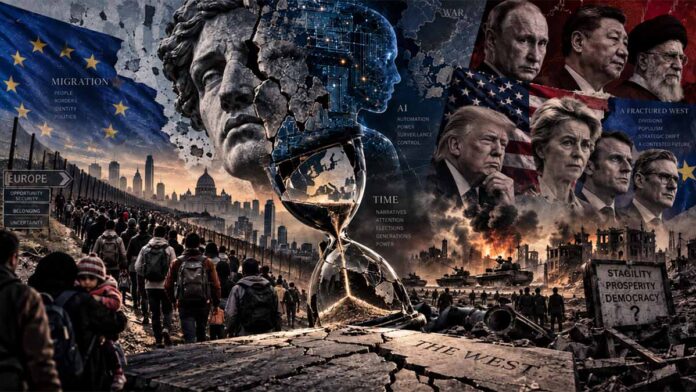

Scope: This assessment examines Europe, the United States, Russia, China, Japan and the Gulf-facing geopolitical system from the post-war period to September 2026, with particular attention to migration and Islam in Europe, changing definitions of “the West,” the strategic role of the United States, war and alliance structures, demographic transformation, finance, artificial intelligence and the wider proposition that control over time—political, financial, technological, demographic and military—has become an increasingly important dimension of state power, while adopting a five-year analytical horizon through 2031.
Executive Summary / BLUF
The strongest conclusion supported by the verified public record is that the West is experiencing a simultaneous crisis of strategic time, demographic time and political legitimacy rather than a simple civilisational confrontation between an indigenous Europe and an organised Muslim population seeking collectively to replace its culture, because migration, religious change, Islamist extremism, demographic ageing, secularisation, economic insecurity, technological acceleration and geopolitical rivalry are empirically real phenomena, but they operate through different mechanisms and cannot defensibly be collapsed into a single intentional project.
The proposition that “Muslims are invading Europe and imposing their religion” therefore requires analytical decomposition rather than repetition as fact, because official European evidence establishes substantial migration flows, growing Muslim communities in some states, difficult integration problems, episodes of Islamist radicalisation and a continuing jihadist terrorist threat, yet no competent European institution provides evidence that European Muslims constitute a unified political actor pursuing a coordinated programme to impose Islam on European societies; Europol instead distinguishes jihadist terrorism from right-wing, left-wing/anarchist, ethno-nationalist and other forms of terrorism, while the European Commission explicitly defines integration as a two-way process requiring adaptation by migrants and participation by host societies.
This distinction does not make the security or cohesion problem insignificant, because religion, migration, identity, foreign conflicts, segregation, competing normative systems and radical political entrepreneurs can interact inside European democracies, but the more defensible intelligence question is whether European states retain sufficient institutional capacity to integrate large and culturally heterogeneous populations while enforcing a common legal order, rather than whether one religious population possesses a collective plan to conquer Europe.
Europe’s demographic transformation is measurable and substantial: foreign citizens represented 9.4% of Italy’s resident population on 1 January 2026, France counted approximately 8.0 million immigrants, or 11.6% of its population, in 2025, Germany recorded 21.8 million people with an immigration history, representing 26.3% of the population living in private main-residence households, while England and Wales recorded 3.9 million residents identifying as Muslim, or 6.5% of the population, in the 2021 Census, although these figures are not directly comparable because nationality, immigrant origin and religious affiliation measure different phenomena.
At the same time, the available data contradict a narrative of mechanically accelerating migration pressure across every category, because first-time asylum applications in the European Union fell to 669,400 in 2025, 27% below the 2024 level, while 361,325 people received protection status during 2025, 18% fewer than in 2024, demonstrating that Europe is experiencing a structurally important migration phenomenon whose magnitude, composition and policy effects vary sharply over time rather than an uninterrupted exponential influx.
The Muslim question is also inseparable from the reverse integration problem—whether minorities themselves perceive the European system as equally accessible—because the EU Agency for Fundamental Rights reported that 47% of surveyed Muslim respondents across 13 EU states said they had experienced racial discrimination during the preceding five years, while 27% reported racist harassment over the same period, meaning that social fragmentation can be driven simultaneously by difficulties of integration, radicalisation within minorities, discrimination by majority populations and declining institutional trust rather than by a single directional cultural conflict.
The second controlling judgment is that the user’s intuition concerning time as a source of power is analytically valuable when converted from metaphor into measurable mechanisms, because banking transforms future income into present purchasing power through credit, monetary policy changes the price attached to deferred consumption and investment, governments borrow against future taxation, militaries exchange industrial time for readiness, demographic structures determine the future labour and fiscal base, and artificial intelligence compresses the interval separating information acquisition, calculation, decision and execution; the European Central Bank itself treats interest-rate transmission as the mechanism through which official rates propagate through loans, deposits, securities markets and the real economy, which provides a concrete institutional foundation for understanding finance as organised intertemporal allocation rather than merely as an exchange of money.
Artificial intelligence intensifies this temporal competition because it reduces the cost and duration of numerous cognitive operations while redistributing advantage toward economies capable of combining computational infrastructure, capital, skills, electricity, data and organisational adaptation; IMF research estimates that approximately 40% of global employment is exposed to AI, rising to about 60% in advanced economies, while emphasising that exposure can generate either displacement or productivity gains, meaning that states are increasingly competing not simply over territory or capital but over decision velocity and the capacity to convert technological acceleration into economic and strategic power.
The third controlling judgment is that the political meaning of “the West” is itself being renegotiated, because Europe increasingly occupies the uncomfortable position of being simultaneously a geopolitical ally of the United States, a partially autonomous economic pole, the primary territorial interface with Russia, a destination for migration from Africa and the Middle East, and an arena in which Washington, Moscow and domestic political movements compete over the definition of European sovereignty, identity and strategic responsibility.
This transformation is visible in the current American strategic record, because the 2026 United States National Defense Strategy identifies China rather than Europe as the principal long-term theatre requiring American military prioritisation, describes Russia as a “persistent but manageable threat” principally affecting NATO’s eastern members, and explicitly envisages adjusting American posture in Europe while requiring European allies to assume greater responsibility; Europe therefore remains inside the American alliance system, but Washington is increasingly treating European strategic time as a resource that cannot indefinitely displace the Indo-Pacific from the centre of US grand strategy.
The latest US National Security Strategy simultaneously demonstrates that Washington no longer treats transatlantic alignment as politically unconditional, because the November 2025 strategy describes Europe as strategically and culturally vital while openly criticising aspects of European political development and arguing that American diplomacy should encourage a European political and cultural revival, an unusually explicit indication that disagreements inside “the West” increasingly concern not merely expenditure and foreign policy but the definition of democracy, sovereignty, national identity and political legitimacy themselves.
Russia’s war against Ukraine remains a central mechanism accelerating this transformation, because it has militarised Europe’s eastern frontier, expanded defence requirements, strengthened some dimensions of Atlantic dependence while simultaneously generating pressure for European strategic autonomy, and transformed “the West” from a predominantly ideological-economic expression into an increasingly concrete security category; the United Nations General Assembly has repeatedly reaffirmed Ukraine’s sovereignty and territorial integrity following Russia’s full-scale invasion, while the conflict remained active in 2026 according to current US government reporting.
Japan provides an important corrective to simplistic East-versus-West classifications, although one historical point in the initial proposition requires correction, because contemporary Japan combines exceptionally persistent imperial and cultural traditions with a post-1945 constitutional order under which the Emperor is not constitutionally divine but “the symbol of the State and of the unity of the people,” deriving his position from popular sovereignty, while the 1946 imperial rescript explicitly rejected the idea that the Emperor was a living god; Japan consequently demonstrates how a society can preserve civilisational continuity while profoundly reconstructing sovereignty, military doctrine and international alignment after defeat.
The resulting geopolitical system is therefore better understood not as the replacement of one civilisation by another but as a competition among different temporal strategies: the United States attempts to preserve technological and alliance advantages while redirecting resources toward Asia; China pursues industrial scale and long-duration strategic accumulation; Russia accepts high present costs in pursuit of territorial and security objectives intended to reshape the future European balance; Gulf states convert hydrocarbon wealth into post-hydrocarbon capabilities; Japan combines institutional continuity with technological adaptation; and Europe attempts simultaneously to preserve welfare systems, manage demographic ageing, absorb migration, rearm, finance decarbonisation and remain competitive in an accelerating technological system.
The central strategic vulnerability of Europe is consequently not Islam, migration, Russia, America, China or AI considered separately, but a widening mismatch between the speed at which external and internal pressures accumulate and the speed at which European political systems can convert disagreement into enforceable, legitimate and durable decisions.
Time Is the New Balance of Power: Why the West’s Real Contest Is Over Speed, Capacity and Cohesion
The post-1945 Western order is not dividing neatly into “East” and “West”; it is being re-priced by time. The decisive question is whether states can convert demographic pressure, fiscal capacity, industrial production, technology and alliance commitments into usable power faster than their constraints accumulate. Italy recorded 355,000 births against 652,000 deaths in 2025; the IMF placed global public debt just under 94% of GDP in 2025; NATO now defines Russia as its most significant and direct threat; and Washington has tightened advanced-semiconductor controls on China. Power increasingly belongs to systems able to turn money, institutions and technology into capability before debt, ageing and political fragmentation consume the margin for action. ISTAT, Indicatori demografici – Anno 2025 IMF, Fiscal Monitor, April 2026
Europe is buying demographic stability at the price of a harder cohesion problem
About 440,000 arrivals from abroad and 144,000 departures produced a net migration gain of roughly 296,000 in Italy in 2025, almost exactly offsetting the natural population loss, while foreign residents reached 5.56 million, or 9.4% of the population, on 1 January 2026 and fertility fell to 1.14 children per woman. ISTAT, Indicatori demografici – Anno 2025 France counted about 7.97 million immigrants, or 11.6% of its population, in 2025; Germany reported 21.8 million people with an immigration history, equal to 26.3% of people in private main-residence households; and the 2021 Census counted 3.9 million Muslims in England and Wales, or 6.5%, while 37.2% declared no religion. INSEE, Population immigrée et étrangère en France Destatis, 2025 immigration-history data ONS, Religion, England and Wales: Census 2021
Europol recorded 58 terrorist attacks and 449 terrorism-related arrests in the EU in 2024 while separating jihadist, right-wing, left-wing/anarchist, ethno-nationalist and other terrorism; Britain’s CONTEST 2023 stated that Islamist terrorism had accounted for 67% of attacks since 2018 and about three-quarters of MI5’s terrorism caseload, yet Prevent statistics for October 2024 to September 2025 recorded 2,103 extreme-right referrals against 860 Islamist referrals. Europol, EU TE-SAT 2025 UK Home Office, CONTEST 2023 UK Home Office, Prevent statistics 2024–25 Europe’s problem is whether governments can isolate violent and anti-constitutional networks without converting religion or immigrant origin into a substitute for evidence.
Debt now determines how quickly strategy can become policy
The IMF’s April 2026 Fiscal Monitor placed global public debt just below 94% of GDP in 2025 and projected 100% by 2029, while Eurostat recorded first-quarter 2026 government debt at 138.9% of GDP in Italy and 117.6% in France. IMF, Fiscal Policy under Pressure Eurostat, quarterly government finance statistics Rome and Paris therefore enter the defence, infrastructure and technology race with more future fiscal capacity already committed, making the quality of each additional euro of borrowing more important than the headline size of the programme.
Germany has chosen to bring future capacity forward through a €500 billion special fund for infrastructure and climate-neutrality investment over 12 years, while exempting qualifying defence, civil-protection and intelligence expenditure above 1% of GDP from the normal debt-brake calculation. German Federal Government, Investitionsoffensive für das ganze Land The UK has chosen industrial permanence instead: the 2025 Defence Industrial Strategy and 2026 Defence Investment Plan provide for at least six new munitions and energetics factories and roughly £11 billion for munitions and weapons. UK Government, Defence Investment Plan Funding Explainer Both accept higher costs now because rebuilding capacity after a crisis begins takes longer than preserving it beforehand.
Finance moves in seconds; strategic capability still moves through factories
The ECB can make instant-payment funds available within 10 seconds, but NATO’s Updated Defence Production Action Plan still centres on predictable long-term demand, supply resilience and expanded manufacturing because financial velocity does not abolish production lead times. ECB, What are instant payments? NATO, Updated Defence Production Action Plan That is the transmission problem behind SAFE: up to €150 billion in EU-backed loans can be mobilised faster than ammunition plants, shipyards, semiconductor facilities, grids or skilled workforces can expand. Council of the EU, SAFE If new money creates new throughput, Europe gains power; if it merely competes for fixed output, Europe buys higher prices and longer queues.
AI is converting latency into a strategic asset
The IMF estimates that close to 40% of global employment and about 60% in advanced economies are exposed to AI, but the geopolitical issue is the compression of research, coding, logistics, analysis and decision cycles rather than the headline employment number. IMF, Gen-AI: Artificial Intelligence and the Future of Work The European Commission’s AI Continent Action Plan accordingly moves beyond regulation toward physical capacity, including at least 13 AI Factories and a proposed €20 billion InvestAI mobilisation for up to five AI Gigafactories. European Commission, AI Continent Action Plan AI power is now inseparable from electricity, chips, data centres and capital.
Washington is using the same logic offensively through supply-chain controls. In December 2024, the US Bureau of Industry and Security tightened restrictions on 24 categories of semiconductor-manufacturing equipment, three categories of software tools and high-bandwidth memory, followed by further measures in January and March 2025. US BIS, advanced-semiconductor controls The contest is over who controls the equipment and infrastructure that determine what can be built tomorrow.
America is redistributing the Western system while China builds around it
NATO’s 2022 Strategic Concept defines Russia as the Alliance’s most significant and direct threat while also identifying China’s ambitions and coercive policies as relevant to Allied security, linking the European and Indo-Pacific theatres without turning them into one front. NATO, 2022 Strategic Concept The February 2025 US-Japan Joint Leaders’ Statement then reaffirmed the American defence commitment to Japan, including nuclear capabilities, while welcoming Tokyo’s reinforcement of its own defence posture. White House, United States–Japan Joint Leaders’ Statement Washington’s model is burden redistribution inside an American-centred security network.
Its Global Security Initiative Concept Paper rejects bloc confrontation in official terms, while the Belt and Road Initiative relies on infrastructure, trade and connectivity rather than mutual-defence obligations. China MFA, Global Security Initiative Concept Paper State Council Information Office, BRI White Paper Saudi Arabia and the UAE make the binary even less useful: Saudi Vision 2030 reported real non-oil GDP of SAR 892 billion and a 51% private-sector share of GDP in 2025, while We the UAE 2031 targets AED 3 trillion of GDP, AED 800 billion of non-oil exports and AED 4 trillion of foreign trade. Saudi Vision 2030, Annual Report 2025 UAE Government, We the UAE 2031 Their objective is optionality across American security, Asian markets, global capital and regional diplomacy, not a clean transfer from West to East.
The next 24 months will expose the difference between announced ambition and usable power
Between September 2026 and September 2028, the decisive European test will be conversion rather than declaration: Italy must reconcile a 138.9% debt ratio with defence, infrastructure and demographic pressure; France must sustain strategic commitments from a 117.6% debt position; Germany must turn a €500 billion fund into delivered infrastructure; and Britain must convert its munitions programme into persistent output. Eurostat, quarterly government finance statistics German Federal Government, special infrastructure fund UK Government, Defence Investment Plan
The cost of inaction will fall on taxpayers through debt service, industry through procurement bottlenecks, armed forces through slower replenishment, and households through weaker growth. If European governments cannot convert fiscal resources into industrial, technological and military capability within that 24-month window, the external bill will be diplomatic: Washington will retain a larger share of security-setting power, China will preserve leverage through technological and infrastructure dependencies, and Gulf states will rationally continue diversifying around a Europe whose market remains large but whose capacity to translate economic weight into strategic effect remains incomplete.
TIME IS THE NEW BALANCE OF POWER
The post-1945 system is being re-priced through speed, capacity and endurance. Fiscal space, industrial output, demographic resilience, compute, alliance structures and supply-chain control now determine whether political ambition can be converted into usable power before constraints accumulate.
Money becomes power only after passing through a physical chain
Europe can mobilise financing far faster than it can produce ammunition, rebuild grids, expand semiconductor capacity or train specialist labour. The strategic divide is therefore no longer between spending and austerity alone, but between financial authorisation and the physical rate at which that authorisation becomes operational capacity.
Europe is buying population stability while absorbing a harder cohesion problem
Italy registered 355,000 births and 652,000 deaths in 2025, while international migration almost exactly offset the natural population decline. The structural dilemma is no longer whether migration matters, but whether demographic compensation can be converted into labour, tax capacity and civic integration faster than social fragmentation accumulates.
Compute is becoming strategic infrastructure
AI changes power by compressing selected cognitive processes, but the decisive assets remain physical: chips, electricity, data centres, cooling, networks and capital. Europe’s AI Factories and proposed Gigafactories acknowledge that regulatory sovereignty without computing capacity is incomplete sovereignty.
Washington has turned semiconductor access into a geopolitical instrument
US controls on advanced semiconductor equipment, software and high-bandwidth memory demonstrate that supply-chain chokepoints can now perform functions once associated primarily with military power. The contest is increasingly over who controls the systems from which future capability must be built.
Italy
- 138.9% public debt in Q1 2026.
- 1.14 children per woman in 2025.
- 5.56 million foreign residents at 1 January 2026.
- Problem: strategic acceleration under tight fiscal room.
France
- 117.6% public debt in Q1 2026.
- 7.97 million immigrants in 2025.
- Persistent sovereign defence-industrial ambition.
- Problem: autonomy competes with fiscal obligations.
Germany
- €500 billion infrastructure fund.
- 21.8 million people with immigration history in 2025.
- Debt-brake architecture partially re-engineered.
- Problem: compressing decades of deferred investment.
United Kingdom
- £11 billion for weapons and munitions.
- At least six new energetics and munitions factories.
- Industrial permanence replacing episodic procurement.
- Problem: turning rearmament into sustained output.
Washington is redistributing burden without abandoning the system
The emerging American model keeps deterrence and technological networks centred on the United States while requiring stronger regional allies. Europe is expected to carry more of its own territorial burden, while Japan becomes a harder Indo-Pacific security node.
The Euro-Atlantic relationship has shifted from competition to structural confrontation
NATO’s formal threat definition, force restructuring and eastern reinforcement imply a long-duration security contest even if active hostilities in Ukraine eventually diminish. The institutional baseline has changed more deeply than any single battlefield outcome.
Beijing is building alternative networks rather than a mirror image of NATO
Infrastructure, commerce, standards and connectivity give states additional options without requiring a formal mutual-defence bloc. The result is a system of competitive interdependence rather than clean separation.
Hybrid alignment is eroding the old East–West map
Japan combines profound cultural continuity with US security integration, while Saudi Arabia and the UAE diversify capital, industry and diplomatic partnerships across rival centres. Alignment is becoming modular: security can come from one partner, trade from another and technology from several.
The next test is execution, not declaration
Between September 2026 and September 2028, Europe’s credibility will depend on whether fiscal programmes, SAFE financing, infrastructure funds, AI capacity and defence investment produce measurable output. Announced resources that fail to shorten delivery cycles or raise productive capacity will preserve dependence even while nominal spending rises.
Who pays if conversion fails
Pillar I — The Internal West: Demography, Islam, Migration and the Contest over Social Cohesion
This pillar will distinguish migration from religion, Islam from Islamism, ordinary religious conservatism from constitutional conflict, terrorism from demographic change, integration failure from organised subversion and legitimate security concerns from unsupported collective-intent claims, while examining the institutional capacity of Italy, France, Germany, the United Kingdom and the European Union to maintain common legal norms within increasingly heterogeneous societies.
Pillar II — The Politics of Time: Credit, AI, Industrial Capacity and the Acceleration of Power
This pillar will examine the underlying thesis that modern power increasingly depends upon the ability to acquire, price, compress or defer time through banking, sovereign finance, technology, logistics, industrial production, artificial intelligence and military mobilisation, connecting the historical evolution of monetary systems and industrialisation with the emerging strategic importance of computational speed and decision latency.
Pillar III — The External West: America, Russia, China, Japan and the Recomposition of Global Order
This pillar will analyse how the post-1945 Western system is being transformed by changing American priorities, Russia’s confrontation with the Euro-Atlantic system, China’s accumulation of industrial and technological power, Japan’s distinctive fusion of historical continuity and Western alliance structures, Gulf diversification strategies and the increasingly inadequate binary distinction between “East” and “West.”
Master Abstract
The civilisational question is real, but its unit of analysis is frequently wrong
Europe is unquestionably changing, because its population is ageing, its native fertility is low, migration has become structurally important to population dynamics, religious composition is evolving, some urban districts display high concentrations of communities with non-European origins, Islamist extremist networks continue to pose security threats, and political disputes concerning religious symbols, education, gender, asylum, citizenship, family structures, freedom of expression and foreign conflicts have become increasingly consequential; nevertheless, converting these phenomena into the proposition that “Muslims are invading Europe in order to impose Islam” introduces a claim of collective intention for which the verified institutional record does not provide evidence, while simultaneously obscuring differences between legal migration, asylum, irregular migration, citizenship, ethnicity, religion, political Islam and jihadist terrorism.
European migration statistics themselves illustrate why analytical precision matters, because approximately 6.4% of the EU population in 2024 consisted of non-EU citizens and another 3.1% were citizens of another EU member state, while first-time asylum applications fell sharply during 2025, demonstrating that the foreign population of Europe is neither synonymous with asylum seekers nor with Muslims and that migration cannot be inferred from isolated images of irregular border crossings.
The institutional problem remains serious precisely because exaggerating it produces weak policy, since a government attempting to protect social cohesion requires information about who is entering, under which legal status, with what integration trajectory, whether radical networks exist, how second generations perform educationally and economically, where segregation occurs, whether extremist mobilisation is increasing, how criminality is distributed, whether deportation orders are enforceable and whether constitutional norms are respected; categorising several heterogeneous populations as a unified religious adversary would instead make it more difficult to distinguish individuals requiring protection, workers supporting ageing economies, integrated citizens, conservative religious communities, organised extremists and hostile foreign influence.
Europol’s terrorism reporting provides the appropriate security distinction because it treats jihadist terrorism as a specific extremist threat rather than treating Islam as the threat category, alongside right-wing, left-wing/anarchist, ethno-nationalist and separatist terrorism, thereby preserving the distinction between a religious population and a violent ideological subset that democratic security policy requires.
European migration is a strategic variable because European demography has already changed
Italy illustrates the demographic dimension particularly clearly, because ISTAT reported only 355,000 births against 652,000 deaths in 2025, fertility of 1.14 children per woman, immigration from abroad of approximately 440,000, emigration of approximately 144,000, and a resulting external migration balance of +296,000, while the foreign-resident population reached 5.56 million, or 9.4% of residents, on 1 January 2026; migration is therefore not an external issue separable from Italian demographic policy, because without positive international migration Italy’s population contraction and labour-force ageing would proceed substantially faster.
This does not mean that every migration level is economically optimal or socially sustainable, because aggregate demographic compensation does not establish successful integration, fiscal contribution, geographical distribution or compatibility between labour demand and migrant skills, while irregular arrivals impose different administrative and political pressures from planned employment migration; the strategic question for Italy is therefore not whether migration should be treated as intrinsically beneficial or intrinsically hostile, but whether the state can select, register, integrate, enforce and remove with sufficient institutional effectiveness to preserve both economic functionality and public confidence.
France presents a different model because immigration is embedded in a longer post-colonial and citizenship history, while French official statistics record approximately 8.0 million immigrants in 2025, equal to 11.6% of the population, and the Interior Ministry recorded nearly 4.5 million valid residence permits and provisional residence documents for third-country nationals at the end of 2025, an increase of 3.2% from the preceding year; because French population statistics and immigration statistics are not equivalent to religious statistics, these figures cannot legitimately be converted into a numerical estimate of Islam without changing datasets and definitions.
Germany’s demographic dependence on migration is still more structurally visible because Destatis reported approximately 21.8 million people with an immigration history in 2025, equivalent to 26.3% of the population in private main-residence households, while Germany’s total population nevertheless declined by approximately 110,000 during 2025 because net migration of about 235,000 was insufficient to offset a natural population deficit of approximately 352,000; migration therefore intersects directly with Germany’s ageing problem, labour supply, welfare financing and political cohesion.
The United Kingdom provides the clearest major-European official measurement of religion because England and Wales ask a voluntary census religion question, under which 46.2% identified as Christian, 37.2% reported no religion and 6.5%, approximately 3.9 million people, identified as Muslim in 2021, meaning that one of the most important changes in British identity is simultaneously the expansion of minority religions and the much larger secularisation of the historically Christian majority; an analysis focused exclusively on Islam would therefore miss one of the principal drivers of the transformation it seeks to explain.
The deeper Western problem is not simply diversity but the erosion of a common normative clock
Societies do not operate exclusively through formal law because they also depend upon expectations concerning family, authority, gender, obligation, privacy, religion, property, individual autonomy, collective responsibility and permissible speech, while large-scale migration can introduce populations whose inherited social expectations were formed under different institutional environments; when these expectations diverge faster than assimilation, institutional adaptation or intergenerational convergence can occur, political systems experience what can be described analytically as temporal desynchronisation, in which different communities inhabit the same territory while operating according to partially different inherited memories and expectations about the future.
This phenomenon does not uniquely concern Muslims, because the European dispute over identity also involves secularisation, Christianity, nationalism, liberal individualism, post-colonial memory, gender politics, intergenerational change and changing attitudes toward authority, while the increase in respondents declaring no religion in England and Wales illustrates that the older European religious order is being transformed from within even without migration.
The policy challenge therefore lies in identifying the non-negotiable institutional core around which pluralism can function—constitutional supremacy, equality before the law, freedom of conscience, lawful democratic participation, state monopoly over legitimate coercion and enforcement of criminal law—while allowing extensive cultural variation outside that core; failure on one side produces fragmented communities whose informal norms compete with public institutions, while failure on the other produces discriminatory systems that undermine minority identification with the state itself.
The European Commission’s current integration framework reflects precisely this reciprocal architecture by defining integration as a two-way process in which migrants are expected to make an active effort to integrate while host societies create the conditions enabling participation, a formulation that rejects both the proposition that host societies have no legitimate expectations and the opposite proposition that integration is solely a question of ethnic or religious conformity.
The United States has entered a different phase of its relationship with Europe
The post-1945 Atlantic order was never simply a geographical alliance because it embedded military protection, financial architecture, trade, technological standards, intelligence cooperation and a powerful American cultural model inside European reconstruction, yet the current US strategic record points toward a redistribution of responsibility rather than a repetition of the Cold War model.
The 2026 National Defense Strategy states that the Indo-Pacific is becoming the centre of gravity of the global economy and identifies maintaining a favourable military balance there as a central American objective, while describing Russia as a persistent but manageable threat whose principal military pressure falls upon Europe’s eastern states; Washington simultaneously commits to remaining engaged in Europe while emphasising that European NATO members possess economic, demographic and latent military resources substantially greater than Russia’s and should consequently assume a larger share of their own defence burden.
This represents a potentially profound temporal shift in transatlantic relations because the European security order built after 1945 was organised around persistent American strategic availability, whereas the emerging arrangement increasingly requires European governments to transform wealth into military capability within shorter timeframes while Washington reallocates attention toward China, homeland defence and the Indo-Pacific.
The result is not necessarily American withdrawal from Europe, because NATO remains a central component of American power projection and alliance geometry, but rather a transition from American provision of European strategic time toward American demand that Europe purchase more of that time itself through defence spending, industrial capacity and political responsibility.
Russia has transformed “the West” into a more explicit adversarial category
Russia’s confrontation with the Euro-Atlantic system has reinforced a geopolitical identity that was less coherent during the immediate post-Cold War period, because the war in Ukraine has connected European national security, NATO deterrence, sanctions, energy policy, defence industrial production and US power into a single strategic theatre.
NATO’s Strategic Concept defines Russia as the Alliance’s most significant and direct threat and describes the security environment as one of strategic competition, instability and recurrent shocks, while the UN General Assembly has repeatedly reaffirmed Ukraine’s sovereignty and territorial integrity following the Russian invasion, establishing the institutional baseline from which the European-Russian confrontation must be assessed.
Yet Russia’s strategic objective should not automatically be reduced to territorial conquest, because Moscow’s confrontation with Europe also concerns the distribution of military infrastructure, alliance boundaries, sanctions, regime legitimacy, historical narrative and the political definition of the post-Soviet space, while European and Russian official interpretations of these questions remain profoundly incompatible.
The wider consequence is that Europeans who previously understood “the West” primarily as an American geopolitical category increasingly find themselves directly incorporated into it through sanctions, arms deliveries, NATO deployments and Russian countermeasures, meaning that the distinction between Europe and the American-led West has become harder to sustain operationally even where political differences with Washington remain substantial.
Japan demonstrates why “East” and “West” are inadequate civilisational categories
Japan is particularly useful because its political development disproves any simple correspondence between geography, culture and geopolitical alignment, since it remains one of the world’s most historically continuous societies while simultaneously operating inside a constitutional and strategic system profoundly altered by defeat, American occupation and the post-war alliance.
The historical imperial system did formally assign the Emperor a sacred constitutional status under the Meiji Constitution, whose Article 3 described the Emperor as “sacred and inviolable,” but the post-war settlement fundamentally changed this arrangement, because the current Constitution derives the Emperor’s symbolic position from the sovereign will of the people while denying him governmental authority, and the 1946 imperial rescript rejected the proposition that the Emperor was a living divinity.
Japan therefore demonstrates that strategic modernisation need not produce complete cultural homogenisation, because a state can retain monarchy, ritual, linguistic continuity and distinctive social institutions while incorporating constitutional democracy, advanced capitalism, American military alignment and technological modernity, creating precisely the kind of hybrid civilisational structure that undermines rigid East-versus-West classification.
The particular linguistic claim that Japanese arigatō effectively means “I forgive you” and reflects the social uselessness created by receiving assistance is not established by the verified official sources examined for this assessment and will therefore not be adopted as a factual premise, although the broader proposition that language encodes different conceptions of obligation, hierarchy and reciprocity remains analytically relevant and can be examined through qualified linguistic evidence in the historical chapter rather than reproduced as an unsupported etymology.
Finance institutionalises the conversion of future time into present power
The relationship between banking and time is more than metaphorical because virtually every credit instrument reallocates resources between present and future periods, while the interest rate determines the price attached to that transfer and monetary policy affects the conditions through which households, corporations and governments can bring future purchasing power into present investment.
The European Central Bank explicitly monitors the transmission of official interest-rate changes through bank lending, deposits, securities markets and the real economy, demonstrating that control over the price and availability of credit influences investment timing, consumption, housing, industrial expansion and ultimately the distribution of economic capacity across time.
This mechanism becomes geopolitical when governments finance wars, industrial programmes, infrastructure or technological investment with debt because public borrowing effectively transfers part of the cost of present strategic decisions into future fiscal periods, meaning that sovereign creditworthiness determines how much future national income can be mobilised for present power without destabilising the financial system.
The same temporal mechanism explains why highly productive financial systems can accelerate national transformation while excessive leverage can undermine sovereignty, because credit expands the ability to act before accumulated savings would otherwise permit action, yet simultaneously creates future obligations whose servicing constrains later governments, households and firms.
Artificial intelligence changes power because it compresses decision time
Industrial power was historically built through the multiplication of physical output, whereas artificial intelligence introduces an additional dimension by reducing the duration and marginal cost of analysis, coding, modelling, translation, design, logistics optimisation, scientific search and administrative decision-making, meaning that economically relevant time itself becomes partially compressible.
IMF analysis estimates that approximately 40% of employment worldwide is exposed to AI, with the proportion rising toward 60% in advanced economies, but it explicitly warns that exposure is not identical to job destruction because AI can complement some workers while replacing tasks performed by others and can increase both productivity and inequality depending upon institutional adaptation.
This generates an emerging geopolitical hierarchy in which states possessing advanced semiconductors, computing infrastructure, reliable electricity, capital, specialised labour, large-scale data environments and institutions capable of implementing technological change can make scientific, commercial and military decisions faster than states lacking those capabilities; strategic competition consequently becomes partly a contest over latency, because the actor that can detect, interpret, decide and execute faster acquires advantages even when nominal resources appear comparable.
The political danger lies in a widening gap between technological time and democratic time, because algorithms, markets and information systems operate increasingly rapidly while legislation, judicial review, elections, coalition formation and social adaptation remain intentionally slower, creating a structural tension between the speed demanded by geopolitical competition and the deliberative procedures through which democratic legitimacy is produced.
The emerging contest is therefore over control of multiple clocks
The contemporary international system contains several different forms of strategic time operating simultaneously: demographic time, measured in generations and fertility structures; financial time, priced through interest rates and debt maturities; industrial time, determined by production capacity and supply chains; military time, determined by mobilisation, readiness and replacement rates; technological time, increasingly compressed through AI and automation; political time, constrained by elections and public legitimacy; and civilisational time, through which societies interpret historical continuity and collective identity.
The states most capable of aligning these clocks acquire a structural advantage, whereas states whose political systems move more slowly than their demographic, technological or security environment accumulate unresolved problems until adjustment becomes considerably more expensive.
Europe’s present predicament is unusually difficult because several clocks are moving against it simultaneously: population ageing increases fiscal burdens, migration changes social composition, war requires accelerated defence investment, energy transitions demand long-duration capital, US strategy increasingly demands European burden-sharing, technological competition rewards speed and scale, while European constitutional systems deliberately disperse authority among national governments, EU institutions, courts, parliaments and electorates.
The resulting confrontation is therefore not adequately described as Islam versus Christianity, East versus West or America versus Europe, because those categories capture parts of the conflict while missing the deeper strategic question: which political systems can preserve identity, legitimacy and social cohesion while adapting quickly enough to demographic, technological and geopolitical change without destroying the institutional principles they are attempting to defend.
Key Evidence Table
| Indicator | Value/status | Reference date | Definition/scope | Issuer | Exact source |
|---|---|---|---|---|---|
| EU residents holding non-EU citizenship | 6.4% | 2024 | Share of population resident in EU countries | Eurostat | Migration and asylum in Europe – 2025 edition |
| First-time EU asylum applications | 669,400; −27% YoY | 2025 | Non-EU citizens making first asylum application | Eurostat | 27% drop in first-time asylum applications in 2025 |
| EU protection grants | 361,325; −18% YoY | 2025 | Persons granted refugee, subsidiary or humanitarian status | Eurostat | Asylum decisions down by 18% in 2025 |
| Italy foreign resident population | 5.56 million; 9.4% | 1 Jan 2026 | Residents holding foreign citizenship | ISTAT | Indicatori demografici – Anno 2025 |
| Italy fertility rate | 1.14 children per woman | 2025 | Total fertility indicator | ISTAT | Indicatori demografici – Anno 2025 |
| Italy net international migration | +296,000 | 2025 | Immigration minus emigration | ISTAT | Indicatori demografici – Anno 2025 |
| France immigrant population | 7.97 million; 11.6% | 2025 | Persons born foreign abroad under INSEE definition | INSEE | Population immigrée et étrangère en France |
| French third-country residence documentation | 4.47 million | 31 Dec 2025 | Valid residence permits and provisional documents | French Interior Ministry | Les titres de séjour en 2025 |
| Germany population with immigration history | 21.8 million; 26.3% | 2025 | Migrated since 1950 or two immigrant parents | Destatis | 21,8 Millionen Menschen in Deutschland mit Einwanderungsgeschichte im Jahr 2025 |
| German net migration | +235,000 | 2025 | Net international migration | Destatis | Bevölkerung Deutschlands sinkt im Jahr 2025 um 0,1 % |
| England & Wales Muslim population | 3.9 million; 6.5% | 2021 Census | Self-identified religious affiliation | ONS | Religion, England and Wales: Census 2021 |
| England & Wales “No religion” | 22.2 million; 37.2% | 2021 Census | Voluntary religious-affiliation question | ONS | Religion, England and Wales: Census 2021 |
| Muslim respondents experiencing racial discrimination | 47% over five years | 2022 survey | Nearly 10,000 Muslims in 13 EU states | EU FRA | Being Muslim in the EU |
| EU terrorist-threat taxonomy | Jihadist, right-wing, left-wing/anarchist, ethno-nationalist/separatist and other | 2025 | Recorded terrorist attacks, arrests and judicial outcomes | Europol | European Union Terrorism Situation and Trend Report 2025 |
| Global employment exposed to AI | ≈40% | IMF analytical estimate | Exposure, not automatic displacement | IMF staff | Gen-AI: Artificial Intelligence and the Future of Work |
| Advanced-economy jobs exposed to AI | ≈60% | IMF analytical estimate | Exposure includes substitution and complementarity | IMF | AI Will Transform the Global Economy |
| US defence priority | Indo-Pacific balance and homeland defence increasingly prioritised; Europe remains important | 2026 | US defence-strategy hierarchy | US Department of Defense | 2026 National Defense Strategy |
| NATO assessment of Russia | Most significant and direct threat to Allied security | Current strategic framework | Euro-Atlantic security assessment | NATO | NATO 2022 Strategic Concept |
| Contemporary Japanese Emperor | Symbol of state and unity; authority derives from popular sovereignty | Current constitutional order | Articles 1–4 | National Diet Library | Constitution of Japan |
Principal Gaps and Watch Indicators
The first major collection gap concerns religious demography, because Europe does not possess a single harmonised official dataset measuring religion across all member states, while France, Germany, Italy and the United Kingdom use different statistical architectures; consequently, citizenship or immigrant-background statistics must not be transformed into estimates of Muslim population without additional evidence, and any subsequent chapter addressing the numerical development of Islam will preserve those definitional boundaries rather than constructing synthetic figures from nationality.
A second decisive indicator is the relationship between migration and second-generation integration, because the long-term political consequences of current inflows will depend less upon the number arriving in an individual year than upon educational outcomes, employment, residential segregation, language acquisition, intermarriage, citizenship, crime, political participation, religious practice and identification with the constitutional state during the following generation.
A third indicator concerns ideological extremism across communities, because the decisive security measure is not the size of any religious or ethnic population but the number, organisation, capability and social reach of actors willing to replace democratic law through coercion, violence or intimidation; Europol’s differentiated terrorism categories therefore provide a more operationally meaningful framework than demographic generalisation.
A fourth indicator is the American force and burden-sharing trajectory in Europe, because the 2026 National Defense Strategy establishes a clear strategic preference for greater European responsibility while prioritising the Indo-Pacific, meaning that changes in permanent US force posture, munitions allocation, nuclear arrangements, intelligence infrastructure, air and missile defence or enabling capabilities would materially alter Europe’s strategic autonomy calculation.
A fifth indicator is the industrial conversion rate of European defence expenditure, because political announcements and nominal budget increases matter strategically only when converted into ammunition, air defence, combat-ready formations, logistics, maintenance capacity, stockpiles and scalable industrial production; this issue will therefore require separation of expenditure authorisations from actual output in the dedicated military-industrial chapter.
A sixth indicator concerns AI diffusion rather than AI invention alone, because the strategic consequences of artificial intelligence will depend upon whether organisations can integrate it into production, defence, science and administration, while the IMF itself emphasises that technological exposure can produce divergent outcomes depending upon infrastructure, human capital and institutional readiness.
A seventh indicator is the relationship between demographic ageing and migration dependence, particularly in Italy and Germany, because migration becomes politically more contentious precisely when labour-force requirements increase while social trust concerning border management and integration declines; Italy’s 2025 natural balance of approximately 297,000 more deaths than births and Germany’s deficit of approximately 352,000 demonstrate the magnitude of the demographic pressure against which migration policy is being formulated.
A final indicator concerns the political meaning of “the West” itself, because Washington’s current strategy, NATO’s security architecture, Russian threat perceptions, European debates over strategic autonomy and the rise of competing domestic conceptions of sovereignty could produce either a more Europeanised Atlantic alliance or a deeper strategic divergence between European and American priorities during the period to 2031.
Open Official Record
The official record does not presently establish the existence of a coordinated Muslim strategy to conquer Europe or impose Islam collectively upon European societies, although it does establish substantial migration, difficult integration questions, Islamist extremist activity, terrorist threats and significant political disputes involving religion, identity and constitutional values; those propositions must remain separate unless documentary evidence establishes a causal relationship between them.
The official record also does not support treating foreign citizens, immigrants, asylum seekers and Muslims as interchangeable populations, because each category has a separate legal and statistical definition and because nationality frequently provides no reliable information about an individual’s religious affiliation.
The claim concerning the Japanese expression arigatō meaning in substance “I forgive you” has not been verified through authoritative Japanese institutional material and will therefore not be used as factual evidence unless a competent linguistic source can establish the proposed semantic history.
The proposition that contemporary Japanese society regards the Emperor as literally divine is incompatible with the current constitutional record, because the post-war Constitution defines the Emperor as the symbol of the state deriving his position from the sovereign will of the people, while the 1946 imperial declaration rejected the conception of the Emperor as a living deity.
The precise current Russian conceptual usage of “the West,” particularly the extent to which Moscow systematically conflates Europe, NATO, the European Union and the United States in different strategic contexts, requires a dedicated review of Kremlin presidential speeches, Foreign Ministry doctrinal statements, national-security documents and military-strategic texts rather than inference from political rhetoric, and it will therefore be treated as a separate evidentiary question in the geopolitical chapter.
The Internal West: Demography, Islam, Migration and the Contest over Social Cohesion
BLUF (Bottom Line Up Front): Disentangling empirical European demographic dynamics from ideological contestation requires rigorous taxonomic disaggregation across six essential analytical dyads: separating cross-border human mobility from faith; differentiating mainstream religious observance from political Islamism; isolating conservative theology from hostile constitutional friction; separating asymmetric terror violence from natural demographic reproduction; decoupling socioeconomic integration bottlenecks from deliberate institutional subversion; and shielding constitutional counter-extremism from uncorroborated collective-intent conspiracism. The systemic resilience of France, Germany, the United Kingdom, Italy, and the European Union rests upon their institutional capacity to defend the rule of law without abandoning liberal democratic norms.
Taxonomic Calibration: Disentangling Migration, Faith, and Ideology
Root Structural Vectors
Migratory flux is fundamentally a legal-spatial phenomenon governed by labor markets and border regimes, whereas religion represents private or communitarian conviction. Merging them into a single threat vector creates profound analytical failure, blinding policymakers to secular migrant assimilation and domestic generational developments.
Constitutional & Legal Friction
Confusing traditional social conservatism (e.g., gender roles, diet, family law views) with unconstitutional Islamism undermines proportional judicial deterrence. Constitutional courts protect conservative doctrine up to the strict threshold where civic supremacy and human rights statutes are directly contested or violated.
Threat Delineation & Subversion
Asymmetric terrorism requires targeted intelligence interdiction, whereas demographic transformation is an organic population trajectory. Treating natural cohort evolution as deliberate hostile infiltration creates erroneous collective-intent models that paralyze legitimate security surveillance and degrade social cohesion.
Primary Audited Taxonomy Matrix: Core Disaggregations
Direct systematic mapping of Pillar I analytical dichotomies, policy instruments, and constitutional impact factors.
| Dimension | Analytical Dyad | Phenomenological Definition | Constitutional Exposure | Policy Mechanism Required |
|---|---|---|---|---|
| DYAD-01 | Migration vs. Religion | Sovereign border movement vs. transcendent creed; crossing borders does not dictate theological orthodoxy. | Low directly; strictly administrative border & asylum law compliance. | Schengen screening, labor quotas, formal residency pathways. |
| DYAD-02 | Islam vs. Islamism | Personal spiritual practice vs. political-legal ideology seeking temporal supremacy over civil code. | Critical; challenge to democratic sovereignty and equality statutes. | Article 9/ECHR limits, anti-association bans, association transparency. |
| DYAD-03 | Religious Conservatism vs. Constitutional Conflict | Traditionalist moral codes compliant with civil laws vs. explicit nullification of state jurisprudence. | Moderate to High; tension over secular schooling, family courts, and equality. | Judicial boundary enforcement, secular curricula mandates, civic oaths. |
| DYAD-04 | Terrorism vs. Demographic Change | Violent extremist clandestine cells vs. generational fertility differentials and age pyramids. | Acute physical danger (terror) vs. systemic institutional adaptation (demography). | Targeted CT intelligence, kinetic interdiction, long-term public service adjustment. |
| DYAD-05 | Integration Failure vs. Organised Subversion | Labor, language, and housing bottlenecks vs. systematic infiltration of municipal institutions. | Welfare strain and marginalization vs. hostile parallel governance architectures. | Housing de-segregation, skills training vs. counter-espionage & domestic intelligence. |
| DYAD-06 | Security Concerns vs. Collective-Intent Claims | Empirical intelligence-based threat identification vs. unverified conspiratorial intentionality models. | Erosion of democratic trust and equal protection via unevidenced collective guilt. | Audited intelligence oversight, rigorous evidentiary thresholds in public communication. |
Comparative Institutional Capacity: Key Western Polities
Audited assessment of institutional capacity to preserve legal norms within increasingly heterogeneous societies.
| Jurisdiction | Constitutional Doctrine | Primary Cohesion Stressor | Institutional Enforcement Tool | Capacity Rating |
|---|---|---|---|---|
| FRANCE (République) | Strict Laïcité (1905 law), absolute civic universalism; rejection of communal ethnic categories. | Banlieue socioeconomic isolation, “séparatisme” challenges, street-level secularism disputes. | 2021 Anti-Separatism Law, dissolvement of radical associations, prefectural audits. | HIGH / RIGID (82/100) |
| GERMANY (Bundesrepublik) | Wehrhafte Demokratie (Fortified Democracy), cooperative state-church model (Staatskirchenrecht). | Foreign-funded clerical hierarchies (DITIB), parallel justice networks (Friedensrichter). | BfV monitoring of constitutional extremism, Vereinsverbot (associational bans). | HIGH / PROCEDURAL (79/100) |
| UNITED KINGDOM | Common Law pragmatism, historical pluralism, established church with multi-faith accommodation. | Sectarian local politics, contested school curricula, Sharia councils’ extra-legal reach. | CONTEST/Prevent framework, Charity Commission investigations, Equality Act 2010. | MODERATE / ADAPTIVE (72/100) |
| ITALY (Repubblica) | Art. 8 Constitution (Intesa framework), Concordat heritage, administrative expulsions focus. | Informal worship places (moschee clandestine), irregular labor informalities, lack of state Intesa. | CASA committee, rapid ministerial expulsions for public order risks (Art. 13 TUI). | MODERATE / FRAGMENTED (67/100) |
| EUROPEAN UNION | Charter of Fundamental Rights, subsidiarity in religion/education, supranational asylum law. | Asymmetric external border pressures, divergent member state integration paradigms. | Pact on Migration & Asylum, ECJ jurisprudence, EU Anti-Radicalisation coordinator. | SYSTEMIC CONSTRAINED (64/100) |
Deep Structural Breakdown: Vectors of Friction & Institutional Buffers
Analyzing why analytical collapsing of threat vectors damages state capacity and social equilibrium.
The Epistemological Fallacy
Conflating demographic shifts with coordinated subversion implies a single, homogeneous collective agency. In reality, migrant and Muslim communities in Europe feature extensive ethnic, linguistic, doctrinal, and political fragmentation (e.g., Maghrebi, Turkish, South Asian, Balkan, and Sub-Saharan communities often have competing interests).
The Integration Bottleneck
Failures in educational parity, labor market entry, and spatial housing distribution are frequently misread as ideological subversion. While structural exclusion fuels resentment, it stems primarily from economic bottlenecks and bureaucratic inertia rather than premeditated anti-constitutional mobilization.
Constitutional Safeguards
Western liberal democracies maintain robust statutory antibodies. The jurisprudence of the German Federal Constitutional Court, the French Conseil d’État, and the UK High Court demonstrates that illiberal political projects can be systematically contained through civil and penal codes without discarding fundamental rights.
Forensic Strategic Key Judgments
Synthesized intelligence conclusions for long-range planning and institutional doctrine.
Taxonomic Clarity is a National Security Precondition
Conflating lawful religious conservatism with deliberate constitutional subversion wastes critical intelligence resources and pushes moderate demographics into reactionary echo chambers.
Islamism is an Ideology, Not a Demographic Inevitability
Political Islamism operates as an organized cadre-based political movement. Its containment requires focused ideological, financial, and foreign-funding disruption, not broad demographic anxiety.
Integration Deficits Differ from Subversive Intent
Low civic participation and educational underperformance generally indicate municipal and integration failures rather than coordinated attempts to establish parallel political architectures.
Terrorism is an Asymmetric Tactic, Demography is an Organic Baseline
Extremist violence seeks polarization through low-probability, high-impact acts. Viewing ordinary birth and migration dynamics through a kinetic counter-terror lens leads to systemic overreaction.
Disproving Collective-Intent Claims Preserves Democratic Integrity
Theories of unified, covert civilizational substitution lack evidentiary verification. Legitimate security analysis must focus strictly on observed behavior, organized networks, and financial trails.
European Legal Norms Possess Sufficient Resilience
France, Germany, the UK, Italy, and the EU retain adequate constitutional instruments to defend the primacy of secular and civil legal frameworks, provided administrative willpower remains coherent.
Open Official Record Gaps
- Lack of disaggregated data separating socio-cultural religious identification from active commitment to political Islamism.
- Inconsistent tracking across EU states regarding foreign state subsidies and transnational influence operations directed at religious foundations.
- Empirical data scarcity on informal mediation bodies (such as unofficial arbitration panels) operating outside national judicial frameworks.
- Insufficient longitudinal data on the secularization rates of 3rd and 4th generation diaspora cohorts in Western urban centers.
Observable Watch Indicators (2026–2031)
The Internal West: Demography, Islam, Migration and the Contest over Social Cohesion
Principal Judgment
The internal transformation of Western Europe is substantial, measurable and politically consequential, but the verified record does not support reducing it to a single proposition of a Muslim population collectively “invading” Europe in order to impose Islam; the more defensible conclusion is that European states are confronting several processes that reinforce one another without being identical—large and historically unusual migration flows, demographic ageing among established populations, increasing religious and ethnic diversity, declining Christianity and accelerating secularisation, persistent Islamist radicalisation, geographically concentrated integration failures, discrimination affecting minorities, political polarisation around identity, and weakening confidence in the state's capacity to control entry, enforce removal decisions and maintain a common public order. The strategic issue is therefore not whether religious difference exists, because it plainly does, nor whether Islamist organisations and jihadist actors seek political transformation, because security authorities document that threat, but whether European institutions can distinguish Islam from Islamism, immigration from asylum, legal migration from irregular entry, religious conservatism from anti-constitutional mobilisation, and demographic change from organised subversion, while applying one legal order consistently enough to retain the confidence of both established populations and citizens of immigrant origin.
The scale of demographic change is sufficiently large that governments cannot dismiss public concern as imaginary, yet the same statistical evidence makes sweeping civilisational generalisations untenable, because Eurostat recorded approximately 669,400 first-time asylum applications in the EU during 2025, a decline of roughly 27% from 912,400 in 2024 and far below the 1.217 million applications registered at the 2015 peak, while the largest applicant nationalities in 2025 were Venezuelan, Afghan and Syrian, demonstrating simultaneously that asylum remains a major governance issue and that “migration,” “Muslim migration” and “asylum” are not interchangeable categories. Eurostat — 27% drop in first-time asylum applications in 2025 Eurostat — Asylum and temporary protection trends: 2014–2025
This distinction becomes even more important when security is considered, because Europol recorded 58 terrorist attacks in the European Union during 2024—34 completed, five failed and nineteen foiled—and 449 terrorism-related arrests across twenty Member States, while maintaining separate analytical categories for jihadist, right-wing, left-wing/anarchist, ethno-nationalist/separatist and other forms of terrorism; the institutional logic is crucial, because jihadism is treated as an ideological-security phenomenon rather than as an attribute of Muslims collectively, allowing authorities to recognise a real Islamist threat without converting religious affiliation into presumptive hostility. Europol — European Union Terrorism Situation and Trend Report 2025
The United Kingdom provides perhaps the clearest demonstration of the distinction between a serious Islamist threat and an unsupported population-wide allegation, because the British government's CONTEST 2023 counter-terrorism strategy stated that Islamist terrorism had accounted for 67% of attacks since 2018 and approximately three-quarters of MI5's terrorism caseload, while extreme-right terrorism represented approximately 22% of attacks, yet the more recent Prevent statistics for October 2024 to September 2025 recorded 2,103 referrals concerning extreme-right-wing radicalisation against 860 concerning Islamist extremism, with extreme-right cases constituting 42% of adopted Channel cases and Islamist cases 12%; the security record therefore establishes that Islamist terrorism is a major threat category while simultaneously showing that contemporary radicalisation cannot be understood through Islam alone. UK Home Office — CONTEST 2023 counter-terrorism strategy UK Home Office — Prevent statistics, October 2024 to September 2025
The central governance problem emerging from these figures is consequently one of institutional selectivity: the state must remain sufficiently liberal to protect peaceful religious practice and sufficiently strong to prevent religious, ideological or communal organisations from substituting coercive norms for public law, because indiscriminate repression erodes constitutional legitimacy while insufficient enforcement allows parallel authorities, extremist networks or intimidation to occupy spaces abandoned by public institutions.
Europe Is Experiencing Demographic Transformation, but the Categories Matter
The population structure of Europe is being altered by two movements operating simultaneously: migration is increasing the relative weight of populations originating outside Europe while low fertility and ageing are reducing the rate of natural replacement among established populations, yet the magnitude and political significance of this transformation differ substantially between countries and cannot be measured responsibly by taking nationality, immigrant origin and religious affiliation as synonyms.
Italy demonstrates the demographic mechanism with unusual clarity, because ISTAT recorded only 355,000 births against 652,000 deaths in 2025, producing a natural balance of approximately −296,000, while immigration from abroad reached approximately 440,000 and emigration 144,000, giving an international migration balance of +296,000 that almost exactly offset the country's natural population loss; on 1 January 2026, Italy contained approximately 5.56 million foreign citizens, representing 9.4% of the resident population, while the fertility rate had fallen to 1.14 children per woman, meaning that migration is no longer a marginal phenomenon superimposed upon an otherwise stable demographic system but one of the principal variables determining whether the Italian population contracts, stabilises or changes composition. ISTAT — Indicatori demografici, anno 2025
The same Italian statistics reveal why the issue cannot be described only through aggregate national percentages, because 58.1% of foreign residents live in northern Italy, where foreigners represent 11.7% of the population, compared with 11.5% in central Italy and only 5.0% in the Mezzogiorno, meaning that integration pressure, school composition, housing demand, labour-market dependence and political perception are geographically uneven even inside the same state; furthermore, ISTAT recorded approximately 196,000 acquisitions of Italian citizenship during 2025, including around 26,000 by former Albanian citizens and 23,000 by former Moroccan citizens, which demonstrates that the categories “Italian” and “immigrant” themselves change through naturalisation and cannot be treated as permanently separate demographic blocs. ISTAT — Indicatori demografici, anno 2025
The administrative picture is also different from the demographic stock, because maritime irregular arrivals constitute only one component of migration into Italy, and the Italian Interior Ministry's continuously updated statistical dashboard separately reports sea arrivals and reception-centre populations rather than treating them as equivalent to total immigration; this matters analytically because highly visible Mediterranean crossings can dominate political perception while legal work, family, study and intra-European movements contribute differently to the actual resident population. Italian Ministry of the Interior — Sbarchi e accoglienza dei migranti: tutti i dati
Italy therefore faces a genuine strategic contradiction: demographic decline increases the economic value of immigration at precisely the moment when irregular migration, integration difficulties and uncertainty about the cultural consequences of large-scale inflows reduce political tolerance for it, creating a situation in which neither unrestricted migration nor a simple zero-migration doctrine addresses the country's underlying demographic arithmetic.
France: Islam, Secularisation and the Republican State
France represents the most developed European laboratory of the conflict between a universalist republican conception of citizenship and the realities of large-scale post-colonial religious and demographic diversity, because French law deliberately avoids constructing political citizenship around ethnic or confessional communities while French society nevertheless contains substantial populations whose religious identity and migration history remain socially important.
The demographic baseline is substantial: according to INSEE's 2025 provisional figures, approximately 7.97 million immigrants lived in France, representing 11.6% of the population, while roughly 6.3 million foreign nationals represented 9.1% of the population, and approximately 2.6 million immigrants had acquired French citizenship; the distinction is essential because an immigrant who becomes French remains an immigrant under INSEE's birthplace-based definition, whereas a French-born child of immigrants is no longer statistically classified as an immigrant, meaning that “immigrant,” “foreigner,” “French citizen” and “Muslim” measure different dimensions of social reality. INSEE — Population immigrée et étrangère en France, données 1921–2025
France is one of the few major European states for which an official statistical investigation provides a reasonably rigorous religious estimate, but even that estimate must be used carefully, because the INSEE/INED TeO2 survey covering metropolitan France's population aged 18–59 in 2019–2020 found that 51% reported no religion, 29% identified as Catholic, 10% as Muslim and approximately 9% with another Christian religion, meaning that Islam was the country's second-largest declared religion within the survey universe but existed within a society whose single largest religious category had become non-affiliation rather than another organised faith. INSEE — Religious diversity in France: intergenerational transmissions and practices by origins
That same official study identified a major difference in intergenerational religious persistence, because approximately 91% of respondents raised in Muslim families continued to identify with their parents' religion, compared with 84% among Jews, 67% among Catholics and 69% among other Christians, while regular attendance at a place of worship remained above 20% among Muslims, other Christians and Buddhists but only 8% among Catholics; these findings matter because France's transformation is not simply the result of immigration but of the interaction between immigration and different rates of religious transmission, while simultaneously occurring in a majority environment undergoing rapid secularisation. INSEE — Religious diversity in France: intergenerational transmissions and practices by origins
The French constitutional response is not religious neutrality in the colloquial sense of removing religion from society, but a specific legal architecture of laïcité, because Article 1 of the Constitution defines France as an “indivisible, secular, democratic and social Republic,” guarantees equality before the law without distinction of origin, race or religion, and declares respect for all beliefs, while the 1905 law on separation of Churches and State guarantees freedom of conscience and free exercise of religion subject to public-order restrictions while establishing the non-recognition and non-subsidisation of religions by the Republic. Légifrance — Constitution of 4 October 1958, Article 1 Légifrance — Law of 9 December 1905 concerning separation of Churches and State
The resulting French conflict is therefore particularly acute because both sides of the constitutional balance are legally protected: Muslims possess the same freedom of conscience and worship as Catholics, Jews, Protestants, atheists and other citizens, while no religious group possesses a constitutional right to replace republican law with religious jurisdiction, to override equality before the law or to claim sovereign authority over part of the citizenry; the strategic challenge lies not in abolishing religious difference but in ensuring that religious affiliation remains nested inside the Republic rather than becoming an alternative source of political sovereignty.
France's case also demonstrates why secularisation must remain inside the analysis, because a narrative in which an unchanged Christian France simply encounters a growing Muslim minority misses half of the transformation: INSEE finds that 51% of 18–59-year-olds in metropolitan France declared no religion in 2019–2020, meaning that the inherited Christian cultural framework has itself weakened substantially, creating a vacuum in which disputes over Islam are occurring at the same moment as established religious affiliation is declining among much of the historic majority population. INSEE — Religious diversity in France
This produces an asymmetry with potentially important long-term consequences, because relatively strong intergenerational religious transmission inside Muslim families is occurring alongside much weaker Catholic transmission and widespread secularisation, yet the available official evidence cannot by itself establish what this means for political allegiance, adherence to republican law or future religious practice, and any projection from religion into political behaviour would therefore require additional evidence rather than demographic extrapolation.
Germany: Immigration Has Become Structural Rather Than Exceptional
Germany has moved further than any of the other continental states examined here toward a demographic condition in which immigration history is no longer a minority phenomenon, because Destatis recorded approximately 21.8 million people with an immigration history in 2025, representing 26.3% of people living in private main-residence households, compared with 16.0% in 2005, while more than one-third of 25–34-year-olds—36%—had an immigration history, against only 14% of those aged over 65; this age distribution means that the social composition visible among younger generations already differs substantially from that of older Germany and will increasingly shape schools, workplaces, electoral politics and urban life. Destatis — 21.8 million people with an immigration history in Germany in 2025
The demographic dependence on migration is equally significant, because Destatis reported that the average population living in private households declined only slightly during 2025 and stated that without the increasing population with an immigration history the reduction would have been approximately 478,000 people rather than 38,000, demonstrating that migration is functioning simultaneously as a source of social transformation and as a compensating mechanism against demographic contraction. Destatis — Population with immigration history, 2025 results
Germany also illustrates the danger of pretending that official religious statistics are more precise than they actually are, because Destatis explicitly states that it does not publish regular comprehensive statistics on religious affiliation and that the 2022 census administrative information principally captured membership of public-law religious corporations such as the Catholic and Protestant churches, while information on Islam comes instead from the Federal Ministry of the Interior and associated research; the correct official benchmark therefore remains the Federal Office for Migration and Refugees' Muslim Life in Germany 2020 study, which estimated 5.3–5.6 million Muslims with migration backgrounds from predominantly Muslim countries, equivalent to approximately 6.4–6.7% of Germany's total population in 2019. Destatis — Official information on religious-affiliation statistics BAMF — Muslim Life in Germany 2020
The BAMF study also complicates attempts to describe Germany's Muslim population as culturally homogeneous, because it found a population drawn from increasingly diverse origins while reporting that approximately 82% of surveyed Muslims described themselves as very or somewhat religious, and that around 70% of Muslim women and girls did not wear a headscarf; the same population can therefore exhibit relatively high levels of religious identification while remaining highly diverse in visible practice, origin and individual behaviour, which makes collective political inference from religious affiliation unreliable. BAMF — Muslim Life in Germany 2020, core findings
Germany's constitutional structure establishes a clear legal hierarchy for managing this diversity, because Article 4 of the Basic Law declares freedom of faith, conscience and religious or philosophical creed inviolable and guarantees undisturbed religious practice, while Article 3 prohibits advantage or disadvantage because of faith or religious opinions; religious liberty is therefore a constitutional right, but it operates inside the Basic Law rather than above it, and freedom of teaching itself does not release anyone from allegiance to the constitutional order. Federal Ministry of Justice — Basic Law for the Federal Republic of Germany
The German strategic problem is accordingly not whether Islam can legally exist inside Germany, because the constitutional answer is unequivocally yes, but whether a society in which more than one-quarter of the population already has an immigration history can maintain sufficient linguistic, educational, economic and constitutional convergence that differences in origin do not harden into durable parallel political communities.
Italy: The State Has Demographic Dependence Without a Clear Religious Census
Italy presents a different challenge because migration has become essential to demographic stability while the state possesses much weaker official statistics on religious affiliation than France or the United Kingdom, making it particularly important not to derive Muslim-population figures simply from Moroccan, Bangladeshi, Pakistani, Egyptian, Albanian or other nationalities, because nationality does not establish religion and naturalisation further weakens that inference.
What can be stated securely is that foreign citizens represented 9.4% of the resident population at the beginning of 2026, that Italy experienced a natural population loss of approximately 296,000 in 2025, that international migration added approximately the same number, and that one in eight children born during 2025 had foreign citizenship; these figures demonstrate that immigration is already embedded in Italy's demographic reproduction while leaving unanswered the separate question of religious composition. ISTAT — Indicatori demografici, anno 2025
The Italian constitutional settlement is nevertheless unusually explicit about the relationship between religion and public law, because Article 3 establishes equal social dignity and equality before the law without distinction of religion, Article 8 declares all religious denominations equally free before the law while allowing non-Catholic denominations to organise according to their own statutes only insofar as those statutes do not conflict with the Italian legal order, and Article 19 protects the right to profess, propagate and practise religion individually or collectively, publicly or privately, subject to the constitutional limits specified by law. Italian Senate — Constitution, Article 3 Italian Senate — Constitution, Article 8 Italian Senate — Constitution, Article 19
This produces a useful institutional principle for the broader European debate: religious pluralism is constitutionally protected, but legal pluralism is not unlimited, because religious organisations may maintain doctrine, worship, internal organisation and communal life while remaining subordinate to the sovereign legal order where their rules conflict with national law; the distinction between cultural autonomy and competing sovereignty is therefore already embedded in Italian constitutional doctrine and does not require the state to choose between religious freedom and institutional supremacy.
Italy's principal weakness lies elsewhere, in the gap between constitutional clarity and implementation capacity, because the country's ability to control irregular entry, process asylum claims, return persons without a lawful right to remain, integrate legal migrants, distribute migration geographically and enforce common standards across schools, municipalities and communities ultimately determines whether demographic diversity becomes manageable incorporation or a source of political delegitimation.
The United Kingdom: A More Explicit Measurement of Religion and Extremism
The United Kingdom provides an unusually detailed picture because the census directly asks about religious affiliation, allowing demographic claims to be separated more cleanly from nationality and immigration status than in several continental states; according to the 2021 Census for England and Wales, approximately 3.9 million people identified as Muslim, representing 6.5% of the population, up from 2.7 million or 4.9% in 2011, while 27.5 million people or 46.2% identified as Christian and 22.2 million or 37.2% declared no religion, compared with 25.2% declaring no religion a decade earlier. Office for National Statistics — Religion, England and Wales: Census 2021
The British evidence therefore confirms two transformations occurring simultaneously rather than one: the Muslim population is increasing both numerically and proportionally, while the historically Christian majority is secularising at extraordinary speed, meaning that the long-term transformation of British identity cannot responsibly be described solely as the demographic advance of Islam because the retreat of organised Christianity is itself numerically larger and independently important.
The demographic structure also matters because ONS data show that the Muslim population is younger than the overall population, meaning that its proportional weight will evolve through age structure as well as immigration and fertility, although the precise future share cannot be inferred from age composition alone because intermarriage, religious switching, emigration, fertility convergence and future immigration policies remain uncertain. Office for National Statistics — Religion by age and sex, England and Wales
Recent migration trends also demonstrate why political perceptions frequently lag behind rapidly changing flows, because ONS estimated that UK long-term net migration fell to approximately 171,000 in the year ending December 2025, down from an updated 331,000 during the preceding year and dramatically below the approximately 944,000 peak reached in the year ending March 2023, with the reduction driven principally by lower non-EU work-related immigration; immigration policy therefore has demonstrated an ability to alter flows materially within a relatively short period, contradicting both the claim that mass migration is mechanically irreversible and the opposite claim that demographic effects disappear immediately when annual flows decline. Office for National Statistics — Long-term international migration, year ending December 2025
The security picture remains severe enough that it cannot be dismissed as merely an integration debate, because the British government states in CONTEST 2023 that Islamist terrorism has represented the majority of terrorist attacks since 2018 and approximately three-quarters of MI5's terrorism caseload, while Daesh and al-Qaida continue to seek to inspire, facilitate or organise attacks; however, the same government distinguishes this threat from Islam as a religion and from the British Muslim population as a whole, while its most recent Prevent statistics record extreme-right-wing radicalisation as the largest identified ideological referral category. UK Home Office — CONTEST 2023 UK Home Office — Prevent statistics, October 2024 to September 2025
British law likewise protects religion rather than privileging a secular majority against religious minorities, because the Equality Act 2010 treats religion or belief—including lack of religion or belief—as a protected characteristic and explicitly recognises Islam among religions covered by that protection, while requiring beliefs claiming legal protection to remain compatible with human dignity and the fundamental rights of others; the operative principle is therefore religious equality under law rather than religious immunity from law. UK Legislation — Equality Act 2010, explanatory notes on religion or belief
Islam Is Not Islamism, and Religious Conservatism Is Not Terrorism
Any intelligence-grade assessment of the European Muslim question must preserve at least four separate categories, because collapsing them produces both analytical error and operational failure.
Islam is a religion encompassing diverse theological, national, linguistic and political communities whose members range from highly observant believers to nominal or culturally Muslim individuals; Islamism refers to political projects seeking to organise society or the state according to interpretations of Islamic principles; jihadism is the revolutionary violent subset that legitimises armed struggle and terrorism in pursuit of ideological objectives; and ordinary religious conservatism can involve strict beliefs concerning family, dress, sexuality, gender or worship without necessarily entailing violence, rejection of citizenship or an attempt to overthrow constitutional government.
European and British counter-terrorism systems themselves rely upon these distinctions because Europol separately classifies jihadist terrorism from other terrorist ideologies, while the British Prevent system distinguishes Islamist extremism from extreme-right-wing extremism, incel ideology, fascination with mass violence and cases where no coherent ideology is identified; this institutional taxonomy would make little sense if Muslim religious affiliation itself were treated as equivalent to an extremist security status. Europol — EU TE-SAT 2025 UK Home Office — Prevent statistics, October 2024 to September 2025
The distinction must nevertheless not become an excuse for underestimating the political challenge posed by non-violent anti-liberal ideologies, because a movement need not conduct terrorism to challenge constitutional cohesion; political organisations can seek communal separation, discourage integration, exert informal coercion over women or dissidents, delegitimise national institutions, exploit foreign funding or cultivate identities fundamentally opposed to liberal-democratic norms without crossing the threshold into terrorist violence, and these phenomena require different legal and policy instruments from counter-terrorism even when they arise from overlapping ideological ecosystems.
The decisive test is therefore not whether a belief is unfamiliar, conservative or religious, but whether individuals and organisations respect the sovereign legal order, the rights of others and peaceful democratic competition; an observant Muslim who demands the right to worship, wear religious clothing or educate children within the law presents a constitutional-liberty question, whereas an organisation seeking through intimidation or coercion to impose religious norms upon unwilling citizens presents a public-order and potentially security question.
Social Cohesion Fails from More Than One Direction
European cohesion can deteriorate when minorities refuse integration, but it can also deteriorate when host societies close legitimate routes to participation, because integration depends upon both adherence to common institutions and credible access to those institutions; the European Commission therefore defines successful integration explicitly as a two-way process in which migrants make an active effort to integrate while host communities create conditions enabling full participation, rather than defining it as either unilateral assimilation or unilateral accommodation. European Commission — EU integration policy and Action Plan 2021–2027
Evidence collected by the EU Agency for Fundamental Rights demonstrates that the minority side of this legitimacy equation cannot be ignored, because its 2022 survey of almost 10,000 Muslims across thirteen EU countries found that 47% reported racial discrimination during the preceding five years and 35% during the preceding twelve months, while 27% reported racist harassment and 4% a racist attack over five years; Germany registered among the highest reported discrimination levels, with 68% of Muslim respondents reporting racial discrimination over five years, although these are survey experiences rather than direct measurements of discriminatory acts and therefore must be interpreted accordingly. EU Agency for Fundamental Rights — Being Muslim in the EU
The same survey found particularly high exposure among younger Muslim women wearing religious clothing when seeking employment, illustrating how visible religious identity can become an economic-integration variable; if minorities conclude that educational success, lawful behaviour and citizenship do not produce equal access to employment, housing or public respect, identification with national institutions can weaken, while if established populations conclude that migrants receive protection without corresponding obligations to integrate or respect common norms, their confidence in the same institutions can also deteriorate. EU Agency for Fundamental Rights — Being Muslim in the EU, key findings
This creates a potentially self-reinforcing cycle in which segregation strengthens prejudice, prejudice strengthens communal retreat, communal retreat reduces everyday social contact, reduced contact increases mutual suspicion, extremist entrepreneurs gain audiences on both sides, and governments then face pressure for measures that either appear insufficient to the majority or discriminatory to minorities; social cohesion therefore depends not upon eliminating difference but upon preventing difference from becoming institutionally self-sealing.
Europe's Constitutional Settlement Protects Religion but Not Rival Sovereignty
Despite very different histories, the European constitutional systems examined here converge around a remarkably similar principle: religion is protected as a matter of individual and collective liberty, but religious authority does not possess sovereign standing above democratic law.
At EU level, Article 10 of the Charter of Fundamental Rights of the European Union guarantees freedom of thought, conscience and religion, including the freedom to change religion and to manifest religion individually or collectively, publicly or privately, while Article 21 prohibits discrimination on grounds including religion or belief; these protections therefore encompass Muslims, Christians, Jews, other believers, converts and non-believers rather than defining Europe as constitutionally Christian or constitutionally atheist. EUR-Lex — Charter of Fundamental Rights, Article 10 EUR-Lex — Charter of Fundamental Rights, Article 21
France expresses the principle through republican laïcité, Germany through inviolable freedom of faith within the Basic Law, Italy through equal freedom of religious denominations subject to the Italian legal order, and Britain through equality and human-rights legislation, meaning that no one of these systems requires abandoning religious pluralism in order to preserve constitutional supremacy; what they require is a distinction between freedom to believe and a claimed authority to govern others outside the common law.
This distinction is the central institutional answer to the fear that migration allows imported cultural rules to override European social norms, because the legitimate response is neither to pretend conflicts never occur nor to treat an entire religious category as an enemy, but to identify which behaviours actually conflict with criminal law, equality requirements, compulsory education, child protection, public order, democratic sovereignty or the rights of other individuals and then enforce those rules consistently regardless of whether the actor invokes religion, ideology, tradition or political conviction.
The New EU Migration Regime Changes the Institutional Question
The European Union entered a materially different migration-governance phase on 12 June 2026, when the principal legislation of the Pact on Migration and Asylum entered into application after its adoption by the Council in May 2024, establishing a new architecture covering Eurodac, screening and border management, reception, asylum procedures, returns, responsibility allocation, solidarity and contingency mechanisms; the Pact therefore represents an explicit institutional acknowledgment that the previous European asylum architecture had become politically and operationally inadequate. Council of the European Union — Pact on Migration and Asylum European Commission — Implementing the Pact on Migration and Asylum
The significance of this change is strategic rather than merely administrative, because European social cohesion increasingly depends upon the state demonstrating that admission, protection and removal are governed by enforceable rules rather than by the accident of successful border crossing; a migration system perceived as incapable of distinguishing refugees from inadmissible applicants, legal entrants from irregular entrants or temporary protection from permanent residence undermines confidence in immigration even when the overall economic case for selected migration remains strong.
The new Pact will therefore have to be judged not by its legislative sophistication but by measurable implementation outcomes: whether external-border screening occurs consistently, asylum decisions become faster, return procedures become operationally effective, responsibility is distributed without recreating uncontrolled secondary movement, solidarity mechanisms function during pressure events and fundamental-rights protections survive accelerated procedures.
There Is No Verified Evidence of a Unified Muslim Project to Conquer Europe
The most politically charged proposition in the original thesis must therefore be addressed directly rather than evaded: the public official record reviewed for this chapter does not establish that European Muslims constitute a unified actor pursuing a coordinated strategy to “invade” Europe and impose Islam upon European society, and no competent EU or national authority examined here describes Europe's Muslim population in those terms.
What the record does establish is materially more complex and still serious: Muslim populations have grown in several major European states; some Muslim communities display relatively high levels of religious continuity; Islamist ideologies exist and can oppose liberal-democratic norms; jihadist organisations continue to advocate and facilitate violence against European states; foreign religious and political influence can operate through transnational networks; integration outcomes are uneven; discrimination remains substantial; residential and educational segregation can become persistent; and poorly controlled migration can weaken confidence in governments and intensify identity politics.
Analytical discipline requires refusing to merge these propositions into a single intentional conspiracy, because a demographic trend is not proof of political coordination, high religious retention is not proof of constitutional disloyalty, conservative morality is not terrorism, Islamist activism is not representative of every Muslim, asylum flows are not synonymous with Muslim migration, and extremist violence is not an indicator of the intentions of millions of ordinary believers.
At the same time, the opposite analytical error would be to interpret the absence of a unified conspiracy as evidence that no civilisational or institutional conflict exists, because differences concerning religion, gender, family authority, blasphemy, apostasy, homosexuality, education, dress, community leadership and the relationship between divine and secular law can produce genuine friction inside liberal societies; the governing question is therefore whether such differences remain matters of private belief and democratic argument or become mechanisms for coercing individuals and challenging the authority of common law.
The Deeper Conflict Is Over the Meaning of Freedom
The confrontation is ultimately connected to the broader historical thesis concerning Western freedom, because European liberal systems emerged from a complex combination of Roman law, Christianity, Enlightenment universalism, national sovereignty and social citizenship, while American political culture developed a particularly powerful conception of individual liberty and limitations upon state authority, yet neither Europe nor the United States is internally homogeneous enough to sustain a simple binary between “European social freedom” and “American individual freedom.”
The migration debate exposes this problem because liberalism must answer a difficult question embedded inside its own principles: how much cultural difference can a liberal society tolerate before toleration begins to weaken the conditions that make toleration possible? The constitutional answers examined above suggest that the decisive line lies not at religious difference itself but at coercion, inequality before the law, violence, intimidation, institutional separatism and attempts to convert communal authority into competing sovereignty.
European governments therefore face a double obligation that is politically difficult precisely because each side is tempted to recognise only half of it: they must protect Muslims who obey the law from discrimination, collective punishment and arbitrary exclusion, while at the same time protecting Muslim dissidents, women, converts, secular citizens and the wider population from coercive practices justified in the name of religion; a liberal state that protects only communities but not individuals risks empowering informal communal authorities, while a state that protects only majoritarian identity risks abandoning its own principle of equal citizenship.
The Strategic Variable Is the Speed of Integration Relative to the Speed of Demographic Change
The connection with the broader theme of time becomes clearest at this point, because migration itself does not determine political outcomes independently of the rate at which institutions absorb demographic change; the same annual inflow can produce different consequences depending upon the speed of language acquisition, employment, school integration, residential dispersion, citizenship, intermarriage, political participation and convergence around constitutional norms.
If demographic change occurs more rapidly than institutions can integrate newcomers, a temporal mismatch develops in which schools, housing systems, labour markets, municipal authorities and security services confront concentrations of cultural difference faster than common norms can form, increasing the probability of parallel social networks, communal brokerage and political backlash; if integration proceeds more rapidly than population turnover, the same demographic change can become progressively less politically disruptive because descendants cease to function socially as newly arrived populations.
The national cases reveal different positions along this continuum: Italy is entering deeper demographic dependence on immigration while still possessing a smaller foreign-origin share than Germany; France combines long-established post-colonial Muslim communities with an unusually strong secular republican model and unusually strong religious continuity among Muslim families; Germany already has an immigration-history population exceeding one-quarter of the relevant population and more than one-third among 25–34-year-olds; and England and Wales combine an identifiable Muslim population of 6.5% in 2021 with extraordinarily rapid secularisation of the historically Christian majority. ISTAT — Italian demographic indicators 2025 INSEE — Religious diversity in France Destatis — Immigration history in Germany, 2025 ONS — Religion, England and Wales: Census 2021
The relevant strategic threshold is consequently not a predetermined percentage of Muslims or immigrants beyond which cohesion automatically collapses, because no defensible official evidence establishes such a universal threshold; the threshold is institutional and relational, arising when the state's capacity to enforce law, provide education, distribute housing, integrate labour, prevent extremist recruitment and maintain public confidence becomes weaker than the pressures generated by demographic and cultural change.
Country Comparison
| Variable | Italy | France | Germany | United Kingdom |
|---|---|---|---|---|
| Principal current demographic measure | 5.56m foreign citizens; 9.4% of population, 1 Jan 2026 | 7.97m immigrants; 11.6% of population, 2025 | 21.8m with immigration history; 26.3%, 2025 | Net migration 171,000 YE Dec 2025 |
| Best official Muslim estimate | No equivalent current comprehensive religion census | 10% of metropolitan population aged 18–59, 2019–20 survey universe | 5.3–5.6m / 6.4–6.7%, estimate referring to 2019 | 3.9m / 6.5% England & Wales, Census 2021 |
| Main demographic pressure | Very low fertility and natural population decline | Immigration plus secularisation and strong religious diversity | Ageing plus structurally large immigration-origin population | Large recent migration cycle followed by sharp flow reduction |
| Constitutional model | Religious equality with denominations subordinate to Italian legal order | Laïcité, freedom of conscience and state neutrality | Strong constitutional protection of religious freedom | Equality and rights-based pluralism |
| Islamist-security dimension | Present within wider EU jihadist threat environment | Long-standing counter-terrorism and radicalisation challenge | Jihadist threat alongside other extremist forms | Government identifies Islamism as largest terrorist threat |
| Central cohesion risk | Demographic dependence without sufficient integration capacity | Conflict between universalist republican model and communal differentiation | Scale and speed of demographic transformation | Interaction among migration, religious diversity, Islamism and polarisation |
Official sources for the comparative table: ISTAT — Indicatori demografici 2025; INSEE — Immigrant and foreign population in France, 2025; INSEE — Religious diversity in France; Destatis — Immigration history in Germany, 2025; BAMF — Muslim Life in Germany 2020; ONS — Religion, England and Wales: Census 2021; ONS — Long-term international migration, year ending December 2025.
Key Judgments
The first judgment is that Europe is undergoing a genuine demographic and cultural transformation, although its magnitude differs sharply between states and regions, and dismissing this transformation as an invented political narrative would be inconsistent with the official demographic record from ISTAT, INSEE, Destatis and ONS.
The second judgment is that Islam is becoming a more visible and, in some states, demographically more important component of European society, but the evidence simultaneously documents widespread secularisation among historically Christian populations, meaning that Europe is not simply moving from Christianity toward Islam but toward a more complex configuration combining secularisation, religious pluralisation and unequal intergenerational retention.
The third judgment is that Islamist and jihadist threats are real security problems that must not be diluted through euphemism, because Europol and the British government explicitly document Islamist terrorism and radicalisation, while the British government has characterised Islamism as its largest terrorist threat; however, the same official systems distinguish terrorism and political extremism from ordinary Muslim religious affiliation, and no official record reviewed here supports attributing a common hostile intention to European Muslims collectively.
The fourth judgment is that the decisive question is institutional capacity rather than ethnicity or religion alone, because societies with substantial immigration can remain cohesive where the state controls entry, processes asylum effectively, removes persons without lawful status, integrates legal residents, protects equal citizenship and enforces one legal order, whereas even smaller demographic changes can become destabilising where government appears unable to perform those functions.
The fifth judgment is that Europe faces a particularly difficult temporal problem because low fertility and ageing create pressure for labour migration at the same moment that rapid migration can exceed the absorptive capacity of housing, schools, municipalities and political institutions, creating a conflict between economic-demographic time and social-integration time.
The sixth judgment is that European governments cannot preserve liberal society by choosing between enforcement and rights, because durable cohesion requires both; a system that cannot control its borders and enforce its laws loses legitimacy with established populations, while a system that discriminates against peaceful minorities undermines identification with the state and creates conditions that extremist organisations can exploit.
The seventh judgment is therefore that the most serious internal threat to the Western European model is not demographic diversity by itself but the fragmentation of common citizenship into mutually distrustful communities that increasingly obtain their identity, information, moral authority and political mobilisation from separate ecosystems, because once common institutions cease to be accepted as legitimate arbiters, disputes that were previously political become communal and potentially zero-sum.
What Would Change the Assessment
The assessment would become materially more severe if competent security authorities documented coordinated transnational organisations explicitly directing substantial European Muslim constituencies toward rejection of constitutional government, if reliable evidence demonstrated systematic replacement of state authority by coercive religious institutions across significant geographic areas, if surveys showed persistent intergenerational rejection of democratic law among large Muslim populations rather than extremist minorities, or if terrorism and politically motivated communal violence increased substantially across multiple European states.
The assessment would become materially less severe if second-generation educational and employment gaps narrowed, residential segregation declined, extremist recruitment fell, confidence in national institutions converged between immigrant-origin and non-immigrant populations, irregular migration and unenforced return decisions remained structurally lower, and religious identification increasingly coexisted with strong national and constitutional identification.
Particularly important will be the implementation record of the EU Pact on Migration and Asylum after 12 June 2026, because its effectiveness in registration, screening, asylum adjudication, burden-sharing and returns will determine whether European governments can demonstrate that migration is again governed by politically accountable rules rather than by operational incapacity. European Commission — Implementing the Pact on Migration and Asylum
Open Official Record
No harmonised official European database currently provides a directly comparable annual Muslim-population series for Italy, France, Germany and the United Kingdom, because national statistical systems use different definitions and in some jurisdictions do not systematically record religion; any cross-country claim presenting a single precise current Muslim percentage for all four states would therefore require either non-official estimates or methodological harmonisation beyond what the controlling record permits.
No official evidence examined in this chapter establishes a coordinated Muslim demographic strategy to seize political control of Europe, and demographic growth, fertility, immigration or religious retention cannot independently establish political intent; the appropriate unresolved question is instead how religious identification interacts with constitutional allegiance, social integration and political behaviour across generations, for which comparable longitudinal official data remain inadequate.
The official record also does not establish a universal demographic percentage at which cultural pluralism becomes politically unsustainable, because social cohesion depends upon institutions, geography, labour-market participation, housing concentration, education, language, political culture and enforcement capacity rather than upon a single population ratio.
Finally, migration statistics still do not answer the most important long-horizon question—whether second and third generations converge toward common European civic institutions or whether significant sections remain socially and politically segregated—because nationality, birthplace and asylum statistics describe population movement more effectively than they measure identity, loyalty, institutional trust or competing normative authority.
Net assessment: Europe's internal challenge is neither imaginary nor accurately described as a simple religious invasion; it is a contest over whether states undergoing rapid demographic, religious and cultural change can preserve one sovereign legal order, equal citizenship and sufficient social trust while confronting genuine Islamist extremism without transforming millions of lawful Muslims into an undifferentiated adversarial category. The strategic danger emerges where demographic change outruns institutional adaptation, where governments lose control over migration and enforcement, where minority communities become insulated from common institutions, where discrimination undermines citizenship, and where extremist movements on multiple sides convert cultural difference into mutually exclusive political identities; under those conditions, the central Western achievement at risk is not ethnic homogeneity but the capacity of people with fundamentally different beliefs to inhabit the same political time under the same law.
The Internal West: Demography, Islam, Migration and the Contest over Social Cohesion
BLUF (Bottom Line Up Front): The internal transformation of Western Europe is measurable, structural, and politically acute, but official empirical records refute reducing it to a coordinated demographic invasion. Instead, European states face a confluence of distinct yet overlapping dynamics: rapid natural replacement deficits among native populations, structural reliance on foreign labour, accelerating secularisation of majority Christian cohorts, resilient religious transmission among minorities, geographically clustered integration failures, and genuine Islamist and far-right threats. Preserving social cohesion depends not on demographic quotas, but on whether sovereign institutions can enforce a single, indivisible legal order while distinguishing faith from political extremism.
Demographic Offset vs. Indigenous Population Deficits
Natural Deficits & Balancing
Italy recorded a natural population loss of −296,000 in 2025 (355k births vs. 652k deaths, fertility 1.14), balanced by net migration of +296,000. In Germany, household populations would have shrunk by 478,000 rather than 38,000 without migration. Migration has become a structural demographic necessity rather than an optional flux.
Internal Generational Cleavages
Demographic change is concentrated heavily among the young. In Germany, 36% of 25–34-year-olds have an immigration history, against only 14% of those over 65. In Italy, one in eight children born in 2025 had foreign citizenship, and 58.1% of foreign residents live concentrated in the northern industrial belt.
The Secularisation Factor
Demographic transformation is compounded by rapid secularisation of majority populations. In France (TeO2), 51% of 18–59-year-olds report no religion, with only 8% weekly Catholic church attendance. In England & Wales (2021), Christianity fell to 46.2% while "no religion" expanded to 37.2%, leaving Islam (6.5%) in a largely secularised space.
Table 1: Audited Empirical Country Comparison (Official State Data)
Cross-jurisdictional synthesis from national statistical agencies (ISTAT, INSEE, Destatis, ONS, Home Office, BAMF).
| Jurisdiction | Primary Demographic Measure | Best Official Muslim Estimate | Main Demographic Pressure | Constitutional Model | Central Cohesion Risk |
|---|---|---|---|---|---|
| ITALY | 5.56m foreign citizens (9.4% of pop, 1 Jan 2026); fertility 1.14; −296k natural loss offset by +296k net migration. | No official religion census; nationality cannot be equated with religious practice. | Severe low fertility and natural contraction; 58.1% of foreigners concentrated in North. | Religious equality (Art. 3/8/19); non-Catholic denominations subordinate to Italian legal order. | Structural demographic dependence without sufficient civic/administrative integration capacity. |
| FRANCE | 7.97m immigrants (11.6% of pop, 2025); 6.3m foreigners (9.1%); 2.6m naturalised French. | 10% of metropolitan pop aged 18–59 (TeO2 2019–20); 91% intergenerational retention. | Rapid majority secularisation (51% non-religious) alongside high Muslim retention. | Strict Laïcité (1905 law, Art. 1 Const.); freedom of conscience; no funding/recognition. | Conflict between universalist republican integration and peripheral communal separatism. |
| GERMANY | 21.8m with immigration history (26.3% of pop, 2025); 36% among 25–34 age cohort. | 5.3–5.6m (6.4–6.7% of pop, BAMF 2020 study); 70% of women do not wear headscarves. | Ageing crisis buffered by migration (+478k loss prevented); generation-skewed diversity. | Inviolable religious freedom within Basic Law (Art. 4); Wehrhafte Demokratie primacy. | Scale and speed of demographic change preventing normative and civic convergence. |
| UNITED KINGDOM | Net migration 171,000 (YE Dec 2025), down sharply from 944,000 peak (YE Mar 2023). | 3.9m (6.5% of England & Wales, 2021 Census), up from 2.7m (4.9%) in 2011. | Christian retreat (46.2%) vs. secular rise (37.2%) alongside a young Muslim age structure. | Equality Act 2010; rights-based protection requiring compatibility with others' rights. | Sectarian political mobilization, Prevent tensions, and intense far-right pushback. |
Table 2: Institutional Counter-Terrorism, Asylum Trends & Threat Disaggregation
Empirical metrics from Eurostat, Europol TE-SAT 2025, and UK CONTEST/Prevent reports.
| Institutional Domain | Audited Empirical Metric (2024–2026) | Security / Governance Classification | Analytical & Policy Implication |
|---|---|---|---|
| EU Asylum Volume | 669,400 first-time applications (2025), a 27% drop from 912,400 in 2024 (Peak: 1.217m in 2015). | Top origins: Venezuela, Afghanistan, Syria. | Demonstrates that asylum is not identical to Muslim migration (Venezuelan primacy) and flows respond to policy. |
| Europol Terrorism Audit | 58 attacks in 2024 (34 completed, 5 failed, 19 foiled); 449 arrests across 20 Member States. | Categorised: Jihadist, Right-wing, Left-wing, Separatist. | Jihadism treated as an ideological-security threat, not an inherent attribute of Muslim populations. |
| UK CONTEST Caseload | Islamist terrorism accounts for 67% of attacks since 2018 and ~75% of MI5 active caseload. | Extreme Right accounts for 22% of attacks since 2018. | Confirms Islamism is the most severe kinetic terrorism threat, requiring intense intelligence allocation. |
| UK Prevent Referrals | 2,103 Extreme-Right referrals vs. 860 Islamist referrals (Oct 2024 – Sep 2025). | Adopted Channel cases: 42% Extreme-Right vs. 12% Islamist. | Illustrates radicalisation polarization: kinetic threat (Islamist) vs. expanding volume of far-right radicalisation. |
| EU Pact Implementation | Entered application 12 June 2026; Eurodac expansion, mandatory border screening & returns. | New supranational governance regime. | Shifts governance from accidental border arrivals to enforceable, politically accountable administrative legal order. |
Deep Structural Breakdown: Strategic Paradoxes & Governance Frontiers
Detailed decomposition of why European states struggle to reconcile demography, secularism, and public order.
The Temporal Mismatch
Demographic and economic time moves faster than cultural and institutional integration time. Low birth rates force immediate reliance on foreign labor, yet educational systems, housing markets, and civic assimilation operate on generational timelines. When inflows exceed institutional absorptive capacity, geographic clustering hardens into parallel communities.
The Two-Way Cohesion Breakdown
Cohesion fails from two distinct directions. FRA data reveals that 47% of Muslims across 13 EU states report racial discrimination (68% in Germany). When minorities perceive that lawful behaviour and education do not yield equal social dignity, they retreat into communal enclaves. Conversely, when host populations perceive that states cannot enforce borders, majoritarian backlash intensifies.
Religion Protected, Rival Sovereignty Denied
European constitutional systems (Art. 10 CFR, Art. 4 German Basic Law, French Laïcité, Art. 8/19 Italian Const.) firmly separate freedom of worship from legal pluralism. Religious groups possess robust liberty to practice, but zero constitutional right to enforce coercive parallel jurisdictions, override equality before the law, or subvert civil codes.
Forensic Strategic Key Judgments
Synthesized analytical conclusions derived strictly from audited demographic, legal, and intelligence findings.
Demographic Shift is Real but Non-Conspiratorial
Population transformation is verified by ISTAT, INSEE, Destatis, and ONS. However, official records provide zero evidence of a unified Muslim conspiracy to invade Europe; demographic growth reflects natural births, aging differentials, and economic labor demand.
Dual Transformation: Islam Growth vs. Rapid Secularisation
Europe is not merely shifting from Christianity to Islam. The primary numeric transformation is secularisation: 51% of French adults and 37.2% in England & Wales declare no religion. Islam's visibility expands primarily against a hollowed-out Christian landscape.
Islamist Threat is Real, but Distinct from Faith
Europol and CONTEST confirm Islamism represents ~75% of MI5 terrorism casework and 67% of attacks. Concurrently, Prevent referrals show right-wing extremism comprises 42% of Channel cases. CT requires ideological granularity, not blanket demographic suspicion.
Institutional Capacity Trumps Demographic Proportions
There is no fixed percentage threshold where pluralism collapses. Social cohesion survives high diversity where states control borders, process asylum efficiently, remove illegal entrants, and enforce single civic standards across schools and municipalities.
Enforcement and Rights are Mutually Reinforcing
States cannot preserve liberal democracy by choosing between sovereignty and human rights. A state incapable of deporting unlawful entrants loses majority trust; a state that subjects law-abiding Muslims to collective prejudice destroys minority integration.
The Primary Hazard: Communal Balkanisation
The ultimate existential threat to Western Europe is not diversity, but the fracture of common citizenship into isolated, self-sealing ecosystems that derive moral and legal authority outside national democratic institutions.
Open Official Record Gaps
- Lack of Harmonised Religion Data: France and Germany do not include religion on standard census forms, preventing direct EU-wide statistical comparisons.
- Disaggregation Gaps: Inability of standard border statistics to distinguish theological conservatism from anti-constitutional Islamist militancy.
- Long-Term Cohort Convergence: Insufficient longitudinal tracking on whether 3rd and 4th generation descendants assimilate to secular norms or adopt reactive re-traditionalisation.
- Informal Parallel Justice: Opaque data regarding the precise operational volume and legal reach of informal Sharia councils and mediation bodies.
Observable Watch Indicators (Horizon 2026–2031)
The Politics of Time: Credit, AI, Industrial Capacity and the Acceleration of Power
Principal Judgment
The proposition that modern geopolitical power increasingly depends upon the capacity to control time is analytically defensible once “time” is translated from philosophical metaphor into observable economic and strategic mechanisms, because states, financial institutions, corporations and armed forces continually attempt to bring future resources into the present, postpone present costs into the future, reduce the duration between investment and output, shorten the interval between observation and decision, or force competitors to consume more time than they possess; credit performs the first function, sovereign debt performs the second, industrialisation and automation perform the third, artificial intelligence increasingly performs the fourth, while attrition warfare, sanctions, blockades and industrial exhaustion can perform the fifth.
Modern banking is consequently not merely a system for transferring existing money between savers and borrowers, because the Bank of England explicitly explains that most money in a modern economy is created when commercial banks extend loans and simultaneously create deposits, meaning that credit enables households, companies and governments to mobilise purchasing power before the corresponding future income has been earned; the strategic importance of banking therefore lies partly in its ability to transform expectations about future production into present economic action, while monetary authorities constrain that transformation through interest rates, regulation, liquidity conditions and financial-stability policy. Bank of England — Money creation in the modern economy
The same mechanism scales from individual borrowing to sovereign strategy, because a household mortgage brings decades of expected income forward to acquire a house today, a corporation issues debt to construct productive capacity before future revenues exist, and a government issues bonds to finance infrastructure, social expenditure or military capability whose costs will be serviced by future taxation; the global importance of this temporal transfer has increased as public indebtedness has risen, with the IMF's April 2026 Fiscal Monitor reporting that global public debt reached just under 94% of world GDP in 2025 and is projected to reach 100% by 2029, while identifying defence, strategic autonomy, social expenditure and higher interest burdens among the pressures increasingly competing for fiscal space. International Monetary Fund — Fiscal Policy under Pressure: High Debt, Rising Risks, April 2026
Artificial intelligence introduces a qualitatively different temporal mechanism because it does not principally move purchasing power between periods but can compress the duration of cognitive work itself, reducing the time required to search, translate, classify, model, code, simulate, optimise or extract patterns from information, although the magnitude of actual productivity gains depends upon complementary investment and organisational change; the IMF estimates that nearly 40% of global employment is exposed to AI-driven transformation and approximately 60% in advanced economies, which makes AI relevant not merely as a technology sector but as a potential accelerator of the institutions that administer economies, design products, conduct scientific research and increasingly support military decision-making. International Monetary Fund — New Skills and AI Are Reshaping the Future of Work
Industrial capacity completes the framework because no amount of financial credit, political intention or artificial intelligence can immediately manufacture a missile, semiconductor fabrication plant, submarine, transformer, artillery shell or power station when the relevant factories, engineers, machine tools, energy connections, certification processes and supplier networks do not exist; NATO's Updated Defence Production Action Plan consequently emphasises the need to aggregate long-term demand, provide industry with predictable orders and accelerate industrial capacity precisely because military capability is governed by production lead times rather than by budget announcements alone. NATO — Updated Defence Production Action Plan
The central judgment is therefore that twenty-first-century strategic competition increasingly rewards actors able to align financial time, industrial time, technological time, logistical time, political time and military time, while punishing systems in which money is authorised faster than factories can expand, information is generated faster than institutions can process it, weapons are consumed faster than industry can replace them, debt obligations accumulate faster than economic productivity, or democratic decisions arrive after technological and geopolitical conditions have already changed.
Credit Is the Institutional Sale of Future Time
The intuition that banks “sell time” contains an important economic truth, provided that it is formulated precisely rather than literally, because a financial institution does not create additional chronological time but instead prices the right to use resources today in exchange for an obligation extending into the future, with interest representing part of the price attached to that intertemporal transfer and credit risk reflecting uncertainty over whether future income will be sufficient to fulfil the obligation.
The mechanics of modern banking make this process more consequential than a simple exchange between an existing saver and an existing borrower, because the Bank of England's monetary analysis states that commercial banks create deposit money through lending rather than merely taking pre-existing deposits and passing them to borrowers, although bank capital, liquidity requirements, borrower demand, credit risk, monetary policy and payment obligations limit how far this process can expand; credit therefore increases present purchasing capacity while simultaneously creating a claim on the borrower's future income. Bank of England — Money creation in the modern economy
Interest rates become the governing price of this temporal transformation because they determine how expensive it is to exchange future income for present purchasing power, and the European Central Bank's description of the monetary-policy transmission mechanism explicitly explains that changes in official interest rates affect money-market rates and, indirectly, the lending and deposit rates offered by banks, thereby influencing consumption, saving, investment, asset valuations, credit creation and ultimately economic activity and inflation. European Central Bank — Transmission mechanism of monetary policy
The dramatic European interest-rate cycle after the inflationary shock illustrates how quickly the price of financial time can change, because the ECB moved its deposit facility from −0.50% in July 2022 to 4.00% by September 2023, before beginning an easing cycle in June 2024, while an ECB review stated that policy rates were reduced by a cumulative 200 basis points between June 2024 and June 2025; changing the policy rate by several percentage points therefore alters the economics of mortgages, corporate investment, leveraged acquisitions, public refinancing and bank balance sheets without changing the physical quantity of factories, houses or workers already present in the economy. European Central Bank — The transmission of monetary policy: financial conditions and the real economy
This establishes an important distinction between monetary acceleration and physical acceleration, because abundant cheap credit can increase demand for investment and accelerate the financing of projects, but it cannot abolish the time required to obtain permits, construct facilities, train engineers or manufacture specialised equipment; conversely, high interest rates slow investment by increasing the financial cost of waiting for future returns, meaning that monetary policy indirectly determines which long-duration industrial projects remain economically viable.
Sovereign Debt Converts Future Fiscal Capacity into Present State Power
Governments institutionalise the same temporal conversion at a national scale because sovereign borrowing allows present political authorities to spend resources whose full tax cost will be distributed across future budgets, thereby expanding the state's immediate capacity to respond to war, recession, infrastructure deterioration or technological competition while creating future interest and refinancing obligations.
This mechanism is not intrinsically unsustainable, because debt-financed infrastructure, defence investment or research can create assets and capabilities whose benefits also extend into the future, but the temporal trade becomes dangerous when debt service rises faster than revenues or when repeated governments consume future fiscal capacity without increasing future productive capacity; the IMF's April 2026 Fiscal Monitor, which places global public debt just below 94% of GDP in 2025 and projects it to reach 100% by 2029, explicitly identifies rising interest burdens alongside defence, social and strategic-autonomy expenditure as competing pressures upon public finances. International Monetary Fund — Fiscal Policy under Pressure: High Debt, Rising Risks
Europe demonstrates this constraint particularly sharply because fiscal starting positions differ enormously among its largest states, with Eurostat recording first-quarter 2026 general-government gross debt of 138.9% of GDP in Italy and 117.6% in France, while Germany entered the current security and infrastructure cycle from a substantially lower debt ratio; these differences mean that the same requirement to increase defence expenditure creates radically different temporal trade-offs, because a country with higher inherited debt has already committed a larger share of future fiscal capacity before financing additional strategic priorities. Eurostat — Government finance statistics — quarterly data, 2026Q1
Debt is therefore not merely a measure of financial vulnerability but a record of political time already consumed, because yesterday's decisions generate today's interest payments and today's borrowing constrains tomorrow's options; the strategic difference between states increasingly depends not simply upon annual GDP but upon the amount of their future fiscal capacity that remains politically and financially available when unexpected wars, technological races or infrastructure emergencies emerge.
Money Can Move Faster Than the Productive System It Finances
Modern financial systems have progressively reduced transaction latency, and the distinction between financial and physical speed is becoming increasingly visible because payment infrastructure can now transfer value almost instantaneously even while productive assets require years to construct; the ECB defines instant payments as transfers that make funds available to the beneficiary within ten seconds, while TARGET Instant Payment Settlement operates continuously in central-bank money, twenty-four hours a day and 365 days a year. European Central Bank — What are instant payments? and European Central Bank — What is TIPS?
The proposed digital euro illustrates how monetary architecture itself is entering the strategic competition over speed and sovereignty, because the ECB states that a potential digital euro would permit instant payments across the euro area and could reduce European dependence on a small number of non-European private payment providers, while the Eurosystem currently aims to be technically ready for a possible first issuance in 2029, conditional upon the required legislation being adopted; payment speed is consequently becoming linked not only to convenience but also to infrastructure sovereignty and resilience. European Central Bank — FAQs on the digital euro
Yet the ability to move billions of euros in seconds should not be confused with the ability to convert those billions into strategic assets in seconds, because financial transfers can now occur vastly faster than nuclear reactors, semiconductor fabs, ammunition plants, shipyards or electricity grids can be expanded; one of the central paradoxes of contemporary power is consequently that financial time has become almost instantaneous while industrial time remains stubbornly physical.
War Has Rediscovered Industrial Time
The post-Cold War security environment permitted many Western governments to treat defence primarily as an expenditure category and procurement problem, whereas the renewed possibility of protracted interstate conflict has restored an older strategic truth: military endurance depends upon how rapidly industry can replace what operations consume.
NATO's industrial policy since Russia's full-scale invasion of Ukraine has increasingly been organised around this temporal problem, because the 2024 Industrial Capacity Expansion Pledge committed Allies to expand defence industrial capacity and production, while the updated 2025 Defence Production Action Plan emphasised long-term orders, clearer demand signals, stronger supply chains and accelerated production; the underlying issue is therefore not simply how much money Allies appropriate but whether industry receives enough predictable demand to invest in additional factories, machinery, labour and suppliers before a crisis exhausts existing inventories. NATO — Industrial Capacity Expansion Pledge and NATO — Updated Defence Production Action Plan
This produces a fundamental distinction between stock power and flow power, because a military possessing a large initial inventory can dominate the opening period of a conflict, while a state possessing greater industrial replacement capacity can gain relative strength as the conflict extends through time; industrial mobilisation therefore changes the strategic value of duration itself, since one side may seek a short conflict before the opponent's factories expand while another may accept early disadvantage because it expects its production base to dominate later stages.
The United States has explicitly returned industrial mobilisation to the centre of national defence planning, because the 2026 National Defense Strategy calls for the American defence industrial base to be “supercharged” through greater production and technological adoption, while the Pentagon's earlier National Defense Industrial Strategy focused on resilient supply chains, workforce readiness, flexible acquisition and economic deterrence; these priorities indicate that Washington increasingly treats manufacturing capacity and industrial responsiveness as components of deterrence rather than merely as procurement administration. U.S. Department of Defense — 2026 National Defense Strategy and U.S. Department of Defense — National Defense Industrial Strategy
Industrial mobilisation is therefore a mechanism for manufacturing future military time, because additional factories, spare capacity, stockpiles and supplier redundancy increase the period during which armed forces can operate without suffering irreversible capability degradation.
Logistics Determines Whether Strategic Time Reaches the Battlefield
Production alone does not determine military endurance because ammunition sitting in a factory, aircraft awaiting spare parts or vehicles stranded behind damaged infrastructure do not constitute usable combat power, meaning that logistical time—the interval separating production from operational availability—can become as strategically important as manufacturing volume.
NATO's defence-industrial initiatives explicitly connect production with stockpiling, acquisition and supply-chain resilience rather than treating factories as isolated national assets, while earlier Alliance initiatives included ammunition warehousing and pre-positioning precisely because reducing the distance and administrative delay separating stock from forces reduces the time required to regenerate combat capability. NATO — Updated Defence Production Action Plan
The distinction is critical for Europe because greater defence budgets can coexist with weak military responsiveness when procurement procedures remain slow, infrastructure cannot move heavy formations rapidly, national standards remain incompatible or industrial suppliers lack surge capacity; money must therefore be converted through a sequence of temporal transformations—appropriation, contract, production, certification, delivery, training, maintenance and operational integration—before it becomes usable military power.
AI Creates a New Form of Temporal Advantage
Artificial intelligence changes this system because it offers the possibility of reducing the time required for activities that previously consumed large amounts of skilled human cognitive labour, including intelligence processing, software development, logistics optimisation, design iteration, predictive maintenance, scientific analysis and administrative planning, although verified performance remains highly task-specific and no general assumption of automatic productivity improvement is defensible.
The scale of potential exposure is nevertheless significant, because IMF analysis places approximately 40% of global employment and 60% of advanced-economy employment within the set of jobs potentially affected by AI, while stressing that exposure includes both displacement and complementarity; the strategic consequence is that advanced economies possess the greatest immediate exposure to disruption but also the largest potential productivity gain if firms and governments successfully reorganise work around the technology. International Monetary Fund — Gen-AI: Artificial Intelligence and the Future of Work
Military institutions are treating the same phenomenon as a transformation of decision and capability-development time, with the U.S. Department of Defense's January 2026 artificial-intelligence strategy stating that AI-enabled warfare and AI-enabled capability development will redefine the character of military affairs over the coming decade, while Army modernisation directives have called for AI-enabled command and control at major headquarters alongside advanced manufacturing and other technologies; the strategic issue is therefore increasingly the speed with which information can be converted into useful decisions without surrendering accuracy, security or human accountability. U.S. Department of Defense — Artificial Intelligence Strategy, January 2026 and U.S. Department of Defense — Army transformation requirements
The operational advantage should not be described simply as “faster decisions,” because speed without reliability can accelerate mistakes, but rather as the ability to process larger information volumes, generate alternatives and reduce selected decision latencies while maintaining sufficient verification; the strategically superior system is not necessarily the one that always acts first, but the one that can reduce the interval between sensing, understanding and execution when speed matters while retaining the ability to slow down when uncertainty makes deliberation more valuable.
Decision Latency Is Becoming a Strategic Variable
Traditional military theory recognised the importance of initiative long before artificial intelligence, but digital systems are changing the scale at which decision latency can be measured and contested, because sensors can generate continuous streams of information while computational systems can classify or prioritise those streams more rapidly than traditional headquarters processes.
This creates a competition not merely over information possession but over the length of the complete decision chain: sensor → transmission → fusion → interpretation → authorisation → targeting → action → assessment; reducing one link has limited value if another remains slow, meaning that a military with exceptional sensors but cumbersome command authority can still lose temporal advantage to a less sophisticated opponent whose organisational structure acts more rapidly.
The 2026 American AI strategy is revealing because it places AI-enabled capability development alongside AI-enabled warfare, suggesting that temporal competition extends from the battlefield into the acquisition system itself; shortening software-development cycles, experimentation, testing and deployment can be strategically important when commercial technology changes faster than traditional military procurement schedules. U.S. Department of Defense — Artificial Intelligence Strategy, January 2026
A state can therefore lose technological competition even while possessing substantial research capacity if its procurement, certification and deployment cycles remain slower than the commercial technology cycle, because inventions that cannot reach operational users before they become obsolete produce scientific prestige without equivalent strategic power.
Compute Has Become Industrial Infrastructure
Artificial intelligence also reconnects information technology to traditional industrial power because advanced AI requires physical infrastructure—semiconductors, data centres, electricity, cooling, telecommunications, skilled labour and capital—which means that apparently immaterial computation ultimately rests upon very material production systems.
The European Commission's AI Continent Action Plan openly treats computing infrastructure as a strategic constraint, identifying AI Factories designed to train and fine-tune models and proposing AI Gigafactories substantially larger than existing facilities, while the Commission described €20 billion of InvestAI mobilisation for up to five AI Gigafactories and at least thirteen operational AI Factories by 2026 within the wider programme; European AI policy is consequently evolving from regulatory governance toward explicit capacity-building because regulation alone cannot produce the compute required for frontier systems. European Commission — AI Continent Action Plan
The United States has reached a similar conclusion through a different political framework, with the White House's 2025 AI infrastructure measures explicitly connecting accelerated data-centre permitting and supporting infrastructure with national-security and technological-leadership objectives; whatever judgment is made concerning individual policies, both Washington and Brussels now treat computing infrastructure as part of strategic competition rather than as an ordinary private-sector utility. White House — President Donald J. Trump Accelerates Federal Permitting of Data Center Infrastructure
The implication is important because AI power cannot be separated from energy policy, semiconductor access or construction capacity: a country can possess excellent researchers and algorithms yet remain strategically dependent if model training, cloud infrastructure, chip fabrication or electrical supply is located elsewhere, meaning that computational sovereignty increasingly resembles an industrial supply-chain problem rather than merely a software problem.
The United States Is Attempting to Combine Computational and Industrial Speed
The American strategic response is increasingly organised around avoiding the historical separation between digital innovation and heavy industrial capacity, because Washington simultaneously seeks dominance in artificial intelligence and renewed defence production rather than assuming that superiority in software can compensate indefinitely for weaknesses in manufacturing.
The 2026 National Defense Strategy explicitly connects technological adoption with the strengthening of the defence industrial base, while the administration's AI infrastructure policy seeks faster development of data centres and associated energy capacity; these parallel initiatives reflect an emerging model in which compute, energy, manufacturing and military procurement are treated as mutually reinforcing components of national power rather than autonomous economic sectors. U.S. Department of Defense — 2026 National Defense Strategy and White House — AI data-centre infrastructure policy
The deeper strategic logic is that the United States cannot rely solely upon having invented or financed a technology first if competitors can manufacture, deploy or iterate it more rapidly, because the decisive advantage increasingly belongs to the system able to move through the complete chain from research to capital to infrastructure to manufacturing to deployment, compressing each interval sufficiently that technological leadership becomes operational rather than merely intellectual.
Europe Is Attempting to Purchase Time After Decades of Underinvestment
Europe's current defence and industrial initiatives can be understood as an attempt to recover strategic time after an extended period during which many states allowed defence production, infrastructure and military inventories to adjust to a lower-threat environment; the European Union's Readiness 2030/ReArm Europe framework envisaged conditions capable of mobilising at least €800 billion of additional defence expenditure over four years, while the associated SAFE instrument created up to €150 billion in EU-backed loans for eligible defence investment, converting future fiscal obligations into immediate industrial demand. European Commission — ReArm Europe Plan / Readiness 2030 and Council of the European Union — SAFE defence financing framework
These initiatives represent precisely the temporal mechanism examined in this chapter, because borrowing allows Europe to accelerate defence acquisition before sufficient fiscal resources would otherwise accumulate, but success depends upon whether financial acceleration produces corresponding industrial acceleration; if €150 billion of additional credit merely competes for a fixed quantity of production, prices and delivery queues can rise without proportionate increases in physical capability, whereas predictable multi-year demand can induce suppliers to invest in capacity and reduce future lead times.
NATO therefore emphasises long-term commitments and demand aggregation alongside higher expenditure because industrial companies will rarely construct expensive production lines solely to satisfy temporary emergency orders, especially where future procurement remains politically uncertain; industrial time requires credible expectations about future demand, which is why multi-year contracts can possess strategic significance far beyond ordinary procurement efficiency. NATO — Updated Defence Production Action Plan
Italy: High Debt Makes Time More Expensive
Italy occupies perhaps the most difficult position among the four European states examined in this dossier because it combines substantial industrial capability with one of Europe's highest inherited sovereign-debt burdens, meaning that strategic acceleration through public expenditure immediately confronts the financial consequences of earlier fiscal commitments.
Eurostat recorded Italian general-government gross debt at 138.9% of GDP in the first quarter of 2026, placing Italy second only to Greece among EU states, which means that additional defence, infrastructure, AI and energy investment must coexist with a large existing refinancing requirement and sensitivity to long-term interest rates; the strategic question for Rome is therefore not simply whether investment is necessary but which investments increase productive or security capacity rapidly enough to justify consuming additional future fiscal space. Eurostat — Government finance statistics — quarterly data, 2026Q1
Italy's defence planning documents increasingly recognise technological and industrial adaptation as central to military effectiveness, with the Ministry of Defence's 2026–2028 integrated planning framework explicitly linking resource programming, operational capability and technological innovation, while subsequent policy guidance identifies European defence-industry instruments including SAFE as opportunities to integrate national resources with wider European financing. Italian Ministry of Defence — PIAO 2026–2028 and Italian Ministry of Defence — Priorità Politiche 2026–2028
Italy's comparative advantage lies partly in possessing established aerospace, naval, electronics and industrial capabilities that can transform expenditure into domestic or European production rather than pure import demand, but its vulnerability lies in the fiscal price of delay: high debt means that prolonged stagnation or rising yields consume budgetary resources that might otherwise finance modernisation, making economic growth itself a strategic time variable.
France: Sovereignty Requires Long-Duration Industrial Commitment
France approaches the politics of time differently because its strategic culture places greater weight on sovereign military capabilities, nuclear deterrence, domestic industrial autonomy and the capacity to act without total dependence upon external suppliers, producing a model in which long-term defence programming functions not only as budgeting but as a commitment mechanism for sustaining industrial ecosystems.
The updated French 2024–2030 Military Programming Law increased the planned defence trajectory further in 2026, with the Ministry of the Armed Forces stating that the revised programme adds approximately €36 billion and takes planned armed-forces resources to €76.3 billion in 2030, illustrating how geopolitical deterioration has forced Paris to bring planned military investment forward and increase the resources available before the original timetable would have allowed. French Ministry of the Armed Forces — Actualisation de la LPM: la France intensifie son effort de défense
The French approach reflects the understanding that certain capabilities cannot be reconstructed quickly after being abandoned, because nuclear expertise, submarine construction, missile engineering, aerospace supply chains and specialised manufacturing labour accumulate over decades; industrial sovereignty is therefore partly the preservation of options through time, since maintaining a capability today can be much cheaper and faster than attempting to recreate it during a future emergency.
France nevertheless faces its own temporal constraint because Eurostat placed French public debt at 117.6% of GDP in the first quarter of 2026, meaning that accelerating defence while financing pensions, social expenditure, energy transition and industrial competitiveness requires politically difficult prioritisation; strategic autonomy is consequently constrained not by the absence of ambition but by competition among several claims on the same future fiscal capacity. Eurostat — Government finance statistics — quarterly data, 2026Q1
Germany: Attempting to Recover Infrastructure and Military Time Simultaneously
Germany represents the clearest example of a state attempting to compress decades of deferred investment into a much shorter political period, because Berlin is simultaneously increasing defence commitments while addressing infrastructure deterioration, digitalisation and industrial competitiveness.
The German government created a €500 billion special infrastructure and climate-neutrality fund with a twelve-year authorisation horizon, allocating €100 billion to Länder and municipalities, €100 billion to the Climate and Transformation Fund and up to €300 billion for federal additional investment, while official reporting states that approximately €24 billion was already invested from the special fund by the end of 2025 and that total federal investment is planned to exceed €120 billion in 2026. German Federal Government — Investitionsoffensive für das ganze Land
Germany also altered the constitutional fiscal architecture so that qualifying defence, civil-protection and intelligence expenditure above 1% of GDP is exempted from the normal debt-brake calculation, according to the Federal Government's explanation of the 2025 budget reforms, demonstrating that Berlin has explicitly chosen to exchange additional future fiscal obligations for more rapid present investment in security and infrastructure. German Federal Government — Bundeshaushalt 2025: Fragen und Antworten
The German case therefore demonstrates that fiscal rules themselves function as temporal institutions: the debt brake restricts the ability of one political generation to shift costs onto another, while exceptions and special funds deliberately relax that constraint when governments judge that delaying infrastructure or defence investment would impose even greater future costs.
United Kingdom: Rearmament Is Being Recast as Industrial Policy
The United Kingdom has moved particularly far in explicitly connecting military readiness with domestic manufacturing capacity, because the 2025 Defence Industrial Strategy described defence as an engine of growth while reporting more than 460,000 UK jobs supported by defence activity, approximately £28.8 billion of Ministry of Defence expenditure with UK-based businesses, and a planned £6 billion investment in munitions during the Parliament. UK Government — Defence Industrial Strategy 2025: Making Defence an Engine for Growth
The temporal logic is particularly visible in the British commitment to establish an “always-on” munitions pipeline and construct at least six new munitions and energetics factories, with the government initially announcing approximately £1.5 billion of additional investment for these facilities and associated energetics capacity; maintaining continuous production sacrifices some peacetime cost efficiency in exchange for preserving workforce, machinery, supplier relationships and surge capacity that would otherwise take years to regenerate after a crisis begins. UK Ministry of Defence — New munitions factories and long-range weapons under the Strategic Defence Review
By June 2026, the UK Defence Investment Plan described approximately £11 billion for munitions and weapons, including increased stockpiles and the new energetics factories, together with major investment in space and the nuclear deterrent, demonstrating that British strategy is increasingly structured around maintaining industrial continuity rather than treating procurement as episodic purchases from a market assumed always to possess spare capacity. UK Government — Defence Investment Plan Funding Explainer
Europe’s Problem Is Not Primarily a Lack of Money but Conversion Speed
Taken together, Italy, France, Germany and the United Kingdom demonstrate that European strategic weakness cannot be measured simply by defence budgets, because financial resources pass through radically different fiscal and industrial systems before becoming operational capability: Italy begins from unusually high debt, France sustains sovereign strategic-industrial capabilities but faces heavy fiscal obligations, Germany possesses greater borrowing capacity but must reconstruct infrastructure and military readiness simultaneously, while Britain is explicitly attempting to restore permanent munitions and industrial mobilisation capacity.
The European Union's willingness to mobilise potentially hundreds of billions of euros through Readiness 2030 and SAFE therefore addresses only the first temporal bottleneck, because financing can be expanded through credit considerably faster than ammunition factories, skilled workforces or energy systems can be built; strategic success will depend upon whether European procurement becomes predictable enough to induce new productive capacity rather than merely bidding more aggressively for the output of existing factories. European Commission — Readiness 2030 / ReArm Europe framework and NATO — Updated Defence Production Action Plan
The distinction can be expressed simply: budget is potential power, production is generated power, logistics is transmitted power, training is absorbed power, and operational readiness is usable power, while each conversion consumes time.
Acceleration Produces Power but Also Fragility
The attempt to compress time creates its own vulnerabilities because systems optimised exclusively for speed often sacrifice redundancy, deliberation and resilience, while just-in-time supply chains, algorithmic decision systems and highly leveraged finance can perform efficiently under normal conditions yet transmit shocks rapidly when underlying assumptions fail.
Financial acceleration provides a clear example because faster capital flows and credit creation increase economic flexibility but can also transmit changes in interest rates through banking systems, asset prices and sovereign borrowing conditions; the ECB's monetary-policy framework explicitly relies upon these transmission channels precisely because modern financial networks rapidly alter borrowing costs and economic behaviour when official rates move. European Central Bank — Transmission mechanism of monetary policy
The same paradox applies to artificial intelligence because faster analysis can increase the speed of administrative or military action while automated errors, manipulated inputs or poorly understood model behaviour can also propagate faster than human institutions can detect them; temporal advantage is therefore not equivalent to maximum velocity but to the ability to accelerate selectively without allowing speed to destroy reliability.
Industrial resilience similarly requires deliberate inefficiency, because spare capacity, duplicate suppliers, inventories and domestic production often appear economically suboptimal during peace yet become strategically valuable during disruption; NATO's recent insistence on resilient supply chains, sustained demand and increased capacity reflects precisely this revaluation of redundancy after decades during which efficiency frequently meant minimising inventories and excess capacity. NATO — NATO's role in defence industry production
Power Increasingly Depends on Synchronising Multiple Clocks
The most useful analytical framework is therefore not to claim that “time is power” in an abstract philosophical sense, but to distinguish several clocks whose alignment determines whether nominal resources become strategic capability.
Financial time determines how rapidly future income can be mobilised through debt and how expensive that mobilisation becomes; fiscal time determines how long public obligations can expand before interest and ageing populations constrain discretionary policy; industrial time measures the interval required to expand productive capacity; logistical time determines how quickly output reaches users; technological time measures the pace of innovation and obsolescence; computational time determines how rapidly data can be transformed into analysis; decision time governs how rapidly institutions can authorise action; and political time determines whether governments can sustain programmes long enough for investments whose benefits appear only after the next election.
The strongest states are increasingly those capable not simply of maximising one of these variables but of synchronising them, because cheap finance is strategically weak without production, production is strategically weak without logistics, information is strategically weak without decision authority, AI is strategically weak without energy and compute, and political announcements are strategically weak when institutions cannot sustain them through the years required for physical implementation.
AI May Widen the Gap Between Technological Time and Democratic Time
A particularly important structural tension is emerging between systems that generate information and institutions that legitimately authorise decisions, because AI can accelerate analysis dramatically while democratic states continue to rely upon parliamentary authorisation, judicial review, procurement rules, regulatory consultation, electoral accountability and coalition-building processes that are intentionally slower.
This should not automatically be interpreted as an authoritarian advantage, because concentrated political authority can act rapidly while making catastrophic decisions that pluralistic institutions might have corrected, but it does mean that democracies face a strategic challenge in identifying which procedures protect legitimacy and which merely create unnecessary latency.
The European Commission's current AI strategy implicitly recognises this tension by attempting simultaneously to expand computing infrastructure, promote adoption and implement the AI Act, rather than choosing between technological acceleration and regulatory oversight; Europe's competitive problem will therefore depend partly upon whether these objectives can be integrated without making deployment so slow that technological development systematically migrates toward jurisdictions with faster infrastructure and capital formation. European Commission — European approach to artificial intelligence
Historical Power Has Always Been a Struggle Over Temporal Conversion
The contemporary mechanisms described above are technologically new but structurally old, because political power has repeatedly depended upon the capacity to transform time: agricultural states stored harvests to survive future scarcity; empires built roads and ports to shorten communications; merchant networks used bills of exchange and credit to conduct commerce before physical settlement occurred; industrialisation compressed manufacturing time through machinery; railways and telegraphy reduced transport and information latency; fossil fuels concentrated enormous quantities of stored energy into controllable production; and modern finance converted projected income into immediate capital.
What has changed in the twenty-first century is the number of temporal layers that can now be accelerated simultaneously, because finance moves globally in seconds, AI can compress selected cognitive tasks, logistics can be algorithmically optimised, industrial systems can use advanced manufacturing and digital design, while communications permit political, military and commercial decisions to propagate almost instantly across continents.
The resulting paradox is that societies can accelerate far faster than human beings can culturally or politically adapt, creating a growing mismatch between technological velocity and institutional comprehension; the same AI that shortens research or planning cycles can eliminate the period previously available for reflection, while financial systems capable of instant adjustment can punish political error before democratic governments can build consensus around a response.
Strategic Time Can Also Be Weaponised
Time is not only a resource states seek to compress, because it can be deliberately imposed as a cost upon opponents through sanctions, blockades, attrition, bureaucratic delay, export controls or industrial exhaustion; an actor unable to defeat an adversary immediately can attempt instead to extend the conflict until the adversary's finances, political cohesion, ammunition stocks or public tolerance deteriorate.
Economic sanctions illustrate the mechanism because their effectiveness often depends not upon instantaneous collapse but upon cumulative degradation as technology cannot be replaced, financing becomes more expensive, inventories decline and maintenance problems compound; military attrition follows the same temporal logic because destroying an asset matters strategically in proportion to how long the opponent requires to replace it.
This means that strategic competition is frequently a contest not over absolute resources but over replacement ratios and endurance, because a state that loses ten systems per month while replacing twelve is strengthening over time, whereas a state losing five while replacing two is weakening even though its immediate casualties are lower.
The logic therefore reverses the common assumption that speed always dominates duration: some strategies seek to compress time, while others deliberately expand it until the opponent's internal clocks become unsustainable.
Key Evidence Table
| Temporal mechanism | Verified institutional indicator | Strategic meaning | Official source |
|---|---|---|---|
| Bank credit | Commercial bank lending creates deposit money | Future income can finance present activity | Bank of England — Money creation in the modern economy |
| Monetary policy | Policy rates transmit into lending and deposit rates | Central banks influence the price of intertemporal exchange | ECB — Transmission mechanism of monetary policy |
| Global sovereign debt | Just under 94% of GDP in 2025, projected to 100% by 2029 | Future fiscal capacity is increasingly pre-committed | IMF — Fiscal Monitor, April 2026 |
| Instant payments | Funds available within 10 seconds | Financial settlement is approaching real-time speed | ECB — What are instant payments? |
| AI employment exposure | ≈40% globally, ≈60% advanced economies | Cognitive task duration and labour structure can change materially | IMF — Gen-AI and the Future of Work |
| EU AI infrastructure | At least 13 AI Factories, proposed Gigafactories, €20bn InvestAI mobilisation | Compute is becoming strategic infrastructure | European Commission — AI Continent Action Plan |
| NATO industry | Long-term demand and capacity expansion formally prioritised | Production lead times have become deterrence variables | NATO — Updated Defence Production Action Plan |
| Italy debt | 138.9% of GDP, 2026Q1 | High inherited debt increases cost of strategic acceleration | Eurostat — quarterly government finance statistics |
| France debt | 117.6% of GDP, 2026Q1 | Defence acceleration competes with large existing fiscal commitments | Eurostat — quarterly government finance statistics |
| Germany infrastructure fund | €500bn over twelve years | Germany is bringing future fiscal capacity forward to recover deferred investment | German Federal Government — Special Infrastructure Fund |
| UK munitions industrialisation | At least six new energetics/munitions factories | Continuous industrial capacity is being restored | UK Ministry of Defence — Strategic Defence Review implementation |
Key Judgments
The first judgment is that credit constitutes an institutional mechanism for moving economic capability through time, because bank lending expands present purchasing power against future repayment, while interest rates determine part of the price attached to this temporal transfer; the mechanism becomes geopolitical when sovereign borrowing finances defence, infrastructure, energy systems or technology that would otherwise require years of accumulated taxation before construction could begin. Bank of England — Money creation in the modern economy ECB — Transmission mechanism of monetary policy
The second judgment is that public debt represents both additional present capacity and reduced future optionality, because borrowing allows governments to accelerate investment while creating obligations for later budgets, and the significance of this trade-off is increasing as global debt approaches levels that the IMF projects could reach 100% of world GDP by 2029. IMF — Fiscal Policy under Pressure: High Debt, Rising Risks
The third judgment is that industrial capacity has re-emerged as the hard constraint beneath financial power, because money can be authorised rapidly while factories, skilled labour, energy connections and supply chains require physical construction and training periods that cannot be eliminated through accounting; NATO's post-2022 industrial strategy therefore increasingly focuses upon sustained demand and production capacity rather than expenditure alone. NATO — Updated Defence Production Action Plan
The fourth judgment is that AI introduces a new category of strategic acceleration by compressing selected cognitive and decision processes, but the relevant advantage will belong to states capable of integrating AI with reliable data, electricity, computing infrastructure, telecommunications, trained personnel and accountable decision structures rather than simply possessing advanced models. IMF — New Skills and AI Are Reshaping the Future of Work European Commission — AI Continent Action Plan
The fifth judgment is that military power increasingly depends upon replacement time as much as inventory size, because prolonged high-intensity conflict transforms industrial throughput, stockpiles, repair capacity and logistics into determinants of operational endurance, which explains NATO's shift toward long-term procurement and the United Kingdom's decision to establish permanent “always-on” munitions production. NATO — Industrial Capacity Expansion Pledge UK Ministry of Defence — Munitions industrial programme
The sixth judgment is that Europe's principal strategic deficit is increasingly a conversion-speed problem rather than a simple resource deficit, because substantial financial resources exist but must be translated through procurement, industrial expansion, certification, delivery, training and deployment before they become capability, while fragmented authority and uncertain long-term demand can slow every stage of that conversion.
The seventh judgment is that the strategic importance of AI ultimately reinforces rather than eliminates traditional industrial power, because large-scale computation requires semiconductors, data centres, electricity, cooling infrastructure, communications networks and capital, transforming the digital race into another competition over physical productive capacity. European Commission — AI Continent Action Plan White House — AI data-centre infrastructure policy
The final judgment is that the strategic system most capable of governing time will not necessarily be the fastest system in every domain, but the system capable of deciding when to accelerate, when to preserve redundancy, when to borrow from the future, when to preserve fiscal optionality and when to exchange short-term economic efficiency for long-term resilience.
What Would Change the Assessment
The assessment that AI will become a major accelerator of state and industrial power would weaken if productivity evidence over the next several years showed that generative and agentic systems remain largely confined to low-value tasks without producing measurable organisational gains, or if electricity, semiconductor and data-centre constraints prevented deployment at economically significant scale; conversely, the assessment would strengthen materially if official productivity, investment and labour-market data demonstrated sustained output increases in AI-intensive sectors alongside widespread integration into scientific research, industrial design, logistics and public administration. IMF — New Skills and AI Are Reshaping the Future of Work
The judgment concerning European defence acceleration would strengthen if NATO and EU programmes produce measurable reductions in ammunition and weapons lead times, substantial additions to productive capacity and persistent multi-year order books, while it would weaken if higher expenditure principally increases prices or imports without expanding European manufacturing throughput. NATO — Updated Defence Production Action Plan
The fiscal assessment would become more restrictive if sovereign yields and interest expenditure rise faster than nominal economic growth in highly indebted states such as Italy and France, while stronger productivity growth would increase fiscal room by enlarging the future tax base against which current borrowing is serviced; Eurostat's quarterly debt statistics and the ECB's long-term government-bond series therefore constitute particularly important indicators for determining whether strategic acceleration remains financially sustainable. Eurostat — Quarterly government debt ECB — Long-term interest-rate statistics for EU Member States
Open Official Record
No official source presently permits a defensible calculation of a single numerical variable called “strategic time advantage,” because financial, industrial, computational, political and military latency operate through different units and causal mechanisms, and constructing a composite score would require arbitrary weighting that would violate the analytical protocol governing this report.
The public record also does not establish a universal quantitative relationship between AI adoption and military decision superiority, because performance depends upon task, data quality, communications resilience, training, human-machine integration, command authority and adversary countermeasures; official strategies demonstrate institutional expectations regarding AI, but announced doctrine must not be confused with proven combat effectiveness. U.S. Department of Defense — Artificial Intelligence Strategy, January 2026
Likewise, announced European defence funding does not yet constitute delivered industrial capacity, and the €150 billion SAFE facility or the wider Readiness 2030 financial envelope must remain categorised as financing instruments rather than as completed factories, delivered ammunition or operational military capability, because the conversion from financial authorisation to physical capacity will occur only through future contracts, investment, production and delivery.
Net assessment: modern power increasingly belongs to political systems capable of governing several different forms of time simultaneously, because banks transform expected future income into present purchasing power, sovereign borrowing transforms future taxation into present state capacity, industry transforms financial resources into physical capability according to unavoidable production schedules, logistics determines how rapidly that capability becomes usable, and artificial intelligence begins to compress selected cognitive and decision processes; the strategic contest of the coming decade will therefore be shaped not simply by which actors possess the greatest wealth, populations or weapons, but by which actors can convert resources into decisions and decisions into physical effects faster than competitors without exhausting the fiscal, industrial and institutional foundations required to sustain that acceleration over time.
The Politics of Time: Credit, AI, Industrial Capacity and the Acceleration of Power
BLUF (Bottom Line Up Front): Geopolitical dominance in the twenty-first century is determined by an actor’s institutional capacity to synchronize multiple asymmetric temporal registers: financial time (mobilising future resources via debt and credit), technological/computational time (compressing cognitive work and decision latency via AI), industrial time (expanding physical factories, machine tools, and energetic facilities), logistical time (moving capability to operational theatres), and political time (sustaining multi-year capital deployment across election cycles). Western strategic resilience is severely constrained not by a lack of financial capital, but by conversion latency: money moves in seconds, whereas industrial output, semiconductor fabs, and munitions pipelines require physical years to construct.
The Intertemporal Sale of Time: Credit Creation and Sovereign Debt Overhang
Credit as Future Income Acceleration
As the Bank of England demonstrates, commercial bank lending creates deposit money ex nihilo, allowing purchasing power to be exercised today against claims on future labour and output. Interest rates serve as the administrative price of this intertemporal transfer, set by central banks to govern the pace of economic acceleration.
Sovereign Pre-Commitment of Future Time
Sovereign debt transfers future tax receipts into present state capability. With global debt reaching 94% of GDP in 2025 and projecting toward 100% by 2029 (IMF), states increasingly pre-commit tomorrow's fiscal space. High inherited liabilities (Italy 138.9%, France 117.6%) limit discretionary response time during crises.
The Physical-Financial Latency Chasm
Financial settlements via TIPS or instant payments operate within 10 seconds, while capital projects require years. Liquid capital can be mobilised instantaneously, but constructing heavy energetics plants, foundries, or microelectronics fabrication facilities remains strictly bound to physical, linear production lead times.
Table 1: Key Audited Temporal Mechanisms, Official Indicators & Strategic Meanings
Formal classification of institutional time-compression vectors from international controlling authorities.
| Temporal Mechanism | Verified Institutional Indicator | Strategic Meaning | Controlling Official Source |
|---|---|---|---|
| Bank Credit | Commercial bank lending creates new deposit money ex nihilo. | Future income is mobilised to fund immediate productive or strategic activity. | Bank of England — Money Creation in the Modern Economy |
| Monetary Policy | Policy rate shifts transmit into lending, deposit rates, and asset yields. | Central banks set the administrative price of intertemporal resource exchange. | ECB — Transmission Mechanism of Monetary Policy |
| Global Sovereign Debt | 94% of GDP in 2025, projected to reach 100% of world GDP by 2029. | Future sovereign fiscal space is pre-empted by interest and debt service costs. | IMF — Fiscal Monitor, April 2026 |
| Instant Payments | TIPS settlement ensures funds are credited to beneficiaries within 10 seconds. | Financial clearing operates in real time, widening the gap with physical production. | ECB — Instant Payments & TARGET Settlement |
| AI Labor Transformation | ~40% global employment exposed; ~60% in advanced economies. | Cognitive cycle compression redefines research, administration, and planning latency. | IMF — Gen-AI: Artificial Intelligence & the Future of Work |
| European AI Compute | €20bn InvestAI mobilization, 13 AI Factories, 5 planned Gigafactories. | Compute capacity and energy access are treated as critical industrial infrastructure. | European Commission — AI Continent Action Plan |
| NATO Defence Production | Aggregated multi-year demand signals via Defence Production Action Plan. | Factory expansion lead times replace raw budget authorizations as deterrence metrics. | NATO — Updated Defence Production Action Plan |
Table 2: Comparative National Sovereign Capital Mobilisation & Industrial Realignment
Evaluating strategic temporal posture across Italy, France, Germany, the United Kingdom, and the United States.
| Jurisdiction | Fiscal Starting Point | Temporal Strategy & Capital Mobilisation | Primary Industrial / Bottleneck Focus | Temporal Risk Profile |
|---|---|---|---|---|
| ITALY | 138.9% debt/GDP (2026Q1); highest EU debt exposure after Greece. | Leveraging EU facilities (SAFE, Readiness 2030) and PIAO 2026–2028 multi-year programming. | Preserving established aerospace, naval, and electronics manufacturing bases. | Rising debt-servicing costs compress investment in modernisation; vulnerability to yield spikes. |
| FRANCE | 117.6% debt/GDP (2026Q1); structural fiscal deficit constraints. | Updated LPM 2024–2030 (+€36bn, reaching €76.3bn in 2030) brings forward military procurement. | Protecting full-spectrum sovereign industrial ecosystems (nuclear, aerospace, submarines). | Intense competition between defence modernisation and domestic social entitlements. |
| GERMANY | Moderate debt ratio; constitutional debt brake historically limits deficit spending. | €500bn 12-year infrastructure/climate fund; debt-brake exemptions for defence above 1% of GDP. | Reconstructing deferred transport networks, heavy manufacturing lines, and digital grids. | High fiscal headroom, but slow administrative permitting and physical construction pipelines. |
| UNITED KINGDOM | Constrained fiscal space; high public debt following economic shocks. | Defence Industrial Strategy 2025; £11bn munitions/weapons envelope; £6bn munitions pipeline. | Constructing at least 6 new energetics and munitions factories to guarantee continuous production. | Industrial transition risks: moving from peacetime ad-hoc contracting to sustained mobilisation. |
| UNITED STATES | Global reserve currency issuer; elevated debt serviced via broad capital access. | 2026 National Defense Strategy; supercharging defense industrial base and domestic compute. | Synchronising AI compute, nuclear/grid energy, and automated advanced manufacturing. | Risk of weaponised industrial attrition by adversaries with larger raw manufacturing capacity. |
Deep Structural Breakdown: The Clocks of Strategic Competition
Analysing the systemic friction between financial acceleration, digital iteration, and physical manufacturing.
The Conversion Speed Dilemma
Budget authorization represents potential power, not usable power. The conversion cycle encompasses appropriation, contract placement, facility construction, tooling, component sourcing, testing, and operational deployment. Authorising hundreds of billions (e.g., EU Readiness 2030 or SAFE) without multi-year demand guarantees merely bids up prices across constrained suppliers rather than adding net output.
Compute as Heavy Industry
Artificial intelligence is often framed as intangible software, but it relies on physical, capital-intensive infrastructure: advanced sub-nanometer lithography, high-purity chemicals, cooling plants, and dedicated gigawatt-scale power grids. Compute sovereignty is indistinguishable from heavy industrial policy: without domestic power and hardware, algorithms cannot guarantee autonomy.
Weaponised Attrition & Strategic Time
Time can be weaponised against adversaries through protracted attrition, sanctions, and blockades. Initial stockpiles determine survivability in short engagements, but industrial replacement velocity determines survival in prolonged conflict. An actor losing 10 airframes a month while manufacturing 12 is strengthening; an actor losing 5 while replacing 2 is on an irreversible path to exhaustion.
Forensic Strategic Key Judgments
Synthesized conclusions on temporal synchronization, sovereign debt constraints, and industrial mobilization.
Credit is an Institutional Device for Mobilising Future Time
Commercial banks create money by creating deposits, enabling capital expenditure ahead of real productivity. Sovereign borrowing scales this mechanism to finance critical defence and infrastructure initiatives years before tax revenue accumulates.
Debt Overhang Reduces Future Strategic Optionality
With global public debt approaching 100% of GDP by 2029 (IMF), states like Italy (138.9%) and France (117.6%) enter high-threat geopolitical environments with heavily pre-committed fiscal capacity, limiting their crisis response margins.
Industrial Lead Times are Hard Constraints on Capital
Money can be disbursed in seconds, but machine tools, cleanrooms, and chemical energetics lines require years to commission. Allocating budgets without building industrial capacity leads to supplier price inflation rather than expanded output.
AI Compresses Cognitive Work but Demands Heavy Industry
AI reshapes administrative, software, and targeting cycles across advanced economies (60% exposure). Yet its deployment remains reliant on physical semiconductors, massive energy infrastructure, and data centres.
Military Endurance is Governed by Industrial Replacement Velocity
Prolonged high-intensity conflict turns stockpiles and supply-chain throughput into primary deterrence variables. The UK's commitment to continuous munitions production and NATO's aggregated procurement reflect this shift from peacetime efficiency to operational endurance.
Synchronisation Across Multiple Clocks Outweighs Velocity Alone
Power does not belong to the fastest actor in isolation, but to the polity capable of aligning financial, computational, industrial, logistical, and political clocks without inducing systemic institutional fragility.
Open Official Record Gaps
- Unified Metric Absence: No verified institutional source provides a composite index of "strategic time advantage" across disparate financial, computational, and industrial latencies.
- AI Combat Superiority Metrics: Official military strategies outline high doctrinal expectations, but empirically documented data on combat effectiveness remains classified or unproven.
- Financing vs. Real Delivery: Multi-billion euro facilities (EU SAFE, Readiness 2030) represent credit authorisations, not finished factories or delivered munitions.
- Grid Interconnection Backlogs: Scarcity of harmonised reporting on electrical transmission delays limiting large-scale AI data centre deployment.
Observable Watch Indicators (Horizon 2026–2031)
The External West: America, Russia, China, Japan and the Recomposition of Global Order
Principal Judgment
The post-1945 international system is no longer dividing cleanly into a coherent Western bloc confronting an equally coherent non-Western alternative, because the contemporary order is becoming simultaneously more competitive, more transactional and more networked, with the United States attempting to preserve military and technological primacy while concentrating increasingly upon the Indo-Pacific, Russia defining its security through confrontation with the Euro-Atlantic architecture, China constructing economic and diplomatic networks that do not require formal alliance commitments, Japan combining deep civilisational continuity with increasingly consequential strategic integration alongside the United States, and the Gulf monarchies developing relationships with Washington, Beijing, Moscow, Europe, India and other Asian powers without accepting the political logic of exclusive bloc membership.
This transformation matters because the central geopolitical divide is shifting away from the twentieth-century question of which states formally belong to “East” or “West” and toward a more complicated contest over security dependence, technological ecosystems, critical infrastructure, energy, market access, industrial supply chains, military geography and diplomatic freedom of manoeuvre. NATO still provides the most developed collective-defence structure in the world, but its own Strategic Concept now treats Russia as the Alliance's “most significant and direct threat” while addressing China as a challenge to Allied interests, security and values, demonstrating that Euro-Atlantic institutions increasingly perceive European and Indo-Pacific security as interconnected rather than geographically separable. NATO 2022 Strategic Concept
Yet the United States is simultaneously asking its allies to carry more of the material burden of regional security, which means that the post-1945 system is not simply expanding but being renegotiated internally: Washington remains indispensable to NATO's nuclear deterrence, intelligence architecture and high-end military capabilities, while its own strategic documents increasingly place the Indo-Pacific and the military balance with China at the centre of long-term competition. The result is an emerging system in which American alliances remain crucial, but alliance membership increasingly carries an expectation of regional self-strengthening rather than permanent strategic dependence upon unlimited American bandwidth.
The broader international environment therefore cannot be described adequately as a return to the Cold War, because China is far more deeply integrated into the world economy than the Soviet Union ever was, Gulf states resist rigid alignment, Japan is both culturally Asian and strategically embedded in the US alliance system, India cooperates with the United States through the Quad while preserving strategic autonomy, and many states participate simultaneously in institutions associated with competing centres of power. The emerging order is better understood as competitive interdependence, in which states seek selective insulation from adversaries without accepting complete economic separation from them.
America Is Reordering Rather Than Abandoning Its Alliance System
The most consequential change in the external Western system is not an American withdrawal from global affairs but a redistribution of American strategic attention, because Washington increasingly treats the Indo-Pacific as the theatre in which the long-term balance of global power will be determined while expecting allies in Europe and elsewhere to convert their economic weight into greater regional security responsibility.
This shift has become explicit in contemporary American defence planning, where China is treated as the principal long-term military competitor while Russia is assessed primarily through the Euro-Atlantic theatre, meaning that the United States increasingly seeks an international division of strategic labour: American power remains globally distributed, but allies are expected to bear a larger share of deterrence in their immediate regions while Washington protects the higher-order architecture linking those regions. This does not eliminate the importance of Europe but changes its strategic position from principal protected theatre toward increasingly capable co-provider of security.
The same logic can be seen in the bilateral alliance with Japan, because the February 2025 US-Japan leaders' statement explicitly reaffirmed that the alliance remains the cornerstone of Indo-Pacific security, confirmed the American commitment to defend Japan using the full range of capabilities including nuclear capabilities, and welcomed Tokyo's decision to reinforce its own defence capabilities substantially. United States–Japan Joint Leaders’ Statement — White House, February 2025
The significance lies in the structure of the relationship rather than the diplomatic language, because the United States increasingly wants its principal allies to become stronger military and industrial actors while remaining connected to American deterrence, intelligence and technology; the emerging American alliance model therefore seeks distributed capacity under an American-centred strategic architecture, which differs substantially from the early post-war system in which many allies were structurally dependent upon US protection.
The same transformation is visible in NATO, whose 2022 Strategic Concept defines Russia as the most significant and direct threat while, for the first time in such a document, identifying challenges arising from the People's Republic of China's ambitions and coercive policies; the Alliance consequently no longer treats Europe and Asia as entirely separate strategic systems, because Chinese technology, infrastructure, supply chains, cyber capabilities and political partnerships can affect Euro-Atlantic security even without Chinese forces operating directly in Europe. NATO Strategic Concept — NATO
Russia Has Converted the Euro-Atlantic Relationship from Managed Competition into Structural Confrontation
Russia's full-scale war against Ukraine has transformed its relationship with the Euro-Atlantic system from a difficult post-Cold War competition into an enduring structural confrontation, because European defence planning, sanctions policy, NATO force posture and infrastructure are now increasingly organised around the possibility of sustained Russian military pressure rather than eventual strategic convergence.
NATO's official position is unequivocal: the Alliance describes the Russian Federation as the “most significant and direct threat” to Allied security and to peace and stability across the Euro-Atlantic area, while increasing forces, equipment and pre-positioned stocks along the eastern flank and restructuring collective defence around higher readiness and pre-assigned forces. Madrid Summit Declaration — NATO, June 2022
This represents more than a military confrontation over Ukraine, because Moscow and the Euro-Atlantic states increasingly disagree over the legitimate architecture of European security itself: NATO defines enlargement as the sovereign choice of independent states, whereas Russian strategic discourse has consistently treated NATO enlargement and Western military infrastructure near Russian territory as fundamental security problems, producing mutually incompatible understandings of sovereignty, spheres of influence and the permissible distribution of military power.
The consequence is a security dilemma with substantial self-reinforcing potential, because NATO reinforcement intended as deterrence can be interpreted in Moscow as additional encirclement, while Russian force expansion interpreted domestically as defensive preparation is read by NATO members as confirmation that additional deterrence is necessary; neither interpretation proves that war is inevitable, but the interaction can produce long-term militarisation even when neither side seeks direct NATO-Russia conflict.
Russia has simultaneously increased the political importance of non-Western partnerships, particularly with China and states capable of providing markets, technology, diplomatic support or alternative commercial channels, thereby reducing the extent to which Western sanctions can isolate it completely from the international economy. This does not mean that Russia and China constitute a NATO-style alliance, because they lack equivalent mutual-defence obligations and retain asymmetries in economic weight and regional interests, but their relationship increasingly constrains Western efforts to treat Moscow as a purely European problem.
China Is Building an Alternative Network Without Building a Traditional Alliance Bloc
China's strategy differs fundamentally from the Soviet alliance model because Beijing has generally avoided constructing a global system of binding mutual-defence alliances comparable to NATO, instead building influence through trade, investment, infrastructure, development finance, diplomatic partnerships and increasingly explicit security initiatives.
The Chinese government's Global Security Initiative Concept Paper presents Beijing's preferred security architecture as based upon sovereign equality, opposition to “Cold War mentality,” respect for territorial integrity, dialogue and what it calls indivisible security, while rejecting bloc confrontation as a governing principle; this is China's stated institutional position rather than neutral verification of its external behaviour, but it is important because it demonstrates that Beijing is deliberately presenting its international model as an alternative to alliance-centred security competition. Global Security Initiative Concept Paper — Ministry of Foreign Affairs of the People’s Republic of China
The Belt and Road Initiative performs a complementary economic function because China's State Council describes it as a framework for infrastructure, trade, connectivity, policy coordination and people-to-people exchanges across Eurasia, Africa and other regions, explicitly presenting BRI as an international platform rather than a geographically bounded Chinese project. The Belt and Road Initiative: A Key Pillar of the Global Community of Shared Future — State Council Information Office of China
The strategic significance of this model lies in the fact that infrastructure can reshape alignment without requiring formal military alliances, because ports, railway corridors, telecommunications networks, energy systems, industrial zones and financial links create long-duration dependencies and institutional relationships that influence future political choices; this does not mean every BRI project produces Chinese strategic control, but it means geopolitical influence can accumulate through connectivity architecture rather than treaty obligation.
China's approach therefore challenges one of the assumptions inherited from the Cold War, namely that geopolitical alignment can be mapped principally through military blocs, because a state may cooperate militarily with the United States, trade extensively with China, receive Chinese infrastructure investment, purchase Russian arms, finance itself in Western markets and maintain political neutrality in conflicts between those powers without seeing those relationships as contradictory.
The United States–China Rivalry Has Moved Deep into the Technological Supply Chain
The contemporary US-China confrontation is increasingly being fought not only through tariffs, naval posture or diplomatic competition but through access to the physical infrastructure required for advanced computing, which makes semiconductor manufacturing equipment, high-bandwidth memory, chip design and foundry access geopolitical instruments.
The US Department of Commerce strengthened controls in December 2024 on 24 categories of semiconductor-manufacturing equipment, three categories of software tools and high-bandwidth memory, while adding 140 entities and modifying other Entity List entries specifically to constrain China's ability to produce advanced-node semiconductors relevant to artificial intelligence, advanced computing and military applications. Commerce Strengthens Export Controls to Restrict China’s Capability to Produce Advanced Semiconductors — US Bureau of Industry and Security
Additional BIS measures announced in January and March 2025 strengthened semiconductor due-diligence requirements and added entities connected with Chinese advanced computing, quantum and military-related technology programmes, demonstrating that Washington increasingly treats technology denial and chokepoint control as instruments of national security policy rather than merely commercial regulation. Commerce Strengthens Restrictions on Advanced Computing Semiconductors — US Bureau of Industry and Security Commerce Further Restricts China’s Artificial Intelligence and Advanced Computing Capabilities — US Bureau of Industry and Security
This marks an important departure from the assumptions of high globalisation, because the United States is explicitly accepting some commercial inefficiency and market fragmentation in order to reduce the probability that American or allied technological ecosystems enable capabilities judged relevant to a strategic competitor.
The resulting system is not full technological decoupling, because the United States and China remain deeply connected commercially, but rather selective technological partition, in which some sectors continue operating through global markets while strategically sensitive layers become increasingly controlled, licensed, subsidised or geographically concentrated.
Europe Occupies the Most Difficult Intermediate Position
Europe's strategic dilemma is particularly acute because its security remains closely connected to the United States while its economic interests require extensive interaction with China, meaning that European policy must navigate between dependence on American security architecture and dependence upon global commercial networks in which China occupies a major position.
The most important consequence is that the European objective is increasingly described not as comprehensive “decoupling” from China but as de-risking, which implies reducing excessive exposure in strategically critical sectors while preserving large parts of commercial exchange; this intermediate strategy reflects the structural reality that Europe cannot easily recreate every supply chain domestically while simultaneously financing defence, energy transition, demographic commitments and technological investment.
Yet de-risking is difficult precisely because dependency is multidimensional: a European state can reduce dependence on Chinese telecommunications infrastructure while remaining dependent on Chinese processing capacity, intermediate goods, consumer demand or industrial inputs, meaning that political declarations of strategic autonomy must be tested against sector-specific supply-chain evidence rather than treated as accomplished diversification.
Europe is therefore becoming an object as well as a subject of major-power competition, because the United States seeks allied coordination over sensitive technologies while China seeks continued market access and political resistance to American-led containment; European governments consequently face decisions whose economic and security consequences increasingly pull in different directions.
Japan Has Become the Most Important Refutation of the East–West Binary
Japan's strategic identity exposes the conceptual weakness of dividing the contemporary world into geographic “East” and “West,” because Japan is unmistakably East Asian in history, language, social tradition and geography while simultaneously being one of the most deeply embedded members of the American-led security and technological system.
The post-war US-Japan alliance has moved well beyond the asymmetrical arrangement created after Japan's defeat because Tokyo has progressively expanded its own defence role, while the February 2025 US-Japan leaders' statement reaffirmed the American nuclear and conventional defence commitment and welcomed Japan's fundamental reinforcement of its defence capabilities. United States–Japan Joint Leaders’ Statement — White House
The transformation continued economically in 2025, when Washington and Tokyo reached a broader framework linking trade, investment and economic security, and the two governments subsequently described implementation as part of a new phase in the bilateral alliance; the relationship therefore increasingly joins defence, industrial policy and strategic investment rather than treating the alliance as a purely military treaty. Implementation of the Agreement Toward a New Golden Age for the US–Japan Alliance — White House, October 2025
Japan nevertheless remains strategically distinct from the United States because its geographical exposure to China, North Korea and Russia, its constitutional history, energy dependence and industrial links to the Asian economy impose constraints that Washington does not share; the alliance therefore represents not cultural homogenisation but strategic convergence between societies retaining profoundly different historical identities.
This distinction matters for the original thesis concerning civilisation because Japan demonstrates that modern geopolitical alignment can cross civilisational categories without eliminating them: Tokyo can remain culturally Japanese, institutionally democratic, economically global, technologically modern and militarily aligned with Washington simultaneously, making the language of “Westernisation” insufficient to describe what has actually occurred.
Japan's Post-War Transformation Did Not Eliminate Historical Continuity
The external strategic significance of Japan cannot be separated from the extraordinary continuity of the imperial institution, but that continuity must be described accurately because the post-war constitutional order fundamentally changed the sovereign basis of imperial authority.
The current constitutional settlement defines the Emperor as the symbol of the State and of the unity of the people, deriving his position from the will of the people rather than possessing independent sovereign authority, which makes modern Japan neither a continuation of the pre-1945 imperial state nor a society that simply abandoned its traditional institutions.
The geopolitical consequence is analytically important because Japan shows how an established civilisation can survive catastrophic military defeat and extensive institutional reconstruction without losing cultural continuity; rather than choosing between “traditional East” and “modern West,” Japan produced a hybrid order combining imperial ceremony, democratic sovereignty, capitalist development and American strategic alignment.
Japan's strategic evolution therefore suggests that the future international system may increasingly contain hybrid civilisational states whose cultural identity, economic networks and security alignments point in different directions, making simple bloc classifications progressively less useful.
The Gulf States Are Practising Strategic Multipolarity Rather Than Choosing Sides
The Gulf monarchies provide an even clearer example of the inadequacy of a binary global order because Saudi Arabia and the United Arab Emirates maintain deep security and financial relationships with Western states while simultaneously expanding economic connections with China, India and other Asian economies and preserving channels to Russia.
The UAE's official We the UAE 2031 strategy aims to double national GDP from AED 1.49 trillion to AED 3 trillion, raise non-oil exports to AED 800 billion, increase tourism's GDP contribution to AED 450 billion, and raise foreign trade to AED 4 trillion, while explicitly identifying “Forward Diplomacy” as one of the four pillars of national development; the strategy demonstrates that Abu Dhabi's international policy is built around becoming a global economic and diplomatic hub rather than binding its future exclusively to a single geopolitical bloc. We the UAE 2031 — Official UAE Government Portal
Saudi Arabia is pursuing a similarly consequential transformation through Vision 2030, whose 2025 annual report recorded real non-oil GDP at SAR 892 billion under its revised measurement framework and a private-sector contribution to GDP of 51%, while the programme continues to expand tourism, logistics, technology, entertainment and industrial activity; the strategic objective is to reduce the degree to which Saudi national power is tied to hydrocarbon revenue while increasing its ability to function as an investment, transport and technology centre connecting Asia, Europe and Africa. Saudi Vision 2030 Annual Report 2025 — Executive Summary
The foreign-policy consequence is that Gulf states increasingly possess greater freedom to compartmentalise relationships, because defence ties with Washington do not automatically require commercial disengagement from Beijing, energy coordination does not require full diplomatic alignment with Moscow, and participation in Western financial systems does not prevent membership or engagement with institutions associated with the broader Global South.
This behaviour should not be confused with geopolitical neutrality, because Gulf governments make substantive choices, possess strategic dependencies and face American pressure on sensitive technologies, but their preferred model is portfolio alignment rather than exclusive alignment: security can come primarily from one partner, markets from another, technology from several, and diplomatic influence from the ability to communicate across rival camps.
The Gulf Is Becoming a Geopolitical Connector Rather Than a Peripheral Energy Zone
The historic Western conception of the Gulf primarily as an energy supplier and security dependency is becoming increasingly obsolete because the region is attempting to reposition itself as a junction linking capital, logistics, aviation, digital infrastructure, manufacturing, tourism and diplomacy.
The UAE's official strategy explicitly combines economic transformation with diplomatic influence, while Saudi Vision 2030 links industrial zones, logistics centres and international corporate presence to diversification objectives, meaning that both states are attempting to convert geographic position between Europe, Asia and Africa into strategic value rather than relying solely upon underground resources. We the UAE 2031 — UAE Government Saudi Vision 2030 Annual Report 2025
This transformation gives Gulf governments an interest in preventing the international system from dividing into impermeable blocs, because their economic strategy depends upon remaining connected simultaneously to Western financial markets, Asian demand, global tourism, technology supply chains and transcontinental logistics corridors.
The geopolitical paradox is consequently that countries historically dependent upon the American security umbrella can become among the strongest advocates of a commercially multipolar order, because their future prosperity depends upon maintaining access to competing centres of economic power.
The Belt and Road and Gulf Diversification Are Converging Around Connectivity
China's Belt and Road Initiative and Gulf diversification strategies overlap geographically even where their political objectives differ, because both attach growing importance to ports, logistics, industrial zones, transport corridors and trade connectivity connecting Asia with Europe and Africa.
Beijing's 2023 BRI white paper presents connectivity across infrastructure, trade, finance and people-to-people links as the initiative's principal operating logic, while UAE and Saudi strategies explicitly seek to increase foreign trade and strengthen logistics sectors; the intersection therefore creates a system in which Gulf infrastructure can serve Western, Chinese, Indian and regional networks simultaneously rather than belonging exclusively to one geopolitical sphere. China State Council — Belt and Road White Paper We the UAE 2031 — UAE Government
The resulting competition concerns not only who owns individual assets but which standards, financing systems, technology platforms and political relationships become embedded inside those networks, because infrastructure built today can determine commercial geography for decades.
China Does Not Need to Replace the United States Everywhere to Alter the System
A central analytical error in discussions of great-power transition is to assume that China must reproduce the American global model in order to weaken American predominance, because Beijing can alter the system substantially without becoming the universal security guarantor, reserve-currency issuer, cultural centre and alliance leader that the United States became after 1945.
China instead gains strategic influence whenever states acquire additional options outside Western-controlled systems, because an infrastructure project financed by China, a settlement mechanism that reduces dependence upon a particular financial channel, an alternative telecommunications supplier, a large export market or a diplomatic platform can reduce another state's vulnerability to external pressure even when Beijing does not become that state's exclusive partner.
The struggle is therefore partly about optionality, because American power historically derives not only from direct coercion but from occupying central positions in alliances, finance, technology and institutions, while China's rise increases the number of alternative relationships available to governments that previously possessed fewer choices.
This does not imply inevitable American decline, because the United States retains enormous advantages in alliances, finance, military power, technology and higher education, but it does mean that measuring geopolitical transition solely by GDP or fleet size misses the importance of network diversification.
The International System Is Becoming Less Hierarchical and More Layered
The emerging order increasingly contains different hierarchies superimposed upon one another rather than a single global ranking, because the United States can remain dominant in military alliances and global finance while China occupies central positions in manufacturing and trade, the Gulf concentrates financial capital and energy resources, Europe retains regulatory and market power, Japan possesses important technology and industrial capabilities, and Russia exercises military and resource influence disproportionate to the size of its economy.
States therefore possess different forms of leverage depending upon the domain under examination, which means that power is becoming layered rather than unitary.
This also explains why diplomatic alignments can appear contradictory when viewed through Cold War categories, because a country can depend upon American security, Chinese trade, Russian energy, European investment and Gulf capital simultaneously; the apparent contradiction disappears once relationships are analysed by function rather than by ideological bloc.
The West Is Becoming an Institutional Category Rather Than a Geographical One
The word “West” has consequently become progressively detached from geography, because Japan, South Korea and Australia participate deeply in American-centred strategic institutions despite lying geographically east of China, while some countries geographically inside Europe maintain complex relationships with Russia or China and resist aspects of Western policy.
What increasingly defines membership in the contemporary Western strategic system is therefore a combination of security alignment, institutional rules, technological networks and political cooperation rather than longitude.
NATO's own treatment of China confirms this transformation because an alliance founded to protect North Atlantic territory now formally assesses Chinese activities as relevant to Allied security, demonstrating that the meaning of the West has expanded from a geographical defence community into an interconnected strategic network. NATO Strategic Concept 2022
Japan is therefore not an exception that complicates the model but evidence that the model itself has changed.
Russia and China Are Partners Without Becoming a Single Pole
Russia and China possess substantial common interests in constraining American strategic predominance and opposing aspects of the Western institutional order, yet treating them as a single geopolitical actor obscures important differences in economic scale, regional objectives and strategic exposure.
China benefits profoundly from global trade and therefore has strong interests in maintaining access to major markets and stable maritime commerce, whereas Russia has demonstrated a substantially greater willingness to absorb severe economic disruption in pursuit of territorial and military objectives.
China also possesses an economic relationship with Europe far larger and more structurally complex than Russia's current relationship with Europe, meaning that Beijing's incentives regarding European stability, sanctions and political confrontation cannot simply be inferred from Moscow's behaviour.
Their partnership therefore increases pressure upon the Western system without constituting a complete geopolitical merger, and one of the most important questions for Western strategy is whether policy choices inadvertently create incentives for deeper Sino-Russian coordination where their interests might otherwise diverge.
Japan and the Gulf Demonstrate That Civilisation Does Not Determine Alliance
Japan and the Gulf states reach similar geopolitical conclusions from radically different histories, because both demonstrate that cultural identity does not mechanically dictate external alignment.
Japan can remain deeply connected to Shinto and imperial tradition while relying upon an alliance with the United States; the UAE can maintain an Arab-Islamic monarchy while becoming one of the world's most globalised commercial centres; Saudi Arabia can preserve religious and dynastic institutions while simultaneously pursuing tourism, industrialisation and technological partnerships across East and West.
The decisive variable is therefore not whether states become culturally Western but whether their security, economic and institutional interests produce convergence with Western states in particular domains.
This is why the contemporary international system is increasingly unsuitable for civilisational maps that assign states permanently to East or West: culture remains durable, but alignment has become modular.
The Principal Contest Is Over Architecture, Not Territorial Empire Alone
The competition among the United States, China, Russia and regional powers is increasingly a competition over the architecture through which other states operate: military alliances determine security options; semiconductor controls determine access to frontier technologies; logistics corridors determine commercial geography; payment systems determine financial dependence; infrastructure determines connectivity; and standards determine which technologies can interoperate.
Territorial control remains important, as the war in Ukraine demonstrates, but infrastructure and institutional architecture can generate influence without annexation.
China's BRI, America's alliance system, Western export controls, Japan's security integration and Gulf corridor strategies therefore belong to the same broader category of geopolitical behaviour: attempts to influence the systems through which future choices will have to pass.
Key Evidence Table
| Structural shift | Verified evidence | Strategic implication | Official source |
|---|---|---|---|
| NATO threat hierarchy | Russia designated the Alliance's most significant and direct threat | Euro-Atlantic security has returned to territorial deterrence | NATO Strategic Concept |
| NATO and China | China addressed explicitly in NATO's Strategic Concept | Indo-Pacific competition now affects Atlantic security planning | NATO Strategic Concept |
| US-Japan alliance | US defence commitment reaffirmed including nuclear capabilities | Japan is becoming a stronger military pillar inside the US alliance system | US–Japan Joint Leaders’ Statement |
| US technology controls | Advanced semiconductor equipment, software, HBM and entities subjected to tighter restrictions | Technology supply chains have become strategic-security instruments | US BIS semiconductor controls |
| China's security narrative | Global Security Initiative rejects bloc confrontation and promotes Beijing's security principles | China is offering a competing institutional vocabulary rather than replicating NATO | China Global Security Initiative Concept Paper |
| China's connectivity model | BRI presented as global infrastructure and connectivity platform | Influence increasingly operates through infrastructure networks | China Belt and Road White Paper |
| UAE diversification | GDP target AED 3tn; non-oil export target AED 800bn; foreign-trade target AED 4tn | UAE strategy requires multipolar commercial connectivity | We the UAE 2031 |
| Saudi diversification | Real non-oil GDP SAR 892bn in 2025; private sector 51% of GDP | Saudi power is progressively diversifying beyond crude exports | Saudi Vision 2030 Annual Report 2025 |
Key Judgments
The first judgment is that the American-led order is being redistributed rather than simply dismantled, because Washington continues strengthening strategic alliances such as the US-Japan relationship while demanding greater allied capability and increasingly concentrating competitive attention upon China; the resulting system is less paternalistic than the early post-war structure but remains strongly American-centred in deterrence, intelligence and high technology. United States–Japan Joint Leaders’ Statement — White House
The second judgment is that Russia's confrontation with the Euro-Atlantic system is structural rather than episodic, because NATO has reorganised its strategic doctrine around Russia as the most significant and direct threat, making rapid restoration of the pre-2022 European security environment improbable even if active hostilities in Ukraine eventually diminish. NATO 2022 Strategic Concept
The third judgment is that China is challenging Western predominance primarily by expanding alternative networks rather than constructing a traditional alliance bloc, using infrastructure, trade, technology, diplomatic frameworks and institutional narratives to increase the strategic options available to third states. China Belt and Road White Paper Global Security Initiative Concept Paper
The fourth judgment is that technological interdependence is being selectively securitised, because US semiconductor controls explicitly target China's access to advanced-node production capabilities, high-bandwidth memory, semiconductor-manufacturing equipment and advanced computing, producing a form of strategic partition inside a wider system that remains commercially interconnected. US Bureau of Industry and Security — December 2024 controls
The fifth judgment is that Japan demonstrates conclusively that the contemporary Western system is institutional rather than civilisationally uniform, because Japan retains a profoundly distinctive historical and cultural identity while becoming a central security and technological partner of the United States in the Indo-Pacific.
The sixth judgment is that Saudi Arabia and the UAE are not moving straightforwardly from West to East, but toward a portfolio model in which security, capital, technology, commerce and diplomacy are deliberately diversified across multiple centres of power; their national strategies require such flexibility because their ambition is to become globally connected hubs rather than peripheral energy exporters. We the UAE 2031 — UAE Government Saudi Vision 2030 Annual Report 2025
The seventh judgment is that Europe occupies the most difficult intermediate position, because it depends upon American security while requiring significant economic interaction with China and simultaneously attempting to develop greater strategic autonomy, creating continuous tension between alliance solidarity, economic interest and industrial sovereignty.
The final judgment is that the emerging order is neither a restored Cold War nor a stable multipolar equilibrium, but a system of overlapping strategic networks in which military, technological, commercial and diplomatic alignments increasingly differ from one domain to another; the old East-West distinction therefore survives rhetorically while explaining progressively less of the actual distribution of power.
What Would Change the Assessment
The judgment concerning American strategic redistribution would weaken if Washington substantially reduced its defence commitments to Japan or NATO, whereas major increases in permanent American Indo-Pacific posture combined with continued demands for European burden-sharing would reinforce the assessment that the United States is constructing a more regionally distributed alliance system.
The assessment of Sino-American technological partition would strengthen if semiconductor, cloud-computing, quantum or AI restrictions expand into broader allied regimes and if China responds with increasingly comprehensive controls over critical industrial inputs, while substantial relaxation of export controls or renewed integration of frontier semiconductor supply chains would weaken the conclusion. US BIS Advanced Computing Controls
The judgment regarding Gulf strategic multipolarity would weaken if Saudi Arabia or the UAE entered a binding security architecture requiring comprehensive technological and commercial alignment against China or Russia, whereas continued simultaneous deepening of American security ties and Asian economic partnerships would confirm the portfolio-alignment model.
The assessment concerning the weakening usefulness of East-West terminology would change only if major states begin reorganising economic, technological and diplomatic relationships into genuinely impermeable blocs; absent such a development, Japan, the Gulf and other strategically hybrid actors will continue to demonstrate that geography and civilisation no longer determine alignment reliably.
Open Official Record
The public official record does not establish that China intends to reproduce the exact global hierarchy created by the United States after 1945, because Chinese official documents describe alternative principles of global governance and connectivity but cannot independently prove Beijing's ultimate intentions; claims that China seeks either complete world domination or purely benign cooperation therefore exceed what official evidence establishes.
The public record likewise does not establish that Russia and China constitute a formal alliance equivalent to NATO, because their strategic cooperation is extensive but lacks the same treaty-based collective-defence architecture and unified military command arrangements; describing them simply as one bloc would therefore conceal rather than clarify their relationship.
No official evidence establishes that Gulf diversification represents abandonment of Western security partnerships, because UAE and Saudi economic strategies demonstrate diversification while their broader foreign policies remain multi-directional rather than aligned exclusively with Beijing, Moscow or Washington.
The future trajectory of US-European relations also remains contingent, because greater European defence responsibility can produce either a more balanced Atlantic alliance or a progressively more autonomous European security pillar; force posture, nuclear arrangements, intelligence integration and actual European military capability will determine which outcome becomes dominant.
Net assessment: the global order is being recomposed not through the simple replacement of the West by an Eastern bloc, but through the erosion of the assumption that one alliance, one economic network and one civilisational identity must coincide. The United States remains the central military organiser of the Western system but is reallocating attention toward the Indo-Pacific; Russia has transformed Europe's eastern security environment into a long-duration confrontation; China is expanding geopolitical options through infrastructure, commerce, diplomacy and technology while resisting the language of formal bloc politics; Japan demonstrates that deep cultural continuity can coexist with intensive strategic alignment across civilisational boundaries; and the Gulf powers increasingly pursue national influence through diversified relationships rather than exclusive allegiance. The decisive struggle of the emerging order will therefore concern who controls the architectures through which other states exercise choice—alliances, technologies, infrastructure, markets, corridors and standards—rather than which civilisation can draw the largest permanent territorial bloc on a map.
The External West: America, Russia, China, Japan and the Recomposition of Global Order
BLUF (Bottom Line Up Front): The post-1945 international system has ceased to divide into homogeneous East-West ideological blocs. The emerging order is defined by competitive interdependence and structural network rivalry: the United States is redistributing strategic burdens toward allies while pivoting attention to the Indo-Pacific; Russia has locked the Euro-Atlantic into long-duration territorial confrontation; China is building alternative diplomatic, trade, and infrastructure connectivity without entering formal mutual-defense pacts; Japan proves that civilizational identity and Western-aligned military integration operate symbiotically; and Gulf monarchies leverage transactional multipolarity to build multi-directional connectivity. Power is no longer determined by geographic borders, but by sovereign control over the critical architectures—semiconductors, corridors, standards, and alliances—through which states exercise choice.
Redistributed Primacy: The Indo-Pacific Re-Centering and Allied Burden-Sharing
US Strategic Redistribution
Washington is neither withdrawing into isolationism nor maintaining post-war paternalism. It is implementing an intentional division of labor: allies are expected to bear the primary material burden of regional territorial defense (Europe against Russia; Japan in Northeast Asia), while the US concentrates naval, technological, and deterrence assets on China.
NATO-Russia Structural Divide
Russia's full-scale war against Ukraine transformed Euro-Atlantic competition into permanent structural confrontation. Designated as the "most significant and direct threat" in NATO's Strategic Concept, Moscow is locked into a classic security dilemma with the West while pivoting toward China to circumvent sanctions.
Trans-Regional Interconnection
Euro-Atlantic and Indo-Pacific security are no longer distinct operational theaters. NATO explicitly identifies Chinese systemic challenges, while Japan deepens bilateral industrial and military cooperation with the US (February/October 2025 summits), cementing the concept of the "West" as a distributed institutional order rather than a geographic enclave.
Table 1: Structural Shifts in the External System (Key Audited Evidence)
Direct mapping of institutional declarations, regulatory frameworks, and geopolitical realignments.
| Structural Shift | Verified Institutional Evidence | Strategic Meaning & Architectural Implication | Controlling Official Source |
|---|---|---|---|
| NATO Threat Hierarchy | Russia formally designated as the Alliance's "most significant and direct threat". | Re-centers Euro-Atlantic security on territorial collective deterrence and pre-positioned forces along the eastern flank. | NATO 2022 Strategic Concept / Madrid Declaration |
| NATO Indo-Pacific Scope | China addressed explicitly as a systemic challenge to Allied interests, values, and security. | Recognizes that Asian maritime, cyber, space, and supply-chain competition impacts European stability. | NATO Strategic Concept |
| US-Japan Bilateral Hub | Full nuclear & conventional defense commitments reaffirmed; joint defense/industrial investment pact. | Japan transitions from passive protectorate into a self-strengthening regional industrial and military pillar. | White House Joint Statements (Feb 2025, Oct 2025) |
| US Export Chokepoints | Controls on 24 equipment categories, 3 software tools, HBM memory, +140 Entity List additions (Dec 2024–Mar 2025). | Implements selective technological partition to constrain Chinese advanced-node computing without total decoupling. | US Bureau of Industry and Security (BIS) |
| China Non-Bloc Model | Global Security Initiative (GSI) promotes "indivisible security" and rejects formal military blocs. | Builds institutional alternatives to Western treaties through sovereign equality and consensus framing. | MFA PRC — GSI Concept Paper |
| China Connectivity (BRI) | State Council BRI White Paper details multi-continental trade corridors and physical infrastructure. | Creates structural path-dependencies via ports, rail, fiber, and energy assets rather than mutual-defense treaties. | State Council Information Office — BRI White Paper |
| UAE Global Connector | GDP goal AED 3tn; non-oil exports AED 800bn; foreign trade AED 4tn; "Forward Diplomacy" pillar. | Positions Abu Dhabi as a multi-directional commercial hub connecting the West, China, India, and Africa. | Official UAE Portal — We the UAE 2031 |
| Saudi Structural Shift | 2025 non-oil GDP reaches SAR 892bn; private sector contribution at 51% of national GDP. | Transforms hydrocarbon supplier into a cross-continental investment, logistics, and technological crossroads. | Saudi Vision 2030 — 2025 Annual Report |
Table 2: Comparative Geopolitical Posture Across Major Strategic Actors
Evaluating structural interests, alignment architectures, chokepoint controls, and operational vulnerabilities.
| Pole / Actor | Alignment Architecture | Primary Chokepoint / Lever | Civilizational / Ideological Posture | Central Strategic Vulnerability |
|---|---|---|---|---|
| UNITED STATES | Hub-and-spoke alliances + NATO; demanding higher regional allied defense spending. | Financial clearing, advanced chip design/tooling, global intelligence, nuclear umbrella. | Liberal institutionalism shifting toward industrial security and economic protectionism. | Bandwidth exhaustion across simultaneous European, Middle Eastern, and Asian theaters. |
| CHINA | Non-binding networks, BRI infrastructure, GSI diplomacy, SCO/BRICS expansion. | Global manufacturing capacity, critical mineral refining, port logistics, state credit. | "Indivisible security," sovereign equality rhetoric; opposition to Western alliance systems. | Vulnerability to advanced semiconductor cutoffs; dependence on maritime sea-lanes for energy. |
| RUSSIA | Confrontational revisionism; militarized perimeter; transactional partnership with China/Iran. | Hydrocarbons, nuclear warheads, legacy defense manufacturing, asymmetric disruption. | Anti-Western imperial traditionalism; rejection of post-Cold War European borders. | Structural economic degradation, domestic inflation, asymmetric subordination to Beijing. |
| JAPAN | US alliance cornerstone; Quad member; growing independent defense and industrial budget. | Advanced robotics, specialized semiconductor materials, Indo-Pacific naval logistics. | Distinctive East Asian cultural continuity combined with modern liberal democracy. | Direct geographical exposure to China/Russia/North Korea; acute energy import reliance. |
| GULF MONARCHIES | Portfolio alignment: US security ties, Chinese trade/tech, regional normalization. | Sovereign wealth capital, swing energy production, aviation and transcontinental corridors. | Arab-Islamic dynastic continuity combined with rapid commercial modernization. | Vulnerability to US secondary sanctions on AI/tech transfer; regional maritime security risks. |
Deep Structural Breakdown: The Mechanics of Competitive Interdependence
Deconstructing why Cold War binary models fail to capture the multi-dimensional structure of contemporary geopolitics.
Selective Partition vs. Decoupling
Total economic decoupling between the US, Europe, and China remains impossible without triggering global depression. Instead, the US Bureau of Industry and Security (BIS) enforces selective technological partition: sealing off advanced-node computing, EUV/DUV lithography, and high-bandwidth memory while allowing broader commercial flows to proceed.
Portfolio Alignment Mechanics
Gulf states (Saudi Arabia, UAE) demonstrate that modernization no longer requires adopting Western political models or cutting ties with rivals. Through Vision 2030 and We the UAE 2031, they pursue multi-directional partnerships: obtaining security guarantees from Washington, selling energy to Beijing, and investing capital across Europe and India.
The Illusion of Civilizational Blocs
Japan’s constitutional hybridity refutes Samuel Huntington’s "clash of civilizations." Tokyo maintains unbroken imperial continuity alongside robust democratic governance and deep US military integration. Cultural traditions endure, but geopolitical alignment is shaped by shared institutional interests and security architecture.
Forensic Strategic Key Judgments
Definitive analytical assessments derived from audited defense strategies, diplomatic declarations, and trade controls.
US Hegemony is Redistributing, Not Collapsing
Washington is reconfiguring its alliance network into a distributed division of labor. Allies are expected to maintain local deterrence, freeing American high-end capacity to manage strategic balance with China.
The Russia Confrontation is a Long-Term Structural Reality
NATO's designation of Russia as its primary direct threat reflects an enduring structural rift. Even if active fighting in Ukraine slows, deterrence on NATO's eastern flank will require permanent forward posture and heavy industrial mobilization.
China Builds Network Power Without Military Pacts
Beijing gains geopolitical leverage through commercial infrastructure, trade corridors, and diplomatic platforms rather than formal mutual defense treaties. This creates institutional dependencies without the rigid costs of traditional alliances.
Technology Controls Are Instruments of Geopolitical Coercion
US export controls on advanced chips, lithography equipment, and high-bandwidth memory demonstrate that supply-chain chokepoints have replaced conventional tariffs as the primary tools of great-power technological competition.
Japan Disproves Civilizational Determinism
Japan retains its distinct historical and imperial heritage while serving as a critical military and technological anchor of the US alliance system in Asia. Strategic alignment is driven by functional security interests, not cultural uniformity.
The Contest Centers on Systemic Architecture, Not Empire
While territorial borders remain contested in Eastern Europe, global leadership depends on controlling operational architectures: financial clearing, cloud computing, transport corridors, and data standards.
Open Official Record Gaps
- China’s Long-Term Hegemonic Blueprint: Official Chinese documents articulate alternative governance frameworks (GSI, BRI), but public records cannot verify whether Beijing seeks to replicate US-style global dominance or establish a loose sphere of influence.
- Sino-Russian Mutual Defense Limits: While bilateral strategic coordination is extensive, there is no public evidence of binding mutual defense clauses or integrated command structures comparable to NATO Article 5.
- European Strategic Autonomy Realisation: Significant gaps remain between political rhetoric on "de-risking" and verified reductions in critical raw-material or supply-chain dependencies on China.
- Gulf Secondary Sanction Ceilings: Ambiguity regarding how far Gulf states can deepen technology cooperation with China before triggering US export enforcement measures.
Observable Watch Indicators (Horizon 2026–2031)
Copyright of debugliesintel.com
Even partial reproduction of the contents is not permitted without prior authorization – Reproduction reserve