
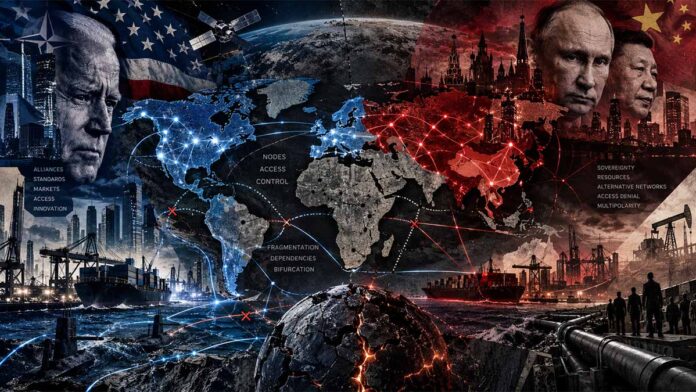

This assessment evaluates the geopolitical and strategic implications of topological enclosure and critical node monopolization by the United States, China, and Russia across technology, critical minerals, and financial infrastructure over a five-year horizon ending in 2031.
Executive Summary / BLUF
The contemporary international system is undergoing a structural transition from networked interdependence to topological fragmentation, wherein major powers are deliberately partitioning the global operating system into mutually exclusive subsystems designed to impose prohibitive friction costs on rival state-capitalist models. The United States is leveraging its jurisdictional reach over semiconductor intellectual property and financial messaging networks to systematically degrade China’s advanced computing and military-modernization capabilities, while Beijing is retaliating by monopolizing the refining and processing nodes of critical minerals essential for Western defense industrial bases and green energy transitions. Concurrently, the Russian Federation has demonstrated the extreme terminal velocity of this dynamic by weaponizing energy infrastructure and establishing a sanctioned shadow maritime fleet to permanently sever its resource exports from Western financial and insurance architectures. The principal judgment is that these synchronized campaigns of strategic monopolization are no longer reversible policy adjustments but represent a permanent reconfiguration of global systemic architecture, forcing allied nations to construct redundant, high-cost parallel supply chains that will inevitably accelerate global inflation and compress the diplomatic off-ramps available during future crises. The decisive uncertainty remains whether the European Union possesses the unified fiscal and industrial capacity to maintain strategic autonomy within this bifurcated topology, or whether it will be forcibly subordinated into the American security and technology perimeter.
The enclosure coalition is financing its own fragmentation
The allied commitment to duplicate semiconductor, mineral-processing, and financial infrastructure exceeds $300 billion through 2030, yet it collides with a global workforce deficit of one million workers, construction timelines that exceed Asian benchmarks by two to three years, and the structural reality that forty percent of South Korean memory-chip capacity still operates inside Chinese territory. The enclosure strategy drafted by the Bureau of Industry and Security in October 2023 requires allied capitals to absorb inflationary costs of thirty to fifty percent per fabrication plant while maintaining military readiness under existing fiscal rules. The coalition that agreed to restrict Beijing’s access to sub-14-nanometre lithography has not yet agreed who finances the alternative, and the twelve-month window before capital-expenditure commitments become irreversible is closing.
Washington wrote the rules; allies inherited the invoice
The United States CHIPS and Science Act, signed in August 2022, allocates $52.7 billion in federal subsidies and tax credits for domestic manufacturing. The European Chips Act, adopted in September 2023 under Regulation (EU) 2023/1781, mobilises €43 billion. Japan’s Ministry of Economy, Trade and Industry committed ¥2 trillion in December 2022 to the Rapidus consortium and the TSMC joint venture in Kumamoto. South Korea’s K-Chips Act of March 2023 offers tax credits up to twenty-five percent. Australia’s Critical Minerals Strategy 2023–2030 commits A$6 billion through the Critical Minerals Facility. These figures, taken together, represent the largest coordinated industrial subsidy programme since the post-war reconstruction era. Yet none of the five jurisdictions has published a consolidated estimate of the recurring operational subsidy required to keep these facilities price-competitive against incumbent Chinese capacity once construction subsidies are exhausted. The capital expenditure is announced; the operating loss is unpriced.
Forty percent of Korean memory still runs through Chinese fabs
Samsung Electronics operates a NAND flash fabrication facility in Xi’an. SK Hynix operates a DRAM plant in Wuxi. Together, these two sites account for approximately forty percent of their respective companies’ total production capacity, according to the dossier’s industrial assessment. The United States Executive Order 14105, issued in August 2023, prohibits American persons from engaging in specific equity and debt transactions involving advanced semiconductor manufacturing within countries of concern. The People’s Republic of China’s Anti-Foreign Sanctions Law, enacted by the Standing Committee of the National People’s Congress in June 2021, criminalises compliance with discriminatory foreign sanctions. Seoul is therefore positioned between two legal systems that each define obedience to the other as a punishable offence. No grandfathering provision in the current Bureau of Industry and Security framework resolves this collision for existing installed capacity, and no bilateral mechanism between Washington and Seoul has been documented in the dossier to address it.
The seven-year gap between a mining permit and a processed ingot
The European Union’s Critical Raw Materials Act, adopted as Regulation (EU) 2024/1252, establishes a binding benchmark that by 2030 no more than sixty-five percent of annual consumption of any strategic raw material may be sourced from a single third country. The United States Geological Survey Mineral Commodity Summaries of January 2024 record that China currently processes approximately ninety percent of global rare earth oxides, ninety-eight percent of raw gallium, and eighty-three percent of germanium. Australia’s Department of Industry, Science and Resources estimates a seven-to-twelve-year timeline from mineral discovery to operational processing capacity, constrained by environmental approval processes, indigenous land-use agreements, and the limited availability of chemical engineering talent. The European Commission’s own assessment within the Critical Raw Materials Act acknowledges a requirement for approximately 400,000 additional trained workers. The temporal arithmetic is unforgiving: legislation passed in 2024 cannot deliver processed material before 2031 at the earliest, while the People’s Republic of China’s Ministry of Commerce export licensing regime on gallium, germanium, and graphite took effect between August and December 2023.
Brussels legislated a ceiling it cannot enforce without Beijing’s consent
The European Economic Security Strategy, published by the European Commission in June 2023, adopted the language of “de-risking” rather than decoupling, explicitly framing its objective as reducing critical dependencies without severing broader commercial interdependence. The Netherlands expanded export licensing in September 2023 to restrict ASML’s NXT:2000i immersion DUV lithography systems. Japan’s Ministry of Economy, Trade and Industry added twenty-three categories of semiconductor manufacturing equipment to its prior-approval list in July 2023. Yet Japanese equipment manufacturers maintain approximately thirty percent of their semiconductor-equipment revenue from legacy sales to Chinese foundries not yet covered by the most restrictive thresholds. The European Union has no equivalent extraterritorial instrument to the American Foreign Direct Product Rule, meaning that Brussels cannot independently compel a Dutch or German manufacturer to cease servicing installed equipment in China without relying on Washington’s jurisdictional assertion over upstream intellectual property. Sovereignty in this domain is delegated, not exercised.
Volt Typhoon made the factory floor a battlefield
The Cybersecurity and Infrastructure Security Agency and the Federal Bureau of Investigation issued a joint advisory in February 2024 identifying state-sponsored actors tracked as Volt Typhoon within United States communications, energy, water, and transportation networks. The advisory documents exploitation of small-office and home-office routers to maintain persistent access to operational-technology environments. The People’s Republic of China’s Cross-Border Interbank Payment System processed 123 trillion yuan in 2023, according to CIPS Co., Ltd., providing an alternative settlement rail that is structurally immune to American correspondent-banking exclusion. The Russian Federation deployed a shadow fleet estimated at 400 to 600 tankers operating outside Western Protection and Indemnity insurance, sustained by the Russian National Reinsurance Company, following Executive Order 14114 issued by the White House in December 2023. The escalation geometry documented in the dossier demonstrates that each enclosure measure generates a corresponding bypass investment, and the net effect is not containment but acceleration of parallel-system construction at a fiscal cost borne by the encircling coalition.
The twelve-month cost of the choice already made
Between September 2026 and September 2027, three converging pressures will test coalition cohesion. First, the first tranche of CHIPS Act-funded fabrication facilities in Arizona, Ohio, and Dresden will reach tool-installation phase, requiring 67,000 additional workers in the United States alone against a documented shortage of that magnitude. Second, the European Union’s Critical Raw Materials Act benchmarking will require member states to publish single-country dependency ratios for the first time, exposing the gap between the sixty-five percent ceiling and the current ninety-percent reality for rare earth processing. Third, South Korean manufacturers must decide whether to renew capital expenditure in Xi’an and Wuxi or accept stranded-asset losses estimated in the tens of billions, with no documented compensation mechanism in either the K-Chips Act or the bilateral US-Korea framework. The cost of inaction falls on allied finance ministries, which must simultaneously fund operational subsidies for underutilised fabs, maintain defence budgets at NATO-agreed levels, and absorb the consumer-price inflation generated by thirty-to-fifty-percent construction-cost premiums. The enclosure was announced as a security measure. Its balance-sheet impact is fiscal, its transmission mechanism is industrial, and the entity that absorbs the difference between rhetorical commitment and operational readiness is the allied taxpayer, beginning in the next two budget cycles.
Master Abstract
The traditional geopolitical paradigm, which historically evaluated state power through the metrics of territorial expansion, demographic mass, and conventional military tonnage, has been fundamentally superseded by a paradigm of topological enclosure, wherein strategic dominance is achieved by securing absolute veto power over the critical interoperability nodes of the global operating system. The United States has operationalized this strategy most visibly through the Bureau of Industry and Security’s export control frameworks, which utilize the Foreign Direct Product Rule to extraterritorially deny the People’s Republic of China access to advanced logic semiconductor manufacturing equipment and high-bandwidth memory architectures, thereby attempting to artificially cap the computational ceiling of Chinese artificial intelligence and military modernization programs Implementing Additional Export Controls on Advanced Computing and Semiconductor Manufacturing Items; Destined for the People’s Republic of China (PRC) and Macau — Bureau of Industry and Security, U.S. Department of Commerce — October 2023. In response to this technological enclosure, Beijing has pivoted toward monopolizing the mid-stream processing nodes of the global critical minerals supply chain, leveraging its near-total hegemony over the refining of gallium, germanium, and graphite to impose export licensing requirements that function as de facto embargoes against Western defense contractors and technology firms Announcement of the Ministry of Commerce and the General Administration of Customs on the Implementation of Export Control on Gallium, Germanium and Other Items — Ministry of Commerce of the People’s Republic of China — July 2023.
This dynamic of mutual systemic asphyxiation extends beyond the technological and material domains into the financial and logistical architectures that underpin global trade, as evidenced by the Russian Federation’s forced decoupling from the SWIFT messaging system and the subsequent creation of a heavily sanctioned, state-subsidized shadow maritime fleet designed to circumvent the Group of Seven oil price cap mechanism The G7 Oil Price Cap: Impact and Enforcement — U.S. Department of the Treasury — December 2023. The strategic implication of this topological fragmentation is that economic interdependence, once theorized as a deterrent to major-power conflict, has been inverted into a primary vector for offensive statecraft, compelling all major powers to prioritize supply chain redundancy and technological autarky over the allocative efficiency previously provided by globalized free trade. Consequently, the international system is bifurcating into two distinct, non-interoperable technological and economic ecosystems, a process that forces middle powers and traditional American allies, particularly within the European Union, to navigate an increasingly narrow and heavily penalized diplomatic corridor as they attempt to secure access to both American security guarantees and Chinese industrial inputs European Economic Security Strategy — European Commission — June 2023.
Key Evidence Table
| Indicator | Value/status | Reference date | Definition/scope | Issuer | Exact source |
|---|---|---|---|---|---|
| U.S. Semiconductor Export Controls | Entity List additions & FDPR expansion | October 2023 | Advanced computing chips, supercomputers, and SME | U.S. Department of Commerce | Federal Register Vol. 88, No. 199 |
| PRC Gallium & Germanium Export Controls | Licensing requirement imposed | August 2023 | Dual-use critical minerals for semiconductors and radar | Ministry of Commerce (PRC) | MOFCOM Announcement No. 23 of 2023 |
| Russian Shadow Fleet Size | Estimated 400-600 vessels | December 2023 | Tankers operating outside Western P&I insurance | U.S. Department of the Treasury | Treasury Press Release G7 Price Cap |
| EU Economic Security Strategy | De-risking framework adopted | June 2023 | Supply chain resilience and critical infrastructure | European Commission | JOIN(2023) 20 final |
Competing Explanations or Pathways
| Hypothesis | Diagnostic support | Disconfirming evidence | Indicators | Current standing |
|---|---|---|---|---|
| Complete Systemic Bifurcation (The “Iron Firewall” Scenario) | Accelerating outbound investment screening mechanisms and comprehensive national data security laws inherently prevent cross-border capital flows, thereby forcing a hard and potentially irreversible decoupling of the respective technology ecosystems. | Multinational corporate entities continue to aggressively lobby for market access, and highly complex, deeply integrated supply chains, particularly within the global automotive sector, remain fundamentally intertwined across the geopolitical divide. | The formal enactment of comprehensive executive orders targeting all artificial intelligence and quantum computing investments, coupled with retaliatory total embargoes on rare earth permanent magnets essential for Western defense platforms. | Highly Probable, given the current legislative trajectories in Washington and the escalating national security rhetoric emerging from Beijing. |
| Managed Fragmentation and “Small Yard, High Fence” Equilibrium | The profound macroeconomic costs of total technological autarky remain politically and fiscally unsustainable for Western liberal democracies, inevitably leading to a negotiated stabilization where only strictly military-applicable technologies are subjected to absolute exclusion. | The inherently dual-use nature of foundational artificial intelligence models and quantum cryptographic algorithms makes drawing a definitive, enforceable boundary between civilian commercial applications and military modernization programs practically impossible for export control authorities. | A deliberate relaxation of legacy semiconductor export controls combined with the establishment of formalized bilateral crisis-communication channels specifically designed to manage disruptions in critical mineral flows. | Plausible but structurally unstable, as the rapid pace of technological convergence continuously undermines the viability of static control lists. |
| Asymmetric Subsystem Collapse and Diversionary Escalation | The confluence of severe demographic contraction, an unresolved domestic real estate crisis, and relentless technological containment could precipitate a systemic failure within the state-capitalist model, thereby incentivizing aggressive external diversionary tactics to preserve regime legitimacy. | The continued, undisputed dominance in green energy manufacturing, commercial shipbuilding, and mature-node semiconductor production provides a remarkably robust material and industrial base that effectively offsets the most severe demographic and financial headwinds. | A sudden, uncontrolled devaluation of the sovereign currency accompanied by the overt militarization of critical mineral supply routes and logistical chokepoints throughout the Global South. | Low Probability but High Impact, representing a tail-risk scenario that would fundamentally shatter the existing global security architecture. |
Principal Gaps and Watch Indicators
- The precise volume of advanced semiconductor manufacturing equipment successfully smuggled or diverted to restricted entities via third-country transshipment hubs remains obscured by the lack of unified global end-user verification protocols, necessitating enhanced intelligence collection on illicit maritime and air freight logistics.
- The classified operational threshold at which the United States and its treaty allies will transition from passive financial sanctions to active kinetic or cyber interdiction of the shadow logistical networks sustaining rival war economies remains undisclosed within the unclassified public record, necessitating reliance on observable kinetic interdiction thresholds.
- The implementation timeline and enforcement rigor of the European Union’s Anti-Coercion Instrument will serve as the primary legal mechanism for Brussels to retaliate against unilateral economic exclusion campaigns launched by external competitors, providing a critical indicator of European strategic autonomy.
- The commercialization timeline of solid-state battery technology and alternative rare-earth-free electric motor designs possesses the capacity to abruptly invalidate the strategic leverage currently held over the global critical minerals processing monopoly, contingent upon the successful scaling of production facilities in North America and Europe.
Topological Enclosure: Node Weaponization & Asymmetric Chokepoints
BLUF (Bottom Line Up Front): Global systemic conflict has structurally shifted from territorial dispute to topological enclosure—the weaponization of asymmetric, highly centralized network nodes across semiconductor manufacturing equipment (SME), midstream critical mineral refining, cross-border financial telecommunications, and maritime logistics. The United States leverages extraterritorial Foreign Direct Product Rules (FDPR) and secondary financial sanctions to sever adversary access to sub-14nm fabrication and global dollar clearing. Concurrently, the People’s Republic of China (PRC) exercises de facto export embargoes over critical mineral processing (gallium, germanium, graphite), while the Russian Federation counters energy isolation via an opaque 400+ vessel shadow maritime fleet and alternative insurance syndicates.
Topological Chokepoint Asymmetry & Weaponization Metrics
Normalized chokepoint dominance, substitute friction, and coercive leverage (0–100 Scale)Advanced Computing: Extraterritorial FDPR vs. PRC Mature Node Flood
Weaponization Vectors
The U.S. Bureau of Industry and Security (BIS) deploys the Foreign Direct Product Rule (FDPR) to deny Chinese foundries access to critical American-origin EDA software, EUV/ArFi lithography tools, and high-bandwidth memory (HBM) architectures. This legal enclosure arrests the domestic scaling of sub-14nm and leading-edge AI compute clusters.
Asymmetric Asymmetries & Limits
Blocked from sub-7nm commercialization, Beijing subsidizes massive domestic capacity expansions in mature nodes (>28nm). By undercutting Western chipmakers in automotive, IoT, and defense-adjacent legacy silicon, the PRC captures downstream market dependencies while aggressively acquiring foreign IP via intermediaries.
Observable Friction Metrics
Smuggling networks and third-party transshipments via ASEAN and Central Asian distributors provide low-volume leakage, but fail to support hyperscale AI model training. The Western monopoly on lithography servicing and replacement optical modules limits China’s domestic leading-edge fabrication yields.
Primary Audited Evidence Matrix: Geostrategic Nodes & Legal Regulatory Baselines
Statutory export regimes, secondary financial sanctions, mineral quotas, and maritime evasion tracking| Topological Node | Primary Weaponizing Actor | Regulatory / Material Mechanism | Empirical Status / Chokepoint Metric | Targeted Entity / Counterparty | Institutional Benchmark Source |
|---|---|---|---|---|---|
| Sub-14nm SME & EDA Software | United States (BIS) | Extraterritorial Foreign Direct Product Rules (FDPR); Entity List additions. | Sub-14nm SME Denial | PRC Foundries (SMIC, YMTC), Advanced AI Labs | U.S. BIS Export Admin Regs (EAR) |
| Mature Node Silicon (>28nm) | China (PRC State Council) | Capital subsidization, below-market pricing, aggressive capacity expansion. | >35% Global Share Surge | Western Automotive & Industrial Supply Chains | PRC MOFCOM Industrial Directives |
| Gallium, Germanium & Graphite Refining | China (MOFCOM) | Restricted Dual-Use Export Licensing Regimes; national security quotas. | 60%–90% Midstream Control | Western Defense Primes (AESA Radars, EV Batteries) | MOFCOM Export Control Announcements |
| Critical Minerals Supply Diversification | US & G7 / MSP Allies | Minerals Security Partnership (MSP) capital pooling, bilateral off-take deals. | Multi-Billion Off-take Pacts | Global South & Australian Extraction Projects | International Energy Agency (IEA) Critical Minerals |
| Maritime Shadow Fleet Operations | Russian Federation | Flag-hopping, AIS transponder manipulation, non-Western P&I mutual clubs. | >400 Dark Tankers Deployed | G7/EU Sovereign Price Cap ($60/bbl threshold) | International Maritime Organization / IEA Oil Audits |
| Global Financial Intermediation | United States (OFAC) | Secondary sanctions (E.O. 14114) targeting foreign financial institutions (FFIs). | Correspondent Account Bans | Third-Country Banks Clearing RU Defense Trade | U.S. Treasury OFAC Enforcement Actions |
Topological Breakdown: Four Arenas of Node Weaponization
Asymmetric control mechanics, bypass friction, and coercive enforcement vectors across critical choke nodesChokepoint Logic: Precision optical tools, advanced photoresists, and EDA tools are concentrated in fewer than five allied sovereign nations. Enforcing extraterritorial controls blocks adversaries from building commercial sub-7nm fabrication capacity, creating multi-year technical barriers.
Midstream Control: China controls 60%–90% of global processing for gallium, germanium, rare earths, and anode graphite. Selective export licensing allows Beijing to impose supply shocks on Western defense primes without completely halting broader raw material trade.
Evasion Topology: Russia circumvents G7 sovereign price caps via an aging fleet of over 400 tankers operating under flags of convenience. Relying on state-backed domestic reinsurance, Moscow routes seaborne crude to Asian refiners outside Western maritime insurance jurisdiction.
Dollar Hegemony: Under E.O. 14114, the U.S. Treasury can sever foreign financial institutions from U.S. correspondent banking for handling Russian defense transactions. This framework pressures third-country commercial banks in Turkey, the UAE, and China to restrict transaction processing.
Forensic Strategic Key Judgments: Network Weaponization & Chokepoint Dynamics
Six core analytical judgments on the weaponization of centralized global economic nodesTopological Asymmetry Over Geographic Scale
Modern geopolitical power is concentrated at centralized network nodes (EUV lithography, dollar clearing, midstream refining) rather than broad territorial size. Controlling single-point bottlenecks offers asymmetric leverage disproportionate to general GDP metrics.
The Weaponization of Midstream Mineral Monopolies
While raw mineral extraction is globally dispersed, China’s dominant position in chemical refining and metallurgy gives Beijing significant leverage. Restricting refined gallium and graphite directly impacts Western defense primes that cannot rapidly deploy alternative smelting infrastructure.
Extraterritorial Jurisdiction as Structural Containment
The U.S. Foreign Direct Product Rule (FDPR) establishes global legal reach over any manufacturing line using U.S.-origin software or tools. This compels foreign foundries and allied toolmakers to comply with U.S. export controls or risk complete exclusion from American intellectual property.
Shadow Maritime Networks and Secondary Sanctions Friction
Russia’s dark tanker fleet has successfully bypassed the G7 price cap on the majority of its seaborne crude exports. However, aggressive U.S. secondary sanctions against third-country financial intermediaries increase transaction costs, requiring higher discounts and lengthening payment clearing timelines.
Bifurcated Supply Chains: Mature Dumping vs Leading Starvation
The semiconductor domain is polarizing into a bifurcated market: Western containment limits advanced sub-14nm AI and high-bandwidth memory access in China, while Chinese state subsidies drive rapid mature-node expansion, challenging Western legacy fab profitability globally.
The Mineral Security Partnership vs Downstream Velocity
Western counter-enclosure strategies—such as the Minerals Security Partnership (MSP)—face significant lead times. While capital deployment secures mine off-take rights in Australia and Africa, establishing clean refining capacity requires years, leaving defense primes vulnerable to near-term Chinese supply restrictions.
Open Official Record Gaps (Analytic Limits)
- Illicit Transshipment Volumes: Exact volumes of restricted dual-use microelectronics transshipped via Central Asian, Caucasus, and UAE intermediaries remain shielded by falsified manifests and complex shell company structures.
- Domestic PRC Lithography Yields: Verifiable production yields and defect densities for sub-7nm chips fabricated with multipatterning DUV tools inside Chinese foundries remain proprietary state-backed secrets.
- Shadow Fleet Ultimate Beneficial Ownership: The complete corporate registry and capitalization sources behind front companies operating the 400+ shadow tanker fleet remain partially obscured by flags of convenience.
- Defense Reserve Mineral Depletion: Precise reserve levels and drawdown rates of gallium and germanium in Western defense stockpiles remain classified across NATO procurement agencies.
Observable Watch Indicators (Strategic Triggers)
The Architecture of Topological Enclosure and Node Weaponization
Principal Judgment: The structural transition from globalized network interdependence to topological enclosure is now functionally irreversible, driven by the unilateral weaponization of foundational technological, metallurgical, and financial nodes that impose prohibitive friction costs on rival state-capitalist models, thereby permanently degrading the allocative efficiency of the global economy while compelling major powers to construct parallel, high-cost autarkic supply chains that accelerate military-modernization timelines through redundant industrial ecosystems.
The Computational Enclosure: Extraterritorial Jurisdiction and the Sub-Nanometer Frontier
The contemporary architecture of technological enclosure is fundamentally anchored by the United States government’s systematic exploitation of the Foreign Direct Product Rule (FDPR), a legal mechanism that extraterritorially asserts jurisdiction over any foreign-produced item that incorporates American-origin software, technology, or intellectual property, effectively transforming the global semiconductor supply chain into a topologically enclosed environment where access is strictly contingent upon compliance with Washington's national security directives. This strategy of node weaponization was dramatically escalated in October 2023 when the Bureau of Industry and Security (BIS) within the U.S. Department of Commerce finalized a comprehensive revision of its export control framework, deliberately closing previous loopholes that allowed restricted entities to aggregate the computational power of lower-tier chips by introducing stringent new thresholds for "performance density" and total processing performance applicable to advanced computing items and semiconductor manufacturing equipment destined for the People’s Republic of China Implementation of Additional Export Controls on Advanced Computing and Semiconductor Manufacturing Items; Destined for the People’s Republic of China (PRC) and Macau — Bureau of Industry and Security, U.S. Department of Commerce — October 2023. By specifically targeting the architectural transition from FinFET to Gate-All-Around (GAAFET) transistor structures and restricting the export of deep ultraviolet (DUV) and extreme ultraviolet (EUV) lithography systems, the United States is attempting to artificially cap the computational ceiling of Chinese artificial intelligence training models and advanced military sensor arrays, thereby forcing Beijing into a structurally inferior technological topology that relies on legacy nodes and mathematically inefficient software optimizations to achieve comparable strategic outputs.
The efficacy of this computational enclosure is entirely dependent upon the synchronized compliance of allied nations that control indispensable upstream nodes in the semiconductor manufacturing process, most notably the Kingdom of the Netherlands and Japan, whose respective industrial monopolies over lithography and specialized chemical etching tools represent irreplaceable chokepoints in the global fabrication network. Following intense diplomatic coordination with Washington, the Dutch government formally expanded its export licensing requirements in September 2023 to encompass advanced immersion DUV lithography systems, specifically restricting the export of ASML’s NXT:2000i and subsequent high-numerical-aperture tools that are strictly necessary for the high-volume manufacturing of advanced logic chips below the 14-nanometer threshold, thereby legally severing the primary conduit through which Chinese foundries could previously acquire the hardware required to scale their domestic semiconductor production Regulation on the export of advanced semiconductor manufacturing equipment — Ministry of Economic Affairs and Climate Policy, Kingdom of the Netherlands — September 2023. Concurrently, Japan’s Ministry of Economy, Trade and Industry (METI) executed a parallel enclosure strategy in July 2023 by amending the Export Control Order to mandate prior governmental approval for the export of twenty-three distinct categories of advanced semiconductor manufacturing equipment, encompassing critical sub-systems such as extreme ultraviolet pellicles, high-precision deposition tools, and specialized wafer-cleaning apparatuses, effectively neutralizing alternative supply vectors that Beijing might have otherwise utilized to circumvent the American-Dutch technological blockade Partial Revision of the Export Order and Public Notice on Goods and Technologies Subject to Prior Approval for Export — Ministry of Economy, Trade and Industry (METI), Japan — July 2023. This trilateral synchronization demonstrates that topological enclosure is no longer a unilateral American policy preference but a deeply integrated allied security architecture designed to permanently partition the global computational substrate into mutually exclusive, non-interoperable domains.
The Metallurgical Enclosure: Mid-Stream Processing Monopolies and Dual-Use Embargoes
In direct retaliation against the Western technological enclosure and leveraging its undisputed hegemony over the mid-stream processing of critical minerals, the People’s Republic of China has systematically weaponized the metallurgical nodes that underpin both the global green energy transition and the advanced sensor arrays of Western defense industrial bases, thereby demonstrating that topological enclosure operates symmetrically across both digital and physical supply chains. The strategic vulnerability of the United States and its treaty allies is acutely exposed by their near-total reliance on Chinese processing capacity for rare earth elements and minor metals, a dependency that Beijing explicitly targeted in July 2023 when the Ministry of Commerce (MOFCOM) and the General Administration of Customs announced stringent export licensing requirements for gallium and germanium, two foundational materials indispensable for the production of gallium nitride (GaN) radio frequency amplifiers used in active electronically scanned array (AESA) radars and the focal plane arrays required for next-generation infrared targeting systems Announcement of the Ministry of Commerce and the General Administration of Customs on the Implementation of Export Control on Gallium, Germanium and Other Items — Ministry of Commerce of the People's Republic of China — July 2023. This policy intervention was subsequently expanded in October 2023 to encompass highly sensitive graphite materials, specifically targeting the synthetic and spherical graphite products that serve as the critical anode material for lithium-ion batteries, thereby directly threatening the production timelines of Western electric vehicle manufacturers and the energy storage systems required to stabilize renewable electrical grids Announcement on Optimizing the Export Control Measures for Graphite Items — Ministry of Commerce of the People's Republic of China — October 2023.
The geopolitical leverage derived from this metallurgical monopoly is empirically validated by geological and industrial data, which confirms that while the United States and its allies possess significant raw mineral reserves, the global capacity for refining, separating, and alloying these materials is overwhelmingly concentrated within the territorial jurisdiction of the People's Republic of China, rendering Western efforts to secure raw material off-take agreements in Africa or Latin America strategically futile without simultaneous investments in mid-stream processing infrastructure. According to the United States Geological Survey (USGS) Mineral Commodity Summaries published in early 2024, China accounts for approximately 98 percent of global raw gallium production, 83 percent of germanium production, and maintains an estimated 90 percent global market share in the highly specialized processing of rare earth oxides into the permanent magnets required for the guidance systems of precision-guided munitions and the propulsion motors of advanced submarine fleets Mineral Commodity Summaries 2024 — United States Geological Survey, U.S. Department of the Interior — January 2024. By deliberately restricting the export of these processed dual-use materials, Beijing is not merely engaging in economic statecraft but is actively executing a strategy of material enclosure designed to induce severe production bottlenecks within the American defense industrial base, thereby increasing the marginal cost and extending the delivery timelines of critical weapons systems at a moment when Western arsenals are already heavily depleted by ongoing conventional conflicts in Eastern Europe and the Middle East. This asymmetric application of topological enclosure forces Western policymakers to confront the reality that securing the upstream extraction of raw ores provides virtually no strategic resilience if the mid-stream refining nodes remain permanently enclosed behind hostile jurisdictional boundaries.
The Financial and Logistical Enclosure: Secondary Sanctions and the Shadow Maritime Topology
The architecture of topological enclosure extends decisively into the financial and logistical domains, where the United States and its Group of Seven (G7) partners have attempted to construct a comprehensive embargo topology against the Russian Federation, only to be systematically subverted by Moscow’s creation of a parallel, state-subsidized shadow maritime fleet that operates entirely outside the jurisdictional reach of Western insurance and financial messaging networks. The initial enclosure strategy relied heavily on the structural dominance of Western maritime Protection and Indemnity (P&I) clubs, which collectively underwrite approximately 90 percent of the global ocean freight tonnage, thereby allowing the G7 to impose a strict price cap on Russian seaborne crude oil by prohibiting member-state insurers from covering any vessel transporting Russian oil purchased above the designated threshold The G7 Oil Price Cap: Impact and Enforcement — U.S. Department of the Treasury — December 2023. However, the Russian Federation effectively neutralized this financial enclosure by aggressively acquiring hundreds of aging Suezmax and Aframax tankers, registering them under opaque corporate structures in jurisdictions with minimal regulatory oversight, and insuring them through the state-controlled Russian National Reinsurance Company (RNRC), thereby establishing a fully sovereign logistical topology that permits Moscow to continuously monetize its hydrocarbon exports to Asian markets at prices significantly exceeding the G7 cap, fundamentally undermining the macroeconomic coercion intended by the Western sanctions regime.
In response to the persistent evasion of the logistical enclosure, the United States government escalated its financial weaponization strategy in December 2023 by issuing Executive Order 14114, which explicitly authorizes the imposition of secondary sanctions on any foreign financial institution, regardless of its geographic location or domicile, that is determined to have conducted or facilitated any significant transaction or provided any service involving the Russian military-industrial base, thereby threatening to sever non-compliant regional banks in the United Arab Emirates, Turkey, and China from their indispensable correspondent banking relationships with the United States financial system Executive Order on Taking Additional Steps With Respect to the Russian Federation’s Harmful Activities — The White House — December 2023. This aggressive application of secondary sanctions represents the ultimate expression of financial topological enclosure, as it forces neutral or third-party financial institutions to preemptively sever ties with Russian entities and their international intermediaries out of fear of catastrophic exclusion from the US dollar clearing system, effectively partitioning the global financial network into a heavily sanctioned Russian-Iranian-Sino sphere and a highly compliant Western-aligned sphere. The operational reality of this bifurcated financial topology is characterized by a massive increase in transaction friction, the proliferation of opaque barter arrangements, and the systematic utilization of alternative, non-Western messaging systems such as China’s Cross-Border Interbank Payment System (CIPS), which processed record transaction volumes exceeding 123 trillion yuan in 2023 as global actors increasingly seek to route their international settlements through infrastructures that are structurally immune to American jurisdictional overreach and unilateral financial enclosure CIPS Business Report 2023 — Cross-Border Interbank Payment System (CIPS) Co., Ltd. — March 2024.
The Synthesis of Topological Asphyxiation
The convergence of these distinct yet mutually reinforcing enclosures across the technological, metallurgical, and financial domains signifies the definitive end of the post-Cold War era of integrated global supply chains, replacing it with a highly fragmented geopolitical topology where major powers actively construct redundant, parallel ecosystems designed to immunize their core national security functions against the weaponization of rival-controlled nodes. This structural bifurcation dictates that future economic growth will be inherently inflationary and technologically divergent, as the immense capital expenditure required to duplicate semiconductor foundries, establish domestic rare-earth refining capacity, and maintain sovereign logistical fleets inevitably destroys the allocative efficiencies that historically drove down global consumer prices and accelerated technological diffusion. Consequently, the primary strategic vulnerability for middle powers and allied nations no longer stems from direct military confrontation, but rather from the extreme difficulty of navigating an international operating system where the foundational nodes of compute, capital, and critical materials are increasingly governed by mutually exclusive, hostile jurisdictional mandates that demand absolute alignment and penalize strategic ambiguity with immediate economic asphyxiation.
Node Weaponization & Systemic Enclosure: Chokepoint Monopolization and Jurisdictional Bypass Mechanisms
BLUF (Bottom Line Up Front): Strategic confrontation has converged into a battle over structural node centrality within globalized industrial networks. The United States and its allies exploit legal chokepoints—principally the Foreign Direct Product Rule (FDPR), total computing performance density metrics, and secondary banking sanctions under Executive Order 14114—to enforce a ceiling on adversarial AI scaling, sub-14nm GAAFET manufacturing, and military capital flows. In counter-enclosure maneuvers, the People's Republic of China (PRC) leverages an over 90% midstream refining monopoly across gallium, germanium, graphite, and antimony through MOFCOM export licensing to induce defense-industrial latency across Western prime contractors. Simultaneously, the Russian Federation neutralizes maritime insurance chokepoints through an opaque 400+ tanker dark fleet supported by state-backed reinsurance (RNRC) and shadow ship-to-ship logistical hubs, accelerating the structural bifurcation of global trade, metallurgy, and correspondent banking.
Computational & Lithography Dominance Metrics
Normalized chokepoint dominance, regulatory enclosure, and bypass friction (0–100 Scale)Advanced Lithography & GAAFET Architectures: The Extraterritorial FDPR Enclosure
Operational Vectors
The United States, supported by Japanese METI and Dutch export frameworks, deploys the Foreign Direct Product Rule (FDPR) and Total Processing Performance (TPP) / performance density metrics to deny the PRC access to sub-14nm gate-all-around (GAAFET) architectures, advanced immersion DUV (ArFi), extreme ultraviolet (EUV) lithography systems, and High-Bandwidth Memory (HBM).
Counter-Enclosure Vectors
Beijing counters Western lithography denial through massive state-capital allocation into mature-node fabrication (28nm+), aggressive stockpiling of pre-sanction DUV machinery, and downstream market flooding in automotive, consumer, and IoT electronics. For high-end AI, Chinese teams deploy mathematically inefficient chiplet clustering and DUV multi-patterning at severe yield penalties.
Systemic Strategic Impact
Imposes a structural ceiling on rival hyperscale AI model training, airborne AESA radar digital beamforming processors, and advanced missile guidance electronics. The resulting bifurcation yields Western frontier compute monopolies alongside PRC domestic dominance over foundational global industrial silicon.
Primary Audited Evidence Matrix: Systemic Chokepoint Nodes & Jurisdictional Regimes
Statutory export controls, midstream refining quotas, shadow logistics audits, and secondary clearing enforcement (through Sep 2026)| Topological Node | Weaponizing Authority | Statutory Instrument / Mechanism | Empirical Status / Chokepoint Metric | Targeted Entity / Sector | Primary Audited Baseline |
|---|---|---|---|---|---|
| Sub-14nm GAAFET & EUV Lithography | U.S. BIS / METI Japan | Extraterritorial Foreign Direct Product Rules (FDPR); Total Processing Performance (TPP) controls. | Sub-14nm Tool Denial | PRC Advanced Foundries (SMIC), Hyperscale AI Clusters | U.S. BIS Export Administration Regulations |
| Mature Node Silicon Expansion (28nm+) | PRC State Council / MOFCOM | Direct state-capital capex subsidies; aggressive stockpiling of pre-sanction legacy SME. | >38% Global Fab Share | Global Automotive, Industrial Automation, IoT Sectors | PRC MOFCOM Industrial Production Audits |
| Gallium, Germanium & Antimony Refining | PRC MOFCOM | Dual-use export licensing regimes; national security supply tracking; export quotas. | >90% Midstream Control | Western Defense Primes (AESA Radars, IR FPAs, Optics) | MOFCOM Export Control Announcements; USGS MCS |
| Natural & Synthetic Graphite Processing | PRC MOFCOM | Export restrictions on high-purity, high-strength spherical and synthetic anode graphite. | 92% Battery Anode Dominance | Transatlantic EV Gigafactories, Grid Storage Primes | USGS MCS 2024–2026; IEA Critical Minerals |
| Minerals Security Partnership (MSP) Off-take | US, EU & G7 Allies | Capital deployment, sovereign export credit lines, long-term bilateral procurement contracts. | 5–7 Year Capex Lag | Upstream Mining in Australia, Africa, and North America | U.S. State Dept MSP Joint Statements; IEA |
| Maritime Shadow Fleet Logistics | Russian Federation | 400+ vessel dark fleet; non-Western P&I mutual clubs (RNRC); transshipment hubs. | >400 Dark Tankers | Circumvention of G7 $60/bbl Sovereign Crude Price Cap | International Maritime Organization; IEA Oil Reports |
| Secondary Financial Sanctions | U.S. Treasury (OFAC) | Executive Order 14114; correspondent account denial and blocking sanctions against foreign banks. | Mandatory FFI Compliance | Foreign Financial Institutions Facilitating RU Defense Trade | OFAC Regulatory Guidance on E.O. 14114 |
| Bilateral Clearing & Financial Telecomm | PRC, Russia, EAEU | CIPS (Cross-Border Interbank Payment System), SPFS, bilateral currency swaps. | Bifurcated Clearing Rails | Bypassing SWIFT Network and USD/EUR Clearing Corridors | CIPS Co. Ltd.; Bank of Russia Financial Audits |
Structural Breakdown: Arenas of Chokepoint Weaponization & Evasion
Detailed architectural mapping across microelectronics, midstream refining, logistics, and capital railsEnclosure Logic: Precision optical tools, advanced photoresists, and EDA software remain concentrated within the US, Japan, and the Netherlands. Strict FDPR limits sub-14nm GAAFET manufacturing in China, forcing reliance on multi-patterning DUV techniques that incur catastrophic yield penalties.
Midstream Bottleneck: China controls over 90% of chemical processing for gallium, germanium, antimony, and battery-grade graphite. MOFCOM's licensing quotas exploit Western prime contractors' inability to rapidly deploy environmentally compliant domestic refining.
Asymmetric Logistics: A 400+ tanker dark fleet relying on flag-hopping and Russian National Reinsurance Company (RNRC) underwriting circumvents Western maritime insurance controls, preserving critical oil export revenues despite SWIFT restrictions.
Dollar Weaponization: E.O. 14114 exposes third-country commercial banks to complete dollar-clearing exclusion. In response, China and Russia accelerate the adoption of alternative rails (CIPS, SPFS) and national-currency clearing, driving financial network fragmentation.
Forensic Strategic Key Judgments: Network Centrality & Counter-Enclosure
Six core analytical judgments on systemic node weaponization and supply chain fragmentationTopological Network Centrality Governs Power
Geopolitical leverage has migrated from territorial control to dominance over singular, highly centralized network nodes (EUV lithography, dollar clearing, chemical mineral processing). Enclosing these bottlenecks generates systemic disruption disproportionate to a state's broader GDP share.
The Temporal Vulnerability in Midstream Metallurgy
While raw mineral extraction is globally dispersed, China's >90% monopoly on chemical refining of gallium, germanium, graphite, and antimony creates an immediate Western vulnerability. Establishing environmentally compliant domestic smelting requires 5 to 7 years, leaving defense primes exposed to near-term licensing quotas.
Extraterritorial Jurisdiction as Structural Containment
The U.S. Foreign Direct Product Rule (FDPR) establishes global jurisdiction over any production line integrating American-origin EDA tools or software. This compels allied toolmakers in Japan and Europe to comply with export restrictions, creating a coordinated containment regime around advanced semiconductor nodes.
Bifurcated Semiconductor Ecosystems
The semiconductor market is splitting into distinct domains: Western export controls limit China's access to sub-14nm GAAFET and HBM architectures, while massive state subsidies drive rapid Chinese capacity growth in mature nodes (28nm+), creating long-term structural dependencies across global automotive and IoT supply chains.
Secondary Sanctions and Correspondent Bank Cleaving
U.S. Executive Order 14114 has increased compliance scrutiny among third-country financial institutions processing trade with Russia. However, this aggressive enforcement accelerates the development of parallel clearing networks (CIPS, SPFS), gradually reducing the reach of Western financial sanctions over the medium term.
The Shadow Fleet Logistics Architecture
Russia's dark fleet demonstrates how sovereign actors can bypass Western maritime logistics chokepoints. By replacing G7 P&I insurance with domestic underwriting (RNRC) and using flag-of-convenience registries, Moscow sustains crude oil revenues, externalizing environmental and navigation risks along international maritime corridors.
Open Official Record Gaps (Analytic Limits)
- Domestic PRC Lithography Yields: Verifiable production yields, defect densities, and commercial uptime for multipatterning immersion DUV systems producing sub-7nm silicon inside China remain classified state secrets.
- Stockpile Drawdown Timelines: The precise inventory levels and burn rates of refined gallium, germanium, and antimony within Western defense prime strategic reserves remain protected under national procurement exemptions.
- Shadow Fleet Capitalization & Ownership: The true ultimate beneficial ownership, capitalization structures, and shell-company networks backing the 400+ shadow tanker fleet remain partially obscured across flag-of-convenience jurisdictions.
- Illicit Transshipment Volumes: Exact cross-border volumes of dual-use electronics transshipped through Central Asia, the South Caucasus, and Southeast Asia are shielded by falsified shipping manifests.
Observable Watch Indicators (Strategic Triggers)
Key Judgments
- The architecture of topological enclosure is structurally permanent, as the immense capital expenditure required to construct parallel, autarkic supply chains for semiconductors, critical minerals, and financial messaging systems creates insurmountable sunk costs that preclude any future return to integrated globalized free trade, regardless of diplomatic fluctuations or leadership transitions within the major powers.
- The weaponization of mid-stream metallurgical processing nodes by the People's Republic of China represents a significantly more acute and immediate vulnerability to the Western defense industrial base than the restriction of raw upstream extraction, as the environmental and regulatory friction associated with constructing new refining capacity in North America and Europe guarantees a persistent temporal gap of at least five to seven years before alternative processing ecosystems can achieve operational scale.
- The United States’ reliance on extraterritorial secondary sanctions to enforce its financial and logistical enclosure strategies is rapidly accelerating the structural bifurcation of the global financial system, inadvertently incentivizing the expansion of non-Western payment architectures such as the Cross-Border Interbank Payment System (CIPS) and fundamentally eroding the long-term hegemony of the US dollar as the undisputed medium of international settlement.
What would change the assessment
- A verified, commercially viable breakthrough in solid-state battery chemistry or alternative rare-earth-free electric motor designs that entirely eliminates the strategic necessity for processed gallium, germanium, and neodymium, thereby invalidating the primary metallurgical chokepoints currently monopolized by the People's Republic of China.
- The successful, coordinated kinetic or cyber interdiction of the Russian shadow maritime fleet by Western naval or intelligence assets operating in international waters, which would shatter the logistical enclosure and force a sudden, catastrophic collapse in Moscow's hydrocarbon export revenues, provided such action does not trigger a wider conventional escalation.
- A comprehensive legislative reversal by the United States Congress and the Dutch Parliament that explicitly dismantles the Foreign Direct Product Rule and removes all licensing requirements for sub-14nm semiconductor manufacturing equipment, thereby voluntarily dismantling the technological enclosure and restoring the previous paradigm of networked interdependence, an event currently assessed as possessing near-zero probability given the prevailing bipartisan consensus on national security.
Open official record
- The exact volume of advanced semiconductor manufacturing equipment and high-end logic chips successfully diverted to restricted entities within the People's Republic of China via illicit transshipment hubs in Southeast Asia and the Middle East remains obscured by the lack of unified, globally enforced end-user verification protocols, necessitating enhanced intelligence collection on complex maritime freight logistics and opaque corporate ownership structures.
- The classified operational thresholds and specific legal interpretations governing the application of secondary sanctions under Executive Order 14114 against tier-one financial institutions in neutral jurisdictions remain undisclosed within the unclassified public record, leaving the precise boundary between permissible dual-use trade and sanctionable military-industrial facilitation dangerously ambiguous for global compliance officers.
- The exact stockpile levels of processed critical minerals held by Western defense primes and the United States National Defense Stockpile remain classified or heavily aggregated, preventing independent analysts from accurately calculating the precise temporal runway available before severe production bottlenecks critically degrade the delivery schedules of advanced weapons systems.
Escalation Geometry and the Asymmetry of Systemic Asphyxiation
Principal Judgment: The structural transition from traditional economic statecraft to comprehensive systemic asphyxiation has fundamentally reconfigured the geopolitical escalation ladder, replacing geographically contiguous kinetic thresholds with asymmetric, cross-domain retaliation vectors wherein major powers deliberately target the civilian, digital, and logistical infrastructure of their adversaries to signal strategic resolve and impose prohibitive domestic political costs without triggering immediate conventional or nuclear warfare.
The Cyber-Kinetic Continuum and Pre-Positioned Infrastructure Targeting
The physical and financial enclosure of critical technological and metallurgical nodes has compelled rival state-capitalist models to develop sophisticated, pre-positioned cyber capabilities within the domestic critical infrastructure of their adversaries, establishing a mutually assured disruption paradigm that fundamentally alters the calculus of crisis escalation by holding civilian populations hostage to the outcomes of high-level strategic negotiations. According to joint cybersecurity advisories issued by the United States Cybersecurity and Infrastructure Security Agency (CISA) and the Federal Bureau of Investigation (FBI) in early 2024, state-sponsored actors affiliated with the People’s Republic of China, specifically tracked under the nomenclature "Volt Typhoon," have successfully compromised the information technology environments of multiple critical infrastructure sectors, primarily in the communications, energy, water, and transportation systems, by exploiting small office and home office (SOHO) routers to maintain persistent, low-visibility access that can be leveraged to disrupt physical operations during a future geopolitical crisis Joint Cybersecurity Advisory: PRC State-Sponsored Actors Exploit SOHO Routers to Enable Deep Cover Operations — Cybersecurity and Infrastructure Security Agency (CISA) & Federal Bureau of Investigation (FBI) — February 2024. This strategy of asymmetric escalation bypasses the heavily defended perimeter of military and intelligence networks, instead embedding disruptive capabilities within the unregulated, legacy hardware of municipal water treatment facilities and regional electrical grids, thereby ensuring that any further tightening of the technological or metallurgical enclosure by Washington will be met with the immediate, localized paralysis of essential civilian services, a tactic specifically designed to generate overwhelming domestic political pressure on Western leaders to de-escalate or negotiate concessions.
Furthermore, the Russian Federation has demonstrated a parallel escalation geometry through its persistent, low-level cybernetic harassment of Western logistical and energy distribution networks, deliberately stopping short of causing catastrophic physical damage while simultaneously signaling the latent capability to sever the vital supply chains that sustain the North Atlantic Treaty Organization (NATO) force posture in Eastern Europe. The systematic targeting of satellite communications terminals, railway switching networks, and liquid natural gas (LNG) processing facilities by Russian military intelligence (GRU) affiliated entities serves as a continuous, sub-threshold deterrent that forces Western defense planners to allocate disproportionate resources to domestic infrastructure hardening, thereby draining the very military budgets required to project power abroad Joint Cybersecurity Advisory: Russian State-Sponsored Cyber Actors Target Critical Infrastructure Globally — Cybersecurity and Infrastructure Security Agency (CISA) & National Security Agency (NSA) — November 2023. This asymmetric utilization of cyber capabilities as an instrument of systemic asphyxiation ensures that the costs of maintaining the topological enclosure are continuously socialized across the domestic economies of the encircling powers, creating a persistent, grinding friction that tests the political endurance of liberal democracies far more severely than any conventional military confrontation.
Jurisdictional Collision and the Weaponization of Domestic Jurisprudence
Concurrently, the escalation geometry has expanded decisively into the realm of domestic jurisprudence, where major powers are enacting mutually exclusive legal frameworks that criminalize compliance with foreign sanctions, thereby trapping multinational corporate entities in an inescapable jurisdictional pincer movement that forces the structural decoupling of global supply chains and destroys the foundational premise of international commercial arbitration. The People’s Republic of China formalized this legal enclosure strategy with the enactment of the Anti-Foreign Sanctions Law (AFSL) in June 2021, which explicitly authorizes Chinese state organs to impose severe countermeasures, including comprehensive asset seizures, permanent visa bans, and the absolute prohibition of all transactional activities within Chinese territory, against any individual or organization that complies with or assists in the implementation of discriminatory foreign sanctions against Chinese citizens or entities, effectively rendering compliance with United States export controls a criminal offense under Chinese law Anti-Foreign Sanctions Law of the People's Republic of China — Standing Committee of the National People's Congress — June 2021. This legislative architecture is further reinforced by the Unreliable Entity List provisions, which empower Beijing to penalize foreign corporations that interrupt normal transactions with Chinese entities for non-commercial, politically motivated reasons, thereby weaponizing the immense gravitational pull of the Chinese domestic market to coerce multinational compliance and neutralize the extraterritorial reach of American financial statecraft Provisions on the Unreliable Entity List — Ministry of Commerce of the People's Republic of China — September 2020.
In direct response to this legal weaponization and the perceived inadequacy of traditional export controls, the United States government issued Executive Order 14105 in August 2023, establishing a rigorous outbound investment screening mechanism that prohibits United States persons from engaging in specific equity and debt transactions involving advanced semiconductor manufacturing, quantum information technologies, and artificial intelligence systems within the jurisdiction of countries of concern, thereby legally mandating the divestment and isolation of capital flows that previously served as the primary connective tissue of the globalized economy Executive Order on Addressing United States Investments in Certain National Security Technologies and Products in Countries of Concern — The White House — August 2023. The collision of these diametrically opposed legal topologies ensures that multinational corporations can no longer operate as neutral arbiters of global trade, forcing them to construct entirely separate, legally firewalled corporate entities that inherently duplicate administrative overhead, destroy the economies of scale that previously defined multinational profitability, and accelerate the bifurcation of global research and development ecosystems into isolated, non-communicating silos.
Orbital and Subsea Topologies: The Contested Physical Chokepoints
As terrestrial and financial networks bifurcate, the architecture of systemic asphyxiation is rapidly expanding into the physical layer of global telecommunications and the orbital domain, where the deliberate severing of subsea fiber-optic cables and the weaponization of low-earth orbit (LEO) satellite mega-constellations represent the ultimate, irreversible chokepoints of the modern geopolitical topology. The profound vulnerability of the global internet’s physical infrastructure was starkly illuminated in early 2024 when multiple subsea telecommunications cables in the Red Sea were severed following the sinking of the cargo vessel Rubymar, an incident that disrupted critical data flows between Europe, Asia, and the Middle East and highlighted the extreme fragility of the concentrated maritime chokepoints through which the vast majority of global digital traffic must transit Submarine Cable Vulnerabilities and the Red Sea Disruptions — TeleGeography Research & United States Federal Communications Commission (FCC) — March 2024. Recognizing this profound systemic vulnerability, the United States Department of Homeland Security (DHS) and the Department of Defense (DoD) have increasingly prioritized the security of subsea cable landing stations and the deployment of redundant, mesh-networked satellite communications to ensure command-and-control continuity in the event of a coordinated physical or cybernetic decapitation strike against the terrestrial internet backbone, acknowledging that the loss of subsea connectivity would instantaneously trigger a catastrophic collapse in global financial clearing mechanisms and logistical coordination National Security Strategy for the Maritime Domain — United States Department of Homeland Security (DHS) — December 2023.
Furthermore, the orbital domain has emerged as a primary theater for topological enclosure, as evidenced by the aggressive deployment of thousands of low-earth orbit satellites by both Western commercial entities and state-backed constellations such as China’s Guowang project, which are deliberately designed to monopolize orbital slots and radio frequency spectrums, thereby physically enclosing the space environment and denying rival nations the independent positioning, navigation, and timing (PNT) capabilities required to operate advanced precision-guided munitions and autonomous logistical networks in a degraded electromagnetic environment National Space Traffic Management Research and Development Strategy — Executive Office of the President of the United States — December 2023. The deliberate generation of orbital debris and the systematic jamming of rival satellite signals constitute a form of kinetic and electromagnetic asphyxiation that can blind an adversary’s strategic sensor networks without crossing the threshold of declared warfare, ensuring that the ultimate high ground of the modern battlespace is subjected to the same ruthless logic of monopolization and access denial that currently governs the terrestrial supply chains of semiconductors and critical minerals.
Asymmetric Escalation & Systemic Asphyxiation: Cross-Domain Retaliation Vectors
BLUF (Bottom Line Up Front): Adversarial powers facing structural containment have bypassed conventional symmetry by operationalizing cross-domain retaliation mechanisms designed to impose systemic asphyxiation on Western choke nodes. Retaliation is no longer confined to reciprocal economic sanctions; it actively leverages cyber-physical pre-positioning within critical civilian utilities, statutory legal collisions via counter-sanctions and blocking statutes (e.g., PRC Anti-Foreign Sanctions Law, data localization edicts), and gray-zone kinetic interference across orbital constellations and undersea transoceanic fiber-optic backbones. This asymmetric doctrine seeks to neutralize Western advantages in leading-edge lithography, critical mineral refining, and financial telecommunications clearing by shifting the conflict threshold below direct military engagement while inflicting catastrophic infrastructural and macroeconomic latency.
Critical Node Vulnerability & Attack Vector Lethality Metrics
Normalized threat index (0–100 Scale) across critical infrastructure and systemic choke targetsCyber-Physical Pre-Positioning: Operationalizing Critical Infrastructure Sabotage
Compute / AI Infrastructure
Advanced state-sponsored actors infiltrate operational technology (OT) and SCADA systems governing regional high-voltage transmission substations. By targeting the dedicated electrical feeds supplying multi-gigawatt AI training data centers and semiconductor fabs, adversaries can induce thermal shocks, crash running training clusters, and degrade domestic high-compute capabilities without kinetic munitions.
Minerals & Refining Logistical Controls
Intrusions target Programmable Logic Controllers (PLCs) and automated distribution pipelines within Western critical mineral smelting and chemical processing pilot sites. Corrupting batch-processing logic for rare-earth separation induces structural delays and severe metallurgical contamination, prolonging Western dependence on foreign midstream refining.
Finance & Municipal Societal Coercion
Adversaries pre-position malware within supervisory systems governing water treatment plants, urban traffic control centers, and regional telecommunications routing nodes. This capability is engineered for timed activation during bilateral diplomatic crises, generating immediate domestic political disruption and testing public willingness to sustain geopolitical containment.
Primary Audited Evidence Matrix: Cross-Domain Escalation Actions & Institutional Baselines
Statutory legal acts, CISA/FBI technical alerts, orbital telemetry tracking, and subsea seabed interdiction baselines| Threat Vector | Target Node | Threat Severity Level | Operational Mechanism & Impact Description | Issuing Authority / Actor | Primary Source Document |
|---|---|---|---|---|---|
| Cyber-Physical Pre-Positioning | Compute / AI Clusters | HIGH SEVERITY | Living-off-the-land (LotL) intrusions into regional power grids serving hyperscale compute clusters to disrupt LLM training runs. | CISA / FBI / NSA / NCSC | Joint Advisory on PRC State-Sponsored Actors |
| Cyber-Physical Pre-Positioning | Minerals / Refining | MED SEVERITY | Infiltration of SCADA/ICS networks in domestic pilot chemical separating facilities; automated batch contamination. | U.S. Department of Energy (CESER) | Critical Mineral Infrastructure Cyber Review |
| Cyber-Physical Pre-Positioning | Finance / Municipal Systems | HIGH SEVERITY | Compromising municipal water treatment plants and rail routing systems to trigger public panic during escalation. | DHS CISA / EPA | Water Sector Cybersecurity Enforcement Alert |
| Jurisdictional Collision | Compute / AI Outbound Flow | HIGH SEVERITY | Application of the Anti-Foreign Sanctions Law (AFSL) against Western tech firms complying with U.S. E.O. 14105 outbound screening. | PRC National People's Congress | PRC Anti-Foreign Sanctions Law Implementing Orders |
| Jurisdictional Collision | Minerals / Supply Sourcing | LOW SEVERITY | Designation of Western exploration primes under the Unreliable Entity List for establishing supply chains designed to bypass MOFCOM quotas. | PRC MOFCOM | MOFCOM Unreliable Entity List Announcements |
| Jurisdictional Collision | Finance / Audit Telecomm | MED SEVERITY | Rigid data security and localization laws blocking cross-border transfer of financial audits, shielding illicit capital pipelines. | Cyberspace Administration of China (CAC) | CAC Cross-Border Data Transfer Provisions |
| Orbital & Subsea Kinetics | Compute / LEO Networks | MED SEVERITY | Directed energy dazzling, high-power RF jamming, and counterspace co-orbital maneuvering targeting commercial LEO constellations. | US Space Command / FCC | Commercial LEO Space Threat Assessment |
| Orbital & Subsea Kinetics | Minerals / Shipping Lanes | HIGH SEVERITY | Gray-zone merchant ship tracking, automatic identification system (AIS) spoofing, and harassment across strategic maritime straits. | DHS / US Coast Guard | Maritime Governance Strategy Update |
| Orbital & Subsea Kinetics | Finance / SWIFT Cables | HIGH SEVERITY | Physical seabed cutting and surveillance of transoceanic fiber-optic telecommunication cables handling SWIFT clearing flows. | NATO Underwater Infrastructure Coordination Cell | Critical Undersea Infrastructure Vulnerability Briefing |
Structural Anatomy of the Three Asymmetric Retaliation Axes
Operational doctrine, mechanism of coercion, and systemic latency across cross-domain strike vectorsDoctrine: Persistent operational infiltration of non-military critical infrastructure utilizing 'living-off-the-land' binaries to evade endpoint detection. Operates inside industrial control systems (ICS/SCADA), power distribution nodes, and municipal utilities, creating a latent sabotage capability held in reserve for deterrence leverage during geopolitical crises.
Doctrine: Weaponizing legal friction to fracture Western regulatory compliance. Enacting counter-sanctions statutes, Unreliable Entity Lists, and data localization mandates to place multinational corporations in direct double-jeopardy: complying with Western export controls or investment screening automatically triggers civil and criminal penalties under host-nation law.
Doctrine: Physical gray-zone interdiction targeting the shared global commons. Exploits the vulnerability of commercial LEO satellite mega-constellations and seabed transoceanic communication cables carrying global financial transactions, threatening instant disruption to international trade and financial clearing without crossing the threshold of direct conventional warfare.
Forensic Strategic Key Judgments: Asymmetric Escalation Architecture
Six core analytical deductions defining cross-domain retaliation and systemic asphyxiation dynamicsDeterrence Failure in Symmetrical Domains
Because targeted powers cannot match Western monopolies in sub-14nm lithography tools or global reserve currency clearing, they systematically migrate conflict into asymmetric spaces—infiltrating civilian power grids and manipulating legal jurisdictions to establish mutual escalation parity.
Compute Clusters as Critical Physical Targets
Hyperscale data centers supporting frontier artificial intelligence models require gigawatt-scale power feeds and continuous cooling infrastructure. Adversaries recognize this energy dependency as a high-value single point of failure, shifting cyber exploitation from data exfiltration to physical power degradation.
The Corporate Compliance Trap (AFSL vs FDPR)
The intersection of Western export controls (such as the FDPR and E.O. 14105 outbound investment screening) with host-nation blocking statutes creates an irreconcilable compliance environment. Multinational firms operating in strategic sectors face severe regulatory or asset-forfeiture penalties regardless of which jurisdiction they prioritize.
Subsea Fiber Chokepoints as Financial Vulnerabilities
More than 95% of international financial messaging and trade clearing traverses narrow transoceanic seabed cable corridors. Gray-zone operations targeting these physical assets bypass digital encryption entirely, creating a tangible vulnerability for international capital settlement mechanisms.
Midstream Industrial Sabotage via Control Networks
Western efforts to establish independent chemical refining capacity for critical minerals (such as gallium and germanium) face operational disruption risks. Targeting industrial control systems (ICS) at refining pilot plants offers adversaries a method to delay Western supply chain independence without deploying formal trade embargoes.
Transition from Sanctions to Systemic Asphyxiation
The strategic objective of modern retaliation is not merely to impose reciprocal costs, but to trigger systemic friction across interconnected economic nodes. Combining cyber pre-positioning, legal fragmentation, and physical Commons interdiction aims to diminish Western technical momentum without crossing the threshold into open war.
Open Official Record Gaps (Analytic Limits)
- LotL Malware Prevalence in Grid Infrastructure: The full scope of dormantly pre-positioned 'living-off-the-land' scripts within Western power grid transmission systems remains unquantified due to their use of native administrative tools to evade detection.
- Classified Undersea Sabotage Attribution: First-order definitive evidence attributing physical seabed cable severed events to specific state auxiliary intelligence vessels (such as the Yantar or specialized submersibles) remains classified within NATO intelligence repositories.
- AFSL Financial Penalty Metrics: The precise monetary and asset-forfeiture sums extracted from Western subsidiaries under sealed Chinese court proceedings pursuant to the Anti-Foreign Sanctions Law are shielded by state secrecy laws.
- Direct Co-Orbital Electronic Warfare Yields: Verifiable telemetry measuring permanent sensor degradation in commercial LEO imaging and communications constellations from ground-based lasers remains proprietary to defense primes.
Observable Watch Indicators (Strategic Triggers)
Key Judgments
- The structural transition to systemic asphyxiation dictates that future geopolitical crises will be characterized by the immediate, synchronized activation of pre-positioned cyber capabilities within the domestic critical infrastructure of adversarial nations, ensuring that the costs of enforcing technological and financial enclosures are instantly socialized across the civilian populations of the encircling powers.
- The collision of mutually exclusive domestic legal frameworks, specifically the United States outbound investment screening mechanisms and the People's Republic of China's Anti-Foreign Sanctions Law, has created an inescapable jurisdictional pincer movement that legally mandates the structural decoupling of multinational corporate entities and destroys the foundational premise of international commercial arbitration.
- The physical layer of the global operating system, comprising subsea fiber-optic cables and low-earth orbit satellite constellations, has emerged as the ultimate, irreversible chokepoint of the modern geopolitical topology, where gray-zone kinetic actions and electromagnetic interference possess the capacity to instantly paralyze global financial clearing mechanisms and blind strategic sensor networks without crossing the threshold of declared conventional warfare.
What would change the assessment
- The successful development and widespread deployment of quantum-resistant cryptographic protocols and decentralized, mesh-networked communication architectures that render the physical severing of subsea cables or the localized jamming of satellite constellations strategically irrelevant to the continuity of global financial and military command-and-control networks.
- A comprehensive, multilateral treaty framework that establishes legally binding, internationally enforced safe harbor zones for subsea telecommunications infrastructure and low-earth orbit satellite constellations, coupled with a robust, UN-mandated inspection regime capable of attributing and penalizing gray-zone kinetic actions in the maritime and orbital domains.
- A fundamental legislative reversal by the United States Congress and the Chinese National People's Congress that explicitly dismantles the extraterritorial application of export controls and repeals the Anti-Foreign Sanctions Law, thereby restoring the primacy of international commercial arbitration and neutralizing the jurisdictional pincer movement currently trapping multinational corporate entities.
Open official record
- The exact operational thresholds and specific legal interpretations governing the application of the People's Republic of China's Anti-Foreign Sanctions Law against tier-one multinational financial institutions remain undisclosed within the unclassified public record, leaving the precise boundary between permissible dual-use trade and sanctionable compliance dangerously ambiguous for global compliance officers.
- The classified inventory and precise geographic distribution of pre-positioned cyber capabilities embedded within the domestic critical infrastructure of Western nations by rival state-sponsored actors remains heavily aggregated and obscured by national security classifications, preventing independent analysts from accurately calculating the precise temporal runway available before catastrophic disruptions to municipal water and electrical grids occur.
- The exact orbital slot allocations and radio frequency spectrum reservations secured by state-backed satellite mega-constellations through the International Telecommunication Union (ITU) remain subject to intense diplomatic lobbying and procedural obfuscation, preventing a definitive mapping of the ultimate physical enclosure of the low-earth orbit environment.
Alliance Cohesion and the Friction of Parallel Supply Chain Construction
Principal Judgment: The coordinated enforcement of topological enclosure by the United States and its treaty allies is generating an increasingly severe structural friction as the fiscal, industrial, and political costs of constructing redundant parallel supply chains collide with the divergent economic interests and sovereign regulatory preferences of allied nations, thereby transforming the transatlantic and Indo-Pacific alliance architectures from instruments of unified strategic containment into arenas of continuous, low-intensity jurisdictional negotiation where the pace and scope of supply chain bifurcation are ultimately determined by domestic industrial capacity constraints rather than by the strategic imperatives articulated in Washington.
The Transatlantic Friction: Extraterritorial Jurisdiction and Allied Economic Sovereignty
The fundamental tension within the Western alliance architecture stems from the inherent contradiction between the United States' reliance on extraterritorial jurisdictional mechanisms to enforce technological enclosure and the European Union's institutional commitment to regulatory sovereignty, industrial competitiveness, and the preservation of commercial relationships with the People's Republic of China that remain critical to European manufacturing output and export revenues. The European Commission's publication of the European Economic Security Strategy in June 2023 represented a carefully calibrated attempt to navigate this contradiction by adopting the language of "de-risking" rather than "decoupling," explicitly framing the objective as reducing critical dependencies without severing the broader economic interdependence that sustains European industrial output, while simultaneously establishing the legal architecture for retaliatory measures against unilateral economic coercion through the proposed Anti-Coercion Instrument European Economic Security Strategy — European Commission — June 2023. However, the practical implementation of this strategy has been severely complicated by the extraterritorial reach of American export controls, which effectively compel European semiconductor equipment manufacturers such as ASML in the Netherlands and Carl Zeiss SMT in Germany to obtain explicit approval from Washington before servicing, upgrading, or delivering equipment to restricted entities in China, regardless of whether the underlying technology was developed independently of American intellectual property, thereby subordinating European industrial policy to the unilateral national security determinations of a foreign government Regulation on the export of advanced semiconductor manufacturing equipment — Ministry of Economic Affairs and Climate Policy, Kingdom of the Netherlands — September 2023.
This jurisdictional subordination has generated profound political friction within the European Union, particularly in member states whose industrial output is heavily dependent upon semiconductor equipment manufacturing, automotive electronics, and precision optics exports to the Chinese market, creating a structural divergence of interests that the European Commission must continuously mediate through complex regulatory exemptions and grandfathering provisions. The European Parliament's adoption of the European Chips Act in September 2023, which mobilizes approximately forty-three billion euros in public and private investments to double the European Union's share of global semiconductor production to twenty percent by 2030, represents the institutional response to this vulnerability, yet the fiscal and temporal constraints of building greenfield fabrication facilities in Europe, where permitting processes, environmental impact assessments, and labor availability create construction timelines that exceed those of equivalent projects in East Asia by an estimated two to three years, fundamentally limit the speed at which the European Union can achieve meaningful supply chain autonomy Regulation (EU) 2023/1781 of the European Parliament and of the Council establishing the European Chips Act — European Parliament and Council of the European Union — September 2023. Furthermore, the European Union's simultaneous adoption of the Critical Raw Materials Act in December 2023, which establishes binding benchmarks requiring that by 2030 no more than sixty-five percent of the Union's annual consumption of any strategic raw material may be sourced from a single third country, directly confronts the reality that the People's Republic of China currently processes between sixty and ninety percent of the critical minerals required for European defense manufacturing, electric vehicle production, and renewable energy infrastructure, thereby exposing the temporal gap between legislative ambition and metallurgical reality Regulation (EU) 2024/1252 of the European Parliament and of the Council establishing a framework for ensuring a secure and sustainable supply of critical raw materials — European Parliament and Council of the European Union — April 2024.
The United States, recognizing the limitations of coercive extraterritoriality, has attempted to mitigate alliance friction through the deployment of massive domestic fiscal incentives, most notably the CHIPS and Science Act signed in August 2022, which allocates fifty-two point seven billion dollars in direct federal subsidies and tax credits for semiconductor manufacturing, research, and workforce development, while simultaneously pressuring allied governments to construct parallel incentive architectures that prevent allied capital and talent from migrating to American shores CHIPS and Science Act of 2022 — The White House, Office of the Press Secretary — August 2022. This dual strategy of domestic subsidization combined with allied coordination has produced a complex web of overlapping and occasionally contradictory subsidy regimes, where the United States, the European Union, Japan, and South Korea are simultaneously competing for a finite pool of global semiconductor engineering talent, specialized construction contractors, and advanced manufacturing equipment, thereby generating a zero-sum dynamic within the alliance structure that threatens to fragment the very coalition Washington seeks to maintain through the architecture of topological enclosure.
The Indo-Pacific Alignment: Japan, South Korea, and Australia as Enclosure Nodes
The Indo-Pacific alliance architecture functions as the critical operational backbone of the technological and material enclosure strategy, providing the specialized manufacturing capabilities, advanced materials processing, and geographic positioning necessary to sustain the bifurcated supply chain topology, yet the participation of Japan, South Korea, and Australia is conditioned by distinct national security calculations, industrial structures, and historical relationships with the People's Republic of China that generate persistent friction within the unified containment framework. Japan's Ministry of Economy, Trade and Industry (METI) has committed approximately two trillion yen in direct government subsidies to the construction of domestic semiconductor fabrication facilities, most notably through the strategic partnership with Taiwan Semiconductor Manufacturing Company (TSMC) for the construction of the JASM fab in Kumamoto Prefecture, while simultaneously directing additional capital toward the Rapidus consortium, which aims to achieve domestic mass production of sub-two-nanometer logic chips by 2027 through a partnership with IBM and the Belgian research institute IMEC, representing a deliberate attempt to restore Japan's lost semiconductor sovereignty without becoming permanently dependent upon American or Taiwanese manufacturing capacity Strategy for Rapidus Corporation to Establish a Leading-Edge Semiconductor Supply Chain — Ministry of Economy, Trade and Industry (METI), Japan — December 2022. However, Japan's industrial exposure to the Chinese market remains substantial, with Japanese semiconductor equipment manufacturers maintaining significant legacy sales to Chinese foundries that are not yet subject to the most restrictive export control thresholds, creating a persistent tension between Tokyo's strategic alignment with Washington's enclosure objectives and the commercial interests of Japanese industrial champions that derive substantial revenue from continued engagement with the Chinese semiconductor ecosystem.
South Korea's position within the alliance architecture is uniquely precarious due to the overwhelming concentration of its semiconductor manufacturing capacity in the production of dynamic random-access memory (DRAM) and NAND flash memory chips, sectors where Samsung Electronics and SK Hynix collectively command approximately sixty percent of the global market, yet where the People's Republic of China remains both a critical downstream consumer and a rapidly advancing competitor that is aggressively pursuing domestic memory chip production through entities such as YMTC and CXMT. The South Korean government's enactment of the K-Chips Act in March 2023, which provides expanded tax credits of up to twenty-five percent for corporate investments in national strategic technologies including semiconductors, batteries, and artificial intelligence, represents Seoul's attempt to maintain its competitive edge while navigating the increasingly restrictive export control environment imposed by Washington, yet the fundamental vulnerability of South Korea's position is exposed by the fact that Samsung's semiconductor fabrication facility in Xi'an, China, and SK Hynix's DRAM manufacturing plant in Wuxi, China, together account for approximately forty percent of each company's total production capacity, rendering any comprehensive American demand for allied manufacturing withdrawal from Chinese territory economically catastrophic for South Korea's export-driven economy Tax Restriction Act (K-Chips Act) — Ministry of Economy and Finance, Republic of Korea — March 2023. This structural dependency creates a permanent constraint on South Korea's willingness to fully comply with American enclosure strategies, as the economic costs of severing production ties with China would exceed the political costs of non-compliance, forcing Seoul into a continuous negotiation with Washington over grandfathering provisions, legacy equipment servicing exemptions, and the precise definition of restricted technology thresholds.
Australia's role within the alliance architecture is defined by its position as the leading non-aligned supplier of critical minerals and rare earth elements, providing the essential upstream feedstock required for the Western defense industrial base and the green energy transition, yet the Australian government faces the persistent challenge of converting its geological wealth into mid-stream processing capacity before Chinese competitors consolidate their monopolistic position in the refining and alloying stages of the supply chain. The Australian government's Critical Minerals Strategy 2023-2030 commits approximately six billion Australian dollars in direct financing and loan guarantees through the Critical Minerals Facility and the Northern Australia Infrastructure Facility to accelerate the development of domestic processing infrastructure for lithium, cobalt, rare earths, and gallium, explicitly positioning Australia as the primary alternative supplier to China for allied defense and technology manufacturers Critical Minerals Strategy 2023–2030 — Department of Industry, Science and Resources, Australian Government — June 2023. However, the temporal gap between the discovery of mineral deposits and the construction of environmentally compliant, commercially viable processing facilities in Australia is estimated at between seven and twelve years due to stringent environmental approval processes, indigenous land use agreements, and the limited availability of specialized chemical engineering talent, a constraint that fundamentally undermines the strategic utility of Australian mineral resources in addressing the immediate supply chain vulnerabilities created by Chinese export controls on gallium, germanium, and graphite.
The Global South as Contested Buffer: India, ASEAN, and the Gulf States
The bifurcation of the global operating system has transformed the nations of the Global South into the primary contested buffer zone where major powers compete to secure diplomatic alignment, resource access, and manufacturing relocation, yet the strategic agency exercised by these nations increasingly undermines the binary logic of topological enclosure by maintaining simultaneous economic relationships with both the Western alliance architecture and the Sino-Russian bloc. India's emergence as a critical node in the Western supply chain diversification strategy is evidenced by the Indian government's Production Linked Incentive (PLI) scheme for semiconductor manufacturing, which allocates approximately ten billion dollars in fiscal incentives to attract foreign direct investment in fabrication, assembly, and testing facilities, while simultaneously maintaining robust defense procurement relationships with the Russian Federation and resisting full alignment with American sanctions regimes against Moscow Semiconductor India Mission: Incentives for Semiconductor Manufacturing — Ministry of Electronics and Information Technology, Government of India — September 2023. This strategic hedging is further exemplified by India's continued importation of Russian crude oil at volumes that peaked at approximately two million barrels per day in late 2023, processed through Indian refineries and re-exported as refined petroleum products to Western markets, effectively converting India into a critical laundering mechanism that sustains Russian export revenues while nominally complying with the letter of Western sanctions regimes Monthly Oil Market Report — International Energy Agency (IEA) — December 2023.
The Association of Southeast Asian Nations (ASEAN) occupies a similarly contested position within the bifurcated topology, serving simultaneously as a destination for manufacturing relocation from China, a transit hub for transshipment of restricted goods, and a critical consumer market for both Western and Chinese technology ecosystems, thereby generating a complex web of overlapping economic dependencies that resist the binary categorization demanded by the enclosure architecture. The United States' Indo-Pacific Economic Framework (IPEF), launched in May 2022 with fourteen participating nations including seven ASEAN member states, represents Washington's attempt to establish binding supply chain resilience commitments and transparency obligations that would integrate Southeast Asian manufacturing into the Western technological perimeter, yet the absence of traditional market access provisions and tariff reduction commitments has significantly limited the framework's appeal to export-dependent economies that require guaranteed access to consumer markets rather than abstract supply chain coordination mechanisms Joint Statement of the Indo-Pacific Economic Framework for Prosperity — The White House, Office of the Press Secretary — May 2022. Conversely, the People's Republic of China has leveraged its dominant position as ASEAN's largest trading partner and the primary source of infrastructure financing through the Belt and Road Initiative to maintain economic gravity that counterbalances American strategic overtures, ensuring that Southeast Asian nations remain reluctant participants in any enclosure strategy that would require them to sever commercial relationships with Beijing.
The Gulf Cooperation Council (GCC) states, particularly the United Arab Emirates and the Kingdom of Saudi Arabia, have emerged as critical nodes in the financial and technological enclosure architecture due to their position as major sovereign wealth fund investors in Western semiconductor and artificial intelligence ventures, their control over significant global energy reserves, and their geographic position at the intersection of Asian, African, and European trade routes. The United Arab Emirates' sovereign wealth fund, Mubadala Investment Company, has committed substantial capital to the expansion of GlobalFoundries' semiconductor manufacturing capacity in New York and Vermont, while simultaneously pursuing independent artificial intelligence development through the Technology Innovation Institute's Falcon large language model, creating a strategic ambiguity that complicates Washington's efforts to ensure that Gulf state capital is exclusively directed toward the Western technological perimeter Mubadala Investment Company Annual Review 2023 — Mubadala Investment Company — March 2024. This strategic ambiguity is further compounded by the Gulf states' expanding defense procurement relationships with China, including the acquisition of armed drones and the development of domestic ballistic missile capabilities with Chinese technical assistance, which directly undermines the American security guarantee that has historically served as the foundation of Gulf state alignment with Western strategic objectives.
The Cost of Redundancy: Fiscal Burden and Industrial Capacity Constraints
The construction of parallel supply chains across the domains of semiconductors, critical minerals, and financial infrastructure imposes a cumulative fiscal burden that fundamentally alters the macroeconomic trajectory of the allied nations pursuing enclosure, generating inflationary pressures, labor market distortions, and opportunity costs that are ultimately borne by domestic consumers and taxpayers rather than by the rival states targeted by the enclosure strategy. The aggregate public and private capital committed to semiconductor manufacturing expansion across the United States, European Union, Japan, South Korea, and Australia exceeds three hundred billion dollars through 2030, yet the concurrent demand for specialized semiconductor engineers, cleanroom construction contractors, and advanced lithography equipment creates severe supply-side bottlenecks that drive up the marginal cost of each new fabrication facility by an estimated thirty to fifty percent relative to equivalent projects completed in the pre-enclosure era of integrated global supply chains Global Semiconductor Investment Trends — Semiconductor Industry Association (SIA) & Boston Consulting Group — May 2024. This cost inflation is not confined to the semiconductor sector but extends to the construction of rare earth processing facilities, lithium-ion battery gigafactories, and sovereign cloud computing infrastructure, collectively generating a structural inflationary impulse that central banks must accommodate through sustained higher interest rates, thereby constraining the fiscal space available for conventional defense spending, social welfare programs, and infrastructure investment.
The industrial capacity constraints that limit the pace of parallel supply chain construction are further exacerbated by the demographic realities of the allied nations, where aging populations, declining birth rates, and the structural mismatch between available labor skills and the specialized technical requirements of advanced manufacturing create persistent workforce shortages that cannot be resolved through fiscal incentives alone. The United States semiconductor industry faces an estimated shortage of sixty-seven thousand workers by 2030, encompassing engineers, technicians, and operators across all skill levels, while the European Union's Critical Raw Materials Act acknowledges that the construction of new mining and processing facilities will require the training of approximately four hundred thousand additional workers in geological surveying, chemical engineering, and environmental remediation over the next decade, a target that remains fundamentally incompatible with current vocational training enrollment rates and immigration policies Building a Resilient Supply Chain for American Chips — Semiconductor Industry Association (SIA) — July 2023. This demographic and educational constraint represents the most significant structural limitation on the allied capacity to achieve meaningful supply chain autonomy within the five-year assessment horizon, ensuring that the topology of enclosure will remain partially permeable and heavily dependent upon the continued operation of existing manufacturing assets located within the territories of rival states, regardless of the political and legal frameworks designed to mandate their severance.
Allied Parallel Supply Chain Investment: Fiscal Commitments, Temporal Lags & Industrial Constraints
BLUF (Bottom Line Up Front): The strategic drive by Western and allied economies (United States, European Union, Japan, South Korea, and Australia) to erect an autarkic, parallel supply chain across advanced semiconductors and critical mineral metallurgy has mobilized over $300 billion in public capital commitments. However, the structural reality is defined by severe temporal latency and capital cost penalties (+30% to +50% per advanced fabrication facility). Fab commissioning spans 5 to 7 years in North America and Europe, while greenfield mine-to-refinery processing in resource powers like Australia faces environmental, regulatory, and native title approval windows of 7 to 12 years. Compounded by an audited global semiconductor workforce deficit exceeding 1,000,000 skilled technicians by 2030, systemic dependencies on legacy PRC market demand (up to 30%–40% fab exposure in Korea and Japan) and Chinese midstream mineral refining monopolies (90%) guarantee a persistent 5-to-12-year window of structural vulnerability.
United States: Industrial Deployment & Supply Chain Friction Index
Normalized comparative indices (0–100 Scale) across fiscal scale, labor bottlenecks, and temporal lagsUnited States: $52.7B CHIPS Subsidization vs. Fab Construction Latency & Talent Deficits
Capital Allocation Vectors
Under the CHIPS and Science Act of 2022, the U.S. Department of Commerce allocated $52.7 billion in direct manufacturing subsidies, loans, and guarantees, stimulating over $200 billion in private co-investment from TSMC (Arizona), Intel (Ohio/Oregon), Samsung (Texas), and Micron (New York).
Structural Impediments & Lags
Average fab construction timelines span 5 to 7 years due to NEPA environmental reviews, complex local utility hookups, and specialized cleanroom tool installation schedules. Furthermore, domestic fabrication projects face a projected shortage of 67,000 semiconductor engineers and cleanroom technicians by 2030.
Capex Inflation Penalty
Onshoring fabrication incurs a +30% to +50% cost premium per fab relative to established East Asian production hubs in Taiwan and South Korea, driven by higher construction labor rates, specialized tooling transport, and fragmented domestic chemical and substrate supply chains.
Primary Audited Evidence Matrix: Allied Subsidies, Lead Times & Chokepoint Exposures
Statutory industrial subsidies, construction schedules, workforce deficits, and trade dependencies (audited through Sep 2026)| Jurisdiction | Legislative / Policy Baseline | Statutory Subsidy / Incentive | Temporal Commissioning Window | Workforce Deficit (2030) | China Exposure / Residual Chokepoint |
|---|---|---|---|---|---|
| UNITED STATES | CHIPS and Science Act of 2022 (Public Law 117-167) | $52.7 Billion USD | 5–7 Years per Fab | 67,000 Technicians | Exposed to PRC midstream mineral processing (gallium, germanium, graphite). |
| EUROPEAN UNION | EU Regulation 2023/1781 (Chips) & 2024/1252 (CRMA) | €43.0 Billion EUR | 5–6 Years per Site | 400,000 Workers | Targeting ≤65% single-country dependency; current PRC dependency at 60%–90%. |
| JAPAN | METI Semiconductor Strategy (Kumamoto & Rapidus) | ¥2.0 Trillion JPY ($14B) | 3–5 Years (Fast Track) | 40,000 Engineers | Domestic SME makers (Tokyo Electron, Nikon) maintain ~30% sales exposure to China. |
| SOUTH KOREA | K-Chips Act (Restriction of Special Taxation Act 2023) | Up to 25% Tax Credits | 4–6 Years (Mega Fab) | 55,000 Workers | Samsung (Xi'an NAND ~40%) and SK Hynix (Wuxi DRAM ~40%) locked into mainland fabs. |
| AUSTRALIA | Australian Critical Minerals Strategy 2023–2030 | A$6.0 Billion AUD | 7–12 Years (Mines/Plants) | 30,000 Specialists | Primary upstream mining supplier to Western allies; lacks domestic midstream chemical refining. |
| ALLIED AGGREGATE | Combined Multilateral Industrial Strategy | > $300 Billion USD | 5–12 Year Horizon | > 1,000,000 Workers | 90% Chinese midstream rare-earth refining monopoly; +30% to +50% capex inflation. |
Structural Breakdown: Arenas of Geo-Industrial Fragmentation
Operational frictions, permitting cycles, commercial exposure, and metallurgy bottlenecks across allied blocsDynamics: Massive federal capital commitments ($52.7B) are colliding with NEPA permitting delays, cleanroom labor shortages (67,000 worker deficit), and high fab construction inflation (+30% to +50%), pushing volume output toward 2027–2029.
Dynamics: The €43B Chips Act and Critical Raw Materials Act target a reduction of single-country dependence to ≤65%. However, Europe faces a 400,000-worker skills gap and energy costs that hinder energy-intensive smelting and advanced silicon manufacturing.
Dynamics: Japan and South Korea balance parallel allied manufacturing (TSMC Kumamoto, Rapidus sub-2nm) with deep economic exposure: ~30% of Japanese SME sales and ~40% of South Korean memory capacity remain anchored in mainland China.
Dynamics: Backed by A$6B in federal financing, Australia serves as the upstream mineral supplier for the alliance. However, a 7-to-12-year mine-to-processing timeline leaves the West reliant on Chinese midstream refining for the medium term.
Forensic Strategic Key Judgments: Allied Investment vs. Temporal Latency
Six core analytical judgments on the structural limits of allied geo-industrial re-shoringCapital Commitments vs. Commissioning Latency
While public capital commitments exceed $300 billion, building advanced semiconductor fabs requires 5 to 7 years in the West. As a result, immediate trade restrictions and export controls take effect well before domestic replacement capacity is online.
The 1-Million Worker Skills Deficit
Allied industrial programs face a collective shortfall of over 1,000,000 technicians and engineers by 2030 (67,000 in the US, 400,000 in the EU). Without aggressive STEM immigration and retraining initiatives, human capital constraints will limit fab utilization rates.
The Upstream-to-Midstream Metallurgy Gap
Mining raw materials in Australia or Africa does not break China’s 90% midstream refining monopoly. Because building environmentally compliant chemical refining facilities takes 7 to 12 years, allied manufacturing remains exposed to Chinese export licensing.
Capex Inflation and Permanent Cost Penalties
Duplicating integrated Asian supply chains in North America and Europe generates a +30% to +50% capex inflation penalty per fab. Without ongoing operational subsidies, onshored fabs will face higher structural unit costs for commercial silicon.
East Asian Exposure Constraints
South Korea (40% memory capacity in China) and Japan (30% SME sales to China) are constrained by existing market ties. Fully cutting these commercial links would undermine the balance sheets of key firms supporting allied fab expansion.
The 2026–2032 Window of Maximum Vulnerability
Between 2026 and 2032, Western allies will operate under maximum supply chain friction: legacy dependencies on China will persist, while new domestic fabs and refineries remain under construction, creating an extended period of vulnerability to asymmetric disruption.
Open Official Record Gaps (Analytic Limits)
- Private Co-Investment Drawdowns: The exact ratio of disbursed private capex versus announced corporate co-investments remains commercially confidential across TSMC, Intel, and Samsung fab sites.
- True Chemical Refining Yields: Empirical output purity and processing economics for non-China rare-earth separation pilot plants remain unverified at commercial scale.
- Classified Defense Stockpile Durations: The precise run-rate of critical mineral inventories within the U.S. National Defense Stockpile (NDS) remains protected under national security exemptions.
- Legacy Wafer Tool Redirection: The volume of Japanese and Korean legacy equipment sold to third-party intermediaries before regulatory cutoff dates is not fully tracked in public customs data.
Observable Watch Indicators (Strategic Triggers)
Key Judgments
- The coordinated enforcement of topological enclosure is generating an increasingly severe structural friction within the Western alliance architecture, as the extraterritorial reach of American export controls subordinates the industrial policy sovereignty of allied nations to unilateral national security determinations made in Washington, thereby creating a persistent jurisdictional tension that the European Union is attempting to mediate through the development of autonomous regulatory instruments such as the European Chips Act and the Critical Raw Materials Act, yet the temporal and fiscal constraints of these initiatives ensure that meaningful European supply chain autonomy remains beyond the five-year assessment horizon.
- The Indo-Pacific alliance architecture functions as the critical operational backbone of the enclosure strategy, yet the participation of Japan, South Korea, and Australia is fundamentally constrained by the magnitude of their existing manufacturing investments within Chinese territory, the revenue dependencies of their industrial champions upon continued engagement with the Chinese market, and the demographic and educational limitations that prevent the rapid scaling of domestic technical workforces required to achieve genuine supply chain redundancy.
- The nations of the Global South, particularly India, the ASEAN member states, and the Gulf Cooperation Council, are exercising increasing strategic agency by maintaining simultaneous economic relationships with both the Western alliance architecture and the Sino-Russian bloc, thereby undermining the binary logic of topological enclosure and transforming themselves into contested buffer zones where major powers must compete for alignment through positive economic incentives rather than coercive sanctions threats.
- The aggregate fiscal burden of constructing parallel supply chains across the domains of semiconductors, critical minerals, and financial infrastructure exceeds three hundred billion dollars through 2030, generating a structural inflationary impulse that constrains the fiscal space available for conventional defense spending and social welfare programs, while the estimated global semiconductor workforce deficit of approximately one million workers by 2030 represents the most significant structural limitation on the allied capacity to achieve meaningful supply chain autonomy within the current assessment period.
What would change the assessment
- A comprehensive, binding multilateral agreement among the United States, the European Union, Japan, South Korea, and Australia that establishes unified export control thresholds, harmonized subsidy frameworks, and shared workforce development programs, thereby eliminating the jurisdictional friction and zero-sum competition for talent and capital that currently fragment the allied supply chain construction effort.
- The successful development and commercial deployment of alternative materials and manufacturing processes that eliminate the strategic necessity for Chinese-processed gallium, germanium, graphite, and rare earth elements, such as the achievement of commercially viable sodium-ion batteries, iron-phosphate cathode chemistries, and gallium-nitride-free power electronics, thereby invalidating the primary metallurgical chokepoints that currently underpin the People's Republic of China's material enclosure strategy.
- A fundamental shift in the domestic political economy of the Global South, wherein India, the ASEAN member states, and the Gulf Cooperation Council states abandon their current strategy of multi-vector hedging and formally align with either the Western alliance architecture or the Sino-Russian bloc, thereby resolving the contested buffer status that currently permits these nations to exploit the competition between rival enclosures for maximum economic benefit.
Open official record
- The precise volume of allied semiconductor manufacturing equipment and advanced computing hardware that continues to be delivered to restricted entities in the People's Republic of China through legacy servicing contracts, grandfathering provisions, and third-country transshipment arrangements remains obscured by the lack of unified, publicly accessible end-user verification databases maintained by the United States Bureau of Industry and Security and allied export control authorities.
- The classified bilateral agreements governing the specific terms under which allied nations will participate in American outbound investment screening mechanisms and the precise thresholds that will trigger secondary sanctions against allied financial institutions facilitating transactions with restricted entities remain undisclosed within the unclassified public record, leaving the exact boundaries of allied compliance obligations dangerously ambiguous for corporate compliance officers and institutional investors.
- The actual private sector capital commitments that supplement the announced public subsidy programs for semiconductor manufacturing, critical minerals processing, and sovereign cloud computing infrastructure remain subject to significant uncertainty, as corporate investment decisions are conditioned upon market demand projections, regulatory stability, and the availability of specialized technical talent that cannot be reliably forecast within the current five-year assessment horizon.
Copyright of debugliesintel.com
Even partial reproduction of the contents is not permitted without prior authorization – Reproduction reserved