


Scope: Assessment of Roberto Vannacci, Futuro Nazionale and their reported Russian-linked political, diplomatic, associative and media relationships from 2021 to September 2026, with implications for Italy, the European Union and NATO.
Executive Summary / BLUF
- The public record establishes a substantial convergence between Vannacci’s foreign-policy positions, parts of his political ecosystem and Russian strategic interests.
- This convergence concerns Ukraine, sanctions, economic relations with Moscow, NATO, European defence and the political representation of Russia as a partner rather than a security threat.
- The “Trojan horse” formulation was not an evidentiary finding by the Financial Times. It originated in a July 2026 analysis by the European Council on Foreign Relations and was subsequently examined by the newspaper.
- Several relationships are verifiable: Vannacci’s military-diplomatic posting in Moscow; Futuro Nazionale’s declared Russia policy; Eliseo Bertolasi’s role in the International Russophiles Movement; his public access to Russian diplomatic institutions; and his receipt of a Russian state honour.
- The investigation published by La Repubblica broadens the relevant ecosystem to include associations, former paratroopers, figures close to Aleksandr Dugin, Russian diplomatic premises, regional politicians and people connected with an Italian local-media group.
- These findings establish access, ideological affinity and potential channels of influence. They do not, individually or collectively, establish Kremlin direction.
- No verified public record examined establishes Russian financing of Vannacci or Futuro Nazionale, a clandestine command relationship, transmission of protected information or operational coordination with Russian state bodies.
- The most defensible judgment is therefore that Futuro Nazionale represents a political environment vulnerable to Russian cultivation, amplification and influence, rather than a publicly proven Russian-controlled operation.
- The strategic risk does not require covert control. A politically autonomous party can advance Russian interests by obstructing sanctions, military assistance to Ukraine, EU defence initiatives or NATO cohesion.
- The decisive missing evidence concerns money, intermediaries, undeclared meetings, sponsored services, digital amplification and the actual influence of Russia-linked individuals over party decisions.
Vannacci and Moscow: Convergence Is Proven, Control Is Not
Roberto Vannacci’s ascent has opened a fault line inside Italian conservatism with consequences extending far beyond electoral arithmetic. His political programme, opposition to military support for Ukraine and advocacy of renewed relations with Russia challenge the strategic doctrine pursued by Giorgia Meloni since 2022. Around Futuro Nazionale, meanwhile, a constellation of activists, former soldiers, Russia-oriented associations, consular contacts and media interests has emerged. The pattern is significant, but the evidentiary boundary is equally important: public records demonstrate ideological convergence, diplomatic access and reciprocal recognition—not Kremlin financing or operational control. For Italy and its allies, the immediate danger is therefore subtler than a conventional “Trojan horse”. A legitimate political movement can weaken European policy in ways favourable to Moscow without being commanded by it.
The Attribution Problem
The Financial Times profile published on 2 September 2026 presented Vannacci as a growing challenge to Meloni’s support for Kyiv. Yet the expression “Trojan horse for Russian influence inside Italy” was not an investigative finding by the newspaper. It originated in an analysis published by the European Council on Foreign Relations on 16 July and was subsequently quoted by the FT.
That distinction matters. A Trojan horse implies concealment, foreign direction and deliberate penetration. None of those elements has been established publicly. The more defensible conclusion is that Futuro Nazionale constitutes a potential domestic transmission mechanism through which policies favourable to Russia could acquire legitimate institutional power.
Three different propositions must remain separate. Vannacci’s political alignment with several Russian objectives is demonstrable. The presence of Russian-connected personalities around his movement is documented to varying degrees. Russian control, financing or tasking of the party is not proven.
The Moscow Continuity
Vannacci served as Italy’s defence attaché in Moscow during the period preceding and immediately following Russia’s full-scale invasion of Ukraine. Former British defence attaché John Foreman told the Financial Times that Vannacci regarded Russia as a partner rather than a security threat and supported restoring military cooperation suspended after the 2014 annexation of Crimea.
Former Italian ambassador Giorgio Starace separately recalled that Vannacci initially discounted a large-scale invasion and, after 24 February 2022, predicted that Russian forces would move through Ukraine “like a knife through butter” and rapidly force Kyiv’s capitulation. These are attributable testimonies by officials who worked with him, although no contemporaneous Italian diplomatic cable or declassified military assessment has been released to confirm their complete context.
The important point is continuity. The strategic interpretation attributed to Vannacci in Moscow reappears in his political programme: Russia is treated as a state with which Italy should restore economic and political relations; assistance to Ukraine is framed principally as a cost; and Euro-Atlantic commitments are subordinated to a sovereigntist reassessment.
This is evidence of a stable worldview. It is not evidence that Moscow created it.
Two Italian Doctrines
Meloni’s government and Vannacci now represent opposing readings of the same conflict. On 24 February 2026, Palazzo Chigi reaffirmed Italy’s support for Ukraine’s sovereignty, independence and territorial integrity, describing Russia’s attack as unjustified aggression. In her March 2026 address to Parliament, Meloni maintained that supporting Kyiv and preserving pressure on Moscow remained necessary to create credible conditions for peace. During a subsequent appearance with President Volodymyr Zelenskyy, she called assistance to Ukraine a strategic necessity for European security.
Vannacci reverses that causal chain. Under his approach, Western support and sanctions become the drivers of Italian insecurity, while reopening relations with Moscow becomes the remedy.
The divergence also conflicts with the threat assessment Italy approved inside NATO. The Alliance’s Strategic Concept, adopted on 29 June 2022, defines Russia as “the most significant and direct threat” to Allied security and states that Moscow uses coercion, subversion, aggression, annexation and hybrid instruments to establish spheres of influence. The Washington Summit Declaration of 10 July 2024 reaffirmed the same judgment.
NATO nevertheless leaves space for communication with Moscow to prevent escalation. The actual dispute is not dialogue versus confrontation. It is whether renewed cooperation should remain conditional on Russian conduct or proceed despite it.
The Bertolasi Bridge
The clearest institutional connection in Vannacci’s wider environment concerns Eliseo Bertolasi. In an interview published on 30 October 2023, the Russkiy Mir Foundation identified him as head of the Italian representation of the International Russophiles Movement, opened in Milan on 12 July that year.
Bertolasi said he had participated in the movement’s founding congress in Moscow on 14 March 2023, attended by Foreign Minister Sergei Lavrov. He described its objectives as opposing “Russophobia”, defending Russian culture, promoting traditional values associated with the Russian Federation and advancing a multipolar world.
These goals combine cultural advocacy with an explicit geopolitical programme. In the same interview, Bertolasi called sanctions against Russia economic “masochism” for Italy, attacked Western reporting on Ukraine and discussed documentary work on Donbas distributed through the RT.Doc environment and VKontakte.
The Russian Consulate General in Milan subsequently documented his presence at a commemoration for Dar’ja Dugina, daughter of ultranationalist philosopher Aleksandr Dugin, describing Bertolasi as an Italian journalist active on Donbas since 2014. His reported receipt of Russia’s Order of Friendship in November 2025 would represent recognition at the highest state level, although the complete presidential decree and its formal citation remain necessary for definitive verification.
The evidence establishes organisational standing, diplomatic access, advocacy and reciprocal recognition. It does not establish that Bertolasi transmitted Russian instructions to Futuro Nazionale, controlled its policy or arranged material support.
Dugin’s Italian Periphery
The ecosystem reconstructed by La Repubblica includes Antonio Imperatore, associated with a “Friends of Imperial Russia—Third Rome” organisation; Roberto Jonghi Lavarini and Giovanni Trombetta, described as Italian contacts of Aleksandr Dugin; and other figures linked to consular, regional or Russia-oriented circles.
Dugin’s position must be described accurately. He is neither a government minister nor a publicly established commander of Russian foreign operations. His importance lies in the ideological vocabulary he supplies: Eurasianism, civilisational sovereignty, multipolarity, traditionalism and hostility to Atlantic power.
On 6 October 2022, the Council of the European Union included Dugin in its Russia sanctions regime. Council Implementing Regulation 2022/1906 described him as a political philosopher who had advocated a Russian-dominated Eurasian entity and supported the invasion of Ukraine.
Personal or political proximity to Dugin therefore carries clear ideological significance. It does not, without evidence of tasking, payment or coordinated activity, establish a relationship with the Russian state. The same limitation applies to visits to the State Duma or Russian consulates: they demonstrate access, not command.
The Media Junction
The most sensitive connection concerns Iana Permiakova, Luca Carleo and Ops Retail, formerly Netweek. CONSOB’s corporate record listed Permiakova as a member of the company’s board at 31 December 2025. That confirms a formal governance role inside a group controlling numerous local newspapers and news websites.
According to her reported curriculum, Permiakova worked from 2011 to 2016 in a press and information department of the Russian government. The precise Russian-language institution, her seniority and her responsibilities have not been established through accessible official employment records. Describing her as a former Russian government communications employee is therefore supportable only with that qualification; portraying her as a Kremlin operative would be unjustified.
Her husband, Luca Carleo, was appointed deputy head of Futuro Nazionale in Lombardy with responsibility for Milan on 28 July 2026. He resigned within approximately 24 hours after his involvement in a Milan investigation concerning the Ops group became public. Permiakova also left the board and told La Repubblica that she had maintained no relationship with the Russian Federation after moving to Italy, apart from contact with her parents.
The sequence creates a potential bridge between previous Russian institutional experience, Italian media governance and regional party organisation. It does not prove that the bridge carried anything. No verified record currently connects Permiakova’s board position with editorial instructions, Russian financing, coordinated content or preferential treatment of Futuro Nazionale. An investigation is also not a finding of guilt, and the reported Milan proceedings cannot be converted into evidence of Russian involvement without an official act establishing that connection.
The missing evidence is concrete: board minutes, editorial directives, related-party transactions, contracts, content-distribution data and communications linking corporate resources with a political objective.
The Legal Boundary
Italian law establishes a sharper threshold for foreign material support than for political sympathy. Law No. 3 of 9 January 2019 prohibits political parties and movements from receiving contributions, free services or other material assistance from foreign governments, foreign public entities and certain foreign legal persons. The prohibition is not limited to money: stable access to services supplied without charge can also constitute material support.
The same reform strengthened transparency obligations for contributions and benefits exceeding €500 per donor per year and extended parts of the regime to politically connected foundations, associations and committees. The relevant investigative question is therefore broader than whether a Russian bank transfer reached Futuro Nazionale. It includes subsidised venues, travel, personnel, communications, advertising, analytics, events and digital infrastructure.
No public document examined establishes that Futuro Nazionale received prohibited foreign support. Equally, the currently available record is insufficient to exclude indirect benefits routed through associations, companies or intermediaries.
At EU level, the Commission proposed harmonised transparency requirements for third-country interest representation on 12 December 2023 as part of its Defence of Democracy package. The initiative reflects a structural regulatory gap: foreign advocacy can pass through consultancies, cultural organisations, media projects or civil-society entities without appearing as direct party financing.
The Evidence Threshold
The progression from association to foreign direction can be defined precisely. Ideological affinity requires only consistent public positions. Open association requires meetings or organisational participation. Institutional access requires repeated or privileged contact. Cultivation requires evidence that a foreign actor developed that access for political utility. Material influence requires money, services or another benefit affecting conduct. Direction requires instructions and responsive action.
The Vannacci record reaches the first three stages and contains indicators relevant to the fourth. It does not publicly reach material influence or direction.
A defensible attribution would require a complete chain: a Russian principal; an identified intermediary; a benefit, request or task; a domestic recipient; a responsive political or media action; and an intended institutional effect. At present, potential principals, intermediaries and favourable political outcomes are visible. The transaction connecting them is not.
The Strategic Exposure
The absence of proven Russian control does not eliminate the security consequence. Moscow benefits when European parties oppose sanctions, question assistance to Kyiv, undermine confidence in NATO and transform energy costs into pressure for accommodation. These results can arise through autonomous political convergence.
Futuro Nazionale’s leverage could become disproportionate if it were required to sustain a future centre-right majority. Vannacci would not need to control the foreign or defence ministries. Coalition agreements, confidence votes, budget decisions and parliamentary authorisations could provide repeated opportunities to condition Italian policy.
For France, this would complicate common European defence projects. For Germany, it would weaken sanctions discipline and eastern deterrence. For the United Kingdom, the concern would be the reliability of NATO coordination. For Meloni, the dilemma is immediate: excluding Vannacci risks losing voters on her right; incorporating him risks importing strategic ambiguity into government.
The Real Test
Italy’s 2026 intelligence report describes a security environment shaped by hybrid pressure, information manipulation and threats to technological, economic and democratic sovereignty. That general assessment justifies institutional vigilance; it does not identify Vannacci or Futuro Nazionale as participants in a Russian operation.
The investigation should now move away from accumulating photographs, ideological quotations and social connections. The decisive record lies in certified accounts, beneficial ownership, service contracts, sponsored travel, undisclosed meetings, editorial instructions and platform-level evidence of coordinated amplification.
The most accurate conclusion is consequently narrower than the accusation—and strategically more useful. Around Vannacci there is a documented ecosystem of Russia-oriented affinity, access and potential transmission. Its capacity to advance Moscow’s interests is real. Whether that capacity has been deliberately financed, coordinated or activated by the Russian state remains unproven.
Master Abstract
The “Trojan horse” claim exceeds the verified record
The Financial Times profile published on 2 September 2026 presents Roberto Vannacci as an increasingly consequential challenge to Prime Minister Giorgia Meloni’s Atlanticist policy. It connects his political rise with public fatigue over Ukraine, economic dissatisfaction and Italy’s historically more accommodating attitudes towards Moscow. The article reports Vannacci’s opposition to continued military support for Kyiv, his advocacy of restored economic relations with Russia and his rejection of Russia as an inherent threat to European security. Russia’s ‘Trojan horse’ in Italy tests Giorgia Meloni — Financial Times — Sep 2026
A critical attribution correction is required. The phrase “Trojan horse for Russian influence inside Italy” was formulated by the European Council on Foreign Relations, not established independently by the Financial Times. The newspaper quoted that assessment and added interviews, political context and biographical evidence. ECFR argued that a Rome influenced by Vannacci might obstruct EU defence measures and sanctions. Its further warning about the possible leakage of sensitive security coordination is a prospective risk scenario, not a documented occurrence. Europe’s problem in Italy: How to resist the rise of Roberto Vannacci — European Council on Foreign Relations — Jul 2026
“Russian influence” must consequently be divided into four evidentiary levels:
- autonomous ideological convergence;
- mutual narrative amplification;
- deliberate cultivation through access, recognition or institutional relationships;
- covert financing, tasking or operational direction.
The verified record strongly supports the first level and provides material indicators of the second and third. It does not establish the fourth.
Moscow supplied experience—and a persistent strategic frame
Vannacci served as Italy’s defence attaché in Moscow during the period preceding and immediately following Russia’s full-scale invasion of Ukraine. According to former British defence attaché John Foreman, Vannacci regarded Russia as a potential partner and favoured restoring military cooperation suspended after Russia’s 2014 annexation of Crimea. Foreman also attributed Vannacci’s assessment failures to his affinity for the Russian state and his overestimation of its military power.
Former Italian ambassador Giorgio Starace separately told the Financial Times that, after the invasion began, Vannacci predicted Russian forces would move through Ukraine “like a knife through butter” and that Kyiv would capitulate quickly. These are named, first-hand recollections from officials who interacted with him. They are significant but remain retrospective testimony: no contemporaneous diplomatic cable, military assessment or declassified Italian record has been produced publicly to confirm the precise language or institutional context. Russia’s ‘Trojan horse’ in Italy tests Giorgia Meloni — Financial Times — Sep 2026
The analytical importance lies less in the failed forecast than in its continuity with Vannacci’s subsequent political line. That line combines opposition to assisting Ukraine, pressure to reopen commercial and energy relations with Russia, rejection of Russia’s designation as a lasting European threat and willingness to reconsider Italy’s international commitments.
Futuro Nazionale’s official programme presents the movement as rooted in Roman and Christian tradition and places national sovereignty above deeper supranational integration. Programma — Futuro Nazionale — 2026 The Financial Times reports that its manifesto calls for reopening channels with the Russian Federation and states that Italy’s treaty commitments—including NATO membership—should be open to reassessment. Russia’s ‘Trojan horse’ in Italy tests Giorgia Meloni — Financial Times — Sep 2026
This establishes political orientation, not foreign authorship. Evidence of dependency would require financial transfers, undisclosed benefits, instructions, covert intermediaries or coordinated activity unavailable in the present public record.
Bertolasi is the clearest documented institutional connection
Among the individuals reported around Futuro Nazionale, Eliseo Bertolasi presents the most directly documented relationship with organised Russian influence structures.
In October 2023, the Russkiy Mir Foundation identified him as the head of the Italian representation of the International Russophiles Movement. In the same interview, Bertolasi discussed defending Russian culture and communicating his interpretation of events in Donbas. The source proves his publicly acknowledged organisational role. As a Russian institution with an interest in the subject, however, it cannot independently establish the character or limits of that relationship. Элизео Бертолази (Италия): «Защита русской культуры является обязанностью каждого достойного человека» — Russkiy Mir Foundation — Oct 2023
The Russian Consulate General in Milan has also documented Bertolasi’s presence at the consulate to commemorate Dar’ja Dugina, daughter of the ultranationalist philosopher Aleksandr Dugin. The consulate described him as an Italian journalist engaged since 2014 in reporting on Donbas. This confirms diplomatic access and Russian institutional recognition. It does not demonstrate operational tasking. Итальянский журналист и общественный деятель Элизео Бертолази почтил память Дарьи Дугиной — Consulate General of the Russian Federation in Milan — Aug 2026
Bertolasi’s reported receipt of Russia’s Order of Friendship raises the relationship above private sympathy. A Russian state honour constitutes formal recognition by the Russian state and should therefore be treated as a material connection. The precise legal basis, official citation and grounds for the award nevertheless require confirmation from the complete presidential decree. An honour proves recognition; it does not by itself prove financing, recruitment or command.
Dugin, “Imperial Russia” and consular access
The La Repubblica investigation identifies several other figures in or around Vannacci’s political environment:
- Antonio Imperatore, a former paratrooper associated with the “Friends of Imperial Russia—Third Rome” circle;
- Roberto Jonghi Lavarini, reported as a visitor to the Russian consulate in Milan and an associate of Aleksandr Dugin;
- Giovanni Trombetta, described as an Italian contact of Dugin and president of the R360 association;
- Ramona Castellino, connected with political networks previously associated with Gianni Alemanno and Indipendenza;
- Pietro Veniamin Andrejevich Stramezzi, an Italian-Russian resident of Moscow reportedly photographed in the State Duma and connected with presidential adviser Anton Kobyakov;
- Larissa Yudina, an Italian-Russian soprano described as close to Futuro Nazionale;
- Stefano Valdegamberi, a Veneto regional politician with a long record of pro-Russian positions who formed a Futuro Nazionale component in the regional council.
These reports describe an ideologically coherent concentration of contacts. The recurring themes are Russian civil Nus, multipolarity, the “Third Rome”, hostility to Atlanticism, proximity to Dugin’s Eurasianist environment and access to Russian diplomatic or political institutions.
This consistency is analytically relevant. It means the reported contacts are not random or distributed across competing foreign-policy orientations. They cluster around a recognisable geopolitical position favourable to Moscow.
They still do not constitute a demonstrated command structure. Different activities carry different evidentiary weight:
| Reported activity | What it can establish | What it cannot establish alone |
|---|---|---|
| Consular meeting | Access and an institutional contact | Recruitment or receipt of instructions |
| Russian state honour | Formal recognition by the Russian state | Financial or operational dependency |
| Relationship with Dugin | Ideological proximity and personal access | Direction by the Russian government |
| Appearance at the Duma | Access to a Russian political environment | Official employment or tasking |
| Role in Futuro Nazionale | Access to the Italian party structure | Control over party decisions |
| Repetition of Russian narratives | Convergence or amplification | Russian authorship of the message |
The evidence therefore supports the existence of an affinity network. It does not yet identify a financial centre, coordinating authority or operational chain.
The media connection requires deeper scrutiny
The cases of Iana Permiakova and Luca Carleo are potentially more consequential because they connect three sensitive environments:
- prior employment in a Russian government communications structure;
- governance of a major Italian local-media group;
- political access to Futuro Nazionale through a spouse appointed to a regional leadership role.
According to the information published by La Repubblica, Permiakova worked from 2011 to 2016 in the Russian government’s “Department of Press and Information Service”. She later served on the board of Ops Retail, formerly Netweek, which controls numerous local newspapers and news websites in Italy.
Carleo was reportedly appointed deputy head of Futuro Nazionale in Lombardy, with responsibility for Milan, on 28 July 2026. He resigned after his involvement in a Milan prosecution investigation concerning the Ops group became public. Permiakova, who was also reportedly implicated in the investigation, resigned from the company’s board.
This sequence is investigative evidence of a potential pathway; it is not proof that the pathway was used for Russian influence. Four facts must be established before a stronger conclusion is defensible:
- the precise institutional character and seniority of Permiakova’s Russian government employment;
- her formal and practical authority inside Ops Retail;
- evidence of intervention in editorial or political content;
- financial, technical or contractual relationships involving Russian-linked parties.
Permiakova told La Repubblica that she had maintained no relationship with the Russian Federation since moving to Italy, except contact with her parents. Her denial must remain part of the record. It neither proves nor disproves the wider proposition. Similarly, involvement in a criminal investigation proves the existence of investigative scrutiny, not guilt and not a Russian connection.
The media dimension is nevertheless strategically important. Local newspapers provide access to audiences that are often less intensively monitored than national platforms. If control of editorial decisions, coordinated content or subsidised distribution were demonstrated, the evidentiary assessment would change materially. The present public record does not yet establish such activity.
Institutional behaviour provides the most reliable measurement
The European Parliament identifies Roberto Vannacci as an Italian member of the Europe of Sovereign Nations Group and as representing Futuro Nazionale. Motions for resolutions — Roberto Vannacci — European Parliament — Sep 2026
The most reliable test of strategic convergence is not personal association but observable institutional conduct. A complete assessment requires:
- roll-call votes on Ukraine, Russia, sanctions and European defence;
- resolutions proposed, supported or opposed;
- declared interests, registered meetings and sponsored travel;
- party and campaign financing;
- political-communications contracts and digital-service providers;
- relationships between party officials and Russian state or state-linked entities;
- evidence of coordinated amplification by Russian media or digital networks.
This distinction matters because Russian control is not necessary for Russian strategic benefit. A politically autonomous actor who consistently opposes sanctions, assistance to Ukraine and European defence integration can produce results favourable to Moscow without receiving instructions.
The central security question is therefore not simply whether Vannacci “answers to Russia”. It is whether his party could acquire sufficient institutional leverage to alter Italian policy on decisions requiring national consent or European unanimity.
Key Evidence Table
| Indicator | Verified value or status | Reference date | Evidentiary meaning | Issuer | Exact source |
|---|---|---|---|---|---|
| Vannacci’s institutional position | Italian MEP; Futuro Nazionale; Europe of Sovereign Nations Group | 7 Sep 2026 | Official parliamentary status | European Parliament | Motions for resolutions — Roberto Vannacci — European Parliament — Sep 2026 |
| Party orientation | National sovereignty and opposition to deeper supranational control | 2026 | First-party political declaration | Futuro Nazionale | Programma — Futuro Nazionale — 2026 |
| “Trojan horse” formulation | Analytical judgment, not official finding | 16 Jul 2026 | Identifies political-security risk | ECFR | Europe’s problem in Italy: How to resist the rise of Roberto Vannacci — European Council on Foreign Relations — Jul 2026 |
| Vannacci’s Moscow assessment | Named testimony concerning his Russia policy and 2022 forecasts | 2 Sep 2026 | Direct retrospective testimony; no public contemporaneous record | Financial Times | Russia’s ‘Trojan horse’ in Italy tests Giorgia Meloni — Financial Times — Sep 2026 |
| Bertolasi’s organisational role | Head of the Italian representation of the International Russophiles Movement | 30 Oct 2023 | Publicly acknowledged Russian-linked organisational connection | Russkiy Mir Foundation | Элизео Бертолази… — Russkiy Mir Foundation — Oct 2023 |
| Bertolasi’s consular access | Presence at Russian Consulate General in Milan for Dugina commemoration | Aug 2026 | Public diplomatic access; not operational control | Russian Consulate General in Milan | Итальянский журналист… почтил память Дарьи Дугиной — Russian Consulate General in Milan — Aug 2026 |
| Russian financing or direction | Not established | 7 Sep 2026 | No verified transfer, tasking or command record retrieved | — | Open record remains insufficient |
Competing Explanations
| Hypothesis | Diagnostic support | Disconfirming evidence or limitation | Decisive indicators | Current standing |
|---|---|---|---|---|
| H1 — Autonomous ideological convergence | Positions are public, internally coherent and continuous over time | Does not fully explain the concentration of Russian institutional contacts around some figures | Domestic financing; independently developed policy; absence of concealed coordination | Best supported |
| H2 — Opportunistic Russian cultivation | Diplomatic access, public recognition, Russophile organisations and narrative amplification | No verified evidence that Vannacci receives Russian instructions | Sponsored access, recurring intermediaries, coordinated media or campaign support | Compatible with the record but unproven |
| H3 — Covert financial or operational direction | Would correspond with Russia’s interest in weakening European unity | No verified payments, communications, contracts or judicial findings establish it | Beneficial ownership, financial transfers, covert tasking or operational messaging | Not established |
| H4 — Heterogeneous domestic coalition later interpreted as a Russian network | Some individuals may have joined for Italian political opportunity rather than Moscow-related objectives | Several Russia-linked activities predate Futuro Nazionale | Precise accession chronology and evidence of actual influence over party decisions | Plausible for part of the ecosystem |
European Implications
| Actor | Primary exposure | Potential consequence of increased Vannacci influence |
|---|---|---|
| Italy | Coalition stability, Ukraine policy, sanctions and Atlantic alignment | Pressure on Meloni to dilute, delay or politically compensate support for Kyiv |
| France | European strategic autonomy and common defence initiatives | Loss of Italian political weight behind French-led European projects |
| Germany | Eastern security, sanctions discipline and industrial policy | Greater fragmentation of EU decisions and reinforcement of anti-assistance blocs |
| United Kingdom | Military support for Ukraine and NATO cohesion | Reduced confidence in Italy’s political reliability and sensitive coordination |
| European Union | Foreign-policy unanimity and sanctions renewal | Increased veto leverage and higher bargaining costs |
| NATO | Deterrence, operational planning and allied confidence | Strategic ambiguity and more restrictive information-sharing decisions |
For Italy, the principal risk is coalition leverage. If Futuro Nazionale became necessary to form or sustain a governing majority, its influence could exceed its electoral share. Concessions on sanctions, military assistance or European defence might become the price of domestic political stability.
For France and Germany, the effect would be structural rather than bilateral. Italy is too large to be treated as a peripheral dissenter. Persistent Italian obstruction would weaken the political mass needed for common defence financing, Ukraine support and sanctions enforcement.
For the United Kingdom, which operates outside the EU but remains a central European military power, the principal exposure would concern NATO trust and the security of political-military coordination. Any leakage risk would require specific evidence; it must not be presumed from political alignment alone.
Principal Gaps and Watch Indicators
Missing records capable of changing the judgment
- Certified accounts and complete donor records for Futuro Nazionale and affiliated entities.
- Beneficial ownership of companies financing or supplying the party.
- Contracts for communications, polling, digital campaigning and audience acquisition.
- Records of sponsored travel, accommodation, events and professional services.
- Complete registers of meetings with Russian diplomatic or state-linked representatives.
- Historical company filings and board minutes for Ops Retail/Netweek.
- Verified employment records defining Permiakova’s Russian government responsibilities.
- Public judicial records defining the scope of the Milan investigation.
- The complete Russian presidential decree concerning Bertolasi’s state honour.
- Forensic analysis of Russian-state or coordinated-network amplification of Futuro Nazionale content.
- A complete dataset of Vannacci’s roll-call votes on Russia, Ukraine, sanctions and defence.
Indicators strengthening the influence hypothesis
- Undeclared funding or services routed through intermediaries.
- Campaign capacity materially exceeding reported financial resources.
- Coordinated publication with Russian state media or diplomatic channels.
- Repeated undisclosed meetings followed by specific policy changes.
- Russia-linked individuals gaining control over party finance, communications or candidate selection.
- Evidence of privileged access to non-public political or security information.
- Digital amplification inconsistent with organic audience behaviour.
Indicators weakening the hypothesis
- Fully transparent, domestically sourced financing.
- Complete disclosure of foreign contacts and sponsored activity.
- Demonstrated editorial independence within the media companies concerned.
- Repeated substantive divergence from Russian positions on strategically important votes.
- Absence of coordinated amplification, concealed benefits or recurring intermediaries.
Net Assessment
The available evidence does not justify describing Roberto Vannacci or Futuro Nazionale as proven instruments of the Russian state. It does justify enhanced institutional scrutiny.
The documented pattern consists of three mutually reinforcing elements: Vannacci’s persistent strategic accommodation of Russia; a party programme capable of weakening Italy’s existing Euro-Atlantic commitments; and an associated environment containing individuals with public relationships to Russian diplomatic, ideological or state-linked institutions.
The strongest conclusion is therefore narrower—and more defensible—than the “Trojan horse” label. Futuro Nazionale currently represents a high-relevance political vulnerability through which Russian interests can be advanced, amplified or cultivated. Whether that vulnerability has already become an organised influence operation remains unresolved.
The determining evidence will not be another ideological quotation or photograph. It will be found, if it exists, in financial records, undisclosed services, communications, beneficial ownership, coordinated digital behaviour and evidence connecting Russian access to specific Italian political decisions.
Roberto Vannacci and Futuro Nazionale: Influence Vector vs. Autonomous Convergence
Forensic evaluation of institutional posture, Russian cultivation networks, and European security impacts. Separating documented ideological convergence from unproven operational or financial subordination to Moscow.
Evidentiary Balance: Autonomous Ideological Convergence (H1)
Tracking diagnostic consistency, evidentiary deficits, and verifiable Russian contact boundaries.
H1 — Autonomous Ideological Convergence: Native National-Sovereignty Profile
Positions are fully public, internally coherent with Vannacci’s published writings, and continuous over time. Alignment reflects genuine sovereignist, anti-Brussels, and culturally conservative convictions rather than external tasking.
Does not fully account for the dense clustering of specific individuals with formal Russian institutional and diplomatic relationships (e.g., Bertolasi, International Russophiles Movement) within the emerging party network.
Transparent domestic campaign financing, organic membership growth, independently formulated policy manifestos, and an absolute absence of encrypted communications or covert funding channels from Russian state cut-outs.
Key Evidence Table: Official Records, Media Reporting & Network Nodes
Systematic reconciliation of verified institutional credentials, diplomatic interactions, public statements, and open-source evidentiary voids.
| Indicator | Verified Value / Status | Ref. Date | Evidentiary Meaning & Scope | Issuer / Source Citation |
|---|---|---|---|---|
| Vannacci’s Position | Italian MEP; Futuro Nazionale; ESN Group | 7 Sep 2026 | Official parliamentary status; sits with Europe of Sovereign Nations. | European Parliament (Motions for resolutions) |
| Party Orientation | National sovereignty; anti-supranationalism | 2026 | First-party manifesto rejecting deeper EU centralization and Atlantic hegemony. | Futuro Nazionale (Programma 2026) |
| “Trojan Horse” Formulation | Analytical judgment (Not official finding) | 16 Jul 2026 | Think-tank framing identifying strategic security risk to EU cohesion. | ECFR (Europe’s problem in Italy) |
| Vannacci Moscow Assessment | Named testimony on Russia policy & 2022 forecasts | 2 Sep 2026 | Direct retrospective testimony; no public contemporaneous record available. | Financial Times (Russia’s ‘Trojan horse’ in Italy) |
| Bertolasi’s Role | Head of Italian Rep., Int’l Russophiles Movement | 30 Oct 2023 | Publicly acknowledged organizational connection to state-backed Russian soft-power network. | Russkiy Mir Foundation |
| Bertolasi Consular Access | Presence at Consulate General in Milan (Dugina memorial) | Aug 2026 | Demonstrates active diplomatic access and public ideological alignment; not operational tasking. | Russian Consulate General in Milan |
| Russian Financing / Command | NOT ESTABLISHED | 7 Sep 2026 | No verified financial transfer, operational tasking, or command-and-control link retrieved. | Open Record Deficit |
Transnational European Vulnerability Mapping
The primary strategic risk posed by Vannacci and Futuro Nazionale is asymmetric coalition leverage. If incorporated into a future Italian governing majority, its capacity to obstruct sanctions and military aid would trigger cascading friction across European and Atlantic structures:
Direct pressure on Giorgia Meloni’s Atlanticist posture. Electoral gains could force concessions on Ukraine weapons decrees, sanctions renewals, or Italian contributions to NATO air policing.
Loss of Italian alignment paralyzes EU common defense borrowing, industrial ramp-ups, and European strategic autonomy projects. Italy is too critical to isolate like Hungary.
Erosion of operational confidence. Sensitive multilateral intelligence-sharing within NATO structures could face compartmentation if Italian ministerial posts are ceded to sovereignist hardliners.
Missing Records Capable of Altering Assessment
- Party Audit Records: Certified donor registries and balance sheets for Futuro Nazionale.
- Corporate Ownership Chains: Beneficial ownership of media and digital suppliers (e.g., Ops Retail/Netweek).
- Diplomatic Travel Logs: Itemized manifests for sponsored travel, accommodation, and private summits in Moscow.
- Judicial Transparency: Public parameters of the ongoing Milan investigative inquiry.
- Roll-Call Voting Records: Systematic longitudinal tracking of Vannacci’s EP votes on sanctions and aid.
Observable Threshold Indicators
Analytic Verdict: Vulnerability Channel, Not Proven Asset
The accessible open-source evidentiary base does not justify characterizing Roberto Vannacci or Futuro Nazionale as confirmed operational assets of the Russian state. However, the documented intersection of strategic accommodation, anti-NATO policy platforms, and prominent intermediaries establishes a high-salience systemic vulnerability. In the absence of certified financial transfers or intelligence leaks, the movement is best understood as a native political force whose disruption of Western cohesion is enthusiastically amplified—and opportunistically cultivated—by Moscow.
Chapter 1 — Political Convergence and Strategic Vulnerability
Principal judgment
The publicly documented convergence between Roberto Vannacci’s political positions and Russian strategic interests is substantial, persistent and operationally relevant. It encompasses the perception of Russia as a partner rather than a primary security threat; opposition to continued military assistance for Ukraine; support for renewed economic and energy relations with Moscow; resistance to European defence integration; and willingness to reconsider Italy’s international commitments.
This convergence does not prove that Vannacci or Futuro Nazionale is controlled, financed or directed by the Russian state. It creates a strategic vulnerability because an autonomous Italian political actor can advance objectives favourable to Moscow without receiving instructions from it. The principal risk is therefore not limited to clandestine penetration. It includes the acquisition of legitimate institutional power by a movement whose declared policies would weaken Italy’s existing position inside the European Union and NATO.
The decisive analytical distinction is between intent, alignment and control:
- Vannacci’s declared political intent is publicly observable.
- His alignment with several Russian strategic objectives is demonstrable.
- Russian control over him or his party is not established by the available public record.
A conflict between two Italian strategic doctrines
The rise of Futuro Nazionale exposes a fundamental division over Italy’s place in the post-2022 European security order.
The policy maintained by Giorgia Meloni’s government treats support for Ukraine as an Italian security interest, not merely an expression of political solidarity. On the fourth anniversary of the full-scale invasion, Palazzo Chigi reaffirmed Italy’s support for Ukraine’s sovereignty, independence and territorial integrity and described the Russian attack as unjustified aggression. Statement by Palazzo Chigi on the anniversary of Russia’s aggression against Ukraine — Presidency of the Council of Ministers — Feb 2026
In March 2026, Meloni stated before the Italian Parliament that supporting Kyiv and maintaining pressure on Moscow remained the serious path for creating conditions for peace. President Meloni’s address to the Chamber of Deputies ahead of the European Council meeting — Presidency of the Council of Ministers — Mar 2026 In a subsequent statement with President Volodymyr Zelenskyy, she described support for Ukraine as a strategic necessity connected with European security. President Meloni’s press statement with President Zelenskyy — Presidency of the Council of Ministers — Apr 2026
Vannacci’s position reverses the causal logic underpinning that policy. His public interventions attribute significant costs borne by Italy to the continuation of support for Ukraine and argue for renewed relations with Moscow. The Financial Times reported his demand that Italy cease providing Ukraine with arms and money and his support for reopening commercial and energy channels with Russia. Russia’s ‘Trojan horse’ in Italy tests Giorgia Meloni — Financial Times — Sep 2026
The disagreement is therefore not tactical. It concerns the identification of the threat itself.
Under the Meloni government’s doctrine, Russia’s aggression creates the insecurity, while Ukrainian resistance and Western support contain it. Under Vannacci’s doctrine, the material cost of resisting Russia becomes the principal problem, while accommodation with Moscow becomes the remedy. If translated into government policy, that inversion would alter Italy’s positions on sanctions, military assistance, defence planning and relations with NATO’s eastern members.
Russia as partner: continuity from Moscow to party politics
Vannacci’s 2021–2022 service as Italy’s defence attaché in Moscow is significant because the strategic interpretation attributed to him during that posting broadly anticipates his later political position.
Former British defence attaché John Foreman told the Financial Times that Vannacci did not regard Russia as a security threat and favoured the restoration of military cooperation suspended after Russia’s 2014 annexation of Crimea. Foreman described an outlook in which confrontation with Moscow should be avoided and Russia should be treated as a partner.
Former Italian ambassador Giorgio Starace separately stated that Vannacci initially underestimated the prospect of a full-scale invasion and, once it began, overestimated the Russian military’s ability to defeat Ukraine rapidly. Starace recalled that Vannacci expected Russian forces to move through Ukraine “like a knife through butter” and Kyiv to capitulate within weeks. Russia’s ‘Trojan horse’ in Italy tests Giorgia Meloni — Financial Times — Sep 2026
These accounts have both evidentiary value and limitations. They are attributed to identifiable officials who interacted directly with Vannacci. However, they are retrospective interviews rather than contemporaneous documents. No declassified diplomatic reporting or official military assessment has been retrieved that would establish the full content, institutional treatment or consequences of Vannacci’s advice.
The testimony nevertheless identifies a consistent interpretive pattern:
- Russian military strength was overestimated.
- Ukrainian capacity and political resilience were underestimated.
- Moscow’s coercive objectives were interpreted less severely than by Italy’s principal allies.
- partnership with Russia remained desirable despite the deterioration of European security.
- the costs of confrontation received greater emphasis than the costs of Russian success.
That pattern reappears in Vannacci’s later political arguments. The continuity strengthens the hypothesis of genuine ideological conviction. It does not, by itself, strengthen the more serious hypothesis of Russian tasking.
Divergence from NATO’s agreed threat assessment
Vannacci’s representation of Russia as a potential partner conflicts directly with the threat assessment formally adopted by all NATO members, including Italy.
The 2022 NATO Strategic Concept defines the Russian Federation as the “most significant and direct threat” to Allied security and to peace and stability in the Euro-Atlantic area. It states that Russia seeks spheres of influence and direct control through coercion, subversion, aggression and annexation and employs conventional, cyber and hybrid instruments against NATO members and partners. NATO 2022 Strategic Concept — North Atlantic Treaty Organization — Jun 2022
The document also preserves an important qualification: NATO does not seek confrontation and remains willing to maintain communication with Moscow to manage risks and prevent escalation. It nevertheless concludes that Russia cannot be considered a partner while its hostile policies and conduct continue.
The 2024 Washington Summit Declaration reaffirmed that Russia remained the Alliance’s most significant and direct threat. Washington Summit Declaration — North Atlantic Treaty Organization — Jul 2024 NATO continued to use the same assessment in its June 2026 deterrence and defence guidance. Deterrence and defence — North Atlantic Treaty Organization — Jun 2026
The policy division can therefore be stated precisely:
| Strategic question | Italian government and NATO position | Vannacci/Futuro Nazionale position reported in the public record |
|---|---|---|
| Nature of Russia | Direct threat created by aggressive conduct | Potential partner whose relationship with Italy should be restored |
| Ukraine assistance | Instrument for defending European security and improving conditions for peace | Unnecessary or counterproductive expenditure that prolongs Italian costs |
| Sanctions | Pressure on Moscow connected with ending aggression | Economic burden to be reconsidered or removed |
| NATO | Foundation of collective defence | International commitment that should not be immune from reassessment |
| European defence | Necessary response to deteriorating security | Potential transfer of national sovereignty and resources |
| Dialogue with Moscow | Necessary for risk management but conditional on Russian conduct | Broader political and economic reopening treated as an Italian interest |
This divergence is legitimate within democratic political competition. Its security relevance arises because an Italian government cannot simultaneously implement both doctrines. One requires sustained pressure and collective deterrence; the other seeks accommodation, reduced commitments and greater freedom from collective constraints.
From policy preference to strategic vulnerability
Political convergence becomes a strategic vulnerability when it creates an exploitable pathway from a foreign state’s objectives to domestic institutional outcomes.
This process does not require an explicit conspiracy. It can occur through five mechanisms.
Narrative substitution
The first mechanism changes the object of public concern. Attention shifts from Russian aggression and coercion to the financial cost of sanctions, weapons deliveries or energy diversification.
Economic consequences are legitimate subjects of democratic debate. Vulnerability arises when causal chains are selectively compressed: the costs of resistance are presented as avoidable political choices, while the costs of Russian coercion, Ukrainian defeat or weakened deterrence are omitted.
This framing gives Moscow a structural advantage. Russia does not need audiences to endorse the invasion. It needs them to conclude that resisting it costs more than accommodating it.
Responsibility inversion
The second mechanism reallocates responsibility for the continuation of conflict. If military assistance to Ukraine is described as the principal obstacle to peace, Russia’s decision to invade and its conditions for terminating hostilities become secondary.
The effect is to convert coercive leverage into negotiating legitimacy. The stronger the military pressure Russia applies, the more urgent Western disengagement appears under this frame. Such reasoning rewards escalation by making Russian violence an argument for reducing resistance.
Alliance conditionality
The third mechanism places Italy’s treaty commitments under permanent domestic renegotiation.
Futuro Nazionale’s programme gives primacy to national sovereignty and contests the expansion of supranational authority. Programma — Futuro Nazionale — 2026 The Financial Times reports that the party’s manifesto would permit reconsideration of Italy’s international treaty commitments, including NATO membership. Russia’s ‘Trojan horse’ in Italy tests Giorgia Meloni — Financial Times — Sep 2026
Formal withdrawal would not be required to reduce allied confidence. Repeated political threats to withhold cooperation, block deployments or reopen foundational commitments would raise uncertainty for:
- force planning;
- military mobility;
- intelligence sharing;
- procurement coordination;
- long-term infrastructure investment;
- reinforcement of NATO’s eastern flank.
Alliance credibility depends on adversaries and allies believing that commitments will survive political pressure. Persistent conditionality weakens that belief before any formal policy reversal occurs.
Institutional obstruction
The fourth mechanism uses existing European decision rules to translate minority political leverage into collective paralysis.
Not every EU decision requires unanimity. Ordinary legislative decisions frequently use qualified majority voting: at least 55% of member states representing at least 65% of the EU population. Qualified majority — Council of the European Union — 2026
Common foreign and security policy, however, retains extensive areas in which national consent is decisive. Sanctions and other politically sensitive measures can therefore become vulnerable to bargaining by one or a small number of governments. An Italy willing to delay or condition agreement would have greater impact than a smaller peripheral dissenter because of its economic weight, diplomatic position and role in European defence.
The principal effect would not necessarily be the immediate termination of sanctions. It could instead involve:
- delayed renewals;
- diluted listings;
- broader exemptions;
- weakened enforcement;
- linkage with unrelated budgetary or migration negotiations;
- signals to markets that European policy lacks durability.
Vulnerability is therefore measured not only by the final vote but by the concessions extracted before it.
Coalition leverage
The fifth mechanism is domestic. A party’s strategic impact can exceed its electoral share when it becomes necessary to form a parliamentary majority.
Futuro Nazionale’s principal leverage would emerge if it occupied the space between electoral relevance and coalition indispensability. Under that condition, Vannacci would not need to control foreign or defence ministries to alter policy. Coalition agreements, confidence votes, budget negotiations and parliamentary authorisations could provide recurring opportunities to demand concessions.
The most consequential scenario is consequently not an outright Vannacci government. It is a government led by another party whose survival depends on his support.
Parliamentary conduct: relevant but not yet fully audited
Vannacci’s official European Parliament profile identifies him as an Italian representative of Futuro Nazionale and a member of the Europe of Sovereign Nations Group. Motions for resolutions — Roberto Vannacci — European Parliament — Sep 2026
His voting and speaking record provides a more reliable indicator of strategic alignment than biographical associations. One reported example occurred in October 2025, when the European Parliament adopted a resolution advocating a coordinated response to Russian violations and additional pressure against Moscow. Vannacci was reported among the Italian members voting against the resolution. The final outcome was reported as 469 votes in favour, 97 against and 38 abstentions. The result demonstrates opposition to that specific parliamentary text; it does not establish the motive for the vote or prove a general relationship with Russia.
A complete audit must avoid selecting only votes consistent with a predetermined conclusion. It should classify every relevant roll-call vote under the same rules:
- direct support for Ukraine;
- sanctions and enforcement;
- condemnation of Russian conduct;
- defence-industrial measures;
- military mobility;
- assistance to Moldova, Georgia and other exposed states;
- measures against foreign interference;
- funding decisions;
- amendments capable of weakening or strengthening adopted texts.
It should also distinguish final votes from amendments. A vote against a final resolution can reflect opposition to one provision rather than rejection of the entire policy, while support for a nominally pro-Ukraine text can be offset by votes for amendments removing operational commitments.
Until that complete dataset has been reconstructed from the European Parliament’s official roll-call files, individual votes should be treated as examples rather than a quantified alignment score.
The economic argument: politically powerful but incomplete
Vannacci’s call to restore commercial and energy relations with Moscow addresses a genuine source of public concern: energy prices and the economic burden of prolonged geopolitical confrontation.
The analytical issue is not whether sanctions and diversification impose costs. They do. The issue is whether renewed dependency would eliminate those costs or exchange them for a different strategic exposure.
Before 2022, relatively inexpensive Russian supply created economic advantages while concentrating leverage in the hands of a state able to manipulate volumes, contracts and expectations. Reopening relations without a change in Russian conduct would involve at least four risks:
- renewed dependence on a politically coercive supplier;
- loss of bargaining credibility after expensive diversification;
- weakened incentives for alternative infrastructure;
- exposure to another supply interruption during a future crisis.
The countervailing force is immediate economic relief. If Russian energy returned at a material discount and in sufficient volume, industrial and household costs might fall. The trade-off is temporal: short-term price benefits would need to be measured against longer-term coercion and renewed dependency.
A defensible assessment therefore cannot dismiss the economic appeal of Vannacci’s position as propaganda. It must show the price, volume, infrastructure, contractual and security assumptions required for the promised benefit to materialise. No verified public programme examined supplies that quantitative reconciliation.
Political affinity is useful to Moscow even without coordination
Russian foreign-policy objectives in Europe include reducing assistance to Ukraine, weakening sanctions, limiting NATO reinforcement and increasing divisions among EU member states. This does not mean that every European politician supporting those outcomes works for Russia.
The relationship is better understood as an overlap between independent political supply and foreign strategic demand.
Vannacci supplies a political platform based on sovereignty, economic grievance, cultural conservatism and opposition to elite institutions. Moscow benefits when that platform produces:
- resistance to Ukraine assistance;
- opposition to sanctions;
- scepticism toward NATO;
- division inside governing coalitions;
- distrust of European institutions;
- reduced acceptance of Russia as a security threat.
Russia can exploit such convergence through public praise, media amplification, invitations, diplomatic access or relationships with ideologically aligned intermediaries. None of these activities requires the target to accept direct control. Indeed, overtly independent actors can possess greater domestic credibility than acknowledged foreign proxies.
This is why the absence of proven financing does not eliminate strategic risk. It changes the category of risk from confirmed covert direction to potential cultivation and autonomous convergence.
The “Trojan horse” metaphor obscures as much as it reveals
The European Council on Foreign Relations described Vannacci as a “Trojan horse for Russian influence inside Italy” and warned that his entry into a governing coalition could damage the EU’s collective security position. Europe’s problem in Italy: How to resist the rise of Roberto Vannacci — European Council on Foreign Relations — Jul 2026
The metaphor is rhetorically powerful but analytically imprecise. A Trojan horse ordinarily implies concealment, hostile control and deliberate penetration. The public record presently establishes none of those elements conclusively.
Vannacci does not conceal his principal policy positions. His criticism of Ukraine assistance, preference for renewed relations with Russia and sovereignty-based opposition to collective constraints are public. If voters support those policies, their translation into government action would result from electoral and coalition processes, not necessarily deception.
A more accurate formulation is:
Futuro Nazionale represents a potential domestic transmission mechanism through which policies favourable to Russian strategic interests could acquire legitimate Italian institutional power.
This description preserves the security consequence without asserting an unproven command relationship.
Meloni’s strategic dilemma
Vannacci creates a two-directional political problem for Giorgia Meloni.
Excluding him from a future coalition risks losing voters attracted by harder nationalism, opposition to Ukraine assistance and economic accommodation with Russia. Incorporating him risks importing those positions into government and weakening Meloni’s credibility with European and Atlantic partners.
The dilemma has three possible effects even before an election:
- Meloni might harden domestic rhetoric while preserving substantive support for Ukraine.
- The governing coalition might demand greater European burden-sharing to contain pressure from its right.
- Allies might begin planning for less predictable Italian positions even if official policy remains unchanged.
This anticipatory effect is important. Strategic vulnerability can arise from uncertainty itself. If France, Germany, the United Kingdom or the United States doubt the durability of Italy’s commitments, they can reduce Italian access, develop alternative coalitions or avoid making plans dependent on Rome.
The result would be a partial loss of influence for Italy even before any formal reversal.
Consequences for France, Germany and the United Kingdom
France: obstruction of European strategic projects
France requires cooperation from other major European states to convert its concept of strategic autonomy into common financing, procurement and operational capacity. Italy is important because of its industrial base, Mediterranean position and role in European defence programmes.
A stronger Vannacci influence would create tension between two forms of sovereignty: France’s objective of building greater European capacity and Futuro Nazionale’s preference for restoring national discretion. Even if both criticise aspects of external dependence, they differ over whether power should be consolidated at European level.
The result would be slower defence integration and more transactional Italian participation.
Germany: erosion of sanctions and eastern deterrence
Germany’s exposure lies in the durability of sanctions, industrial coordination and the defence of NATO’s eastern flank. Italy need not reject these policies outright to weaken them. Delays, exemptions or conditional support would reduce predictability and increase the domestic political burden on Berlin.
Vannacci’s rise would also connect Italy more closely with a wider European political field sceptical of military support for Ukraine and deeper integration. This could transform scattered national opposition into a recurring European blocking coalition.
United Kingdom: confidence and information exposure
The United Kingdom operates outside the EU but remains a leading military supporter of Ukraine and a central NATO actor. Its concern would focus on the reliability of Italian cooperation, operational planning and the protection of sensitive coordination.
No public evidence establishes that Vannacci or his associates transferred protected information to Russia. Such a claim must not be inferred from ideological affinity. The relevant risk is prospective: if individuals with substantial Russian institutional relationships acquired access to sensitive Italian or NATO functions, allies would require enhanced conflict-of-interest and access-control assessments.
Key judgments
- Vannacci’s public position is not merely “pro-peace”; it constitutes an alternative strategic doctrine that shifts responsibility and policy costs away from Russian conduct and towards Western resistance.
- His treatment of Russia as a potential partner conflicts with the threat assessment formally adopted by Italy through NATO.
- The continuity between the views attributed to him in Moscow and his later political programme supports ideological conviction more strongly than covert direction.
- Futuro Nazionale could materially affect European security without winning national power outright; coalition indispensability would be sufficient.
- Italy’s influence over sanctions, European defence and NATO planning makes the consequences larger than the party’s domestic electoral size.
- The “Trojan horse” metaphor overstates what has been proven because it implies concealment and control. Strategic vulnerability is nevertheless real.
- The most consequential scenario is an Italian government that remains formally Euro-Atlantic while becoming progressively conditional, obstructive and unpredictable.
What would change the assessment
The assessment would strengthen materially if the public record established:
- Russian or Russian-linked financing of Futuro Nazionale;
- undisclosed sponsored services, campaign support or digital infrastructure;
- operational coordination between party communications and Russian state bodies;
- policy changes following concealed meetings or benefits;
- concentration of Russia-linked figures in finance, communications, candidate selection or security portfolios;
- access to sensitive information unsupported by legitimate institutional need.
The assessment would weaken if:
- party financing proved fully transparent and domestically sourced;
- all material Russian contacts were disclosed and limited to ordinary political engagement;
- Vannacci demonstrated repeated policy independence from Moscow on high-cost strategic questions;
- a complete voting audit showed a more differentiated position than the selected public examples suggest;
- no coordinated amplification, hidden benefit or recurring intermediary emerged.
Open official record
The following records remain necessary for a conclusive assessment:
- the complete official roll-call dataset for Vannacci’s Russia-, Ukraine- and defence-related votes;
- Italian diplomatic or military records concerning his Moscow assessments, if lawfully declassified;
- Futuro Nazionale’s certified accounts, donors and service providers;
- registered meetings, sponsored travel and benefits involving Russian representatives;
- coalition proposals identifying which foreign-policy commitments are negotiable;
- quantitative documentation supporting the claimed economic gains from reopening Russian energy and commercial relations;
- any competent judicial, parliamentary or security-service finding concerning foreign financing or direction.
Consequences for France, Germany, and the United Kingdom: The Transnational Impact of Italian Political Re-Alignment
Forensic strategic assessment of the systemic ripple effects generated by Roberto Vannacci and Futuro Nazionale across key European capitals: evaluating French strategic autonomy paralysis, German sanctions and eastern flank vulnerability, and British intelligence-sharing and NATO operational trust exposure.
Vector Profile: France (Paralysis of Strategic Autonomy & Common Defence Procurement)
Measuring friction between European sovereign capability-building and Italian national discretion withdrawal.
France: Obstruction of European Strategic Autonomy & Common Defence Initiatives
Paris requires active, predictable alignment from major European capitals to convert its doctrine of “strategic autonomy” into supranational financing vehicles, common defense procurement programmes, and autonomous expeditionary capability.
Generates direct tension between two fundamentally opposing visions: France’s pursuit of consolidated European supranational power versus Futuro Nazionale’s core objective of dismantling EU oversight and reclaiming unconstrained national discretion.
Slower defence integration, deadlocked European Defence Fund (EDF) allocations, fractured naval coordination in the Mediterranean, and highly transactional, conditional Italian participation in joint industrial aerospace projects.
Comprehensive Transnational Exposure Matrix
Systematic evaluation of national exposures, primary vulnerability channels, operational mechanisms, and failure modes across Europe.
| Target Actor | Primary Strategic Exposure | Operational Consequence of Vannacci Influence | Institutional Failure Mode |
|---|---|---|---|
| France | European strategic autonomy, joint defense procurement, and sovereign industrial financing. | Erosion of Italian political support behind French-led European projects; paralysis of EU common defense borrowing mechanisms. | Strategic Stagnation |
| Germany | Durability of Russia sanctions, industrial energy coordination, and NATO eastern flank deterrence. | Italian demands for exemptions and conditional renewals; creation of an institutionalized European blocking bloc against aid to Kyiv. | Sanctions Attrition |
| United Kingdom | Military aid execution for Ukraine, bilateral operational planning, and NATO intelligence security. | Erosion of trust in Rome’s security reliability; introduction of restrictive information-sharing protocols on sensitive military planning. | Intelligence Segregation |
| European Union (Collective) | Foreign-policy unanimity (CFSP) and semi-annual renewal of Russia economic sanctions packages. | Elevated veto leverage used to extract domestic fiscal concessions; exhaustion of EU crisis-bargaining mechanisms. | Unanimity Breakdown |
| NATO Alliance | Deterrence consensus, Southern Region air/naval tasking, and Article 5 operational planning credibility. | Strategic ambiguity regarding collective defense commitments; friction between NATO threat benchmarks and Italian sovereign messaging. | Doctrinal Fracture |
The fundamental flaw in traditional risk modeling is evaluating a political force solely through its headline electoral percentage. In fragmented parliamentary democracies, a party commanding merely 5% to 8% of the national vote can exert total veto leverage over grand strategy:
Futuro Nazionale does not require an absolute majority to dictate foreign policy. If Giorgia Meloni or an alternative center-right coalition requires its parliamentary votes to sustain a governing majority, foreign-policy concessions—such as delaying Ukraine military packages or demanding sanctions exemptions—become the baseline currency of domestic survival.
Unlike smaller peripheral dissenters (e.g., Hungary or Slovakia), Italy is the EU’s third-largest economy, a G7 member, and the dominant military maritime power in the central Mediterranean. Obstruction by Rome cannot be managed via Article 7 isolation or bilateral side-agreements without completely derailing European governance.
The most probable and damaging scenario is not an overt Italian withdrawal from NATO or the EU. Rather, it is a government that remains formally committed on paper while becoming progressively conditional, obstructive, slow in execution, and unpredictable in intelligence-sharing and sanctions renewals.
Forensic Strategic Key Judgments
Indicators Strengthening the Influence Hypothesis
- Financial Disclosures: Audit proof of Russian state, oligarchic, or cut-out financing routed to Futuro Nazionale.
- Subsidized Infrastructure: Undisclosed sponsored digital campaigning, bot networks, or polling services.
- Synchronized Messaging: Coordinated timing between party communications and official Kremlin media/diplomatic statements.
- Personnel Capture: Placement of known Russian-linked actors into party finance, candidate selection, or defense roles.
- Access Beyond Mandate: Inquiries seeking classified NATO or national security intelligence without valid parliamentary need.
Indicators Weakening the Influence Hypothesis
- Transparent Funding: Certified financial audits demonstrating 100% domestic, small-donor party funding.
- Diplomatic Full Disclosure: Complete, verified publication of all international contacts, travel, and meetings.
- Substantive Divergence: Vannacci repeatedly voting against Moscow’s strategic interests on critical EP defense rolls.
- Voting Record Nuance: Exhaustive voting analysis showing pragmatic alignment with European sovereign interests rather than obstruction.
- Absence of Intermediaries: Proven elimination or rejection of Russian soft-power agents from the organizational core.
Open Official Record: Evidentiary Gaps Required for Conclusive Assessment
A definitive intelligence judgment cannot rest on ideological extrapolation. The accessible public and parliamentary record lacks seven primary documentary items:
Chapter 2 — The Documented Ecosystem: Diplomacy, Ideology and Media
Principal judgment
The environment around Roberto Vannacci and Futuro Nazionale contains a documented concentration of individuals, associations and communication assets connected—at different levels—to Russian diplomatic institutions, state-supported cultural structures, Eurasianist ideology and Russia-oriented political activism.
The strongest verified links concern Eliseo Bertolasi, whose leadership role in the Italian branch of the International Russophiles Movement, participation in Russian information initiatives and access to the Russian Consulate General in Milan are documented by Russian institutional sources. A second category consists of political and associative figures reported to maintain relations with Aleksandr Dugin, Russian diplomats or proponents of “Imperial Russia”. A third concerns the media sector, particularly the presence of former Russian government communications employee Iana Permiakova on the board of Ops Retail, formerly Netweek.
These connections do not form a publicly demonstrated command hierarchy. They constitute an ecosystem of access and affinity: a set of overlapping political, diplomatic, ideological and media relationships capable of facilitating influence if combined with resources, coordination or decision-making authority. The existence of the ecosystem is substantially supported; its conversion into a Russian-directed operation is not established.
An ecosystem, not yet a network under command
The term “network” can imply a degree of organisation that the evidence does not necessarily support. The available record is better represented as a layered ecosystem:
| Layer | Function | Evidence presently available |
|---|---|---|
| Political core | Party leadership, regional organisation and policy formulation | Official party roles and public programme |
| Diplomatic interface | Contacts with Russian consular or political institutions | Institutional publications, photographs and reported meetings |
| Ideological interface | Russophilia, Eurasianism, multipolarity and “Third Rome” concepts | Organisational roles, publications and public declarations |
| Communications interface | Journalism, local newspapers, websites and documentary production | Corporate records, editorial activity and media ownership |
| Social-military interface | Former paratroopers and military-associated personal networks | Biographies, political appointments and reported affiliations |
| State-recognition interface | Russian honours, invitations and formal acknowledgement | Russian institutional announcements; complete decrees not always retrievable |
A person’s appearance in one layer does not establish participation in the others. Nor does the existence of several connected layers prove that a single actor directs the system. The analytical concern arises from cumulative connectivity: Russian institutions, Russia-oriented political narratives and access to Italian political or information structures recur within the same environment.
Three tests determine whether such an ecosystem has become an influence operation:
- Resource test: Is money, logistical support, media capacity or another material benefit provided?
- Coordination test: Are messages, appointments or political actions organised across nodes?
- Conversion test: Does foreign access produce a specific institutional or electoral outcome?
The first-delivery evidence establishes access and ideological compatibility. It does not yet satisfy all three tests.
The Russian diplomatic interface
Consulates are legitimate institutions—and potential cultivation platforms
Contact with a foreign embassy or consulate is not inherently suspicious. Diplomatic missions routinely interact with politicians, journalists, academics, cultural associations, businesses and diaspora communities. The evidentiary question is not whether contact occurred, but its frequency, transparency, exclusivity, sponsorship and connection to subsequent political activity.
Russian diplomatic premises in Italy appear in the reported Vannacci ecosystem through:
- commemorative and cultural events;
- meetings with Russia-oriented associations;
- contacts with figures close to Aleksandr Dugin;
- engagement with activists promoting Russian geopolitical narratives;
- recognition of individuals involved in interpreting the war in Ukraine for Italian audiences.
These activities operate at the boundary between conventional public diplomacy and political influence. The boundary is crossed when cultural access becomes a mechanism for undisclosed political support, targeted cultivation, message coordination or preferential access to decision-makers. The public record examined does not establish that this threshold has been crossed in relation to Futuro Nazionale.
Bertolasi’s consular access is directly documented
The Russian Consulate General in Milan publicly recorded Eliseo Bertolasi’s visit to commemorate Dar’ja Dugina. The consulate described him as an Italian journalist and public figure who had reported on Donbas since 2014. Итальянский журналист и общественный деятель Элизео Бертолази почтил память Дарьи Дугиной — Consulate General of the Russian Federation in Milan — Aug 2026
This document establishes:
- Bertolasi’s physical access to the consulate;
- the consulate’s public recognition of him;
- the political-symbolic purpose of the encounter;
- continuity between his Donbas activity and his relationship with Russian institutions.
It does not establish:
- employment by the consulate;
- payment or sponsorship;
- receipt of instructions;
- involvement of Vannacci or Futuro Nazionale in the encounter;
- transmission of the consulate’s political direction into party decisions.
The correct assessment is therefore that Bertolasi represents a documented diplomatic-access node, not a proven diplomatic agent.
Eliseo Bertolasi: the strongest verified bridge
A formal position in the International Russophiles Movement
An October 2023 profile published by the Russkiy Mir Foundation identifies Bertolasi as the head of the Italian representation of the International Russophiles Movement. It states that the Italian representation opened in Milan on 12 July 2023 and that Bertolasi participated in the movement’s founding event in Moscow on 14 March 2023. Элизео Бертолази (Италия): «Защита русской культуры является обязанностью каждого достойного человека» — Russkiy Mir Foundation — Oct 2023
The article records the movement’s declared objectives as:
- opposing what it defines as Russophobia;
- defending and promoting Russian culture;
- promoting “traditional values” associated with the Russian Federation;
- advancing the concept of a multipolar world.
These are not merely cultural objectives. “Traditional values” and multipolarity are central components of contemporary Russian state narratives. In Russian foreign-policy usage, multipolarity contests a Western-led international order and supports a redistribution of power towards Russia and other non-Western centres. In European political discourse, it commonly accompanies criticism of Atlanticism, sanctions and supranational integration.
Bertolasi’s role is therefore more significant than private cultural sympathy. It places him in a transnational organisation explicitly devoted to promoting concepts aligned with Russian foreign-policy positioning.
High-level Russian participation—but disputed institutional independence
Bertolasi stated that Russian Foreign Minister Sergei Lavrov attended the movement’s founding process in Moscow. The available Russian account consequently links the organisation with high-level official Russian participation. At the same time, Bertolasi expressly stated that his Italian branch received no support from any government institution and relied on private individuals. Элизео Бертолази (Италия): «Защита русской культуры является обязанностью каждого достойного человека» — Russkiy Mir Foundation — Oct 2023
Both propositions must be preserved:
- Russian official participation demonstrates political interest and recognition.
- Bertolasi’s denial of governmental support is a direct statement against state financing or formal dependency.
The denial is not independently audited. Neither should it be disregarded merely because it appears in a Russian institutional publication. The unresolved question is organisational: whether the movement operates independently while receiving political endorsement, or whether official participation is accompanied by unreported material or logistical assistance.
Financial accounts, event sponsorship records and service contracts would be required to resolve this.
Bertolasi’s narrative role extends beyond cultural diplomacy
The 2023 Russkiy Mir interview records Bertolasi’s views on sanctions, Ukraine and information conflict. He described sanctions as economic “masochism” for Italy, attributed serious economic and social harm to the rupture with Russia and characterised the Italian media environment as politically manipulated. He also discussed his documentary production concerning Donbas and its circulation through the RT.Doc festival and VKontakte. Элизео Бертолази (Италия): «Защита русской культуры является обязанностью каждого достойного человека» — Russkiy Mir Foundation — Oct 2023
The documented significance is threefold.
First, Bertolasi acts as an Italian-language interpreter of Russian geopolitical positions. Second, his material enters Russian media and cultural-distribution systems. Third, his narrative links Italian economic dissatisfaction with opposition to sanctions and distrust of Western media.
This creates a potential two-way transmission channel:
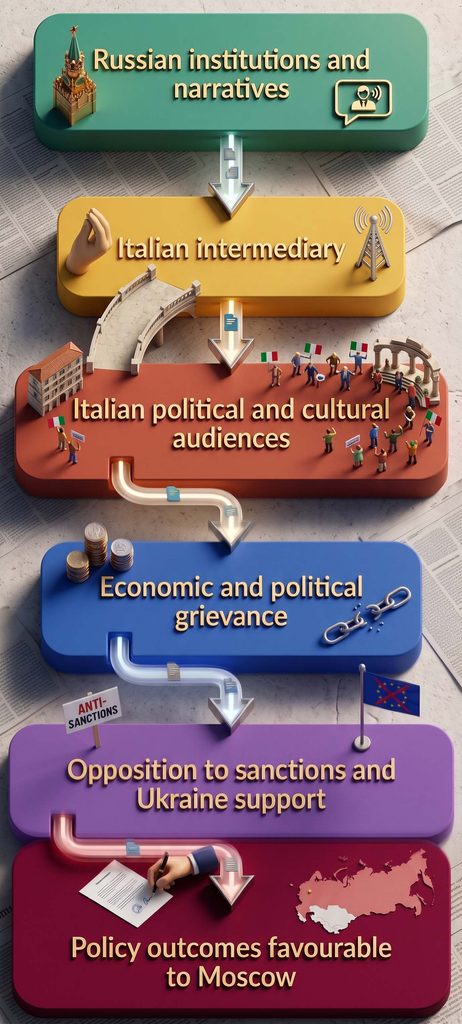
The diagram describes a possible influence mechanism, not a proven chain of direction. Its central analytical value is that influence can operate through translation and legitimisation rather than the literal reproduction of Russian official statements.
Russian state recognition
The La Repubblica investigation reports that Bertolasi received the Russian Order of Friendship directly from Vladimir Putin in November 2025. Russian reporting also associates him with formal recognition for promoting Russian culture and supporting the Russian interpretation of Donbas.
If confirmed by the complete presidential decree, the award constitutes a first-order indicator of Russian state recognition. It would establish that Bertolasi’s activity was valued at the highest political level of the Russian Federation.
It would not establish an employment or intelligence relationship. States award honours to foreigners for diplomacy, culture, business and political advocacy without acquiring command over them. The analytical relevance lies in reciprocal recognition: an Italian activist promotes Russian positions, and the Russian state publicly rewards that activity.
The precise decree number, formal citation and grounds for the award remain part of the open official record. Until retrieved, the honour should be described as reported and institutionally corroborated, not treated as fully documented in all legal particulars.
Dugin’s role must be defined accurately
Aleksandr Dugin is frequently described as “Putin’s philosopher” or the Kremlin’s ideological architect. Those descriptions can exaggerate his formal authority. Dugin is not equivalent to a serving Russian minister, presidential adviser with a publicly established portfolio or state official responsible for executing foreign policy.
His relevance lies elsewhere. He provides an ideological vocabulary—Eurasianism, civilisational conflict, multipolarity, traditionalism and opposition to Atlanticism—that overlaps with Russian state narratives and sections of the European radical right.
The European Union listed Dugin under its Russia-related restrictive measures in October 2022. The Council’s implementing regulation identified him as a political philosopher who had long advocated the unification of Russian-speaking and other territories into a Russian-dominated Eurasian entity and supported Russia’s invasion of Ukraine. Council Implementing Regulation (EU) 2022/1906 implementing Regulation (EU) No 269/2014 — Council of the European Union — Oct 2022
The EU listing is a controlling legal record for the imposition of sanctions and the Council’s stated reasons. It does not prove that every person who meets or agrees with Dugin acts for the Russian state.
Reported Italian interlocutors
The La Repubblica reconstruction identifies Roberto Jonghi Lavarini and Giovanni Trombetta as Italian figures connected with Dugin. Jonghi Lavarini is also described as a visitor to the Russian Consulate General in Milan, while Trombetta is presented as another Italian contact through the R360 association.
These connections require disaggregation:
- a personal relationship with Dugin demonstrates ideological or social access;
- participation in events demonstrates association;
- repeated interaction may indicate a channel of influence;
- neither establishes that Dugin controls Futuro Nazionale or speaks for the Kremlin in that relationship.
The missing evidence includes dates, frequency, communications, sponsorship, institutional purpose and whether the individuals influenced party policy or appointments.
The current record supports the conclusion that Dugin’s ideological environment has points of access within the broader Vannacci-associated sphere. It does not establish Dugin as an organisational superior.
“Imperial Russia” and the Third Rome
Antonio Imperatore, a former paratrooper, is reported as a leader of the association “Friends of Imperial Russia—Third Rome”, whose delegation was received by the Russian consul general in Milan.
The terminology is politically material. The concept of Moscow as the “Third Rome” originated in a historical-religious claim to succession from Rome and Constantinople. In contemporary political use it can express a civilisational mission in which Russia represents an alternative centre of Christian, conservative and imperial authority.
An association’s adoption of this language demonstrates more than an interest in Russian literature or bilateral friendship. It indicates identification with a particular historical-political conception of Russia.
Nevertheless, three distinctions remain necessary:
- cultural monarchism is not automatically support for the current Russian government;
- support for contemporary Russian power is not automatically a formal connection with the state;
- a consular reception does not automatically create political dependency.
The original association documents, governing bodies, financing, event records and consular publication should be retrieved before assigning the organisation a formal role in a Russian influence architecture.
Former military personnel as an access multiplier
The reported presence of former paratroopers and individuals from military-associated circles deserves attention without implying wrongdoing by professional category.
Former military personnel can provide:
- pre-existing personal trust;
- organisational discipline;
- access to security communities;
- credibility with nationalist audiences;
- familiarity with defence institutions;
- networks extending across veterans’ associations and serving personnel.
These characteristics make military networks valuable to political mobilisation. They can also create counterintelligence concerns if political activism overlaps with active service, security clearances or access to protected information.
No evidence examined establishes that the former paratroopers cited by La Repubblica transmitted military information to Russia. That allegation should not be inferred from their background or political views.
The appropriate institutional questions concern status and access:
- Are any individuals still serving?
- Do they hold active security clearances?
- Do party duties overlap with military obligations?
- Have foreign contacts been declared where required?
- Is access to protected material justified by present responsibilities?
The risk depends on current authority, not former occupation alone.
The Rome–Milan political bridge
The reported ecosystem is geographically structured rather than confined to one city.
Rome: political integration
The Rome component reportedly includes individuals originating in networks associated with Gianni Alemanno, Indipendenza and the “Roma ai Romani” movement. The transformation of social-media accounts from “Roma ai Romani” into “Futuro Nazionale Roma” indicates organisational absorption or rebranding rather than the creation of an entirely new communications structure.
The reported publication of a tribute to Dar’ja Dugina on those channels is relevant because it combines:
- a local Italian political platform;
- a figure symbolically important to Dugin’s ideological environment;
- the anniversary of her death;
- incorporation into the communication identity of Futuro Nazionale.
The evidentiary limit is important: a tribute establishes ideological signalling, not Russian authorship or coordination.
Milan and Lombardy: diplomatic, corporate and media concentration
Milan is the more consequential node for diplomatic and media exposure. The Russian consulate is located there; several reported Russia-oriented associations operate in the region; and the Ops Retail/Netweek corporate issue is centred on Lombardy.
Luca Carleo’s reported appointment as deputy head of Futuro Nazionale in Lombardy, with responsibility for Milan, created a direct political connection between the party and an executive associated with Ops Retail. His rapid resignation after news of prosecutorial scrutiny emerged limited the duration of the formal appointment but does not eliminate the relevance of the prior relationship.
The evidentiary questions are:
- Who proposed and approved Carleo’s appointment?
- What due diligence preceded it?
- What relationships existed before the formal appointment?
- Did Carleo contribute money, services, contacts or communications capacity?
- Did his relationship with the party continue after resignation?
No public appointment file or internal party record has been retrieved to answer these questions.
Ops Retail and the media-sector pathway
Permiakova’s directorship is officially documented
CONSOB’s public corporate information for Ops Retail, formerly Netweek, identified Iana Permiakova as a board member. The regulator’s record therefore confirms her formal position in the company’s governance structure; this element does not depend solely on journalistic reporting. OPS RETAIL SpA — Corporate Bodies — Commissione Nazionale per le Società e la Borsa — Dec 2025
The corporate position matters because a board member can participate in strategic oversight. It does not establish direct control of newsrooms, editorial selection or individual publications. Italian corporate governance separates board authority from daily editorial responsibility, although the practical division must be assessed through company records and testimony.
The verified statement should therefore be limited to: Permiakova held a corporate governance position in a media group. Any stronger claim about influence over editorial content requires additional evidence.
Russian government employment remains incompletely verified
Permiakova’s published curriculum reportedly states that from 2011 to 2016 she worked in the Russian Federation government’s “Department of Press and Information Service” in Moscow.
The description raises several unresolved issues:
- the exact Russian-language name of the department;
- whether it belonged to the federal government apparatus, a ministry or another institution;
- her job title and level of seniority;
- whether her duties concerned domestic communications, foreign media or administration;
- whether any continuing contractual or professional relationship existed after 2016.
Without those details, the phrase “former Russian government employee” is supportable only as a biographical claim reported from her curriculum. “Former Kremlin official”, “Russian operative” or equivalent formulations would not be justified.
The marriage connection creates access, not proof of coordination
Permiakova is married to Luca Carleo, who briefly held a senior Futuro Nazionale role in Lombardy. The combination creates a potential bridge between:
- previous Russian government communications experience;
- Italian media-company governance;
- regional party organisation.
Marriage establishes proximity and potential access. It does not prove that spouses shared professional information, coordinated political activity or acted jointly on behalf of a foreign interest.
The connection becomes evidentially significant only if accompanied by:
- common financial interests;
- shared companies or contracts;
- communications concerning party or editorial strategy;
- Russian-linked payments;
- coordinated appointments;
- identifiable changes in editorial output.
No such evidence has been verified in the accessible public record.
Editorial reach must not be confused with editorial manipulation
Ops Retail’s significance derives from its ownership or control of numerous local print publications and news websites. Local media can influence political perceptions through issue selection, repetition and geographic targeting. They can also provide a low-cost infrastructure for distributing narratives into communities not reached through national political media.
That capacity is a vulnerability indicator, not proof of misuse.
A rigorous content assessment would require:
- a fixed sample of publications and dates;
- identification of all Russia-, Ukraine- and Vannacci-related coverage;
- comparison with control publications outside the group;
- analysis of story origin, authorship and syndicated material;
- correction for local political relevance and news events;
- testing for coordinated timing or identical language;
- documentation of editorial instructions where available.
Without this work, claims of media manipulation would be speculative.
Pietro Stramezzi and access to Russian political circles
The La Repubblica account describes Pietro Veniamin Andrejevich Stramezzi as an Italian-Russian living in Moscow, photographed in the State Duma and maintaining contact with Anton Kobyakov, identified as an adviser to President Vladimir Putin.
If independently verified, the connection would place Stramezzi closer to Russian federal political structures than an ordinary cultural intermediary. The evidentiary weight would depend on:
- whether access was ceremonial, professional or recurring;
- Kobyakov’s precise institutional role at the time;
- the subject of their interactions;
- Stramezzi’s formal relationship with Futuro Nazionale;
- whether he transmitted requests, proposals, resources or introductions.
A photograph at the Duma proves presence. It does not prove an official function. An identified interlocutor proves contact only when the underlying meeting record, communication or first-party acknowledgement is available.
The present record therefore supports further collection, not a conclusive designation.
Larissa Yudina and cultural legitimacy
The reported proximity of Italian-Russian soprano Larissa Yudina to Futuro Nazionale illustrates how cultural actors can provide reputational and social connectivity.
Cultural figures can:
- normalise political relationships;
- convene audiences across partisan boundaries;
- connect diplomatic institutions with domestic civic groups;
- translate geopolitical positions into cultural or identity-based narratives.
These functions are legitimate forms of public activity. They become relevant to foreign influence when cultural status is combined with undisclosed sponsorship, systematic political messaging or privileged access used to advance foreign-state objectives.
No verified record examined establishes such conduct by Yudina. She should therefore be treated as a reported cultural-affinity node, not an operative or coordinating figure.
Valdegamberi: regional politics as a separate influence channel
Stefano Valdegamberi is described as one of Italy’s most openly pro-Russian regional politicians and as having formed a Futuro Nazionale component in the Veneto Regional Council.
His relevance lies in connecting national political mobilisation with regional institutions. Regional politicians can influence:
- resolutions and symbolic recognition;
- trade and cultural missions;
- local business networks;
- conferences and public buildings;
- regional media visibility;
- political recruitment.
Regional activity can also create a parallel diplomatic environment below the level of national foreign policy. This is not necessarily unlawful: Italian regions routinely engage in international economic and cultural relations. The concern arises where symbolic or commercial relationships contradict national sanctions policy, legitimise internationally disputed territorial claims or create undeclared foreign dependencies.
A complete assessment requires official Veneto Regional Council records, motions, travel disclosures and institutional expenditure. Until those are examined, Valdegamberi’s role should be treated as a visible political alignment requiring separate documentary analysis.
Evidence matrix
| Person or entity | Documented relationship | Source quality | What is established | What remains unproven |
|---|---|---|---|---|
| Roberto Vannacci | Moscow posting; Russia-accommodating policy; leadership of Futuro Nazionale | Official profile plus attributed testimony | Political authority and declared convergence | Russian direction or financing |
| Eliseo Bertolasi | Italian Russophiles Movement leader; consular access; Donbas media activity | Russian institutional and diplomatic sources | Organisational role, access and advocacy | Tasking, payment or party control |
| International Russophiles Movement | Founded in Moscow; objectives include traditional values and multipolarity | First-party institutional account | Declared mission and Russian official participation | Funding and operational governance |
| Aleksandr Dugin | Ideological reference; reported Italian contacts | EU legal record plus discovery reporting | Sanctioned ideologue supporting Russian expansionism | Formal control of Italian contacts |
| Antonio Imperatore/Third Rome circle | Reported consular engagement and imperial-Russian orientation | Primarily journalistic discovery | Coherent ideological association if confirmed | State financing or political direction |
| Jonghi Lavarini/Trombetta | Reported Dugin and consular relationships | Primarily journalistic discovery | Leads requiring verification | Frequency, purpose and party influence |
| Iana Permiakova | Ops Retail board membership | CONSOB corporate record | Formal media-company governance role | Editorial manipulation or continuing Russian relationship |
| Luca Carleo | Brief Futuro Nazionale Lombardy appointment; Ops connection | Party and journalistic reporting | Potential political-corporate bridge | Coordinated media or Russian activity |
| Ops Retail/Netweek | Local-media portfolio | Corporate/regulatory record | Communications capacity | Use of that capacity for foreign influence |
| Pietro Stramezzi | Reported Duma presence and Russian political contacts | Journalistic discovery | Collection lead | Formal role, tasking or intermediation |
| Larissa Yudina | Reported cultural proximity | Journalistic discovery | Potential social-cultural access | Political or state-directed activity |
| Stefano Valdegamberi | Pro-Russian regional politics and reported FN affiliation | Public political record requiring consolidation | Regional political channel | Coordination with Russian institutions |
Convergence across the four layers
The ecosystem displays four consistent alignments.
Diplomatic convergence
Several reported actors have access to the Russian Consulate General in Milan or other Russian institutions. Access is visible, public and in some cases celebrated by Russian sources.
Ideological convergence
The recurrent themes—multipolarity, traditional values, Eurasianism, civilisational sovereignty, the Third Rome and opposition to Atlanticism—form a coherent ideological family rather than an assortment of unrelated cultural interests.
Political convergence
Futuro Nazionale’s foreign-policy direction would reduce pressure on Russia, oppose continuing support for Ukraine and reopen economic channels with Moscow.
Information convergence
Journalists, documentary production, social-media rebranding and a local-media corporate connection create multiple potential routes for political narratives to reach Italian audiences.
The four layers reinforce each other. Diplomatic recognition legitimises ideological actors; ideological actors translate Russian narratives; media access distributes them; political actors convert them into demands on government policy.
This is a plausible mechanism. The evidence does not yet demonstrate central coordination across the layers.
Key judgments
- The ecosystem surrounding Futuro Nazionale contains more Russia-linked access points than can reasonably be dismissed as a single incidental association.
- Bertolasi is the strongest documented bridge because his organisational role, diplomatic access and information activity are acknowledged by Russian institutional sources.
- The International Russophiles Movement combines cultural advocacy with explicitly geopolitical objectives, including promotion of traditional values and multipolarity.
- Relationships with Dugin demonstrate ideological proximity but must not be converted into evidence of Kremlin command.
- Permiakova’s Ops Retail directorship is officially documented; her alleged influence over editorial content is not.
- The Permiakova–Carleo relationship creates a potential media-political pathway but does not prove joint or foreign-directed activity.
- Former military, cultural and regional-political networks can multiply access, yet their members require individual assessment rather than collective attribution.
- The documented structure is best classified as an ecosystem of affinity, access and potential transmission, not a proven Russian operational network.
What would change the assessment
The assessment would strengthen if evidence established:
- common funding across the political, associative and media layers;
- Russian sponsorship of events, travel, communications or campaign services;
- a recurring intermediary connecting Russian officials with multiple Futuro Nazionale figures;
- coordinated messaging timed with Russian diplomatic or state-media activity;
- editorial instructions affecting Ops Retail publications;
- appointment of Russian-linked figures to party finance, communications or candidate-selection roles;
- concealed meetings followed by identifiable political action;
- operational communications linking the individual nodes.
The assessment would weaken if:
- contacts proved isolated, ceremonial and fully disclosed;
- organisational financing were demonstrably domestic and independent;
- the reported individuals held no substantive influence within Futuro Nazionale;
- content analysis found no abnormal editorial convergence;
- party due diligence excluded undeclared foreign dependencies;
- no common intermediary, resource flow or coordination mechanism emerged.
Open official record
The following records remain necessary:
- complete Russian presidential decrees concerning Bertolasi’s honour and reported citizenship;
- statutes, accounts, donors and sponsors of the Italian International Russophiles Movement;
- official records of Russian consular meetings involving the named Italian actors;
- Italian association-registry documents for the “Third Rome” and R360 organisations;
- Futuro Nazionale appointment records, organisational charts and due-diligence procedures;
- complete CONSOB and company filings for Ops Retail/Netweek during Permiakova’s tenure;
- board minutes defining her responsibilities and resignation;
- verified Russian employment documentation for Permiakova;
- publication-level content data for the Ops Retail media portfolio;
- Veneto Regional Council records concerning Valdegamberi’s Russia-related activity;
- records establishing the nature and frequency of Stramezzi’s contacts in Moscow;
- competent judicial documents relating to the Ops Retail investigation.
Ecosystem of Affinity, Access & Transmission: The Futuro Nazionale Evidence Matrix
Forensic multi-node evaluation of the network surrounding Roberto Vannacci and Futuro Nazionale. Dissecting established connections from unverified operational command across four distinct transmission layers: diplomatic access, ideological affinity, political positioning, and media corporate conduits.
Layer Diagnostic: Diplomatic Access & Institutional Ties
Tracking verified consular presence, institutional recognition, and absence of operational tasking.
Layer 1: Diplomatic Convergence & Consular Access Channels
Multiple figures linked to the Futuro Nazionale ecosystem maintain public, documented access to the Russian Consulate General in Milan and related state apparatuses. These interactions are overt, recorded in diplomatic photographs, and acknowledged by Russian state foundations.
Diplomatic recognition provides symbolic prestige and legitimacy to non-establishment Italian actors. Russian state institutions use these access points to cultivate potential political intermediaries without requiring formal espionage channels.
Consular hospitality and commemorative attendance do not equate to espionage tradecraft, clandestine financing, or programmatic command-and-control. Official records demonstrate access, not subordination.
Comprehensive Evidence Matrix: Nodes, Status & Evidentiary Limits
Systematic evaluation of individual persons and corporate entities, assessing documented relationships against what remains unproven in open judicial and intelligence records.
| Person / Entity | Documented Relationship | Source Quality | What is Established | What Remains Unproven |
|---|---|---|---|---|
| Roberto Vannacci | Moscow defense posting (2021–22); Russia-accommodating doctrine; leadership of Futuro Nazionale. | Official profile plus attributed testimony | Political authority and declared ideological convergence. | Russian direction, operational tasking, or financial underwriting. |
| Eliseo Bertolasi | Italian Russophiles Movement head; Milan consular access; Donbas embedded reporting. | Russian institutional & diplomatic sources | Formal organizational role, verified access, and public advocacy. | Clandestine tasking, illicit payments, or direct party executive control. |
| Int’l Russophiles Movement | Founded in Moscow; charters prioritize traditional values, multipolarity, and anti-globalism. | First-party institutional account | Declared geopolitical mission and Russian state official participation. | Underlying financial flows and operational governance in Italy. |
| Aleksandr Dugin | Ideological lodestar; philosophical father of Neo-Eurasianism; reported Italian network contacts. | EU legal sanctions record & investigative reporting | Sanctioned ideologue advocating dismantling of Western Atlantic hegemony. | Formal command or executive control over Italian political circles. |
| Antonio Imperatore / Third Rome | Reported consular engagement, monarchist/imperial Russian traditionalist orientation. | Primarily journalistic discovery | Coherent ideological association with Eurasian traditionalism if verified. | Russian state financing or sovereign political direction. |
| Jonghi Lavarini / Trombetta | Reported Dugin interactions, consular access, and sovereignist political networking. | Primarily journalistic discovery | Intelligence leads requiring rigorous official document verification. | Frequency of meetings, definitive purpose, and party influence. |
| Iana Permiakova | Directorship on the corporate board of Ops Retail (Netweek media publishing chain). | CONSOB corporate & regulatory filings | Formal statutory governance role within a regional media holding. | Editorial manipulation or active links to Russian state services. |
| Luca Carleo | Brief organizational role in Futuro Nazionale Lombardy; corporate ties to Ops Retail. | Party releases & investigative reporting | Structural intersection between party organization and commercial media. | Coordinated pro-Kremlin media campaigns or Russian tasking. |
| Ops Retail / Netweek | Syndicated network of local Italian weekly newspapers and digital regional portals. | Corporate balance sheets & public registers | Substantial physical broadcast and print communications capacity. | Actual deployment of local editorial assets for foreign influence operations. |
| Pietro Stramezzi | Reported presence at the State Duma and dialogue with Russian legislative deputies. | Journalistic discovery & conference photos | High-priority counter-intelligence collection lead. | Formal party representation mandate, tasking, or financial intermediation. |
| Larissa Yudina | Reported cultural and social proximity to Russian expatriate and diplomatic circuits. | Journalistic discovery | Potential cultural and social network access channel. | Substantive political involvement or state-directed intelligence activity. |
| Stefano Valdegamberi | Pro-Russian regional legislative record (Veneto); reported political affinity with FN. | Public political records & voting history | Active regional political channel challenging EU sanctions against Moscow. | Formal operational coordination with Russian intelligence or state services. |
Convergence Architecture: How the Four Layers Reinforce
The core analytical finding is that Futuro Nazionale’s ecosystem does not rely on clandestine espionage cut-outs. Rather, it functions via a mutually reinforcing architecture of four public or semi-public layers:
Visible engagement with the Russian Consulate General in Milan grants status, media attention, and symbolic standing to peripheral actors, legitimizing their role within domestic sovereignist politics.
Philosophical concepts (Duginism, Third Rome, civilisational conservatism) are translated by cultural intermediaries into accessible Italian political talking points, attacking NATO and EU supranationalism.
Documentary filmmakers, digital platforms, and corporate presence in local media holdings (Ops Retail/Netweek) provide latent infrastructure to broadcast narrative themes directly to local Italian electorates.
Futuro Nazionale institutionalizes these narratives into formal legislative demands: opposing Ukraine military decrees, seeking sanctions repeals, and demanding normalized commercial energy ties with Moscow.
Forensic Strategic Key Judgments
Indicators Strengthening Operational Attribution
- Financial Integration: Traceable common funding streams linking political figures, cultural associations, and media publishing firms.
- Sovereign Underwriting: Russian state sponsorship of travel, logistics, conference halls, or digital bot infrastructure.
- The Central Intermediary: Discovery of an operative linking Russian intelligence directly to multiple executive figures within Futuro Nazionale.
- Editorial Directives: Documented instructions issued to Ops Retail / Netweek editors mandating specific pro-Moscow coverage.
- Personnel Capture: Formal appointment of Russia-connected individuals to party executive committees, candidate vetting, or treasury portfolios.
Indicators Weakening Operational Attribution
- Ceremonial Isolation: Verification that consular interactions were isolated, ceremonial, and fully reported to Italian authorities.
- Certified Independent Accounts: Financial audits showing party operations are funded strictly by domestic micro-donations and membership dues.
- Marginalized Intermediaries: Proof that figures like Bertolasi or Stramezzi hold zero formal influence or advisory power over party decisions.
- Editorial Autonomy: Quantitative semantic audits of Netweek newspapers confirming no abnormal pro-Russian slant or top-down interference.
- Party Vetting Action: Institutional due diligence by Futuro Nazionale actively excluding individuals with undisclosed foreign entanglements.
Open Official Record: Specific Evidentiary Files Required for Conclusive Finding
An evidence-based assessment cannot substitute speculation for records. A final determination requires twelve specific official documents:
Chapter 3 — From Association to Influence: The Unresolved Evidentiary Threshold
Principal judgment
The public record supports the existence of a politically coherent, Russia-oriented ecosystem around Futuro Nazionale, but it does not establish that Roberto Vannacci or his party is financed, instructed or controlled by the Russian Federation.
The evidentiary threshold between association and foreign influence has not yet been crossed because the available material demonstrates contacts, access, ideological affinity and reciprocal recognition—but not the decisive transmission mechanism connecting a Russian state interest to a specific Italian political action through money, tasking, concealed assistance or coordinated operations.
This conclusion does not make the ecosystem strategically insignificant. It means that the risk must be classified correctly:
- Documented: political convergence, Russian institutional access and Russia-oriented advocacy among individuals associated with the broader environment.
- Partially documented: the existence of potential diplomatic, political and media transmission channels.
- Unresolved: whether those channels have been deliberately cultivated or materially supported by Russian state-linked actors.
- Not established: covert financing, operational tasking, intelligence activity, illegal foreign interference or Kremlin control of Futuro Nazionale.
The central investigative requirement is therefore to move from evidence of who knows whom to evidence of who provided what, through which intermediary, for which intended result.
The evidentiary ladder
Foreign influence is not a binary condition. It exists across a progression of relationships with different legal and analytical implications.
| Level | Evidentiary category | Defining characteristic | Present status |
|---|---|---|---|
| 1 | Ideological affinity | Independent agreement with Russian positions | Established |
| 2 | Open association | Public meetings, cultural activity or political dialogue | Established for several figures |
| 3 | Institutional access | Repeated or privileged access to Russian diplomatic or political bodies | Established for Bertolasi; reported for others |
| 4 | Reciprocal amplification | Russian and Italian actors promote each other’s narratives or legitimacy | Partially established |
| 5 | Cultivation | A foreign actor develops a relationship to obtain future political utility | Plausible but unproven |
| 6 | Material influence | Money, services, travel, media support or other benefits affect political activity | Not established |
| 7 | Coordinated influence operation | Foreign and domestic actors knowingly coordinate objectives, messages or actions | Not established |
| 8 | Direction or control | The foreign actor determines decisions, appointments or operations | Not established |
| 9 | Espionage or other criminal conduct | Protected information, clandestine tasking or offences under applicable law | No public evidence identified |
The first four levels can exist lawfully. Even cultivation is not automatically criminal: foreign diplomats routinely seek access and develop relationships. Legal and counterintelligence significance increases when the relationship becomes concealed, materially supported, deceptive or directed towards compromising an institutional process.
The public discussion surrounding Vannacci frequently collapses these categories. The description “pro-Russian” generally concerns Level 1. Photographs at a consulate concern Levels 2 or 3. A Russian state honour can support Levels 3 and 4. None of those facts alone establishes Levels 6–9.
Affinity is not agency
A political actor can sincerely hold positions that benefit a foreign state. Shared policy preferences do not demonstrate that the foreign state created or controls those preferences.
Vannacci’s opposition to military assistance for Ukraine, support for restored economic relations with Russia and scepticism about NATO or European integration can be explained by his declared sovereigntist worldview. The continuity between the positions attributed to him during his Moscow posting and his subsequent political programme strengthens the autonomous-ideology explanation.
The alternative explanation—that Russian actors cultivated or supported the political project—requires evidence beyond policy convergence. Otherwise, the assessment would treat political disagreement as evidence of foreign agency.
A finding of agency would normally require at least one of the following:
- a communication containing a request or instruction;
- a financial or material benefit connected to expected political conduct;
- an intermediary acting on behalf of a Russian state or state-linked principal;
- coordinated timing that cannot reasonably be explained by common access to public events;
- concealment or false reporting of a relevant relationship;
- internal acknowledgement of the foreign origin or intended beneficiary of an action;
- a repeated exchange in which political output follows foreign support.
No such evidence has been verified in the accessible record concerning Vannacci or Futuro Nazionale.
Access is not influence—but it is a prerequisite
Eliseo Bertolasi’s leadership of the Italian representation of the International Russophiles Movement and his access to the Russian Consulate General in Milan are documented by Russian institutional sources. Элизео Бертолази (Италия): «Защита русской культуры является обязанностью каждого достойного человека» — Russkiy Mir Foundation — Oct 2023 Итальянский журналист и общественный деятель Элизео Бертолази почтил память Дарьи Дугиной — Consulate General of the Russian Federation in Milan — Aug 2026
These records demonstrate that Bertolasi is not merely a distant commentator sympathetic to Russia. He has organisational standing, diplomatic access and recognition within an institutional environment that promotes Russian cultural and geopolitical narratives.
The missing step is conversion. The public record does not show that Bertolasi:
- determined Futuro Nazionale’s policy;
- arranged funding or services for the party;
- transmitted Russian instructions;
- influenced candidate appointments;
- managed party communications;
- provided access to protected Italian information;
- coordinated party messaging with a Russian institution.
His presence within the broader political environment raises the relevance of those questions but does not answer them.
The distinction is essential because access is a necessary condition for interpersonal influence but not proof that influence occurred. A contact becomes evidentially significant when it is connected to an identifiable decision, benefit or behavioural change.
Recognition is not recruitment
Russian state honours, institutional invitations and favourable media treatment are forms of recognition. They can reward existing advocacy, encourage further activity and confer prestige on recipients.
Bertolasi’s reported Order of Friendship is therefore relevant even if no financial benefit accompanied it. The award communicates that the Russian state values his work. It can enhance his status within Russia-oriented associations and make his activity more visible to prospective supporters.
Recognition nevertheless remains distinguishable from recruitment. The evidentiary difference is contractual or operational:
| Recognition | Recruitment or tasking |
|---|---|
| Public award or invitation | Specific request for conduct |
| Symbolic political endorsement | Expected or agreed political output |
| General encouragement | Operational objectives or reporting requirements |
| No demonstrated obligation | Formal or informal reciprocal obligation |
| Publicly attributable | Frequently concealed or deniable |
The complete presidential decree and accompanying citation would establish the legal basis for the honour. They would not, without additional records, demonstrate that Bertolasi accepted obligations towards the Russian state.
The same reasoning applies to meetings with Russian diplomats. Diplomatic hospitality creates access and potentially cultivates goodwill; it does not prove that the guest acts as a foreign representative.
Ideological transmission is not necessarily coordinated disinformation
The ecosystem reproduces themes common to contemporary Russian strategic communication:
- sanctions allegedly damage Italy more than Russia;
- Western assistance prolongs rather than contains the war;
- Russia represents traditional social and Christian values;
- the international order should become “multipolar”;
- Western media conceal or manipulate the origins of the conflict;
- NATO or the United States bears principal responsibility for escalation;
- Ukraine is denied full strategic agency and represented as an instrument of external powers.
Bertolasi expressed several of these themes in the Russkiy Mir interview, including his description of sanctions as economic “masochism”, his criticism of Italian media and his promotion of a multipolar order. Элизео Бертолази (Италия): «Защита русской культуры является обязанностью каждого достойного человека» — Russkiy Mir Foundation — Oct 2023
Narrative similarity alone cannot establish coordination. Political actors often adopt the same interpretation independently because they share ideology, information sources or incentives. A defensible finding of coordinated information activity would require evidence such as:
- common non-public source material;
- identical unusual errors or formulations;
- simultaneous dissemination following private communication;
- centralised production of media assets;
- shared technical infrastructure;
- payments for content or distribution;
- platform evidence identifying coordinated accounts;
- instructions concerning target audiences or timing.
No complete cross-platform forensic analysis has been presented for Futuro Nazionale. The available material supports narrative convergence, not a finding of coordinated inauthentic behaviour.
The legal threshold for foreign political financing
Italian law provides a clearer threshold for material foreign influence than for ideological or diplomatic association.
Law No. 3 of 9 January 2019 strengthened transparency requirements for political parties and movements. Article 1, paragraph 12 prohibits parties and political movements from receiving contributions, free services or other forms of material support from:
- foreign governments;
- public entities of foreign states;
- legal persons based in another state;
- adult individuals not registered on Italian electoral rolls or deprived of voting rights.
The parliamentary legislative record also explains that the prohibition includes support provided through stable access to free services. Legge 9 gennaio 2019, n. 3: transparency of political parties and movements — Chamber of Deputies — Jan 2019
This is critical because foreign political support need not consist of a bank transfer. It can include:
- free or subsidised office space;
- communications work;
- advertising;
- polling or analytics;
- transport or accommodation;
- event production;
- digital infrastructure;
- personnel secondment;
- legal or consulting services;
- access to media distribution;
- campaign materials supplied below market value.
Accordingly, the absence of a disclosed monetary donation would not resolve the financing question. An investigation must compare the party’s actual campaign capacity with declared expenditure and determine whether any foreign or foreign-funded entity supplied services or absorbed costs.
The available public record does not establish that Futuro Nazionale received prohibited foreign support. It also does not contain sufficient audited financial documentation to exclude indirect benefits.
Transparency thresholds and their limits
Italian law requires increased disclosure of political contributions. The parliamentary materials for Law No. 3/2019 state that contributions, free services and other material support exceeding €500 per donor per year engage publication and transparency requirements. The same reform extended transparency provisions to certain politically connected foundations, associations and committees. Legge 9 gennaio 2019, n. 3: transparency of political parties and movements — Chamber of Deputies — Jan 2019
The law is relevant to the Vannacci ecosystem because support can travel outside a party’s central account. Potential pathways include:
- formally independent associations organising political events;
- foundations commissioning studies or communications;
- companies providing staff or venues;
- media organisations offering systematically favourable distribution;
- regional committees absorbing campaign costs;
- individuals paying suppliers directly;
- services divided among several entities or transactions.
The legal framework seeks to capture some politically connected entities, but its effectiveness depends on accurate classification, disclosure and enforcement. An association can be politically important without meeting every statutory criterion for equivalence with a party.
The evidentiary inquiry must therefore address both legality and economic substance. A transaction can be formally external to a party while producing a measurable political benefit.
Foreign interest representation remains incompletely harmonised
At EU level, the Commission’s 2023 Defence of Democracy package included a proposal for harmonised transparency requirements for interest-representation activities conducted on behalf of third countries. The proposal aimed to identify who was representing a third-country interest, for whom, with what resources and towards which public decision. Documents on Defence of Democracy — European Commission — Dec 2023
As of the subsequent Commission documentation examined, the proposal remained under discussion by the EU co-legislators. Communication on the European Democracy Shield — European Commission — Nov 2025
This limitation matters. Cultural, analytical and political advocacy conducted on behalf of a foreign principal does not always fit neatly into party-financing law. Where no contribution is made directly to a party, the relevant conduct may instead resemble lobbying, public diplomacy, media activity or civil-society cooperation.
The legal status depends on questions that the public record has not resolved:
- Was an Italian actor acting independently or on behalf of a Russian principal?
- Was compensation or another benefit provided?
- Was the intended target a public authority, a political party or the general public?
- Was the relationship disclosed?
- Did the activity involve legitimate advocacy, deception or prohibited support?
Without evidence of the principal-agent relationship, the proposed transparency framework cannot be analytically backfilled by assumption.
Political influence is broader than criminal conduct
A significant strategic vulnerability can exist without a prosecutable offence.
Foreign influence can be:
- overt and lawful;
- covert but not necessarily criminal;
- unlawful under political-financing or transparency rules;
- corrupt;
- part of an intelligence operation;
- connected with espionage or other national-security offences.
These categories require different evidence and different institutional responses.
| Finding | Necessary evidence | Appropriate response |
|---|---|---|
| Lawful political affinity | Public statements and votes | Democratic scrutiny and policy debate |
| Undisclosed foreign advocacy | Proof of representation for a foreign principal | Registration, disclosure and administrative enforcement |
| Prohibited foreign support | Transfer or service from a prohibited foreign source | Financial investigation and statutory sanctions |
| Corrupt influence | Benefit linked to misuse of public or political authority | Criminal investigation |
| Covert state operation | Tasking, concealment and state-linked coordination | Intelligence and counterintelligence response |
| Espionage | Acquisition or transfer of protected information | Criminal and national-security investigation |
The evidence concerning Vannacci currently remains in the first category, with indicators requiring examination under the second and third. It does not publicly meet the fourth, fifth or sixth thresholds.
Media ownership: capacity is not evidence of use
Iana Permiakova’s membership of the Ops Retail board is recorded by CONSOB. OPS RETAIL SpA — Corporate Bodies — Commissione Nazionale per le Società e la Borsa — Dec 2025
The position created potential access to corporate strategy inside a group controlling numerous local publications and news websites. Her reported previous employment within a Russian government press and information structure increases the relevance of examining that access.
Neither fact establishes editorial interference.
To cross the evidentiary threshold, an investigation would need to connect board-level access with identifiable media output. Relevant evidence would include:
- board or management instructions concerning Russia, Ukraine or Futuro Nazionale;
- changes in editorial appointments linked to political objectives;
- disproportionate or coordinated coverage unsupported by newsworthiness;
- undisclosed sponsored content;
- distribution of material originating from Russian state sources;
- common wording across nominally independent local outlets;
- suppression of contrary reporting;
- payments, contracts or technical support from Russian-linked entities.
The analysis must also identify legitimate alternative explanations, including ordinary commercial decisions, national wire-service content, local political relevance and independent editorial judgment.
Without a controlled content study or internal documentation, the proposition that the media group functioned as an influence instrument remains unresolved.
Permiakova is married to Luca Carleo, who briefly held a Futuro Nazionale leadership position in Lombardy and was associated with Ops Retail. This creates a plausible route of interpersonal access between corporate media governance and party organisation.
It is not sufficient evidence of coordination.
A defensible joint-activity finding would require:
- shared financial or corporate interests relevant to the party;
- communications concerning editorial or political strategy;
- common involvement in appointments or contracts;
- Russian-linked benefits;
- use of company resources for political purposes;
- evidence that one spouse acted as an intermediary for the other.
The fact of marriage cannot substitute for this evidence. Treating family relationships as proof would produce guilt by association rather than intelligence analysis.
Investigations are not findings of guilt
The reported Milan investigation involving Ops Retail, Carleo and Permiakova must be described according to procedural status.
An investigation establishes that competent authorities are examining possible conduct. It does not establish:
- that an offence occurred;
- that every investigated person participated;
- that allegations will result in charges;
- that charges will result in conviction;
- that the matter concerns Russia or foreign influence.
Unless the competent prosecution office or court publishes an act defining the alleged conduct, the investigation should not be used as indirect evidence of a Russian political operation.
The same principle applies to reported military-prosecutor scrutiny of serving personnel associated with Futuro Nazionale. Such scrutiny may concern military rules on political activity rather than foreign relationships. Its existence cannot be repurposed to support a different allegation.
The intelligence threshold differs from the judicial threshold
A criminal court requires admissible evidence proving an offence under the applicable standard. An intelligence assessment addresses risk under uncertainty and can act before criminal proof exists.
This difference permits institutional caution but not factual inflation.
An intelligence service might reasonably monitor:
- repeated access to hostile-state officials;
- unexplained benefits;
- attempts to place individuals near sensitive functions;
- concealed intermediaries;
- anomalous travel or communications;
- media amplification linked with foreign infrastructure.
The service need not wait for a completed offence before reducing access or intensifying collection. It still must distinguish indicators from conclusions.
For the present case, the intelligence-level judgment is that the ecosystem merits scrutiny because multiple potential pathways exist. The judicial-level judgment is that no publicly verified evidence establishes illegal Russian financing, corruption, covert coordination or espionage.
Italy’s intelligence assessment establishes the general threat, not this case
Italy’s annual intelligence reporting for activity conducted in 2025 describes a security environment affected by geopolitical competition, hybrid pressure, information manipulation and threats to technological, economic and democratic sovereignty. Relazione sulla politica dell’informazione per la sicurezza relativa all’anno 2025 — Presidency of the Council of Ministers — Mar 2026 Relazione al Parlamento 2026 — Sistema di informazione per la sicurezza della Repubblica — Mar 2026
These assessments establish the general relevance of foreign interference and hybrid activity to Italian national security. They do not publicly identify Vannacci, Futuro Nazionale or the individuals examined in this dossier as participants in a Russian operation.
The distinction prevents a common analytical error: using a general official warning about Russian interference to validate an unproven allegation against a specific person.
General threat reporting can justify collection priorities. Only case-specific evidence can justify case-specific attribution.
Testing the principal explanations
The evidence supports four distinct explanations that remain sufficiently plausible to warrant structured comparison.
Hypothesis 1 — Autonomous ideological coalition
Under this explanation, Vannacci and the individuals around him are independently attracted to nationalism, traditionalism, multipolarity and renewed relations with Russia. Russian institutions recognise these actors because their positions are useful, but they did not create or direct the movement.
Supporting evidence
- continuity in Vannacci’s views;
- public and explicit party positions;
- ideologically coherent self-identification;
- absence of proven Russian financing or tasking.
Evidence that would weaken it
- concealed benefits;
- coordinated communications;
- shared intermediaries;
- evidence that policies were requested or supplied externally.
This remains the best-supported explanation.
Hypothesis 2 — Russian cultivation without direct control
Under this explanation, Russian diplomats and affiliated institutions identify sympathetic Italian actors, provide access, prestige, amplification or other non-command support and develop relationships for potential future utility.
Supporting evidence
- consular access;
- organisational connections;
- Russian state recognition;
- circulation through Russian institutional and media environments;
- reciprocal promotion of compatible narratives.
Evidence that would weaken it
- contacts shown to be isolated or purely ceremonial;
- absence of continuing relationships;
- transparent domestic funding;
- no pattern of Russian amplification.
This is compatible with the evidence but remains unproven as a deliberate programme.
Hypothesis 3 — Indirect material influence through intermediaries
Under this explanation, support does not move directly from the Russian state to Futuro Nazionale. Associations, companies, media services, private donors or dual-national intermediaries provide benefits that affect political activity.
Supporting evidence
- the existence of potential intermediary nodes;
- political, media and diplomatic layers in the same environment.
Evidence missing
- transactions;
- beneficial ownership;
- contracts;
- free services;
- common financial controllers;
- identifiable political outputs.
This hypothesis is not established.
Hypothesis 4 — Covert Russian political operation
Under this explanation, Futuro Nazionale or influential figures inside it knowingly participate in a Russian-directed operation intended to alter Italian or European policy.
Required evidence
- tasking;
- operational communications;
- covert funding;
- controlled intermediaries;
- reporting back to a Russian principal;
- concealment;
- measurable execution of agreed objectives.
No verified public evidence presently meets this standard.
The decisive chain of proof
A defensible attribution of foreign influence requires a complete causal chain:
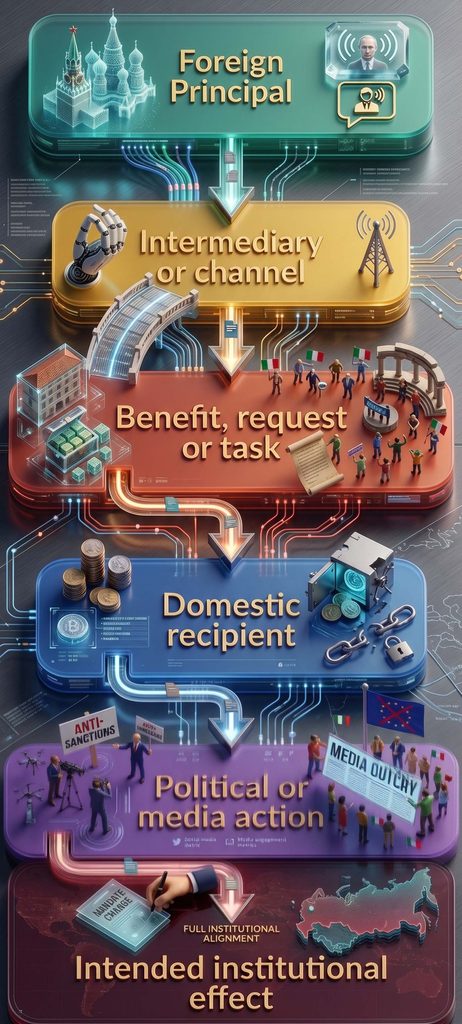
For the Vannacci case, portions of the chain are visible:
- Russian institutions exist as potential foreign principals.
- Several Italian actors can function as intermediaries.
- Futuro Nazionale is the relevant domestic political recipient.
- Policies favourable to Russian interests are publicly advocated.
The central links remain missing:
- no verified benefit or task connecting the principal to the recipient;
- no demonstrated agreement connecting support to political output;
- no proven coordination connecting the ecosystem’s separate nodes.
The beginning and end of a potential influence chain cannot be used to invent the missing middle.
A collection matrix for resolving the threshold
| Intelligence question | Required record | Confirming indicator | Disconfirming indicator |
|---|---|---|---|
| Has Futuro Nazionale received foreign material support? | Accounts, bank records, invoices, service contracts | Foreign-funded benefit or below-market service | Fully reconciled domestic financing |
| Do intermediaries act for Russian principals? | Contracts, communications, travel sponsorship | Instructions, compensation or reporting relationship | Independent financing and no tasking |
| Has media capacity been politically deployed? | Editorial directives and content dataset | Coordinated narratives or suppressed coverage | Ordinary editorial variation |
| Did consular access affect party decisions? | Meeting records and decision chronology | Specific request followed by responsive action | No temporal or substantive connection |
| Were appointments influenced externally? | Nomination records and internal communications | Foreign-linked recommendation or condition | Documented domestic selection |
| Has information been transferred? | Access logs, communications and classification records | Unauthorised disclosure | No access or transmission |
| Is digital amplification coordinated? | Platform and infrastructure data | Common control, automation or synchronised deployment | Organic, independently managed accounts |
This collection programme would produce materially greater analytical value than additional compilation of photographs, public statements or ideological quotations.
Key judgments
- The documented ecosystem has crossed the threshold from isolated coincidence to a legitimate national-security collection question.
- It has not crossed the threshold required to describe Futuro Nazionale as a Russian-controlled or Russian-financed political operation.
- Bertolasi’s organisational standing and Russian institutional recognition establish access and reciprocal legitimacy, not tasking.
- Narrative alignment is strong but cannot be classified as coordinated disinformation without technical or communications evidence.
- Italian law prohibits foreign governmental, foreign public-entity and certain foreign legal-person support to political parties, including material services—not only cash donations.
- No verified public record examined establishes that Futuro Nazionale violated those financing rules.
- Permiakova’s media-company directorship establishes institutional capacity, but no verified evidence connects that capacity to editorial manipulation.
- Investigations involving associated individuals must not be treated as findings of guilt or repurposed as proof of Russian influence without case-specific acts.
- The most defensible current classification is documented convergence with material indicators of potential cultivation, but unproven foreign direction.
What would change the assessment
The assessment would change decisively if any of the following emerged:
- a Russian-funded payment, service or benefit reaching Futuro Nazionale or a legally equivalent entity;
- evidence that an intermediary acted under instructions from a Russian official or state-linked organisation;
- internal party communications acknowledging foreign support or coordinating with Russian actors;
- proof that Russian access influenced appointments, voting, coalition conditions or communications;
- editorial instructions connecting Ops Retail resources with a foreign political objective;
- platform evidence of centrally controlled amplification;
- concealment of reportable foreign contacts, support or beneficial ownership;
- unauthorised access to or transfer of protected government, military or NATO information.
The assessment would weaken if:
- party and associated-entity accounts were fully reconciled and domestically funded;
- all relevant benefits and services were purchased at documented market rates;
- foreign contacts were limited, transparent and unrelated to decision-making;
- a complete content analysis found no coordinated media pattern;
- the named individuals proved peripheral to party strategy and resource allocation;
- no shared intermediary connected the political, diplomatic and media layers.
Open official record
The following instruments and observations remain necessary:
- Futuro Nazionale’s complete certified financial statements and donor disclosures;
- records of non-monetary services, event sponsorship and political advertising;
- accounts and governance records of politically connected associations and committees;
- official Russian records identifying financial or institutional support to Italian partner organisations;
- the full decree and citation concerning Bertolasi’s Order of Friendship;
- Russian and Italian documentation concerning any reported grant of Russian citizenship;
- official consular meeting registers and event sponsorship records;
- verified employment documentation defining Permiakova’s former Russian government role;
- complete Ops Retail board minutes, related-party transactions and editorial-governance rules;
- competent prosecutorial or judicial acts defining the Ops Retail investigation;
- European Parliament and party records concerning meetings, gifts, travel and declarations of interest;
- platform-level evidence concerning coordinated amplification;
- any declassified Italian assessment specifically addressing Futuro Nazionale or the named ecosyste
Futuro Nazionale & Foreign Influence: The Collection Threshold vs Unproven Subordination
Forensic intelligence appraisal distinguishing an authorized national-security collection priority from unverified conclusions of Russian operational direction. Dissecting Italian party-financing statutes, narrative convergence parameters, and evidentiary gaps across the political-corporate nexus.
Intelligence Metrics: National Security Collection Standing
Tracking observable network access, institutional recognition, and evidentiary gaps required for definitive attribution.
Threshold Assessment: Legitimate National-Security Collection Priority
The documented ecosystem has definitively crossed the threshold from isolated coincidence into an authorized national-security collection priority. The concentration of access points around diplomatic, ideological, and media assets warrants enhanced institutional monitoring.
It has not crossed the threshold required to describe Futuro Nazionale as a Russian-controlled or Russian-financed political operation. A collection mandate establishes the necessity to investigate; it is not a finding of operational subordination.
The most defensible current classification is documented convergence with material indicators of potential cultivation, but unproven foreign direction. Bertolasi’s standing establishes access and reciprocal legitimacy, not sovereign command.
Forensic Strategic Key Judgments
Comparative Evidentiary Matrix: Established Facts vs Unproven Hypotheses
Cross-examination of institutional records, legal frameworks, and counter-intelligence standards defining the current operational baseline.
| Pillar | Documented / Verified Reality | What Remains Strictly Unproven | Legal & CI Standing |
|---|---|---|---|
| Party Legal Status & Finance | Statutory prohibition on foreign party funding (cash and material in-kind services) under Italian law. | Zero verified public proof, banking transfer records, or judicial findings of foreign funding reaching the party. | Compliant on Record |
| Bertolasi Institutional Nexus | Head of Italian Russophiles Movement; accredited presence at Russian Consulate General in Milan. | Operational intelligence tasking, covert handling, or executive command over Futuro Nazionale party decisions. | Access & Legitimacy |
| Media Corporate Nexus (Ops Retail) | Iana Permiakova served on the board of Ops Retail (holding company of the Netweek publishing group). | Editorial intervention, pro-Kremlin content dictation, or foreign covert deployment of local newspapers. | Unproven Conduit |
| Narrative Alignment & Ideology | Public sovereignist manifesto opposing Ukraine military assistance and EU supranational centralism. | Technical, algorithmic, or clandestine coordination with Russian state disinformation machinery. | Autonomous Convergence |
Threshold Triggers Strengthening Attribution
The current judgment would escalate decisively to confirmed foreign operation if any of the following emerge:
- Financial Tracing: A verified Russian-funded payment, in-kind service, or material benefit reaching Futuro Nazionale.
- Intermediary Agency: Proof that a named intermediary acted under direct tasking from Russian state officials.
- Internal Party Comms: Internal party correspondence acknowledging foreign financial support or operational guidance.
- Institutional Steering: Proof that Russian access influenced executive appointments, votes, or coalition terms.
- Editorial Weaponization: Directives proving Ops Retail/Netweek resources were leveraged for foreign political goals.
- Digital Infrastructure: Platform forensic data demonstrating state-backed bot amplification.
- Espionage Nexus: Unauthorized access to or transfer of protected Italian, EU, or NATO defense intelligence.
Threshold Triggers Weakening the Hypothesis
The collection priority would downgrade and the influence hypothesis dissolve if:
- Reconciled Domestic Accounts: Complete certified accounting demonstrating 100% domestic, transparent funding.
- Commercial Arm’s-Length Terms: All media and campaign services proven to be procured at standard market rates.
- Disclosed External Relations: Verified registers proving foreign meetings were routine, disclosed, and non-decisional.
- Absence of Media Slant: Comprehensive content analysis demonstrating normal editorial independence across Netweek.
- Peripheral Role Verification: Evidence that named pro-Russian individuals hold zero advisory or financial influence in the party.
- Network Discontinuity: Verification that no common operational intermediary links the political, diplomatic, and media nodes.
Open Official Record: Specific Evidentiary Instruments Required for Conclusive Assessment
An objective counter-intelligence determination requires fourteen specific documentary instruments currently absent from public access:
Copyright of debugliesintel.com
Even partial reproduction of the contents is not permitted without prior authorization – Reproduction reserved