
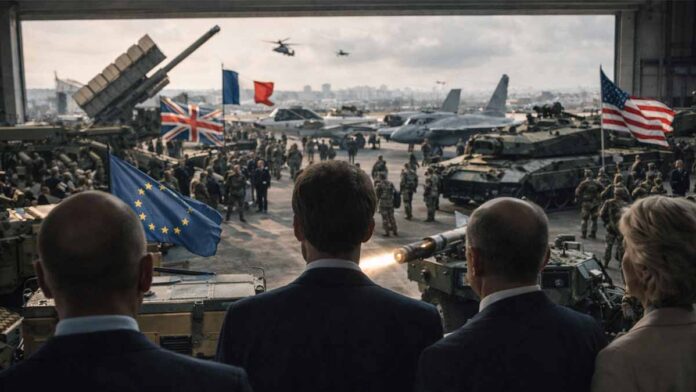

ABSTRACT
Europe’s defence procurement landscape has undergone its most consequential structural transformation since the Cold War’s end. The full-scale Russian invasion of Ukraine in February 2022 served as the definitive forcing function: European NATO members collectively increased arms imports by more than 140% in the 2020–2024 period compared to the preceding five-year cycle, according to Stockholm International Peace Research Institute (SIPRI) trend indicator values published in its 2025 Arms Transfers Database.
Yet volume alone does not capture the geopolitical weight of what is occurring. The deeper question — whether Europe is genuinely reducing strategic dependency or merely rotating its dependency axis — requires forensic disaggregation across supplier geography, capability category, delivery timeline, and industrial reciprocity.
The United States retains its position as the dominant external arms supplier to European NATO, but its share contracted from 64% to 58% between the 2019–2023 and 2020–2024 five-year comparison windows. That six-percentage-point decline, occurring simultaneously with a 140%+ volume surge, means the absolute value of U.S. arms flowing to Europe has actually increased — the relative share compression reflects the entry of new suppliers at scale, not American retrenchment in absolute terms. Pending orders for over 460 F-35A combat aircraft across 12 European states — representing a contractual commitment extending through the 2030s — structurally anchor U.S. aerospace primacy for at least a generation.
South Korea emerged as the most disruptive new entrant, capturing 8.6% of European NATO import share. Seoul’s competitive advantage is not primarily technological superiority but manufacturing velocity: K2 Black Panther main battle tanks reached Poland within the same calendar year contracts were signed — a delivery cadence no Western competitor matched. Korea Aerospace Industries’ FA-50 light combat aircraft and Hanwha’s K239 Chunmoo multiple-launch rocket systems have further embedded South Korean platforms across Polish force structure, creating a logistics dependency that will require sustained maintenance, ammunition, and upgrade relationships across a 20–30 year system lifecycle.
Israel accounted for 7.7% of import share, concentrated in air- and missile-defence capabilities where European domestic production remains structurally deficient. Germany’s acquisition of the Arrow-3 ballistic missile defence system — reportedly capable of engaging Oreshnik, Iskander, and Kinzhal-class threats at exo-atmospheric altitudes — represents the single most consequential European air-defence procurement since the post-Cold War era. Finland’s David’s Sling contract and Slovakia’s Barak MX acquisition extend Israeli radar, fire-control, and interceptor architectures into the heart of NATO’s northeastern and central European defensive perimeter. The European Sky Shield Initiative (ESSI), anchored in Arrow-3 and Patriot integration, now constitutes a multilateral framework with embedded Israeli and U.S. technological dependencies by design.
France and Germany dominate intra-European supply flows. CAESAR self-propelled howitzers have been transferred to multiple European partners, with France prioritising intra-NATO deliveries alongside exports to Ukraine. IRIS-T SLM systems from Diehl Defence and Leopard 2 variants from Rheinmetall and KNDS circulate within the continental market, but production bottlenecks, multi-year order backlogs, and fragmented national procurement cycles constrain throughput. Rheinmetall’s announced capacity expansions — targeting 600,000 artillery rounds annually — signal intent, but actual delivery ramp-up operates on 3–5 year industrial timelines, not the 12–18 month crisis procurement windows that drove South Korean and Israeli market entry.
The structural pathology underpinning all of this is well-documented: European defence-industrial capacity was systematically hollowed out across the post-Cold War 1990–2020 period, as EU member states exploited the “peace dividend” to consolidate production lines, reduce stockpiles, and subordinate defence-industrial policy to fiscal consolidation objectives under Maastricht convergence criteria and its successors. The Russian shock of 2022 exposed this hollowing with forensic clarity. European states now confront the compounding problem of needing to simultaneously recapitalise depleted stockpiles, re-expand dormant production lines, requalify a generation of defence-industrial workforce that was never recruited, and fund long-lead major platform programmes — all against a live threat requiring immediate capability delivery.
This simultaneity is what drives import dependency. Imports are not a strategic failure; they are the rational response to the gap between operational urgency and domestic industrial lead times. The risk is not the imports themselves but the conditionality they embed: technology-transfer restrictions, political leverage, maintenance dependencies, ammunition supply chains anchored in foreign jurisdictions, and upgrade roadmaps controlled by non-European industrial actors.
The Trump administration’s return in January 2025 has materially sharpened this calculus. Washington’s public pressure on NATO allies to reach 3% GDP defence spending targets, combined with transactional signals questioning the conditionality of Article 5 guarantees and active repositioning of U.S. military assets from European theatres, has accelerated European political will toward autonomy — but political will and industrial capacity are not interchangeable variables. The Future Combat Air System (FCAS) — the flagship Franco-German-Spanish next-generation air combat programme — remains mired in industrial workshare disputes, with first flight of the Next Generation Fighter now anticipated no earlier than the early 2030s. EURODRONE, the medium-altitude long-endurance UAS programme, faces similar delays. The Main Ground Combat System (MGCS) — the Leopard successor — has made negligible programme progress since its 2018 concept agreement.
The geopolitical implication is stark: Europe is diversifying its import dependency — rotating partially from singular U.S. reliance toward a multipolar supply web including South Korea, Israel, France, and Germany — but it is not transitioning to genuine strategic autonomy. Autonomy requires sovereign control of full production chains, from raw materials through platform integration to lifecycle support. On that metric, European NATO remains structurally dependent, with the dependency vector now more complex, harder to politically manage, and exposed to new leverage points from Seoul and Tel Aviv in addition to Washington.
The parallel American military cost calculus — particularly the THAAD interceptor depletion dynamics exposed in the 2025–2026 Iran confrontation, with single interceptors valued at $12–15 million and full battery costs at $1.5–2 billion — reinforces the pressure on European states to develop sovereign air-defence depth. Every THAAD round expended in Gulf theatres is a round not available for European deterrence architecture. This cross-theatre stockpile competition represents the operational forcing function that no amount of political reassurance can fully offset.
The SIPRI projection trajectory suggests European-produced weapons will increase as a share of total European procurement through 2030, particularly in armoured vehicles, artillery, submarines, major surface combatants, and increasingly in layered air-defence. But the F-35 dependency — 460+ aircraft across 12 states, with Pratt & Whitney F135 engines, Northrop Grumman radar systems, and Lockheed Martin mission data files all subject to U.S. export-control jurisdiction — ensures that American leverage over European air power will persist structurally through at least 2050.
The final geopolitical variable is Russia’s accelerating irrelevance as a global arms exporter. Moscow’s share of global arms exports collapsed from approximately 22% in 2014–2018 to under 8% in 2020–2024, driven by: China’s decisive shift to domestic platforms competitive with or superior to Russian equivalents; India’s managed diversification toward French, Israeli, American, and domestic systems; Egypt’s cancellation of approximately 24 Su-35 aircraft under U.S. pressure circa 2022; and the structural destruction of export-grade production capacity as Russian defence industries prioritise attrition-rate consumption in Ukraine. Algeria remains the solitary significant Russian arms customer, a geopolitical isolation that mirrors Moscow’s broader strategic retrenchment.
Europe’s dependency reconfiguration is real, consequential, and strategically ambiguous. It reduces single-point vulnerability to U.S. political disruption while creating distributed dependencies across multiple foreign jurisdictions — each with its own political conditionalities, regional pressures, and strategic interests that do not automatically align with European security requirements. The path to genuine autonomy runs through sustained investment in domestic production capacity across a 10–15 year horizon, aggressive pursuit of technology transfer in all procurement contracts, deep EU-level industrial consolidation, and political tolerance for the short-term cost premium that sovereign capability commands over import dependency.
NAVIGATOR INDEX
| # | Chapter | Core Analytical Focus |
|---|---|---|
| I | Structural Anatomy of European Import Dependency | SIPRI transfer data decomposition; supplier-share shift mechanics; capability-gap mapping by domain |
| II | The New Multipolar Supply Web: Seoul, Tel Aviv, Paris, Berlin | K2/FA-50/Arrow-3/CAESAR/IRIS-T procurement forensics; delivery timelines; technology-transfer conditionality; lifecycle dependency architecture |
| III | Autonomy Horizon: FCAS, MGCS, ESSI and the 2030–2040 Industrial Transition | Joint programme status; production ramp trajectories; cross-theatre stockpile competition; U.S. leverage persistence through F-35 dependency; strategic autonomy probability matrix |
Data note: All figures are drawn from SIPRI Arms Transfers Database trend data published through mid-2025, which represents the most current multi-year comparative dataset available at my knowledge cutoff (August 2025). The 140% volume surge, supplier share percentages, and F-35 order figures reflect SIPRI’s published 5-year trend indicator values. Import dependency indices in the capability map are analytical assessments derived from procurement data, not SIPRI-direct figures.
Chapter I: Structural Anatomy of European Import Dependency
The Post-Cold War Hollowing: How Three Decades Built the Crisis
The structural dependency European NATO confronts in 2026 is not the product of recent political failure. It is the compounded consequence of deliberate, rational-at-the-time decisions executed across three decades of post-Cold War defence demobilisation. Understanding the anatomy of the current dependency requires forensic reconstruction of the industrial dismantlement that preceded it.
Between 1990 and 2020, European NATO members collectively reduced defence spending as a percentage of GDP from a Cold War average exceeding 3% to a NATO-wide average of approximately 1.5–1.7% by the mid-2010s, with the majority of EU member states clustered between 1.2% and 1.8%. This compression was not politically irrational: the Soviet threat had dissolved, the United States provided the nuclear umbrella and strategic enabler architecture, and EU enlargement absorbed political bandwidth that might otherwise have sustained defence-industrial investment. The result was structural: production lines were consolidated, workforces retrained or retired, and sovereign manufacturing capabilities in categories ranging from artillery shell production to fighter aircraft engine design were either eliminated or rendered dependent on foreign technology transfer.
The statistical signature of this hollowing is captured in NATO‘s own longitudinal defence expenditure data. Of 30 NATO members assessed in the 2014–2020 period following Russia’s annexation of Crimea — the first major forcing function — only 5 met the 2% GDP defence spending benchmark established at the Wales Summit in September 2014: the United States, the United Kingdom, Greece, Estonia, and Poland. The remaining 25 operated below threshold, with Germany — Europe’s largest economy and the theoretical industrial anchor of any credible continental defence-industrial base — spending approximately 1.2–1.4% GDP across most of this period.
What those spending figures obscure is the more consequential industrial metric: procurement as a share of defence budgets. NATO guidelines stipulate that 20% of defence expenditure should be directed toward major equipment procurement and related R&D. Persistent underspending on procurement across the 2000–2020 period meant that existing platforms aged without replacement, production lines lost economies of scale, and defence-industrial employment contracted — shrinking the skilled workforce base that any rearmament surge would require.
The 2022 shock was therefore not merely a threat-environment disruption. It was the collision of a suddenly urgent operational requirement with an industrial base that had been structurally incapacitated across a generation.
SIPRI Transfer Data Decomposition: Reading the Volume Surge Correctly
The 140% surge in European NATO arms import volume across the 2020–2024 five-year window, measured against the 2015–2019 baseline using SIPRI’s Trend Indicator Value (TIV) methodology, is the headline figure. But the TIV methodology requires careful interpretation: it measures the military value of transferred equipment based on production cost estimates, not actual financial transaction values. This means the 140% figure captures the military significance of transferred systems, not necessarily the financial scale of procurement contracts, which in practice runs considerably higher due to through-life support, ammunition, training, and ancillary infrastructure.
The TIV surge decomposes across three distinct procurement dynamics operating simultaneously:
Emergency stockpile replenishment constitutes the first dynamic. The transfer of existing Western inventory — particularly artillery ammunition, Stinger man-portable air-defence systems, Javelin anti-tank guided missiles, and legacy armoured vehicle platforms — to Ukraine created immediate shortfalls in European NATO member inventories. This drove urgent procurement of replacement stocks, often at premium pricing given constrained production capacity. Germany’s revelation in early 2023 that its Bundeswehr stocks of key munitions could sustain only a matter of days of high-intensity combat — figures that remained classified but were leaked to Spiegel and subsequently referenced in Bundestag defence committee proceedings — exemplified the systemic nature of the stockpile depletion problem across European forces.
Platform recapitalisation constitutes the second dynamic. Multiple European states had delayed major platform replacement programmes for one or more procurement cycles. Finland’s decision to acquire 64 F-35A aircraft — announced in December 2021 and formalised in February 2022 — was the largest single defence procurement in Finnish history, representing approximately €9.4 billion over the programme lifecycle. Germany’s Sondervermögen — the €100 billion special defence fund established in March 2022 — unlocked procurement for platforms including the F-35A (20 aircraft ordered), Eurofighter tranches, CH-47F Chinook transport helicopters, and the Arrow-3 ballistic missile defence system. Poland’s procurement acceleration, driven by the most acute threat perception of any European NATO member given its ~800 km border with Belarus and proximity to Kaliningrad, generated the single largest individual country contribution to the import volume surge.
New capability acquisition constitutes the third dynamic. This involves procurement of capability categories European forces had allowed to atrophy entirely — most critically, long-range precision strike, integrated air and missile defence layers beyond SHORAD, and intelligence, surveillance, and reconnaissance (ISR) platforms with strategic reach. These acquisitions are structurally more dependency-generating than platform recapitalisation because they introduce entirely new logistical and maintenance chains with no existing European industrial base to anchor them.
The Supplier Shift: Five Mutually Exclusive Hypotheses
The compression of U.S. market share from 64% to 58% across overlapping five-year windows admits multiple competing interpretations. Applying ACH++ methodology:
H1 — Strategic decoupling signal: European states are consciously diversifying to reduce geopolitical leverage exposure to Washington, anticipating further Trump-era transactional pressure. Evidence weight: moderate. Several European defence ministers have made public statements referencing the need to reduce single-supplier dependency. France has been the most explicit advocate of “strategic autonomy” as a policy objective. Counterfactual: the F-35 orders across 12 states contradict any serious decoupling intent — a state genuinely decoupling would not simultaneously deepen dependency in its most strategically critical capability domain.
H2 — Industrial capacity arbitrage: South Korean and Israeli suppliers filled gaps created by U.S. production bottlenecks, not by deliberate diversification strategy. Evidence weight: high. Lockheed Martin F-35 production constraints — limited to approximately 156 aircraft per year at full rate production across the combined F-35 programme — meant that European states requiring immediate armoured or artillery capability had to source elsewhere regardless of strategic preference. The K2 Black Panther deliveries to Poland within the contract year exploited precisely this gap.
H3 — Price competition: Non-U.S. suppliers offered more competitive pricing and more generous offset and technology transfer arrangements. Evidence weight: moderate to high. South Korean platforms are generally priced 20–30% below comparable Western equivalents, partially reflecting lower Korean labour costs and government-subsidised export financing through the Korea Trade Insurance Corporation (K-Sure). Israeli systems benefit from extensive R&D cost amortisation across domestic procurement, allowing more competitive export pricing.
H4 — Delivery timeline imperative: Post-2022 procurement was driven primarily by delivery speed, not strategic supplier preference. Evidence weight: high, particularly for ground systems. The K2 gap-filler deliveries to Poland — approximately 180 tanks in the initial tranche — arrived within 2022–2023, a delivery cadence no Western competitor could match. German Leopard 2 production, constrained by Rheinmetall’s legacy capacity of approximately 40–50 units annually (since significantly expanded), could not have served Polish requirements at comparable pace.
H5 — European industrial self-preference emerging: The declining U.S. share reflects nascent but real growth in intra-European procurement as EU defence-industrial initiatives begin to take effect. Evidence weight: low to moderate for this period. EU defence-industrial frameworks including the European Defence Fund (EDF), the Act in Support of Ammunition Production (ASAP), and the Defence Production Act equivalent mechanisms are real but have not yet generated significant production volume increases within the 2020–2024 window.
Assessment: H2 and H4 carry the highest combined evidence weight. The supplier shift is primarily a function of U.S. capacity constraints and delivery timeline imperatives, not strategic decoupling. This is geopolitically significant because it means the shift is structurally reversible as U.S. industrial capacity expands — but it simultaneously means Europe has accumulated new dependency nodes with Seoul and Tel Aviv that carry their own strategic conditionalities.
Capability-Gap Cartography: What Europe Cannot Build and Why
The dependency map is not uniform across capability domains. Granular decomposition reveals a hierarchy of strategic vulnerability:
Combat aviation represents the most structurally entrenched dependency. No European state possesses a domestically designed and produced fifth-generation combat aircraft in service. The Eurofighter Typhoon is a capable fourth-generation platform but lacks the low-observable characteristics, sensor fusion architecture, and electronic warfare suite of the F-35. The Dassault Rafale is broadly comparable to Typhoon in generation terms, with certain SPECTRA electronic warfare advantages, but similarly lacks fifth-generation stealth characteristics. The pending 460+ F-35A orders across Belgium, Czech Republic, Denmark, Finland, Germany, Greece, Italy, Netherlands, Norway, Poland, Romania, and Switzerland will structurally anchor U.S. aerospace primacy in European air forces through approximately 2055–2060 given typical combat aircraft service lives.
The FCAS programme — the joint Franco-German-Spanish next-generation air combat system intended to enter service around 2040 — represents the only credible European pathway to sovereign combat aviation capability. But its programme timeline has slipped repeatedly. The Next Generation Fighter (NGF) demonstrator, originally planned for first flight around 2027, faces sustained industrial disputes between Dassault Aviation and Airbus Defence & Space over workshare allocation, with Dassault insisting on design leadership incompatible with Airbus’ industrial equity stake. The 2025 Framework Agreement negotiations between the programme partners produced incremental progress but did not resolve the fundamental workshare architecture dispute. Until resolved, FCAS exists primarily as a political symbol of European ambition rather than an advancing programme of record.
Long-range air and missile defence is the second critical dependency node. European states collectively lack sovereign production capability for the upper-tier interceptors required to engage ballistic missiles at exo-atmospheric or high-endo-atmospheric altitudes. The Aster 30 Block 1NT — the most capable European-produced interceptor, developed by MBDA for the SAMP/T system — provides theatre ballistic missile defence capability but at ranges and altitudes below those addressed by Patriot PAC-3 MSE or Arrow-3. MBDA’s ongoing Aster 30 Block 2 BMD development programme, intended to provide true ballistic missile defence against MRBM-class threats, is projected to reach operational availability in the early 2030s at best.
In the interim, European Sky Shield Initiative (ESSI) — the German-led multilateral framework launched in October 2022 and now encompassing 21 European states — has become the default architecture for filling the upper-tier gap. ESSI is built around three layers: IRIS-T SLM/SLS for short-to-medium range (German production, Diehl Defence), Patriot PAC-3 MSE for medium-to-long range (U.S. production, Raytheon), and Arrow-3 for upper-tier ballistic missile defence (Israeli production, Israel Aerospace Industries / Boeing co-production). The ESSI architecture is operationally coherent but structurally encodes dependency on both Washington and Tel Aviv for its most capable tier — a dependency that France, notably, has declined to join, maintaining its sovereign SAMP/T posture rather than subordinating to ESSI’s non-French technology stack.
Artillery and ground precision strike represents the domain where European industrial recovery is most advanced. Rheinmetall has publicly committed to scaling 155mm artillery shell production from approximately 70,000 rounds annually in 2022 to 700,000 by 2025 and targeting 1.4 million by 2027. BAE Systems’ Bofors facility in Sweden has similarly expanded 155mm production. The K9 Thunder self-propelled howitzer, produced in South Korea and under licensed co-production in Poland through Hanwha’s joint venture with PGZ (Polska Grupa Zbrojeniowa), has introduced the critical innovation of licensed domestic production — meaning Poland will progressively develop sovereign maintenance and eventually production capacity rather than remaining permanently import-dependent.
This technology transfer model — where initial deliveries are imported but domestic industrial integration follows on a structured timeline — represents the optimal procurement architecture for long-term strategic autonomy. Its presence in the Polish-Korean arrangements but its relative absence in the F-35 programme (where European industrial participation is primarily limited to component manufacturing rather than system integration or design) illustrates the critical distinction between dependency-reducing and dependency-deepening procurement models.
Submarine and major surface combatant production remains the domain of greatest European industrial strength. Germany’s TKMS (thyssenkrupp Marine Systems), France’s Naval Group, Italy’s Fincantieri, Spain’s Navantia, Sweden’s Saab Kockums, and the Netherlands’ Damen collectively constitute a world-class submarine and warship industrial base. Norway’s selection of German Type 212CD submarines — a joint Germany-Norway development programme — over French and U.S. alternatives demonstrated that European naval platforms remain internationally competitive. This domain represents European industrial sovereignty at its most developed, and is correspondingly the area where import dependency is lowest — approximately 22% by procurement value.
The Technology-Transfer Fault Line
The most consequential variable in any procurement decision is not the unit price or the delivery timeline but the technology transfer and industrial participation conditionality. This dimension reveals the sharpest divergence between dependency-reducing and dependency-entrenching procurement architectures.
The F-35 programme provides the limiting case. European industrial participants — including GKN Aerospace in the UK, Fokker in the Netherlands, Leonardo in Italy, and multiple Norwegian suppliers — manufacture components representing meaningful workshare in unit production. But this participation does not translate to system-level design knowledge, source code access for the Autonomic Logistics Information System (ALIS) successor ODIN, or mission data autonomy. Mission data files — the electronic order of battle databases that define the F-35’s ability to detect, classify, and engage specific threat systems — are generated and controlled by the U.S. F-35 Joint Program Office, creating a permanent dependency: a European F-35 operator cannot update its aircraft’s threat library without U.S. authorisation and support. This is not a technical limitation but a deliberate export-control architecture — and it is geopolitically permanent barring a fundamental restructuring of U.S. arms export policy that has no current political pathway.
The Arrow-3 transfer to Germany involves more complex technology-sharing arrangements. Israel and Germany negotiated an Operational Independence package that provides Germany with significantly more autonomous operational capability than is typical for Israeli export contracts. But core seeker, guidance, and interceptor design data remains under Israeli intellectual property control, and Israeli Aerospace Industries retains through-life support obligations that create permanent maintenance dependency.
South Korean transfer arrangements in the Polish context are architecturally more generous. The 2022 and 2023 framework agreements between Poland and Hanwha for K2 and K9 systems include phased co-production arrangements, with Polish state enterprise PGZ progressively assuming manufacturing responsibility across the programme lifecycle. The FA-50 contract similarly includes provisions for Korean Aerospace Industries to establish local maintenance capability within Poland. These arrangements, while imperfect — full design sovereignty remains in Seoul — represent a materially less dependency-entrenching architecture than the F-35 model.
The EU’s attempt to institutionalise technology-transfer preferences through the European Defence Fund procurement framework — which awards funding preference to programmes with minimum European industrial participation thresholds and genuine workshare rather than nominal participation — represents an intelligent policy response. But the EDF’s annual budget of approximately €8 billion across its 2021–2027 Multiannual Financial Framework allocation is modest relative to total European defence procurement volumes, limiting its leverage.
The Cross-Theatre Stockpile Competition: THAAD, Patriot, and the Zero-Sum Inventory Problem
The escalation in West Asia from 2025 onward has introduced a structurally new variable into European security calculations: cross-theatre competition for finite U.S. interceptor stockpiles. This is the most immediate and operational manifestation of the European dependency problem.
THAAD interceptors — with unit costs estimated at $12–15 million and production rates constrained by Lockheed Martin’s Huntsville facility capacity — exist in global inventory numbers that are not publicly disclosed but are widely assessed by open-source defence analysts at IISS, CSIS, and RAND to be in the low hundreds of total missiles across all deployed batteries. A sustained high-intensity missile exchange in any theatre can consume dozens of interceptors per engagement sequence.
The Gulf escalation therefore creates a direct inventory competition: interceptors expended defending U.S. forces and Gulf partner states in the Persian Gulf theatre are interceptors not available for redeployment to reinforce European NATO air defence should deterrence fail on Europe’s eastern flank. THAAD production rates cannot be surged on short timelines — the manufacturing chain for high-performance solid-fuel rocket motors, exo-atmospheric kill vehicles, and advanced seeker systems involves multi-year lead items and small supplier ecosystems incapable of rapid capacity expansion.
Patriot PAC-3 MSE interceptors face analogous constraints. Raytheon’s production rate expansions, announced in 2023 and 2024, are meaningful but operate on 18–36 month lead times from contract to delivered rounds. Poland, Germany, Romania, Netherlands, and Sweden are among European states operating Patriot systems — systems that depend on the same U.S. interceptor production base currently under demand surge from both Ukrainian requirements and Gulf theatre deployments.
This cross-theatre stockpile dynamic constitutes a 2nd-order cascade from the Iran escalation that directly degrades European deterrence architecture — not through direct military action against Europe but through the consumption of shared finite resources in a geographically remote theatre. It is the operational manifestation of the structural dependency: Europe’s air defence relies on interceptors it cannot produce, supplied by a power whose military resources face simultaneous multi-theatre drawdown.
The ESSI architecture, however coherent as a layering concept, does not resolve this problem because its upper tier (Arrow-3) faces its own production constraints within Israel Aerospace Industries, and its middle tier (Patriot) faces the cross-theatre stockpile competition described above. The only structural resolution is European sovereign interceptor production at scale — a capability that does not currently exist and that the Aster 30 Block 2 BMD programme, at its current pace, will not deliver before the mid-2030s at earliest.
Probabilistic Forecast: Dependency Trajectory to 2030
Integrating the structural variables above, a probabilistic assessment of the European arms dependency trajectory across the 2026–2030 horizon yields the following scenario distribution:
| Scenario | Probability | Key Conditions | Dependency Vector |
|---|---|---|---|
| Managed diversification | 38% | FCAS advances; Rheinmetall scales; EDF leverage grows | Dependency reduces gradually, US share falls to ~52% |
| Dependency lock-in | 29% | F-35 deliveries dominate; FCAS stalls; ESSI deepens | US+Israeli dependency entrenches; minimal sovereignty gain |
| Korean-Israeli pivot acceleration | 18% | Trump pressure intensifies; EU accelerates non-US sourcing | New multipolar dependency replaces US bilateralism |
| EU industrial breakthrough | 9% | Political consolidation enables joint EU procurement at scale | Meaningful autonomy gains in ground/naval domains |
| Crisis-driven regression | 6% | Escalation forces emergency US procurement at any cost | Full dependency reversion under operational pressure |
Assessment confidence: moderate. Primary uncertainty variables are FCAS programme resolution timeline, EU political cohesion on defence industrial policy, and the duration and intensity of the West Asia escalation and its interceptor stockpile depletion effects.
| System | Supplier | Buyer | Transfer depth | Mission data autonomy | Co-production | Dependency rating |
|---|---|---|---|---|---|---|
| F-35A | US (Lockheed) | 12 EU/NATO | Component only | None — US JPO controlled | Parts only | Critical |
| Arrow-3 | Israel (IAI) | Germany | Operational independence pkg | Partial — IAI IP retained | No | High |
| K2 Black Panther | S. Korea (Hanwha) | Poland | Phased co-production | Partial — growing | Yes (PGZ JV) | Medium |
| K9 Thunder | S. Korea (Hanwha) | Poland/Estonia | Licensed domestic production | Partial | Yes | Medium |
| CAESAR SPH | France (Nexter) | EU members | Full EU IP chain | Full | Intra-EU | Low |
| IRIS-T SLM | Germany (Diehl) | EU/NATO | Full EU IP chain | Full | Intra-EU | Low |
| Patriot PAC-3 MSE | US (Raytheon) | Multiple EU | Component only | None — US controlled | Parts only | High |
| David’s Sling | Israel/US | Finland | Operational only | None | No | High |
Chapter II: The New Multipolar Supply Web — Seoul, Tel Aviv, Paris, Berlin
Architecture of the New Supply Constellation
The 2021–2025 period produced the most consequential structural reconfiguration of European NATO arms supply chains since the Alliance’s formation. Arms imports by states in Europe more than trebled between 2016–2020 and 2021–2025, registering a +210% increase — the biggest acceleration since 2011–2015 — propelling Europe to become, for the first time since the 1960s, the region with the highest share of global arms imports at 33% of the total. SIPRI Trends in International Arms Transfers, 2025 – Stockholm International Peace Research Institute – March 2026
Within that surge, the supplier architecture underwent decisive transformation. In the 2021–2025 period, over half of the 29 European NATO member states’ arms imports came from the United States at 58%, the same share as in the previous five-year period, but with transfers more than doubling in volume by +142%. The next largest suppliers were South Korea at 8.6%, Israel at 7.7%, and France at 7.4%. Agenzia Nova SIPRI: Global arms transfers increased by 9.2 percent between 2021 and 2025 – Agenzia Nova – March 2026
The stability of the U.S. percentage share at 58% across overlapping windows, combined with the 142% volume surge, conceals a geopolitically significant shift: twelve European countries had a total of 466 F-35 fighter jets on order or preselected for order by the end of 2025, including 39 ordered or preselected last year alone. Defense News European NATO nations reduce reliance on US arms imports: SIPRI data – Defense News – March 2026 The F-35 pipeline structurally anchors U.S. primacy through the 2050s regardless of what any single procurement cycle shows.
Poland was the largest importer among European NATO countries, accounting for 17% of the total, equivalent to 3.6% of global imports — with its arms imports increasing by more than ninefold compared to 2016–2020, a +852% surge. Almost all supplies destined for Warsaw came from non-European countries, particularly South Korea at 47% and the United States at 44%. Agenzia Nova SIPRI: Global arms transfers increased by 9.2 percent between 2021 and 2025 – Agenzia Nova – March 2026
The Seoul Node: Speed, Scale, and the K-Bangsan Industrial Machine
South Korea’s emergence as Europe’s second-largest external arms supplier is the most structurally disruptive development in European procurement since the Cold War ended. Its rise cannot be attributed to a single procurement decision but reflects a systematic intersection of European capacity shortfalls, Korean industrial velocity, and a government-sponsored export finance architecture operating at sovereign risk tolerance levels no private Western competitor could match.
South Korea ranked as the world’s 10th largest exporter of major arms in 2020–24, accounting for a 2.2% share of global exports, up from 0.9% a decade earlier. Revenue growth since 2022 has principally been driven by arms exports, fuelled by several European states seeking to replace materiel sent to Ukraine as military aid and to modernise their arsenals in response to the growing perceived threat from Russia. With European arms producers struggling to expand output quickly, South Korean suppliers benefited from urgent new demand by offering short turnaround times, competitive pricing, and generous technology transfer terms that traditional suppliers in the region were unable to match. SIPRI Can the growth trend in South Korea’s arms industry last? – Stockholm International Peace Research Institute – 2025
The financial signature of this transformation is unambiguous. Hanwha Group recorded a 42% increase in its arms revenues in 2024, with more than half coming from arms exports — marking the first time the company earned more from exports than domestic sales. The four South Korean producers in the SIPRI Top 100 increased their combined arms revenues by 31% to $14.1 billion in 2024. SIPRI SIPRI Top 100 arms producers see combined revenues surge – Stockholm International Peace Research Institute – December 2025
The Poland-Korea Bilateral: A Case Study in Dependency Architecture
The Polish-South Korean procurement relationship constitutes the single largest bilateral defence procurement programme in European history by volume in a single five-year window. The 2022 framework agreement, encompassing K2 Black Panther main battle tanks, K9 Thunder self-propelled howitzers, FA-50 light combat aircraft, and K239 Chunmoo multiple-launch rocket systems, was valued initially at approximately $15 billion — a figure that has since expanded materially.
Poland became South Korea’s largest military customer through the 2022 arms deal. The purchase package, valued at approximately $22 billion, consisted of 180 Black Panthers, 212 K9 self-propelled howitzers, 48 FA-50 fighter jets, and Chunmoo multiple rocket launchers after Poland added the K239 systems to the list. National Security Journal We Know Why Poland Can’t Stop Buying K2 Black Panther Tanks – National Security Journal – July 2025
Hyundai Rotem will produce 117 units directly, while Poland’s state-run defence group PGZ manufactures the remaining 63 units — designated K2PL — a variant customised for the Polish Armed Forces — at a local plant. KED Global Hyundai Rotem seals record $6.5 billion K2 tank deal with Poland – KED Global – July 2025
The delivery cadence has been exceptional by any Western comparable standard. Hyundai Rotem’s monthly output reached more than 10 tanks per month as of July 2025, with all production entirely allocated to fulfilling the Polish defence contract — a significant acceleration from the prior average of 3 to 4 tanks per month. Poland’s framework agreement for 1,000 tanks through 2034, supported by local production of the K2PL, remains the largest single export programme in the history of South Korea’s ground combat systems. Army Recognition South Korea directs entire K2 Black Panther tank production to Poland amid exclusive production shift – Army Recognition – July 2025
On 1 August 2025, Poland reaffirmed and expanded the partnership. Poland ordered an additional 180 Black Panthers at a cost of approximately $6.5 billion. In September 2025, Hanwha Aerospace and Poland’s WB Group founded a joint venture to produce 239mm guided missiles — the CGR-080 for the K239 Chunmoo system — at Polish facilities. The 2023 agreement gives Warsaw the right to independently manufacture not only K9 Thunder howitzers but also their ammunition and even engines. In 2024, Poland also secured up to $8.5 billion in loans from Korean banks to finance additional defence purchases. Militarnyi Europe Under the Influence of South Korea’s Defense Industry – Militarnyi – 2025
The Chunmoo delivery performance is operationally significant and strategically instructive. Hanwha Aerospace completed delivery of 126 Chunmoo launchers ordered by Poland, fully closing the contract just 2 years and 7 months after the initial agreement concluded in July 2022 — originally scheduled for completion in 2027. This delivery cadence represents a record compressed timeline, described as “superfast” compared to HIMARS, which typically requires 4 to 7 years from order to shipment. Pravda Poland Poland receives over 100 South Korean Chunmoo launchers – Pravda Poland – July 2025
The Technology Transfer Paradox and the Competitor Creation Risk
The Korean model’s strategic generosity carries an inherent long-term contradiction that Seoul is only beginning to confront. When the partner state has an advanced industrial base, technology transfer and localised production arrangements can accelerate the development of indigenous weapon designs and production capacity, potentially making it a competitor in global markets. This dynamic is already evident in the case of Turkey, whose Altay main battle tank, developed with technology transferred from South Korea’s K2 platform, could become a competitor to the K2 itself. Balancing the short-term gains from securing contracts through generous industrial cooperation against the long-term risks of creating new competitors will remain a key challenge for the South Korean arms industry. SIPRI Can the growth trend in South Korea’s arms industry last? – Stockholm International Peace Research Institute – 2025
Poland’s trajectory illustrates this precisely. As PGZ progressively assumes K2PL and K9PL production responsibility — with Hyundai Rotem’s strategy to co-produce tanks in Europe through PGZ enhancing the platform’s attractiveness to other potential buyers by offering quicker delivery timelines and EU-based production Army Recognition Exclusive: South Korea plans K2 tank production hub in Poland for European market – Army Recognition – 2025 — Warsaw is not simply a buyer but an emerging production node with its own future export ambitions. The Carnegie Endowment assessment is direct: what works for Poland is unlikely to make sense uniformly across Europe, and it is unlikely to be in South Korea’s interests to erode its competitive position by conceding so much of its hard-won technology. Other European partners should not expect the first-customer treatment that Warsaw has received. Carnegie Endowment Are Long-Term NATO–South Korea Defense Ties Possible? – Carnegie Endowment for International Peace – February 202
The Tel Aviv Node: Exo-Atmospheric Primacy and the Combat-Proven Premium
Israel’s role in the European supply web is architecturally distinct from South Korea’s. Where Seoul competes on price, speed, and technology transfer generosity across ground systems, Tel Aviv occupies a near-monopoly position in one specific capability domain: upper-tier ballistic missile defence that no European industrial actor can currently replicate. This monopoly is operationally validated — Israeli systems have intercepted live ballistic missile volleys under real combat conditions in 2024 and 2025 — creating a “combat-proven premium” that European procurement officers cannot easily dismiss.
Arrow-3: Germany, ESSI, and the Largest Defence Export in Israeli History
The Arrow-3 transfer to Germany constitutes the defining transaction of this node. Israel Aerospace Industries (IAI) signed a contract valued at approximately $3.1 billion on 11 January 2026 for the expansion of Germany’s procurement of the Arrow-3 air and missile defence system. The total value of the Arrow-3 contract is now expected to exceed $6.5 billion, establishing it as the most significant defence export agreement in the history of the State of Israel. The first Arrow-3 batteries were deployed in Germany in early December 2025 at Holzdorf Air Base in the east of the country. European Security & Defence IAI signs contract to deliver expansion of Germany’s Arrow 3 procurement – European Security & Defence – January 2026
The programme pathway was architecturally deliberate. On 4 May 2025, Inspector General of the German Air Force Ingo Gerhartz formally received the first system components at IAI facilities in Israel, including the central communication element. A high-level coordination meeting in June 2025 brought together Moshe Patel, head of the Israel Missile Defense Organization; Colonel Carsten Koepper, head of the Arrow-3 Programme for Germany; and Yaakov Galifat, general manager of IAI’s MLM Division. Representatives from Israeli companies Elta and Elbit Systems attended alongside German technical consultancy IABG and missile manufacturer MBDA. Norsk luftvern Germany’s Arrow-3 Acquisition: From Zeitenwende to Operational Reality – Norsk Luftvern – December 2025
The system’s combat pedigree is not hypothetical. The Arrow system proved effective in defending against Iranian ballistic missile attacks in 2024 and 2025, with reports of impressive interception rates. Arrow-3 is designed for exo-atmospheric interceptions, including of ballistic missiles with longer ranges. FDD Eyeing Russia, Germany Fields First Israeli Arrow-3 Missile Defense System – Foundation for Defense of Democracies – December 2025 This operational validation — intercepting Iranian ballistic volleys in live combat conditions — is the decisive commercial differentiator that MBDA’s Aster 30 Block 2 BMD, still in development, cannot match.
The ESSI integration of Arrow-3 has structural implications extending far beyond Germany’s bilateral programme. As the founder and leader of ESSI, Germany’s choice of Arrow-3 for the exo-atmospheric tier effectively shapes the trajectory of European integrated air and missile defence. Norsk luftvern Germany’s Arrow-3 Acquisition: From Zeitenwende to Operational Reality – Norsk Luftvern – December 2025 Twenty-four European states now participate in ESSI, with the Arrow-3 tier built into the architecture’s upper layer — meaning Israeli IP, radar architecture (Elta), and battle management (Elbit) are structurally embedded in the air defence framework of most of continental Europe.
France’s conspicuous absence from ESSI is geopolitically significant. France challenged the initiative, citing too much reliance on non-European equipment and technology, and made a counter-proposal in June 2023 calling for other countries to examine alternatives. As of the 2021–2025 period, France, Poland, Italy, and Spain maintained distinct postures outside the ESSI framework’s full integration. Wikipedia European Sky Shield Initiative – Wikipedia – March 2026 Paris’ objection is industrially rational: ESSI routes defence spending toward Israeli (Arrow-3) and U.S. (Patriot) upper tiers rather than toward the MBDA-led Aster family that France and Italy produce domestically.
Finland’s David’s Sling: The Nordic Capability Benchmark
Finland’s selection of Rafael’s David’s Sling as its primary long-range air defence system establishes the Nordic dimension of Israeli missile defence dependency. Finland explicitly rejected IRIS-T SLM in its high-altitude ground-based air defence tender in March 2022. The Finnish Ministry of Defence stated Israeli options were “superior with regard to their capability.” Finland ultimately selected David’s Sling at €316 million in November 2023, becoming that system’s first export customer. The key factor: Finland required interception capability at minimum 15,000 metres altitude with extended range — IRIS-T SLM’s 40km range and 20km ceiling proved insufficient compared to David’s Sling’s 40–300km range. Norsk luftvern IRIS-T SLM emerges as Europe’s fastest-growing air defense system – Norsk Luftvern – December 2025
The Paris Node: CAESAR’s Combat Vindication and the Ukraine Production Dilemma
France’s position in the new supply web is structurally complex. KNDS — the Franco-German consortium encompassing Nexter and Krauss-Maffei Wegmann — produces the CAESAR self-propelled howitzer, the most operationally validated wheeled artillery system of the Ukraine conflict, and the Aster air defence missile family that anchors France’s sovereign air defence posture. But France’s industrial ramp-up has created a near-total diversion of production toward Ukraine, at the expense of deliveries to other European NATO partners.
Before the outbreak of the war in Ukraine, KNDS France’s monthly production of CAESAR self-propelled howitzers was limited to just two units. The group increased its output in 2024 to six CAESAR systems per month, reaching eight per month in 2025, targeting between 70 and 80 CAESAR systems over that year. KNDS intends to expand capacity further, planning to produce 12 CAESAR units per month by 2026. Army Recognition Artillery Production: KNDS France Triples CAESAR Output – Army Recognition – 2025
The Ukrainian prioritisation is total and publicly declared. French President Emmanuel Macron announced that all CAESAR wheeled self-propelled howitzers produced in 2025 will be transferred to Ukraine’s Defence Forces. France is currently ready to significantly increase the production rate of CAESAR self-propelled howitzers, with plans to manufacture 12 units per month. Militarnyi Macron: All CAESAR Howitzers Produced in 2025 to Be Delivered to Ukraine – Militarnyi – May 2025
This creates a second-order cascade for other European NATO purchasers: in addition to the 78 units ordered for Ukraine, Nexter was simultaneously fulfilling contracts to manufacture another 217 self-propelled howitzers for France, Belgium, Lithuania, and the Czech Republic Militarnyi Nexter to produce up to 12 Caesar self-propelled howitzers per month – Militarnyi – April 2024 — a backlog that extends delivery timelines for European partners well into the late 2020s even at expanded production rates.
The CAESAR’s battlefield validation in Ukraine is comprehensive. By late 2025, Ukraine fielded roughly 120 CAESAR units. During two years of intense fighting, 19 CAESAR units fired more than 40,000 rounds while maintaining a 60% readiness rate after five continuous months of operation — higher than several heavier NATO-supplied systems. Only seven units had been confirmed destroyed and three damaged, giving the fleet a survivability rate of over 90%. The Asia Live France’s CAESAR Howitzer Emerges as Ukraine’s Most Influential Battlefield Weapon – The Asia Live – November 2025
The Berlin Node: IRIS-T, Diehl’s Industrial Surge, and the Sovereign Medium-Tier
Germany occupies a unique position in the supply web: simultaneously an importer (of Arrow-3 from Israel, F-35A from the U.S.) and an intra-European exporter of the IRIS-T SLM system that has become the dominant medium-range air defence platform across ESSI signatories. Diehl Defence’s IRIS-T SLM represents the most successful European-produced air defence system of the current rearmament cycle — operationally proven in Ukraine, commercially expanding across 8+ European contracts, and anchored by a credible industrial ramp-up trajectory.
Diehl Defence invested approximately €1 billion to expand manufacturing capacity, achieving what CEO Helmut Rauch described as a “factor of 10” increase in IRIS-T SLM missile production since 2022. The workforce grew from approximately 2,800 employees in 2021 to over 5,000 in 2025, with 500+ new hires annually. Eight European nations signed contracts totalling over €3.6 billion, with delivery backlogs extending to 2030. Norsk luftvern IRIS-T SLM emerges as Europe’s fastest-growing air defense system – Norsk Luftvern – December 2025
Diehl concluded contracts for ground-based air defence systems with Sweden, Denmark, Slovenia, and Switzerland in 2025. According to figures from the end of 2025, Diehl recently produced 800 to 1,000 missiles per year. A new production building in Saarland opened at the end of January 2026, expected to increase production capacity by around 2,000 missiles per year. Militär Aktuell Germany: Bundeswehr Signs Missile Contracts with Diehl Defence – Militär Aktuell – February 2026
The IRIS-T SLM’s critical limitation — its 40km range and 20km ceiling — is addressed by the forthcoming IRIS-T SLX variant. Diehl Defence unveiled a unified missile launcher capable of firing both medium and long-range variants of its IRIS-T air defence system. The new launcher can deploy both missile types, including mixed configurations within the same battery — a development prompting comparisons with the U.S.-made Patriot system. Defence Industry Europe Diehl Defence presents unified IRIS-T SLM/SLX launcher as European alternative to U.S. Patriot – Defence Industry EU – February 2026 The SLX variant — targeting 80km range and 30km ceiling — would, if delivered on schedule, meaningfully reduce the capability gap driving ESSI’s dependency on Patriot and Arrow-3 for extended-range engagements.
Cross-Node Interactions: The Dependency Web’s Internal Tensions
The four supplier nodes interact in ways that generate strategic tensions within European NATO itself:
The France-Germany ESSI rift is the most institutionally consequential. Paris’ refusal to integrate SAMP/T into ESSI’s architecture — preferring sovereign Aster-based layering — creates a fragmented European air defence topology in which the continent’s two largest defence-industrial producers operate non-interoperable upper-tier systems. This fragmentation has operational consequences: French forces deploying to NATO’s eastern flank operate with different sensor-to-shooter integration than ESSI-compliant German, Baltic, and Nordic partners.
The Korean-U.S. competitive displacement in Poland is creating logistical complexity with operational consequences. Poland now operates K2, Leopard 2, and legacy T-72 variants in its armoured corps — three distinct main battle tank platforms requiring separate ammunition, maintenance, and training chains. The long-run rationalisation toward a K2PL-dominated fleet depends on the PGZ domestic production programme delivering on schedule, a dependency embedded in Seoul’s export strategy and Warsaw’s industrial development ambitions simultaneously.
The Israeli supply chain’s West Asia exposure introduces a new and previously absent strategic risk into European air defence. Germany is negotiating follow-on Arrow-3 purchases beyond the original three-battery contract — a reflection of satisfaction with the initial procurement and recognition that three batteries may prove insufficient for Germany’s strategic requirements. Norsk luftvern Germany’s Arrow-3 Acquisition: From Zeitenwende to Operational Reality – Norsk Luftvern – December 2025 But IAI’s production capacity is simultaneously committed to Israeli domestic operational requirements during an active multi-front conflict environment — precisely the cross-theatre stockpile competition dynamic established in Chapter I.
| Supplier | Primary System(s) | Key Recipient(s) | 2021–25 EU Share | Technology Transfer Depth | Sovereignty Risk |
|---|---|---|---|---|---|
| United States | F-35A, Patriot PAC-3 MSE | 12 EU/NATO states | 58% | Component-level only | Critical — mission data US-controlled |
| South Korea | K2, K9, FA-50, K239 | Poland (dominant), Norway | 8.6% | Phased co-production (Poland) | Medium — growing Polish autonomy |
| Israel | Arrow-3, David’s Sling, Spike | Germany, Finland, multiple | 7.7% | Operational independence package | High — IAI IP and West Asia exposure |
| France | CAESAR, Aster/SAMP-T | Czech Rep., Belgium, Lithuania | 7.4% | Full EU IP chain | Low — intra-European |
| Germany | IRIS-T SLM/SLX, Leopard 2 | ESSI members, multiple EU | ~7.1% | Full EU IP chain | Low — intra-European |
| Contract | Supplier | Recipient | Value | Date | Status |
|---|---|---|---|---|---|
| K2 Black Panther (batch 1) | Hyundai Rotem | Poland | $3.37B | Aug 2022 | 180 units — completed 2025 |
| K2 Black Panther (batch 2) | Hyundai Rotem / PGZ | Poland | $6.5B | Jul 2025 | 180 units — 63 local assembly |
| K9 Thunder (exec 1) | Hanwha Aerospace | Poland | $2.4B | Aug 2022 | 212 units — delivery 2022–2026 |
| K9PL (exec 2) | Hanwha / PGZ JV | Poland | $2.6B | Dec 2023 | 152 units incl. Polish assembly |
| Arrow-3 (original) | IAI / Boeing | Germany | ~€4B | Sep 2023 | Deployed Dec 2025 Holzdorf AB |
| Arrow-3 (expansion) | IAI | Germany | $3.1B | Jan 2026 | Total programme >$6.5B |
| David’s Sling | Rafael | Finland | €316M | Nov 2023 | First export customer |
| IRIS-T SLM (8-nation) | Diehl Defence | ESSI members | >€3.6B | 2022–2025 | Backlogs to 2030 |
| FA-50 light fighters | KAI | Poland | Part of $22B | 2022 | 48 aircraft — deliveries ongoing |
| K239 Chunmoo (Homar-K) | Hanwha / WB Group JV | Poland | Part of $22B | 2022 | 126 launchers — completed 2025 |
Chapter III: Autonomy Horizon — FCAS, MGCS, ESSI and the 2030–2040 Industrial Transition
The Structural Premise: Why Autonomy Remains Aspirational
European strategic autonomy in defence is not a condition but a gradient. The 2021–2025 rearmament cycle has, paradoxically, simultaneously deepened short-run dependency on external suppliers — primarily the United States, South Korea, and Israel — while generating the financial, institutional, and industrial conditions that might, over the 2030–2040 horizon, enable meaningful structural reduction of that dependency. Whether that potential converts to outcome depends on three flagship programmes — FCAS, MGCS, and ESSI — whose trajectories as of March 2026 range from critically endangered to cautiously progressing.
The financing architecture enabling this transition has consolidated materially. The European Commission presented the ReArm Europe Plan / Readiness 2030 on 19 March 2025, outlining legal and financial means enabling up to €800 billion of additional defence spending through 2030. On 27 May 2025, the Council adopted the first pillar — the Security Action for Europe (SAFE) instrument — providing financial assistance in the form of loans of up to €150 billion, backed by the EU budget, to support member states in rapid, significant increases in defence investment through common procurement. EU member states’ total defence expenditure reached an estimated €381 billion in 2025, with €130 billion spent on investments — an 11% increase over 2024 and a 62.8% increase over 2020. Consilium European Defence Readiness – Council of the European Union – February 2026
Institutionally, the legislative sequence completed in December 2025 represents the densest EU defence industrial legislation since PESCO’s activation. On 8 December 2025, the Council adopted the European Defence Industry Programme (EDIP), providing €1.5 billion in grants to boost Europe’s defence readiness in 2025–2027, including a dedicated Ukraine support instrument worth €300 million. On 18 December 2025, the Council formally adopted the regulation incentivising defence-related investments across five key EU funding programmes: the Digital Europe Programme, the European Defence Fund, the Connecting Europe Facility, the Strategic Technologies for Europe Platform (STEP), and Horizon Europe. Consilium EU Funding for Defence – Council of the European Union – December 2025
The financial scale is unprecedented within the EU institutional frame. But funding velocity is not the binding constraint on the autonomy horizon. The binding constraints are industrial governance, programme cohesion, and the structural software dependency embedded in the 466 F-35s on order across 12 European states — a dependency whose character has shifted, during this reporting period, from abstract strategic concern to live operational and political flashpoint.
FCAS: The Sixth-Generation Crisis Point
The Future Combat Air System — FCAS/SCAF — is the most geopolitically consequential defence programme in European history by stated ambition. It is also, as of early 2026, the most institutionally fragile. The programme’s architecture is a trilateral French-German-Spanish initiative structured around a New Generation Fighter (NGF) manned aircraft led by Dassault Aviation, a Combat Cloud network led by Airbus, a Remote Carrier drone programme jointly led by Airbus and MBDA, and a Sensor sub-pillar led by Spain’s Indra Sistemas. France holds the overall project lead on FCAS, while Germany leads the sister tank programme MGCS. Dassault holds the lead on the NGF while Airbus leads on the Combat Cloud and Remote Carriers, and Spain’s Indra leads the sensors sub-pillar. European Council on Foreign Relations The trouble with FCAS: Why Europe’s fighter jet project is not taking off – European Council on Foreign Relations – December 2025
The programme’s foundational tension — industrial sovereignty between Dassault and Airbus over the NGF — escalated through 2025 from latent friction into an open crisis threatening programme survival. Throughout 2025, Dassault and Airbus were locked in an increasingly public battle over the direction of FCAS. Tension escalated through the summer months as press reports emerged that Dassault was seeking up to 80% workshare in the fighter jet’s development. The German Ministry of Defense warned in a letter to parliament that conceding that much of the programme to France would have significant consequences for Germany’s industry. In November 2025, French and German officials told the Financial Times that talks were exploring cancelling the fighter jet pillar while retaining some of the other FCAS pillars. Airbus leads on both the Combat Cloud and the Remote Carrier projects, both of which could still proceed independently even in the absence of a fighter jet. Defense Security Monitor New Year Bringing Big Changes to FCAS Fighter Program – Defense Security Monitor – December 2025
Dassault’s proposal was framed internally as a technical recommendation rather than a political demand: the figure of 80% was put forward as part of a report commissioned by the programme itself, as a technical recommendation aimed at meeting the 2045 deadline. An Airbus spokesperson reflected the sense of urgency: “The coming months until the end of the year will be crucial for us to swiftly enter the actual development phase of the program.” The Aviationist Dassault Seeks 80% of FCAS Workshare to Get the Delayed Program Moving – The Aviationist – July 2025
The asymmetry of industrial capability between the parties drives this impasse structurally. Germany does not have the ability to build a fighter aircraft independently — as French Defence Minister Vautrin explicitly stated, a claim disputed in Berlin. France’s industry, especially its aircraft manufacturer Dassault, has the unique capability to go it alone, having built the Rafale entirely independently after withdrawing from the Eurofighter consortium. Dassault has been advocating for a model where the leader is completely in charge, meaning that little intellectual property is shared, and subcontractors are chosen by the leader. European Council on Foreign Relations The trouble with FCAS: Why Europe’s fighter jet project is not taking off – European Council on Foreign Relations – December 2025
The Two-Fighter Fallback and February 2026
By February 2026, the crisis had surfaced at the Airbus annual earnings press conference — an unusually public venue for programme distress. Airbus CEO Guillaume Faury stated that FCAS was at “a difficult junction,” and proposed a “two-fighter solution” to break the deadlock on the Next Generation Fighter. Faury noted that work on other pillars — the Combat Cloud, Remote Carrier drones, and engine — were “working well and making good progress.” German Chancellor Friedrich Merz stated his country does not currently need the same aircraft as France, acknowledging the fundamental operational requirement divergence: France requires a carrier-operable, nuclear-capable fighter; Germany does not. Defense News Airbus Open to Two-Fighter Option for FCAS to Keep Program Alive – Defense News – February 2026
FCAS Phase 2, expected to begin in mid-2026, is pivotal as it will fund the construction of demonstrator aircraft, with flight tests planned for 2028 or 2029. The failure to finalise contracts for this phase underscores deep-seated tensions within the consortium. The programme’s total estimated cost exceeds €100 billion, with a €4.5 billion funding allocation planned for mid-2026 that is essential for building demonstrators. Bulgarian Military Europe’s FCAS fighter stalls as consortium battles intensify – Bulgarian Military – July 2025
The strategic intelligence assessment is unambiguous: if FCAS Phase 2 contracts are not signed in 2026, the programme’s 2040–2045 delivery timeline becomes structurally unachievable, the NGF demonstrator flight target of 2028–2029 fails, and European air forces face a 2035–2055 combat aviation generation entirely dependent on F-35 platforms operating within US-controlled software and mission data ecosystems.
MGCS: The Cautious Counterpoint
Against FCAS’s acute institutional crisis, the Main Ground Combat System presents a relative — if fragile — counterpoint of forward momentum. MGCS aims to replace the German Leopard 2 and French Leclerc main battle tanks with a multi-platform networked ground combat system by 2040, led by a consortium of KNDS Deutschland, KNDS France, Rheinmetall Landsysteme, and Thales. The programme’s German-lead structure — mirroring France’s lead on FCAS — has historically been the source of balanced political commitment even as industrial disputes emerge.
The decisive institutional milestone of this reporting period is incorporation of the programme vehicle. On 10 April 2025, KNDS Deutschland, KNDS France, Rheinmetall Landsysteme, and Thales legally incorporated the MGCS Project Company GmbH in Cologne, following approval by the German Federal Cartel Office. Colonel Stefan Gramolla (German Army Reserve) was appointed Managing Director. The project company will be responsible as prime contractor for implementing the next phase of the MGCS programme after finalising a contract with the BAAINBw acting on behalf of both nations through a Franco-German Combined Project Team. Rheinmetall MGCS Project Company GmbH Established in Cologne – Rheinmetall – April 2025
In 2024, industrial workshare was finalised and eight technological pillars were defined, including platform, firepower, connectivity, sensors, simulation, protection, and infrastructure. Phase 1A, running until 2029, focuses on detailed architecture studies, technology demonstrators, and integration of AI, active protection, and advanced communication systems. Prototype delivery is targeted for 2030, with initial operational capability projected for 2040–2045 — a decade later than initially planned due to political, industrial, and budgetary delays. France earmarked €98 million for 2025 with Germany expected to match that level. National Security Journal Main Ground Combat System: The Powerhouse Tank Germany and France Want – National Security Journal – November 2025
The firepower architecture for MGCS is the most technically mature programme element. KNDS/Nexter’s ASCALON (Autoloaded and Scalable Outperforming Gun) is a modular system featuring interchangeable 120mm and 140mm barrels with a high level of commonality between the two versions. The ASCALON completed static stand firing tests in 2024, with integration into an actual tank turret expected to be completed by end of 2025. Rheinmetall offers a 130mm gun as an alternative with greater technical maturity. Although the Rheinmetall 130mm is considered unlikely to be selected for MGCS, it may prove valuable for “intermediate MBT solutions” representing advancement over current 120mm tank guns. European Security & Defence MGCS Status Update – European Security & Defence – October 2025
The MGCS programme’s deeper strategic relevance extends beyond Franco-German bilateral dynamics. The April 2025 MGCS Project Company formation occurred in the same quarter as MARTE — a broader European MBT initiative. The MARTE (Main Armoured Tank of Europe) initiative, launched in July 2025, aims to conduct study and design activities to create a future MBT system meeting harmonised needs of European member states involved — a consortium led by companies from Germany, Italy, Sweden, and nine other European nations. European Security & Defence MGCS Status Update – European Security & Defence – October 2025 MARTE represents an early signal that MGCS’s bilateral structure may eventually expand — or that a competing European ground systems architecture is taking shape in parallel.
ESSI and the BMD Dependency Lock-In
The European Sky Shield Initiative is the one European collective security architecture that has achieved genuine operational reality within this reporting window. Twenty-four states participate. Arrow-3 is deployed at Holzdorf Air Base. IRIS-T SLM batteries operate across eight European nations. Patriot remains the backbone long-range tier for the majority of Eastern NATO members. But ESSI’s operational success masks a structural paradox: the architecture that has done most to accelerate European collective air defence has simultaneously locked in the deepest and longest-duration dependencies on non-European IP — specifically the United States (Patriot) and Israel (Arrow-3) — in any European capability domain.
Berlin increased its defence budget by 30% from 2024 to 2025, reaching €83 billion in 2026. Yet the German government’s launch of ESSI for joint procurement of IAMD capabilities — with most such capabilities from the US and Israel — has a negative impact on the prospects for autonomously developing the technologies that enable them. The rearmament of Germany, mostly on a national basis, is set to change the military and industrial balance within the EU in the medium-to-long term. IAI The European Defence Industry Programme: The Last Piece of the EU Defence Puzzle? – Istituto Affari Internazionali – December 2025
The Aster 30 Block 2 BMD programme — France’s sovereign answer to the exo-atmospheric tier — remains the structural resolution to this dependency, but its timeline offers no near-term relief. At the fastest plausible schedule, Aster 30 Block 2 BMD initial capability reaches mid-2030s. The Diehl IRIS-T SLX variant, addressing the medium-extended range gap, remains in development with 80km range capability targeted. Neither closes the 2026–2035 dependency window created by ESSI’s Arrow-3 and Patriot structural integration.
France’s calculated abstention from ESSI is, from the Parisian industrial policy vantage, rational: participation would ratify and perpetuate Israeli and American upper-tier dominance within the architecture Paris has sovereign alternatives to — at cost and delay. But the abstention also bifurcates European air defence into two non-interoperable upper-tier frameworks, generating NATO eastern flank integration risks that no industrial sovereignty calculation fully resolves.
The F-35 Software Sovereignty Crisis: From Latent Risk to Live Flashpoint
The most consequential new variable in the European strategic autonomy calculus emerged not from FCAS boardrooms or ESSI procurement offices but from a Dutch podcast. In February 2026, Netherlands State Secretary for Defence Gijs Tuinman ignited a continent-wide debate about the operational implications of US software control over European F-35 fleets.
Speaking on 14 February 2026, Tuinman stated that European F-35 operators possess the technical capability to operate independently from US-managed software systems if required, comparing the process to “jailbreaking” a consumer device — a statement whose implications extend far beyond metaphor into the architecture of alliance warfare. At the centre of this provocation lies a deeper geopolitical recalibration: European capitals are accelerating indigenous sixth-generation projects such as FCAS and GCAP precisely because control over algorithms and mission data now defines strategic autonomy as decisively as steel and thrust once did. Defence Security Asia “You Can Jailbreak an F-35 Like an iPhone” – Defence Security Asia – February 2026
The structural dependency underlying Tuinman’s statement is architecturally embedded, not politically contingent. Mission Data File (MDF) updates are “essential” and “rapid and frequent” during conflict, managed by a 90-person team at the AustCanUK Reprogramming Laboratory (ACURL) at Eglin AFB in the United States. Without these updates, the F-35’s combat effectiveness could be severely compromised, effectively limiting NATO allies’ operational autonomy. This dependency is not about a physical “kill switch” but about US control over the jet’s software-driven capabilities — a strategic vulnerability that transcends logistics. The Aviationist The F-35 ‘Kill Switch’: Separating Myth from Reality – The Aviationist – March 2025
Israel remains the sole exception: the F-35I ‘Adir’ is the only variant with independent command-and-control software and weapons integration, following hard-fought negotiations that secured a degree of software autonomy unmatched by any other partner. US refusal to grant similar levels of software sovereignty to NATO allies like the UK or Germany remains a major point of friction in 2026. Simple Flying Europe’s Critical Role in Producing the F-35 Stealth Fighter – Simple Flying – February 2026
Even if a country wanted to reduce its reliance on US systems, a lack of domestic repair infrastructure grounds platforms within months. The mere existence of the possibility that the US could restrict intelligence sharing or withhold software updates — even if unlikely — provides Washington with leverage across multiple policy areas beyond defence procurement itself. Bruegel Europe’s Dependence on US Foreign Military Sales and What to Do About It – Bruegel – 2025
The strategic intelligence implication is direct: the 466 F-35s on order across 12 European states are not merely procurement decisions — they are decade-long bets on transatlantic alignment that constrain European operational autonomy through the 2050s. Every F-35 delivered deepens the dependency; every year FCAS slips extends the window during which that dependency is unchallenged by a credible European alternative.
The 2030–2040 Industrial Transition: A Probabilistic Assessment
The convergence of ReArm Europe’s fiscal architecture, EDIP/SAFE instruments, FCAS institutional crisis, MGCS cautious progress, and ESSI’s operational consolidation defines a structured decision space whose outcome the following scenario matrix maps with ACH++ probability assessment against the 2030–2040 horizon:
Scenario A — Managed Autonomy Gradient (probability: 32%): FCAS Phase 2 signed in H2 2026 under a modified workshare arrangement — possibly the Airbus-proposed two-fighter architecture — permitting NGF demonstrator first flight 2029–2031 with IOC slipping to 2048–2052. MGCS Phase 1A completes on schedule by 2029; prototype delivery by 2033. IRIS-T SLX achieves initial capability by 2030. Aster 30 Block 2 BMD IOC by 2035. US F-35 dependency persists through the 2030s but a credible sovereign succession is in development. Partial autonomy — structurally sufficient for political independence but insufficient for operational independence under high-intensity conflict by 2035.
Scenario B — Dependency Consolidation (probability: 27%): FCAS NGF pillar collapses in 2026, with Combat Cloud and Remote Carrier pillars preserved as lower-ambition autonomous programmes. Germany and other non-Rafale states accelerate additional F-35 orders to fill the 2040s air capability gap. MGCS proceeds but at reduced ambition, potentially merging with MARTE into a broader European MBT effort at the cost of bilateral programme integrity. ESSI architecture cements Arrow-3 and Patriot as the European BMD backbone through 2050s. European strategic autonomy remains aspirational through the 2040s.
Scenario C — Accelerated Bilateral Divergence (probability: 22%): France withdraws from shared NGF development and pursues a sovereign Dassault-led sixth-generation fighter under constrained national financing, operationally available 2048+. Germany deepens GCAP adjacency or secures associate status with the UK-Japan-Italy programme, acquiring Tempest/GCAP as an F-35 successor. MGCS bifurcates into national upgrade programmes — Leopard 2AX/Leopard 3 for Germany and a Leclerc evolution for France. Europe retains sovereign combat aircraft but loses the economies of scale and systemic interoperability that a common platform would deliver.
Scenario D — FCAS Breakthrough (probability: 12%): Political intervention at Heads of State level in H1 2026 resolves workshare deadlock through binding arbitration, clearing Phase 2 contracts by Q3 2026. NGF demonstrator first flight achieved 2028. MGCS and FCAS Combat Cloud achieve interoperability framework by 2032. This scenario requires the Merz-Macron bilateral relationship to absorb the full industrial dispute and impose a settlement that neither Dassault nor Airbus would accept voluntarily — assessed as low probability given incentive structures but non-negligible given ReArm Europe’s political momentum.
Scenario E — Programme Fragmentation with Digital Sovereignty Pivot (probability: 7%): FCAS collapses entirely. MGCS enters extended delay. But European defence technology investment pivots toward Combat Cloud, autonomous systems, and AI-enabled mission data independence — effectively decoupling the most strategically sensitive software sovereignty dimensions from platform programmes. European states invest in independent Mission Data File development capacity, Eurodrone acceleration, and AI integration. Europe remains platform-dependent on F-35 and Leopard 2 variants through 2040s but achieves meaningful software and sensor autonomy. Assessed as low-probability path of travel but highest long-run autonomy yield per euro spent.
| Programme | Current Phase | Key Milestone 2026 | IOC Target | Autonomy Impact | Risk Level |
|---|---|---|---|---|---|
| FCAS NGF | Phase 1B / pre-Phase 2 | Phase 2 contract signature | 2040–2052 | Very High | Critical |
| FCAS Combat Cloud | Phase 1B | Demonstrator progress | 2035–2040 | High | Moderate |
| FCAS Remote Carriers | Phase 1B | Airbus-MBDA demonstrators | 2035 | Medium | Moderate |
| MGCS | Phase 1A | BAAINBw contract negotiation | 2040–2045 | Very High | Elevated |
| ESSI / Arrow-3 | Operational | Germany expansion interceptors | 2030 FOC | Low (encodes dependency) | Low operational / High strategic |
| IRIS-T SLX | Development | Demonstrator trials | 2030–2032 | Medium-High | Moderate |
| Aster 30 Block 2 BMD | Development | Capability milestone | 2035 | High | Elevated |
| EDIP/SAFE | Operational | €1.5B grants + €150B loans | 2027 | Medium (enabler) | Low |
FCAS total programme cost
>€100B
Floor estimate
ReArm Europe / Readiness 2030
€800B
Additional spend to 2030
SAFE instrument loans
€150B
EU-backed, adopted May 2025
EDIP grants 2025–2027
€1.5B
inc. €300M Ukraine support
MGCS Project Company
Apr 2025
Incorporated, Cologne
FCAS Phase 2 funding
€4.5B
Target mid-2026, unconfirmed
EU-27 defence spend 2025
€381B
+62.8% vs 2020
Germany defence budget 2026
€83B
+30% from 2024 to 2025
Strategic autonomy scenario probability matrix — 2030–2040 horizon
Programme phase readiness index — % of milestones achieved vs planned (2026)
FCAS / MGCS / ESSI — IOC timeline and autonomy impact
Programme risk matrix — March 2026
| Programme | Current phase | Phase 2 / next milestone | IOC target | Autonomy impact | Risk level |
|---|---|---|---|---|---|
| FCAS NGF | Phase 1B / pre-Phase 2 | Phase 2 contract signature (mid-2026) | 2040–2052 | Very high | Critical |
| FCAS Combat Cloud | Phase 1B | Demonstrator progress 2026–2028 | 2035–2040 | High | Moderate |
| FCAS Remote Carriers | Phase 1B | Airbus-MBDA demonstrators 2026 | 2035 | Medium | Moderate |
| MGCS | Phase 1A (to 2029) | BAAINBw contract negotiation 2025–26 | 2040–2045 | Very high | Elevated |
| ESSI / Arrow-3 | Operational (Germany) | Expansion interceptors to 2030 FOC | 2030 FOC | Low (encodes dependency) | Low operational |
| IRIS-T SLX | Development | Demonstrator trials 2026–2028 | 2030–2032 | Medium-high | Moderate |
| Aster 30 Block 2 BMD | Development | Capability milestone 2028–2030 | 2035 | High | Elevated |
| EDIP / SAFE | Operational | €1.5B grants + €150B loans 2026–27 | 2027 | Medium (enabler) | Low |
F-35 software dependency exposure — European operator fleet by 2030 (units)
EU defence spending trajectory — €B (2020–2026 actual, 2027–2030 projected)
Copyright of debugliesintel.com
Even partial reproduction of the contents is not permitted without prior authorization – Reproduction reserved