
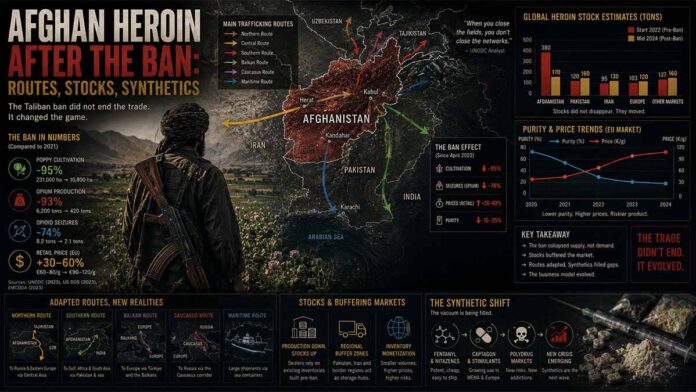

Executive Summary
BLUF: The Afghan heroin system is not collapsing; it is being re-engineered into a lower-volume, higher-opacity, multi-commodity trafficking architecture.
Afghan opium production fell to an estimated 296 tonnes in 2025, compared with 6,200 tonnes in 2022, but stockpiles, adulteration and displaced cultivation continue to buffer downstream markets.
The latest European evidence corrects the baseline supplied: EU heroin seizures declined from 9.5 tonnes in 2021 to 3.6 tonnes in 2024; the often-cited 5.4-tonne figure refers to 2023, not 2025.
The strategic centre of gravity is shifting from cultivation volume to control over inventories, processing, precursor access, maritime logistics, financial settlement and retail-level dilution.
Pakistan’s Balochistan, the Iran–Azerbaijan–Georgia axis, the Makran–East Africa maritime system and Turkish Mediterranean ports are becoming increasingly consequential.
Heroin is progressively sharing infrastructure with methamphetamine, synthetic cathinones, diverted pharmaceuticals and synthetic opioids.
The principal European threat is therefore not a simple heroin shortage, but an unstable transition involving declining purity, polysubstance exposure and substitution by highly potent opioids.
The five-year base case is continued heroin availability at reduced purity, accompanied by route diversification and increasing synthetic penetration.
The highest-impact scenario is a rapid exhaustion or sequestration of Afghan stocks followed by nitazene, fentanyl-class or other synthetic-opioid substitution in vulnerable European markets.
Policy must move from seizure-counting toward stock estimation, chemical profiling, port-risk fusion, financial-network mapping and near-real-time toxicological warning.
Pillar I — The Post-Ban Afghan Supply System
Cultivation compression, strategic stockpiles, Taliban enforcement asymmetry, displaced production, processing geography, precursor access and the conversion of opium into a politically controlled inventory.
Pillar II — Route Recomposition and Criminal Logistics
Northern-route concealment, Caucasus expansion, Iranian brokerage, Pakistani maritime outlets, Indian Ocean trans-shipment, containerization, port corruption, drone delivery and convergence with licit freight.
Pillar III — Synthetic Substitution and the 2026–2031 Risk Envelope
Methamphetamine competition, opioid adulteration, nitazene penetration, European demand resilience, public-health consequences, financial adaptation and alternative five-year market trajectories.
Master Abstract
The post-2022 Afghan opiate economy should no longer be analysed as a conventional agricultural supply chain in which reduced cultivated hectares produce a roughly proportional reduction in heroin availability. It has become an inventory-mediated political economy in which the decisive variables are the size and ownership of accumulated opium stocks, the geographic redistribution of cultivation, access to conversion laboratories, precursor-chemical availability, the rate at which traffickers release product and the ability of protected networks to move commodities across increasingly diversified corridors. The latest United Nations estimate places Afghan opium-poppy cultivation at 10,200 hectares in 2025, down from 232,000 hectares in 2022, with potential opium production falling to 296 tonnes. This output could support only approximately 22–34 tonnes of export-quality heroin, compared with an estimated 350–580 tonnes in 2022. The decline is therefore structurally real, but its downstream transmission is neither immediate nor linear. Large pre-ban inventories, product dilution, staged liquidation and residual cultivation allow trafficking organizations to smooth the shock over several market cycles. The European Union Drugs Agency additionally records a major measurement divergence: alternative high-resolution satellite analysis estimated 12,818 hectares of Afghan cultivation and 414 tonnes of opium in 2025, while estimating Afghan stocks at roughly 12,000 tonnes of opium. This discrepancy is itself an intelligence finding. It establishes a wide uncertainty interval around the most important predictive variable in the entire system—the volume of marketable inventory still controlled by traffickers and politically connected custodians. Under a Bayesian assessment, the probability that Afghan-origin heroin remains materially available to European markets through at least 2028 is assessed at 72%, while the probability of an abrupt continent-wide shortage before the end of 2027 is only 18%. The probability rises materially after 2028 if cultivation remains suppressed and stock estimates prove overstated. Afghanistan Opium Survey 2025 – United Nations Office on Drugs and Crime – November 2025 — Verified official report. Heroin and Other Opioids: The Current Situation in Europe – European Union Drugs Agency – June 2026 — Verified official analysis.
The geographical consequence of supply compression is not the disappearance of the historic northern, Balkan and southern routes, but their partial fusion into a modular logistics system capable of switching commodities, carriers and jurisdictions. The northern corridor through Tajikistan, Uzbekistan, Kyrgyzstan and Kazakhstan remains relevant, but its visibility is impaired by uneven reporting, enormous licit freight volumes, weak forensic interoperability and the strategic displacement of enforcement attention toward synthetic stimulants. To the west, the Iran–Azerbaijan–Georgia–Türkiye sequence has gained value as a bypass architecture linking Iranian consolidation zones to the Caucasus, Black Sea gateways and the Balkan system. To the south, the Makran coast, Pakistani and Iranian ports, Gulf trans-shipment centres, East African coastal nodes and commercial container networks provide the depth required to absorb enforcement shocks at any single border. Official UNODC analysis of the Balkan route already treats heroin and methamphetamine as connected trafficking problems rather than isolated markets, while the United States’ official international narcotics assessment identifies Iran and Pakistan as the principal routes for Afghan-origin opiates. These converging assessments support a network interpretation: traffickers increasingly purchase logistics as a service from brokers who control freight documentation, warehousing, port access, customs relationships, maritime transfers, vehicle compartments and financial settlement mechanisms. The commodity inside the system can change without requiring the system itself to be rebuilt. This creates an important asymmetry for enforcement. A heroin seizure removes one shipment; dismantling a freight forwarder, corrupt customs cell, maritime refuelling node, hawala settlement chain or chemical-procurement intermediary can degrade several illicit markets simultaneously. The user-supplied July 2026 study provides a valuable route and actor inventory, especially regarding Badakhshan, Balochistan, Iran, the Caucasus and the western Indian Ocean, but its interview-based and secondary-source assertions are treated here as hypotheses requiring independent corroboration rather than as final evidence. Opiates and Methamphetamine Trafficking on the Balkan Route – United Nations Office on Drugs and Crime – 2025 — Verified official report. 2025 International Narcotics Control Strategy Report, Volume I – United States Department of State – March 2025 — Verified official report.
The decisive 2026–2031 transformation is likely to occur at the interface between declining heroin purity and expanding synthetic-drug capability. Europe is not yet experiencing a uniform heroin famine. The latest EUDA data show that heroin seizures by EU Member States declined from 9.5 tonnes in 2021 to 8.0 tonnes in 2022, 5.4 tonnes in 2023 and 3.6 tonnes in 2024. Türkiye separately seized 4.3 tonnes in 2024, up from 3.3 tonnes in 2023. Retail brown-heroin purity in reporting countries ranged from 8% to 33% in 2024, with half reporting average purity between 10% and 21%, while purity has fallen markedly over the last four years. This pattern is consistent with rationing through adulteration rather than immediate market failure. At the same time, Europe’s opioid-risk environment is broadening. More than 50,000 nitazene-containing tablets were detected in ten countries in 2024, compared with 23,000 in 2023 and 380 in 2022. Although synthetic opioids still account for a relatively small proportion of the total European drug market, their extreme potency permits small production or trafficking networks to replace substantial volumes of heroin-equivalent retail doses. The principal warning indicator is therefore not merely a further decline in heroin seizures. It is the simultaneous occurrence of five signals: sustained purity deterioration, rising wholesale-price dispersion, increased detections of nitazenes or fentanyl-class substances in counterfeit medicines or heroin samples, clusters of geographically concentrated overdoses and growth in non-heroin opioid treatment presentations. Analysis of Competing Hypotheses produces five credible pathways: H₁ managed contraction, in which stocks maintain supply while purity falls; H₂ regional substitution, in which Pakistani or Myanmar opium partly offsets Afghan losses; H₃ synthetic displacement, in which nitazenes or other potent opioids capture vulnerable markets; H₄ commodity convergence, in which heroin becomes one component of methamphetamine-led trafficking portfolios; and H₅ political reversal, in which Afghan cultivation rebounds because enforcement weakens or revenue needs override prohibition. The current posterior distribution assigns H₁ 36%, H₄ 25%, H₃ 18%, H₂ 13% and H₅ 8%. These are structured analytical estimates, not official forecasts. European Drug Report 2026: Heroin and Other Opioids – European Union Drugs Agency – June 2026 — Verified official analysis. World Drug Report 2025: Contemporary Issues on Drugs – United Nations Office on Drugs and Crime – June 2025 — Verified official report.
Afghan Opiate–Synthetic Transition Monitor
Scenario Inputs
Composite Strategic Risk
Route Pressure Matrix
Iran → Azerbaijan → Georgia/Nakhchivan → Türkiye → EU logistics.
Makran coast → Gulf/East Africa → Mediterranean and northern European ports.
Badakhshan → Tajikistan/Uzbekistan → Kazakhstan → Russia or Caspian diversion.
Türkiye → overland Balkan branches or container/ferry systems into EU ports.
Analysis of Competing Hypotheses
H₁Managed contraction and declining purity36%H₂Regional opium-source substitution13%H₃Synthetic-opioid displacement18%H₄Heroin–methamphetamine convergence25%H₅Afghan cultivation rebound8%Dynamic Five-Year Interpretation
Chapter 1 — The Post-Ban Afghan Supply System
1.1 Strategic Judgement
The Taliban’s April 2022 prohibition has produced a genuine and historically exceptional contraction in Afghan poppy cultivation, but it has not yet dismantled the Afghan opiate supply system. The system has moved from a high-throughput agricultural model into a more concentrated inventory economy in which access to stored opium, processing expertise, protected transport and cross-border brokerage determines market power. UNODC estimates that cultivation declined from approximately 232,000 hectares in 2022 to 10,800 hectares in 2023, recovered only marginally to 12,800 hectares in 2024, and fell again to approximately 10,200 hectares in 2025. Potential opium output was estimated at only 296 tonnes in 2025, compared with approximately 6,200 tonnes in 2022. These figures establish that the cultivation shock is real; they do not establish that traffickers face an equivalent shortage of marketable opiates. The 2022 ban was announced immediately before the main harvest, which was substantially permitted to proceed, allowing farmers, landowners and traders to retain that year’s production as prices rose. EUDA’s technical assessment further estimates that cultivation during the preceding period may have generated inventories of up to 13,000 tonnes between 2019 and 2022, although this is a modelled upper-range assessment rather than a directly observed stock count. The intelligence significance is fundamental: the market’s controlling variable is no longer annual output alone but the rate at which privately held inventories are accumulated, transferred, converted and released. The Taliban therefore achieved substantial control over planting without necessarily extinguishing wholesale trade. This distinction explains why cultivation indicators collapsed immediately while downstream availability adjusted more slowly. Afghanistan Opium Survey 2025 – United Nations Office on Drugs and Crime – November 2025 — Verified official report. Understanding the Impact of the Taliban Drug Ban – European Union Drugs Agency – May 2025 — Verified official technical report.
Core assessment: the ban has transformed opium from a widely produced cash crop into a scarcer, appreciating and politically sensitive reserve asset. Under the previous model, market influence was dispersed among farmers, landowners, harvest labourers, village traders, laboratory owners, transporters, commanders and cross-border wholesalers. Under the emerging model, influence migrates upward toward actors with sufficient capital and protection to hold inventory for several years, finance purchases during price spikes, commission processing, absorb interdiction losses and choose when to release supply. The resulting structure is more oligopolistic even if the underlying trade remains fragmented. It also creates a paradox for Taliban governance. Strict suppression of new cultivation supports the regime’s public claim that it is enforcing the decree, raises the value of existing stocks and reduces the number of actors able to enter the market. Yet complete suppression of storage, processing and export would destroy the economic buffer available to influential landowners, traders and communities affected by the ban. EUDA’s assessment notes that opium continued to trade inside Afghanistan despite two consecutive low-cultivation years and that higher prices increased the wealth of stockholding farmers and traders. This does not by itself prove centrally directed Taliban management of inventories. It does, however, support the inference that a prohibition focused more effectively on visible cultivation than on all stages of the commodity chain can unintentionally transfer value from small cultivators to capitalized inventory holders. The post-ban system should therefore be modelled not as a uniformly prohibited market but as a layered order in which cultivation, storage, processing, internal transport and cross-border export face different combinations of enforcement, tolerance, bribery, political protection and risk. Understanding the Impact of the Taliban Drug Ban – European Union Drugs Agency – May 2025 — Verified official technical report.
1.2 Cultivation Compression: Scale, Geography and Limits
The cultivation contraction is geographically uneven and therefore strategically different from an eradication campaign that removes production proportionally across all provinces. The strongest and most visible reduction occurred in the former southern heartland, particularly Helmand, where large-scale cultivation had previously been enabled by irrigated desert agriculture, solar-powered pumping, accumulated agronomic expertise and established commercial networks. EUDA records that satellite analysis placed Helmand’s cultivation at approximately 128,000 hectares in 2022 but only about 740 hectares in 2023, indicating that Taliban deterrence was highly effective where the movement possessed dense administrative, coercive and social control. By contrast, cultivation remained more persistent in Badakhshan, where geography, local political relationships and the social distance between provincial communities and the predominantly southern Taliban apparatus complicated enforcement. UNODC’s 2024 assessment found that national cultivation rose by approximately 19% from the exceptionally low 2023 baseline, with the centre of cultivation shifting toward north-eastern provinces. The subsequent 2025 decline to approximately 10,200 hectares did not eliminate the importance of these residual zones. Such displacement matters because even modest surviving cultivation can perform three systemic functions: it replenishes selected inventories, preserves seed and cultivation expertise, and maintains the commercial relationships required for rapid expansion should enforcement weaken. A ban that suppresses the country’s largest production basin but leaves smaller peripheral clusters does not merely reduce volume; it changes who controls entry into the market. Traders able to aggregate small harvests from dispersed locations acquire greater leverage, while traditional southern processing networks can import raw opium from surviving production areas rather than depend exclusively on local farms. Afghanistan Drug Insights, Volume 1: Opium Poppy Cultivation 2024 – United Nations Office on Drugs and Crime – November 2024 — Verified official report. Afghanistan Opium Survey 2025 – United Nations Office on Drugs and Crime – November 2025 — Verified official report. Understanding the Impact of the Taliban Drug Ban – European Union Drugs Agency – May 2025 — Verified official technical report.
Climate and water stress reinforce cultivation compression but should not be confused with the political effect of the Taliban ban. Poppy is relatively drought-resistant compared with several alternative crops, yet it still depends on reliable planting conditions, irrigation access, labour and credit. Afghanistan’s wider rural economy has suffered from recurrent drought, declining groundwater, restrictions affecting employment and humanitarian operations, and weak legitimate market access. UNODC’s socioeconomic assessment estimates that the 2023 cultivation collapse removed approximately US$1 billion in farm-level income compared with the preceding year, concentrating losses in areas where poppy had financed household consumption, land rental, agricultural inputs and rural employment. Farmers replacing poppy with wheat generally faced a severe revenue decline because wheat produces lower gross returns and is more difficult to use as collateral within informal credit relationships. This economic shock has not generated an immediate nationwide cultivation rebellion partly because higher opium prices reward households that retained stocks and partly because Taliban enforcement has made planting visibly dangerous in core areas. The resulting rural political economy divides communities into at least four groups: stockholding landowners who benefit from scarcity; landless labourers who lose seasonal employment; indebted sharecroppers who cannot monetize the price increase because they retained little crop; and traders who gain from arbitrage and storage. This segmentation weakens the assumption that all former poppy-producing communities share the same incentive to resist the ban. It also creates future instability. As stocks become concentrated and eventually depleted, households excluded from inventory gains may become more willing to resume cultivation, migrate to permissive areas or enter other illicit economies. Socio-Economic Impact of the Narcotics Ban in Afghanistan, with a Focus on Northern Provinces – United Nations Office on Drugs and Crime – December 2025 — Verified official report. World Drug Report 2025: Key Findings – United Nations Office on Drugs and Crime – June 2025 — Verified official report.
1.3 Strategic Stockpiles: The Market’s Hidden Balance Sheet
The size, distribution and release rate of Afghan opium inventories constitute the most important intelligence gap in forecasting European heroin supply. Stocks cannot be inferred simply by subtracting annual seizures and estimated consumption from reported output because each component contains substantial uncertainty: cultivation surveys carry confidence intervals; yields vary by province and weather; conversion ratios differ according to opium quality and laboratory technique; domestic consumption is imperfectly measured; seizures represent only detected flows; and inventories may include degraded, adulterated or pledged product that is not immediately marketable. EUDA’s estimate that as much as 13,000 tonnes could have accumulated from cultivation between 2019 and 2022 should therefore be treated as a high-side scenario, not a warehouse count. Nevertheless, even a substantially smaller usable inventory could sustain exports for several years because annual European heroin demand requires only a fraction of Afghanistan’s pre-ban output. The release mechanism resembles commodity-finance behaviour: farmers and traders compare expected future appreciation against current liquidity needs, storage risk, theft, enforcement exposure and product degradation. Rising prices after 2022 encouraged withholding, while the ability to sell in local markets converted opium into a liquid store of value. In effect, the ban created a scarcity premium. Actors with capital can hold product and sell gradually; poorer households liquidate earlier and lose future upside. Inventory ownership therefore becomes a mechanism of social and political stratification. It also gives authorities and protected intermediaries potential leverage without requiring formal state ownership: controlling checkpoints, markets, laboratories or cross-border passage can determine which stockholders can monetize their reserves and at what cost. Understanding the Impact of the Taliban Drug Ban – European Union Drugs Agency – May 2025 — Verified official technical report. Drug Supply, Production and Precursors: The Current Situation in Europe – European Union Drugs Agency – June 2026 — Verified official analysis.
A useful stock-depletion model requires at least four inventory categories rather than one aggregate estimate. I₁ household reserves consist of small quantities retained by farmers for savings, debt repayment or future sale. I₂ commercial reserves are larger holdings accumulated by village traders, wholesalers and landowners. I₃ processing reserves are opium or intermediate products positioned near conversion sites and therefore more readily exportable. I₄ strategic protected reserves are hypothetical high-volume inventories held by actors possessing sufficient political, armed or commercial protection to delay release and influence market timing. Open sources do not permit a reliable division among these categories, but each has a different market effect. Household stocks are likely to enter the market gradually under economic pressure; commercial stocks respond to prices and expected enforcement; processing stocks can produce immediate heroin flows; protected stocks may be released selectively to preserve relationships or exploit scarcity. The user-supplied July 2026 study describes extensive inventories and protected trafficking relationships, but because many of its claims derive from confidential interviews and non-governmental reporting, it is used here as an intelligence lead set, not as conclusive evidence under the primary-source rule. The analytical implication remains valid without accepting every actor-level allegation: national production statistics cannot predict downstream supply unless analysts estimate stock ownership, turnover and conversion capacity. Priority collection should therefore monitor local opium prices, the spread between opium and heroin-base prices, storage-site activity, laboratory demand, cross-border wholesale quotes, debt settlements and geographically differentiated seizure purity. A widening opium-to-heroin price mismatch would indicate margin compression and stronger incentives to adulterate, improve conversion efficiency or redirect product toward the most profitable export markets. Understanding the Impact of the Taliban Drug Ban – European Union Drugs Agency – May 2025 — Verified official technical report.
1.4 Taliban Enforcement Asymmetry
Taliban enforcement must be disaggregated by activity and geography. The evidence is strongest for successful deterrence of planting in core southern and eastern provinces. Cultivation is highly visible from the ground and through satellite monitoring; it requires months of exposure; and it can be suppressed before planting through orders to village elders, landowners and water managers. By comparison, stored opium can be concealed in houses or commercial compounds, processing can move between small facilities, and transport can be fragmented into multiple consignments. These activities impose higher intelligence and enforcement costs and create more opportunities for discretionary application. EUDA’s assessment indicates that internal and cross-border opiate trade continued after the cultivation collapse and that significant seizures by neighbouring states confirmed continuing movement. It also found that routes into Pakistan and Iran remained active, although transport costs increased and guarantees protecting traders against losses weakened on some corridors. This pattern is consistent with an enforcement regime that raises transaction costs without sealing the market. The same authority can simultaneously suppress fields, destroy selected laboratories, arrest unprotected actors and tolerate or fail to detect other transactions. Such unevenness should not automatically be interpreted as evidence of a centrally coordinated narcotics policy beyond the published decree. It may also arise from variable provincial capacity, local bargaining, corruption, tribal relationships, enforcement priorities and the inherent difficulty of policing clandestine commerce. The analytical error would be to classify Taliban behaviour as either complete prohibition or complete complicity. The available evidence supports a spectrum ranging from genuine suppression to selective tolerance and opportunistic rent extraction. Understanding the Impact of the Taliban Drug Ban – European Union Drugs Agency – May 2025 — Verified official technical report. 2025 International Narcotics Control Strategy Report, Volume I – United States Department of State – March 2025 — Verified official report.
The enforcement asymmetry also serves political objectives independent of narcotics control. Suppressing cultivation allows the Taliban to demonstrate sovereign reach, discipline rural populations, improve its external narrative and distinguish the current regime from the corruption associated with the previous republic. At the same time, a controlled rather than completely extinguished trade can limit rural rebellion and preserve income among influential stockholders. This produces what may be termed coercive market compression: the authority reduces the number of producers and visible transactions while the remaining market becomes more dependent on permission, protection or privileged access. The hypothesis is analytically plausible but cannot be confirmed solely through official production data. It should be tested through indicators such as geographical patterns of eradication, identities and affiliations of arrested traders, selectivity in laboratory destruction, persistence of wholesale markets, checkpoint payment structures and changes in the concentration of stock ownership. The principal counter-hypothesis is administrative limitation: Taliban units may genuinely seek comprehensive prohibition but lack the intelligence, forensic capacity and border-control resources required to suppress an economy developed over decades. A second counter-hypothesis is decentralized corruption: local officials may protect traffickers without authorization from central leadership. A third is strategic sequencing: the Taliban may have prioritized cultivation because it was measurable and politically achievable, intending to tackle processing and export later. Current evidence discriminates strongly in favour of effective cultivation suppression but remains insufficient to determine which combination of centralized strategy, local accommodation and institutional weakness best explains continuing trade. Afghanistan Opium Survey 2025 – United Nations Office on Drugs and Crime – November 2025 — Verified official report. Understanding the Impact of the Taliban Drug Ban – European Union Drugs Agency – May 2025 — Verified official technical report.
1.5 Displaced Production and the Balochistan Variable
The most consequential external adaptation is the apparent expansion of opium cultivation and heroin-processing capacity in Pakistan’s Balochistan province. EUDA’s 2026 assessment states that Pakistan has become a large opium producer, primarily in Balochistan, and reports that Afghan farmers and individuals with heroin-processing expertise have relocated across the border to lease land and operate laboratories. It further assesses that Balochistan’s 2025 output may have rivalled Afghanistan’s. This is a major structural development because production displacement into Balochistan shortens the distance between cultivation, processing and the Makran coast, including the maritime access offered by Gwadar and surrounding coastal areas. The operational advantage is substantial: raw opium no longer needs to traverse the full Afghan–Pakistani logistics chain before reaching processing and maritime dispatch nodes. Production nearer the coast reduces inland transport exposure, allows easier access to commercial chemicals and provides entry into long-established dhow, fishing-vessel and container networks. The evidence must nevertheless be interpreted carefully. Pakistan’s cultivation remains less systematically measured than Afghanistan’s, and official reporting contains significant uncertainty. Satellite-based estimates, eradication figures and seizure volumes can indicate expansion but do not yet offer the same longitudinal confidence as UNODC’s Afghan monitoring series. Even so, the direction of travel is strategically credible and now recognized in an official EU agency assessment. If production displacement persists, the Taliban ban will have reduced Afghanistan’s share of regional cultivation without proportionally reducing the wider Afghanistan–Pakistan opiate complex. Drug Supply, Production and Precursors: The Current Situation in Europe – European Union Drugs Agency – June 2026 — Verified official analysis. 2025 International Narcotics Control Strategy Report, Volume I – United States Department of State – March 2025 — Verified official report.
Production displacement changes the strategic leverage of the Taliban. If Afghan laboratories and farmers can relocate across an international frontier, Kabul loses direct coercive control over part of the supply chain while Afghan-origin skills, capital and commercial relationships remain productive. Conversely, cross-border displacement may benefit Afghan traders who retain access to regional networks without assuming the risk of planting inside Afghanistan. It may also create a complementary division of labour: Afghan stocks and residual cultivation supply established processing centres, while Balochistan provides replenishment, laboratories, chemical access and maritime export. This would make national crop suppression an incomplete policy instrument because the relevant market would span southern Afghanistan, western Pakistan and eastern Iran. The probability of such a regionalized production architecture is assessed at 65% for 2026–2028, with medium confidence. The estimate increases if three indicators converge: sustained satellite evidence of large Balochistan fields; repeated seizures of locally produced opium or heroin with chemical signatures distinct from Afghan material; and persistent movement of Afghan cultivators or processing personnel into Pakistan. It falls if Pakistani eradication becomes systematic, if Gwadar-area maritime surveillance significantly improves, or if forensic profiling shows that Balochistan remains mainly a transit and processing zone rather than a major source of raw opium. This is a structured analytical estimate, not an official forecast. Drug Supply, Production and Precursors: The Current Situation in Europe – European Union Drugs Agency – June 2026 — Verified official analysis.
1.6 Processing Geography and Margin Compression
Processing geography determines how rapidly stored opium can become exportable heroin and where enforcement can impose the greatest systemic cost. Opium must pass through intermediate stages—commonly morphine base, heroin base and, for some markets, heroin hydrochloride—using skilled labour, water, heat, equipment and chemical inputs. A cultivation ban does not automatically remove these assets. Laboratories can remain dormant, relocate, operate intermittently or process commissioned batches when traders release inventory. EUDA found that the sharp rise in Afghan opium prices was not matched proportionally by equivalent price increases for morphine base and heroin products. This compresses processor and trader margins. Market actors have four principal responses: increase conversion efficiency, lower payments to suppliers or intermediaries, adulterate intermediate and finished products, or reserve higher-quality output for premium destination markets. EUDA observed increasing adulteration in products destined for local and regional consumers while reporting that European-bound heroin initially appeared to retain higher purity and profitability. By 2024, however, European indicators were beginning to show declining purity, although the available evidence suggested that at least some adulteration occurred closer to the European retail market rather than inside Afghanistan. This distinction matters for attribution. Lower street purity does not automatically prove that Afghan processors have reduced the quality of export material. Chemical and impurity profiling must distinguish upstream changes in production from downstream cutting in Türkiye, the Balkans or EU distribution hubs. Understanding the Impact of the Taliban Drug Ban – European Union Drugs Agency – May 2025 — Verified official technical report. Heroin and Other Opioids: The Current Situation in Europe – European Union Drugs Agency – June 2026 — Verified official analysis.
The likely processing map is becoming more distributed. Traditional south-western Afghan centres retain expertise and proximity to stored opium, while residual north-eastern cultivation may initially move as raw opium because precursor supply and specialist capacity are thinner. Pakistani Balochistan offers proximity to maritime export and potentially easier access to industrial chemicals. Iranian territory can serve as a transit, consolidation and possibly reprocessing environment, although reliable official data on clandestine production inside Iran remain limited. Distributed processing improves network resilience because laboratories need not operate continuously or at industrial scale; modular equipment and trained personnel can be moved between locations. It also complicates interdiction. Destroying one site removes physical capacity but not the commercial system that commissions production, supplies chemicals and arranges transport. The highest-value targets are therefore not necessarily the laboratories themselves but the processing coordinators who link inventory owners, chemists, precursor brokers and export wholesalers. Intelligence collection should identify repeated associations between bulk opium purchases, acetic anhydride diversion, fuel and generator procurement, packaging materials, rural compounds and cross-border freight. Waste signatures and environmental sampling can supplement seizures because heroin conversion produces chemical residues that may reveal activity even when laboratories relocate. Official EU reporting similarly emphasizes the need to monitor precursor and non-scheduled chemical flows as illicit producers adapt their synthesis and concealment methods. Drug Supply, Production and Precursors: The Current Situation in Europe – European Union Drugs Agency – June 2026 — Verified official analysis. International Narcotics Control Board Precursors Report 2024 – International Narcotics Control Board – March 2025 — Verified official publication portal.
1.7 Precursor Access: The Supply Chain’s Under-Monitored Chokepoint
Acetic anhydride remains the most strategically important controlled chemical associated with heroin manufacture because it is required to acetylate morphine into heroin. Afghanistan does not possess a legitimate industrial base that would explain large domestic requirements, meaning that illicit processing depends primarily on diversion and cross-border supply. Precursor control is therefore one of the few interventions capable of constraining processing independently of opium availability. Yet the practical challenge is substantial. Acetic anhydride has legitimate industrial uses; it can move through long commercial chains; documentation can be falsified; consignments can be divided into smaller loads; and brokers can route it through neighbouring states before entry into Afghanistan or Pakistan. The ban may have increased the price and risk of obtaining high-quality chemicals, encouraging processors to improve recovery rates, substitute lower-grade materials or adulterate finished products. EUDA records anecdotal claims that laboratories sought better-quality “acid,” understood to mean acetic anhydride, to improve conversion economics after opium prices rose. These claims require forensic confirmation, but the incentive is clear: when raw material becomes expensive, every percentage improvement in yield gains value. Consequently, precursor scarcity may not reduce heroin output linearly; it may first generate innovation, chemical substitution and greater concentration among processors capable of obtaining reliable supplies. Understanding the Impact of the Taliban Drug Ban – European Union Drugs Agency – May 2025 — Verified official technical report. International Narcotics Control Board Precursors Report 2024 – International Narcotics Control Board – March 2025 — Verified official publication portal.
Precursor intelligence should therefore move beyond counting seizures. A meaningful monitoring architecture would combine export notifications, customs records, end-user verification, company-registration analysis, unusual purchasing patterns, transport routes, packaging identifiers and chemical impurity profiles. The objective is to identify diversion chains before chemicals reach processing zones. Priority jurisdictions include legitimate chemical-producing and trading states, regional re-export hubs, and the immediate neighbours through which Afghan and Pakistani laboratories are supplied. A shipment seized at the Afghan border represents only the final stage of the diversion chain; the more valuable intelligence lies in the supplier, intermediary, false consignee, financial settlement and prior shipments from the same commercial network. Investigators should also monitor alternative chemicals and techniques that could partially substitute for controlled inputs. The synthetic-drug sector demonstrates that illicit producers rapidly migrate toward non-scheduled or “designer” precursors when regulatory pressure increases. Although heroin chemistry offers less flexibility than several synthetic-drug processes, traffickers can still alter purity, conversion stages and processing location. The possibility that morphine base is produced near opium stocks and acetylated later in another jurisdiction deserves particular attention because it separates the most chemical-intensive step from cultivation geography. Effective precursor policy must consequently integrate Afghanistan with Pakistan, Iran, Central Asia, the Gulf and major chemical-export economies rather than treat it as an isolated destination problem. 2025 International Narcotics Control Strategy Report, Volume I – United States Department of State – March 2025 — Verified official report. Drug Supply, Production and Precursors: The Current Situation in Europe – European Union Drugs Agency – June 2026 — Verified official analysis.
1.8 Analysis of Competing Hypotheses
Five hypotheses explain how severe cultivation compression can coexist with continued opiate availability. H₁ — Deep-stock buffering: substantial pre-ban inventories are being released gradually, allowing the system to maintain exports while annual production remains low. H₂ — Underestimated residual production: cultivation surveys miss dispersed, concealed or politically inaccessible fields, causing actual output to exceed official central estimates. H₃ — Regional displacement: falling Afghan production is partly replaced by cultivation and processing in Pakistani Balochistan and, to a smaller degree, other source regions. H₄ — Efficiency and adulteration: improved conversion, differentiated purity and increased cutting permit smaller quantities of opium to support a larger apparent retail market. H₅ — Demand-side contraction: heroin demand is falling or being replaced by methamphetamine, synthetic cathinones, pharmaceutical opioids and potent synthetic opioids, so less Afghan product is required to sustain market availability. These hypotheses are not mutually exclusive. The current Bayesian distribution assigns H₁ 37%, H₃ 23%, H₄ 17%, H₅ 13% and H₂ 10% as the dominant explanatory mechanism. When combined rather than treated as exclusive alternatives, the strongest composite scenario is H₁ + H₃ + H₄: stocks provide the principal buffer, displaced production provides partial replenishment, and adulteration stretches the finished product. Confidence is moderate because inventory size and Pakistani output remain poorly measured. Afghanistan Opium Survey 2025 – United Nations Office on Drugs and Crime – November 2025 — Verified official report. Understanding the Impact of the Taliban Drug Ban – European Union Drugs Agency – May 2025 — Verified official technical report. Drug Supply, Production and Precursors: The Current Situation in Europe – European Union Drugs Agency – June 2026 — Verified official analysis.
The principal discriminating indicators are identifiable. Evidence favouring H₁ would include continued high Afghan opium prices, stable cross-border availability, declining stocks reported by rural surveys and no major rebound in cultivation. Evidence favouring H₂ would include substantial discrepancies between independent satellite estimates, seizure volumes incompatible with reported output and newly detected cultivation outside historically monitored zones. Evidence favouring H₃ would include sustained Balochistan field expansion, processing-site discoveries, distinct chemical profiles and increased maritime dispatch from the Makran coast. Evidence favouring H₄ would appear as falling purity, greater use of caffeine, paracetamol or synthetic opioids, changing impurity signatures and a widening difference between wholesale and retail volumes. Evidence favouring H₅ would include declining heroin-treatment initiation, lower wastewater markers, reduced overdose involvement of heroin or morphine and rising consumption of synthetic alternatives. No single indicator can resolve the system. A robust assessment requires a fusion model linking satellite cultivation, farm-gate pricing, precursor movements, laboratory intelligence, seizure chemistry, wholesale pricing, treatment data, toxicology, wastewater analysis and financial flows. Seizure tonnage alone is especially unreliable because it reflects enforcement effort, intelligence quality and reporting practices as much as underlying traffic. The practical objective is not to produce a single stock number but to update a probability distribution as each indicator changes.
1.9 Five-Year Outlook, 2026–2031
The base case, probability 52%, is a prolonged managed contraction. Afghan cultivation remains below historical levels through at least 2028, but inventories, residual production and Pakistani displacement prevent a sudden breakdown of supply. Afghan opium becomes progressively more concentrated among wealthy traders and protected networks. Heroin processing becomes more selective, with the highest-quality output reserved for lucrative markets and lower-grade products increasingly adulterated. By 2028–2029, stock depletion becomes more visible through widening price differentials, declining purity and episodic shortages in markets farthest from established routes. The Taliban maintains cultivation suppression because it reinforces internal authority and external messaging, but enforcement against storage, processing and trafficking remains uneven. The synthetic acceleration case, probability 23%, occurs if stocks prove smaller than expected or become inaccessible because of internal conflict, border disruption or financial fragmentation. Heroin scarcity then creates openings for nitazenes, fentanyl-class compounds, diverted medicines and stimulants. The regional substitution case, probability 17%, sees Balochistan and other producers offset a significant share of Afghan decline, preserving opiate flows but shifting processing and political risk into Pakistan and maritime corridors. The cultivation rebound case, probability 8%, requires weakened Taliban enforcement, severe rural unrest, political fragmentation or a deliberate policy reversal driven by revenue pressures. Heroin and Other Opioids: The Current Situation in Europe – European Union Drugs Agency – June 2026 — Verified official analysis. World Drug Report 2025: Key Findings – United Nations Office on Drugs and Crime – June 2025 — Verified official report.
The decisive warning window is 2027–2029. If the post-ban inventory is near the upper estimate and release remains disciplined, market stress may remain gradual beyond 2029. If usable stocks are much smaller, poorly distributed or degraded, instability could emerge earlier and unevenly. The highest-value indicators are: quarterly Afghan opium prices; the wholesale spread between opium, morphine base and heroin base; cultivation changes in Badakhshan and Balochistan; acetic-anhydride interdictions; the number and geography of laboratories; heroin purity at sequential points from Afghanistan to Europe; seizures containing both heroin and synthetic drugs; and clusters of nitazene-linked poisonings. A sharp increase in three or more indicators within twelve months should trigger a revised high-risk assessment. The central policy conclusion is that the Taliban ban has not removed the Afghan heroin system. It has converted it into a smaller, more capital-intensive, politically mediated and regionally distributed system whose resilience depends increasingly on inventories, chemical access and cross-border infrastructure rather than the sheer size of the annual Afghan crop.
Pillar II — Route Recomposition and Criminal Logistics
2.1 Strategic Judgement
The contraction of Afghan opium production has not produced a proportional contraction in the trafficking architecture connecting Afghanistan to Europe, Russia, the Middle East, Africa and the Indian Ocean. Instead, it has accelerated the transition from relatively identifiable territorial corridors into a modular logistics system in which criminal networks can alternate among roads, railways, ferries, dhows, commercial vessels, container terminals, air cargo, passenger couriers and short-range unmanned aircraft. Heroin remains important, but the infrastructure moving it is increasingly commodity-neutral: the same brokers, transport companies, warehouses, corrupt gatekeepers and financial channels can handle methamphetamine, cannabis resin, cocaine, synthetic cathinones, pharmaceutical products, weapons, migrants or illicit cash. Four principal pathways continue to connect Afghan-origin opiates to Europe—the Balkan, southern, Caucasus and northern routes—but they should no longer be treated as independent lines on a map. They are overlapping networks joined by switch points in Iran, Pakistan, Türkiye, the Caucasus, Central Asia, the Gulf and East Africa. EUDA’s official market analysis identifies diversification in both routes and transport modes, while UNODC’s 2025 Balkan-route assessment shows that heroin and methamphetamine increasingly move through overlapping commercial and financial systems. The operational centre of gravity has consequently moved away from controlling a finite number of frontier crossings and toward identifying the coordinators who can redirect consignments between jurisdictions, modes of transport and nominally legitimate businesses. EU Drug Market: Heroin and Other Opioids—Trafficking and Supply – European Union Drugs Agency – January 2024 — Verified official analysis. Opiates and Methamphetamine Trafficking on the Balkan Route: Drug Flows, Illicit Incomes and Illicit Financial Flows – United Nations Office on Drugs and Crime – March 2025 — Verified official report.
The central analytical conclusion is that route resilience is now generated by redundancy, substitution and embeddedness in legitimate commerce. Redundancy means that disruption of one border or port shifts flows to another rather than stopping them. Substitution means that trafficking organizations can replace heroin with methamphetamine or another commodity while preserving the same logistical structure. Embeddedness means that illicit consignments are concealed within the scale, speed and documentary complexity of legal trade. Commercial trucks, containerized cargo, vehicle ferries, agricultural shipments, construction materials, fuel tanks, pallet structures and maritime supply chains offer traffickers a protective envelope that enforcement cannot search comprehensively without obstructing commerce. The World Customs Organization’s risk-management doctrine therefore emphasizes profiling and intelligence-led selection rather than universal inspection, while its joint container-control model is designed to create specialized port and air-cargo units capable of identifying high-risk consignments without stopping ordinary trade. This operational necessity also creates the traffickers’ opportunity: whoever manipulates manifests, routing data, seals, customs declarations, consignee records or inspection schedules can convert a legal logistics platform into criminal infrastructure. WCO Customs Risk Management Compendium – World Customs Organization – Updated May 2024 — Verified official framework. Container Control Programme Highlights Success in Preventing Illicit Trade – World Customs Organization – April 2023 — Verified official programme assessment.
2.2 Route-Recomposition Matrix
| Route system | Principal upstream supply | Key switch points | Dominant transport modes | Main concealment opportunities | Current strategic role | 2026–2031 assessment |
|---|---|---|---|---|---|---|
| Northern Eurasian route | North-eastern Afghanistan and residual Afghan stocks | Tajikistan, Uzbekistan, Kyrgyzstan, Kazakhstan, Caspian interfaces | Road freight, rail, agricultural cargo, passenger vehicles, river crossings | Fruit and vegetable loads, construction materials, sealed freight, hidden vehicle compartments | Supplies Russia while retaining diversion capacity toward the Caspian and Caucasus | Lower visibility but persistent; increasing integration with synthetic-drug logistics |
| Caucasus route | Iranian-consolidated Afghan opiates and possible Caspian diversions | Azerbaijan, Nakhchivan, Georgia, Black Sea ports, eastern Türkiye | Trucks, Caspian vessels, passenger vehicles, small boats, drones | Pallets, building materials, fuel tanks, commercial cargo, cross-border aerial drops | Pressure-release mechanism around the Iran–Türkiye frontier and Black Sea disruption | Likely to gain strategic value if traditional land routes remain heavily monitored |
| Balkan route | Iran–Türkiye and Caucasus-linked flows | Türkiye, Bulgaria, Greece, Western Balkans, Adriatic ports | Trucks, ferries, containers, mixed road–sea logistics | Commercial freight, trailer cavities, legitimate logistics firms, ferry traffic | Still the principal European heroin corridor, increasingly multi-commodity | Persistent but less linear; maritime and intermodal options will grow |
| Southern maritime route | Southern Afghanistan, Pakistani Balochistan, Iranian processing and consolidation zones | Makran coast, Gulf ports, East Africa, Indian Ocean islands | Dhows, fishing vessels, fast boats, containers, air couriers | Offshore transfer, sea drops, false manifests, bulk commodities, fishing activity | Highest geographical flexibility and largest capacity for long-distance displacement | Strong expansion potential, especially for mixed heroin–methamphetamine shipments |
| Direct commercial-air route | Pakistan, Iran, Gulf and East African trans-shipment hubs | Major regional airports and parcel centres | Passenger couriers, checked baggage, air cargo, express parcels | Body packing, luggage linings, commercial parcels, corrupted baggage handling | Lower volume but rapid, distributed and difficult to eliminate | Expected to grow where maritime intelligence improves |
Assessment note: The table integrates official EUDA, UNODC, WCO and INTERPOL findings with structured inferences from the user-supplied July 2026 field study. Actor-specific and micro-route claims in that study remain intelligence leads unless independently confirmed.
2.3 The Northern Route: Concealment Through Scale and Political Opacity
The northern route remains the most frequently underestimated component of the post-ban system because declining publicly reported heroin seizures are often interpreted as evidence of structural disappearance. UNODC’s Afghanistan trafficking assessment instead indicates that reduced Afghan production has lowered outward opiate flows without eliminating the networks, stocks or border relationships that sustain them. The classical route runs from Badakhshan, Takhar and Kunduz across the Panj and Amu Darya systems into Tajikistan, before consignments move through Uzbekistan or Kyrgyzstan, consolidate in Kazakhstan, and continue toward Russian markets. Its resilience derives from three features. First, the Afghan–Tajik border is geographically difficult to monitor, allowing small riverine and mountain movements to coexist with official crossings. Second, Central Asian transit is embedded in high-volume road and rail commerce linking agricultural producers, distribution centres and Russian consumer markets. Third, information about major trafficking networks is politically sensitive and unevenly disclosed, reducing the reliability of open seizure data as a measure of throughput. The route therefore operates less as a single high-volume pipeline than as a layered system of cross-river deliveries, local storage, truck-based consolidation and long-distance freight. Afghanistan Drug Insights, Volume 4: Drug Trafficking and Opiate Stocks – United Nations Office on Drugs and Crime – March 2025 — Verified official report.
The most important post-2022 adaptation is not simply a rerouting of heroin but the transformation of the northern corridor into a poly-drug platform. UNODC and EUDA assessments show that methamphetamine originating in or near Afghanistan has entered routes historically associated with opiates, while Central Asian states face expanding domestic synthetic-drug production and online retail markets. The economic logic is strong: a logistics network already capable of protecting freight, arranging checkpoints, corrupting officials and distributing wholesale heroin can add methamphetamine without recreating the route. Mixed consignments also diversify revenue and spread commodity risk. If heroin availability tightens, the same vehicle, warehouse and payment relationship can carry stimulants; if synthetic-drug enforcement intensifies, opiates can still move in smaller or less conspicuous quantities. The route should therefore be evaluated through network continuity rather than heroin tonnage alone. Indicators of persistence include repeated use of the same transport companies, drivers, border brokers, agricultural exporters, storage sites and financial intermediaries across different seizure categories. The user-supplied study’s portrayal of a quieter, politically insulated route is consistent with this structural model, but its specific allegations concerning elite protection require case-level corroboration. World Drug Report 2025: Contemporary Issues on Drugs – United Nations Office on Drugs and Crime – June 2025 — Verified official report. EU Drug Market: Methamphetamine – European Union Drugs Agency and Europol – May 2022 — Verified official market analysis.
Northern-Route Vulnerability Scheme
Central Asian Supply & Liquidity Transit Corridor
Geospatial Pipeline & Asymmetric Divergence Vectors
Badakhshan / Takhar / Kunduz
Primary sorting and processing node source zones, initiating cross-boundary material flows across regional geographic boundaries.
Local Couriers & Border Facilitators
Asymmetric sorting network execution across tactical geographic crossing paths, navigating the Panj / Amu Darya river crossings.
Tajikistan Consolidation Hub
Systemic temporary storage, cargo batch aggregation, and transit documentation sanitization under sovereign border checkpoints.
Bilateral Distribution Vectors
Eastern tier bypass corridor
Central valley distribution grid
Kazakhstan Arterial Pipeline
Integration into heavy continental transport networks, leveraging optimized bulk rail corridors, commercial road networks, and intermodal freight registries.
End-Market Stratification
Northern distribution networks
Azerbaijan / Caucasus lateral arcs
The scheme identifies Tajik aggregation, Uzbek and Kyrgyz route substitution, Kazakh trunk-line movement and Caspian diversion as the principal transition points. The most valuable enforcement targets are not necessarily the river couriers but the aggregators capable of assembling small consignments into commercial freight and the brokers who can switch loads among road, rail and maritime pathways.
2.4 The Caucasus: From Secondary Corridor to Strategic Bypass
The Caucasus corridor has gained importance because it links Iranian trafficking systems to European markets while avoiding the most heavily monitored segments of the direct Iran–Türkiye frontier. Its strategic architecture is built around Azerbaijan’s border with Iran, access to the Caspian Sea, the westward connection through Georgia, and the Nakhchivan Autonomous Republic, which provides a narrow but highly valuable connection to Türkiye. EUDA recognizes the Caucasus as one of the four principal heroin routes from Asia toward Europe, and official Azerbaijani customs records demonstrate that commercial vehicles crossing Nakhchivan have carried very large heroin consignments concealed in pallets and fuel tanks. One official Azerbaijani case documented more than 325 kilograms of heroin across three trucks: two consignments were hidden in the legs of wooden pallets, while another was concealed in a fuel tank. An earlier official customs publication documented more than 527 kilograms of heroin in related enforcement activity. These cases are operationally significant not because they prove the corridor’s total volume, but because they show the sophistication of concealment, the use of Turkish and Iranian commercial vehicles, and the direct integration of Nakhchivan into European-bound freight chains. More than 325 Kilograms of Heroin Seized – State Customs Committee of the Republic of Azerbaijan – 2022 — Verified official customs publication. More than 527 Kilograms of Heroin Seized – State Customs Committee of the Republic of Azerbaijan – 2021 — Verified official customs publication.
The corridor’s rise is best understood as network arbitrage. Traffickers compare the probability of interception, corruption costs, journey time, cargo capacity and political disruption across alternative routes. When the direct Iran–Türkiye border becomes more difficult, consignments can move north into Azerbaijan and either pass through Nakhchivan into Türkiye or continue through mainland Azerbaijan and Georgia. Caspian transfers can connect Turkmen or Iranian coastal points to Azerbaijani logistics; Georgian road and port infrastructure then offers access to Türkiye or the Black Sea. This does not mean that the Caucasus has replaced the Balkan route. It acts as an upstream feeder and pressure-release mechanism that reconnects with Turkish and Balkan networks farther west. The strategic risk increases because the route serves both road and maritime options and because the region is crossed by legitimate energy, construction and transit trade. Building materials, industrial inputs and palletized freight offer plausible concealment environments, while transport companies can be legitimate, infiltrated, coerced or created specifically to service trafficking. The analytical priority is therefore beneficial-ownership mapping of freight companies, route-history comparison, repeated consignee analysis and identification of trucks that travel in coordinated sequences with matching documentation. EU Drug Market: Heroin and Other Opioids—Trafficking and Supply – European Union Drugs Agency – January 2024 — Verified official analysis.
Caucasus Expansion Assessment
| Indicator | Intelligence interpretation | Direction | Confidence |
|---|---|---|---|
| Large heroin loads concealed in commercial trucks in Nakhchivan | Established high-capacity freight corridor rather than exclusively courier-scale movement | Increasing relevance | High |
| Repeated use of pallet structures, fuel tanks and declared industrial cargo | Concealment engineering is integrated into legitimate logistics | Persistent | High |
| Iran-facing border plus Caspian access | Enables both land and maritime insertion | Structural advantage | High |
| Connection to Georgia and Black Sea infrastructure | Creates alternative westward and maritime branches | Increasing | Medium–high |
| Potential drone delivery across short frontier segments | Useful for small, high-value or test consignments, but not a replacement for bulk freight | Niche expansion | Medium |
| Reconnection with Türkiye and Balkan networks | Converts the Caucasus into a feeder rather than an isolated route | Persistent | High |
2.5 Iranian Brokerage: The System’s Indispensable Switching Layer
Iran functions less as a simple transit country than as a brokerage and consolidation environment connecting Afghan and Pakistani supply with Türkiye, the Caucasus, Gulf shipping and Indian Ocean routes. Geography gives Iran simultaneous access to Afghanistan, Pakistan, Türkiye, Azerbaijan, Armenia, the Persian Gulf, the Gulf of Oman and the Caspian Sea. This permits criminal networks to choose among western overland movement, northern Caucasus diversion, southern maritime export or staged internal redistribution. EUDA’s official assessment identifies Iranian organized-crime networks as central participants in the European heroin chain, while UNODC’s Balkan-route study places Iran at the upstream interface between Afghan supply, methamphetamine production and European-bound logistics. Iranian brokerage is therefore not defined only by transporting drugs across national territory. It includes receiving fragmented consignments from Afghan or Baloch suppliers, consolidating them into larger loads, arranging storage, selecting exit routes, obtaining vehicles, coordinating drivers, manipulating documentation and settling accounts through informal or commercial systems. EU Drug Market: Heroin and Other Opioids—Production – European Union Drugs Agency – January 2024 — Verified official analysis. Opiates and Methamphetamine Trafficking on the Balkan Route – United Nations Office on Drugs and Crime – March 2025 — Verified official report.
The Iranian layer also illustrates why route analysis must incorporate sanctions, currency restrictions and the informal economy. Where formal banking channels are constrained, commercial settlement can rely more heavily on cash, commodities, trade-based value transfer, hawala-like arrangements, gold, vehicles or reciprocal shipment obligations. Such mechanisms can serve legitimate economic needs while also creating concealment opportunities for traffickers. A logistics coordinator may therefore receive compensation through an apparently lawful import transaction rather than a visible drug payment. The investigative challenge is to distinguish ordinary sanction adaptation from criminal settlement without criminalizing broad commercial sectors. High-value indicators include mismatches between declared cargo value and actual commodity flows, repeated use of shell importers, abnormal vehicle transfers, unexplained freight subsidies, circular trade, rapid changes in ownership and transactions inconsistent with a company’s declared business. The user-supplied study describes vehicle-based compensation and state-affiliated brokerage as field hypotheses; these should remain investigatory leads absent official judicial or financial-intelligence confirmation. The correct OSINT posture is therefore to map transactional anomalies and relationships, not to infer official complicity from geography alone.
2.6 Pakistan and the Makran Maritime Outlet
Pakistan provides the most direct interface between residual Afghan supply, displaced cultivation in Balochistan and the Arabian Sea. Opiates can enter through western and north-western borderlands, consolidate around Balochistan and move toward Gwadar, Pasni, Karachi or informal coastal launching points. The system’s strength lies in the combination of difficult terrain, long-standing smuggling economies, fishing activity, commercial ports and proximity to Gulf and East African routes. The southern maritime pathway does not require every shipment to enter a major port. Dhows and fishing vessels can depart from informal coastal sites, transfer cargo offshore, rendezvous with larger vessels or deliver to remote beaches. Containerized shipments offer higher capacity, while small craft offer flexibility and deniability. The same coastline can support both methods, allowing networks to choose between volume and concealment. EUDA and UNODC assessments link the southern route not only to heroin but increasingly to methamphetamine, reinforcing the conclusion that the Makran logistics system is becoming multi-commodity. EU Drug Market: Heroin and Other Opioids—Trafficking and Supply – European Union Drugs Agency – January 2024 — Verified official analysis. Production and Trafficking of Captagon and Methamphetamine along the Southern Route and North Africa Region – European Union Drugs Agency – April 2026 — Verified official strategic assessment.
The Makran route’s primary vulnerability is not the open sea but the shore-side support network. Vessels require fuel, crew, communications, loading areas, storage, repair, food, documentation and knowledge of patrol patterns. Mapping refuelling points, boat ownership, unusual nighttime departures, repeated satellite-telephone activity, AIS anomalies, changes in fishing behaviour and links between coastal warehouses and inland freight can expose the system before cargo reaches international waters. Yet analysts must avoid treating all small-vessel activity as suspicious. Fishing communities routinely operate with incomplete digital visibility, and many wooden vessels lack sophisticated tracking equipment. Effective risk models therefore need behavioural baselines: vessel size, customary route, seasonal fishing patterns, port visits, ownership history, fuel consumption and crew composition. Deviations become meaningful only when combined with other indicators. The highest-risk pattern is not a vessel turning off its transponder in isolation, but a vessel with opaque ownership, abnormal fuel purchase, non-standard voyage duration, contact with known trafficking areas and an unexplained cargo or ballast profile. INTERPOL’s maritime-security programmes emphasize information exchange, investigative capacity and cross-sector cooperation because no single coastguard, customs authority or naval force can reconstruct these chains alone. Maritime Crime: Our Response – INTERPOL – Current Official Programme Framework — Verified official programme page.
2.7 Indian Ocean Trans-Shipment and East African Recomposition
The western Indian Ocean has evolved from a peripheral transit space into a strategic redistribution zone linking the Makran coast to Kenya, Tanzania, Mozambique, Madagascar, Mauritius, Seychelles, South Africa and onward routes toward Europe and Asia. INTERPOL’s Port Security Project, implemented from 2020 to 2024 across nine East and southern African and Indian Ocean states, was explicitly designed to improve the capacity of law-enforcement agencies and port authorities to address illicit maritime activity. Its existence reflects the structural vulnerability of the region: enormous maritime areas, uneven radar and patrol coverage, multiple small ports, fishing and dhow traffic, fragmented jurisdiction and limited forensic capacity. The later Project Compass continues the investigative emphasis on maritime crime in East Africa, southern Africa and the Indian Ocean. Port Security Project – INTERPOL – 2020–2024 — Verified official programme page. Project Compass – INTERPOL – Current Programme — Verified official programme page.
The operational system commonly uses several stages. A dhow or fishing vessel carries a bulk consignment from the Makran area or a Gulf departure point. Cargo may be transferred at sea to smaller craft, dropped at pre-arranged coordinates or landed on a lightly monitored coastline. Local networks then divide the load for storage, regional consumption, air courier movement or onward containerization. This staged architecture separates upstream suppliers from final distributors and limits the damage caused by a single seizure. The seizure of more than one tonne of 98%-pure methamphetamine from a flagless vessel by Kenyan authorities in 2025 illustrates both the scale of Indian Ocean synthetic-drug movement and the role of maritime law-enforcement cooperation. The case involved 769 packets weighing 1,024 kilograms, confirmed by the Kenyan Government Chemist. Although it concerned methamphetamine rather than heroin, it is directly relevant because it demonstrates the capability of the same maritime environment to move industrial-scale high-value narcotics. Kenya Intercepts Flagless Vessel Carrying One Tonne of Crystal Methamphetamine – INTERPOL – October 2025 — Verified official operational report.
Transnational Maritime Supply & Interception Corridor
Geospatial Asymmetric Distribution & Flow Dynamics Matrix
Afghanistan / Balochistan / Iran
Upstream extraction and compilation zone, feeding overland transit routes down regional cross-border vectors toward maritime embarkation channels.
Makran and Gulf Outlets
Consolidation of bulk overland supply lines at coastal shipping networks and coastal hideaways, transitioning freight for naval export arrays.
Maritime Freight Logistics
Bifurcation of tactical transport into asynchronous shipping profiles based on radar signature and target transit volume:
- Offshore mid-sea transfers
- Deep sea drops / caches
- Major regional Gulf hubs
- Intermodal trans-shipment
East African / Island Distribution Belt
Primary geographic clearing arc wrapping across continuous island nodes and maritime landing sites: Kenya – Tanzania – Mozambique – Seychelles – Madagascar – Mauritius – South Africa
Logistics Striation & Re-Containerization
The ultimate market distribution interface, splitting cargo into precise end-destination delivery mechanisms:
Integration into domestic commercial networks along coastal landing zones.
High-speed intercontinental transit vectors bypassing common border gates.
Sanitizing customs registries for final entry delivery paths into Europe / Asia.
The scheme demonstrates why interdiction at destination ports alone is insufficient. The cargo can change vessel, packaging, declared origin, ownership chain and customs jurisdiction multiple times before entering Europe.
2.8 Containerization and the Corruption Interface
Containerization offers traffickers three advantages: scale, anonymity and statistical protection. Scale allows hundreds of kilograms to move in a single consignment. Anonymity derives from layered commercial relationships involving exporters, freight forwarders, carriers, terminal operators, customs brokers, consignees and beneficial owners. Statistical protection comes from the impossibility of physically searching every container without paralysing trade. WCO doctrine therefore requires risk profiling, advance cargo information, intelligence exchange and targeted intervention. Traffickers seek to defeat this model by acquiring knowledge of targeting criteria, corrupting insiders, manipulating cargo data, selecting low-risk commodities or routing shipments through intermediate ports to obscure origin. WCO Customs Risk Management Compendium – World Customs Organization – Updated May 2024 — Verified official framework. UNODC–WCO Container Control Programme – World Customs Organization – Programme Description — Verified official programme overview.
Port corruption occurs at several levels and should not be reduced to direct bribery of customs officers. A shipper may falsify cargo weight; a freight forwarder may create misleading documentation; a terminal worker may switch seals; a driver may divert a container to an unauthorized location; a scanner operator may manipulate the inspection process; or a criminal group may infiltrate a logistics company through ownership, employment or coercion. The most sophisticated model requires only a few strategically placed insiders because the wider port system continues to operate normally. This reduces exposure and complicates attribution. The relevant intelligence unit is therefore the container journey, not merely the seized container. Investigators should reconstruct booking creation, exporter history, stuffing location, seal issuance, route changes, trans-shipment stops, inspection decisions, terminal access records, consignee activity and post-release transport. Anomalies become particularly important when the same company, commodity, port pair or documentation pattern appears across multiple unrelated seizures.
Port-Corruption Typology
| Corruption or infiltration layer | Criminal function | Observable OSINT or investigative indicator | Disruption priority |
|---|---|---|---|
| Exporter or producer | Creates legitimate commercial cover | New company exporting abnormal volumes; inconsistent production capacity | High |
| Freight forwarder | Selects routes and documents cargo | Repeated high-risk port pairs; unusual trans-shipment changes | Very high |
| Customs broker | Manipulates declarations and classification | Systematic under-valuation, commodity misclassification, repeated amendments | Very high |
| Terminal insider | Controls access, seals or container position | Unauthorized access logs; seal mismatch; abnormal container movement | Critical |
| Scanner or inspection insider | Defeats risk-based control | Repeated release despite anomalies; selective equipment failure | Critical |
| Driver or trucking company | Diverts or extracts the load | Route deviation, unexplained stops, mismatched tractor and trailer records | High |
| Import consignee | Receives or abandons cargo | Shell ownership, dormant company suddenly importing high-volume goods | Very high |
| Financial facilitator | Settles profits and corruption payments | Trade-value mismatch, circular payments, unexplained asset accumulation | Critical |
2.9 Drone Delivery: Tactical Innovation, Not Strategic Replacement
Small unmanned aircraft offer traffickers a means of moving modest quantities across short, highly monitored border segments without exposing couriers or vehicles. They are particularly useful for testing border responses, supplying local markets, transporting synthetic drugs with high value-to-weight ratios or delivering packages to pre-arranged coordinates. The Caucasus and Iran–Azerbaijan frontier are well suited to such experimentation because a drone can cross terrain or controlled border strips that would otherwise require an individual courier. Nevertheless, drone trafficking should not be overstated. Payload, range, weather sensitivity, electronic detection, navigational risk and the need for operators on both sides limit its utility for bulk heroin movement. Drones supplement rather than replace trucks, boats and containers. Their strategic importance lies in reducing the minimum viable shipment size and creating numerous low-signature incursions that can exhaust border surveillance.
The highest-value response is a layered counter-drone system combining radar, radio-frequency detection, optical confirmation, geofencing analysis and forensic exploitation of recovered aircraft. A seized drone can reveal firmware, route files, controller identifiers, memory cards, communication applications, component suppliers and links to prior flights. Border authorities should also map probable launch and recovery zones rather than focus solely on the flight path. Recurring land ownership, vehicle presence, mobile-device clustering or nighttime activity near these points may expose the supporting network. Because drones are dual-use technology, regulation must focus on behaviour and criminal networks rather than broad ownership bans that would burden legitimate agriculture, surveying and commercial operations.
2.10 Convergence With Licit Freight and Criminal Service Providers
The modern heroin route increasingly resembles a criminal logistics marketplace rather than a vertically integrated cartel. Upstream producers may not know the European receiver; transport companies may carry illicit cargo without knowing its precise nature; corrupt insiders may provide access to multiple networks; financial brokers may settle accounts for drugs, migrant smuggling and commercial sanctions evasion simultaneously. EUDA’s market analysis notes that criminal networks exploit legally established, acquired or infiltrated companies and that Turkish and Western Balkan groups cooperate with suppliers and distribution partners across the route. This distributed model lowers barriers to entry and reduces the risk of total network collapse when one organization is disrupted. EU Drug Markets Analysis: Key Insights for Policy and Practice – European Union Drugs Agency and Europol – 2024 — Verified official assessment. EU Drug Market: Heroin and Other Opioids—Criminal Networks – European Union Drugs Agency – January 2024 — Verified official analysis.
The system’s most important actors are therefore often not the nominal owners of the drugs but the service providers controlling specialized capabilities: concealment engineers, document forgers, customs brokers, corrupt port employees, warehouse operators, maritime dispatchers, drone technicians, money brokers and communications specialists. These actors create horizontal links among otherwise separate criminal markets. Removing them generates disproportionate effects because several trafficking organizations depend on the same capability. A serious disruption strategy should consequently map services rather than commodities. When the same freight forwarder appears in heroin, methamphetamine and counterfeit-goods investigations, the convergence is more strategically meaningful than the quantity seized in any one case.
Criminal-Logistics Service Chain
| Service node | Function | Commodities potentially served | Network effect if disrupted |
|---|---|---|---|
| Inventory broker | Matches upstream stock with buyer demand | Opium, heroin, methamphetamine | Delays supply and raises transaction costs |
| Processing coordinator | Links raw material, chemists and precursors | Heroin, methamphetamine | Disrupts production across multiple sites |
| Concealment specialist | Designs cavities or cargo embedding | Drugs, weapons, cash | Removes reusable technical capability |
| Freight forwarder | Books routes and selects carriers | All containerized illicit goods | Exposes multiple networks and destinations |
| Port insider | Manipulates access, seals or targeting | Drugs, tobacco, wildlife, counterfeit goods | High systemic impact |
| Maritime dispatcher | Coordinates vessels and sea drops | Heroin, methamphetamine, arms | Degrades offshore transfer capacity |
| Financial broker | Settles payments and corruption costs | Drugs, migrant smuggling, sanctions evasion | Reveals network relationships and profits |
| Digital communications provider | Provides secure coordination | All illicit markets | Enables attribution across cases |
2.11 Structural Analysis of Competing Route Hypotheses
Five principal hypotheses explain the evolution of Afghan-origin trafficking after the ban. H₁ — Balkan persistence: the traditional Iran–Türkiye–Balkan route remains dominant, with apparent decline reflecting lower volumes and improved concealment rather than route displacement. H₂ — Caucasus expansion: tighter controls and geopolitical disruption have redirected a growing share through Azerbaijan, Nakhchivan, Georgia and Black Sea interfaces. H₃ — Southern maritime acceleration: Pakistani and Iranian maritime outlets increasingly carry both heroin and methamphetamine through Gulf and East African trans-shipment nodes. H₄ — Northern-route stabilization: Central Asian trafficking persists below public visibility and serves primarily Russia while retaining Caspian diversion capacity. H₅ — Fully networked convergence: no single route dominates because traffickers dynamically combine all four corridors according to enforcement, price, conflict and commodity availability.
| Hypothesis | Prior probability | Updated probability | Key confirming evidence | Key disconfirming evidence |
|---|---|---|---|---|
| H₁ Balkan persistence | 35% | 27% | Continued Turkish seizures, established diaspora and wholesale structures | Sustained maritime and Caucasus growth |
| H₂ Caucasus expansion | 15% | 20% | Large Nakhchivan truck seizures, Iran-facing geography, route diversification | Declining repeated high-volume cases |
| H₃ Southern maritime acceleration | 20% | 24% | Indian Ocean methamphetamine cases, Makran access, port vulnerabilities | Strong coordinated maritime interdiction |
| H₄ Northern stabilization | 15% | 10% | Persistent Central Asian seizures and freight integration | Continued long-term decline in opiate indicators |
| H₅ Networked convergence | 15% | 19% | Shared logistics, multi-commodity loads, intermodal switching | Evidence of strong route specialization |
The posterior distribution does not imply that the Balkan route has ceased to be the most important European pathway. It indicates that the marginal growth and strategic adaptation are increasingly concentrated in maritime, Caucasus and multi-route options. The most likely composite scenario is H₁ + H₂ + H₃ + H₅: the Balkan system remains central, but it is supplied through increasingly diversified upstream and maritime branches.
2.12 Shadow Dimensions
Liquidity Flows
Route selection is partly a financial decision. The preferred corridor is the one that maximizes expected profit after transport costs, corruption payments, seizure probability, delay, credit expense and product loss. When heroin becomes scarcer, the value of each shipment rises and networks may accept higher transport costs for more reliable protection. Conversely, methamphetamine’s high value-to-weight ratio may support smaller, faster consignments. Investigators should therefore compare changes in wholesale prices with route-specific corruption costs and insurance-like guarantees offered by trafficking brokers.
Mercenary and Armed Protection
There is insufficient verified primary-source evidence to conclude that organized mercenary formations constitute a central component of current Afghan heroin logistics. Armed protection is more plausibly localized through traffickers, tribal networks, corrupt officials, militant environments and maritime crews. Analysts should avoid importing battlefield categories into criminal logistics without evidence. The relevant indicator is not formal mercenary branding but the presence of paid armed escorts, protection agreements and actors capable of imposing violence at border, warehouse or coastal nodes.
Cyber and Communications
Encrypted messaging, satellite connectivity, digital manifests, shipping portals and online financial systems now shape route coordination. The cyber dimension is primarily enabling rather than autonomous: criminals use legitimate digital infrastructure to coordinate drivers, verify loads, alter documentation and monitor law-enforcement activity. The most productive investigative target is metadata linkage among bookings, devices, logistics accounts and payment activity, subject to legal safeguards.
Corruption Liquidity
Corruption payments may be embedded in freight fees, commercial over-invoicing, vehicle transfers, property transactions or informal settlement. This makes traditional cash-focused investigations incomplete. Financial intelligence should connect port employment, lifestyle changes, company ownership, customs decisions and repeated shipment anomalies.
2.13 Five-Year Outlook, 2026–2031
The base case, probability 48%, is continued route diversification without the disappearance of the Balkan corridor. Türkiye remains the principal European gateway, but a larger proportion of supply reaches it through Caucasus, maritime and intermodal systems. Pakistani and Iranian coastal outlets expand their role as heroin and methamphetamine share logistics. East Africa and western Indian Ocean islands become more important for storage, redistribution and re-export, although stronger international maritime cooperation produces periodic large seizures. Containerized movement grows because it provides scale and integration with legitimate trade. The maritime acceleration case, probability 24%, emerges if land borders become substantially harder to penetrate or regional conflicts disrupt road corridors. Dhows, commercial vessels and port-based trans-shipment then absorb a larger share of bulk movement. The Caucasus consolidation case, probability 16%, develops if Iran–Azerbaijan and Nakhchivan networks institutionalize reliable high-volume freight movement. The fragmented scarcity case, probability 12%, occurs if Afghan stocks decline sharply and traffickers move smaller, higher-value shipments through drones, couriers and parcel systems while synthetic opioids replace part of the heroin supply.
The decisive warning indicators for 2026–2031 are: growth in mixed heroin–methamphetamine seizures; repeated use of the same freight companies across unrelated cases; rising Nakhchivan and Georgian transit activity; expansion of Makran-linked dhow movements; increased container seizures in Mediterranean, Adriatic and East African ports; higher frequency of drone incursions; unexplained changes in shipping routes; and evidence that synthetic-drug networks are acquiring former heroin logistics. The central strategic conclusion is that enforcement success cannot be measured by displacement from one route. A route closes only when the criminal service network loses the ability to switch transport mode, commodity, jurisdiction and commercial cover.
Afghan-Origin Route Recomposition Dashboard
Interactive structural model of land, maritime, container, drone and commercial-freight adaptation. Adjust enforcement and market conditions to test how trafficking pressure migrates among routes.
Interactive Route Architecture
Scenario Controls
Pillar III — Synthetic Substitution and the 2026–2031 Risk Envelope
3.1 Strategic Judgement
The principal threat emerging from the contraction of Afghan opium production is not a mechanically proportional decline in European opioid harm. It is the destabilization of a mature heroin market and its progressive intersection with methamphetamine, diverted medicines, synthetic cathinones and highly potent synthetic opioids. Heroin remains Europe’s most commonly used illicit opioid, and the Afghan-origin supply system continues to function through inventories, residual cultivation, displaced production and adaptive trafficking. The strategic danger arises because diminished or less predictable heroin supply changes incentives at every stage of the chain. Wholesalers seek products with higher value-to-weight ratios; retailers compensate for declining purity by altering mixtures; dependent consumers substitute whatever suppresses withdrawal; and criminal service providers reuse the same freight, communications and financial infrastructure for multiple substances. In this environment, a reduction in heroin tonnage may coexist with rising overdose mortality, more complex dependence, faster market turnover and weaker attribution between source-country developments and European health outcomes. The European Drug Report 2026 records that new synthetic opioids still occupy a relatively small share of the overall European market but already represent a serious problem in parts of the Baltic region and have generated poisoning outbreaks elsewhere. It also reports that heroin was involved in an estimated 1,600 drug-induced deaths in the European Union in 2024, while opioids of different kinds remained central to fatal overdoses. The risk envelope must therefore be constructed around market toxicity and substitution behaviour rather than heroin volume alone. European Drug Report 2026: Heroin and Other Opioids – European Union Drugs Agency – June 2026 — Verified official analysis. Drug-Induced Deaths: The Current Situation in Europe – European Union Drugs Agency – June 2026 — Verified official analysis.
The most likely 2026–2031 trajectory is not wholesale replacement of heroin by a single synthetic opioid. It is a layered substitution system. Methamphetamine competes with heroin for trafficking capacity, criminal investment and portions of the consumer market but does not reproduce heroin’s pharmacological function. Nitazenes, fentanyl derivatives, emerging “orphine” opioids and diverted pharmaceutical opioids can replace or intensify heroin’s opioid effects, but their penetration depends on local distribution expertise, consumer tolerance, retail practices and the ability of toxicology systems to identify them. Adulterated heroin can contain authentic diacetylmorphine alongside caffeine, paracetamol, sedatives or synthetic opioids; counterfeit tablets may contain no declared medicine; and products sold as heroin can consist primarily of other opioids. The competitive environment is therefore multidimensional. Methamphetamine competes for routes and profits; synthetic opioids compete for dose economics; counterfeit medicines compete for consumer trust; and heroin retains demand because of familiarity, established treatment populations and entrenched retail networks. The transition is likely to be geographically uneven: the Baltic region, parts of northern Europe and localized urban markets may experience rapid synthetic-opioid penetration, while established heroin corridors in southern and western Europe remain supplied for longer. The critical policy error would be to wait for a continent-wide shortage before expanding early-warning systems. By the time a synthetic substitute appears prominently in aggregate statistics, multiple localized outbreaks may already have occurred. Understanding Europe’s Drug Situation in 2026 – European Union Drugs Agency – June 2026 — Verified official assessment. New Psychoactive Substances: The Current Situation in Europe – European Union Drugs Agency – June 2026 — Verified official analysis.
3.2 Synthetic-Substitution Architecture
| Substitution layer | Principal substances | Relationship to heroin | Primary market driver | Principal health consequence | 2026–2031 trajectory |
|---|---|---|---|---|---|
| Logistical substitution | Methamphetamine, synthetic cathinones, cannabis resin, cocaine | Uses heroin routes, brokers, ports and financial services without necessarily replacing opioid demand | Higher margins, diversified consignments, resilient supply | Polysubstance use, stimulant psychosis, cardiovascular harm | Strong expansion |
| Pharmacological substitution | Nitazenes, fentanyl derivatives, orphines, diverted methadone or buprenorphine | Replaces or intensifies opioid effects | Small dose volume, low production footprint, heroin scarcity | Rapid respiratory depression and overdose clusters | High-impact, uneven penetration |
| Retail adulteration | Caffeine, paracetamol, benzodiazepines, xylazine-like sedatives, synthetic opioids | Extends heroin inventory or changes perceived potency | Margin protection and product differentiation | Unpredictable potency, mixed toxidromes | Highly likely |
| Counterfeit pharmaceutical substitution | Fake oxycodone, diazepam-like tablets, counterfeit pain medicines | Reaches consumers outside traditional heroin retail channels | Trust in tablet appearance, online and social distribution | Consumers unaware of opioid exposure | Increasing |
| Consumer behavioural substitution | Crack cocaine, powder cocaine, pregabalin, synthetic cathinones, methamphetamine | Used alongside or instead of heroin to manage availability or desired effects | Price, accessibility, withdrawal suppression and local norms | Polydrug dependence and treatment complexity | Persistent |
| Source substitution | Pakistani or other regional opium; residual Afghan stocks | Maintains heroin availability rather than replacing it | Scarcity premium and existing consumer demand | Delays but does not remove synthetic-transition risk | Medium probability |
The architecture demonstrates that “synthetic substitution” does not describe one event. It encompasses changes in criminal investment, trafficking commodities, pharmaceutical form, retail composition and user behaviour. Methamphetamine can overtake heroin in seizure weight along a corridor while heroin demand remains resilient. Nitazenes can cause disproportionate mortality without occupying a large market share. Counterfeit tablets can introduce potent opioids into groups that do not identify themselves as heroin users. These processes can reinforce one another: the same network may transport methamphetamine in bulk, use synthetic opioids to strengthen weak heroin and sell counterfeit medicines through digital retail systems.
3.3 Methamphetamine Competition: Logistics Before Pharmacology
Methamphetamine represents the most mature synthetic competitor to the Afghan heroin economy because it combines scalable production, expanding global demand, high transport efficiency and compatibility with existing trafficking routes. Global methamphetamine seizures rose sharply during the past decade, and UNODC continues to identify synthetic drugs as the fastest-changing component of the world drug market. The user’s source text reports an increase from slightly below 400 tonnes in 2021 to approximately 500 tonnes in 2023, while heroin seizures declined strongly over the same period. Those figures illustrate the direction of travel, but the strategic significance lies less in the exact ratio than in the incentives it creates. Methamphetamine does not depend on annual poppy cultivation, large rural labour forces or bulky inventories of agricultural output. Production can relocate, scale and adapt to precursor regulation. Once manufactured, the drug offers a high value-to-weight ratio and can be transported through commercial freight, dhows, air cargo or passenger networks already used for heroin. World Drug Report 2025: Key Findings – United Nations Office on Drugs and Crime – June 2025 — Verified official report. World Drug Report 2025 – United Nations Office on Drugs and Crime – June 2025 — Verified official publication portal.
The immediate competitive effect is therefore logistical rather than pharmacological. Methamphetamine cannot directly satisfy the physiological requirements of an opioid-dependent user, but it can attract criminal capital, occupy concealment space and generate higher or faster profits for brokers who previously specialized in heroin. A transporter deciding whether to move ten kilograms of heroin, methamphetamine or a mixed consignment compares expected revenue, seizure risk, buyer reliability, shelf life and replacement cost. If heroin becomes expensive upstream and less pure downstream, methamphetamine may offer a better commercial return. Mixed shipments allow networks to hedge: heroin reaches entrenched opioid markets, while methamphetamine reaches expanding stimulant markets. The routes described in Pillar II—Central Asia, Iran, Türkiye, the Caucasus, the Makran coast and East Africa—are therefore not undergoing a simple commodity replacement. They are becoming portfolio routes. The same freight forwarder, maritime dispatcher or corrupt gatekeeper can service several substances, reducing marginal costs and weakening commodity-specific enforcement. The user-supplied field study repeatedly identifies mixed heroin–methamphetamine and broader poly-drug movement along northern and southern corridors. These observations are analytically consistent with official global trends, although the source’s specific actor claims remain field-derived intelligence rather than verified governmental findings.
Heroin–Methamphetamine Competitive Matrix
| Variable | Heroin | Methamphetamine | Strategic implication |
|---|---|---|---|
| Raw-material dependence | Agricultural opium crop and inventories | Chemical precursors or plant-derived ephedrine inputs | Methamphetamine production can relocate faster |
| Production footprint | Farms, storage and multi-stage conversion | Laboratories with variable scale | Synthetic production is more geographically flexible |
| Storage durability | Opium stores well; finished heroin quality varies | Finished product generally compact and durable | Both support stockholding, but meth avoids crop cycles |
| Value-to-weight ratio | High, especially under scarcity | High and potentially higher in distant markets | Both suit long-distance transport |
| Consumer function | Opioid dependence and analgesic effects | Stimulation and euphoria | Meth competes for profits and routes more than opioid demand |
| Supply-chain visibility | Cultivation detectable by satellite | Precursor and laboratory detection required | Synthetic expansion can be less visible |
| Enforcement adaptation | Crop eradication and route interdiction | Precursor controls and lab intelligence | Separate enforcement doctrines required |
| Market resilience | Strong established demand | Rapidly expanding demand in multiple regions | Poly-drug logistics become commercially rational |
3.4 From Commodity Competition to Consumer Convergence
Although methamphetamine and heroin serve different pharmacological markets, they increasingly converge at the level of individual consumption. Opioids may be combined with stimulants intentionally to modify sedation, extend wakefulness or produce a particular subjective effect. They may also be combined unintentionally when users encounter adulterated or misrepresented products. European drug scenes already exhibit widespread polysubstance consumption, including combinations of heroin or methadone with cocaine, crack cocaine, benzodiazepines and other depressants. This makes the distinction between “heroin users” and “stimulant users” less operationally useful for public-health planning. Treatment populations may move between substances according to local availability, and overdose cases may involve multiple drugs whose combined effects are more dangerous than any one substance alone. EUDA notes that opioids are commonly identified with other substances in fatal toxicology, making causal attribution difficult and illustrating the need for comprehensive post-mortem testing. Drug-Induced Deaths: The Current Situation in Europe – European Union Drugs Agency – June 2026 — Verified official analysis. Frequently Asked Questions: Drug-Induced Deaths in Europe – European Union Drugs Agency – August 2025 — Verified official guidance.
The heroin–stimulant interface creates at least four distinct risk populations. P₁ consists of long-term opioid-dependent users who encounter declining heroin purity and increase injection frequency or combine heroin with crack or cocaine. P₂ includes opioid users who deliberately add methamphetamine or synthetic cathinones to weak heroin or methadone. P₃ comprises stimulant users exposed to opioid adulteration without opioid tolerance, producing an exceptionally high overdose risk. P₄ includes consumers of counterfeit medicines who believe they are taking legitimate pharmaceuticals but receive nitazenes or other potent opioids. These populations require different communication and intervention strategies. Warnings directed solely at “heroin users” will not reach people buying counterfeit oxycodone or diazepam-like tablets. Naloxone distribution limited to opioid-treatment centres will not cover stimulant users exposed through contamination. Drug-checking systems that identify only traditional opioids will miss emerging analogues. A high-level response must therefore shift from identity-based targeting to exposure-based targeting, distributing warnings and countermeasures across nightlife settings, homeless services, prisons, online markets, stimulant communities, pain-medicine consumers and conventional opioid-treatment populations.
3.5 Opioid Adulteration: The First Transmission Mechanism of Scarcity
Heroin markets usually transmit supply pressure first through quality rather than absolute availability. Wholesalers and retailers can reduce purity, vary package weight or introduce additional psychoactive substances while maintaining familiar street prices. EUDA’s 2026 assessment records declining heroin purity in Europe and warns that potent synthetic opioids may become more prominent if heroin availability falls. This creates a dangerous asymmetry: consumers observe that familiar heroin has become weaker and may increase dose size, but individual batches can suddenly contain a far stronger synthetic opioid. A consumer adapting to a succession of diluted products becomes acutely vulnerable when the next packet contains nitazene. Scarcity therefore does not produce a smooth downward adjustment in exposure. It creates volatility, which is more dangerous than consistently low potency because users cannot reliably calibrate dose. Heroin and Other Opioids: The Current Situation in Europe – European Union Drugs Agency – June 2026 — Verified official analysis. EU Drug Markets Analysis: Key Insights for Policy and Practice – European Union Drugs Agency and Europol – 2024 — Verified official assessment.
Adulteration should be separated into economic cutting, functional cutting and substitution. Economic cutting increases saleable volume using relatively inexpensive inactive or weakly active materials. Functional cutting adds substances intended to affect taste, appearance, onset or subjective effect. Substitution replaces some or all heroin with another opioid. These categories can overlap within the same sample. Caffeine and paracetamol have long been identified in European heroin; benzodiazepines or sedative adulterants may intensify respiratory depression; nitazenes can increase potency dramatically at very low concentrations. The same physical sample may therefore contain multiple risk layers. Laboratories need quantitative rather than merely qualitative testing because detecting a nitazene does not reveal whether it is present at trace contamination, deliberate fortification or dominant active concentration. Harm-reduction services similarly need rapid but accurate methods that can guide real-time warnings while confirmatory laboratories establish composition. The user-supplied source reports examples of supposed heroin containing nitazenes, benzodiazepines, xylazine-like substances and conventional adulterants, sometimes with little or no heroin. These field observations should be treated as early-warning evidence requiring official laboratory corroboration, but they demonstrate the range of mixtures that monitoring systems must be capable of detecting.
Adulteration Escalation Scheme
Sovereign Supply Compression Analytics
Asymmetric Market Degradation & Downstream Public Health Cascade
Afghan Opium Supply Compression
Strict enforcement mechanism leads to sharp contraction of primary output cultivation, creating immediate volume shock across international trans-shipment vectors.
Higher Raw-Material Cost
Upstream scarcity triggers sharp wholesale valuation spikes, forcing market brokers to reallocate liquid asset structures to secure incoming inventory lots.
Bilateral Market Realignment
Brokers choose divergent operational pathways to absorb the structural raw cost shock:
Hoarding existing high-purity stock reserves to maximize future long-term equity.
Altering unit layout specs to sustain volume delivery within set retail pricing tiers.
Margin Deflation Degradation
Downstream distribution cells implement a triple-vector processing adaptation framework to maintain margin baselines:
Dilution of active chemical cores.
Volumetric shrinkflation pricing rules.
Adulteration via unregulated chemical fill lines.
Unstable Retail Potency
The structural decoupling of standardized content indices yields acute metric volatility, causing extreme consumer variance in base target active strength levels.
Asymmetric Consumption Modalities
End-market consumer bases adapt to unpredictable material composition layers via high-hazard utilization curves:
Compensating for perceived loss of active payload core weight.
Cross-mixing parallel substances to artificially achieve threshold baseline expectations.
Adulteration using non-organic analogs to mimic expected performance scales.
Overdose and Poisoning Clusters
Absolute toxic failure vector. The sudden introduction of highly potent synthetic analogs into destabilized delivery channels produces hyper-localized, unpredictable spikes in critical medical emergencies and multi-vector mortality clusters.
3.6 Nitazene Penetration: Small Volumes, Systemic Consequences
Nitazenes are benzimidazole-class synthetic opioids, several of which are highly potent and capable of causing severe respiratory depression in extremely small quantities. Their strategic relevance does not depend on achieving a large market share. Because only minute quantities are needed for retail doses, a relatively small import or production operation can create thousands of potentially lethal exposures. EUDA reports that, since 2019, fentanyl derivatives in Europe have largely been displaced within the new-psychoactive-substance market by nitazenes and, more recently, by benzimidazolone “orphine” opioids. Seven new synthetic opioids were formally reported to the EU Early Warning System in 2025, including three nitazenes and three orphines. Europe had detected 95 new synthetic opioids since 2009 by June 2026, demonstrating continuing chemical diversification. New Psychoactive Substances: The Current Situation in Europe – European Union Drugs Agency – June 2026 — Verified official analysis. New Health Risks for Europeans in a Fast-Moving Drug Market – European Union Drugs Agency – June 2026 — Verified official release.
Nitazene penetration has already taken several forms. Powders have been sold as or mixed with heroin; counterfeit tablets have imitated medicines such as oxycodone or benzodiazepines; and poisoning outbreaks have occurred in France, Ireland and the United Kingdom. In the French and Irish outbreaks reported in 2023, nitazenes appear to have been mis-sold as heroin, demonstrating direct entry into established opioid markets. EUDA’s 2026 reporting further notes the increasing detection of fake medicines containing nitazenes. This expands the affected population beyond conventional heroin consumers and creates a significant communications problem: the person at risk may believe that a tablet’s shape, colour or imprint verifies its contents. EU Drug Market: New Psychoactive Substances—New Opioids – European Union Drugs Agency – June 2024 — Verified official analysis. New Health Risks for Europeans in a Fast-Moving Drug Market – European Union Drugs Agency – June 2026 — Verified official release.
The critical threshold is not a fixed quantity of nitazene seizures. It is the transition from episodic importation to routine retail incorporation. Episodic importation produces localized outbreaks linked to a particular batch or distributor. Routine incorporation occurs when wholesalers or retailers adopt nitazenes as a repeatable tool for strengthening heroin, manufacturing counterfeit tablets or replacing unavailable opioids. The latter state would allow rapid diffusion through existing retail networks. Indicators include recurring detections across several cities, chemically consistent batches separated by time, repeated tablet designs, common packaging, shared online vendors, and forensic links between heroin and counterfeit medicines. A further warning would be the simultaneous appearance of multiple nitazene analogues, suggesting that suppliers are actively substituting compounds in response to legal controls. The emergence of orphines increases this concern because banning one chemical family does not remove the commercial demand for potent alternatives.
Nitazene Penetration Stages
| Stage | Market condition | Principal indicator | Public-health posture |
|---|---|---|---|
| N₀ — Isolated detection | Single seizure or sample without confirmed distribution | One-off laboratory identification | Confirm, trace and alert specialists |
| N₁ — Local outbreak | Concentrated poisonings linked to one batch | Cluster of overdoses in one city or service network | Immediate public warning and naloxone surge |
| N₂ — Recurrent regional supply | Multiple related batches over weeks or months | Matching chemistry, packaging or vendor links | Joint health–law-enforcement investigation |
| N₃ — Multi-market diffusion | Presence in heroin, powders and counterfeit tablets | Detections across several consumer groups | National early-warning activation |
| N₄ — Structural substitution | Routine use to replace or fortify heroin | Persistent detection despite seizures and warnings | System-wide overdose emergency response |
| N₅ — Analogue adaptation | Rapid movement to new nitazenes or orphines | Multiple newly controlled and uncontrolled variants | Generic scheduling plus real-time toxicology |
3.7 The European Early-Warning Problem
Europe possesses a comparatively advanced institutional architecture through the EU Early Warning System, national focal points, forensic laboratories and public-health monitoring. Nevertheless, the speed and potency of new synthetic opioids expose structural delays. A novel compound must first be detected in a seizure, biological sample or drug-checking service; then correctly identified; then communicated across institutions; and finally translated into warnings, treatment changes and enforcement priorities. Each stage can fail. Routine toxicology may not screen for the newest analogue. Small laboratories may lack reference standards. Clinical staff may record “opioid overdose” without identifying the substance. Death certificates may be completed before confirmatory results. Aggregated annual data can therefore understate a rapidly evolving local problem. EUDA explicitly warns that new synthetic opioids may be under-represented in routine European indicators outside the most affected countries. Understanding Europe’s Drug Situation in 2026 – European Union Drugs Agency – June 2026 — Verified official assessment.
The required system is a near-real-time toxicological fusion network. Emergency departments, ambulance services, poison centres, police laboratories, customs, prisons, wastewater laboratories, drug-checking programmes and mortality registries should be able to submit standardized signals rapidly. The objective is not to merge all personal data into a single surveillance platform but to identify abnormal patterns: repeated naloxone administration, unusually prolonged respiratory depression, unexplained clusters, tablets with common imprints, and sudden shifts in toxicology. High-confidence alerts should be distributable within hours to local services, while laboratory confirmation proceeds. The response must also be geographically precise. A warning that “nitazenes are present in Europe” is too broad to change behaviour; a warning that a particular tablet or powder is associated with overdoses in a named city is actionable.
3.8 European Demand Resilience
European heroin demand is structurally more resilient than annual prevalence figures suggest because a substantial proportion is generated by long-term, high-frequency users with established dependence. Heroin’s role is therefore not comparable to that of a recreational drug whose consumption can decline quickly in response to fashion or moderate price changes. Dependent users may reduce consumption, seek opioid agonist treatment, purchase diverted medicines or substitute synthetic opioids, but the underlying demand for withdrawal relief persists. EUDA reports that heroin remains Europe’s most frequently used illicit opioid and that opioids continue to account for a large share of treatment demand and drug-induced deaths. This means that supply contraction does not remove the market; it creates competition over how that demand will be satisfied. Heroin and Other Opioids: The Current Situation in Europe – European Union Drugs Agency – June 2026 — Verified official analysis.
Demand resilience varies by country and city. Markets with older heroin-using populations, extensive treatment coverage and stable distribution networks may maintain conventional heroin longer. Markets with declining purity, poor treatment access or existing synthetic-opioid experience may transition faster. Prison systems are especially vulnerable because compressed supply chains, limited treatment continuity and high-value small-volume products favour synthetic opioids and treated-paper formats. Homeless populations face elevated risk because unstable housing impedes safe dosing and emergency response. Migrant and marginalized communities may receive warnings late or mistrust official services. The transition therefore follows social infrastructure as much as geography. A city with high-quality drug checking, low-threshold treatment and broad naloxone availability may experience synthetic penetration without equivalent mortality. Another city with the same drug supply but weak services may suffer a severe outbreak.
Demand-Resilience Matrix
| Market characteristic | Heroin-demand resilience | Synthetic-substitution risk | Expected consequence |
|---|---|---|---|
| Older dependent population with established dealers | High | Medium | Heroin persists, purity gradually declines |
| Strong opioid agonist treatment coverage | Medium | Lower | More users buffered from illicit-market shocks |
| Weak treatment and naloxone access | High illicit demand | Very high | Severe mortality if potent substitutes appear |
| Existing nitazene or fentanyl market | Lower heroin specificity | Very high | Rapid synthetic diffusion |
| High counterfeit-medicine use | Medium | High | Exposure outside traditional opioid groups |
| Large stimulant market | Medium | High for polysubstance harm | Heroin–stimulant convergence |
| Prison or closed setting | High and concentrated | Very high | Small-volume synthetic products gain advantage |
| Strong drug-checking and alert systems | Demand unchanged | Lower mortality | Faster identification and behavioural adaptation |
3.9 Public-Health Consequences
The first public-health consequence is potency uncertainty. Traditional heroin varies in purity, but synthetic-opioid adulteration increases the possible range dramatically. A dose prepared according to previous experience can become fatal when a highly potent substance is unevenly distributed through the mixture. This “hot spot” problem is particularly severe when powders are mixed without pharmaceutical-grade equipment. The second consequence is toxicological complexity. Heroin may be combined with benzodiazepines, pregabalin, alcohol, cocaine or methamphetamine, producing mixed clinical presentations. The third is population expansion: counterfeit medicines expose consumers who may not consider themselves drug users and may have no opioid tolerance. The fourth is surveillance failure, because routine tests may not identify the substance responsible. EUDA’s assessment of European mortality emphasizes that opioids are frequently found alongside other substances and that differences in toxicological capacity complicate cross-country comparisons. Drug-Induced Deaths: The Current Situation in Europe – European Union Drugs Agency – June 2026 — Verified official analysis.
Naloxone remains an essential countermeasure because it can reverse opioid-induced respiratory depression, including poisoning involving potent synthetic opioids, although repeated doses and extended observation may be required depending on potency, dose and duration. The response cannot stop at naloxone distribution. People need training to recognize overdose, call emergency services, administer repeat doses and remain with the affected person. Ambulance and emergency departments must be prepared for re-sedation and polysubstance complications. EUDA’s 2026 harm-reduction assessment highlights opioid agonist treatment, take-home naloxone, drug consumption rooms and related interventions as core components of European risk reduction. Harm Reduction: The Current Situation in Europe – European Union Drugs Agency – June 2026 — Verified official analysis.
Opioid agonist treatment also becomes a strategic supply-shock instrument. Methadone or buprenorphine treatment reduces dependence on unpredictable illicit products and can lower overdose risk, criminal exposure and demand for adulterated heroin. A sudden heroin disruption should therefore trigger simplified treatment entry, continuity guarantees for people moving between jurisdictions and special arrangements for prisons and hospitals. Restrictive admission procedures can unintentionally push users toward synthetic substitutes precisely when the market is most dangerous. Treatment capacity should be modelled as part of national security resilience rather than solely as a health-service output.
Public-Health Intervention Ladder
| Alert level | Market evidence | Immediate operational response | System response |
|---|---|---|---|
| Green | No confirmed potent synthetic opioids | Routine naloxone and treatment provision | Maintain forensic readiness |
| Yellow | Isolated nitazene detection | Targeted warning and enhanced sample collection | Expand laboratory screening |
| Orange | Repeated detections or non-fatal cluster | Naloxone surge, mobile outreach, treatment fast track | Multi-agency incident cell |
| Red | Fatal outbreak or multi-city spread | Public emergency warning, extended clinical observation | National stock deployment and daily reporting |
| Black | Structural substitution across markets | Universal high-risk messaging and broad treatment access | Sustained emergency framework and cross-border coordination |
3.10 Financial Adaptation: From Bulk Commodity Revenue to Dose-Efficient Liquidity
The transition toward synthetic opioids changes criminal finance because potent substances require less physical volume, less storage and fewer transport movements to generate substantial retail revenue. Traditional Afghan opiate finance involves payments to farmers, inventory purchase, processing, cross-border movement, wholesale distribution and retail sale. FATF’s analysis of Afghan opiate flows found that drug shipments and financial flows often travel by different routes and that substantial value moves through or is stored in regional financial centres using money or value transfer services. The heroin economy therefore depends on a broad settlement architecture rather than cash physically following the drug. Financial Flows Linked to the Production and Trafficking of Afghan Opiates – Financial Action Task Force – June 2014 — Verified official report.
Synthetic substitution can shorten this chain. A small quantity of nitazene can enter Europe through parcels, baggage or commercial cargo and be diluted into a much larger number of retail doses. This shifts value creation closer to the destination market. Upstream agricultural payments become less relevant, while chemical sourcing, pill presses, mixing facilities, online retail, parcel distribution and local money laundering gain importance. Criminal networks can also use virtual assets, money-service businesses, trade transactions, cash couriers and professional laundering services. FATF’s synthetic-opioid report warns that organized criminal groups exploit a variety of financial channels and emphasizes collaboration among financial institutions, virtual-asset businesses, customs, chemical suppliers and law enforcement. Money Laundering from Fentanyl and Synthetic Opioids – Financial Action Task Force – November 2022 — Verified official report.
The critical adaptation is liquidity compression: more retail value can be generated from less transported mass. This reduces the number of large transactions and increases the number of small payments, digital transfers and retail cash flows. Traditional anti-money-laundering systems designed to identify large or unusual transfers may therefore miss the early stages of a synthetic-opioid market. Financial intelligence should monitor networks rather than transaction size alone: repeated payments to chemical vendors, pill-press suppliers, parcel intermediaries, storage facilities, online advertisers and money mules can reveal the business model. Shared identifiers—telephone numbers, devices, delivery addresses, virtual-asset wallets, company directors and freight accounts—become more important than individual payment value.
Financial-System Recomposition
Asymmetric Financial Architecture Analysis
Liquidity Settlement Modalities & Transaction Pipeline Systems
Traditional Heroin Finance
Synthetic-Opioid Finance
3.11 Illicit-Finance Indicators
| Financial indicator | Traditional heroin interpretation | Synthetic-transition interpretation | Priority |
|---|---|---|---|
| Large cash or MVTS settlements linked to known opiate corridors | Payment for bulk stock or transport | May decline in relative importance | Medium–high |
| Payments to chemical or laboratory-equipment suppliers | Heroin precursor procurement | Synthetic production or tablet manufacturing | Critical |
| Numerous low-value virtual-asset transfers | Retail drug activity or laundering | Distributed online synthetic-opioid sales | High |
| Parcel-service payments to multiple addresses | Small sample or retail shipment | High-potency import and redistribution | Critical |
| Purchase of pill presses or tablet dies | Pharmaceutical counterfeiting | Counterfeit nitazene medicines | Critical |
| Short-lived e-commerce companies | Trade cover | Chemical, tablet or parcel facilitation | High |
| Unexplained pharmacy or medical-product trade | Diverted medicines | Counterfeit or mixed opioid market | High |
| Trade-value mismatch | Opiate settlement or laundering | Precursor purchase and synthetic-profit movement | Very high |
| Frequent small cash deposits by multiple persons | Retail collection | Money-mule network for online sales | High |
3.12 Analysis of Competing Hypotheses
Six hypotheses describe the possible interaction between Afghan supply contraction and European synthetic-drug markets. Unlike a single forecast, these hypotheses identify different causal systems that can coexist but produce distinct warning indicators.
H₁ — Managed Heroin Contraction
Afghan stocks, residual production and regional substitution keep heroin available through 2031, but purity declines and prices rise gradually. Synthetic opioids remain localized rather than structurally replacing heroin. This hypothesis is supported by the continued resilience of European heroin markets after the 2022 ban and by the ability of traffickers to ration supply through adulteration. It would be weakened by rapid multi-country nitazene diffusion or a sharp collapse in heroin availability.
H₂ — Methamphetamine-Led Portfolio Transition
Heroin continues to move, but trafficking organizations allocate increasing capacity and investment to methamphetamine. Mixed consignments become common, methamphetamine captures younger consumers and heroin becomes a smaller component of a diversified criminal portfolio. This hypothesis is supported by rising global synthetic-drug seizures and the reuse of Afghan and southern-route infrastructure.
H₃ — Nitazene Shock Substitution
A supply disruption or sustained purity decline creates a commercial opportunity for nitazenes to enter established heroin markets. Local outbreaks expand rapidly because only small amounts are required and distributors can use existing retail systems. This hypothesis would be confirmed by repeated nitazene detections in heroin across several cities and increasing counterfeit-tablet seizures.
H₄ — Pharmaceutical and Counterfeit Diversification
The principal substitution occurs through diverted methadone, buprenorphine, pregabalin, tramadol-like products and counterfeit prescription medicines rather than open-market heroin replacement. Consumers may shift toward apparently pharmaceutical products, while nitazenes are introduced through counterfeit tablets.
H₅ — Geographically Fragmented Europe
There is no common European transition. Baltic and northern markets experience potent synthetic opioids; southern and western markets retain heroin; central and eastern markets show mixed pharmaceutical and stimulant substitution. Aggregate EU statistics obscure severe local crises.
H₆ — Cultivation or Source Recovery
Afghan cultivation rebounds or Pakistani and other regional production offsets the decline before synthetic opioids capture the market. Heroin supply stabilizes, reducing the commercial incentive for widespread nitazene substitution but not reversing methamphetamine expansion.
Bayesian Update
| Hypothesis | Prior probability | Updated probability | Confidence | Principal supporting evidence |
|---|---|---|---|---|
| H₁ Managed heroin contraction | 30% | 29% | Medium–high | Continued heroin availability and gradual purity deterioration |
| H₂ Methamphetamine portfolio transition | 22% | 24% | High | Global synthetic growth and route convergence |
| H₃ Nitazene shock substitution | 15% | 18% | Medium | European outbreaks, counterfeit tablets and analogue growth |
| H₄ Pharmaceutical diversification | 12% | 10% | Medium | Existing diverted-opioid and counterfeit markets |
| H₅ Fragmented Europe | 13% | 14% | High | Strong national and regional differences |
| H₆ Source recovery | 8% | 5% | Low–medium | Possible Balochistan growth but no verified full replacement |
The probabilities represent the likelihood that each hypothesis becomes the dominant explanatory framework by 2031. They do not imply exclusivity. The highest-probability composite outcome is H₁ + H₂ + H₅: heroin undergoes managed contraction, methamphetamine expands through shared logistics, and synthetic-opioid penetration remains geographically fragmented. The highest-impact combination is H₃ + H₅, in which only parts of Europe experience severe nitazene substitution, allowing aggregate statistics to conceal localized mortality crises.
3.13 Monte Carlo-Style Five-Year Scenario Envelope
A structured scenario model was constructed around seven variables: usable Afghan opium stocks, cultivation persistence, methamphetamine supply growth, heroin purity, nitazene market access, treatment coverage and toxicological detection capacity. The figures below are analytical estimates derived from the official evidence base and should not be interpreted as measured forecasts.
| Scenario | Probability | Supply configuration | European market outcome | Mortality outlook | Principal warning indicators |
|---|---|---|---|---|---|
| S₁ Managed contraction | 37% | Stocks decline gradually; heroin remains available | Lower purity, stable retail access, more cutting | Moderate increase concentrated among vulnerable users | Purity decline without major nitazene diffusion |
| S₂ Poly-drug convergence | 25% | Heroin and methamphetamine share routes and distributors | Mixed consumption and portfolio trafficking | Rising stimulant and opioid co-toxicity | Mixed seizures and treatment presentations |
| S₃ Synthetic-opioid shock | 16% | Abrupt heroin disruption followed by nitazene substitution | Local heroin markets rapidly transformed | Severe outbreak risk | Multi-city clusters and counterfeit tablets |
| S₄ Regional source substitution | 10% | Pakistan or other production offsets Afghan decline | Heroin stabilizes but routes shift southward | Mortality broadly stable but purity variable | Balochistan cultivation and maritime seizures |
| S₅ Fragmented scarcity | 8% | Stocks unevenly distributed; peripheral shortages | City-level volatility and substitute use | Uneven and difficult to detect | Strong regional price and purity divergence |
| S₆ Afghan cultivation rebound | 4% | Enforcement weakens and production rises | Heroin supply recovers after lag | Synthetic risks persist but do not dominate | Large cultivation rebound visible by satellite |
Five-Year Trajectory
| Year | Most likely market phase | Principal strategic risk |
|---|---|---|
| 2026 | Stock-buffered heroin availability with synthetic-logistics expansion | Authorities mistake lower seizures for lower harm |
| 2027 | Greater purity dispersion and mixed heroin–methamphetamine movement | Local nitazene outbreaks remain under-detected |
| 2028 | First decisive stock-pressure window | Counterfeit opioid tablets and regional substitution accelerate |
| 2029 | Divergence between well-monitored and poorly monitored markets | Mortality concentrates in cities with weak treatment and toxicology |
| 2030 | Criminal networks optimize commodity portfolios | Synthetic opioids become repeatable rather than exceptional in some markets |
| 2031 | Stable hybrid market or fragmented synthetic transition | Europe faces multiple opioid systems rather than one heroin market |
3.14 Critical Indicators and Trigger Thresholds
| Indicator | Baseline interpretation | Escalation threshold | Analytical meaning |
|---|---|---|---|
| Retail heroin purity | Gradual scarcity transmission | Decline exceeding 25% within 12 months in several cities | Accelerating supply pressure |
| Wholesale heroin price | Reflects availability and route cost | Sustained rise above 40% without equivalent retail-price increase | Heavy dilution or margin compression |
| Nitazene detections | Emerging synthetic presence | Three or more linked cities or repeated monthly detections | Transition from episodic to recurrent supply |
| Counterfeit opioid tablets | Parallel synthetic market | Common tablet design in several states | Organized transnational production |
| Methamphetamine in heroin-route seizures | Logistics convergence | Mixed loads become routine rather than exceptional | Portfolio trafficking established |
| Naloxone administrations | Overdose intensity | Sudden rise with repeated-dose requirement | Potent opioid or batch change |
| Unexplained opioid deaths | Toxicology gap | Increase without detected heroin or known pharmaceuticals | New compound likely |
| Treatment waiting times | System resilience | Demand exceeds available entry capacity during a warning | Increased illicit-market exposure |
| Chemical and pill-press transactions | Synthetic-production capability | Linked purchases, parcels and suspected distributors | Local manufacturing or counterfeiting |
| Virtual-asset retail clusters | Online distribution | Shared wallets across tablet and powder sales | Multi-product criminal retail network |
A European synthetic-opioid escalation event should be declared when at least three of the following occur within a rolling 90-day window: confirmed nitazene or orphine detections in multiple jurisdictions; a fatal or non-fatal poisoning cluster; recurrent counterfeit-tablet seizures; abnormal naloxone usage; or forensic evidence that the same compound appears in both heroin and apparently pharmaceutical products. Such a threshold would not prove continent-wide structural substitution, but it would justify coordinated surveillance and emergency harm-reduction measures.
3.15 Structural Policy Response
The policy response must be built around anticipation, containment and resilience. Anticipation requires faster toxicology, broad reference libraries, wastewater and drug-checking integration, precursor intelligence and financial monitoring. Containment requires immediate alerts, network investigations, parcel and freight targeting, online-market disruption and tracing of chemical or tablet-production equipment. Resilience requires low-threshold treatment, naloxone saturation, overdose-prevention services and continuity of care in prisons, hospitals and migration settings. Enforcement and health systems must share signals without collapsing their distinct mandates. A seizure can identify an emerging compound; a hospital cluster can identify a distribution area; a financial investigation can expose suppliers; and a drug-checking service can warn consumers before official mortality data are available.
The response must also recognize that aggressive disruption can itself alter the risk environment. Removing heroin without expanding treatment can accelerate synthetic substitution. Closing one online vendor can fragment sales among smaller channels. Scheduling one nitazene can move production toward an uncontrolled analogue. Policy therefore needs feedback loops: every enforcement action should be followed by monitoring of price, availability, purity, poisonings and substitute substances. The objective is not to avoid enforcement but to prevent unmeasured displacement.
Integrated Response Matrix
| Domain | Immediate priority | 2026–2028 capability | 2029–2031 strategic objective |
|---|---|---|---|
| Toxicology | Add nitazene and orphine screening | Real-time cross-border spectral library | Predictive analogue identification |
| Harm reduction | Expand naloxone and targeted warnings | Universal high-risk service coverage | Embed overdose resilience in health systems |
| Treatment | Remove emergency entry barriers | Cross-border continuity and prison linkage | Reduce dependence on unstable illicit supply |
| Customs | Target small parcels and chemical flows | Integrate manifests, devices and financial data | Detect network behaviour rather than commodity alone |
| Law enforcement | Link outbreaks to distributors | Joint health–crime incident cells | Disrupt synthetic-opioid service providers |
| Finance | Identify chemical and pill-press payments | Virtual-asset and MVTS network analytics | Seize profits and production infrastructure |
| Regulation | Rapid temporary controls | Generic or class-based scheduling where lawful | International analogue coordination |
| Research | Quantify heroin purity and synthetic presence | Longitudinal city-level market monitoring | Model substitution before mortality escalation |
3.16 Strategic Conclusions
The Afghan cultivation ban has created a delayed and uneven pressure wave rather than a clean collapse in heroin supply. Strategic stockpiles and route adaptation continue to shield European markets, but the buffer is not permanent. As heroin becomes scarcer, more expensive or less pure, criminal organizations will not abandon an established dependent consumer base. They will ration, adulterate, diversify and substitute. Methamphetamine is already the strongest competitor for trafficking investment and route capacity. Nitazenes and emerging synthetic opioids represent the most severe mortality risk because extremely small volumes can transform local markets. Counterfeit pharmaceuticals broaden exposure beyond recognized heroin-using populations. The result is a market in which declining heroin volumes can generate increasing systemic harm.
The 2026–2031 base case is a hybrid European drug system: heroin remains available, methamphetamine expands through overlapping routes, and potent synthetic opioids penetrate selected markets unevenly. The decisive variable is not whether synthetic substitution occurs, but whether institutions detect it while it is still localized. Europe’s strongest defence is not one border seizure or one scheduling decision. It is the integration of toxicology, treatment, harm reduction, freight intelligence, precursor monitoring and financial investigation into a common early-warning architecture.
European Heroin–Synthetic Substitution Dashboard
Interactive analytical model linking Afghan stock pressure, heroin purity, methamphetamine competition, nitazene access, treatment capacity and toxicological detection.
Scenario Inputs
Composite Risk Envelope
Competing Hypotheses
H₁ Managed contraction 29% H₂ Meth portfolio transition 24% H₃ Nitazene shock 18% H₄ Pharmaceutical diversification 10% H₅ Fragmented Europe 14% H₆ Source recovery 5% Five-Year Transition Timeline
Copyright of debugliesintel.com
Even partial reproduction of the contents is not permitted without prior authorization – Reproduction reserved