
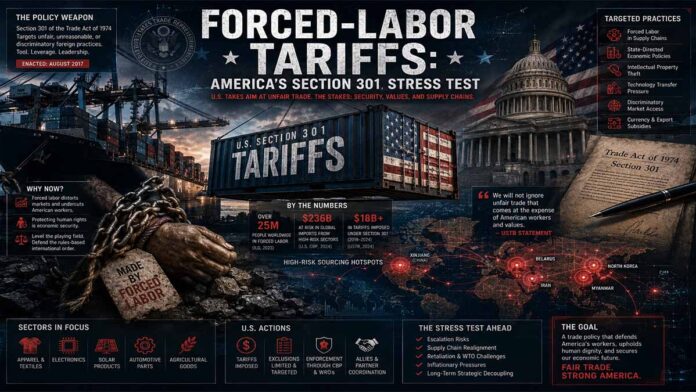

Executive Summary
BLUF: On 24 July 2026, the Trump administration activated additional Section 301 duties covering most imports from 60 economies, representing 99.4% of total US imports.
The final structure imposes 10%, 12.5%, or a capped combined MFN–Section 301 rate, subject to extensive product exemptions.
The administration presents the measure as leverage to compel foreign governments to prohibit imports produced with forced labor.
Its legal vulnerability is substantial but materially different from the defect identified in the Supreme Court’s February 2026 rejection of the administration’s IEEPA tariffs.
Unlike IEEPA, Section 301 expressly authorizes duties, yet litigation will test whether country-wide tariffs on nearly all goods remain sufficiently connected to a demonstrated burden on US commerce.
The strongest challenge concerns statutory fit, remedy proportionality, administrative reasoning, country-specific evidence, and the constitutional significance of converting retaliatory authority into a near-universal tariff instrument.
The economic burden will fall predominantly inside the United States: New York Federal Reserve researchers estimate that US firms and consumers absorbed nearly 90% of the burden generated by the 2025 tariffs.
The forced-labor justification may produce accelerated foreign legislation, but broad tariffs are poorly calibrated to identify, interdict, or remediate specific high-risk supply chains.
Over the 2026–2031 horizon, the modal outcome is prolonged litigation, negotiated exemptions, supply-chain rerouting, compliance fragmentation, and partial—not comprehensive—forced-labor reform.
Trump’s Forced-Labour Tariffs Put America’s Trade Constitution on Trial
Washington has transformed the fight against forced labour into the newest legal foundation for an almost universal tariff system. On 23 July 2026, US Trade Representative Jamieson Greer imposed additional duties on 60 economies representing 99.4% of American imports. The objective is formally moral and commercial: compel foreign governments to prohibit goods produced through coercion. The method, however, is a tax paid at the US border by American importers and transmitted through factories, retailers and households. Behind the humanitarian language lies a larger constitutional and geoeconomic contest: whether a retaliatory instrument enacted in 1974 can become the executive branch’s permanent substitute for tariff legislation by Congress.
A third legal route
The new tariffs mark the Trump administration’s third attempt to preserve broad import duties through a different statutory rationale. Its 2025 emergency tariffs relied on the International Emergency Economic Powers Act. On 20 February 2026, the Supreme Court rejected that approach in Learning Resources, Inc. v. Trump, holding that IEEPA did not confer the tariff authority claimed by the President. Learning Resources, Inc. v. Trump – Supreme Court of the United States – February 2026.
The administration subsequently turned to Section 301 of the Trade Act of 1974. Unlike IEEPA, Section 301 expressly permits the United States Trade Representative to impose duties when a foreign act, policy or practice is unreasonable or discriminatory and burdens US commerce. That textual difference gives the government a stronger case. It does not, however, settle whether Congress authorized duties of this geographical and commercial breadth.
USTR opened 60 investigations on 12 March 2026. On 2 June, it concluded that each economy’s failure to impose and effectively enforce a forced-labour import prohibition distorted competition, displaced compliant goods and facilitated circumvention of the American ban. The agency consulted more than 45 governments, received over 2,100 submissions across the investigative and remedial phases and heard more than 100 witnesses between 7 and 9 July. USTR Takes Action in Forced Labor Section 301 Investigations – United States Trade Representative – July 2026.
The architecture of pressure
The final action is differentiated, but only narrowly. Seventeen economies—including the United Kingdom, India, Canada, Mexico, Bangladesh, Cambodia, Indonesia, Malaysia and Pakistan—received an additional 10% duty because they had adopted a prohibition, established a partial regime or committed to act through reciprocal trade agreements. Most remaining economies, including China, Israel, Türkiye and Russia, face 12.5%, subject to product exemptions. For the European Union, Japan, South Korea, Switzerland and Taiwan, USTR established combined-rate ceilings involving existing most-favoured-nation duties.
This is not a conventional anti-dumping case calibrated to a measured price distortion, nor an interdiction directed at a particular factory, commodity or shipment. It is a government-level sanction applied across most products because the exporting jurisdiction allegedly fails to police goods produced through forced labour elsewhere. The policy therefore operates as a secondary trade sanction: one state is penalised for not restricting its commercial relations with another source of potentially abusive production.
The design creates negotiating leverage. Governments can enact legislation, improve customs enforcement or conclude agreements in exchange for lower rates and exclusions. Yet the two principal tariff bands—10% and 12.5%—bear little visible relationship to the size of the affected trade, the incidence of forced labour, customs capacity or the estimated burden imposed on US commerce. That weak calibration will become central in litigation.
Who pays the tariff
The political presentation suggests that foreign economies bear the charge. The customs mechanism says otherwise. The legal payer is the American importer of record, which must remit the duty when goods enter US commerce. Foreign suppliers may reduce prices, but recent Federal Reserve evidence indicates that most of the burden remains inside the United States.
Researchers at the Federal Reserve Bank of New York found that the average US tariff rate increased from 2.6% to 13% during 2025 and that nearly 90% of the economic burden fell on American companies and consumers. Who Is Paying for the 2025 U.S. Tariffs? – Federal Reserve Bank of New York – February 2026.
A Federal Reserve Board study published in June 2026 found price pass-through of 15–20% across more highly exposed household-spending categories. At the mean increase in tariff exposure, prices rose by 1–2% while spending declined by approximately 4%. Low-income households experienced disproportionate welfare losses; middle-income consumers shifted expenditure toward essentials and cheaper alternatives. Paying More and Buying Less: 2025 Tariffs and U.S. Household Spending – Federal Reserve Board – June 2026.
The transmission begins before inflation appears. An importer receiving $100 million of affected goods must finance an additional $10 million or $12.5 million in duties. That payment raises inventory costs, consumes credit lines and compresses margins before the merchandise is sold. Large corporations may renegotiate contracts or diversify suppliers. Smaller firms are more likely to reduce orders, eliminate product lines or pass costs to customers.
Substitution without reform
Tariffs can alter trade flows, but altered trade flows are not proof that forced labour has diminished. Importers may shift production to another jurisdiction, move final assembly, redesign products or route merchandise through intermediaries. Some substitution is genuine; some merely changes the declared country of origin while high-risk raw materials or components remain embedded upstream.
The central enforcement problem is therefore traceability. A tariff based on national origin can reduce direct imports from a targeted economy while leaving the underlying production practice untouched. It may even lengthen the supply chain, adding processors, traders and jurisdictions that make ownership and origin more difficult to establish.
Product-level interdiction works differently. Section 307 of the Tariff Act of 1930 already prohibits imports produced wholly or partly through forced labour. Customs and Border Protection can detain shipments through Withhold Release Orders, while the Uyghur Forced Labor Prevention Act creates a rebuttable presumption against specified Xinjiang-linked goods and entities. These measures require far more evidence but connect enforcement to products, producers and supply chains rather than taxing every compliant and non-compliant exporter in the same jurisdiction. Forced Labor Frequently Asked Questions – US Customs and Border Protection – February 2025.
A comprehensive country tariff is easier to collect. It is also less precise. A compliant manufacturer pays because of its government’s policy, while a tainted product may escape if it is sufficiently processed or concealed elsewhere. The result can be substantial customs revenue without measurable worker remediation.
Europe’s competing model
The European Union has chosen a structurally different route. Regulation 2024/3015, adopted on 27 November 2024 and applicable from 14 December 2027, prohibits products made with forced labour from being placed on or exported from the Union market. It covers goods regardless of origin and can reach forced labour used at any stage of extraction, harvesting, production or processing. Investigations are risk-based and divided between the European Commission and national competent authorities. Regulation (EU) 2024/3015 – European Parliament and Council – November 2024.
The difference is strategic. Washington is using access to the American market to compel governments to adopt import bans. Brussels is constructing an investigative system designed to remove identified products from commerce. The American model maximises leverage; the European model prioritises evidentiary connection. Both will confront opaque subcontracting, commodity commingling and falsified records, but only the product-centred system inherently distinguishes compliant suppliers from abusive ones.
The transatlantic relationship will consequently become a test of regulatory interoperability. If Washington recognises credible EU investigations and enforcement, the two markets could form a high-traceability commercial area. If it continues to treat the Union principally as a tariff target, European authorities will regard the measure less as labour policy than as an instrument of American commercial power.
The constitutional fault line
The strongest legal challenge will not claim that Section 301 contains no tariff authority. It plainly does. The dispute will concern whether the statute permits retaliatory duties covering almost all goods from economies accounting for almost all US imports.
After Loper Bright Enterprises v. Raimondo, decided in June 2024, federal courts may not defer to an agency’s interpretation merely because statutory language is ambiguous. Judges must independently determine the best reading of the law. USTR therefore cannot define the outer boundary of its own jurisdiction by declaring that a foreign regulatory omission burdens American commerce. It must establish the statutory connection and explain why the chosen remedy is appropriate.
The administration can point to extensive hearings, explicit tariff language and Congress’s decision to include forced labour among actionable unreasonable practices. Challengers will emphasise the standardised findings, limited rate differentiation and absence of a clear product-by-product relationship between the alleged practice and the duty imposed.
The most probable adverse ruling would not invalidate Section 301 itself. A court could instead hold that USTR failed to demonstrate sufficiently specific burdens or that the remedy became so broad that it ceased to function as retaliation against identified conduct and became a general tariff schedule—a power the Constitution assigns to Congress.
The global response
China has rejected the investigations as discriminatory unilateralism and has opened its own trade-barrier proceedings concerning American measures that Beijing says disrupt global production networks. The likely Chinese response will extend beyond symmetrical tariffs into export licensing, regulatory scrutiny and restrictions affecting inputs for which alternative suppliers are limited.
The United Kingdom and India begin with a relative advantage under the 10% tier and may use formal compliance to capture investment diverted from higher-rate jurisdictions. Bangladesh, Cambodia and Pakistan could preserve competitiveness in apparel and consumer manufacturing, but only if legislation is accompanied by credible customs and labour enforcement.
Israel is likely to pursue bilateral exemptions and regulatory accommodation, relying on its specialised exports, free-trade relationship and broader strategic ties with Washington. Türkiye faces greater exposure through textiles, metals, machinery and its position between the EU customs area, Asian manufacturing networks and Russia-linked trade corridors. For Russia, the decisive issue is not direct US trade but the capacity to embed commodities and intermediate products in third-country processing chains.
The five-year contest
Between 2026 and 2031, five outcomes will compete. Courts may invalidate or narrow the programme. Foreign governments may negotiate lower rates through new legislation and enforcement commitments. Congress may expressly ratify the authority, converting an executive initiative into a durable market-access regime. Major economies may retaliate. Or the world may fragment into incompatible US, EU and China-centred compliance systems.
The most likely result is negotiated fragmentation: the tariffs remain partially in force, numerous governments adopt formal prohibitions, and multinational companies build separate high-traceability supply chains for the United States and Europe. Trade will not disappear; it will become longer, more conditional and more expensive to finance.
That outcome would confirm the administration’s ability to impose regulatory change abroad. It would not demonstrate that comprehensive tariffs are the most effective instrument against forced labour. Success cannot be measured by customs revenue, declining bilateral imports or the number of laws passed. It must be measured in workers released from coercion, wages restored, abusive producers excluded and tainted supply chains dismantled.
The constitutional question is equally concrete. Congress may delegate substantial retaliatory authority, but a delegation designed to correct specific foreign practices cannot silently become a permanent presidential power to tax virtually all imports. The fight against forced labour is legitimate. Whether it can sustain an almost universal tariff system without new legislation is the question now moving from the customs border to the courtroom.
Pillar I — Presidential Power, Section 301 and Judicial Review
The report will distinguish Congress’s constitutional tariff power from the delegated retaliatory authority exercised by the US Trade Representative, assessing statutory text, causation, remedy breadth, judicial review after Loper Bright, and the controlling implications of Learning Resources v. Trump.
Pillar II — Tariff Incidence, Supply-Chain Transmission and Forced-Labor Effectiveness
The analysis will quantify tariff pass-through, importer exposure, inflationary transmission, industrial substitution, trade diversion, customs enforcement, transshipment risk and the difference between universal country tariffs and product-level forced-labor interdiction.
Pillar III — Five-Year Geoeconomic Scenarios, 2026–2031
The outlook will model judicial invalidation, negotiated adaptation, congressional ratification, retaliatory escalation and institutional fragmentation, with dedicated tracking of the European Union, China, United Kingdom, India, Israel, Türkiye, Russia-linked trade channels and labor-intensive manufacturing economies.
Master Abstract
The verified factual baseline has moved beyond the prospective phase described in the initial hypothesis: the administration has already taken final action. On 23 July 2026, US Trade Representative Jamieson Greer, acting at President Donald Trump’s direction, announced additional duties against 60 economies; the duties became applicable at 12:01 a.m. Eastern Time on 24 July 2026, subject to a narrow in-transit exception for qualifying goods entered before 28 July. The measure therefore is not merely a proposal awaiting implementation but an operative trade action whose legality, incidence and strategic effects must now be evaluated from an enforcement baseline. The final notice divides the covered economies into several operational categories. Imports from 17 economies, including the United Kingdom, Canada, Mexico, India, Indonesia, Malaysia and Pakistan, generally face an additional 10% duty. Goods from most remaining investigated economies face 12.5%. For the European Union and Taiwan, the combined MFN and Section 301 rate is generally capped at 10%; for Japan, South Korea and Switzerland, the corresponding ceiling is 12.5%. Numerous products are exempted where USTR concluded that tariffs could impair US supply, create economy-wide disruption, cover products unavailable domestically in sufficient quantities, fail to advance the stated objective, or undermine negotiated incentives. USTR states that the 60 partners collectively account for 99.4% of US imports, making this one of the broadest uses of Section 301 in the statute’s history. The administrative record includes investigations initiated on 12 March, consultations with more than 45 governments, two hearing phases, more than 2,100 combined public submissions, and over 100 witnesses during the July hearings. Notice of Actions in Section 301 Investigations – Office of the United States Trade Representative – July 2026 — Verified final action. USTR Takes Action in Forced Labor Section 301 Investigations – Office of the United States Trade Representative – July 2026 — Verified announcement.
The central legal question is not whether Congress possesses tariff authority; Article I assigns Congress the powers to impose duties and regulate foreign commerce. The operational dispute is whether Congress, through Sections 301–310 of the Trade Act of 1974, authorized the executive branch to deploy retaliatory duties at this scale and on this evidentiary theory. Section 301 expressly permits USTR to investigate foreign acts, policies or practices that are unjustifiable, unreasonable or discriminatory and that burden or restrict US commerce; Section 301(c) permits duties or other import restrictions and allows action against goods not themselves involved in the underlying practice. Those provisions give the administration a substantially stronger textual position than it possessed under IEEPA. On 20 February 2026, the Supreme Court held in Learning Resources, Inc. v. Trump that IEEPA did not confer the tariff authority claimed for the 2025 emergency program. That decision forecloses treating an emergency-powers statute as a general tariff code, but it does not automatically invalidate a measure imposed under an act that expressly mentions duties. The decisive litigation questions will instead be whether USTR established a legally sufficient burden on US commerce for each investigated economy; whether imposing duties on virtually every non-exempt product is a permissible means of obtaining the elimination of the identified practice; whether the record genuinely differentiates national conduct; whether the chosen rates reflect reasoned decision-making; and whether the government has transformed a country-specific enforcement mechanism into a functional substitute for congressional tariff legislation. Judicial review after Loper Bright Enterprises v. Raimondo removes any presumption that an agency’s interpretation of ambiguous statutory authority controls. A reviewing court will independently determine the best reading of Section 301. The administration can cite explicit tariff language, procedural consultations and statutory permission to reach uninvolved goods. Challengers can respond that the breadth, uniformity and near-total coverage sever the remedy from the country-specific commercial burden that activates the statute. Learning Resources, Inc. v. Trump – Supreme Court of the United States – February 2026 — Verified Supreme Court opinion. Section 301 of the Trade Act of 1974 – Congressional Research Service – February 2026 — Verified statutory overview.
The policy case is more vulnerable than the formal statutory case because the tariff architecture only indirectly addresses forced labor. US law has prohibited the importation of goods produced wholly or partly by forced labor for nearly a century, and contemporary enforcement can detain or exclude shipments based on evidence tied to producers, facilities, regions or supply chains. The new Section 301 regime instead penalizes most goods originating in a covered economy because that government allegedly failed to establish or enforce an adequate import prohibition against forced-labor goods originating anywhere. This creates a secondary-pressure mechanism: access to the US market is conditioned not solely on whether the exported product is itself tainted, but on the exporting jurisdiction’s treatment of third-country supply chains. The mechanism may induce rapid legislative concessions—as USTR reports occurred in several economies during the investigation—but tariff breadth is not equivalent to enforcement precision. It does not automatically create traceability systems, labor inspections, victim remedies, customs intelligence or evidentiary standards capable of identifying coercion. It may also encourage formal legislation without operational enforcement, trade rerouting through exempt classifications, manipulation of origin documentation, and preferential agreements negotiated primarily to reduce tariff exposure. The global normative environment is also more complex than a binary division between compliant and non-compliant states. The ILO Forced Labour Convention of 1930 is widely ratified, but the United States has not ratified either that convention or its 2014 Protocol; the current ILO database records 65 Protocol ratifications, not 61. The United States has ratified the separate Abolition of Forced Labour Convention, 1957, but remains outside C029 and P029. Economically, the domestic incidence cannot be dismissed as a foreign payment. New York Federal Reserve researchers examining 2025 data found that the average US tariff rate rose from 2.6% to 13% and that nearly 90% of the economic burden fell on US firms and consumers. This implies that the 2026 program functions simultaneously as foreign-policy coercion, domestic taxation, industrial policy and negotiating leverage. Who Is Paying for the 2025 U.S. Tariffs? – Federal Reserve Bank of New York – February 2026 — Verified tariff-incidence analysis. Conventions Not Ratified by the United States – International Labour Organization – July 2026 — Verified ILO status. Protocol of 2014 to the Forced Labour Convention – International Labour Organization – July 2026 — Verified ratification record.
Presidential Tariff Power After Learning Resources: The Section 301 Boundary Test
Constitutional allocation and the post-IEEPA baseline
The constitutional starting point is unusually clear even though the litigation outcome is not. Article I, Section 8 assigns Congress the powers to impose “Duties” and regulate commerce with foreign nations; the executive possesses no freestanding peacetime authority to tax imports merely because tariff policy affects diplomacy, national security or negotiations. In Learning Resources, Inc. v. Trump, decided on 20 February 2026, the Supreme Court confirmed this allocation and held that the International Emergency Economic Powers Act, or IEEPA, did not authorize the President to impose tariffs. The controlling opinion emphasized that tariffs constitute an exercise of the taxing power, that Congress had not placed any reference to tariffs or duties in IEEPA, and that the government had conceded the absence of inherent presidential tariff authority during peacetime. The Court regarded the administration’s proposed reading—unlimited tariffs, adjustable at presidential discretion, covering any product from any country—as a transformative transfer of congressional power unsupported by the statutory text. It also stressed that Congress, when delegating tariff authority elsewhere, has normally done so expressly and with identifiable constraints. The new forced-labor tariffs therefore cannot be defended as an exercise of residual Article II power or as an extension of the emergency authority rejected in February. Their legality stands or falls on the materially different text, findings, procedures and limitations of Section 301 of the Trade Act of 1974. That distinction is decisive: Learning Resources does not establish that every presidentially directed tariff is unconstitutional, but it establishes a demanding interpretive baseline under which a court should require a genuine congressional authorization rather than infer one from general language concerning trade regulation or foreign affairs. U.S. Constitution, Article I – Congress and Library of Congress – current text — Verified constitutional text. Learning Resources, Inc. v. Trump, 607 U.S. 229 – Supreme Court of the United States – February 2026 — Verified Supreme Court opinion.
Section 301 gives the administration a stronger textual foundation than IEEPA because Congress expressly authorized the United States Trade Representative to impose duties or other import restrictions after making specified determinations. Under 19 U.S.C. §2411, mandatory action applies where USTR finds that US rights under a trade agreement have been denied or that a foreign act, policy or practice is unjustifiable and burdens or restricts US commerce. Discretionary action under Section 301(b) may be taken where a foreign act, policy or practice is unreasonable or discriminatory and burdens or restricts US commerce. The authorized objective is not open-ended revenue collection; it is to enforce US trade rights or obtain the elimination of the foreign act, policy or practice. Section 301(c) gives USTR considerable remedial flexibility, including the ability to impose duties and, in certain circumstances, to act against goods that were not directly involved in the disputed practice. These features distinguish the statute from the tariff-free vocabulary of IEEPA and weaken any facial argument that Congress never authorized duties of the relevant kind. Nevertheless, explicit tariff language is only the beginning of the legal inquiry. The statute contains an activation chain: a legally cognizable foreign practice must be identified; the practice must meet the statutory category of unjustifiable, unreasonable or discriminatory conduct; USTR must establish that it burdens or restricts US commerce; the procedural requirements governing investigation, consultation and public participation must be satisfied; and the responsive measure must remain connected to the statutory objective. The administration cannot lawfully skip from the abstract existence of forced labor in global commerce to universal tariff authority. A court applying ordinary statutory interpretation will ask whether the identified omission—failure to enact or effectively enforce a forced-labor import ban—constitutes a “practice” attributable to each foreign government, whether the commercial burden was demonstrated rather than presumed, and whether tariffs covering most goods from nearly every major trading partner qualify as a response designed to eliminate that particular practice. 19 U.S.C. §2411, Actions by United States Trade Representative – Office of the Law Revision Counsel, US House of Representatives – July 2026 — Verified statutory text.
The forced-labor findings and the causation problem
USTR has constructed an administrative record considerably more elaborate than the emergency proclamations invalidated under IEEPA. On 12 March 2026, the agency initiated separate Section 301 investigations concerning 60 economies. It subsequently conducted hearings, received approximately 500 comments and rebuttal comments during the investigative phase, consulted with more than 45 governments, issued findings on 2 June, received more than 1,600 additional submissions on the proposed remedies and heard more than 100 witnesses during hearings held from 7 to 9 July. On 23 July 2026, USTR announced final action, effective from 24 July, imposing additional duties of 10% or 12.5%, subject to differentiated treatment for several economies and numerous product exemptions. USTR states that the covered partners represent 99.4% of US imports. Its causal theory is that governments failing to prohibit forced-labor imports permit lower-cost goods to circulate in international markets, weaken firms that avoid forced-labor inputs, displace compliant products and facilitate circumvention of the US import prohibition. That theory is economically plausible at a systemic level, but legal vulnerability arises from the movement between aggregation and country-specific proof. Section 301 requires a determination regarding the acts, policies or practices of a foreign country and their burden on US commerce. A reviewing court may therefore demand evidence demonstrating how the particular legal or enforcement failure of each economy materially contributes to the claimed burden, rather than accepting a single worldwide theory replicated across 60 files. The problem is sharpest for economies whose trade structures, forced-labor exposure, enforcement capacity and role in transshipment differ radically. A small commodity exporter, a major manufacturing hub, the European Union, a petroleum producer and a sophisticated customs jurisdiction cannot automatically be presumed to create the same commercial harm by the same mechanism. Uniform findings can be administratively efficient, but they may look legally conclusory where statutory causation is individualized. USTR Makes Findings and Proposes Action in 60 Section 301 Investigations – Office of the United States Trade Representative – June 2026 — Verified findings announcement. USTR Takes Action in Forced Labor Section 301 Investigations – Office of the United States Trade Representative – July 2026 — Verified final-action announcement.
The administration’s defense will rely heavily on the breadth of the statutory terms “burdens or restricts United States commerce” and on Congress’s express recognition that certain foreign practices need not operate directly at the border to injure US commercial interests. It will argue that forced-labor production depresses input prices, alters competitive conditions across integrated supply chains and diverts non-compliant merchandise into markets where US producers and compliant foreign firms compete. It can also point to post-investigation conduct as evidence that the tariff threat is capable of obtaining elimination of the targeted practice: USTR assigned the lower 10% rate to economies that had enacted import prohibitions, committed to do so through reciprocal-trade agreements or established partial regimes, while most remaining economies received 12.5%. Product exemptions were granted where tariffs could impair US access to raw materials, cause economy-wide disruption, cover products unavailable domestically in adequate quantities, undermine negotiated incentives or contribute insufficiently to eliminating the challenged practice. These details show some calibration and complicate a claim that the action is literally unlimited. Yet they also expose a potential mismatch. The rates are clustered into two narrow bands; they do not appear to vary according to the estimated magnitude of forced-labor exposure, the value of affected trade, the probability of circumvention, customs-enforcement capacity or the quantified burden on US commerce. A challenger will characterize this structure as evidence that the forced-labor rationale functions as a statutory bridge to preserve broad baseline tariffs after the expiration or judicial defeat of other authorities. Courts generally avoid substituting their economic judgment for agency policy, but they can invalidate action where the agency failed to articulate a rational connection between the record and the chosen remedy, ignored material distinctions, relied on factors Congress did not authorize or offered an explanation inconsistent with the operational design. The decisive question is therefore not whether broad tariffs might exert pressure; it is whether the record demonstrates why 10% or 12.5% on most products is a reasoned Section 301 response for each economy rather than a general tariff program carrying a forced-labor label. Notice of Final Actions in Section 301 Investigations – Office of the United States Trade Representative – July 2026 — Verified Federal Register pre-publication notice.
| Judicial review node | Administration’s strongest position | Challenger’s strongest position | Preliminary vulnerability |
|---|---|---|---|
| Express tariff authority | Section 301 expressly authorizes duties | Express authority is conditional, not universal | Low |
| Foreign governmental practice | Failure to legislate or enforce is an actionable omission | Statutory “practice” may require more specific state conduct | Medium |
| Burden on US commerce | Forced-labor goods distort prices and displace compliant trade | Findings may be generalized and insufficiently country-specific | High |
| Remedy scope | Section 301 permits action against uninvolved goods | Near-economy-wide tariffs may exceed remedial purpose | High |
| Rate calibration | Two tiers reward partial compliance and agreements | 10%/12.5% categories insufficiently track actual conduct | High |
| Procedure | Hearings, consultations and thousands of comments support regularity | Volume of process does not cure inadequate reasoning | Medium |
| Constitutional avoidance | Congress expressly delegated tariff tools | Reading Section 301 as universal tariff authority raises major-questions concerns | High |
| Nondelegation | Trade statutes historically allow executive discretion | Unlimited geographic, product and temporal scope lacks an intelligible boundary | Medium–High |
Loper Bright, major questions and independent judicial judgment
Loper Bright Enterprises v. Raimondo changes the decisional environment even though it does not by itself dictate invalidation. The Supreme Court held in 2024 that courts must exercise independent judgment when interpreting statutes administered by executive agencies and may not defer to an agency merely because the statutory text is ambiguous. USTR therefore cannot prevail by arguing that its interpretation of “unreasonable,” “burdens or restricts,” “appropriate and feasible action,” or the permissible relationship between a foreign practice and an import duty deserves controlling deference. A court must identify the best meaning of the statute using text, context, structure, history and established interpretive principles. This matters because Section 301 contains both expansive remedial language and limiting architecture. Its broad terms allow economic assessment and policy choice, but those terms sit inside a statute directed toward specific foreign practices and the elimination of identifiable burdens on commerce. Loper Bright leaves factual and discretionary judgments to agencies where Congress has lawfully assigned them, but it denies agencies the power to decide the outer boundary of their own jurisdiction. The new action thus faces two analytically distinct reviews: first, the court decides de novo what Section 301 authorizes; second, it assesses whether USTR’s factual findings and remedial reasoning satisfy the applicable administrative-law standard within that authorized space. Learning Resources adds a constitutional-avoidance and major questions overlay. The February decision reasoned that courts should hesitate before reading ambiguous language to transfer a highly consequential element of the congressional taxing power to the executive, especially where the alleged authority is unprecedented in breadth and historical practice. Section 301’s express reference to duties makes this a harder case for challengers than IEEPA, but the action’s coverage of 99.4% of imports may still trigger the question whether Congress clearly authorized USTR to transform retaliatory authority into a durable quasi-global tariff schedule. The administration’s statutory foothold is strong; its claim to near-universal scale is much less secure. Loper Bright Enterprises v. Raimondo, 603 U.S. 369 – Supreme Court of the United States – June 2024 — Verified Supreme Court decision index. Learning Resources, Inc. v. Trump – Supreme Court of the United States – February 2026 — Verified opinion.
The constitutional challenge will probably be framed primarily through statutory interpretation and constitutional avoidance rather than a direct claim that Section 301 is facially invalid. Courts have historically tolerated substantial executive discretion in foreign commerce, and the statute supplies triggering findings, procedural obligations and a remedial objective. Moreover, the Federal Circuit’s precedential decision in HMTX Industries LLC v. United States, issued in September 2025, is institutionally important because it sustained broad Section 301 tariff action arising from the China investigation and confirmed that USTR may possess considerable authority to modify tariffs and reach products not directly implicated in the original conduct. That precedent strengthens the government’s argument that Section 301 is not limited to narrowly matched product sanctions. It does not, however, resolve whether the statute can sustain coordinated tariffs against 60 distinct economies based on a common legal omission, nor whether the record adequately connects each omission to US commerce. The scale and architecture are different. The better litigation strategy for challengers is therefore cumulative: argue that USTR interpreted Section 301 beyond its best textual meaning after Loper Bright; that the agency’s burden findings lack sufficient country-specific evidence; that the remedy is arbitrary because rates and product coverage do not track comparative culpability or commercial injury; that the measure is inconsistent with the statute’s elimination-oriented purpose; and that any interpretation authorizing effectively worldwide tariffs without a meaningful ceiling would raise serious major-questions and nondelegation concerns. Courts frequently prefer narrower statutory holdings to constitutional invalidation. Consequently, the most probable adverse judgment would not declare Section 301 unconstitutional; it would hold that these investigations, findings or remedies exceeded the authority Congress actually granted, leaving USTR free to adopt narrower, better-supported actions against individual countries, sectors or supply chains. HMTX Industries LLC v. United States, No. 23-1891 – US Court of Appeals for the Federal Circuit – September 2025 — Verified precedential case record.
Analysis of Competing Hypotheses
The following ACH matrix separates five plausible explanations for the design of the action. The scores are analytical judgments, not adjudicated facts: “++” indicates strong consistency, “+” moderate consistency, “0” neutral or ambiguous evidence, “−” inconsistency and “−−” strong inconsistency. The evidence most diagnostic of intent is not the administration’s public language but the relationship among geographic coverage, rate differentiation, exemptions, bilateral concessions, evidentiary specificity and the timing immediately following the judicial rejection of IEEPA tariffs. H₁, genuine forced-labor enforcement, is supported by the statutory identification of forced labor as an unreasonable practice, consultations with governments, reduced rates for economies adopting import bans and exemptions intended to preserve incentives. It is weakened by the blunt two-tier rate structure and near-universal product coverage. H₂, replacement of the lost global tariff baseline, is supported by the 99.4% import reach, timing and relative uniformity, but weakened by meaningful exemptions and observable foreign policy changes. H₃, negotiated leverage, explains country concessions, reciprocal-trade linkages and adjustable treatment particularly well. H₄, industrial protection, fits broad domestic competitive effects but does not fully explain why legal reform abroad changes tariff treatment. H₅, strategic decoupling and supply-chain control, fits the long-term creation of traceability blocs but remains only partially visible in the present record. The highest-probability interpretation is not exclusive: the policy can simultaneously pursue labor reform, maintain tariff leverage and reorganize supply chains. For judicial purposes, mixed motive is not necessarily fatal; the legal issue is whether the action remains within the factors and purposes Congress permitted. An impermissible motive becomes especially relevant where the remedy’s structure contradicts the stated statutory objective or reveals that the asserted rationale is pretextual.
| Diagnostic evidence | H₁ Labor enforcement | H₂ Global tariff replacement | H₃ Negotiating leverage | H₄ Industrial protection | H₅ Supply-chain bloc formation |
|---|---|---|---|---|---|
| Coverage of 99.4% of imports | − | ++ | + | ++ | + |
| Two principal tariff bands | − | ++ | + | + | 0 |
| Lower treatment after legal commitments | ++ | − | ++ | 0 | + |
| Broad product exemptions | + | − | + | 0 | + |
| Timing after IEEPA defeat | 0 | ++ | + | + | 0 |
| Country-specific causal evidence | − | 0 | 0 | 0 | 0 |
| Consultations with over 45 governments | + | 0 | ++ | − | + |
| Tariffs on goods not tied to forced labor | − | ++ | + | ++ | + |
Bayesian assessment as of 25 July 2026
| Hypothesis | Prior probability | Evidence-adjusted probability |
|---|---|---|
| H₁ — Primary objective is forced-labor reform | 25% | 18% |
| H₂ — Primary objective is restoration of broad tariffs | 25% | 31% |
| H₃ — Primary objective is bilateral negotiating leverage | 20% | 27% |
| H₄ — Primary objective is generalized industrial protection | 20% | 15% |
| H₅ — Primary objective is formation of traceability-aligned trade blocs | 10% | 9% |
International comparison and geopolitical amplification
The international comparison undermines any binary claim that the United States is confronting universal foreign inaction through the only available model. The European Union adopted Regulation (EU) 2024/3015, which prohibits products made with forced labor from being placed on or exported from the Union market and becomes operational on 14 December 2027. Its architecture differs fundamentally from the US Section 301 approach. It applies to products irrespective of origin, including EU-produced goods; assigns investigations involving forced labor outside the Union principally to the Commission; gives national authorities responsibility for domestic cases; uses risk-based preliminary assessment, investigations and product-ban decisions; and coordinates enforcement through customs and market-surveillance authorities. It therefore targets the product and supply-chain nexus rather than imposing generalized tariffs on jurisdictions whose legal systems are deemed inadequate. This difference will be important in US litigation because the European Union is included among the investigated economies even though it has enacted a binding prohibition that is in an implementation phase. USTR can answer that enactment without effective present enforcement does not eliminate the commercial burden; challengers can respond that the tariff fails to distinguish regulatory transition from refusal to act. The comparison also supplies a less-restrictive policy benchmark: product-specific exclusion, shared risk databases, evidence submissions, customs coordination and review procedures may be better aligned with eliminating forced-labor goods than universal duties. A court will not normally require USTR to choose the least restrictive measure, but an unexplained refusal to account for materially different foreign regimes can support arbitrary-and-capricious review. Regulation (EU) 2024/3015 on prohibiting products made with forced labour on the Union market – European Parliament and Council – November/December 2024 — Verified Official Journal text. Forced Labour Regulation Implementation Portal – European Commission – June 2026 — Verified implementation framework.
China’s Ministry of Commerce has rejected the investigation as unilateral, arbitrary, discriminatory and protectionist, emphasizing that China has ratified 28 ILO conventions, disputing US allegations and highlighting that the United States has not ratified the 1930 Forced Labour Convention. Beijing has also linked the investigation to a broader pattern of US Section 301 pressure and, on 27 March 2026, initiated trade-barrier investigations concerning US measures alleged to disrupt global production and supply chains. These official responses matter less as evidence of US statutory authority than as indicators of geopolitical consequence. Retaliation, parallel investigations and reciprocal restrictions can enlarge the commercial burden created by the US remedy, complicating USTR’s claim that the tariffs are narrowly directed toward eliminating foreign labor-policy failures. They also increase the probability that forced-labor enforcement becomes embedded in competing regulatory blocs: a US model based on country-level leverage, an EU model based on product prohibition and risk investigation, and a Chinese model that treats certain Western forced-labor instruments as discriminatory trade barriers. No verified Russian federal response specifically addressing the final 23 July action was located in the official sources reviewed; Russia nevertheless appears among the investigated economies, and any assertion concerning a formal Russian retaliatory decision would therefore be premature. The multilingual record supports a broader inference: by 2027–2029, companies may face not one global forced-labor compliance standard but overlapping systems that differ in evidentiary presumptions, geographic risk designation, product detention, data disclosure and retaliatory exposure. This fragmentation will strengthen the administration’s argument that US commerce faces system-wide distortion, while simultaneously making it harder to prove that a uniform tariff against each jurisdiction is causally and proportionately tailored. Ministry of Commerce Spokesperson Response to US Forced-Labor Section 301 Investigations – Ministry of Commerce of the People’s Republic of China – March 2026 — Verified Chinese-language statement. MOFCOM Announcement No. 17 of 2026 on Trade-Barrier Investigation – Ministry of Commerce of the People’s Republic of China – March 2026 — Verified investigation record.
Five-year judicial and institutional outlook, 2026–2031
The five-year legal trajectory will probably unfold through staged rather than immediate resolution. Importers with substantial duty exposure, trade associations and potentially affected states possess strong economic incentives to challenge the action in the US Court of International Trade, where jurisdiction over tariff disputes is likely to concentrate. Initial litigation will seek preliminary relief, but courts may hesitate to suspend a sweeping trade program without a clear showing of statutory excess, irreparable injury and administrable relief. During 2026–2027, the most important record-building issues will be liquidation of entries, protest mechanisms, exclusion requests, country modifications and whether USTR publishes sufficiently specific reasoning for its burden findings and exemption decisions. In 2027–2028, appellate review is likely to focus on the meaning of “burdens or restricts United States commerce,” the degree of required country specificity and the permissible distance between the challenged practice and the goods tariffed. By 2028–2029, Supreme Court review becomes materially plausible if the Federal Circuit sustains the program on broad deference-like reasoning inconsistent with Loper Bright, or invalidates it using Learning Resources to impose a clear-statement rule on Section 301. The Court’s likely preference would be a statutory resolution: Section 301 authorizes strong retaliatory tariffs, but not a near-global baseline without demonstrated country-specific burdens and a reasoned remedial connection. Congress could alter the outcome at any stage by expressly ratifying, limiting or redesigning the program. A statute specifying forced-labor import-ban deficiencies as actionable practices, authorizing defined rate ceilings, requiring periodic review and setting evidentiary criteria would materially reduce the legal uncertainty. Conversely, congressional silence after repeated executive attempts to preserve worldwide tariffs will strengthen the argument that the administration is assuming a legislative function Congress deliberately retained. The outlook is therefore a dynamic contest among judicial interpretation, executive modification and possible congressional intervention rather than a single binary test of presidential power.
| Period | Expected legal development | Central evidentiary issue | Estimated probability |
|---|---|---|---|
| H₂ 2026–H₁ 2027 | CIT complaints, refund claims and requests for preliminary relief | Standing, injury, liquidation and reviewability | 85% |
| 2027 | Merits ruling on statutory authority or administrative record | Country-specific burden and remedy nexus | 65% |
| 2028 | Federal Circuit appeal | Scope of Section 301 after HMTX and Loper Bright | 70% |
| 2028–2029 | Significant tariff revisions or negotiated country removals | Whether modifications cure or moot claims | 60% |
| 2029–2030 | Supreme Court review or denial of certiorari | Major questions, clear authorization, remedy breadth | 45% |
| 2030–2031 | Congressional codification, limitation or replacement framework | Durable division of tariff authority | 40% |
The report’s Monte Carlo-style legal assessment uses five variables: S, explicit statutory support; C, country-specific causation; R, remedial proportionality; P, procedural regularity; and M, major-questions exposure. On the current record, explicit statutory support is high because Section 301 expressly authorizes duties; procedural regularity is medium-high because USTR conducted consultations, hearings and comment processes; causation is medium-low because the public findings appear substantially standardized; remedial proportionality is low-to-medium because the action covers nearly all imports while using only limited rate differentiation; and major-questions exposure is high because of the program’s economic scale and its relationship to a core congressional power. Across 10,000 conceptual scenario draws, calibrated as an analytical heuristic rather than an empirical judicial forecast, the estimated distribution is: 18% probability that the action is substantially upheld without material narrowing; 27% probability that it is upheld but significantly constrained through exclusions, country-specific requirements or temporal review; 34% probability that the tariff program is invalidated on statutory or Administrative Procedure Act grounds while preserving Section 301’s constitutionality; 9% probability of a broader constitutional ruling limiting congressional delegation of tariff power; and 12% probability that litigation is overtaken by settlements, legislative action or program redesign before final Supreme Court adjudication. The modal outcome is therefore neither complete executive victory nor facial destruction of Section 301. It is judicial narrowing: the President may direct USTR within a valid statutory delegation, but neither the President nor the agency may define the outer dimensions of that delegation for themselves. The more the action resembles a standing worldwide tariff schedule, the more likely a court is to demand explicit congressional authorization, individualized commercial findings and enforceable limits on rates, duration and product coverage.
Consolidated risk architecture
Pillar II — Tariff Incidence, Supply-Chain Transmission and Forced-Labor Effectiveness
The incidence mechanism: the importer pays first, the domestic economy pays last
The legal payer of a US import tariff is the importer of record, not the foreign government, exporter or worker whose conduct allegedly motivated the measure. When a shipment enters the United States, Customs and Border Protection calculates the duty from the customs value, tariff classification, declared origin and applicable trade-remedy provisions; the resulting payment becomes an immediate landed-cost increase on the importer’s balance sheet. Foreign suppliers can absorb part of that burden through lower export prices, exchange-rate adjustment or commercial rebates, but the historical US evidence indicates that such offsets are usually incomplete. The US International Trade Commission found that, during 2018–2021, import prices on products covered by Sections 232 and 301 rose approximately one-for-one with the tariff rate, meaning US importers bore nearly the full direct cost at the border. Its sectoral analysis found that Section 301 duties reduced covered imports from China by 13%, raised the value of US production in directly affected sectors by 0.4%, and increased US prices in those sectors by 0.2%. The result is not a contradiction: even when a tariff suppresses imports and modestly stimulates protected domestic production, the cost can still be transferred through wholesalers, manufacturers, retailers and households. A tariff can therefore achieve measurable import substitution while imposing a larger aggregate burden on downstream users than the gain captured by protected producers. The Federal Reserve’s 2026 evidence reinforces this mechanism. Tariff changes implemented through November 2025 had raised core-goods PCE prices by 3.1% through February 2026 and lifted the overall core PCE price level by approximately 0.8%; the estimated pass-through was effectively complete after roughly seven months. The relevant policy question is consequently not whether tariffs affect domestic prices, but how quickly, unevenly and persistently the burden propagates across supply chains. Economic Impact of Section 232 and 301 Tariffs on U.S. Industries – US International Trade Commission – March 2023 — Verified official report page. Detecting Tariff Effects on Consumer Prices in Real Time—Part II – Board of Governors of the Federal Reserve System – April 2026 — Verified official analysis.
| Incidence stage | Immediate tariff effect | Principal absorber | Typical adjustment mechanism | Forced-labor policy relevance |
|---|---|---|---|---|
| Port of entry | Duty liability added to landed cost | Importer of record | Cash payment, customs bond, working-capital draw | No direct proof that the shipment contains forced-labor inputs |
| Foreign supplier | Pressure to reduce invoice price | Exporter or upstream producer | Discount, renegotiation, currency adjustment | May reduce supplier margins without changing labor practices |
| US manufacturer | Imported input cost rises | Producer or downstream buyer | Supplier substitution, inventory use, redesign | Can shift sourcing without eliminating the underlying abuse |
| Wholesale and logistics | Financing and carrying costs rise | Distributor | Surcharges, shorter payment terms, lower inventories | Compliance cost becomes embedded in distribution margins |
| Retail | Replacement cost enters pricing decisions | Consumer and retailer | Price increase, shrinkflation, reduced assortment | Consumer payment is disconnected from victim remediation |
| Household | Real purchasing power declines | Final consumer | Trade-down, delayed purchase, lower quantities | Regressive burden can exceed any measurable labor-policy gain |
| Government | Customs revenue increases | Domestic economy collectively | Revenue collection and possible refunds after litigation | Revenue is not automatically earmarked for enforcement or victims |
Importer exposure, liquidity compression and the balance-sheet transmission channel
The most immediate financial effect of a 10%–12.5% country-wide tariff is not necessarily recorded in consumer inflation; it first appears in importer liquidity, inventory valuation, collateral requirements and gross-margin management. A US company importing goods with a customs value of $100 million faces an additional annual duty obligation of $10 million at a 10% rate or $12.5 million at 12.5%, before accounting for brokerage charges, merchandise-processing fees, storage, financing or the higher insurance value of tariff-inclusive inventories. Because duties are generally due when merchandise enters US commerce, the payment can precede the importer’s receipt of customer revenue by weeks or months. Businesses with large inventories, seasonal procurement or low operating margins therefore experience a working-capital shock even when they intend eventually to pass the entire cost to customers. The effect is amplified when banks calculate revolving-credit availability from receivables and inventory subject to borrowing-base discounts: the tariff raises the cash cost of inventory without necessarily increasing its liquidation value by an equivalent amount. Smaller importers may consequently reduce orders, seek longer supplier payment terms, cancel product lines or consolidate purchasing with larger intermediaries able to finance duties more efficiently. The Federal Reserve’s June 2026 household-spending research found that categories with higher 2025 tariff exposure experienced price pass-through of approximately 15%–20% over the observed interval; at the mean tariff-exposure increase, category prices rose 1%–2%, while spending fell roughly 4%. That divergence indicates that the burden is transmitted not only through price but also through volume contraction, substitution toward cheaper products and reduced discretionary consumption. Middle-income households showed particularly strong reallocation toward essential goods and lower-priced options, while low-income households experienced disproportionate welfare losses because necessities absorb a larger share of their budgets. For forced-labor policy, this matters because the economic pressure is diffuse and domestic, whereas the intended behavioral response is foreign and politically mediated. The importer pays immediately, the consumer adjusts later, but the targeted government may have weak incentives or limited capacity to translate the tariff into effective labor inspections, criminal prosecution or supply-chain remediation. Paying More and Buying Less: 2025 Tariffs and U.S. Household Spending – Board of Governors of the Federal Reserve System – June 2026 — Verified official research paper.
Summary: Supply-Chain Incidence & Policy Relevance
| Incidence Stage | Principal Absorber | Typical Adjustment Mechanism | Forced-Labor Policy Relevance |
|---|---|---|---|
| Port of Entry | Importer of Record | Cash duty payment, customs bond draw | No direct proof shipment contains forced labor |
| Foreign Supplier | Exporter / Producer | Discounts, currency adjustment | Reduces supplier margins without changing labor practices |
| US Manufacturer | Producer / Buyer | Supplier substitution, redesign | Shifts sourcing without eliminating underlying abuse |
| Wholesale / Logistics | Distributor | Surcharges, shorter payment terms | Compliance costs embedded in distribution margins |
| Retail / Household | Final Consumer | Price hikes, trade-down, spending cuts | Consumer payment disconnected from victim remediation |
| Government | Domestic Economy | Customs revenue collection | Revenue not automatically earmarked for enforcement |
Inflationary transmission: timing, inventory lags and heterogeneous pass-through
Tariff inflation does not appear as a single synchronized price increase because firms operate through contracts, inventory buffers, hedging arrangements and different competitive structures. The Federal Reserve’s real-time methodology separates direct import content from imported intermediate inputs embodied in domestically produced goods. A tariff can therefore raise the retail price of an imported finished product directly, but it can also raise the cost of a nominally US-made product that depends on imported components, machinery, chemicals, packaging or energy-intensive materials. The Board’s 2025 analysis found that the 2018–2019 tariffs were passed through fully and rapidly—within approximately two months—to the affected consumer-goods categories. The 2025 tariff cycle propagated more gradually. By February 2026, however, the cumulative effects were consistent with full dollar-for-dollar pass-through at the aggregate core-goods level. A separate Federal Reserve item-level study found that goods imported from China registered an 8.5% year-on-year retail-price increase by December 2025, with consumer pass-through of at least 30% between April and December. Differences between estimates do not necessarily conflict because they measure different products, periods, stages of the distribution chain and definitions of pass-through. Early in a tariff episode, importers may absorb duties, sell pre-tariff inventory or delay repricing; later, replenishment costs enter the retail system and margins become unsustainable. Pass-through also rises when multiple competitors face the same tariff, because no single seller sacrifices market share by increasing prices. Under a near-universal tariff, this coordination effect is stronger than under a country-specific tariff: substituting from one foreign supplier to another no longer removes the duty, and domestic producers may increase prices below the tariff-inclusive import price while expanding margins. Inflationary transmission is therefore likely to be slower than the customs collection but broader than the directly imported product universe. Over 2026–2031, repeated tariff changes would create a staircase pattern: importers initially absorb each increment, inventories delay the visible effect, retail prices rise during replenishment cycles, and demand destruction eventually limits further pass-through. Detecting Tariff Effects on Consumer Prices in Real Time – Board of Governors of the Federal Reserve System – May 2025 — Verified official analysis. The Slow Climb: How Tariffs Gradually Raised Retail Prices in 2025 – Board of Governors of the Federal Reserve System – March 2026 — Verified official analysis.
| Transmission variable | Low-pass-through condition | High-pass-through condition | Expected time profile |
|---|---|---|---|
| Inventory position | Large pre-tariff stocks | Rapid replenishment cycle | Delayed, then abrupt |
| Market competition | Importer cannot raise prices | Competitors face same tariff | Faster under universal coverage |
| Contract structure | Fixed-price customer contracts | Indexed or renegotiable pricing | Contract-renewal lag |
| Supplier power | Exporter grants discounts | Scarce or specialized input | Immediate landed-cost transfer |
| Exchange rate | Foreign currency depreciates | Dollar weakens or currency stable | Partial offset or amplification |
| Product necessity | Highly discretionary demand | Essential or low-elasticity demand | Higher pass-through for necessities |
| Domestic alternative | Available at comparable cost | Capacity constrained or unavailable | Lower versus higher persistence |
| Imported-input intensity | Minimal foreign content | Multi-tier imported components | Narrow versus economy-wide effect |
Industrial substitution: production gains, downstream losses and capacity constraints
Tariffs can stimulate domestic substitution, but the magnitude depends on whether US firms possess idle capacity, skilled labor, capital equipment, regulatory approvals and competitively priced inputs. The USITC’s retrospective analysis demonstrates the asymmetry. Section 232 steel tariffs reduced affected steel imports by 24%, increased US steel prices by 2.4%, and expanded domestic steel production by 1.9%; aluminum tariffs reduced covered imports by 31%, raised prices by 1.6%, and increased domestic production by 3.6%. Yet downstream industries consuming steel and aluminum experienced average price increases of 0.2%, production reductions of 0.6%, and an estimated $3.5 billion decline in 2021 output attributable to the tariffs. The protected upstream sectors gained, but industries using the protected materials faced reduced competitiveness. Section 301 effects were similarly heterogeneous: the Commission estimated a 72.3% reduction in covered semiconductor imports from China, a 4.1% increase in US semiconductor prices and a 6.4% increase in domestic production value, whereas computer-equipment imports declined only 5%, prices increased 0.8%, and US production value rose 1.2%. These results establish that substitution is technically and sectorally specific; a uniform tariff rate does not produce a uniform industrial response. Forced-labor tariffs covering nearly every product from most major trading partners face a more restrictive substitution frontier than a tariff focused on one country. When all alternative foreign sources are taxed, the importer must choose among a higher-cost foreign supplier, a capacity-constrained domestic producer, product redesign, automation, reduced output or market exit. Domestic production can expand where facilities and inputs already exist, but sectors dependent on globally concentrated minerals, electronics, pharmaceuticals, textiles or industrial machinery cannot recreate multi-tier supply chains rapidly. The forced-labor rationale does not alter these physical constraints. From 2026 to 2031, the strongest reshoring effects would occur in standardized, transport-sensitive and moderately capital-intensive products; the weakest would occur in products dependent on specialized ecosystems, scarce raw materials, certification cycles or large labor-cost differentials. Economic Impact of Section 232 and 301 Tariffs on U.S. Industries – US International Trade Commission – March 2023 — Verified official report page.
| Sector characteristic | Probability of US substitution by 2031 | Principal constraint | Likely tariff outcome |
|---|---|---|---|
| Existing idle US capacity | High | Labor and financing | Production expansion with moderate price rise |
| Standardized intermediate goods | Medium–High | Energy and material costs | Partial reshoring and supplier diversification |
| Complex electronics ecosystems | Low–Medium | Supplier clustering and scale | Diversion to alternative Asian hubs |
| Critical minerals and refined inputs | Low | Geological concentration and processing capacity | Persistent higher import cost |
| Apparel and labor-intensive goods | Low | Wage differential and automation limits | Diversion, price increases and consumption reduction |
| Regulated medical products | Low–Medium | Validation and approval timelines | Delayed substitution, exemption pressure |
| Heavy transport-sensitive goods | Medium–High | Capital investment | Regionalization and domestic capacity growth |
| Highly differentiated branded goods | Low | Intellectual property and consumer preference | Price pass-through rather than substitution |
Trade diversion and the transshipment paradox
Trade diversion is the principal reason why a country-wide tariff can reduce measured direct imports without eliminating the targeted upstream practice. When one origin becomes more expensive, importers shift orders to another jurisdiction, suppliers relocate final assembly, or intermediaries alter the commercial route. The transformation may be genuine if production, investment and labor move to a compliant country; it may be superficial where only minor processing, packaging, invoicing or documentation changes. The distinction is legally and operationally crucial because customs origin is normally determined through product-specific rules such as substantial transformation, not by the location of the invoice issuer or final port of shipment. A forced-labor input can therefore remain embedded several tiers upstream while the declared country of origin changes lawfully or fraudulently. Federal Reserve research on the European Union’s 2018 retaliatory tariffs found immediate and complete pass-through to EU importers, but also a persistent decline in the US share of EU imports for many targeted goods even after the retaliatory duties were removed. This demonstrates hysteresis: once buyers qualify alternative suppliers, modify contracts and reorganize logistics, the new trade route may persist beyond the tariff. Under the 2026 US regime, the near-universal geographic coverage reduces simple substitution among targeted economies but does not eliminate diversion. It shifts the incentive toward exempt product classifications, excluded sectors, free-trade partners receiving preferential treatment, de minimis channels where available, bonded zones, processing regimes and transshipment through economies with stronger documentary systems. It also increases pressure to manipulate Harmonized Tariff Schedule classifications or conceal upstream suppliers. China’s official trade authorities have characterized US forced-labor measures as discriminatory trade restrictions and have opened trade-barrier proceedings concerning US actions that Beijing alleges disrupt production and supply chains; these responses raise the probability of reciprocal restrictions, parallel investigations and politically motivated customs scrutiny. The net result may be lower bilateral trade between the United States and selected origins while global production continues with more intermediaries, longer routes and less transparent ownership. The Design and Effect of Tariff Retaliation: Evidence from the European Union – Board of Governors of the Federal Reserve System – March 2026 — Verified official analysis. MOFCOM Announcement No. 17 of 2026 on Trade-Barrier Investigation – Ministry of Commerce of the People’s Republic of China – March 2026 — Verified official Chinese investigation record.
Customs enforcement: broad revenue collection versus evidentiary interdiction
A universal or near-universal country tariff is comparatively simple to administer because customs officers need to determine classification, value, origin and applicable rate; they do not need to establish that the specific merchandise was produced with forced labor. Product-level interdiction is more demanding but more closely connected to the prohibited conduct. Under 19 U.S.C. §1307, CBP may issue a Withhold Release Order when information reasonably, though not conclusively, indicates that merchandise was produced with forced labor, and may publish a formal Finding when the evidentiary threshold is met. Under the Uyghur Forced Labor Prevention Act, goods mined, produced or manufactured wholly or partly in Xinjiang, or by listed entities, are subject to a rebuttable presumption of exclusion. Importers may be required to provide end-to-end supply-chain documentation, transaction records, production data, transport documents and evidence that the goods fall outside the statutory presumption or were not produced with forced labor. CBP can detain, exclude, seize or require exportation of merchandise, while the importer bears storage expenses and the commercial risk of delayed release. This model concentrates enforcement on shipments, producers, regions and evidentiary indicators. Its weakness is resource intensity: multi-tier supply chains can involve traders, subcontractors and commingled commodities; forced labor generally leaves no physical trace on the finished product; and documentary records may be incomplete, inaccessible or deliberately falsified. The broad Section 301 tariff reverses the enforcement equation. It produces immediate and predictable revenue with low case-specific evidentiary requirements, but it does not determine whether any individual product is clean or tainted. A compliant producer in a targeted country pays the same tariff as a non-compliant one unless an exclusion applies, while a tainted product routed through an exempt origin may avoid the tariff unless detected by product-level enforcement. Country tariffs can increase foreign-government incentives to enact import bans, but only interdiction systems can connect customs action to a product, entity, region or supply chain. Forced Labor Frequently Asked Questions – US Customs and Border Protection – February 2025 — Verified official enforcement guidance. Uyghur Forced Labor Prevention Act – US Department of Homeland Security – current official framework — Verified official implementation portal.
| Enforcement attribute | Country-wide Section 301 tariff | Product-level WRO or UFLPA interdiction |
|---|---|---|
| Trigger | Origin in a targeted economy | Evidence, presumption, entity or supply-chain nexus |
| Proof required at entry | Classification, value and origin | Detailed upstream sourcing and production evidence |
| Customs scalability | High | Medium–Low |
| Precision | Low | High when intelligence is reliable |
| Treatment of compliant firms | Tariff generally applies | Goods may enter if compliance is established |
| Treatment of rerouted tainted goods | Can fail if origin changes | Can reach upstream inputs regardless of final origin |
| Revenue generation | Immediate and substantial | Incidental; principal objective is exclusion |
| Victim-remediation nexus | Indirect | Still limited, but directly tied to prohibited merchandise |
| Evasion vector | Misclassification and false origin | Supplier concealment, commingling and document fabrication |
| Behavioral target | Foreign government | Producer, exporter, importer and supply chain |
| Best strategic use | Negotiating leverage and broad pressure | Actual removal of tainted products from commerce |
Comparative effectiveness: why product prohibition is more precise but not automatically sufficient
The effectiveness test must distinguish three separate outcomes: reducing imports from a targeted country, reducing the entry of forced-labor products into the United States, and reducing forced labor itself. A country tariff can accomplish the first outcome without achieving the second or third. If imports shift to another origin while the same high-risk inputs remain embedded upstream, bilateral statistics improve but forced-labor exposure does not. Product-level interdiction is more directly connected to the second outcome because it seeks to exclude the merchandise itself, but even successful exclusion may merely divert the product to another market rather than change labor conditions. The third outcome requires remediation: workers must be able to leave coercive employment, recover withheld wages, access legal remedies, obtain identity documents, organize, report abuse and receive protection from retaliation. Tariff revenue does not automatically finance any of these functions. The European Union’s Regulation 2024/3015, applicable from 14 December 2027, illustrates a more product-centered architecture. It prohibits products made with forced labor regardless of sector or origin, covers forced labor at any stage of extraction, harvest, production, manufacture or processing, and requires cooperation among the European Commission, national competent authorities and customs administrations. Customs authorities act on decisions identifying prohibited products; authorities can order withdrawal, refuse release and require disposal, while risk information is exchanged through integrated market-surveillance and customs systems. The EU model also recognizes responsible disengagement, including the potential consequences for affected workers, rather than treating supplier termination as the sole compliance objective. Nevertheless, it will confront the same evidentiary limitations as the US interdiction system: opaque ownership structures, data asymmetry, subcontracting, state-imposed labor programs and commodity commingling. The optimal policy is therefore layered rather than singular: targeted product exclusion, entity listings, traceability obligations, customs intelligence, international cooperation, criminal enforcement, worker remediation and narrowly calibrated economic pressure. A universal tariff can supplement that architecture as leverage, but it is a weak substitute for it. Regulation (EU) 2024/3015 on Prohibiting Products Made with Forced Labour on the Union Market – European Parliament and Council – November 2024 — Verified official legal text. What Is the Forced Labour Regulation and How Does It Work? – European Commission – 2026 — Verified official implementation guidance.
Five-year outlook, 2026–2031: adaptation, fragmentation and the enforcement frontier
The most probable 2026–2031 trajectory is not rapid elimination of forced labor but progressive adaptation by importers, foreign governments and supply-chain intermediaries. During the first twelve months, US importers will rely on pre-tariff inventories, renegotiate prices, reduce low-margin product lines and request exclusions for goods with limited domestic alternatives. Retail inflation will emerge asynchronously as replacement inventory arrives, with the largest effects in high-import-content goods and categories where alternative suppliers face the same tariff. By 2027, larger firms will have accelerated supplier mapping and dual sourcing, while smaller companies will increasingly purchase through distributors that aggregate customs, compliance and financing functions. Foreign governments seeking lower tariff treatment are likely to enact formal forced-labor import prohibitions, but implementation quality will vary sharply. Some will create genuine investigative powers and customs risk systems; others will adopt statutory language sufficient for negotiations while devoting few resources to enforcement. From 2027 onward, the EU regulation will create a second major product-prohibition system, increasing incentives for common databases and evidence exchange but also exposing differences between US presumptions, EU risk-based decisions and national enforcement practices. By 2028–2029, transshipment enforcement will become the decisive frontier. Customs authorities will require greater visibility beyond the declared exporter, including manufacturer identities, bill-of-materials data, mine or farm origin, beneficial ownership, production capacity, energy consumption, shipping patterns and inconsistencies between declared output and observed inputs. Artificial intelligence can improve anomaly detection, but algorithmic flags will not replace legally sufficient evidence. By 2030–2031, the market is likely to separate into high-traceability supply chains serving the United States and European Union, opaque chains serving less regulated markets, and hybrid networks that preserve optionality across jurisdictions. Under the central scenario, the tariff program reduces direct imports from several targeted economies and produces additional foreign legislation, but product-level enforcement accounts for most verifiable exclusion of forced-labor goods. The probability that the broad tariffs alone generate a material global reduction in forced labor remains low because the causal chain from US importer payment to worker liberation contains too many political, commercial and evidentiary breaks.
| 2031 scenario | Probability | Tariff pass-through | Supply-chain response | Forced-labor effect |
|---|---|---|---|---|
| S₁ — Coordinated traceability regime | 18% | Medium | US–EU data alignment, targeted exclusions, verified remediation | Material reduction in covered supply chains |
| S₂ — Managed fragmentation | 37% | High initially, then stabilizing | Dual sourcing, compliance blocs, persistent exemptions | Moderate exclusion, limited global reduction |
| S₃ — Tariff-driven diversion | 24% | High | Rerouting, assembly relocation, deeper intermediaries | Low; exposure becomes harder to observe |
| S₄ — Judicial or political rollback | 13% | Declining after 2027–2028 | Reversion toward targeted enforcement | Depends on CBP and allied enforcement capacity |
| S₅ — Retaliatory trade spiral | 8% | Very high | Reciprocal barriers, stockpiling, regionalization | Negative or indeterminate due to reduced cooperation |
Integrated assessment
The analytical conclusion is that broad tariffs and product-level forced-labor interdiction operate through fundamentally different causal mechanisms. A Section 301 tariff alters the relative price of nearly every covered import and pressures the government of origin; a WRO, entity-list presumption or EU prohibition seeks to stop a specific product because evidence connects it to forced labor. The tariff is easier to administer and harder for a targeted government to ignore, but its domestic incidence is large, its industrial effects are uneven, and its correspondence to the underlying abuse is weak. The product prohibition is more precise and preserves market access for compliant firms, but it demands granular intelligence, traceability and adjudicative capacity. Tariff pass-through evidence from the Federal Reserve and USITC indicates that US firms and households will bear a substantial share of the new duties through higher prices, lower margins and reduced consumption. Industrial substitution will occur, but capacity limitations mean that a significant share of trade will be diverted rather than reshored. As sourcing networks reorganize, direct imports from targeted countries may decline faster than forced-labor exposure, creating a false indicator of success. The appropriate performance dashboard must therefore avoid using tariff revenue, bilateral import reduction or the number of foreign statutes enacted as primary outcome measures. It should track the value and number of shipments detained and excluded; the share released after credible documentation; the number of upstream producers mapped; confirmed remediation cases; wages repaid; workers removed from coercion; prosecutions and sanctions against responsible actors; changes in high-risk commodity flows; origin anomalies; and recurrence after suppliers are cleared. A strategy centered only on tariffs optimizes what customs can collect, not what labor enforcement must prove. Over five years, the strongest policy architecture would retain narrowly tailored economic leverage while shifting resources toward intelligence-led interdiction, common US–EU data standards, importer due diligence, anti-transshipment analytics and measurable worker remediation. The probability of reducing forced labor rises only when commercial exclusion is connected to verifiable changes at the workplace level.
Pillar III — Five-Year Geoeconomic Scenarios, 2026–2031: From Tariff Shock to Fragmented Trade Governance
The strategic baseline: a tariff system that is global in reach but bilateral in execution
The forced-labor tariff regime begins its five-year life with an internal contradiction that will define every scenario through 2031: it is almost global in commercial coverage but remains administratively divisible, politically negotiable and legally dependent on country-specific Section 301 determinations. USTR’s final action covers 60 economies representing 99.4% of US imports, yet it does not impose a single immutable world tariff. Seventeen economies—including India, the United Kingdom, Bangladesh, Cambodia, Indonesia, Malaysia, Pakistan and several Western Hemisphere partners—received a 10% additional rate because they had enacted a forced-labor import prohibition, established a partial regime or committed to one through a reciprocal-trade agreement. Most other investigated economies, including China, Israel, Türkiye and Russia, fall within the 12.5% category unless product exemptions or specially calculated tariff ceilings apply. The European Union, Taiwan, Japan, South Korea and Switzerland receive a structure under which Section 301 duties interact with their pre-existing most-favored-nation rates and specified combined-rate ceilings. That differentiation creates a built-in diplomatic market: governments can attempt to move from the higher to the lower tier, negotiate product exclusions, demonstrate enforcement or embed forced-labor commitments in broader reciprocal arrangements. It also means that the five-year outcome will not be determined solely by the courts. Even if litigation remains unresolved, USTR can alter schedules, suspend duties, grant exclusions, recognize foreign legislation or conclude agreements that progressively transform a formally multilateral measure into a mosaic of bilateral settlements. Conversely, if negotiations fail, the same architecture can be escalated through higher rates, narrower exemptions, origin investigations and parallel Section 301 proceedings. USTR Takes Action in Forced Labor Section 301 Investigations – Office of the United States Trade Representative – July 2026 — Verified official action. Fact Sheet: USTR Section 301 Action in Response to the Failure of 60 Economies to Ban Imports Produced with Forced Labor – USTR – July 2026 — Verified official fact sheet.
| Economy or group | Initial Section 301 position | Principal US leverage | Principal counter-leverage | Dominant 2026–2031 pathway |
|---|---|---|---|---|
| European Union | Combined-rate ceiling for specified goods | Access to US consumer and industrial markets | €1.7 trillion transatlantic trade relationship; autonomous trade countermeasures | Negotiated adaptation with conditional retaliation |
| China | Generally 12.5%, subject to exemptions | Scale of US final demand; customs interdiction | Manufacturing depth, critical inputs, retaliatory investigations | Escalation and bloc fragmentation |
| United Kingdom | 10% | US market access and prospective regulatory alignment | Bilateral diplomacy and diversified services economy | Rapid negotiated compliance |
| India | 10% | Export market access and supply-chain relocation opportunities | Large domestic market, strategic partnership value | Selective alignment and manufacturing gains |
| Israel | Generally 12.5% | High-value US market and regulatory influence | Security relationship, technology specialization, bilateral FTA | Exemption-oriented accommodation |
| Türkiye | Generally 12.5% | Access for textiles, machinery and metals | Customs-union links with the EU, regional logistics role | Partial reform plus diversion risk |
| Russia-linked channels | Generally 12.5% | Customs, financial and origin enforcement | Indirect routing, commodity fungibility, non-Western markets | Deepened circumvention architecture |
| Labor-intensive exporters | 10% or 12.5% | Apparel, footwear and consumer-goods access | Low-cost labor, supplier mobility, competing buyers | Formal legal reform with uneven enforcement |
Scenario S₁ — Judicial invalidation and the return to targeted interdiction
The first scenario assumes that litigation initiated during 2026–2027 produces a Court of International Trade or Federal Circuit judgment finding that USTR’s near-universal remedies exceed Section 301, lack sufficiently individualized findings or are arbitrary in their calibration. A final invalidation would not abolish the US prohibition on forced-labor imports, eliminate the Uyghur Forced Labor Prevention Act, prevent CBP from issuing Withhold Release Orders or disable conventional Section 301 action against a specific foreign practice. It would instead remove—or force substantial narrowing of—the additional country-wide tariff layer. The immediate geoeconomic consequences would include importer refund claims, disputes over liquidation and interest, downward repricing of future orders, and renewed sourcing from suppliers whose competitiveness had been reduced by the 10%–12.5% duties. Trade flows would not return mechanically to their pre-tariff configuration because firms will already have qualified alternative suppliers, rewritten contracts, invested in traceability and altered inventory strategies. The most important institutional effect would be a shift from tariff collection toward evidentiary interdiction. USTR and CBP would be under pressure to identify specific products, entities, regions and production networks rather than treating a government’s regulatory omission as sufficient justification for comprehensive duties. The European Union’s product-centered forced-labor system, applicable from 14 December 2027, would become the principal allied template for interoperability: joint risk data, compatible product identifiers, reciprocal evidence transmission and coordinated decisions could replace broad country tariffs as the preferred transatlantic strategy. For China, judicial invalidation would remove part of the new horizontal tariff burden but leave numerous pre-existing trade restrictions and forced-labor presumptions intact; Beijing would present the ruling as evidence against unilateral Section 301 expansion while continuing to contest US supply-chain allegations. For labor-intensive economies, invalidation would reduce general export costs but increase pressure for shipment-level documentation, because customs authorities would need stronger operational proof that enforcement remains effective. Regulation (EU) 2024/3015 – European Parliament and Council – November 2024 — Verified EU forced-labor prohibition. Section 301 of the Trade Act of 1974 – Congressional Research Service – February 2026 — Verified statutory overview.
Scenario S₂ — Negotiated adaptation and a tiered network of reciprocal compliance
The second and most probable scenario is negotiated adaptation: the tariffs survive long enough to induce governments to enact import prohibitions, establish customs procedures and conclude bilateral understandings, while USTR progressively differentiates rates and exemptions. The final action already demonstrates this mechanism. USTR assigned the lower 10% rate to economies that had adopted qualifying measures or undertaken commitments in reciprocal-trade agreements, and reported that 10 trading partners had agreed to enact forced-labor import bans through such arrangements. This creates a tariff-remission bargain in which access to the lower rate depends not merely on domestic labor law but on a government’s willingness to police imports produced elsewhere. The United Kingdom begins this scenario from a comparatively advantageous position because it received the 10% rate and can use its regulatory, diplomatic and customs capacity to demonstrate implementation without overhauling the whole structure of its economy. India also received the lower rate, positioning it to capture supply-chain relocation from higher-tariff jurisdictions while institutionalizing enough import-control capacity to preserve US market access. India’s wider trade diversification is strengthened by the India–UK Comprehensive Economic and Trade Agreement entering into force on 15 July 2026, which creates an additional corridor through which manufacturers can diversify demand and inputs while adapting to US requirements. Bangladesh, Cambodia, Pakistan, Sri Lanka, Malaysia and Indonesia face a more delicate calculation: the 10% tier preserves relative competitiveness against 12.5% economies, but implementation demands may extend into textile traceability, cotton origin, recruitment practices, subcontracting and informal manufacturing. Their governments may enact laws quickly while customs and labor inspectorates remain underfunded. USTR will then need to decide whether formal adoption is sufficient or whether ineffective enforcement justifies renewed escalation. The negotiation system is therefore likely to produce periodic compliance reviews, conditional suspensions and product-level quotas rather than a stable final settlement. India and the United Kingdom Comprehensive Economic and Trade Agreement Entry into Force – Ministry of Commerce and Industry, Government of India – June 2026 — Verified official announcement. USTR Final Forced-Labor Action – USTR – July 2026 — Verified official action.
Scenario S₃ — Congressional ratification and the construction of a durable tariff mandate
Congressional ratification would fundamentally change both the litigation calculus and the international bargaining environment. Congress could enact a statute expressly identifying a foreign government’s failure to prohibit forced-labor imports as an actionable practice, authorizing specified additional duties, defining permissible product coverage, setting maximum rates, requiring periodic reviews and creating conditions for suspension. Such legislation would answer the most important statutory-authority objection: whether the 1974 Congress intended Section 301 to support an effectively worldwide tariff schedule based on secondary forced-labor enforcement. It would not eliminate all constitutional challenges, because an unlimited delegation without intelligible constraints could still raise separation-of-powers concerns, but a carefully drafted mandate would make judicial invalidation considerably less likely. Ratification would also change the tariff from an executive experiment into a durable feature of US commercial policy. Governments would then be unable to wait for litigation to terminate the program; they would need to comply, negotiate or restructure trade. The legislation could integrate tariff treatment with CBP enforcement data, entity listings, import documentation and measurable foreign performance, creating a more credible link between rates and outcomes. Alternatively, Congress might codify only the broad tariff authority while leaving rate selection to the President, thereby institutionalizing the same calibration problems that currently expose the action to challenge. The political economy would be complex. Protected US producers and labor organizations may favor durable duties, while import-dependent manufacturers, retailers and agricultural exporters exposed to retaliation would demand exclusions and sunset provisions. Revenue effects would create an additional constituency because the duties generate federal receipts even when they fail to change labor conditions. Internationally, congressional ratification would accelerate regulatory emulation: allies would adopt import prohibitions to secure lower treatment, while adversaries would characterize the regime as a permanent US extraterritorial trade instrument. The system would begin to resemble a conditional market-access club in which compliance with US supply-chain governance becomes a tariff variable. Section 301 of the Trade Act of 1974 – Congressional Research Service – February 2026 — Verified Congressional analysis. USTR Forced-Labor Investigations Portal – USTR – 2026 — Verified investigation record.
Scenario S₄ — Retaliatory escalation and the conversion of labor policy into trade conflict
Retaliatory escalation emerges if major partners conclude that the forced-labor rationale is insufficiently connected to the goods taxed or constitutes disguised protectionism. China’s Ministry of Commerce has already characterized the investigation as unilateral and discriminatory, stated that Section 301 measures damage the international trade order and reserved the right to take necessary action. Chinese authorities also initiated a trade-barrier investigation concerning US measures alleged to disrupt global production and supply chains. Beijing possesses several escalation instruments: tariffs, export licensing, entity restrictions, antitrust or cybersecurity scrutiny, customs delays, procurement discrimination and tighter controls on strategically concentrated inputs. The most damaging retaliation would not necessarily mirror the US tariff rate. China could target products or materials for which American or allied firms have few alternative suppliers, thereby maximizing economic and political pressure per unit of restricted trade. The European Union would probably pursue a more legally sequenced response. EU Regulation 2026/1455 implements tariff concessions connected to the 2025 EU–US joint statement but explicitly empowers the Commission to suspend those concessions if the United States fails to implement its commitments, discriminates against EU operators or otherwise disrupts the trade and investment relationship. The regulation therefore creates a ready-made institutional lever if the Section 301 action is judged incompatible with the negotiated framework. Because EU–US trade in goods and services exceeded €1.7 trillion in 2025, and firms on the two sides held more than €4.8 trillion in mutual investments in 2024, escalation would transmit through integrated production, services, finance and intellectual property rather than remaining confined to merchandise tariffs. Retaliation by smaller labor-intensive economies would be more constrained; they are more likely to redirect procurement, challenge the measure institutionally, delay cooperation or align with larger blocs. In a severe scenario, forced-labor governance becomes subordinate to strategic rivalry: the United States treats import bans as market-access obligations, China frames them as discriminatory containment, and the EU attempts to preserve an evidence-based product regime while retaining autonomous countermeasures. Ministry of Commerce Response to US Forced-Labor Section 301 Investigations – People’s Republic of China – March 2026 — Verified Chinese-language statement. Regulation (EU) 2026/1455 – European Parliament and Council – June 2026 — Verified EU tariff-adjustment regulation. EU–US Trade: Council Final Approval – Council of the European Union – June 2026 — Verified official release.
Scenario S₅ — Institutional fragmentation and competing forced-labor jurisdictions
Institutional fragmentation is not simply the coexistence of different regulations; it is the formation of trade spaces in which the same product receives different legal treatment depending on the destination market, evidentiary standard, origin rule and political relationship. The United States combines Section 301 country pressure with product-level interdiction, entity lists and rebuttable presumptions. The European Union will prohibit products made with forced labor from 14 December 2027, regardless of whether they are imported, manufactured within the Union or exported, and has already established an ICSMS forced-labor module to transmit investigations, decisions and customs-enforcement information. China rejects several US forced-labor instruments as discriminatory and is developing retaliatory trade-barrier proceedings. These systems do not merely overlap; they can conflict. A supplier excluded from the United States may remain eligible in the EU until a European authority completes its own investigation. A company cleared under EU procedures may still be unable to rebut a US statutory presumption. China may penalize disclosure or commercial disengagement that foreign regulators require, placing multinational firms between incompatible legal obligations. By 2028–2030, large corporations are therefore likely to segment data, contracts and production according to destination. High-traceability lines will serve the United States and European Union; less transparent networks will serve markets with weaker or politically different enforcement; hybrid manufacturers will maintain multiple supplier identities and bills of materials. Compliance will become an element of industrial architecture rather than a single audit function. Financial institutions, insurers and logistics providers will also price forced-labor and transshipment exposure into trade finance, cargo coverage and customer due diligence. The result is a shadow dimension of liquidity fragmentation: exporters unable to demonstrate traceability may face shorter credit maturities, higher collateral requirements and exclusion from dollar- or euro-denominated financing even where their goods are not formally prohibited. This private financial pressure could prove more behaviorally effective than the tariff itself, but it also risks excluding small producers that lack documentation rather than those responsible for coercion. Commission Implementing Regulation (EU) 2026/903 – European Commission – April 2026 — Verified ICSMS enforcement architecture. Forced Labour Regulation Implementation Portal – European Commission – 2026 — Verified implementation portal.
European Union: negotiated stability with an embedded retaliation switch
The European Union is the actor most capable of combining negotiation, legal implementation and calibrated retaliation. Its starting position differs from that of economies accused of having no import prohibition because Regulation 2024/3015 already creates a Union-wide forced-labor product ban, although its substantive application begins only in December 2027. The dispute therefore centers on timing and effective enforcement rather than complete regulatory absence. The Commission has moved beyond legislation by adopting the information architecture for investigations and customs communication, strengthening the argument that the Union is in a genuine implementation phase. Simultaneously, Brussels has constructed safeguards around its broader trade bargain with Washington. Regulation 2026/1455 allows the Commission to suspend tariff concessions if US conduct undermines transatlantic market access or discriminates against EU operators, while the Council’s June 2026 statement emphasizes both stability and the ability to respond rapidly and proportionately. The five-year EU pathway is consequently likely to follow three stages. During 2026–2027, the Commission will seek recognition that its forthcoming product-ban system satisfies the US requirement and will press for exemptions or removal from Section 301 treatment. During 2027–2029, operational interoperability—shared risk indicators, customs communication and recognition of enforcement decisions—will become the principal bargaining currency. By 2029, the EU must assess the effects of its tariff arrangements with the United States and decide whether to extend them; unresolved Section 301 treatment could directly affect that review. Full retaliation remains less probable than negotiated stabilization because the economic relationship is exceptionally deep, but the probability rises if US duties exceed the negotiated ceiling or target politically sensitive sectors. The EU’s preferred outcome is not acceptance of a permanent American compliance hierarchy. It is mutual recognition between autonomous enforcement systems, preserving European regulatory sovereignty while minimizing tariff exposure. EU–US Trade: Council Gives Final Approval – Council of the European Union – June 2026 — Verified official statement. Regulation (EU) 2024/3015 – European Union – November 2024 — Verified legal framework.
China: strategic resistance, selective decoupling and counter-coercion
China represents the highest-impact escalation node because it combines enormous manufacturing depth, significant upstream material concentration, mature retaliatory institutions and a fundamental rejection of the US evidentiary narrative. Beijing’s official response argues that the United States has politicized forced-labor allegations, misused Section 301 and damaged the multilateral trading system. The Chinese-language Ministry of Commerce record also emphasizes that the United States has not ratified the ILO Forced Labour Convention of 1930, using normative asymmetry to contest Washington’s legitimacy. This argument will not determine US law, but it is geopolitically important because it enables China to frame compliance demands as strategic containment rather than human-rights harmonization. During 2026–2027, Chinese exporters will attempt to absorb, pass through or circumvent the additional duty while accelerating final assembly in Southeast Asia, the Gulf, Latin America and other jurisdictions. US authorities will respond with more aggressive origin verification and upstream component tracing, increasing friction for third-country exporters. During 2028–2029, China may intensify counter-coercion through licensing or regulatory pressure in sectors where alternative supply is limited, while expanding trade denominated and financed outside US-controlled channels. By 2030–2031, the most probable outcome is not complete decoupling but selective bifurcation: strategically sensitive supply chains become more regional and politically aligned, while high-volume consumer and intermediate trade continues through longer and more opaque networks. China’s response will also affect labor-intensive economies. Countries receiving relocated production may gain investment, but they will inherit demands to prove that Chinese upstream inputs are free of forced-labor exposure. The tariff therefore externalizes US–China compliance conflict into third-country customs, banking and industrial policy. MOFCOM Response on Forced-Labor Section 301 Investigation – Ministry of Commerce of the People’s Republic of China – March 2026 — Verified official Chinese statement. US Section 301 Findings Summary – China WTO Information Network, Ministry of Commerce – June 2026 — Verified Chinese-language official record.
United Kingdom and India: first-mover compliance and competitive relocation
The United Kingdom and India occupy the lower-rate tier but possess very different economic structures. The United Kingdom’s advantage lies in institutional capacity: customs modernization, legal drafting, financial-sector oversight and diplomatic access make it comparatively capable of producing the formal and operational assurances USTR seeks. Its risk is that alignment with US requirements could diverge from the EU forced-labor system, increasing compliance complexity for firms trading across both the British and European markets. The rational UK strategy is therefore regulatory interoperability: develop an import-control framework capable of satisfying US enforcement tests while remaining compatible with EU product investigations. India’s position is more commercially transformative. It can capture production diverted from China and higher-tariff economies in pharmaceuticals, electronics assembly, machinery, textiles, chemicals and consumer goods, but gains will depend on the traceability of imported inputs and the credibility of enforcement across a vast and heterogeneous manufacturing base. The India–UK trade agreement entering into force in July 2026 broadens India’s export options and may accelerate two-way supply-chain investment, reducing exclusive dependence on the US market. Yet this diversification does not eliminate Section 301 exposure because the United States remains a high-value destination and because US compliance standards can propagate through multinational procurement. Through 2031, India is likely to follow a dual strategy: accommodate the forced-labor import-ban requirement sufficiently to retain the 10% tier, while resisting intrusive country-specific conditions that constrain domestic industrial policy. The United Kingdom is likely to seek a faster formal settlement and product exemptions. Both can gain relative market share, but neither is tariff-free; their advantage is comparative rather than absolute. India–United Kingdom CETA Entry into Force – Ministry of Commerce and Industry, Government of India – June 2026 — Verified official release. USTR Final Action – USTR – July 2026 — Verified country-rate classification.
Israel and Türkiye: alliance leverage, regional production and asymmetric exposure
Israel and Türkiye are formally grouped among the economies subject to the higher 12.5% rate, but their exposure profiles differ sharply. Israel’s exports to the United States are concentrated more heavily in technologically sophisticated, specialized and often relationship-dependent sectors than those of a mass labor-intensive manufacturing economy. Its principal strategy will therefore be bilateral accommodation, product exemptions and recognition of regulatory equivalence rather than wholesale relocation. The Israeli government’s July 2026 approval of the “What is good for the United States is good for Israel” reform, which allows specified goods complying with US federal regulation to enter an alternative Israeli import pathway from 2027, demonstrates a broader orientation toward US regulatory compatibility. That reform is not itself a forced-labor import prohibition, and it should not be represented as satisfying USTR’s demand; it nevertheless gives Israel an institutional mechanism and political narrative for deeper regulatory cooperation. The country’s free-trade relationship, security partnership and technology interdependence increase the probability of negotiated differentiation before 2031. Türkiye, by contrast, is exposed through textiles, apparel, metals, machinery, appliances and regional logistics. It also sits within the EU customs-union environment for many industrial goods, making divergent US and EU forced-labor systems commercially consequential. Turkish manufacturers could gain from relocation away from Asia, but higher US tariffs reduce that opportunity unless Ankara adopts a qualifying prohibition and demonstrates enforcement. Türkiye’s geographic position also raises transshipment concerns involving the Caucasus, Central Asia, the Middle East and Russia-linked trade. No verified Turkish government response specifically addressing the final 23 July tariff action was located in the official record reviewed; retaliation should therefore not be asserted as a decided policy. The more probable path is partial legal accommodation combined with efforts to preserve regional sourcing flexibility. Standards Bill Amendment No. 21 – Knesset – July 2026 — Verified Israeli legislative record. US Regulatory Import Reform – Israel Ministry of Economy and Industry – July 2026 — Verified Hebrew-language government statement.
Russia-linked trade channels and the shadow architecture of circumvention
Russia’s significance lies less in direct bilateral US trade, already constrained by sanctions and other restrictions, than in the interaction among commodity fungibility, third-country processing, financial routing and origin transformation. The Section 301 tariff adds a further layer to a commercial environment already shaped by sanctions, export controls, energy-market reorientation and alternative payment channels. Russia-linked goods can enter global supply chains through metals, fertilizers, petrochemical feedstocks, timber, precious materials and intermediate products that undergo processing in third jurisdictions. Once transformed, the customs origin may lawfully change even though Russian economic value remains embedded upstream. A forced-labor tariff directed at the declared exporting country may therefore miss the Russia-linked component, while a broad tariff on the intermediary economy can penalize unrelated production without proving Russian or forced-labor content. Through 2026–2031, enforcement agencies will increasingly combine customs origin analysis with beneficial ownership, shipping history, payment flows, production capacity, energy consumption and input-output discrepancies. The principal shadow risk is not simple relabeling at a port; it is the creation of commercially plausible production chains that are technically sufficient to establish a new origin but designed primarily to preserve market access. Türkiye, Kazakhstan, the Gulf, China, India and other processing or logistics centers can become relevant nodes without every transaction constituting evasion. Authorities must distinguish lawful trade diversification from deliberate circumvention, or enforcement will generate excessive false positives and diplomatic friction. No verified Russian federal statement responding specifically to the final forced-labor tariff action was found during the present review. The five-year assessment therefore treats Russian retaliation as an analytical possibility rather than a confirmed decision. The likely outcome is deeper separation between Western-documented supply chains and Russia-linked networks serving alternative markets, accompanied by higher compliance costs for neutral intermediaries.
Labor-intensive manufacturing economies: reform, displacement and the danger of paper compliance
For Bangladesh, Cambodia, Pakistan, Sri Lanka, Vietnam and other labor-intensive manufacturing economies, the decisive variable is not tariff incidence alone but whether US buyers continue to view them as reliable compliance jurisdictions. Bangladesh, Cambodia, Pakistan and Sri Lanka received the lower 10% rate, while Vietnam falls within the higher group under the final USTR structure. A 2.5-percentage-point relative difference may appear modest, but in apparel, footwear, furniture and low-margin consumer products it can materially influence sourcing decisions when combined with freight, wages, lead times and preferential access. Governments therefore have powerful incentives to enact forced-labor import bans and demonstrate that imported cotton, yarn, components and intermediate goods are not derived from prohibited sources. Yet formal legislation can create an illusion of compliance where customs agencies lack supplier databases, inspectors cannot access facilities, migrant recruitment remains opaque or political interests protect major exporters. The tariff may also produce adverse labor effects. When buyers cancel orders or move production quickly, workers can lose employment without receiving remediation, while the coercive practice relocates to subcontractors outside formal export factories. A credible performance system must therefore measure enforcement decisions, investigations, supplier remediation, recruitment-fee repayment and worker mobility rather than statute adoption alone. From 2027 onward, these economies will face simultaneous US and EU demands; the EU’s product-level regime may require evidence tied to specific supply chains, while the US tariff rewards government-level regulatory action. Economies capable of integrating the two systems will gain competitive advantage. Those that merely pass laws will remain vulnerable to tariff escalation, product detention and buyer withdrawal. The central scenario is a two-speed manufacturing landscape: larger exporters develop sophisticated traceability and preserve access, while small and informal suppliers are pushed into less regulated markets.
Bayesian scenario synthesis and 2031 probability distribution
The scenario probabilities must be treated as conditional analytical estimates, not as deterministic forecasts. The posterior distribution is updated from five observable signals: I₁, USTR’s willingness to differentiate rates and negotiate; I₂, the explicit congressional tariff authority already present in Section 301 but contested at its outer boundary; I₃, the EU’s autonomous forced-labor and retaliation architecture; I₄, China’s official rejection and capacity for counter-coercion; and I₅, evidence that firms retain altered sourcing networks even after tariffs are removed. Those indicators raise the probability of negotiated adaptation and institutional fragmentation relative to a clean judicial or political termination. The central scenario assigns 33% to managed negotiated adaptation, in which many governments enact import prohibitions and obtain lower rates or exclusions while the basic tariff framework survives. Institutional fragmentation receives 24%, reflecting incompatible US, EU and Chinese compliance systems. Judicial invalidation or major narrowing receives 19%, substantial enough to shape business planning but not dominant because Section 301 expressly authorizes tariffs. Congressional ratification receives 13%, constrained by political polarization and conflicting sectoral interests. Retaliatory escalation receives 11% as the primary system state, although limited retaliation is probable inside several other scenarios. These categories are mutually exclusive only for modeling purposes; reality will combine them. A court may narrow the program while negotiations continue, Congress may ratify part of the authority, and China may retaliate even as the EU settles. The most robust 2031 inference is therefore architectural: global trade will become more conditional on regulatory traceability, more segmented by destination market and more costly to finance where ownership or origin cannot be demonstrated. The forced-labor objective will advance most where tariff pressure is connected to product-level evidence and worker remediation; it will advance least where tariff reduction is granted for formal legislation without operational enforcement.
| Primary 2031 state | Probability | Judicial condition | Trade configuration | Forced-labor governance effect |
|---|---|---|---|---|
| S₁ — Judicial invalidation or major narrowing | 19% | Broad tariffs vacated or materially constrained | Recovery of selected trade; stronger targeted enforcement | Higher precision, lower government-level coercion |
| S₂ — Negotiated adaptation | 33% | Tariffs survive or remain unresolved | Bilateral rate tiers, exclusions and compliance bargains | More laws and variable enforcement |
| S₃ — Congressional ratification | 13% | Authority expressly reinforced | Durable conditional market-access regime | Strong leverage if metrics are credible |
| S₄ — Retaliatory escalation | 11% | Legal status secondary to strategic conflict | Reciprocal restrictions and selective decoupling | Cooperation deteriorates |
| S₅ — Institutional fragmentation | 24% | Multiple systems coexist | US, EU, China-centered compliance blocs | Better traceability in some markets, diversion elsewhere |
Copyright of debugliesintel.com
Even partial reproduction of the contents is not permitted without prior authorization – Reproduction reserved