
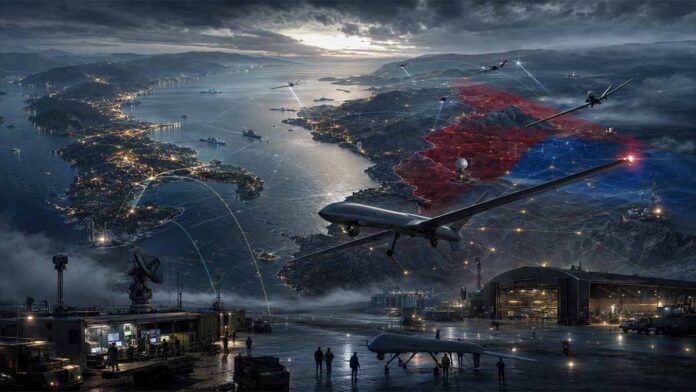

Strategic Consequences for the Balkans, Italy and the Mediterranean Security Architecture
Executive Summary
Serbia’s proposed combat-drone factory with Israel’s Elbit Systems should be assessed as a potentially important component of Belgrade’s military and industrial transformation, but not yet as a proven strategic breakthrough. The project may ultimately matter less for the airframes assembled in Serbia than for the possible integration of Serbian forces into a broader Israeli technological ecosystem encompassing command, control, communications, computers, intelligence, surveillance and reconnaissance—C4ISR—secure communications, electro-optics, electronic warfare, targeting, data fusion and precision fires.
The evidentiary distinction is essential. Elbit Systems has officially announced a USD 1.635 billion contract with an unidentified European country, to be implemented over five years. The disclosed package includes artillery and rocket systems, unmanned reconnaissance and loitering aerial combat systems, intelligence capabilities, embedded artificial intelligence, military digitisation and networked command-and-control solutions. Elbit has not publicly identified Serbia as the customer. The connection to Serbia is therefore credible and supported by converging reporting, but it remains an attribution rather than a formally confirmed corporate disclosure. Elbit Systems: USD 1.635 billion European contract
President Aleksandar Vučić has announced an intended opening of the joint factory around 15–20 September 2026. This is an announced target, not evidence that the facility is already operational. The factory’s location, capital investment, employment, production capacity, designated platforms, degree of technology transfer, access to source code, intellectual-property allocation, Serbian local-content share, export authority and production readiness remain undisclosed.
The reported ownership structure—51% Elbit Systems and 49% Yugoimport–SDPR—also differs from Vučić’s political description of the venture as effectively “half-and-half.” Until incorporation records or an official joint-venture agreement are available, ownership, governance rights and operational control should be treated as credible reporting rather than fully verified corporate facts.
The project fits Serbia’s transition from diversified procurement towards a multi-aligned defence ecosystem. This ecosystem combines:
- French combat aviation, centred on Serbia’s EUR 2.7 billion contract for 12 new Rafale aircraft and associated equipment;
- Israeli sensors, unmanned systems, precision fires and battlefield-management technologies;
- Chinese UAV and air-defence capabilities;
- Russian-origin legacy aircraft, helicopters and air-defence systems;
- Serbian ammunition, missile, armoured-vehicle, artillery and drone production;
- continuing military cooperation with NATO members despite Serbia’s formal policy of military neutrality.
The Rafale acquisition is a confirmed and strategically significant anchor of this transformation. It constitutes a long-term movement towards a Western combat-aircraft architecture, training system and sustainment relationship, even though it does not by itself establish Serbian political alignment with NATO. Serbian Ministry of Defence: contract for 12 Rafale aircraft
This multi-vendor structure can increase Serbia’s bargaining power and reduce dependence on any single foreign supplier. It may also create serious integration burdens. French, Israeli, Chinese, Russian-origin and Serbian systems do not automatically share communications standards, data architectures, identification protocols, cybersecurity requirements or maintenance systems. Strategic autonomy would therefore depend not on the diversity of the inventory but on Serbian control over integration, encryption, mission data, software modification, maintenance, component replacement and operational decision-making.
The factory does not currently prove Serbian offensive intent, nor does it independently alter the Balkan military balance. Its present regional-balance effect is assessed at 2/5. Its current strategic significance is 3/5, while its potentially transformative significance is 4/5, conditional on serial production, meaningful technology transfer, integration into Serbian command networks and authorised exports.
The most immediate security implications concern Kosovo and Bosnia and Herzegovina. These risks arise primarily from the possibility that more persistent surveillance, faster targeting cycles, electronic warfare and deniable unmanned activity could compress decision time during an existing political or security crisis. Misidentification, contested attribution and ambiguous drone activity could become more dangerous than the nominal number of aircraft produced.
For Kosovo, the critical escalation pathway would be:
surveillance activity → disputed attribution → mobilisation or coercive signalling → electronic or kinetic response → NATO involvement.
KFOR remains the decisive military deterrent against a large-scale confrontation. The project should therefore be monitored through observable operational indicators rather than inferred intent: specialised unit formation, deployment patterns, exercises near sensitive areas, logistics activity, command-network integration, rules of engagement and the geographic positioning of ISR and electronic-warfare assets.
For Bosnia and Herzegovina, consequences would require a transmission mechanism. Lawful Serbian production does not itself create a direct Bosnian security effect. Risk would arise through dual-use circulation, diversion, illicit acquisition, proxy access, intelligence support or the political symbolism of Serbian technological superiority. These are vulnerabilities to monitor, not established outcomes.
Croatia is likely to interpret the venture in the context of regional military modernisation. Nevertheless, Croatia’s NATO integration, Western command architecture and alliance support differentiate its position from Serbia’s. A limited Serbian–Croatian procurement competition is plausible, particularly in UAVs, loitering munitions, electronic warfare and counter-UAS systems, but a bilateral arms race is not inevitable.
Israel and Elbit could obtain more than commercial revenue. Serbia may offer industrial capacity, engineering labour, ammunition and metallurgy expertise, geographic production diversification and access to markets across the Balkans, Eastern Europe and the Mediterranean. Whether the Serbian facility becomes an export platform will depend on ownership, Israeli export licensing, Serbian export controls, intellectual-property rights, end-use restrictions and political acceptability in destination countries.
Russia faces a gradual erosion of its historical position within the Serbian defence establishment. Serbia is not necessarily abandoning political relations with Moscow, but the Rafale acquisition and deeper Israeli integration reduce Russian technological centrality. China retains substantial influence through air-defence systems, UAVs, infrastructure and broader strategic relations. Operating Chinese, Israeli, Western and Russian-origin technologies within one military ecosystem, however, increases compartmentalisation, cybersecurity and counterintelligence requirements.
Serbia’s EU trajectory will become increasingly relevant. As a candidate country, Serbia is not yet bound by the entire EU defence, procurement, dual-use, data and cybersecurity acquis in the same way as a member state. Serbian law applies directly; the EU–Serbia Stabilisation and Association Agreement, market access, European operators, controlled components and contractual conditions create additional channels of regulatory influence. Full application of EU law would become relevant only after accession, although accession benchmarks already exert political and institutional pressure.
The European Commission reported that Serbia’s alignment with EU Common Foreign and Security Policy decisions reached 63% by 24 October 2025, compared with 59% in 2024, but continued to characterise alignment as insufficient. Serbia’s selective alignment and continued non-participation in major Russia-related sanctions remain structural constraints on its accession path. European Commission: Serbia Report 2025
Italy is the most directly affected major EU state outside the immediate Western Balkans. Its exposure combines:
- responsibility for stability in the Adriatic and Western Balkans;
- participation in KFOR and EUFOR Althea;
- substantial commercial and industrial interests in Serbia;
- security concerns involving ports, airspace, energy infrastructure and submarine cables;
- potential industrial opportunities in radar, electronic warfare, counter-UAS, secure communications, cyber defence, testing, certification and maintenance.
Italy should neither oppose the project automatically nor treat it as commercially neutral. Rome should seek transparency, support regional confidence-building, strengthen counter-UAS and attribution capabilities, and position Italian industry to participate in lawful and interoperable elements of the emerging ecosystem.
The report’s overall judgment is that Serbia is becoming more Western- and Israeli-connected, less technologically dependent on Russia, but not unambiguously Western-aligned. It remains formally neutral and strategically diversified. The project can support genuine autonomy only if Serbia develops sovereign integration and sustainment capacity. Otherwise, it will exchange dependence on a dominant supplier for dependence on multiple external technology owners.
Consolidated ratings
| Assessment dimension | Rating | Condensed judgment |
|---|---|---|
| Current strategic significance | 3/5 | Important, but not yet transformative |
| Transformative potential | 4/5 | Conditional on technology transfer, integration and serial production |
| Current regional-balance effect | 2/5 | No proven material shift |
| Deterrence contribution | 3/5 | Mixed: stronger awareness and precision, but greater escalation sensitivity |
| Overall strategic risk | 3/5 | Substantial but manageable |
| Overall confidence | 3/5 | Moderate, constrained by undisclosed project fundamentals |
Abstract
This condensed report evaluates the proposed Serbia–Elbit combat-drone factory as a defence-industrial, military-technological and geopolitical project connecting Serbia’s national modernisation strategy with the security of the Western Balkans, Italy, the European Union, NATO and the Mediterranean.
The analysis distinguishes verified facts from attributed reporting and forward-looking assessment. Elbit Systems has officially disclosed a five-year, USD 1.635 billion contract with an unnamed European state covering advanced defence solutions, unmanned systems, precision fires, intelligence, embedded artificial intelligence and military digitisation. Serbia’s connection to that contract is credible but has not been publicly confirmed by Elbit. President Vučić has announced a joint factory opening target in September 2026, but the site, investment, employment, production capacity, platforms, technology-transfer terms, local content and export rights remain undisclosed.
The report finds that the project is strategically significant primarily because it could connect Serbia to an integrated Israeli ecosystem of C4ISR, secure communications, electro-optics, electronic warfare, targeting and precision engagement. It complements Serbia’s EUR 2.7 billion acquisition of 12 French Rafale aircraft, Chinese UAV and air-defence capabilities, Russian-origin legacy systems and domestic defence production.
The resulting model is best described as a multi-aligned defence ecosystem rather than a decisive geopolitical realignment. It may improve Serbian bargaining power and resilience, but it also increases interoperability, cybersecurity, counterintelligence, maintenance and supplier-dependence risks.
No available evidence demonstrates that the factory independently changes the regional military balance or establishes offensive intent. The principal risks arise from crisis interaction: persistent surveillance, ambiguous attribution, electronic warfare and compressed decision cycles could intensify escalation around Kosovo or Bosnia and Herzegovina. Italy’s interests are directly engaged through its military commitments, Adriatic security responsibilities, industrial position and economic exposure to Serbia.
The report concludes that the project is not yet strategically transformative. Transformation would require demonstrable serial production, specialised military integration, Serbian engineering authority, component localisation, sovereign maintenance capacity and authorised exports. Until those indicators appear, the venture should be treated as a high-potential but incompletely documented element of Serbia’s broader military modernisation.
Index
Executive Summary
Abstract
Chapter 1 — The Project, Serbia’s Strategic Transformation and the Emerging Defence Ecosystem
- 1.1 Confirmed facts, attributed reporting and critical unknowns
- 1.2 Serbia’s military-neutrality doctrine
- 1.3 From diversified procurement to multi-alignment
- 1.4 France, Israel, China, Russia and domestic production
- 1.5 The military-technological value of the Elbit ecosystem
- 1.6 Strategic autonomy versus multi-supplier dependence
- 1.7 Yugoimport–SDPR and defence-industrial statecraft
- 1.8 Domestic political and governance consequences
- 1.9 Chapter judgment
Chapter 2 — Balkan Security, Italy, the EU and the Wider Mediterranean
- Kosovo and the escalation environment
- Bosnia and Herzegovina and Republika Srpska
- Croatia and regional military modernisation
- Italy’s security, industrial and economic exposure
- EU accession, NATO deterrence and regulatory consequences
- Adriatic, Mediterranean and export-market implications
Chapter 3 — Scenarios, Consequence Mapping and Strategic Recommendations, 2026–2035
- Five strategic scenarios
- Military, political, technological and industrial consequences
- Country-exposure assessment
- Early-warning indicators and intelligence gaps
- Recommendations for Serbia, Italy, the EU and NATO
- Final judgments and five-year outlook
The drone factory that’s changing Serbia: the new military axis between Israel, the Balkans, and the Mediterranean.
The planned opening in Serbia of a combat drone factory developed with Israel’s Elbit Systems represents more than just a new industrial investment. It is the most visible sign of the transformation through which Belgrade is seeking to convert its military neutrality into a form of autonomy based on technological diversification.
The project hasn’t yet changed the military balance in the Balkans. However, if it moves from assembly to serial production and the integration of sensors, electronic warfare, and command systems, it could become one of Serbia’s key strategic multipliers by 2031.
A project still partially opaque
According to available information, the plant is expected to be built in Šimanovci , near Belgrade, through a joint venture owned 51% by Elbit Systems and 49% by the Serbian state-owned company Yugoimport – SDPR. The announced production will include short-range strike systems, unmanned platforms intended for longer missions, and electronic warfare capabilities.
President Aleksandar Vučić has indicated September 2026 as a possible opening date. However, several key details remain unknown: the investment value, number of employees, models produced, annual capacity, Serbian industrial content, export markets, and the extent of technology transfer. Elbit , when asked about the details, also did not provide further clarification.
This distinction is crucial. A line assembling imported components doesn’t provide the same autonomy as a plant with local engineering, access to technical data, modification capabilities, advanced maintenance, and system configuration authority.
The factory, therefore, should not be judged by the number of announced drones, but by the effective control that Serbia and Elbit will exercise over software, sensors, communications, navigation, upgrades, intellectual property, and exports.
Sources: Times of Israel , Reuters .
Belgrade’s multi-aligned strategy
The project is part of an increasingly sophisticated procurement policy. Serbia continues to declare itself militarily neutral, maintains historic relations with Moscow, and maintains an economic and technological partnership with Beijing, but is significantly expanding its ties with France, Israel, and other European suppliers.
The acquisition of Rafale fighters ties a crucial part of the Serbian Air Force to French and Western standards. Chinese systems have strengthened air defense and UAV capabilities. Russian equipment continues to constitute a significant component of the existing inventory. Israel can now add sensors, secure communications, electronic warfare, unmanned systems, and firepower integration. Added to this is the domestic industry, active in the fields of munitions, missiles, armored vehicles, and drones.
Belgrade isn’t simply replacing Russia with the West. It’s building a multi-aligned military ecosystem in which politically and technologically competing suppliers operate within the same national architecture.
This strategy increases Serbia’s negotiating power and reduces dependence on a single country. But it also creates a structural problem: French platforms, Israeli systems, Chinese technologies, Russian equipment, and Serbian products must share data, communications, maintenance, and operational procedures. Without a strictly governed architecture, diversification can lead to logistical fragmentation, cyber vulnerability, and simultaneous dependence on multiple suppliers.
The real value is not in the aircraft
The Ukrainian experience has shown that a drone’s military value depends not only on its flight range or explosive payload. Its advantage comes from the network that connects observation, identification, decision-making, attack, and outcome evaluation.
The operational sequence is now clear:
ISR detection → target identification → command decision → electronic or kinetic engagement → effects assessment.
Elbit ‘s most important contribution may not be the aircraft. The Israeli company has expertise in C4ISR systems, electro-optics, secure communications, electronic warfare, target acquisition, data fusion, and precision systems.
If the factory were to become the entry point to this ecosystem, Serbia could connect drones, artillery, rocket launchers, ground sensors, and command centers. Such a development would have military significance beyond the simple production of platforms.
However, there is insufficient documentary evidence to attribute specific models such as the Hermes or SkyStriker to the factory. Until contracts, product registrations, or acceptance documents are published , any precise identification will remain speculative.
Kosovo: the point of greatest exposure
After Serbia, the most directly affected country is Kosovo. The reason lies not in alleged proof of Belgrade’s offensive intentions, which the project fails to provide, but in the combination of geographic proximity, tensions in northern Kosovo, and the difficulty of quickly attributing dubious air or electronic activity.
A drone can be used for surveillance, target acquisition, electronic jamming, or attack. In a crisis, distinguishing a demonstration operation from operational preparation can become difficult. The greatest risk arises from the compressed decision-making time: persistent surveillance, electronic interference, non-state actor activity, misidentification, and political pressure can all add up before it’s possible to definitively establish responsibility and intent.
NATO maintains approximately 4,500 troops in Kosovo as part of KFOR and has reserve forces ready to deploy. This presence is the main deterrent against a major escalation, but it does not eliminate the risk of tactical incidents, attribution errors, or actions below the threshold of conventional conflict.
Therefore, the most effective response is not simply to purchase new weapons systems. We need airspace and electromagnetic spectrum protocols, secure communications, attribution procedures, and mechanisms that allow Serbia, KFOR, and the Kosovo authorities to quickly manage incidents, lost connections, border encroachments, and disruptive activities.
Source: NATO – KFOR .
Bosnia, Croatia and regional competition
In Bosnia and Herzegovina, the risk is different. The main consequence would not be a conventional military confrontation, but the political and symbolic impact of Serbia’s technological superiority within a fragmented institutional system.
Relations between Belgrade and Banja Luka, the vulnerability of Bosnian institutions, the circulation of dual-use technologies, and the possible use of small drones for surveillance or intimidation deserve attention. These are plausible risks to monitor, not evidence of clandestine transfers or programs. EUFOR Althea remains the primary international force for maintaining a safe environment in the country.
Croatia, on the other hand, enjoys the political and operational protection of the Atlantic Alliance and is developing a military structure increasingly interoperable with Western standards. Zagreb is unlikely to respond by copying the Serbian model exactly. It is more likely to accelerate investments in surveillance, electronic warfare, anti-drone defense, precision, and infrastructure protection.
A regional competition could thus emerge, but not necessarily a symmetrical race for attack drones. The fastest growth could involve radar, passive sensors, jammers, interceptors, resilient communications, and defense systems for airports, military bases, ports, and energy infrastructure.
Source: EUFOR Althea .
What Israel gets
For Israel, Serbia offers advantages beyond the commercial value of the orders. The country has a skilled workforce, a metallurgical industry, ammunition production, engineering capabilities, and a well-established military export structure through Yugoimport – SDPR.
A Serbian manufacturing presence could also provide geographic diversification, greater supply chain resilience, and industrial capacity outside Israel during periods of high production pressure. Belgrade could become a link between Israeli technology and Balkan, European, Mediterranean, African, or Middle Eastern markets.
However, this is not a free platform. Israeli-sourced military technologies, software, and services remain subject to the control of the Israeli Defense Export Agency. Production in Serbia does not automatically eliminate licenses, destination restrictions, re-export authorizations, or the protection of sensitive technologies.
The opening of a new Elbit facility for unmanned systems in Romania in 2026 also demonstrates Serbia’s potential to join a distributed European network. It could complement existing facilities by specializing in specific activities, or compete for orders, investments, and production functions.
Sources: Elbit Systems – UAS plant in Romania , Israeli Ministry of Defense – export controls .
The consequences for Russia and China
For Moscow, the project represents a further erosion of Russia’s traditional centrality in Serbian defense. Russia doesn’t necessarily lose its political, energy, and cultural influence, but it does see its ability to influence Belgrade through dependence on military equipment and assistance diminish.
Moscow could tolerate some diversification so as not to jeopardize the overall relationship. However, it could use political and informational tools if cooperation with Israel, France, or NATO were presented as a definitive strategic shift for Serbia.
For Beijing, the issue is primarily technological and commercial. Israeli systems can compete with Chinese drones and equipment already acquired by Serbia. The coexistence of Israeli, Chinese, and Western technologies within the same armed forces also increases the need for compartmentalization, cybersecurity, and access control.
This does not prove espionage, illicit transfer, or reverse engineering. However, it does indicate that Serbia must prevent one vendor’s maintenance personnel, software, diagnostic tools, or remote connections from exposing information belonging to another.
Because Italy is directly involved
Italy cannot consider the project a peripheral issue. It is present in KFOR and EUFOR, maintains significant industrial and financial interests in Serbia, and is located at the heart of the Adriatic strategic space.
An increase in UAV and electronics capabilities in the Balkans directly impacts the protection of Italian contingents, bases, ports, sea routes, energy infrastructure, and digital connections. A potential crisis in Kosovo or Bosnia would have immediate consequences for security, investment, logistics, and Rome’s European policy.
Industrial opportunities also exist. Leonardo, Elettronica, MBDA Italia, and companies specializing in counter-UAS systems can offer radar, sensors, electronic warfare, secure communications, command and control, cybersecurity, testing, certification, and maintenance. Serbia could become a competitor in some low-cost segments, but also a manufacturing partner or a market for high-value Italian technologies.
Rome should therefore pursue a dual strategy: protecting its own missions and infrastructure, but maintaining open collaboration conditioned on transparency, technological security, and compliance with export controls.
The crossroads of the next five years
By 2031, three outcomes will be possible.
The first is an assembly facility dependent on Israeli components, software, and authorizations. It would generate employment and increased operational availability, but would have limited technological autonomy.
The second, and currently more plausible, model is a licensed production model. Serbia could produce structures, wiring, integration, testing, maintenance, and some modifications, while maintaining external dependence on sensors, advanced electronics, communications, and intellectual property.
The third is the creation of a comprehensive ecosystem, with Serbian engineering, software, configuration authority, deep maintenance, local suppliers, and the ability to independently offer variants to international markets. This is the most ambitious and also the most difficult scenario: it requires capital, qualified personnel, access to components, ongoing orders, and export authorizations.
The decisive test won’t be the plant’s inauguration. It will be the data: personnel employed by function, Serbian added value, quantities accepted by the armed forces, maintenance capacity, update control, configuration rights, authorized customers, and the factory’s behavior in the event of supply disruptions.
A transformation to be governed
The factory doesn’t make a war in the Balkans inevitable, it doesn’t demonstrate a Serbian offensive plan, and it doesn’t automatically give Serbia control of Israeli technologies. But it also can’t be reduced to a standard industrial investment.
The project encompasses three transformations: the spread of unmanned warfare; Serbia’s transition from a mere buyer to a potential integrated producer; and the construction of a military network in which French, Israeli, Chinese, Russian, and domestic technologies coexist under an increasingly complex strategy of neutrality.
Its final significance will depend on four elements: control of the technology, depth of production, destination of exports and operational use modalities.
If Belgrade makes its financing, production and exports transparent, develops human control mechanisms and maintains de-escalation protocols with KFOR, EUFOR and neighbouring countries, the factory will be able to strengthen deterrence and industry without destabilising the region.
If, however, opaque capabilities, ambiguous surveillance, weak end-user control, and political mobilization overlap, the same project could accelerate military competition and dangerously compress crisis management times.
This, more than the name of the drone that will roll off the production line, is the real strategic issue for Serbia, Italy, Europe, and the Mediterranean.
Chapter 1 – The Project, Serbia’s Strategic Transformation and the Emerging Defence Ecosystem
1.1 Confirmed facts, attributed reporting and critical unknowns
The analytical starting point is not the assumption that a fully operational combat-drone factory already exists. The verified position is narrower.
Elbit Systems officially announced in August 2025 that it had secured a USD 1.635 billion contract to supply a European country over five years. The package includes technologically advanced defence solutions, unmanned reconnaissance and loitering aerial combat systems, artillery and rockets, intelligence capabilities, embedded artificial intelligence, battlefield digitisation and a networked command-and-control solution extending from strategic headquarters to tactical formations. Elbit Systems: official contract announcement
Elbit did not identify the customer. The attribution to Serbia is supported by reporting and by the apparent correspondence between the disclosed technological package and Serbian announcements, but it has not been converted into a formal public confirmation by the company.
President Vučić has stated that a Serbian–Israeli drone factory should open around 15–20 September 2026. That statement establishes political intent and an implementation target. It does not establish that the facility has passed acceptance testing, commenced serial production or delivered operational systems.
The reported ownership structure is 51% Elbit Systems and 49% Yugoimport–SDPR. Vučić has described the arrangement politically as “half-and-half.” These formulations are not necessarily incompatible economically, but they may imply different voting, governance, intellectual-property and export-control rights. The legal incorporation documents remain necessary to determine actual control.
The following remain unconfirmed:
- factory location;
- capital investment;
- direct and indirect employment;
- annual production capacity;
- named UAV or loitering-munition platforms;
- component localisation;
- Serbian access to source code;
- intellectual-property ownership;
- design authority;
- Israeli and Serbian export rights;
- end-use restrictions;
- operational delivery schedule;
- integration with Serbian command networks.
Accordingly, Hermes, SkyStriker or any other named system must not be attributed to the factory without documentary evidence. The venture could involve an established Elbit platform, a licensed derivative, a jointly adapted system or an as-yet-undisclosed family of products.
1.2 Serbia’s military-neutrality doctrine
Serbia’s military neutrality is best understood as a policy of non-membership in military alliances rather than equidistance from all external partners. Belgrade cooperates with NATO through the Partnership for Peace and interoperability activities while maintaining political and defence relations with Russia, a comprehensive strategic relationship with China, expanding cooperation with Israel and increasingly significant procurement from France.
This flexibility gives Serbia room to negotiate with multiple suppliers and present itself domestically as sovereign and non-aligned. It also permits President Vučić to address constituencies with competing geopolitical preferences: pro-European economic actors, pro-Russian political and cultural groups, security institutions seeking Western technology, and industrial interests favouring diversified partnerships.
Neutrality therefore functions simultaneously as:
- a security doctrine;
- a domestic political narrative;
- a procurement strategy;
- a diplomatic bargaining instrument;
- a mechanism for avoiding an explicit alliance choice.
The central question is whether this model remains sustainable as Serbian forces become increasingly dependent on Western and Israeli communications, software, aircraft, sensors and precision-effect systems.
1.3 From diversified procurement to multi-alignment
Serbia is moving beyond the opportunistic purchase of equipment from unrelated suppliers. The emerging structure increasingly resembles a multi-aligned defence ecosystem composed of several technological layers.
France provides the most visible Western platform commitment. In August 2024, Serbia signed a EUR 2.7 billion contract for 12 new Rafale aircraft and accompanying equipment. The acquisition creates a long-term relationship involving training, sustainment, mission preparation, secure communications, armaments integration and technical support. Serbian Ministry of Defence: Rafale contract
Israel could provide the digital and sensor architecture around which several Serbian capabilities are connected. Elbit’s disclosed European package is important precisely because it extends beyond UAVs into C4ISR, artificial intelligence, intelligence systems, networked combat and precision fires.
China supplies capabilities that Western partners have generally been unwilling or unable to provide Serbia on comparable political terms, including Chinese-origin UAVs and modern air-defence systems. These acquisitions diversify Serbian access but create particularly sensitive cybersecurity and counterintelligence requirements when operated alongside Israeli and Western systems.
Russia remains embedded through legacy platforms, institutional relationships, training experience, political ties and public sentiment. Its relative technological position is nevertheless declining. Sanctions, production pressure and restricted access to components have reduced Russia’s ability to remain Serbia’s principal modernisation partner.
Serbia’s domestic industry supplies the final layer. It produces ammunition, artillery systems, missiles, armoured vehicles and an expanding range of unmanned or remotely operated systems. The strategic purpose of foreign partnerships is therefore not only acquisition: it is also to improve domestic engineering, production, maintenance and export capacity.
1.4 France, Israel, China, Russia and domestic production
The coexistence of these suppliers creates opportunities and structural risks.
French platforms can strengthen Serbia’s combat aviation and deepen technical engagement with Europe. Israeli systems can accelerate battlefield digitisation, surveillance, targeting and precision engagement. Chinese systems can provide comparatively rapid access to air defence and unmanned capabilities. Russian-origin equipment maintains continuity with existing force structures. Serbian production can reduce costs, support employment and give Belgrade greater control over supply.
However, each supplier introduces its own:
- communications architecture;
- encryption requirements;
- data formats;
- maintenance chain;
- export restrictions;
- software dependencies;
- mission-planning systems;
- security classifications;
- component vulnerabilities.
True autonomy would require Serbia to control the interfaces connecting these systems. Without sovereign integration capability, multi-alignment may produce an inventory that is politically diversified but operationally fragmented.
1.5 The military-technological value of the Elbit ecosystem
The factory’s potential strategic importance does not lie only in manufacturing airframes. Modern unmanned warfare depends on the complete operational chain:
ISR detection → target identification → command decision → electronic or kinetic engagement → battle-damage assessment.
A drone provides strategic value only when it can acquire information, transmit it securely, support lawful and timely command decisions, cue an effect and verify the result. The decisive variables include communications resilience, navigation, data quality, electronic-warfare resistance, sensor performance, trained operators, rules of engagement and integration with artillery or other precision fires.
An Elbit relationship could therefore affect:
- C4ISR;
- ISTAR;
- electro-optical surveillance;
- secure tactical communications;
- electronic warfare;
- target acquisition;
- battlefield digitisation;
- precision engagement;
- data fusion;
- military decision speed.
If Serbia acquires only final assembly capacity, the project’s technological significance will remain limited. If it obtains licensed production, maintenance, software adaptation and systems-integration competence, autonomy will increase. A full ecosystem would require Serbian engineering authority, component production, testing, certification, maintenance and meaningful export rights.
1.6 Strategic autonomy versus multi-supplier dependence
The project may generate four competing outcomes.
First, it could increase strategic autonomy by localising production, reducing delivery dependence and strengthening Serbian engineering.
Second, it could create multiple technological dependencies. Serbia might rely on France for aviation, Israel for sensors and networks, China for air defence, Russia for legacy sustainment and external suppliers for chips, propulsion, navigation and communications components.
Third, it could improve bargaining power. No single supplier would possess complete leverage over Serbia’s defence establishment.
Fourth, it could produce an unsustainable logistics structure involving incompatible training, maintenance, cybersecurity and supply arrangements.
The determining factor is not the number of suppliers. It is Serbia’s capacity to integrate, secure, maintain and modify the resulting ecosystem without requiring continuous external permission or technical intervention.
1.7 Yugoimport–SDPR and defence-industrial statecraft
Yugoimport–SDPR is more than a commercial intermediary. It operates as an instrument of Serbian foreign policy, industrial development and defence diplomacy. Its role in the proposed venture could connect foreign technology with Serbian production, state-backed exports and relationships across Europe, Africa, the Middle East and Asia.
A minority stake would not necessarily mean minority strategic value. Yugoimport could contribute:
- market access;
- domestic industrial coordination;
- Serbian export relationships;
- integration with national weapons programmes;
- regulatory and political management;
- links to ammunition, artillery and armoured-vehicle production.
The crucial unresolved questions concern board control, reserved decisions, export approval, intellectual-property rights, technology-access limitations and the distribution of revenue and liability.
1.8 Domestic political and governance consequences
For President Vučić, the factory supports a narrative of national prestige, industrial revival and technological modernisation. It can be presented as evidence that Serbia is capable of attracting a globally significant defence company while preserving military neutrality.
The political benefits may include:
- employment and regional development;
- greater national prestige;
- support for military-modernisation narratives;
- stronger control over a strategic industrial sector;
- expanded relationships with foreign governments;
- additional defence-export opportunities.
The governance risks are equally significant:
- opaque public procurement;
- limited parliamentary oversight;
- unclear state-aid arrangements;
- patronage within state-owned enterprises;
- concentration of industrial authority;
- insufficient disclosure of beneficial control and liabilities;
- reputational exposure arising from cooperation with Israeli defence companies.
These risks do not prove corruption, illegality or misuse. They establish the areas in which transparency and institutional oversight will be necessary.
1.9 Chapter judgment
Serbia is not simply replacing Russia with the West. It is constructing a diversified, multi-aligned defence system in which French, Israeli, Chinese, Russian-origin and domestic capabilities perform different functions.
The proposed Elbit venture could become one of the most important elements of that system because it may connect sensors, communications, targeting, electronic warfare and precision fires. Nevertheless, the project remains incompletely documented and has not yet demonstrated serial production, sovereign integration or operational transformation.
The correct present judgment is therefore:
Strategically significant, potentially transformative, but not yet proven to be transformative.
Its success will depend on whether Serbia acquires genuine engineering and systems-integration authority—or merely hosts the controlled assembly of foreign technology.
Serbia’s Multi-Aligned Defence Ecosystem
Diverse international suppliers create strategic bargaining power—but true national autonomy depends on the strength of sovereign integration.
Chapter 2 – Balkan Security, Italy, the EU and the Wider Mediterranean
2.1 Regional assessment: capability is not intent
The proposed Serbia–Elbit drone factory must be analysed within an already contested regional security environment, but its existence would not by itself demonstrate Serbian offensive intent or an intention to revise borders by force.
Three distinctions are essential:
- Industrial capacity is not operational capability. A factory announcement does not establish serial production, military acceptance, trained units, deployable stocks or integration into command networks.
- Operational capability is not political intent. Even an operational drone fleet could support territorial surveillance, deterrence, infrastructure protection or defensive targeting rather than preparations for aggression.
- Intent is not inevitability. Coercive signalling or military mobilisation can increase risk without making conflict unavoidable, particularly where NATO, the EU and the United States retain diplomatic and military leverage.
The principal regional consequence is therefore not an immediate quantitative shift in military power. It is the possibility that Serbia could acquire a more persistent and responsive surveillance-to-engagement system capable of shortening the interval between detection, identification, command decision and military effect.
This matters most in Kosovo and Bosnia and Herzegovina, where political disputes, contested narratives and the presence of international forces can interact with ambiguous unmanned activity. In such environments, uncertainty over who is operating a drone, what it is collecting and whether it is supporting an impending action can become strategically destabilising.
The current regional-balance effect remains assessed at 2/5: observable, but not yet material. The potential effect would rise only if Serbia demonstrated serial production, operational deployment, secure command-network integration, specialised units, resilient communications and a sustained ability to generate unmanned mass.
2.2 Kosovo and the escalation environment
2.2.1 The immediate security context
Kosovo is the most exposed theatre because the Serbia–Kosovo dispute remains unresolved, northern Kosovo contains a concentrated Kosovo Serb population, and relatively limited incidents can acquire national and international significance.
The proposed factory does not create this instability. It enters an environment already characterised by:
- disputes over sovereignty and institutional authority;
- periodic confrontation in northern Kosovo;
- competing Serbian and Kosovo security narratives;
- contested policing and municipal legitimacy;
- cross-boundary political influence;
- vulnerability to armed, proxy or non-state activity;
- NATO, EU and United States involvement;
- persistent risks of misinformation and disputed attribution.
The factory’s principal relevance would be to the information and decision architecture surrounding a crisis. Persistent ISR, electro-optical surveillance, electronic intelligence and secure communications could provide Serbia with a more detailed operational picture. The same capabilities could also be perceived by Kosovo as instruments of coercive preparation, even where Serbian activity remained formally defensive.
2.2.2 KFOR as the decisive deterrent
NATO’s Kosovo Force has operated since June 1999 and remains the principal external military mechanism supporting a safe and secure environment and freedom of movement. Its presence substantially raises the political and military cost of any large-scale Serbian intervention and reduces the plausibility of an uncontested attempt to change conditions by force. NATO: KFOR and NATO’s role in Kosovo
KFOR does not eliminate lower-level escalation. Its deterrence is strongest against overt conventional action and less complete against:
- unattributed surveillance;
- electronic interference;
- information operations;
- proxy mobilisation;
- limited border incidents;
- coercive deployments;
- civil disturbances involving armed elements;
- ambiguous drone activity below the threshold of open warfare.
The strategic concern is therefore a crisis beginning below KFOR’s conventional-response threshold and escalating through cumulative misinterpretation.
EULEX complements this architecture through its rule-of-law mandate, monitoring functions and support to Kosovo institutions. It is not a substitute for KFOR’s military deterrence, but it can contribute to evidence preservation, institutional coordination and the forensic investigation of incidents.
2.2.3 Drone-specific risks
Unmanned systems introduce five principal risks.
First, attribution. A drone observed near a sensitive site might belong to a state security institution, a commercial operator, a journalist, a criminal network, a political group or an unauthorised individual. Visual observation alone may not establish ownership or mission.
Second, dual use. A platform conducting surveillance can provide information later used for coercive or kinetic action, even if it carries no weapon.
Third, compressed decision time. Persistent ISR connected to artillery, loitering munitions or electronic warfare can shorten the interval between detection and engagement. This increases operational effectiveness but reduces the time available for verification and diplomatic intervention.
Fourth, deniability. Small drones can cross administrative or territorial boundaries without immediately revealing the operator. States or proxies may exploit this ambiguity for surveillance, signalling or provocation.
Fifth, counter-UAS escalation. Jamming, spoofing or physically intercepting a drone may be interpreted as a defensive act, an electronic attack or evidence of hostile intent, depending on location and circumstances.
Kosovo and Albania are consequently likely to strengthen:
- short-range drone detection;
- passive radio-frequency monitoring;
- radar and electro-optical identification;
- electronic countermeasures;
- command protocols for unidentified aircraft;
- evidence preservation and technical attribution;
- coordination with NATO and the United States.
Türkiye is also relevant. Its defence relationship with Kosovo and Albania, its strong position in the regional UAV market and its role within NATO give Ankara the capacity to support procurement, training and counter-UAS development. This does not mean that Türkiye will automatically balance every Serbian acquisition, but it is one of the most plausible external suppliers if Kosovo or Albania accelerates unmanned-system modernisation.
2.2.4 Escalation ladder
| Level | Trigger or activity | Potential Serbian action | Likely Kosovo/NATO/EU response | Principal de-escalation mechanism |
|---|---|---|---|---|
| 1. Routine surveillance | Normal border, infrastructure or training activity | Declared ISR and military exercises | Monitoring; normal liaison | Advance notification and geographic separation |
| 2. Contestation and information pressure | Disputed flight, inflammatory claim or alleged incursion | Increased ISR; public accusation; force-protection measures | Technical investigation; public rebuttal; KFOR liaison | Joint or third-party attribution |
| 3. Localised security incident | Arrest, roadblock, armed encounter or drone interception | Local readiness increase; reinforcement near sensitive areas | Kosovo Police response; KFOR posture adjustment; EU/US diplomacy | Incident containment and verified evidence |
| 4. Proxy or non-state violence | Armed group activity or sabotage | Intelligence support; border reinforcement; coercive signalling | KFOR reinforcement; arrests; sanctions warnings | Isolation of non-state actors and direct communications |
| 5. Cross-boundary military crisis | Sustained firing, casualties or repeated incursions | Mobilisation, electronic warfare, persistent ISR | NATO warning; KFOR force protection; EU crisis diplomacy | Verified stand-down and monitored withdrawal |
| 6. Limited state engagement | Confirmed state use of force | Electronic or kinetic action; precision targeting | KFOR defensive action; NATO consultation; international pressure | Immediate ceasefire and military-to-military channel |
| 7. Regional confrontation | Expanded operations or attack on international forces | Broader military employment | NATO-led military response and comprehensive diplomatic isolation | Externally imposed cessation of hostilities |
Movement through this ladder is not automatic. Attribution, communications, restraint and the visible positioning of international forces can interrupt escalation at every level.
2.2.5 Indicators distinguishing deterrence from war preparation
The factory itself cannot distinguish defensive modernisation from offensive planning. More useful indicators would include:
| Interpretation | Observable indicators |
|---|---|
| Deterrence and territorial defence | Declared exercises; defensive basing; infrastructure surveillance; transparent rules; NATO notification; emphasis on counter-UAS and force protection |
| Coercive signalling | Highly publicised deployments; intensified surveillance near sensitive areas; selective disclosure of readiness; political threats; short-notice exercises |
| Operational preparation for conflict | Dispersal of units; ammunition movement; field command activation; electronic-warfare deployment; medical and logistics preparation; persistent target collection; cancellation of leave; restrictions on civilian airspace |
No single indicator is conclusive. Assessment requires the convergence of operational, logistical, political and intelligence evidence.
2.3 Bosnia and Herzegovina and Republika Srpska
2.3.1 A consequence requiring transmission
The Serbian factory would not directly change the security situation in Bosnia and Herzegovina. A Serbian-produced UAV does not automatically become available to Republika Srpska, a political organisation, a paramilitary formation or a non-state actor.
A security consequence would require a transmission mechanism:
lawful Serbian production → dual-use circulation or official transfer → diversion, illicit acquisition or proxy access → operational or political effect.
This distinction prevents the analysis from transforming technological proximity into an allegation of planned proliferation.
The most plausible consequences are initially political and perceptual:
- enhanced symbolism of Serbian military-technological superiority;
- stronger perceptions of Belgrade’s capacity to support Banja Luka;
- increased concern within the Federation of Bosnia and Herzegovina;
- political exploitation of Serbian capabilities by competing actors;
- pressure for additional international monitoring;
- increased demand for drone detection and critical-site protection.
2.3.2 Belgrade–Banja Luka relations
Close political relations between Belgrade and Republika Srpska mean that Serbian defence developments will be watched closely in Sarajevo, Banja Luka, Brussels and NATO capitals. Political leaders may use the project to support contrasting narratives.
Republika Srpska leaders may present Serbian industrial development as evidence of wider Serbian national strength and strategic protection. Opponents may portray the same development as evidence of an impending security threat. Neither narrative, by itself, establishes an operational transfer or hostile plan.
The relevant evidence would concern:
- formal procurement or cooperation agreements;
- training arrangements;
- transfer of controlled components;
- movement of operators or technical personnel;
- unexplained dual-use drone circulation;
- communications or data support;
- storage or operation near sensitive sites;
- interference with spectrum-monitoring systems;
- diversion from documented end users.
2.3.3 Fragmented institutions and dual-use circulation
Bosnia and Herzegovina’s fragmented political and security system can complicate nationwide monitoring, procurement control and incident attribution. Commercial drones, components, navigation equipment, cameras and radio-frequency systems can circulate through civilian markets without constituting military transfers.
The risk lies in the possible combination of commercially available airframes with:
- higher-quality sensors;
- secure communications;
- modified payloads;
- autonomous navigation;
- military-derived software;
- targeting data;
- external technical assistance.
The structural vulnerabilities are therefore dual use, diversion and institutional fragmentation—not proven Serbian state sponsorship.
2.3.4 EUFOR Althea
EUFOR Althea remains the central international military presence supporting a safe and secure environment in Bosnia and Herzegovina. Italy contributes personnel, and in January 2026 Italian Major General Maurizio Fronda assumed command of the operation. EUFOR has explicitly emphasised the importance of the Italian contribution to stability. EUFOR Althea: role of Italian troops
For EUFOR, the relevant requirements are likely to include:
- detection of small unmanned aircraft around bases and sensitive sites;
- electronic-spectrum awareness;
- common incident-attribution procedures;
- protection of communications and ammunition facilities;
- monitoring of unusual training or equipment movement;
- coordination with Bosnian law-enforcement and military institutions;
- strategic communication capable of correcting unsupported threat narratives.
The most credible near-term risk is not a Serbian drone attack on Bosnia and Herzegovina. It is an ambiguous incident, politically amplified, occurring within an already polarised institutional environment.
2.3.5 Bosnia and Herzegovina judgment
Security risk remains plausible but indirect. It would increase materially only if evidence emerged of unauthorised technology transfer, proxy access, unexplained operational training or deployment linked to political coercion.
The appropriate response is enhanced monitoring, licensing, customs control, serial-number tracking, spectrum evidence and chain-of-custody procedures—not unsupported accusations.
2.4 Croatia and regional military modernisation
2.4.1 Different strategic architectures
Croatia and Serbia are both modernising, but they do so within fundamentally different security structures.
Croatia is a member of NATO and the European Union. Its procurement, training, communications, air operations and military planning are embedded in Western institutions. Serbia is militarily neutral, maintains a multi-vendor inventory and seeks strategic flexibility outside alliance membership.
Nominal equipment comparisons can therefore be misleading. Operational capability depends on:
- availability and readiness;
- trained personnel;
- secure communications;
- ammunition stocks;
- intelligence support;
- maintenance capacity;
- command integration;
- alliance reinforcement;
- electronic-warfare resilience.
Croatia’s NATO membership provides access to collective planning, intelligence and reinforcement that cannot be represented by counting national platforms alone. Serbia, by contrast, may possess considerable national capabilities but must integrate and sustain them through a more fragmented supplier network.
2.4.2 Areas of emerging competition
The project could encourage Croatia to accelerate investment in:
- UAVs and loitering munitions;
- counter-UAS systems;
- radar and passive detection;
- electronic warfare;
- secure command networks;
- artillery and longer-range precision fires;
- ammunition resilience;
- dispersed basing and critical-infrastructure protection.
This would not necessarily constitute a bilateral arms race. Much of Croatia’s modernisation would occur regardless of the Serbian factory because of NATO requirements, lessons from Ukraine and wider European rearmament.
A genuine Serbia–Croatia arms competition would be indicated by:
- procurement publicly justified as a response to the other state;
- repeated capability matching;
- accelerated budgets outside existing plans;
- competing long-range strike acquisitions;
- reciprocal deployment changes;
- deterioration in military transparency;
- politically charged exercises near sensitive areas.
At present, the more defensible judgment is regional procurement acceleration, not a proven bilateral arms race.
2.4.3 Industrial consequences
Croatia may seek new partnerships with Western or Israeli suppliers in counter-UAS, sensors, communications and unmanned systems. It may also position its NATO and EU status as an industrial advantage over Serbia for projects requiring:
- access to EU funding;
- NATO-compatible security standards;
- EU-certified supply chains;
- protection of classified information;
- common export-control standards;
- European customer confidence.
Serbia may compete through lower production costs, flexible export relationships and established Yugoimport networks. Croatia may compete through regulatory alignment, alliance interoperability and access to EU defence-industrial initiatives.
2.5 Italy’s security, industrial and economic exposure
2.5.1 Why Italy is directly affected
Italy is not a distant observer. Its exposure is simultaneously military, geographic, political, industrial and commercial.
Italy has:
- forces and responsibilities connected to KFOR;
- personnel and command responsibilities within EUFOR Althea;
- an immediate interest in Adriatic stability;
- major economic and financial interests in Serbia;
- close relations with Serbia, Croatia, Albania, Kosovo, Slovenia and Greece;
- a strategic relationship with Israel;
- a substantial national defence-industrial base;
- critical ports, energy systems, cables and maritime infrastructure exposed to unmanned and hybrid threats.
The factory therefore intersects with Italian interests even if no Serbian-produced system is ever exported to Italy.
2.5.2 Adriatic and military-security consequences
The Western Balkans form part of Italy’s immediate security perimeter. A crisis in Kosovo or Bosnia and Herzegovina could require:
- force reinforcement;
- air and maritime transport;
- intelligence and surveillance activity;
- protection of Italian contingents;
- diplomatic crisis management;
- evacuation planning;
- enhanced security for Adriatic ports and infrastructure.
Italian forces may encounter Serbian, Israeli, Turkish, Chinese or commercially derived unmanned technologies within the same operating environment. This makes technical attribution and electronic-spectrum awareness increasingly important.
Italy should prioritise:
- interoperable counter-UAS coverage for deployed contingents;
- passive and active drone detection;
- electronic-warfare deconfliction;
- forensic recovery of downed platforms;
- shared databases of signatures and components;
- incident reporting between KFOR, EUFOR and national commands;
- protection of airbases, ports, energy facilities and communications nodes.
2.5.3 Industrial opportunities
The most credible Italian opportunities do not lie in direct airframe co-production, which remains speculative. They lie in complementary capabilities where Italian firms possess established expertise.
| Opportunity | Assessed maturity | Principal condition |
|---|---|---|
| Counter-UAS integration | Near-term | Serbian demand, licensing and security assurances |
| Radar and electronic warfare | Near-term | Protection of sensitive technology and data |
| Secure C2 and cyber defence | Credible | Trusted architecture and supplier compartmentalisation |
| Testing and certification | Credible | Agreed standards and access to technical data |
| Maintenance, repair and sustainment | Credible | Platform disclosure and OEM authorisation |
| Electro-optics | Conditional | Israeli–Italian–Serbian industrial compatibility |
| Composite materials | Conditional | Verified local-production requirements |
| Propulsion | Early | Platform class and export permissions |
| Direct airframe co-production | Speculative | Major change in ownership, IP and export arrangements |
Leonardo is the most obvious Italian actor in radar, sensors, secure electronics, mission systems, cyber defence and command-and-control. Elettronica has relevant electronic-warfare expertise. MBDA Italia may be affected by the evolution of precision-effect architectures, although integration would require political approval and stringent technology protection. Avio Aero could become relevant only if propulsion requirements, platform classes and licensing conditions align. Fincantieri’s most direct interest lies in maritime counter-UAS, port protection and the security of naval and critical infrastructure rather than in Serbian drone-airframe production.
Italian participation cannot be assumed. It would require:
- compatibility with Israeli intellectual-property restrictions;
- Serbian acceptance of Western security conditions;
- export licences;
- protection against unauthorised technical access;
- clear end users;
- enforceable end-use monitoring;
- separation from sensitive Chinese and Russian-origin systems;
- commercially credible production volumes.
2.5.4 Economic exposure
Italy’s economic stake in Serbia is already substantial. According to the Italian Ministry of Foreign Affairs, Serbia hosts more than 1,200 registered Italian-owned companies. These companies contribute more than 5% of Serbia’s national wealth, while bilateral trade reached approximately EUR 4.5 billion in 2024. Italy was Serbia’s third-largest trading partner and maintained particularly important positions in banking, insurance and automotive manufacturing. Italian Ministry of Foreign Affairs: Italy’s economic presence in Serbia
This exposure creates two opposing consequences.
A stable and technologically modernising Serbia can generate opportunities for Italian investment, advanced manufacturing and services. Conversely, a serious regional crisis, sanctions controversy or export-control breach could affect:
- financing;
- insurance;
- supply chains;
- compliance costs;
- corporate reputation;
- cross-border payments;
- investment decisions;
- personnel security.
Italian companies operating in Serbia should therefore treat geopolitical risk, sanctions screening and dual-use compliance as board-level issues rather than narrow legal formalities.
2.5.5 Recommended Italian posture
Rome should follow a dual-track strategy:
- Engage Serbia rather than isolate it. Italy should use its political and commercial influence to promote transparency, EU-compatible controls and regional restraint.
- Protect Italian and allied security. Engagement should be accompanied by enhanced counter-UAS capability, export-control scrutiny, intelligence collection and protection of critical technology.
Italy should seek structured consultations with Belgrade on:
- factory governance;
- intended product families;
- export policy;
- end-use monitoring;
- cybersecurity;
- airspace safety;
- regional notification mechanisms;
- separation of sensitive Western technologies from Chinese and Russian-origin systems.
2.6 EU accession, NATO deterrence and regulatory consequences
2.6.1 What binds Serbia before accession
Serbia is an EU candidate, not an EU member. The distinction determines which legal obligations apply directly.
| Regulatory pathway | Present reach before accession |
|---|---|
| Serbian national law | Direct |
| EU–Serbia Stabilisation and Association Agreement | Direct within its scope |
| Rules affecting EU operators or EU-controlled components | Strong |
| EU market, financing or data connection | Material and conditional |
| Accession benchmarks | Political and institutional |
| EU law applicable solely through membership | Not directly binding before accession |
EU rules may still affect the project before accession when:
- an EU company supplies controlled technology;
- components originate within the EU;
- financing involves an EU institution;
- data are processed within EU jurisdiction;
- products enter the EU market;
- contractual terms incorporate EU standards;
- a member state must authorise export, brokering or technical assistance;
- sanctions prohibit transactions with a designated person or entity.
Serbia adopted a new law on dual-use goods in March 2025 intended to align further with Regulation (EU) 2021/821 and continues to update its national control list. Its applications to join the Wassenaar Arrangement and Australia Group remain under consideration. European Commission: Serbia Report 2025
2.6.2 Accession consequences
The factory could support accession by:
- modernising Serbian industry;
- increasing engagement with European and Israeli technology;
- improving export-control institutions;
- encouraging cybersecurity and data-governance reform;
- creating supply-chain connections with EU companies.
It could complicate accession if:
- procurement remains opaque;
- state aid is not transparent;
- export controls are inadequately enforced;
- end-use monitoring is weak;
- sensitive technology is exposed to sanctioned or high-risk actors;
- AI-supported targeting lacks accountability;
- Serbia uses military capability for regional coercion;
- foreign-policy alignment remains insufficient.
The European Commission reported Serbia’s CFSP alignment at 63% as of 24 October 2025, compared with 59% in 2024, while continuing to regard alignment as low. This indicates selective convergence rather than full strategic alignment. European Commission: Serbia Report 2025
2.6.3 NATO deterrence and interoperability
Serbia is not a NATO member, but it participates in the Partnership for Peace and maintains practical military cooperation with the Alliance. In May 2026, approximately 600 troops from Serbia and six NATO countries, including Italy, Romania and Türkiye, participated in a NATO–Serbia exercise. This demonstrates that military neutrality does not exclude operational cooperation. NATO Joint Force Command Naples: NATO–Serbia Exercise 2026
NATO’s interests are not served by opposing every Serbian capability increase. The Alliance’s priorities are:
- preventing conflict;
- protecting KFOR;
- maintaining freedom of movement;
- preserving credible deterrence;
- avoiding miscalculation;
- improving notification and communications;
- ensuring that Serbian modernisation does not undermine regional stability.
The most useful mechanisms are practical rather than rhetorical: military liaison, exercise notification, emergency communications, airspace coordination, technical attribution and clear consequences for hostile action against international forces.
2.7 Adriatic, Mediterranean and export-market implications
2.7.1 Serbia as an inland production hub
Serbia is landlocked, but it is not strategically isolated. Its industrial position connects:
- the Danube corridor;
- Adriatic ports;
- Central and Eastern Europe;
- the Black Sea region;
- the Eastern Mediterranean;
- Türkiye and the Levant;
- potential North African and Gulf markets.
A Serbian–Israeli production base could reduce manufacturing costs, diversify wartime supply and shorten delivery routes to some European customers. However, geographic convenience does not automatically create export access.
Every export would depend on:
- Serbian authorisation;
- Israeli technology-transfer approval;
- ownership and licensing terms;
- destination-country acceptability;
- sanctions status;
- end-use assurances;
- controlled-component availability;
- transport and insurance;
- competition from Turkish, Chinese, American and European suppliers.
2.7.2 Competition with Türkiye and other suppliers
Türkiye has developed an influential export model combining relatively affordable UAVs, political engagement, training, maintenance and rapid delivery. A Serbian–Israeli venture could compete by combining Serbian production economics with higher-end Israeli sensors, communications and command systems.
The models are not identical.
| Industrial model | Principal advantage | Principal constraint |
|---|---|---|
| Turkish | Integrated national production and politically active export strategy | Political conditions and supplier dependence |
| Israeli | Advanced sensors, C4ISR, EW and precision systems | Licensing, cost and political sensitivity |
| Chinese | Price, financing and availability | Trust, interoperability and technology-security concerns |
| Iranian | Low-cost mass and rapid conflict adaptation | Sanctions, legal exposure and proliferation risk |
| European | Regulatory credibility and NATO/EU interoperability | Cost, production speed and fragmented procurement |
| Serbian–Israeli | Potential combination of lower-cost production and advanced systems | Undisclosed technology transfer, ownership and export authority |
The Serbian project could become commercially important without displacing established suppliers. Its most plausible advantage would be a hybrid offering: Serbian manufacturing and ammunition expertise combined with Israeli sensors, software and networked warfare systems.
2.7.3 Maritime and critical-infrastructure security
The spread of drones and loitering munitions affects the Mediterranean even when production occurs inland. Ports, pipelines, LNG facilities, power interconnectors, naval bases, offshore installations and submarine-cable landing points are increasingly exposed to:
- surveillance;
- sabotage;
- navigation interference;
- electronic intelligence;
- low-cost attacks;
- deniable disruption;
- coordinated drone swarms.
Italy, Croatia, Greece, Cyprus, Romania and other regional states will consequently require layered protection combining radar, electro-optics, radio-frequency detection, electronic warfare, cyber defence and kinetic interception.
A Serbian factory would be only one element of this broader proliferation environment. Turkish, Chinese, Iranian, Israeli, European, American and commercially adapted systems are already shaping the market.
2.7.4 Export and proliferation risks
There is no evidence that the proposed factory is intended to evade sanctions or supply non-state actors. Such claims would be unsupported.
Nevertheless, structural risks include:
- opaque intermediary companies;
- re-export through third countries;
- incomplete end-use monitoring;
- substitution of controlled components;
- diversion of dual-use systems;
- undocumented software modification;
- loss of serial-number traceability;
- transfer of technical knowledge rather than complete platforms;
- operation by proxies while formal ownership remains elsewhere.
The appropriate response is a control architecture built around:
export licensing → customs verification → serial-number tracking → end-use certification → post-delivery inspection → spectrum evidence → chain of custody.
Serbian production would not necessarily loosen Israeli export restrictions. If Elbit retains majority ownership, critical intellectual property, controlled components or export approval rights, Serbian manufacture may remain subject to substantial Israeli control.
2.8 Consolidated country and actor exposure
| Country or actor | Security impact | Political impact | Industrial impact | Overall exposure |
|---|---|---|---|---|
| Serbia | 4/5 | 5/5 | 5/5 | 5/5 |
| Kosovo | 5/5 | 5/5 | 3/5 | 5/5 |
| Bosnia and Herzegovina | 3/5 | 4/5 | 2/5 | 4/5 |
| Croatia | 3/5 | 3/5 | 4/5 | 3/5 |
| Italy | 3/5 | 4/5 | 4/5 | 4/5 |
| European Union | 3/5 | 4/5 | 3/5 | 4/5 |
| NATO/KFOR | 4/5 | 4/5 | 2/5 | 4/5 |
| Israel/Elbit | 3/5 | 4/5 | 5/5 | 4/5 |
| Russia | 2/5 | 4/5 | 3/5 | 3/5 |
| China | 2/5 | 3/5 | 3/5 | 3/5 |
| Mediterranean export markets | 3/5 | 3/5 | 4/5 | 3/5 |
The scores are ordinal judgments, not mathematical forecasts. They express relative exposure across security, politics and defence industry.
2.9 Chapter judgment
The proposed factory does not presently overturn the Balkan military balance. Its regional importance arises from the possibility that Serbia could combine persistent ISR, electronic warfare, secure command networks and precision effects within a more responsive operational architecture.
Kosovo is the most directly exposed actor after Serbia because existing tensions, disputed attribution and NATO’s presence create the shortest pathway from ambiguous drone activity to international crisis. Bosnia and Herzegovina faces a lower direct military risk but a significant political and institutional risk, particularly if Serbian technological development is incorporated into competing narratives surrounding Republika Srpska.
Croatia is likely to accelerate UAV and counter-UAS modernisation, but its NATO integration means that nominal comparisons with Serbia are insufficient. The more likely outcome is broader regional procurement acceleration rather than a self-contained Serbia–Croatia arms race.
Italy has the greatest exposure among major EU states. It combines deployed forces, Adriatic responsibilities, substantial economic interests in Serbia and credible industrial opportunities. Rome should therefore pursue engagement, transparency and industrial positioning while strengthening counter-UAS defence, export-control scrutiny and regional crisis-management mechanisms.
The EU should use accession instruments to improve Serbian transparency, dual-use regulation, end-use monitoring and foreign-policy alignment. NATO should maintain deterrence while expanding incident-attribution, liaison and deconfliction mechanisms.
The Mediterranean consequence is conditional but strategically relevant. If the venture develops beyond assembly into systems integration, maintenance and export authority, Serbia could become an inland production hub linking Israeli technology with European and Mediterranean markets. Until those conditions are demonstrated, that outcome remains a credible scenario—not an established fact.
Balkan Security, Italy, the EU & the Mediterranean
The factory does not prove offensive intent; true escalation risk emerges through operational deployment, attribution challenges, and rapid crisis interaction.
Chapter 3 – Scenarios, Consequence Mapping and Strategic Recommendations, 2026–2035
3.1 Method and probability convention
The proposed Serbia–Elbit drone factory remains insufficiently documented to support deterministic forecasting. Scenario analysis is therefore used to test alternative development paths rather than to predict a single outcome.
The probability ranges below are structured analytical judgments. They are not mathematical forecasts and should not be added together: several scenarios may occur sequentially or partially overlap. For example, controlled industrial success could coexist with regional procurement acceleration, while an initially successful venture could later encounter regulatory restrictions.
The assessment is based on five groups of indicators:
- implementation of the announced factory timetable;
- degree of Serbian production and engineering authority;
- operational integration into the Serbian Armed Forces;
- regional political and military reactions;
- export, regulatory and supply-chain conditions.
Three terms must remain distinct:
- Factory opening: formal inauguration or commencement of activity;
- Serial production: repeatable output meeting defined quality and acceptance standards;
- Operational capability: systems delivered to trained units and integrated into doctrine, logistics, communications and command networks.
An inauguration in September 2026 would not, by itself, prove either serial production or operational transformation.
3.2 Five strategic scenarios
Scenario 1 — Controlled industrial success
Central proposition
The factory opens, enters limited serial production, supplies the Serbian Armed Forces and secures a small number of authorised exports without materially destabilising the Western Balkans.
Probability and horizon
- Indicative probability: 35–50%
- Principal horizon: 2026–2031
- Longer-term relevance: potentially sustained through 2035
This is the most plausible individual scenario because it requires neither complete technological autonomy nor regional crisis. It assumes that Elbit retains control over critical technology and export decisions while Serbia provides industrial capacity, labour, selected components, maintenance and market access.
Principal triggers
- legally constituted joint venture;
- factory opening close to the announced timetable;
- disclosed production or assembly activity;
- delivery of initial systems to Serbian forces;
- establishment of training and maintenance arrangements;
- functioning export-licensing and end-use controls;
- limited authorised sales to politically acceptable customers.
Early-warning indicators
- recruitment of engineers, technicians and operators;
- construction or adaptation of a secured production site;
- machinery imports and supplier contracts;
- military acceptance testing;
- dedicated budget lines for unmanned systems;
- specialised attack-drone or ISR units;
- Serbian–Israeli training programmes;
- publication of export approvals or customer announcements.
Principal winners
- Serbian political leadership;
- Yugoimport–SDPR and participating Serbian suppliers;
- Elbit Systems;
- Serbian armed forces;
- regions receiving production and skilled employment;
- authorised foreign customers seeking shorter delivery times.
Principal losers
- competing suppliers excluded from Serbian programmes;
- Russian defence-industrial influence;
- Serbian firms unable to meet quality or security requirements;
- intermediaries dependent on opaque procurement structures.
Consequences for Serbia
Serbia gains a credible unmanned-systems production base and improves domestic maintenance capacity. The government obtains prestige and evidence of industrial modernisation. However, autonomy remains partial if critical electronics, sensors, navigation systems, software, communications and export authority stay under Israeli control.
Consequences for Italy
The scenario produces manageable security effects and credible commercial opportunities in counter-UAS, radar, electronic warfare, secure communications, cyber defence, certification and sustainment. Italian companies would still require strict technology-protection and end-use conditions.
Consequences for the EU and NATO
The project becomes a test of whether Serbian defence modernisation can be combined with transparency, regional restraint and progressive regulatory alignment. NATO gains no automatic interoperability benefit, but greater notification and technical dialogue could reduce miscalculation.
Mediterranean implications
Serbia begins to function as a limited inland manufacturing node connected to Adriatic and Danube logistics. Mediterranean exports remain selective rather than systemic.
Recommended policy response
Encourage disclosure, end-use monitoring, military transparency and incident-notification mechanisms. Italy and the EU should pursue participation in non-sensitive, interoperable parts of the supply chain without endorsing undisclosed export practices.
Scenario 2 — Balkan drone and counter-drone competition
Central proposition
Serbia’s venture contributes to accelerated UAV, loitering-munition and counter-UAS procurement by Croatia, Kosovo, Albania and neighbouring NATO members. The result is a regional action–reaction cycle focused more on unmanned systems and electronic warfare than on conventional platform parity.
Probability and horizon
- Indicative probability: 45–60%
- Principal horizon: 2026–2032
This is the most likely broader consequence because regional procurement acceleration is already being driven by Ukraine’s battlefield lessons, falling entry costs and NATO/EU capability priorities. The Serbian project would act as an additional catalyst rather than the sole cause.
Principal triggers
- visible Serbian serial production;
- formation of attack-drone units;
- large-scale unmanned-system exercises;
- procurement of loitering munitions;
- integration with artillery and precision fires;
- politically charged public claims;
- unidentified drone incidents near borders or sensitive sites.
Early-warning indicators
- emergency or accelerated procurement in Kosovo, Croatia or Albania;
- Turkish, Israeli, American or European supplier agreements;
- new regional counter-UAS requirements;
- increased military use of restricted airspace;
- exercises centred on drone swarms, electronic warfare or infrastructure defence;
- procurement publicly justified by Serbian capabilities;
- expansion of NATO technical surveillance in the region.
Principal winners
- Turkish, Israeli, European and American UAV suppliers;
- counter-UAS, radar and electronic-warfare companies;
- military technology and training providers;
- defence ministries receiving larger modernisation budgets.
Principal losers
- regional confidence-building mechanisms;
- civilian aviation and spectrum users;
- public finances if procurement becomes reactive;
- security institutions unable to integrate rapidly acquired systems.
Consequences for Serbia
Belgrade gains deterrent visibility but faces diminishing marginal advantage as neighbours procure countermeasures. Serbian systems become increasingly exposed to jamming, spoofing, interception and technical exploitation.
Consequences for Italy
Italian forces in KFOR and EUFOR face a denser and more complex unmanned environment. Italian industry gains opportunities in radars, electronic warfare, command systems and infrastructure protection. Rome also incurs additional costs for deployed-force protection and regional crisis management.
Consequences for the EU and NATO
The need for common standards, layered counter-UAS protection and technical attribution increases. The EU’s Readiness 2030 framework identifies drones, counter-drone systems, cyber defence and critical-infrastructure protection as priority areas, creating a wider industrial context for regional procurement. European Commission: White Paper for European Defence—Readiness 2030
Mediterranean implications
The Balkan market becomes part of a wider Mediterranean competition involving Turkish, Israeli, European, Chinese and American suppliers. Counter-UAS demand expands around ports, airports, energy facilities and military bases.
Recommended policy response
Create regional incident protocols, shared technical standards and procurement transparency. NATO should integrate Western Balkan contingencies into its evolving layered counter-UAS work while preserving clear boundaries between partner cooperation and Alliance guarantees.
Scenario 3 — Serbia becomes a regional defence-industrial hub
Central proposition
The factory expands beyond final assembly into engineering, component localisation, software adaptation, maintenance, systems integration and authorised exports. Serbia becomes a regional centre for unmanned systems, precision fires and battlefield digitisation.
Probability and horizon
- Indicative probability: 20–35%
- Principal horizon: 2028–2035
The probability is lower than for controlled industrial success because this scenario requires sustained investment, transfer of protected technology, Serbian workforce development, reliable component access, export authority and customer demand.
Principal triggers
- disclosed Serbian design or modification authority;
- local production of structures, payloads or subsystems;
- access to mission-system integration;
- certified maintenance and overhaul capacity;
- regional export contracts;
- expansion into sensors, electronic warfare or command systems;
- integration with Serbian artillery, rocket systems and domestic platforms.
Early-warning indicators
- Serbian patents or jointly owned intellectual property;
- laboratories for electronics, composites and testing;
- domestic supplier qualification;
- export-specific product variants;
- multi-year production orders;
- workforce expansion beyond final assembly;
- Serbian authority to perform upgrades independently;
- foreign customers receiving Serbian-built systems.
Principal winners
- Serbia and its defence-industrial sector;
- Elbit Systems;
- Yugoimport–SDPR;
- Serbian engineering and technical education;
- regional customers seeking alternative supply;
- foreign component suppliers accepted into the ecosystem.
Principal losers
- competing Turkish, Chinese and European exporters;
- Russia’s residual defence-industrial position in Serbia;
- domestic Serbian firms excluded from the joint venture;
- suppliers unable to satisfy security and quality controls.
Consequences for Serbia
Serbia gains greater strategic relevance and bargaining power. Defence exports support employment, fiscal revenues and foreign relationships. The project could become a national industrial-policy instrument rather than a single procurement programme.
Dependence would nevertheless persist for advanced chips, sensors, navigation, propulsion, encryption and communications unless these components were localised or available from multiple authorised sources.
Consequences for Italy
The scenario creates both competition and partnership opportunities. Serbia could compete in lower-cost assembly, maintenance and exports while depending on European technology in counter-UAS, radar, cyber defence, composites, testing and certification.
Italy would need to choose where to compete, where to partner and which technologies to protect. Direct airframe co-production would remain less realistic than participation in complementary subsystems and infrastructure protection.
Consequences for the EU and NATO
Serbia’s value as an industrial partner would increase, but so would scrutiny of ownership, state aid, procurement, export controls, cybersecurity and foreign-policy alignment. EU access would depend on political trust and compliance, not production capacity alone.
Mediterranean implications
Serbia could become an inland export platform connected through Adriatic ports, the Danube and southeastern European logistics corridors. It could supply selected European, North African, Middle Eastern or Gulf customers, subject to Israeli and Serbian approval.
Recommended policy response
Offer conditional integration into European supply chains where transparency, end-use monitoring and technology security meet EU standards. Avoid transferring highly sensitive technologies without verified compartmentalisation from Chinese and Russian-origin systems.
Scenario 4 — Regulatory and geopolitical backlash
Central proposition
The project is delayed, reduced or politically constrained by export restrictions, EU pressure, Israeli licensing decisions, governance controversies, supply-chain disruption or reputational risk.
Probability and horizon
- Indicative probability: 25–40%
- Principal horizon: 2026–2033
This scenario is credible because major project fundamentals remain undisclosed and the venture would depend on controlled technology, foreign components, political approvals and reliable governance.
Principal triggers
- failure to meet the announced opening timetable;
- disagreement over ownership or intellectual property;
- restrictions on Israeli defence exports;
- EU concerns about Serbian end-use controls;
- sanctions involving customers, intermediaries or components;
- evidence of procurement irregularity;
- exposure of sensitive Western technology to high-risk systems;
- domestic political instability or severe reputational controversy.
Early-warning indicators
- repeated postponements;
- absence of incorporation or construction evidence;
- unexplained changes in ownership;
- declining capital expenditure;
- recruitment freezes;
- Israeli refusal to approve exports;
- Serbian parliamentary or civil-society investigations;
- supplier withdrawal;
- inability to obtain controlled chips or navigation components;
- disappearance of official references to the facility.
Principal winners
- competing suppliers;
- EU institutions seeking stronger regulatory leverage;
- domestic political actors opposing opaque procurement;
- alternative Serbian industrial partners.
Principal losers
- Elbit and Yugoimport–SDPR;
- Serbian employees and suppliers;
- President Vučić’s industrial-modernisation narrative;
- potential customers;
- regions expecting investment.
Consequences for Serbia
Serbia incurs financial and political costs without receiving the expected technological benefit. The project could reinforce concerns about opaque state-enterprise governance and expose the limits of multi-alignment when suppliers impose incompatible conditions.
Consequences for Italy
Direct security risk declines, but Italian companies operating in Serbia may face compliance uncertainty and reputational exposure. Industrial opportunities shift towards governance, certification, cyber protection and supply-chain due diligence.
Consequences for the EU and NATO
The EU gains leverage but risks pushing Belgrade towards less transparent suppliers if conditionality is applied without an engagement strategy. NATO’s operational concern remains regional stability rather than the venture’s commercial outcome.
Mediterranean implications
Serbian export ambitions weaken. Turkish, Chinese and other suppliers retain or expand their regional market positions.
Recommended policy response
Apply targeted, evidence-based conditions rather than political generalisation. Preserve channels for lawful industrial cooperation while preventing weak end-use control, sanctions exposure and unauthorised technology access.
Scenario 5 — Regional security crisis
Central proposition
A Kosovo- or Bosnia-related crisis brings Serbian unmanned capabilities into active surveillance, deterrence, mobilisation or operational planning. Drone activity, electronic warfare and contested attribution compress decision time and increase the risk of NATO or EUFOR involvement.
Probability and horizon
- Indicative probability: 10–20%
- Principal horizon: possible throughout 2026–2035
The probability is lower than for industrial and procurement scenarios, but the strategic severity is much higher. The factory would not cause the underlying crisis; it could alter the speed, visibility and ambiguity of military interaction.
Principal triggers
- major violence in northern Kosovo;
- armed proxy or non-state activity;
- casualties involving Serbian or Kosovo security personnel;
- attack on KFOR or EUFOR;
- destabilising constitutional confrontation in Bosnia and Herzegovina;
- disputed drone incursion;
- electronic interference with military or critical infrastructure;
- rapid Serbian mobilisation;
- intelligence suggesting imminent kinetic action.
Early-warning indicators
- persistent ISR near sensitive areas;
- deployment of electronic-warfare systems;
- activation of field command posts;
- ammunition and fuel movement;
- dispersal of aircraft and drones;
- specialised-unit mobilisation;
- increased military medical readiness;
- cancellation of leave;
- restrictions on airspace or communications;
- inflammatory official messaging;
- breakdown of military liaison and diplomatic channels.
Principal winners
No actor can be treated as a durable winner. Defence suppliers may obtain short-term demand, but escalation would damage regional security, investment, accession and political legitimacy.
Principal losers
- Kosovo and Serbia;
- Bosnia and Herzegovina;
- regional civilian populations;
- KFOR and EUFOR personnel;
- Italy and neighbouring EU states;
- Serbian and regional economies;
- EU enlargement policy;
- long-term Israeli and Serbian industrial interests.
Consequences for Serbia
Serbia could initially gain enhanced situational awareness and coercive leverage but would face NATO deterrence, diplomatic isolation, economic disruption and possible sanctions if capabilities were used unlawfully or against international forces.
Consequences for Italy
Italy could be required to reinforce KFOR or EUFOR, protect transport and logistics routes, raise Adriatic readiness and manage the consequences for companies and citizens. Italian forces would face direct drone, electronic-warfare and attribution risks.
Consequences for the EU and NATO
NATO would become the decisive military actor in a Kosovo crisis. EUFOR would be central to containment in Bosnia and Herzegovina. The EU would need to combine emergency diplomacy, economic leverage, sanctions options and protection of enlargement credibility.
Mediterranean implications
A Balkan crisis would affect Adriatic transport, investment confidence, energy-security planning and military readiness. The effect on the wider Mediterranean would be indirect but immediate through NATO and EU resource allocation.
Recommended policy response
Maintain reinforced situational awareness, protected communications, deployable counter-UAS systems and tested crisis channels. All actors should distinguish unattributed activity from verified state action before authorising irreversible responses.
3.3 Comparative scenario matrix
| Scenario | Probability range | Strategic severity | Principal horizon | Dominant consequence |
|---|---|---|---|---|
| Controlled industrial success | 35–50% | Moderate | 2026–2031 | Limited production and authorised supply |
| Balkan drone competition | 45–60% | Moderate–high | 2026–2032 | Regional UAV and counter-UAS acceleration |
| Serbia becomes a regional defence hub | 20–35% | High strategic importance | 2028–2035 | Technology localisation and exports |
| Regulatory and geopolitical backlash | 25–40% | Moderate–high | 2026–2033 | Delay, restriction or project contraction |
| Regional security crisis | 10–20% | Very high | 2026–2035 | Kosovo/Bosnia escalation and international intervention |
The probability ranges reflect current evidence, implementation requirements and regional conditions. They do not express statistical confidence.
3.4 Consequence mapping
3.4.1 Structured consequences matrix
| Consequence | First-order effect | Second-order effect | Third-order effect | Horizon | Probability | Severity |
|---|---|---|---|---|---|---|
| Serbian local UAV production | Reduced dependence on imported finished systems | Expanded technical workforce | Stronger defence-export diplomacy | 1–5 years | Medium–high | 3/5 |
| Integration with Israeli C4ISR | Faster surveillance and targeting cycle | Greater precision and command awareness | Changed regional threat perceptions | 2–6 years | Medium | 4/5 |
| Multi-vendor force structure | Wider supplier choice | Interoperability and maintenance burdens | Need for sovereign integration architecture | Immediate–long term | High | 4/5 |
| Reduced Russian technological centrality | Greater Western and Israeli role | Lower Russian defence leverage | Possible Russian political or information response | 2–7 years | High | 3/5 |
| Coexistence of Israeli, Chinese and Western systems | Broader capability portfolio | Compartmentalisation and cybersecurity pressure | Counterintelligence and data-leakage exposure | Immediate–long term | High | 4/5 |
| Serbian prestige and employment gains | Increased political legitimacy | Stronger state control over strategic industry | Patronage and oversight concerns | 1–5 years | Medium–high | 3/5 |
| Kosovo counter-UAS procurement | Better detection and protection | Increased supplier involvement | Regional action–reaction cycle | 1–4 years | High | 4/5 |
| Croatian procurement acceleration | Stronger NATO-compatible capability | Competitive regional modernisation | Higher defence spending and industrial partnerships | 2–6 years | Medium–high | 3/5 |
| Bosnia threat perception | Political concern and symbolic imbalance | Demand for EUFOR monitoring | Risk of amplified or manipulated narratives | Immediate–5 years | Medium | 3/5 |
| Italian industrial participation | New radar, EW and cyber opportunities | Deeper Italian–Serbian technical links | Greater Italian influence and compliance exposure | 2–7 years | Medium | 3/5 |
| EU regulatory pressure | Stronger controls and transparency demands | Possible accession conditionality | Either convergence or Serbian resistance | 1–8 years | High | 4/5 |
| Mediterranean exports | Expanded Serbian industrial reach | Competition with Turkish and other suppliers | Greater end-use and diversion exposure | 3–9 years | Low–medium | 4/5 |
| Ambiguous drone incident | Disputed attribution | Mobilisation or electronic response | NATO/EU crisis involvement | Immediate | Low–medium | 5/5 |
| AI-assisted targeting | Faster analysis and target recognition | Automation bias and accountability risk | Legal, ethical and reputational exposure | 2–9 years | Medium | 4/5 |
| Supply-chain disruption | Production delay | Higher costs and substitution pressure | Reduced export credibility | Immediate–5 years | Medium | 3/5 |
Interpretation
The highest-severity consequences are not the most probable. The most probable effects are industrial diversification, regional counter-UAS procurement and growing integration burdens. The most severe effect is a misidentified or unattributed incident during a political crisis.
3.4.2 Military consequences
The principal military change would be a potentially shorter and more integrated sensor-to-shooter chain. This could improve:
- persistent surveillance;
- target identification;
- artillery cueing;
- anti-armour engagement;
- border monitoring;
- critical-infrastructure protection;
- battle-damage assessment;
- electronic support and force protection.
The military effect will remain limited if Serbia lacks secure communications, resilient positioning and navigation, trained operators, munitions stocks, electronic-warfare protection and effective command procedures.
A small number of high-end systems would provide persistence and sensor quality. Lower-cost FPV, decoy and loitering systems would provide attritable mass. The most credible future force model is therefore mixed:
- high-end ISR for persistence;
- tactical UAVs for formation-level awareness;
- precision loitering systems for selected targets;
- low-cost FPV systems for mass;
- decoys and relays for saturation, communications and deception.
3.4.3 Political consequences
The venture strengthens President Vučić’s narrative of national modernisation and strategic relevance. It also concentrates responsibility for procurement transparency, state-enterprise governance and foreign-policy balance.
Politically, the project may:
- reinforce military-neutrality rhetoric;
- support claims of technological sovereignty;
- demonstrate reduced dependence on Russia;
- deepen relations with Israel and France;
- increase EU scrutiny;
- create opposition concerns over procurement and governance;
- generate reputational controversy linked to Israeli military operations;
- increase Belgrade’s diplomatic value to external partners.
The political benefit will decline if implementation is delayed, local content remains negligible or the factory becomes associated with diversion, regional coercion or opaque financial arrangements.
3.4.4 Technological and counterintelligence consequences
The technological architecture may be more consequential than the factory’s physical output. Integration of Israeli sensors and command systems with French platforms, Chinese capabilities, Russian-origin legacy equipment and Serbian systems creates a highly complex security environment.
Principal risks include:
- unauthorised observation of interfaces;
- data leakage;
- supply-chain compromise;
- malware or concealed access;
- incompatible encryption;
- dependence on foreign software updates;
- reverse engineering;
- compromise of mission data;
- exposure of electronic signatures;
- insufficient separation between supplier environments.
These are risks to investigate, not established facts.
Serbia will require compartmentalised networks, supplier-specific access controls, independent source-code review where permitted, controlled maintenance facilities, continuous penetration testing and strict personnel vetting.
3.4.5 Industrial and economic consequences
Three industrial models remain possible.
| Industrial model | Serbian role | Strategic autonomy | Evidence required |
|---|---|---|---|
| Final assembly | Assembly of imported kits and basic testing | Low | High imported content; foreign-controlled software and certification |
| Licensed production | Local structures, selected components, maintenance and adaptation | Partial | Serbian supplier qualification, engineering teams and licensed modifications |
| Full ecosystem | Design, component production, integration, sustainment and export participation | Substantial | Serbian IP, design authority, certified laboratories and meaningful export rights |
The full ecosystem is the most strategically important and the least evidenced. Until production contracts, workforce data, supplier lists and governance documents are disclosed, the venture should not be described as a complete technology-transfer programme.
3.5 Country-exposure assessment
The following scores are ordinal and transparent. They compare relative exposure; they are not measurements or forecasts.
| Country or actor | Security | Political | Economic | Defence-industrial | Overall exposure | Explanation |
|---|---|---|---|---|---|---|
| Serbia | 4 | 5 | 4 | 5 | 5/5 | Owner, operator, industrial host and principal political beneficiary |
| Kosovo | 5 | 5 | 3 | 3 | 5/5 | Shortest escalation pathway and greatest sensitivity to Serbian ISR and coercive signalling |
| Bosnia and Herzegovina | 3 | 4 | 2 | 2 | 4/5 | Indirect military exposure but high political and institutional sensitivity |
| Croatia | 3 | 3 | 3 | 4 | 3/5 | Likely procurement and industrial response moderated by NATO integration |
| Italy | 3 | 4 | 4 | 4 | 4/5 | KFOR/EUFOR role, Adriatic proximity, industrial opportunities and major Serbian economic exposure |
| Albania | 3 | 4 | 2 | 3 | 3/5 | Kosovo relationship and likely NATO/Turkish coordination |
| Israel/Elbit | 3 | 4 | 4 | 5 | 4/5 | Revenue, production diversification, market access and reputational exposure |
| European Union | 3 | 5 | 3 | 4 | 4/5 | Enlargement, regulation, regional stability and defence-industrial implications |
| NATO/KFOR | 5 | 4 | 2 | 3 | 4/5 | Direct responsibility for deterrence and crisis containment in Kosovo |
| Russia | 2 | 4 | 2 | 4 | 3/5 | Declining technological role but continued political influence |
| China | 2 | 3 | 3 | 3 | 3/5 | Supplier competition and technology-security sensitivity |
| Türkiye | 3 | 4 | 3 | 5 | 4/5 | Regional UAV competition, NATO position and relationships with Kosovo and Albania |
| Mediterranean customers | 3 | 3 | 3 | 4 | 3/5 | Potential access to new supply but increased export-control and diversion exposure |
Kosovo is the most directly affected actor after Serbia. Italy has the greatest combined exposure among major EU states.
3.6 Ten early-warning indicators
- Factory timetable slippage or acceleration
Evidence that the September 2026 target will be met, delayed or reduced to a ceremonial opening. - Disclosure of ownership and governance rights
Incorporation documents clarifying the reported 51% Elbit–49% Yugoimport structure, voting control and reserved decisions. - Named platform identification
Official confirmation of the systems or technological families to be manufactured. - Evidence of Serbian technology access
Source-code permissions, design authority, engineering rights, local certification or jointly owned intellectual property. - Formation and deployment of specialised units
Attack-drone, loitering-munition, ISR or electronic-warfare units with dedicated command structures. - Integration with artillery and command networks
Exercises demonstrating detection-to-engagement connectivity with Serbian precision fires. - Unusual activity near Kosovo or Bosnia and Herzegovina
Persistent ISR, electronic-warfare deployment, field command activation or logistics movement. - Regional procurement response
Accelerated Kosovo, Croatian, Albanian or neighbouring NATO acquisition of UAVs and counter-UAS systems. - Export approvals and first foreign customers
Evidence that Serbia has meaningful export authority rather than assembly rights alone. - Regulatory or supply-chain intervention
Israeli licence restrictions, EU component denials, sanctions exposure, supplier withdrawal or end-use controversy.
3.7 Critical intelligence gaps
The following gaps prevent a higher-confidence assessment:
- Exact factory location and physical status
- Legally verified ownership and governance structure
- Total investment value and financing arrangements
- Direct and indirect employment projections
- Designated platforms and product families
- Planned annual production capacity
- Serbian local-content percentage
- Origin of propulsion, chips, navigation and communications components
- Allocation of intellectual property and source-code access
- Serbian authority to modify systems independently
- Export-control and re-export arrangements
- Identity and rights of prospective customers
- Military acceptance and delivery schedule
- Integration with Serbian artillery, PULS and command networks
- Electronic-warfare and cyber-resilience standards
- Data-separation measures for Israeli, Chinese, Western and Russian-origin systems
- End-use monitoring and post-delivery inspection mechanisms
- Environmental, safety and industrial-security arrangements
- Relationship between the factory and Elbit’s wider European production footprint
- Evidence that the reported USD 1.635 billion European contract is formally attributable to Serbia
These gaps do not invalidate the strategic assessment. They limit the confidence with which future scale, autonomy and export potential can be judged.
3.8 Strategic recommendations
3.8.1 Recommendations for Serbia
1. Publish a controlled transparency package
Serbia should disclose the factory’s ownership, governance, investment, product categories, local-content objectives, export-control framework and institutional oversight without releasing operationally sensitive details.
A dedicated national integration body should control interfaces, mission data, cybersecurity, configuration management and maintenance across French, Israeli, Chinese, Russian-origin and Serbian systems.
3. Preserve meaningful human control
Targeting and engagement procedures should preserve identifiable human responsibility. Records must show who knew what, who authorised action, what evidence supported the decision and which system performed each function.
4. Strengthen parliamentary and audit oversight
Defence secrecy should not eliminate financial accountability. State aid, procurement, beneficial control, liabilities and state-enterprise governance require independent review.
5. Adopt regional confidence-building measures
Serbia should notify sensitive exercises, establish emergency communications with KFOR and neighbouring states, define geographic restrictions for training and support forensic investigation of disputed drone incidents.
3.8.2 Recommendations for Italy
1. Establish an interministerial Serbia–UAV assessment cell
The Presidency of the Council should coordinate the Ministries of Foreign Affairs, Defence and Enterprises and Made in Italy with intelligence services, export-control authorities and industry.
2. Protect Italian contingents
Italian units in KFOR and EUFOR should receive layered counter-UAS protection, passive radio-frequency monitoring, forensic-recovery capability and secure incident-reporting procedures.
3. Pursue industrial opportunities selectively
Italy should prioritise:
- counter-UAS integration;
- radar;
- electronic warfare;
- secure C2;
- cyber defence;
- testing and certification;
- sustainment;
- critical-infrastructure protection.
Direct airframe co-production should remain a secondary objective until platforms, ownership and technology rights are confirmed.
4. Use economic influence to improve governance
Italy’s substantial trade, investment, banking, insurance and manufacturing presence should support Serbian transparency and EU-compatible compliance rather than unconditional political endorsement.
5. Develop an Adriatic drone-security initiative
Rome should promote cooperation with Croatia, Slovenia, Albania, Greece and relevant Balkan partners on detection, attribution, airspace procedures, port protection and infrastructure resilience.
3.8.3 Recommendations for the European Union
1. Convert accession leverage into measurable benchmarks
The EU should define practical requirements for defence procurement, state aid, dual-use controls, cybersecurity, end-use monitoring and Common Foreign and Security Policy alignment.
2. Offer conditional industrial integration
Serbian companies should be able to join selected European supply chains where ownership, security, export compliance and technology protection meet required standards.
3. Support Western Balkan counter-UAS resilience
EU programmes should strengthen airports, police, border services, energy infrastructure and civil-protection authorities—not only military users.
4. Create a regional end-use and diversion-monitoring mechanism
The mechanism should combine licensing, customs records, serial numbers, post-delivery verification, spectrum evidence and chain-of-custody procedures.
5. Avoid indiscriminate exclusion
A blanket rejection of Serbian defence cooperation could reinforce reliance on less transparent suppliers. Conditional engagement offers greater regulatory leverage.
The EU’s Readiness 2030 agenda and European Drone Defence Initiative provide a broader framework for collaborative drone and counter-drone capability development. European Commission: Defence Readiness Roadmap 2030
3.8.4 Recommendations for NATO
1. Preserve credible KFOR deterrence
NATO should ensure that Serbia and all regional actors understand the consequences of hostile action against KFOR or attempts to change security conditions through force.
2. Build a common drone-incident protocol
KFOR should maintain procedures for detection, identification, electronic response, recovery, attribution and public communication.
3. Expand counter-UAS protection
Bases, logistics routes and critical sites require layered detection and proportionate defeat options. NATO has already expanded its counter-drone efforts in response to the growing quantity and quality of unmanned threats. NATO: Counter-UAS Industry Day
4. Deepen military-to-military communication with Serbia
Partnership mechanisms should be used for exercise notification, airspace safety, emergency liaison, electronic deconfliction and crisis communication.
5. Separate cooperation from security guarantees
NATO should engage Serbia pragmatically while maintaining an explicit distinction between partnership activities and the collective-defence guarantees available only to Allies.
3.9 Action timetable
Next six months
Serbia
- publish joint-venture ownership and governance;
- clarify whether the September 2026 opening target remains achievable;
- identify product families without unsupported platform claims;
- establish parliamentary and financial oversight;
- open technical dialogue with KFOR on drone-incident procedures.
Italy
- create the interministerial assessment cell;
- review counter-UAS protection for KFOR and EUFOR contingents;
- map Italian corporate exposure in Serbia;
- identify controlled technologies potentially relevant to the project;
- initiate consultations with Belgrade, Zagreb, Pristina and Tirana.
European Union
- request structured project transparency within accession dialogue;
- evaluate Serbian dual-use and military-export implementation;
- identify regulatory gaps involving data, cyber and AI-supported targeting;
- coordinate with Israel on export and end-use conditions.
NATO
- update the regional unmanned-threat picture;
- test KFOR incident-attribution procedures;
- review electronic-warfare deconfliction;
- maintain visible but proportionate deterrence.
Next 12 months
- verify whether the factory has progressed from inauguration to repeatable production;
- assess workforce, component imports and Serbian local content;
- observe the formation and training of specialised units;
- conduct regional counter-UAS exercises;
- establish shared forensic standards for recovered drones;
- develop Italian industrial proposals in radar, EW, cyber and sustainment;
- link EU accession benchmarks to measurable export-control performance;
- test crisis communications involving Serbia, KFOR, Kosovo and EU actors.
Next 36 months
- determine which industrial model has emerged: assembly, licensed production or full ecosystem;
- assess operational integration with Serbian artillery and command networks;
- review regional procurement acceleration and escalation dynamics;
- evaluate first exports and post-delivery monitoring;
- develop an Adriatic critical-infrastructure protection network;
- decide whether selected Serbian suppliers qualify for European defence supply chains;
- reassess regional military balance, strategic risk and project confidence.
3.10 Required final judgments
1. How strategically significant is the factory compared with Serbia’s other defence acquisitions?
It is potentially more significant than a conventional equipment purchase because it could create continuing industrial, technological and export capacity. It is not yet more demonstrably consequential than the confirmed EUR 2.7 billion Rafale acquisition. Current significance is 3/5; conditional transformative potential is 4/5.
2. Does it materially change the regional military balance?
Not at present. There is no verified evidence of serial production, operational stocks, unit integration or deployable scale. Current regional-balance effect: 2/5.
3. Does it increase deterrence or instability?
Both are possible. Better surveillance and precision may improve deterrence, but ambiguous drone activity, electronic warfare and faster decision cycles may increase crisis instability. Deterrence effect: 3/5, mixed.
4. Is Serbia becoming more Western-aligned, more autonomous or simply more diversified?
Serbia is becoming more Western- and Israeli-connected and less technologically dependent on Russia, but it is not unequivocally Western-aligned. It is primarily becoming more diversified. Autonomy will depend on integration, software, maintenance and design authority.
5. What does Israel obtain beyond commercial revenue?
Potentially lower-cost industrial capacity, supply-chain diversification, skilled labour, access to Serbian ammunition and metallurgy expertise, production resilience and an export foothold connecting Europe and the Mediterranean.
6. What are the consequences for Russia and China?
Russia faces declining technological centrality and procurement leverage. China faces competition in UAVs and a more sensitive technology-security environment, but it retains wider strategic and industrial influence in Serbia.
7. Is a Balkan drone and counter-drone race likely?
A broad procurement acceleration is likely; a destabilising arms race is not inevitable. Indicative probability of meaningful regional acceleration: 45–60%.
8. Which country is most directly affected after Serbia?
Kosovo, because it combines unresolved political conflict, proximity, attribution risk and NATO’s military presence.
9. What are the principal risks for Kosovo and Bosnia and Herzegovina?
For Kosovo: surveillance, misidentification, compressed decision time, coercive signalling and accidental NATO involvement.
For Bosnia and Herzegovina: political amplification, dual-use diversion, proxy access and institutional fragmentation. The Bosnian risk requires a transmission mechanism and is not a direct consequence of lawful Serbian production.
10. What are the concrete implications for Italy?
Italy faces greater requirements for KFOR and EUFOR protection, Adriatic surveillance, counter-UAS defence, corporate compliance and crisis planning. It also gains credible opportunities in radar, EW, secure communications, cyber, certification and sustainment.
11. Could Serbia become an Israeli export-production platform for Europe and the Mediterranean?
Yes, but only conditionally. Export authority, Israeli licensing, customer acceptability, component access and Serbian local capability remain unconfirmed.
12. What evidence would invalidate the most alarmist interpretation?
- production limited to small quantities;
- defensive basing and doctrine;
- transparent exercises;
- strong end-use monitoring;
- no deployment near crisis areas;
- no proxy transfers;
- continued military communication with NATO;
- absence of mobilisation and target-collection patterns.
13. What evidence would confirm strategic transformation?
- sustained serial production;
- specialised operational units;
- integration with C4ISR and precision fires;
- meaningful Serbian engineering and software authority;
- local subsystem production;
- sovereign maintenance and upgrades;
- authorised exports;
- expansion into EW, sensors and battlefield digitisation.
14. What should Italy, the EU and NATO do?
They should monitor implementation, protect deployed forces, strengthen regional attribution, apply export-control and accession conditionality, preserve engagement with Serbia and prevent ambiguous incidents from becoming irreversible crises.
3.11 Ten key findings
- The factory is announced, not yet proven operational.
- The Serbia attribution of Elbit’s USD 1.635 billion European contract remains credible but corporately unconfirmed.
- The project’s primary value may lie in C4ISR and battlefield integration rather than airframes.
- Serbia is building a multi-aligned defence ecosystem.
- Greater supplier diversity does not automatically create strategic autonomy.
- The regional military balance has not yet materially changed.
- Kosovo is the most directly exposed actor after Serbia.
- Bosnia-related consequences require an identifiable transmission mechanism.
- Italy has the greatest combined exposure among major EU states.
- Serial production, technology transfer and export authority will determine whether the project becomes transformative.
3.12 Ten principal risks
- Ambiguous drone activity during a Kosovo crisis
- Compressed decision time and misidentification
- Weak interoperability among multiple supplier ecosystems
- Cyber compromise and unauthorised technological observation
- Dependence on imported electronics and controlled components
- Opaque procurement and state-enterprise governance
- Diversion or inadequate end-use monitoring
- Regional reactive procurement
- EU accession and foreign-policy controversy
- Reputational damage affecting Serbia, Elbit and commercial partners
3.13 Ten potential opportunities
- Serbian engineering and skilled employment
- Domestic maintenance and sustainment
- Improved territorial and infrastructure surveillance
- Greater supplier bargaining power
- Italian radar and counter-UAS participation
- European testing and certification cooperation
- Stronger export-control institutions
- Adriatic critical-infrastructure protection
- Regional technical dialogue and attribution mechanisms
- Conditional integration of Serbian firms into European supply chains
3.14 Overall strategic-risk and confidence ratings
| Assessment | Rating | Judgment |
|---|---|---|
| Current strategic significance | 3/5 | Important but not transformative |
| Transformative potential | 4/5 | High if technology transfer and integration occur |
| Current regional-balance effect | 2/5 | Limited and unproven |
| Deterrence contribution | 3/5 | Mixed |
| Escalation sensitivity | 4/5 | High in Kosovo-related contingencies |
| Industrial opportunity | 4/5 | Substantial but conditional |
| Regulatory and governance exposure | 4/5 | Significant |
| Overall strategic risk | 3/5 | Substantial but manageable |
| Overall confidence | 3/5 | Moderate |
The confidence rating is constrained principally by the non-disclosure of the facility’s location, investment, platforms, capacity, local content, technology rights, export authority and operational schedule.
3.15 Five-year outlook
Over the next five years, Serbia is likely to become more deeply connected to French and Israeli defence technology while retaining Chinese capabilities, Russian-origin legacy systems and a formal doctrine of military neutrality. This will reduce Russia’s former technological centrality without necessarily eliminating Moscow’s political influence.
The most probable development is not full Serbian technological sovereignty. It is a controlled hybrid model in which Serbia performs assembly, selected production, maintenance and adaptation while Israel retains control over critical sensors, software, communications, intellectual property and export permissions.
A more transformative outcome is possible if the venture expands into:
- Serbian engineering authority;
- subsystem production;
- software adaptation;
- certified testing;
- sovereign maintenance;
- integration with domestic artillery and missiles;
- authorised third-country exports.
Regional instability will depend less on the number of drones produced than on how they are deployed, connected and politically interpreted. The highest five-year risk is a Kosovo- or Bosnia-related crisis in which ambiguous surveillance, electronic warfare, mobilisation and disputed attribution compress decision time before NATO, the EU or the United States can intervene diplomatically.
The strategic opportunity is equally clear. Managed transparently, the project could strengthen Serbian industry, reduce single-supplier dependence, improve regional counter-UAS readiness and create lawful cooperation with Italian and European companies.
The final assessment remains:
The Serbia–Elbit project is strategically significant and potentially transformative, but it has not yet demonstrated the production scale, technological transfer, operational integration or export authority required to change the Balkan military balance. Its long-term effect will be determined not by the factory’s inauguration, but by who controls the software, components, data, maintenance, command architecture and decisions to use force.
Scenarios, Consequences & Policy Response
Probability ranges are structured analytical judgments rather than strict mathematical forecasts. Scenarios may overlap or execute sequentially.
Copyright of debugliesintel.com
Even partial reproduction of the contents is not permitted without prior authorization – Reproduction reserved