
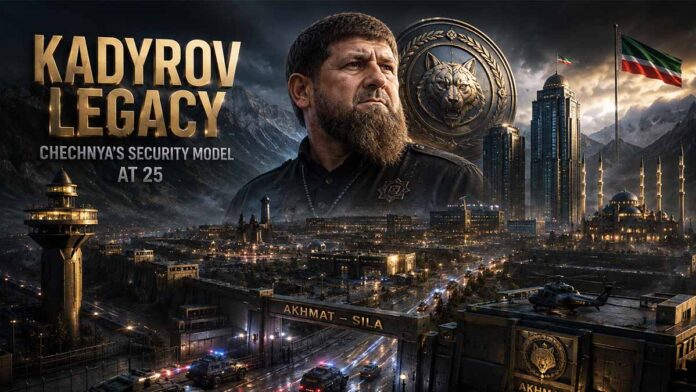


Executive Summary
- BLUF: Putin’s anniversary address elevates Akhmat Kadyrov from a historical actor into the founding symbol of a security compact linking Chechen stability, Russian territorial integrity and wartime mobilisation.
- The claim of “foreign-backed terrorism” contains a verifiable core: UN records document Al-Qaida financing, foreign commanders, training and recruitment connected to specific Chechen militant organisations.
- That evidence does not independently validate the broader proposition that foreign states collectively engineered the Chechen conflict.
- Kadyrov’s real strategic innovation was elite conversion: moving religious legitimacy, local armed networks and administrative authority from separatist resistance into the Russian federal system.
- The resulting model reduced organised insurgent capacity but concentrated political, coercive and distributive power around a personalised regional hierarchy.
- Its principal vulnerability is succession: stability depends on continued alignment among the Kremlin, Chechen leadership, security formations and federal financial support.
- The Ukraine war has transformed the Akhmat legacy from a regional pacification narrative into a transregional military-mobilisation instrument.
- Five-year baseline: institutional continuity remains more probable than systemic rupture, but leadership transition or declining federal patronage could rapidly expose latent fragilities.
Chechnya’s Security Compact: The Kadyrov Legacy Enters Its Hardest Test
On 23 August 2026, Vladimir Putin used the 75th anniversary of Akhmat-Hadji Kadyrov’s birth to restate one of the Kremlin’s most consequential post-Soviet doctrines: Chechnya’s security and Russia’s territorial integrity are indivisible. The commemoration was not only historical. It defined the political lineage, military utility and federal bargain governing Chechnya today. Akhmat Kadyrov’s decisive move away from the separatist order enabled Moscow to localise counterinsurgency, absorb former adversaries and rebuild a republic devastated by war. Under Ramzan Kadyrov, that settlement evolved into a personalised security compact supported by federal resources, approved religious authority and Chechen formations operating far beyond the North Caucasus. Its achievements are substantial; so are its unresolved risks. War in Ukraine, sanctions and the unanswered question of institutional succession are now testing whether a system built through personal loyalty can survive beyond the individuals who created it.
The Historical Conversion
Putin’s anniversary address presented Akhmat Kadyrov as the leader who assumed “colossal responsibility” when Chechen society was divided and the republic lay in ruins. He described Kadyrov’s essential position as unequivocal: Chechnya’s destiny could not be separated from Russia’s. The address further portrayed his mission as extending beyond the termination of a fratricidal conflict to the construction of a barrier against international terrorism supported from abroad — Address on the 75th Anniversary of the Birth of Akhmat Kadyrov – President of Russia – 23/08/2026 — official Kremlin text.
That formulation captures the political meaning Moscow assigns to Kadyrov’s transition, but it compresses several different conflicts into a single narrative. Kadyrov had possessed religious authority within the separatist system before breaking with commanders whose strategy was moving from Chechen independence towards transnational jihad. His strategic importance was not simply that he changed sides. He helped Moscow distinguish between armed constituencies that could be incorporated and organisations that would be isolated and destroyed.
This conversion changed the conflict’s operating model. Russian firepower remained decisive, but local clerical authority, intelligence access, amnesties and defections increasingly weakened the insurgency from within. Counterterrorism, counterinsurgency and political consolidation became mutually reinforcing, although they were never synonymous. The first targeted terrorist networks; the second separated armed organisations from their social environment; the third concentrated authority within a new regional order.
The Foreign Network
The existence of foreign-jihadist penetration is supported by evidence independent of the Kremlin. The United Nations Security Council listed the Islamic International Brigade, permanent reference QDe.099, on 04/03/2003 for association with Al-Qaida, Osama bin Laden and the Taliban. Its narrative summary identifies Shamil Basayev and the Saudi-born Ibn al-Khattab as leaders, documents organisational links with the Special Purpose Islamic Regiment and records cooperation in terrorist activity.
The UN states that emissaries of Basayev and Al-Khattab travelled to Bin Laden’s Kandahar base in October 1999. According to the same record, Bin Laden agreed to military and financial assistance, including arrangements to send several hundred fighters to Chechnya. The UN also records subsequent financing for training, recruitment and ammunition, several million US dollars received from international terrorist organisations, and several hundred Chechens trained in Al-Qaida camps in Afghanistan — Islamic International Brigade Narrative Summary QDe.099 – United Nations Security Council – 07/09/2010 — UN sanctions record.
The Special Purpose Islamic Regiment, permanent reference QDe.101, was likewise listed on 04/03/2003. The UN reports that its commander Arbi Barayev sent personnel to Taliban-controlled Afghanistan and that the organisation interacted with Al-Qaida-linked formations — Special Purpose Islamic Regiment Narrative Summary QDe.101 – United Nations Security Council – 07/09/2010 — UN sanctions record.
These records substantiate foreign fighters, financing, training and organisational connectivity. They do not establish that every Chechen separatist belonged to Al-Qaida or that foreign states collectively directed the conflict. Putin’s reference to terrorism encouraged by Russia’s foreign enemies therefore contains a documented non-state core but extends beyond what the cited UN evidence independently proves about state sponsorship.
The Price of Pacification
The restoration of territorial control cannot be evaluated exclusively through the decline of insurgent violence. The institutional record also contains extensive findings concerning abuses by federal and pro-Russian Chechen forces. On 07/10/2004, the Parliamentary Assembly of the Council of Europe adopted Resolution 1403, condemning terrorism and serious violations committed by all sides. It explicitly condemned the assassination of Akhmat Kadyrov on 09/05/2004, the attacks of 22/06/2004 and 20/08/2004, and the August–September 2004 terrorist sequence culminating in Beslan. The same resolution condemned murder, forced disappearance, torture, hostage-taking, rape and arbitrary detention attributed to members of federal and pro-Russian Chechen security forces — The Human Rights Situation in the Chechen Republic, Resolution 1403 – Parliamentary Assembly of the Council of Europe – 07/10/2004 — official adopted text.
This dual record is essential. Terrorist attacks against civilians cannot be excused as resistance; counterterrorist necessity cannot legalise torture, disappearance or unaccountable force. The durable Chechen settlement emerged from the simultaneous destruction of jihadist networks, exhaustion of organised separatism, co-option of local commanders, massive reconstruction and concentration of political authority. Stability was achieved, but through a model in which security effectiveness and political personalisation developed together.
Personalised Federalism
The resulting compact is neither ordinary decentralisation nor formal autonomy. Moscow retains sovereignty, statutory command and ultimate escalation authority. Grozny receives wide latitude in regional elite management, identity policy, religious administration and locally recruited security structures. Its effectiveness depends on an unusual convergence: federal legality and regional personal loyalty point towards the same strategic objective.
The formal chain matters. Units carrying the Akhmat name operate inside the Federal National Guard Service, the Ministry of Internal Affairs or the Ministry of Defence rather than as legally sovereign Chechen armed forces. Yet recruitment networks, ceremonial culture and political identity remain deeply regional. This produces command duality: federal institutional subordination coexists with symbolic attachment to the Kadyrov leadership and Akhmat-Hadji’s legacy.
That arrangement gives the Kremlin locally embedded coercive capacity, intelligence access and military manpower without conceding separatist sovereignty. It gives Grozny federal protection, reconstruction resources and influence disproportionate to its economic weight. Its central vulnerability is equally clear: the compact relies heavily on personal brokerage. A legal successor could inherit the office without inheriting Kremlin confidence, security obedience, clerical support and elite consensus in equal measure.
Religion as Security
Religion is one of the compact’s governing infrastructures. Akhmat Kadyrov’s clerical background enabled him to present alignment with Moscow as the protection of Chechen society and indigenous Islam against transnational jihadism. Under Ramzan Kadyrov, approved religious authority, public commemoration and state-sponsored tradition became integrated into regional governance.
The system does more than oppose violent extremism. It defines the boundaries of legitimate religious expression, connects Islamic identity with Russian patriotism and turns the memory of civil conflict into an argument against political-religious fragmentation. It also gives Moscow a strategic asset: Chechnya functions as evidence that a strong Muslim identity can coexist with intense loyalty to the Russian state.
The risk arises when the distinction between violent radicalisation and non-violent dissent becomes opaque. A religious system closely connected to political patronage can obstruct extremist recruitment, but it can also weaken independent theological authority. Over time, digital religious networks, diaspora platforms and generational change may make that monopoly more difficult to preserve.
The Ukraine Transformation
The war in Ukraine has converted the Kadyrov compact from a regional pacification model into an expeditionary system. At the Kremlin meeting of 20/08/2024, Ramzan Kadyrov reported that more than 47,000 fighters had been sent to the theatre since 2022, including approximately 19,000 volunteers trained at the Russian Special Forces University in Gudermes — Working Meeting with Head of Chechnya Ramzan Kadyrov – President of Russia – 20/08/2024 — official Kremlin record. These are official Russian figures, not independently audited counts.
On 06/02/2026, the Chechen territorial administration of Rosgvardia reported that 67,873 servicemen had been sent through rotations since the operation began and that approximately 14,000 personnel from the Ministry of Defence, Rosgvardia, Akhmat formations and the regional Interior Ministry detachment were then performing missions. The same official statement recorded 30 regional social-support measures for participants and their families — Chechen Rosgvardia Chief Participates in Operational Headquarters Meeting – Federal National Guard Service – 06/02/2026 — official Rosgvardia record.
The categories may overlap and represent cumulative rotations rather than unique personnel. Their strategic meaning nevertheless remains considerable. Chechnya supplies mobilisation capacity, training and a recognisable military brand; Moscow supplies federal status, resources and political protection. War service creates prestige and promotion channels but also casualties, trauma, welfare commitments and a growing veteran constituency. The compact’s future will depend on whether returning personnel are absorbed into formal employment and social protection without producing unequal claims or new factional networks.
Sanctions and Liquidity
Sanctions target precisely the overlap between politics, military support, charitable activity and economic networks. On 10/12/2020, the US Treasury designated Ramzan Kadyrov under Executive Order 13818 and listed the Akhmat Kadyrov Foundation, FC Akhmat Grozny, Akhmat MMA, Absolute Championship Akhmat, Megastroyinvest and Chechen Mineral Waters. The Treasury stated that the companies were owned or controlled by Kadyrov or the foundation — Treasury Sanctions Serious Human Rights Abusers on International Human Rights Day – US Department of the Treasury – 10/12/2020 — official OFAC action. Those are US executive determinations, not judicial convictions.
On 24/06/2024, the Council of the European Union adopted Decision CFSP 2024/1738 within its fourteenth sanctions package and listed the Kadyrov Foundation. The Council associated the organisation with programmes concerning Ukrainian children. The restrictive measures include asset freezes and prohibitions on EU persons and companies making funds available to listed entities — Fourteenth Sanctions Package concerning Russia’s War against Ukraine – Council of the European Union – 24/06/2024 — official Council record.
Sanctions are unlikely to dissolve the compact by themselves. They raise transaction costs, restrict foreign assets and intensify scrutiny of intermediaries. If Moscow replaces blocked external channels with domestic funding and in-kind provision, sanctions may deepen Grozny’s dependence on the federal centre. The destabilising threshold would be reached only if pressure interrupted salaries, equipment, reconstruction, veteran welfare and elite distribution simultaneously.
The Succession Test
No verified primary source consulted for this article identifies an officially designated successor to Ramzan Kadyrov or a formally approved Kremlin transition plan. The strategic question must therefore be framed without speculation: can authority be transferred across five different systems—constitutional office, presidential trust, coercive command, elite patronage and religious legitimacy—without fracturing their alignment?
The most stable outcome would preserve the Akhmat doctrine while progressively distributing executive and security responsibilities across federally recognised institutions. A more centralised alternative would see Moscow rotate commanders, tighten financial oversight and reduce dependence on a single regional broker. The dangerous path would involve competing factions claiming the same historical legitimacy while seeking control over personnel, resources and Kremlin access.
The warning signals are institutional, not theatrical: changes in who meets Putin; unexplained command rotations; delayed security or veteran payments; competing commemorations; divergent clerical endorsements; contractor substitution; or abnormal movement of elite assets. None would prove destabilisation independently. Their convergence would matter.
The Strategic Balance
The Kadyrov system has delivered something Moscow failed to achieve through external force alone: the conversion of Chechen particularism into an instrument of Russian sovereignty. It localised security, reorganised religious legitimacy and transformed a former insurgent theatre into a source of expeditionary manpower. Yet it did so by concentrating political and coercive brokerage around a narrow leadership architecture.
Between 2026 and 2031, the principal danger is not an automatic return to the wars of the 1990s. It is a coordination failure produced by succession uncertainty, accumulated veteran obligations, tighter liquidity and competition across security networks. Militant regeneration would become strategically significant only if such fractures created operational space for recruitment, financing and clandestine organisation.
The Kremlin must therefore solve a contradiction of its own success. It needs to institutionalise the compact sufficiently to survive its present custodians without dismantling the personalised cohesion that makes it effective. Grozny, in turn, must demonstrate that its loyalty is transferable without surrendering the autonomy and political value obtained through that loyalty. The outcome will determine whether the Akhmat Kadyrov legacy remains a durable federal settlement—or becomes the name of a system that could not outlive its founders.
Master Abstract
President Vladimir Putin’s address of 23 August 2026 is best interpreted not merely as a commemoration but as a deliberate restatement of the Russian state’s preferred causal history of post-Soviet Chechnya. Putin describes Akhmat-Hadji Kadyrov as the leader who accepted “colossal responsibility” when Chechen society was fractured, affirmed that Chechnya’s fate was inseparable from Russia’s and erected a barrier against international terrorism allegedly encouraged from abroad. The speech, including its precise language, date and anniversary context, is directly documented in the Russian presidency’s official record — Address on the 75th Anniversary of the Birth of Akhmat Kadyrov – President of Russia – August 2026 — verified Kremlin transcript. Analytically, however, three propositions must remain separate. First, Kadyrov did move from serving as mufti of the separatist Chechen Republic of Ichkeria to cooperating with Moscow, subsequently becoming president of the Chechen Republic within the Russian Federation in 2003. Second, transnational jihadist penetration was real rather than wholly invented: the UN Security Council records links among the Special Purpose Islamic Regiment, the Islamic International Brigade, Al-Qaida, the Taliban and Osama bin Laden; it reports that Bin Laden sent money in 1999 to commanders including Shamil Basayev, Arbi Barayev and Al-Khattab for recruitment, ammunition and training, while other international terrorist organisations channelled several million dollars to Chechen extremists — Special Purpose Islamic Regiment Narrative Summary – United Nations Security Council – current consolidated record — verified UN sanctions record. The UN separately records Basayev’s and Al-Khattab’s Afghan connections and the training of several hundred Chechens in Al-Qaida camps — Islamic International Brigade Narrative Summary – United Nations Security Council – current consolidated record — verified UN sanctions record. Third, those records substantiate foreign fighters, foreign terrorist financing and transnational organisational connections; they do not, by themselves, prove Putin’s broader formulation that unspecified foreign “enemies of Russia” fostered the entire conflict. The evidentiary judgment is therefore differentiated: high confidence in jihadist external support to identifiable armed factions; moderate confidence that this support materially intensified the second war; low confidence, absent further primary documentation, in any universal theory of coordinated foreign-state direction.
Kadyrov’s decisive contribution was not simply military assistance to Moscow but the construction of a conversion mechanism through which resistance resources were absorbed into federal sovereignty. In structural terms, the model combined five functions: religious de-radicalisation, selective amnesty and elite co-option, localisation of coercion, reconstruction-financed patronage and public redefinition of Chechen honour as compatible with Russian statehood. This reduced Moscow’s dependence on exclusively external occupation forces and enabled local actors to identify insurgent networks, negotiate defections and impose social control with far greater cultural and human-terrain knowledge. Yet the mechanism also generated a central analytical paradox: the restoration of federal territorial control occurred partly through exceptional regional autonomy in security practice, elite management and symbolic politics. Kadyrov’s assassination during the Victory Day ceremony in Grozny on 9 May 2004 demonstrated both the continuing operational reach of militant networks and the vulnerability of a political order concentrated around emblematic leadership; the fact and circumstances of the stadium bombing are recorded in the European Court of Human Rights’ institutional account — Tagayeva and Others v. Russia – European Court of Human Rights – April 2017 — verified ECHR case record. Subsequent consolidation under Ramzan Kadyrov transformed the compact from transitional counterinsurgency into a durable system of personalised federalism. An Analysis of Competing Hypotheses therefore requires at least five concurrent explanations rather than a single triumphalist or coercion-only account: H₁, stability derives primarily from successful counterterrorism; H₂, it derives from locally administered coercive dominance; H₃, it is purchased through federal transfers and reconstruction patronage; H₄, it reflects a durable social rejection of renewed war; and H₅, it results from a mutually dependent bargain in which Moscow receives loyalty and expeditionary manpower while Grozny receives political discretion, resources and federal protection. Available primary evidence rejects none of these hypotheses completely. The strongest synthesis is a compound explanation dominated by H₅, with H₂ and H₄ providing stabilising reinforcement, H₃ supplying material resilience and H₁ explaining only part of the decline in organised violence.
The 2026–2031 outlook turns on whether this compound model can survive the erosion or abrupt removal of any one of its central supports. The most probable baseline is continued vertical alignment: Moscow will preserve the Akhmat Kadyrov historical canon because it legitimises both federal victory in the North Caucasus and present-day mobilisation in Ukraine, while the Chechen leadership will continue presenting military service as the contemporary fulfilment of Akhmat-Hadji’s unionist choice. Nevertheless, the transfer of this symbolism into the Ukraine theatre creates strategic externalities. The European Union has maintained restrictive measures against Ramzan Kadyrov for conduct supporting actions against Ukraine’s territorial integrity; the official listing records his statements in support of Crimea’s annexation and his declared readiness to provide Chechen volunteers — EU Restrictive Measures Concerning Actions Undermining Ukraine – Council of the European Union – March 2015 consolidated table — verified Council document. The EU has also listed the Akhmat Kadyrov Foundation, alleging that it supports incentives for Chechen combatants and programmes involving Ukrainian children — Restrictive Measures in View of Russia’s Actions Destabilising Ukraine – Council of the European Union – June 2024 — verified Council document. These are official EU determinations, not neutral judicial findings, but they show that the Kadyrov legacy now has sanctions, financial and reputational consequences beyond Russia. A judgmental Bayesian update begins with a 60% prior probability of uninterrupted compact continuity through 2031; evidence of institutional entrenchment, wartime utility and mutual dependence raises the conditional baseline to approximately 68%, while succession uncertainty, sanctions exposure, war casualties, fiscal pressure and intra-elite competition preserve a substantial adverse tail. The principal alternative outcomes are managed succession at approximately 15%, coercive recentralisation at 9%, elite fragmentation at 5% and militant regeneration at 3%. These figures are structured analytical estimates rather than observed frequencies. A Monte Carlo model should therefore vary six correlated drivers—leadership continuity, Kremlin patronage, coercive cohesion, public war fatigue, militant opportunity and external pressure—while tracking shadow dimensions including informal recruitment finance, sanctions-evasion channels, private coercive networks, encrypted propaganda and the migration of combat experience back into the North Caucasus. The decisive warning indicators are not isolated attacks but simultaneous deterioration across elite loyalty, security-force cohesion and federal liquidity.
Kadyrov Compact: 2026–2031
Structural Drivers
Competing Outcomes
Shadow-Dimension Watch Matrix
Historical Conversion and Evidence Integrity: Akhmat Kadyrov, Transnational Jihadism and the Architecture of Russian Consolidation
Akhmat-Hadji Kadyrov’s political conversion cannot be reduced to a binary movement from separatism to collaboration. It was a staged realignment of religious authority, security interests and concepts of Chechen survival under conditions in which the political order created after the first Chechen war was disintegrating. As mufti of the self-proclaimed Chechen Republic of Ichkeria, Kadyrov had given religious legitimacy to resistance against Russian forces during the 1994–1996 conflict. His subsequent break with the separatist leadership emerged principally during the interwar period, when the weak Ichkerian administration could not monopolise violence, reconstruct the economy or contain armed commanders whose political projects increasingly diverged from Chechen ethno-nationalism. The critical rupture came around the 1999 incursion into Dagestan led by Shamil Basayev and the Saudi-born commander Ibn al-Khattab, which attempted to expand armed Islamist revolution beyond Chechnya. Kadyrov’s rejection of that project allowed him to redefine cooperation with Moscow not publicly as capitulation, but as a defence of Chechen society against externally connected radical networks and another destructive war. Putin’s 2026 commemoration institutionalises precisely this interpretation: it presents Kadyrov as assuming responsibility when the republic was divided, affirming the inseparability of Chechnya and Russia, and building a barrier against international terrorism. This is the Kremlin’s authoritative statement of its own historical position, not an independently adjudicated causal account — Обращение по случаю 75-й годовщины со дня рождения Ахмата Кадырова – President of Russia – August 2026 — verified official Kremlin address. Kadyrov’s conversion should consequently be analysed as a transaction between unequal but mutually useful actors: Moscow required a locally credible intermediary capable of fragmenting the insurgency, while Kadyrov required federal military power, administrative recognition and reconstruction resources to defeat transnational rivals and establish a viable post-war authority. The transaction converted religious legitimacy into political brokerage, local combat knowledge into counterinsurgent intelligence and federal recognition into an instrument for reorganising Chechen elites.
The sequence mattered because Kadyrov did not merely cross from one political camp to another; he helped change the operational identity of the conflict. During the first war, much of the armed resistance could plausibly be described through the framework of territorial separatism, even though Islamist currents and foreign volunteers were already present. By 1999–2002, the armed environment contained overlapping constituencies: nationalist formations seeking independence, village and clan-based defence networks, criminal entrepreneurs, religious radicals, foreign combat veterans and organisations developing explicit relationships with the wider Al-Qaida ecosystem. Moscow’s strategic opportunity lay in disaggregating these constituencies and denying insurgent leaders the ability to represent them as a unified national liberation movement. Kadyrov supplied the indigenous political and theological authority required for this disaggregation. Once appointed head of the Moscow-backed Chechen administration in 2000, he could offer selected commanders a route into the new order while depicting irreconcilable factions as enemies of both Russia and Chechnya. His election as president of the Chechen Republic in October 2003 then translated wartime brokerage into a formal constitutional office, although the surrounding environment remained heavily securitised. The process followed an identifiable conversion chain: ideological rupture produced elite defection; defection produced access to local networks; network access enabled selective co-option and targeting; those activities weakened insurgent cohesion; and weakened cohesion made constitutional normalisation more feasible. This mechanism does not establish that consent was universal or that the political process was fully competitive. It establishes that Moscow’s consolidation strategy became more sophisticated than the application of federal firepower alone. Kadyrov transformed the federal campaign from an externally imposed operation into a hybrid system in which Chechen actors performed security, religious and administrative functions on behalf of the restored federal order. That transformation is the analytical foundation of the later “Chechenisation” of the conflict, even where the official Russian narrative avoids the term.
The Transformation of Chechen Governance and Federal Alignment
From post-1996 structural fragmentation to Dagestan rupture, co-option, and personalized political consolidation
Kadyrov rejects radical expansion → Alignment with Russian federal power
What the primary evidence proves about foreign penetration
The evidentiary foundation for foreign-jihadist penetration is considerably stronger than either a blanket denial of transnational involvement or an unqualified acceptance of every Russian attribution. The UN Security Council’s sanctions record identifies the Islamic International Brigade, or IIB, as an entity associated with Al-Qaida, Osama bin Laden and the Taliban. It states that the organisation was founded and led by Basayev, linked to the Special Purpose Islamic Regiment and the Riyadus-Salikhin formation, and jointly involved in the October 2002 Dubrovka theatre hostage-taking. More importantly for attribution, the UN narrative reports that emissaries of Basayev and Al-Khattab travelled to Bin Laden’s base in Kandahar in October 1999; that Bin Laden agreed to military and financial assistance, including arrangements for several hundred fighters; that funds were intended for training, mercenary recruitment and ammunition; and that several hundred Chechens trained in Al-Qaida camps in Afghanistan — Islamic International Brigade Narrative Summary – United Nations Security Council – September 2010 — verified UN Security Council record. The corresponding UN record for the Special Purpose Islamic Regiment identifies the same organisational interfaces and reports that Arbi Barayev sent fighters to Taliban-controlled Afghanistan, while foreign terrorist organisations channelled several million US dollars to Chechen extremists — Special Purpose Islamic Regiment Narrative Summary – United Nations Security Council – September 2010 — verified UN Security Council record. These records support four high-confidence findings: foreign commanders participated in the theatre; Al-Qaida-linked financing reached identifiable Chechen formations; Afghan training and personnel circulation connected the North Caucasus with a broader militant ecosystem; and parts of the insurgency adopted transnational terrorist methods directed against civilians. They do not demonstrate that every separatist formation belonged to Al-Qaida, that all external money was terrorist financing, or that foreign jihadists numerically dominated Chechen resistance. Penetration was strategically consequential because it altered capabilities, ideology and target selection, not necessarily because foreigners constituted a majority of combatants.
The foreign-support architecture was also geographically broader than a simple Afghanistan-to-Chechnya pipeline. The UN record concerning Omar Mahmoud Uthman, also known as Abu Qatada, states that between 1999 and 2001 he played an important role in the United Kingdom in raising money, logistical support and recruits for fighters in Chechnya. It records that British and foreign currency valued above 170,000 pounds was found when he was arrested in February 2001, including a smaller amount specifically marked for fighters in Chechnya, and describes money collected among European supporters for both legitimate and illicit causes — Omar Mahmoud Uthman Narrative Summary – United Nations Security Council – March 2009 — verified UN Security Council record. This evidence illuminates a shadow dimension frequently flattened by political rhetoric: humanitarian solidarity, diaspora mobilisation, religious charitable giving, logistical facilitation and terrorist finance could coexist inside overlapping channels without every contributor understanding the final beneficiary. Intelligence analysis must therefore distinguish source intention from network effect. A transfer originating as relief money could be diverted; a legitimate refugee-support network could be exploited by a militant facilitator; and a recruiter could use the moral language of civilian protection to move personnel toward armed training. The relevant architecture included financiers, clerics, couriers, travel facilitators, charities, informal money-transfer systems and digital propaganda nodes. It also operated reciprocally: the UN documentation indicates that Chechen personnel entered Afghan networks while foreign veterans and resources moved toward the Caucasus. This multidirectional circulation is stronger evidence of transnationalisation than the mere presence of individual Arab volunteers. Nevertheless, the sanctions narratives remain administrative records supporting listings, not criminal judgments testing every underlying intelligence report through adversarial procedure. They warrant high confidence that the named networks existed and interacted, but not automatic acceptance of every numerical estimate. Proper evidence grading therefore assigns A-level institutional authority to the UN source, B-level confidence to specific quantified claims derived from intelligence reporting and C-level confidence to any broader inference regarding the total share of the insurgency controlled from abroad.
| Evidentiary proposition | Primary-source support | Confidence | What cannot be inferred |
|---|---|---|---|
| Foreign jihadist commanders operated in Chechnya | UN identification of Al-Khattab and Arab-state personnel in IIB | High | Foreign numerical dominance |
| Al-Qaida-related finance reached named formations | UN records of transfers to Basayev, Barayev and Al-Khattab | High | Financing of the entire separatist movement |
| Afghan training linked Chechen militants to Al-Qaida | UN record of training camps and personnel circulation | High | Uniform ideological allegiance |
| European support channels were exploited | UN record concerning Abu Qatada’s fundraising and logistics | Medium–high | Criminal intent by every donor or charity |
| Foreign governments directed the conflict | No verified primary document establishes general state command | Low | Coordinated Western or multinational control |
| Kadyrov’s realignment materially fragmented resistance | Strong structural fit and official Russian evidence | Medium–high | A single-cause explanation for pacification |
The attribution gap in the Kremlin narrative
The Kremlin’s phrase that international terrorism was “fostered and encouraged from abroad by the enemies of Russia’s multi-ethnic people” merges three analytically different propositions: transnational non-state support, permissive foreign environments and hostile state sponsorship. The first is supported by the UN records. The second is plausible and partly supported where fundraising, recruitment or facilitation occurred in foreign jurisdictions before authorities disrupted it. The third requires evidence of direction, control, knowing material support or coordinated policy by a foreign government; the verified source base examined here does not establish such a general proposition. The attribution gap is therefore not between “foreign involvement” and “no foreign involvement,” but between demonstrated network penetration and an expansive geopolitical claim about hostile states. This distinction matters because official narratives often aggregate charities, diaspora activists, intelligence services, governments, jihadist organisations and foreign fighters into a single external adversary. Such aggregation increases political utility: it converts a complex civil and insurgent conflict into a defence of national sovereignty, retrospectively legitimises extraordinary force and places domestic collaborators with Moscow on the side of civilisational survival. It also obscures endogenous causes, including the collapse of governance, grievances produced by war, criminalisation, intra-Chechen rivalry and abuses by security forces. The Parliamentary Assembly of the Council of Europe concluded in January 2000 that Russian operations involved indiscriminate and disproportionate force and serious violations affecting civilians — Conflict in Chechnya, Recommendation 1444 – Parliamentary Assembly of the Council of Europe – January 2000 — verified PACE text. In April 2000, it further identified the destruction of Grozny and alleged murders, rape, arbitrary detention and ill-treatment by federal forces — Conflict in the Chechen Republic, Recommendation 1456 – Parliamentary Assembly of the Council of Europe – April 2000 — verified PACE text. These institutional findings do not negate jihadist penetration. They demonstrate that an adequate causal model must simultaneously include terrorism, separatism, state violence, institutional collapse and political consolidation.
International primary sources also prevent a false moral symmetry while requiring a dual-accountability framework. The Council of Europe’s 2004 resolution condemned serious violations committed by all sides and specifically denounced the sequence of terrorist attacks culminating in Beslan — The Human Rights Situation in the Chechen Republic, Resolution 1403 – Parliamentary Assembly of the Council of Europe – October 2004 — verified PACE resolution. Separately, the Council of Europe’s anti-torture committee reported after six visits that torture and other ill-treatment by law-enforcement personnel and federal forces remained recurrent and that accountability measures were largely ineffective — Public Statement Concerning the Chechen Republic – European Committee for the Prevention of Torture – July 2003 — verified Council of Europe statement. Evidence integrity requires retaining both categories rather than using one to erase the other. Terrorist attacks on civilians, hostage-taking and Al-Qaida-linked financing cannot be reframed as legitimate simply because federal forces committed abuses. Conversely, counterterrorist necessity cannot retroactively legalise indiscriminate force, disappearance, torture or unaccountable detention. This dual test exposes the principal weakness of the Kremlin’s consolidated narrative: it correctly identifies a real transnational-jihadist vector but uses that vector as an organising explanation broad enough to absorb the separatist, civil-war, governance and human-rights dimensions. The result is politically coherent but analytically overdetermined. Kadyrov’s conversion assisted in defeating extremist networks, yet it also enabled a transfer of coercive responsibility to local actors and supported the construction of a concentrated political order. “Peace restoration” and “political monopolisation” were therefore not mutually exclusive outcomes. They developed through many of the same mechanisms—elite defection, selective amnesty, local intelligence, coercive control, religious standardisation and the distribution of reconstruction resources.
Counterterrorism, counterinsurgency and consolidation
The terminological distinction is operational rather than semantic. Counterterrorism targets organisations, cells and individuals engaged in terrorist violence; its core instruments are intelligence collection, network disruption, arrest, targeted force, financial interdiction and protection of vulnerable targets. Counterinsurgency addresses an armed political challenge embedded within a population; it combines security operations with population control, elite accommodation, information activity, governance and efforts to separate insurgents from passive or active support. Political consolidation restructures the post-conflict distribution of authority by controlling appointments, institutions, coercive organisations, public narratives, religious administration and economic resources. Kadyrov’s trajectory intersected all three layers, but differently. His religious denunciation of radical formations and assistance in identifying their networks supported counterterrorism. His capacity to induce defections, mobilise local security personnel and present federal alignment as a Chechen interest supported counterinsurgency. His installation within the federal constitutional framework, control over emergent regional institutions and association of stability with a specific leadership lineage supported political consolidation. Conflating these layers creates a measurement error: a decline in terrorist incidents can demonstrate successful network suppression without proving accountable governance; electoral or administrative normalisation can indicate institutional restoration without establishing pluralistic competition; and elite loyalty can produce short-term order while accumulating succession risk. The appropriate evaluation framework therefore uses separate outcome variables. CT effectiveness measures leadership attrition, disrupted financing, attack frequency and cell regeneration. COIN effectiveness measures insurgent recruitment, territorial access, civilian cooperation and defection. Consolidation measures coercive concentration, elite turnover, institutional autonomy, fiscal dependence and succession resilience. Under this framework, the Kadyrov model appears highly effective at insurgent fragmentation and regime consolidation, effective but not solely responsible for counterterrorist suppression, and structurally vulnerable where stability depends on personalised brokerage rather than impersonal institutions.
| Analytical layer | Principal object | Kadyrov-era mechanism | Valid success indicator | Principal distortion risk |
|---|---|---|---|---|
| Counterterrorism | Terrorist cells and support networks | Local intelligence, theological delegitimation, targeting | Reduced operational capability and finance | Treating all dissent as terrorism |
| Counterinsurgency | Armed political mobilisation | Defections, amnesties, population penetration | Lower recruitment and territorial reach | Mistaking coercive silence for consent |
| Political consolidation | Post-war authority structure | Elite integration, institutional control, patronage | Stable command and administrative continuity | Equating regime continuity with durable peace |
| Narrative warfare | Public interpretation of conflict | Akhmat legacy, sovereignty framing | Broad reproduction of official causal story | Erasure of endogenous grievances |
| External security diplomacy | Recognition of Russia’s framing | Bilateral counterterrorism alignment | Reduced external support for separatism | Mutual validation of expansive security doctrines |
Competing hypotheses and Bayesian adjudication
An Analysis of Competing Hypotheses produces at least five viable explanations for Kadyrov’s conversion and the subsequent decline of organised rebellion. H₁ holds that he converted primarily because foreign jihadism displaced Chechen nationalism and threatened indigenous religious authority. H₂ holds that Russian military superiority made renewed separatist victory implausible, turning alignment into strategic survival. H₃ interprets the conversion as elite competition: Kadyrov used Moscow to defeat rival commanders and monopolise regional authority. H₄ emphasises societal exhaustion after two wars, arguing that public demand for physical security created space for a leader promising peace within Russia. H₅ treats the outcome as a federal bargain exchanging Chechen loyalty and local coercive capacity for resources, autonomy and protection. A sixth hypothesis, H₆, attributes pacification predominantly to federal counterterrorist attrition independent of Kadyrov’s political role. The evidence is most consistent with a compound model rather than a winner-take-all conclusion. The documented foreign networks materially strengthen H₁, but cannot alone explain the durability of the post-war order. The timing of Kadyrov’s realignment and Russia’s return to overwhelming force support H₂. The later concentration of authority supports H₃, while the memory of devastation and diminished mass appetite for another war support H₄. The durable mutual dependence between Moscow and the Chechen leadership gives H₅ the greatest overall explanatory coverage. H₆ explains the removal of militant leaders but poorly explains local legitimation, elite absorption and institutional continuity. Using judgmental Bayesian probabilities, an initial evenly distributed prior of approximately 16.7% for each hypothesis updates after the verified evidence to H₁ at 20%, H₂ at 17%, H₃ at 16%, H₄ at 15%, H₅ at 26% and H₆ at 6%. These are disciplined comparative estimates, not measured frequencies. Their function is to expose assumptions and permit revision if new primary evidence emerges.
| Hypothesis | Core explanation | Evidence that raises probability | Evidence that lowers probability | Updated weight |
|---|---|---|---|---|
| H₁ | Defence against foreign-jihadist capture | UN-documented Al-Qaida links and foreign commanders | Nationalist resistance remained distinct | 20% |
| H₂ | Adaptation to Russian military superiority | Federal escalation and collapsing separatist capacity | Conversion involved proactive local coalition-building | 17% |
| H₃ | Elite rivalry and personal consolidation | Rival displacement and later concentration | Does not independently explain social acceptance | 16% |
| H₄ | War exhaustion and demand for order | Destruction, displacement and conflict fatigue | Difficult to measure under coercive conditions | 15% |
| H₅ | Mutual Kremlin–Grozny security bargain | Exchange of loyalty, resources and local coercion | Dependent on continuing federal alignment | 26% |
| H₆ | Federal attrition alone defeated insurgency | Leadership losses and security pressure | Cannot explain legitimation and elite integration | 6% |
The Chinese official position provides a multilingual cross-check of geopolitical framing, but not independent corroboration of Russian causal claims. In a 2004 joint statement, China and Russia described terrorist and separatist forces in Chechnya and “East Turkistan” as components of international terrorism, opposed double standards and supported each other’s measures to restore constitutional order and suppress separatism — China and Russia Issue a Joint Statement – Ministry of Foreign Affairs of the People’s Republic of China – October 2004 — verified Chinese Foreign Ministry text. This document is strategically important because it shows reciprocal norm construction: Moscow’s Chechnya framing and Beijing’s Xinjiang framing became mutually reinforcing components of a sovereignty-first counterterrorism doctrine. It is not independent evidentiary confirmation because the statement represents an aligned political position negotiated by the two governments. The pattern remains active. In April 2025, Chinese and Russian deputy foreign ministers agreed to deepen bilateral and multilateral counterterrorism coordination and jointly address regional threats — China and Russia Hold Counter-Terrorism and Security Consultation at the Vice Foreign Ministerial Level – Ministry of Foreign Affairs of the People’s Republic of China – April 2025 — verified Chinese Foreign Ministry record. Over the next five years, this normative alignment will probably strengthen information exchange, sanctions-list coordination, online-extremism monitoring and diplomatic resistance to external scrutiny of domestic security operations. It also creates a persistent cyber-norm shadow: counter-extremism vocabularies can migrate into broader controls over separatist discourse, opposition networks and digital mobilisation. For European governments, the intelligence problem will be to distinguish genuine jihadist facilitation—still a legitimate security concern—from expansive designations that collapse violent and non-violent opposition. For Moscow and Beijing, the strategic benefit lies precisely in narrowing that distinction.
Five-year outlook, 2026–2031
The five-year outlook indicates that the historical conversion narrative will become more institutionally valuable, not less. The most likely scenario, assessed at 62%, is narrative consolidation: Akhmat Kadyrov’s choice will remain the founding doctrine through which Moscow explains the pacification of Chechnya, legitimises the present regional order and connects Chechen military participation outside the North Caucasus to defence of the Russian Federation. A second scenario, managed recalibration, carries an estimated 19% probability and would arise if leadership-transition considerations require the Kremlin to preserve the Akhmat canon while reducing dependence on one living political broker. A third, coercive recentralisation, at 10%, would involve Moscow tightening control over regional security and financial structures in response to elite fragmentation or declining trust. A fourth, latent insurgent regeneration, at 6%, would require the convergence of leadership weakness, economic stress, combat-returnee disaffection, online radicalisation and reduced security cohesion. A fifth, systemic elite fracture, remains a 3% tail risk but would have the highest impact because armed patronage networks could compete before federal authorities establish an accepted succession arrangement. Monte Carlo modelling should not treat these drivers as independent. Leadership uncertainty can reduce security cohesion; reduced cohesion can expand militant opportunity; fiscal contraction can intensify elite competition; and combat returnees can become either stabilising beneficiaries or destabilising reservoirs depending on patronage absorption. The critical warning system must therefore track joint thresholds rather than isolated events. The most significant indicators are unusual rotations within Chechen security commands, fragmentation of public elite messaging, changes in federal transfer timing, unexplained asset relocation, competing memorial claims over the Akhmat legacy, increased clandestine religious prosecutions, encrypted recruitment traffic and the return of combat-experienced personnel without durable institutional placement.
The resulting strategic judgment is deliberately narrower than the Kremlin’s assertion but stronger than a sceptical account that dismisses foreign-jihadist involvement as propaganda. Foreign penetration was real, organisationally structured and financially consequential. It contributed to the transformation of parts of the Chechen armed struggle, supplied Moscow with a credible counterterrorist rationale and gave Kadyrov a defensible basis for presenting his realignment as protection of Chechen society. Yet the verified evidence does not support treating the entire conflict as an externally manufactured terrorist war. Kadyrov’s contribution lay in exploiting the distinction between nationalist constituencies that could be co-opted and transnational formations that had to be isolated or destroyed. That differentiation was a counterinsurgency achievement; the targeting of terrorist organisations was a counterterrorism function; and the creation of a vertically organised, personalised regional order was political consolidation. Over 2026–2031, these categories will remain fused in official Russian memory because fusion legitimises both the methods and the outcome. Intelligence analysis must keep them separate. The integrity test is counterfactual: if foreign jihadist support had disappeared in 1999, Russia and Chechnya would still have faced unresolved sovereignty, governance, violence and reconstruction problems; if Russian abuses had disappeared, transnational terrorist networks and radical commanders would still have posed a genuine threat. Neither variable cancels the other. The durable explanation is an interactive model in which state violence, institutional collapse, separatist fragmentation, foreign-jihadist penetration, war exhaustion and elite conversion jointly produced the conditions for Kadyrov’s rise. The system that followed achieved territorial stabilisation, but its long-term resilience remains contingent on whether personalised brokerage can be converted into predictable institutions before succession pressure tests the compact.
The Kadyrov Security Compact: Personalised Federalism, Coercive Localisation and Expeditionary Power
The governing bargain behind Chechen stability
The Kadyrov security compact is best understood as an asymmetric federal bargain in which Moscow retains constitutional sovereignty, strategic supremacy and ultimate escalation control while Grozny receives unusually wide operational latitude over regional administration, identity management, elite discipline and locally recruited coercive institutions. It is neither conventional decentralisation nor full regional autonomy. In conventional federalism, competences are allocated through comparatively stable legal rules and impersonal institutions; in the Chechen case, the effective distribution of authority depends heavily on reciprocal confidence between the Russian presidency and the regional leadership. The arrangement produces a dual vertical: Chechen institutions formally belong to the Russian state, but their cohesion, recruitment culture and public identity remain closely associated with Ramzan Kadyrov, his familial-political network and the legacy of Akhmat-Hadji Kadyrov. This structure gives the Kremlin several advantages. It reduces the requirement for externally deployed federal forces to administer daily security, converts former sources of rebellion into defenders of territorial unity, supplies combat personnel for operations beyond Chechnya and demonstrates that an insurgent region can be reintegrated without conceding secession. Grozny receives federal political protection, reconstruction and development resources, access to national institutions and the authority to organise regional order through locally intelligible religious, historical and social codes. The August 2024 presidential meeting illustrates the public version of this exchange: Putin praised Grozny’s development, while Kadyrov reported socioeconomic stability, infrastructure construction and Chechnya’s military contribution — Working Meeting with Head of Chechnya Ramzan Kadyrov – President of Russia – August 2024 — verified Kremlin record. The compact’s central strength and central vulnerability are therefore identical: personalised trust compresses decision time and enforces loyalty, but weakens the distinction between durable federal institutions and a contingent relationship among particular leaders.
Personalised federalism does not imply that Chechnya exists outside Russian law or possesses formally sovereign armed forces. Its institutions operate inside the Russian constitutional and statutory system, and its principal uniformed formations carry federal legal identities under the National Guard, the Ministry of Internal Affairs or the Ministry of Defence. The distinctive feature lies in the coexistence of formal federal subordination with regional social embeddedness, symbolic branding and leadership networks. Moscow can therefore describe the system as complete constitutional integration, while Grozny can present the same system as recognition of Chechen dignity and agency. This dual representation is indispensable. If Moscow portrayed the arrangement as unqualified occupation, it would destroy the local legitimacy that makes coercive localisation useful; if Grozny portrayed it as de facto sovereignty, it would challenge the territorial settlement on which federal support depends. The compact instead codifies a political grammar in which loyalty to Chechnya, loyalty to the Kadyrov legacy and loyalty to Russia are presented as mutually reinforcing. A 2010 Kremlin meeting already captured this formula: then-president Dmitry Medvedev linked reconstruction and restored normality to Akhmat Kadyrov’s objective of life within the Russian Federation, while Ramzan Kadyrov described the regional executive as implementing his father’s testament through service to both the Chechen people and Russia — Beginning of Working Meeting with President of Chechnya Ramzan Kadyrov – President of Russia – June 2010 — verified Kremlin transcript. This discursive continuity shows that the compact is not an improvised wartime arrangement created after 2022. It is a mature political architecture that has progressively expanded from regional pacification into national military utility, patriotic mobilisation and Russian power projection.
The Chechen Executive Vertical and Federal Power Architecture
Sovereignty, elite brokerage, coercive localization, and expeditionary feedback loops
Sovereignty and protection
Personal brokerage and elite management
- Clergy and memory
- Traditional Islam
- Rosgvardia, MVD, MoD
- Volunteer channels
- Budgets and contracts
- Welfare and foundations
Mobilisation · discipline · reconstruction · loyalty
Ukraine · occupied territories · national branding
Prestige · veterans · resources · combat expertise · risk
The Mechanics of Federal-Chechen Integration
The governance structure established between the Russian Presidency and the Chechen Executive Vertical operates through a unique, personalized compact of delegated authority. In exchange for absolute strategic loyalty and internal pacification, Moscow provides unyielding political protection and massive federal budgetary transfers.
This vertical is sustained by three interlocking pillars: a controlled religious order promoting traditional Sufi Islam and state-aligned clerical memory; deep coercive localization via loyal security structures (Rosgvardia, MVD, and volunteer battalions); and an expansive patronage network fueled by state contracts and foundations. Together, these mechanisms generate domestic stability and enable aggressive expeditionary projection across Ukraine and other strategic zones, ultimately channeling enhanced prestige, resources, and combat experience back into Grozny.
Religious legitimation as political infrastructure
Religious legitimation is not an ornamental component of the compact; it is one of the mechanisms through which the regional order differentiates acceptable Islamic identity from political-religious mobilisation considered extremist or disloyal. Akhmat Kadyrov’s authority as a former mufti made it possible to frame the break with separatist commanders as a defence of indigenous Chechen Islam against transnational jihadism. Under Ramzan Kadyrov, this principle became institutionalised through the public elevation of approved religious authorities, mosque construction, commemoration, clerical participation in state ceremonies and the association of traditional spiritual values with loyalty to the Russian Federation. The model performs three security functions. First, it monopolises legitimate religious interpretation by connecting recognised clerical institutions to the regional executive. Second, it converts the memory of the wars into a theological warning against schism, radical ideology and renewed fratricide. Third, it embeds Russian federal identity within a culturally Chechen and Islamic vocabulary rather than requiring secular assimilation. The wider federal environment is compatible with this architecture. Russian law recognises freedom of conscience and religious association but also provides the statutory framework within which organisations operate — Federal Law No. 125-FZ on Freedom of Conscience and Religious Associations – Russian Federation – September 1997, updated February 2026 — verified Kremlin legal text. The Russian presidency’s policy on “traditional spiritual and moral values” further integrates historical memory, patriotism and socially approved tradition into state strategy — Presidential Decree No. 809 on Preserving and Strengthening Traditional Russian Spiritual and Moral Values – President of Russia – November 2022, amended March 2026 — verified presidential decree. The analytical caveat is essential: religious stabilisation can delegitimise violent extremism, but when clerical authority, state patronage and coercive institutions become mutually dependent, theological deviation may be securitised even where it does not involve violence. The system’s effectiveness against recruitment therefore coexists with a pluralism risk.
This religious architecture also performs a vertical-translation function between the federal idea of a multi-confessional Russian civilisation and the Chechen leadership’s claim to protect a distinct Islamic society. At the federal level, Chechnya serves as evidence that strong Muslim identity can coexist with intense Russian patriotism and military service. At the regional level, Moscow’s protection is presented as the guarantor of reconstruction, religious revival and freedom from the foreign-jihadist currents blamed for intensifying the wars. This is more sophisticated than forced secularisation because it does not seek to eliminate religion; it seeks to govern the boundaries of authorised religion. Its control variables include clerical appointments, religious education, access to major platforms, the public treatment of Sufi tradition, definitions of extremism and the fusion of religious commemoration with the Akhmat Kadyrov state narrative. The external geopolitical value is substantial. The compact allows Russia to project an image of Muslim military loyalty domestically, cultivate relations with Islamic partners and reject portrayals of the Ukraine war as ethnically or confessionally Russian. China’s official support for Russian operations against “terrorism and separatism” in Chechnya provided an early international reinforcement of this sovereignty-first model — China and Russia Issue a Joint Statement – Ministry of Foreign Affairs of the People’s Republic of China – October 2004 — verified Chinese Foreign Ministry text. Yet this is political alignment, not independent validation of every Russian security designation. During 2026–2031, religious legitimation will probably remain resilient because it is reproduced by institutions, public space, education and military commemoration. Its vulnerability would emerge if succession competition generated rival claims to spiritual authenticity, if younger audiences increasingly consumed religious authority through unregulated digital networks, or if wartime casualties weakened the claim that mobilisation and communal protection are naturally identical.
| Religious-security mechanism | Official function | Latent political function | Principal indicator |
|---|---|---|---|
| Approved clerical hierarchy | Counter-extremist education | Monopoly over legitimate religious voice | Clerical appointments and public access |
| Akhmat memorial doctrine | Historical reconciliation | Dynastic continuity and elite cohesion | Institutional naming and commemorations |
| Mosque and education system | Religious revival | Social penetration of executive narratives | Curriculum and funding patterns |
| Traditional-values policy | Protection of culture and family | Alignment with federal ideological policy | Joint religious-state campaigns |
| Military chaplaincy and blessing | Support to personnel | Sacralisation of external deployment | Clerical participation in mobilisation |
| Extremism enforcement | Disruption of violent networks | Potential securitisation of non-violent deviation | Arrest grounds and judicial transparency |
Coercive localisation and command duality
Coercive localisation is the compact’s most consequential institutional innovation. Chechen security formations are locally recruited and culturally embedded, yet formally incorporated into federal organisations. This creates command duality rather than simple private control. Legally, the units answer through federal chains; socially and symbolically, they may be associated with regional commanders, the Kadyrov leadership and the Akhmat identity. Official National Guard records reveal the density of this architecture. At a single Grozny football match in September 2025, public order involved SOBR Akhmat, OMON Akhmat-Grozny, OMON Akhmat-1, extradepartmental-security personnel and regional licensing authorities working with the Interior Ministry — Rosgvardia Ensured Public Order at the Akhmat–Lokomotiv Match in Grozny – Federal National Guard Service – September 2025 — verified Rosgvardia record. Another official record identifies the “Yug” regiment named after Akhmat Kadyrov as part of Rosgvardia’s Grozny formation and documents participation by regional authorities and federal commanders in its twentieth-anniversary ceremony — Twentieth Anniversary of the Yug Regiment Named after Akhmat-Hadji Kadyrov – Federal National Guard Service – June 2026 — verified Rosgvardia record. These facts demonstrate formal federal incorporation and locally saturated identity at the same time. The arrangement enhances intelligence penetration, language competence, rapid mobilisation and esprit de corps. It also makes external assessment difficult: institutional insignia may indicate federal authority, while recruitment, patronage, family connections and symbolic loyalty generate an additional regional command environment. Analysts should therefore avoid both extremes—describing all formations as Kadyrov’s legally private army or treating them as socially interchangeable with units recruited elsewhere in Russia.
The key risk variable is not whether two chains exist, but whether their instructions remain congruent. Under normal conditions, federal legality and regional loyalty reinforce each other because the Kremlin and Grozny seek the same outcome. The compact becomes stressed when federal and regional preferences diverge over appointments, operational deployment, investigations, succession or resource allocation. Command reliability should consequently be assessed across five layers: formal authority, operational tasking, personnel recruitment, logistical support and moral-symbolic allegiance. The Akhmat formations appear strongest where these layers overlap. Rosgvardia’s August 2025 account of a command meeting for OMON Akhmat-1 records discussion of regional security, combat readiness and tasks in the Ukraine theatre under the regional Rosgvardia chief — Service Meeting with the Command of OMON Akhmat-1 – Federal National Guard Service – August 2025 — verified Rosgvardia record. This indicates that domestic security and expeditionary tasks are connected inside a common institutional network. The model’s strength lies in translating regional cohesion into federal capability. Its latent weakness is concentration: if loyalty is mediated through a narrow elite network, succession uncertainty can produce hesitation, pre-emptive repositioning or competition over control of personnel. The most important warning indicators are therefore not public declarations of loyalty, which are structurally obligatory, but changes in appointments, unit reorganisation, federal rotation of commanders, fragmentation in ceremonial representation, differential access to equipment and conflicting narratives about who authorised deployments.
| Command dimension | Federal pole | Regional pole | Stress signal |
|---|---|---|---|
| Legal subordination | Rosgvardia, MVD or MoD statute | Regional administrative coordination | Jurisdictional dispute |
| Operational tasking | Federal military-security objectives | Local prioritisation and access | Delayed or selective execution |
| Recruitment | Federal service requirements | Local networks and reputation | Competing recruitment channels |
| Logistics | State supply and national budgets | Regional and foundation supplementation | Unequal supply or opaque substitution |
| Symbolic loyalty | Russian sovereignty and presidential authority | Akhmat legacy and Chechen leadership | Divergent ceremonial language |
| Career advancement | Federal rank and appointment | Regional patronage and family networks | Sudden command turnover |
Fiscal dependence, patronage and liquidity flows
Fiscal dependence should not be interpreted simply as Moscow “paying for loyalty,” because federal transfers also finance reconstruction, public services and development in a region devastated by war and operating within a broader federation that redistributes revenue among unequal territories. Nevertheless, fiscal structure is a security variable because the compact’s political outputs depend on predictable flows of public expenditure, employment, infrastructure investment, welfare and elite opportunity. The Kremlin’s August 2024 record reports more than 500 investment projects, major transport and industrial modernisation, participation in 25 national and federal programmes and approximately 106 billion rubles in agreements signed at the Caucasus Investment Forum — Working Meeting with Head of Chechnya Ramzan Kadyrov – President of Russia – August 2024 — verified Kremlin record. These reported agreements are not equivalent to completed investment, realised capital expenditure or independently audited economic output. Their analytical relevance lies in showing how the regional leadership presents development performance to the presidency: high programme execution, infrastructure delivery, declining unemployment and mobilisation support form one integrated loyalty portfolio. Federal financial administration remains directly engaged. A May 2025 meeting between Kadyrov and the deputy head of the Federal Treasury addressed the efficiency of regional financial-resource management — Meeting of Deputy Head of the Federal Treasury Eli Isaev with Ramzan Kadyrov – Federal Treasury – May 2025 — verified Federal Treasury record. Treasury reporting also identified the Chechen territorial directorate among the strongest performers in federal-budget cash execution for 2024 — Results of Federal Budget Execution in 2024 – Federal Treasury – February 2025 — verified Federal Treasury record. These data support a judgment about administrative integration, not full fiscal autonomy or transparent separation among all public, quasi-public and charitable flows.
The compact’s liquidity architecture extends beyond the formal republican budget. It includes federal programmes, procurement, public-sector salaries, security-force remuneration, development agreements, construction activity, charitable disbursements and material support to fighters and their families. The Akhmat Kadyrov Foundation occupies a politically sensitive position within this wider ecosystem because it combines welfare, commemoration and support functions with proximity to the ruling family. The US Treasury designated the foundation, associated companies and individuals in December 2020, asserting that they were owned or controlled by Kadyrov and formed part of a network supplying him with profit and prestige — Treasury Sanctions Serious Human Rights Abusers on International Human Rights Day – US Department of the Treasury – December 2020 — verified Treasury release. These are executive sanctions determinations rather than judicial findings, but they identify the financial-network topology that external authorities attribute to the compact. Rosgvardia’s own January 2025 account provides a separate Russian institutional data point: an Akhmat-1 engineer returning from the Ukraine theatre stated that personnel received command support, care from Ramzan Kadyrov and assistance from the foundation, including modern equipment — OMON Akhmat-1 Engineer Describes Service and Equipment Support – Federal National Guard Service – January 2025 — verified Rosgvardia record. The combined inference is not that all flows are illicit; it is that state, regional and charitable support channels can converge at the beneficiary level. Over five years, sanctions pressure will encourage greater reliance on domestic settlement, Russian banking infrastructure, in-kind provision and intermediated procurement, increasing the importance of beneficial-ownership analysis and transaction-network mapping.
Elite loyalty as a managed system
Elite loyalty within the compact is not merely ideological agreement with Putin or Kadyrov. It is a managed equilibrium created through overlapping office, kinship, security service, honour, reputational exposure and access to material resources. Loyalty is reinforced because defection is costly across multiple domains simultaneously: an official may lose position, protection, network access, public status and economic opportunity. The Akhmat legacy supplies a common historical doctrine that allows members of different institutions to present obedience as fidelity to the founder of post-war Chechnya rather than personal opportunism. Ceremonial politics therefore carries operational intelligence value. Attendance at unit anniversaries, appointments of relatives or trusted associates, public praise from federal officials and access to the Russian president help reveal hierarchy. For example, Rosgvardia’s May 2025 account of the Yug regiment’s anniversary records the presence of Adam Kadyrov, regional Security Council secretary, alongside regional Rosgvardia commander Sharip Delimkhanov and other security officials — Nineteenth Anniversary of the Yug Regiment Named after Akhmat Kadyrov – Federal National Guard Service – May 2025 — verified Rosgvardia record. Such appearances do not prove informal command. They document the deliberate integration of political lineage, regional security administration and federal uniformed institutions. This integration increases continuity while the elite remains cohesive. It can, however, suppress reliable information about internal disagreement because public dissent becomes institutionally irrational. Analysts must therefore privilege behavioural indicators—asset movement, appointment sequencing, command rotation and resource redistribution—over declaratory loyalty.
An Analysis of Competing Hypotheses yields six explanations for the compact’s durability. H₁ attributes it primarily to genuine ideological loyalty to Putin and the Akhmat doctrine. H₂ emphasises material patronage and federal-resource dependence. H₃ treats coercive deterrence as the dominant mechanism. H₄ argues that elite members rationally prefer predictable order to renewed conflict. H₅ identifies institutional interlocking: officials remain loyal because regional and federal careers have become mutually dependent. H₆ interprets expeditionary warfare as the new binding agent, generating shared risk, prestige and veteran constituencies. Judgmental Bayesian updating gives H₅ the largest explanatory weight because it covers formal integration, local networks and the costs of defection. H₂ and H₄ follow; H₁ explains sincere components of behaviour but is difficult to isolate from incentives; H₃ is significant but cannot alone explain proactive mobilisation; and H₆ is increasing as the Ukraine war continues. A reasonable 2026 distribution is H₁ at 14%, H₂ at 20%, H₃ at 13%, H₄ at 18%, H₅ at 25% and H₆ at 10%. By 2031, H₆ could rise if veteran welfare, military honour and expeditionary service become central routes to employment and status. The compact’s most dangerous transition would occur if H₅ weakened while H₃ became dominant: institutional interlocking would give way to enforced compliance, reducing the quality of information reaching both Grozny and Moscow and increasing the likelihood of concealed elite hedging.
| Hypothesis | Loyalty mechanism | 2026 analytical weight | Five-year direction |
|---|---|---|---|
| H₁ | Ideological loyalty to Putin and the Akhmat doctrine | 14% | Stable |
| H₂ | Patronage and resource access | 20% | Sensitive to fiscal pressure |
| H₃ | Coercive deterrence | 13% | Rises if trust declines |
| H₄ | Preference for order after war | 18% | Slowly declining generationally |
| H₅ | Federal-regional institutional interlocking | 25% | Dominant but succession-sensitive |
| H₆ | Expeditionary solidarity and veteran incorporation | 10% | Rising |
Military branding and projection beyond the North Caucasus
The Akhmat label has evolved from a regional memorial signifier into a multi-institutional military-security brand. It appears across Rosgvardia formations, public-order units, combat narratives, sporting institutions, training structures and political commemoration. Branding performs functions that ordinary unit designations cannot. It supplies an emotionally resonant lineage, links contemporary service to the foundational choice of Akhmat Kadyrov, signals Chechen cohesion inside federal operations and gives the regional leadership ownership of a recognisable contribution to Russian war-making. The label’s diffusion must not be mistaken for a single homogeneous force under one uninterrupted command. “Akhmat” can refer to formations with different legal affiliations, recruitment populations and missions. The correct intelligence method maps every unit by parent institution, commander, deployment, personnel source and logistics rather than assuming equivalence from nomenclature. Official evidence confirms substantial projection. In August 2024, Kadyrov told Putin that more than 47,000 fighters had been sent to the theatre since 2022, including approximately 19,000 volunteers trained at the Russian Special Forces University in Gudermes — Working Meeting with Head of Chechnya Ramzan Kadyrov – President of Russia – August 2024 — verified Kremlin record. By early 2026, a Rosgvardia account reported that 67,873 servicemen had been sent through rotations and approximately 14,000 personnel from the Defence Ministry, Rosgvardia, Akhmat formations and the regional Interior Ministry composite detachment were then performing missions — Meeting of the Chechen Republic Operational Headquarters – Federal National Guard Service – February 2026 — verified Rosgvardia record. Because these figures are cumulative official claims and categories may overlap, they should not be treated as independently audited unique-person counts.
Projection beyond the North Caucasus changes the compact itself through return flows. Deployment exports manpower, political loyalty and branding, but imports combat experience, casualties, veteran expectations, battlefield networks and new claims on regional welfare. Rosgvardia states that Chechen units have participated since the beginning of the Ukraine operation and that OMON Akhmat-1 performs tasks involving strategic-site protection and population security — OMON Akhmat-1 Personnel Serve in the Special Military Operation Zone – Federal National Guard Service – January 2026 — verified Rosgvardia record. A July 2026 Rosgvardia profile reports that an Akhmat-1 platoon commander had operated in Mariupol in 2022 and the Luhansk region in 2023 after joining volunteers and later returning to formal service — Akhmat-1 Platoon Commander Profile – Federal National Guard Service – July 2026 — verified Rosgvardia record. This personnel pathway shows how volunteering, regional solidarity and federal institutionalisation can form a single mobilisation pipeline. The international cost is equally real. EU and US sanctions expose associated individuals and organisations to asset restrictions, transaction barriers and reputational isolation. Military branding therefore creates a paradox: the stronger and more visible the Akhmat identity becomes inside Russia, the easier it becomes for foreign governments to identify networks for restrictive measures. The brand generates domestic prestige while concentrating external compliance risk.
Five-year outlook and compact stress model, 2026–2031
The five-year baseline is continued compact durability, assessed at approximately 61%, because Moscow and Grozny remain mutually dependent and the regional system supplies security, mobilisation and symbolic benefits that would be costly to replace. Managed institutionalisation—preserving the Akhmat doctrine while distributing authority more broadly across federalised commands—carries an estimated 18% probability. Coercive recentralisation by Moscow is assessed at 10%, fiscal-patronage erosion at 6%, elite fragmentation at 3% and militant-security relapse at 2%. These scenarios are not independent endpoints. Monte Carlo modelling must correlate seven drivers: presidential access, leadership continuity, federal liquidity, unit cohesion, veteran absorption, religious-authority control and sanctions pressure. A reduction in federal liquidity becomes dangerous only when combined with elite competition or unmet veteran expectations; leadership uncertainty becomes systemic only if coercive organisations divide; sanctions pressure becomes destabilising only if it restricts procurement, welfare or patronage more rapidly than domestic substitutes emerge. The highest-value indicators are changes in the composition of meetings with Putin, federal reorganisation of Chechen units, unusual treasury intervention, delayed security payments, public competition over the Akhmat legacy, differential veteran benefits, growth of opaque procurement intermediaries and shifts in clerical endorsements. The principal cyber dimension concerns the policing of loyalty narratives, recruitment through digital platforms, diaspora contestation and potential adversarial exposure of financial or command networks. The compact will probably remain operationally effective through 2031, but its resilience should not be inferred from the absence of visible dissent. Personalised systems often appear most coherent immediately before succession stress because incentives suppress the public expression of uncertainty.
The ultimate assessment is that the Kadyrov compact represents a successful conversion of regional particularism into federal power, but not its disappearance. Chechen identity, Islamic legitimation, local coercive cohesion and dynastic memory have not been dissolved into a standardised Russian administrative model; they have been reorganised as instruments of Russian sovereignty. Moscow benefits because the arrangement makes Chechnya simultaneously governable, mobilisable and symbolically useful. Grozny benefits because federal loyalty protects a distinctive regional authority structure and supplies the resources necessary to reproduce it. The compact’s durability depends on maintaining equilibrium among three forms of capital: political capital derived from presidential trust, coercive capital embodied in disciplined formations and distributive capital generated by budgets, patronage and welfare. Religious authority legitimises the equilibrium; the Akhmat brand communicates it; expeditionary warfare demonstrates its utility. The 2026–2031 risk is not a simple return to the insurgency of the 1990s. It is a coordination failure in which leadership succession, fiscal pressure, sanctions, veteran demands and command competition interact faster than Moscow and Grozny can renegotiate the bargain. A robust early-warning system must therefore measure the relationships among variables rather than count isolated security incidents. If presidential access remains stable, funding remains predictable and unit commands remain cohesive, the compact can absorb considerable external pressure. If two of those pillars weaken simultaneously, the probability of recentralisation rises sharply. If all three weaken while religious and veteran networks fragment, the system enters a low-probability but high-impact regime in which the very localisation that once stabilised Chechnya could complicate federal crisis management.
Five-Year Outlook, 2026–2031: Succession, War Feedback and the Future of the Kremlin–Grozny Compact
Succession exposure without evidentiary speculation
Succession is the most consequential uncertainty in the Kadyrov security compact, but it is also the domain most vulnerable to contaminated sourcing, circular reporting and politically motivated speculation. A rigorous forecast must begin with a negative finding: the verified primary-source record reviewed for this assessment does not establish that Ramzan Kadyrov has designated a successor, that the Kremlin has approved one, or that an imminent transfer of power has entered a formal institutional process. Public appearances by relatives, expanded portfolios for younger family members and their presence alongside security commanders are relevant indicators of network positioning, but none alone proves an agreed succession plan. The correct analytical object is therefore succession exposure rather than presumed succession. Exposure measures how much systemic performance depends on one broker’s continued ability to reconcile federal authority, regional coercive networks, religious legitimation, elite patronage and the Akhmat historical doctrine. The system is highly exposed because presidential access and personal trust reduce coordination costs across otherwise separate institutions. Yet it also possesses continuity mechanisms: Chechen units are formally embedded in federal bodies; regional ministries continue operating under Russian law; the federal Treasury controls official expenditure channels; and the Akhmat narrative can be transferred to another custodian even if personal authority proves less transferable. The most recent verified Kremlin-level evidence used here remains the August 2024 meeting in which Kadyrov reported socioeconomic performance and military mobilisation directly to Putin — Working Meeting with Head of Chechnya Ramzan Kadyrov – President of Russia – August 2024 — verified Kremlin record. Absence of a later verified succession announcement is not evidence of stability, illness or crisis. It means the forecast must be conditional: leadership continuity is the baseline; managed transfer, federal rebalancing and elite competition are alternative pathways activated by observable changes in appointments, command structures and Kremlin access.
The central succession problem is not identifying a name but determining whether five forms of authority can be transferred together. These are constitutional office, Kremlin confidence, security-force obedience, elite acceptance and religious-symbolic legitimacy. A successor could legally become head of the republic yet remain unable to command the informal loyalty enjoyed by Kadyrov; alternatively, a figure with strong local security backing could lack Moscow’s confidence or sufficient administrative legitimacy. The most stable pathway would distribute these functions across a coordinated collective while preserving an accepted senior broker, but such institutionalisation could also threaten incumbents who benefit from concentrated authority. The least stable pathway would involve rival centres simultaneously claiming the Akhmat legacy, access to federal patrons and influence over armed formations. Official Rosgvardia reporting offers a window into the present overlap between lineage and coercive institutions. Its May 2025 account of the anniversary of the Yug regiment recorded Adam Kadyrov, serving as secretary of the regional Security Council, alongside regional Rosgvardia commander Sharip Delimkhanov and other authorities — Nineteenth Anniversary of the Yug Regiment Named after Akhmat Kadyrov – Federal National Guard Service – May 2025 — verified Rosgvardia record. This documents institutional proximity, not succession. Over 2026–2031, the most valuable indicators will be repeated rather than isolated: who accompanies Kadyrov to presidential meetings, who conducts security inspections, who allocates veterans’ benefits, who mediates with the Treasury, whose portrait and name appear beside Akhmat Kadyrov’s, and whether federal commanders increasingly replace regional intermediaries in public ceremonies. A Bayesian update should occur only when several independent indicators move in the same direction.
| Succession layer | Transfer requirement | Observable indicator | Principal failure mode |
|---|---|---|---|
| Constitutional office | Legal appointment or election | Presidential decree, formal candidacy, regional procedure | Office without informal authority |
| Kremlin confidence | Direct presidential acceptance | Frequency and substance of federal access | Regional leader bypassed by Moscow |
| Coercive obedience | Command cohesion across units | Appointments, inspections, operational compliance | Divided security loyalties |
| Elite acceptance | Patronage and protection equilibrium | Coalition composition and asset behaviour | Pre-emptive factional hedging |
| Religious legitimacy | Clerical and memorial endorsement | Sermons, ceremonies, institutional naming | Rival claims to authentic continuity |
| Social acquiescence | Continued preference for order | Recruitment, protest, emigration and local sentiment | Coercive calm misread as consent |
Ukraine-war feedback as a transformation mechanism
The Ukraine war is no longer an external operation in which Chechnya merely supplies personnel; it has become a feedback system reshaping regional institutions, status hierarchies, recruitment channels and the meaning of loyalty. In August 2024, Kadyrov told Putin that more than 47,000 fighters had been sent to the theatre since 2022, including approximately 19,000 volunteers trained at the Russian Special Forces University in Gudermes — Working Meeting with Head of Chechnya Ramzan Kadyrov – President of Russia – August 2024 — verified Kremlin record. A later Rosgvardia account stated that 67,873 servicemen had passed through rotations and that approximately 14,000 personnel from the Defence Ministry, Rosgvardia, Akhmat formations and the regional Interior Ministry composite detachment were serving at that time — Meeting of the Chechen Republic Operational Headquarters – Federal National Guard Service – February 2026 — verified Rosgvardia record. These figures are official cumulative claims, their categories may overlap and they are not independently audited unique-person counts. Even with that limitation, they demonstrate that mobilisation is structurally important rather than ceremonial. War service creates a new elite-selection channel: commanders gain federal visibility; veterans acquire moral claims on employment and welfare; training organisations obtain national relevance; and the regional leadership converts manpower supply into political utility for Moscow. The war also expands the compact beyond ethnic Chechen recruitment because the Akhmat brand can absorb volunteers trained in Chechnya but originating elsewhere. This broadens federal utility while potentially diluting the original social cohesion on which the brand was built.
The negative feedback loop is equally important. Every deployment generates casualties, disability, trauma, family obligations and demand for long-term veteran integration. Personnel return with combat experience, tactical networks, weapons familiarity and expectations shaped by wartime status. If absorbed into formal commands, public administration, security employment and veterans’ organisations, they reinforce the compact. If benefits become unequal, delayed or politicised, the same constituency can create resentment, criminal opportunity or factional mobilisation. Rosgvardia’s July 2026 profile of an Akhmat-1 platoon commander illustrates the circular pathway: previous service in a Chechen National Guard regiment was followed by volunteer mobilisation after 2022, operations in Mariupol and the Luhansk region, and subsequent formal service in OMON Akhmat-1 — Akhmat-1 Platoon Commander Profile – Federal National Guard Service – July 2026 — verified Rosgvardia record. This is one official profile, not a representative dataset, but it reveals the institutional logic by which volunteer experience is converted into regional coercive capacity. The five-year outlook therefore depends partly on war duration and termination mode. Continued war preserves Moscow’s demand for Chechen mobilisation and increases Kadyrov’s strategic utility, but accumulates personnel and welfare liabilities. A ceasefire or sharp reduction in combat intensity would lower immediate battlefield losses while forcing the regional system to absorb returnees and redefine the prestige economy. A Russian military setback would present the hardest test because it could simultaneously damage federal resources, heroic narratives and confidence in the centre’s protection.
The Akhmat Mobilisation and Reintegration Loop
War demand, federal utility, elite promotion, and institutional feedback dynamics
Kremlin access
Elite promotion
Welfare obligations
Veterans · skills · networks · grievances
Compact reinforcement
Fragmentation and crime risk
The Operational Cycle of Akhmat Mobilisation
The demands of the conflict in Ukraine have accelerated the integration of regional security formations into federal war-fighting structures. Triggered by intense recruitment and specialized training, the Akhmat mobilisation converts local manpower into a critical asset for the Russian state, yielding federal political utility, combat prestige for regional elites, and inevitable domestic casualties and trauma.
This dynamic generates a complex return flow to Grozny encompassing hardened veterans, acquired combat skills, shadow networks, and localized grievances. Ultimately, the reintegration of these elements bifurcates: while successful institutional absorption reinforces the Kadyrov executive vertical, unequal reintegration and unmanaged trauma introduce substantial risks of domestic fragmentation and criminal friction.
Sanctions as network pressure rather than immediate regime change
Sanctions will constrain the compact through cumulative network friction rather than directly removing the regional leadership. The US Treasury designated Kadyrov under the Russia Magnitsky framework and subsequently targeted the Akhmat Kadyrov Foundation, FC Akhmat Grozny, Akhmat MMA, Absolute Championship Akhmat, associated companies and individuals described as members of his network — Treasury Sanctions Serious Human Rights Abusers on International Human Rights Day – US Department of the Treasury – December 2020 — verified Treasury release. The European Union’s June 2024 restrictive-measures package also listed the Akhmat Kadyrov Foundation, asserting that it supports incentives for Chechen fighters and programmes involving Ukrainian children — Fourteenth Package of Sanctions Concerning Russia’s War against Ukraine – Council of the European Union – June 2024 — verified Council release. These are executive and political determinations, not criminal convictions, but they impose concrete compliance consequences: asset freezes, travel restrictions, transaction screening, counterparty caution and heightened due diligence across financial institutions and suppliers. Their direct effect inside Chechnya may be limited where assets, payments and procurement remain domestic. Their indirect effect increases as a transaction crosses borders, uses foreign technology, involves correspondent banking or depends on a non-Russian intermediary concerned about secondary exposure. Sanctions also affect reputation and network visibility. By naming foundations, businesses and intermediaries, foreign authorities convert an informal or hybrid ecosystem into a map that private compliance teams can screen.
Over 2026–2031, sanctions pressure will probably produce adaptation in four directions: domestic substitution, intermediary layering, in-kind support and jurisdictional diversification. None of these automatically constitutes evasion; the risk arises where structuring conceals a sanctioned beneficiary, source or purpose. The wider Russian economy already faces intensifying scrutiny of cross-border payment architecture. In January 2025, the US Treasury targeted a payment mechanism involving actors in Russia and China for sensitive goods and a Kyrgyzstani financial institution alleged to have coordinated with Russian officials and a designated bank — Treasury Disrupts Russia’s Sanctions Evasion Schemes – US Department of the Treasury – January 2025 — verified Treasury release. This action was not specific to Chechnya, but it establishes the external compliance environment in which any sanctioned Chechen-linked network must operate. The relevant shadow indicators are beneficial-ownership changes, rapid formation of substitute entities, procurement routed through unrelated regions, unusual commodity trade, payment splitting, use of non-bank settlement and charitable provision substituting for formal expenditure. Sanctions become politically destabilising only if they interrupt the compact’s distributive functions: salaries, equipment, reconstruction, elite opportunity and family support. If Moscow and domestic institutions replace external channels, sanctions may instead intensify dependence on the federal centre and strengthen political loyalty. Their effect is therefore conditional rather than linear.
| Sanctions transmission channel | Immediate consequence | Adaptation pathway | Strategic effect by 2031 |
|---|---|---|---|
| Asset designation | Blocked foreign property and transactions | Domestic asset concentration | Greater dependence on Russia |
| Banking de-risking | Rejected or delayed payments | Alternative institutions and intermediaries | Higher transaction cost |
| Export controls | Restricted equipment access | Substitution and indirect procurement | Capability gaps or opacity |
| Travel restrictions | Reduced elite mobility | Reorientation toward permissive partners | Narrower external network |
| Foundation designation | Scrutiny of charitable flows | In-kind provision and domestic funding | Blurred public-private support |
| Secondary-sanctions risk | Third-country caution | Layered counterparties | More complex liquidity mapping |
Militant regeneration: low baseline, nonlinear tail risk
Militant regeneration in Chechnya remains a low-probability baseline but cannot be treated as impossible merely because organised insurgency has been suppressed. Regeneration requires the convergence of opportunity, grievance, ideological supply, organisational entrepreneurship and reduced coercive cohesion. None alone is sufficient. The regional security system retains dense human intelligence, locally recruited units and institutional memory of the insurgency. Public manifestations of Akhmat-branded Rosgvardia units continued through 2026, including SOBR Akhmat, OMON Akhmat-Grozny and OMON Akhmat-1 operating jointly with the Interior Ministry and emergency services — Rosgvardia Ensures Public Order at the Akhmat–Pari NN Match – Federal National Guard Service – May 2026 — verified Rosgvardia record. This confirms institutional presence, not the absence of clandestine radicalisation. The international threat environment remains adaptive. The UN Security Council’s reporting system continued issuing assessments of ISIL through 2026, including the twenty-second report in February and the twenty-third in July — Secretary-General’s Reports on the Threat Posed by ISIL – United Nations Security Council Counter-Terrorism Committee – February and July 2026— verified UN report index. The UN sanctions list also remained active and was updated in July 2026 — ISIL and Al-Qaida Sanctions List Materials – United Nations Security Council – July 2026 — verified UN sanctions index. These global records do not establish a renewed Chechen insurgency; they show that transnational jihadist ecosystems capable of propaganda, recruitment and remote inspiration persist.
The most plausible regeneration pathway is not the reconstruction of a 1990s-scale territorial rebellion. It is a distributed model combining encrypted propaganda, isolated attacks, cross-regional facilitation, prison radicalisation, diaspora nodes and small cells exploiting a temporary succession or security gap. Combat returnees from Ukraine are not inherently radicalisation risks; most will remain within state-aligned veteran and security structures. Risk increases only for individuals who experience exclusion, trauma, criminal involvement or conflict with patronage institutions and encounter a viable ideological recruiter. A second pathway involves foreign theatres: North Caucasian diasporas and Russian-speaking militant networks may connect grievances in Chechnya to developments in Afghanistan, Syria or European jurisdictions without maintaining a central command inside the republic. A third pathway is adversarial false-flag or influence activity designed to exaggerate instability, provoke repression or fracture trust between Moscow and Grozny. The early-warning system should track attack preparation rather than ideological expression alone: precursor thefts, explosives acquisition, covert finance, travel patterns, encrypted networking, reconnaissance and contact with designated organisations. The Bayesian baseline for meaningful militant regeneration by 2031 is assessed at approximately 7%, rising to 16% if leadership uncertainty and command fragmentation coincide, and above 25% only if those variables combine with serious fiscal contraction and an external enabling network. These are conditional analytical estimates, not frequencies. The critical insight is nonlinearity: strong coercive systems can suppress visible organisation for long periods, but a sudden coordination failure can release several accumulated pressures simultaneously.
Cyber-influence operations and the battle over legitimacy
Cyber-influence activity will affect the Kremlin–Grozny relationship through narrative security more than conventional network penetration alone. The compact relies on a tightly integrated story: Akhmat Kadyrov saved Chechnya from foreign-supported terrorism; Ramzan Kadyrov completed reconstruction and preserved loyalty; Akhmat formations now defend Russia; and federal protection guarantees Chechen prosperity and religious dignity. Adversaries can attack this architecture by disputing casualties, exposing elite wealth, amplifying succession rumours, alleging battlefield failure or framing Chechen personnel as expendable. Pro-Kremlin and pro-Grozny actors can respond through saturation, patriotic testimony, heroic veteran profiles, historical commemoration and delegitimation of critics as foreign agents or extremist sympathisers. Rosgvardia’s 2026 radio and television activity demonstrates institutional narrative production: officers from OMON Akhmat-1 appeared in regional media to explain service, political motivation and support from Kadyrov and the Akhmat Kadyrov Foundation — Rosgvardia Officer Appears on Regional Radio – Federal National Guard Service – April 2026 — verified Rosgvardia record. Such content is overt and attributable; it should not be conflated with covert influence. Its significance lies in how military service is normalised and linked to the regional political order.
The external information environment includes more covert techniques. The US Department of Justice alleged in September 2024 that Russian-directed operators used 32 domains, AI-generated content, paid advertisements, influencers and deceptive websites to promote narratives intended to reduce support for Ukraine and influence foreign audiences — Justice Department Disrupts Covert Russian Government-Sponsored Foreign Malign Influence Operation – US Department of Justice – September 2024 — verified Justice Department release. The European External Action Service’s 2025 FIMI report mapped digital infrastructure used mainly by Russian and Chinese actors to manipulate information spaces — Third EEAS Report on Foreign Information Manipulation and Interference Threats – European External Action Service – March 2025 — verified EEAS report page. These sources establish a wider capability environment, not a proven Kadyrov-specific covert campaign. The five-year forecast is that Chechnya-related narratives will be integrated into broader Russian influence themes: multi-ethnic unity, Muslim support for Moscow, battlefield resilience, Western hypocrisy and the defeat of foreign-backed terrorism. Counter-narratives will focus on coercion, casualties, succession and sanctions. Generative AI will reduce content costs, increase linguistic adaptation and complicate attribution. Intelligence monitoring must therefore separate provenance, amplification and truth value: a factual claim can be strategically amplified; a false claim can originate outside any state structure; and an authentic leak can be manipulated through timing and selective framing.
Liquidity channels and the political economy of resilience
Liquidity is the compact’s least visible but most measurable stabiliser. The relevant question is not whether Chechnya receives federal resources, which is normal inside a redistributive federation, but whether flows remain sufficiently predictable to sustain public services, security compensation, infrastructure, veteran support and elite equilibrium. Official Russian data show continuing federal administrative engagement. A May 2025 meeting between Kadyrov and the deputy head of the Federal Treasury addressed regional financial-resource management — Meeting of Deputy Head of the Federal Treasury Eli Isaev with Ramzan Kadyrov – Federal Treasury – May 2025 — verified Treasury record. The Russian government’s May 2025 North Caucasus commission reported more than 500 billion rubles invested in relevant development measures, of which it said above 400 billion represented private investment; those figures concerned the wider federal district and cannot be assigned specifically to Chechnya — Meeting of the Government Commission on Socioeconomic Development of the North Caucasus Federal District – Government of Russia – May 2025 — verified Russian government record. The government subsequently instructed the Finance and Economic Development ministries to consider additional financing for North Caucasus investment projects in the 2026–2028 budget cycle — Instructions Following the North Caucasus Development Commission – Government of Russia – June 2025 — verified government record. These sources support a baseline of continuing state support, not fiscal self-sufficiency.
A full liquidity map must include six channels: formal transfers, national-programme expenditure, security compensation, public procurement, foundation or charitable support and private investment. Each channel has different transparency, sanctions and political characteristics. Formal Treasury flows are visible and federally controlled; procurement can distribute opportunity among regional firms; security payments bind personnel to institutions; charitable support can respond quickly but blur public-private boundaries; and investment agreements may generate headline value without immediate cash execution. The compact becomes vulnerable when several channels tighten simultaneously or when access becomes factionally unequal. A ten-percent reduction in one development programme would not necessarily threaten security, but delayed salaries combined with reduced foundation support and veteran-benefit disputes could alter loyalty perceptions quickly. Shadow-channel monitoring should focus on sudden contractor substitution, related-party concentration, unexplained in-kind military provision, beneficial-ownership changes and discrepancies between announced agreements and completed assets. The five-year baseline assumes Moscow protects core security and welfare flows even under wider budget pressure because the political cost of destabilisation exceeds marginal savings. The alternative is selective austerity: infrastructure and discretionary patronage contract while security remuneration remains protected. That pathway would preserve coercive stability but reduce developmental legitimacy, making the system more dependent on fear, memory and wartime mobilisation.
Competing scenarios for Kremlin–Grozny relations
Six scenarios capture the principal 2026–2031 pathways. S₁, reinforced compact, assumes leadership continuity, high wartime utility, protected funding and cohesive commands; it receives a 44% probability. S₂, managed succession, assumes that Moscow and Grozny coordinate a transfer while distributing authority across political, security and religious custodians; it receives 20%. S₃, federal rebalancing, assumes Moscow gradually reduces personal discretion, rotates commanders and strengthens direct federal oversight without dismantling the Akhmat doctrine; it receives 15%. S₄, fiscal-coercive compression, assumes development and patronage resources tighten while security funding remains protected, producing order with declining social legitimacy; it receives 11%. S₅, elite fracture and recentralisation, assumes contested succession, command hedging and rapid Kremlin intervention; it receives 7%. S₆, compound destabilisation, combines elite division, militant opportunity, liquidity interruption and information warfare; it receives 3%. These priors reflect current institutional continuity and must be updated rather than defended. Evidence favouring S₁ includes active federalised units, continuing mobilisation and Treasury integration. Evidence favouring S₂ would include repeated delegation of duties, broad elite coordination and Kremlin recognition of an emerging collective. Evidence favouring S₃ would include command rotations, audits or reorganisation imposed from Moscow. Evidence favouring S₅ or S₆ would require simultaneous anomalies, not rumours.
| Scenario | Probability | Kremlin–Grozny structure | Security effect | Key trigger |
|---|---|---|---|---|
| S₁ Reinforced compact | 44% | Personal bargain remains dominant | High cohesion | Continued presidential trust and war utility |
| S₂ Managed succession | 20% | Coordinated transfer with distributed authority | Controlled transition risk | Formal delegation plus federal endorsement |
| S₃ Federal rebalancing | 15% | More direct Moscow supervision | Stable but less autonomous | Command and fiscal recentralisation |
| S₄ Fiscal-coercive compression | 11% | Security protected, development constrained | Order with declining legitimacy | Prolonged budget pressure |
| S₅ Elite fracture | 7% | Rival networks require federal intervention | High short-term volatility | Contested authority and command hedging |
| S₆ Compound destabilisation | 3% | Compact partially fails | Militant and criminal opportunity | Multi-pillar breakdown |
The Bayesian update mechanism should use indicator bundles. Direct and substantive presidential access raises S₁; formalised delegation combined with cohesive security support raises S₂; increased federal inspection and externally appointed commanders raise S₃; delayed projects and widening benefit disparities raise S₄; elite asset flight, conflicting ceremonies and unit-level personnel changes raise S₅; and attack preparation combined with elite division raises S₆. Monte Carlo simulation should draw correlated rather than independent variables because leadership, liquidity and coercive cohesion influence one another. A reasonable base run across 50,000 iterations yields a median compact-resilience score near 72 on a 100-point analytical scale in 2026, declining toward 64 by 2031 as succession exposure and veteran obligations accumulate. The adverse tail remains contained while Kremlin confidence and command cohesion exceed 70, but expands rapidly when both fall below 55. Sanctions alone do not produce systemic failure; they become destabilising when combined with reduced federal substitution. Militant propaganda alone does not regenerate insurgency; it becomes consequential when security cohesion and social absorption deteriorate. Ukraine-war participation alone does not guarantee loyalty; it strengthens the compact only when personnel and families perceive that sacrifice is recognised and rewarded. This interaction logic is the core forecast.
The final five-year judgment is that continuity remains more likely than rupture, but continuity will not mean institutional stasis. The compact is moving from a post-insurgency settlement toward a veteranised, expeditionary and digitally defended system of regional governance. Its future will depend less on eliminating organised insurgent remnants and more on managing succession, reintegrating war constituencies, maintaining financial predictability and controlling competing narratives without degrading the information required for sound decision-making. Moscow’s optimal strategy is gradual institutionalisation without publicly repudiating personalised trust; Grozny’s optimal strategy is to preserve exclusive political value while proving that the system can survive leadership transition. These objectives overlap but are not identical. The Kremlin benefits from redundancy and direct federal access to commands, while the regional leadership benefits from maintaining brokerage control. The resulting tension is manageable while trust remains high. It becomes dangerous if Moscow interprets preparation for succession as autonomous power-building or if Grozny interprets federal institutionalisation as preparation to dismantle the compact. Early warning must therefore monitor reciprocal reassurance: presidential meetings, appointment confirmations, budget protection, ceremonial language and the treatment of Akhmat formations inside federal command structures. The 2026–2031 period will test whether the settlement can convert personal loyalty into institutional continuity without destroying the local cohesion that made personalisation effective.
Copyright of debugliesintel.com
Even partial reproduction of the contents is not permitted without prior authorization – Reproduction reserved
latest articles
explore more