
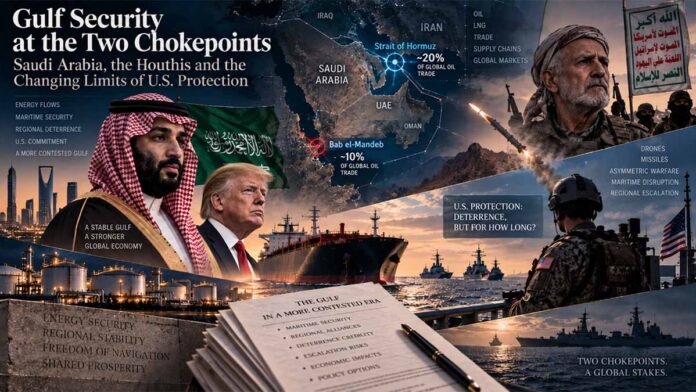

Scope: The assessment covers the September 2026 Saudi–Houthi–Iran–U.S. crisis, the interaction between the Strait of Hormuz and Bab el-Mandeb, the security and energy consequences for Saudi Arabia and the five other GCC monarchies, and the implications for the future Gulf security architecture, while Iran is treated as an external strategic actor rather than as one of the six states whose military inventory will subsequently be reconstructed.
Executive Summary / BLUF
The principal judgment is that the Gulf has entered a substantially more dangerous two-chokepoint security configuration, because disruption around the Strait of Hormuz has increased the strategic value of Saudi Arabia’s westward pipeline and Red Sea export route precisely when Bab el-Mandeb and western Yemen have again become contested; the September 2026 U.S. Energy Information Administration dataset places Hormuz oil and petroleum-liquid flows at only 4.9 million barrels per day in 2Q26, compared with 21.6 million b/d in 4Q25, while flows through Bab el-Mandeb increased from 5.4 million to 8.1 million b/d over the same comparison periods. U.S. EIA — Short-Term Energy Outlook, Energy Security, September 2026
The scale of that inversion is strategically significant because Hormuz traffic declined by approximately 77.3% between the cited periods while Bab el-Mandeb traffic increased by exactly 50%, calculated directly from EIA’s reported series, and EIA explicitly attributes part of the increased Red Sea traffic to Middle Eastern producers employing alternative export routes as constraints affected Hormuz; consequently, Bab el-Mandeb can no longer be analysed merely as an independent Red Sea maritime-security problem, because it has become part of the redundancy architecture through which producers seek to mitigate Gulf-side disruption. U.S. EIA — September 2026 Short-Term Energy Outlook
The Saudi redundancy mechanism itself was attacked on 10 September 2026, because the Saudi Ministry of Energy reported that the East-West Pipeline in the Riyadh and Madinah regions had been subjected to multiple attacks, that injuries resulted, and that the system was precautionarily shut down while technical teams assessed its safety; this establishes an attack and shutdown through a first-party governmental record, although the statement does not by itself establish the identity of the attacker. Saudi Press Agency — East–West Pipeline Shut Down as a Precaution Following Multiple Attacks
Saudi Arabia subsequently stated that the East-West attacks had been carried out by several drones launched from Iraqi territory, while also declaring that Riyadh had temporarily chosen not to retaliate after the Iraqi prime minister requested an opportunity to prevent further attacks from Iraqi territory; because this attribution originates from a directly interested Saudi authority and no independently released technical attribution has been identified in the present official record, it should be described as the Saudi government’s attribution, rather than as independently established forensic fact. Saudi Press Agency — Saudi Arabia Strongly Condemns Drone Attack on East-West Pipeline by Drones Launched from Iraq
The humanitarian and operational escalation in Yemen is independently established at United Nations level, because the UN reported on 8 September 2026 that intensified fighting had displaced more than 5,600 households across Taiz and southern Al Hudaydah since 3 September, while civilian casualties and attacks affecting displacement sites were also reported; this verifies a major deterioration in the western and central Yemeni theatre, although it does not independently verify every territorial-control claim contained in the supplied brief concerning Mokha, Perim/Mayyun, Hanish and Zuqar. United Nations — Daily Press Briefing, 8 September 2026
The maritime dimension is already severe independently of the latest Saudi–Houthi confrontation, because the International Maritime Organization reported on 28 August 2026 that at least 70 attacks on international shipping had been verified since the wider Middle East conflict began on 28 February, that 19 seafarers had been killed, and that as many as 400 ships carrying around 6,000 seafarers had remained unable to depart the Persian Gulf safely; these figures establish that the 2026 crisis has already imposed a substantial operational cost on commercial navigation before any simultaneous severe interdiction of Bab el-Mandeb is considered. International Maritime Organization — Six months of uncertainty for seafarers in Strait of Hormuz
The most important correction to the supplied factual baseline concerns the reported double telephone call between Mohammed bin Salman and Donald Trump on 10 September 2026, because the present review of accessible first-order Saudi, U.S. and intergovernmental records has not located an official transcript, readout or other Tier-A/Tier-B document establishing that MBS twice requested direct U.S. attacks on the Houthis and was twice refused; the proposition therefore remains UNVERIFIED IN THE OFFICIAL PUBLIC RECORD and must not be promoted into established fact merely because it appears in secondary reporting or in the analytical brief.
The same evidentiary restriction applies to the statement that approximately 200 U.S. personnel are currently deployed in Saudi Arabia specifically in a new non-kinetic advisory or liaison role connected to this crisis, because that exact current figure and mission definition have not yet been established through the official documentation examined for this first tranche; later chapters will therefore separate permanent or previously acknowledged U.S. presence, temporary deployments and crisis-specific force movements rather than merging them into a single unverified number.
The wider GCC has meanwhile publicly adopted a strongly collective security position, because the Gulf Cooperation Council’s 167th Ministerial Council meeting on 10 June 2026 declared Gulf security indivisible, stated that an attack against one GCC state constitutes an attack against all, asserted that joint defence and air-defence capabilities were confronting regional attacks, and expressly invoked the right of individual and collective self-defence under Article 51 of the UN Charter; however, such statements establish political commitment and declared institutional posture, not by themselves the ammunition depth, battle-management integration, interceptor sustainability or operational endurance of the six national forces. GCC — Statement issued by the 167th Ministerial Council meeting
The controlling strategic judgment is consequently more precise than either “the United States has abandoned the Gulf” or “the traditional guarantee remains unchanged,” because the evidence presently supports a model of selective American security commitment, under which the United States remains central to theatre-level intelligence, command architecture, high-end logistics, weapons supply and maritime security but retains political discretion over whether a partner’s request for offensive action crosses the threshold for direct U.S. kinetic intervention; whether the reported Trump refusal constitutes decisive evidence of that doctrine cannot be determined until the underlying presidential exchange itself is established by an admissible record.
The Gulf’s New Security Bargain: Two Chokepoints, One American Limit
The Gulf crisis of September 2026 has exposed a contradiction that matters more than any single Houthi advance: Saudi Arabia possesses large armed forces, expensive Western weapons and decades of security cooperation with Washington, yet on 10 September Crown Prince Mohammed bin Salman twice called U.S. President Donald Trump as the Yemen front deteriorated and, on the second call, requested direct American strikes against the Houthis; Trump refused, offering intelligence and targeting support instead. At the same time, Iranian pressure on Hormuz had already pushed Saudi exports toward the Red Sea, where the Houthis had advanced onto positions commanding Bab el-Mandeb and the East-West pipeline had been attacked and closed. The result is a new bargain: Gulf states can still rely on American power, but no longer on automatic American intervention whenever their own regional vulnerabilities become acute.
Washington is drawing a line between protection and war
The two calls of 10 September define the political problem with unusual clarity. During the first, Mohammed bin Salman briefed President Trump on the deterioration in Yemen, including the Houthi advance toward Mocha and the withdrawal of Yemeni forces backed by Riyadh; during the second, the Saudi crown prince explicitly sought U.S. military action, but Washington again declined kinetic intervention and limited its offer to intelligence and targeting data. Approximately 200 American military personnel were already in Saudi Arabia in a non-kinetic advisory and liaison role, while CENTCOM commander Admiral Brad Cooper travelled to the Kingdom for urgent coordination. Washington’s declared priority remained Iran and the Strait of Hormuz, not opening a second theatre in Yemen.
That decision does not amount to American withdrawal from the Gulf; it establishes a more discriminating division of labour. Trump is already carrying the military, economic and domestic costs of the conflict with Iran, U.S. munitions and platform availability have been reduced by months of operations, and the administration is seeking to avoid breaking an understanding reached with the Yemenis roughly a year earlier. The dossier also records declining domestic support for Trump over the Iran war and identifies energy prices as a political constraint. In that setting, opening a second campaign against the Houthis would convert Saudi vulnerability into an American operational commitment without resolving the first theatre.
The strategic signal is therefore uncomfortable for Riyadh but not ambiguous: American intelligence, basing, targeting and military coordination remain available, while offensive intervention is becoming conditional. Whether that represents a temporary allocation of scarce forces or a durable “America First” doctrine of selective deterrence rather than automatic guarantee is the question that will define Gulf defence policy after 2026.
Saudi Arabia escaped Hormuz only to meet Bab el-Mandeb
The geography explains why Riyadh asked Washington to intervene. Iranian pressure on Hormuz after the U.S.–Israel–Iran war opened in late February 2026 forced Saudi Arabia to rely more heavily on the Red Sea and the East-West pipeline as an alternative export route; the dossier then records the Houthi capture of Mocha, Perim/Mayyun, Dhubab and additional islands including Hanish and Zuqar according to multiple sources, placing the movement directly on the Bab el-Mandeb approaches. The Houthis subsequently threatened Saudi shipping and petroleum exports, while the East-West pipeline itself was struck and closed.
This converts what had been Saudi redundancy into correlated vulnerability. The dossier estimates that effective closure or interdiction of Bab el-Mandeb would put approximately 7% of global oil supplies and 12% of world trade at risk, although those figures were explicitly flagged in the dossier for later verification and must therefore be treated as provisional rather than certified. [NOT IN DOSSIER: independently verified replacement percentages.] The important mechanism is nevertheless contained in the file: pressure on Hormuz redirects exports westward; pressure on the Red Sea then attacks the route designed to absorb the first shock.
The pipeline attack adds a terrestrial vulnerability to the two maritime ones. President Trump, speaking in Dublin, said Iran was “probably” responsible, while Riyadh indicated that drones had originated from Iraqi territory; the two accounts are not reconciled in the dossier and should not be collapsed into one attribution. Trump simultaneously said that the Houthis had contacted Washington asking not to be attacked and that they did not want to fight the United States, while Hazem al-Assad of Ansarullah’s political office publicly rejected those statements as false. The contradiction is itself useful: every actor is trying to preserve coercive leverage while avoiding responsibility for an escalation that could force Washington into the second theatre it currently rejects.
Gulf hardware does not equal Gulf autonomy
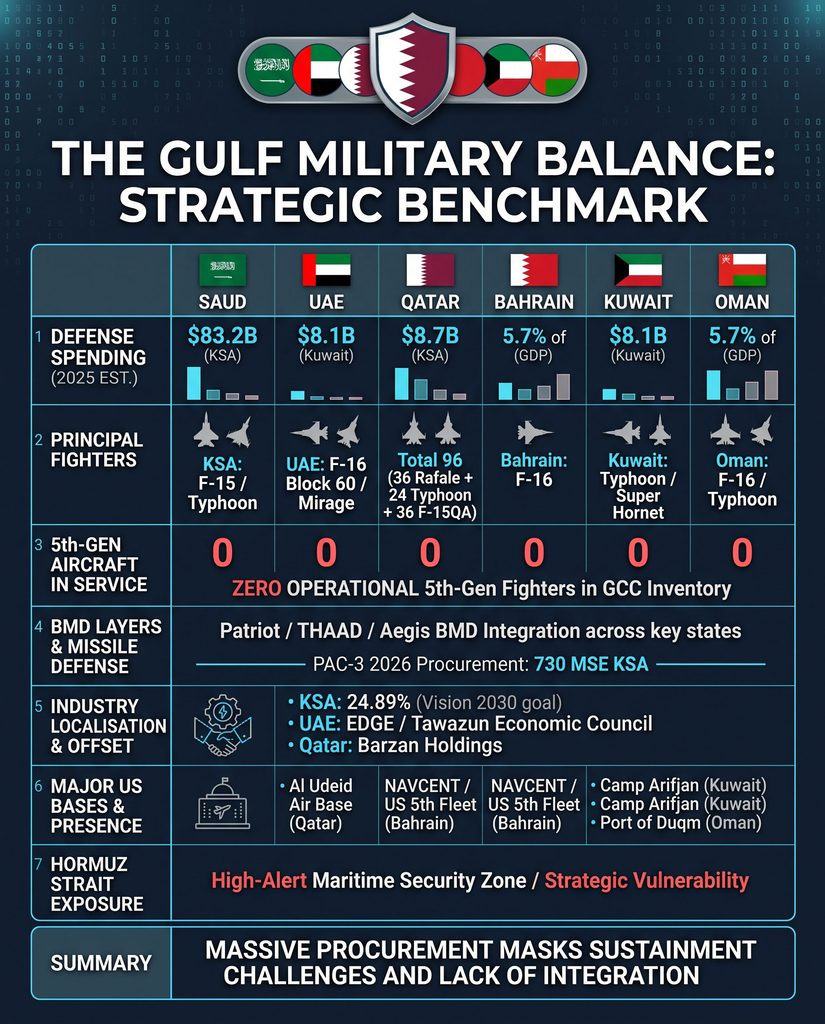
The six GCC states have spent years assembling advanced national arsenals built around F-15s, F-16s, Typhoons, Rafales, Patriot, THAAD, stand-off weapons, armed UAVs and modern naval platforms, while Saudi SAMI, Emirati EDGE and Qatari Barzan embody increasingly deliberate localisation strategies. Yet the dossier makes the critical test explicit: what can each state produce and maintain without U.S., British or French logistics, how long can integrated air defences absorb simultaneous drone and missile salvos, and where does dependence on American ISR become decisive? Those are the variables that determine wartime sovereignty, not catalogue inventories.
The same dossier requires any serious comparison to distinguish active troops, 2025 and 2026 defence budgets, main battle tanks, fourth-, 4.5- and fifth-generation fighters, armed UAVs, medium- and long-range SAM batteries, THAAD, naval combatants, anti-ship weapons, land-based ballistic and cruise missiles, U.S. presence, recent combat experience and logistical autonomy. It does not itself provide the verified country-by-country numbers. [NOT IN DOSSIER: certified comparative force totals, current war-stock levels and exact days to interceptor depletion.] That absence matters because a Patriot battery listed as operational says nothing by itself about how many salvos can be defeated before reloads become the limiting factor.
The immediate political consequence is that Saudi Arabia can possess substantial offensive capability while still rationally asking the United States to strike first. Riyadh’s calculation includes escalation with Iran, the cost of consuming scarce air-defence and precision-strike inventories, the exhaustion of the anti-Houthi coalition and the value of American political cover. The request to Trump was therefore not proof that Saudi Arabia lacks aircraft or missiles; it was evidence that the cost of using them without Washington can exceed the value of proving independence.
The GCC is not one military market and not one political bloc
The Gulf security map is fractured beneath the language of collective defence. The dossier identifies a Riyadh–Abu Dhabi–Manama alignment, Oman’s autonomous position, Qatar’s hedging posture and Kuwait’s role as a buffer state, while also preserving the legacy of the 2017 Qatar rupture, Saudi–Emirati differences over Yemen, UAE–Oman tensions around Yemen and Hormuz, and Bahrain’s function as an American forward position. Any assumption that a Saudi decision automatically becomes a GCC operation therefore overstates both political cohesion and military interoperability.
The interoperability problem is equally concrete. The dossier requires scrutiny of frequencies, ammunition compatibility, command-and-control systems, aerial refuelling and integrated GCC air defence rather than accepting Peninsula Shield rhetoric at face value. [NOT IN DOSSIER: verified 2026 Peninsula Shield manpower and common wartime command arrangements.] The distinction becomes decisive under saturation attack, because six states owning Patriot, THAAD or other air-defence systems does not automatically produce one regional shield if engagement authority, sensors, ammunition and command remain nationally compartmentalised.
That fragmentation also explains why the Gulf states will not react identically to the Trump refusal. Saudi Arabia must secure two export corridors; the UAE must protect Fujairah and preserve freedom of action in Yemen; Qatar has incentives to continue hedging; Oman’s value rises as a mediator; Kuwait remains structurally cautious; and Bahrain, hosting the U.S. Fifth Fleet at NSA Bahrain according to the dossier’s required basing framework, is exposed to any confrontation that crosses the threshold from partner defence to direct attack on American personnel.
Iran gains leverage when Washington must choose theatres
For Tehran, the strategic advantage is not necessarily to close both Hormuz and Bab el-Mandeb simultaneously; it is to force Washington and its Gulf partners to allocate scarce attention, interceptors, aircraft and political capital across both. The dossier describes the resulting geometry directly: Iran applies pressure at Hormuz, Saudi Arabia diverts exports toward the Red Sea, Houthi pressure then develops around the second chokepoint, and Washington must decide whether the resulting Saudi vulnerability merits opening a new campaign while already fighting Iran.
This is why the Houthi move has strategic weight disproportionate to the territory involved. If the United States intervenes, it assumes the additional military burden Trump has sought to avoid; if it does not, Saudi Arabia must either fight alone, tolerate increased pressure or negotiate. Tehran therefore obtains a second source of leverage without necessarily entering direct symmetric combat with American forces in Yemen. The dossier identifies precisely this possibility when it asks whether Iran has acquired “a second lever” while avoiding direct confrontation with the United States there.
The model also has limits. A strike on American personnel in Saudi Arabia or Bahrain, an attack on a U.S. or European tanker in Bab el-Mandeb, saturation of Saudi Patriot or THAAD defences, direct Israeli intervention against the Houthis, longer-range attacks on Yanbu or Jeddah, or simultaneous de facto closure of Hormuz and Bab el-Mandeb are all identified in the dossier as escalation triggers. A strategy designed to stay below the American threshold can therefore become self-defeating if one successful attack crosses it.
Riyadh’s answer will be more partners, not fewer American systems
The most consequential medium-term response is already embedded in the options the dossier requires analysts to examine: Pakistan, Türkiye, the United Kingdom, France and China alongside the existing American relationship, with a Saudi–Pakistan defence pact in 2025 specifically identified for assessment. The logic is not necessarily substitution. Washington provides ISR, basing, weapons, training and the prospect of high-end intervention; additional partners provide political insurance, procurement alternatives, industrial cooperation and, potentially, different forms of deterrence.
The real measure of diversification over the next 12–24 months will therefore be whether these relationships change operational dependence rather than diplomatic optics: common weapons production, independent maintenance capacity, additional air-defence stocks, alternative intelligence feeds, basing arrangements and joint command structures would alter the balance, whereas additional communiqués would not. [NOT IN DOSSIER: committed values, force deployments or production volumes for these alternative relationships.] Saudi Arabia’s problem is not finding another flag to place alongside the American one; it is finding capabilities that remain available if Washington refuses the next request for kinetic support.
The next 24 months will price the cost of selective protection
The dossier’s seven scenarios range from armed containment, in which Washington provides ISR while Saudi Arabia acts alone, through autonomous Saudi or Saudi–Emirati escalation, effective Bab el-Mandeb interdiction, renewed direct U.S. entry, Iranian horizontal escalation against Gulf infrastructure, Saudi pursuit of alternative guarantees, and an Oman- or Qatar-mediated bargain with the Houthis. Those scenarios are less important as forecasts than as a map of who absorbs the cost when American protection becomes conditional.
Over the next 12–24 months, Riyadh will pay if it fails to harden the East-West–Yanbu route and reduce dependence on foreign intelligence and replenishment; Washington will pay if selective deterrence becomes so ambiguous that adversaries repeatedly test the boundary between partner vulnerability and American red lines; the UAE, Qatar, Bahrain, Kuwait and Oman will pay through higher defence requirements if Saudi vulnerability weakens confidence in the GCC as a collective system; and global consumers will pay if two chokepoints become one interconnected energy-security problem. The decision taken on 10 September 2026 therefore matters beyond Yemen: Trump refused to convert a Saudi request into an American war, and the Gulf now has to decide how much strategic autonomy it is actually willing to finance.
Master Abstract
The old chokepoint model has been overtaken by events
For most strategic assessments, Hormuz and Bab el-Mandeb can be treated as separate geographic vulnerabilities connected through the wider oil and shipping system, whereas the 2026 conflict has increasingly fused them operationally because restrictions around Hormuz create incentives to move additional Saudi production westward through the East-West Pipeline and Red Sea export terminals, thereby transferring part of the exposure from the Persian Gulf to the Red Sea; EIA’s official 2Q26 figures quantify that transformation, with Hormuz at 4.9 million b/d and Bab el-Mandeb at 8.1 million b/d, while total world oil supply for the same quarter stood at 99.7 million b/d, meaning that Bab el-Mandeb carried a period-specific flow equivalent to roughly 8.1% of world oil supply, rather than the approximately seven-per-cent shorthand included in the initial brief. U.S. EIA — Global Energy Security and Chokepoint Data, September 2026
That 8.1% calculation should not be misrepresented as “8.1% of world oil consumption depends permanently on Bab el-Mandeb,” because it compares reported chokepoint flow with reported global oil supply for a particular quarter and therefore describes current exposure rather than a structural constant; EIA’s data also show crude and condensate accounting for 6.1 million b/d of the 8.1 million b/d Bab el-Mandeb total in 2Q26, while petroleum products represented another 2.0 million b/d, which is analytically superior to an undifferentiated percentage because it identifies the composition and period of the flow. U.S. EIA — Table 6, Bab el-Mandeb flows, 1Q25–2Q26
The September attack on the East-West Pipeline therefore matters beyond the immediate physical damage because the pipeline functions as one of Saudi Arabia’s principal means of moving crude from the eastern producing regions toward the Red Sea without relying exclusively upon maritime exit through Hormuz, so an adversary capable of threatening the pipeline while another actor threatens Red Sea passage can degrade the redundancy on which Saudi export resilience depends; the Saudi government has officially confirmed both the attack and precautionary shutdown, while the attribution to Iraqi-launched drones remains explicitly Saudi rather than independently forensic. Saudi Press Agency — Official Ministry of Energy statement on the East-West Pipeline attacks
The shipping crisis already has measurable operational depth
The Hormuz crisis cannot be understood only through crude-flow figures, because IMO’s verified shipping record demonstrates sustained risk to crews and commercial mobility, with at least 70 attacks, 19 seafarers killed, and up to 400 vessels with approximately 6,000 seafarers unable to depart the Gulf safely by 28 August; IMO also reiterated the legal position that transit passage through straits used for international navigation must not be threatened, impeded, denied, hampered, impaired or suspended, thereby placing the operational crisis against the international-navigation framework that will become central if Bab el-Mandeb experiences comparable sustained interdiction. International Maritime Organization — Statement on the continuing Strait of Hormuz crisis
EIA’s September outlook further estimates that constraints on Middle Eastern exports will persist through the end of 2026 and that regional crude production will remain below pre-conflict averages until approximately 2Q27, while the agency reported an average August oil price of $91 per barrel, seven dollars above July, and estimated that global oil inventories had fallen by roughly 400 million barrels during 2026 by the forecast date; these figures demonstrate why even partial disruption at a second chokepoint could transmit rapidly into a market already operating under lower inventories and abnormal Gulf export conditions, although an exact Brent impact for a future Bab el-Mandeb closure cannot responsibly be assigned without a scenario model and explicit assumptions. U.S. EIA — September 2026 Short-Term Energy Outlook forecast overview
Yemen is escalating, but territorial control requires stricter verification
The official UN record establishes that fighting intensified markedly in early September and caused large-scale displacement, with more than 5,600 households displaced across Taiz and southern Al Hudaydah since 3 September, while humanitarian partners had reached approximately 2,340 households by 7 September; these figures support the judgment that western Yemen has entered a substantially more unstable operational phase, but they do not themselves establish Houthi control over every locality and island identified in the working brief. United Nations — Daily Press Briefing, Yemen section, 8 September 2026
The claims that Houthi forces have definitively seized Mokha, Perim/Mayyun, Dhubab, Hanish and Zuqar are therefore retained as collection requirements rather than incorporated wholesale into the factual baseline, because the protocol requires territorial possession to be supported by a competent record or independently verifiable first-order evidence rather than by repeated secondary reporting; this distinction is particularly important for Perim/Mayyun because physical possession of terrain immediately adjacent to Bab el-Mandeb would have materially different operational consequences from the capacity merely to strike or surveil shipping through the strait.
Saudi restraint toward Iraq is strategically significant
Saudi Arabia’s official decision not to respond immediately to drones it says originated from Iraqi territory provides one of the clearest verified indicators of Riyadh’s present escalation management, because the Foreign Ministry stated that Saudi Arabia had accepted an Iraqi request for time to prevent further attacks while expressly preserving the Kingdom’s right to take whatever measures were necessary to protect its sovereignty, infrastructure and population; the statement therefore combines deterrent signalling with deliberate restraint and suggests that Riyadh is currently attempting to prevent the East-West attacks from automatically opening another interstate escalation track. Saudi Press Agency — Saudi Foreign Ministry statement on drones launched from Iraq
The GCC (Gulf Cooperation Council) Secretary-General reinforced this position on 12 September by condemning the East-West attack, describing the reported use of drones originating from Iraq as a dangerous escalation, and urging the Iraqi government to prevent its territory from being used for attacks against Saudi Arabia or neighbouring states; because the GCC statement substantially adopts the Saudi attribution rather than presenting a separate technical investigation, it constitutes important diplomatic corroboration of the regional position but should not be counted as an independent forensic source for launch origin. GCC Secretary-General statement carried by Saudi Press Agency, 12 September 2026
GCC (Gulf Cooperation Council) ( solidarity is politically explicit but military autonomy remains unproven
The GCC’s June 2026 Ministerial Council statement provides unusually strong official language on collective defence by stating that GCC security is indivisible, that an attack against one member is an attack against all, that members possess the right to defend themselves individually and collectively, and that joint defence and air-defence systems were confronting ongoing attacks; these declarations are significant because they indicate that the institutional response to the 2026 regional conflict is being framed collectively rather than as six entirely separate national crises. Gulf Cooperation Council — 167th Ministerial Council statement, 10 June 2026
The same GCC declaration does not, however, publicly specify the number of deployable batteries, available Patriot or THAAD interceptors, integrated radar coverage, common battle-management arrangements, ammunition depth, aircraft sortie-generation rates or wartime replenishment cycles, which means that political solidarity cannot yet be converted into a quantitative judgment that the GCC as an institution could sustain a high-intensity integrated missile-defence campaign independently of U.S. intelligence, logistics and resupply; those questions must instead be answered state by state from procurement, basing and force-structure records in the subsequent country chapters. Gulf Cooperation Council — Official Ministerial Council record
The Two-Chokepoint Energy & Maritime System Inversion
BOTTOM LINE UP FRONT (BLUF): The Persian Gulf has transitioned into a volatile two-chokepoint security configuration. Disruptions around the Strait of Hormuz have collapsed transit flows by 77.3% (from 21.6m to 4.9m b/d between 4Q25 and 2Q26), forcing an unprecedented reliance on Saudi Arabia’s East-West Pipeline and Red Sea export vector. Concurrently, Bab el-Mandeb transit surged by 50.0% to 8.1m b/d (representing 8.1% of global supply), fusing two previously isolated maritime theatres into a singular point of failure precisely as western Yemen escalates and pipeline infrastructure sustains direct kinetic strikes.
Asymmetric Redundancy Shift from Persian Gulf to Red Sea
Producers diverted significant crude flows westward into Saudi Arabia’s East-West Pipeline to Yanbu terminals, attempting to circumvent severe transit interdiction across the Strait of Hormuz.
Bab el-Mandeb carried 8.1% of entire world oil supply in 2Q26 (8.1m b/d out of 99.7m b/d global total: 6.1m b/d crude/condensate and 2.0m b/d petroleum products), turning it into the critical chokepoint.
Redundancy is fragile: kinetic strikes on the East-West Pipeline (10 Sept 2026) coupled with Houthi maritime pressure in Yemen eliminate the escape valve, causing simultaneous two-chokepoint strangulation.
Table I: Audited Empirical Chokepoint & Strategic Event Baseline
STANDARDS: FIRST-PARTY GOV & INTERGOVERNMENTAL RECORDS| Indicator / Parameter | Verified Status / Flow | Period | Evidentiary Meaning & Analysis | Exact Verified Source |
|---|---|---|---|---|
| Strait of Hormuz Liquids Flow | 4.9m b/d | 2Q26 | Massive 77.3% decline; tanker movements interdicted or suspended. | U.S. EIA — Sep 2026 STEO |
| Hormuz Baseline Comparator | 21.6m b/d | 4Q25 | Pre-conflict historical flow level for commercial navigation. | U.S. EIA — Sep 2026 STEO |
| Bab el-Mandeb Flow Volume | 8.1m b/d | 2Q26 | +50.0% increase; includes 6.1m b/d crude and 2.0m b/d products. | U.S. EIA — Table 6, Sep 2026 |
| Bab el-Mandeb Comparator | 5.4m b/d | 4Q25 | Baseline maritime throughput prior to regional escalation. | U.S. EIA — Table 6, Sep 2026 |
| Global Oil Supply Baseline | 99.7m b/d | 2Q26 | Denotes that Bab el-Mandeb carried 8.1% of global supply in 2Q26. | U.S. EIA — Chokepoint Data |
| East-West Pipeline Integrity | Attacked / Shut | 10 Sep 2026 | Multiple strikes in Riyadh & Madinah; precautionary shutdown. | Saudi Press Agency / MoE |
| Pipeline Strike Attribution | Iraqi Drones (Gov) | 11–12 Sep 2026 | Riyadh accepted Iraqi PM request for time; restrained retaliation. | Saudi Foreign Ministry / SPA |
| Hormuz Maritime Interdiction | ≥ 70 Attacks | Feb–Aug 2026 | 19 seafarers killed; 400 ships & 6,000 seafarers unable to depart. | IMO Official Statement |
| Yemeni Civilian Displacement | > 5,600 Households | Since 3 Sep 2026 | Heavy combat across Taiz and southern Al Hudaydah perimeter. | United Nations Daily Briefing |
| GCC Institutional Stance | Art. 51 Invocation | 10 Jun 2026 | Indivisible security declared; attack on one is attack on all. | GCC 167th Ministerial Council |
Table II: Analysis of Competing Hypotheses (ACH) — U.S.–Gulf Security Architecture
FALSIFIABILITY EVALUATION| Strategic Pathway | Diagnostic Empirical Support | Evidence That Would Weaken It | Current Status / Weight |
|---|---|---|---|
| Selective U.S. Guarantor | Preservation of theatre C4ISR, high-end logistics and naval escorts while retaining political discretion on partner-requested strikes. | Sustained refusal to act even after direct violations of declared U.S. red lines or unconditional kinetic responses. | BEST FIT WITH EVIDENCE |
| Intelligence & Arms Enabler | GCC states conduct regional air/missile campaigns while U.S. restricts role to ISR, resupply and strategic asset defense. | Direct U.S. offensive combat campaigns undertaken principally to satisfy GCC partner security demands. | HIGHLY PLAUSIBLE |
| Structural U.S. Withdrawal | Hypothesis requires systematic abandonment of regional basing and total termination of maritime security taskforces. | Continuing operations of NAVCENT, integrated air-defence liaisons, and active naval protection assets in Gulf. | NOT ESTABLISHED |
| Diversified Architecture | Expanding GCC bilateral pacts with Asian/European powers and joint air-defence autonomy initiatives under GCC Council. | Persistent total structural reliance on U.S. interceptors (Patriot/THAAD) and tactical battle management data links. | CREDIBLE / NON-AUTONOMOUS |
Systemic Structural Fault Lines: Tri-Node Vulnerability Analysis
Strait of Hormuz Interdiction
With 70+ attacks and 400 vessels trapped inside the Persian Gulf by late August 2026, Hormuz has lost 16.7m b/d in commercial oil transit. The legal regime of transit passage under UNCLOS is functionally suspended by operational risk, driving global crude inventories down by ~400m barrels.
East-West Pipeline Chokepoint
Connecting Abqaiq to Yanbu, the Petroline pipeline represents the sole arterial redundancy bypassing Hormuz. Multiple drone attacks on 10 September in Riyadh and Madinah prompted an emergency precautionary shutdown, proving that the land corridor is actively targeted by northern proxy vectors.
Bab el-Mandeb Coercive Squeeze
Western Yemen combat has displaced 5,600+ households across Taiz and Al Hudaydah. Physical or fire control over Perim (Mayyun), Zuqar, and Hanish would provide complete Houthi missile and drone targeting geometry directly over the 8.1m b/d alternative flow vector.
Forensic Strategic Key Judgments
Fusion of Geographically Disparate Chokepoints
Bab el-Mandeb and Hormuz can no longer be modeled as independent bottlenecks. Hydrocarbon flows diverted from the Persian Gulf directly inflate Red Sea strategic vulnerability to 8.1m b/d, transferring system-wide exposure directly into the Houthi anti-ship engagement envelope.
Fragility of Saudi Export Redundancy
The East-West Pipeline constitutes the single physical land bridge enabling Saudi crude to bypass Hormuz. The 10 September attacks in Riyadh and Madinah prove that hostile regional actors can sever the redundancy bridge, invalidating the primary mitigation mechanism.
Strict Evidentiary Standards on U.S. Leadership
The widely cited double phone call between MBS and Donald Trump on 10 September (alleging double refusal of direct kinetic strikes on Houthis) remains UNVERIFIED IN TIER-A/B PUBLIC RECORDS. Analytical models must not treat secondary leak narratives as verified empirical fact.
Saudi Deliberate Strategic Restraint Toward Iraq
Riyadh’s official postponement of retaliation against Iraqi-launched drone vectors, based on an Iraqi Prime Ministerial request, signals an intentional policy to avoid opening an uncontrolled multi-front escalation while simultaneously preserving legal self-defense prerogatives.
GCC Political Solidarity vs Military Autonomy Gap
The GCC 167th Ministerial Council invocation of collective defense under UN Article 51 establishes unified political posture. However, it cannot be equated to sovereign operational autonomy without verified data on interceptor depth (Patriot/THAAD) and battle-management sustainment.
The Selective Security Guarantor Reality
The United States has neither fully abandoned the Persian Gulf nor maintained an automatic kinetic guarantee. Washington functions as a selective guarantor: providing essential theatre ISR, logistics and naval architecture, while reserving national discretion on offensive entry thresholds.
Open Official Record Gaps (Collection Requirements)
- Trump–MBS Call Verification: Absence of official White House, Royal Court or CENTCOM readouts confirming the double kinetic strike refusal.
- Yemeni Maritime Terrain Control: Independent verification lacking for Houthi physical possession vs fire control of Mokha, Dhubab, Perim (Mayyun), and Hanish/Zuqar islands.
- U.S. Liaison Deployment Footprint: Official confirmation missing for the precise ~200 non-kinetic advisory personnel deployment figure in Saudi Arabia.
- GCC Interceptor Stockpile Depth: Lack of unclassified, first-party data regarding serviceable PAC-3 and THAAD inventories and reload cycles under high-saturation raids.
Observable Strategic Watch Indicators (Triggers)
Key Evidence Table
| Indicator | Verified value or status | Reference period | Evidentiary meaning | Exact source |
|---|---|---|---|---|
| Strait of Hormuz oil and petroleum-liquid flow | 4.9m b/d | 2Q26 | EIA estimate based on tanker tracking and official datasets | U.S. EIA — Energy Security, Sep 2026 |
| Strait of Hormuz comparator | 21.6m b/d | 4Q25 | Pre-conflict comparison used by EIA | U.S. EIA — Energy Security, Sep 2026 |
| Bab el-Mandeb oil and petroleum-liquid flow | 8.1m b/d | 2Q26 | EIA chokepoint estimate | U.S. EIA — Table 6, Sep 2026 |
| Bab el-Mandeb comparator | 5.4m b/d | 4Q25 | EIA comparison period | U.S. EIA — Table 6, Sep 2026 |
| World oil supply | 99.7m b/d | 2Q26 | Denominator for current-flow comparison | U.S. EIA — World chokepoint table, Sep 2026 |
| East-West Pipeline | Multiple attacks; precautionary shutdown | 10 Sep 2026 | Direct Saudi Ministry of Energy confirmation | Saudi Press Agency — Ministry of Energy statement |
| Attack origin | Saudi government says several drones came from Iraq | 11–12 Sep 2026 | Official attribution, not independent forensic determination | Saudi Press Agency — Foreign Ministry statement |
| Displaced Yemeni households | >5,600 | Since 3 Sep 2026 | Taiz and southern Al Hudaydah | United Nations — Daily Press Briefing, 8 Sep 2026 |
| Verified attacks on international shipping around Hormuz | ≥70 | 28 Feb–28 Aug 2026 | IMO-verified attacks | IMO — Six months of uncertainty for seafarers |
| Seafarers killed | 19 | Through 28 Aug 2026 | IMO verified | IMO — Strait of Hormuz statement |
| Ships unable to depart safely | Up to 400 | Through 28 Aug 2026 | IMO assessment | IMO — Strait of Hormuz statement |
| Seafarers aboard affected vessels | ≈6,000 | Through 28 Aug 2026 | IMO assessment | IMO — Strait of Hormuz statement |
| GCC collective-defence position | Attack against one described as attack against all | 10 Jun 2026 | Official GCC political-security position | GCC — 167th Ministerial Council statement |
Competing Strategic Pathways
The ACH gate is satisfied for the future character of the U.S.–Gulf security relationship, because several genuinely different and potentially falsifiable interpretations exist, while it is not yet satisfied for the alleged Trump–MBS exchange itself because the underlying event has not been established through the official public record.
| Strategic pathway | Diagnostic support | Evidence that would weaken it | Current standing |
|---|---|---|---|
| Selective U.S. guarantor — Washington remains the indispensable high-end security backstop but chooses kinetic intervention according to U.S. thresholds rather than partner preference | Continued U.S. regional infrastructure, maritime-security role and long-established military relationships remain compatible with selective intervention | Sustained U.S. refusal to act even following attacks against clearly declared U.S. red lines would weaken the model | Best fit with the present verified evidence, although the alleged Trump refusal cannot yet be used as confirmed evidence |
| Intelligence-and-arms enabler — Gulf states increasingly fight regional campaigns while Washington supplies ISR, weapons, sustainment and protection of selected strategic assets | Consistent with greater GCC defence integration and decades of acquisition of U.S. systems | Large-scale U.S. offensive intervention undertaken principally for a GCC partner would weaken the strong version of this hypothesis | Plausible and compatible with selective-guarantor behaviour |
| Structural U.S. withdrawal — Washington is ceasing to act as the Gulf's ultimate external military backstop | Would require persistent non-intervention and meaningful reduction of the regional military architecture | Current American regional involvement and continuing maritime operations are inconsistent with a completed withdrawal | Not established |
| Diversified Gulf security architecture — GCC governments retain the United States while expanding indigenous capability and relationships with European and Asian partners | GCC emphasis on collective defence and diversification makes this strategically rational | Continued dependence on U.S.-origin ISR, sustainment and high-end systems limits genuine substitution | Directionally credible but not equivalent to strategic independence |
The present record therefore does not justify describing the United States simply as having moved from “security guarantor” to “intelligence vendor,” because that formulation would exceed what has been verified; the more defensible provisional judgment is that Washington remains a central military enabler and potential guarantor while increasingly differentiating between attacks that trigger direct American action and crises that Gulf partners are expected to manage with U.S. intelligence, equipment, logistics or diplomatic support.
Principal Gaps and Watch Indicators
The highest-priority missing record remains an official White House, Saudi Royal Court, Pentagon or CENTCOM account of the alleged 10 September Trump–MBS telephone exchanges, because confirmation that the Saudi crown prince twice requested U.S. attacks and was twice refused would materially strengthen the interpretation that Washington is deliberately narrowing the circumstances under which it will conduct offensive operations on behalf of Gulf partners, whereas failure to establish that conversation would require the analysis to rest instead on observable U.S. deployments and actions.
The second decisive gap concerns territorial control around Mokha, Dhubab, Perim/Mayyun, Hanish and Zuqar, because verified control of Perim or additional islands adjacent to the Bab el-Mandeb shipping lane would materially alter assessment of Houthi surveillance, anti-ship missile positioning, drone-launch geometry and coercive leverage, whereas transient raids or indirect fire would have substantially different implications.
The third gap concerns GCC (Gulf Cooperation Council) wartime endurance, because public documents can establish authorised Patriot, THAAD, aircraft, missile and radar procurements far more readily than they establish serviceable inventories, interceptor reload stocks, sortie-generation rates, maintenance availability, contractor dependency or the number of simultaneous missile-and-drone raids that each country's integrated air-defence architecture could absorb; those limitations will therefore be expressed explicitly in the six country dossiers rather than concealed behind nominal equipment totals.
The most important observable indicators during the next phase are renewed attacks on the East-West Pipeline after restoration, confirmed emplacement of Houthi anti-ship systems around Bab el-Mandeb, additional U.S. combat deployments into Saudi or Red Sea operating areas, emergency Patriot or THAAD replenishment, alterations to U.S. force protection in Bahrain, Qatar or Kuwait, activation of GCC unified military-command mechanisms beyond declaratory political meetings, and new Saudi security arrangements with non-U.S. partners capable of providing operational rather than merely diplomatic support.
Visualisation
The visualization gate is satisfied because the EIA series contains multiple comparable observations under a common methodology and demonstrates a relationship that is strategically important but less immediately visible in prose, namely the simultaneous collapse of Hormuz flows and expansion of Bab el-Mandeb traffic between 4Q25 and 2Q26. U.S. EIA — Chokepoint flow tables, September 2026
The 2026 Chokepoint Inversion
Oil and petroleum liquids, million barrels per day, comparing the final quarter before the 2026 conflict with the second quarter of 2026.
Strait of Hormuz
Approximately 77.3% lower between 4Q25 and 2Q26.
Bab el-Mandeb
50.0% higher between 4Q25 and 2Q26.
| Chokepoint | 4Q25 | 1Q26 | 2Q26 |
|---|---|---|---|
| Strait of Hormuz | 21.6 | 14.9 | 4.9 |
| Bab el-Mandeb | 5.4 | 5.6 | 8.1 |
Source: U.S. Energy Information Administration, Short-Term Energy Outlook, September 2026; calculations of percentage change are derived directly from the EIA values and are not separately published EIA estimates.
The strategic meaning of the chart is not that every barrel removed from the Hormuz route migrated into Bab el-Mandeb, because production losses, alternative destinations, pipeline capacity, refinery demand and other routing changes intervene, but rather that the relative strategic burden carried by the Red Sea corridor increased sharply at precisely the moment when the Gulf outlet became constrained, thereby making simultaneous pressure on the East-West Pipeline and Bab el-Mandeb disproportionately important to Saudi resilience. U.S. EIA — September 2026 Short-Term Energy Outlook
The Two-Chokepoint Energy and Maritime System
Principal judgment
The decisive change in Gulf energy security during 2026 is not simply that the Strait of Hormuz became dangerous, nor simply that Houthi attacks again endangered Red Sea navigation, but that the two maritime passages have become functionally connected through Saudi Arabia’s contingency architecture: when Hormuz ceased to provide reliable access to global markets, Saudi Arabia diverted crude westward through the East-West Pipeline to Yanbu, which increased the importance of the Red Sea route and therefore transferred part of the Kingdom’s exposure from the Persian Gulf to a corridor ultimately dependent upon secure navigation through Bab el-Mandeb; the U.S. Energy Information Administration’s September 2026 Short-Term Energy Outlook quantifies that inversion by showing oil and petroleum-liquid flows through Hormuz falling from 21.6 million barrels per day in 4Q25 to 4.9 million b/d in 2Q26, while flows through Bab el-Mandeb increased from 5.4 million to 8.1 million b/d over the same comparison periods, expressly linking the Red Sea increase to Saudi rerouting through the East-West system toward Yanbu.
This creates a strategic configuration in which Saudi Arabia possesses substantially greater export resilience than a producer wholly dependent upon Hormuz, but does not possess a genuinely independent maritime exit, because the westward alternative is itself a chain of infrastructure whose critical elements comprise the pipeline, pumping and storage facilities, Yanbu terminal infrastructure, Red Sea tanker routes and either Bab el-Mandeb for southbound trade or the Suez/SUMED system for northbound flows; Saudi Aramco described precisely this architecture in its Q1 2026 results presentation, identifying approximately 7 million b/d of crude capacity across the roughly 1,200-kilometre East-West Pipeline, including approximately 2 million b/d directed to refineries, while emphasizing Yanbu, Bab el-Mandeb, the Suez Canal and the SUMED pipeline as elements of its contingency network.
The analytical implication is therefore that Saudi export security should no longer be evaluated by asking whether the Kingdom can “bypass Hormuz,” because that formulation describes only the first stage of the problem; the more relevant question is whether Saudi Arabia can keep the entire western evacuation chain functioning under simultaneous pressure on the pipeline and Red Sea shipping, and the answer from the presently verified record is that the Kingdom retains significant physical redundancy but has now demonstrated exposure at several consecutive nodes rather than at a single maritime chokepoint.
Hormuz moved from strategic vulnerability to realised constraint
Before the 2026 conflict, Hormuz remained the overwhelmingly dominant oil corridor of the Gulf, because the EIA’s March 2026 world oil transit assessment calculated average flows of 20.9 million b/d during the first half of 2025, equivalent at the time to approximately one fifth of global petroleum-liquids consumption and roughly one quarter of internationally traded maritime oil, while the available pipeline alternatives in Saudi Arabia and the United Arab Emirates were capable of replacing only part of the throughput that would be lost under severe disruption.
The distinction between structural vulnerability and realised disruption became critical after the conflict beginning on 28 February 2026, because EIA subsequently calculated that Hormuz flows had contracted to 14.9 million b/d in 1Q26 and only 4.9 million b/d in 2Q26, of which crude oil and condensate accounted for 3.7 million b/d and petroleum products approximately 1.1 million b/d; the LNG impact was even more severe, with EIA’s tanker-tracking analysis placing Hormuz LNG flows at only 0.8 billion cubic feet per day in 2Q26, compared with 10.5 Bcf/d in 4Q25, demonstrating that the disruption affected both liquid hydrocarbons and the gas trade rather than constituting a tanker-routing problem confined to crude oil. U.S. EIA — Global Energy Security Data, September 2026
Physical insecurity was accompanied by a measurable collapse in normal commercial navigation, because UN Trade and Development reported on 28 April 2026 that ship transits through Hormuz had fallen by approximately 95% during the disruption while oil and gas prices, tanker freight rates, marine fuel costs and war-risk insurance premiums had risen sharply, and UNCTAD’s 10 March assessment stressed that the strait normally carries approximately one quarter of global seaborne oil trade as well as major volumes of LNG and around one third of global seaborne fertilizer trade, estimated at approximately 16 million tonnes.
The maritime consequences have persisted even after diplomatic attempts to reopen the route, because the International Maritime Organization reported on 28 August 2026 that at least 70 attacks on international shipping had been verified since 28 February, 19 seafarers had been killed, and as many as 400 ships carrying around 6,000 seafarers had been unable to depart the Gulf safely at different points during the crisis; by 10 September, the IMO’s incident register had increased the number of confirmed Middle East incidents to 75, including additional attacks around Oman, the United Arab Emirates and the approaches to Iraq. IMO — Middle East Highlighted Confirmed Incidents
The regulatory and operational significance extends beyond the attack count because IMO was compelled during June to organise an evacuation mechanism for stranded shipping, initially planning for more than 11,000 seafarers, while its later operational reporting recorded 136 vessels and an estimated 2,900 seafarers evacuated between 23 and 26 June; an attack on a vessel after the evacuation operation began caused the organisation temporarily to suspend the programme while safety guarantees were reassessed, illustrating that maritime access can become commercially unusable well before a strait is physically or legally “closed.” IMO — Strait of Hormuz operational information IMO — Evacuation plan paused following attack, 25 June 2026
This distinction matters for government analysis because an international strait does not need to be sealed by mines, blockships or a formally declared blockade in order to cease functioning normally: repeated attacks, inability to guarantee crew safety, insurance repricing, charter-party restrictions, flag-state guidance, sanctions exposure and shipowner refusal can reduce economically viable traffic almost as effectively as physical obstruction, and the 2026 Hormuz record demonstrates precisely that form of de facto commercial interdiction even while limited navigation continued.
The East-West Pipeline is Saudi Arabia’s principal strategic bypass
Saudi Arabia is better positioned than most Gulf exporters to mitigate a Hormuz interruption because the East-West crude pipeline carries oil from the eastern production system toward the Red Sea, with the EIA describing the system in 2026 as having approximately 7 million b/d of maximum capacity, of which approximately 5 million b/d is available for exports and around 2 million b/d serves domestic refinery requirements, while Aramco’s own Q1 presentation places total crude capacity at roughly 7 million b/d across approximately 1,200 kilometres.
This capacity represents an unusually important strategic asset because EIA identifies Saudi Arabia and the United Arab Emirates as the two principal regional producers possessing meaningful physical routes around Hormuz, with the UAE using the Abu Dhabi Crude Oil Pipeline to Fujairah and Saudi Arabia using the East-West system to Yanbu; EIA explicitly assesses that these investments reduced the scale of production shut-ins suffered by the two states relative to regional producers more dependent upon Hormuz, thereby confirming that pipeline redundancy translates into measurable wartime production resilience rather than merely providing theoretical spare infrastructure. U.S. EIA — UAE’s exit from OPEC+ reduced the group’s share of crude oil production and capacity, 2026
Saudi Aramco’s own first-half 2026 reporting demonstrates how aggressively this network was being used before the September attack, because the company reported 98.4% supply reliability during 2Q26 despite regional conflict, attributing that performance to its integrated global network, flexible logistics, strategic domestic and overseas storage and alternative export routes, while stating that the East-West Pipeline continued to be utilised and that the Yanbu export terminal had been repositioned as a strategic hub for western-region shipments. Saudi Aramco — Q2 and Half-Year 2026 Interim Report, Saudi Exchange
The importance of that resilience claim lies not in the headline percentage alone but in its timing, because it shows that Aramco had already converted the western corridor from contingency infrastructure into an actively employed strategic route during the Hormuz crisis, which means that the subsequent attack on the East-West Pipeline affected infrastructure whose wartime value had materially increased rather than an underutilised backup system.
The September attack exposed the land component of the bypass
The Saudi Ministry of Energy confirmed that the East-West Pipeline in the Riyadh and Madinah regions was subjected to multiple attacks on the morning of 10 September 2026, causing injuries and prompting a precautionary shutdown while emergency and technical teams assessed the integrity of the infrastructure; the ministry did not identify the attacker in its initial announcement, making the fact of the attack and the shutdown established while responsibility remained unresolved at that stage. Saudi Press Agency — East–West Pipeline Shut Down as a Precaution Following Multiple Attacks, 11 September 2026
Saudi Arabia subsequently stated that several drones used in the attack had been launched from Iraqi territory and that Riyadh had temporarily refrained from retaliating after the Iraqi prime minister requested time to prevent further attacks, while reserving the Kingdom’s right to take whatever measures it considered necessary for self-defence; that attribution must remain explicitly identified as the Saudi government’s position unless and until a technical investigation independently establishes origin, flight path and responsibility, because the competent public record presently verifies Saudi attribution rather than independently verified perpetrator identity. Saudi Press Agency — Saudi Arabia Strongly Condemns Drone Attack on East-West Pipeline by Drones Launched from Iraq, 12 September 2026
The military-economic significance is larger than the immediate duration of the shutdown, because pipelines achieve resilience by replacing maritime dependency with fixed terrestrial infrastructure, yet fixed infrastructure also produces geographically identifiable pumping stations, valves, compressor and control systems, storage sites and terminal interfaces that cannot manoeuvre away from attack; the September event therefore demonstrates that a Hormuz bypass can itself become part of an adversary’s coercive target set, and repeated attacks need not permanently destroy the pipeline to impose inspection delays, precautionary shutdowns, security costs and uncertainty regarding export schedules.
No verified official source available at the cut-off establishes how long the September shutdown will ultimately last, what quantity of throughput was lost, what specific pipeline sections were damaged, how much spare line capacity remained usable, or whether storage at Yanbu can compensate for the interruption for a defined number of days, so any precise assertion regarding barrels lost, repair duration or the number of export days Saudi Arabia can absorb without material shipment disruption would exceed the present official record.
Yanbu has become a wartime export hub rather than a secondary terminal
Yanbu’s role in Saudi energy security has expanded progressively as regional maritime threats increased, because the EIA’s Saudi Arabia country analysis records that Yanbu’s share of Saudi seaborne crude exports reached a then-record 18% in 2Q24, while Aramco had begun exporting Arab Heavy from the Red Sea terminal in early 2024 to avoid Houthi-related insecurity around Bab el-Mandeb; the 2026 Hormuz crisis subsequently accelerated the same westward strategy on a much larger scale.
The transformation was explicitly recognised by Aramco in its first-half 2026 disclosures, which stated that the company had enhanced west-coast export infrastructure and repositioned Yanbu as a strategic hub for western-region shipments, while its Q1 presentation connected the terminal to the East-West Pipeline, Red Sea shipping, Bab el-Mandeb, the Suez Canal and SUMED; this establishes that Yanbu is no longer analytically separable from Hormuz contingency planning, because it is the principal maritime conversion point through which east-origin crude becomes west-coast export capacity. Saudi Aramco — Q2 and Half-Year 2026 Interim Report Saudi Aramco — Q1 2026 Results Presentation
This westward architecture nevertheless divides rather than eliminates maritime risk, because cargoes leaving Yanbu for European markets can proceed north through the Red Sea toward Suez, whereas eastbound or Asian-bound traffic must move south through Bab el-Mandeb, and even northbound cargoes remain indirectly exposed to the broader Red Sea threat environment through insurer assessments, ship availability, crew risk and naval-security conditions; accordingly, Yanbu reduces dependence upon Hormuz while creating a different pattern of dependence upon Red Sea stability.
Bab el-Mandeb became more important precisely because Hormuz became less reliable
EIA’s 2026 data reveal an unusually clear substitution pattern, with total oil flows through Bab el-Mandeb increasing from 3.9 million b/d in 1Q25 to 5.4 million in 4Q25, 5.6 million in 1Q26 and 8.1 million in 2Q26, while Hormuz moved in the opposite direction from more than 20 million b/d during 2025 to only 4.9 million b/d in 2Q26; the agency expressly states that the rise in Bab el-Mandeb traffic was associated with Saudi Arabia redirecting crude away from Hormuz through the East-West Pipeline and Yanbu. U.S. EIA — Short-Term Energy Outlook, September 2026
Measured against the 99.7 million b/d of world oil supply reported by EIA for 2Q26, the 8.1 million b/d moving through Bab el-Mandeb was equivalent to approximately 8.1% of world supply, although that calculated ratio should be treated as a period-specific measure of exposure rather than as a permanent statement that 8.1% of global supply structurally “depends” upon the strait, because individual barrels may be rerouted, production can adjust and the relationship between gross chokepoint flows and final consumption is not one-to-one. U.S. EIA — World Chokepoint Volumes, 1Q25–2Q26
The composition of those 2Q26 flows also matters because EIA records approximately 6.1 million b/d of crude and condensate and 2.0 million b/d of petroleum products through Bab el-Mandeb, which means that disruption would affect both upstream crude distribution and refined-product markets, while substitution through alternative routes would impose different constraints depending upon tanker class, refinery destination, storage availability and pipeline access. U.S. EIA — Short-Term Energy Outlook, Energy Security tables
The risk ceased to be hypothetical during July and August, because the International Maritime Organization condemned renewed attacks on Red Sea shipping on 23 July and reported another deadly attack on 12 August after the cargo vessel TIHAMAH was struck by a projectile off Al Mokha, Yemen, resulting in confirmed seafarer fatalities; IMO’s current Red Sea incident register states that 61 incidents notified since 10 January 2024 had been confirmed, of which 57 occurred through the end of 2025 and four were subsequently confirmed in 2026 by the current reporting date. IMO — Red Sea Area, Confirmed Incidents IMO — Statement on deadly ship attack in the Red Sea, 12 August 2026
For Saudi Arabia, the threat environment deteriorated further because the London market’s Joint War Committee records that the Houthis announced an embargo against Saudi ports and an intention to target Saudi-linked vessels, after which two Saudi-linked ships were attacked in the first days and the committee moved its Red Sea notification boundary northwards; because the Joint War Committee represents marine hull-war underwriters in the Lloyd’s and International Underwriting Association markets, this statement is evidence of the insurance market’s own operational risk treatment rather than independent proof of every Houthi military claim.
This creates the core Saudi paradox: the more successfully Riyadh uses Yanbu to reduce exposure to Hormuz, the more economically consequential the security of the Red Sea becomes, while an adversary does not need to stop all ships at Bab el-Mandeb to degrade the western option because selective attacks on Saudi-linked vessels can produce differentiated insurance, chartering and routing behaviour even if third-country shipping remains physically able to pass.
Commercial shipping converts military danger into economic interruption before physical closure
Commercial shipping decisions are governed by a sequence of risk thresholds that is materially different from military definitions of sea control, because a navy can judge a route technically navigable while an owner, charterer, insurer, cargo interest or crew judges the same transit commercially unacceptable; the 2026 Hormuz crisis demonstrated this divergence when the International Underwriting Association stated on 11 March that maritime trade through Hormuz had halted principally because of physical safety concerns rather than because insurance had disappeared, while insurers continued to offer war-risk cover under increasingly risk-sensitive terms.
The marine-insurance architecture itself remained functional rather than collapsing, because the International Union of Marine Insurance stated in April 2026 that hull and cargo war cover remained available for vessels willing to transit high-risk Middle Eastern waters, generally under specific agreement and voyage-by-voyage reassessment, while the organisation emphasised that insurance availability should not be confused with an assessment that navigation was safe; this distinction is essential because the economic cost of a chokepoint crisis can rise sharply even while formal insurance capacity survives.
The scale of the insurance market’s response became clearer on 19 June 2026, when Lloyd’s announced a dedicated marine war-risk consortium led by Chubb to support Hormuz transits, offering up to $200 million of capacity separately for hull and P&I risks and an additional $200 million for cargo, subject to underwriting, sanctions screening and individual risk assessment; the creation of dedicated capacity indicates that the market was adapting to extraordinary risk rather than withdrawing altogether, but it also demonstrates that the normal insurance architecture required additional capital and specialised underwriting to sustain trade.
The Red Sea subsequently developed a parallel insurance response because the Joint Liability Committee’s August 2026 notice allowed underwriters to cancel specified war P&I coverage with 72 hours’ notice and then reassess or reinstate coverage under revised terms for defined portions of the Indian Ocean, Gulf of Aden and Red Sea, following the Houthi declaration concerning Saudi ports and Saudi-linked shipping; the practical consequence is that military signalling can alter the contractual economics of navigation before any generalized blockade occurs, because shipowners can face higher premiums, revised exclusions, additional security requirements or refusal by counterparties to accept the voyage.
The most defensible conclusion is therefore not that insurance would automatically become unavailable during a Bab el-Mandeb crisis, because the first-party insurance record explicitly contradicts that proposition, but that price, terms, cancellation rights and voyage-specific underwriting become part of the transmission mechanism through which military risk suppresses traffic, with particularly exposed vessels potentially becoming commercially non-viable even while other ships continue to transit.
Suez converts Bab el-Mandeb insecurity into an Egypt–Europe trade problem
Bab el-Mandeb is strategically important beyond energy because vessels travelling between the Indian Ocean and Suez normally must pass through the southern Red Sea entrance, linking Yemeni maritime insecurity directly to the canal route between Asia, the Mediterranean and Europe; the World Bank’s February 2025 Red Sea assessment found that by the end of 2024 traffic through the Suez Canal and Bab el-Mandeb — a corridor that had previously carried approximately 30% of global container traffic — had fallen by roughly three quarters, while traffic around the Cape of Good Hope increased by more than 50%, establishing a recent empirical precedent for how rapidly shipping can abandon the Red Sea when security deteriorates.
Conditions had begun recovering before the new 2026 escalation, because the Suez Canal Authority reported in February that the first half of Egypt’s 2025/26 financial year had produced a 5.8% increase in transiting vessels, a 16% rise in net tonnage and an 18.5% increase in revenues relative to the corresponding previous-year period, while 1,315 vessels carrying 56 million net tonnes had generated $449 million from the beginning of 2026 through the reporting date.
The recovery continued sufficiently for large container services to return, with the Suez Canal Authority reporting on 22 August that multiple Europe–Asia maritime services had resumed using the canal and specifically recording increased daily traffic by Maersk-affiliated vessels, while earlier official SCA reports documented renewed transits by major CMA CGM vessels after successful passage through Bab el-Mandeb; these records establish that commercial operators were testing and progressively restoring the shorter Red Sea route before the latest Houthi escalation against Saudi-linked shipping.
The strategic significance of a renewed Bab el-Mandeb deterioration is therefore asymmetric: it would not merely impose direct risk on Saudi crude leaving Yanbu southbound, but could reverse the still-fragile normalization of Suez traffic, again divert Asia–Europe vessels around the Cape of Good Hope, reducing Egyptian canal revenue, increasing sailing distance and fuel consumption, tying up vessel capacity for longer voyages and transmitting Red Sea military risk into European supply chains.
The Cape is an alternative route, but not an economic substitute without cost
The Cape of Good Hope provides an indispensable physical alternative when the Red Sea route becomes unacceptable, and EIA calculated approximately 9.4 million b/d of oil and petroleum liquids moving around the Cape in 2Q26, compared with 9.9 million b/d in 4Q25, demonstrating the route’s substantial capacity within the global tanker system; nevertheless, geographical availability should not be confused with costless substitutability because longer voyages consume additional fuel, occupy ships for more days, alter tanker availability and delay delivery schedules. U.S. EIA — World Chokepoint and Cape of Good Hope flows, September 2026
The resulting economic mechanism operates through several layers simultaneously: direct loss or delay of hydrocarbon supply raises crude and product prices; longer routes increase freight and bunker costs; greater voyage duration reduces effective fleet capacity; heightened war risk increases insurance costs and contractual complexity; changes in refinery sourcing can widen regional product spreads; and higher energy and fertilizer prices subsequently transmit through manufacturing, transport and food systems, a sequence that UNCTAD documented during the 2026 Hormuz disruption as a combined shock to energy markets, maritime transport, agricultural inputs and financially vulnerable importing economies.
The World Bank has reached a comparable conclusion on distributional consequences, reporting in an August 2026 analysis of global trade disruption that a Hormuz-type shock propagates through global value chains by raising energy costs, weakening demand and reducing real incomes across sectors, with disproportionate effects on developing economies and workers in energy-sensitive sectors; this means that the global consequences of a simultaneous Hormuz–Bab el-Mandeb disruption would extend materially beyond the nominal volume of oil prevented from moving on any given day.
Oil prices respond to duration and substitutability, not merely headline attack volume
The 2026 Hormuz experience provides an observable benchmark for price transmission because EIA reported that Brent front-month futures traded between approximately $72 and $118 per barrel during 2Q26, with prices beginning the quarter above $100 as restricted Hormuz access reduced global availability and forced Middle Eastern producers to shut in production, before later easing as expectations regarding passage and supply improved.
The price shock was moderated by several countervailing forces, including lower demand from China, alternative supplies and changing expectations about the duration of disruption, with EIA reporting that Chinese crude imports fell to 8.1 million b/d in 2Q26, approximately 32% below the preceding quarter, thereby softening part of the upward pressure created by reduced Gulf supply; this is analytically important because it demonstrates why a simple equation between “barrels threatened” and a fixed Brent price response would manufacture false precision.
EIA’s September outlook indicates that the system still had not fully normalised before the latest pipeline and Red Sea escalation, because the agency expected Middle Eastern production and trade gradually to recover as Hormuz flows increased and alternative routes were used, while earlier August analysis estimated approximately 5.5 million b/d of shut-in production in July and expected a general return toward pre-conflict production and trade patterns only around early 2027 under its stated assumptions; importantly, that forecast explicitly assumed that threats against Saudi crude moving through Bab el-Mandeb would not cause additional production shut-ins, meaning that a sustained Red Sea interdiction would invalidate one of the assumptions underpinning the baseline recovery trajectory. U.S. EIA — Global Oil Markets, August 2026 U.S. EIA — Short-Term Energy Outlook, September 2026
This is one of the most important decision-relevant findings of the chapter: the market baseline against which September escalation must be judged is not a fully normal pre-war oil system, but a partially recovering system in which Hormuz flows remain impaired, Saudi Arabia has increased reliance upon westward infrastructure, Red Sea traffic has become correspondingly more important and insurers have already repriced regional maritime danger, so additional disruption at Bab el-Mandeb would strike an energy and shipping network with less redundancy than headline global production capacity alone would suggest.
The two chokepoints are economically coupled but militarily different
Hormuz and Bab el-Mandeb cannot be treated as equivalent military problems because their geography, controlling actors, maritime traffic patterns, neighbouring states, available basing infrastructure and mechanisms of interdiction differ substantially, while the legal regime applicable to international navigation also remains distinct from the factual question of whether commercial operators consider passage safe; the IMO Council’s July 2026 resolution reaffirmed that the right of transit passage through straits used for international navigation should not be threatened, impeded, denied, hampered, impaired or suspended and that traffic-management measures should remain consistent with IMO rules under SOLAS.
Hormuz is economically dominated by hydrocarbons originating inside the Persian Gulf, whereas Bab el-Mandeb serves both as a hydrocarbon corridor and as one component of the broader Asia–Europe container and general-cargo route through Suez, meaning that disruption in the former initially concentrates on Gulf energy exports while disruption in the latter more directly affects the wider shipping network connecting the Indian Ocean with the Mediterranean; the combination therefore creates a compound shock, because one chokepoint constrains the production region while the other constrains one of the principal routes used to escape that constraint.
Their interaction also produces different forms of Saudi exposure because Riyadh can shift some crude away from Hormuz without changing national production geography, but once that crude reaches Yanbu its onward destination determines whether it faces Bab el-Mandeb, Suez/SUMED or alternative storage and refinery pathways, so the strategic value of the East-West Pipeline is contingent upon downstream maritime access rather than defined solely by nominal pipeline capacity.
Saudi export redundancy remains substantial, but it is finite and conditional
The verified evidence supports a high-confidence judgment that Saudi Arabia retains greater export resilience than any Gulf producer lacking large bypass infrastructure, because the East-West Pipeline can move several million barrels per day toward the Red Sea, Aramco has deliberately expanded the strategic role of Yanbu, the company maintains storage and refinery optionality, and its reported 98.4% supply reliability during 2Q26 shows that those assets delivered genuine resilience during one of the most severe Hormuz disruptions in recent history. Saudi Aramco — Q2/H1 2026 Report U.S. EIA — Saudi bypass capacity analysis
The evidence does not, however, support describing Saudi Arabia as insulated from a simultaneous two-chokepoint crisis, because the 7 million-b/d nominal East-West capacity includes roughly 2 million b/d serving refineries rather than export availability, the pipeline itself has now been physically attacked, Yanbu’s enhanced strategic role increases the consequence of western-infrastructure disruption, and vessels leaving the Red Sea remain subject to Houthi threats, insurance restrictions and route-specific commercial decisions; consequently, Saudi redundancy is best understood as a powerful shock absorber, not as an independent second export system immune to the regional conflict.
The Saudi system’s resilience also contains an important temporal dimension that cannot currently be quantified from official sources, because storage at eastern and western terminals, refinery absorption, scheduled tanker liftings, pipeline repair capacity and inventory held abroad can buffer disruption for some period, yet the open record does not establish a defensible number of days during which the Kingdom could maintain contracted exports after simultaneous loss of normal Hormuz access and extended interruption of the East-West/Red Sea chain; this remains a material collection gap rather than a number that should be inferred.
Maritime insurance is an amplifier, not the original cause of interdiction
The evidence from Lloyd’s, IUMI and the International Underwriting Association consistently indicates that insurance capacity remained available during the 2026 Middle East conflict, which means that claims that insurers themselves “closed Hormuz” or would automatically “close Bab el-Mandeb” are not supported; instead, insurers responded through repricing, additional war-risk cover, voyage-specific assessment, cancellation clauses and dedicated capacity, while shipowners and crews often withdrew principally because the physical threat itself became unacceptable. International Underwriting Association — Operation of insurance coverage in response to the Iran war IUMI — Marine Insurance in the Middle East
Insurance nevertheless acts as a powerful economic amplifier once military risk has risen, because higher premiums, restricted terms and 72-hour cancellation mechanisms feed directly into voyage economics and can differentiate among ships according to flag, ownership, cargo, destination or perceived political affiliation; the Joint War Committee’s decision to adjust its Red Sea listed area after threats against Saudi ports and Saudi-linked vessels provides direct evidence that Houthi targeting declarations can alter London-market underwriting treatment even before attacks become universal. Lloyd’s Market Association — Joint War Committee Lloyd’s Market Association — Joint Liability Committee Red Sea Notice
For governments, this means that protection of shipping cannot be evaluated solely by counting naval escorts or successful interceptions, because commercial normalization additionally requires a sufficiently stable risk environment for insurers, owners, charterers, crews, ports and cargo interests to believe that repeated transit remains sustainable; a military operation that keeps most vessels physically intact but leaves premiums prohibitive, crews unwilling to sail or underwriters exercising cancellation clauses has not fully restored the economic function of the sea lane.
The systemic transmission chain is now identifiable
The verified record supports a clear causal sequence in which military pressure at Hormuz reduces Gulf maritime exports; Saudi Arabia compensates by increasing use of the East-West Pipeline; additional barrels reach Yanbu and increase the economic importance of Red Sea navigation; Houthi threats and attacks raise the risk of the southern corridor; insurers and shipowners adjust terms and routing; Suez traffic becomes vulnerable to renewed diversion; freight, bunker, insurance and inventory costs rise; oil and refined-product markets absorb the shock; and higher energy and transport costs propagate through industrial production, fertilizer, agriculture, food prices and the external financing position of vulnerable importers. U.S. EIA — September 2026 Energy Security assessment UNCTAD — Strait of Hormuz disruptions: implications for global trade and development
UNCTAD’s later assessment demonstrates that this mechanism had already extended into macro-financial conditions during the Hormuz phase alone, because by 1 April 2026 the organisation was reporting weaker equity markets, currency pressure, rising external borrowing costs and a projected deceleration of global merchandise-trade growth from approximately 4.7% in 2025 to 1.5–2.5% in 2026, while emphasizing that 3.4 billion people lived in countries already spending more on debt service than on health or education; these figures should not be attributed entirely to Hormuz, but they establish the limited fiscal capacity of many states to absorb an additional energy and shipping shock. UNCTAD — Hormuz disruption deepens global economic strain across trade, prices and finance, 1 April 2026
The second chokepoint therefore matters not because Bab el-Mandeb alone would necessarily remove a larger absolute volume of oil than Hormuz historically carried, but because its disruption would attack the principal compensating route being used while Hormuz remains abnormal, creating a multiplicative rather than merely additive effect on Saudi resilience, tanker availability, Suez recovery and market expectations.
What simultaneous severe disruption would mean
A simultaneous de facto commercial interdiction of Hormuz and Bab el-Mandeb would not imply the complete disappearance of Gulf oil from world markets, because Saudi Arabia could continue serving some western destinations from stored or pipeline-fed Red Sea inventories if the northern Red Sea/Suez route remained available, the UAE retains its Fujairah bypass outside Hormuz, some production could reach domestic refining systems, alternative supplies would respond and tanker traffic could exploit routes that remained physically usable; however, the combination would remove or constrain the two most obvious maritime pathways through which Gulf producers normally reach Asian and European markets, while increasing pressure on pipeline capacity, storage, the Cape route and non-Gulf producers. U.S. EIA — World Oil Transit Chokepoints
The market effect would depend principally upon duration, actual barrels removed rather than threatened, usable spare pipeline capacity, available strategic and commercial inventories, OPEC and non-OPEC spare production, tanker availability, Chinese and broader Asian demand, the insurance response and expectations regarding restoration of navigation, which is why a deterministic statement such as “closure of Bab el-Mandeb would produce Brent at $X” would fail the forecasting gate without a defined scenario model; the 2026 Hormuz record nevertheless demonstrates that Brent can move above $100 and briefly toward $118 per barrel during severe Gulf disruption, while also demonstrating that prices can fall quickly when demand weakens and expectations of restored supply improve. U.S. EIA — Petroleum markets responded to disruptions in the Middle East in the second quarter
A simultaneous crisis would also complicate U.S. and allied military decision-making because naval protection cannot by itself restore a damaged terrestrial pipeline, air and missile defence around Saudi infrastructure cannot guarantee safe merchant navigation through a geographically distant strait, and interception of individual Houthi weapons does not eliminate the insurance and chartering consequences of repeated attempted attacks; effective restoration would therefore require a combination of maritime security, air and missile defence, infrastructure protection, intelligence, commercial-risk reduction and diplomatic de-escalation rather than a single military instrument.
Decision-relevant indicators
| Indicator | What the verified record currently shows | Why it matters | Source |
|---|---|---|---|
| Hormuz oil flow | 4.9m b/d in 2Q26, versus 21.6m b/d in 4Q25 | Measures the degree to which the original Gulf outlet remains impaired | U.S. EIA, Sep 2026 |
| Bab el-Mandeb oil flow | 8.1m b/d in 2Q26, versus 5.4m b/d in 4Q25 | Measures the increased burden transferred to the Red Sea route | U.S. EIA, Sep 2026 |
| East-West nominal crude capacity | ≈7m b/d, including ≈2m b/d to refineries | Defines the scale but not the currently usable export bypass | Saudi Aramco Q1 2026 |
| Export-available East-West capacity | ≈5m b/d according to EIA | Better measure of export redundancy than gross line capacity | U.S. EIA |
| East-West operational status | Attacked 10 Sep 2026 and precautionarily shut down | Determines whether the principal Saudi Hormuz bypass is functioning | Saudi Ministry of Energy / SPA |
| Aramco supply reliability | 98.4% in 2Q26 | Evidence that redundancy worked before September pipeline attacks | Aramco H1 2026 report |
| Yanbu strategic role | Repositioned as strategic western export hub | Indicates lasting shift in Saudi export geography | Aramco H1 2026 report |
| Hormuz confirmed maritime incidents | 75 by 10 Sep 2026 | Measures persistent physical threat to shipping | IMO incident register |
| Red Sea insurance treatment | Listed-area boundaries expanded; Saudi-linked shipping explicitly highlighted | Shows military threats transmitting into underwriting decisions | LMA Joint War Committee |
| Suez recovery | Traffic and major liner services had begun recovering during 2026 | Identifies what renewed Bab el-Mandeb disruption would put at risk | Suez Canal Authority |
| Baseline oil-price volatility | Brent traded between $72 and $118/b in 2Q26 | Provides an empirical range from the existing Hormuz shock without claiming a forecast | U.S. EIA |
Key judgments
The two chokepoints now form one strategic energy system for Saudi Arabia. Hormuz disruption materially increased the value and actual utilisation of the East-West–Yanbu route, while the resulting increase in Red Sea flows raised the strategic importance of Bab el-Mandeb; the EIA’s 2026 data provide direct quantitative evidence of this inversion rather than merely a theoretical linkage.
Saudi Arabia possesses genuine but conditional redundancy. The East-West Pipeline and Yanbu materially reduced production shut-ins relative to states entirely dependent upon Hormuz, yet the approximately 7 million-b/d gross pipeline figure should not be confused with 7 million b/d of immediately available incremental exports, because EIA places export-capable throughput closer to 5 million b/d, while the line itself, terminal system and onward Red Sea routes remain vulnerable. U.S. EIA — Saudi bypass capacity
The September East-West attack represents a strategic warning even if physical damage proves limited. The event demonstrates that the terrestrial component of Saudi maritime redundancy belongs to the regional conflict’s targetable infrastructure set, and because the Saudi Ministry of Energy confirmed a precautionary shutdown after multiple attacks, future assessments must treat pipeline availability as a variable rather than a fixed assumption.
Bab el-Mandeb can become commercially restrictive without being militarily sealed. The combination of selective attacks, explicit threats against Saudi-linked vessels, insurer reassessment and operator risk aversion is sufficient to suppress traffic selectively, as demonstrated by the Joint War Committee’s adjustment of Red Sea risk treatment and the Joint Liability Committee’s war-P&I notice.
A second severe disruption would strike an already abnormal market rather than a peacetime baseline. Hormuz traffic remained far below pre-conflict volumes, regional production had not fully recovered, insurers were already operating under extraordinary conditions, Saudi Arabia was relying more heavily upon western infrastructure and EIA’s baseline recovery assumptions explicitly depended upon Bab el-Mandeb threats not causing additional shut-ins, making the Red Sea the most important new downside variable in the energy-security outlook. U.S. EIA — Global Oil Markets
What would change the assessment
The assessment would become materially more severe if Saudi Arabia reports extended East-West Pipeline outage or substantial throughput impairment, if independently verified evidence establishes sustained Houthi control of firing positions capable of persistent interdiction around Perim/Mayyun and the Bab el-Mandeb approaches, if major tanker or container operators suspend Red Sea transits again, if London-market war-risk notices are broadened materially northward or premiums and exclusions make Saudi-linked voyages commercially prohibitive, or if EIA revises its baseline to include additional Saudi production shut-ins caused by Red Sea insecurity.
The assessment would improve materially if the East-West Pipeline returns to verified full operational capacity, if Saudi cargoes continue moving through Yanbu without repeated attacks, if IMO-confirmed Red Sea incidents decline for a sustained period, if major Asia–Europe liner services continue returning to Suez, and if insurance-market notices narrow rather than expand the relevant high-risk areas, because those indicators would show that military threats were failing to generate durable commercial interdiction.
Open official record
No authoritative public record at the cut-off date establishes the current post-attack throughput of the East-West Pipeline, the quantity or location of physical damage, the amount of western Saudi crude storage immediately available, the number of days during which Yanbu inventories could sustain scheduled exports after an extended pipeline interruption, or the precise quantity of Saudi crude currently scheduled through Bab el-Mandeb rather than northward through Suez-linked routes; these are therefore decisive collection gaps rather than variables for which unsupported estimates should be substituted.
No public first-order record currently establishes a defensible single war-risk insurance premium applicable to “the Red Sea” or “Hormuz”, because premiums depend upon vessel, ownership, voyage, insured value, cargo, timing, policy structure and negotiated underwriting terms, while the London-market sources explicitly state that rating remains a matter for negotiation between individual brokers and underwriters; a universal percentage would therefore be misleading even though the direction of insurance repricing is firmly established. Lloyd’s Market Association — Joint War Committee
No supportable fixed Brent-price forecast can be assigned to simultaneous Hormuz and Bab el-Mandeb disruption without specifying outage volumes, duration, inventories, spare supply, shipping availability and demand response, although the verified 2026 experience establishes both the capacity for prices to rise sharply and the importance of countervailing demand and expectations; future scenario work should therefore model explicit outage assumptions rather than attaching unsupported price numbers to political scenarios. U.S. EIA — Petroleum markets responded to disruptions in the Middle East
The Two-Chokepoint Energy and Maritime System: Saudi Western Redundancy & Compound Vulnerability
EXECUTIVE BLUF: The decisive change in Gulf energy security is that the Strait of Hormuz and Bab el-Mandeb have become functionally coupled through Saudi Arabia’s contingency export network. As Hormuz transit flows contracted by 77.3% (dropping from 21.6m b/d in 4Q25 to 4.9m b/d in 2Q26), Saudi crude rerouting through the 1,200 km East-West Pipeline to Yanbu expanded Bab el-Mandeb volumes by 50% to 8.1m b/d (8.1% of global liquids supply). Saudi export security is no longer an isolated question of bypassing Hormuz; the western evacuation route constitutes an interdependent infrastructure chain where terrestrial strikes (such as the 10 September drone attacks) and southern maritime interdiction create a compound two-chokepoint choke point.
Red Sea Corridor Converted into Sole Strategic Redundancy Escape Valve
Interdiction at Hormuz forced Saudi Arabia to redirect crude westward via the East-West Pipeline to Yanbu. The resulting 50% surge in Bab el-Mandeb volume transferred Persian Gulf operational vulnerability directly into the Red Sea.
Bab el-Mandeb handled 8.1m b/d (6.1m b/d crude/condensate and 2.0m b/d refined products) in 2Q26, equivalent to 8.1% of global oil supply (99.7m b/d), leaving world markets hyper-sensitive to maritime interdiction off Yemen.
Bypassing Hormuz does not confer strategic immunity. Terrestrial vulnerability along the 1,200 km pipeline plus Houthi anti-ship pressure south of Yanbu compresses Saudi contingency options down to a multi-node choke chain.
Table I: Primary Empirical Hydrocarbon & Infrastructure Baseline
FIRST-PARTY OFFICIAL & OPERATIONAL RECORDS| System Variable / Metric | Audited Value / Status | Period / Date | Evidentiary & Strategic Meaning | Direct Authoritative Source |
|---|---|---|---|---|
| Hormuz Liquids Transit Flow | 4.9m b/d | 2Q26 | Crude/condensate 3.7m b/d; products 1.1m b/d (-77.3% drop vs 4Q25). | U.S. EIA — Sep 2026 STEO |
| Hormuz Baseline Comparator | 21.6m b/d | 4Q25 | Pre-conflict normal volume (corroborated by 20.9m b/d in 1H25). | U.S. EIA — Global Energy Security |
| Bab el-Mandeb Transit Flow | 8.1m b/d | 2Q26 | Crude 6.1m b/d, products 2.0m b/d; exactly 50% expansion from 4Q25. | U.S. EIA — Table 6, Sep 2026 |
| Bab el-Mandeb Baseline | 5.4m b/d | 4Q25 | Historic flow level (progressed from 3.9m in 1Q25 to 5.6m in 1Q26). | U.S. EIA — Table 6, Sep 2026 |
| East-West Pipeline Capacity | ≈ 7.0m b/d Gross | 1Q–2Q26 | 1,200 km line; ≈ 5m b/d export available, ≈ 2m b/d for refineries. | Saudi Aramco / U.S. EIA |
| East-West Pipeline Status | Attacked / Precautionary Shut | 10 Sep 2026 | Multiple strikes across Riyadh and Madinah; injuries sustained. | Saudi Ministry of Energy / SPA |
| Hormuz LNG Interdiction | 0.8 Bcf/d | 2Q26 | Severe gas collapse from 10.5 Bcf/d in 4Q25 (-92.4% gas export loss). | U.S. EIA — Tanker Tracking |
| Cape of Good Hope Diversion | 9.4m b/d | 2Q26 | Massive sustained volume moving around Africa (vs 9.9m b/d in 4Q25). | U.S. EIA — World Transit Data |
| Saudi Supply Reliability | 98.4% | 2Q26 | Maintained pre-September attack through network flexibility & Yanbu. | Saudi Aramco Q2/H1 2026 Report |
Table II: Audited Maritime Incidents, Insurance Architecture & Macro Impact
INSTITUTIONAL REGULATORY DISCLOSURES| Operational Indicator | Reported Parameter | Date / Window | Regulatory & Commercial Impact | Direct Authoritative Source |
|---|---|---|---|---|
| Confirmed Middle East Maritime Attacks | 75 Confirmed | Through 10 Sep 2026 | 70 verified by 28 Aug; 19 seafarers killed; 400 ships trapped in Gulf. | IMO Incident Register |
| IMO Seafarer Evacuation Operation | 136 Ships / 2,900 Crew | 23–26 Jun 2026 | Evacuation paused following direct strike; 11,000 crew originally targeted. | IMO Operational Updates |
| Red Sea Lethal Merchant Strikes | TIHAMAH Struck (Deadly) | 12 Aug 2026 | Struck off Al Mokha; 61 confirmed Red Sea incidents recorded since Jan 2024. | IMO Red Sea Register |
| London War-Risk Consortium | $200m Hull / $200m Cargo | 19 Jun 2026 | Chubb-led consortium providing bespoke capacity for high-risk Hormuz transits. | Lloyd’s of London Announcement |
| War-Risk P&I Cancellation Clause | 72-Hour Notice | August 2026 | Underwriters permitted to cancel/reprice cover after Saudi-targeting notice. | LMA Joint Liability Committee |
| Suez Canal Recovery Baseline | 1,315 Ships / $449m | Feb–Aug 2026 | Major liners (Maersk, CMA CGM) returned before late August Houthi escalation. | Suez Canal Authority (SCA) |
| Brent Crude Price Range | $72 – $118 / bbl | 2Q26 Range | Averaged $91/bbl in August; tempered by 32% drop in Chinese 2Q crude imports. | U.S. EIA — Price Review |
| Global Trade Growth Retraction | Decel. to 1.5–2.5% | 1 Apr 2026 | Down from 4.7% in 2025; debt service exceeds health/education for 3.4B people. | UNCTAD Global Assessment |
The Western Evacuation Sequence: Three Vulnerability Tiers
East-West Pipeline Structural Limits
The ~1,200 km line provides ~7m b/d gross capacity, but only ~5m b/d is available for export due to ~2m b/d allocated to domestic refineries. Unlike mobile maritime assets, fixed compressor stations, valve nodes and pumping yards in Riyadh and Madinah cannot manoeuvre away from drone strikes.
Yanbu Strategic Repositioning
Yanbu evolved from handling 18% of Saudi crude loadings in 2Q24 into Aramco's primary western export nexus. However, loading crude at Yanbu merely bifurcates rather than eliminates transit friction: Europe-bound tankers must clear the Suez/SUMED network, while Asian buyers must run Bab el-Mandeb.
De Facto Underwriting Suppression
An international strait does not require a physical mine barrier to close. The combination of targeted strikes (TIHAMAH off Mokha), Houthi embargo notices against Saudi-linked hulls, and the London JLC 72-hour P&I cancellation clauses creates selective commercial paralysis before physical closure.
Forensic Strategic Key Judgments
Functional Unification of the Two Chokepoints
Hormuz and Bab el-Mandeb are now unified in a single operational loop. Saudi crude rerouting from the blocked Gulf to the Red Sea shifted 8.1m b/d into Bab el-Mandeb (8.1% of global liquids supply in 2Q26), transforming what was an alternative escape path into an amplified point of systemic failure.
Saudi Redundancy Is Finite and Conditional
The East-West Pipeline reduced shut-ins compared to producers trapped behind Hormuz, supporting Aramco’s 98.4% supply reliability in 2Q26. However, nominal 7m b/d capacity contains only ~5m b/d of export throughput, and the system relies on vulnerable fixed pump stations and downstream maritime passage.
The Terrestrial Redundancy Vector Is Targeted
The 10 September strikes in Riyadh and Madinah demonstrated that adversaries consider Saudi overland bypass infrastructure a priority target. Precautionary shutdowns prove that attacks need not breach physical steel permanently to interrupt scheduled maritime liftings at Yanbu.
Commercial Interdiction Precedes Physical Blockade
Maritime interdiction does not require military blockades or mined straits. Commercial navigation halts through crew risk thresholds, 72-hour P&I cancellations, London Joint War Committee boundary shifts, and charter refusals, as demonstrated by the 400 vessels trapped inside the Gulf in August.
Re-escalation Threatens Fragile European Suez Link
Renewed Bab el-Mandeb insecurity threatens to undo the delicate recovery of Suez Canal transits (which generated $449m across 1,315 vessels in early 2026). Diverting container lines back around the Cape of Good Hope adds fuel, freight and transit times directly to European supply chains.
A Shock Imposed on an Already Depleted Baseline
EIA base-case projections explicitly assumed that Red Sea threats would not cause additional Saudi production shut-ins. Because global commercial inventories drew down by ~400m barrels in 2026 and regional output remains depressed, dual-chokepoint disruption hits a market stripped of buffers.
Open Official Record Gaps (Collection Requirements)
- Post-Attack Pipeline Throughput: No public Tier-A record details the barrels per day lost, extent of physical damage, or exact operating throughput across the East-West line post-10 September.
- Yanbu Terminal Storage Cushion: Open official records omit the precise volume of crude currently held in western tank farms, leaving the number of days Yanbu can sustain loadings without pipeline flow unverified.
- Southbound vs Northbound Crude Splits: Lack of published operational breakdowns detailing the exact percentage of Yanbu crude liftings routing south via Bab el-Mandeb versus north via Suez/SUMED.
- Universal War-Risk Premium Figure: No single rate applies uniformly across the Red Sea or Hormuz; premiums are quoted on a vessel-by-vessel, cargo-specific, and voyage-negotiated basis.
Observable Watch Indicators (Strategic Triggers)
Gulf Military Power and External Dependence
Principal judgment
The six Gulf Cooperation Council states collectively possess one of the world’s densest concentrations of advanced Western combat aircraft, precision weapons, long-range air-defence systems and modern naval platforms relative to population, yet the verified record does not support treating those assets as a self-sufficient integrated military system, because the decisive constraints are not acquisition volume alone but interceptor depth, battle-management integration, intelligence and early warning, software and cryptographic dependencies, depot-level maintenance, engine and radar support, precision-munition replenishment, specialised contractor support and the political availability of external suppliers during sustained war; the significance of those weaknesses was demonstrated during the 2026 Iran conflict, when the IISS assessed that more than 4,000 Iranian missiles and UAVs had been launched against GCC states by 19 March, with comparatively high interception rates but nevertheless successful strikes against military, energy, transport and civilian infrastructure across all six monarchies. IISS — Mapping the damage: Iranian strikes on the GCC, 27 March 2026
The hierarchy of Gulf military power is consequently more complex than a ranking based on expenditure or platform totals: Saudi Arabia has by far the greatest strategic mass and fiscal capacity; the United Arab Emirates combines smaller scale with unusually high operational competence and the region’s strongest indigenous defence-industrial ecosystem; Qatar possesses extraordinary combat-air capital relative to its manpower but remains structurally dependent upon foreign personnel, training and sustainment; Kuwait fields substantial modern equipment but remains deeply integrated with the United States for theatre logistics and high-end defence; Bahrain has limited national mass but exceptional strategic value because it hosts the U.S. Fifth Fleet; and Oman possesses the most autonomous geographic posture and useful maritime access outside Hormuz but a substantially smaller high-end combat structure. This distinction between equipment ownership and sustainable sovereign combat capacity is consistent with the IISS Military Balance 2026, whose 2026 edition specifically treats armed-force inventories, procurement, defence economics and Gulf defence-industrial development as separate variables rather than interchangeable measures of power.
The dependence problem is particularly visible in the American supply relationship: Saudi Arabia received a congressional notification in January 2026 for 730 PAC-3 MSE interceptors valued at an estimated $9 billion and in February for a further $3 billion package devoted principally to sustaining the F-15 fleet, while Kuwait received a separate $800 million Patriot sustainment and follow-on technical-support package and Bahrain received a $445 million F-16 sustainment package in December 2025; none of these notices proves that existing fleets are unusable without American personnel, but collectively they demonstrate that some of the Gulf’s most consequential air-combat and missile-defence capabilities remain embedded in continuous U.S. software, engineering, spare-parts, training, repair and stockpile-management ecosystems. DSCA — Kingdom of Saudi Arabia: PAC-3 Missile Segment Enhancement Missiles, 30 January 2026 DSCA — Kingdom of Saudi Arabia: F-15 Sustainment, 3 February 2026 DSCA — Kuwait: PATRIOT Program Sustainment, 14 January 2026 DSCA — Bahrain: F-16 Sustainment, 1 December 2025
The most important analytical conclusion is therefore that the Gulf can conduct substantial combat operations without direct American kinetic participation, but it cannot presently reproduce the entire American enabling architecture during a prolonged high-intensity missile, air and maritime campaign, and the difference becomes larger as the conflict extends from days into weeks because initial platform availability gradually gives way to questions of interceptor expenditure, precision-munition stocks, maintenance cycles, replacement components, intelligence collection and industrial replenishment.
Saudi Arabia
Defence mission, strategic depth and force structure
Saudi Arabia fields the largest and most heavily financed military establishment in the GCC, combining the Ministry of Defence services with the Saudi Arabian National Guard, Strategic Missile Force and other security formations, while its declared 2026 military-sector budget allocation is SAR 240 billion, approximately $64 billion at the fixed SAR3.75/$ exchange rate, compared with SIPRI’s broader estimate of $83.2 billion of Saudi military expenditure in 2025, equivalent to approximately 6.5% of GDP; the difference should not be treated as an error because Saudi budget-sector appropriations and SIPRI’s internationally harmonised military-expenditure methodology do not use identical institutional coverage. Saudi Ministry of Finance — Budget Statement FY2026, Military Sector SIPRI — Trends in World Military Expenditure, 2025
A precise consolidated active-personnel number satisfying the required evidentiary standard cannot be produced from an openly accessible Saudi governmental personnel register, because Riyadh does not publish a current audited establishment by service, while the authoritative open-source reference remains the country table in the IISS Military Balance 2026; consequently, this chapter does not transform secondary estimates for the Royal Saudi Land Forces, Royal Saudi Air Force, Royal Saudi Naval Forces, Royal Saudi Air Defence Forces, Strategic Missile Force and Saudi Arabian National Guard into falsely exact official figures, and the personnel line in the comparative table is therefore explicitly marked as not publicly verified to the required first-order standard rather than populated with an unsupported total.
Combat aviation and offensive reach
Saudi Arabia possesses by far the largest combat-air establishment in the GCC, centred on the F-15 family and Eurofighter Typhoon, with the enduring importance of the F-15 fleet independently demonstrated by the United States approving a $3 billion F-15 sustainment package in February 2026 covering spares, repair, software, training and U.S. government and contractor logistics support; this package is operationally more revealing than a headline aircraft count because it shows that Saudi long-range air power remains tied to an extensive external sustainment chain even after decades of national experience operating the platform. DSCA — Kingdom of Saudi Arabia: F-15 Sustainment, 3 February 2026
The Saudi air arm nevertheless possesses genuine independent strike experience, because its aircraft conducted sustained operations over Yemen from 2015 onward and developed practical experience in aerial refuelling, precision strike, dynamic targeting and coalition air-tasking, although combat experience should not be confused with complete logistical sovereignty; the 2026 sustainment notification explicitly includes software, publications, repair-and-return support, engineering assistance and contractor logistics, meaning that the Kingdom can generate national combat missions while continuing to depend upon the United States and other Western suppliers for important elements of long-duration fleet regeneration. DSCA — Kingdom of Saudi Arabia: F-15 Sustainment IISS — The Military Balance 2026
Saudi Arabia also retains a strategic missile force whose complete operational inventory, readiness level and current missile variants are not transparently disclosed by the government, and therefore public claims concerning exact numbers of Chinese-origin DF-3, DF-21 or subsequent systems should not be presented as verified 2026 holdings merely because historical acquisition is well documented; under the technical gate established for this dossier, possession, current serviceability, deployed quantity and nuclear or conventional mission must remain separate propositions unless supported by current evidence. IISS — The Military Balance 2026
Integrated air and missile defence
Saudi Arabia’s missile-defence architecture is built around Patriot and the progressive introduction of THAAD, while the scale of anticipated Patriot expenditure is unusually clear because the January 2026 U.S. notification covered 730 PAC-3 MSE interceptors, launcher-conversion kits, telemetry, logistics, training, test support and contractor assistance for an estimated $9 billion; crucially, this is a possible Foreign Military Sale notification, not evidence that 730 additional missiles were already delivered into Saudi magazines by September 2026, and the distinction between authorised quantity, contracted quantity, delivered quantity and immediately combat-available inventory must be preserved. DSCA — Kingdom of Saudi Arabia: PAC-3 MSE Missiles, 30 January 2026
No admissible public record provides a reliable current number of ready Patriot launchers, loaded interceptors, reload stocks or simultaneous raid capacity, which prevents a defensible calculation of how many Iranian or Houthi salvos Saudi Arabia can absorb before local depletion; the 2026 conflict itself demonstrates why nominal launcher inventories are insufficient, because IISS found that Gulf states intercepted a high proportion of incoming Iranian projectiles while nevertheless suffering penetrations against high-value military and economic targets. IISS — Mapping the damage: Iranian strikes on the GCC DSCA — PAC-3 MSE Missiles for Saudi Arabia
Land forces, National Guard and infrastructure defence
Saudi land power contains two strategically different structures, because the Royal Saudi Land Forces provide conventional manoeuvre formations while the Saudi Arabian National Guard has historically combined territorial, regime-protection and critical-infrastructure functions; the 2026 Saudi budget statement records active localisation efforts within the National Guard, including Saudi-led contracts for simulator operations, vehicle-fleet sustainment, integrated weapons, heavy weapons, electronic systems and maintenance, which demonstrates that Riyadh is deliberately reducing some categories of contractor dependence rather than remaining static. Saudi Ministry of Finance — Budget Statement FY2026, Military Sector
Saudi Arabia’s armoured force is centred on Western-origin equipment including the M1A2 Abrams family and other U.S. and European systems, yet an exact current number of mission-capable tanks cannot be derived from procurement history because inventories include vehicles under overhaul, reserve holdings and different modernisation standards; accordingly, the later comparison table distinguishes verified type presence from a misleading “all purchased vehicles equal combat-ready vehicles” assumption. IISS — The Military Balance 2026
Saudi naval power has historically been divided between eastern and western fleets, a division whose strategic importance increased dramatically in 2026 because the Western Fleet must now protect Yanbu and Red Sea export infrastructure while the Eastern Fleet faces the Persian Gulf and Hormuz environment; Saudi Arabia has also been recapitalising its surface fleet through modern corvette and frigate programmes, giving it a progressively more capable maritime combat structure than the legacy force that entered the Yemen war. IISS — The Military Balance 2026
The principal limitation is not the absence of modern surface combatants but the difficulty of translating a modest-sized national navy into persistent control of the entire Red Sea–Bab el-Mandeb battlespace while simultaneously securing the Gulf coast, offshore energy infrastructure and commercial approaches, meaning that Saudi maritime autonomy improves substantially when U.S., European and multinational ISR, mine-countermeasure, air-defence and maritime-security capabilities are available.
C4ISR and external dependence
Saudi Arabia possesses national airborne early-warning, tanker, reconnaissance and increasingly capable indigenous command systems, yet the February 2026 F-15 sustainment documentation and broader U.S. security architecture demonstrate continued dependence upon American software, engineering, technical documentation and contractor support, while the high-value target environment created by Iranian ballistic missiles, cruise missiles and UAVs means that regional cueing and sensor fusion remain operationally decisive. DSCA — Kingdom of Saudi Arabia: F-15 Sustainment IISS — Mapping the damage: Iranian strikes on the GCC
Defence industry and sovereign sustainment
Saudi Arabia has made the most ambitious industrial-autonomy effort in the Arab Gulf after the UAE, with Vision 2030 establishing a target of localising 50% of military and security spending by 2030, while the latest official Vision 2030 report states that the military-industry localisation rate reached 24.89% in 2024, up from a 7.7% baseline, with 311 licensed establishments and 572 military licences and permits reported by the end of 2024; these figures demonstrate genuine industrial expansion but also show that Riyadh remained substantially short of majority localisation in the latest available official measurement. Saudi Vision 2030 — Annual Report 2025
Saudi Arabia can increasingly perform maintenance, integration, electronics work, vehicle sustainment and selected weapons production domestically, but current official evidence does not show national sovereignty across F-15 engines and mission systems, Patriot or THAAD interceptor production, advanced seeker technology or all categories of long-range precision weapons, so defence-industrial progress should be described as rapidly reducing dependence rather than eliminating it. Saudi Vision 2030 — Annual Report 2025 DSCA — Saudi F-15 Sustainment
Net combat judgment
Saudi Arabia can independently conduct substantial air strikes against Houthi fixed targets, naval and coastal objectives and identified missile infrastructure, protect priority sites with layered air defence, move sizeable land forces, and sustain a national command structure; however, sustained operations against a dispersed opponent using mobile missiles, UAVs and decoys would rapidly increase the value of U.S. intelligence, airborne surveillance, target development, electronic warfare and precision-munition replenishment, while a simultaneous Iranian missile campaign would force Riyadh to choose between offensive sortie generation and homeland defence. IISS — Mapping the damage: Iranian strikes on the GCC DSCA — Saudi PAC-3 MSE sale
The Saudi breaking point is therefore not publicly quantifiable in “days of ammunition”, because the necessary war-stock and readiness data are non-public, but the principal vulnerabilities are identifiable: expenditure of high-end Patriot interceptors against cheaper drones or missiles, damage to radar and command nodes, simultaneous defence of oil infrastructure and major cities, F-15 and Typhoon maintenance cycles, and access to American and European replacement components.
United Arab Emirates
Strategic model
The UAE maintains a significantly smaller force than Saudi Arabia but has pursued a different model centred on a compact professional military, advanced air and missile defence, expeditionary special operations, maritime power, foreign partnerships and the development of EDGE Group and Tawazun as national industrial instruments, giving Abu Dhabi a disproportionately large military footprint relative to population and territory. IISS — The Military Balance 2026 EDGE Group — official corporate platform
An exact 2026 active-duty personnel total is not available through a current audited Emirati government publication, and although IISS provides an open-source force estimate in its country inventory, its public webpage does not expose the complete UAE data table; consequently, the chapter treats exact personnel as not publicly verified to first-order standard, rather than repeating common internet totals without provenance. IISS — The Military Balance 2026
Air combat power
The foundation of current Emirati air power remains the 80 F-16E/F Block 60 aircraft originally ordered from Lockheed Martin, whose unique configuration includes advanced radar, electronic warfare and extended-range features, while the continuing importance of this fleet is demonstrated by the May 2025 U.S. approval of a $130 million F-16 sustainment sale covering additional aircraft components, spares and logistics support. Lockheed Martin — UAE Block 60 F-16 Programme DSCA — United Arab Emirates: F-16 Sustainment, 12 May 2025
The next generational step is a contracted fleet of 80 Rafale F4 aircraft, the largest military export order ever received by Dassault when signed, but these aircraft must be classified as ordered rather than current 2026 operational inventory unless an official delivery record establishes otherwise; Dassault states that the UAE purchased 80 Rafale F4s under the 2021 agreement, which will eventually give Abu Dhabi one of the Gulf’s most formidable multirole fleets but does not justify adding all 80 to the presently fielded combat-air total. Dassault Aviation — Historical contract for 80 Rafale F4 Dassault Aviation — Civil and military aircraft
Air and missile defence
The UAE is unique among the GCC states in having long operated both Patriot and THAAD, making it the region’s most developed national layered ballistic-missile-defence architecture outside the U.S. force structure, while official U.S. documentation confirms continuing UAE financial participation in THAAD interceptor-system costs. DSCA — THAAD Interceptor Nonrecurring Cost, UAE, 21 February 2024
Operational experience does not mean impermeability, because IISS’s March 2026 assessment found the UAE among the Gulf states disproportionately targeted by Iranian strikes and recorded successful hits on economic and infrastructure targets despite generally high regional interception rates; the correct assessment is therefore that Emirati IAMD is technologically sophisticated and combat-experienced but still vulnerable to saturation, leakage, low-cost drones and attacks distributed across a large number of protected sites. IISS — Mapping the damage: Iranian strikes on the GCC
The UAE Navy operates a modern force of missile-armed corvettes, patrol combatants and amphibious/support vessels suited to coastal defence, offshore infrastructure protection and Gulf operations, while the Presidential Guard and mechanised land forces provide a comparatively capable expeditionary component whose experience in Yemen and other external operations distinguishes the UAE from several smaller GCC forces. IISS — The Military Balance 2026
Its armoured fleet includes the French Leclerc family and a wide mix of locally supported armoured vehicles, but as with Saudi Arabia, historical procurement numbers should not be equated automatically with 2026 operational availability because no public Emirati readiness return provides a current mission-capable total. IISS — The Military Balance 2026
Industry and autonomy
The UAE possesses the GCC’s most mature defence-industrial conglomerate through EDGE, whose portfolio encompasses guided weapons, loitering munitions, UAVs, electronic warfare, communications, naval systems, armoured vehicles, ammunition and increasingly complex integration, giving Abu Dhabi a far stronger domestic replacement and adaptation capacity for selected categories than would be inferred from its population size alone. EDGE Group — official capabilities portfolio
This industrial depth materially improves autonomy in drones, ammunition, electronic systems and some naval and land platforms, but it does not eliminate dependence upon the United States and Europe for F-16 engines and major avionics support, Rafale sustainment, THAAD and Patriot interceptors, and parts of the intelligence and software ecosystem; the May 2025 U.S. F-16 sustainment approval provides direct documentary evidence of that continuing relationship. DSCA — UAE F-16 Sustainment
External basing and combat judgment
The UAE maintains a formal defence-cooperation framework with the United States, while American and allied access to Emirati facilities has long supported Gulf air operations, making Abu Dhabi both a capable national actor and an important coalition platform; the U.S. Department of State records a modern defence-cooperation agreement with the UAE among the agreements concluded since 2017. U.S. Department of State — Office of Security Negotiations and Agreements
The UAE can independently conduct meaningful strikes against Houthi launchers, fixed infrastructure and coastal targets, defend priority urban and energy nodes and deploy capable special and ground forces, but a prolonged campaign requiring high-tempo ballistic-missile defence, deep intelligence coverage and sustained F-16/Rafale precision-strike logistics would still benefit decisively from U.S. and European support; compared with the other five GCC states, the UAE has the strongest combination of tactical competence and domestic industrial depth, but even it has not achieved full strategic autonomy.
Qatar
Force design: enormous capital intensity, limited human mass
Qatar has built perhaps the most capital-intensive armed force in the Gulf, particularly in combat aviation, by acquiring 36 Rafales, 24 Eurofighter Typhoons and 36 F-15QA fighters, creating three parallel advanced Western fighter fleets for a state with a comparatively small indigenous manpower base; Dassault confirms Qatar’s total of 36 Rafales, BAE Systems reported delivery of the final two Typhoons in 2025 bringing that fleet to 24, and Boeing documents the Qatari agreement for 36 F-15QA aircraft. Dassault Aviation — Civil and military aircraft: Qatar, 36 Rafales BAE Systems — 2025 Full Year Results: final Qatari Typhoons delivered Boeing — Boeing in Qatar
This produces an unusually large theoretical fighter establishment of 96 aircraft across the three principal modern fleets, before counting trainers or other combat-capable platforms, but airframe count does not equal simultaneously deployable combat power because the three fleets require different training, maintenance, engines, weapons, software and supplier relationships; diversification protects Doha against dependence upon any single supplier, yet simultaneously raises the logistics and manpower burden of sustaining three sophisticated ecosystems. Dassault Aviation BAE Systems Boeing
Qatar also acquired 24 AH-64E Apache attack helicopters, with Boeing stating that the final aircraft were delivered in August 2020 together with a continuing package of spare parts, maintenance manpower support, performance-based logistics and aircrew and maintainer training; this is a useful illustration of the wider Qatari model, in which extremely sophisticated equipment is paired with deep foreign sustainment support. Boeing — Boeing in Qatar
Qatar’s navy has undergone a substantial qualitative transformation through the Italian naval programme, including four Al Zubarah-class corvettes, with Fincantieri confirming delivery of the fourth and final vessel in May 2023, while the class is designed for surveillance, escort, interdiction and combat missions and can operate NH90 helicopters; at approximately 3,250 tonnes full load and with more than 3,500 nautical miles of range, these vessels give Doha a genuine modern surface-combat capability rather than a patrol-only navy. Fincantieri — Fourth corvette Semaisma for Qatar delivered, 16 May 2023 Fincantieri — Al Zubarah Class specification
Air defence and strategic protection
Qatar operates Patriot and other Western air-defence systems and has invested heavily in protecting Doha, Ras Laffan, LNG infrastructure and major military facilities, but exact numbers of operational batteries, launchers and available interceptor stocks are not published in a current first-order Qatari return, meaning that any assertion that Qatar can sustain a specified number of missile salvos would exceed the public record. IISS — The Military Balance 2026
The 2026 Iranian campaign nevertheless tested this architecture under real attack conditions, and IISS recorded that Qatar, despite its traditional mediation relationship with Tehran, suffered material damage as Iran targeted GCC territory across the region, demonstrating that political hedging does not remove the requirement for high-end homeland missile defence. IISS — Mapping the damage: Iranian strikes on the GCC
The strongest explicit U.S. security assurance in the GCC
Qatar possesses the most explicit contemporary American political security assurance among the six Gulf monarchies because President Trump’s Executive Order 14353 of 29 September 2025 states that the United States regards an armed attack on Qatar’s territory, sovereignty or critical infrastructure as a threat to U.S. peace and security interests and will take lawful and appropriate measures, including military measures if necessary, while requiring joint contingency planning. White House — Executive Order 14353: Assuring the Security of the State of Qatar, 29 September 2025
Al Udeid Air Base further anchors this relationship, with U.S. Air Forces Central describing it in February 2026 as the largest U.S. presence in the Middle East, while ongoing Qatari-funded construction and modernisation demonstrates that the relationship is being structurally reinforced rather than wound down. U.S. Air Forces Central — Strengthening partnerships, modernizing AUAB, 3 February 2026
Industrial autonomy
Qatar has developed Barzan Holdings as a national defence-investment and industrial platform and has expanded local partnerships in small arms, ammunition, vehicles and specialised technologies, but its most important combat systems remain imported and externally supported, meaning that the industrial base currently improves procurement sovereignty and selected maintenance capacity more than it provides full independent regeneration of combat-air or missile-defence capability. Barzan Holdings — official corporate platform
Net combat judgment
Qatar can field a disproportionately strong fighter force, modern attack helicopters, advanced naval combatants and capable air defence, yet its principal structural constraint is force-generation depth, because sustaining 96 advanced fighters across three supplier ecosystems requires a large body of highly specialised pilots, maintainers, weapons technicians, mission planners, infrastructure and contractor support; consequently, Qatar can defend national airspace and conduct meaningful coalition or limited independent strike operations, but prolonged high-intensity autonomous warfare would expose manpower and sustainment constraints well before capital equipment became irrelevant. Dassault Aviation BAE Systems Boeing
Bahrain
Small national force, exceptional strategic geography
Bahrain possesses the smallest strategic depth of the six GCC monarchies and cannot generate Saudi- or Emirati-scale independent force mass, but its importance is magnified by geography and alliance structure because Naval Support Activity Bahrain hosts U.S. Naval Forces Central Command and the U.S. Fifth Fleet, while the installation supports U.S. and coalition forces throughout a maritime area covering the Arabian Gulf, Gulf of Oman, Red Sea and adjoining waters. U.S. Naval History and Heritage Command — Naval Support Activity Bahrain, updated August 2026
The installation is not a token presence, because a U.S. Navy account records 147 tenant commands and more than 12,000 military, civilian and contractor personnel living and working on the installation, although this figure describes the broader base community and must not be misrepresented as 12,000 permanently assigned U.S. combat troops. U.S. Navy — NSA Bahrain, Ministry of Interior Conduct Emergency Response Exercise
Combat aviation
Bahrain became the first international customer for the F-16 Block 70, with Lockheed Martin receiving a U.S. government contract for 16 new aircraft, and the fleet introduces the APG-83 AESA radar, modern avionics and extended structural life; Bahrain simultaneously retains an older F-16 force whose sustainment remains linked to the United States, as demonstrated by the $445 million F-16 sustainment sale approved in December 2025. Lockheed Martin — Contract to build 16 F-16 Block 70 aircraft for Bahrain DSCA — Bahrain: F-16 Sustainment
The Block 70 acquisition therefore materially improves Bahraini air defence and coalition interoperability, but it does not transform the country into an autonomous expeditionary air power, because a sixteen-aircraft new-build fleet remains vulnerable to attrition, maintenance bottlenecks and sortie-generation limits when operating without access to U.S. training, parts, intelligence and weapons support. Lockheed Martin — Bahrain First F-16 Block 70 DSCA — F-16 Sustainment
Land-force modernisation
Bahrain received U.S. approval in March 2024 for a possible purchase of 50 M1A2 SEPv3 Abrams tanks, together with four M88A2 recovery vehicles, eight assault bridges, eight M1150 assault breachers and associated equipment for an estimated $2.2 billion, but the notification constitutes authorisation for a possible sale rather than proof that 50 Abrams are operational in Bahrain in September 2026, so they should remain categorised as a procurement programme until delivery is independently verified. DSCA — Bahrain: M1A2 Abrams Main Battle Tanks, 19 March 2024
Maritime power and the U.S. relationship
Bahrain’s own navy is modest compared with the Fifth Fleet hosted on its territory, but the country has received U.S. excess-defence equipment including the former Oliver Hazard Perry-class frigate Robert G. Bradley, while its role in multinational maritime operations provides practical coalition experience considerably greater than fleet size alone would suggest. U.S. Department of State — U.S. Security Cooperation with Bahrain
Bahrain has been a Major Non-NATO Ally since 2002 and since 2023 has also been linked to the United States through the Comprehensive Security Integration and Prosperity Agreement, which establishes consultation and coordinated defence responses in the event of external aggression; this framework, together with the Fifth Fleet headquarters, makes Bahrain the GCC state whose national military security is most tightly fused with the day-to-day operational architecture of the U.S. Navy. U.S. Department of State — U.S. Security Cooperation with Bahrain U.S. Department of State — Comprehensive Security Integration and Prosperity Agreement
Net combat judgment
Bahrain can defend national airspace with increasingly capable F-16s, contribute to coalition maritime and air operations and field credible land formations for a small state, but it cannot independently absorb a sustained regional missile-and-drone campaign comparable with the 2026 Iranian attack without extensive external support; IISS’s finding that Iranian strikes hit civilian and other infrastructure in Bahrain despite strong GCC interception performance illustrates the consequences of limited geographic depth, because a very small national territory leaves comparatively little separation between military bases, population centres, ports and economic infrastructure. IISS — Mapping the damage: Iranian strikes on the GCC
Kuwait
Strategic role and expenditure
Kuwait combines significant defence expenditure with an unusually deep U.S. ground-logistics relationship, and SIPRI estimates its 2025 military expenditure at $8.1 billion, equivalent to approximately 4.7% of GDP, placing it among the world’s forty largest military spenders despite its small population and territory. SIPRI — World Military Expenditure 2025
The Kuwaiti force has modernised heavily since the 1991 Gulf War, but the country’s strategic defence concept remains inseparable from coalition reinforcement and pre-positioning, because the U.S. Army maintains major logistical infrastructure at Camp Arifjan, where the Army Field Support Battalion-Kuwait receives, maintains and issues Army Prepositioned Stocks for CENTCOM requirements. U.S. Army Sustainment Command — Army Field Support Battalion-Kuwait
Combat aviation
Kuwait has constructed a modern dual-fighter fleet through 28 Eurofighter Typhoons and 28 F/A-18E/F Super Hornets, with Leonardo confirming the total 28-aircraft Typhoon programme and Boeing documenting the Super Hornet order as 22 single-seat F/A-18E and six two-seat F/A-18F aircraft; these platforms give Kuwait substantial defensive counter-air and precision-strike potential while also creating dependence upon two different Western sustainment ecosystems. Leonardo — Kuwait Eurofighter Programme: order for 28 aircraft Boeing — Boeing in Kuwait
Boeing also documents Kuwaiti operation of 16 AH-64D Apache helicopters and two C-17 strategic transports, together with continuing company support, demonstrating that Kuwait possesses important national strike and mobility assets but remains embedded in long-term foreign maintenance relationships. Boeing — Boeing in Kuwait
Air and missile defence
Kuwait relies heavily upon Patriot for upper-tier national air and missile defence, and two recent U.S. notifications illustrate the depth of this dependence: a $425 million Patriot Post-Deployment Build 8.1 upgrade approved in April 2025 and an additional $800 million sustainment and technical-support package approved in January 2026 covering spares, stockpile reliability, missile support, training and U.S. government and contractor assistance. DSCA — Kuwait: PATRIOT Post-Deployment Build 8.1, 30 April 2025 DSCA — Kuwait: PATRIOT Program Sustainment, 14 January 2026
These packages demonstrate that Kuwait possesses a serious missile-defence architecture but also that software upgrades, stockpile surveillance, operator support and PAC-3 missile-support functions remain linked directly to the U.S. system, meaning that autonomous short-term operation and sovereign long-term sustainment are different propositions. DSCA — PATRIOT Sustainment and Follow-On Technical Support
The 2026 combat test
Kuwait was among the GCC states most heavily exposed during the Iranian campaign, with IISS assessing that it suffered the highest proportion of damage to military sites among Gulf states and specifically identifying Ali Al Salem Air Base among the attacked military infrastructure; this demonstrates that the presence of advanced air defence and substantial U.S. forces can improve interception and deterrence without making the host state immune to a sufficiently large missile and UAV campaign. IISS — Mapping the damage: Iranian strikes on the GCC
Net combat judgment
Kuwait can independently defend its territory against limited raids, generate modern fighter sorties and conduct land combat using a relatively well-equipped force, but its strategic model remains based upon rapid coalition reinforcement rather than autonomous prosecution of a large regional war; the continued U.S. pre-positioning mission at Camp Arifjan and intensive Patriot support architecture make Kuwait exceptionally valuable as a coalition logistics hub while simultaneously making American military access part of its national deterrence structure. U.S. Army Sustainment Command — Army Field Support Battalion-Kuwait DSCA — Kuwait PATRIOT Sustainment
Oman
Geography produces a different form of military value
Oman’s armed forces are smaller than those of Saudi Arabia or the UAE, but the Sultanate occupies uniquely important terrain because it controls the southern side of the Strait of Hormuz while also possessing Duqm, Salalah and other ports outside the strait, giving it strategic logistics value that is not captured by conventional force rankings; the United States and Oman signed an expanded access framework in 2019 covering Salalah and Duqm, building upon the bilateral military-cooperation agreement first established in 1980 and renewed in 2010. U.S. Department of State — U.S. Security Cooperation with Oman
SIPRI’s 2025 dataset places Oman’s military burden at approximately 5.7% of GDP, one of the highest ratios globally, although its absolute expenditure remains far below Saudi Arabia’s because of the much smaller Omani economy; this produces a force whose scale is limited but which receives unusually high fiscal priority. SIPRI — World Military Expenditure 2025
Air power
Oman’s principal combat aircraft are F-16s and Eurofighter Typhoons, while the U.S. Department of State records American provision of two F-16 squadrons together with AIM-120C-7 AMRAAM, AIM-9X Sidewinder and AGM-84 Harpoon weapons and continuing F-16 Block 50/52 upgrade and sustainment support; this gives Oman a credible national air-defence and maritime-strike capability but again demonstrates supplier dependence for advanced weapons and platform sustainment. U.S. Department of State — U.S. Security Cooperation with Oman
The Royal Air Force of Oman is therefore sufficient for national air policing, limited offensive missions and coalition interoperability but lacks the mass possessed by Saudi Arabia, the UAE or Qatar, making dispersal, base protection, sortie generation and aircraft preservation particularly important under missile attack.
Oman’s navy is unusually relevant to chokepoint security because it operates immediately adjacent to the approaches to Hormuz while retaining access to the Arabian Sea, and its most capable surface combatants include three 99-metre Khareef-class corvettes, which BAE Systems confirms were delivered in 2014 and remain in service with the Royal Navy of Oman; the vessels displace approximately 2,660 tonnes, have a quoted range of 4,500 miles and endurance of 21 days, giving Muscat meaningful offshore patrol, surveillance and combat capability beyond coastal police functions. BAE Systems — Khareef Class Corvettes
Oman’s navy nevertheless cannot independently guarantee continuous freedom of navigation across the full Hormuz battlespace against a major Iranian missile, mine, submarine, drone and fast-attack-craft campaign, because the geographic scale and threat diversity exceed the force mass of the national fleet; Oman’s strategic contribution therefore lies in national coastal control, surveillance, port access and coalition enabling rather than unilateral sea control.
American access without alliance absorption
The U.S.–Oman relationship is materially different from Bahrain or Qatar because Oman is not a Major Non-NATO Ally and deliberately maintains diplomatic flexibility, but Washington has enjoyed military access under bilateral arrangements for decades, with the 2019 framework explicitly expanding U.S. access to Duqm and Salalah; this makes Oman particularly valuable if Hormuz access is constrained because both facilities lie outside the Persian Gulf chokepoint. U.S. Department of State — U.S. Security Cooperation with Oman U.S. Department of State — U.S. Relations with Oman
The same State Department record reports 63 active U.S. Foreign Military Sales cases valued at $2.72 billion at the time of the cited official fact sheet, covering F-16 upgrades and sustainment, air-to-air missiles, Harpoon, Javelin and TOW weapons, illustrating that Omani strategic autonomy in foreign policy coexists with substantial Western dependence in military equipment and sustainment. U.S. Department of State — U.S. Security Cooperation with Oman
Net combat judgment
Oman can defend selected national objectives, operate capable fighters and corvettes, monitor the southern approaches to Hormuz and provide strategically important ports and airfields outside the strait, but it does not possess the aircraft numbers, layered missile-defence depth or industrial capacity required to fight an extended high-intensity conflict independently; its comparative advantage is geography, diplomacy, access and resilience through dispersion, rather than overwhelming firepower.
The Gulf military balance in one table
The numerical table below deliberately distinguishes verified quantities from non-verifiable readiness, because a purchased airframe, missile or tank is not equivalent to a currently mission-capable system, and because neither GCC governments nor foreign suppliers publicly disclose the data needed to calculate wartime availability across every category; the overarching inventory reference is the IISS Military Balance 2026, while individual quantities shown as verified are anchored to official government or manufacturer records.
| Indicator | Saudi Arabia | UAE | Qatar | Bahrain | Kuwait | Oman |
|---|---|---|---|---|---|---|
| 2025 military spending | $83.2bn SIPRI | Exact 2025 SIPRI value not disclosed in top-40 fact sheet | Not publicly separated in cited official record | Not publicly separated in cited official record | $8.1bn SIPRI | SIPRI burden 5.7% GDP; exact value not used here without database extraction |
| 2026 official budget | SAR240bn military sector | No comparable transparent defence-sector appropriation identified | No comparable transparent defence-sector appropriation identified | No comparable transparent defence-sector appropriation identified | No directly comparable figure used | No directly comparable figure used |
| Active personnel | Not publicly verified to required official standard | Same | Same | Same | Same | Same |
| Principal current fighters | F-15 family; Typhoon | F-16E/F Block 60; Mirage 2000-9 | 36 Rafale + 24 Typhoon + 36 F-15QA = 96 principal modern fighters | F-16C/D + 16 Block 70 programme | 28 Typhoon + 28 F/A-18E/F programme | F-16 + Typhoon |
| 5th-generation fighter in operational national service | None publicly established | None; 80 Rafale F4 ordered, not 5th generation | None | None | None | None |
| Attack helicopter | AH-64 family | AH-64 family / armed rotorcraft | 24 AH-64E | AH-1 family | 16 AH-64D | Limited compared with larger GCC peers |
| Long-range BMD | Patriot; THAAD programme | Patriot + operational THAAD architecture | Patriot; additional layered systems | Patriot | Patriot | No THAAD publicly established |
| 2026 PAC-3 acquisition | 730 PAC-3 MSE authorised, not delivered count | — | — | — | Sustainment/upgrade rather than new quantity in cited 2026 case | — |
| Major modern surface combatants | Modern corvette/frigate recapitalisation | Baynunah-class and other modern combatants | 4 Al Zubarah-class corvettes plus broader Fincantieri programme | Small national fleet; U.S.-supplied frigate | Missile patrol/combatant force | 3 Khareef-class corvettes |
| Indigenous defence industry | Rapidly expanding; 24.89% localisation latest official reading | Strongest GCC industrial ecosystem through EDGE/Tawazun | Developing through Barzan | Limited | Limited/modest | Limited/modest |
| Major U.S. basing/access | Longstanding defence cooperation and operational access | Defence-cooperation framework and air access | Al Udeid; largest U.S. presence in Middle East | NAVCENT/Fifth Fleet headquarters | Camp Arifjan; pre-positioned stocks and major ground logistics | Duqm and Salalah access |
| MNNA / equivalent | IISS reports Saudi Arabia gained MNNA status in 2025–26 security realignment | No MNNA designation used here | MNNA plus EO 14353 security guarantee | MNNA since 2002 + C-SIPA | MNNA | No MNNA; bilateral access framework |
| Recent combat experience | Extensive Yemen campaign; 2026 homeland defence | Yemen/external operations; 2026 homeland defence | Limited expeditionary combat; 2026 homeland defence | Coalition participation; 2026 homeland defence | Limited expeditionary combat; 2026 homeland defence | Limited expeditionary combat; 2026 homeland defence |
| Autonomous logistics | Medium and improving, but high-end U.S./European dependencies remain | Highest in GCC for selected local systems; foreign dependence persists for combat aviation/BMD | Low-to-medium because of three imported fighter ecosystems | Low | Low-to-medium | Medium for basic operations; lower for high-end systems |
| Exposure to Hormuz | High but partially bypassable through East-West/Yanbu | High but partially bypassable through Fujairah | Very high, especially LNG | High | High | Geographic exposure but ports outside strait provide exceptional alternative access |
| Exposure to Bab el-Mandeb | High and rising because of Yanbu route | Indirect/moderate | Lower direct export dependence | Lower | Lower | Lower direct hydrocarbon dependence |
Sources for the expenditure comparison are SIPRI’s 2025 military-expenditure dataset and the Saudi FY2026 Budget Statement; aircraft figures are supported by Dassault Aviation, BAE Systems, Boeing Qatar, Boeing Kuwait, Lockheed Martin UAE, Lockheed Martin Bahrain and U.S. State Department documentation on Oman.
The alliance map is not a single axis
The Gulf’s defence architecture is frequently described as if it consisted of a single Saudi–Emirati core surrounded by smaller U.S. partners, but the operational map is more complicated because Saudi Arabia and the UAE remain the strongest Arab military actors while simultaneously pursuing partly divergent strategic interests, Qatar combines U.S. security dependence with Turkish ties and independent diplomacy, Oman retains the greatest foreign-policy autonomy, Kuwait behaves primarily as a defensive buffer and coalition logistics state, and Bahrain is structurally intertwined with U.S. naval power. IISS — The Military Balance 2026 U.S. Navy — Naval Support Activity Bahrain White House — Security of Qatar EO 14353
The historically important Riyadh–Abu Dhabi–Manama axis therefore persists in shared threat perceptions and defence interoperability, but it is not equivalent to unified strategic command, while Qatar’s post-2017 security strategy deliberately diversified external dependencies and Oman continues to resist binary alignment; this prevents the GCC from functioning as the equivalent of an integrated NATO national-command structure even though the organisation’s political leadership has repeatedly stated that an attack on one member should be treated as an attack on all. GCC — 167th Ministerial Council Statement, June 2026 IISS — The Military Balance 2026
The United States remains the indispensable military network
American military power in the Gulf is not concentrated in one installation but distributed across complementary nodes: Qatar provides Al Udeid and the largest U.S. regional air presence; Bahrain hosts NAVCENT and the Fifth Fleet; Kuwait hosts major Army logistics and pre-positioning at Camp Arifjan; Oman provides strategically valuable access to Duqm and Salalah outside Hormuz; and defence-cooperation arrangements with Saudi Arabia and the UAE provide additional operational depth, creating a regional network whose combined value is substantially greater than any individual base. U.S. Air Forces Central — Al Udeid modernization U.S. Navy — NSA Bahrain U.S. Army — AFSBn-Kuwait U.S. Department of State — U.S. Security Cooperation with Oman
This network also explains why the question “can the GCC defend itself without the United States?” cannot be answered solely from GCC weapons inventories, because removing U.S. participation would affect not only American aircraft and warships but also the intelligence picture, pre-positioned equipment, maintenance pipelines, missile-support centres, software updates, multinational command structures, training systems, logistics contracts, maritime surveillance and reinforcement architecture through which many national Gulf capabilities achieve their full operational effectiveness. DSCA — Saudi F-15 Sustainment DSCA — Kuwait PATRIOT Sustainment
Who can fight alone against the Houthis?
Saudi Arabia and the UAE are the only GCC members that possess the combination of fighter numbers, precision-strike experience, tanker and support infrastructure, intelligence capabilities and operational history required to conduct a sizeable independent air campaign against Houthi targets, although neither has demonstrated an ability to eliminate the movement’s distributed missile, drone and underground infrastructure through air power alone, as the experience of the 2015–2022 Yemen intervention already demonstrated. IISS — The Military Balance 2026
Qatar and Kuwait possess aircraft technologically capable of high-end strike missions, but their force structures are primarily designed around national defence and coalition operations rather than an autonomous prolonged Yemen campaign, while Bahrain and Oman could contribute useful air, maritime or access capabilities without possessing the mass required to conduct such a campaign independently. Dassault Aviation — Qatar Rafale inventory Leonardo — Kuwait Typhoon programme U.S. Department of State — Oman security cooperation
Who can survive missile and drone saturation?
The 2026 war provides the strongest available empirical answer: all six GCC states can intercept substantial numbers of incoming missiles and drones, but none can guarantee impermeable defence, because IISS found more than 4,000 Iranian projectiles launched at GCC territory by 19 March, with relatively high interception rates but successful strikes against military, energy, transport and civilian infrastructure across the region; this means the relevant concept is resilience under leakage rather than the unrealistic expectation of a perfect defensive shield. IISS — Mapping the damage: Iranian strikes on the GCC
The UAE and Saudi Arabia have the deepest layered defensive architectures, Kuwait possesses a mature Patriot system reinforced by U.S. support, Qatar protects a small and economically critical territory with sophisticated Western systems, Bahrain benefits from extensive U.S. force-protection infrastructure but has minimal geographic depth, and Oman’s wider geography provides some dispersion but its high-end interceptor mass is smaller; the decisive unknown for every state remains war-stock endurance, because governments do not publish enough data to calculate a credible number of days or salvos before Patriot, THAAD or other interceptor shortages begin to constrain engagement policy. DSCA — Saudi PAC-3 MSE sale DSCA — Kuwait Patriot Sustainment
Industrial sovereignty is improving faster than strategic autonomy
Saudi Arabia and the UAE are changing the Gulf defence equation by localising maintenance, ammunition, drones, armoured vehicles, electronics and increasingly sophisticated weapons integration, with Saudi Arabia officially reporting 24.89% defence-sector localisation in the latest national indicator against a 50% target for 2030, while EDGE provides the UAE with a broad indigenous portfolio of guided weapons, electronic warfare, UAVs, naval systems and ammunition. Saudi Vision 2030 — Annual Report 2025 EDGE Group — official portfolio
Neither industrial programme yet substitutes for the foreign supply chain supporting F-15, F-16, Typhoon, Rafale, Patriot and THAAD at full system level, while Qatar’s Barzan model concentrates more heavily on partnerships and investment and the smaller GCC states retain narrower indigenous manufacturing bases; consequently, industrial localisation is already increasing operational resilience, but strategic autonomy remains substantially lower because the most technologically demanding combat systems are still embedded in foreign-controlled production and sustainment networks. DSCA — Saudi F-15 Sustainment DSCA — UAE F-16 Sustainment Barzan Holdings
Key judgments
Saudi Arabia remains the only GCC state possessing sufficient scale to attempt a prolonged multi-domain campaign largely under national command, but its high-end combat power is not logistically sovereign, because F-15 sustainment, Patriot replenishment and other critical functions remain embedded in Western support systems even as localisation grows rapidly. Saudi Ministry of Finance — FY2026 Military Sector DSCA — Saudi F-15 Sustainment
The UAE is the GCC’s most capable small-state military and has the strongest indigenous defence-industrial base, but the F-16, future Rafale, Patriot and THAAD layers ensure that its highest-end capabilities remain connected to American and French industrial ecosystems. Lockheed Martin — UAE F-16 programme Dassault Aviation — UAE 80-Rafale contract
Qatar owns more sophisticated fighter capacity than its manpower base can independently sustain at maximum wartime tempo, while the explicit U.S. security assurance of Executive Order 14353 and the enormous American presence at Al Udeid reduce the strategic requirement for fully autonomous force generation under present policy. White House — EO 14353 U.S. Air Forces Central — Al Udeid
Bahrain is the military weak point in terms of sovereign mass but one of the strongest alliance nodes in the entire Gulf, because national force limitations are partly offset by hosting NAVCENT and the Fifth Fleet, although precisely that American role also increases the strategic value of Bahraini territory to an adversary. U.S. Naval History and Heritage Command — NSA Bahrain
Kuwait possesses modern air power and missile defence but remains architecturally dependent upon the United States for theatre logistics and high-end defensive sustainment, making it extremely useful in coalition war while less suited to autonomous prolonged regional operations. U.S. Army — AFSBn-Kuwait DSCA — Kuwait PATRIOT Sustainment
Oman is not the strongest Gulf military but possesses the most strategically valuable geography for operations that must survive disruption of Hormuz, because Duqm and Salalah provide access outside the strait while Muscat’s diplomatic posture gives it an unusual capacity to combine military access with mediation. U.S. Department of State — U.S. Security Cooperation with Oman
What would change the assessment
The judgment that the GCC remains strategically dependent upon the United States would weaken materially if Saudi Arabia or the UAE demonstrated domestic production and independent lifecycle support for high-end interceptors, fighter mission systems and long-range precision weapons at wartime rates, if GCC states fielded an operationally unified regional air-and-missile-defence command with common sensor data and engagement authority, or if sustained combat demonstrated that national ISR and maintenance systems could replace American support without a material fall in sortie generation or interception performance. GCC — 167th Ministerial Council Statement Saudi Vision 2030 — Annual Report 2025
The judgment would strengthen if further Iranian or Houthi saturation attacks forced visible rationing of high-end interceptors, if emergency U.S. resupply became necessary to maintain Patriot or THAAD coverage, if fleet readiness deteriorated without foreign contractors, or if Gulf governments requested deployment of additional U.S., British or French aircraft specifically because national forces could no longer cover simultaneous infrastructure and population-centre defence; the 2026 conflict has already provided partial evidence of this vulnerability by demonstrating successful penetrations despite substantial interception. IISS — Mapping the damage: Iranian strikes on the GCC
Open official record
No government among the six GCC states publicly discloses sufficient 2026 information to calculate mission-capable aircraft percentages, exact usable Patriot or THAAD interceptor stocks, daily wartime sortie capacity, missile reload times under attack, current precision-guided-munition inventories, protected fuel reserves, spare-engine pools or the number of days before foreign logistics become operationally decisive, and any report assigning exact values to those variables without access to non-public information would be manufacturing precision rather than conducting open-source assessment. IISS — The Military Balance 2026
A second unresolved issue concerns personnel, because national governments do not uniformly publish current audited service-by-service establishments and the detailed 2026 IISS country tables are not reproduced on the institute’s publicly accessible overview page; rather than combining inconsistent Global Firepower, media or historical estimates into ostensibly exact totals, this chapter preserves the personnel figures as not publicly verified at the evidence standard required by this dossier, consistent with the instruction to narrow claims when the controlling record is unavailable. IISS — The Military Balance 2026
The principal strategic conclusion nonetheless survives these collection gaps: the GCC is capable of fighting without U.S. forces firing the first shot, but it is not presently capable of reproducing the complete U.S.-enabled combat system during a prolonged two-front missile, air and maritime war, while Saudi Arabia and the UAE are the only members approaching meaningful partial autonomy, Qatar possesses exceptional equipment but limited sovereign force depth, Kuwait and Bahrain remain deeply incorporated into the American regional architecture, and Oman’s greatest contribution lies in geography, access and political flexibility rather than force mass. U.S. Air Forces Central — Al Udeid U.S. Navy — NSA Bahrain U.S. Army — Camp Arifjan support mission U.S. Department of State — Oman security cooperation
Gulf Military Power and External Dependence: Capital Density vs. Sovereign Sustainment
EXECUTIVE BLUF: The six GCC states field one of the world's densest concentrations of advanced Western combat aviation, IAMD batteries, and precision strike systems, yet they remain structurally incapable of prosecuting an extended, high-intensity multi-domain campaign independently of the United States. During the 2026 Iran conflict, despite high interception rates against >4,000 launched ballistic missiles and UAVs, saturation leakages penetrated critical military, energy, and civilian sites across all six monarchies. Sovereign capability is bounded not by platform procurement totals, but by deep lifecycle dependencies: U.S. FMS sustainment packages ($9B for 730 Saudi PAC-3 MSEs, $3B for Saudi F-15s, $800M for Kuwaiti Patriots, $445M for Bahraini F-16s), depot-level software and radar links, contractor logistics support (CLS), and interceptor magazine depth.
Combat Air Capital vs. Sustainable High-Tempo Sortie Generation
Saudi Arabia and the UAE remain the only GCC powers capable of executing multi-squadron offensive strikes over Yemen or the Gulf. However, Saudi air superiority depends directly on external U.S. FMS maintenance ($3B approved Feb 2026) for mission software, engine depot repairs, and contractor logistics support.
Doha has amassed 96 modern fighters (36 Rafale, 24 Typhoon, 36 F-15QA) across three foreign supply chains. While hedge diversification protects against single-nation embargoes, it fragments technical manpower, requiring foreign contractors and dedicated logistics lines for each type.
Purchased airframes do not equal persistent wartime sorties. Under high-tempo multi-axis saturation raids, maintenance bottlenecks, spare-parts exhaustion, and precision-guided munition (PGM) reload depletion become decisive within days without U.S. emergency resupply.
Audited GCC Force Structure, Expenditure & Dependence Matrix
STANDARDS: FIRST-PARTY DSCA, SIPRI, MOF & IISS AUDITS| Indicator / Domain | Saudi Arabia | UAE | Qatar | Bahrain | Kuwait | Oman |
|---|---|---|---|---|---|---|
| 2025 Defence Spending | $83.2B (SIPRI, 6.5% GDP) | Not disclosed in top-40 | Unseparated in open data | Unseparated in open data | $8.1B (SIPRI, 4.7% GDP) | 5.7% GDP Burden (SIPRI) |
| Official FY26 Budget | SAR 240B (~$64B MoF) | No public sector line | No public sector line | No public sector line | No verified appropriation | No verified appropriation |
| Active Personnel | NOT PUBLICLY VERIFIED TO TIER-A FIRST-PARTY AUDIT STANDARD ACROSS ALL SIX STATES (IISS BENCHMARKED) | |||||
| Combat Air Fleet | F-15C/D/S/SA + Eurofighter Typhoon | 80 F-16E/F Blk 60; Mirage 2000-9 (80 Rafale ord.) | 96 total: 36 Rafale + 24 Typhoon + 36 F-15QA | F-16C/D + 16 Blk 70 programme | 56 total: 28 Typhoon + 28 F/A-18E/F | F-16C/D Blk 50/52 + Typhoon |
| 5th-Gen Fighters | None operational | None (Rafale F4 is 4.5 Gen) | None operational | None operational | None operational | None operational |
| Long-Range IAMD / BMD | Patriot PAC-2/3; THAAD intro prog. | Patriot PAC-3 + Operational THAAD | Patriot PAC-3; Layered SHORAD | Patriot PAC-2/3 system | Patriot PAC-3 (PDB-8.1 upgrade) | No THAAD/long-range BMD established |
| Recent U.S. FMS Lifeline | $9B: 730 PAC-3 MSE $3B: F-15 sustainment |
$130M: F-16 sustain. THAAD nonrecurring cost |
Apache/F-15 QA performance logistics | $445M: F-16 sustain. $2.2B M1A2 SEPv3 (auth) |
$800M: Patriot sustain. $425M: PDB-8.1 build |
63 active FMS cases ($2.72B total) |
| Major Surface Fleet | Corvette & frigate recapitalisation | Baynunah-class missile corvettes | 4 Al Zubarah-class corvettes (3,250t) | Ex-US Perry frigate (Bradley); patrol craft | Fast missile patrol boats; littoral craft | 3 Khareef-class corvettes (2,660t, BAE) |
| Domestic Industry | 24.89% localized (2024); 50% target 2030 | EDGE / Tawazun: Region's premier EW/UAV hub | Barzan Holdings (JV/investments) | Minimal sovereign industrial capacity | Limited maintenance/support | Modest domestic depot base |
| U.S. Basing / Architecture | Eskan Village, PSAB access, training | Al Dhafra Air Base access & logistics | Al Udeid: Primary USAFCENT hub | NSA Bahrain: NAVCENT / Fifth Fleet HQ | Camp Arifjan: APS-5 heavy theatre depot | Duqm & Salalah deepwater access |
| Legal Alliance Level | MNNA status in 2025–26 realignment | DCA framework (post-2017) | MNNA + EO 14353 Security Guarantee | MNNA (2002) + C-SIPA Treaty | Major Non-NATO Ally (MNNA) | Bilateral military access (1980/2019) |
Strategic Operational Archetypes: Three Models of Gulf Power
Large-Scale Multi-Domain Power
With a SAR 240B (~$64B) official FY26 defence budget ($83.2B SIPRI 2025), Saudi Arabia alone commands sufficient fiscal mass to maintain 280+ front-line fighters, an active Strategic Missile Force, and two distinct navies (Western Fleet guarding Yanbu and Eastern Fleet covering Hormuz).
Expeditionary & Industrial Autonomy
The UAE offsets smaller demographic mass through the GCC's most capable indigenous defence conglomerate (EDGE Group), operational THAAD batteries, and high-end Block 60 F-16s. Its Presidential Guard and special forces possess proven expeditionary capability in Yemen.
Capital Equipment vs. Host Dependencies
Qatar fields 96 advanced jets across three distinct Western systems, yet relies on U.S. Executive Order 14353 and Al Udeid. Bahrain compensates for minimal territorial depth by hosting NAVCENT/Fifth Fleet. Kuwait anchors Army Prepositioned Stocks (APS-5) at Camp Arifjan, while Oman offers Hormuz-bypass ports at Duqm and Salalah.
Forensic Strategic Key Judgments
Equipment Ownership Does Not Equal Sovereign Warfighting
The GCC possesses extraordinary hardware density, but combat aircraft and IAMD batteries cannot be treated as a self-sufficient military system. Depot-level engine maintenance, operational software updates, radar cueing data, and specialized contractor logistics support remain firmly in Western hands.
Magazine Exhaustion Under Saturation Assault
The >4,000 Iranian missiles and UAVs launched by 19 March 2026 proved that high interception percentages still result in systemic leakage across energy, military, and civilian targets. The operational limit is not launcher presence, but the burn rate of multi-million-dollar interceptors against low-cost mass.
The Qatari Tri-Fleet Capital Trap
Doha’s acquisition of 36 Rafale, 24 Typhoon, and 36 F-15QA fighters creates 96 advanced multi-role airframes, but splits finite indigenous human capital into three isolated technical pipelines. This structure maximizes diplomatic hedge leverage while severely constraining sovereign wartime sortie generation.
Geographic Asymmetry and Alliance Anchors
Bahrain (NSA/Fifth Fleet) and Kuwait (Camp Arifjan APS-5) provide minimal strategic depth but anchor indispensable coalition logistics. Oman’s value is geographic: ports outside Hormuz (Duqm, Salalah) provide alternative access, balancing independent diplomacy with Western operational facilities.
Industrial Localisation vs. Strategic Autonomy
Saudi Arabia (24.89% localized in 2024) and the UAE (EDGE Group) have established indigenous production in armored vehicles, UAVs, and ammunition. However, strategic autonomy remains low because high-end interceptors, jet engines, and advanced radars cannot be replaced domestically during wartime.
The Indispensable American Enabling Architecture
The GCC can initiate air and missile strikes independently, but it cannot sustain high-intensity operations as days turn into weeks. Removing U.S. intelligence cueing, operational data-links, air-tasking command nodes, and emergency munitions lifelines would force immediate defensive rationing.
Open Official Record Gaps (Collection Requirements)
- Active Personnel Strengths: No audited, service-by-service establishment figures are openly published by GCC governments; secondary estimates cannot be promoted to first-order facts.
- Interceptor Magazine Depth: The current number of ready Patriot PAC-3 and THAAD interceptors held in national magazines remains classified; authorised sales (e.g. 730 PAC-3 MSE) do not equal delivered stocks.
- Combat Mission-Capable Rates: Fleet readiness, spare engine availability, and contractor dependencies for F-15, F-16, Rafale, and Typhoon wings are omitted from public defence returns.
- Strategic Missile Force Details: The operational status, deployment locations, and conventional warhead configurations of Saudi Arabia's Chinese-supplied missile arsenal remain unverified.
Observable Strategic Watch Indicators (Triggers)
Escalation, Alliance Adaptation and Strategic Choice
Principal judgment
The September 2026 crisis is testing a Gulf security architecture that has become simultaneously more militarily capable, more institutionally diversified and less politically automatic, because the United States retains overwhelming regional enabling power and has demonstrated willingness to use major force when American personnel, commercial navigation through Hormuz or explicit security commitments are crossed, yet Washington has not established an equivalent public automatic-intervention threshold for every Saudi or Emirati confrontation with the Houthis; the consequence is a system in which American deterrence remains indispensable but Gulf governments increasingly require their own capacity to survive the interval between an attack, a political decision in Washington and any subsequent U.S. military response. The contrast is visible in official American behaviour during 2026: CENTCOM conducted immediate self-defence strikes when U.S. warships were attacked in Hormuz on 7 May, subsequently launched hundreds of strikes against Iranian military targets following attacks on commercial shipping in July, and publicly tied those operations to protection of freedom of navigation, whereas the publicly available record still does not verify the reported Saudi request for direct American strikes against the Houthis on 10 September or the alleged refusal by President Trump. U.S. Central Command — CENTCOM Protects U.S. Warships Transiting Strait of Hormuz, 7 May 2026 U.S. Central Command — U.S. Forces Finish Latest Round of Strikes Against Iran, 11 July 2026
The strategic dividing line is therefore not between an American “guarantee” and an American “withdrawal,” but between several increasingly distinct thresholds: direct defence of U.S. forces; protection of commercial navigation deemed vital to U.S. and global interests; fulfilment of unusually explicit bilateral commitments such as the Qatar security assurance; support to GCC partners under strategic defence arrangements; and discretionary offensive intervention in conflicts where neither U.S. forces nor a clearly stated American red line has yet been crossed. President Trump’s September 2025 Executive Order on Qatar is unusually explicit, stating that an armed attack on Qatari territory, sovereignty or critical infrastructure will be treated as a threat to U.S. peace and security interests and that Washington will employ lawful measures, including military measures if necessary, whereas the November 2025 U.S.–Saudi Strategic Defense Agreement is publicly described by the White House as strengthening deterrence, burden sharing and the U.S. role as regional security enabler but its full operative text has not been released publicly, which prevents treating it as equivalent to the Qatar language. White House — Executive Order 14353: Assuring the Security of the State of Qatar, 29 September 2025 White House — President Donald J. Trump Solidifies Economic and Defense Partnership with the Kingdom of Saudi Arabia, 18 November 2025
This distinction is decisive for Riyadh because the Gulf crisis has exposed a structural problem that weapons purchases alone cannot solve: Saudi Arabia possesses the mass to fight the Houthis independently and increasingly possesses non-American security relationships, but escalation into direct Iranian retaliation, prolonged missile saturation or simultaneous disruption of Hormuz and Bab el-Mandeb would rapidly restore the centrality of U.S. ISR, missile defence, maritime power, logistics and strategic strike capabilities; accordingly, the rational Saudi objective is not to replace the United States but to reduce the political price of American discretion by building alternative layers of deterrence, industrial resilience and diplomatic access.
The American threshold ladder is visible in action even where doctrine remains unstated
The clearest U.S. red line during 2026 has been direct attack on American forces, because when Iranian missiles, drones and small boats attacked three U.S. Navy destroyers transiting Hormuz on 7 May, CENTCOM intercepted the incoming threats and struck missile and drone launch sites, command-and-control facilities and ISR nodes, while explicitly stating that the command did not seek escalation but would protect American forces; this is the most firmly established threshold because it rests on actual operational behaviour rather than declaratory ambiguity. U.S. Central Command — CENTCOM Protects U.S. Warships Transiting Strait of Hormuz, 7 May 2026
The second demonstrated threshold is sustained attack on international commercial shipping through Hormuz, because CENTCOM responded to renewed Iranian attacks in July with successive rounds of offensive strikes against Iranian coastal radar, missile and drone sites, naval capabilities, air defences, communications and logistics; on 7 July, CENTCOM reported strikes against more than 80 targets in immediate response to attacks on three commercial vessels, while by 11 July it reported more than 300 Iranian targets struck during three nights of operations, and by 24 July the command had completed thirteen consecutive nights of strikes while declaring that commercial ships were continuing to navigate with U.S. military support. U.S. Central Command — U.S. Forces Complete New Round of Retaliatory Strikes Against Iran, 7 July 2026 U.S. Central Command — U.S. Forces Finish Latest Round of Strikes Against Iran, 11 July 2026 U.S. Central Command — U.S. Concludes 13th Night of Strikes on Iranian Military Targets, 24 July 2026
Washington also demonstrated that it was prepared to use coercive maritime power against Iran beyond immediate self-defence, because CENTCOM announced the resumption of a naval blockade against maritime traffic entering and exiting Iranian ports from 14 July, after an earlier blockade from 13 April to 18 June in which CENTCOM said more than 140 compliant vessels had been redirected, nine non-compliant ships disabled and more than 50 humanitarian vessels allowed through; whatever the wider legal and political dispute surrounding the measure, the operational significance is that the Trump administration was willing during 2026 to conduct prolonged maritime coercion against Iran rather than restrict itself to point defence of allied territory. U.S. Central Command — U.S. Forces to Resume Naval Blockade Against Iran, 13 July 2026
The third threshold is the security of specially protected partners, but American commitments are not uniform across the GCC, because Qatar received an exceptionally explicit presidential assurance through Executive Order 14353, while Saudi Arabia received a new Strategic Defense Agreement whose publicly released White House description emphasises deterrence, burden sharing, Saudi responsibility for common threats and the United States as a regional security enabler rather than publishing an automatic military-response clause; this asymmetry matters because it means that the public record itself creates different degrees of certainty for Doha and Riyadh even though Saudi Arabia is militarily and economically the larger partner. White House — Assuring the Security of the State of Qatar White House — U.S.–Saudi Strategic Defense Agreement fact sheet
The fourth threshold — and the one directly implicated by the September Saudi–Houthi crisis — remains politically discretionary offensive intervention on behalf of a partner when U.S. personnel, U.S. vessels and an explicit treaty-like commitment have not themselves been attacked, and the official public record examined for this dossier still does not verify the reported 10 September episode in which Mohammed bin Salman allegedly requested direct American strikes twice and was refused twice; the analytical significance of that story is potentially very high, but under the protocol it cannot be used as a confirmed doctrinal precedent until a competent Saudi or American readout establishes what was requested and what was refused.
Washington is neither abandoning the Gulf nor promising to fight every Gulf war
The strongest evidence against the thesis of structural U.S. withdrawal is the scale of ongoing American operations, because CENTCOM reported in July that more than 50,000 U.S. service members were operating across the Middle East, while U.S. forces had facilitated approximately 900 commercial vessel transits and 450 million barrels of crude oil through Hormuz since early May, in addition to operating the regional air, missile-defence and basing architecture described in the preceding chapter; a military posture of this magnitude is incompatible with describing the United States as having become merely an intelligence vendor. U.S. Central Command — U.S. Concludes 13th Night of Strikes on Iranian Military Targets, 24 July 2026
The stronger interpretation is that Washington is attempting to differentiate systemic interests from partner-specific contingencies, defending American forces, commercial navigation and the regional order while requiring Gulf governments to bear a larger share of the military burden when the threat can be managed without direct U.S. escalation; the November 2025 White House description of the Saudi Strategic Defense Agreement explicitly states that the arrangement would strengthen burden sharing and enable Saudi Arabia to shoulder more responsibility for countering shared threats, which is unusually consistent with a model of selective guarantee rather than automatic expeditionary intervention. White House — President Donald J. Trump Solidifies Economic and Defense Partnership with Saudi Arabia, 18 November 2025
For Trump, this structure also reduces the risk of a recurrent strategic trap in which every Houthi attack eventually becomes an American campaign in Yemen, because the United States can supply ISR, missile defence, logistics and intelligence while reserving direct strikes for defined triggers such as attacks on U.S. forces or sustained interference with international commerce; the weakness of this approach is that adversaries can attempt to remain deliberately below those thresholds, imposing large costs on Gulf partners without creating the single dramatic event that forces Washington to intervene.
GCC collective defence has moved beyond symbolism, but not beyond national sovereignty
The GCC entered the 2026 conflict with a formal collective-defence framework that became politically more explicit as Iranian attacks spread across member states, because the 50th Extraordinary Ministerial Council meeting on 1 March stated that GCC security is indivisible and that an attack on one member constitutes an attack against all under the GCC Charter and Joint Defence Agreement, while the 167th Ministerial Council meeting on 10 June repeated the principle and asserted the right of individual and collective self-defence under Article 51 of the UN Charter. GCC — 50th Extraordinary Ministerial Council Statement, 1 March 2026 GCC — 167th Ministerial Council Statement, 10 June 2026
The organisation also developed substantial crisis-management activity, with the GCC Secretary-General reporting at the June ministerial meeting that more than 150 extraordinary ministerial and technical meetings had been held to coordinate responses to the regional conflict, while emphasising joint defence, air-defence cooperation, economic continuity and the reopening of Hormuz; this demonstrates that GCC coordination in 2026 has become operationally meaningful at the political and administrative levels rather than remaining purely ceremonial. GCC — During 167th Ministerial Council Meeting, GCC Secretary General Praises High Level of Coordination, 10 June 2026
The limitation is that the Joint Defence Agreement does not transform six sovereign armed forces into a single integrated command equivalent to NATO’s mature command structure, because engagement authorities, national political calculations, platform sustainment, intelligence access and bilateral relationships with Washington remain state-specific; therefore, the GCC is best understood as an increasingly important coordination and collective-legitimacy mechanism whose military effectiveness still depends upon national forces and external enablers, rather than as an independent supranational warfighting command.
The July GCC statement on renewed Iranian attacks in Hormuz confirms the political consolidation of this position, again treating attacks on individual members as attacks on all while connecting collective self-defence explicitly to maritime security, energy-market stability and the global economy; this linkage matters because it allows GCC governments to frame defence of individual energy infrastructure as part of wider regional economic security rather than as a purely bilateral quarrel. GCC — GCC Member States Condemn Iranian Attacks in the Strait of Hormuz and on GCC Territories, 9 July 2026
Saudi autonomy is increasing through diversification rather than separation from Washington
Saudi Arabia’s response to uncertainty about American intervention has increasingly been to accumulate additional security relationships around — rather than instead of — the U.S. alliance, with the most important development being the Saudi–Pakistan Strategic Mutual Defense Agreement signed in September 2025, whose official Saudi text states that aggression against either country is to be treated as aggression against both and that the agreement aims to strengthen joint deterrence and defence cooperation. Saudi Ministry of Foreign Affairs — Joint Statement on the State Visit of the Prime Minister of Pakistan, September 2025
The arrangement expanded substantially during 2026 because Türkiye, Pakistan and Saudi Arabia established the Makkah Agreement for Joint Defence framework and, on 31 August 2026, their foreign ministers, defence ministers and chiefs of defence met in Istanbul to institutionalise collective deterrence, establish a secretariat in Saudi Arabia under an initially Pakistani secretary-general and deepen defence-industrial cooperation, joint technology development and joint production; this is one of the most consequential alliance adaptations in the Gulf because it introduces two large non-Arab Muslim military powers into a structured Saudi-centred security framework without displacing the American relationship. Republic of Türkiye Ministry of Foreign Affairs — Strategic Political and Defence Committee of the Makkah Agreement for Joint Defence, Joint Statement, 31 August 2026
The strategic value of Pakistan is principally deterrent depth, defence-industrial cooperation, manpower and military scale, while Türkiye adds drones, missiles, electronics, naval systems, industrial production and an increasingly autonomous defence ecosystem; nevertheless, the public texts do not establish Pakistani nuclear weapons as automatically extended to Saudi defence, and describing the arrangement as a “Saudi nuclear guarantee” would therefore exceed the official record even though Pakistan’s status as a nuclear-armed state plainly gives the agreement strategic significance. Saudi Ministry of Foreign Affairs — Saudi–Pakistan Strategic Mutual Defense Agreement Republic of Türkiye Ministry of Foreign Affairs — Makkah Agreement Joint Statement
The United Kingdom constitutes a second major layer rather than a substitute guarantee, because London deployed additional aircraft, helicopters and a destroyer after Iranian attacks on Saudi Arabia in March and explicitly said it stood ready to support Saudi defence, while in April the British prime minister confirmed deployment of the Sky Sabre air-defence system and discussed deeper Saudi–British defence-industrial cooperation; the UK’s 2025 Strategic Defence Review also describes Saudi Arabia as part of a longstanding joint industrial and military partnership and identifies Gulf access as important to freedom of navigation and British energy security. UK Government — PM call with Mohammed bin Salman, 6 March 2026 UK Government — PM meeting with Mohammed bin Salman, 8 April 2026 UK Ministry of Defence — Strategic Defence Review 2025
The practical implication is that Saudi Arabia is constructing strategic optionality rather than a post-American bloc: U.S. systems remain central to Saudi air and missile defence, Britain provides additional defensive capabilities and industrial integration, Pakistan and Türkiye provide a new collective-defence layer, and China supplies diplomatic and economic leverage but no publicly documented mutual-defence undertaking comparable with the American, Pakistani or Turkish arrangements.
The UAE is pursuing autonomy through capability and bilateral depth
The Emirati model is less dependent upon alliance multiplication and more focused on maintaining enough national military competence and industrial capacity to retain freedom of action, while simultaneously preserving strong relationships with the United States and France; France stated in April 2026 that its solidarity with the UAE remained anchored in the bilateral defence agreement and that Paris was prepared to participate in Emirati defence should circumstances again require it, making France an actual security actor rather than merely a weapons supplier. France Diplomatie — United Arab Emirates: Meeting between Jean-Noël Barrot and Sheikh Abdullah bin Zayed, 30 April 2026
Abu Dhabi simultaneously remains committed to the wider U.S.–GCC security framework, because at the GCC–U.S. ministerial meeting on 26 June 2026 the UAE publicly welcomed the continuing American commitment to GCC security and the U.S.–GCC Strategic Partnership while supporting the U.S.–Iran memorandum as a path toward de-escalation; this dual approach illustrates Emirati strategic logic particularly clearly, because independence is being built through national capabilities and multiple partners without challenging American primacy where American power remains useful. UAE Ministry of Foreign Affairs — UAE Stresses Need for Unity at GCC-US Joint Ministerial Meeting, 26 June 2026
The UAE’s principal divergence from Riyadh is therefore not opposition to collective defence but a greater willingness to preserve independent operational choices, particularly around Yemen, commercial relations and regional diplomacy; because no public GCC mechanism gives Riyadh command authority over Emirati forces, a renewed Saudi campaign against the Houthis should not automatically be treated as an Emirati campaign even where the two governments share concerns about Houthi military expansion.
Oman remains the indispensable diplomatic hinge
Oman’s strategic value derives from the rare combination of geographic relevance to Hormuz, military access relationships with Western powers and sustained political channels to Tehran, which allowed Muscat to host separate U.S. and Iranian delegations in February 2026 and attempt to create conditions for renewed diplomatic and technical negotiations immediately before the wider conflict intensified. Oman Ministry of Foreign Affairs — Minister holds consultations with Iranian and US delegations, 6 February 2026
That mediating function survived the subsequent war, because Oman welcomed the U.S.–Iran understanding reached in June and later issued a joint statement with Iran reaffirming support for implementation of the agreement and safe passage through the Strait of Hormuz in accordance with applicable international law, while simultaneously recognising the coastal states’ sovereignty and sovereign rights in their territorial waters; this makes Oman uniquely positioned to connect the maritime-security problem with direct Iranian diplomacy. Oman Ministry of Foreign Affairs — Foreign Minister welcomes US–Iran understanding, 15 June 2026 Oman Ministry of Foreign Affairs — Oman and the Islamic Republic of Iran issue a joint statement, 23 June 2026
Oman’s comparative advantage is consequently not the ability to coerce either Washington or Tehran but its credibility as an off-ramp provider, particularly when public direct negotiation becomes politically difficult, and the September crisis increases rather than reduces that value because Muscat can address both the Iranian strategic dimension and, through its longstanding involvement in Yemen diplomacy, the Houthi–Saudi dimension without requiring either side publicly to concede first.
The limitation is that mediation works only when the principals themselves see value in preventing escalation, and Oman cannot compensate indefinitely for deliberate violations of negotiated arrangements; CENTCOM’s July strikes following renewed Iranian attacks on commercial shipping demonstrate that formal understandings can coexist with rapid military re-escalation if operational behaviour changes. U.S. Central Command — U.S. Forces Complete New Round of Retaliatory Strikes Against Iran, 7 July 2026
Qatar provides a second diplomatic channel under an unusually strong American umbrella
Qatar’s mediation role changed over the course of the 2026 conflict, because Doha stated on 24 March that it was not at that moment engaged in direct U.S.–Iran mediation while focusing on national defence after attacks on its own territory, yet by June and August official Qatari statements documented active support for U.S.–Iran negotiations and coordination with Oman and Pakistan to maintain dialogue and contain escalation; the record therefore shows adaptation rather than a single static mediation posture. Qatar Ministry of Foreign Affairs — Qatar Not Involved in Direct US–Iran Mediation, 24 March 2026 Qatar Ministry of Foreign Affairs — Qatar Keeps Washington–Tehran Dialogue Channel Open, 4 August 2026
Qatar also welcomed the 18 June U.S.–Iran memorandum of understanding, explicitly noting that it addressed cessation of military operations and freedom of navigation in Hormuz, while crediting Pakistan and other regional partners for their role; this is important because Doha’s mediation is not confined to nuclear diplomacy but has become directly connected to the security of the maritime system described in Chapter 1. Qatar Ministry of Foreign Affairs — Qatar Welcomes US–Iran Memorandum of Understanding, 18 June 2026
The White House security guarantee strengthens Qatar’s ability to mediate because Doha can maintain communication with adversarial parties without relying solely upon political neutrality for survival, although it also makes Al Udeid and Qatari critical infrastructure strategically relevant in any wider U.S.–Iran confrontation; mediation and alliance dependence therefore coexist rather than cancel each other. White House — Executive Order 14353
Iran’s leverage is strongest where it can impose costs without seeking decisive battle
Iran’s principal strategic leverage in the Gulf is not the ability to defeat the United States conventionally but its capacity to create distributed economic and military costs across shipping, energy infrastructure, air-defence inventories and partner territory, thereby forcing Washington and Gulf governments to spend disproportionate resources maintaining normal economic activity; the 2026 record demonstrates this mechanism through attacks on commercial ships, strikes across GCC territory and the resulting U.S. campaign to protect Hormuz. GCC — 167th Ministerial Council Statement, 10 June 2026 U.S. Central Command — U.S. Forces Complete 11th Night of Strikes Against Iran, 21 July 2026
The Strait of Hormuz remains Iran’s most consequential direct economic lever because disruption forces military protection of international shipping and changes global energy flows, but the development of pressure against Saudi Arabia from Yemen creates a complementary indirect lever in the Red Sea; the United Nations has confirmed renewed Houthi cross-border attacks against southern Saudi Arabia affecting civilians and energy infrastructure, while IMO has documented renewed lethal attacks on Red Sea shipping, meaning that Tehran benefits strategically whenever Saudi Arabia must divide defensive attention between its Gulf and Red Sea fronts even if direct Iranian operational control over individual Houthi attacks cannot be established from the public record. United Nations — Daily Press Briefing, 8 September 2026 IMO — Statement on deadly ship attack in the Red Sea, 12 August 2026
This distinction is analytically essential because Iranian strategic benefit does not prove Iranian tactical command, and the public record should not collapse Ansarullah into a mechanically controlled Iranian unit; the stronger judgment is that Iranian capabilities, political support and regional relationships contribute to a strategic environment in which pressure on Saudi Arabia from Yemen compounds Iran’s own leverage around Hormuz, regardless of whether every tactical Houthi decision originates in Tehran.
Iran also retains an important diplomatic interest in preventing pressure from creating a fully consolidated anti-Iran coalition, which helps explain its continued engagement with Oman, Qatar and China even during intense confrontation; the June Oman–Iran joint statement committed both coastal states to safe navigation through Hormuz, while China has repeatedly supported de-escalation and Iranian engagement with Gulf neighbours, giving Tehran incentives to preserve some channels of reassurance even while retaining coercive capacity. Oman Ministry of Foreign Affairs — Oman and Iran Joint Statement, 23 June 2026 Chinese Ministry of Foreign Affairs — Wang Yi Has a Phone Call with Iranian Foreign Minister Abbas Araghchi, 17 June 2026
Houthi strategy is coercive because it does not require control of the sea
The Houthi movement does not need to defeat Saudi Arabia militarily or physically close Bab el-Mandeb to produce strategic effects, because selective attacks against merchant vessels, Saudi territory or energy infrastructure can raise insurance costs, deter ship operators, stretch Saudi air defence and create political pressure for either escalation or negotiation; IMO’s July and August statements demonstrate that relatively limited numbers of attacks were sufficient to renew warnings to international shipping and damage confidence in the Red Sea route. IMO — Statement on recent attacks on ships in the Red Sea, 23 July 2026 IMO — Statement on deadly ship attack in the Red Sea, 12 August 2026
The September escalation strengthens that coercive model because the United Nations confirmed Houthi cross-border attacks on multiple sites in southern Saudi Arabia affecting civilians and energy infrastructure and, two days later, the Security Council met following additional attacks and reports that the movement had captured another important Red Sea port; this establishes a simultaneous land, cross-border and maritime pressure pattern even though individual island-control claims remain subject to verification. United Nations — Daily Press Briefing, 8 September 2026 United Nations — Security Council LIVE: Fresh attacks prompt emergency meeting on Yemen, 10 September 2026
The most rational Houthi coercive strategy is therefore not unlimited closure of the Red Sea, which would maximise international opposition and increase the probability of U.S. intervention, but selective uncertainty: maintaining enough capability and demonstrated willingness to threaten Saudi-linked shipping and infrastructure to raise Riyadh’s costs while avoiding a single attack so severe that Washington concludes the Red Sea threat has crossed the same systemic threshold already applied to Iranian attacks in Hormuz.
The two-front problem creates a hierarchy of escalation triggers
The most dangerous trigger remains an attack causing substantial American casualties, because U.S. behaviour in May demonstrates that attacks on American warships produce immediate kinetic response, while Bahrain, Qatar, Kuwait and Saudi Arabia all host American personnel whose exposure could transform a regional partner conflict into direct U.S. combat within hours; the logic is operationally clearer than any speculative political threshold because it has already been demonstrated. U.S. Central Command — CENTCOM Protects U.S. Warships Transiting Strait of Hormuz
A second critical trigger would be a lethal attack on major international shipping in Bab el-Mandeb comparable to the pattern that prompted American escalation around Hormuz, particularly if the vessel were U.S.-flagged, carried U.S. citizens or generated prolonged closure by commercial operators; IMO’s repeated insistence that attacks threaten global supply chains and freedom of navigation provides the institutional backdrop against which such an incident would rapidly become a wider international security problem. IMO — Statement on recent attacks on ships in the Red Sea IMO — Council reaffirms commitment to protecting vital shipping lanes, 13 July 2026
A third trigger would be renewed attacks that significantly impair the East-West Pipeline or Yanbu export infrastructure while Hormuz remains constrained, because that combination would transform the crisis from regional military coercion into a direct threat to global energy substitution capacity; Washington, London and Paris have all explicitly connected Gulf security to maritime navigation and energy stability during 2026, suggesting that systemic economic impact rather than simple territorial geography will influence intervention thresholds. UK Government — PM meeting with Mohammed bin Salman, 8 April 2026 France Diplomatie — France–Saudi ministerial meeting, 28 May 2026
A fourth trigger would be a Saudi or Emirati campaign against Houthi leadership, missile infrastructure or Iranian-linked targets so extensive that Tehran concludes its own strategic interests or personnel are directly threatened, because this would collapse the current distinction between the Iranian and Yemeni theatres and create incentives for renewed strikes against Gulf energy infrastructure; no current official record establishes that this threshold has been crossed.
A fifth and especially dangerous trigger would be simultaneous effective commercial interdiction of Hormuz and Bab el-Mandeb, because the first chapter established that Bab el-Mandeb has become more important precisely as Gulf exporters sought alternatives to Hormuz, and the simultaneous impairment of both routes would transform a regional security crisis into a global energy-and-trade emergency that would be difficult for the United States, Europe, China and India to treat as a purely local conflict.
China is becoming strategically important without becoming a substitute military guarantor
China’s role during the 2026 crisis has been primarily diplomatic and economic rather than one of direct military guarantee, because Beijing publicly supported the U.S.–Iran memorandum, emphasised restoration of Hormuz navigation and encouraged a new regional security architecture while maintaining strategic relationships simultaneously with Iran, Saudi Arabia, the UAE, Oman and Qatar; during a June meeting with the UAE’s national-security leadership, Wang Yi identified permanent ceasefire, restoration of normal Hormuz navigation and rebuilding regional trust as China’s immediate priorities. Chinese Ministry of Foreign Affairs — Wang Yi Meets UAE Supreme National Security Council Secretary-General Ali Al Shamsi, 23 June 2026
China and Saudi Arabia describe their relationship as a comprehensive strategic partnership, and Saudi Foreign Minister Faisal bin Farhan told Wang Yi in April that Riyadh wanted stronger coordination with Beijing to promote de-escalation, while China simultaneously maintained its comprehensive strategic partnership with Iran; this dual access makes Beijing potentially useful in crisis diplomacy but also constrains its ability to replace Washington as a hard-security guarantor without sacrificing the balanced relationships that generate much of its regional influence. Chinese Ministry of Foreign Affairs — Wang Yi Has a Phone Call with Saudi Foreign Minister Faisal bin Farhan, 2 April 2026 Chinese Ministry of Foreign Affairs — Wang Yi Has a Phone Call with Iranian Foreign Minister Abbas Araghchi, 17 June 2026
The current official record therefore supports treating China as an increasingly important diplomatic, economic and potential security-architecture participant, but not as a state currently offering Gulf monarchies an operational defence guarantee comparable to American basing and strike capabilities, the British deployment of air defence, the French bilateral commitment to the UAE or the Pakistan–Saudi/Türkiye structured defence framework.
Escalation pathway tree
The forecasting gate does not support fabricated numerical probabilities for the seven scenarios originally requested, because no reproducible base rate exists for this specific 2026 combination of active U.S.–Iran conflict, partially impaired Hormuz traffic, Saudi pipeline attacks and renewed Houthi advances; the scenarios are therefore assigned calibrated standings — High, Medium-High, Medium, Medium-Low or Low — describing comparative plausibility over the stated horizon rather than pseudo-precise percentages.
| Pathway | Current standing | Principal trigger | Evidence that would strengthen it | Evidence that would weaken it |
|---|---|---|---|---|
| Armed containment — U.S. supplies ISR and defensive support while Saudi Arabia conducts limited operations and Houthi pressure remains calibrated | Medium-High | No mass-casualty attack on U.S. or international shipping | Continued U.S. restraint; Saudi limited strikes; Omani/Qatari diplomacy | Large attack on U.S. personnel or major merchant casualty |
| Saudi autonomous escalation — Riyadh expands air and missile strikes against Houthi military infrastructure | Medium | Further attacks on pipeline, Yanbu or Saudi population centres | Saudi force movement, tanker activity, target warnings, UAE coordination | Active ceasefire mediation or reduced Houthi attacks |
| Effective Bab el-Mandeb interdiction | Medium-Low but high consequence | Repeated successful attacks causing major operators to suspend transit | Insurance-area expansion, fleet rerouting, lethal tanker strike | Stable transits and declining IMO incidents |
| Direct renewed U.S. campaign against the Houthis | Medium-Low | Attack on U.S. forces or systemic international shipping disruption | CENTCOM force repositioning, formal warnings, maritime escorts | Continued selective Houthi targeting below U.S. threshold |
| Iranian horizontal escalation against Gulf energy infrastructure | Medium | Saudi/U.S. attacks viewed by Tehran as threatening core Iranian interests | Missile deployments, attacks from multiple theatres, renewed Hormuz violence | Implementation of June MOU and active Omani channels |
| Accelerated Gulf strategic diversification | High | Continued uncertainty over automatic U.S. intervention | Makkah Agreement implementation, UK/French deployments, local production | New explicit comprehensive U.S. guarantees reducing perceived uncertainty |
| Oman/Qatar-brokered Saudi–Houthi or U.S.–Iran de-escalation | Medium-High | Mutual preference to avoid second-front war | Back-channel meetings, maritime restraint, reduced cross-border fire | Major mass-casualty attack or territorial breakthrough threatening Aden/Yanbu |
The ranking gives armed containment and diplomacy a higher near-term standing than generalised regional war, not because the conflict is stable but because all principal actors possess strong incentives to obtain leverage without triggering the costs of simultaneous conflict at both chokepoints; those incentives can be overwhelmed rapidly by miscalculation, especially where unmanned systems, commercial vessels and distributed proxy or partner forces make political control over escalation imperfect.
Actor decision tree: next 72 hours
United States
The most rational immediate American action is to preserve the distinction between the Iranian and Yemeni theatres while strengthening ISR, force protection and maritime warning, because Washington has already demonstrated that its clearest thresholds are attacks on U.S. forces and international shipping, while the public record does not establish a commitment to strike the Houthis automatically in response to every attack on Saudi territory. U.S. Central Command — CENTCOM Protects U.S. Warships Transiting Hormuz White House — U.S.–Saudi Strategic Defense Agreement fact sheet
The principal American rupture action would be pre-emptive or retaliatory strikes on Houthi missile, drone and command infrastructure, while the principal restraint signal would be continued intelligence and defensive support without kinetic participation; the observable indicators are movement of strike aircraft and naval platforms toward the Red Sea, evacuation or hardening measures at regional U.S. bases, new CENTCOM maritime warnings and language linking Houthi actions explicitly to American red lines.
Saudi Arabia
The rational Saudi action is to restore and harden the East-West export system, reinforce air defence around Yanbu and western infrastructure, preserve readiness for limited retaliatory strikes and use Oman or Qatar to determine whether the Houthi advance can be frozen without giving the movement a durable strategic position on the Bab el-Mandeb approaches; escalation becomes more rational if additional attacks demonstrate that restraint is increasing rather than reducing Saudi vulnerability.
A Saudi rupture action would be a sustained air campaign against leadership, launch sites, coastal missile infrastructure and logistical nodes in Yemen, particularly if accompanied by renewed support to anti-Houthi ground forces, while the most important observable indicator of a broader campaign would be mobilisation beyond defensive aviation and the return of systematic strike packages rather than episodic retaliation.
United Arab Emirates
The rational Emirati action is to protect Red Sea and Gulf commercial interests while avoiding automatic re-entry into a Saudi-led Yemen campaign unless Houthi territorial gains threaten Emirati partners, maritime routes or southern Yemen; Abu Dhabi has sufficient military autonomy to cooperate selectively rather than merely follow Riyadh, while its official June position continued to emphasise GCC unity and U.S.–GCC security cooperation. UAE Ministry of Foreign Affairs — UAE Stresses Need for Unity at GCC-US Joint Ministerial Meeting
Oman
Oman’s most rational immediate action is intensive private shuttle diplomacy between Riyadh, Tehran, Washington and Yemeni actors, because Muscat has maintained functional channels with the United States and Iran throughout the war and has repeatedly framed safe navigation through Hormuz as compatible with political negotiation; visible Omani meetings with Iranian or Saudi officials would therefore be a containment indicator rather than diplomatic theatre. Oman Ministry of Foreign Affairs — Oman and Iran Joint Statement
Qatar
Qatar’s rational role is complementary to Oman rather than competitive with it, using its American alliance, Iranian channels and coordination with Pakistan to preserve a second mediation route and support implementation of the June agreement; the Ministry of Foreign Affairs stated in August that Qatar, Oman and Pakistan were jointly working to keep U.S.–Iran engagement functioning, which provides an existing mechanism that can be reactivated as the September crisis develops. Qatar Ministry of Foreign Affairs — Qatar Keeps Washington–Tehran Dialogue Channel Open, 4 August 2026
Iran
Iran’s rational immediate action is to preserve leverage around Hormuz while avoiding a direct act that triggers another large American strike cycle, and simultaneously to benefit from Saudi pressure in Yemen without creating public evidence that converts the Houthi confrontation into an undisputed U.S.–Iran proxy war; the July experience demonstrates that attacks on commercial shipping can generate hundreds of U.S. strikes against Iranian military infrastructure, sharply increasing the cost of overt escalation. U.S. Central Command — U.S. Forces Finish Latest Round of Strikes Against Iran
Houthis
The rational Houthi action is to maintain pressure sufficient to demonstrate control, threaten Saudi infrastructure and raise Red Sea commercial risk without producing the mass-casualty event most likely to trigger direct American intervention, while the rupture action would be sustained attempts to close the Bab el-Mandeb corridor or a high-casualty strike on U.S. or major Western shipping; the UN and IMO records confirm that the movement already possesses the ability to affect both Saudi territory and international navigation. United Nations — Daily Press Briefing, 8 September 2026 IMO — Red Sea Area: Confirmed Incidents
Two-to-four-week pathways
Over the following two to four weeks, the critical variable will be whether the September attacks produce institutionalised military adaptation or episodic crisis management, because Riyadh now has a new Saudi–Pakistan–Türkiye defence framework, continuing British defensive support and a deepened U.S. strategic agreement, while the GCC itself has already developed an unusually high level of crisis coordination; additional exercises, joint command meetings, deployed air-defence units or defence-industrial emergency agreements would indicate that the crisis is accelerating long-term security diversification rather than merely producing temporary deployments. Republic of Türkiye Ministry of Foreign Affairs — Makkah Agreement Joint Statement, 31 August 2026 GCC — 167th Ministerial Council coordination statement
The strongest containment pathway would combine Saudi defensive reinforcement with limited retaliation, Houthi avoidance of mass-casualty merchant attacks, Omani and Qatari mediation, continued implementation of the U.S.–Iran understanding and gradual reopening of shipping routes; the strongest escalation pathway would combine continuing Houthi territorial advances, repeated pipeline or Yanbu attacks, Saudi air strikes, renewed Iranian pressure on Gulf infrastructure and American force-protection measures that signal expectation of direct engagement.
Three-to-six-month pathways
Over three to six months, the most consequential development is likely to be institutional rather than tactical, because Gulf governments now have incentives to convert the lessons of 2026 into greater interceptor stockpiles, dispersed basing, hardened infrastructure, integrated sensors, indigenous weapons production and overlapping external defence partnerships; the Makkah Agreement, British deployments, French commitment to the UAE and explicit U.S. security assurance to Qatar already show that a more plural Gulf security system is emerging even though American military infrastructure remains dominant. Republic of Türkiye Ministry of Foreign Affairs — Makkah Agreement Joint Statement UK Government — Gulf air defences boosted further, 31 March 2026 France Diplomatie — UAE defence commitment
The likely direction is therefore layered diversification rather than strategic realignment away from Washington, because the alternatives provide supplementary capabilities but do not currently reproduce American satellite coverage, global logistics, naval mass, tanker and ISR fleets, missile-defence support, long-range strike or the regional base network; the Gulf states are buying insurance against American selectivity rather than replacing the insurer.
The highest-risk escalation chain
The most dangerous sequence begins with another successful Houthi attack on Saudi energy infrastructure or a large merchant vessel, followed by Saudi retaliation against Houthi missile, drone and command targets, followed by Iranian signalling or indirect retaliation against Saudi or Emirati infrastructure, after which American defensive support intensifies and the probability of direct U.S. strikes rises sharply if American personnel or commercial vessels are hit; if this occurs while Hormuz remains impaired, commercial operators could simultaneously reduce use of both principal chokepoints, converting an initially local Yemen confrontation into the global energy emergency described in Chapter 1.
The chain is particularly unstable because each actor possesses a rational argument for one additional limited action: the Houthis can describe attacks as calibrated coercion, Riyadh can describe retaliation as self-defence, Tehran can describe additional pressure as deterrence, and Washington can describe strikes as protection of its forces or freedom of navigation, while the cumulative result can nevertheless be generalised escalation without any actor having initially chosen a regional war.
Strategic choices
Washington: protect the system without becoming the default combat arm of every partner
The most rational American strategy is to preserve unmistakable red lines around U.S. forces and international navigation while making partner-specific offensive intervention conditional, because credible thresholds reduce adversary incentives to test American resolve while preventing every regional dispute from automatically consuming U.S. strike capacity; CENTCOM’s May and July operations demonstrate that such red lines can be made credible through action rather than rhetorical ambiguity. U.S. Central Command — CENTCOM Protects U.S. Warships U.S. Central Command — U.S. Forces Complete 11th Night of Strikes Against Iran
The most costly American error would be ambiguity at the wrong threshold, because signalling unwillingness to fight everywhere is sustainable only if adversaries remain convinced that certain attacks will unquestionably trigger intervention; if the distinction becomes impossible to read, deterrence can fail not because Washington lacks force but because opponents misjudge where the line lies.
Riyadh: restore deterrence without reconstructing the Yemen war of attrition
The most rational Saudi strategy is to combine restoration of the East-West/Red Sea system, strengthened air and missile defence, selective military retaliation and intensive mediation while accelerating implementation of the U.S., British, Pakistani and Turkish security relationships; this preserves sovereign freedom of action without committing Saudi Arabia immediately to another open-ended Yemen air campaign.
The most costly Saudi error would be to interpret American selectivity as proof that Riyadh must demonstrate autonomy through maximal escalation, because a prolonged campaign could consume precisely the interceptors, aircraft hours and intelligence resources required to protect the Kingdom against the higher-order Iranian threat.
Tehran: preserve leverage without triggering coalition consolidation
The most rational Iranian strategy is to preserve bargaining leverage around Hormuz while supporting a regional diplomatic framework capable of preventing a consolidated U.S.–GCC–European–Pakistani–Turkish alignment, because the strongest long-term threat to Tehran is not an isolated Saudi strike but a durable architecture combining Gulf money, American technology, Turkish and Pakistani strategic depth and European defensive participation.
The most costly Iranian error would be to treat Gulf diversification as evidence that American deterrence has collapsed and therefore intensify attacks on Gulf infrastructure, because the 2026 response has instead shown that Iranian escalation can accelerate precisely the defence integration Tehran would prefer to prevent. GCC — 167th Ministerial Council Statement Republic of Türkiye Ministry of Foreign Affairs — Makkah Agreement Joint Statement
Key judgments
The United States remains the indispensable external military power in the Gulf, but its guarantee is becoming differentiated rather than universal, because actual 2026 operations demonstrate clear willingness to fight over U.S. forces and Hormuz navigation, Qatar possesses an explicit presidential security assurance, and Saudi Arabia possesses a major Strategic Defense Agreement whose public terms emphasise deterrence and burden sharing without disclosing an equivalent automatic-response clause. White House — Executive Order 14353 White House — U.S.–Saudi Strategic Defense Agreement fact sheet
The GCC is becoming more cohesive under external attack but remains a coalition of national militaries rather than a supranational force, because the Joint Defence Agreement and more than 150 crisis meetings provide real coordination while command authority, war stocks and operational choices remain sovereign. GCC — 167th Ministerial Council Meeting
Saudi Arabia is responding to uncertainty by creating overlapping defence relationships rather than replacing Washington, with the U.S. Strategic Defense Agreement, Pakistan’s mutual-defence commitment, the Türkiye–Pakistan–Saudi Makkah Agreement and expanding British support collectively forming a layered security architecture. White House — U.S.–Saudi Strategic Defense Agreement Saudi Ministry of Foreign Affairs — Saudi–Pakistan Strategic Mutual Defense Agreement Türkiye Ministry of Foreign Affairs — Makkah Agreement Joint Statement
Oman and Qatar are not peripheral diplomatic actors but structural components of the escalation-control architecture, because both maintained U.S.–Iran communication during 2026 and the June memorandum explicitly connected diplomacy to cessation of military operations and freedom of navigation through Hormuz. Oman Ministry of Foreign Affairs — Oman and Iran Joint Statement Qatar Ministry of Foreign Affairs — Qatar Welcomes U.S.–Iran Memorandum
Iran now benefits strategically from pressure on two maritime systems, but that leverage is constrained by the risk of creating a stronger coalition against itself, while no public evidence justifies treating every Houthi tactical action as directly commanded from Tehran.
The Houthi strategic advantage lies in selective coercion rather than total maritime closure, because attacks that raise Saudi, insurer and shipowner costs while remaining below the American threshold for major intervention can impose disproportionate political and economic effects. IMO — Statement on recent Red Sea attacks
The highest-probability structural outcome is greater Gulf security diversification rather than U.S. displacement, because alternative partners can add air defence, weapons, industrial capacity, diplomacy and deterrent depth but none presently duplicates the total American network of command, ISR, naval power, logistics, missile defence and regional basing.
What would change the assessment
The assessment would shift toward direct U.S. re-engagement in Yemen if Houthi forces kill American personnel, attack U.S. naval assets, cause a mass-casualty event aboard major international shipping or create sustained effective commercial interdiction of Bab el-Mandeb, because those events would increasingly resemble thresholds Washington already acted upon around Hormuz. U.S. Central Command — CENTCOM Protects U.S. Warships U.S. Central Command — July retaliatory strikes against Iran
The assessment would shift toward durable containment if cross-border attacks decline, the East-West Pipeline returns to stable operation, Saudi retaliation remains limited, commercial shipping continues through Bab el-Mandeb, the June U.S.–Iran framework remains operative and Oman or Qatar publicly confirms renewed negotiation.
The assessment would shift toward structural Gulf strategic autonomy only if the Saudi–Pakistan–Türkiye framework produces standing combined planning, joint production, integrated command functions or deployable collective forces while European partners provide enduring defensive capabilities and GCC missile defence becomes less dependent upon American systems; diplomatic agreements alone would not satisfy that threshold. Republic of Türkiye Ministry of Foreign Affairs — Makkah Agreement Joint Statement
The assessment would shift toward simultaneous-system crisis if Hormuz traffic again contracts sharply while Bab el-Mandeb attacks cause significant operator withdrawal, because the defining strategic development would then be the loss of redundancy rather than the intensity of any individual military exchange.
Open official record
The most consequential unresolved record remains the alleged 10 September 2026 Trump–MBS exchange, because no official White House, Saudi Royal Court, Pentagon or CENTCOM transcript or readout identified in the current research session establishes that the Crown Prince twice requested direct U.S. attacks on the Houthis and that President Trump refused twice; until such a record appears, the episode cannot legitimately serve as the central factual proof of a new American doctrine even though it remains an important collection requirement.
The operative text of the November 2025 U.S.–Saudi Strategic Defense Agreement is also not publicly available in the material examined, while the White House fact sheet confirms its existence, deterrence purpose and burden-sharing structure but does not reproduce a Qatar-style commitment defining exactly when the United States must use military force; the distinction between the published political description and the non-public instrument must therefore remain explicit. White House — President Donald J. Trump Solidifies Economic and Defense Partnership with Saudi Arabia
The public record likewise does not establish that the Pakistani nuclear arsenal is incorporated into the Saudi–Pakistan or Makkah Agreement deterrence commitments, despite Pakistan’s nuclear status and the unusually strong mutual-defence language in the bilateral agreement; any statement that Riyadh has acquired a Pakistani “nuclear umbrella” should therefore remain an analytical hypothesis rather than an established fact. Saudi Ministry of Foreign Affairs — Saudi–Pakistan Strategic Mutual Defense Agreement
The final unresolved variable is whether Houthi control of specific Red Sea coastline, ports and islands has reached the point at which persistent anti-ship systems can be deployed and sustained immediately adjacent to Bab el-Mandeb, because the United Nations confirms major territorial and operational deterioration but the complete island-by-island force disposition remains insufficiently documented for a certified conclusion. United Nations — Security Council LIVE: Fresh attacks prompt emergency meeting on Yemen, 10 September 2026
Escalation, Alliance Adaptation and Strategic Choice: The Differentiated Security Architecture
EXECUTIVE BLUF: The September 2026 regional crisis exposes a Gulf security system that is more militarily capable and institutionally diversified, yet fundamentally less politically automatic. The United States maintains decisive theatre-level enabling power, demonstrated by immediate kinetic responses when U.S. forces are targeted (destroyer defence on 7 May) or commercial transit through Hormuz is threatened (300+ targets struck across 13 nights in July, alongside naval blockades disabling 9 non-compliant vessels). However, Washington has avoided establishing a public, automatic offensive threshold for partner-initiated Yemeni confrontations; the alleged Trump refusal of MBS's double kinetic request on 10 September remains unverified in Tier-A/B public records. Consequently, Gulf monarchies are pursuing layered diversification—manifested in the 31 August 2026 Türkiye-Pakistan-Saudi Makkah Agreement and British/French deployments—to mitigate the operational interval of American political discretion without displacing foundational U.S. command, C4ISR, and logistics architecture.
Layered Diversification Outpaces Withdrawal Hypotheses
Washington differentiates systemic threats (freedom of navigation in Hormuz, direct attacks on U.S. warships) from discretionary partner-specific campaigns. U.S. forces provide high-end C4ISR, IAMD integration, and logistics while preserving political autonomy over offensive entry.
Rather than separating from the U.S., Riyadh builds complementary security layers: the 31 August 2026 Makkah Agreement with Pakistan and Türkiye establishes joint deterrence, industrial co-production, and a permanent secretariat without replacing the underlying American military umbrella.
The widely cited 10 September double call between MBS and Donald Trump (alleging double refusal of direct U.S. strikes on Houthis) remains unverified in official Tier-A/B public records. Strategic analysis must rely upon observable force postures and executed operations rather than secondary leaks.
Table I: Operational Interventions, Treaty Commitments & Alliance Instruments
FIRST-ORDER OFFICIAL & MILITARY RECORDS| Strategic Action / Instrument | Verified Operational Scope | Date / Period | Evidentiary & Doctrinal Meaning | Direct Authoritative Source |
|---|---|---|---|---|
| U.S. Destroyer Self-Defence Kinetic Strikes | Immediate Kinetic Response | 7 May 2026 | Strikes on Iranian C2, ISR nodes and launch sites following attacks on 3 U.S. destroyers. | U.S. Central Command (CENTCOM) |
| CENTCOM Sustained Retaliation Wave | 300+ Targets / 13 Nights | 7–24 Jul 2026 | Targeted coastal radar, naval craft and missile batteries after strikes on 3 commercial ships. | U.S. CENTCOM Operational Releases |
| U.S. Maritime Blockade on Iranian Ports | 140 Redirected / 9 Disabled | Apr–Jun & Jul 2026 | Enforced maritime quarantine against non-compliant hulls; 50+ aid ships cleared. | CENTCOM Blockade Notifications |
| U.S. Commercial Escort Volume | 900 Ships / 450M bbls | May–Jul 2026 | Proves structural U.S. presence: 50,000+ U.S. military personnel active across the theatre. | CENTCOM Freedom of Navigation Data |
| Qatar Security Guarantee (EO 14353) | Explicit Military Response | 29 Sep 2025 | Attack on Qatari sovereignty/critical infrastructure treated as direct threat to U.S. security. | White House Executive Order 14353 |
| U.S.–Saudi Strategic Defense Agreement | Enabler / Burden-Sharing | 18 Nov 2025 | Framework solidifies deterrence; operative text non-public, lacking explicit automatic clause. | White House Official Fact Sheet |
| GCC Extraordinary Coordination Pace | 150+ Crisis Meetings | Mar–Jun 2026 | Invoked UN Charter Art. 51 and declared indivisible security under Joint Defence Agreement. | GCC Secretariat / 167th Ministerial |
| Türkiye-Pakistan-Saudi Makkah Pact | Trilateral Joint Defence | 31 Aug 2026 | Institutionalised joint deterrence, industrial co-development, and Riyadh-based secretariat. | Republic of Türkiye MFA Statement |
| UK & French Forward Air Deployments | Sky Sabre & Naval Escorts | Mar–Apr 2026 | UK deployed Sky Sabre SAM to Saudi Arabia; France reaffirmed defence assistance to UAE. | UK MoD / France Diplomatie |
Table II: Calibrated Escalation Pathways & Diagnostic Falsification Gates
ACH EVALUATION MATRIX • 2026 HORIZON| Strategic Trajectory | Plausibility | Primary Operational Trigger | Strengthening Indicators | Weakening Indicators |
|---|---|---|---|---|
| Accelerated Gulf Security Diversification | HIGH | Persistent uncertainty regarding automatic U.S. kinetic entry. | Makkah Agreement standing committees; UK/French deployments; local arms co-production. | Explicit U.S. congressional treaty ratification offering automatic security umbrella. |
| Armed Containment & Selective U.S. Support | MED-HIGH | Absence of mass-casualty attacks on U.S. troops or Western merchantmen. | Continued U.S. ISR/C4ISR sharing; calibrated Saudi counter-strikes; active diplomacy. | High-casualty kinetic hits on U.S. naval units or commercial fleet sinkings. |
| Oman / Qatar Brokered De-escalation | MED-HIGH | Mutual exhaustion and desire to avoid concurrent two-front regional war. | Implementation of 18 June U.S.–Iran MOU; technical maritime deconfliction via Muscat. | Territorial Houthi push to seize Mokha port or deep missile hits in Riyadh. |
| Saudi Autonomous Offensive Campaign | MEDIUM | Secondary strikes targeting East-West Pipeline pumping stations or Yanbu hub. | RSAF surge operations, dynamic target packages in Sana'a/Hudaydah, UAE tactical link. | Verified truce consolidation; Iraqi containment of northern drone vectors. |
| Direct Renewed U.S. Kinetic Campaign in Yemen | MED-LOW | Direct Houthi attack on U.S. Navy surface combatant or lethal strike on U.S. crew. | CENTCOM carrier strike group repositioning to Red Sea; formal presidential ultimatum. | Houthi avoidance of U.S. assets; targeting restricted strictly to regional hulls. |
| Effective Bab el-Mandeb Interdiction | MED-LOW | Emplacement of ASCMs on Perim/Mayyun Island; multiple merchant tanker sinkings. | London JWC expands listed area north; P&I underwriters issue 72-hr blanket cancellations. | Continued safe transit of commercial liners (Maersk/CMA CGM) through southern corridor. |
Tri-Polar Geopolitical Framework: Escalation Drivers, Restraints & Hedges
The Selective Intervention Doctrine
The U.S. military posture in 2026 is governed by explicit trigger thresholds: attacks on American servicemen or U.S. Navy warships trigger immediate offensive strikes (e.g. 7 May Hormuz destroyer action). Systemic commercial shipping interdiction triggers sustained campaigns (e.g. 13 nights of air strikes in July). Discretionary partner strikes in Yemen are avoided to prevent entrapment in secondary wars of attrition.
Strategic Plurality & The Makkah Pact
Confronted with American political discretion, Riyadh is constructing layered strategic depth: the trilateral Makkah Agreement (31 August 2026) binds Pakistan's military mass and Türkiye's aerospace/drone industrial base into an institutionalised mutual defence council. Concurrently, London deploys Sky Sabre SAM units and Paris reaffirms its binding defence pact with Abu Dhabi.
Asymmetric Multi-Axis Coercion
Adversary strategy avoids decisive conventional confrontation with U.S. carrier groups, relying instead on distributed cost-imposition. Houthi cross-border strikes against southern Saudi energy infrastructure and selective strikes on Red Sea merchant vessels inflate insurance premiums and stretch IAMD magazines, while remaining below the trigger threshold for direct U.S. intervention.
Forensic Strategic Key Judgments
Differentiated American Guarantor Thresholds
The U.S. security guarantee is neither a blanket promise nor a structural withdrawal. Washington acts kinetically when American warships or international sea lines of communication are directly hit, but maintains strict political discretion over discretionary offensive campaigns requested by regional partners.
Layered Diversification Without U.S. Displacement
Saudi Arabia's accession to the Makkah Agreement with Pakistan and Türkiye, alongside British Sky Sabre SAM deployments, creates operational optionality. However, this structure supplements rather than replaces the U.S. security architecture, as neither partner can match U.S. C4ISR, tanker mass, or high-end logistics.
Strict Evidentiary Status of Trump–MBS Interchange
The reported double telephone call of 10 September 2026—in which MBS allegedly requested direct U.S. air strikes against the Houthis and was twice refused—remains UNVERIFIED IN TIER-A/B PUBLIC RECORDS. Analytical frameworks must treat this narrative as unproven until formal readouts are released.
Oman & Qatar as Core Escalation Shock Absorbers
Muscat and Doha are structural components of the Gulf escalation-control architecture. Oman's back-channel access to Tehran and Ansarullah, coupled with Qatari-hosted dialogue supported by U.S. Executive Order 14353, provides the primary off-ramps preventing localized tactical strikes from triggering two-front war.
Asymmetric Coercion Below Escalation Thresholds
The Houthi operational advantage lies in selective coercion rather than total strait closure. Targeted attacks that damage pipeline nodes or single vessels drive up war-risk premiums and stretch Saudi air defence coverage, while deliberately avoiding the high-casualty threshold that would compel direct U.S. kinetic entry.
Chinese Diplomatic Engagement vs Hard Guarantees
While Beijing maintains Comprehensive Strategic Partnerships with Riyadh, Tehran, and Abu Dhabi, its role remains strictly diplomatic and commercial. China lacks the expeditionary architecture, overseas basing network, and political inclination to act as an operational security guarantor in the Gulf.
Open Official Record Gaps (Collection Requirements)
- Trump–MBS Call Transcript: Absence of official White House, Royal Court, Pentagon, or CENTCOM readouts validating the reported 10 September double refusal.
- U.S.–Saudi SDA Operative Text: The full text of the November 2025 Strategic Defense Agreement remains classified; public releases confirm deterrence and burden-sharing, not an automatic mutual defense clause.
- Pakistani Nuclear Deterrence Ambiguity: Official records of the Saudi-Pakistan agreement and Makkah Pact do not confirm the extension of Pakistani nuclear guarantees to Saudi sovereign territory.
- Bab el-Mandeb Littoral Control: UN reports confirm intense fighting in Taiz and Hudaydah, but lack independent verification of Houthi physical control over Perim (Mayyun), Zuqar, and Hanish islands.
Observable Watch Indicators (Strategic Triggers)
Copyright of debugliesintel.com
Even partial reproduction of the contents is not permitted without prior authorization – Reproduction reserved