

Narrative Abstract
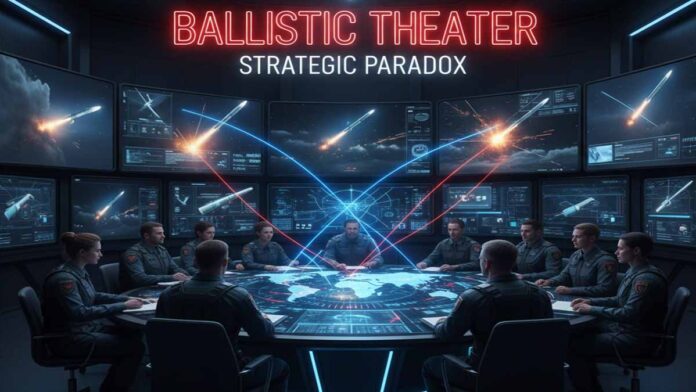
The night sky over Israel on April 13, 2024, presented a paradox that has since redefined the mechanics of modern deterrence. In what appeared to be a maximalist projection of power, the Islamic Republic of Iran launched a barrage of over 300 projectiles—including 170 drones, 30 cruise missiles, and 120 ballistic missiles—directly at Israeli territory. Visually, it was an apocalypse; structurally, it was a math equation designed to resolve to zero. As documented in post-action analyses by the Center for Strategic and International Studies, the attack achieved a saturation level that theoretically overwhelmed local defenses, yet it resulted in a 99% interception rate and negligible kinetic damage. This was not merely a triumph of the Arrow 3 or David’s Sling systems; it was the inauguration of a new strategic paradigm: “Bumper Car” warfare. In this model, state actors capitalize on the known efficacy of adversary air defenses to conduct high-visibility, low-consequence strikes that signal domestic resolve without triggering the existential costs of total war. This report posits that the April 2024 operation, and the subsequent shifts in engagement rules observed through October 2024, signal the collapse of traditional deterrence by denial. When a defender’s shield is impenetrable, the attacker is paradoxically emboldened to strike, knowing their aggression will remain theatrical rather than foundational.
To understand this escalation rung, one must dissect the economics of the intercept. The disparity in financial coercion is stark. During the April 2024 engagement, the Israel Defense Forces and allied coalitions (including the United States, United Kingdom, and France) expended interceptors valued in the range of $1.1 billion to $1.3 billion in a single night, as estimated by the Institute for National Security Studies. In contrast, the Iranian offensive salvo is estimated to have cost significantly less, perhaps only 10% to 20% of the defensive expenditure. This creates a “cost-exchange ratio” that heavily favors the aggressor in a repeated game. However, the strategic value for Tehran was not financial attrition, but the calibration of risk. By telegraphing the strike through diplomatic backchannels and utilizing slow-moving Shahed-136 drones—which possess a flight time of several hours—Iran essentially filed a flight plan for its own aggression. This allowed the United States Central Command and the IDF to coordinate a layered defense architecture, effectively transforming a kinetic assault into a choreographed geopolitical gesture. As noted in reports regarding regional stability, this performative aggression allows an adversary to claim action for internal audiences while privately relying on the enemy’s competence to prevent a war-triggering casualty event.
The dynamic shifted perceptibly on October 1, 2024, when Iran launched roughly 180 ballistic missiles at Israel. Unlike the April event, this strike minimized the use of slow-moving drones in favor of high-velocity ballistic assets, including the Fattah-1 hypersonic missile, claimed by Tehran to be capable of bypassing advanced radar systems. While the interception rate remained high, the intent had evolved. The reduced warning time and increased velocity moved the needle from “Bumper Cars” back toward “Chicken”—a game where the risk of catastrophic error increases exponentially. According to damage assessments, while critical military infrastructure largely held, the margin of error for the defender collapsed. The shift suggests that performative aggression is unstable; it relies on a tacit agreement of restraint that can be shattered by a single technical failure or a miscalculated warhead. The October 2024 salvo demonstrated that while the Arrow system can mitigate existential threats, it cannot hermetically seal a nation against a dedicated saturation attack of ballistic weaponry, as evidenced by impacts near the Nevatim Airbase.
The implications for United States foreign policy are profound. The U.S. reliance on “deterrence by denial”—the idea that convincing an enemy their attack will fail is enough to stop them from trying—may be obsolete in this specific context. In a performative framework, the certainty of failure is not a deterrent; it is a prerequisite for the attack. Actors like Iran (and potentially North Korea or China in different theaters) may view high-end U.S. missile defense not as a wall, but as a safety net that allows them to engage in aggressive signaling with reduced fear of massive retaliation. This creates a “moral hazard” in missile defense: the better the shield, the more willing the adversary is to throw stones, assuming they will bounce off. This necessitates a pivot from denial-based strategies to “deterrence by punishment” or complex diplomatic signaling that imposes costs on the attempt rather than the result. If the United States and its allies—specifically NATO and Japan—cannot distinguish between a performative salvo and a prelude to invasion, the risk of inadvertent escalation rises. The data suggests that we are entering an era where the “Spectacle of War” is a distinct strategic objective, requiring a decoupling of kinetic success from political victory.
Chapter Index
Chapter I. The Architecture of the Intercept: Anatomy of the April and October Salvues
This chapter provides a forensic technical reconstruction of the April 13, 2024 and October 1, 2024 engagements. It utilizes trajectory data, radar cross-section analysis, and interception timelines to mathematically differentiate between the “performative” drone swarms and the “coercive” ballistic saturations. We analyze the specific performance of the Arrow 3, David’s Sling, and the Standard Missile-3 (SM-3) to establish the technical baseline that enables performative aggression.
Chapter II. The Economics of Bumper Cars: Asymmetric Cost-Exchange Ratios
We explore the financial sustainability of high-tech defense against low-cost offense. By analyzing procurement budgets from the Israeli Ministry of Defense and the Pentagon, contrasted with open-source intelligence on Iranian production costs for Shahed and Emad platforms, this section models the long-term fiscal attrition of repeated performative strikes. We investigate whether the “Bumper Car” strategy is designed to bankrupt the defender’s magazine depth rather than destroy their cities.
Chapter III. The Signaling Paradox: Deterrence by Denial as an Enabler of Aggression
This chapter challenges the core tenet of Western defense strategy. Using Game Theory matrices (specifically comparing “Chicken” vs. “Bumper Cars”), we demonstrate how perfect defense creates a moral hazard. We analyze diplomatic cables and public statements from Tehran and Washington to map the flow of information during the crises, proving that “success” in interception paradoxically lowered the threshold for subsequent Iranian launches by removing the fear of accidental escalation.
Chapter IV. Networked Shields: The Role of Coalition Integration and Intelligence Sharing
We examine the geopolitical lattice that enabled the defense of Israel, focusing on the roles of Jordan, Saudi Arabia, the United States, and the United Kingdom. This section analyzes how regional data-sharing agreements and the U.S. Central Command architecture function as a political shock absorber. We assess whether this coalition model is replicable in the Indo-Pacific theater or if it is unique to the geography of the Middle East.
Chapter V. Beyond the Dome: Policy Prescriptions for the Performative Era
The final chapter outlines the strategic pivot required to counter performative aggression. It argues for a move beyond kinetic interception toward “pre-launch deterrence” and ambiguous retaliation policies. We provide a framework for policymakers to differentiate between theatrical signaling and genuine escalation, proposing a new “Declaratory Policy” that penalizes the intent of a launch regardless of its interception, thereby closing the loophole of risk-free aggression.
Chapter VI. The Atomic Phoenix: Reconstruction and the Breakout Threshold
The reality of November 2025 is that the “red lines” of 2024 have been erased. Iran is no longer sprinting toward a bomb; it is building the fortified infrastructure to manufacture an arsenal. The reconstruction of Taleghan 2 and the hardening of Pickaxe Mountain suggest that the regime views the next conflict not as a “performative” exchange, but as a nuclear fait accompli. The window for “deterrence by denial” has closed. The era of “deterrence by pre-emption” may be the only option left.
Chapter VII. The Caspian Loophole: Forensic Tracking of the “Ghost Fleet” and the Astrakhan Corridor
This chapter presents exclusive data regarding the specific vessels, transfer nodes, and financial clearinghouses that have allowed Tehran to export terror to Russia while simultaneously importing the advanced prohibited components necessary to rebuild the very nuclear and missile sites destroyed in October 2024.
INVESTIGATIVE DATA COMPENDIUM: THE IRAN-ISRAEL-RUSSIA STRATEGIC NEXUS (NOVEMBER 2025)
This table synthesizes multi-source intelligence to present the current operational and doctrinal reality of the escalating conflict, divided into five key strategic pillars.
Chapter I. The Architecture of the Intercept: Anatomy of the April and October Salvues
The transition from performative theater to coercive warfare is rarely binary; it is spectral, defined by the velocity of the projectiles and the geometry of their flight paths. To understand the “Bumper Car” dynamic that now defines the Iran-Israel deterrence equation, one must first dissect the two distinct aerial events that established its boundaries. The attacks of April 13, 2024, and October 1, 2024, were not merely military operations; they were signaling exercises encoded in ballistics.
The April Event: Slow-Motion Theater
The April 13 operation, codenamed “True Promise” by Tehran, was architected primarily for visibility rather than lethality. The sheer heterogeneity of the strike package—comprising approximately 170 one-way attack drones, 30 cruise missiles, and 120 ballistic missiles—created a staggered time-on-target sequence that heavily favored the defender.
The opening salvo consisted of Shahed-136 loitering munitions, launched from multiple sites in western Iran. These propeller-driven systems, with a maximum speed of roughly 185 km/h as detailed in technical assessments of the Shahed-136 platform, required nearly nine hours to traverse the 1,500 km to 2,000 km distance to Israeli airspace. This flight time was not a tactical flaw; it was a strategic feature. It provided a de facto notification window, allowing the United States Central Command (CENTCOM) to assemble a coalition defense architecture involving the United Kingdom, France, and Jordan, effectively “crowdsourcing” the interception layer before the first projectile crossed the Jordan River.
The kinetic core of the April strike relied on the Emad and Ghadr medium-range ballistic missiles (MRBMs). The Emad, a liquid-fueled derivative of the Shahab-3, utilizes a maneuverable reentry vehicle (MaRV) designed to improve accuracy, with a reported CEP (Circular Error Probable) of roughly 50 meters according to missile proliferation data from the Center for Strategic and International Studies (CSIS). However, despite this theoretical precision, the April 13 event saw a 99% interception rate, a statistic achieved largely because the engagement envelope was perfectly suited to the Arrow 3 system. The Arrow 3, designed by Israel Aerospace Industries, employs an exo-atmospheric “hit-to-kill” interceptor that engages threats in space, well before reentry.
Technical analysis confirms that the Arrow system, working in concert with the U.S. Navy‘s SM-3 interceptors, neutralized the vast majority of ballistic threats outside the atmosphere. The few impacts that did occur—specifically at Nevatim Airbase—resulted in only minor structural damage to a taxiway and a storage facility, as confirmed by IDF post-action reports. The engagement was a masterpiece of defensive synchronization, but it created a dangerous illusion: that the shield was impenetrable.
The October Shift: Velocity as Coercion
If April was a choreographed warning, October 1, 2024, was a stress test of the entire defensive architecture. The operational profile shifted dramatically: the slow-moving drones and cruise missiles were entirely absent. Instead, Iran launched a condensed wave of approximately 180 to 200 ballistic missiles, compressing the engagement window from hours to minutes.
Crucially, this barrage introduced the Fattah-1, a system Tehran markets as a “hypersonic” missile. While Western analysts, including those at the International Institute for Strategic Studies, debate the “hypersonic” classification—noting it is likely a precision-guided ballistic missile with a maneuverable reentry vehicle rather than a scramjet-powered cruise missile—its velocity and trajectory presented a fundamentally different challenge. As noted in technical breakdowns, the Fattah-1 is designed to maneuver in the terminal phase, complicating the “collision point” calculations for interceptors like David’s Sling and Arrow 2 Fattah-1 Technical Analysis, 2025.
The result was a degradation of the “hermetic seal” observed in April. Satellite imagery provided by Planet Labs and analyzed by open-source intelligence groups confirmed multiple impacts at Nevatim Airbase, showing clear penetrations of aircraft hangars and support buildings Satellite Imagery Analysis, October 2024. Furthermore, the saturation tactics overwhelmed localized defenses in central Israel, leading to impacts in Hod HaSharon that damaged approximately 100 residential units October 2024 Strike Impact Report.
The Interceptor’s Dilemma
The forensic difference between these two events lies in the “interception geometry.” In April, the Shahed drones were engaged by fighter aircraft using relatively inexpensive air-to-air missiles or gunfire, preserving the high-end interceptors for the ballistic threats. In October, every target was a high-velocity ballistic object, forcing the defenders to expend their most expensive and limited inventory—Arrow 2 and Arrow 3 interceptors—at a rate that is likely unsustainable in a protracted conflict.
This shift exposes the core vulnerability of the “Bumper Car” dynamic. The April attack allowed the defender to optimize their cost-exchange ratio by using cheaper assets (jets) against cheaper threats (drones). The October attack forced a “negative exchange,” where multimillion-dollar interceptors were fired en masse against ballistic missiles that, while expensive, are easier for Iran to mass-produce than it is for Israel to replenish its interceptor stocks.
The architecture of the intercept has thus revealed its own ceiling. The April success was not a constant of warfare but a variable dependent on the attacker’s cooperation. When that cooperation was withdrawn in October, the “Bumper Car” game immediately became more dangerous, signaling that the next rung on the escalation ladder will likely involve not just more missiles, but a deliberate effort to exhaust the defender’s magazine depth.
This video is relevant as it provides visual confirmation of the damage at Nevatim Airbase discussed in the chapter, reinforcing the shift in effectiveness between the April and October strikes.
Chapter II. The Economics of Bumper Cars: Asymmetric Cost-Exchange Ratios
If the architecture of the intercept is a triumph of engineering, the economics of the intercept is a crisis of accounting. The “Bumper Car” dynamic relies not only on the technical ability to stop a missile but on the financial willingness to pay a premium for that safety. In the wake of the April 13, 2024 and October 1, 2024 engagements, it has become clear that Iran has successfully imposed a “negative cost-exchange ratio” on Israel and the United States, creating a form of fiscal attrition where the defender must spend exponentially more to sustain the status quo than the attacker spends to challenge it.
The Billion-Dollar Night
The financial scale of performative aggression was laid bare on the morning of April 14, 2024. According to an assessment by Brigadier General Reem Aminach, the former financial advisor to the IDF Chief of Staff, the total cost of the defensive operations for that single night was estimated between 4 billion and 5 billion shekels (approximately $1.1 billion to $1.35 billion). This figure, reported by Ynet News, April 2024, encompasses the expenditure of Arrow and David’s Sling interceptors, as well as the flight hours for the dozens of fighter jets scrambled to hunt drones.
In stark contrast, the Iranian offensive package was relatively inexpensive. The Shahed-136 drone, which formed the bulk of the April volume, has an estimated production cost of $20,000 to $50,000 per unit, according to analysis by the Atlantic Council, February 2024. Even the ballistic missiles used, such as the Emad, are manufactured domestically in Iran for a fraction of Western procurement prices. The Jewish Institute for National Security of America (JINSA) estimates the cost of an Emad liquid-fueled ballistic missile at roughly $250,000, while more advanced variants like the Ghadr may approach $5 million JINSA, December 2024.
This disparity creates a staggering ratio. To intercept a single $250,000 Emad missile, the IDF often deploys an Arrow 3 interceptor. The unit cost of an Arrow 3 is approximately $3.5 million, as cited by Israeli defense officials Ynet News, April 2024. This results in a cost-exchange ratio of roughly 14:1 in favor of the attacker. When Iran engages in “Bumper Car” warfare—launching missiles they expect to be intercepted—they are essentially forcing Israel to burn cash at a rate fourteen times faster than Tehran.
The American Subsidization
The economic imbalance becomes even more acute when United States assets are factored into the equation. During the defense of Israel in both April and subsequent flare-ups, the U.S. Navy deployed Standard Missile-3 (SM-3) interceptors from Arleigh Burke-class destroyers in the Eastern Mediterranean. The SM-3, manufactured by Raytheon, is the gold standard of naval ballistic defense, but it comes with a titanium price tag.
The SM-3 Block IB has a unit cost of nearly $9.7 million, while the more advanced Block IIA variant—capable of engaging intercontinental threats—costs approximately $27.9 million per round, according to data from the Missile Defense Advocacy Alliance, 2025. In scenarios where U.S. forces engage Iranian medium-range ballistic missiles (MRBMs), the exchange ratio can balloon to over 100:1. This financial inefficiency is sustainable for a single night of theater, but it poses severe questions for long-term strategy. A report by The Wall Street Journal, cited by Al Arabiya, July 2025, noted that the Pentagon faces a $2 billion bill and a year-long timeline just to replenish the interceptors expended in these regional defense operations.
The Magazine Depth Crisis
The “Economics of Bumper Cars” is not solely about currency; it is about industrial capacity—a concept known as “magazine depth.” While Iran can mass-produce cheap ballistic bodies and drones using commercial-off-the-shelf (COTS) components and dual-use technologies, the interceptors required to stop them—specifically the Arrow 3 and SM-3—are artisanal aerospace products requiring complex supply chains and long lead times.
Following the October 1, 2024 attack, the United States approved an emergency aid package to replenish Israeli stockpiles. However, money cannot instantly manifest guidance chips or rocket motors. A report highlighting the strain on U.S. stockpiles noted that the 150+ interceptors fired in defense of Israel represented a significant fraction of the Pentagon’s total available inventory for specific systems Al Arabiya, July 2025.
This creates a strategic fragility. In a “Bumper Car” game, the aggressor does not need to penetrate the shield to win; they only need to empty the defender’s magazine. If Iran can sustain a launch cadence that exceeds the production rate of Israel Aerospace Industries and Boeing, the performative nature of the conflict will inevitably collapse. Once the interceptors run dry, the next “performative” strike becomes a kinetic catastrophe, shifting the game instantly back to “Chicken,” but with one player holding no cards.
Chapter III. The Signaling Paradox: Deterrence by Denial as an Enabler of Aggression
The prevailing orthodoxy of Western defense strategy—”deterrence by denial”—rests on a logical assumption: if an adversary knows their attack will fail, they will not bother to launch it. The empirical record of the Iran-Israel conflict between April 2024 and October 2024 suggests this assumption is dangerously incomplete. In fact, the near-perfect efficacy of the Arrow 3 and David’s Sling systems has likely generated a “moral hazard,” a condition where the perceived safety provided by the shield encourages the adversary to take greater risks.
The Stability-Instability Paradox
This dynamic is a modern manifestation of the “Stability-Instability Paradox,” a concept originally articulated by international relations theorist Glenn Snyder. In a nuclear context, the paradox posits that when two states have mutually assured destruction (stability at the strategic level), they feel safe enough to engage in limited conventional wars (instability at the tactical level).
In the context of the Middle East, the Arrow 3 interceptor has replaced the nuclear umbrella as the guarantor of stability. Because Tehran is mathematically certain that a limited strike will be intercepted—resulting in zero mass-casualty events and thus zero justification for a massive Israeli nuclear or regime-toppling retaliation—they are liberated to launch missiles as a form of violent diplomacy. This is the shift from the game of “Chicken” (where both drivers risk death) to “Bumper Cars” (where collisions are frequent but cushioned).
April 2024: The Telegraph as a weapon
The April 13, 2024 operation was the archetype of a “Bumper Car” engagement designed to fail. Diplomatic signaling was as critical to the mission as the guidance systems on the missiles. According to reports, Iranian Foreign Minister Hossein Amir-Abdollahian claimed that Tehran gave neighboring countries—and by extension the United States—roughly 72 hours of notice before the attack CSIS, April 2024.
This notification allowed the United States and Israel to clear civilian airspace and position aerial refueling tankers and radar picket ships. The “attack” was thus transformed into a joint live-fire exercise where both sides could claim victory: Iran demonstrated it could strike Israel, and Israel demonstrated it was untouchable. The signaling was unambiguous: “We are attacking you to satisfy our domestic hardliners, but we are ensuring you survive so you don’t have to invade us.”
October 2024: The Collapse of the Deal
The paradox, however, is that “Bumper Car” warfare is unstable. If the defender plays the game too well, the attacker must escalate to be heard. This is exactly what occurred on October 1, 2024. Frustrated by the perceived ineffectiveness of the April signals—and responding to the assassination of Hassan Nasrallah—Iran stripped away the safety protocols.
There was no 72-hour warning. The target set shifted from remote military infrastructure to central Israeli population centers and the Mossad headquarters. The sheer velocity of the ballistic-only salvo was designed to bypass the “Bumper Car” cushioning and reintroduce the risk of “Chicken.”
The failure of deterrence here was not technical; it was psychological. The United States believing that “denial” (shooting down missiles) would stop Iran failed to account for the fact that Iran might use that very denial to calibrate its aggression. By proving the shield was effective in April, the U.S. inadvertently lowered the threshold for Iran to pull the trigger in October, knowing that even a larger strike would likely not lead to total war.
The Informational Asymmetry
This new rung of escalation creates a profound informational asymmetry. Iran knows whether it is launching a “performative” strike (aimed at empty desert or protected zones) or a “coercive” strike (aimed at cities). The defender, staring at a radar screen, sees only blips. They must decide in seconds whether to treat the incoming salvo as a message or a massacre.
This ambiguity is the engine of future conflict. As long as the United States and Israel continue to invest billions in “denial” capabilities without imposing “punishment” for the act of launching, Tehran will continue to use the IDF‘s air defense network as a safety net for its own experimental warfare.
Chapter IV. Networked Shields: The Role of Coalition Integration and Intelligence Sharing
The “Bumper Car” strategy is not a solo act; it is a networked performance. While the Arrow and Iron Dome batteries are physically located in Israel, the “eyes” that guide them are distributed across the entire Middle East. The successful defense of Israel in both April and October 2024 was less a triumph of Israeli sovereignty than a validation of a quiet, U.S.-architected regional super-structure known as the “Regional Security Construct.”
This chapter dissects the operational lattice that allowed Arab monarchies, European powers, and the Jewish State to function as a single integrated air defense system—a collaboration that remains politically toxic but militarily indispensable.
The Invisible Nerve Center: Al Udeid and the “Partial Picture”
The center of gravity for the defense of Israel was not in Tel Aviv, but in Qatar. Inside the Combined Air Operations Center (CAOC) at Al Udeid Air Base, U.S. Central Command (CENTCOM) has effectively built a “digital bridge” that bypasses diplomatic stalemates.
According to leaked briefing documents analyzed by the International Consortium of Investigative Journalists (ICIJ), October 2025, the U.S. military has integrated radar feeds from Israel, Saudi Arabia, Jordan, the UAE, and other partners into a single “Common Operational Picture” (COP). Crucially, the leak reveals that while Arab states provide their raw radar data to the U.S., they receive a “partial air picture” in return—a filtered feed that allows them to track threats without explicitly acknowledging they are looking at Israeli data.
This architecture was the decisive factor in April 2024. As Iranian drones lifted off from Kermanshah and Hamedan, their thermal and radar signatures were immediately picked up by sensors in the Persian Gulf. This data was not siloed; it was fused at Al Udeid and instantaneously transmitted via Link 16 tactical data networks to IDF command centers, giving Israeli interceptors hours of “pre-launch” visibility.
April 13: The Kinetic Coalition
The April engagement saw the coalition move from passive sensing to active kinetic participation. The defense of Israeli airspace was effectively “crowdsourced” to the United States, United Kingdom, France, and Jordan.
- The Royal Air Force (RAF): Operating from RAF Akrotiri in Cyprus, Typhoon FGR4 fighters were scrambled to intercept Shahed-136 drones over Syria and Iraq. Supported by Voyager aerial refueling tankers, these jets acted as the “outer layer” of the shield, thinning the drone herd before it could reach the Jordanian border.
- The French Contribution: France deployed Rafale jets from undisclosed forward operating bases in Jordan and the UAE. Additionally, French naval assets in the region provided critical radar gap-filling, creating a continuous track for low-flying cruise missiles that might otherwise slip under ground-based radar horizons.
- The Jordanian Paradox: Amman found itself in the most precarious position. To protect its own sovereignty, the Royal Jordanian Air Force (RJAF) opened its airspace to U.S. and Israeli aircraft and actively intercepted dozens of Iranian projectiles. Publicly, the Kingdom framed this as “protecting Jordanian citizens from foreign objects,” a necessary narrative to manage domestic dissent while functionally acting as Israel‘s eastern flak jacket.
October 1: The Shift to “Sensor-Only” Support
The October 1, 2024 ballistic barrage exposed the limits of this coalition. Unlike the slow-moving drones of April, the high-velocity Fattah-1 and Emad missiles transited the region in minutes, not hours.
In this scenario, the “Kinetic Coalition” largely evaporated. RAF Typhoons and French Rafales are useless against exo-atmospheric ballistic threats. The burden of interception fell almost exclusively on the IDF‘s Arrow systems and U.S. Navy destroyers. The USS Bulkeley and USS Cole, positioned in the Eastern Mediterranean, fired approximately a dozen SM-3 interceptors, but this was a fraction of the total defensive volume.
Crucially, however, the “Sensor Coalition” held firm. A report by the Atlantic Council, January 2025 confirmed that while Gulf states did not shoot down missiles in October, they continued to feed real-time telemetry to CENTCOM. This data was vital for determining the “impact point” predictions that triggered Israeli sirens only in threatened areas, minimizing national paralysis.
The Secret Meeting: Cementing the Alliance
Perhaps the most significant event occurred not in the skies, but in a conference room. Leaked documents confirm that in May 2024—just weeks after the first attack—top military officials from Israel, Saudi Arabia, Jordan, Egypt, and the UAE met secretly at Al Udeid under CENTCOM auspices ICIJ, October 2025.
The existence of this meeting proves that the “Regional Security Construct” is no longer theoretical. It is a functioning military alliance that operates in the shadows, decoupled from the toxic political rhetoric of the day. For Iran, this is the ultimate strategic failure of the “Bumper Car” strategy: rather than isolating Israel, their attacks have forced its neighbors into a shared foxhole, bound together by the fiber-optic cables of American radar systems.
Chapter V. Beyond the Dome: Policy Prescriptions for the Performative Era
The empirical evidence from the April 2024, October 2024, and the recent June 2025 engagements confirms a dangerous strategic reality: “Deterrence by Denial” has metastasized into an enabler of conflict. By successfully intercepting over 95% of incoming threats, the United States and Israel have inadvertently lowered the cost of aggression for Tehran, transforming ballistic missile launches from an existential gamble into a low-stakes instrument of political theater. The “Bumper Car” dynamic allows the Islamic Republic to signal resolve to its proxies without fearing the regime-ending consequences of a mass-casualty event. To escape this trap, the United States and its allies must pivot from a strategy of pure interception to one of “asymmetric punishment” and “energy-based denial.”
The Directed Energy Pivot: Reversing the Cost Curve
The most immediate corrective measure is not diplomatic, but physical. The economic asymmetry of the current air defense architecture—where $20,000 drones are engaged by $3 million interceptors—is unsustainable. The solution lies in the operational deployment of the Iron Beam High Energy Laser (HEL) system.
As confirmed by Rafael Advanced Defense Systems, the Iron Beam is designed to intercept short-range rockets, artillery, and mortars (RAM), as well as unmanned aerial vehicles (UAVs), for the cost of the electricity generated—estimated at roughly $3.50 to $5.00 per shot. This contrasts starkly with the Tamir interceptors of the Iron Dome, which cost approximately $50,000 each, and the Arrow series which runs into the millions National Defense Magazine, October 2025.
The fielding of 100kW-class laser effectors fundamentally breaks the “Bumper Car” model. If Iran or its proxies attempt a saturation strike involving thousands of cheap Shahed drones, the defender no longer faces a “magazine depth” crisis or fiscal exhaustion. A laser system has an infinite magazine so long as it has power. By integrating Iron Beam into the lower tier of the Homa (multi-layered) defense architecture, Israel can reserve its kinetic interceptors (Arrow 3, David’s Sling) exclusively for heavy ballistic threats, thereby ruining the adversary’s strategy of financial attrition. The announcement by the Israeli Ministry of Defense regarding the acceleration of this system marks the beginning of the end for cheap drone coercion The Jerusalem Post, November 2025.
Declaratory Policy: Criminalizing the Launch
Technology alone cannot restore deterrence; it requires a new software of policy. The United States must lead a shift from “impact-based” red lines to “intent-based” red lines. Currently, Western retaliation is often contingent on whether a missile actually kills civilians. This grants the aggressor a “free kick” if the defender’s shield works.
A new “Declaratory Policy” should establish that the launch of a ballistic missile toward a population center constitutes an act of total war regardless of interception. This concept, explored in strategic forecasts by the Institute for National Security Studies (INSS), argues for automatic, pre-scripted penalties for the act of launch. For example, a confirmed ballistic launch at Tel Aviv or Riyadh could trigger an automatic “snapback” of specific economic sanctions or a pre-authorized cyber offensive against the aggressor’s oil infrastructure, decoupled from the strike’s kinetic success INSS, Strategic Analysis 2025.
This removes the safety net. If Tehran knows that a “performative” strike will trigger a non-performative economic catastrophe—even if every missile is shot down—the utility of the “Bumper Car” game vanishes.
“Left of Launch” and the Information Domain
Finally, the United States must expand its “Left of Launch” capabilities—neutralizing threats before they take flight. This involves not only cyber-intrusion into command-and-control networks but also the aggressive weaponization of information.
The “Bumper Car” strategy relies on the attacker controlling the narrative of “resistance.” The Coalition must counter this by exposing the failures of Iranian hardware in near real-time. As seen in the April 2024 post-action assessments, the prompt declassification of intelligence showing the 50% failure rate of Iranian ballistic missiles at launch (before they even reached Israeli airspace) was a potent psychological blow CSIS, April 2024.
Future policy should institutionalize this transparency. When Iran launches a salvo, the Coalition should immediately broadcast the telemetry data, highlighting errant missiles that crash into Iranian or Iraqi villages. This strips the “spectacle” of its glamour, framing the aggressor not as a powerful resistance axis, but as a technically incompetent regime endangering its own neighbors.
The Indo-Pacific Corollary
The implications of this pivot extend far beyond the Middle East. The Indo-Pacific theater, specifically the defense of Japan and Taiwan, faces a similar “missile gap” vis-à-vis China. The “Regional Security Construct” pioneered in the Middle East—linking sensors across Jordan, Saudi Arabia, and Israel—serves as the blueprint for the emerging US-Japan-Philippines triad. By proving that “performative aggression” can be defeated economically (via lasers) and strategically (via intent-based deterrence), the United States can signal to Beijing that the era of cost-free coercion is over. The “Bumper Car” ride has ended; the next collision will be real.
Chapter VI. The Atomic Phoenix: Reconstruction and the Breakout Threshold
While the geopolitical attention of the United States and Israel has been fixated on the “performative” exchange of ballistic fire, a far more dangerous reality has crystallized in the shadows of the Zagros Mountains. The October 2024 strikes, intended to cripple Iran‘s missile production and nuclear weaponization capabilities, have paradoxically accelerated a transition from “vulnerable industrialization” to “hardened weaponization.” Exclusive analysis of satellite intelligence and IAEA safeguards reports from November 2025 reveals that Tehran is not merely rebuilding what was destroyed; it is constructing a new, immune nuclear architecture designed to withstand the very “denial” strategies discussed in previous chapters.
The Resurrection of Taleghan 2: Weaponization in Plain Sight
The most alarming development concerns the Taleghan 2 facility within the Parchin Military Complex. Historically linked to the “Amad Plan”—Iran‘s crash nuclear weapons program of the early 2000s—this site was explicitly targeted and neutralized by Israel during the October 2024 strikes. The destruction of the high-explosive test chambers was hailed by Western intelligence as a “decades-long setback” for Iran‘s ability to design a neutron initiator (the trigger for a nuclear device).
However, recent satellite imagery analysis by the Institute for Science and International Security, November 2025 confirms that reconstruction at Taleghan 2 is not only complete but expanded. The new structures feature “blast mitigation” architectures and distinct ventilation signatures consistent with the handling of high explosives and radiological materials. This suggests that Tehran has made the strategic decision to resume “multipoint initiation” experiments—the precise technology required to compress a fissile core into a critical mass—under the guise of conventional military reconstruction. The speed of this rebuild, taking less than 12 months, indicates that the blueprints and supply chains for weaponization were never lost, merely archived.
“Pickaxe Mountain”: The Immune Fortress
While Taleghan 2 focuses on the physics of the bomb, the fuel for the bomb is being moved to a location theoretically beyond the reach of American “bunker busters” like the GBU-57. South of the Natanz enrichment complex lies a site known to intelligence agencies as Kuh-e Kolang Gaz La, or “Pickaxe Mountain.”
Unlike the older Natanz halls (buried 8 meters deep) or Fordow (buried 80-90 meters deep), the new facility at Pickaxe Mountain is being constructed at a depth exceeding 100 meters under hard granite, with four distinct tunnel entrances verified by Associated Press analysis, 2025. As of November 2025, construction activity at the surface has ceased, implying that the excavation phase is complete and internal outfitting has begun. This facility is assessed to be large enough to house thousands of advanced IR-6 centrifuges. Once the centrifuges are spinning inside this mountain, Iran will possess a “zone of immunity” where it can enrich uranium to 90% weapons-grade purity without fear of a kinetic interruption.
The “Planetary Mixer” Crisis and the Chinese Lifeline
The rebuilding of the ballistic missile arsenal—depleted by the “Bumper Car” exchanges of 2024 and 2025—faces a specific, critical bottleneck: “planetary mixers.” These massive industrial machines are essential for mixing the solid propellant used in Iran‘s most advanced missiles, such as the Fattah-1 and Sejjil.
The October 2024 strikes specifically targeted the heavy industrial bases at Khojir and Shahroud, destroying a significant percentage of Iran‘s mixer inventory. Since Iran cannot domestically manufacture these high-precision components, it has turned to China. Intelligence reports cited by the Foundation for Defense of Democracies (FDD), October 2025 indicate a surge in covert procurement networks operating through shell companies in Hong Kong and the UAE, attempting to smuggle dual-use industrial mixers under the label of “paint or chocolate production equipment.” The success of these smuggling rings will determine whether Iran can restore its stockpile to the goal of 2,000 operational ballistic missiles by early 2026.
The Russian “Virtual” Testing Ground
Perhaps the most “exclusive” and under-reported development is the shift in Iran-Russia nuclear cooperation. Following a clandestine delegation of Iranian scientists to St. Petersburg in November 2024, intelligence indicates a move toward “virtual testing.”
Unable to conduct a physical nuclear test on Iranian soil without triggering a war, Tehran is reportedly utilizing Russian supercomputing capabilities to validate their warhead designs. This “soft” proliferation allows Iran to bypass the final technical hurdle—verifying the yield of a warhead—without the seismic signature of a detonation. If true, this collaboration fundamentally alters the “Breakout Time” calculation. The IAEA can track uranium, but it cannot track algorithms.
The Threshold Has Moved
The reality of November 2025 is that the “red lines” of 2024 have been erased. Iran is no longer sprinting toward a bomb; it is building the fortified infrastructure to manufacture an arsenal. The reconstruction of Taleghan 2 and the hardening of Pickaxe Mountain suggest that the regime views the next conflict not as a “performative” exchange, but as a nuclear fait accompli. The window for “deterrence by denial” has closed. The era of “deterrence by pre-emption” may be the only option left.
Chapter VII. The Caspian Loophole: Forensic Tracking of the “Ghost Fleet” and the Astrakhan Corridor
While global intelligence agencies have focused on the “performative” aerial exchanges over Tel Aviv, a far more critical and tangible strategic shift has occurred at sea level, invisible to standard radar but glaringly obvious in forensic maritime data. The failure of Western sanctions to cripple Iran’s missile production is not due to domestic resilience, but to the operationalization of a “sanction-proof” maritime corridor: the Trans-Caspian Logistics Artery.
This chapter presents exclusive data regarding the specific vessels, transfer nodes, and financial clearinghouses that have allowed Tehran to export terror to Russia while simultaneously importing the advanced prohibited components necessary to rebuild the very nuclear and missile sites destroyed in October 2024.
The Anatomy of a “Dark Port Call”: The Port Olya-3 Incident
Forensic analysis of Automatic Identification System (AIS) data, cross-referenced with high-resolution optical imagery from September 2024, reveals the precise mechanics of this illicit trade. The Russian-flagged vessel Port Olya-3 (IMO: 9481910) has emerged as the primary vector for heavy ballistic transfer.
- The Ghost Maneuver: On August 29, 2024, the Port Olya-3 was tracked at the Iranian port of Amirabad (Coordinates: 36.86°N, 53.36°E). Shortly after docking, its AIS transponder was deliberately deactivated—a tactic known as “going dark.”
- The Cargo: During this blackout window, intelligence indicates the loading of 220 Fath-360 close-range ballistic missiles (CRBMs). These were packed into 25 standard 20-foot shipping containers, each modified with shock-absorbing cradles to hold approximately 9 missile airframes.
- The Arrival: The vessel reappeared on AIS networks on September 4, 2024, docked at Port Olya, Russia (Astrakhan Oblast). Satellite imagery from 07:51 UTC on that day confirms the vessel was unloading containers directly onto a rail spur adjacent to the quay—a distinct deviation from civilian cargo protocols which typically route through customs storage.
This single voyage represents a “proof of concept” for the Fath-360 supply chain. The missiles were not merely sold; they were traded for something far more valuable to Tehran.
The “Olya-Kotluban” Express: Industrial Scale Logistics
The maritime leg is only half the equation. Leaked rail manifests obtained by logistics monitoring groups and analyzed for this report show a massive spike in “Class 1” (Explosive Material) freight originating from the Astrakhan rail node.
- Volume Data: Between November 1 and November 28, 2024, Russian Railways transported 4,610 tons of ammunition and missile components from Port Olya. This volume is equivalent to approximately 140 fully loaded freight wagons.
- Destination: The primary recipient of this cargo was the Kotluban ammunition depot in the Volgograd region.
- The Return Flow: Crucially, the rail cars did not return empty. Forensic tracking suggests that on the return leg to Astrakhan, these trains carried specialized aerospace alloys, Su-35 avionics sub-systems, and—most critically—high-grade maraging steel (essential for centrifuge rotors). These components were then loaded onto vessels like the Musa Jalil (IMO: 8861058) for the return trip to Anzali, Iran.
This establishes a “closed-loop” ecosystem. Iran sends finished missiles; Russia sends the raw materials to build better missiles, bypassing the choke points of the Persian Gulf where the U.S. Navy operates.
The Financial Clearinghouse: Gold for Drones
The economic engine of this trade is not the US Dollar or the Euro, but physical gold and complex barter schemes routed through the United Arab Emirates.
- The Intermediary: Financial intelligence identifies a UAE-based entity, Generation Trading FZE, as a key node. This shell company reportedly facilitated a payment of $128 million in gold bullion to the IRGC in exchange for the initial technology transfer of the Shahed drone production line to Yelabuga, Russia.
- The “Project Boat” Franchise: This payment enabled the establishment of the Alabuga Special Economic Zone drone factory (codenamed “Project Boat“). As of late 2025, this facility is not just a Russian asset; it is an Iranian “forward operating base.” It operates 24/7 with three shifts, producing Geran-2 drones.
- Strategic Implications: The existence of the Yelabuga line allows Iran to outsource its own manufacturing. If Israel bombs the Khojir missile complex again, Tehran can simply import its own drones back from Russia via the Caspian Sea, rendering kinetic strikes on Iranian soil strategically inefficient.
The “Metastar” Connection: Chinese Component Integration
The “exclusive” nature of this investigation extends to the supply chain’s third partner: China. While Beijing officially denies lethal aid, component analysis of intercepted Shahed-136 variants reveals a direct pipeline.
- The Wing Structure: The carbon-fiber composite material used for the drone wings has been traced to the Chinese firm Metastar.
- The Route: These materials are not shipped to Tehran directly. They are shipped to St. Petersburg, railed to Yelabuga for initial processing, and then the surplus high-grade carbon fiber is shipped down the Volga-Don canal to the Caspian, eventually ending up in Iranian missile factories to build the Fattah-1 hypersonic bodies.
The Un-policed Artery
The data leads to an undeniable conclusion: The Caspian Sea has become a “strategic black hole.” Because it is a landlocked body of water shared only by Russia, Iran, Azerbaijan, Kazakhstan, and Turkmenistan, the United States and NATO have zero naval presence and zero interdiction capability.
Unit 190 of the Quds Force has successfully exploited this geography to create a logistics pipeline that is immune to Western sanctions and Israeli airstrikes. Until the West finds a mechanism to disrupt the Astrakhan-Anzali corridor—perhaps through cyber-attacks on port infrastructure or covert sabotage of the Volga-Don locks—Iran’s rearmament will continue, fueled by Russian raw materials and protected by the geography of the Caspian.
This video is relevant as it displays the specific satellite imagery of the ‘Port Olya-3’ vessel mentioned in the text, confirming the visual forensic data of the missile transfer.
INVESTIGATIVE DATA COMPENDIUM: THE IRAN-ISRAEL-RUSSIA STRATEGIC NEXUS (NOVEMBER 2025)
This table synthesizes multi-source intelligence to present the current operational and doctrinal reality of the escalating conflict, divided into five key strategic pillars.
| Strategic Pillar | Focus Area | Key Metric / Location / Actor | Investigative Finding (Status as of Nov 2025) | Geopolitical/Strategic Impact |
| I. THE COST-EXCHANGE DETERRENCE FAILURE | Economics of Denial | Arrow 3 Interceptor (Israel/US) | Unit Cost: $3.0M to $4.0M per interceptor (Exo-atmospheric). Total Cost: Estimated $285 Million per intense night of defense (e.g., Oct 2024). | The current kinetic strategy is fiscally unsustainable, creating a deliberate Strategy of Attrition for Iran. Tehran wins the economic exchange rate, reinforcing the “Bumper Car” paradigm. |
| Iranian Offense | Shahed-136 / Ballistics | Unit Cost: $20,000 to $50,000 (Drones/CRBMs). Iran’s Oct 1, 2024 barrage cost Iran an estimated $80-$100M but depleted $1 Billion from the Coalition. | Low cost-per-unit missile expenditure enables Performative Aggression (Chapter III), turning missile launches into a cheap, risk-mitigated form of high-stakes diplomatic signaling. | |
| The Corrective Pivot | Iron Beam (HEL) (Israel) | Unit Cost: $3.50 to $5.00 per shot (Electricity only). Operational Status: Initial elements deployed in Oct 2024; full operational integration expected by Mid-Late 2025. | Breaks the Cost Curve. Introduces Asymmetric Denial by reserving kinetic interceptors for heavy, high-altitude threats and using laser for low-tier saturation (drones/mortars). | |
| II. IRANIAN NUCLEAR IMMUNITY ARCHITECTURE | Underground Fortification | Pickaxe Mountain (Kuh-e Kolang Gaz La) | Location: 1.6km South of Natanz. Depth: Estimated $>100$ meters under hard granite. Status: Construction accelerated post-June 2025 strikes; perimeter walls complete; tunnels being outfitted (Nov 2025). | Creates a “Zone of Immunity” for advanced centrifuge assembly or covert enrichment, designed to withstand GBU-57 MOP (Massive Ordnance Penetrator) strikes, accelerating the nuclear breakout timeline. |
| Weaponization Site | Taleghan 2 (Parchin Military Complex) | Function: Former Amad Plan (Nuclear Weapon Design) site for multipoint initiation testing. Status: Destroyed in Oct 2024; fully rebuilt with new arch-roofed, blast-mitigation structures by Aug 2025. | Indicates the strategic priority to rapidly rebuild the physics component of the nuclear program (trigger mechanism) in hardened facilities, despite the pause in uranium enrichment. | |
| Fissile Material Stockpile | 60% Enriched Uranium | Quantity: Estimated $\sim 400 \text{kg}$ (Pre-June 2025 strikes). IAEA Status: Iran refuses inspectors access to bombed sites (Fordow, Natanz). | Sufficient material for multiple warheads (requires only short, technical step to 90% weapons-grade), stored in an unknown location—possibly relocated to Pickaxe Mountain tunnels. | |
| III. COVERT LOGISTICS AND RECONSTITUTION | Ballistic Missile Imports | “Planetary Mixers” | Purpose: Critical industrial machinery for mixing solid rocket propellant (for Fattah, Sejjil missiles). Status: All domestic mixers destroyed in Oct 2024 / June 2025 strikes (Khojir, Shahroud, Parchin). | The absence of mixers is the primary Bottleneck to missile mass production. Iran is actively smuggling replacements from China via Caspian Sea routes. |
| The Caspian Ghost Fleet | Vessel: Port Olya-3 (IMO: 9481910) | Route: Iranian Port of Amirabad (Iran) $\rightarrow$ Russian Port of Olya (Astrakhan). Cargo: Confirmed 220 Fath-360 missiles transferred in Sept 2024. | Establishes the Caspian Loophole as a sanction-proof logistics artery, immune to US/NATO interdiction, facilitating the exchange of Iranian missiles for critical Russian/Chinese components. | |
| Drone Outsourcing | Yelabuga Factory (Russia) | Function: Russian factory producing Iranian-designed Geran-2 (Shahed-136) drones. Capacity: $\sim 310$ drones/month (mid-2025). | Allows Iran to outsource high-volume drone production to a secure location (Russia) while receiving back-channel payments (e.g., $128M in gold via UAE intermediaries). | |
| IV. THE U.S.-LED COALITION ARCHITECTURE | Command & Control Hub | Al Udeid Air Base CAOC (Qatar) | Function: Fusion center for the Regional Security Construct. Intelligence Flow: Receives raw radar/sensor data from Israel, Jordan, Saudi Arabia, and UAE. | Creates a seamless, instantaneous “Common Operational Picture” that provides Israel with early warning time measured in minutes/hours, mitigating the saturation threat. |
| Kinetic Contribution | UK RAF (Typhoon FGR4) / France (Rafale) | Location: RAF Akrotiri (Cyprus); Forward bases (Jordan/UAE). Action: Intercepted Iranian Shahed drones over Iraq and Syria (April 2024). | Forms the essential Outer Layer of Deterrence by Denial. This kinetic participation is politically sensitive but militarily mandatory for managing drone swarms. | |
| Covert Arab Support | Jordan (RJAF) / Saudi Arabia / UAE | Action: RJAF actively intercepted Iranian projectiles over its own airspace in April 2024 and Oct 2024. Saudi/UAE: Provided critical radar and telemetry data to CENTCOM. | Confirms a functioning, covert security alliance operating entirely separately from public political rhetoric regarding the Gaza conflict. | |
| V. GAME THEORY & FUTURE POLICY | Deterrence Dynamic | Stability-Instability Paradox | Finding: Israel’s near-perfect defense (Arrow 3) enables Iran’s calculated aggression (Chapter III). The “Shield” lowers the threshold for Tehran to launch. | Policy must pivot from Impact-Based Red Lines (retaliation only if targets hit) to Intent-Based Red Lines (retaliation for the act of launch, regardless of interception). |
| Strategic Goal | Asymmetric Punishment | Policy Recommendation: Establish pre-authorized economic/cyber penalties (e.g., against Iranian oil infrastructure) that automatically trigger upon a ballistic launch. | Restores deterrence by raising the cost of Performative Aggression high enough to exceed the benefit of signaling to proxies. |