
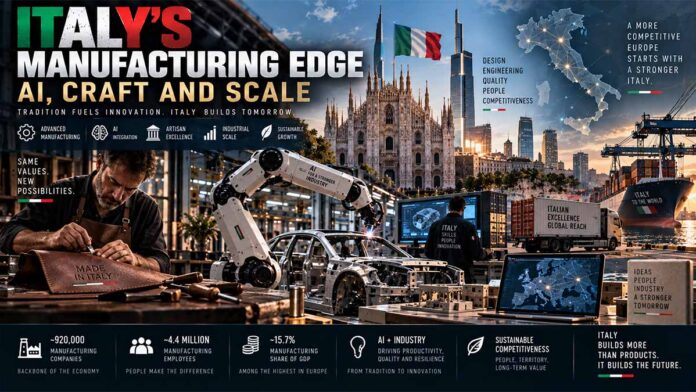

Scope: Italian artisanal and industrial manufacturing, with a short-term horizon of 2026–2029 and a structural horizon extending to 2035.
Executive Summary / BLUF
- Italian manufacturing can defend its competitive position, but it cannot defend every existing task, occupation or production model.
- The strategic objective is not resistance to automation; it is control over which activities are automated, which knowledge is digitised and which human capabilities remain part of the product’s market value.
- Italy’s greatest vulnerability is the widening adoption gap between large companies and SMEs: AI use reached 53.1% among large enterprises but only 15.7% among SMEs in 2025.
- The immediate impact will fall mainly on administrative, analytical, planning, documentation and standardised quality-control activities—not on the complete replacement of skilled production workers.
- In luxury, footwear, furniture, precision mechanics and other variable-material sectors, expert judgment remains economically defensible when it affects quality, yield, customisation or brand authenticity.
- However, craftsmanship that cannot be measured, transmitted or integrated into digital production will become a bottleneck rather than a competitive advantage.
- Large manufacturers must combine robotics, machine vision, predictive systems and workforce redesign; artisanal firms need shared technological infrastructure and affordable integration.
- The most probable outcome is a two-speed manufacturing system: digitally integrated exporters and premium artisans advance, while undercapitalised intermediate producers lose margins and bargaining power.
- The decisive asset will not be labour intensity. It will be the ability to combine machine repeatability with human control of variation.
- Italy can remain a manufacturing power only if it converts tacit craftsmanship into an augmented industrial capability without converting uniqueness into standardised commodity output.
Italy’s Manufacturing Edge: The Human Value AI Cannot Commoditise
Italy can defend its manufacturing base from the advance of artificial intelligence, but not by defending every existing task. The viable strategy is to automate repetition while protecting—and digitally amplifying—the judgment that creates quality, flexibility and pricing power. This distinction matters because Italy’s exposure is unusually asymmetric: large companies can finance data infrastructure, integration and specialist teams, while small manufacturers and workshops carry the fixed costs of transformation across far narrower revenues. The result could be a stronger, technology-enabled Made in Italy—or an industrial system split between integrated leaders and dependent suppliers. The decisive question is therefore not whether machines will enter factories. They already have. It is whether Italian companies will control the machines, the data and the allocation of human expertise, or surrender all three to larger customers and external platforms.
The Divide Behind the Headline
The acceleration is real. On 15 December 2025, Istat reported that the share of Italian enterprises with at least ten employees using artificial intelligence had risen from 5.0% in 2023 to 8.2% in 2024 and 16.4% in 2025. But the aggregate conceals the central industrial fault line: adoption reached 53.1% among large enterprises, against 15.7% among SMEs. The size gap widened from about 20 percentage points in 2023 to 37 points in 2025. Imprese e ICT – Anno 2025 — Istat — Dec 2025
Large groups can spread the cost of sensors, cybersecurity and specialists across plants. SMEs absorb similar fixed costs across narrower revenues and often must repair fragmented data first. The advantage compounds: adopters generate better data and attract further capital.
Adoption Is Not Transformation
“AI adopter” says little about industrial maturity. Among Italian users in 2025, 70.8% extracted information from text and 59.1% used generative technologies. Only 20.0% used machine learning for data analysis, about 18% used image recognition or workflow automation, and 5.9% applied AI to autonomous machine movement. Offices are changing before workshops.
Istat also found that 33.4% of AI-using businesses identified no specific corporate purpose among those surveyed; 83.3% of that group had 10–49 employees. Purchasing access to a model is not transformation. Transformation begins when verified data inform an accountable decision and improve scrap, downtime, energy use, lead time, yield or quality. Imprese e ICT – Anno 2025 — Istat — Dec 2025
Where the Machine Wins
Machines possess a clear economic advantage when inputs are stable, tolerances explicit, movements repeatable, exceptions rare and production volumes sufficient to recover integration costs. This includes document processing, demand analysis, production scheduling, standard dimensional inspection, repetitive handling and selected maintenance forecasting. Across the EU in 2025, 55.03% of large enterprises used AI, compared with 30.36% of medium-sized and 17.0% of small enterprises. Among AI users, 33.46% of large companies used it in production processes, against 19.02% of small firms. Use of Artificial Intelligence in Enterprises — Eurostat — 2025
Technical feasibility is not industrial superiority. Economics must include integration, validation, downtime, false rejection, reworking and lost flexibility—not labour alone.
Where Judgment Still Pays
A high-end shoe makes the boundary visible. Digital systems can optimise patterns, place cuts, schedule orders, trace components and flag surface anomalies. But natural leather varies in thickness, elasticity, grain and response to tension. An experienced operator does not simply repeat a movement: the operator interprets several weak signals, anticipates downstream consequences and changes the process before value is lost.
Expertise remains monetisable when it commands a quality premium, raises material yield, accelerates customisation, avoids expensive failure or transmits scarce knowledge. “Human touch” alone is not a strategy: a manual task producing no distinguishable value is vulnerable. A brief intervention that saves costly material may nevertheless remain economically superior.
The optimal architecture is machine screening with expert adjudication: robots execute stable movements; operators control exceptions and turn corrections into production knowledge. The Commission’s Industry 5.0 framework links competitiveness to a human-centric, resilient model. Industry 5.0 — European Commission — accessed Sep 2026
The Skills Bottleneck
Among Italian firms that considered AI but did not adopt it, 58.6% cited inadequate expertise, 47.3% uncertainty over legal consequences, 45.2% insufficient or poor-quality data, 43.2% privacy concerns and 43.0% excessive costs. Only 14.8% judged the technology useless. Imprese e ICT – Anno 2025 — Istat — Dec 2025 The primary obstacle is therefore absorptive capacity, not hostility to innovation.
Italy needs operators able to challenge machine recommendations, engineers who understand variable materials and managers who calculate total process economics. Article 4 of the EU Artificial Intelligence Act requires adequate AI literacy among personnel, adjusted to experience and context. Regulation (EU) 2024/1689 — European Parliament and Council — Jun 2024 In manufacturing, that means knowing when to trust, stop and escalate.
Master craftspeople must define defects, acceptable variation and corrective action for apprentices and systems. Extracting expertise merely to weaken their position invites resistance and leaves a static model as living knowledge deteriorates.
Data Are the New Industrial Know-How
Production data contain the firm’s memory: tolerances, material behaviour, defects and expert corrections. Transferring them indiscriminately may create a substitute for its expertise. Contracts must establish ownership, prohibit unauthorised training, govern storage and subcontractors, and guarantee export and deletion.
Dependency is the parallel danger: histories and workflows may become locked into proprietary infrastructure. Sovereignty requires portable data, segmented access and an alternative mode for critical operations. The Commission seeks wider access to curated industrial data; Italian firms must prevent reciprocal sharing from becoming unilateral disclosure. A European Strategy for Data — European Commission — accessed Sep 2026
Capital With Conditions
Italy already possesses significant financial instruments. Its recovery and resilience plan allocates €13.4 billion to the digital transition and innovation of the production system, including advanced technologies, research and training. Italy’s Recovery and Resilience Plan — European Commission — accessed Sep 2026 The National Research, Innovation and Competitiveness Programme 2021–2027 carries €5.56 billion, including €3.75 billion for research, innovation, digitalisation, investment and skills and €601.8 million for STEP critical technologies. Programma Nazionale Ricerca, Innovazione e Competitività — MIMIT, MUR and MASE — Mar 2026
Funding should reward absorption rather than acquisition. Incentives should require a production baseline, data-governance and workforce plans, portability and post-deployment measurement—not isolated machinery bearing an AI label.
The Commission lists 19 AI Factories, including Italy’s IT4LIA, and 13 antennas; European Digital Innovation Hubs provide assessments, training and technical support. AI Factories — European Commission — accessed Sep 2026 European Digital Innovation Hubs — European Commission — accessed Sep 2026 They must operate as extension services for small manufacturers, not distant research showcases.
Choosing the Competitive Position
AI cannot compensate for an undefined industrial position. Large-scale producers must compete through throughput, tolerances, delivery reliability and integrated supply chains; insufficient automation becomes a direct cost disadvantage. Flexible specialists require interoperable planning, rapid changeovers and machine assistance adapted to small batches. Premium artisans must automate non-differentiating work while documenting provenance and preserving the operations that justify a price premium. Luxury groups must combine scale with traceable human intervention without marketing automated uniformity as craftsmanship.
The firms at greatest risk are too expensive for scale, too standardised for a premium and too poorly digitised for superior flexibility. AI accelerates an existing strategic weakness.
The Italian Model
Italy’s answer should be organised around districts and supply chains. Microenterprises cannot each maintain data scientists, robotics laboratories and legal teams. They can share vendor-neutral process audits, secure testing facilities, integration specialists and sector-specific training while retaining ownership of their production knowledge. The EU’s Apply AI Strategy, presented on 8 October 2025, seeks precisely to accelerate adoption across strategic sectors, particularly among SMEs, and strengthen European technological sovereignty. Commission Communication: Apply AI Strategy — European Commission — Oct 2025
Italy should combine district AI centres, governed data spaces, shared machine-vision laboratories, master-craft schemes and outcome-based incentives—a distributed architecture compatible with its specialised networks.
The Cost of Inaction
The most probable danger is not a factory without people. It is a two-speed system in which integrated groups control data, planning and customer access while smaller suppliers retain physical work but lose margins and bargaining power. Digital procurement will increasingly demand structured information on capacity, provenance, defects, energy and delivery. Suppliers that remain informationally opaque may be penalised before robots replace a single operation.
Italy can defend both industrial scale and craftsmanship, but only by refusing the false choice between technology and human work. Repetition should be automated; variability should be measured; expertise should be amplified; industrial data should remain governable; and every investment should be judged against quality, productivity, resilience and market position. The decisive competitive advantage will not be the number of people or machines in a factory. It will be knowing exactly where each creates value—and retaining control over the system that connects them.
Master Abstract
Italy can defend value, not every existing job
Italian manufacturing will not be able—and should not attempt—to preserve its current allocation of tasks unchanged. It can, however, defend and potentially strengthen its share of high-value production if firms distinguish between labour that is merely embedded in the process and human judgment that is embedded in the product’s value. The available evidence does not support a near-term scenario in which artificial intelligence simply removes people from factories. The OECD estimates that 27% of employment across member economies is concentrated in occupations at high risk from automation technologies considered collectively, but its survey of manufacturing and financial firms found that most AI-adopting businesses had not changed their employment levels; reported reductions were only slightly more frequent than increases and the difference was not statistically significant. The same evidence identifies possible improvements in job satisfaction, health and wages alongside risks involving work intensity, privacy and bias. OECD Employment Outlook 2023 — OECD — Jul 2023 The defensible conclusion is therefore narrower than either technological optimism or mass-displacement forecasts: individual tasks will be reorganised faster than entire occupations disappear. In manufacturing, AI principally expands the capacity to forecast, classify, inspect, schedule and optimise; robotics translates some of those decisions into physical action. Replacement becomes commercially rational where inputs, tolerances and movements are sufficiently standardised. Augmentation remains superior where material variability, low production volumes, aesthetic judgment, repairability or customer-specific requirements make full automation expensive, brittle or value-destroying.
A high-end shoe illustrates this boundary precisely. Cutting can increasingly be supported by digital nesting, machine vision and automated cutting systems; production planning can be optimised against orders, material availability and delivery dates; image recognition can flag surface anomalies; and traceability systems can associate components, batches and operations with the finished product. None of these functions proves that the complete product should be automated. Leather varies in thickness, elasticity, grain, defects and response to tension. The economic question is not whether a machine can execute a movement, but whether it can detect the relevant variation, interpret its effect on the desired finish and correct the operation at a lower total cost than a skilled worker. That total cost includes rejected material, reworking, production interruption, loss of flexibility and any reduction in the authenticity for which the customer pays. Where experienced intervention raises yield, preserves scarce material or protects the visible finish, craftsmanship is not sentimental residue: it is productive capital. Yet this defence is conditional. If expert knowledge remains entirely tacit—held by ageing specialists, undocumented and unavailable to new workers—it becomes vulnerable to retirement, labour scarcity and inconsistent replication. The strategic response is therefore to capture decision rules, defect taxonomies, process histories and acceptable-variation ranges while leaving final authority with qualified operators where the data cannot fully describe quality.
The real threat is a two-speed industrial system
Italy’s most immediate risk is not autonomous machinery but unequal organisational capacity. In 2025, 16.4% of Italian enterprises with at least ten employees used at least one AI technology, twice the 8.2% recorded in 2024 and more than three times the 5.0% recorded in 2023. This acceleration conceals a widening structural divide: adoption reached 53.1% among large enterprises but 15.7% among SMEs, producing a gap of roughly 37 percentage points, compared with approximately 20 points in 2023. Among companies that considered AI but did not implement it, 58.6% identified inadequate skills as an obstacle, 47.3% cited insufficient legal clarity, 45.2% inadequate or poor-quality data, 43.2% privacy and data-protection concerns and 43.0% excessive costs. Imprese e ICT – Anno 2025 — Istat — Dec 2025 These figures indicate that Italy’s industrial exposure lies less in an intrinsic technological incapacity than in the fixed cost of adoption. A large manufacturer can distribute expenditure on data engineering, cybersecurity, integration and specialised personnel across multiple plants and product lines. An artisanal or small industrial business may need the same categories of expertise but cannot absorb them internally. If this imbalance persists, large firms will use AI to reduce lead times, inventory, defects and energy consumption, while smaller suppliers remain connected through spreadsheets, manual inspection and fragmented production records. The resulting pressure will appear first in margins, delivery conditions and dependence on dominant customers—not necessarily in headline employment losses.
The short-term period to 2029 will therefore be characterised by selective automation. Generative AI will spread rapidly through documentation, quotations, technical translation, procurement support, customer service, compliance preparation and product-content generation. Conventional machine learning will expand in demand forecasting, anomaly detection, predictive maintenance and quality classification. Physical automation will advance more slowly in highly variable artisanal processes because it requires sensors, machine integration, reliable data and often redesigned production layouts. Istat’s 2025 evidence already shows this hierarchy: among enterprises using AI, 70.8% applied text-based knowledge extraction and 59.1% used generative AI, whereas only 20.0% used machine-learning data analysis, approximately 18% applied image recognition or workflow automation, and 5.9% used AI for autonomous machine movement. Imprese e ICT – Anno 2025 — Istat — Dec 2025 Adoption is thus moving faster in informational work than in the physical transformation of materials. This creates a limited window during which Italian firms can digitise managerial and supporting functions, build production data and prepare workers before more capable robotics reaches economically viable deployment.
Craftsmanship becomes stronger when it is engineered
The artisanal component will remain defensible where three conditions coincide. First, human intervention must produce a measurable economic effect: higher material yield, lower rejection rates, superior finish, greater customisation, faster correction of unexpected variation or a price premium linked to provenance. Second, the firm must be able to demonstrate that contribution through traceability, certification, process documentation or customer-visible differentiation. Third, technology must reinforce rather than obscure the human contribution. A company that markets craftsmanship while using AI to imitate provenance or conceal fully standardised production weakens the credibility of the category. Conversely, a firm that records material characteristics, supports operators with real-time information, automates repetitive handling and documents where skilled intervention occurred can make craftsmanship more scalable without claiming that every stage remains manual. The industrial objective is “bounded automation”: machines control repeatable parameters; workers retain authority over exceptions whose treatment affects commercial value.
This model changes the worker’s role. The valuable operator of the next decade will not simply execute traditional movements. The operator will interpret sensor outputs, validate machine recommendations, recognise novel defects, adjust process parameters and teach the system which variations matter. This increases the importance of hybrid skills: materials knowledge, production engineering, statistical process control, digital traceability and the ability to challenge automated outputs. It also creates a risk of deskilling. If firms capture expert decisions only to remove workers from the process, they may lose the tacit feedback through which production knowledge evolves. If, instead, they use captured knowledge to train apprentices, support less-experienced staff and escalate unusual cases to senior specialists, AI can expand the productive reach of scarce expertise. Governance therefore enters the factory floor through work design: who may override the system, how corrections are recorded, whether performance monitoring becomes intrusive, and whether productivity gains are reinvested in skills or extracted solely through workforce compression.
Scale and craftsmanship face different strategic imperatives
Large-scale Italian manufacturing cannot defend itself through artisanal differentiation alone. Automotive components, machinery, pharmaceuticals, packaging, metals and standardised consumer goods compete on throughput, tolerances, energy use, delivery reliability and integration with international supply chains. In these sectors, delayed automation becomes a cost disadvantage. The required architecture combines interoperable production data, machine vision, predictive maintenance, digital twins where economically justified, cybersecurity and workers capable of supervising automated systems. The danger is purchasing isolated AI products without restructuring data and decision rights. Istat reports that in 2025 33.4% of AI-using enterprises could not associate their use with any of the surveyed business functions; these were predominantly firms with 10–49 employees. Imprese e ICT – Anno 2025 — Istat — Dec 2025 This suggests that part of the observed adoption remains experimental and organisationally unstructured. Buying access to a generative model is not equivalent to industrial transformation.
Artisanal and premium manufacturing confront the opposite error: using uniqueness as a reason to avoid measurement. Digitalisation does not require reducing quality to one automated score. It requires documenting the sources of variation sufficiently to improve planning, training, traceability and material utilisation. Shared services will be essential because many firms are too small to operate proprietary AI infrastructure. European AI Factories are intended to connect computing capacity, data and talent with universities, industry and SMEs; the Commission lists 19 AI Factories, including Italy’s IT4LIA, and 13 associated antennas, with at least nine new AI-optimised supercomputers expected to more than triple EuroHPC AI capacity. AI Factories — European Commission — accessed Sep 2026 Their relevance to Italian manufacturing will depend not on aggregate computing power alone but on whether firms can access sector-specific datasets, engineering support, secure testing environments and implementation expertise at a cost compatible with small production volumes.
The policy instruments exist, but coordination remains decisive
Italy does not lack public programmes. The National Research, Innovation and Competitiveness Programme 2021–2027 has a total envelope of €5.56 billion, including €3.72 billion from the European Regional Development Fund and €1.84 billion in national co-financing. Its first priority allocates €3.75 billion to research, innovation, digitalisation, investment and skills, while the STEP critical-technologies priority carries €601.8 million. Programma Nazionale Ricerca, Innovazione e Competitività per la transizione verde e digitale 2021–2027 — MIMIT/MUR/MASE — Mar 2026 SIMEST also provides a dedicated €200 million reserve for AI and quantum-computing investments by internationally oriented companies, with a subsidised rate displayed at 0.371%, financing of up to €500,000 for microenterprises, €2.5 million for SMEs and innovative SMEs, and €5 million for other companies, subject to the instrument’s eligibility rules. Transizione digitale o ecologica — SIMEST — accessed Sep 2026
Funding alone will not close the adoption gap. The defensible policy priority is a manufacturing-extension model capable of performing process audits, data-readiness assessments, worker training and vendor-neutral technology selection inside individual production systems. Italy should treat master craftspeople as part of the innovation infrastructure: their knowledge must inform datasets, inspection standards and human-machine interfaces. Public support should favour measurable production outcomes—lower scrap, reduced downtime, faster customisation, improved energy efficiency, safer work and successful apprentice training—rather than the purchase of equipment labelled “AI”. Financing should also protect industrial data. If proprietary information about materials, tolerances, defect correction and customer specifications is transferred indiscriminately to external platforms, firms may surrender precisely the process knowledge that differentiates them. The competitive issue is therefore not only whether Italian companies adopt AI, but whether they retain control over the data, models and operational feedback generated by adoption.
Long-term outcome: polarisation rather than disappearance
By 2035, Italian manufacturing is likely to divide into three groups. The first will consist of large and medium-sized firms that integrate AI throughout engineering, procurement, production, maintenance and commercial operations. Their employment may become less concentrated in repetitive supervision and administration, while increasing in systems integration, maintenance, data governance and high-level production control. The second will comprise premium artisanal firms that use digital tools behind the product while preserving human intervention where it remains visible, economically consequential and recognised by the customer. These businesses can strengthen provenance and customisation, but only if they train successors and avoid dependence on inaccessible proprietary platforms. The third—and most exposed—group will include companies positioned between craftsmanship and efficient scale: too standardised to command a substantial premium, too small or poorly organised to automate effectively, and too dependent on larger customers to control prices or investment schedules.
The central judgment is therefore conditional but affirmative. Italian artisanal and large-scale manufacturing can defend itself from the disruptive effects of AI, but not through the same strategy. Industrial manufacturers must automate sufficiently to protect productivity and delivery performance. Artisanal producers must identify exactly where human expertise changes the product and use technology to reinforce, document and transmit that expertise. Both require stronger data governance, continuous training and a deliberate allocation of decision rights between people and systems. The winning factory will not necessarily employ more or fewer people. It will know why a person is required at one stage, why a machine is superior at another, and how the interaction between them produces an advantage that competitors cannot cheaply reproduce.
Key Evidence Table
| Indicator | Value/status | Reference date | Definition/scope | Issuer | Exact source |
|---|---|---|---|---|---|
| Italian enterprises using AI | 16.4% | 2025 | Enterprises with at least 10 employees | Istat | Imprese e ICT – Anno 2025 — Istat — Dec 2025 |
| AI adoption among Italian SMEs | 15.7% | 2025 | Enterprises with 10–249 employees | Istat | Imprese e ICT – Anno 2025 — Istat — Dec 2025 |
| AI adoption among large Italian enterprises | 53.1% | 2025 | Enterprises with at least 250 employees | Istat | Imprese e ICT – Anno 2025 — Istat — Dec 2025 |
| Firms citing skills as an AI-adoption obstacle | 58.6% | 2025 | Non-users that considered adopting AI | Istat | Imprese e ICT – Anno 2025 — Istat — Dec 2025 |
| Employment in occupations at high automation risk | 27% | 2023 assessment | OECD employment; all automation technologies including AI | OECD | OECD Employment Outlook 2023 — OECD — Jul 2023 |
| Italian PN RIC envelope | €5.56 billion | 2021–2027 programme | ERDF and national co-financing | MIMIT/MUR/MASE | Programma Nazionale Ricerca, Innovazione e Competitività — MIMIT/MUR/MASE — Mar 2026 |
| European AI infrastructure | 19 AI Factories; 13 antennas | Status accessed Sep 2026 | EuroHPC-linked European network | European Commission | AI Factories — European Commission — accessed Sep 2026 |
Competing Industrial Pathways
| Hypothesis | Diagnostic support | Disconfirming evidence | Watch indicators | Current standing |
|---|---|---|---|---|
| H₁ — Broad labour substitution | Falling automation costs; expanding machine vision and robotics | Current firm evidence does not show statistically significant aggregate employment contraction from AI adoption | Employment per unit of output; dismissals by task; autonomous-machine adoption | Plausible in standardised functions, insufficiently supported as the economy-wide outcome |
| H₂ — Human augmentation | AI adoption currently concentrated in information, analysis and support functions | Benefits may be captured through workload intensification or later workforce reductions | Training expenditure; override rates; productivity and wages | Best supported near-term pathway |
| H₃ — Two-speed industrial divergence | 37-point AI-adoption gap between large firms and SMEs | Shared infrastructure and targeted finance could reduce fixed costs | SME adoption, cloud/data integration and skilled vacancies | Principal Italian structural risk |
| H₄ — Craft premium reinforcement | Human variation control, provenance and customisation remain monetisable | Machine quality may eventually approach acceptable premium standards | Price premium, rejection rates, custom orders and traceability | Strong in selected luxury and variable-material segments, not a universal defence |
| H₅ — Hollowing-out of intermediate producers | Firms without either scale efficiency or defensible uniqueness face margin pressure | Supplier collaboration, specialisation and shared automation could restore competitiveness | Supplier exits, consolidation, contract margins and capital expenditure | Material long-term risk |
Principal Gaps and Watch Indicators
- Sector-level Italian evidence separating AI use in manufacturing from adoption in services and administrative functions.
- Comparable measurements of defect rates, scrap, reworking and productivity before and after AI deployment.
- Evidence distinguishing experimental AI licences from systems integrated into production decisions.
- Data on the age structure and replacement rate of specialised artisanal occupations.
- Contractual evidence showing whether productivity gains are retained by SMEs or captured by dominant buyers.
- Measurement of how much consumers will continue paying for verified human workmanship once machine-produced quality becomes less distinguishable.
Italy’s AI Adoption Acceleration
Share of enterprises with at least 10 employees using one or more AI technologies. The comparison measures adoption, not production integration or productivity impact.
SMEs — 2025
Large enterprises — 2025
| Measure | 2023 | 2024 | 2025 |
|---|---|---|---|
| All enterprises, 10+ employees | 5.0% | 8.2% | 16.4% |
| SMEs | Not reproduced here | 7.7% | 15.7% |
| Large enterprises | 24.1% | 32.5% | 53.1% |
Source: Imprese e ICT – Anno 2025 — Istat — December 2025. Percentages describe technology use among enterprises and do not demonstrate causal employment or productivity effects.
The Asymmetry: AI Adoption, Industrial Scale and the SME Divide
The strategic judgment
Italy’s principal manufacturing vulnerability is not insufficient technological awareness, nor an intrinsic incompatibility between artificial intelligence and craftsmanship. It is the widening difference between enterprises able to convert AI into an integrated production capability and enterprises limited to isolated, experimental or administrative uses. In 2025, 16.4% of Italian enterprises with at least ten employees used at least one AI technology, compared with 8.2% in 2024 and 5.0% in 2023. The aggregate acceleration is substantial, but the distribution is more important: adoption reached 53.1% among large enterprises and only 15.7% among SMEs, creating a gap of approximately 37 percentage points. That gap had been approximately 20 points in 2023 and 25 points in 2024. Imprese e ICT – Anno 2025 — Istat — Dec 2025 The risk is therefore cumulative. Larger manufacturers gain experience, improve their data, redesign workflows and attract specialists; smaller firms confront the same fixed integration costs with fewer financial and managerial resources. If this dynamic persists, AI will not simply differentiate technologically advanced firms from traditional ones. It will redistribute margins, negotiating power, production knowledge and control of customer relationships across entire industrial supply chains.
Adoption is not transformation
The statistic “uses AI” must not be treated as evidence that a company has transformed its production system. It may describe anything from occasional generative-AI use in marketing to machine vision embedded in quality inspection. Istat’s figures reveal that Italian adoption remains concentrated in relatively accessible informational applications. Among enterprises reporting AI use in 2025, 70.8% employed technologies that extract knowledge from written documents, 59.1% used generative AI for language, images, video or audio, and 41.3% used speech-recognition technologies. Only 20.0% used machine learning for data analysis; approximately 18% reported image recognition or workflow automation; and just 5.9% used AI to enable the physical movement of machines. Imprese e ICT – Anno 2025 — Istat — Dec 2025 These categories are not mutually exclusive, but their distribution establishes the current direction: AI is entering the office and management layer faster than the physical production layer. Consequently, near-term employment effects are more likely to emerge in documentation, quotations, customer management, scheduling and administrative coordination than through the wholesale removal of skilled operators from variable-material manufacturing.
A second warning appears in the organisational purpose attributed to adoption. In 2025, 33.4% of Italian AI-using enterprises did not identify any business purpose among those included in the survey, up from 15.5% in 2024; 83.3% of these enterprises had between 10 and 49 employees. Istat interprets this as evidence of increasingly widespread but still initial or experimental adoption. Imprese e ICT – Anno 2025 — Istat — Dec 2025 This distinction is decisive. A small manufacturer whose employees use a public generative model to draft emails is statistically an AI adopter, but it has not necessarily reduced defects, shortened setup times, improved material yield or made delivery forecasts more reliable. The relevant managerial metric is therefore not possession of an AI licence. It is the proportion of critical workflows in which verified data enter a controlled model, generate an actionable recommendation, reach an accountable decision-maker and produce a measurable operational result. Without that chain, adoption remains consumption of a digital service rather than accumulation of industrial capability.
Why scale compounds the advantage
AI behaves as a general-purpose capability requiring complementary assets. A model cannot optimise production scheduling if orders, inventories, machine status and labour availability are stored in incompatible systems. Machine vision cannot improve quality if defect classes are undefined or images are not associated with materials, operations and outcomes. Predictive maintenance cannot function reliably without sensor histories and consistent failure records. Large companies are better positioned because they can distribute the fixed costs of data engineering, cybersecurity, legal review, systems integration and specialist recruitment across more sites, products and transactions. They can also tolerate unsuccessful pilots and retain internal expertise after vendors leave. Smaller enterprises face indivisible costs: the minimum viable integration project may be modest relative to a multinational’s budget but excessive relative to the cash flow of a workshop or specialised supplier.
European evidence confirms that this is a structural size effect rather than an Italian anomaly. In 2025, 17.0% of small EU enterprises, 30.36% of medium-sized enterprises and 55.03% of large enterprises used AI. Eurostat identifies implementation complexity, economies of scale and affordability among the plausible explanations. The operational gap is also visible inside specific business functions. Among AI-using enterprises, 33.46% of large firms used AI in production processes, compared with 19.02% of small firms; the corresponding figures for ICT security were 47.51% and 14.51%. Use of Artificial Intelligence in Enterprises — Eurostat — 2025 Larger firms therefore do not merely adopt more frequently. They are better positioned to deploy AI in functions requiring integration with machinery, operational data, security controls and formal governance. This is the point at which the adoption gap becomes a productivity and resilience gap.
Italy’s barrier is organisational capacity
The Italian evidence identifies a layered constraint system. Among enterprises that considered AI but did not adopt it, 58.6% cited insufficient expertise, 47.3% uncertainty over legal consequences, 45.2% unavailable or inadequate data, 43.2% privacy and data-protection concerns and 43.0% excessive cost. Only 14.8% considered AI not useful. Imprese e ICT – Anno 2025 — Istat — Dec 2025 The problem is therefore not predominantly cultural rejection. It is the absence of the complementary capabilities needed to turn general-purpose technology into controlled industrial use. Skills are listed first, but the barriers reinforce one another: a company lacking technical expertise cannot assess data quality, calculate returns, select an appropriate vendor or determine which legal obligations apply. Legal ambiguity increases the perceived cost of experimentation. Weak data prevent accurate pilots. Failed pilots then confirm management’s suspicion that the technology is immature or irrelevant.
The widening size gap also shows that cheaper access to generative AI does not automatically democratise industrial transformation. The marginal cost of using a cloud chatbot can be low, but the cost of safely integrating AI with production planning, customer specifications, intellectual property and machinery remains significant. The scarce inputs are not limited to computing power. They include clean historical data, process expertise, management time, cybersecurity, change control and the authority to redesign work. Italy’s industrial policy must consequently distinguish between access and absorption. Access means that a firm can purchase software or computing services. Absorption means that it can identify a valuable application, prepare the required data, adapt operations, train employees, monitor performance and retain control of the resulting knowledge. Subsidising the first without building the second risks producing high counts of formally digitalised firms with limited gains in productivity.
The supply-chain transmission mechanism
The AI divide will spread through supply chains even when small suppliers do not adopt the technology themselves. Large manufacturers and luxury groups will increasingly use AI to forecast demand, classify suppliers, evaluate delays, monitor quality and optimise procurement. Their suppliers will be required to provide more frequent, structured and standardised data. Companies unable to supply real-time information on capacity, material provenance, energy use, delivery status or defect resolution will become less visible to automated procurement systems and more expensive to manage. The immediate penalty may not be exclusion. It may take the form of shorter contracts, smaller order allocations, more intrusive reporting requirements and stronger pressure on prices.
This mechanism creates a paradox for artisanal suppliers. Their commercial value may depend on flexibility, tacit knowledge and the ability to solve non-standard production problems, yet their position in the supply chain may depend increasingly on digital standardisation. The correct response is not to standardise the product until its distinctive qualities disappear. It is to standardise the information surrounding the product: order specifications, material records, processing stages, tolerances, interventions, quality outcomes and delivery status. A workshop may retain human judgment over leather selection or finishing while digitally documenting why a piece was rejected, which correction was applied and how the outcome was validated. This allows craftsmanship to remain physically adaptive while becoming organisationally legible. Firms that fail to make this distinction risk losing contracts not because their workmanship is inferior, but because customers cannot integrate them into data-driven production networks.
Large firms face a different failure mode
Scale provides resources, but it does not guarantee depth of adoption. Large enterprises can accumulate pilots, licences and vendor relationships without changing the operational system. The United Kingdom provides a useful warning. By June 2026, approximately 35% of UK businesses with at least ten employees reported using at least one AI technology, up from roughly 12% in late 2023. Yet the average number of technologies used per adopting business increased only from approximately 1.4 to 1.6, and the Office for National Statistics judged the transformative impact to date to be relatively limited for most adopters. Artificial Intelligence in UK Businesses: 2023 to 2026 — Office for National Statistics — Jul 2026 Large companies can therefore suffer from breadth without integration: many disconnected applications, uncertain ownership and insufficient connection to production economics.
Earlier UK evidence also shows that manufacturing follows a distinct adoption pathway. In 2023, AI was used by 5% of manufacturing firms, compared with 9% of service firms, while manufacturing adoption of specialised equipment and robotics reached 64% and 14%, respectively. Furthermore, 91% of AI-using firms also used cloud systems and 83% used specialised equipment. Firms in the top decile for management-practice scores were substantially more likely to have adopted advanced technologies than those in the bottom decile. Management Practices and the Adoption of Technology and Artificial Intelligence in UK Firms — Office for National Statistics — Mar 2025 These figures support a broader conclusion: AI rarely enters an industrial vacuum. It builds on earlier investment in machinery, cloud infrastructure, specialist software and disciplined management. The relevant divide is therefore cumulative technological readiness, not AI procurement in isolation.
A comparative European position
Direct international comparisons require caution because surveys use different samples, questions and measurement dates. The United Kingdom’s 2026 ONS estimate, for example, should not be placed directly beside Italy’s harmonised 2025 enterprise survey as though the figures belonged to one dataset. The comparable European baseline is Eurostat, which records adoption across enterprises with at least ten workers under harmonised size categories. Within that framework, the EU-wide size gradient—17.0% small, 30.36% medium and 55.03% large—closely resembles the Italian division. Italy’s 53.1% adoption among large companies approaches the EU large-enterprise figure, while adoption among Italian SMEs remains the more consequential constraint. Use of Artificial Intelligence in Enterprises — Eurostat — 2025
France, Germany and the United Kingdom remain relevant not merely as adoption benchmarks but as competing industrial systems. Germany’s larger Mittelstand companies often possess deeper engineering integration and capital equipment, although small firms still face the same fixed-cost problem. France can channel adoption through more centralised national programmes and sectoral champions. The United Kingdom has stronger AI-service and financial ecosystems but official evidence shows that manufacturing AI adoption has lagged its use of robotics and specialised equipment. Italy’s distinctive advantage is its dense network of specialised suppliers and premium producers; its corresponding weakness is fragmentation. The strategic objective is therefore not to reproduce another country’s enterprise structure. It is to give small Italian manufacturers access to integration capabilities normally available only inside large organisations.
The financing architecture
Italy has material resources available for technological upgrading. The National Research, Innovation and Competitiveness Programme 2021–2027 has a total envelope of €5.56 billion, comprising €3.72 billion in European Regional Development Fund resources and €1.84 billion in national co-financing. Its first priority assigns €3.75 billion to research, innovation, digitalisation, investment and skills, while €601.8 million is assigned to the STEP critical-technologies priority. Programma Nazionale Ricerca, Innovazione e Competitività per la transizione verde e digitale 2021–2027 — MIMIT, MUR and MASE — Mar 2026 At European level, 19 AI Factories and 13 associated antennas are being established, including Italy’s IT4LIA, to connect computing capacity, data and expertise with research organisations, industry and SMEs. AI Factories — European Commission — accessed Sep 2026
For internationally oriented firms, SIMEST advertises a dedicated €200 million reserve for investments in AI and quantum computing. Under the displayed conditions, the maximum financing is the lower of 35% of average revenues over the previous two financial statements and ceilings of €500,000 for microenterprises, €2.5 million for SMEs and innovative SMEs, or €5 million for other enterprises. Transizione digitale o ecologica — SIMEST — accessed Sep 2026 These instruments address capital availability, but they do not automatically supply trusted integrators, usable industrial data or internal managerial capacity. The policy failure to avoid is financing equipment without financing the organisational change needed to use it.
The required industrial response
Closing the divide requires shared capabilities rather than identical firm-level investments. Industrial districts, technology centres, universities, chambers of commerce and sectoral associations should provide vendor-neutral process assessment, secure testing environments, data-engineering support and workforce training. Small businesses do not each require an internal AI laboratory. They require access to expertise that can determine whether a proposed application is technically feasible, economically material and compatible with the firm’s data and production constraints. Shared systems must nevertheless preserve confidentiality: pooled infrastructure cannot become a mechanism through which proprietary tolerances, defect classifications, designs or customer information migrate to competitors or platform providers.
Public incentives should therefore be tied to verified operational baselines and post-investment outcomes. Relevant indicators include scrap per unit, reworking hours, machine downtime, energy consumed per unit, setup time, delivery variance, material yield and the time required to qualify a new operator. An AI project that cannot identify which of these variables it is intended to improve should not be treated as industrial transformation. For artisanal companies, the assessment must also include preservation of the attributes supporting the price premium: quality consistency, customisation, provenance, repairability and documented skilled intervention. This avoids forcing every firm into the same automation model.
Key Evidence Matrix
| Dimension | Italy | EU benchmark | Strategic implication |
|---|---|---|---|
| AI adoption, all enterprises covered | 16.4% in 2025 | Country range 5.21–42.03% | Italy is advancing rapidly but remains far from universal adoption |
| AI adoption, SMEs | 15.7% | Small 17.0%; medium 30.36% | The constraint is concentrated in smaller organisations |
| AI adoption, large enterprises | 53.1% | 55.03% | Large Italian firms are close to the EU size-class benchmark |
| Italian large–SME gap | Approximately 37 pp | EU large–small gap 38.03 pp | The asymmetry is structural, not uniquely Italian |
| Skills barrier among considering non-adopters | 58.6% | 70.89% | Capability formation is more urgent than awareness campaigns |
| AI used for autonomous machine movement | 5.9% of Italian AI adopters | 1.39% of all EU enterprises | Physical AI remains far less diffused than informational AI |
| AI in production processes | No directly comparable Italian figure in the cited release | 33.46% large; 19.02% small among EU AI users | Production integration has a separate size penalty |
Key judgments
- Italy’s large enterprises are not the centre of the adoption crisis; the widening SME capability gap is.
- Nominal adoption overstates industrial transformation because much current use remains informational, administrative or experimental.
- Scale creates cumulative advantages in data, integration, cybersecurity, specialised personnel and the ability to absorb failed pilots.
- Artisanal firms can remain technologically selective, but they cannot remain informationally opaque.
- Supply-chain digitalisation will penalise non-integrated suppliers before physical automation eliminates their production roles.
- Public financing will have limited effect unless coupled with process redesign, workforce development and accessible integration expertise.
- The likely outcome without intervention is not the disappearance of Italian manufacturing but its polarisation between integrated leaders and increasingly dependent laggards.
What would change the assessment
The judgment would improve if harmonised evidence showed rapid AI diffusion among Italian small and medium manufacturers, increasing use in production and quality-control functions, measurable productivity gains and sustained investment in workforce capabilities. It would deteriorate if adoption continued to rise statistically while remaining concentrated in generic office applications, if large customers imposed data requirements that small suppliers could not meet, or if industrial process knowledge migrated to external platforms without contractual and technical safeguards.
Open official record
- Harmonised Italian AI-adoption figures specifically for manufacturing, disaggregated simultaneously by enterprise size and technology.
- Longitudinal measurements linking AI deployment to productivity, employment, wages, defects and material yield.
- Sector-specific data for footwear, leather goods, textiles, furniture, precision mechanics and other craftsmanship-intensive production.
- Comparable official 2025–2026 statistics for France and Germany using definitions aligned with the Italian and Eurostat series.
- Evidence separating employee-led use of public AI tools from enterprise-governed systems integrated into production.
The Production Boundary
What autonomous systems commoditise through scalable predictability versus where human judgment commands asymmetric economic rent.
Machine Domain: The Zero-Marginal Shift
Tasks with well-defined loss functions, structured input surfaces, and historical precedent collapse to baseline computational costs.
- Syntactic Execution: Code, translation, extraction
- Statistical Inference: Multi-variate pattern matching
- Distribution Cost: Asymptotes to energy cost
- Defensibility: Ephemeral (Model parity)
Human Domain: Asymmetric Judgment
Economic value concentrates in risk assumption, cross-domain arbitration, and the legal or institutional liability of outcomes.
- Fiduciary Underwriting: Ultimate liability absorption
- Novelty Navigation: Zero-shot institutional strategy
- Distribution Cost: Constrained / Uncapped upside
- Defensibility: High (Reputational capital)
Mechanisms of Value Capture Across the Frontier
Machines reduce search and compilation friction to near-zero. Value shifts entirely to choosing *which* objective function to optimize.
Institutions do not pay for computational predictions; they pay for legal, fiduciary, and political responsibility when predictions fail.
Standardised models regress toward the training distribution mean. Human conviction captures alpha during unprecedented shifts.
Persuasion, high-trust mediation, and subjective consensus remain stubbornly immune to synthetic scaling laws.
The Production Boundary: What Machines Can Standardise and What Human Judgment Still Monetises
The controlling judgment
The boundary between machine and human work is not determined by whether an activity has traditionally been described as artisanal. It is determined by the interaction of process variability, observability, repeatability, error cost and customer-recognised value. Machines hold the economic advantage when inputs can be classified reliably, desired outcomes can be expressed as measurable parameters, exceptions are sufficiently rare and production volumes justify the capital and integration costs. Human judgment retains its advantage when relevant differences are difficult to observe, quality depends on context rather than a fixed tolerance, exceptions occur frequently, correction requires causal understanding, or the buyer assigns value to verified human intervention. This means that neither artisanal production nor industrial manufacturing constitutes a single automation category. The same high-end shoe can contain operations suitable for complete automation, operations requiring machine assistance and operations in which skilled human control remains commercially decisive. The managerial error would be to automate according to the visibility of a task rather than its contribution to total product economics.
The correct production boundary is consequently dynamic. A task that requires human judgment today may become automatable after better sensors, more representative data, improved robotics or redesign of the product itself. Conversely, technical automation does not automatically establish economic superiority. A system may perform a nominal task while generating unacceptable rework, material waste, downtime, cybersecurity exposure or loss of product differentiation. The relevant question is not whether AI or robotics can reproduce an isolated movement under controlled conditions. It is whether the complete system can manage real production variability, maintain required quality, recover from exceptions and produce a lower risk-adjusted unit cost without destroying attributes for which the customer pays. This distinction is particularly important for Italian manufacturing, where competitive value often resides in flexible small batches, complex supplier relationships, scarce materials, customisation and accumulated process knowledge rather than maximum-volume standardisation.
Five tests for the automation boundary
A production activity should cross into full automation only when it passes five tests. The first is observability: sensors and data must capture the variables that an expert actually uses. A camera may detect colour variation but miss differences in texture, elasticity, internal stress or tactile response. The second is specifiability: acceptable output must be expressible in sufficiently precise and stable terms. A numerical tolerance is easier to automate than an aesthetic judgment conditioned by the character of a particular material. The third is repeatability: the process must encounter enough comparable cases for automation to learn or execute consistently. The fourth is recoverability: the system must identify abnormal conditions, stop safely and route exceptions to an appropriate human authority. The fifth is economics: savings in direct labour must exceed the combined cost of equipment, integration, validation, maintenance, data preparation, supervision, downtime, cybersecurity and quality failures.
These tests separate physical feasibility from industrial rationality. High-volume automotive welding passes them more readily than restoration, bespoke finishing or the assembly of highly variable natural materials. Automated inspection may classify a familiar defect with high consistency but perform poorly when lighting, surface geometry or material characteristics differ from the training environment. A robotic system may reproduce pressure and trajectory precisely but lack sufficient information to determine when the correct pressure should change. In such cases, automation can still provide positioning, measurement or force assistance while the worker retains control of the exceptional decision. The European Commission’s Industry 5.0 framework explicitly defines the industrial objective as human-centric, sustainable and resilient, emphasising technology that supports and empowers workers rather than treating replacement as the default destination. Industry 5.0: Towards a More Sustainable, Resilient and Human-Centric Industry — European Commission — Jan 2021
The production stack must be disaggregated
The production boundary becomes clearer when manufacturing is divided into layers rather than occupations. The first layer contains information processing: demand forecasts, quotations, work instructions, procurement documentation, inventory analysis, compliance records and translation. These activities are highly exposed because their inputs and outputs are substantially digital. The second contains perception and classification: identifying surface defects, measuring components, comparing images, recognising anomalous machine behaviour and verifying labels or assemblies. AI can perform these tasks effectively where sensing conditions and defect definitions are controlled. The third contains physical execution: cutting, handling, joining, coating, machining, packing and transport. Automation depends on the physical variability of inputs and the cost of reconfiguring equipment. The fourth contains exception resolution: determining why a defect occurred, whether material can be recovered, how process parameters should change and whether the output remains commercially acceptable. The fifth contains product judgment: decisions about feel, finish, balance, aesthetic coherence, authenticity and customer-specific expectations.
Current adoption data confirm that these layers are progressing at different speeds. Across EU enterprises in 2025, technologies analysing written language were used by 11.75%, while AI for image, video or audio generation reached 9.55% and language or code generation 8.76%. Technologies enabling machines to move physically through autonomous observation and decisions were used by only 1.39% of enterprises. Even among large enterprises, where adoption is substantially higher, autonomous physical movement was the least-used AI category at 8.55%. Use of Artificial Intelligence in Enterprises — Eurostat — 2025 The evidence therefore supports a staged transition. Information processing and selected perception tasks are crossing the boundary rapidly; adaptable physical manipulation and unstructured exception resolution remain considerably more difficult.
The high-end shoe as an industrial system
In high-end footwear, digital design, pattern grading, order configuration and cutting-layout optimisation are strong candidates for automation because they involve formal information and calculable material allocation. Computer-controlled cutting can reproduce geometries precisely, while machine vision can support the mapping of visible marks and the placement of components. Production planning can match orders to materials, machines, labour and delivery commitments. Traceability systems can associate hides, components, operators and processing stages with the finished product. These functions do not eliminate craftsmanship; they remove informational friction and repetitive execution around it.
The boundary becomes less stable when the system encounters natural leather. Two hides—and different regions of the same hide—can respond differently to tension, folding, skiving, lasting and finishing. Surface appearance does not necessarily reveal every production-relevant property. An experienced operator integrates sight, touch, resistance, sound and knowledge of downstream effects. The operator’s value is not the manual movement alone but the rapid interpretation linking present material behaviour to future product quality. A machine can standardise stitch length and nominal tension; the expert determines whether the material requires deviation from the nominal setting. A vision system can flag a visual irregularity; the expert decides whether it is a defect, a usable natural characteristic or a feature that must be positioned away from a visible part.
This does not make the activity permanently immune to automation. It establishes the information that an automated system would have to acquire and the economic threshold it would have to beat. If multimodal sensors reliably capture thickness, elasticity, surface condition and deformation, part of the expert decision can migrate into software. But the firm must still evaluate the cost of false acceptance, false rejection and material waste. In a premium product, a low-frequency error can carry a disproportionately high cost because it affects an expensive material, a completed product, delivery to a high-value customer or brand reputation. Human review therefore remains rational even when machines perform most classifications. The optimal design may be automated screening with expert adjudication of ambiguous cases rather than either universal manual inspection or universal machine authority.
Where human judgment becomes monetisable
Human judgment is economically defensible only when it changes an outcome the company or customer can recognise. This can occur through five channels: quality premium, material yield, flexibility, risk reduction and knowledge transmission. Quality premium exists when skilled intervention produces a finish, fit, sound, taste, visual effect or tactile result for which buyers pay more. Material yield matters when experts recover or reallocate inputs that an automated system would reject. Flexibility matters when low-volume, customised or rapidly changing orders would make dedicated automation uneconomic. Risk reduction arises when human intervention prevents rare but expensive failures. Knowledge transmission creates value when experts teach apprentices, refine standards and generate the labelled examples needed for future technological improvement.
The phrase “human touch” is commercially insufficient unless connected to at least one of these mechanisms. A task may require considerable manual effort but produce no distinguishable customer value and no operational advantage. In that case, protecting it is labour preservation rather than industrial strategy. Conversely, an apparently minor intervention may justify human control if it determines whether an expensive input becomes a premium product or scrap. Companies should therefore calculate a Human Judgment Contribution for critical operations using measurable effects: reduction in rejection and rework; increase in material utilisation; reduction in changeover time; avoided warranty costs; price premium associated with customisation or certified workmanship; and successful resolution of non-standard cases. The purpose is not to reduce craftsmanship to one crude score. It is to prevent management from eliminating valuable expertise simply because its contribution has never been recorded.
A practical allocation matrix
| Production condition | Preferred allocation | Reason |
|---|---|---|
| Stable inputs, explicit tolerances, high volume, low exception rate | Machine-led automation | Repeatability and scale justify integration costs |
| Stable task but hazardous, fatiguing or ergonomically damaging | Automation with human supervision | Safety and consistency gains dominate |
| Observable variation with sufficient labelled examples | AI-assisted classification | Machines screen volume; humans handle ambiguity |
| Variable materials with costly false rejection | Human adjudication after machine screening | Expert recovery can exceed labour cost |
| Frequent product changes and small batches | Flexible automation or cobotics | Dedicated automation may not recover its capital cost |
| Aesthetic or customer-specific acceptance criteria | Human-controlled decision with digital support | Quality depends on context and market expectation |
| Novel defect or process deviation without historical analogue | Human escalation authority | The system lacks a validated decision boundary |
| Repetitive movement with no market-recognised human contribution | Automation candidate | Manual execution does not itself create differentiation |
| Craft intervention supporting provenance or premium pricing | Human execution with traceability | The intervention is part of the product’s commercial identity |
| Process expertise concentrated in ageing specialists | Immediate knowledge-capture priority | Non-action creates succession and continuity risk |
The matrix establishes that human and machine roles should not be allocated by job title. A single worker may supervise automated execution, inspect uncertain outputs, resolve exceptions and perform a final aesthetic operation. Likewise, a production cell may move between automated and human-controlled modes depending on the material or order. This is more complex than replacing an entire occupation, but it is economically more precise.
Quality control: the strongest near-term frontier
Quality control is among the most attractive applications because it connects AI directly to waste, reworking, warranty risk and customer acceptance. Yet it also demonstrates why human judgment cannot be removed merely because an algorithm reaches high average accuracy. The industrial consequences of an error depend on its type. A false rejection wastes material and productive time; a false acceptance transfers the defect downstream, where correction becomes more expensive or impossible. The correct threshold therefore changes with product value, process stage and defect severity. A system inspecting an intermediate component should not necessarily use the same decision rule as one approving a finished luxury product.
A robust architecture divides cases into three zones. Clear conformity can be accepted automatically. Clear non-conformity can be rejected or diverted. The uncertainty zone is escalated to a skilled operator. Every human decision then becomes structured feedback: the image, material properties, operating parameters, reason for the decision and final outcome are retained. This generates an auditable process and gradually improves the model. Human review is not a temporary embarrassment to be removed as quickly as possible. It is a control mechanism that protects quality while expanding the evidence base. The boundary should move only when observed performance demonstrates that automation maintains or improves total process economics across normal and exceptional conditions.
Planning, maintenance and administrative work
Production planning is highly suitable for AI assistance but poorly suited to unsupervised authority when objectives conflict. A model can estimate demand, identify bottlenecks and generate schedules, yet managers must decide how to trade utilisation against resilience, inventory against delivery risk and efficiency against workforce stability. Historical data may also encode past shortages, distorted order patterns or customer priorities that no longer apply. The machine can search a larger solution space; management remains responsible for defining the objective and determining which constraints cannot be violated.
Predictive maintenance follows a similar pattern. Sensors and models can identify deviations that precede failure, allowing maintenance to be scheduled before breakdown. The benefit is largest where downtime is expensive and sufficient operational history exists. The human technician remains essential when symptoms have multiple causes, sensors are unreliable, or repair requires improvisation. AI can prioritise inspection and retrieve relevant histories, but the system should not convert uncertain predictions into automatic component replacement without economic validation. Otherwise, the company exchanges unplanned downtime for unnecessary maintenance expenditure.
Administrative functions will cross the automation boundary faster. Drafting routine documents, extracting order information, reconciling records and producing initial quotations can be partially automated because outputs are digital and review is comparatively inexpensive. However, automation must preserve accountability. A generated quotation incorporating an incorrect tolerance, delivery commitment or contractual condition can transfer risk directly into production. Human review should be concentrated according to consequence rather than applied indiscriminately to every output.
Human-centred design is frequently framed as worker protection, but it is also an industrial reliability strategy. Operators detect weak signals, resolve combinations of events not represented in training data and preserve production during partial system failure. Removing their authority can create a factory that performs efficiently under expected conditions but fails sharply when assumptions break. The European Commission’s Industry 5.0 approach links human-centricity with resilience rather than treating them as separate objectives. Industry 5.0 — European Commission — accessed Sep 2026
The operational principle should be human command over exceptions, objectives and irreversible decisions. Workers need authority to stop a process, reject an automated recommendation and record why the system was wrong. Management must distinguish legitimate override from resistance to change. Overrides should be analysed for patterns: repeated justified interventions show that the model or process boundary is defective; repeated unjustified interventions may indicate training problems or poorly designed interfaces. Removing override rights conceals both forms of evidence. The result may look highly automated while becoming less capable of learning.
AI can also degrade expertise if the operator is reduced to passive monitoring. Skills weaken when workers no longer diagnose, decide or practice difficult operations. Firms must therefore design deliberate skill-retention mechanisms: rotational manual practice, simulation of abnormal conditions, review of difficult cases, mentoring and certification of escalation authority. Otherwise, the company may discover during system failure that nominally qualified employees can no longer operate independently.
Intellectual property and the capture of craftsmanship
Digitising artisanal knowledge creates both resilience and appropriation risk. Images of materials, defect classifications, process parameters, corrective actions and customer specifications may constitute a highly valuable industrial dataset. If this information is transferred to an external platform without clear restrictions on retention, model training, reuse and subcontractor access, the firm may surrender the knowledge it intended to protect. The economic boundary between human and machine is therefore also an ownership boundary: who controls the model, the training data, the corrections and the operational history.
Italian firms should classify production knowledge before deployment. Generic administrative information may be suitable for external systems subject to ordinary controls. Customer designs, tolerances, recipes, finishing procedures, material-selection rules and expert corrections require stronger contractual and technical protection. Sensitive use cases may justify local processing, private infrastructure, segregated datasets or models that do not transmit proprietary inputs to a general service. The aim is not technological isolation. It is preservation of bargaining power. A company that gives a vendor access to the cumulative decisions of its most skilled workers may help create a substitute for its own expertise without retaining ownership of that substitute.
Measuring the correct outcome
Automation projects should be judged against a production baseline rather than a narrative of technological modernity. Before implementation, the company should record cycle time, labour time, scrap, rework, downtime, energy use, defect escape, delivery variance, setup time and the frequency of expert intervention. After implementation, the same indicators should be measured under comparable product mixes and operating conditions. Productivity gains should not be inferred from a demonstration or supplier forecast.
For craftsmanship-intensive operations, the evaluation must include variables conventional automation programmes often omit: recovered material, preservation of custom options, customer returns, final acceptance by expert inspectors, price premium and time required to train new operators. A system that reduces direct labour but increases discarded leather, suppresses customisation or weakens perceived quality may destroy more value than it saves. Conversely, a tool that leaves headcount unchanged but enables the same specialists to manage more orders, train apprentices faster or reduce scarce-material waste can be economically transformative.
The production boundary should consequently be reviewed periodically. Automation is not a one-time binary decision. It is a controlled movement of responsibility based on observed performance. The burden of proof should increase with the irreversibility and commercial consequence of the decision being transferred.
The emerging production model
The most defensible model for Italian premium manufacturing is neither the traditional workshop preserved unchanged nor the fully autonomous factory. It is a digitally legible, machine-assisted and human-commanded production system. Repetitive movement, hazardous handling, standard measurements, document processing and high-volume classification migrate toward machines. Experts concentrate on material allocation, exception resolution, process adaptation, aesthetic acceptance, customer-specific decisions and the continuous improvement of both human and automated work.
For large-scale manufacturing, the boundary will move further toward automation because volumes justify integration and processes can be redesigned for machine execution. Nevertheless, human authority remains necessary for objective setting, abnormal conditions, safety, supplier disruption and complex quality trade-offs. For artisanal producers, physical automation will remain more selective, but digital traceability and AI-supported planning will become unavoidable. A company can legitimately decide that final finishing must remain human. It cannot use that decision to justify poor inventory information, undocumented quality standards or dependence on one specialist whose knowledge disappears upon retirement.
Key judgments
- Automatable does not mean economically rational to automate.
- The strongest near-term applications lie in information processing, planning, inspection support, documentation and predictive functions.
- Physical automation advances most rapidly where inputs and tolerances are stable and production volume absorbs fixed integration costs.
- Human judgment remains monetisable when it improves yield, resolves exceptions, protects high-cost materials, enables customisation or sustains a recognised quality premium.
- Craftsmanship without measurement and traceability is vulnerable; craftsmanship reduced entirely to data risks appropriation and commoditisation.
- The optimal architecture is frequently machine screening, machine execution or decision support combined with human authority over ambiguous, consequential or novel cases.
- Worker autonomy and override mechanisms are elements of operational resilience, not merely labour policy.
- Firms must measure total process economics rather than direct labour savings.
What would change the assessment
The production boundary would move materially toward machines if multimodal sensing could reliably capture tactile and structural material properties, flexible robotic manipulation became economical for small batches, and longitudinal factory evidence demonstrated lower total costs without deterioration in premium quality. It would remain human-centred for longer if variable materials continued to generate high exception rates, customers paid verifiable premiums for skilled intervention, automation increased false rejection or industrial data could not be protected from external appropriation.
Open official record
- Sector-specific Italian evidence comparing human, assisted and automated quality inspection.
- Verified data on material yield and rework after AI deployment in leather, footwear, textiles, furniture and precision engineering.
- Official measurements of the price premium attributable specifically to human workmanship.
- Longitudinal evidence on skill retention after automation and the performance of workers during system failure.
- Comparable total-cost data for flexible robotics in low-volume and highly customised production.
- Public evidence on contractual control of industrial training data supplied to external AI platforms.
The Production Boundary: What Machines Can Standardise and What Human Judgment Still Monetises
An operational taxonomy dissecting the dynamic frontier between zero-marginal-cost algorithmic precision and irreplaceable, risk-underwriting human discernment across high-consequence manufacturing stacks.
The Production Allocation Landscape & Dynamic Frontier
Visualising boundary inflection across five production layers, error asymmetries, and input variability.
The Controlling Judgment
The boundary between machine and human work is not determined by whether an activity has traditionally been described as artisanal. It is governed by an empirical equilibrium between process variability, observability, repeatability, error cost, and customer-recognised value. Machines command decisive unit-cost advantages when input domains can be classified deterministically, target states expressed numerically, and failure frequencies suppressed below integration friction. Human judgment retains commercial sovereignty when variance is high-context, defect propagation is irreversible, and buyers anchor willingness-to-pay to verified human custody.
Five Tests for the Automation Boundary
A production phase must pass all five sequential gates before autonomous authority is granted over direct human intervention.
Sensors must capture what experts feel: internal stress, anisotropic shear, tactile grain response, and acoustic feedback, not merely flat visual color.
Target states must be mathematically stable. Fixed millimetric tolerances automate readily; contextual balance or aesthetic harmony resist static formulation.
The system requires sufficiently populated statistical distributions. Extreme customization lacks the structural volume required for continuous learning models.
Autonomous loops must register anomalous drift instantly, cease safe execution, and route structural exceptions to designated human arbitrators without total downtime.
Direct labour displacement must unambiguously exceed amortised Capex, integration, tool recalibration, software licensing, and catastrophic tail-risk scrap.
Disaggregation of the Five Production Layers
Occupational titles obscure real automation risk. Replacing an entire craftsperson is an industrial fallacy; automation diffuses layer-by-layer across disparate mechanical and cognitive tasks.
The empirical data demonstrates the stark divergence between text/code automation and physical real-world autonomy.
Case Study: High-End Footwear as an Industrial System
The luxury leather shoe exemplifies where machine standardisation unlocks leverage and where unyielding physical variability defends human premium monetization.
Digital Grading & Vector Cutting: CAD nesting optimizes geometry, cutting hides at millimetric precision, eliminating computational and marking waste. Complete digital traceability matches individual hides and supplier batches to downstream assembly lines.
Anisotropic Hide Behavior: Full-grain leather lacks uniform mechanical properties. A hide’s neck, flank, and butt react differently to tensile stress, skiving, and moisture. Surface vision maps marks, but cannot evaluate internal tension or fiber grain directional resistance.
Tactile Arbitration & Force Bias: The master shoemaker modulates pulling tension during lasting based on haptic feedback, preventing warping or premature creasing. This protects both raw material yield and the tactile luxury premium commanded at retail.
Comprehensive Production Allocation Matrix
Mapping empirical production regimes directly to operational architectures and microeconomic rationales.
| Production Condition | Preferred Allocation | Industrial & Microeconomic Rationale |
|---|---|---|
| Stable inputs, explicit tolerances, high volume, low exception rate | Machine-Led Automation | Deterministic repeatability and high throughput amortise fixed capital and system integration costs rapidly. |
| Stable task but hazardous, fatiguing or ergonomically damaging | Automation w/ Human Oversight | Worker safety mandates substitution; consistency gains dominate supervisory overhead costs. |
| Observable variation with sufficient labelled training distributions | AI-Assisted Classification | Algorithms filter baseline volume; skilled operators adjudicate high-uncertainty edge deviations. |
| Variable materials with costly false rejection (raw leather, marble) | Human Adjudication post-Screen | Expert material recovery and yield preservation heavily outweigh the direct labour cost of manual inspection. |
| Frequent product changes, small lots, hyper-flexible lines | Flexible Cobotics / Human Cell | Dedicated fixed automation cannot recover recurring retooling and integration downtime in dynamic batch setups. |
| Aesthetic, acoustic, or customer-specific acceptance criteria | Human-Controlled Decision | Definitive commercial quality is contextual, subjective, and linked directly to market willingness-to-pay. |
| Novel process deviations lacking historical system data | Mandatory Human Escalation | Out-of-distribution events lack valid statistical decision boundaries, risking cascading catastrophic failures. |
| Repetitive physical motion without consumer-perceived value | Primary Automation Target | Manual execution creates zero price premium or operational differentiation; represents pure friction. |
| Craft intervention supporting provenance or luxury pricing | Human Custody w/ Traceability | The certified human intervention constitutes an explicit component of the product’s commercial identity. |
| Specialised tacit knowledge concentrated in ageing personnel | Tacit Capture & Dual-Operator | Operational continuity vulnerability: requires structured data capture, sensor tagging, and apprentice mentoring. |
Quality Control: The Tri-Zone Boundary Engine
Average statistical accuracy in computer vision is an insufficient industrial metric. The commercial viability of inspection hinges on managing asymmetric error costs: false rejects destroy material yield; false accepts contaminate downstream brand value.
Unambiguous conformity automatically routes to the next processing cell. Zero human supervisory friction.
Ambiguous edge cases divert to expert inspectors. The master’s override creates labelled training data, expanding future machine boundaries.
Confirmed defects are halted instantly, preventing irreversible value compounding or catastrophic tool strikes.
AI simulates vast scheduling surfaces, but management sets strategic risk parameters—balancing machine utilization against supplier buffers. Predictive maintenance prevents failure, but technicians must validate before parts are scrapped prematurely.
Human command is an operational robustness requirement. Removing human override capabilities blinds the factory to weak warning signals. Tacit skill degrades unless operators actively exercise diagnostic judgment on atypical production flows.
Exporting expert decisions to public cloud AI risks training an external substitute for proprietary manufacturing knowledge. Proprietary recipes, tolerances, and corrective actions demand local, segregated, or on-premise governance.
Automation programs should be assessed on comprehensive outcomes: cycle variance, scrap rate, setup time, customisation retention, and warranty exposure. Measuring direct labour savings alone obscures destructive systemic costs.
Key Executive Judgments
What Would Change the Assessment
The boundary moves toward autonomy if multi-modal tactile sensing reaches parity with human touch, flexible cobotics solve low-volume batch economics, and long-term operating data demonstrates reduced total system costs without eroding luxury brand premiums. Conversely, it will remain anchored in human judgment if material variability keeps exception costs high, consumers demand verified craft provenance, and industrial IP risks deter firms from contributing proprietary data to cloud-based foundation models.
Open Official Record & Evidence Agenda
- Sector-specific Italian data comparing human, cobotic, and automated visual inspection.
- Empirical yield-recovery rates post-AI deployment across leather, textiles, and marble.
- Audited luxury price premiums tied directly to certified manual workmanship.
- Longitudinal tracking of technician diagnostic degradation during prolonged automated runs.
- Comparative total cost of ownership (TCO) benchmarks for flexible robotics in agile, small-lot manufacturing.
The Strategic Response: Investment, Skills, Data Ownership and Industrial Positioning
The controlling judgment
Italy should not pursue a generic objective of “more AI” in manufacturing. It should pursue selective technological sovereignty at firm and supply-chain level: the capacity to identify economically valuable applications, integrate them with production, preserve control over industrial knowledge and ensure that productivity gains reinforce rather than hollow out the national manufacturing base. The strategic divide will not be between companies that use AI and those that do not. It will be between companies that control the purposes, data and economics of their systems and companies that become dependent on external platforms, suppliers or dominant customers.
The required response has four mutually reinforcing components. Investment must be tied to operational outcomes rather than equipment acquisition. Skills policy must combine production expertise with digital authority rather than separating technical employees from experienced operators. Data governance must treat production histories and expert corrections as strategic assets. Industrial positioning must determine where Italy competes through scale, where it competes through flexibility and where verified human workmanship sustains a defensible premium. Failure in any one component weakens the others: machinery without skills remains underused; skills without data cannot train reliable systems; data without ownership strengthens vendors more than manufacturers; automation without positioning accelerates commoditisation.
Investment must begin with the process
The first investment decision should not be the selection of an AI product. It should be the selection of a production problem whose economic importance can be measured. Candidate projects should be ranked according to baseline losses: scrap, reworking, machine downtime, energy consumption, delayed delivery, forecasting error, setup time, administrative burden, warranty exposure or dependence on scarce expertise. Only after the loss mechanism has been quantified should management determine whether AI, conventional automation, better sensors, process redesign or employee training constitutes the most efficient intervention.
This sequence matters because many operational problems described as AI opportunities are failures of data collection, maintenance or management discipline. A manufacturer cannot obtain reliable predictive maintenance from incomplete machine histories. It cannot automate quality classification if defects have never been defined consistently. It cannot optimise production scheduling when inventory, orders and actual machine availability reside in incompatible systems. In such cases, the first investment is the creation of an auditable digital baseline. AI may become valuable later, but introducing it prematurely adds another layer of uncertainty.
Italian public support should therefore apply a staged financing model:
- Diagnostic stage: process mapping, digital-maturity assessment, data inventory and baseline measurement.
- Preparation stage: sensors, interoperability, cybersecurity, data cleaning and workforce training.
- Pilot stage: one bounded use case with defined success and failure criteria.
- Industrialisation stage: integration with operational systems, accountable human oversight and continuity arrangements.
- Scaling stage: replication across products or facilities only after verified results.
- Post-deployment stage: measurement of productivity, quality, employment, safety and unintended effects.
Italy’s recovery and resilience plan already assigns €13.4 billion to the digital transition and innovation of the production system, including incentives for advanced technologies, research and development and training activities. Italy’s Recovery and Resilience Plan — European Commission — accessed Sep 2026 The strategic issue is therefore not simply the volume of public funding. It is whether expenditure builds cumulative firm-level capabilities or produces disconnected purchases whose benefits disappear when the subsidy cycle ends.
Different firms require different capital strategies
A microenterprise, an industrial SME and a multinational manufacturing group should not be expected to follow the same investment architecture.
| Enterprise type | Priority investment | Model to avoid | Required support |
|---|---|---|---|
| Artisanal microenterprise | Digital records, traceability, planning, assisted inspection and knowledge capture | Expensive proprietary automation designed for stable high volumes | Shared technical expertise, small pilots and simple contractual safeguards |
| Small industrial supplier | Interoperability, production visibility, quality data and customer-system integration | Isolated AI tools without connection to machinery or workflow | District-level integration services and pooled testing infrastructure |
| Medium manufacturer | Predictive maintenance, machine vision, planning optimisation and flexible automation | Multiple vendor pilots without unified architecture | Internal product owner, data governance and workforce redesign |
| Large industrial group | Enterprise-scale integration, digital twins, supplier data and automated control | Centralisation that removes local production knowledge | Independent validation, plant-level authority and supply-chain inclusion |
| Luxury or premium group | Provenance, customisation, material yield and craftsmanship traceability | Automation that weakens authenticity or commoditises design | Protected datasets and explicit human-intervention standards |
For microenterprises, owning complex infrastructure is generally less important than obtaining trusted access to it. European Digital Innovation Hubs provide digital-maturity assessments, training, technical assistance and connections to financing, while the EU’s AI Factory architecture is designed to connect computing capacity, data and expertise with industry and SMEs. European Digital Innovation Hubs Network — European Commission — accessed Sep 2026 AI Factories — European Commission — accessed Sep 2026 Italy should use these networks as industrial extension services rather than as generic innovation showcases. Their success should be measured by systems deployed, production improvements verified and capabilities retained inside participating firms.
Capital support must reward absorption
Public incentives traditionally favour identifiable capital expenditure because equipment is easy to invoice and audit. AI-intensive transformation depends heavily on less visible complementary investment: process analysis, data preparation, employee time, workflow redesign, cybersecurity, integration and post-deployment validation. If only machinery or software licences qualify, firms may optimise their applications around subsidy rules rather than industrial value.
The National Research, Innovation and Competitiveness Programme 2021–2027 provides €5.56 billion, including €3.75 billion under the priority covering research, innovation, digitalisation, investment and skills and €601.8 million for STEP critical technologies. Programma Nazionale Ricerca, Innovazione e Competitività per la transizione verde e digitale 2021–2027 — MIMIT, MUR and MASE — Mar 2026 SIMEST also provides a dedicated €200 million reserve for AI and quantum-computing investments by internationally oriented companies. Transizione digitale o ecologica — SIMEST — accessed Sep 2026
These instruments should be evaluated according to additionality and absorption. Additionality asks whether public support caused a productive investment that would otherwise have been delayed or abandoned. Absorption asks whether the recipient acquired the organisational capacity to continue using, improving and governing the technology after the funded project. A subsidised system that remains vendor-operated, poorly understood internally and disconnected from measurable production outcomes does not establish durable competitiveness.
Skills are part of the capital stock
The central skills problem is not that every production worker must become a programmer. It is that firms need people capable of translating between production reality and digital systems. The critical profiles include operators who understand data and measurement, engineers who understand material variability, technicians who can interpret models without surrendering judgment, managers who can evaluate total process economics and legal or security personnel who understand industrial data flows.
Istat reports that 58.6% of Italian enterprises that considered but did not adopt AI identified inadequate skills as an obstacle. The same survey shows that AI adoption is associated far more strongly with marketing, administration and research than with autonomous physical machinery. Imprese e ICT – Anno 2025 — Istat — Dec 2025 The appropriate response is therefore occupation-specific training rather than generic AI awareness. A quality inspector requires competence in confidence thresholds, false acceptance, false rejection and escalation. A maintenance technician requires anomaly interpretation and sensor validation. A production planner needs to understand optimisation constraints and the consequences of inaccurate data. A manager needs to distinguish a convincing demonstration from a reproducible return on investment.
Training should be divided into four levels:
- AI literacy for all affected workers: purposes, limitations, data handling, error reporting and rights.
- Operational competence: use, verification and override of systems deployed in a particular workflow.
- Integration competence: connection of AI with machinery, enterprise software, cybersecurity and quality systems.
- Strategic competence: investment selection, vendor governance, intellectual-property protection and organisational redesign.
This is not merely recommended management practice. Article 4 of the EU Artificial Intelligence Act requires providers and deployers to take measures, to the best of their ability, to ensure an adequate level of AI literacy among staff and other persons operating AI systems on their behalf, considering their knowledge, experience, training and the context of use. Regulation (EU) 2024/1689 — European Parliament and Council — Jun 2024 Compliance training should not be reduced to a standard online module. The required literacy differs between someone using generative AI for correspondence and someone relying on machine vision to release a component into production.
The master craftsperson must enter the digital system
Traditional expertise should be treated as a source of industrial data, but not mined as though it had no owner or institutional context. Senior operators should participate in defining defect categories, acceptable variations, escalation rules and the circumstances under which a machine recommendation must be rejected. Their interventions should be recorded with explanations and linked to production outcomes. This creates training material for apprentices, evidence for process improvement and labelled examples for technological development.
Compensation and status should reflect this additional role. If firms ask experienced workers to transfer decades of knowledge into a system that may later reduce their bargaining power or eliminate their position, resistance is economically rational. Knowledge-capture programmes should therefore include transparent objectives, recognition of contributors, commitments to training and defined rules over how the captured knowledge will be used. Where appropriate, collective agreements or internal governance arrangements should address monitoring, evaluation and redeployment.
The strategic objective is not to preserve every inherited method. Some practices will prove inefficient once measured. Others will reveal contributions previously invisible to management. The point is to subject both technology and tradition to evidence. A manual step that does not affect quality, flexibility or risk should be reconsidered. An expert intervention that consistently prevents expensive failures should be formalised and protected.
Data ownership is industrial sovereignty at company scale
Production data are not administrative exhaust. They contain the operational memory of the enterprise: machine behaviour, material characteristics, defect patterns, customer specifications, corrective interventions, process tolerances, supplier performance and commercial priorities. When combined, these records may reveal how the company produces quality, where it tolerates variation and how it solves problems competitors cannot manage.
Before deploying AI, every manufacturer should classify its data into at least four categories:
| Data class | Examples | Default treatment |
|---|---|---|
| Commodity operational data | Public manuals, generic maintenance instructions | External processing may be acceptable |
| Sensitive business data | Orders, prices, inventories, schedules | Contractual restrictions, access controls and segregation |
| Core industrial know-how | Process parameters, defect taxonomies, yield optimisation | Strong protection; controlled or local processing |
| Identity and provenance data | Designs, artisanal interventions, customer specifications | Highest contractual, technical and audit controls |
The European data framework is moving toward greater access and reuse of industrial data, but access rights do not remove the need for governance. The Commission’s evolving data strategy emphasises high-quality, curated data as an input to AI innovation. A European Strategy for Data — European Commission — accessed Sep 2026 For an Italian manufacturer, however, more data sharing is not automatically advantageous. The firm must determine whether a proposed data space creates reciprocal value or transfers unique knowledge to a stronger platform, customer or technology supplier.
Contracts must preserve control
AI procurement contracts should define at least:
- ownership of source data, prompts, labels, corrections and model outputs;
- whether the supplier may retain or use company data for model training;
- the location and duration of storage;
- access by subcontractors and non-EU entities;
- procedures for deletion, export and migration;
- technical and financial consequences of service termination;
- audit rights and incident notification;
- allocation of liability for defective recommendations;
- portability of histories, configurations and learned parameters;
- protection of trade secrets and customer information;
- continuity arrangements if the provider fails or changes terms.
The greatest strategic danger is not necessarily data theft. It is dependency without portability. A manufacturer may gradually design production around a vendor’s proprietary model, interface and storage format. Switching then becomes operationally risky even when prices rise or contractual protections weaken. Firms should therefore maintain exportable data, documented workflows and a credible manual or alternative operating mode for critical functions.
Large groups should extend the same discipline to supplier platforms. Requiring small suppliers to upload detailed production information may improve coordination, but it can also transfer asymmetrical visibility and bargaining power to the buyer. Industrial policy should encourage interoperable standards that allow necessary information to circulate without giving one company unrestricted access to another’s core know-how.
Cybersecurity becomes production security
Once AI connects information systems with production, cybersecurity can affect physical output. Manipulated training data can distort inspection. Compromised sensors can generate false maintenance alerts. Unauthorised changes to optimisation objectives can prioritise throughput over safety or quality. Dependence on cloud services can interrupt operations during connectivity failures or provider outages. A system that improves average efficiency but creates a single point of failure may reduce resilience.
Every industrial deployment should therefore specify:
- the maximum acceptable outage;
- the process used during loss of the AI service;
- who may modify models, thresholds and objectives;
- how model and configuration changes are logged;
- how input data are validated;
- how anomalous recommendations are detected;
- which actions require human authorisation;
- whether the system is isolated from safety-critical controls;
- how the company retrieves its data after termination.
For artisanal firms, these requirements must remain proportionate. A ten-person workshop does not need the governance bureaucracy of an automotive group. It does need basic separation between ordinary office tools and sensitive production knowledge, verified backups, restricted access and a clear rule against placing proprietary designs or customer data into unapproved public systems.
Industrial positioning must precede automation
Technology cannot repair an unclear market position. Before investing, management must decide which of four competitive models the company intends to defend.
Scale leadership
The firm competes on unit cost, throughput, delivery reliability and consistency. Automation should penetrate deeply, while human work shifts toward engineering, supervision, maintenance and exception management. Underinvestment creates direct exposure to more efficient international producers.
Flexible specialisation
The firm competes through small batches, rapid configuration and engineering responsiveness. It requires interoperable systems and flexible automation rather than equipment optimised for one stable product. Human expertise remains central to changeovers and unusual specifications.
Verified craftsmanship
The firm competes through material knowledge, skilled intervention, provenance and a visible quality premium. Technology should reduce non-differentiating cost and document authenticity without erasing the intervention that supports the premium.
The firm combines industrial volume with selected human-controlled operations. Luxury groups often occupy this position. Their challenge is to preserve credibility: marketing claims about craftsmanship must correspond to traceable production reality.
The most vulnerable businesses are those caught between these positions—too expensive to compete through scale, too standardised to command a premium, and insufficiently flexible to dominate specialised niches. AI accelerates their exposure because competitors can reduce informational and coordination costs even before they automate the physical product.
The Italian strategic model
Italy should organise its response around manufacturing districts and supply chains rather than isolated firms. The country’s fragmentation becomes an advantage only when specialised companies can share infrastructure without surrendering independence. A viable national model would combine:
- District AI extension centres providing process audits, integration support and testing.
- Sector-specific data trusts or governed data spaces with strict rules on access, purpose and commercial reuse.
- Shared machine-vision and robotics laboratories for small-batch manufacturing.
- Master-craft knowledge programmes connecting experienced workers, apprentices and engineers.
- Outcome-based investment incentives tied to productivity, quality, safety and energy results.
- Portable procurement standards preventing vendor lock-in.
- Human-override and continuity requirements for production-critical systems.
- Verified digital provenance supporting premium positioning in international markets.
The Italian Strategy for Artificial Intelligence 2024–2026 identifies enterprises and training as strategic pillars and presents AI as an instrument for strengthening national development while promoting transparent and reliable solutions. Pubblicato il documento completo della Strategia Italiana per l’Intelligenza Artificiale 2024–2026 — AgID — Jul 2024 The next policy step should translate that national orientation into sector-level operating institutions able to reach firms that cannot design transformation programmes alone.
Italy, France, Germany and the United Kingdom
Italy should not copy another European model wholesale. Germany’s comparative strength lies in engineering-intensive manufacturers, capital equipment and structured industrial supply chains; its risk is that smaller firms still face disproportionate integration costs. France can mobilise central institutions, national champions and coordinated programmes more readily, but centralisation can distance technological support from small production environments. The United Kingdom benefits from a strong AI-services ecosystem, yet official ONS evidence shows that AI adoption in manufacturing has lagged the sector’s adoption of specialised equipment and robotics. In 2023, 5% of UK manufacturing firms reported AI adoption, while 64% used specialised equipment and 14% robotics. Management Practices and the Adoption of Technology and Artificial Intelligence in UK Firms — Office for National Statistics — Mar 2025
Italy’s appropriate position is a distributed model: national standards and finance, regional and district-level implementation, sector-specific technical competence and firm-level control of data and production choices. The EU’s Apply AI Strategy explicitly seeks to increase adoption across strategic industrial sectors, particularly among SMEs, and to reinforce European technological sovereignty. Commission Communication: Apply AI Strategy — European Commission — Oct 2025 Italy should use this European architecture to obtain computing, models and technical support while protecting the industrial knowledge on which its distinctive manufacturing advantage depends.
Courses of action
| Option | Principal action | Expected effect | Main burden | Principal risk |
|---|---|---|---|---|
| A — Market-led adoption | Leave investment and integration largely to individual firms | Rapid movement among established leaders | Low public coordination burden | SME divergence and foreign-platform dependence |
| B — Capital subsidy expansion | Increase tax credits and subsidised finance | Raises equipment and software investment | Fiscal cost and verification | Purchases without organisational absorption |
| C — District capability system | Build shared technical, training and testing services | Reduces fixed costs for SMEs and artisans | Institutional coordination | Fragmentation or capture by vendors |
| D — Strategic data and skills compact | Protect industrial data and formalise knowledge transfer | Preserves know-how and strengthens workforce adaptation | Contractual and organisational complexity | Slower deployment if governance becomes excessive |
| E — Integrated national strategy | Combine B, C and D with outcome-based evaluation | Addresses capital, capability and sovereignty together | Highest implementation burden | Poor coordination across ministries, regions and sectors |
Recommended course
Option E, implemented incrementally through selected industrial districts, offers the strongest strategic balance. Capital support should remain available, but access to larger incentives should require a verified process baseline, a skills plan, data-governance provisions, portability safeguards and measurable post-deployment outcomes. Pilot districts should be selected across different production models—luxury and footwear, machinery, furniture, automotive components and other sectors where Italy combines SMEs, exporters and specialised craftsmanship. Scaling should occur only after independent evaluation demonstrates additional productivity, quality or resilience.
Implementation sequence
| Period | Priority | Decision indicator |
|---|---|---|
| 0–12 months | Data inventory, process baselines, AI-literacy compliance, sensitive-use rules | Share of firms with approved data and AI governance |
| 12–24 months | Bounded pilots in planning, maintenance, quality and documentation | Verified operational gains against baseline |
| 24–48 months | District services, shared laboratories and supplier interoperability | SME deployment and integration rates |
| 3–5 years | Scale successful systems; retire failed or non-portable pilots | Productivity, yield, skills and export performance |
| 5–10 years | Reposition firms around scale, flexible specialisation or verified craftsmanship | Sustained premium, market share and supply-chain control |
Key judgments
- Investment should finance an industrial capability, not an AI-labelled asset.
- The correct sequence is problem definition, data preparation, pilot, validation, integration and scaling.
- Skills policy must create hybrid authority between operators, engineers, managers and digital specialists.
- Master craftspeople should become formal contributors to digital process knowledge, not passive sources for extraction.
- Production histories, expert corrections and defect classifications constitute strategic industrial assets.
- Vendor portability and data-use restrictions are necessary to prevent technological adoption from becoming commercial dependency.
- Italy’s strongest institutional model is district-based implementation supported by national finance and European infrastructure.
- Industrial positioning must determine automation strategy; automation cannot substitute for positioning.
- The preferred national course combines outcome-based capital support, shared SME capabilities, workforce governance and protection of industrial data.
What would change the assessment
The strategic assessment would improve if public programmes began reporting verified productivity, quality, energy and workforce outcomes rather than expenditure and participation alone; if SMEs gained routine access to sector-specific integration expertise; and if procurement contracts demonstrated effective portability and restrictions on reuse of industrial data. It would deteriorate if adoption remained dominated by generic external platforms, if training consisted primarily of non-operational AI awareness, or if large buyers used supply-chain digitalisation to appropriate supplier knowledge and compress margins.
Open official record
- Comparable post-investment performance data for Italian AI-supported manufacturing projects.
- Public evaluation of the additionality and absorption effects of current digital-transition incentives.
- Sector-specific inventories of industrial datasets and their ownership arrangements.
- Evidence on vendor portability and concentration in manufacturing AI services.
- Measurements of wage, job-quality and skill effects inside AI-adopting Italian factories.
- Official indicators distinguishing software acquisition from operational integration.
- Audited evidence on whether AI deployment strengthens or weakens the bargaining position of SME suppliers.
Divergent Firms Require Different Capital Strategies
Capital allocation cannot be homogenised across industrial scale. From bespoke artisanal workshops to multinational conglomerates, economic viability requires matching asset velocity, system interoperability, and governance structures to specific operating realities.
Capital Strategy Profile: Artisanal Microenterprise
Prioritising shared digital infrastructure, low CapEx, and tacit craft capture over proprietary mechanisation.
Artisanal Microenterprise: Priority Blueprint
Digital production logs, item-level traceability, assisted optical screening, basic schedule planning, and structured tacit knowledge capture before craftsman retirement.
Expensive, bespoke proprietary robotics designed exclusively for rigid, high-volume production schedules that destroy workshop adaptability.
Shared technical expertise via European Digital Innovation Hubs (EDIHs), small-scale testbeds, micro-grants, and turnkey legal/contractual safeguards for proprietary craft datasets.
Industrial Scale Allocation Matrix
Comprehensive cross-tier allocation breakdown across the five enterprise archetypes.
| Enterprise Tier | Priority Investment Architecture | Failure Model to Avoid | Required Institutional Support |
|---|---|---|---|
| Artisanal Microenterprise | Digital records, supply traceability, simple planning, assisted inspection, tacit knowledge capture. | Expensive proprietary automation designed for stable, high-volume standardisation. | Shared technical expertise, low-risk pilots, simple IP contractual safeguards. |
| Small Industrial Supplier | API interoperability, real-time line visibility, structured quality logs, OEM system integration. | Isolated point-solution AI tools lacking integration into machine PLCs or factory ERPs. | District-level systems integration services, shared metrology and stress-testing infrastructure. |
| Medium Manufacturer | Predictive maintenance, computer vision QA, scheduling optimisation, flexible cobotic cells. | Fragmented vendor pilots operating in operational silos without cohesive data architecture. | Internal software product ownership, robust data governance, systematic workforce upskilling. |
| Large Industrial Group | Enterprise-wide multi-plant integration, digital twin simulations, multi-tier supplier data pools. | Over-centralisation stripping plant-floor operators of operational override authority. | Third-party validation audits, devolved plant-level decision autonomy, Tier-2/3 inclusion schemes. |
| Luxury / Premium Group | Provenance attestation, hyper-customisation, raw material yield recovery, craft verification logs. | Blind automated substitution that dilutes perceived authenticity, commoditising brand cachet. | Legally ring-fenced datasets, secure on-prem training, explicit certified human custody standards. |
Institutional Anchors: From Innovation Showcases to Extension Services
For smaller industrial units, capital access is less decisive than trusted system integration. Microenterprises should not purchase redundant compute infrastructure; they must connect to shared infrastructure via regional public utilities.
Must function as technical engineering extensions rather than academic seminar centers. Focus on: digital maturity audits, vendor-neutral integration pilots, small-scale test-before-invest infrastructure, and micro-financing packaging.
Connects EuroHPC supercomputing clusters and foundation model ecosystems directly to manufacturing SME clusters. Protects proprietary industrial shop-floor weights without forcing vendor lock-in.
Success must be indexed to hard manufacturing outcomes: active shop-floor integrations verified, material scrap reduction, and retained technical capability within the firm, not conferences held or marketing memos published.
Copyright of debugliesintel.com
Even partial reproduction of the contents is not permitted without prior authorization – Reproduction reserved


Dear author, INDUSTRY 5.0 entered the second decade of existence on December 2, 2025. Let me share with you the insights collected during the first decade from the perspective of iNDUSTRY 5.0 Founder https://www.youtube.com/watch?v=33sh5kHbIEI
You are absolutely right that ITALY and ITALIAN INDUSTRY and BUSINESS can benefit strongly from the strategic implementation of INDUSTRY 5.0 Principles, but to be successful the INDUSTRY 5.0 FAKE must be ditched.
If any questions, feel free to ask