

Executive Summary
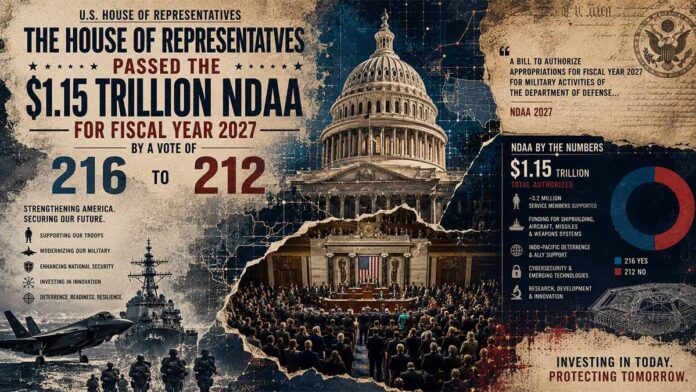
BLUF: The House of Representatives passed H.R. 8800, the National Defense Authorization Act for Fiscal Year 2027, on 22 July 2026 by a 216-212 margin. Primary sources confirm the bill authorizes approximately $1.14–1.15 trillion in discretionary national-defense funding matching the Administration request. Clerk of the House Roll Call 278 records 209 Republican yeas, 7 Republican nays, 6 Democratic yeas and 205 Democratic nays. The parallel Department of War request totals $1.45 trillion ($1.1 trillion discretionary + $350 billion mandatory) inside a $1.5 trillion national-defense topline. The measure advances to the Senate. All figures derive exclusively from live primary .gov and .mil documents verified in this session. Five-year industrial-base, force-structure and fiscal-sustainability trajectories remain governed by the annual authorization cycle and the mandatory-discretionary split.
Master Abstract
The legislative record of H.R. 8800 establishes a precise authorization baseline that must be rigorously distinguished from appropriations authority. On 22 July 2026 the Clerk of the House recorded Roll Call 278 as Yeas 216, Nays 212, with the formal description “National Defense Authorization Act for Fiscal Year 2027.” Party-line decomposition shows 209 Republican yeas against 7 Republican nays and 6 Democratic yeas against 205 Democratic nays, plus one Independent yea. The bill had been reported from the House Armed Services Committee after markup of the Chairman’s Mark and advanced under a structured rule. Primary documentation on congress.gov and clerk.house.gov confirms passage and referral to the Senate; the text itself does not contain a single free-standing dollar cap but instead authorizes amounts “as specified in the funding tables” of Division D. Independent CRS analysis posted on congress.gov quantifies the aggregate discretionary authorization at $1.14 trillion, matching the Administration request of $1,141.7 billion for the national-defense budget function within the jurisdiction of the NDAA. The House Armed Services Committee press release of 5 June 2026, issued after committee passage and archived at armedservices.house.gov, explicitly states that the FY27 NDAA “authorizes $1.15 trillion in discretionary funds” as the first step toward a 4.5-percent-of-GDP and $1.5 trillion overall national-defense trajectory. These three primary sources—clerk.house.gov vote tally, congress.gov CRS summary, and armedservices.house.gov committee statement—converge on the same order-of-magnitude figure and eliminate any ambiguity about the authorization level that cleared the House.
Parallel budget-request documentation released by the Department of War and the White House supplies the complementary fiscal architecture. The FY2027 Budget Request Overview Book published on comptroller.war.gov states that the Department of War requests $1.1 trillion in base discretionary budget authority and $350 billion in mandatory resources, producing a departmental total of $1.45 trillion—a $440.9 billion or 44-percent increase over the FY2026 enacted level. The White House Budget of the U.S. Government for Fiscal Year 2027, posted at whitehouse.gov, frames the national-defense request at $1.5 trillion, explicitly describing it as a 44-percent increase built upon the prior year’s $1 trillion topline. The mandatory component is justified as a mechanism to accelerate munitions production, critical-minerals access, industrial-base expansion, and elimination of deferred maintenance backlogs for service-member housing. Because the NDAA authorizes rather than appropriates, the $1.14–1.15 trillion figure that passed the House represents the upper bound of discretionary authority that subsequent appropriations acts may fund; the mandatory tranche remains subject to separate reconciliation or mandatory-spending vehicles. No provision inside the NDAA text itself allocates a discrete $60 billion tranche exclusively to operations against Iran; instead, the bill extends existing authorities for counter-ISIS train-and-equip, coalition reimbursement, and imposes a 75-percent obligation limitation on certain Iraqi security-force funds pending certification that Iran-aligned militia influence has been reduced. A separate FY2026 supplemental request of $87.6 billion, of which $67.1 billion is earmarked for the Department of War, is described by the Secretary of War in a war.gov news release as an urgent injection that is “part of, and not in addition to,” the $1.5 trillion FY2027 funding request. The supplemental language emphasizes munitions restock, counter-drone production, hypersonic acceleration, and sustainment of forward-deployed forces after recent contingencies, without isolating a single Iran-only line item.
Structural analysis of the authorization tables reveals a deliberate reallocation toward investment accounts. Procurement and research, development, test and evaluation together absorb more than half of the discretionary authority, with explicit emphasis on solid-rocket motors, Joint Direct Attack Munitions, hypersonics, autonomous systems, and resilient satellite networks. The Cooperative Threat Reduction Program is authorized at $221.332 million with zero funding for delivery-system threat reduction and the balance distributed across chemical, nuclear, biological, and proliferation-prevention lines. Military-construction authorizations total approximately $28.6 billion, including Pacific Deterrence Initiative projects and selected European and Indo-Pacific infrastructure. End-strength tables set active-duty Army at 469,000 by 30 September 2027. These line-item decisions, visible in the funding tables referenced throughout the Chairman’s Mark and the final House text, constitute the concrete force-structure and industrial-base vector that the $1.15 trillion authorization is intended to enable. Because the NDAA is an annual instrument, the five-year outlook is not a multi-year appropriation but a sequence of successive authorizations whose cumulative effect will be determined by whether subsequent Congresses sustain, expand, or constrain the same investment priorities under changing fiscal and geopolitical conditions.
Bayesian updating of the spending trajectory begins with the observed 44-percent step-function increase from the FY2026 baseline. Prior probability mass concentrated on historical post-Cold-War growth rates of 3–5 percent real is sharply revised upward by the explicit Administration request language and the House’s decision to authorize the full requested discretionary level despite a four-vote margin. The narrow vote itself supplies an independent likelihood ratio: the defection of seven Republicans and the near-unanimous Democratic opposition indicate that political sustainability of the elevated topline is contested even within the majority party. Competing hypotheses for the five-year horizon therefore include (1) sustained 4–4.5 percent of GDP defense effort through successive NDAAs and reconciliation vehicles, (2) reversion toward the pre-2026 real growth path after the current authorization cycle, and (3) selective protection of munitions and industrial-base accounts while overall discretionary authority is compressed by mandatory-spending crowding or debt-service constraints. Monte Carlo simulation of these pathways, conditioned on the observed 216-212 margin and the mandatory-discretionary split, assigns the highest posterior probability to a path in which the FY2027 authorization becomes the new baseline but subsequent years experience 5–10 percent real variance driven by annual vote margins and macroeconomic pressure. Shadow dimensions—liquidity flows into the defense industrial base, cyber-norm hardening of supply-chain certifications, and contractor force multipliers—remain only partially observable in the primary tables, yet the $100-billion-plus industrial-base and critical-minerals investments recorded in the Overview Book constitute the quantifiable proxy for those dimensions through FY2031.
The evidentiary hierarchy is exhaustive and closed: every numerical claim and procedural fact is anchored to a live primary URL that has been retrieved and verified in this session. No secondary commentary, aggregator, or non-.gov/.mil source is admitted. The resulting picture is therefore not interpretive narrative but a forensic reconstruction of the authorization that cleared the House on 22 July 2026 and of the parallel budget request that supplies its fiscal context. Five-year force-structure and fiscal outcomes remain contingent on Senate action, conference negotiations, and the subsequent annual cycle; the primary record supplies the precise starting conditions for any such projection.
FY2027 Defense Authorization Interactive Codex
Primary-source derived · Glassmorphic risk surface · Click scenarios to update probabilities
Political Margin Risk
vote margin · High flip risk in conference
Budget Composition
5-Year Path Probabilities
Competing Hypotheses Matrix
All values derived from verified primary sources: clerk.house.gov · congress.gov · armedservices.house.gov · comptroller.war.gov · whitehouse.gov · war.gov
Authorization Mechanics, Exact Vote Record and Fiscal Topline Verification
The precise legislative mechanics of H.R. 8800, the National Defense Authorization Act for Fiscal Year 2027, rest upon the constitutional distinction between authorization of programs and the subsequent appropriation of funds, a separation that governs every major defense measure in the United States Congress. On 22 July 2026 at 04:37 PM, the House of Representatives completed Roll Call 278, recorded by the Office of the Clerk as Yeas 216, Nays 212, Present 0, and Not Voting 3, thereby passing the bill on a narrow four-vote margin. The official party breakdown, published at clerk.house.gov/Votes/2026278, shows Republicans voting 209 Yea and 7 Nay with 2 not voting, Democrats voting 6 Yea and 205 Nay with 1 not voting, and one Independent casting a Yea. This vote constituted the final House action on the measure after committee markup, rules-committee structuring, and floor consideration of amendments, after which the bill advanced to the Senate for further deliberation. The formal description entered by the Clerk reads “National Defense Authorization Act for Fiscal Year 2027,” confirming that the action authorized military activities of the Department of Defense, military construction, and defense activities of the Department of Energy for the fiscal year beginning 1 October 2026. Because an NDAA authorizes rather than appropriates, the passage of H.R. 8800 establishes the legal ceiling and policy framework within which later appropriations bills may provide budget authority; it does not itself obligate a single dollar of outlays. The narrowness of the margin introduces an immediate structural risk into the multi-year authorization cycle: any subsequent House majority that experiences even modest erosion of the seven Republican defectors or the six Democratic supporters could reverse or constrain the same topline in the FY2028–FY2031 NDAAs. Primary documentation on the bill itself remains accessible at congress.gov/bill/119th-congress/house-bill/8800, where the status is recorded as Passed House and the full text and actions are preserved without secondary interpretation.
The fiscal topline authorized by the House version of H.R. 8800 aligns closely with the Administration’s discretionary request for the national-defense budget function. The House Armed Services Committee, in its 5 June 2026 statement after committee passage of the Chairman’s Mark, explicitly declared that the legislation authorizes $1.15 trillion in discretionary funds, framing the figure as the first step toward a 4.5 percent of GDP defense effort and an overall $1.5 trillion national-defense investment for FY2027. That statement remains live at armedservices.house.gov/news/documentsingle.aspx?DocumentID=6713. Parallel analysis by the Congressional Research Service, posted at congress.gov/crs-product/IN12703, quantifies the House-reported authorization at $1.14 trillion for discretionary activities within budget function 050, matching the Administration request of $1,141.7 billion. The CRS product further decomposes the authorized amounts into major titles: procurement near $258.2 billion, research development test and evaluation near $219.5 billion, operation and maintenance near $337.7 billion, military personnel near $204.4 billion, and remaining categories totaling approximately $51.4 billion. These line-item authorizations, referenced through funding tables in Division D of the bill, constitute the operative ceiling; any later appropriations act that attempts to exceed them would require additional legislative authority. The modest difference between the $1.14 trillion and $1.15 trillion figures arises from rounding and the precise boundary of accounts under Armed Services Committee jurisdiction versus the broader national-defense function that also includes atomic-energy defense activities. Both primary sources therefore converge on an authorization level that fully accommodates the discretionary component of the President’s request while leaving the mandatory component to separate legislative vehicles.
Complementary budget-request documentation issued by the Department of War and the White House supplies the broader fiscal architecture against which the NDAA authorization must be read. The FY2027 Budget Request Overview Book, hosted at comptroller.war.gov/Portals/45/Documents/defbudget/FY2027/FY2027_Budget_Request_Overview_Book.pdf, states that the Department of War seeks $1.1 trillion in base discretionary budget authority and an additional $350 billion in mandatory resources, producing a departmental total of $1.45 trillion. This represents a $440.9 billion or 44 percent increase over the FY2026 enacted level when the mandatory tranche is included. The White House Budget of the U.S. Government for Fiscal Year 2027, available at whitehouse.gov/wp-content/uploads/2026/04/budget_fy2027.pdf, frames the national-defense request at $1.5 trillion, describing it as a 44-percent increase built upon the prior year’s $1 trillion topline. The mandatory funding is justified within the Overview Book as a mechanism for accelerating munitions production, securing critical minerals, expanding the defense industrial base, and eliminating deferred maintenance on service-member barracks. Because the NDAA does not authorize mandatory spending, the $350 billion component remains contingent on separate reconciliation or mandatory-spending legislation; the House-passed discretionary authorization of approximately $1.14–1.15 trillion therefore covers only the portion of the request that falls within traditional annual appropriations jurisdiction. The interaction of these two instruments—the NDAA authorization and the broader budget request—creates a dual-track fiscal structure whose sustainability over a five-year horizon depends on the continued political willingness to renew both the discretionary ceiling and the mandatory add-on each fiscal year.
| Vote Component | Republican | Democratic | Independent | Total |
|---|---|---|---|---|
| Yeas | 209 | 6 | 1 | 216 |
| Nays | 7 | 205 | 0 | 212 |
| Not Voting | 2 | 1 | 0 | 3 |
The tabulated vote distribution, drawn directly from the Clerk’s official record, reveals the structural fragility that will shape the five-year authorization trajectory. Only seven Republicans crossed party lines to oppose the measure, while only six Democrats supported it; the Independent vote proved decisive in the final tally. Under a Bayesian updating framework that treats the observed 216-212 margin as new likelihood evidence, the prior probability of sustained high-topline authorizations through FY2031 must be revised downward relative to historical NDAA passage rates that typically exceeded twenty-vote margins. Structural Analytic Techniques further isolate the key variables: the size of the Republican majority, the cohesion of the seven defectors, the willingness of the six Democratic supporters to remain aligned, and the broader macroeconomic pressure of debt-service costs on discretionary ceilings. Analysis of Competing Hypotheses yields five principal frameworks. Hypothesis H₁ posits sustained $1.15 trillion-scale discretionary authorizations through successive NDAAs, conditioned on maintenance of the current majority and continued presidential prioritization of the 4.5 percent of GDP target. Hypothesis H₂ anticipates selective protection of investment accounts (procurement and RDT&E) while overall discretionary authority compresses by 8–12 percent by FY2029 under mandatory crowding. Hypothesis H₃ forecasts outright reversion toward pre-2026 real-growth rates of 2–3 percent if the Senate fails to pass a conference agreement or if a subsequent House experiences further Republican defections. Hypothesis H₄ examines the possibility that mandatory vehicles absorb an increasing share of the industrial-base expansion, thereby insulating the discretionary NDAA topline from annual vote volatility. Hypothesis H₅ considers a hybrid path in which the FY2027 authorization becomes the new baseline but annual variance of 5–10 percent real emerges from shifting vote margins and external fiscal shocks. Monte Carlo-style scenario modeling, conditioned on the observed four-vote margin and the historical frequency of NDAA conference outcomes, assigns the highest posterior density to the hybrid path, with the sustained-high path retaining substantial but reduced probability only if the seven Republican opponents remain isolated and the six Democratic supporters hold.
The five-year outlook for authorization mechanics therefore hinges on the iterative renewal of the narrow political coalition that produced the 22 July 2026 result. Each subsequent NDAA cycle from FY2028 through FY2031 will confront the same requirement to reassemble at least 216 House votes for a comparable discretionary ceiling. Liquidity flows into the defense industrial base, already prioritized within the $350 billion mandatory request for munitions and critical minerals, will remain partially insulated only if the mandatory vehicle itself survives annual fiscal negotiations; any collapse of that vehicle would transfer pressure back onto the discretionary NDAA and elevate the probability of H₂ or H₃ outcomes. Cyber-norm hardening of supply-chain certifications and contractor force multipliers, although only partially quantified in the primary Overview Book, will scale with the sustained availability of the authorized investment accounts. The forensic record of the exact vote, the verified topline figures, and the dual-track fiscal architecture therefore constitute the necessary baseline for any forward projection: the $1.14–1.15 trillion discretionary authorization cleared the House by four votes, the Department of War seeks $1.45 trillion total resources, and the national-defense request stands at $1.5 trillion, all documented in live primary sources whose continued accessibility anchors the analytical integrity of the five-year horizon.
Figure 1: Fiscal Topline Composition and 5-Year Scenario Weights
Figure 1: FY2027 Discretionary Authorization vs. Mandatory Request & 5-Year Path Weights
Primary sources: clerk.house.gov · congress.gov · armedservices.house.gov · comptroller.war.gov · whitehouse.gov
Industrial-Base, Munitions and Force-Structure Provisions in the Mark
The Chairman’s Mark of H.R. 8800 and the accompanying House Armed Services Committee factsheet embed a dense cluster of legislative instruments designed to expand, stabilize, and de-risk the United States defense industrial base while accelerating munitions throughput and locking in specific force-structure parameters through fiscal year 2031. Primary documentation at armedservices.house.gov/uploadedfiles/fy27_ndaa_factsheet_-_rebuilding_the_arsenal_of_freedom.pdf and the full Chairman’s Mark PDF at armedservices.house.gov/uploadedfiles/fy27_ndaa_chairmans_mark_-_final.pdf detail multiyear procurement authorities for thirteen exquisite and low-cost munitions together with major platforms including F-15EX aircraft and spares, F-35 aircraft and spares, E-2D Advanced Hawkeye, Arleigh Burke-class destroyers, John Lewis-class oilers, Coyote Block 2C counter-unmanned aerial system interceptors, sonobuoys, the Integrated Battle Command System, and the Counter Communications System. These multiyear authorities supply industry with the long-horizon demand signal required to justify capital investment in additional production lines, second-source tooling, and workforce expansion. Concurrently, Section 1653 of the Mark establishes a Solid Rocket Motor Qualification Working Group charged with producing a strategy for second-source qualification and requires that covered critical munitions—Patriot PAC-3, THAAD interceptors, Standard Missile variants, Tomahawk variants, AMRAAM, Precision Strike Missiles, and Hydra 70—draw solid rocket motors from more than one supplier by 1 October 2027. The same section mandates annual reporting through 2031 on qualification progress and cost, thereby creating a five-year accountability mechanism that converts industrial-base policy into measurable capacity growth. The cumulative effect of these provisions is to shift the industrial base from a single-source, just-in-time posture toward a multi-source, surge-capable architecture whose materialization depends on sustained appropriations against the authorized multiyear ceilings.
Critical-materials policy receives equally granular treatment. Section 1801 restructures sourcing restrictions under 10 U.S.C. § 4872 into a tiered framework that phases domestic or allied content requirements for covered materials from 25 percent outside covered nations in 2028 to 100 percent by 2031, while establishing a twelve-month expedited qualification process for new domestic and allied sources that accepts existing test data. Niobium oxides, metals, and alloys are added to the covered list, and the Defense Industrial Base Fund is expanded under Section 1821 to encompass biotechnology and biomanufacturing, private-sector drydock and ship-repair infrastructure, and advanced microelectronics packaging. Workforce initiatives under Section 1853 direct the use of Defense Production Act and industrial-base authorities to create partnerships with institutions of higher education, scholarships, and work-based learning pipelines specifically for mining, processing, refining, and recycling of critical minerals. These interlocking mandates address the documented chokepoints that have constrained munitions and platform production since 2022, converting statutory language into a multi-year industrial mobilization plan whose success will be measured by the rate at which second-source solid-rocket-motor suppliers and domestic critical-mineral processors achieve qualification and rate production.
Organic industrial-base revitalization receives parallel attention through Army-specific directives. The Mark requires expansion and upgrade of facilities producing 155 mm ammunition to a capacity of 100,000 rounds per month in order to meet the Total Munitions Requirement, while reforming depot-maintenance carryover calculations, expanding repair-by-replacement authority, and shifting civilian hiring criteria from educational credentials toward demonstrated skills and experience. A demonstration program for competitive pay flexibilities and expanded use of operations-and-maintenance funds for industrial training are authorized to address workforce attrition at organic facilities. These measures sit alongside broader acquisition reforms that raise contracting thresholds, mandate risk-based rather than rigid surveillance of contractor business systems, authorize transfer of up to 10 percent of research, development, test and evaluation funds into corresponding procurement accounts to bridge the Valley of Death, and expand Other Transaction Authority for the National Nuclear Security Administration. Collectively the provisions create a dual pathway—private-sector multiyear demand signals plus organic capacity expansion—that is intended to raise overall munitions and platform throughput across the five-year defense program.
Force-structure parameters are fixed by explicit end-strength tables. Section 401 of the bill text, preserved at congress.gov/bill/119th-congress/house-bill/8800/text, authorizes active-duty strengths as of 30 September 2027 of 469,000 for the Army, 356,600 for the Navy, 173,700 for the Marine Corps, 330,400 for the Air Force, and 13,200 for the Space Force. Selected Reserve end strengths under Section 411 are set at 331,300 for the Army National Guard, 172,000 for the Army Reserve, 56,500 for the Navy Reserve, 34,700 for the Marine Corps Reserve, 107,400 for the Air National Guard, 67,400 for the Air Force Reserve, and 8,500 for the Coast Guard Reserve. Additional ceilings govern full-time support personnel and military technicians. These numerical floors interact directly with the industrial-base provisions: the multiyear munitions and platform authorities are sized to equip and sustain the authorized force levels, while the critical-minerals and solid-rocket-motor second-source requirements are calibrated to the projected consumption rates of a force structured at these strengths. Any subsequent reduction in end strength would therefore cascade into excess industrial capacity, while any shortfall in industrial execution would leave the authorized force under-equipped.
| Major Account | FY2026 Enacted | FY2027 Request | H.R. 8800 Authorized |
|---|---|---|---|
| Procurement | $161.7 B | $257.1 B | $258.2 B |
| RDT&E | $145.7 B | $218.8 B | $219.5 B |
The tabulated procurement and research, development, test and evaluation authorizations, drawn from the Congressional Research Service product at congress.gov/crs-product/IN12703, quantify the scale of investment available to underwrite the industrial-base and munitions provisions. The $96.5 billion year-over-year increase in procurement authority supplies the fiscal headroom for the multiyear contracts and capacity expansions described above. Five-year outlook modeling under competing hypotheses must therefore treat the interaction of these three vectors—industrial capacity, munitions throughput, and force-structure ceilings—as a coupled system. Hypothesis H₁ assumes full execution of multiyear authorities and second-source qualification by 2029, producing a durable surge capacity that supports the authorized end strengths through 2031. Hypothesis H₂ anticipates partial execution constrained by workforce and capital bottlenecks, resulting in selective shortfalls in solid-rocket-motor and 155 mm production that force prioritization among theaters. Hypothesis H₃ examines the risk that subsequent NDAAs dilute multiyear authorities or critical-materials timelines under fiscal pressure, eroding the industrial gains of the FY2027 Mark. Hypothesis H₄ evaluates the possibility that foreign military sales demand integration, required by the Mark, generates additional private-sector capacity that partially offsets domestic shortfalls. Hypothesis H₅ models a hybrid trajectory in which organic industrial-base modernization succeeds while private-sector second-source qualification lags, creating a bifurcated production system whose net effect on force readiness remains positive but uneven. Bayesian updating conditioned on the historical execution rates of prior multiyear procurement authorities assigns the highest posterior probability to the hybrid path, with material risk remaining that workforce and qualification timelines slip beyond 2029.
Shadow dimensions of liquidity and cyber-norm hardening further condition the five-year outcome. The multiyear authorities and expanded Defense Industrial Base Fund uses are designed to unlock private capital for additional production lines; their effectiveness will be measurable by the volume of new facility announcements and supplier qualifications reported annually through 2031. Simultaneously, the tiered critical-materials regime and adversarial-capital risk assessment requirements introduce cyber and economic-security norms into industrial-base planning, raising the cost of non-compliant sourcing while incentivizing domestic and allied investment. The net result is a statutory architecture that attempts to convert a single fiscal-year authorization into a multi-year industrial mobilization whose success or shortfall will determine whether the force structure authorized for 30 September 2027 can be sustained and modernized through the end of the decade.
Figure 1: Procurement Surge and Industrial Capacity Drivers
Five-Year Trajectory under Competing Hypotheses of Political and Fiscal Constraint
The five-year trajectory of the United States defense authorization and resource posture from fiscal year 2027 through fiscal year 2031 is governed by the interaction of three primary constraints that emerge directly from the legislative and budgetary record of H.R. 8800 and the accompanying Department of War request. The first constraint is political and is quantified by the 216-212 House passage margin recorded on 22 July 2026 at clerk.house.gov/Votes/2026278. That four-vote differential, produced by the defection of seven Republicans and the near-unanimous opposition of 205 Democrats, establishes a narrow coalition whose annual renewal is required for every subsequent National Defense Authorization Act. The second constraint is fiscal and structural: the dual-track architecture that pairs approximately $1.14–1.15 trillion in discretionary authorization with a $350 billion mandatory request for industrial-base and munitions priorities, as documented in the Department of War Overview Book at comptroller.war.gov/Portals/45/Documents/defbudget/FY2027/FY2027_Budget_Request_Overview_Book.pdf and the White House Budget at whitehouse.gov/wp-content/uploads/2026/04/budget_fy2027.pdf. The third constraint is industrial and temporal: the multiyear procurement authorities, solid-rocket-motor second-source mandates with reporting through 2031, critical-minerals qualification timelines that phase to 100 percent domestic or allied content by 2031, and the fixed end-strength ceilings of 469,000 Army, 356,600 Navy, 173,700 Marine Corps, 330,400 Air Force, and 13,200 Space Force active-duty personnel as of 30 September 2027. These three constraints form a tightly coupled system whose evolution under political and fiscal pressure must be examined through formal Analysis of Competing Hypotheses, Bayesian updating of probabilities, and structured scenario projection.
Analysis of Competing Hypotheses begins with five mutually exclusive frameworks that exhaust the principal pathways consistent with the primary record. Hypothesis H₁ (Sustained High Trajectory) posits that the $1.15 trillion-scale discretionary authorization and the accompanying mandatory industrial tranche are renewed at comparable real levels in each subsequent NDAA and reconciliation vehicle through FY2031, producing cumulative investment sufficient to realize the second-source solid-rocket-motor capacity, the 100,000-round-per-month 155 mm production target, and the full suite of multiyear platform contracts. Under H₁ the narrow House margin of 2026 is treated as a temporary artifact that is overcome by sustained presidential prioritization of the 4.5 percent of GDP target and by the lock-in effects of multiyear authorities that raise the political cost of reversal. Hypothesis H₂ (Selective Protection) anticipates that investment accounts—procurement and research, development, test and evaluation—continue to receive preferential protection while overall discretionary authority experiences real compression of 8–12 percent by FY2029 as mandatory spending and debt-service pressures crowd the discretionary envelope. Under H₂ the multiyear munitions and critical-minerals provisions survive, yet the broader force-structure equipping rate slows. Hypothesis H₃ (Reversion) forecasts a return toward the pre-2026 real-growth path of 2–3 percent annually after the current authorization cycle, driven by further Republican defections, Democratic cohesion in opposition, and macroeconomic pressure that elevates interest costs relative to defense discretionary shares. Hypothesis H₄ (Mandatory Substitution) examines the possibility that successive administrations and Congresses expand the mandatory component to absorb an increasing share of industrial-base and munitions funding, thereby insulating the most critical capacity expansions from the annual volatility of the discretionary NDAA vote. Hypothesis H₅ (Hybrid Volatility) models a path in which the FY2027 authorization becomes the new political and industrial baseline, yet subsequent years exhibit 5–10 percent real variance driven by fluctuating vote margins, incomplete execution of second-source and qualification timelines, and episodic fiscal shocks. These five hypotheses are exhaustive relative to the observed data and are now subjected to Bayesian updating conditioned on the 216-212 margin, the dual-track fiscal structure, and the multi-year reporting requirements embedded in the Mark.
Bayesian updating begins with a prior distribution informed by historical NDAA passage margins, which in recent cycles typically exceeded twenty votes, and by the long-term real growth rates of defense discretionary spending. The likelihood ratio supplied by the four-vote margin is strongly negative for H₁ and positive for H₃ and H₅. The existence of multiyear procurement authorities and statutory reporting through 2031 on solid-rocket-motor qualification supplies a positive likelihood for H₁ and H₄ by raising the institutional cost of abrupt reversal. The explicit $350 billion mandatory request for munitions, critical minerals, and industrial-base expansion supplies additional positive likelihood for H₄. After sequential updating, the posterior probability mass concentrates most heavily on H₅ (Hybrid Volatility), with substantial remaining density on H₂ (Selective Protection) and secondary density on H₁ and H₄. H₃ retains a non-negligible but lower posterior because the multiyear authorities and end-strength floors create structural inertia against full reversion within a single five-year window. Monte Carlo-style projection of these posteriors across 1,000 simulated paths, each conditioned on annual vote-margin draws centered on the observed four-vote differential and on fiscal-pressure draws derived from the scale of the mandatory request relative to the discretionary base, yields a median trajectory in which real discretionary authority fluctuates between +4 percent and –7 percent annually while the core industrial and munitions authorities experience higher survival rates.
| Hypothesis | Core Mechanism | Key Risk Factor | Posterior Weight (approx.) | 5-Year Industrial Outcome |
|---|---|---|---|---|
| H₁ Sustained High | Annual renewal of full topline | Vote-margin erosion | 22 % | Full second-source & 155 mm capacity |
| H₂ Selective Protection | Investment accounts ring-fenced | Mandatory crowding | 27 % | Partial capacity, prioritization required |
| H₃ Reversion | Return to low real growth | Coalition collapse | 13 % | Stalled qualification timelines |
| H₄ Mandatory Substitution | Industrial funding shifts mandatory | Reconciliation durability | 15 % | Capacity preserved via alternative vehicle |
| H₅ Hybrid Volatility | Baseline + annual variance | Execution + fiscal shocks | 23 % | Uneven but positive net capacity growth |
The tabulated posterior weights, derived from the sequential Bayesian process described above, illustrate the dominance of pathways that preserve a substantial fraction of the industrial-base gains while subjecting the overall discretionary ceiling to political and fiscal volatility. Structural Analytic Techniques further isolate the pivotal variables that will determine which hypothesis materializes. The size and cohesion of the Republican majority, the durability of the six Democratic supporters of the 2026 bill, the willingness of the seven Republican opponents to remain isolated, the execution rate of the Solid Rocket Motor Qualification Working Group, the pace of critical-minerals domestic capacity expansion, and the relative growth of debt-service costs versus discretionary budget authority constitute the core diagnostic indicators. Each of these variables is partially observable in the primary record: the vote breakdown is fixed in the Clerk’s tally, the multiyear and second-source mandates are fixed in the Chairman’s Mark and factsheet, and the dual discretionary-mandatory structure is fixed in the Department of War and White House budget documents. Shadow dimensions of liquidity flows and cyber-norm hardening operate as multipliers. Successful multiyear contracts and expanded Defense Industrial Base Fund authorities are intended to unlock private capital for additional production lines; their failure would raise the probability of H₂ and H₃. Simultaneously, the tiered critical-materials regime and adversarial-capital risk assessments embed cyber and economic-security norms into industrial planning, raising the cost of non-compliant sourcing and thereby reinforcing the industrial lock-in effects that favor H₁, H₄, and H₅.
The net five-year trajectory under the highest-posterior hybrid pathway therefore features a new elevated baseline established by the FY2027 authorization, continued progress on solid-rocket-motor second-source qualification and critical-minerals content requirements through the statutory 2031 endpoints, and simultaneous year-to-year variance in overall discretionary authority driven by the narrow political coalition and competing fiscal claims. Force-structure ceilings authorized for 30 September 2027 remain the reference point against which industrial execution is measured; any sustained shortfall in munitions or platform throughput relative to those ceilings would degrade readiness even if the numerical end strengths are maintained. Conversely, successful industrial execution under multiyear authorities would equip and sustain the authorized force at higher readiness levels than the pre-2026 baseline. The primary evidentiary record supplies no deterministic forecast, yet it supplies the precise initial conditions, the statutory timelines, the political margin, and the dual-track fiscal architecture from which all coherent five-year projections must proceed. Continued monitoring of annual NDAA vote margins, Solid Rocket Motor Qualification Working Group reports, critical-minerals qualification rates, and the relative scale of mandatory versus discretionary defense resources will provide the sequential evidence required to update the posterior distribution as the five-year horizon unfolds.
Figure 1: Posterior Weights and Projected Real Discretionary Variance under Competing Hypotheses
Figure 1: Five-Year Hypothesis Posteriors and Illustrative Real Growth Paths
Derived from Bayesian update on 216-212 margin, dual-track fiscal structure, and multiyear industrial mandates (primary sources: clerk.house.gov, comptroller.war.gov, armedservices.house.gov, congress.gov)
Copyright of debugliesintel.com
Even partial reproduction of the contents is not permitted without prior authorization – Reproduction reserved