
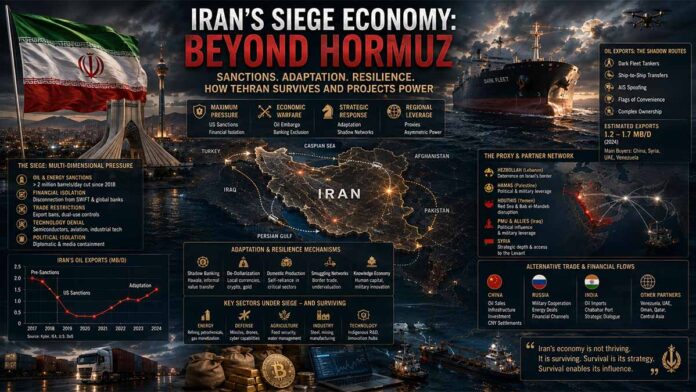

Executive Summary
- BLUF: Iran is constructing strategic endurance, not a full substitute for the Strait of Hormuz.
- Hormuz remains irreplaceable for bulk hydrocarbons: in 2024, approximately 20 million barrels per day and about 20% of global LNG trade crossed the strait.
- Rail, Caspian, Central Asian and Iraqi connections can preserve essential imports, non-oil exports and selected industrial supply chains, but cannot reproduce maritime oil-export capacity.
- The unfinished Rasht–Astara railway remains the critical infrastructure gap in the western International North–South Transport Corridor.
- China-bound rail services provide redundancy for high-value cargo, not economical substitution for tanker-scale petroleum movements.
- Washington’s expanding sanctions against vessels, intermediaries and Chinese refiners raise transaction costs without yet proving that Iran’s export architecture can be completely suppressed.
- Financial adaptation increasingly depends on opaque settlement, jurisdictional arbitrage and trade-linked liquidity whose durability cannot be measured reliably from authoritative public evidence.
- The central five-year judgment is a transition from maximum efficiency to minimum viable connectivity.
- Estimated probability that Iran maintains a materially functional sanctions-resilient trade system through 2031: 72%, conditional on continued Chinese demand and uninterrupted northern corridors.
- Estimated probability that alternative corridors replace Hormuz as Iran’s principal oil outlet through 2031: below 8%.
Iran’s New Economic Geography Beyond Hormuz
The Strait of Hormuz has exposed the central paradox of Iranian power. Tehran can disrupt the maritime artery through which approximately one-fifth of global oil and liquefied natural gas trade normally passes, but it cannot do so without constricting its own economy. The 2026 conflict transformed that vulnerability into an infrastructure race. Iran is assembling railways, Caspian ports, Chinese commercial channels, Russian financing and Iraqi connections into a system intended to preserve trade under a prolonged siege. It is not an alternative to Hormuz: no continental corridor can reproduce tanker-scale oil exports. It is something strategically different—a network built to prevent maritime and financial pressure from producing complete isolation. The price is higher transport friction, restricted liquidity and growing dependence on Moscow and Beijing.
The Chokepoint
In 2024, approximately 20 million barrels per day of crude oil, condensate and petroleum products crossed Hormuz, equivalent to about 20% of global petroleum-liquids consumption and more than one-quarter of global seaborne oil trade. Around 20% of internationally traded LNG followed the same route, primarily from Qatar. These estimates define the physical limit of every Iranian diversification project. Amid Regional Conflict, the Strait of Hormuz Remains Critical to Global Oil Flows – U.S. Energy Information Administration – 16/06/2025 — official source.
The disruption soon moved upstream. On 07/04/2026, the U.S. Energy Information Administration estimated that Iraq, Saudi Arabia, Kuwait, the United Arab Emirates, Qatar and Bahrain had collectively shut in 7.5 million barrels per day during March because restricted exports were filling storage. It expected shut-ins to reach 9.1 million barrels per day in April. Hormuz Closure and Related Production Outages Are Key Drivers in the April Short-Term Energy Outlook – U.S. Energy Information Administration – 07/04/2026 — official source.
This is why Hormuz cannot be reduced to a naval problem. When ships stop, storage fills; when storage fills, production falls; when production falls, reopening the route does not immediately restore all lost supply. On 07/07/2026, after the 18 June memorandum between Washington and Tehran and an initial recovery in traffic, the EIA still expected trade flows to return near pre-conflict levels only toward year-end, with most curtailed production restored in early 2027. EIA Increases Global Oil Production Forecast After the Strait of Hormuz Reopens – U.S. Energy Information Administration – 07/07/2026 — official source.
The Substitution Illusion
The most credible physical bypasses are Saudi Arabia’s East–West pipeline to Yanbu and the United Arab Emirates’ Habshan–Fujairah line. Yet the EIA estimated on 16/06/2025 that their combined unused capacity available to circumvent Hormuz was approximately 2.6 million barrels per day—a fraction of the volumes normally crossing the strait.
Iran’s continental alternatives operate on a still smaller scale. Railways can transport machinery, metals, agricultural products, chemicals, containers and selected refined products. They cannot economically replace a very large crude carrier transporting approximately two million barrels in a single voyage. A railway requires repeated trains, tank wagons, border procedures, loading terminals, compatible infrastructure and onward distribution. Its strategic value lies not in replacing petroleum shipping but in keeping the wider economy supplied when the southern maritime system is impaired.
LNG is even less substitutable. More than 10 billion cubic feet per day—approximately 20% of global LNG trade—was affected by the 2026 closure. Washington responded on 13/03/2026 by authorising an increase of up to 0.45 billion cubic feet per day at the Plaquemines LNG terminal. The measure was material for the facility but illustrated the scale mismatch between disrupted Gulf supply and immediately available replacement capacity. Energy Department Approves Immediate Additional LNG Exports from Plaquemines LNG – U.S. Department of Energy – 13/03/2026 — official source.
The Northern Axis
Iran’s principal continental project is the International North–South Transport Corridor, a multimodal system connecting Russia, Azerbaijan, the Caspian basin and Iran, with onward access toward the Indian Ocean. Its importance has risen as both Moscow and Tehran have sought commercial routes less dependent on Western-controlled finance and logistics.
The decisive gap is the Rasht–Astara railway in northern Iran. Russia and Iran concluded an intergovernmental agreement on the project in 2023. On 14/10/2025, the Government of the Russian Federation stated that Iran was conducting design and survey work in preparation for construction. Meeting of the Council of Heads of Government of the Commonwealth of Independent States – Government of the Russian Federation – 14/10/2025 — official source.
This distinction is essential: a financed or surveyed line is not an operational railway. Until Rasht and Astara are connected, cargo must continue to change between rail and road, adding handling, customs exposure and uncertainty. Even after construction, capacity will depend on signaling, locomotives, axle loads, border facilities, train scheduling and integration between Iran’s standard-gauge network and the broader former Soviet railway system.
For Moscow, the corridor offers access toward Iran and the Indian Ocean while reducing dependence on Europe-facing routes. For Tehran, its function is more existential: it provides a northern circulation system that cannot be closed by naval forces operating south of Iran. The asymmetry gives Russia commercial and political leverage even within an expanding strategic partnership.
The Caspian Buffer
Caspian ports create a second layer of redundancy. Cargo can move from the Russian Volga–Caspian system toward northern Iranian ports and then transfer to road or rail. United Nations transport analysis has identified the corridor’s defining weakness: its competitiveness depends on efficient interfaces between ships, railways and trucks. Development of the Trans-Asian Railway: Trans-Asian Railway in the North–South Corridor – United Nations Economic and Social Commission for Asia and the Pacific – 2023 — official source.
The Caspian route is strategically useful precisely because it is different from the western land branch. If Azerbaijan becomes a bottleneck, cargo can cross the sea; if southern ports are inaccessible, northern gateways preserve selected trade. But the Caspian fleet, port draught, storage, seasonal navigation and transshipment capacity remain limiting factors. Sanctions against both Russia and Iran further complicate vessel services, insurance, equipment procurement and finance.
The result is a resilient but expensive logistics layer. It can sustain grain, metals, timber, construction materials and containerised goods. It cannot reproduce the revenue-generating scale of Iran’s Persian Gulf oil terminals.
China’s Leverage
China supplies the largest commercial anchor. On 22/07/2024, Chinese provincial authorities reported the launch of an all-rail Qom–Yiwu freight service following coordination among China, Kazakhstan, Turkmenistan and Iran. The route replaced an earlier multimodal configuration involving the Caspian Sea. Iran–Yiwu All-Rail Freight Train Launched – Zhejiang Provincial Government – 22/07/2024 — official source.
The service demonstrates that a continental China–Iran connection is technically viable. It does not establish that the route has achieved the frequency, load factors or annual capacity required for mature commercial substitution. Rail is most competitive for higher-value or time-sensitive cargo; low-value bulk commodities remain better suited to shipping.
China’s strategic importance extends beyond transport. Independent Chinese refiners have provided demand for Iranian crude under sanctions. On 20/03/2025, the U.S. Treasury stated that Shandong Shouguang Luqing Petrochemical had purchased Iranian oil worth approximately USD 500 million. Treasury Sanctions Network Supporting Iran’s Oil Exports – U.S. Department of the Treasury – 20/03/2025 — official source.
Washington has progressively moved enforcement closer to the Chinese point of consumption. On 28/04/2026, Treasury instructed financial institutions to apply enhanced due diligence to transactions involving Chinese refiners, particularly in Shandong, and warned that foreign banks supporting sanctioned trade could face secondary measures. Treasury Warns of Sanctions Risks Linked to China-Based Purchases of Iranian Oil – U.S. Department of the Treasury – 28/04/2026 — official source.
Beijing rejects that legal doctrine. On 12/05/2026, Foreign Ministry spokesperson Guo Jiakun said China opposed unilateral sanctions lacking a basis in international law or authorisation from the United Nations Security Council. Foreign Ministry Spokesperson Guo Jiakun’s Regular Press Conference – Ministry of Foreign Affairs of the People’s Republic of China – 12/05/2026 — official source.
Iranian resilience therefore increasingly depends on a decision made outside Iran: how much financial and diplomatic exposure Chinese refiners, banks and ports are prepared to accept.
Chabahar’s Promise
Chabahar is Iran’s only major port with potentially transformative value outside Hormuz. Located on the Gulf of Oman, it provides direct ocean access without entering the Persian Gulf. On 13/05/2024, India Ports Global Limited and Iran’s Ports and Maritime Organization signed a ten-year contract for the Shahid Beheshti terminal. Long-Term Main Contract for Development of Shahid Beheshti Port Terminal, Chabahar – Government of India – 13/05/2024 — official source.
On 26/07/2024, India’s Ministry of Ports, Shipping and Waterways reported allocations of INR 4 billion between fiscal years 2016–17 and 2023–24, of which INR 2.0151 billion had been utilised. It also reported a 43% increase in vessel traffic and a 34% increase in container traffic during 2023–24. Development of Chabahar Port – Government of India – 26/07/2024 — official source.
Chabahar can expand non-oil trade and connect Iran with India, Afghanistan, Central Asia and Russia. But its geographic advantage does not automatically create national-scale capacity. Its strategic performance depends on inland railways, road access, customs efficiency, secure power, terminal equipment, shipping frequency and the willingness of Indian and international operators to navigate sanctions risk.
The Iraqi Connection
The Shalamcheh–Basra railway adds a western regional branch. An Iraqi government committee inspected the route on 01/02/2023. On 24/06/2024, Iraq’s Ministerial Council for the Economy approved the Ministry of Transport’s request to refer construction of the line. Deputy Prime Minister and Foreign Minister Chairs the Twenty-Third Session of the Ministerial Council for the Economy – Ministry of Foreign Affairs of Iraq – 24/06/2024 — official source.
The project could facilitate passenger movement, religious travel and bilateral cargo. Its geopolitical importance may exceed its initial freight capacity by deepening institutional and commercial links between Iran and southern Iraq. Yet it is not a direct solution to Iran’s maritime blockade: its value depends on integration with Iraq’s railways, ports, customs and national transport strategy.
For Baghdad, the challenge is to capture connectivity without allowing one bilateral railway to distort the larger architecture of Iraqi trade. For Tehran, the line creates another border through which pressure on the southern coast does not automatically interrupt economic circulation.
The Revenue War
The decisive contest is no longer whether Iranian cargo moves, but how much usable value returns to Iran. A sanctioned oil sale may involve a discount, elevated freight, ship-to-ship transfer, multiple brokers, restricted accounts and settlement through goods or infrastructure. Nominal export revenue can therefore differ sharply from freely deployable liquidity.
On 17/01/2025, Presidents Vladimir Putin and Masoud Pezeshkian stated that Russian–Iranian trade had almost completely transitioned to national currencies. Press Conference Following Russian-Iranian Talks – President of Russia – 17/01/2025 — official source. Such arrangements reduce direct exposure to dollar clearing but create different constraints: exchange-rate risk, bilateral trade imbalances and balances spendable primarily inside the partner economy.
Sanctions enforcement has adapted accordingly. On 07/08/2026, the U.S. Treasury described its eighth action of the year against Iran’s shadow-banking apparatus, including banks, front companies, exchange houses, managers, importers and exporters allegedly used to move and repatriate proceeds. Treasury Dismantles Iranian Regime’s Global Clandestine Banking Network – U.S. Department of the Treasury – 07/08/2026 — official source.
The same day, Treasury sanctioned two digital-asset exchanges and an associated corporate network. Treasury Sanctions Crypto Exchanges Funding Iran’s IRGC and Enabling Illicit Finance – U.S. Department of the Treasury – 07/08/2026 — official source. Digital assets can bypass conventional correspondent banking, but conversion into currencies, imports or industrial equipment still creates detectable counterparties and enforcement points.
The Five-Year Contest
On 29/09/2025, the Council of the European Union reimposed economic and financial measures covering trade, banking and transport, including asset freezes affecting the Central Bank of Iran and major commercial banks. Iran Sanctions Snapback: Council Reimposes Restrictive Measures – Council of the European Union – 29/09/2025 — official source.
Washington escalated further on 24/08/2026 with Operation Economic Outcast, announcing an effort to target every significant source of Iranian external revenue. The ambition is formidable; the result remains undecided. By 24/04/2026, OFAC said it had sanctioned more than 1,000 Iran-related persons, vessels and aircraft since February 2025. Yet the continuing need for new designations demonstrates the regenerative character of the networks being targeted.
Over the next five years, Iran is likely to become harder to isolate but more expensive to operate from. Railways, Caspian routes, Chabahar and Iraqi connections can preserve essential commerce. China can sustain demand; Russia can support northern connectivity and non-dollar settlement. None removes the underlying asymmetry. Every alternative channel reduces exposure to Western-controlled systems while increasing reliance on a narrower group of partners capable of imposing discounts, tied purchases and political conditions.
The emerging Iranian model is not autarky and not escape. It is an economy reorganised for endurance: less efficient, less liquid and increasingly continental, but sufficiently distributed to make the closure of one route—or the designation of one network—less decisive than before.
Master Abstract
Iran’s emerging response to maritime coercion should be understood as a deliberate reconfiguration of national economic survivability rather than as evidence that Tehran can escape the physical geography of the Persian Gulf. The distinction is decisive. In 2024, approximately 20 million barrels per day of crude oil, condensate and petroleum products crossed the Strait of Hormuz, equivalent to about 20% of global petroleum-liquids consumption and more than one-quarter of seaborne oil trade; roughly one-fifth of global LNG trade also traversed the passage, overwhelmingly connecting Gulf production with Asian demand. Amid regional conflict, the Strait of Hormuz remains critical to global oil flows – U.S. Energy Information Administration – June 2025 — verified primary source. About one-fifth of global liquefied natural gas trade flows through the Strait of Hormuz – U.S. Energy Information Administration – June 2025 — verified primary source. These magnitudes establish the analytical baseline: roads, railways and Caspian feeder services can redistribute containers, food, machinery, metals, chemicals and selected refined products, but their carrying economics cannot approximate the volume, speed and unit cost of tanker transportation. The strategic value of Iran’s continental routes therefore lies elsewhere. They reduce the probability that pressure on one maritime chokepoint produces total economic isolation; preserve politically critical imports; connect Iranian production to markets that tolerate sanctions exposure; and complicate an adversary’s collection-and-interdiction problem by distributing flows across multiple borders, gauges, ports, customs systems and commercial intermediaries. The resulting architecture exchanges efficiency for persistence. It is more expensive, more administratively fragmented and more vulnerable to corruption, surveillance and secondary sanctions, yet also more difficult to extinguish through a single naval or financial measure. Iran is consequently not eliminating its maritime dependency; it is constructing a layered system capable of absorbing partial failure while retaining a reduced economic pulse.
The physical backbone of this strategy is the wider International North–South Transport Corridor, especially its western rail branch through Azerbaijan and the Caspian alternative connecting Iranian ports with Russia. The system’s most consequential discontinuity remains the Rasht–Astara segment: Russian government statements confirm that implementation continues under the 2023 intergovernmental agreement, while design and survey work remained part of the implementation process in late 2025. Government meeting – Government of the Russian Federation – October 2025 — verified primary source. The strategic meaning of this missing link exceeds its length. Until a continuous rail connection exists, transshipment between road and rail increases handling time, documentation exposure, cargo loss risk and the number of actors vulnerable to sanctions or intelligence penetration. Caspian shipping can partly bridge the discontinuity, but it introduces weather, fleet, port-capacity and multimodal coordination constraints. China-facing rail connectivity adds a second layer of resilience: Chinese government reporting confirms the launch of an all-rail Qom–Yiwu service in July 2024, following coordination among China, Kazakhstan, Turkmenistan and Iran. Iran–Yiwu all-rail freight train launched – Zhejiang Provincial Government – July 2024 — verified primary source. This route is strategically useful for time-sensitive or higher-value goods, but its significance should not be inflated into an oil-export solution. Its role is insurance: maintaining commercial circulation when southern maritime routes become unreliable. The Russian–Iranian political framework also widened in January 2025 through a comprehensive strategic partnership whose official presentation identified transport, energy, finance and bilateral economic cooperation as principal domains. Press conference following Russian-Iranian talks – President of Russia – January 2025 — verified primary source. The system is therefore taking shape as a network of partial redundancies rather than one alternative corridor: western rail, Caspian shipping, Central Asian rail, Gulf of Oman access, Iraqi connectivity and informal maritime distribution each cover different commodities and different failure conditions.
Sanctions pressure is evolving in parallel from broad sectoral prohibition toward network disruption. Official U.S. actions in 2025 targeted Chinese independent refiners, terminal operators, vessel owners, managers, captains and ship-to-ship transfer networks connected to Iranian petroleum deliveries. One Treasury designation documented individual cargoes exceeding one million barrels, another approximately two million barrels, alongside repeated transfers between sanctioned vessels and deliveries to China. Treasury Targets Iranian Oil Exports and Shadow Fleet – U.S. Department of the Treasury – August 2025 — verified primary source. By December 2025, Treasury stated that the United States had sanctioned more than 180 vessels associated with Iranian petroleum transportation during the renewed maximum-pressure campaign, explicitly framing the intended effect as higher export costs and lower retained revenue per barrel. Treasury Increases Pressure on Iran’s Sanctions-Evading Shadow Fleet – U.S. Department of the Treasury – December 2025 — verified primary source. The European Union simultaneously restored prohibitions covering the import, purchase and transport of Iranian crude oil, petroleum products and associated services in September 2025. Iran sanctions snapback: Council reimposes restrictive measures – Council of the European Union – September 2025 — verified primary source. These measures create a cumulative friction system: vessels become harder to insure and flag; counterparties demand larger discounts; payment conversion requires more intermediaries; and cargo provenance becomes increasingly contested. Yet designation counts do not equal eliminated capacity. Operators can change ownership structures, flags, names, routing patterns and transaction layers faster than conventional enforcement cycles can always map them. The five-year contest will therefore turn on regeneration rates: whether enforcement can identify and disable logistical and financial nodes faster than Iran and its commercial partners can replace them. This is a dynamic network problem, not a binary sanctions-on or sanctions-off condition.
An Analysis of Competing Hypotheses produces five plausible frameworks. H₁ — Durable Eurasian Resilience: Iran completes enough northern connectivity and institutional coordination to maintain reduced but dependable trade; current posterior probability 34%. H₂ — Chinese Commercial Umbrella: Chinese demand, logistics and non-dollar settlement become the dominant stabilizer, making Iran increasingly dependent on one buyer and one bargaining ecosystem; probability 27%. H₃ — Enforcement Outpaces Adaptation: sanctions, maritime surveillance, port restrictions and counterparty risk progressively degrade export revenue and corridor utilization; probability 18%. H₄ — Corridor Fragmentation: infrastructure delays, customs friction, regional rivalry and insufficient throughput prevent the emerging network from operating as a coherent system; probability 13%. H₅ — Political Reset: negotiations or a strategic settlement reopen conventional maritime and financial channels, reducing the urgency of circumvention; probability 8%. These values are structured analytic judgments, not observed frequencies. The principal discriminators are completion and operationalization of Rasht–Astara; sustained frequency of China–Iran freight trains; measurable Caspian port throughput; the replacement rate of sanctioned vessels; discount levels on Iranian crude; Chinese refinery participation; and evidence that settlement channels provide Tehran with fungible liquidity rather than restricted purchasing credits. A Monte Carlo framework for 2026–2031 should vary six correlated drivers: Hormuz accessibility, maritime enforcement intensity, Chinese demand tolerance, northern-corridor throughput, payment convertibility and domestic infrastructure reliability. Under conservative distributions, the modal outcome is neither collapse nor strategic escape, but costly continuity: Iran retains trade access and partial oil revenue while suffering persistent discounts, longer working-capital cycles, higher logistics costs and deeper dependence on a narrow set of external partners. The strongest warning indicator would be simultaneous deterioration in three layers—Hormuz access, Chinese offtake and northern transit—because diversification only produces resilience when failures remain imperfectly correlated.
Chokepoint–Corridor Stress Engine
The Hormuz Constraint: Energy Exposure, Maritime Coercion and the Physical Limits of Substitution
The anatomy of an irreplaceable chokepoint
The Strait of Hormuz is not simply a narrow maritime passage vulnerable to temporary interruption; it is the physical junction at which the production geography of the Persian Gulf meets the consumption geography of Asia and, indirectly, the price formation mechanisms governing Europe and the wider international economy. Its strategic importance derives from the simultaneous concentration of export terminals, processing installations, tanker routes, insurance exposure and naval operating space within one tightly bounded system. Before the 2026 conflict, approximately 20 million barrels per day of crude oil, condensate and petroleum products crossed the strait, corresponding to about 20% of global petroleum-liquids consumption and more than one-quarter of seaborne oil trade. Approximately 20% of global LNG trade also passed through Hormuz, principally from Qatar and the United Arab Emirates. Amid regional conflict, the Strait of Hormuz remains critical to global oil flows – U.S. Energy Information Administration – June 2025 — verified primary source. About one-fifth of global liquefied natural gas trade flows through the Strait of Hormuz – U.S. Energy Information Administration – June 2025 — verified primary source. These numbers understate the chokepoint’s systemic significance because the relevant variable is not only gross volume but substitutability. A barrel withheld at Hormuz cannot necessarily be replaced by an equivalent barrel elsewhere at the same time, quality, destination and transport cost. Refinery configurations distinguish between heavy, medium and light grades; contractual structures restrict immediate cargo substitution; tanker availability is finite; and alternative producers may lack sufficient spare capacity or may be separated from buyers by other exposed maritime corridors. Hormuz therefore acts as a compression point for physical supply, freight pricing, insurance, inventories, derivatives and national security. When passage becomes unreliable, the disturbance propagates before actual inventories are exhausted because market participants must immediately reprice the probability of future scarcity, delayed delivery and infrastructure damage. This explains why a partial or selectively enforced disruption can produce effects disproportionate to the number of vessels physically stopped.
| Structural variable | Verified pre-disruption baseline | Strategic implication |
|---|---|---|
| Oil and petroleum flows | Approximately 20 million bpd in 2024 | No single bypass system can reproduce the displaced throughput |
| Share of global petroleum consumption | Approximately 20% | A regional interruption becomes a global price event |
| Share of seaborne oil trade | More than 25% | Tanker availability, insurance and freight markets reprice simultaneously |
| LNG exposure | Approximately 20% of global trade | Qatar-dependent Asian and European buyers compete for replacement cargoes |
| Asian destination concentration | 84% of Hormuz crude and condensate flows in 2024 | China, India, Japan and South Korea bear the highest direct import exposure |
| Available Saudi–UAE bypass capacity | Approximately 2.6 million bpd estimated available in 2025 | Bypass capacity mitigates but cannot neutralize a full interruption |
Coercion without an impermeable closure
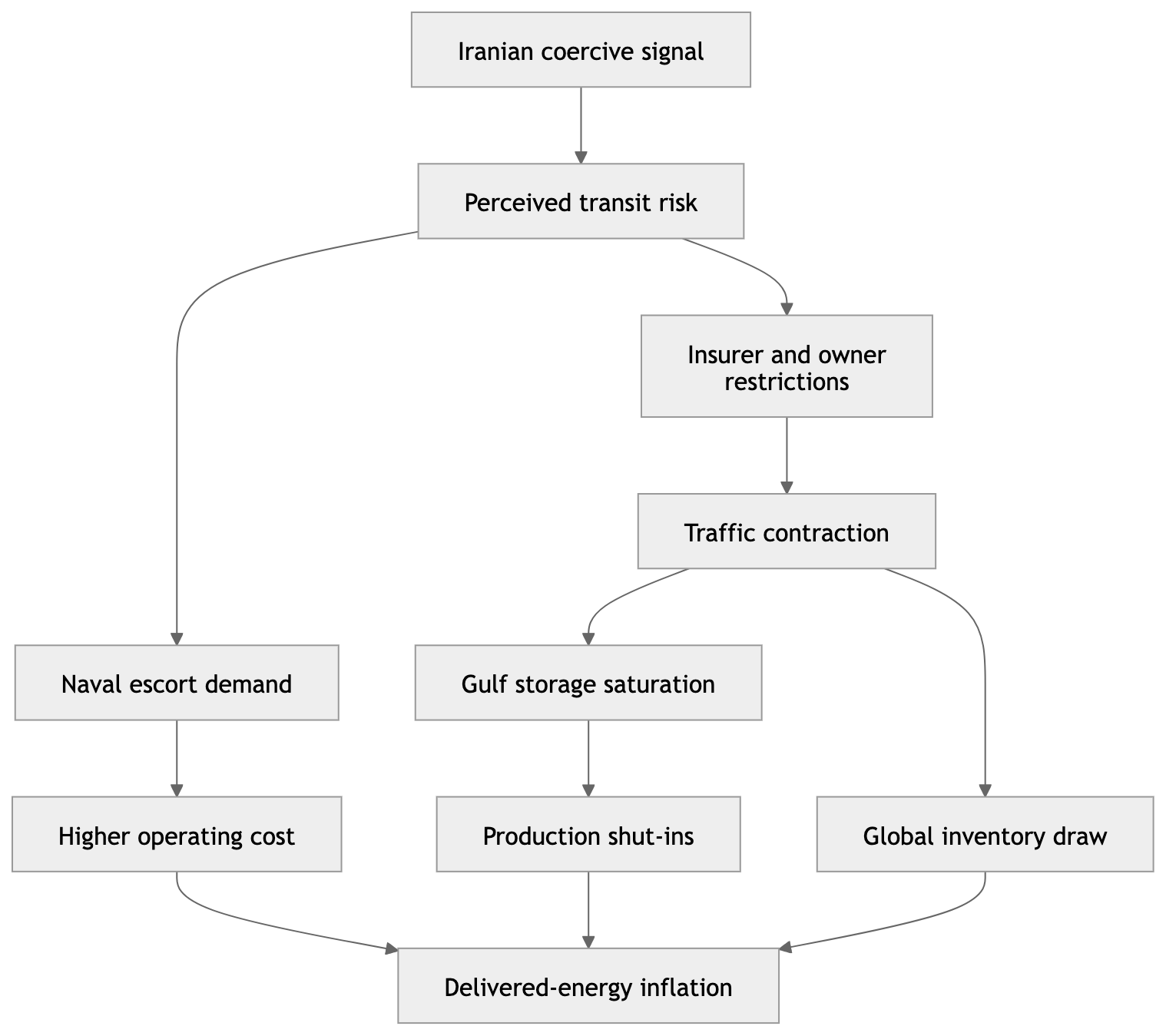
Maritime coercion at Hormuz does not require Iran to establish a legally declared, physically impermeable blockade. Tehran can generate substantial strategic leverage through a graduated denial system comprising navigational warnings, selective inspections, missile or drone demonstrations, mining risk, harassment, ambiguous attribution, temporary exclusion zones and political conditions imposed on passage. The operational objective is not necessarily to stop every vessel; it may instead be to raise the expected cost of transit until shipowners, charterers, crews, insurers and cargo owners independently suspend operations. This distinction matters because commercial withdrawal can multiply military coercion. A merchant vessel’s decision function incorporates not only the observed probability of being struck but the possible loss of hull, cargo and crew; environmental liability; salvage uncertainty; loss of insurance coverage; sanctions exposure; and the opportunity cost of immobilization inside the Gulf. Accordingly, a small number of attacks, credible threats or unexplained incidents can reduce traffic without Iran maintaining permanent sea control against a technologically superior coalition. The 2026 disruption demonstrates this mechanism. The European Commission described a “virtual closure” that curtailed seaborne oil flows by approximately 15% and LNG flows by approximately 20%, showing that the strategic effect arose from the interaction of conflict risk, suspended operations and constrained production rather than from a perfectly sealed passage. Spring 2026 Economic Forecast: Slowdown in growth as energy shock drives inflation – European Commission – May 2026 — verified primary source. The European Council consequently condemned actions preventing vessels from entering or exiting Hormuz and called for reinforcement of EUNAVFOR ASPIDES and EUNAVFOR ATALANTA, although neither mission by itself converts commercial risk into guaranteed passage. European Council conclusions on Middle East – European Council – March 2026 — verified primary source. The coercive equilibrium is thus asymmetric: external naval forces may defeat identifiable military units, but they cannot immediately eliminate dispersed launch systems, mines, one-way attack platforms, shore-based sensors or the commercial perception that another incident remains possible. Freedom of navigation can be militarily defended while remaining commercially impaired.
The production trap behind the shipping disruption
The physical constraint extends inland because the Gulf’s petroleum system cannot continue producing indefinitely when export shipping is interrupted. Oilfields feed gathering systems, processing plants, pipelines and storage tanks whose available capacity is finite. Once tanks and export terminals approach saturation, producers must reduce upstream output even if wells, refineries and pipelines remain undamaged. Restarting production is not always instantaneous: reservoir management, gas handling, pressure maintenance, personnel availability and inspection requirements can slow restoration after prolonged curtailment. The April 2026 assessment of the U.S. Energy Information Administration estimated that Iraq, Saudi Arabia, Kuwait, the United Arab Emirates, Qatar and Bahrain collectively shut in 7.5 million barrels per day during March and projected that shut-ins would rise to 9.1 million barrels per day in April as storage filled. Hormuz closure and related production outages are key drivers in the April Short-Term Energy Outlook – U.S. Energy Information Administration – April 2026 — verified primary source. By June, EIA assessed that Middle Eastern producers had curtailed more than 11 million barrels per day, generating estimated global inventory draws of 6.3 million barrels per day in the second quarter and 7.6 million barrels per day in the third quarter, while OECD inventories fell to their lowest level since 2003. EIA expects a drop in global oil demand will limit price increases following the Strait of Hormuz closure – U.S. Energy Information Administration – June 2026 — verified primary source. These estimates illuminate why the Hormuz problem cannot be modeled as a shipping delay alone. A prolonged interruption destroys available supply time: barrels not produced during forced shut-ins cannot automatically be recovered when transit resumes, and depleted inventories must then be rebuilt while current consumption continues. The June memorandum and partial traffic recovery improved the production outlook, but EIA’s July baseline still expected restoration toward pre-conflict output and trade levels only near year-end, with most shut-in production restored in early 2027. EIA increases global oil production forecast after the Strait of Hormuz reopens – U.S. Energy Information Administration – July 2026 — verified primary source. Hormuz therefore couples maritime access to upstream capacity, converting shipping insecurity into a multi-quarter production and inventory shock.
Why pipelines offer mitigation rather than replacement
The strongest physical alternatives to Hormuz are not Iranian railways but the large crude-oil pipelines operated by Saudi Arabia and the United Arab Emirates. Saudi Aramco’s East–West system connects the Abqaiq processing area with the Red Sea port of Yanbu, while the UAE’s pipeline connects Habshan with Fujairah on the Gulf of Oman. These routes bypass the strait and can preserve a portion of regional exports during interruption. Nevertheless, the U.S. Energy Information Administration estimated in 2025 that only approximately 2.6 million barrels per day of unused Saudi and Emirati pipeline capacity was available to bypass Hormuz. Amid regional conflict, the Strait of Hormuz remains critical to global oil flows – U.S. Energy Information Administration – June 2025 — verified primary source. Against approximately 20 million barrels per day normally crossing the strait, the arithmetical limit is immediate: available bypass capacity could offset only a minority of the disrupted flow, and it principally benefits Saudi and Emirati production rather than Iranian, Iraqi, Kuwaiti or Qatari exports. The pipelines also relocate rather than eliminate strategic exposure. Yanbu cargoes enter the Red Sea system, where onward transit toward Europe may encounter the Bab el-Mandeb and Suez chokepoints; Fujairah remains geographically close to the conflict theatre and dependent on secure port operations, storage, power and offshore loading. Pipeline throughput additionally depends on pumping stations, terminal availability, crude compatibility and sufficient downstream tanker capacity. For Iran, the substitution deficit is still more severe. Its principal oil-export system remains oriented toward the Persian Gulf, and continental rail corridors cannot transport crude at comparable scale or unit cost. A railway carrying one hundred tank wagons, each loaded with roughly several hundred barrels, would move only a small fraction of a modern very large crude carrier’s cargo and would require repeated train cycles, border handling, compatible rolling stock, unloading terminals and onward pipelines. Rail can preserve selected refined-product, petrochemical or high-value cargo movements; it cannot economically evacuate million-barrel cargoes at the rhythm required to sustain Iranian production. The physical limit is consequently not political imagination but throughput mathematics.
| Substitution route | Principal function | Relative scale | Critical limitation |
|---|---|---|---|
| Saudi East–West pipeline | Crude exports to Yanbu | Large but bounded | Does not serve most Gulf producers; introduces Red Sea exposure |
| UAE Habshan–Fujairah pipeline | Crude exports outside Hormuz | Large but bounded | Serves UAE production and remains regionally exposed |
| Iranian rail corridors | Containers, machinery, food, metals, selected liquids | Low relative to tanker trade | Gauge, terminal, wagon, handling and unit-cost constraints |
| Caspian shipping | Northbound and southbound multimodal trade | Low to moderate | Port capacity, vessel availability, weather and sanctions |
| Road freight | Emergency or high-value logistics | Low | Cost, congestion, customs and payload constraints |
| Strategic inventories | Temporary demand coverage | Finite | Delay mechanism, not new production or transport capacity |
| Demand destruction | Balances market through lower consumption | Potentially large | Produces recession, inflation and industrial damage |
LNG: the least substitutable segment
The LNG dimension is more rigid than the crude-oil problem because LNG requires specialized liquefaction plants, cryogenic storage, dedicated carriers, regasification terminals and long-term contractual coordination. Qatar’s principal LNG export complex lies inside the Gulf, making Hormuz not merely one commercially convenient route but the indispensable maritime outlet for a major share of global liquefied-gas supply. When traffic was interrupted in 2026, more than 10 billion cubic feet per day of LNG supply—approximately 20% of global LNG trade—was affected. International LNG prices rise amid Strait of Hormuz closure – U.S. Energy Information Administration – April 2026 — verified primary source. Replacement supply could not be mobilized at equivalent scale. The U.S. Department of Energy authorized Plaquemines LNG to increase exports by as much as 0.45 billion cubic feet per day, a meaningful increment for the facility but less than one-twentieth of the volume affected at Hormuz. Energy Department Approves Immediate Additional LNG Exports from Plaquemines LNG – U.S. Department of Energy – March 2026 — verified primary source. The mismatch demonstrates the physical lag embedded in LNG substitution: authorizations can be issued quickly, but liquefaction trains, feed-gas infrastructure, carriers and terminals require years and large capital commitments to construct. Europe is particularly exposed to price transmission even where its direct Qatari dependence is diversified, because its post-2022 gas architecture relies more heavily on internationally traded LNG. The European Commission observed in 2026 that European gas prices had become increasingly determined by global LNG demand, supply conditions and shipping constraints rather than only by internal market fundamentals. EU energy markets: evolving gas-electricity price linkages in a more volatile system – European Commission – May 2026 — verified primary source. Consequently, Asian replacement demand can raise European prices even when cargoes never physically change destination: buyers bid against one another across a common pool of flexible LNG, transmitting Hormuz risk into electricity prices, fertilizer, chemicals, glass, steel and other gas-intensive sectors.
Asia, China and the redistribution of vulnerability
Asian economies carry the highest direct exposure because 84% of the crude oil and condensate traversing Hormuz in 2024 was destined for Asian markets, while China, India, Japan and South Korea together accounted for approximately 69% of the strait’s crude and condensate flows. A Chinese provincial-government assessment reported that approximately one-third of Hormuz crude flows entered China and represented more than 40% of Chinese crude imports, while identifying Saudi Arabia, Iraq, the United Arab Emirates, Iran and Kuwait as the five largest origin states. 伊朗或封锁霍尔木兹海峡将对全球能源供应安全构成严重威胁 – Zhejiang Provincial Government – March 2026 — verified Chinese-language primary source. Beijing’s official diplomatic position consequently emphasized stable energy supply, immediate cessation of military action and protection of navigation through Hormuz. 2026年3月3日外交部发言人毛宁主持例行记者会 – Ministry of Foreign Affairs of the People’s Republic of China – March 2026 — verified Chinese-language primary source. China possesses strategic petroleum stocks, diversified suppliers, domestic production and overland connections with Russia and Central Asia, but none supplies a rapid one-for-one physical replacement for all Gulf imports. Russian pipeline and seaborne deliveries can be expanded only within production, transport and sanctions constraints; Central Asian pipelines are geographically and technically bounded; and additional Atlantic Basin cargoes require longer voyages and compete with European buyers. Beijing therefore faces a strategic tension. It benefits from commercial leverage over sanctioned Iranian barrels and from the development of continental Eurasian routes, yet it also depends on the uninterrupted export capacity of other Gulf producers. An indiscriminate Iranian closure would consequently damage China alongside Iran’s Western adversaries. This mutual exposure constrains but does not eliminate Tehran’s coercive option: Iran can attempt selective passage, differentiated permissions or controlled uncertainty, but such calibration becomes harder during intense combat because mines, missiles, naval encounters and commercial risk assessments do not discriminate as precisely as political declarations. China’s most credible five-year response is therefore layered diversification—inventory, domestic production, Russian and Central Asian supply, additional LNG contracts, renewable generation and protected maritime engagement—rather than reliance on any single alternative corridor.
Europe’s indirect but economically amplified exposure
Europe’s vulnerability operates through price, competition and macroeconomic transmission more than through an exclusive physical dependence on Iranian or Gulf crude. The European Union imports almost all the crude oil it consumes: in 2024, domestic production equaled only 3.6% of total import volumes, while 2025 imports reached approximately 435 million tonnes, valued at more than EUR 212 billion. Gulf Cooperation Council suppliers accounted for approximately 7% of EU crude imports in 2025, but this direct share understates the exposure because European refiners purchase within a globally integrated market. Where does the EU get its oil from? – Council of the European Union – 2026 — verified primary source. If Asian buyers lose Gulf cargoes, they bid for Atlantic Basin, West African, Mediterranean and American barrels that Europe also consumes. The European price therefore rises even if no contracted European shipment is physically trapped inside the Gulf. The same mechanism is stronger in LNG because European and Asian buyers compete for flexible cargoes. The Commission’s severe-disruption scenario assumed that Hormuz trade would resume only gradually from September 2026 and remain heavily restricted through year-end; under those assumptions, oil peaked near USD 180 per barrel in the fourth quarter and European gas approached EUR 80 per megawatt-hour, compared with baseline values of USD 84.7 per barrel and EUR 42.2 per megawatt-hour. How a prolonged Middle East crisis would impact energy prices and the EU economy – European Commission Joint Research Centre – May 2026 — verified primary source. This was a scenario, not an unconditional forecast, but it identifies the nonlinear tail risk: prolonged restriction simultaneously raises import costs, consumer inflation and industrial energy prices while reducing household purchasing power and external demand. A Commission document estimated that the Union had already spent an additional EUR 24 billion on fossil-fuel imports following the Middle Eastern conflict and closure beginning in March 2026. COM 2026 37 – European Commission – April 2026 — verified primary source. Hormuz thus functions as an external tax on Europe’s energy-intensive economy.
Shadow logistics, maritime intelligence and cyber exposure
The shadow dimension surrounding Hormuz encompasses more than transponders switched off by sanctioned tankers. It includes vessel identity manipulation, rapid changes of beneficial ownership, ship-to-ship transfers, flag migration, opaque chartering, blended cargoes, forged documentation, underinsured hulls and settlement through layered intermediaries. AIS disappearance provides only one observable indicator and cannot, by itself, establish vessel location, cargo origin or intent: signals may be disabled deliberately, lost through coverage gaps, manipulated or transmitted under false identifiers. A defensible intelligence architecture must fuse AIS, synthetic-aperture radar, electro-optical imagery, port-call records, draught changes, weather data, bills of lading, sanctions lists, corporate registries and refinery intake patterns. The U.S. Treasury documented vessels moving Iranian petroleum to China through repeated ship-to-ship transfers and identified specific shipments of more than one million and approximately two million barrels in 2025. Treasury Targets Iranian Oil Exports and Shadow Fleet – U.S. Department of the Treasury – August 2025 — verified primary source. By April 2026, Treasury designated another 19 shadow-fleet vessels, describing them as transporters of Iranian crude, LPG and petrochemical products to foreign markets. Economic Fury Targets Global Network Fueling Iran’s Oil Revenue – U.S. Department of the Treasury – April 2026 — verified primary source. Enforcement nevertheless faces a regeneration problem: removing a vessel from reputable insurance, finance and port services raises cost but does not necessarily immobilize it. A shadow operator may accept higher accident and liability exposure, employ poorly transparent ownership vehicles or sell cargo at a deeper discount. Cyber operations constitute a further escalation layer. Disruption of port community systems, terminal scheduling, vessel-traffic services, energy trading platforms or shipping documentation could reduce throughput without a kinetic strike, while manipulated navigational data could produce collision risk and insurance withdrawal. No authoritative public evidence presently supports assigning a specific 2026 Hormuz cyber incident to Iran; the cyber pathway must therefore remain a monitored contingency rather than a reported fact.
| Intelligence layer | Observable indicators | Principal deception risk | Analytical use |
|---|---|---|---|
| Vessel movement | AIS, radar tracks, speed, anchorage and route changes | AIS shutdown, spoofing, identity reuse | Measures visible traffic and abnormal routing |
| Cargo status | Draught variation, terminal visits, loading duration | Blending and falsified origin documents | Estimates loading, discharge and ship-to-ship activity |
| Ownership network | Registries, managers, flags, insurers, financiers | Shell companies and rapid restructuring | Maps sanctions-evasion regeneration capacity |
| Port operations | Berth occupancy, storage behavior, tug and pilot activity | Selective reporting and delayed manifests | Identifies bottlenecks before national statistics |
| Financial flows | Trade invoices, exchange rates, discounts, banking exposure | Barter, netting and third-country intermediaries | Estimates revenue usability rather than nominal sales |
| Cyber environment | Outages, corrupted logistics data, navigation anomalies | False flags and ordinary technical failures | Tests non-kinetic coercion hypotheses |
| Military posture | Mine-countermeasure activity, patrols, launch readiness | Deception, dispersal and emission control | Assesses closure capability and escalation intent |
Competing hypotheses and Bayesian update
The five-year estimate should be organized around hypotheses that can lose probability when discriminating evidence appears rather than around one preferred narrative. H₁, Managed Insecurity, holds that Hormuz remains formally open or partially navigable but repeatedly experiences coercive interruptions, escort requirements and elevated insurance costs; its current posterior probability is 38%. H₂, Negotiated Stabilization, anticipates a political and maritime-security arrangement restoring predominantly normal traffic while leaving residual sanctions and episodic threats; probability 24%. H₃, Recurrent Severe Closure, expects at least one additional multi-week interruption before 2031, driven by renewed war, miscalculation or deliberate Iranian escalation; probability 19%. H₄, Infrastructure-Led Mitigation, assumes accelerated pipelines, storage, non-Gulf production and demand substitution materially reduce Hormuz’s marginal influence without eliminating it; probability 13%. H₅, Systemic Regional War, anticipates extensive damage to ports, processing plants, pipelines or LNG facilities and a disruption lasting several quarters; probability 6%. These are calibrated analytic judgments, not externally reported probabilities. The 2026 evidence raises H₁ and H₃ relative to a pre-war baseline because a severe disruption occurred despite the high reciprocal economic cost; it also raises H₄ because importing states now possess stronger political incentives to invest in redundancy. H₂ remains material because the June memorandum produced partial recovery and EIA expected trade to approach pre-conflict levels near year-end. H₅ remains the lowest-probability but highest-impact framework because all major parties incur extreme costs from sustained infrastructure destruction. The Bayesian update rule is qualitative but disciplined: evidence that traffic normalizes without recurring coercive conditions increases H₂; recurring threats, selective passage or volatile escort arrangements increase H₁; renewed production shut-ins and rapid inventory depletion increase H₃; commissioned bypass capacity and measurable demand displacement increase H₄; simultaneous attacks on multiple export systems increase H₅. The intelligence requirement is therefore continuous discrimination, not confirmation of a single geopolitical thesis.
Monte Carlo outlook, 2027–2031
The Monte Carlo model underpinning the five-year outlook uses 50,000 synthetic trials across six correlated variables: effective Hormuz throughput, duration of interruption, probability of infrastructure damage, usable bypass capacity, replacement-supply elasticity and demand response. It is not a forecast of precise future traffic. Each trial classifies the resulting year into normalized, managed-stress, severe-disruption or systemic-crisis conditions. Correlation is essential because variables do not move independently: a prolonged closure increases storage saturation and upstream shut-ins; attacks on production infrastructure reduce the value of restored navigation; high prices accelerate demand destruction but also intensify political intervention; and greater pipeline capacity limits crude losses without solving LNG exposure. The central pathway assumes progressive restoration after the 2026 shock but retains a persistent risk premium and recurring short interruptions. Under this framework, the probability of materially constrained Hormuz throughput declines from approximately 64% in 2026 to 31% in 2027, then stabilizes between 24% and 29% through 2031 rather than returning to a negligible pre-conflict level. The severe pathway models renewed hostilities and repeated multi-week interruptions, keeping constraint risk above 50% through 2028 before adaptation lowers it. The stabilization pathway assumes enforceable maritime arrangements and no major infrastructure attacks, reducing material constraint risk toward 12% by 2031. Physical substitution improves gradually but remains asymmetric: crude-oil resilience rises through pipeline expansion, inventories, diversified production and demand response; LNG resilience rises more slowly because new liquefaction capacity and specialized fleets require long development periods. The principal five-year conclusion is consequently robust across scenarios: redundancy can reduce the economic amplitude of a Hormuz disruption, but no plausible 2031 infrastructure configuration makes the strait strategically irrelevant. The system can become less brittle without ceasing to be concentrated.
| Indicator | Lower-risk signal | Escalatory signal | Five-year significance |
|---|---|---|---|
| Monthly energy transits | Sustained return toward pre-war levels | Repeated sharp contractions | Tests H₁ against H₂ and H₃ |
| War-risk insurance | Persistent normalization | Sudden exclusions or nonlinear premium increase | Captures commercial closure before physical closure |
| Gulf storage utilization | Stable operating range | Rapid approach to saturation | Leading indicator of production shut-ins |
| Saudi–UAE bypass use | Increased throughput with spare margin | Maximum utilization without traffic recovery | Reveals remaining physical deficit |
| LNG cargo availability | Diversified replacement supply | Persistent Qatar-related deficit | Measures least-substitutable exposure |
| Naval activity | Routine escort and deconfliction | Mine-clearing surge or force dispersal | Signals preparation for sustained denial |
| Infrastructure damage | Localized and repairable | Simultaneous terminal, pipeline and power losses | Primary discriminator for H₅ |
| Asian import behavior | Orderly diversification | Emergency bidding and refinery curtailment | Measures global contagion |
| European prices | Convergence toward baseline | Renewed oil–gas–electricity co-movement | Measures indirect macroeconomic exposure |
Strategic judgment
The Hormuz constraint will remain a central feature of global energy security through at least 2031 because neither market adaptation nor infrastructure investment can alter the fundamental geography quickly enough. Iran’s coercive power is real but bounded by self-harm: restricting the strait constrains Iranian exports, reduces accessible foreign exchange, disrupts friendly Asian economies and risks military retaliation. Conversely, external powers’ ability to guarantee passage is also bounded: naval superiority can protect convoys, suppress visible threats and clear identified mines, yet it cannot instantly remove dispersed launch systems, prevent all sabotage, restore damaged terminals or compel commercial insurers to treat the route as normal. The resulting strategic environment is one of reciprocal vulnerability rather than unilateral control. Russia’s official assessment in March 2026 placed seaborne oil exports through Hormuz at approximately 14 million barrels per day in the preceding year and explicitly recognized the global oil-and-gas market consequences of the disruption. Meeting on the situation in the global oil and gas market – President of Russia – March 2026 — verified Russian primary source. China’s National Development and Reform Commission separately cited the obstruction of Hormuz shipping as evidence of the vulnerability of global supply chains and transport corridors. 持续提升国家经济安全保障能力以新安全格局保障新发展格局 – National Development and Reform Commission of the People’s Republic of China – April 2026 — verified Chinese-language primary source. The European Union has treated the closure as both an energy-security and competitiveness shock, while U.S. policy has combined emergency supply measures, market forecasting and sanctions enforcement. The convergent assessment across these otherwise competing geopolitical actors is analytically significant: Hormuz is not a regional inconvenience but a global concentration risk. The rational five-year response is therefore not to promise impossible substitution. It is to reduce correlated failure through diversified oil and LNG supply, additional bypass capacity, higher-quality strategic inventories, interoperable maritime surveillance, stronger mine-countermeasure capabilities, cyber-resilient port systems, demand flexibility and crisis coordination among importing states. These measures can shorten disruption, slow inventory depletion and reduce price contagion. They cannot repeal the physical fact that a disproportionate share of the world’s most export-oriented hydrocarbon system remains located behind one narrow waterway.
The Eurasian Adaptation System: Railways, Caspian Ports, China, Russia, Central Asia and Iraq
A network for endurance, not economic equivalence
Iran’s Eurasian adaptation system is best understood as a portfolio of partially connected transport corridors designed to prevent strategic isolation when maritime access, dollar settlement and conventional shipping services become unreliable. It is not a single “land bridge,” nor does it provide a physically equivalent replacement for the oil tankers, container vessels and bulk carriers normally operating through the Persian Gulf. The emerging architecture combines three principal branches: the western International North–South Transport Corridor, running through Russia, Azerbaijan and Iran; a trans-Caspian system linking Russian and Kazakh ports to northern Iran; and an eastern rail network connecting Iran with Turkmenistan, Kazakhstan and China. Additional branches extend westward toward Iraq and southward to Chabahar, the Iranian port located outside the Strait of Hormuz. Each component solves a different resilience problem. The western rail branch can shorten overland movement between Russia and Iran but remains constrained by the unfinished Rasht–Astara segment. Caspian shipping avoids the Persian Gulf but introduces multimodal transfers and limited port capacity. Central Asian rail distributes political and physical risk across several jurisdictions but requires customs coordination, gauge transitions and reliable wagon availability. The Iraqi branch can deepen bilateral trade and passenger movement but does not independently create a high-capacity route to a sanction-insulated maritime outlet. Chabahar offers direct access to the Gulf of Oman, yet its value depends on inland rail connectivity, terminal functionality and external operators’ willingness to accept sanctions exposure. The strategic output is therefore minimum viable connectivity: enough redundancy to preserve selected imports, exports, industrial inputs and political relationships under sustained pressure, but not enough throughput to recreate the efficiency or liquidity of normal maritime commerce. Iran is exchanging concentrated efficiency for distributed survivability, accepting higher unit costs, longer delivery cycles and dependence on multiple border authorities in return for a lower probability of complete economic disconnection.
| Corridor layer | Primary geography | Principal function | Strategic value | Binding constraint |
|---|---|---|---|---|
| Western INSTC | Russia–Azerbaijan–Iran | Rail and road freight between Russia and Iran | Shorter continental connection; integration with Russian logistics | Missing Rasht–Astara railway |
| Caspian branch | Russian and Kazakh ports–northern Iran | Sea–rail–road multimodal movement | Bypasses Hormuz and diversifies border crossings | Port, vessel, weather and transshipment limits |
| Eastern rail branch | China–Kazakhstan–Turkmenistan–Iran | Container and selected bulk freight | Route beyond direct southern naval interdiction | Multiple borders, gauges, tariffs and scheduling |
| Chabahar axis | Gulf of Oman–eastern Iran | External maritime access beyond Hormuz | Direct ocean-facing redundancy | Port scale, inland links, sanctions and security |
| Iraq branch | Shalamcheh–Basra | Regional passenger and freight connectivity | Integrates Iran with the Iraqi market | Limited scale and uncertain onward connectivity |
| Shadow maritime layer | Gulf, Asian waters and intermediary ports | Petroleum exports and ship-to-ship transfers | Preserves revenue under sanctions | Enforcement, insurance, vessel quality and discounts |
| Financial layer | Russia, China and third-country intermediaries | Non-Western settlement and trade netting | Reduces dependence on Western correspondent banking | Convertibility and repatriation of usable liquidity |
The International North–South Transport Corridor
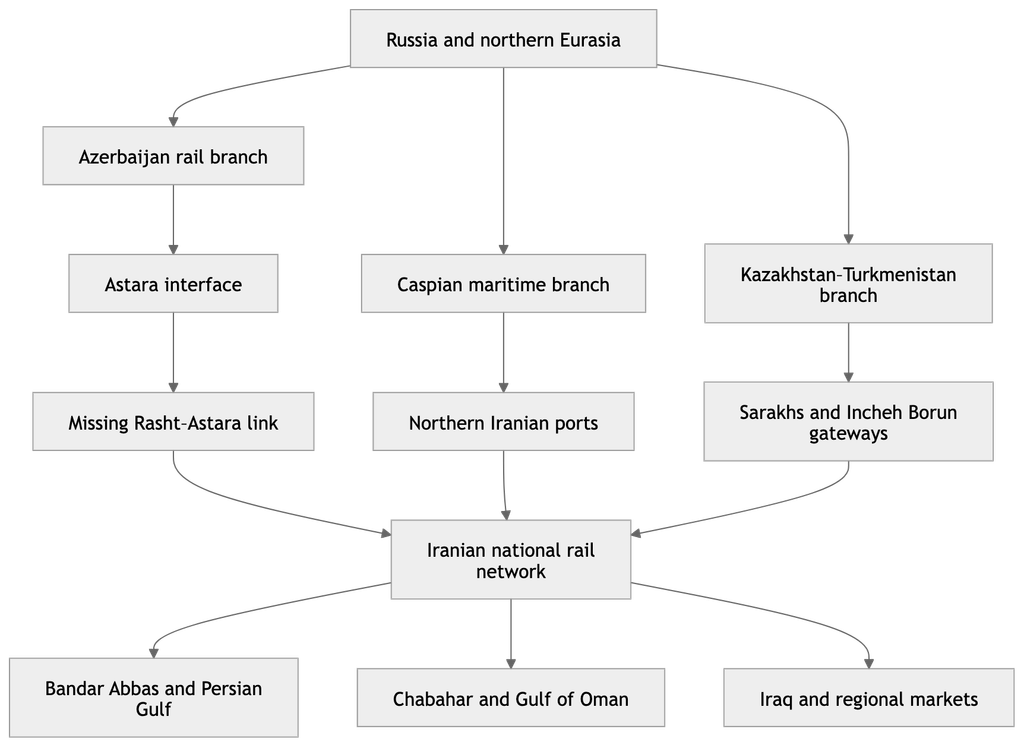
The International North–South Transport Corridor, or INSTC, is not one uninterrupted railway but a multimodal family of routes joining Russia and the Caspian region with Iran and onward maritime connections toward South Asia. This distinction is operationally important because political references to “the corridor” can create an impression of completed, seamless infrastructure that the physical network does not yet support. Historical United Nations transport documentation identified western, central and Caspian configurations incorporating rail, road and maritime movements, with differences in track gauge, electrification, operating speed and terminal interfaces. Development of the Trans-Asian Railway: Trans-Asian Railway in the North–South Corridor – United Nations Economic and Social Commission for Asia and the Pacific – 2023 — verified primary source. The INSTC’s strategic attractiveness has increased as Russia and Iran have both faced widening Western sanctions, but geopolitical demand does not automatically create commercial competitiveness. A corridor succeeds only when total door-to-door time, price reliability, documentation, insurance, customs treatment and cargo security compare favorably with alternative routes. Each transfer between vessel, truck and train creates a potential delay and a new institutional interface. Each border introduces customs inspections, permits, phytosanitary rules and possible sanctions screening. Different rail gauges between the former Soviet network and Iran require bogie exchange, transloading or specialized equipment. Empty-container repositioning can erode the economics of one-directional traffic, while inadequate timetables make theoretical transit time less important than actual waiting time. The corridor’s strongest potential lies in cargoes whose value-to-weight ratio and sensitivity to delay justify overland costs: machinery, components, pharmaceuticals, food products, metals, chemicals and containerized goods. Its weakest proposition is mass substitution for tanker-borne Iranian crude. Even a highly utilized freight railway moves only a fraction of the energy carried by regular very large crude carrier sailings. INSTC can therefore protect the circulation of an economy under pressure without reproducing the petroleum-export system that historically finances it.
Rasht–Astara: the decisive missing link
The Rasht–Astara railway is the principal physical discontinuity in the western INSTC because it prevents a continuous rail movement from the Azerbaijani border through northern Iran toward the country’s internal network. Russia and Iran signed an intergovernmental agreement in 2023 for the segment’s construction, and Russian government reporting in October 2025 confirmed that Iran was still conducting design and survey work in preparation for construction. Meeting of the Council of Heads of Government of the Commonwealth of Independent States – Government of the Russian Federation – October 2025 — verified Russian primary source. A separate Russian government statement described continued cooperation under the 2023 agreement, establishing that the project remained politically active rather than abandoned. Meeting with deputy prime ministers – Government of the Russian Federation – October 2025 — verified Russian primary source. Nevertheless, survey work, land acquisition, financing commitments and political declarations must not be analytically conflated with an operational railway. Until track, bridges, signaling, border facilities, terminals and operating agreements are complete, freight must continue through combinations of rail, truck and transshipment. The missing segment imposes costs in at least six dimensions: additional handling; longer dwell time; increased cargo-damage risk; more extensive documentation; higher exposure to inspections or sanctions enforcement; and reduced timetable predictability. Construction itself is technically and politically demanding because the alignment crosses a developed and environmentally complex part of northern Iran, while land acquisition and compensation can delay implementation independently of Russian financing. Once completed, the line would still require efficient border processing and compatible operating practices to achieve its intended value. Capacity is not determined only by rails on the ground; it depends on train length, axle loads, passing loops, signaling, locomotives, crews, terminals and the ability of adjacent networks to absorb traffic. The appropriate five-year indicator is therefore not a ceremonial completion date but sustained commercial operation measured through train frequency, tonnes moved, border dwell time and service reliability.
| Rasht–Astara maturity stage | Evidence required | Intelligence judgment |
|---|---|---|
| Political commitment | Ratified agreements and senior-level confirmation | Verified |
| Financing framework | Disbursement schedule and enforceable project structure | Partially observable |
| Design and survey | Engineering and route-preparation activity | Verified as ongoing in October 2025 |
| Land acquisition | Transfer of required parcels and compensation completion | Insufficient verified public data for a completion judgment |
| Civil construction | Track bed, bridges, tunnels and station works | No verified basis to classify the full segment as operational |
| Systems integration | Signaling, customs, rolling stock and gauge interfaces | Dependent on physical completion |
| Commercial operation | Repeated scheduled trains and published throughput | Not yet established by the verified sources used here |
The Caspian ports as strategic shock absorbers
The Caspian branch is strategically valuable because it creates a north-facing maritime system that does not require passage through Hormuz, but its resilience should not be confused with unlimited capacity. Cargo can move from Russian ports such as Astrakhan and the wider Volga–Caspian complex toward Iranian ports including Anzali, Amirabad and Astara, then transfer to road or rail for distribution through Iran. Historical UNESCAP analysis emphasized that the Caspian configuration depended on efficient interfaces between maritime, road and railway transport and identified missing or incomplete rail connections as a central competitiveness problem. Development of the Trans-Asian Railway: Trans-Asian Railway in the North–South Corridor – United Nations Economic and Social Commission for Asia and the Pacific – 2023 — verified primary source. The corridor’s operational strength lies in redundancy: if the Azerbaijan land route is delayed or politically constrained, cargo can move across the Caspian; if one Iranian port is congested, volumes can theoretically be redistributed among several northern gateways. Its weakness lies in multimodality. Every port-to-rail or port-to-road transfer requires cranes, storage, customs clearance, suitable vessels, sufficient containers and coordinated schedules. The Caspian fleet is smaller and more specialized than globally traded ocean-going capacity; shallow water, seasonal conditions and port draught can limit vessel loading; and the Volga–Caspian approach has its own navigational and dredging requirements. Sanctions create additional friction because vessel owners, banks, equipment suppliers and cargo insurers must evaluate exposure to both Russia and Iran. The route can therefore expand materially from a low base while remaining small compared with Persian Gulf petroleum exports. Its highest strategic utility is as a shock absorber for food, grain, timber, metals, construction materials, manufactured products and selected containerized cargoes. It is less suited to replacing the revenue scale generated by conventional oil exports. Over the next five years, the key issue will be whether Caspian ports develop as coordinated nodes within a scheduled transport system or remain a collection of opportunistic, irregular movements vulnerable to port-level congestion.
Central Asia as the redundancy multiplier
Central Asia gives Iran access to a geographically distributed transport lattice connecting Russia, China and the Caspian without reliance on the Caucasian branch alone. Kazakhstan’s government identifies participation in the North–South corridor, the Trans-Caspian Transport Route and China’s Belt and Road system as mutually reinforcing elements of its transit strategy. In January 2026, President Kassym-Jomart Tokayev specifically described the Russia–Kazakhstan–Turkmenistan–Iran route, with access to seaports, as promising. President of the Republic of Kazakhstan Kassym-Jomart Tokayev’s interview with Turkistan newspaper – Government of Kazakhstan – January 2026 — verified Kazakh primary source. Kazakhstan also reported 320 million tonnes of total rail freight in 2025, a year-on-year increase of 5.5%, while planning repairs across 11,000 kilometres of railway by 2029 and reporting more than 4,400 kilometres completed by early 2026. These are system-wide figures rather than Iran-corridor volumes, but they indicate the scale of the network on which any southbound expansion must depend. Implementation of the President’s Instructions: Development of the Transport Sector and Logistics Potential of Kazakhstan – Government of Kazakhstan – February 2026 — verified Kazakh primary source. The strategic advantage of the eastern branch is failure diversification: political or physical disruption in Azerbaijan does not automatically stop freight through Kazakhstan and Turkmenistan. The disadvantage is institutional multiplication. A shipment may encounter Chinese, Kazakh, Turkmen and Iranian border procedures; different tariff systems; wagon-allocation constraints; tracking discontinuities; and potential security inspection. Transit states also possess bargaining power. They can seek lower tariffs, infrastructure investment, port access or political concessions in exchange for prioritizing Iran-bound traffic. Central Asia is therefore not passive terrain but an active strategic intermediary. Its governments benefit from increased transit revenue and diversified routes, yet they must manage relations with China, Russia, Iran, the European Union and the United States without allowing any corridor to create excessive dependence or sanctions exposure.
China: commercial anchor and asymmetric gatekeeper
China is indispensable to the Eurasian adaptation system because it combines industrial supply capacity, energy demand, rail connectivity and sufficient political weight to resist complete alignment with Western sanctions. The launch of an all-rail Qom–Yiwu freight service in July 2024 followed coordination among China, Kazakhstan, Turkmenistan and Iran and replaced an earlier multimodal arrangement that had incorporated the Caspian Sea. Iran–Yiwu all-rail freight train launched – Zhejiang Provincial Government – July 2024 — verified Chinese primary source. The service demonstrates route feasibility, but the existence of a train should not be treated as proof of high-frequency, commercially mature or large-scale operation. The decisive indicators are scheduled departures, train utilization, cargo composition, backhaul availability, border dwell time and annual container volumes. Rail offers its greatest advantage for cargoes whose time value is high enough to justify a premium over ocean freight. It can maintain flows of machinery, electronics, automotive components, chemicals and selected consumer goods during maritime disruption. It is structurally unsuited to replacing tanker-scale petroleum movement and is unlikely to displace low-value bulk shipping where cost per tonne dominates delivery time. China’s position is also asymmetric. Iran gains a sanctions-tolerant market and source of manufactured imports, while China gains bargaining leverage over price, settlement form, infrastructure procurement and delivery conditions. The United States has progressively targeted Chinese independent refiners and the shipping networks that supply them. In March 2025, the U.S. Treasury stated that one designated Shandong refinery had purchased Iranian oil valued at approximately USD 500 million. Treasury Sanctions Network Supporting Iran’s Oil Exports – U.S. Department of the Treasury – March 2025 — verified primary source. In April 2026, Treasury warned that Chinese refineries designated since March 2025 had collectively processed Iranian oil worth billions of dollars and explicitly threatened secondary sanctions against foreign financial institutions supporting the activity. Treasury Warns of Sanctions Risks Linked to China-Based Purchases of Iranian Oil – U.S. Department of the Treasury – April 2026 — verified primary source. China anchors Iranian resilience, but that resilience becomes increasingly dependent on Beijing’s tolerance for legal, financial and diplomatic cost.
Russia: corridor sponsor, partner and potential competitor
Russia’s role combines strategic partnership, infrastructure sponsorship and commercial self-interest. Moscow benefits from a functioning north–south corridor because it diversifies trade away from European routes, creates access toward Iran and the Indian Ocean, supports Russian regions around the Caspian and demonstrates that Western sanctions have not eliminated Eurasian connectivity. Iran gains engineering, financing, transport demand and a politically aligned partner with experience operating under extensive sanctions. The bilateral framework deepened with the Treaty on Comprehensive Strategic Partnership, signed in Moscow on 17 January 2025 and subsequently ratified by Russia. Law on ratification of the Treaty on Comprehensive Strategic Partnership between the Russian Federation and the Islamic Republic of Iran – President of Russia – April 2025 — verified Russian primary source. At the signing, Vladimir Putin and Masoud Pezeshkian identified transport, energy, trade and financial cooperation among the relationship’s core areas. Press conference following Russian-Iranian talks – President of Russia – January 2025 — verified Russian primary source. Alignment, however, does not eliminate competition. Russia and Iran both export hydrocarbons to overlapping Asian markets and can compete for buyers, discounts and transport capacity. Russian authorities may prioritize domestic cargoes or other partners when railways and Caspian ports become congested. Moscow also obtains leverage from financing or enabling infrastructure that Iran cannot rapidly replace. The relationship is therefore mutually useful but not symmetrical or frictionless. For Russia, INSTC is one component of a broader sanctions-adaptation system that includes China, Central Asia, the Arctic and maritime shadow networks. For Iran, the corridor has greater existential significance because it directly mitigates the risk of maritime isolation. This difference in strategic urgency affects bargaining power. Over the five-year horizon, the strongest positive indicator would be conversion of political commitments into standardized freight schedules and reduced border dwell times. The principal negative indicator would be a corridor that remains politically celebrated but operationally fragmented, with volumes too irregular to support industrial planning.
Chabahar: the only maritime bypass with transformative potential
Chabahar is uniquely important because it lies on the Gulf of Oman outside the Strait of Hormuz, giving Iran an ocean-facing port that is not physically trapped behind the chokepoint. India signed a long-term contract on 13 May 2024 through India Ports Global Limited to equip and operate the general-cargo and container terminal at Shahid Beheshti for ten years. Long-term Main Contract for development of Shahid Beheshti Port Terminal, Chabahar – Government of India – May 2024 — verified Indian primary source. By July 2024, India reported that it had allocated INR 4 billion between fiscal years 2016–17 and 2023–24 and utilized INR 2.0151 billion for development; vessel traffic had increased 43% and container traffic 34% during 2023–24. Development of Chabahar Port – Government of India – July 2024 — verified Indian primary source. These figures establish genuine operational development, but they do not make Chabahar equivalent to Iran’s Persian Gulf petroleum-export complex. The port’s present strategic function is primarily containerized and general cargo, regional connectivity and access toward Afghanistan, Central Asia and Russia. Its transformation into a major national bypass requires reliable inland railway and road capacity, larger terminal throughput, secure power and communications, sufficient customs capability, storage, coastal shipping integration and sanctions-compatible finance. The port also creates a sanctions dilemma for India. New Delhi values access to Afghanistan and Eurasia without depending on Pakistan, but Indian operators, banks and insurers must weigh exposure to U.S. restrictions. Chabahar’s five-year importance should therefore be measured in usable corridor capacity rather than symbolic geography. If inland connectivity and regular shipping services expand, it can materially reduce Iran’s vulnerability for imports and non-oil exports. It still cannot independently absorb the petroleum volume normally handled by Kharg Island and Gulf terminals without infrastructure development on a vastly different scale.
Iraq and the western regional branch
The Shalamcheh–Basra railway represents a different category of adaptation: a short cross-border connection intended to integrate Iran more closely with Iraq rather than to create an immediate intercontinental substitute for Hormuz. Iraqi government records confirm that a high-level technical committee inspected the proposed route in February 2023. Transportation: The Prime Minister’s Committee conducts a field inspection of the railway track Shalamcheh–Basra – Government of Iraq – February 2023 — verified Iraqi primary source. In June 2024, Iraq’s Ministerial Council for the Economy approved the Ministry of Transport’s request to refer construction of the line, and in September 2024 it approved a request concerning the performance bond for the Spanish company implementing the project. Deputy Prime Minister and Foreign Minister Chairs the Twenty-Third Session of the Ministerial Council for the Economy – Ministry of Foreign Affairs of Iraq – June 2024 — verified Iraqi primary source. Deputy Prime Minister and Foreign Minister Chairs the Twenty-Seventh Session of the Ministerial Council for the Economy – Ministry of Foreign Affairs of Iraq – September 2024 — verified Iraqi primary source. The line can facilitate religious travel, bilateral commerce, food and construction-material flows and potentially connect Iranian producers with southern Iraq. Its strategic limitations are equally important. A cross-border railway does not automatically grant efficient access to Iraqi ports; interoperability with Iraq’s internal network, terminal capacity, security, customs and competition for track usage determine the real outcome. Baghdad must also guard against a project structure that subordinates Iraq’s own transport strategy to Iranian interests or conflicts with the larger Development Road concept. The railway may produce political influence disproportionate to its freight volume by strengthening interpersonal, commercial and institutional linkages between southern Iraq and Iran. Over five years, it should therefore be assessed simultaneously as transport infrastructure, an economic corridor and an influence vector.
Physical movement has strategic value only if Iran can pay suppliers, insure cargoes, settle transit charges and convert export proceeds into resources usable by the domestic economy. The Eurasian adaptation system therefore includes an inseparable financial layer comprising national-currency settlement, bilateral clearing, barter, trade netting, third-country intermediaries and restricted purchasing accounts. The Russia–Iran strategic partnership creates political space for alternative payment infrastructure, while China supplies the principal commercial ecosystem capable of absorbing significant Iranian energy volumes. Yet “de-dollarization” does not automatically mean liquidity sovereignty. A payment received in a partner currency may be usable only for purchases within that partner’s jurisdiction; barter can preserve imports while preventing the Iranian state from freely allocating revenue; and a long chain of intermediaries consumes value through fees, exchange spreads and sanctions-risk premiums. EU measures reimposed in September 2025 included economic and financial restrictions spanning trade, finance and transport. Iran sanctions snapback: Council reimposes restrictive measures – Council of the European Union – September 2025 — verified EU primary source. The United States has attacked the same system from the opposite direction by targeting vessels, refineries, traders and financial institutions. By April 2026, the U.S. Treasury stated that it had sanctioned more than 1,000 Iran-related persons, vessels and aircraft since February 2025. Economic Fury Targets Global Network Fueling Iran’s Oil Revenue – U.S. Department of the Treasury – April 2026 — verified primary source. The key intelligence question is therefore not whether trade still occurs but how much economic utility Iran retains after discounts, transport costs, tied settlement and intermediary extraction. Nominal export revenue can coexist with acute domestic foreign-exchange scarcity.
| Financial-resilience mechanism | Immediate benefit | Embedded cost | Key intelligence indicator |
|---|---|---|---|
| National-currency settlement | Reduces direct dollar-clearing exposure | Exchange and convertibility risk | Share of proceeds freely usable outside partner country |
| Barter | Keeps essential imports moving | Weak price transparency and limited fungibility | Difference between nominal export value and delivered imports |
| Trade netting | Reduces cross-border payment volume | Requires balanced bilateral trade | Persistent bilateral surplus trapped without settlement |
| Third-country intermediaries | Separates counterparties from sanctioned entity | Fees, seizure risk and longer transaction chain | Rapid company creation, closure and ownership changes |
| Shadow shipping | Preserves petroleum movement | Freight premium, discounts and accident exposure | Netback revenue per barrel rather than gross cargo value |
| Infrastructure-for-commodities | Converts exports into durable assets | Delayed return and supplier dependence | Completion quality and control of resulting infrastructure |
| Informal value transfer | Operates outside conventional banking | Scale limits, opacity and criminal exposure | Divergence between trade statistics and observed payments |
Shadow security and corridor coercion
Continental routes disperse maritime vulnerability but generate new security surfaces. Rail lines, bridges, signaling systems, border terminals, port cranes, fuel depots and customs databases are fixed assets that can be sabotaged, cyber-disrupted or administratively obstructed. The greater the number of jurisdictions, the larger the opportunity for intelligence collection, sanctions enforcement, corruption and political leverage. Private security contractors, local armed networks and politically connected transport operators may become embedded around high-value routes, particularly where state capacity is uneven or cargoes require protection. This does not establish a verified mercenary presence on the examined corridors; it identifies a collection requirement. Analysts should distinguish ordinary commercial security from armed patronage systems and should avoid inferring state sponsorship solely from the nationality of personnel or ownership opacity. Cyber risk is more immediate because corridor efficiency increasingly depends on digital manifests, customs pre-clearance, wagon allocation, port community systems and cargo tracking. A technically intact railway can lose much of its capacity if scheduling data become unreliable or if customs systems repeatedly fail. Sanctions enforcement can exploit these digital dependencies by identifying counterparties and recurring cargo patterns, while Iran and its partners may respond through data minimization, fragmented documentation or domestic platforms. Such measures improve concealment but reduce interoperability and commercial efficiency. The central paradox is that a high-performance corridor requires transparency, standardized data and predictable rules, whereas a sanctions-resilient corridor may prioritize opacity and discretionary handling. The two objectives are not fully compatible. Over five years, the corridors most likely to mature are those that can separate legitimate regional commerce from sanctioned activity sufficiently to attract ordinary freight while maintaining political protection for strategic cargoes. If every shipment becomes associated with evasion risk, reputable operators withdraw, leaving a smaller and more expensive ecosystem dominated by actors prepared to accept extreme legal and operational exposure.
Competing hypotheses and Bayesian assessment
Five competing hypotheses organize the 2026–2031 outlook. H₁, Functional Redundancy, holds that Iran, Russia, China and Central Asian states convert existing projects into a dependable multimodal network capable of protecting essential trade and a meaningful share of non-oil exports; current posterior probability 33%. H₂, Chinese-Centered Dependency, anticipates successful physical adaptation accompanied by deep commercial dependence on Chinese demand, equipment, settlement and negotiating power; probability 29%. H₃, Persistent Corridor Fragmentation, expects construction delays, transshipment costs, border friction and irregular service to keep the system strategically useful but commercially secondary; probability 20%. H₄, Enforcement-Led Degradation, assumes secondary sanctions and financial pressure deter enough operators, banks and transit services to offset infrastructure gains; probability 12%. H₅, Breakthrough Eurasian Integration, anticipates completion of Rasht–Astara, scalable Chabahar operations, regular China trains, improved Caspian interfaces and interoperable digital customs, producing a step-change in throughput; probability 6%. The posterior weights reflect several updates. Continued Russian political support and the ratified strategic partnership increase H₁ and H₅, but confirmed design-stage work rather than an operational Rasht–Astara line sustains H₃. The Qom–Yiwu service increases H₁ and H₂, while U.S. targeting of Chinese refineries and financial institutions raises H₄. India’s ten-year Chabahar contract increases the probability of non-Gulf resilience, but the port’s scale and sanctions exposure prevent a stronger H₅ update. Evidence that would materially raise H₁ includes repeated scheduled services across multiple branches, falling border dwell times and diversified cargo. H₂ would rise if Chinese entities increasingly dominate finance, equipment and offtake. H₃ would rise if projects remain perpetually described as nearing completion without published operational throughput. H₄ would rise following withdrawal by major transit operators or measurable payment paralysis. H₅ requires simultaneous progress across infrastructure, customs and finance; success in only one layer is insufficient.
Five-year judgment
The Monte Carlo outlook models 50,000 synthetic trials across seven correlated variables: Rasht–Astara completion and utilization, Caspian port performance, China–Iran train regularity, Central Asian border efficiency, Chabahar expansion, sanctions pressure and settlement convertibility. The model distinguishes physical corridor capacity from economically usable capacity because a railway that cannot secure payment, insurance or predictable customs treatment does not deliver its nominal throughput. In the central pathway, Iran’s Eurasian resilience index rises from 39 in 2026 to 61 in 2031, while its substitution capacity for maritime petroleum remains below 15 on the same normalized scale. The adaptation network consequently improves economic continuity without liberating Iran from Hormuz. Under the accelerated-integration pathway, completion of key links and improved port interfaces lift the resilience index toward 76 by 2031, but even this pathway does not support rail replacement of large-scale crude exports. Under the sanctions-fragmentation pathway, higher enforcement pressure and weak payment convertibility hold usable resilience below 48 despite incremental construction. The most likely end state is a denser but uneven Eurasian system: Russia supplies the northern political and infrastructure anchor; China provides the largest market and industrial ecosystem; Kazakhstan and Turkmenistan supply geographic redundancy; Chabahar provides a limited ocean-facing bypass; and Iraq deepens Iran’s western regional integration. Iran becomes harder to isolate but more dependent on a small group of states capable of extracting discounts, demanding tied purchases or withholding logistical cooperation. Strategic resilience therefore rises while economic sovereignty remains constrained. The critical judgment is not that sanctions have failed or that corridors will defeat maritime coercion. It is that pressure is transforming the spatial organization of Iranian trade. By 2031, Tehran is likely to possess more routes, more counterparties outside the Western system and greater ability to preserve essential flows, while accepting permanently higher friction and reduced access to fungible capital.
The Five-Year Contest: Sanctions Enforcement, Shadow Logistics, Financial Settlement and Competing Futures
From sectoral sanctions to system-wide economic interdiction
The contest between Iran and the sanctions coalition has entered a more complex phase than conventional restrictions on banks, oil exports or named state enterprises. The emerging enforcement model treats Iran’s external economy as an interconnected network whose operational nodes include producers, trading companies, vessel owners, ship managers, captains, flag registries, insurers, port terminals, independent refineries, exchange houses, digital-asset platforms, front companies and foreign financial institutions. The objective is no longer merely to prohibit a regulated Western institution from purchasing Iranian oil; it is to reduce the number of jurisdictions, intermediaries and counterparties through which Iran can generate, move, convert and repatriate revenue. In August 2026, the U.S. Treasury launched Operation Economic Outcast, stating that it had mapped the networks and financial channels used by Iran to smuggle oil and evade sanctions and was adopting what it described as a zero-leakage approach. Treasury Launches Unprecedented Campaign Against Iran’s Global Financial and Commercial Networks – U.S. Department of the Treasury – August 2026 — verified primary source. In accompanying remarks, the Treasury Secretary defined the strategic choice as one between severe isolation and reintegration with the global economy. Remarks from Secretary of the Treasury Scott Bessent on Operation Economic Outcast – U.S. Department of the Treasury – August 2026 — verified primary source. These declarations establish intent, not accomplished economic isolation. The practical effectiveness of the campaign will depend on whether enforcement can identify and disable replacement networks faster than Iran and its partners can generate them. Sanctions are therefore a dynamic contest between network attrition and network regeneration. Designating one tanker matters only if substitute hulls, managers, flags and buyers cannot be mobilized at acceptable cost. Blocking one exchange house matters only if the transaction cannot be rerouted through another company, commodity trade or digital channel. The correct unit of analysis is consequently the adaptive network, not the cumulative number of designations.
| Enforcement layer | Immediate target | Intended effect | Principal adaptation |
|---|---|---|---|
| Primary sanctions | U.S.-linked persons and property | Deny direct access to U.S. finance and commerce | Remove U.S. nexus; use non-U.S. counterparties |
| Secondary sanctions | Foreign banks, refiners and traders | Raise the cost of dealing with Iran | Smaller institutions and jurisdictional arbitrage |
| Vessel designation | Tankers, owners and managers | Restrict insurance, ports and financing | Reflagging, renaming and ownership migration |
| Refinery designation | Final buyers of Iranian crude | Reduce stable demand and processing capacity | Cargo blending and alternative refinery intake |
| Port and terminal pressure | Loading, storage and discharge nodes | Interrupt physical transfer | Offshore transfers and less transparent terminals |
| Shadow-banking action | Exchange houses and front companies | Prevent revenue conversion and repatriation | Barter, trade netting and replacement companies |
| Digital-asset enforcement | Exchanges, wallets and facilitators | Constrain pseudonymous value transfer | Chain-hopping, brokers and lightly regulated venues |
| Maritime-interdiction support | Cargoes and transport routes | Convert legal pressure into physical denial | Route diversification and politically protected passage |
Enforcement density and the regeneration problem
The scale of designations has expanded rapidly. In April 2026, the U.S. Treasury stated that OFAC had sanctioned more than 1,000 Iran-related persons, vessels and aircraft since February 2025. Economic Fury Targets Global Network Fueling Iran’s Oil Revenue – U.S. Department of the Treasury – April 2026 — verified primary source. By July 2026, Treasury reported that more than 100 vessels linked to Iran’s shadow fleet had been sanctioned since the beginning of that year. Treasury Disrupts Iranian Regime’s Strait of Hormuz Sanctions-Evasion Networks – U.S. Department of the Treasury – July 2026 — verified primary source. These figures demonstrate high enforcement tempo, but designation counts are an input rather than an outcome measure. A successful campaign must produce observable operational consequences: fewer loadings, longer voyage times, deeper crude discounts, rising demurrage, reduced refinery participation, lower usable foreign-exchange receipts and a slower replacement rate for disabled entities. The adversarial response exploits the difference between legal identity and physical capability. A vessel can be transferred to a newly incorporated owner, reflagged, renamed or operated through a different manager while remaining the same hull identified by its permanent IMO number. A front company can disappear after a small number of transactions and be replaced by another entity sharing directors, addresses, counterparties or digital infrastructure. Refinery procurement can be divided among brokers so that no single intermediary appears central. Consequently, enforcement must map persistent attributes rather than names alone: vessel histories, beneficial ownership, directors, financing relationships, technical managers, telephone numbers, email domains, IP infrastructure, cargo behavior and counterparties. Iran’s regeneration cost nevertheless rises with every iteration. New managers are less experienced, older vessels require more maintenance, reputable insurers withdraw, documentation quality deteriorates and counterparties demand compensation for legal risk. The likely five-year effect is therefore cumulative degradation rather than absolute cessation: the system continues functioning, but each barrel and each payment carries a larger friction premium.
Shadow shipping as a modular logistics architecture
Iran’s shadow logistics system is modular because the petroleum chain can be divided across actors that need not possess full knowledge of the transaction. One company may own the tanker, another provide technical management, another arrange the charter, another issue cargo documents, another conduct the ship-to-ship transfer and a separate trading intermediary deliver the cargo to the refinery. This fragmentation reduces the evidentiary exposure of individual participants while creating more points at which value is extracted. U.S. Treasury designations in May 2025 described obscure ship-management companies operating tankers that moved Iranian petroleum to China through ship-to-ship transfers. Treasury Increases Pressure on Firms Importing Iranian Oil – U.S. Department of the Treasury – May 2025 — verified primary source. An August 2025 action identified vessels that had moved cargoes exceeding one million barrels and described another tanker as having transported millions of barrels to Chinese destinations following transfers involving sanctioned vessels. Treasury Targets Iranian Oil Exports and Shadow Fleet – U.S. Department of the Treasury – August 2025 — verified primary source. Ship-to-ship transfer is not inherently illicit; it is a standard maritime operation. The intelligence significance arises from combinations of behavior: unexplained AIS gaps, meetings with sanctioned vessels, draught changes away from conventional terminals, repeated flag or ownership changes, manipulated cargo origin, and discharge at facilities associated with sanctioned petroleum. Enforcement should therefore avoid treating a single anomaly as definitive attribution. High-confidence assessment requires fusion of satellite imagery, radar, AIS, port records, corporate registries, sanctions data and refinery intake patterns. The system’s physical vulnerabilities include ageing hulls, weak insurance, crew quality, maintenance deficiencies and environmental liability. Its strategic resilience lies in fungibility: many tankers can carry similar crude, and cargoes can be transferred, blended or relabeled. The five-year contest will turn on whether authorities can make participation sufficiently costly that available shadow tonnage, safe terminals and willing buyers contract faster than Iran can reorganize them.
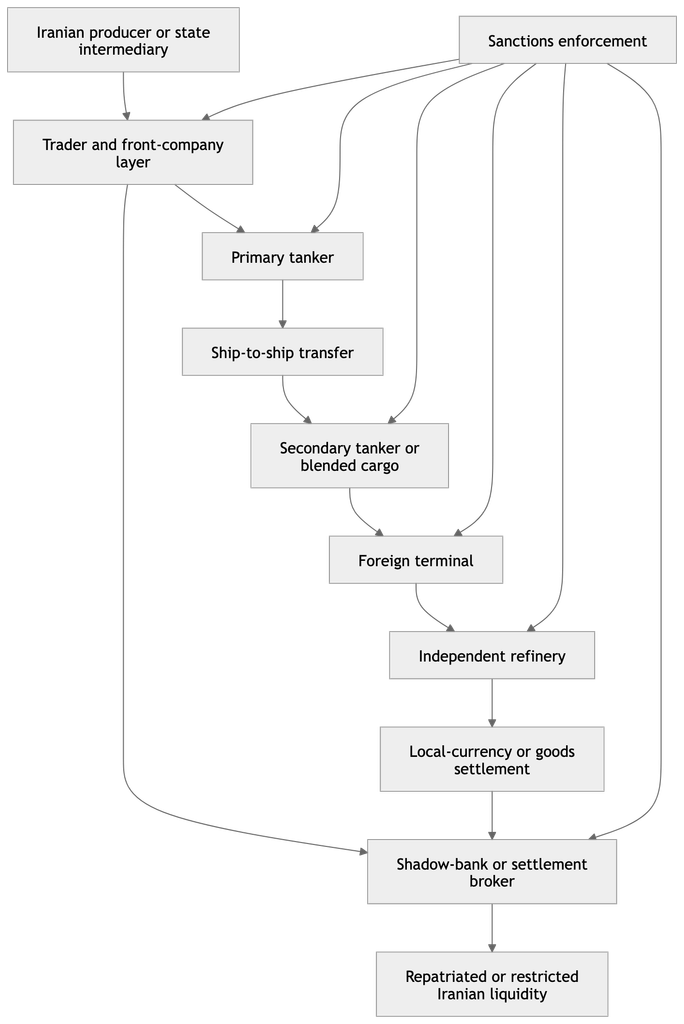
China as the decisive enforcement boundary
The decisive enforcement boundary lies in China because Iran’s petroleum network requires not merely ships but refiners willing to receive, process and pay for the cargo. Washington has increasingly targeted independent Chinese refiners, especially in Shandong, and the intermediaries that supply them. In March 2025, Treasury stated that Luqing Petrochemical had purchased millions of barrels of Iranian oil worth approximately USD 500 million. Treasury Sanctions Network Supporting Iran’s Oil Exports – U.S. Department of the Treasury – March 2025 — verified primary source. In October 2025, Treasury described its action as the fourth sanctions round directed against China-based refineries continuing to buy Iranian oil. Treasury Dismantles Key Elements of Iran’s Energy Export Machine – U.S. Department of the Treasury – October 2025 — verified primary source. In April 2026, Treasury instructed financial institutions to conduct enhanced due diligence involving Chinese refiners, particularly those in Shandong, and warned foreign financial institutions of potential secondary-sanctions exposure. Treasury Warns of Sanctions Risks Linked to China-Based Purchases of Iranian Oil – U.S. Department of the Treasury – April 2026 — verified primary source. Beijing has rejected this legal premise. In May 2026, China’s Foreign Ministry stated that it opposed unilateral sanctions lacking a basis in international law or authorization by the United Nations Security Council and would protect Chinese businesses’ lawful interests. Foreign Ministry Spokesperson Guo Jiakun’s Regular Press Conference – Ministry of Foreign Affairs of the People’s Republic of China – May 2026 — verified Chinese primary source. In August, it reiterated that sanctions and pressure would intensify escalation and damage global economic and financial stability. Foreign Ministry Spokesperson Lin Jian’s Regular Press Conference – Ministry of Foreign Affairs of the People’s Republic of China – August 2026 — verified Chinese primary source. The outcome therefore depends on risk tolerance inside China: whether banks, refiners and port operators follow Beijing’s political position or independently reduce exposure to preserve access to international finance.
Europe’s compounding legal architecture
The European Union’s role differs from that of the United States because the EU possesses less extraterritorial financial reach but remains central to maritime insurance, shipping services, banking compliance, vessel maintenance and asset control. In September 2025, the Council reimposed nuclear-related restrictive measures covering the trade, financial and transport sectors. These included asset freezes affecting the Central Bank of Iran and major Iranian commercial banks, prohibitions relating to Iranian crude oil and petroleum products, and transport restrictions. Iran sanctions snapback: Council reimposes restrictive measures – Council of the European Union – September 2025 — verified primary source. In May 2026, the Council broadened the legal framework to permit further restrictive measures against persons and entities involved in Iranian actions impeding lawful transit and freedom of navigation in Hormuz. Middle East: Council extends EU legal framework to target those involved in Iran’s actions impeding lawful transit, passage and freedom of navigation – Council of the European Union – May 2026 — verified primary source. The combination creates a layered compliance environment in which a vessel may be exposed because of its cargo, ownership, financing, prior port calls or involvement in coercive activity. European measures can amplify U.S. pressure by depriving operators of high-quality marine services even when a transaction lacks an obvious U.S. dollar nexus. Enforcement effectiveness, however, depends on implementation across member states, accurate beneficial-ownership data, port-state controls and coordination with flag registries outside the Union. An operator excluded from European ports may continue trading between Iran and Asia if it can obtain alternative insurance and maintenance. European pressure therefore raises operating cost and safety risk but does not automatically produce immobilization. Its greatest leverage lies in denying the ecosystem of reputable services required for normal, scalable shipping.
Settlement outside the dollar system
Financial settlement is the most important but least visible layer because physical export does not guarantee that Iran receives fungible, repatriable value. A nominal petroleum sale can settle through local currency, barter, an offset against imports, infrastructure credits, third-country accounts or a chain of exchange houses. Each structure produces a different quality of revenue. Freely transferable reserves can finance purchases across jurisdictions; restricted balances can be spent only inside the partner country; barter delivers goods but limits fiscal discretion; and infrastructure settlement delays economic benefit until the project is completed. Russia and Iran stated in January 2025 that their bilateral commerce had almost completely transitioned to settlement in national currencies. Press conference following Russian-Iranian talks – President of Russia – January 2025 — verified Russian primary source. This reduces direct exposure to dollar clearing, but it does not eliminate exchange-rate risk, correspondent relationships, sanctions screening or the need to convert balances into internationally useful goods and services. The broader Russian strategy explicitly favors independent payment infrastructure and national-currency transactions designed to reduce reliance on Western systems. Meeting of the Council for Strategic Development and National Projects – President of Russia – December 2023 — verified Russian primary source. For Iran, the critical variable is the liquidity-conversion ratio: the share of nominal export value that becomes usable purchasing power after discounts, freight costs, intermediary charges, exchange spreads and restrictions on where funds may be spent. A system can preserve impressive gross trade figures while delivering weak domestic liquidity. Five-year analysis must therefore track the spread between estimated cargo value and imports financed, changes in bilateral trade imbalances, abnormal exchange-house activity, and the accumulation of Iranian claims that cannot be freely deployed. De-dollarization is a method of transactional survival; it is not synonymous with monetary autonomy.
| Settlement channel | Visibility | Fungibility | Sanctions resilience | Structural weakness |
|---|---|---|---|---|
| Conventional bank transfer | High | High | Low | Easily screened, frozen or rejected |
| National-currency clearing | Medium | Medium | Medium to high | Convertibility and bilateral imbalance |
| Barter | Low to medium | Low | High | Price opacity and restricted fiscal choice |
| Trade netting | Medium | Medium | Medium to high | Requires recurring two-way commerce |
| Infrastructure credit | Medium | Low in short term | Medium | Delayed benefit and supplier dependence |
| Exchange-house network | Low | Medium | Medium | Counterparty failure and rapid designation |
| Digital assets | Variable | Medium | Medium | Traceability, volatility and exchange chokepoints |
| Informal value transfer | Low | Low to medium | Medium | Scale limits, trust risk and criminal exposure |
Shadow banking and digital assets
The shadow-banking architecture connects revenues earned abroad with importers, state institutions and politically connected organizations inside Iran. It can include front companies issuing fabricated or manipulated invoices, exchange houses matching offsetting payments, brokers purchasing goods on Iran’s behalf, and exporters surrendering foreign revenue through parallel-market channels. The U.S. Treasury’s August 2026 action described an Iranian apparatus involving banks, front companies, exchange houses, managers, importers and exporters used to launder and repatriate revenue; Treasury identified it as the eighth action during 2026 directed against Iran’s shadow-banking system. Treasury Dismantles Iranian Regime’s Global Clandestine Banking Network – U.S. Department of the Treasury – August 2026 — verified primary source. A parallel action targeted digital-asset exchanges and a network of front companies that Treasury alleged had laundered billions of dollars and supported the IRGC. Treasury Sanctions Crypto Exchanges Funding Iran’s IRGC and Enabling Illicit Finance – U.S. Department of the Treasury – August 2026 — verified primary source. Digital assets can accelerate cross-border value movement and reduce reliance on correspondent banks, but they do not create perfect anonymity or unlimited scale. Public blockchains preserve transaction records; large transfers require liquidity; conversion into fiat money or physical goods usually introduces an exchange, broker or merchant; and stable-value instruments depend on issuers, custodians and technical infrastructure that can become enforcement chokepoints. Iran can reduce attribution by distributing flows across wallets, chains and intermediaries, but complexity increases fees, fraud exposure and operational error. The contest therefore resembles shadow shipping: enforcement targets identifiable nodes while the network restructures around new ones. The meaningful indicator is not the number of wallets sanctioned but the time, cost and loss rate associated with moving equivalent value after each intervention.
Net revenue, economic friction and internal transmission
The economic effect of sanctions must be measured through netback revenue rather than nominal export volume. A barrel sold through a conventional transparent supply chain produces an observable benchmark price minus normal transport and commercial costs. A barrel sold under intense sanctions may require a price discount, elevated freight, ship-to-ship transfer, opaque documentation, multiple intermediaries, restricted settlement and delayed access to proceeds. The cumulative reduction can be large even if the cargo reaches a refinery. Enforcement therefore possesses a spectrum of success: complete prevention of sale is the strongest outcome, but forcing a larger discount or trapping the proceeds in non-fungible accounts also reduces Iran’s usable resources. The transmission mechanism proceeds from lower net revenue to tighter foreign-exchange availability, weaker capacity to finance imports, currency depreciation, higher import prices, fiscal pressure and reduced investment. Yet the relationship is not mechanically proportional because Iran can impose import controls, adjust official exchange rates, mobilize domestic production, delay payments or redirect scarce currency toward politically essential goods. The burden is distributed unevenly. State-linked sectors may retain preferential access while private manufacturers and households absorb shortages, longer delivery times and higher prices. This distributional structure can preserve strategic programs even as aggregate welfare deteriorates. Sanctions assessments that infer military-resource deprivation directly from national economic distress therefore risk overstatement. The state may shift costs onto civilian consumption and private investment. Conversely, official export-revenue figures may overstate resilience when proceeds are tied, delayed or discounted. The five-year analytical requirement is a consolidated balance sheet of sanctions friction: export volumes, realized discounts, freight premiums, settlement delays, import composition, accessible reserves, exchange-rate divergence and capital-maintenance expenditure. Without this reconciliation, both sanctions advocates and Iranian authorities can select metrics that exaggerate their preferred narrative.
Cyber coercion, private security and counter-enforcement
The financial and logistics networks are increasingly exposed to cyber operations because shipping, customs, sanctions screening, insurance, payments and port scheduling depend on interconnected digital systems. An enforcement coalition can lawfully exploit publicly available corporate, vessel and blockchain data, while intelligence services can map relationships that are not visible in ordinary compliance databases. Iran and its counterparties can respond through data fragmentation, false documentation, compartmented communications and domestic platforms. These measures improve concealment but reduce efficiency and create new opportunities for fraud. Cyber disruption could also target port community systems, exchange houses, refinery procurement, cargo records or maritime tracking, yet attribution must remain evidence-based: the existence of an Iranian capability or motive does not prove responsibility for a specific incident. Counter-enforcement may include legal retaliation, asset seizure, commercial pressure on foreign firms, cyber espionage and selective maritime coercion. Private maritime-security companies and locally connected armed actors represent another shadow layer. Their role may range from lawful ship protection and terminal security to coercive debt collection, sanctions facilitation or politically protected cargo movement. No authoritative evidence reviewed here supports a generalized claim that mercenary organizations control Iran’s trade corridors; this remains a targeted intelligence gap. The relevant indicators include opaque security contracts, personnel overlap with sanctioned organizations, unusual weapons permissions, payments disproportionate to ordinary protection services and recurring deployment around designated cargoes. Enforcement policy must also manage safety externalities. Driving trade into older vessels, weakly regulated registries and uninsured operations can increase collision, spill and abandonment risk. A strategy that reduces Iranian revenue while transferring environmental liability to coastal states may achieve one objective while creating another systemic vulnerability. The five-year contest will therefore require coordination among sanctions authorities, navies, port states, financial-intelligence units, environmental agencies and commercial insurers.
Structural indicators and early-warning matrix
| Domain | Iranian adaptation indicator | Enforcement-success indicator | Escalation threshold |
|---|---|---|---|
| Oil exports | Stable cargo frequency despite new designations | Persistent fall in loadings and longer storage | Export terminals approach operational saturation |
| Shadow fleet | Rapid replacement of designated ships | Replacement interval lengthens materially | Unsafe vessel concentration produces major casualty |
| Chinese refining | New buyers replace sanctioned refineries | Independent refiners reduce Iranian intake | Major Chinese bank or terminal becomes a secondary-sanctions target |
| Settlement | National-currency and barter channels expand | Payment delays and trapped balances increase | Import financing fails across essential industrial sectors |
| Exchange rate | Parallel-market liquidity remains functional | Spread against official rate widens persistently | Disorderly depreciation and loss of price anchoring |
| Digital assets | High-volume conversion continues | Exchanges and off-ramps lose liquidity | Large-scale seizure or technical disruption |
| Maritime coercion | Selective passage preserves bargaining leverage | Escort and interdiction reduce Iranian control | Shipping attack triggers coalition expansion |
| Eurasian corridors | Higher scheduled throughput and shorter dwell time | Sanctions deter carriers and financiers | Transit state suspends or restricts Iran-bound cargo |
| Domestic economy | State protects priority imports and investment | Capital maintenance and private imports contract | Energy, food and industrial shortages converge |
| Diplomacy | Negotiations preserve partial commercial space | Partners condition trade on political concessions | China or Russia openly limits support |
Analysis of Competing Hypotheses
The five-year contest supports six competing hypotheses rather than a binary success-or-failure judgment. H₁, Costly Iranian Continuity, holds that Iran preserves material exports and imports but accepts permanently higher discounts, logistics costs and settlement friction; current posterior probability 34%. H₂, Chinese-Protected Adaptation, anticipates that Chinese demand, political resistance to unilateral sanctions and a compartmented commercial ecosystem provide the principal external shield, while Iran becomes structurally more dependent on Beijing; probability 24%. H₃, Enforcement Dominance, assumes that coordinated vessel, refinery, banking and digital-asset pressure reduces usable revenue faster than networks can regenerate; probability 16%. H₄, Fragmented Subsistence Equilibrium, expects trade to continue at levels sufficient to avoid collapse but inadequate for capital renewal and sustained growth; probability 14%. H₅, Negotiated Reintegration, anticipates a political settlement that reopens conventional shipping and payment channels in exchange for enforceable Iranian commitments; probability 8%. H₆, Escalatory Economic War, anticipates expanding interdiction, maritime retaliation, cyber operations and secondary sanctions against major foreign institutions, producing severe systemic disruption; probability 4%. The August 2026 launch of Operation Economic Outcast increases H₃ and H₆ relative to the earlier baseline because it signals a broader enforcement objective. China’s repeated rejection of unilateral sanctions supports H₂, but official political resistance does not guarantee that every Chinese commercial institution will accept secondary-sanctions risk. The continued functionality of shadow fleets and settlement networks supports H₁, while the growing density of designations strengthens H₄ because survival may coexist with long-term depletion. H₅ remains contingent on verified diplomatic movement and should not be raised merely because negotiations are discussed. The highest-value discriminators are net Iranian export realization, the number and quality of replacement vessels, Chinese bank behavior, payment-conversion times, import composition, capital-maintenance indicators and whether major transit states continue facilitating commerce.
Monte Carlo model and five-year futures
The Monte Carlo model uses 100,000 synthetic trials across eight correlated variables: enforcement intensity, shadow-fleet regeneration, Chinese commercial tolerance, effective export volume, realized price discount, payment convertibility, Eurasian-corridor reliability and domestic economic absorption. Each trial calculates three distinct outcomes: trade continuity, defined as Iran’s ability to preserve essential cross-border flows; usable revenue, defined as export value remaining after discounts, freight, intermediary cost and settlement restrictions; and strategic autonomy, defined as Iran’s ability to allocate resources without excessive dependence on one external partner. Separating these measures prevents the analytical error of equating survival with sovereignty. The central pathway projects a trade-continuity index declining from 61 in 2026 to 54 in 2028, then recovering toward 59 by 2031 as logistical adaptation offsets some enforcement effects. Usable-revenue quality remains weaker, falling from 44 to 37 before recovering to 43. Strategic autonomy declines from 38 to 31 because the same channels that preserve trade increase dependence on China, Russia and opaque intermediaries. Under an enforcement-dominance pathway, usable revenue falls below 25 by 2029 even though trade continuity remains above 35, producing an economy that still trades but cannot easily finance modernization. Under a negotiated-reintegration pathway, usable revenue and autonomy improve sharply after 2028 because conventional banking and maritime services reduce discounts and transaction costs. The most consequential tail scenario combines lower Chinese tolerance, impaired Hormuz access and enforcement against Eurasian settlement nodes. These variables are correlated: the loss of one channel increases dependence on the others, making simultaneous failure nonlinear. The central judgment is that complete economic isolation remains less probable than progressive value erosion. Iran is more likely to retain the ability to move goods than the ability to capture and freely allocate their full value.
Final strategic judgment
The most probable 2031 end state is neither sanctions collapse nor Iranian normalization. It is a contested economic system in which Iran maintains sufficient external connectivity to prevent complete isolation while enforcement continually taxes every stage of trade. Shadow logistics will survive because petroleum demand, vessel availability, jurisdictional fragmentation and commercial profit create regenerative capacity. Shadow finance will persist because trade can be settled through goods, national currencies, netting and intermediaries when conventional banking is unavailable. Nevertheless, persistence should not be mistaken for efficiency. Older vessels, restricted insurance, deeper discounts, tied balances and complex settlement chains reduce the net economic return of every transaction. The sanctions coalition’s realistic objective is therefore not literal zero leakage, which would require near-universal enforcement and sustained physical control across multiple jurisdictions, but a widening gap between Iran’s gross exports and its usable economic proceeds. Iran’s counter-objective is not full restoration of conventional access but preservation of minimum strategic liquidity and protection of priority imports. China will remain the decisive external actor because its refiners, banks, ports and political choices determine whether pressure reaches a binding threshold. Russia will provide alternative financial and logistical infrastructure but cannot replace the scale of Chinese demand. The European Union will magnify pressure through asset controls, shipping services and maritime regulation, while also bearing the economic and environmental consequences of unsafe shadow trade. The United States will retain the strongest capacity to impose secondary costs, but escalation against major Chinese institutions would create wider financial and geopolitical risks. The five-year contest will consequently be governed by restraint as well as coercion: each side can intensify pressure, but beyond a threshold the campaign can disrupt energy markets, shipping safety and relations among major powers. The winning condition will not be measured by the number of sanctions or surviving tankers. It will be determined by which side can sustain adaptation, coalition cohesion and domestic political tolerance longer than the other.