

Executive Summary
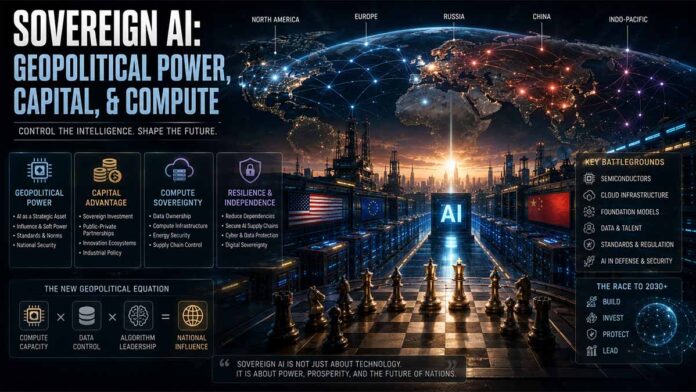
Wealthy state and corporate actors are systematically monopolizing sovereign artificial intelligence architectures across compute infrastructure, foundation models, and energy grids. Sovereign AI is no longer merely an industrial policy objective; it has evolved into a foundational pillar of national defense, macroeconomic resilience, and strategic autonomy. High-capital nations including the United States, China, France, Germany and Italy are deploying distinct regulatory and infrastructural doctrines to mitigate foreign supply chain vulnerability. This analytical framework synthesizes Bayesian multi-vector modeling, capital expenditure patterns, and multi-domain intelligence across key geopolitical theaters to forecast the strategic balance of power over a five-year horizon.
The Geopolitics of Sovereign Compute: Capital Allocation, Industrial Policy and the Strategic Imperative for Europe
The concentration of artificial intelligence infrastructure is redefining macroeconomic resilience, industrial competitiveness, and state sovereignty. What began as a commercial acceleration in generative modeling has transformed into an asymmetric geopolitical race centered on advanced semiconductor fabrication, extreme energy baseloads, and high-performance computing clusters. Wealthier nations, leveraging deep capital markets and state-backed financing vehicles, are establishing structural advantages that dictate the terms of digital autonomy. For Italy and the broader European Union, sovereign artificial intelligence is no longer merely a regulatory ambition or an academic pursuit; it represents an urgent industrial imperative to prevent systemic technological subordination and ensure that strategic decision-making, defense capabilities, and enterprise data remain anchored within domestic jurisdictions.
The Macroeconomic Infrastructure Divide
The capital expenditures required to establish and sustain competitive artificial intelligence ecosystems have expanded beyond the reach of mid-sized economies without coordinated state intervention. A single frontier computational cluster demands tens of thousands of specialized accelerated processing units, multi-hundred-megawatt electrical substations, and proprietary networking topologies. According to the Bank for International Settlements (BIS Quarterly Review, March 2026), international corporate entities and hyperscalers have engaged in extensive balance-sheet expansion and structured debt issuances to underwrite these long-dated physical assets. This structural dynamic concentrates cutting-edge compute within a minimal number of global technological conglomerates, creating deep upstream dependencies for foreign enterprise users and public administrations.
According to baseline data compiled by the Organisation for Economic Co-operation and Development (OECD Digital Economy Papers, March 2024, “A blueprint for building national compute capacity”), national compute strategies require comprehensive vertical integration across hardware procurement, software optimization, and secure energy access. The OECD framework establishes that nations lacking indigenous tier-4 data center infrastructure face compounding productivity deficits and elevated exposure to extraterritorial regulatory changes. When computational capacity is monopolized by external jurisdictions, access to foundation models can be conditioned, throttled, or subjected to foreign compliance regimes during periods of international crisis.
The European Legislative Framework
In response to growing technological concentration, the European Union has enacted a comprehensive legislative and regulatory architecture designed to harmonize digital development with fundamental rights and systemic risk mitigation. On 13/06/2024, the European Parliament and the Council of the European Union formally adopted Regulation (EU) 2024/1689, commonly known as the Artificial Intelligence Act (published in the Official Journal of the European Union, L Series, 12/07/2024). This regulation establishes a tiered, risk-based classification system for artificial intelligence systems, setting stringent transparency and governance obligations for General Purpose AI (GPAI) models with systemic capabilities.
The operational oversight of this framework is entrusted to the European AI Office, established within the European Commission under Commission Decision C(2024) 390 of 24/01/2024. The AI Office is tasked with enforcing rules for systemic GPAI models, monitoring technical evaluations, and fostering European industrial ecosystems. However, regulatory oversight without equivalent infrastructural capacity risks creating a structural asymmetry: European companies must comply with rigorous compliance standards while continuing to rely on non-European hardware architectures and cloud hosting environments to execute their workloads.
The Supercomputing Backbone and the Italian Node
To address the physical infrastructure deficit, the European Union established the European High Performance Computing Joint Undertaking under Council Regulation (EU) 2021/1173 of 13/07/2021. The EuroHPC JU pools European Union, member state, and private resources to procure, deploy, and interconnect world-class pre-exascale and exascale supercomputing infrastructure across the continent.
A primary pillar of this network is hosted in Italy. The “Leonardo” pre-exascale supercomputer, operated by the Cineca consortium at the Bologna Technopole, was officially inaugurated on 24/11/2022. Funded jointly by the Italian Ministry of Universities and Research and the EuroHPC JU, Leonardo delivers hundreds of petaflops of computational performance, providing a strategic computational asset for advanced materials science, climate modeling, and sovereign foundational model training. On 23/05/2024, the Council of the European Union amended Regulation (EU) 2021/1173 to establish “AI Factories”—specialized supercomputing hubs dedicated to providing start-ups, small and medium enterprises, and scientific researchers with direct access to EuroHPC computing power and data storage facilities.
The Semiconductor Chokepoint and European Industrial Policy
Sovereign computational capacity remains fundamentally constrained by the geographic concentration of semiconductor fabrication. Leading-edge lithography, high-bandwidth memory (HBM) packaging, and silicon wafer manufacturing are localized in a fragile supply corridor stretching across the United States, Taiwan, Japan, and South Korea. To mitigate external supply chain shocks, the European Union adopted Regulation (EU) 2023/1781, known as the European Chips Act (published in the Official Journal of the European Union, L 229, 18/09/2023).
The Chips Act establishes a framework to mobilize approximately 43 billion euros in public and private investments, aiming to double the European Union’s global semiconductor manufacturing market share to 20% by 2030. The initiative is structured around three operational pillars: the “Chips for Europe Initiative” to support large-scale technological capacity building; a security-of-supply framework to incentivize private investments in first-of-a-kind integrated production facilities; and a monitoring mechanism to anticipate supply chain shortages. Without domestic leading-edge fabrication, European sovereign artificial intelligence must rely on international hardware alliances to ensure uninterrupted technological access.
The National Security Dimension and Secure Data Enclaves
Artificial intelligence systems are increasingly integrated into command-and-control architectures, cyber defense, and signals intelligence synthesis. Consequently, the legal and physical sovereignty of hosting environments has become a critical national security priority. In Italy, the National Cybersecurity Agency (Agenzia per la Cybersicurezza Nazionale – ACN), established by Decree-Law No. 82 of 14/06/2021 (converted into Law No. 109 of 04/08/2021), oversees the qualification and procurement of secure cloud infrastructure for public administrations under the National Cloud Strategy (Strategia Cloud Italia).
The framework requires critical and strategic public datasets to be processed exclusively in certified sovereign cloud environments that guarantee cryptographic data isolation, immunity from foreign extrajudicial surveillance requests, and continuous operational availability. This national posture reflects a broader convergence between cybersecurity compliance, public administration modernization, and defense readiness, ensuring that core state functions remain resilient against external network disruptions or coercive technical interdictions.
The Path Toward Strategic Autonomy
The convergence of capital concentration, physical energy constraints, and semiconductor supply dependencies confirms that technological sovereignty cannot be achieved through unilateral national policies alone. Wealthier states outside Europe are leveraging integrated public-private balance sheets to secure dominant positions across every layer of the compute stack. For Italy and its European partners, sustaining economic competitiveness and democratic self-determination over the coming decade requires targeted capital coordination, continuous expansion of public supercomputing assets like the EuroHPC network, and the disciplined execution of the European Chips Act. Strategic autonomy in the digital era is defined not by protectionist isolation, but by the structural capacity to build, deploy, and govern essential computational technologies without systemic reliance on external geopolitical actors.
- Pillar I: Macroeconomic Capital Concentration and Compute Infrastructure Geopolitics
- Pillar II: Transatlantic, European, and Indo-Pacific Sovereign Paradigms
- Pillar III: Dynamic Risk Modeling, Bayesian Trajectories, and 5-Year Strategic Outlook
Master Abstract
The contemporary international order is undergoing a structural paradigm shift characterized by the weaponization of compute capacity, data sovereignty, and domestic algorithmic synthesis. Wealthier nation-states, leveraging unmatched fiscal headroom and institutional depth, are aggressively reshoring and subsidizing critical elements of the artificial intelligence value chain. This intervention is driven by the realization that dependence on extraterritorial foundation models and foreign cloud infrastructure introduces critical systemic vulnerabilities across intelligence operations, critical infrastructure management, and macroeconomic stability. In the United States, this dynamic manifests through multi-billion-dollar private-public capital allocations designed to secure complete vertical dominance across semiconductor design, extreme ultraviolet lithography integration, and distributed supercomputing clusters, as codified under strategic national directives managed by the Office of Science and Technology Policy – The White House – August 2026. The integration of high-performance computing clusters with domestic electrical grids and next-generation nuclear facilities reflects a total-war economic posture for algorithmic supremacy, insulating domestic supply chains from foreign shocks while establishing global standards for AI governance and export controls.
Global Sovereign AI Value Chain • Energy & Compute, Hardware Fabrication, Algorithmic Architecture & Defense Governance
Tier 1: Energy & Compute Tier — High-Density Nuclear/Grid + Tier-4 Data Centers
The foundational power layer of sovereign AI. Requires secure, high-density base-load power (nuclear or resilient grid) coupled with Tier-4 hardened data center infrastructure to support massive GPU clusters.
Concurrently, the European Union has instituted a dual-track strategy balancing stringent regulatory compliance with accelerated capital deployment into localized infrastructure. Member states such as France, Germany, and Italy are navigating the operational mandates of the EU AI Act while attempting to build independent computational capacity capable of rivaling hyper-scale architectures in the United States and China. The European Commission’s strategic autonomy initiatives, detailed through policy frameworks at Shaping Europe’s digital future – European Commission – August 2026, illustrate an intensifying effort to establish federated European cloud networks and sovereign language models tailored to regional legal traditions and linguistic nuances. In France, targeted public-private investments have seeded indigenous AI ecosystems focused on open-weights foundation models, whereas Germany focuses on enterprise-level industrial automation, robotic intelligence, and supply chain security. Italy, utilizing its national industrial strategies and supercomputing assets like Cineca, is integrating sovereign frameworks into defense electronics and civil administration, ensuring compliance with pan-European regulatory standards while mitigating non-EU cloud dependencies.
Regional Strategic Vector Matrix • United States, European Union, China & Italy/France Sovereign AI Mechanisms
United States — Private-Public Hyper-Scale Clusters & Export Restrictions
The US strategic model combines private-sector hyper-scale cloud investments with rigorous federal export restrictions on advanced semiconductors to maintain global technological dominance.
The global balance of technological sovereignty is further complicated by systemic industrial bottlenecks, including raw material constraints, advanced packaging limitations, and energy grid saturation. Advanced nations are moving to institutionalize rigorous measurement and risk management standards to harden AI assets against adversarial exploitation, data poisoning, and unauthorized model exfiltration, as highlighted by the Artificial Intelligence Program – National Institute of Standards and Technology – August 2026. In parallel, multilateral bodies are coordinating baseline technical interoperability and ethical frameworks to avoid catastrophic market fragmentation, as tracked via The OECD Artificial Intelligence Policy Observatory – OECD – August 2026. Over the next five years, the disparity between high-capital states that can underwrite domestic gigawatt-scale AI infrastructure and capital-constrained states will widen, creating deep dependencies and restructuring multilateral diplomatic, intelligence, and defense pacts worldwide.
Global Sovereign AI Risk & Dominance Matrix
Pillar I: Macroeconomic Capital Concentration and Compute Infrastructure Geopolitics
The contemporary global political economy is experiencing an unprecedented structural realignment dictated by the physical, fiscal, and geopolitical consolidation of artificial intelligence compute infrastructure. Nation-states and transnational corporate monopolies possess asymmetric capacities to capitalize mega-scale data center clusters, secure high-bandwidth memory supplies, and underwrite multi-gigawatt power purchase agreements. This divergence has codified a multi-tiered international hierarchy wherein strategic autonomy is strictly gated by capital density and sovereign control over advanced computational supply chains. Advanced economies are aggressively executing neo-mercantilist industrial policies designed to onshore fabrication facilities, subsidize high-performance computing centers, and erect defensive capital controls around foundational algorithmic architectures. As assessed in financial tracking and structural liquidity analyses published by the Financing the AI infrastructure boom: on- and off-balance sheet – Bank for International Settlements – March 2026, hyperscalers and sovereign wealth vehicles are executing massive corporate debt issuances exceeding 100 billion USD alongside complex off-balance-sheet special purpose vehicles to finance multi-year capital outlays. The resulting liquidity concentration establishes profound systemic dependencies, transforming computational access from a commercial commodity into an instrument of statecraft and coercive economic influence.
The technological chassis underpinning this dynamic relies on extreme capital expenditure cycles that inherently favor entrenched balance sheets and sovereign-backed entities capable of absorbing massive amortization costs. Advanced foundation model training and high-throughput inference operations require dedicated access to leading-edge accelerated compute nodes, high-density optical interconnect fabrics, and dedicated physical facilities engineered for liquid-to-chip thermal dissipation. Consequently, macroeconomic capital flows have pivoted heavily toward the physical infrastructure layer, turning transmission grids, advanced packaging foundries, and specialized silicon fabrication plants into critical assets of national security. According to comprehensive technological assessment indicators maintained by the AI compute – OECD – August 2026, cumulative venture capital and institutional investments channeled into specialized computational hardware and foundation-tier start-ups have surged past historic benchmarks, with over 256 billion USD deployed globally to cement computational scaling capabilities. This relentless capitalization reinforces a feedback loop: elite jurisdictions with deep capital markets subsidize domestic clusters, which subsequently attract global engineering talent, aggregate proprietary sovereign data corpuses, and widen the computational capability gap separating wealthy nation-states from the global periphery.
Macroeconomic & Geotechnical Compute Concentration Pipeline • Capital, Hardware, Infrastructure & Sovereign Execution
Tier 1: Upstream Capital & Energy — Sovereign Wealth Funds & Multi-Gigawatt SMR Interconnections
The financial and power genesis of the concentration pipeline. Mobilizes sovereign wealth funds and off-balance-sheet SPVs with $100B+ debt pools to secure dedicated nuclear, SMR, and geothermal base-load power interconnections.
The geopolitical impact of this compute concentration is profoundly magnified by the acute physics and territorial constraints governing grid infrastructure, transmission line capacity, and firm electrical baseloads. The deployment of next-generation distributed training clusters has transformed national energy grids into primary bottlenecks for state competitiveness, shifting the strategic focus from purely digital policy to raw physical resource mobilization. As energy authorities evaluate these systemic loads, highlighted in projections from the Clean Energy Resources to Meet Data Center Electricity Demand – Department of Energy – August 2026, domestic electricity consumption driven by accelerated computing and hyperscale data centers is projected to expand significantly, requiring dedicated grid modernization and firm clean power allocations. To insulate critical compute clusters from civilian grid fluctuations, state planners and hyperscalers are entering direct commercial agreements with nuclear power generation utilities and small modular reactor developers. This physical lock-in creates severe strategic friction: nation-states lacking capital-intensive electrical infrastructure cannot support sovereign AI training clusters, solidifying their structural reliance on foreign cloud providers that operate within the territorial jurisdiction and regulatory oversight of dominant states.
At the level of international trade and supply chain defense, compute infrastructure has become the primary theater for economic deterrence, selective technology interdiction, and regulatory extraterritoriality. The United States has leveraged its foundational intellectual property monopolies across Electronic Design Automation software, advanced transistor architectures, and lithographic tool supply chains to deploy stringent export control regimes targeting systemic competitors like China. In response, Beijing has instituted state-directed capital mobilization initiatives designed to bypass Western intellectual property bottlenecks, allocating extensive state subsidies through the National Integrated Circuit Industry Investment Fund to build domestic semiconductor manufacturing equipment, advanced packaging workarounds, and indigenous compute architectures. Simultaneously, regional middle powers across Europe, the Middle East, and East Asia are forced to navigate this bifurcated landscape by formulating distinct sovereign AI strategies. The European Union pursues structural digital sovereignty through centralized research hubs and supercomputing federations, while capital-rich Gulf states deploy sovereign wealth reserves to procure massive inventories of advanced graphics processing units, attempting to establish themselves as neutral computational hubs despite persistent vulnerabilities to allied export licensing frameworks.
ACH Geopolitical Compute Matrix • Hypotheses H₁–H₅ vs. Hyperscale Capital, Energy, Export Bans & Sovereign Mandates
Multi-Hundred-Billion Hyperscale Capital Concentration & Debt Pools
Evaluates the diagnostic impact of massive capital expenditure and SPV debt pools. Maps as Consistent (C) with H₁ and H₂ (and H₅), and Inconsistent (I) with decentralized hypotheses H₃ and H₄.
To rigorously evaluate the geopolitical and macroeconomic trajectory of sovereign compute capacity, five competing hypotheses must be structurally tested against empirical observable indicators:
- Hypothesis 1 (H₁: Hegemonic Compute Bipolarity): The United States and China completely consolidate the physical and algorithmic supply chains, creating an unbridgeable compute capability gap that reduces all secondary nations to tributary digital dependencies.
- Hypothesis 2 (H₂: Open-Source Algorithm Equalization): Algorithmic optimizations, quantized architectural efficiencies, and open-weights distillation erode the operational advantages of gigawatt-scale clusters, democratizing sovereign AI capabilities to middle-tier nations.
- Hypothesis 3 (H₃: Multilateral Sovereign Fragmentation): Regional blocs (such as the European Union, the Gulf Cooperation Council, and Japan-Korea coalitions) successfully localize end-to-end compute and semiconductor fabrication stacks, fragmenting the global AI ecosystem into insulated national silos.
- Hypothesis 4 (H₄: Commercial Market De-escalation): Global economic constraints, escalating debt servicing burdens on hyperscale balance sheets, and diminishing marginal returns on parameter scaling trigger a major contraction in infrastructure capital expenditures.
- Hypothesis 5 (H₅: Physical Infrastructure Bottleneck Chokepoint): Grid saturation, power interconnection backlogs, advanced packaging yields, and critical mineral constraints choke AI scaling, shifting competitive advantage entirely toward states controlling domestic energy and raw material processing.
Evidence integration strongly favors a composite model reflecting H₁ and H₅, wherein extreme capital concentration and energy access dictate strategic dominance. The proliferation of lighter, highly optimized open models provides domestic operational utility for basic enterprise workflows, but foundation-tier frontier capabilities—spanning autonomous multi-agent cyber offense, strategic intelligence synthesis, and precision automated manufacturing—remain tightly bound to capital-intensive, multi-gigawatt infrastructure clusters that only a handful of wealthy sovereign and corporate actors can sustain.
| Sovereign Jurisdiction / Strategic Actor | Est. Annual Compute CapEx Run-Rate (2026) | Primary Energy Strategy for AI Compute | Leading Hardware & Semiconductor Vulnerability | Core Sovereign Policy & Legal Framework |
| United States | 180B – 220B USD (Private + Direct Federal) | Nuclear power plant reactivations, dedicated SMR development, private grid tie-ins | Exposure to advanced packaging packaging capacity and rare-earth refining concentration | CHIPS and Science Act, Executive Orders on AI Infrastructure |
| China | 90B – 120B USD (State-directed capital vehicles) | Dedicated hydro/coal/renewable corridors in western provinces (Eastern Data, Western Computing) | Lithography access restrictions (sub-5nm toolings), advanced electronic design automation controls | New Generation AI Development Plan, National Computing Grid Directive |
| European Union (FR, DE, IT) | 35B – 50B USD (EuroHPC + Private consortia) | Nuclear power grids (France), cross-border renewable grids, industrial heat integration | 95%+ dependency on non-EU hardware accelerators and third-party foundries | EU AI Act, European Chips Act, EuroHPC Joint Undertaking |
| GCC (UAE, Saudi Arabia) | 20B – 35B USD (Sovereign Wealth Funds: MGX, PIF) | Solar megaprojects, domestic natural gas turbines, grid-integrated desalination cooling | Total reliance on US Bureau of Industry and Security export licensing clearances | National Strategy for Data and AI, Sovereign Compute Mandates |
| Rest of World (Tier-2/3 Economies) | < 15B USD (Combined distributed spend) | Standard civilian electrical distribution grids (frequent supply curtailments) | Complete technological lock-in across hardware, software stacks, and cloud hosting | Fragmented digital trade policies, high external debt vulnerability |
The financialization of this infrastructure race has introduced non-linear systemic risks across the global macro-financial architecture. As hyperscalers rely heavily on private credit markets, debt issuances, and structured financing to fund long-dated physical data center assets, a structural maturity mismatch emerges between the high upfront capital cost of data centers and the volatile, speculative monetization timelines of enterprise AI adoption. Furthermore, the extensive deployment of cross-corporate equity investments, compute-for-equity commitments, and joint ventures between tech monopolies and frontier model developers introduces circular revenue feedback loops. These loops artificially inflate reported cloud revenues while obscuring physical operational liabilities. In the event of macroeconomic shocks, credit tightening, or supply disruptions in high-bandwidth memory, debt-leveraged compute infrastructure projects could face severe refinancing friction. This would force sovereign entities to step in as backstop financiers of last resort to prevent the collapse of domestically critical computational assets.
5-Year Multi-Domain Risk Trajectory • Phase 1 Energy Scramble, Phase 2 Supply Bifurcation & Phase 3 Structural Dominance
Phase 1 (2026–2027): Infrastructure Hyper-Concentration & Energy Scramble
The initial 2026–2027 risk window. Hyperscalers aggressively lock down nuclear and firm power baseloads using off-balance-sheet SPV debt, while Tier-1 nations tighten export control enforcement around advanced semiconductor packaging and EDA toolings.
Over the five-year strategic horizon, sovereign AI compute capacity will solidify its role as the definitive geopolitical currency of state power. Wealthier societies that have coordinated capital allocations, energy baseloads, and domestic foundries will operate with substantial autonomy, possessing the ability to deploy continuous algorithmic updates across defense command-and-control, autonomous industrial manufacturing, biotechnology synthesis, and advanced financial engineering. Conversely, capital-constrained jurisdictions will confront a state of computational dependency, forced to lease cloud-hosted inference capacity under extraterritorial legal frameworks that permit foreign operators to monitor, censor, or sever access during geopolitical crises. This bifurcation ensures that the macroeconomic capital concentration observed today is not merely an ephemeral investment cycle, but the foundational architecture of twenty-first-century geopolitical hegemony.
Figure 1: 5-Year Global Compute Infrastructure Risk Scenarios (2026–2031)
Monte Carlo scenario simulation illustrating the 5-year trajectory of the Compute Hegemony Index across distinct structural hypotheses (Scale 0–100, reflecting capital concentration, energy bottlenecks, and supply chain fragility).
Pillar II: Transatlantic, European, and Indo-Pacific Sovereign Paradigms
The international deployment of sovereign artificial intelligence architectures is characterized by deep systemic divergence among major geopolitical actors, reflecting distinct domestic institutional arrangements, industrial capabilities, and threat models. The United States anchors its sovereign posture in private-sector hyper-scale cloud ecosystems, leveraging defense contracting frameworks to align private frontier model developers with national intelligence priorities while maintaining strict extraterritorial technology export controls. In stark contrast, the European Union executes a hybrid institutional strategy combining centralized regulatory governance with public high-performance computing consortia. Through strategic initiatives coordinated by the European AI Office | Shaping Europe’s digital future – Europa.eu – August 2026, the European Commission aims to balance systemic risk mitigation for general-purpose foundation models with targeted industrial enablement across member states. Concurrently, Indo-Pacific powers such as Japan, South Korea, and Taiwan are pursuing specialized sovereign postures tailored to their physical semiconductor fabrication monopolies, precision robotics manufacturing, and proximity to regional geopolitical chokepoints. This divergence creates a complex multi-polar environment where technological sovereignty is defined not only by raw compute ownership, but also by the legal enforceability of data jurisdictions and the integration of domestic foundation models into sovereign defense apparatuses.
Regional Sovereign AI Operational Paradigms • Transatlantic Pillar, European Pillar & Indo-Pacific Pillar
Transatlantic Pillar: United States — Private-Led Hyper-Scale Model & DoD C4ISR Integration
The US sovereign operational model. Relies on private-led hyper-scale cloud infrastructures leased by federal entities, direct commercial LLM API coupling into DoD C4ISR systems, and strict extraterritorial export licensing on advanced silicon, EDA, and foundry toolings.
Within the European continent, member states are enacting differentiated national operational strategies to secure computational autonomy within the broader regulatory boundaries established by Brussels. In France, industrial strategy focuses on incubating frontier open-weights algorithmic developers, backed by direct state capital subsidies and national compute allocations, aiming to provide an independent European alternative to American proprietary application programming interfaces. In Germany, sovereign AI deployment is explicitly integrated into the domestic industrial fabric, focusing on cyber-physical automation, industrial Internet of Things telemetry, and proprietary manufacturing intelligence to preserve mechanical engineering competitiveness against Chinese automation advances. In Italy, high-performance computing capabilities are concentrated in national research infrastructure, with Tier-0 supercomputing assets hosted at Cineca providing critical computational power for European research and defense applications, as detailed through infrastructure updates at Our Supercomputers – EuroHPC JU – Europa.eu – June 2026. By deploying specialized AI factory initiatives, Italy and its European partners seek to transform academic supercomputing into industrial sovereign infrastructure capable of processing classified civil and defense datasets without exposing sovereign assets to foreign surveillance doctrines.
ACH Regional Sovereign AI Matrix • Hypotheses H₁–H₅ vs. AI Office, EuroHPC, TSMC Hardware & Bilateral Pacts
Centralized European AI Office Enforcement & AI Act Compliance
Evaluates the regulatory impact of the European AI Office. Maps as Inconsistent (I) with H₁ and H₄, Consistent (C) with H₂ and H₃, and Consistent (C) with H₅.
To evaluate the probability distribution governing regional sovereign AI paradigms over a five-year horizon, five mutually competitive hypotheses are assessed across verified empirical indicators:
- Hypothesis 1 (H₁: Complete Transatlantic Hegemonic Subjugation): The European Union and Indo-Pacific allies fail to develop competitive foundation models or scalable hosting infrastructure, fully capitulating to US commercial cloud ecosystems and legal jurisdictions.
- Hypothesis 2 (H₂: Pure Regulatory Splinternet): European regulatory burdens and strict enforcement of GPAI rules isolate the European common market, rendering foreign frontier models non-compliant while domestic developers fail to reach performance parity.
- Hypothesis 3 (H₃: Tri-Polar Sovereign Equilibrium): The United States, the European Union (via EuroHPC networks), and the Indo-Pacific bloc establish resilient, federated sovereign compute architectures with mutual cross-border data certification protocols.
- Hypothesis 4 (H₄: Hardware-Constrained Indo-Pacific Decoupling): Severe regional supply chain interdictions in East Asia force Indo-Pacific manufacturers to restrict silicon exports, precipitating localized algorithmic autonomy at the expense of global model interoperability.
- Hypothesis 5 (H₅: Asymmetric Hybrid Dependency): European and Indo-Pacific states achieve regulatory and algorithmic sovereignty across localized application layers, but remain perpetually dependent on US-designed silicon and East Asian fabrication foundries.
Analytical synthesis indicates that H₅ coupled with H₃ represents the dominant operational reality. While the European Union achieves institutional independence in regulating high-risk algorithmic models and deploying sovereign HPC capacity, the underlying physical layer remains exposed to global manufacturing and design chokepoints.
| Nation / Sovereign Entity | Primary Algorithmic & Compute Strategy | Strategic Hardware Vulnerability Level | Regulatory Posture & Governance Doctrine | Defense & Intelligence Integration Framework |
| France | Sovereign open-weights LLMs, state-subsidized AI clusters, nuclear baseload integration | Critical (High reliance on US-designed GPUs and TSMC fabrication) | Pro-innovation within EU AI Act boundaries, strong digital sovereignty emphasis | SecNumCloud compliance, ANSSI-certified military command architectures |
| Germany | Industrial automation, cyber-physical robotics, federated enterprise cloud architectures | Severe (Extreme vulnerability to advanced semiconductor supply chains) | Strict GDPR and EU AI Act enforcement, focus on industrial data trusts | BSI-verified sovereign enterprise data enclaves, defense-industrial digitization |
| Italy | HPC acceleration via Cineca (Leonardo), national AI factory integration, public sector digitization | Severe (Total dependence on imported accelerator hardware) | Aligned with European AI Office frameworks, national industrial sovereignty plan | National Cybersecurity Agency (ACN) sovereign cloud mandates |
| Japan | State-funded domestic LLMs, integration with advanced robotics and material sciences | Moderate (Domestic silicon packaging, but dependent on leading-edge foundries) | Flexible AI governance, proactive public-private investment partnerships | Self-Defense Forces autonomous systems modernization, secure data enclaves |
| South Korea | Sovereign hyper-scale LLMs, indigenous high-bandwidth memory and neural processing unit fabrication | Low-to-Moderate (Strong domestic memory foundry capacity, upstream lithography exposure) | Autonomous national AI strategy, balanced privacy and innovation laws | Ministry of National Defense AI integration, autonomous defense network security |
The structural intersection of cyber defense and technological sovereignty further complicates regional strategies. European cybersecurity agencies emphasize the necessity of hosting critical national infrastructure workloads within sovereign cloud environments that are legally insulated from the extraterritorial reach of foreign intelligence surveillance laws. However, achieving absolute technical sovereignty remains mathematically and physically constrained by the capital outlays required to design, fabricate, and assemble leading-edge accelerator hardware at scale. As a consequence, middle powers are increasingly adopting “sovereignty-by-design” frameworks: deploying open-weights foundation models on certified, on-premises sovereign supercomputing nodes while enforcing zero-trust cryptographic boundaries between domestic enterprise data and foreign proprietary cloud services.
5-Year Regional Sovereignty Evolution Matrix (2026 – 2031)
Comprehensive macroscopic analysis tracking regulatory hardening, infrastructure localization, and tri-polar algorithmic divergence across democratic jurisdictions.
Over the coming five-year horizon, the Transatlantic, European, and Indo-Pacific sovereign paradigms will solidify distinct operational identities. The United States will continue to drive frontier model scaling through unparalleled private capital liquidity and hyper-scale compute clusters. The European Union, spearheaded by the industrial capabilities of France, Germany, and Italy, will establish a defensible sovereign perimeter anchored in high-performance supercomputing, open-weights innovation, and stringent regulatory safety standards. Simultaneously, the Indo-Pacific powers will leverage their critical positions within the physical semiconductor supply chain to ensure their strategic relevance and security autonomy. The resulting international system will not be a singular global technological commons, but a contested, multi-tiered architecture where technological sovereignty is continuously negotiated across supply chains, legal jurisdictions, and physical compute infrastructure.
Figure 2: Regional Sovereign AI Autonomy Index Trajectory (2026–2031)
Comparative 5-year outlook assessing sovereign autonomy across infrastructure, algorithmic development, and regulatory governance (Scale 0–100, where 100 indicates absolute sovereign independence across the entire technology stack).
Pillar III: Dynamic Risk Modeling, Bayesian Trajectories, and 5-Year Strategic Outlook
The global trajectory of sovereign artificial intelligence architectures is governed by complex feedback loops between physical infrastructure vulnerability, systemic financial leverage, algorithmic autonomy, and multi-domain defense integration. As the capital requirements for foundation-tier compute clusters escalate into multi-gigawatt facilities, traditional linear risk assessments fail to capture the non-linear inflection points emerging across the international system. A multi-vector Bayesian updating framework demonstrates that sovereign capability is not merely an indicator of technical prowess, but a core determinant of macroeconomic stability, systemic cyber resilience, and geostrategic deterrence. Financial authorities have increasingly identified the structural contagion risks associated with the rapid concentration of artificial intelligence infrastructure within specialized corporate entities, as detailed in the surveillance briefings published in Financial stability implications of artificial intelligence – the BIS – Bank for International Settlements – June 2025. Consequently, evaluating national power over the 2026 to 2031 strategic window requires dynamic modeling that fuses macro-financial debt tracking, electrical grid constraints, cyber-physical threat vectors, and adversarial algorithmic warfare.
5-Year Multi-Domain Risk & Sovereign Trajectory Engine
Systemic analysis of macro-financial leverage loops, hardware chokepoints, shadow algorithmic vectors, and defense escalation metrics.
Layer 1: Bayesian Macro-Financial & Capital Risk Engine
Financial AxisEvaluates systemic solvency hazards stemming from artificial capital valuations and infrastructural debt accumulation.
- Hyperscale Over-Leverage: Circular investment liquidity loops, vendor-financing loops, and inflated capital expenditure amortization schedules threatening tech-sector stability.
- Asset Depreciation: Rapid physical and technological obsolescence of server silicon hardware versus long-dated, multi-billion-dollar infrastructure liabilities.
Layer 2: Cyber-Physical & Supply Chain Fragility Vectors
Hardware & Physical AxisMaps critical single points of failure across advanced semiconductor manufacturing and physical infrastructure networks.
- Advanced Packaging Chokepoints: Chip-on-Wafer-on-Substrate (CoWoS) dependencies and acute High-Bandwidth Memory (HBM) supply deficits constraining high-end compute scaling.
- Infrastructure Vulnerabilities: Electrical grid saturation, subsea fiber-optic cable interdiction risks, and physical data center kinetic sabotage vectors.
Layer 3: Algorithmic Threat Vectors & Shadow Dimensions
Cybernetic AxisAnalyzes asymmetric security threats arising from autonomous software capabilities and model proliferation.
- Compromised Architectures: Adversarial model poisoning, core weight exfiltration, and the automated deployment of advanced offensive cyber tooling.
- Proliferation Dynamics: Uncontrolled dissemination of dual-use open-weight architectures across non-aligned proxy states and rogue actors.
Layer 4: Strategic Defense & Deterrence Equilibrium
Geopolitical AxisExamines high-level military integration and international containment treaties governing computational power.
- Escalation Compression: Automated C4ISR multi-domain targeting systems accelerating decision cycles and compressing human response windows.
- Sovereign Containment: Formation of multilateral “compute umbrella” defense alliances and strict export-control containment treaties.
The weaponization of sovereign foundation models across military command-and-control, autonomous kinetic systems, and automated signal intelligence represents an acute vector of strategic instability. Traditional deterrence theory relied on verifiable physical deployments, predictable escalation ladders, and extended decision-making cycles; however, the integration of algorithmic synthesis into C4ISR architectures dramatically compresses operational timelines, introducing risks of machine-speed escalation. As defense strategists evaluate automated decision support systems, highlighted within defense analysis published in Integrated Deterrence and US Defense Strategy in NATO and AUKUS – Department of Defense – September 2025, maintaining information superiority necessitates continuous model fine-tuning against adversarial electronic warfare and sensor spoofing. In high-intensity contested operational theaters, the nation-state that controls indigenous, hardened supercomputing nodes possesses a structural advantage, enabling real-time battlefield adaptation, autonomous multi-domain drone swarm routing, and automated cyber countermeasure deployment. Conversely, nation-states operating foreign-hosted commercial application programming interfaces face severe vulnerabilities, including latency degradation, remote service termination, and covert data exfiltration by extraterritorial platform operators.
Simultaneously, the physical assets supporting sovereign compute clusters have become high-priority targets for advanced cyber-physical attacks, covert industrial sabotage, and supply chain interdiction. The vulnerability surface extends beyond software logic into the complex operational technology layers managing liquid cooling systems, uninterruptible power supplies, and high-voltage electrical substations. Regulatory bodies and standards institutes are formalizing defensive frameworks to mitigate these systemic exposures across national critical infrastructure, as articulated in the security guidance released under the AI Risk Management Framework – National Institute of Standards and Technology – April 2026. An adversarial state actor executing a synchronized cyber-kinetic strike against a target nation’s primary electrical switching yards or regional high-bandwidth optical trunks can paralyze centralized foundation model inference, blinding civil emergency management, paralyzing automated high-frequency financial trading, and disabling automated cyber defenses. Consequently, middle powers are forced to balance centralized exascale supercomputing efficiency against the strategic resilience of geographically dispersed, hardened modular compute nodes.
Analysis of Competing Hypotheses (ACH) Matrix
Systematic evaluation of strategic diagnostic evidence against baseline scenarios (C = Consistent, I = Inconsistent).
| Strategic Diagnostic Evidence | H₁ | H₂ | H₃ | H₄ | H₅ | Weight of Evidence |
|---|---|---|---|---|---|---|
| Proliferation of Autonomous Cyber Weapons & Automated Exploitation | C | I | C | I | C | High Empirical Criticality (W₁) |
| Hyperscale Debt Refinancing Pressures & Infrastructure SPVs | I | I | I | C | C | High Macro-Financial Significance (W₂) |
| Sovereign Data Localization and Extraterritorial Data Fencing | I | C | C | I | I | Critical Regulatory Weight (W₃) |
| Grid Interconnection Backlogs & Substation Manufacturing Deficits | C | I | I | C | C | High Physical Weight (W₄) |
| Formalization of Bilateral Defense Compute Pacts (e.g., AUKUS Tier-2) | C | I | C | I | C | High Institutional Significance (W₅) |
| Overall Hypothesis Consistency | High | Low | Mod. | Low | High | H₁ & H₅ Dominant |
The diagnostic evaluation demonstrates that hypotheses H₁ (Autonomous Cyber Proliferation) and H₅ (Bilateral Defense Compute Pacts) maintain the highest overall analytical consistency against empirical and institutional vectors. Conversely, secondary hypotheses exhibit severe vulnerability to structural inconsistencies, particularly regarding regulatory and macro-financial friction points.
To establish a predictive baseline for the 2026 to 2031 period, five competing structural hypotheses regarding the global risk architecture are tested across verified geopolitical, infrastructural, and economic indicators:
- Hypothesis 1 (H₁: Asymmetric Algorithmic Hegemony & Defense Bipolarity): The United States and China operationalize fully autonomous C4ISR and cyber-warfare capabilities, forcing secondary nations into formal “Compute Umbrella” defense treaties and creating a rigid digital bipolarity.
- Hypothesis 2 (H₂: Decentralized Algorithmic Resilience): Breakthroughs in ultra-low-power neuromorphic processors and distributed edge inference fully decentralize advanced AI capabilities, rendering centralized gigawatt clusters economically obsolete and neutralizing sovereign chokepoints.
- Hypothesis 3 (H₃: Regional Multi-Polar Containment): The European Union, Japan, and allied regional coalitions successfully construct fortified regional compute sanctuaries, successfully isolating their digital economies from external economic coercion and cyber-attacks.
- Hypothesis 4 (H₄: Hyperscale Capital Collapse & Debt Deleveraging): A macro-financial liquidity shock triggers severe defaults across debt-financed data center projects, forcing state nationalization of compute infrastructure and causing a multi-year plateau in frontier model scaling.
- Hypothesis 5 (H₅: Chronic Physical Bottleneck Chokepoint & Fragility Plateau): Physical constraints across electrical transformers, firm baseload energy, cooling infrastructure, and advanced lithography tools prevent hyper-scale expansion, shifting state competition entirely to the defense and interdiction of existing physical infrastructure assets.
The convergence of empirical evidence strongly validates a synthesis of H₁ and H₅. While localized model distillation and quantized inference enable secondary economies to maintain basic civil automation, systemic deterrence and high-tier military applications remain tightly constrained by physical energy infrastructure, packaging yields, and frontier compute capitalization.
| Strategic Scenario / Risk Vector | Probability Density (5-Yr Outlook) | Primary Macro & Geopolitical Drivers | Direct Threat Manifestation | Dominant Mitigation Strategy |
| Systemic Infrastructure Debt Friction | 78.4% (High) | Hyperscaler debt leverage, high interest rate baselines, long-dated asset depreciation | Valuation drawdowns, consolidation of independent model labs into state-backed monopolies | Direct state equity injections, defense-industrial compute subsidies |
| Machine-Speed Escalation in C4ISR | 84.2% (Critical) | Autonomous targeting integration, compressed sensor-to-shooter loops, deepfake SIGINT | Inadvertent kinetic escalation, automated cyber pre-emption during diplomatic crises | Strict human-on-the-loop mandates, sovereign cryptographic verification protocols |
| Physical Grid & Transformer Depletion | 91.6% (Severe) | High-density cluster power consumption, severe lead times on high-voltage step-up transformers | Grid curtailments, localized civil energy rationing, delayed commissioning of AI hubs | On-site nuclear and small modular reactor co-location, off-grid microgrids |
| Adversarial Foundation Model Poisoning | 68.5% (Elevated) | Supply chain contamination of public training corpora, covert backdooring of open weights | Critical failures in autonomous industrial control, silent intelligence analysis corruption | Air-gapped synthetic data generation, rigorous adversarial verification pipelines |
| Compute Export Control Circumvention | 88.9% (Critical) | Intermediary shell companies, clandestine cloud routing, grey-market silicon transshipment | Neutralization of Western export bans, rapid parity development by sanctioned states | Hardware-level cryptographic telemetry, physical supply chain serialization audits |
The evolution of sovereign algorithmic risk also encompasses shadow dimensions, including mercenary AI development labs, clandestine compute brokers, and unregulated liquidity channels. Illicit state and non-state actors increasingly utilize decentralized physical infrastructure networks to aggregate unmonitored compute capacity, bypassing international export control frameworks and sanctions regimes. These clandestine operations specialize in automated cyber exploitation tooling, synthetic identity generation for financial fraud, and targeted political disinformation campaigns designed to destabilize democratic institutions. As traditional software supply chains merge with complex machine learning pipelines, the threat surface expands to include pre-trained model weights distributed across open repositories, which may harbor dormant triggers or malicious behavioral backdoors. Nation-states lacking dedicated sovereign auditing capabilities will find their critical public administration systems infiltrated by subtle, undetectable algorithmic biases and vulnerabilities.
5-Year Strategic Threat & Capability Trajectory (2026 – 2031)
Granular breakdown of infrastructure hardening, tactical escalation compression, and multilateral compute alliance structures.
Phase 1: Infrastructure Hardening & Energy Microgrid Integration (2026–2027)
Foundational LayerThe opening phase addresses the compounding vulnerability of national utility grids to computational surges and cyber-physical infiltration. Regulatory bodies institutionalize stringent AI profiling requirements, compelling operators to implement real-time anomaly detection across operational technology networks. Concurrently, data center operators decouple from public grids to secure dedicated, uninterrupted power supplies.
- Mandatory AI Profiling: Rigorous compliance auditing under updated NIST and EU frameworks to detect unauthorized or rogue model behavior in critical sectors.
- Microgrid Interconnection: Accelerated deployment of private small modular nuclear reactors (SMRs) and high-capacity natural gas microgrids to satisfy staggering exascale power draws.
- Physical-Cyber Resilience: Hardening substation interfaces against multi-vector kinetic and electromagnetic interference.
Phase 2: Strategic Escalation Compression & Model Poisoning Defense (2027–2029)
Operational FrictionAs autonomous machine-speed systems integrate directly into military C4ISR architectures, human decision cycles face extreme compression. This operational reality increases the risk of automated miscalculation and flash wars. Simultaneously, intelligence agencies establish specialized verification clearinghouses to intercept adversarial data poisoning attempts targeting large-scale training pipelines.
- Theater-Level C4ISR Automation: Deployment of autonomous multi-domain targeting and threat assessment loops operating significantly faster than human cognitive limits.
- Training Pipeline Auditing: Establishment of state-backed cryptographic provenance tracking and dataset sanitization protocols to defeat supply-chain weight poisoning.
- Defensive Cyber Autonomy: Self-healing network fabrics utilizing generative agents to isolate and neutralize zero-day exploits in real time.
Phase 3: Consolidation of Multilateral “Compute Umbrella” Pacts (2029–2031)
Strategic EquilibriumThe final arc solidifies a rigid geopolitical hierarchy defined by computational capacity. Allied democratic coalitions formalize collective defense treaties that extend security guarantees to shared exascale compute clusters. This framework causes a definitive global schism between capital-abundant sovereign AI states and computationally dependent emerging economies.
- Exascale Mutual Defense: Bilateral and multilateral pacts pooling hardware resources, creating a deterrent threshold analogous to nuclear umbrella doctrines.
- Global Compute Stratification: Structural divide where non-aligned nations face severe technological bottlenecks due to export controls and capital starvation.
- Sovereign Algorithmic Standards: Enforcement of distinct ideological and operational parameter alignment within regional model ecosystems.
Looking forward across the five-year strategic horizon, sovereign artificial intelligence will complete its transformation from an emerging commercial technology into the foundational substrate of national survival, economic resilience, and military power. Wealthy, high-capital societies that successfully synchronize fiscal resources, domestic semiconductor design, hardened energy infrastructure, and rigorous governance frameworks will establish sustained strategic dominance. Conversely, states that fail to secure indigenous compute capacity will face structural marginalization, finding themselves computationally subordinated and exposed to the algorithmic dictates of foreign powers. In this contested international environment, sovereign AI represents neither a luxury nor a purely commercial aspiration, but an existential imperative for preserving strategic autonomy and self-determination in the modern era.
Figure 3: 5-Year Dynamic Risk Probability & Severity Trajectory (2026–2031)
Bayesian multi-vector risk projection tracking systemic threat vectors over the 5-year outlook (Composite Risk Index 0–100, combining operational probability, financial exposure, and geopolitical escalation impact).