
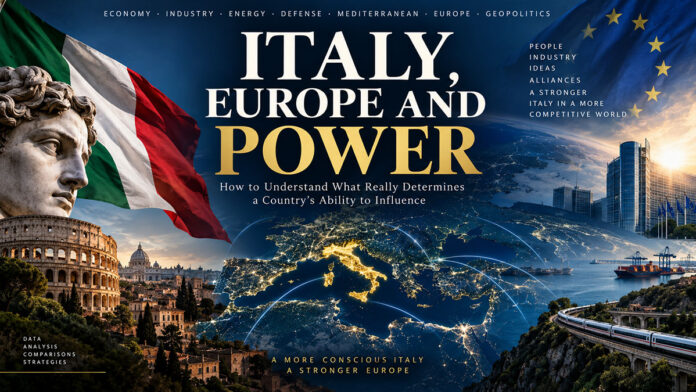

Understanding what really determines a country’s capacity
Introduction
What does it mean to be a European power today?
The question seems simple only until you try to answer it seriously, because in the 21st-century international system, a state’s power no longer coincides with a single variable; it cannot be reduced to the size of its gross domestic product, the number of soldiers, the amount of debt, exports, energy availability, or diplomatic strength. Rather, it arises from the ability to combine all these resources within a system sufficiently coherent to transform them into real decision-making capabilities.
It is precisely from this question that ITALY, EUROPE AND POWER was born , a book designed to analyze, without simplification, Italy’s position in the new economic, industrial, and geopolitical order emerging from the crises of the last fifteen years—from the sovereign debt crisis to the pandemic, from the war in Ukraine to the energy crisis, from the redefinition of NATO to the competition in technologies, from new European industrial policies to the transformation of the Mediterranean into a space in which energy, trade, security, migration, infrastructure, and data increasingly overlap.
The book does not start from the idea that Italy is inevitably in decline, but neither does it assume the opposite, equally superficial, image of a country that automatically possesses all the tools necessary to transform its resources into influence. The central thesis is more complex: Italy possesses a wealth of industrial, financial, energy, technological, military, and geographical capabilities far greater than some of the public narrative suggests, but its historical difficulty lies in coordinating these capabilities, developing them, and transforming them into lasting power within a system characterized by high debt, low productivity, administrative fragmentation, and a rapidly aging population .
The volume accompanying this article reconstructs this problem through data, institutional sources, economic series, public budgets, European documents, industrial programs, NATO data, trade statistics, and analyses of the main strategic infrastructures.
Anyone wishing to read the complete analysis can download the book attached to this article .
Abstract
ITALY, EUROPE AND POWER analyzes the transformation of Italy’s economic and strategic capacity from the euro crisis to the new geopolitical phase of the 1920s, examining the relationship between industry, the state, public finance, energy, technology, defense, demography, and its Mediterranean location.
The starting point is that contemporary sovereignty cannot be measured simply by the amount of powers formally possessed by a state, because a decision is truly sovereign only when sufficient resources, infrastructure, capital, technology, and alternatives exist to make it materially feasible. A country formally free to choose but dependent on a single energy supplier, a single trade route, non-substitutable foreign technology, or financial markets that deem its debt unsustainable has fewer real options than its legal powers suggest.
The book then reconstructs Italy’s response to the sovereign debt crisis, the transformation of the European Central Bank, the pandemic, the PNRR, the war in Ukraine, the progressive energy detachment from Russia, the growth of military spending, the return of industrial policy, and the growing centrality of the Mediterranean. It also compares Italy’s situation with that of Germany, France, and the United Kingdom.
The conclusion is not a ranking of states, but an interpretation of European power as a multidimensional capacity, in which industry, capital, energy, technology, security, demography and institutional capacity must be organised together .
THE ARTICLE
Italy’s economic history over the last fifteen years can be seen as a long search for decision-making space. In 2011, the country discovered how quickly a combination of high debt, insufficient growth, and a loss of confidence could restrict the time available for policymaking. In the years that followed, the euro’s architecture was progressively modified, the ECB developed tools that reduced the risk of monetary fragmentation, and the European Stability Mechanism, the Banking Union, and, during the pandemic, a common European borrowing capacity that would lead to NextGenerationEU and the NRRP were established.
The Italy of 2026 is therefore profoundly different from the Italy of November 2011, but this very transformation allows us to understand one of the fundamental theses of the book: European protection and the European bond have grown together .
The single currency is now more resilient to self-sustaining crises, the Italian banking system is much more solid, the country’s external financial position has improved dramatically, and the ECB has tools that simply didn’t exist in 2011. At the same time, however, fiscal policy operates within a more structured framework, spending trajectories are negotiated over multiple years, access to common instruments carries conditions, and public debt continues to concretely limit the number of policies that can be financed simultaneously.
This relationship between protection and constraint runs through the entire volume.
Debt is not just a figure: it is the power of the past over the present.
In 2025, Italy’s deficit fell to 3.1 percent of GDP, the primary balance returned to positive territory, and public investment reached exceptionally high levels, supported by the final phase of the PNRR. At the same time, the debt-to-GDP ratio rose to 137.1 percent, and real growth remained at just 0.5 percent.
These numbers, considered in isolation, can be used to support completely opposite narratives. The declining deficit can be presented as evidence of consolidation; the growing debt as a sign of fragility; the high investment as evidence of expansionary economic policy; the weak growth as evidence of Italy’s structural difficulties.
The problem is that all of these statements can be true at the same time.
This is precisely why the book continually insists on the need to distinguish stocks, flows, investments, capacities and outcomes .
Debt is a stock built up over decades.
The deficit measures a single year.
The PNRR represents an extraordinary flow of investments and reforms.
Productivity measures the ability to transform those resources into greater output over time.
The real Italian question is therefore not simply whether to spend less or more, but to understand what part of present spending can increase the future denominator enough to make the inherited stock sustainable .
Italian industry is much more sophisticated than the image the country offers of itself
Another central part of the volume concerns manufacturing, because one of the most persistent representations of Italy continues to associate it almost exclusively with fashion, food, design, and tourism—very important sectors but insufficient to describe the real production system.
True 21st-century Made in Italy also includes automatic machinery, pharmaceuticals, aerospace, radar, helicopters, shipbuilding, missile systems, packaging technologies, advanced components, submarine cables, energy systems, and thousands of specialized companies that often work within the production chains of other countries.
Italy remains one of Europe’s largest manufacturing economies and has a surprisingly large number of high-tech firms, but it also faces one of the system’s most significant problems: Italian firms are on average smaller, spending on research and development remains lower than that of its major partners, and venture capital is less deep.
The Italian problem is therefore not whether the country still produces.
It produces, and a lot.
The real question is how much of the strategic value of what it produces it directly controls , how much intellectual property it owns, how much software it develops, how many technology platforms it can build, and how quickly it can shift to the technologies where future value will be concentrated.
Germany, France, the United Kingdom and Italy do not represent four steps on the same ladder
To understand the Italian position, the book systematically compares the country with Germany, France and the United Kingdom.
The result shows how misleading it is to transform the comparison into a single ranking.
Germany continues to represent above all a power in terms of production scale , thanks to a manufacturing, technological and industrial base that remains exceptional even after the difficulties of recent years.
France best represents the power of the strategic state , capable of combining nuclear power, deterrence, diplomacy, large industrial groups, public research and national planning.
The UK retains extraordinary global networking power , built around the City, universities, intelligence, nuclear deterrence, its relationship with Washington, life sciences and diplomatic capacity.
Italy, on the other hand, has a more distributed configuration, based on industrial specialization and geography , with highly diversified manufacturing, significant niche expertise, strategic champions in energy, defense, and infrastructure, and a Mediterranean location that could become an extraordinary asset if properly organized.
These four configurations are not alternatives.
They are complementary.
And it is precisely from this complementarity that part of Europe’s overall power derives.
Energy has shown that economic dependence can become political dependence.
Russia’s invasion of Ukraine has transformed a commercial relationship into a national security issue, demonstrating how quickly a seemingly efficient energy structure can become vulnerable when the supplier becomes a geopolitical adversary.
Italy responded with extraordinarily rapid diversification through Algeria, Azerbaijan, LNG, new regasification terminals, and increased use of storage facilities, radically reducing the weight of Russian gas.
This transformation constitutes one of the most important cases of the entire book, because it shows that security does not coincide with autarky .
Italy has not become energy independent.
It has increased the number of its options.
This is a crucial distinction.
Contemporary energy sovereignty does not mean producing everything domestically, but preventing a single supplier from possessing power great enough to turn a commercial disruption into a political crisis.
Defense has also returned to industrial policy
The war in Ukraine also brought to an end a long phase in which European defence could be treated mainly as an item in the public budget and brought back to the forefront a concept that seemed to belong to twentieth-century history: military-industrial capacity as a component of national power .
This change is particularly important for Italy because the country already has a significant industrial base through Leonardo, Fincantieri, MBDA Italia, Avio, and a vast network of specialized suppliers.
The new growth in military spending can therefore produce not only operational capacity, but also research, production, intellectual property, employment and international presence.
But the book insists on another fundamental distinction: spending more does not automatically mean having more military capacity .
A purchased but poorly maintained platform produces less capacity than the inventory indicates.
A missile ordered is not a missile delivered.
A delivered system is not automatically operational.
A modern ship without sufficient maintenance or ammunition remains a partial capability.
For this reason, investment and exercise must grow together.
The Mediterranean has returned to the centre of Italian strategy
One of the most important parts of ITALY, EUROPE AND POWER concerns the transformation of the Mediterranean, because it is precisely in this space that Italy possesses a number of levers that are difficult for other large European countries to replicate.
Algeria, Tunisia, Libya, Egypt and Türkiye do not constitute a single “South”, but five completely different relationships.
The relationship with Algeria is mainly energy-related but increasingly industrial.
Trade, migration, energy and the future ELMED electricity interconnection overlap with Tunisia.
In Libya, energy and migration coexist with persistent institutional fragmentation.
The relationship with Egypt is inseparable from the Suez Canal, the Red Sea, Gaza, and the new gas geography of the Eastern Mediterranean.
With Turkey, Italy interacts with a true manufacturing, military, and technological power, capable of simultaneously competing and cooperating with the Italian industrial system.
This is where the concept of an enlarged Mediterranean takes on a concrete meaning.
It doesn’t just describe a geographical region.
It describes a space in which energy, industry, logistics, security and diplomacy become inseparable.
Suez has shown that Italy also depends on infrastructures that it does not control
The Red Sea crisis has exposed another form of dependence, different from energy.
Italy does not import Suez.
It does not sign a contract with the Canal to be able to trade with Asia.
Yet a significant portion of the logistical efficiency of its industry depends on Egypt’s infrastructure remaining open and secure.
When ships are diverted through the Cape of Good Hope, Cairo loses canal revenue while Rome loses logistical productivity.
It is an interdependence without a contract.
It is geography itself that produces it.
Modern economic security must therefore consider not only suppliers and raw materials, but also straits, cables, ports, routes and external infrastructure embedded in the internal workings of the economy .
Sicily is the place where all these transformations become physical
Sicily represents perhaps the most evident geographical manifestation of this new Mediterranean.
Sigonella is a NATO ISR node.
The TransMed system brings Algerian gas to Mazara del Vallo.
Greenstream connects Libya to Gela.
ELMED will directly connect the European and North African electricity grids.
The Tyrrhenian Link strengthens the connection with Sardinia and the mainland.
Palermo hosts international landing points and digital infrastructure.
Augusta remains one of the major energy and industrial hubs of the Mediterranean.
For decades, Sicily’s insularity was interpreted almost exclusively as a cost.
The new geography also allows us to read it as a possibility.
But possibility is not yet development.
If energy, data, and goods pass through the island without generating local activity, Sicily becomes a transit point for the power of others.
If data centers, industry, logistics, research, training, and advanced services are built around those infrastructures, geography itself can become capital.
Migration remains an essential issue, but it cannot define Mediterranean policy alone
In recent years, the Mediterranean has often been reduced, in Italian political debate, to the issue of landings.
The phenomenon is real and politically relevant.
But it’s not the Mediterranean.
Reducing regional policy to a demand for curbing departures would mean obscuring energy, trade, infrastructure, security, and industry precisely at a time when Italy is interested in building much deeper relations with North Africa.
The Mattei Plan was born precisely from this ambition: to connect development cooperation, investment, training, energy, and addressing the root causes of migration within a single strategy.
Here too the book applies a fundamental rule.
Announcing a project doesn’t mean it’s done.
Allocating money does not mean having produced capacity.
The Mattei Plan will be judged on the basis of completed infrastructure, mobilized capital, employment, training, and economic development in the countries involved.
The demographic problem runs through everything else
Energy, defense, industry and public finance ultimately lead to the same problem: population.
Italy is one of the oldest countries in Europe.
The reduction in the working-age population simultaneously affects pensions, tax revenue, and the availability of technicians, doctors, researchers, skilled workers, and military personnel.
An economy can offset some of this reduction through increased productivity, female participation, automation, and legal immigration.
But he can’t ignore it.
Demography is slow.
That’s exactly why it’s powerful.
An industrial decision can be changed in a few years.
The age structure of a population is the result of decades.
Contemporary sovereignty is not independence: it is the ability to choose.
At the end of the hundreds of pages of ITALY, EUROPE AND POWER , the central question therefore returns to the meaning of sovereignty.
Italy cannot control Suez.
It can contribute to the safety of the routes that lead to them.
It cannot produce internally all the energy it consumes.
It can build enough sources and interconnections to not be dependent on a single supplier.
It cannot finance Africa’s transformation alone.
It can combine the Mattei Plan, the Global Gateway, multilateral institutions, and private capital.
It cannot replicate the technological scale of the United States or China.
It can integrate its industrial specializations into a European strategy capable of reaching that scale.
Modern sovereignty is therefore not the absence of interdependence.
It is a government of interdependence .
It is the ability to prevent a single supplier, a single technology, a single route, or a single source of capital from paralyzing the system.
It’s the amount of alternatives available.
The real Italian question is coordination
Italy has more capacity than it often acknowledges.
He owns industry.
Technology.
Savings.
Ports.
Energy.
Global enterprises.
Defense.
University.
Geography.
But an uncoordinated resource produces less power than an organized resource.
This is perhaps the biggest difference with France and Germany.
France concentrates.
Germany organizes through industrial, federal and financial systems.
The UK coordinates across markets, universities, intelligence and global networks.
Italy tends to produce capacity in a more distributed manner, across territories, SMEs, administrations, and large groups that are not always integrated into a coherent strategy.
This structure produces flexibility.
But it makes large-scale coordinated transformation more difficult.
And this is where the future is decided
Italy must not become Germany, France, or the United Kingdom.
He must become more capable of using what he already has.
Manufacturing needs to incorporate more research.
The Mediterranean position must become logistical.
Energy infrastructure must become an industry.
Cables must become the digital economy.
Public investments must become productivity.
Military spending must become readiness and technology.
Diplomacy must become economic access.
Savings must become productive capital.
This is the transformation that separates a large economy from a true geoeconomic power.
Why download the book
This article can only anticipate some of the questions addressed in ITALY, EUROPE AND POWER .
The volume reconstructs in a much broader way the Italian and European evolution through the debt crisis, the ECB, Italian governments, the PNRR, industry, energy, the labor market, pensions, taxes, defense, Made in Italy, Africa, the Mediterranean, Algeria, Libya, Egypt, Turkey, Sicily and the systematic comparison with Germany, France and the United Kingdom.
The book uses data, institutional documents, statistics, economic and military sources to answer a question that runs through the entire analysis:
How much real room does Italy have today to choose its own future, and what must it do to increase it?
To read the complete analysis, comparative tables, data, and the entire historical and economic journey, download the book “ITALY, EUROPE AND POWER” attached to this article .
This is not a book designed to demonstrate whether Italy is strong or weak.
It is built to understand where power really lies, what capabilities Italy possesses, what dependencies limit it, and what decisions could transform its resources into greater strategic freedom .
Because in the new world order the decisive question is not whether a country is formally sovereign.
The question is how many real alternatives you have when it comes time to choose .
Copyright of debugliesintel.com
Even partial reproduction of the contents is not permitted without prior authorization – Reproduction reserved