
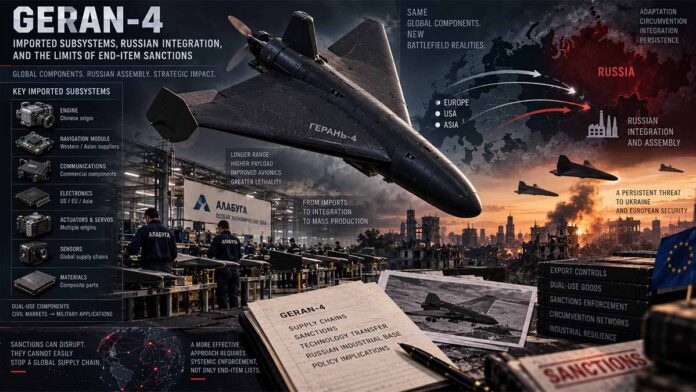

Scope: Russian Geran-4 one-way attack UAV development, recovered-system exploitation, component provenance, Alabuga production, sanctions exposure and defensive implications, with evidence reviewed through 28 September 2026.
1. Bottom Line Up Front
Ukraine has obtained a surviving Geran-4 sufficiently intact for detailed examination, although the reviewed primary record does not independently confirm that it was recovered specifically after an emergency landing. The exploitation indicates a purpose-designed Russian airframe and Russian final integration around predominantly foreign high-value subsystems: Chinese turbojet propulsion, Chinese electro-optics and mesh communications, civilian cellular connectivity, and multinational commercial semiconductors. Geran-4 UAV — War & Sanctions Schemes Geran-4 teardown — 19 September 2026
Reported performance remains configuration-dependent: official Ukrainian sources publish 350–500 km/h, 4–5 km ceilings and 450–770 km ranges, while the September teardown reports 450–500 km/h, up to 8 km, and more than 700 km. Confidence: Moderate. The policy implication is that end-item sanctions alone cannot reliably disrupt a production architecture built around globally traded dual-use technology; component traceability, intermediary enforcement and telecommunications pathways therefore form part of the same control problem.
Geran-4: The Sanctions Problem Is No Longer the Drone
Russia’s Geran-4 programme exposes a weakness in the way Western governments still conceptualise military-industrial sanctions: the target is treated as a weapon, while the production system increasingly behaves like a commercial integration network. Ukraine’s War & Sanctions database identifies Alabuga as the Geran-4 manufacturer, but the same record attributes critical propulsion, electro-optical, communications, navigation and semiconductor functions to foreign suppliers, with Chinese systems occupying several of the most consequential positions. The result is not Russian technological autarky, nor simply dependence on imports. It is a production model in which Russian airframe engineering, explosive payloads and serial integration convert globally traded dual-use technologies into a weapon whose reported speed can approach 500 km/h and whose reported range spans sharply conflicting estimates between 450 km and more than 700 km. The policy problem is therefore shifting from banning weapons to governing the commercial pathways from which weapons can be assembled.
Russia is adding integration capacity faster than it is replacing foreign technology
The Geran-4 is not a Geran-2 with a jet engine attached. Ukraine’s Defence Intelligence reported on 25 May 2026 that the aircraft had been structurally redesigned with reinforced construction and integrated wings after the Geran-3 approach proved inadequate for higher dynamic loads. That matters because it identifies the Russian contribution precisely: Alabuga and associated Russian suppliers are providing aerodynamic adaptation, structural engineering, warhead integration and production organisation, while imported systems supply much of the technological content that makes the new platform operationally different.
The propulsion chain illustrates the division. Ukraine’s War & Sanctions database identifies the Chinese Telefly LX-WP-160, while the 25 May 2026 Defence Intelligence release also associated the programme with the TF-TJ2000A; the surviving aircraft examined by Schemes on 19 September 2026 was described with a TJ-2000 designation. The names are not sufficiently consistent to justify presenting one engine as universal across the fleet, but the underlying industrial fact is clearer: the jet-propulsion function documented publicly remains Chinese rather than Russian.
The same pattern extends through the mission system. The Geran-4 database identifies the Chinese Honpho TS130C-01 electro-optical camera and Xingkay Tech mesh communications hardware, while the September examination reported day, night and infrared imaging with 10× optical and 32× digital zoom. HUR’s published component inventory also includes devices associated with Texas Instruments, Micron, Infineon, Analog Devices/Maxim, STMicroelectronics, Toshiba and Raspberry Pi. Manufacturer identity does not establish knowledge of Russian military use, but it does establish that the platform’s electronics remain embedded in international commercial supply chains.
The numbers show adaptation, but they do not yet describe one standard aircraft
The public performance record is internally contradictory, and that contradiction is itself important. HUR’s structured Geran-4 database gives 320 km/h cruise speed, 350 km/h maximum speed, 770 km range and a ceiling up to 4,000 metres. Its separate release of 25 May 2026 instead reported manoeuvring at approximately 300–400 km/h, maximum speed up to 500 km/h, range up to 450 km and altitude up to 5,000 metres. The Schemes examination published on 19 September 2026 reported specialist estimates of approximately 450–500 km/h, a ceiling up to 8,000 metres and range above 700 km.
Those figures should not be averaged into a single specification. They point instead to a programme that may already contain different engine, payload, fuel and communications configurations under the same Geran-4 designation. For air-defence planners, the exact upper ceiling remains unresolved, but even the conservative public record establishes a platform materially faster than the approximately 180–200 km/h piston-powered Geran-2 class described in the dossier. The resulting change is operational rather than cosmetic: reaction times fall, inexpensive interceptor UAVs lose part of their previous speed margin, and the defender is pushed toward a more capable engagement layer.
The production figures deserve the same discipline. Ukrainian Defence Intelligence reporting relayed in August 2026 estimated approximately 3,000 Geran-4 and Geran-5 aircraft per month at Alabuga and around 2,800 Geran-2 per month. Those figures have not been independently audited, and satellite-observed expansion does not convert buildings automatically into monthly aircraft output. But if the estimate is even directionally correct, the industrial significance lies in the coexistence of older piston platforms and faster jet variants rather than in a simple replacement cycle.
Civilian telecommunications have become part of the weapons architecture
The most consequential Geran-4 feature may be one of the least military-looking. The aircraft examined on 19 September 2026 carried two GSM modems with separate SIM cards, while the reporting cited cards associated with operators in Ukraine, Russia, Kazakhstan and several EU states. The mechanism turns ordinary commercial cellular coverage into a possible telemetry or command pathway once the aircraft enters an area served by compatible networks.
That changes the regulatory perimeter. A civilian mobile operator whose SIM or roaming service appears in a recovered weapon has not thereby been shown to have supported the weapon knowingly, yet the presence of ordinary telecommunications credentials means counter-UAV defence now intersects with SIM provisioning, roaming relationships, abnormal machine-to-machine traffic and legally authorised network intervention. The security problem therefore extends beyond export-control authorities and defence ministries into regulators, mobile operators and cross-border telecommunications governance.
The Chinese Xingkay Tech mesh modem adds a second layer. The September examination attributed a nominal range of roughly 300 km to the system, while the broader Geran architecture described in the dossier allows one aircraft to relay communications for another. Whether 300 km is brochure performance or combat-effective range remains unresolved, but the design principle is clear: multiple aircraft can create a decentralised airborne communications network that reduces dependence on a single line-of-sight link.
Western export bans are colliding with the economics of commercial electronics
The appearance of Texas Instruments-marked electronics in the September aircraft is not evidence that Texas Instruments knowingly supplied Russia. The company states that it stopped sales into Russia and Belarus in February 2022 and prohibits subsequent resale into Russia. The analytical problem begins precisely there: a component can remain commercially available, change hands through authorised or unauthorised intermediaries, pass through several jurisdictions and eventually reach a sanctioned military integrator without the original manufacturer controlling the final transaction.
The dossier therefore leaves several competing explanations open for Western components recovered in Geran systems: third-country diversion after lawful sale, reseller transshipment, pre-2022 stockpiles, recycled inventory, counterfeit devices or relabelled parts. None can be selected responsibly without lot dates, die authentication, distributor histories and customs records. The enforcement burden consequently moves downstream from the manufacturer toward the distributor, freight forwarder, bank, customs broker and intermediary jurisdiction where a legal commercial transaction may become diversion.
That is already reflected in formal policy architecture. The U.S. Bureau of Industry and Security’s Common High Priority List covers integrated circuits, communications equipment, navigation hardware, cameras, antennas and manufacturing equipment, while the United Kingdom’s corresponding priority framework addresses similar categories and third-country procurement risk. The European Commission’s dual-use guidance under Regulation (EU) No 833/2014, updated on 25 September 2026, likewise provides legal coverage for advanced technology restrictions. The gap exposed by Geran-4 is therefore not simply an absence of rules; it is the distance between regulatory prohibition and transaction-level interdiction.
China occupies a different position because it supplies whole subsystems
China’s role in the Geran-4 documented in the dossier is qualitatively different from the appearance of individual Western semiconductors. HUR identifies Chinese-origin turbojet propulsion, electro-optical equipment, mesh communications and navigation-related hardware, meaning Chinese industry appears in several subsystem categories that directly determine how the aircraft moves, sees and communicates.
China also operates formal export controls. The PRC Ministry of Commerce Announcement No. 31 of 2024, effective 1 September 2024, adjusted restrictions covering specified UAV engines, payloads and communications systems and prohibited exports where an exporter knows or should know an otherwise unlisted UAV-related item is intended for military use. A separate Ministry of Commerce response dated 3 July 2026 concerning small micro-turbojets indicated that classification may require technical assessment rather than exemption based solely on claimed civilian or model-aircraft use.
What the dossier does not contain is the transaction trail that matters most: [NOT IN DOSSIER] for the export licence, declared end user, customs declaration, distributor, payment chain or shipping route associated with the Telefly-class engines that reached Alabuga. Without those documents, the evidence supports Chinese manufacturer origin but not a conclusion about state authorisation, manufacturer knowledge or the point at which any legal export became military diversion.
Alabuga is valuable because it connects foreign technology to Russian scale
Alabuga’s significance is not that it manufactures every component domestically. Its importance is that it can turn imported subsystems into serial military output. Ukraine’s Defence Intelligence reported that preparations for Geran-4 mass production were completed by January 2026, while the September surviving-airframe examination described Chinese engine markings together with an Alabuga technician’s approval indicating that the engine was fit for use. If that documentation is authentic, the production logic resembles industrial incoming inspection: foreign propulsion arrives, is accepted locally and enters Russian integration.
The historical structure of the site reinforces that interpretation. Alabuga was established in 2006 as a special economic zone designed to attract international industrial investment and previously hosted foreign commercial activity. Its subsequent conversion into a UAV production node means Russia is not constructing its wartime manufacturing system from an isolated base; it is repurposing industrial infrastructure originally designed for integration into international manufacturing and logistics.
That distinction also explains why sanctioning Alabuga alone cannot sever every input. A production node can be listed, banks can be constrained and direct trade can be prohibited, yet hundreds of dual-use components can still originate in markets where their legitimate civilian demand vastly exceeds Russian military procurement. The narrower and more technically specific the component, however, the more valuable serial-number, distributor and shipment tracing becomes.
Over the next 12–24 months, the contest will shift from listings to traceability
The next 12–24 months will test whether Western sanctions systems can move from identifying prohibited destinations to reconstructing the commercial chain behind recovered hardware quickly enough to affect subsequent production. Engine serial numbers, semiconductor date codes, SIM IMSI/ICCID records, modem IMEI identifiers and Alabuga receipt data are more consequential for that task than another generic prohibition on Russian UAVs, because they can connect battlefield recovery to a specific distributor, transaction or logistics node.
Air defence will face the parallel bill. If the Geran-4 continues to operate in the 300–500 km/h class and at altitudes potentially extending from 4,000 to 8,000 metres, Ukraine and its partners will require an interception layer faster and higher-reaching than cheap FPV defenders but economically more sustainable than repeated use of high-value conventional surface-to-air missiles. Failure to close that gap transfers cost directly to air-defence inventories, infrastructure protection and the number of defended sites that can be covered simultaneously.
The industrial cost of inaction falls differently. If approximately 3,000 Geran-4/5 aircraft per month proves even broadly accurate, delayed transaction tracing gives Alabuga time to rotate suppliers, standardise alternative components and accumulate inventory before enforcement reaches the relevant intermediary. The diplomatic cost falls on governments that must ask China and other transit jurisdictions for transaction-level cooperation without overstating what recovered manufacturer markings prove. The Geran-4 therefore turns sanctions enforcement into a race between Russian integration speed and allied attribution speed; over the next 12–24 months, the side that shortens that cycle will determine whether foreign dual-use technology remains a vulnerability in Russia’s production system or simply one of its recurring inputs.
Pillar I — Platform, Exploitation and Foreign Technology Dependence: Sections 2–5 cover source reliability, combat role, technical exploitation and component provenance.
Pillar II — Industrial Scale, Operational Adaptation and Sanctions Exposure: Sections 6–9 examine Alabuga production, defensive consequences, supply-chain controls and the wider strategic model.
Pillar III — Falsification, Collection and Policy Response: Sections 10–13 test alternative explanations, define intelligence gaps, present non-ranked policy options and provide technical annexes.
Russian Integration, Imported Combat Value and the Dual-Use Supply Chain
The Geran-4 is best understood neither as a wholly Russian weapon nor as an imported Chinese platform, but as a Russian-designed and Alabuga-integrated strike architecture whose propulsion, sensing, communications, navigation and electronic functions remain materially dependent on globally traded technology.
Confidence is reduced by unresolved variation in engine designation, range, ceiling, communications configuration and reported monthly production.
Geran-4 value-chain architecture
The combat system emerges from Russian structural and weapons integration combined with imported subsystems whose original commercial markets are substantially larger than the military UAV market itself.
Airframe engineering, explosive payload, systems integration, production organization and tactical adaptation.
Propulsion, electro-optics, mesh networking, navigation electronics and a substantial share of onboard semiconductor functionality.
End-item sanctions alone do not address a weapons architecture assembled from commercially distributed dual-use technology.
Performance claims must remain separated
Ukrainian official reporting and the September surviving-airframe examination provide materially different figures, and the public evidence does not support collapsing them into a single nominal specification.
| Indicator | HUR structured database | HUR 25 May 2026 narrative | Schemes 19 Sep 2026 | Analytical treatment |
|---|---|---|---|---|
| Speed |
320 km/h cruise 350 km/h maximum MODERATE |
300–400 km/h manoeuvring up to 500 km/h maximum MODERATE |
approximately 450–500 km/h MODERATE |
Configuration, engine variant, fuel state and mission profile can plausibly explain part of the variance; no single figure should be treated as a fleet-wide certified maximum. |
| Ceiling |
up to 4,000 m MODERATE |
up to 5,000 m MODERATE |
up to 8,000 m LOW–MODERATE |
The 8 km figure is specialist reporting rather than publicly released instrumented telemetry and should remain a higher-end claim. |
| Range |
770 km MODERATE |
up to 450 km MODERATE |
more than 700 km MODERATE |
The most defensible public description is a configuration-dependent several-hundred-kilometre operating range rather than one exact value. |
| Engine designation | Telefly LX-WP-160 | LX-WP-160 and TF-TJ2000A associated with development | TJ-2000 rendering | Evidence is consistent with closely related Chinese micro-turbojet models or variants; a unique fleet-wide official designation is not publicly established. |
| Production | No independently audited monthly output | Serial-production transition described | Physical examination does not determine factory throughput | Ukrainian intelligence reporting of approximately 3,000 Geran-4/5 per month remains a single-source intelligence estimate. LOW–MODERATE |
The 4 km, 5 km and 8 km ceiling claims, together with the 450 km, 770 km and greater-than-700 km range reporting, should remain visible as separate observations until serial-specific engineering data identify the configuration associated with each figure.
Control points created by the supply architecture
The available evidence supports several policy instruments, but it does not establish a basis for ranking them without a specified governmental objective, legal authority and tolerance for commercial or diplomatic cost.
Export-control coverage
Distributor and logistics enforcement
Manufacturer-assisted traceability
Mobile-network countermeasures
Higher-speed C-UAS layer
China-specific transaction tracing
Core evidence and control references
- HUR War & Sanctions — Geran-4
- Defence Intelligence of Ukraine — 25 May 2026
- Schemes / Radio Svoboda — 19 Sep 2026
- CSIS — From Shahed to Geran — 4 Sep 2026
- Militarnyi — Geran-4/5 production estimate — 12 Aug 2026
- U.S. BIS — Common High Priority Items List
- European Commission — Dual-use export restrictions
- UK Government — Common High Priority Items List
- Texas Instruments — Statement on Russia
- PRC Ministry of Commerce — UAV export controls
2. Source note and confidence
This assessment distinguishes three evidentiary categories.
Fact denotes a documentary proposition established by the source itself, such as the existence of a component in Ukraine’s published Geran-4 component database, a formally enacted export-control measure, or a manufacturer’s documented compliance policy. It does not mean that every interpretation attached to that source has been independently verified.
Reporting denotes an attributed claim, including Ukrainian Defence Intelligence reporting, military-source statements to Militarnyi, and technical observations made by specialists participating in the September Schemes examination. Ukraine is a belligerent and therefore its intelligence publications are treated as interested first-party reporting rather than automatically independent verification.
Assessment denotes analytical judgment derived from the combined record.
The principal official technical source is Ukraine’s War & Sanctions database. Its current Geran-4 entry lists Alabuga as manufacturer, 55 identified component entries, an LX-WP-160 turbojet, Honpho TS130C-01 camera, Xingkay mesh modem and Western-origin semiconductors, while publishing a 320 km/h cruise speed, 350 km/h maximum speed, 770 km range and ceiling up to 4 km. Confidence in the fact that these figures are currently published by HUR: High; confidence that they describe every Geran-4 configuration: Moderate. War & Sanctions Geran-4 component record
HUR’s separate 25 May 2026 narrative release reported active manoeuvring at approximately 300–400 km/h, maximum speed up to 500 km/h, altitude up to 5,000 m, and range up to 450 km. It also reported two Chinese engine solutions associated with the programme, the Telefly LX-WP-160 and TF-TJ2000A. Confidence: Moderate, because this is official Ukrainian intelligence reporting but conflicts materially with HUR’s own structured database on range, altitude and maximum speed. War&Sanctions: DIU Reveals Structure of Russia’s New Jet-Powered Strike UAV — 25 May 2026
The strongest late-September source is the 19 September 2026 Schemes/Radio Svoboda examination, whose journalists and technical specialists physically examined a surviving Alabuga-assembled Geran-4. It reports a Chinese engine described as TJ-2000, a Chinese mesh modem, two GSM modems, a 16-channel protected antenna, EO/IR imaging and Texas Instruments-marked electronics. The article attributes 450–500 km/h, an 8 km ceiling and more than 700 km range to participating specialists rather than to instrumented test data. Confidence: Moderate for observed hardware; Low–Moderate for the upper performance limits.
The supplied baseline also records the rendering TG-2000 in some reporting. No reviewed manufacturer or primary teardown record establishes TG-2000 as the unique official engine designation. The defensible assessment is therefore that Geran-4 lots have used, tested or been associated with closely related Chinese Telefly micro-turbojet models or variants, rather than that one designation can be assigned to the entire fleet. Confidence: Moderate.
The broader evolution of communications, mesh networking, CRPA navigation and COTS integration is independently synthesized by the 4 September 2026 CSIS study by Kateryna Bondar and Nicole Errera. CSIS describes the transition from improvised cellular telemetry to two LTE modems, mesh networking and remotely correctable flight, but many underlying observations ultimately originate in Ukrainian recoveries and reporting. Confidence: Moderate–High on the developmental pattern, lower on individual undocumented configurations. CSIS — From Shahed to Geran, 4 September 2026
Confidence scale used in this assessment: High means multiple mutually reinforcing documentary or direct-examination sources with no material unresolved contradiction; Moderate means credible but incomplete, configuration-dependent or partly attributed evidence; Low means single-source, inferred, brochure-derived or otherwise insufficiently corroborated reporting.
What would materially change the source assessment: publication of an instrumented Ukrainian laboratory exploitation report; multiple serial-numbered Geran-4 teardown datasets; engine test results correlated to airframe configuration and payload; or Russian manufacturing documentation independently authenticating production specifications.
Visualisation judgment: No additional decision-useful graphical visualisation is supportable without converting conflicting configuration data into artificial precision. Comparative tables are therefore used instead.
3. System description and combat role
Assessment — Moderate–High confidence: Geran-4 represents a structural redesign of the Shahed/Geran concept rather than a simple propulsion substitution. The relevant adaptation path is Geran-2 → Geran-3 → Geran-4, with Geran-5 representing a related but aerodynamically different jet-powered branch.
Geran-2 remains the baseline mass one-way attack weapon: piston propulsion, propeller drive, comparatively low speed of approximately 180–200 km/h in Ukrainian and specialist reporting, long endurance and an operating model centred on scale and low relative cost. Confidence: Moderate. CSIS describes the subsequent Geran-3 as a jet-powered attempt using the earlier airframe, with the Chinese Telefly JT80, but reports that the inherited structure was inadequate for the higher G-load environment.
HUR’s May 2026 reporting describes Geran-4 as the answer to that limitation: a reinforced airframe with integrated wings and reduced access openings, explicitly designed for higher-speed manoeuvre rather than merely receiving a turbojet on the existing Geran-2 chassis. CSIS independently reproduces the same adaptation sequence and describes Geran-4 as a more aerodynamic, reinforced delta-wing derivative capable of substantially greater manoeuvring speeds. HUR Geran-4 structure release — 25 May 2026
The operational significance is not merely higher maximum velocity. Jet propulsion compresses defender reaction time, moves a greater portion of the flight envelope beyond that of some low-cost interceptor UAVs, enables higher-altitude routing, and makes visual or remotely corrected terminal employment more useful when communications survive. The trade is reduced propulsive efficiency and potentially lower range/endurance for a given fuel fraction relative to piston propulsion. Assessment confidence: High for the direction of the trade; Moderate for its exact magnitude in Geran-4.
The platform should consequently be understood as a higher-speed one-way attack and remotely correctable strike architecture, not as a conventional cruise missile and not simply as a faster Geran-2. The combination of EO sensing, cellular connectivity, mesh networking and anti-jam navigation gives at least some configurations an operator-assisted function that is qualitatively different from the original fire-and-forget Shahed model. Schemes reports that specialists considered operator correction feasible through the terminal phase when network connectivity was available; CSIS describes the broader Geran family as having progressed toward real-time remote control. Confidence: Moderate–High.
What would change the judgment: evidence that the camera, GSM or mesh equipment appears only on a limited seeker or experimental subset, rather than serial operational configurations, would narrow the assessment from “Geran-4 capability” to “specific Geran-4 variants.”
4. Technical exploitation findings
Propulsion
Reporting: HUR’s May release associates Geran-4 development with the Chinese Telefly LX-WP-160, rated in HUR reporting at approximately 160 kgf/1,600 N thrust, and TF-TJ2000A, approximately 200 kgf/1,960 N thrust. Its structured Geran-4 page specifically records the LX-WP-160 as Chinese and manufactured by Telefly. Confidence: High that Chinese Telefly propulsion is present in the programme; Moderate on engine-to-subvariant allocation.
The September Schemes examination calls the engine in the examined aircraft a Chinese TJ-2000, states that it remained serviceable, and reports a manufacturer’s service-life figure of approximately 30 hours. It also cites advertised Chinese pricing of approximately $20,000–25,000, compared with roughly $65,000 on Ukrainian listing sites. Those figures are commercial-market observations rather than documented procurement prices. Confidence: Moderate on Chinese origin; Low on service life and market price as indicators of actual Russian acquisition conditions.
Separate August Ukrainian intelligence reporting relayed by Militarnyi placed comparable engine cost around $35,000–40,000. The price variance is therefore too wide and too source-dependent to support a single acquisition-cost estimate. Militarnyi — Geran production and engine dependence, 15 August 2026
Assessment — Moderate confidence: engine nomenclature variation is more consistent with a family of closely related commercial micro-turbojets, changing lots, or informal reporting conventions than with evidence for one standardized designation across all serial Geran-4 production.
What would change the judgment: engine serial plates, manufacturer’s shipping documents, lot records or dimensional/metallurgical comparison across several recovered examples.
Airframe
War & Sanctions lists a Geran-4 length of 3.6 m, wingspan of 3.05 m, maximum take-off mass up to 450 kg, and a 50 kg standard warhead entry. Confidence: Moderate, because these are HUR-published specifications rather than independently instrumented measurements across the fleet.
HUR’s narrative reporting and CSIS both describe the Geran-4 as structurally reinforced relative to Geran-3, with the redesign intended to tolerate the dynamic and G-loading associated with jet-powered manoeuvre. This matters analytically because it indicates Russian value-add extends beyond final screwdriver assembly: aerodynamic redesign, structural engineering, production adaptation and subsystem integration are substantive domestic contributions even where critical electronics and propulsion are imported. Assessment confidence: High.
Electro-optics
War & Sanctions identifies a Honpho TS130C-01 camera of Chinese origin in its Geran-4 component inventory. Schemes reports that the examined camera arrangement provided day, night and infrared channels, with 10× optical zoom and 32× digital zoom. Confidence: High for the HUR-listed Chinese camera; Moderate for the precise zoom specification of the September examined configuration.
The military effect is not autonomous target recognition by default; rather, where communications remain available, the camera provides an observation channel enabling an operator to inspect the route or target area and potentially correct aimpoint or flight path. The distinction matters because public evidence establishes sensing and communications architecture more strongly than it establishes autonomous terminal guidance logic. Assessment confidence: Moderate–High.
C2 and communications
Schemes observed two GSM modems with different SIM cards in the examined aircraft and reports that specialists had recently encountered SIMs associated with operators in Ukraine, Russia, Kazakhstan and several EU states. Some secondary retellings also identify Belarusian cards, but the directly reviewed Schemes text does not itself list Belarus in that sentence. Confidence: High that multi-SIM cellular connectivity is used; Moderate on the full country distribution.
Earlier Geran evolution provides corroborating context. CSIS reports that standardized telemetry packages appearing from early 2025 incorporated a Raspberry Pi computer and two Chinese ZTE 3G/LTE modems, with both Russian and Ukrainian SIM cards. The important mechanism is therefore well established even where modem brands differ between batches: the weapon can exploit ordinary commercial cellular coverage for telemetry or control functions once inside a network’s service area.
The examined Geran-4 also carried a Chinese mesh modem. War & Sanctions identifies Xingkay Tech as the manufacturer of the Geran-4 mesh modem. Schemes reports a nominal link distance of approximately 300 km and describes relay operation between aircraft. Confidence: High for Chinese mesh hardware; Low–Moderate for 300 km as an operationally reliable combat range, because the publicly reported number is not supported by field RF measurements and mesh performance depends on geometry, antenna configuration, interference and network density.
CSIS describes the same evolutionary logic: individual Gerans equipped with mesh radios can function as nodes or repeaters, enabling data to reroute through neighbouring aircraft when sufficient network density exists. The architecture therefore reduces dependence on a single direct line-of-sight control channel. Assessment confidence: Moderate–High.
War & Sanctions also publishes a Geran-4 NASIR interference-protection system based on a 16-element Harxon-16 CRP antenna, together with Chinese Unicore GNSS components and other multinational electronics in associated boards. Confidence: High that HUR has documented the subsystem; Moderate on fleet-wide standardization.
Flight computer and semiconductors
The September Schemes examination reports Texas Instruments-marked devices on onboard computer boards. Separately, HUR’s Geran-4 database documents TI transceivers and processors together with Micron, Analog Devices/Maxim and a wider component population originating from the United States, China, Germany, Switzerland, Japan, Taiwan and the United Kingdom.
Later pages of the HUR dataset additionally identify, among other manufacturers, Infineon, STMicroelectronics, Toshiba, Nichicon, FTDI, Raspberry Pi, Unicore and multiple Chinese electronics suppliers. These database records establish manufacturer-of-record markings and HUR’s attributed origin identification; they do not establish the last lawful purchaser, contractual distributor, export route, or corporate knowledge of Russian military end use.
Assessment — High confidence: the Geran-4 electronics architecture remains substantially dependent on commercial international semiconductor and computing ecosystems. Low confidence attaches to any claim about the precise diversion route until distributor, invoice, customs and lot-trace records are obtained.
Warhead class
War & Sanctions currently lists a 50 kg Geran-4 warhead class and specifically publishes the Russian TBBCh-50M thermobaric warhead and an incendiary/fragmentation configuration. HUR’s May narrative additionally reported the OFZBCh-50, TBBCh-50M and a 90 kg TBBCh-90 option. Schemes likewise describes a warhead capacity “up to 90 kg.” Confidence: High for documented 50 kg configurations; Moderate for a 90 kg Geran-4 option.
The presence of Russian-origin warheads is important to the value-add assessment: the platform is not simply an imported Chinese drone. Russia supplies or integrates the destructive payload, airframe, production engineering and mission architecture around a foreign-intensive subsystem base.
5. Bill of materials and origin map
| Component class | Likely origin / manufacturer-of-record | Dual-use status | Sanctions relevance | Confidence |
|---|---|---|---|---|
| Reinforced composite airframe | Russia / Alabuga integration | Composite materials themselves can be dual-use; airframe is military end item | Production node, composite inputs, machine tools | High on Russian final integration |
| 50 kg warhead | Russia; HUR identifies Russian TBBCh-50M producer | Military-specific | Direct military-industrial control | High |
| Reported 90 kg warhead option | Russia | Military-specific | Direct military-industrial control | Moderate |
| Micro-turbojet | China; Telefly LX-WP-160 / related TJ2000-class family | Dual-use micro-turbine/UAV/model-aircraft technology | Critical propulsion chokepoint | High on Chinese origin; Moderate on exact variant |
| EO/IR camera | China; Honpho TS130C-01 in HUR database | Dual-use COTS optics | End-use screening, distributor traceability | High for listed component |
| Mesh modem | China; Xingkay Tech | Dual-use communications | High-value C2 subsystem | High |
| GSM/LTE modules | Commercial telecommunications hardware; Chinese hardware documented in broader Geran evolution | Civilian dual-use | Conventional defence-market screening alone is insufficient | Moderate for specific Geran-4 vendor |
| SIM connectivity | Multiple civilian operator jurisdictions | Civilian service | Provisioning, roaming, account-abuse and identity controls | High on multi-SIM use; Moderate on complete country set |
| GNSS/CRPA components | Chinese Unicore/Harxon elements with system-level integration | Dual-use navigation | Anti-jam navigation supply chain | High for HUR-listed components |
| Flight computer semiconductors | US, China and additional allied-country manufacturers | Dual-use COTS semiconductors | Core diversion/transshipment issue | High for HUR database; Moderate for every individual serial airframe |
| Industrial production equipment | Russian facility using domestic and historically foreign machine/automation technologies | Dual-use industrial equipment | Production capacity and maintenance dependence | Moderate |
The component matrix is supported most directly by the HUR Geran-4 database, which publicly enumerates Chinese propulsion, camera and mesh hardware together with Western and Asian semiconductor components.
Judgment — High confidence: Russia supplies substantial structural, explosive, systems-integration and manufacturing value, but a disproportionate share of the Geran-4’s propulsion, sensing, communications, navigation and electronic combat value is enabled by imported technology.
What would change the judgment: repeated serial teardowns showing Russian-manufactured substitutes for turbojet propulsion, EO systems, mesh radios, GNSS electronics and the majority of mission-critical semiconductors.
6. Production and logistics
Assessment — High confidence: Alabuga should be treated as an integrator and increasingly capable manufacturer, not an autarkic full-stack producer.
HUR reported in May that preparations for Geran-4 mass production had been completed by January 2026, followed by testing and operational employment. War & Sanctions lists JSC SEZ PPT Alabuga as the Geran-4 manufacturer. HUR Geran-4 release — 25 May 2026
This distinction matters. Alabuga appears capable of producing or integrating the airframe, installing Russian warheads, packaging avionics, conducting incoming inspection and adapting designs to combat feedback. It does not follow that Alabuga domestically manufactures the turbojet, camera, mesh radio, GNSS receiver or Western-origin semiconductor dies.
The September surviving-airframe examination provides unusually useful evidence for the logistics process. The specialist interviewed by Schemes reported finding Chinese engine markings together with an Alabuga paper bearing a local technician’s approval that the engine was “fit for use.” If accurately interpreted, this is consistent with incoming inspection and acceptance of an imported propulsion subsystem before integration, rather than domestic manufacture of that engine. Confidence: Moderate, because the document itself has not been independently published and authenticated.
Ukrainian Defence Intelligence told Militarnyi in August 2026 that Alabuga production had reached approximately 3,000 Geran-4 and Geran-5 aircraft per month, while Geran-2 production was reported around 2,800 per month. Those figures have been widely repeated but remain a single intelligence estimate rather than independently audited industrial output. Confidence: Low–Moderate. Militarnyi — Geran-4 and Geran-5 production estimate, 12 August 2026 Militarnyi — jet Geran production comparison, 15 August 2026
Satellite-observed construction at Alabuga reported during 2026 is consistent with capacity expansion but does not by itself identify the function, utilization rate or completed-aircraft throughput of individual buildings. It therefore supports industrial growth but cannot independently validate the 3,000-per-month figure. Confidence: Moderate on expansion; Low on deriving output from construction alone.
Alabuga’s earlier identity is also analytically relevant. The special economic zone was established in 2006 as an investment and industrial-development platform, and its own historical materials advertised international residents including companies such as Ford Sollers, 3M, Rockwool and Armstrong. Its later function as a UAV-production node therefore represents conversion of an industrial and investment ecosystem rather than the creation of an isolated wartime workshop.
The EU has subsequently listed Alabuga-linked entities in the Russia sanctions architecture and describes the zone as a significant UAV-production location.
What would change the production judgment: authenticated monthly production logs, serial-number distributions from recovered aircraft, engine import volumes, workforce and shift data, completed-aircraft storage imagery, and launch-volume analysis capable of distinguishing production from stock depletion.
7. Operational implications for the defender
Assessment — Moderate–High confidence: Geran-4 complicates the low-cost interception model because it combines greater speed and potential altitude with more resilient navigation and multiple communications pathways, but the public record does not establish that every launched Geran-4 simultaneously carries the full seeker, cellular and mesh suite.
Speed and altitude
A Geran-2 moving around 180–200 km/h offers a materially different interception geometry from a jet Geran operating in the 300–500 km/h band. The relevant effect is compressed engagement time and a reduced speed margin for inexpensive FPV-style interceptors. Confidence: Moderate.
The ceiling evidence is less settled. HUR’s current database says up to 4 km; its May narrative says up to 5 km; the September specialist claims up to 8 km. It would therefore be analytically incorrect to present 8 km as established fleet performance. For defence planning, the evidence supports a higher-altitude threat than earlier low-and-slow intercept models were optimized against, but exact ceiling remains unresolved.
Cellular piggybacking
The presence of civilian LTE/GSM modules and multiple SIMs means an attacking airframe can potentially exploit cellular infrastructure belonging to the territory it is traversing. This converts an ordinary civilian network into an involuntary communications opportunity without requiring the mobile operator to have any knowledge of military use.
The defensive problem is therefore not simply electronic warfare. It also becomes a telecommunications-security and lawful network-management issue involving SIM provisioning, abnormal roaming behaviour, machine-to-machine traffic patterns, rapid operator coordination and legally authorized intervention against confirmed hostile use.
Confidence: High on the architectural problem; Moderate on how consistently live C2 is achieved in combat.
Mesh relay and man-in-the-loop control
The Chinese mesh modem creates a second communications layer that does not depend on cellular coverage. Schemes reports a nominal 300 km link specification and relay functionality; CSIS describes a larger Geran mesh architecture in which aircraft can pass traffic between neighbouring nodes and reroute communications if one link fails.
The combination of mesh relay, cellular connectivity, EO sensing and CRPA-protected navigation means that defeating any single channel does not necessarily terminate the mission. Assessment confidence: Moderate–High.
The implication for EW is therefore architectural rather than frequency-specific: the defender benefits from detecting and disrupting multiple navigation and communications dependencies, while recognising that a disconnected aircraft can retain pre-programmed navigation or other autonomous mission functions.
High-altitude C-UAS
The Geran-4 evidence supports a requirement for a defensive layer between inexpensive low-altitude interceptor drones and high-cost traditional surface-to-air missiles. The desired attributes are greater interceptor speed, sufficient altitude performance, automated cueing, persistent sensing and a cost structure appropriate to mass raids. This is a capability requirement, not a claim that one specific interceptor architecture is preferable.
What would change the judgment: evidence that most Geran-4 missions remain at lower speed or altitude for fuel conservation, or that seeker/mesh-equipped aircraft represent only a small specialist subset, would reduce the magnitude of the defensive shift.
8. Sanctions and supply-chain implications
Central assessment — High confidence: the Geran-4 demonstrates that sanctions aimed primarily at complete military end items cannot, by themselves, prevent a state from assembling militarily effective systems from internationally traded dual-use components.
This is not evidence that sanctions have no effect. Controls can increase cost, delay procurement, reduce supplier choice and force substitution. The narrower conclusion is that effectiveness depends substantially on enforcement beyond the named weapon and prime integrator.
China as the critical propulsion and communications source
HUR’s public Geran-4 inventory identifies the turbojet and mesh modem as Chinese, while the EO camera and several navigation/electronic components are also Chinese. China’s role in the observed configuration is therefore qualitatively different from the presence of individual Western semiconductor chips: China supplies complete high-value subsystems capable of determining propulsion, sensing or connectivity.
This does not by itself establish Chinese state authorization, manufacturer knowledge of Russian military end use, or a direct manufacturer-to-Alabuga sale.
China also maintains formal UAV-related export-control rules. Its 2024 controls cover specified UAV engines, payloads and long-range communications equipment, and require export licensing when listed conditions are met; the rules additionally prohibit exports where an exporter knows or should know an otherwise unlisted UAV is intended for military use. PRC Ministry of Commerce UAV export-control announcement No. 31 of 2024
A July 2026 Chinese Ministry of Commerce response to a query specifically concerning small micro-turbojets declined to create a blanket exemption and instructed exporters to determine whether the product falls under the dual-use control list or seek a formal classification determination when uncertain. The public record reviewed here does not establish what licence, declaration or end-user documentation accompanied Telefly-class engines reaching Russia.
That documentation is therefore an intelligence gap, not evidence of either compliance or deliberate violation.
Western semiconductors after 2022
The continuing appearance of Texas Instruments and other Western-designed components does not establish manufacturer complicity. Texas Instruments states that it stopped selling into Russia and Belarus in February 2022, prohibits resale into Russia, and regards subsequent shipments into Russia as unauthorized diversion. Texas Instruments statement on Russia
Several competing explanations must therefore remain open:
| Hypothesis | Compatibility with current evidence | Principal limitation |
|---|---|---|
| Third-country diversion after lawful initial sale | High compatibility | Requires transaction-level tracing |
| Distributor or reseller transshipment | High compatibility | Responsible intermediary not established |
| Pre-2022 stockpiles | Possible for older components | Does not readily explain components carrying later date codes where those codes are authentic |
| Counterfeit or relabelled components | Possible | Requires destructive or manufacturer-assisted authentication |
| Recycled/recovered inventory | Possible for some parts | Scale not established |
| Direct knowing manufacturer supply | Not established | Current public evidence does not demonstrate it |
The U.S. BIS Common High Priority List explicitly includes integrated circuits, communications equipment, radio-navigation hardware, cameras, antennas, printed circuits and manufacturing equipment, and warns that Russia uses third-party intermediaries and transshipment points to obscure end users. U.S. Bureau of Industry and Security — Common High Priority Items List
The United Kingdom likewise identifies microelectronics, communications modules, cameras, antennas and related equipment as priority items and explicitly instructs businesses to account for procurement through non-sanctioning countries. UK Common High Priority Items List
The European Commission’s current guidance, updated 25 September 2026, covers export restrictions under Articles 2, 2a and 2b of Regulation (EU) No 833/2014 and its advanced-technology/dual-use architecture. European Commission — Export-related restrictions for dual-use goods and advanced technologies
Civilian communications outside the defence market
GSM/LTE modules and ordinary SIMs expose a different control problem. The relevant hardware and service accounts exist in civilian markets measured in enormous volumes. Traditional military end-use controls therefore have limited discriminating power at the point of manufacture.
A SIM from a Ukrainian, Russian, Kazakh, Belarusian or EU operator does not demonstrate that the operator knowingly supported a weapon. It establishes, at most, that a credential associated with that operator or roaming ecosystem was physically present or observed in a recovered system.
The evidentiary distinction between operator of record, account subscriber, SIM reseller, roaming partner, final military user and person who provisioned the card is essential.
Alabuga as an evasion-relevant industrial node
Alabuga is significant because it combines established industrial infrastructure, special-economic-zone logistics, labour and assembly capacity with a global component intake. Its history as an investment zone demonstrates that such production can exploit infrastructure originally optimized for international industrial integration.
The sanctions problem is consequently not a simple binary between “Russian” and “foreign” weapons. It is a network problem involving the integrator, component makers, distributors, logistics firms, freight forwarders, customs intermediaries, banks, telecom accounts and transshipment jurisdictions.
What would change the sanctions judgment: evidence of sustained domestic substitution across propulsion, optics, communications and semiconductor functions would reduce the leverage of component controls; conversely, customs and commercial data demonstrating concentrated recurring routes would increase the potential leverage of targeted enforcement.
9. Strategic assessment
Assessment — High confidence: the Geran-4 supports a broader proposition that a sanctioned industrial power does not require a fully indigenous technology stack to field an effective modern precision-attack architecture if it retains the capacity to integrate commercially available technologies, redesign structures, substitute suppliers and scale assembly.
The strategically relevant Russian capability is therefore not any single imported chip. It is the integration system: Alabuga and associated suppliers can combine a Russian airframe and warhead with Chinese propulsion and communications, multinational electronics, iterative battlefield feedback and serial production.
CSIS describes precisely this development model: experimentation on deployed systems, rapid incorporation of successful modifications, extensive use of COTS hardware and production changes occurring on timelines measured in weeks rather than conventional acquisition cycles.
Cost-exchange implications
Geran-4 probably costs more than the piston Geran-2 because the turbojet, EO payload and communications suite add substantial hardware value. The available open-source price evidence is too inconsistent to establish a reliable complete-aircraft unit cost.
Nevertheless, its design seeks to alter the defender’s cost exchange in another way: by forcing engagement from faster, higher-altitude or more sophisticated defensive systems than those adequate against slower piston aircraft. Assessment confidence: Moderate.
Whether Russia has actually achieved a favourable total cost exchange cannot be determined from airframe cost alone. It depends on launch success, defensive probability of kill, cost of interceptor inventory, infrastructure damage avoided, EW success and the opportunity cost of air-defence allocation.
“Sanctions as strategy”
The observed persistence of restricted foreign electronics several years after the 2022 controls indicates that legal prohibition and actual interdiction are separate variables. Assessment — High confidence.
Sanctions therefore function through several mechanisms—raising transaction cost, restricting direct access, increasing legal exposure, forcing substitution and exposing intermediaries—rather than guaranteeing physical exclusion of every controlled component.
The appearance of post-2022 production-date components, where markings are authentic, would be particularly important because it weakens the explanation that the entire foreign component base derives from pre-war inventory. It still does not identify the responsible diversion route.
Replicability beyond Ukraine
Assessment — Moderate confidence: the model is transferable because its core inputs—micro-turbines, navigation electronics, telecommunications hardware, EO sensors, composite manufacturing and commercial microelectronics—exist in global civilian markets.
Transferability does not mean equal effectiveness in every theatre. It depends on local communications coverage, target geography, air-defence architecture, industrial integration capability, access to explosives and the ability to source critical propulsion and navigation components.
What would change the strategic assessment: sustained evidence that export enforcement creates chronic engine shortages, forces inferior domestic substitutes, sharply lowers output, or makes networked seeker variants exceptional rather than standard would demonstrate greater supply-chain leverage than the current record suggests.
10. Alternative hypotheses and what would disprove the main line
| Alternative hypothesis | Evidence consistent with it | Evidence weighing against it | What would resolve it |
|---|---|---|---|
| The September aircraft is a prototype or specialist seeker variant, not representative of serial Geran-4 | Rich sensor/C2 configuration may indicate a specialized lot | HUR database independently lists camera, mesh and advanced navigation components; broader Geran evolution shows serial adoption of networking | Teardowns of multiple serial-numbered aircraft from separate raids |
| The 8 km ceiling is theoretical rather than routine operational performance | Figure comes from an interviewed specialist, not flight telemetry | Jet propulsion and redesigned airframe plausibly support higher operation than piston Gerans | Flight-recorder/telemetry data correlated with payload and fuel |
| The 300 km mesh figure is brochure performance | No public combat-range test accompanies the claim | Physical mesh modem presence and relay architecture are independently documented | Captured RF logs, waveform analysis and measured link-budget data |
| Texas Instruments markings represent counterfeit or relabelled devices | Counterfeit components circulate globally | HUR documents multiple TI-marked devices across boards and airframes | Manufacturer-assisted die authentication and lot tracing |
| Western components derive principally from old stock | Some inventory can remain in distribution for years | Later date codes reported on parts are difficult to reconcile with an exclusively pre-2022 stockpile if authentic | Authentication of date codes and distributor records |
| The 3,000 Geran-4/5 monthly figure is inflated | Figure originates with Ukrainian intelligence and is not audited | Alabuga expansion and high operational usage are directionally consistent with substantial output | Engine-import volumes, factory output records, serial-number capture and launch-tempo reconciliation |
| Different performance reports actually describe different Geran-4 subvariants | Engine variation and rapid configuration changes are documented | Sources frequently use “Geran-4” without subtype separation | Serial/configuration mapping across recovered aircraft |
| Russia is approaching propulsion independence | Russian industry has incentives to localize critical technology | Current public Geran-4 records still identify Chinese turbojets | Recovered serial engines showing Russian manufacture at meaningful scale |
Main-line assessment — Moderate–High confidence: the simplest explanation of the current evidence is a serially evolving family rather than one immutable Geran-4 specification. Engine, payload and communications configuration should therefore be treated as variables within a production architecture.
11. Intelligence gaps and collection priorities
| Missing information | Why it matters | Record required |
|---|---|---|
| Engine serial numbers, lot markings and manufacturing dates | Separates Telefly variants and establishes procurement cadence | Multiple recovered engine plates; manufacturer authentication |
| Export and licensing trail for Telefly-class micro-turbojets | Establishes lawful sale, declared end user and diversion point | PRC export licence, customs declaration, invoice, end-user certificate |
| SIM IMSI/ICCID and provisioning records | Identifies account ownership, reseller chain and roaming architecture | Operator records under applicable legal authority |
| GSM modem IMEI and hardware identifiers | Enables hardware/vendor and network-use correlation | Teardown photographs plus operator/network logs |
| Mesh modem waveform and combat-effective range | Tests the public 300 km claim and relay resilience | RF capture and controlled exploitation |
| CRPA/GNSS firmware and navigation logic | Determines actual anti-jam architecture | Laboratory exploitation of recovered modules |
| Date codes and die authentication for TI/Micron/Infineon devices | Tests stockpile, counterfeit and post-ban-diversion hypotheses | Manufacturer-assisted lot and die verification |
| Distributor and freight-forwarder records | Establishes the point at which legitimate trade becomes diversion | Commercial invoices, customs data and shipping manifests |
| Alabuga engine receipts versus completed-airframe output | Tests the ~3,000/month intelligence estimate | Import records, warehouse data, production logs and serial counts |
| Alabuga launch throughput versus accumulated stocks | Separates current production from inventory depletion | Launch records reconciled with recovery serials and imagery |
| Camera and seeker configuration by serial batch | Determines whether man-in-the-loop is standard or specialist | Multi-airframe teardown dataset |
| Russian domestic turbojet programme maturity | Measures future sanctions leverage | Recovered indigenous engines, procurement records and industrial imagery |
No single one of these gaps invalidates the present assessment. Several, however, would materially change judgments concerning industrial scale, sanctions leverage and the proportion of serial Geran-4 aircraft carrying advanced communications.
12. Policy options (not recommendations dressed as facts)
The following are non-ranked courses of action. Their inclusion does not imply endorsement.
| Policy group / option | Expected effect | Cost / burden | Principal risk | Time-to-impact | Coalition requirement |
|---|---|---|---|---|---|
| Export controls — update technical coverage of micro-turbojets, mesh radios, EO modules and associated UAV subsystems where existing thresholds leave ambiguity | Reduces regulatory gaps and improves customs screening | Regulatory review; technical classification capacity | Overbreadth can capture legitimate civilian trade; substitution to other products | Medium | Higher effectiveness with US/EU/UK/Japan and Chinese enforcement dialogue |
| Entity measures — designate intermediaries only where transaction evidence demonstrates material diversion support | Raises financial and legal cost for identified procurement nodes | Investigative and evidentiary burden | Premature designation can displace trade without exposing the next node | Short–Medium once evidence is established | Multilateral alignment increases effect |
| Financial/logistics — extend high-priority-item red flags to banks, freight forwarders and insurers handling high-risk combinations of UAV subsystems and transshipment routes | Increases detection before physical delivery | Compliance cost and false-positive management | Excessive de-risking of legitimate commerce | Medium | Strong benefit from financial-intelligence coordination |
| Customs — strengthen serial/lot-level tracing for micro-turbines and identified communications/navigation components | Converts generic commodity controls into traceable supply-chain evidence | Data architecture and customs training | Relabelling and HS-code manipulation remain possible | Medium | Producer-state and transit-state participation important |
| Industry due diligence — structured feedback of recovered component lot/date data to manufacturers and authorized distributors | Helps identify distributor leakage and anomalous ordering patterns | Manufacturer compliance resources | Attribution remains difficult where components change hands repeatedly | Short–Medium | Can begin nationally; greater value through allied data sharing |
| Telecommunications — joint Ukraine/operator programme for hostile SIM-abuse indicators, abnormal roaming and rapid legally authorized suspension of confirmed weapon-associated credentials | Reduces utility of civilian cellular networks for telemetry/C2 | Operator analytics and legal coordination | False positives, privacy concerns, adversary adaptation | Potentially Short | Ukraine, home-network operators and roaming partners |
| Telecommunications — cross-border sharing of confirmed IMSI/ICCID/IMEI indicators derived from recovered systems | Improves attribution and blocks reuse of known credentials/devices | Modest technical burden once legal basis exists | Indicators can become obsolete quickly | Short | Requires operator and regulator cooperation |
| C-UAS — increase investment in the speed/altitude layer between FPV interceptors and expensive traditional SAM engagement | Addresses compressed engagement window and higher operating altitude | Procurement, sensor integration, training | New interceptors may themselves create an unfavorable cost exchange | Medium–Long | National capability; interoperability useful |
| China policy — provide Chinese authorities with serial-specific evidence and request licensing/end-user records for recovered micro-turbojets and communications equipment | Tests whether products were licensed, misdeclared or diverted after export | Diplomatic and forensic effort | Limited cooperation or incomplete commercial records | Medium | Bilateral engagement; coordinated evidence strengthens request |
| China policy — distinguish manufacturer origin from demonstrated diversion culpability in enforcement packages | Improves evidentiary credibility and reduces unsupported corporate allegations | Requires transaction-level investigation | Slower than broad nationality-based restrictions | Medium | Useful across allied sanctions systems |
The policy landscape is already built around a substantial legal architecture. BIS warns that Russian procurement employs intermediaries and transshipment points; the UK Common High Priority framework makes comparable due-diligence demands; and the European Commission maintains current dual-use restrictions under Regulation 833/2014.
Assessment — High confidence: the principal implementation problem is no longer the absence of controls on many relevant categories. It is the ability to connect a component recovered from a weapon to its manufacturer, authorized distributor, last lawful transaction, intermediary, logistics route and final diversion event quickly enough for enforcement to disrupt the next shipment.
13. Annexes
Annex A — Performance comparison: Geran-2 versus Geran-4
| Attribute | Geran-2 | Geran-4 | Evidentiary note |
|---|---|---|---|
| Propulsion | Piston engine + propeller | Chinese-origin micro-turbojet | Geran-4 Chinese turbojet is strongly documented by HUR and Schemes |
| Typical/max speed | Approximately 180–200 km/h in specialist/Ukrainian reporting — Moderate confidence | HUR database: 320 km/h cruise / 350 km/h max; HUR May narrative: 300–400 manoeuvre / up to 500 max; Schemes: 450–500, possibly higher — Moderate confidence overall | Figures should not be collapsed into one nominal value |
| Ceiling | Source/configuration dependent; lower-speed piston operating model | 4 km HUR database; 5 km HUR May narrative; 8 km Schemes specialist claim — Moderate for 4–5 km; Low–Moderate for 8 km | Most material unresolved Geran-4 performance discrepancy |
| Range | Long-range one-way attack platform; exact comparable baseline varies by model/configuration | 450 km HUR May narrative; 770 km current HUR database; 600–850 km in August DIU-derived reporting; >700 km Schemes route-based estimate — Moderate for broad 600–800 km class, Low for exact value | Fuel, engine, payload and mission profile likely matter |
| Warhead | Multiple approximately 50 kg-class and later heavier Geran-family payloads | 50 kg documented; 90 kg option reported — High / Moderate confidence respectively | Configuration-dependent |
| Cellular C2 | Evolved from improvised to standardized LTE telemetry | Two GSM modems reported in examined Geran-4 | Evolution rather than clean platform break |
| Mesh networking | Introduced into later Geran architecture | Chinese mesh modem documented | Xingkay Tech listed by HUR |
| EO seeker | Cameras increasingly added to later Gerans | Integrated EO position; day/night/IR reported | Seeker-equipped configuration documented |
| Airframe | Original Shahed-derived delta architecture | Purpose-reinforced, more aerodynamic delta structure | Distinguishes Geran-4 from Geran-3 |
| Core combat logic | Cheap volume, endurance, saturation | Faster/higher attack, networked correction in equipped variants | Geran-4 complements rather than automatically replaces all Geran-2 functions |
Source note: current War & Sanctions data provide 350 km/h maximum, 320 km/h cruise, 770 km range and 4 km ceiling; Schemes reports 450–500 km/h, up to 8 km and >700 km from specialists examining a surviving airframe.
Annex B — Component origin matrix
| System | Published component/manufacturer | Manufacturer HQ/origin as identified in source | Tied directly to Geran-4 HUR dataset? | Evidentiary status |
|---|---|---|---|---|
| Turbojet | Telefly LX-WP-160 | China | Yes | High |
| Additional reported engine family | TF-TJ2000A / TJ-2000-class | China | Narrative/teardown reporting | Moderate |
| EO camera | Honpho TS130C-01 | China | Yes | High |
| Mesh modem | Xingkay Tech | China | Yes | High |
| Network switch | SCYTON Technology | China | Yes | High |
| GNSS receiver | Unicore UC9810 | China | Yes | High |
| CRPA-related system | NASIR / Harxon-16 architecture | Chinese component base with system integration | Yes | Moderate–High |
| Transceiver | Texas Instruments | United States | Yes | High as marking/origin attribution |
| Memory | Micron Technology | United States | Yes | High as marking/origin attribution |
| Interface electronics | Maxim Integrated / Analog Devices | United States | Yes | High |
| Power semiconductors | Infineon | Germany | HUR Geran-4 component inventory | High |
| Semiconductor devices | STMicroelectronics | Switzerland-linked manufacturer | HUR Geran-4 inventory | High |
| Electronic components | Toshiba / Nichicon | Japan | HUR Geran-4 inventory | High |
| Interface/controller devices | FTDI / Raspberry Pi | United Kingdom-based manufacturers | HUR Geran-4 inventory | High |
| Relay | FOTEK | Taiwan | Yes | High |
| Warhead | TBBCh-50M | Russia | Yes | High |
| Airframe/final integration | JSC SEZ PPT Alabuga | Russia | Yes | High |
Analytic caution: “manufacturer headquarters country” is not the same evidentiary category as manufacturing location for a particular semiconductor die, authorized distributor, last legal destination or diversion jurisdiction.
Annex C — Glossary
C2 — Command and Control: communications and decision architecture used to monitor, direct or modify a mission.
COTS — Commercial Off-The-Shelf: commercially available technology not designed exclusively for military use.
CRPA — Controlled Reception Pattern Antenna: multi-element antenna architecture designed to improve resistance to GNSS interference or jamming.
EO/IR — Electro-Optical / Infrared: imaging systems operating in visible and infrared bands.
FCU — Flight Control Unit: onboard electronics controlling aircraft attitude and flight behaviour.
GNSS — Global Navigation Satellite System: satellite-navigation systems and receivers.
GSM/LTE: civilian mobile-communications standards used for cellular connectivity.
ICCID — Integrated Circuit Card Identifier: identifier associated with a physical SIM card.
IMEI — International Mobile Equipment Identity: identifier associated with cellular equipment.
IMSI — International Mobile Subscriber Identity: subscriber identity stored in a SIM/eSIM environment.
Mesh network: communications topology in which multiple nodes can relay data between one another rather than relying on one direct link.
One-way attack UAV: unmanned aircraft intended to deliver its payload by striking the target rather than returning for reuse.
Transshipment: movement of goods through an intermediary jurisdiction or commercial node before their ultimate destination.
Annex D — Source register
Defence Intelligence of Ukraine / War & Sanctions — “Geran-4 UAV,” current database record, accessed 28 September 2026. Primary source for published Geran-4 characteristics, component inventory, Alabuga attribution, turbojet, camera, mesh modem, warheads and electronics.
Open War & Sanctions Geran-4 record
Defence Intelligence of Ukraine — “War&Sanctions: DIU Reveals Structure of Russia’s New Jet-Powered Strike UAV,” 25 May 2026. First-party Ukrainian intelligence reporting on Geran-4 airframe redesign, turbojet variants, speed, altitude, range and warheads.
Open HUR release
Schemes / Radio Svoboda — “Journalists dismantled a jet Geran: how Russia improves the drones it uses to attack Kyiv,” 19 September 2026. Direct examination of a surviving airframe with specialist commentary on engine, camera, GSM, mesh, SIMs, altitude, range and TI-marked components.
Open Schemes investigation
RFE/RL — Geran-4 examination coverage, 24 September 2026. English-language companion coverage of the surviving-airframe investigation.
Open RFE/RL Geran-4 coverage
Kateryna Bondar and Nicole Errera, CSIS — “From Shahed to Geran: How Russia Continues to Reinvent the One-Way Attack Drone,” 4 September 2026. Secondary analytic synthesis of the adaptation cycle, cellular telemetry, mesh networking, CRPA evolution and Geran-3/4 transition.
Open CSIS study
Militarnyi — Geran-4/Geran-5 production reporting based on Ukrainian Defence Intelligence, 12 August 2026. Source of the approximately 3,000-per-month Geran-4/5 intelligence estimate; treated as non-audited single-source intelligence reporting.
Open Militarnyi production report
Militarnyi — production comparison and Chinese engine dependence, 15 August 2026. Secondary publication of DIU statements concerning jet-Gerans, Geran-2 output and turbojet dependence.
Open Militarnyi follow-up
U.S. Department of Commerce, Bureau of Industry and Security — Common High Priority Items List. Official source for high-priority microelectronics, communications, navigation, optics and manufacturing goods and U.S. warnings regarding intermediary and transshipment procurement.
Open BIS Common High Priority Items List
European Commission — “Export-related restrictions for dual-use goods and advanced technologies,” updated 25 September 2026. Current EU guidance concerning Articles 2, 2a and 2b of Council Regulation (EU) No 833/2014.
Open European Commission guidance
UK Government — “Russia Sanctions – Common High Priority Items List.” Official UK source identifying microelectronics, communications, cameras, antennas and other priority items and due-diligence expectations concerning third-country procurement.
Open UK Common High Priority Items List
Texas Instruments — “TI issued the following statement on Russia.” First-party company statement that TI stopped direct sales into Russia and Belarus in February 2022 and prohibits subsequent resale into Russia; relevant to separating manufacturer identity from diversion pathway.
Open Texas Instruments statement
PRC Ministry of Commerce, General Administration of Customs and CMC Equipment Development Department — Announcement No. 31 of 2024 concerning adjustment of UAV export controls, effective 1 September 2024. Primary Chinese regulatory source covering specified UAV engines, payloads and communications equipment and military-end-use restrictions.
Open Chinese export-control announcement
PRC Ministry of Commerce — micro-turbojet dual-use licensing inquiry, response dated 3 July 2026. Primary evidence that micro-turbojet classification can require technical assessment rather than assumption based solely on declared model-aircraft use or thrust.
Open Ministry of Commerce licensing response
Council of the European Union / EUR-Lex — restrictive-measures material concerning Alabuga-linked production, April 2026. Official EU record relevant to the sanctioned industrial node and its role in Russian UAV production.
Net assessment — Moderate–High confidence: the Geran-4 is not evidence of Russian technological autarky. It is evidence of a more operationally consequential capability: the ability to combine Russian structural engineering, explosives, production organization and combat-driven adaptation with foreign commercial technology sufficiently quickly and at sufficient scale to generate a continuously changing weapon system. The principal uncertainties concern the exact performance envelope, serial prevalence of the full seeker/network package, monthly production output and the transaction routes through which foreign components reach Alabuga. None of those uncertainties presently overturns the central finding that the system’s highest-value propulsion, sensing, communications and semiconductor functions remain materially exposed to international supply chains.
Copyright of debugliesintel.com
Even partial reproduction of the contents is not permitted without prior authorization – Reproduction reserved