
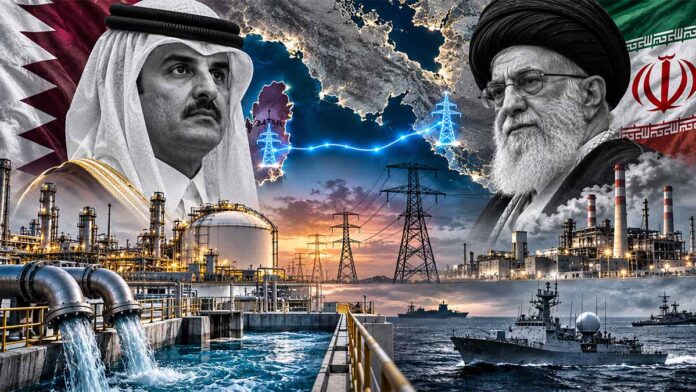

Strategic assessment of cross-border electricity integration, wartime infrastructure vulnerability, Iranian supply reliability, GCC network resilience, sanctions exposure and regional security implications, 2026–2031.
Scope: This assessment examines the proposed Qatar–Iran electricity interconnection in the context of the 2026 Gulf conflict, Qatar’s electricity–desalination infrastructure, existing GCC power integration and Iran’s generation constraints, with a five-year planning horizon through November 2031.
Executive Summary / Bottom Line Up Front
The proposed Qatar–Iran electricity interconnection presents a potential instrument of infrastructure diversification but not, on the evidence currently available, a dependable wartime emergency-power capability. Its strategic value depends on whether electricity remains physically deliverable, commercially transferable and politically accessible during the same crisis that threatens Qatar’s domestic infrastructure.
The decisive findings are:
1. The project has an identifiable procurement basis. Qatar’s official procurement listing records a feasibility consultancy awarded to Energoprojekt Entel for QAR 6,228,000 on 25 June 2025. This establishes a consultancy commitment, not construction authorisation or an operational transmission asset.
2. The threat to critical infrastructure is demonstrated rather than hypothetical. Qatar officially reported Iranian attacks on Ras Laffan in March 2026, including damage to energy facilities. Its communications to the United Nations also reported a drone attack against water tanks associated with Mesaieed Power Plant.
3. Electricity and drinking-water security are operationally connected. Qatar Power Company identifies its Ras Laffan integrated facility as having 1,025 MW of installed electricity capacity and 60 million imperial gallons per day of water capacity. A loss of electricity, desalination equipment or distribution infrastructure can create different but interacting service disruptions. Qatar Power Company+1
4. Qatar already possesses an established regional interconnection. The GCC Interconnection Authority operates a cross-border transmission system connecting the six GCC states, including a 400 kV connection to Qatar. The GCC Secretariat reported more than USD 952 million in network-related savings during 2025.
5. Iranian supply availability is the principal technical uncertainty. The US Energy Information Administration recorded a 12 GW gap between Iran’s summer peak electricity demand and available supply in 2023. In June 2026, Iran’s energy minister additionally reported that 4,700 MW of war-damaged generation capacity was not operating. These figures refer to different periods and cannot be treated as a common current capacity deficit.
6. Sanctions are a potential operational constraint, not merely a financing issue. Payments, counterparties, insurance, specialist maintenance, replacement components and emergency restoration require transaction-specific legal assessment under the applicable sanctions regime. Office of Foreign Assets Control
7. The central policy requirement is verified emergency deliverability. Qatar must establish whether an Iranian connection would provide additional usable electricity during simultaneous generation shortages, regional escalation, infrastructure damage or restrictions on cross-border transactions.
Principal judgment: The project’s security value cannot be established from nominal cable capacity or diplomatic commitments. It requires evidence of firm or otherwise reliable supply, protected domestic delivery paths, executable operating agreements and viable maintenance arrangements.
Qatar–Iran: The Power Cable That Could Turn Energy Security into Strategic Dependence
An electricity link across the Gulf promises additional supply, but the 2026 conflict has exposed a harder question: who controls the power that keeps a country’s essential infrastructure operating?
Qatar is considering an electricity interconnection with the same country whose military attacks damaged its energy infrastructure in March 2026. The contradiction reaches beyond diplomacy. Doha already possesses a functioning GCC electricity connection, substantial domestic generation and strategic water reserves, yet an additional supply route could become a new dependency precisely when electricity is most critical. A QAR 6.228 million feasibility consultancy has placed the proposed Iran–Qatar connection within a formal institutional process, without establishing its construction cost, operating capacity or emergency-delivery obligations. The decision now carries consequences for industrial resilience, infrastructure investment, sanctions compliance and Gulf security. A second international electricity connection strengthens national security only when its power remains available, deliverable and contractually accessible during the crisis it is supposed to withstand.
A feasibility contract is not an electricity guarantee
Qatar’s General Electricity & Water Corporation, Kahramaa, awarded Energoprojekt Entel a consultancy associated with the proposed connection. The official procurement database contains two relevant records: tender 2069/2022, published on 27 July 2022 and awarded on 25 June 2025, and tender 3559/2022, also identified as GTC-1080-2022, published on 3 November 2022 and awarded on 11 June 2025. Both identify the same contractor and QAR 6,228,000. Their administrative relationship remains unresolved, so the amount cannot legitimately be counted twice. More importantly, neither record establishes a construction authorisation, final investment decision, cable capacity or commissioning schedule. Qatar Ministry of Finance — Tender 2069/2022; Qatar Ministry of Finance — Tender 3559/2022.
On 16 June 2026, Iranian Energy Minister Abbas Aliabadi described the feasibility studies as approaching completion and the initiative as entering an early implementation phase. That statement established Tehran’s declared ambition, not independently verified construction progress. The distinction determines the project’s financial meaning: a consultancy can establish whether a transmission corridor is technically and commercially viable, but it does not secure generating capacity, identify the party assuming construction risk or oblige either utility to deliver electricity during war. The project originated before the 2026 conflict; the conflict has changed the security conditions against which its value must be assessed. Iranian Energy Minister’s Statement — 16 June 2026.
The numbers expose a problem of availability, not capacity
Iran’s electricity fleet appears substantial on paper. On 16 June 2026, Minister Aliabadi reported 100,315 MW of nominal installed capacity, alongside a government objective of reaching 130,000 MW. He also reported that 4,700 MW of war-damaged generation remained unavailable at that date. Those figures cannot be converted into an exportable surplus by simple subtraction. Installed power includes equipment subject to maintenance, fuel limitations, operating constraints and competing domestic demand. The 130,000 MW figure is a target, while the reported damage describes a particular moment rather than a verified November 2026 operating balance. Iranian Energy Minister’s Capacity Statement — June 2026.
The US Energy Information Administration recorded a 12 GW summer supply deficit in Iran in 2023, with available capacity below 78% of installed capacity. Its October 2024 assessment also identified 361 TWh of net generation in 2022, of which 93% came from fossil fuels, principally natural gas. Iran’s net electricity exports fell from nearly 7 TWh in 2020 to approximately 1 TWh in 2023. These are different reporting periods, not components of one current deficit. Together, however, they establish why Tehran’s historical ability to export electricity cannot be equated with the capacity to guarantee additional deliveries during extreme summer demand or military disruption. Country Analysis Brief: Iran — US Energy Information Administration, October 2024.
Qatar’s own figures reinforce the distinction. Kahramaa reported 10,573 MW of thermal generating capacity at the end of 2024 and a summer peak load of 10,220 MW, alongside 800 MWDC of solar capacity at Al Kharsaah. The reported thermal capacity and peak demand cannot, by themselves, establish dependable reserve availability, while photovoltaic direct-current ratings cannot be added unadjusted to dispatchable thermal output. For Doha, the relevant question is not how much electricity Iran has installed, but how many megawatts it could deliver through an intact connection after satisfying its own demand and operating requirements. Electricity Sector — Kahramaa.
The strategic exposure runs from generation to drinking water
The events of March 2026 demonstrated why electricity security in Qatar cannot be separated from water infrastructure. On 2 March, Qatar’s Ministry of Defense reported that two Iranian drones had targeted a water tank associated with Mesaieed Power Plant and an energy facility at Ras Laffan. On 18 March, the ministry reported five ballistic missiles launched against Qatar, four intercepted and one striking Ras Laffan Industrial City. QatarEnergy subsequently reported extensive industrial damage, while the Ministry of Interior confirmed that firefighters had contained two fires across three affected sites on 19 March. The official record establishes infrastructure targeting, damage and emergency response; it does not establish a nationwide collapse of electricity or drinking-water distribution. Ministry of Defense — 2 March 2026; QatarEnergy — 18 March 2026; Ministry of Interior — 19 March 2026.
The technical consequences are more complex than replacing lost megawatts. Qatar Power Company’s Ras Laffan installation combines 1,025 MW of electricity capacity with 60 million imperial gallons per day of desalination capacity. Its multi-stage flash desalination equipment depends on thermal processes integrated with power generation. Imported electricity may support surviving pumps, controls or distribution equipment, but it cannot automatically replace damaged turbines, steam circuits or desalination units. The relevant distinction is between losing electrical supply to functional equipment and losing the equipment itself. Only the former can potentially be remedied through an alternative electricity source alone. Qatar Power Company — Integrated Generation and Desalination Facility.
Qatar’s water reserves provide another layer of protection, but not unlimited autonomy. Kahramaa reports storage capacity of approximately 2,417 million imperial gallons and water demand of 420 million imperial gallons per day in 2024. Its strategic reservoir programme, commissioned in December 2018, added 1,500 million imperial gallons of capacity at five sites, supported by more than 650 km of associated pipelines, at a reported project cost of QAR 14.5 billion. Those capacities cannot be translated directly into guaranteed days of emergency supply: actual usable inventory, water demand, pumping electricity and hydraulic connectivity determine how much water reaches consumers. An Iranian interconnection would therefore contribute to drinking-water security only where imported power could sustain equipment and delivery routes that remain functional. Water Sector — Kahramaa; Strategic Water Reservoirs — Kahramaa, December 2018.
The GCC network changes the economics of a second connection
Qatar is not entering cross-border electricity cooperation for the first time. Its grid is already linked to the GCC Interconnection Authority through two 400 kV circuits at Logistic Zone Super. The wider GCC system operates a regional transmission architecture that supports scheduled electricity exchanges, installed-capacity resource sharing and operational reserves. The GCC Secretariat reported financial savings exceeding USD 952 million in 2025. That amount measures a reported regional economic benefit, not dependable emergency capacity available to Qatar. It nevertheless establishes an existing institutional and physical benchmark against which the Iranian connection must demonstrate additional value. GCC Interconnection Authority — Existing Network; GCC Electricity and Water Cooperation — GCC Secretariat, October 2026.
The investment comparison consequently becomes more demanding. A line from Iran might diversify Qatar’s external supply routes, but its value would depend on whether Iranian generation remained available when GCC assistance was insufficient, whether the new receiving interface avoided shared domestic vulnerabilities and whether the additional electricity could reach the loads requiring protection. If existing GCC reserves and domestic infrastructure could already cover the specified disruption, another connection might add commercial flexibility without producing a proportionate resilience benefit. Conversely, a verified gap in emergency supply could strengthen the case for additional imports. On 30 March 2026, Kahramaa announced Qatar’s chairmanship of the GCCIA board for the following three-year term, placing Doha within the governance structure of the regional network whose existing capabilities must be incorporated into the comparison. Kahramaa — Qatar’s GCCIA Chairmanship, 30 March 2026.
Qatar’s own technical rules make this distinction enforceable in engineering terms. Its Transmission Grid Code, issued on 29 September 2025, establishes N−1 planning criteria for specified lines and cables and N−2 treatment of 400 kV tower contingencies, alongside requirements addressing generation losses, protection coordination and system security. The code’s operational objective of returning the system to a normal state within thirty minutes following specified disturbances is not a guarantee that every damaged industrial or water facility can be restored within that period. An international connection must be evaluated against these established network criteria rather than treated as secure merely because it adds another transmission circuit. Qatar Transmission Grid Code ES-M4 — Kahramaa, September 2025.
Sanctions can disable an otherwise functioning cable
The project’s legal and financial exposure extends beyond construction. Electricity deliveries require payment settlement; transmission systems require inspection, specialist maintenance and replacement equipment; and major faults can require contractors whose services must remain commercially and legally accessible. On 10 September 2026, the US Treasury’s Office of Foreign Assets Control announced a restrictive Iran-related licensing policy, generally applying a presumption of denial to specific licence applications subject to stated exceptions. On 5 October 2026, OFAC separately warned foreign financial institutions about sanctions exposure arising from transactions involving Iran’s sanctioned financial sector. Neither action establishes that the Qatar–Iran electricity project is categorically prohibited, but both make the identity of counterparties, banking arrangements and lawful service provision material to its economic viability. OFAC — Iran-Related Licensing Policy, 10 September 2026; OFAC — Notice to Foreign Financial Institutions, 5 October 2026.
This produces a financial problem that conventional transmission-capacity calculations cannot resolve. An interconnection may remain electrically functional while payments cannot be executed or essential repair services become unavailable. A construction contract may allocate capital expenditure without establishing who bears wartime damage, prolonged interruption, equipment replacement or changes in sanctions law. A power purchase agreement may guarantee scheduled electricity under ordinary conditions while allowing curtailment during domestic shortages. For Doha, the distinction between a cable that can carry electricity and an obligation that can be performed under stress is therefore both technical and legal. The final investment cost, insurance provisions, financing structure and binding emergency-delivery conditions remain [NOT IN DOSSIER]. Without them, neither total lifecycle exposure nor the project’s security-adjusted economic return can be established.
Regional integration does not eliminate political control over supply
The political contradiction became explicit in March 2026. On 1 March, Qatar’s Ministry of Foreign Affairs summoned Iranian Ambassador Ali Salehabadi to protest attacks against Qatari territory. On 18 March, Doha declared Iranian military and security attachés and associated personnel personae non gratae. Between those decisions, the United Nations Security Council adopted Resolution 2817 (2026) on 11 March by 13 votes in favour and two abstentions, condemning Iranian attacks against several Gulf states and Jordan. These institutional actions establish that an electricity relationship with Iran would operate against a documented background of military confrontation and formal diplomatic restrictions. They do not establish that all bilateral technical cooperation has ceased. Qatar Ministry of Foreign Affairs — 1 March 2026; Qatar Diplomatic Measures — 18 March 2026; UN Security Council Resolution 2817 (2026).
A competing diplomatic approach emerged from Oman. On 26 October 2026, Foreign Minister Sayyid Badr Albusaidi advocated an inclusive Gulf security framework incorporating Iran and Iraq alongside the six GCC states. The proposal followed Oman–Iran consultations on maritime security in August and reflected a regional approach that treats institutional engagement as a possible mechanism for limiting confrontation. Yet an inclusive political framework would not itself guarantee electricity delivery. Transmission-system operators would still require defined obligations, emergency dispatch authority and rules governing interruption. Shared infrastructure can create mutual economic incentives, but it can also increase dependence on another government’s decisions over essential supplies. Oman’s Ministry of Foreign Affairs — Inclusive Gulf Security Framework, October 2026; Oman–Iran Ministerial Consultations — August 2026.
The next 24 months will determine who carries the risk
Between November 2026 and November 2028, the most consequential decisions concern the acceptance of the feasibility study, the definition of the project’s intended function, the demonstration of Iranian export availability and the establishment of legally executable commercial terms. A final investment decision without these elements would transfer unresolved risks into long-term infrastructure obligations. A commercially viable connection could still be justified as an electricity-trading asset, but it should not be counted as firm emergency support without verified generating resources, network deliverability and enforceable operating commitments. Qatar’s existing GCC arrangements and its national transmission code provide the immediate standards against which that claim can be tested. GCCIA — Electricity Exchange and Reserve Arrangements; Kahramaa — Transmission Grid Code.
The cost of inaction is therefore two-sided. Failing to investigate a demonstrable emergency-supply gap could leave Kahramaa and essential water-system operators exposed to avoidable service interruptions. Proceeding without proving the proposed connection’s incremental reliability could instead commit capital to infrastructure whose commercial obligations, foreign generation availability or restoration arrangements fail under the conditions used to justify the investment. In either case, the exposure ultimately reaches Qatar’s public infrastructure operators, the entities financing and maintaining the asset, industrial consumers dependent on continuity and households requiring electricity and drinking water. The governing decision is not whether Qatar should possess another cable across the Gulf, but whether the electricity it purchases would remain a usable national resource when the political and physical systems supporting it come under pressure.
PILLAR I — STRATEGIC BASELINE, INSTITUTIONAL ARCHITECTURE AND PHYSICAL INFRASTRUCTURE
Chapter 1 — The Qatar–Iran Electricity Corridor: Origins, Strategic Rationale and Project Maturity : Historical development of bilateral electricity discussions; procurement and feasibility arrangements; declared Iranian and Qatari positions; the distinction between a proposed interconnection and an authorised operational project; implications of shared energy geography.
Chapter 2 — Qatar’s Electricity–Water Infrastructure: Integrated Assets and Critical Dependencies : Generation and desalination architecture; Ras Laffan and Mesaieed; Kahramaa’s transmission and distribution responsibilities; water storage and pumping continuity; dependency pathways between electricity availability and potable-water delivery.
Chapter 3 — Existing GCC Interconnection and the Institutional Architecture of Cross-Border Power : GCCIA infrastructure and operating arrangements; electricity exchanges, reserve support and transmission access; the incremental function of an Iranian connection; operator competence, system control, fault isolation and third-country transit questions.
PILLAR II — WARTIME VULNERABILITY, SUPPLY CONSTRAINTS AND GEOPOLITICAL EXPOSURE
Chapter 4 — Iran’s Electricity System: Generation Availability, Peak Demand and Export Reliability : Installed versus available capacity; domestic summer demand; war-damaged generation; cross-border electricity commitments; the distinction between occasional exports and guaranteed emergency delivery.
Chapter 5 — Energy and Water Infrastructure Under Military Threat : Documented 2026 attacks; infrastructure concentration; operational consequences of electricity interruptions; desalination and reservoir dependencies; possible simultaneous disruption across generation, substations, transmission and water distribution.
Chapter 6 — Sanctions, Financing, Industrial Supply Chains and Operational Continuity : US sanctions exposure; financial settlement and counterparty compliance; procurement and contractor availability; cable inspection, repair and replacement; insurance, contractual force majeure and restoration responsibilities.
Chapter 7 — Regional Security Architecture and Strategic Dependence : Qatar–Iran political relations; GCC security coordination; wartime access to essential services; infrastructure interdependence as a possible stabilising mechanism or coercive vulnerability; institutional consequences for regional energy cooperation.
PILLAR III — RESILIENCE SCENARIOS, POLICY OPTIONS AND FIVE-YEAR STRATEGIC OUTLOOK
Chapter 8 — Competing Strategic Pathways and Crisis Scenarios, 2026–2031 : Commercial electricity exchange; limited emergency-support arrangements; integrated regional cooperation; disruption during wider conflict; differentiated effects of single-site failures, national grid emergencies and concurrent regional shortages.
Chapter 9 — Engineering, Governance and Investment Requirements for Dependable Emergency Supply : Import-delivery conditions; reserve obligations; operating protocols; priority-load continuity; security of transmission interfaces; investment responsibilities; comparison with domestic redundancy, GCC interconnection enhancement and water-system resilience.
Chapter 10 — Decision Framework, Early-Warning Indicators and Final Net Assessment : Feasibility thresholds; sequencing of bilateral commitments; technical and financial decision conditions; monitoring priorities; reversibility and downside exposure; five-year assessment of the interconnection’s contribution to Qatar’s critical-infrastructure security.
Master Abstract
An interconnection whose strategic purpose must survive a crisis
The Qatar–Iran electricity project emerges at the intersection of three developments: the physical vulnerability of Gulf energy infrastructure during interstate conflict, the operational dependence of drinking-water systems on reliable power, and the expansion of regional electricity interconnections as instruments of energy security.
The existing evidence establishes a fundamental distinction between network diversification and crisis resilience. An additional cross-border connection can increase available transmission routes, but it does not automatically create another dependable supply source. That requires the exporting system to possess surplus deliverable generation, the receiving system to retain functioning substations and distribution infrastructure, and both operators to maintain the contractual and technical ability to transfer electricity during emergencies.
Qatar’s strategic problem is particularly consequential because electricity supply supports not only commercial and industrial activity but also the production, storage, pumping and distribution of drinking water. A power-system disturbance can therefore transmit consequences into another essential sector. Nevertheless, the scale and duration of a water-service interruption depend on the type of infrastructure affected, the availability of alternative supply, the condition of pumping equipment and the amount of usable stored water. The existence of this interdependence does not establish that every electricity outage will produce a water emergency.
The conflict has changed the basis of risk assessment
The March 2026 attacks demonstrate that Gulf energy assets are exposed to direct military consequences. QatarEnergy confirmed substantial damage at Ras Laffan, while Qatar’s diplomatic reporting described attacks against both energy infrastructure and water-storage facilities. These events establish the relevance of considering electricity and water systems together in national resilience planning. They do not, however, establish that Qatar’s entire national electricity or potable-water system ceased functioning.
The proposed Iranian connection introduces a distinctive strategic dilemma. Iran is simultaneously a potential electricity partner, an electricity system with documented domestic supply constraints, and a state whose military actions Qatar formally condemned following attacks on its territory. Commercial cooperation and military confrontation are not logically incompatible, but the coexistence of both conditions makes the reliability of cross-border emergency support a political as well as an engineering issue.
The critical distinction concerns the timing of assistance. Electricity that can be supplied under ordinary market conditions may not be available when both countries experience extreme summer demand or when military escalation affects generation, transmission and access to repair services. The June 2026 disclosure by Iran’s energy minister concerning 4,700 MW of damaged, unavailable generation reinforces the importance of assessing operational capacity rather than announced or installed capacity alone.
Existing regional resilience changes the investment question
Qatar is not evaluating its first external electricity connection. It participates in an established GCC transmission system designed to support power exchanges between member networks. That existing infrastructure creates an essential counterfactual: the proposed bilateral link must be evaluated against the emergency assistance Qatar can already obtain, not against an artificial scenario of complete national isolation.
The GCC (Gulf Cooperation Council) system’s economic results demonstrate the relevance of regional cooperation, but reported financial savings are not themselves a measure of emergency electricity available to Qatar. Likewise, the capacity of a future Iranian cable would not determine how much power could be supplied at a specified hour, through a specific substation, for a specified duration.
A credible investment decision therefore requires separate assessments of additional electrical capacity, independent supply availability, route diversity, domestic distribution survivability and operational control. Each may contribute to resilience, but none can substitute automatically for the others.
Infrastructure interdependence can stabilise or expose
A functioning bilateral electricity system could create continuing technical cooperation between utilities in Doha and Tehran. Dispatch coordination, maintenance planning and shared operating rules would establish recurring institutional contact even during periods of political tension.
The opposite mechanism must also be considered. If an external supplier retains broad discretion to suspend deliveries when its domestic grid is stressed, a receiving state cannot confidently count those imports as emergency support. If the supplier is involved in the conflict generating the emergency, reliability depends additionally on political decisions that cannot be controlled through technical specifications alone.
Existing US sanctions arrangements create a further distinction between commercial feasibility and operational sustainability. A project may be technically achievable yet encounter constraints affecting payments, procurement or repairs. The relevant question is not whether all electricity cooperation with Iran is inherently prohibited, but whether the particular parties, contractual structure, transactions and services are permitted under the sanctions applicable at the time. Office of Foreign Assets Control
The five-year strategic assessment
The proposed connection should be assessed as a contingent addition to Qatar’s resilience architecture, rather than as an established substitute for domestic redundancy or GCC (Gulf Cooperation Council) emergency support.
Its potential contribution depends on four linked conditions: credible surplus supply during emergencies; survivable delivery through Qatar’s electricity network; legally executable operating and maintenance arrangements; and institutional commitments sufficiently reliable to remain useful during regional crises.
Absent evidence satisfying those conditions, the public record supports the existence of a project under consideration, but not the conclusion that it would materially reduce Qatar’s wartime electricity or drinking-water vulnerability.
The decisive evidence would be an approved feasibility assessment, a disclosed technical configuration, independently assessable supply obligations, binding operating arrangements and credible emergency-restoration provisions.
Key Evidence Table
| Indicator | Value / Status | Reference date | Definition / Scope | Issuer | Exact source |
|---|---|---|---|---|---|
| Qatar–Iran feasibility consultancy | QAR 6,228,000; Energoprojekt Entel | 25 June 2025 | Awarded consultancy; not construction cost | Qatar Ministry of Finance / Kahramaa | Tender & Its Companies’ Details — Qatar Ministry of Finance |
| Iranian project statement | Studies described as in final stages; early implementation claimed | 16 June 2026 | Attributed ministerial statement; no independently established construction completion | Iranian Ministry of Energy | Statement of Energy Minister Abbas Aliabadi — Tasnim, Jun 2026 |
| Ras Laffan attacks | Missile attack and extensive damage reported | 18–19 March 2026 | QatarEnergy operational facilities | QatarEnergy / Qatar News Agency | QatarEnergy Reports Missile Strikes — QNA, Mar 2026 |
| Mesaieed water infrastructure | Attack on water tanks officially reported | 3 March 2026 | Reported targeting; not quantified national water loss | State of Qatar | Qatar’s Communication to the United Nations — QNA, Mar 2026 |
| Ras Laffan integrated plant | 1,025 MW electricity; 60 MIGD water | Company facility specifications | Installed power and water capacity; not wartime availability | Qatar Power Company | About QPOWER — Qatar Power Company, undated |
| Qatar desalinated-water production | 538 million imperial gallons per day | 2024 | Reported national production measure, not an emergency reserve quantity | Kahramaa | Water Sector — Kahramaa, undated |
| GCC grid architecture | 400 kV / 50 Hz system, with frequency conversion for Saudi Arabia | Current network description | Existing regional interconnection | GCCIA | Our Network — GCCIA, undated |
| GCC interconnection savings | More than USD 952 million | 2025 | GCC-wide reported financial savings; not firm emergency capacity | GCC General Secretariat | Electricity and Water Systems — GCC Secretariat, Oct 2026 |
| Iranian electricity deficit | 12 GW | Summer 2023 | Peak demand above available supply | US EIA | Country Analysis Brief: Iran, p. 11 — EIA, Oct 2024 |
| Iran’s damaged generation | 4,700 MW reportedly unavailable | June 2026 | Ministerial statement on war-damaged capacity, not a verified current deficit | Iranian Energy Minister | Ministerial Statement — Tasnim, Jun 2026 |
| Iran–Türkiye grid operation | 400 kV Van–Khoy operating agreement signed | 24 January 2024 | Cross-border operating framework; not evidence of Qatar supply capacity | TEİAŞ | Van–Khoy Interconnection Operating Agreement — TEİAŞ, Jan 2024 |
| Iran sanctions framework | Active sanctions and licensing requirements | 10 November 2026 | Applicable US sanctions; transaction-specific assessment required | US Treasury / OFAC | Iran Sanctions — OFAC, current programme |
Evidence qualification: The procurement record was identifiable in the official indexed listing, but its live page could not be reopened for full direct inspection during this assessment. The publicly accessible documents reviewed do not independently establish the completed interconnection design, installed transfer capacity, final investment decision, financing structure or enforceable emergency-supply obligation.
Competing Strategic Explanations and Pathways
The available evidence supports four distinct but potentially overlapping explanations for the project. These are not mutually exclusive; Qatar and Iran could pursue commercial trade, technical integration and strategic cooperation simultaneously.
| Hypothesis | Diagnostic support | Disconfirming evidence / limitations | Observable indicators | Current standing |
|---|---|---|---|---|
| H1 — Commercial electricity integration | Feasibility procurement and established Iranian cross-border electricity experience | No verified bilateral electricity purchase agreement, volumes or tariff schedule | Published trading terms, delivery volumes, tariff structure | Plausible; commercial model not established |
| H2 — Emergency infrastructure diversification | Existing electricity–water dependence and documented attacks on critical infrastructure | No verified firm Iranian supply obligation; documented Iranian domestic shortages | Emergency-delivery obligations, critical-load studies, response-time requirements | Strategically relevant; capability unproven |
| H3 — Wider regional integration | Existing GCC grid and bilateral interconnection discussions | No verified agreement integrating the Iranian project with GCCIA operating arrangements | GCCIA interface studies, transmission-access agreements, multilateral protocols | Possible future pathway; institutional integration unestablished |
| H4 — Strategic interdependence with security exposure | Bilateral electricity cooperation alongside documented interstate military confrontation | No verified evidence that the proposed line has been used as coercive leverage | Supply restrictions during crises, emergency exemptions, political conditions attached to deliveries | Material risk mechanism; coercive intent not established |
Assessment of the competing pathways
The commercial explanation has a direct documentary basis in the feasibility procurement, but the absence of verified terms prevents a conclusion about the project’s eventual commercial purpose. The emergency-resilience explanation is consistent with Qatar’s infrastructure exposure, yet it requires stronger operational evidence than the public record currently provides.
Regional integration is institutionally conceivable because cross-border electricity networks already operate in the Gulf. However, an Iran–Qatar bilateral connection and an electricity transfer through the GCC system would involve different operating relationships and potentially different access rights.
The strategic-dependence explanation is analytically significant because military confrontation can alter the willingness or ability of parties to maintain energy exchanges. That mechanism does not establish that either government intends to use electricity supplies for political coercion.
The available evidence therefore supports multiple potential objectives without identifying a single definitive project purpose.
Principal Gaps and Watch Indicators
| Priority | Consequential evidence gap | Required record or observation | Decision consequence |
|---|---|---|---|
| Critical | Transfer capacity, connection points, cable technology and construction route | Approved engineering feasibility study and technical design | Determines potential deliverability and exposure to single points of failure |
| Critical | Firm Iranian export availability during Qatar’s peak-demand periods | Hourly generation, reserve-margin and cross-border dispatch assessments | Determines whether the connection can support a defined emergency load |
| Critical | Protection of priority electricity and water loads | Kahramaa contingency study linking electrical substations to water pumping requirements | Determines whether imports would actually preserve essential water services |
| High | Status of final investment and construction authorisation | Formal project approval, procurement packages, financing commitments | Distinguishes proposal from funded development |
| High | Emergency operating authority | Bilateral operating agreement and dispatch procedures | Establishes who may request, authorise, reduce or restore transfers |
| High | US sanctions and financial executability | Transaction-specific legal, banking and counterparty assessments | Determines whether construction, maintenance and emergency repairs can proceed |
| High | Interaction with GCC emergency capacity | GCCIA–Kahramaa technical assessment | Establishes incremental value beyond existing external supply arrangements |
| High | Political reliability during renewed regional conflict | Binding provisions on suspension, interruption, restoration and dispute resolution | Determines whether the arrangement can provide dependable crisis support |
| Medium | Actual resilience of domestic water reserves | Water inventory, pumping continuity and duration-of-supply assessments | Establishes the size and timing of any electricity-support requirement |
These gaps form a hierarchy. Supply availability and domestic delivery-path survivability are immediate prerequisites for emergency usefulness. Financing, sanctions and institutional arrangements determine whether that technical potential can be translated into a functioning and maintainable service.
Critical-Infrastructure Dependency Analysis
The following schematic distinguishes external electricity availability from the downstream conditions required to maintain drinking-water distribution. It represents established functional relationships, not a verified design of the proposed Qatar–Iran connection.
Electricity–Water Resilience: Conditional Dependency Model
Illustrative operating relationships based on documented infrastructure and interconnection arrangements. Proposed imports are not treated as an existing capability.
Qatari generation
Established electricity production supports the national grid and electricity-dependent water operations.
GCC interconnection
Operational cross-border connection providing a mechanism for electricity exchanges and system support.
Iran–Qatar interconnection
Potential additional import route. Actual emergency capacity, deliverability and operating conditions remain unestablished.
Additional imported electricity cannot by itself restore physically damaged desalination equipment, substations, transmission routes or pumping systems. Stored water may sustain service temporarily, subject to usable inventory and distribution-system availability.
Decision test: An external interconnection contributes to water security only when electricity is available at the required time and can reach operational water-system loads through functioning infrastructure.
GCC Interconnection Authority — Our Network
Kahramaa — Water Sector
Qatar Power Company — Integrated Water and Power Facility
Kahramaa — Strategic Water Reservoirs, December 2018
Qualitative dependency scheme. No unverified capacity estimates, emergency response times or reliability probabilities are assigned.
Principal Strategic Assessment
Three distinctions govern the final interpretation of the project at this stage.
First, additional interconnection does not automatically provide independent supply security. The degree of supply independence depends on generation availability, the correlation of peak demand and emergency conditions, and the physical separation of possible failure pathways. Two cross-border electricity sources can provide useful diversification without necessarily remaining available simultaneously.
Second, the ability to import electricity must not be confused with the ability to maintain water production or distribution. Operational desalination equipment, usable reservoirs, functioning pumps and surviving transmission infrastructure are separate requirements. An emergency-power investment must therefore be evaluated against specific protected services and failure conditions rather than aggregate national electricity consumption.
Third, infrastructure cooperation does not remove strategic dependence. A bilateral electricity relationship can create reciprocal economic incentives and operating contact, while simultaneously exposing essential services to counterparty shortages, regulatory restrictions and conflict-related decisions. The net consequence depends on enforceable terms and tested availability, not on an assumed stabilising effect of interdependence.
Qatar’s existing GCC (Gulf Cooperation Council) electricity connection and strategic water-reservoir system provide important resilience mechanisms. The publicly documented attack record and Iran’s own electricity constraints justify examining additional measures, but they do not independently demonstrate that an Iranian interconnection would produce a measurable improvement in wartime continuity.
For a decision-making authority, the decisive question is therefore whether the proposed link would deliver incremental, dependable electricity to identifiable critical loads under credible emergency conditions, after taking account of existing GCC support, domestic system redundancy, sanctions exposure and restoration requirements.
Until those conditions can be documented, its commercial and diplomatic potential should remain analytically separate from claims of assured national-security capability.
QATAR–IRAN POWER CORRIDOR
An interactive critical-infrastructure intelligence model: electricity integration, desalination dependency, wartime exposure and the difference between available transmission and dependable emergency supply.
Documented Strategic Reference Points
Installed electricity capacity reported by Qatar Power Company. This is not a measure of national emergency supply.
Generation reported unavailable following wartime damage in June 2026; not a verified November 2026 deficit.
Summer peak-demand shortfall reported for 2023 by the US EIA. A separate historical measure, not directly comparable with the other cards.
Interactive 3D-Style Infrastructure Dependency Graph
Select a scenario and then a network element. The model highlights qualitative dependencies and potential failure pathways; it does not calculate outage probabilities or predict grid performance.
Conceptual dependency network. Spatial positioning and arrows are explanatory, not a geographic cable route or engineering single-line diagram.
Four Conditions for Emergency Deliverability
The exporter must have usable power at the moment assistance is required.
Cables, grid interfaces, substations and downstream routes must remain operable.
Dispatch authority, interruptions and restoration responsibilities must be agreed.
Payments, insurance, contractors and replacement equipment must remain accessible.
Public-Record Decision Matrix
Documentary status, not a calculated score or current equipment-health monitor.
An unestablished public-record status does not prove that the underlying capability or agreement does not exist.
Auditable Evidence Table
Figures retain their original dates, units and definitions. They must not be combined into a single capacity total.
| Indicator | Value / status | Reference | Interpretation | Official source |
|---|---|---|---|---|
| Qatar–Iran feasibility consultancy | QAR 6,228,000 | 25 Jun 2025 | Consultancy award, not construction expenditure | Qatar MoF |
| Ras Laffan integrated power plant | 1,025 MW | Facility specification | Installed electricity capacity | QPOWER |
| Ras Laffan water capacity | 60 MIGD | Facility specification | Water production capacity, million imperial gallons/day | QPOWER |
| Iran summer supply deficit | 12 GW | 2023 | Historical peak-demand gap versus available supply | US EIA |
| Iran war-damaged generation | 4,700 MW | Jun 2026 | Unavailable generation as reported by Iran’s energy minister | Ministerial statement |
| GCC grid economic savings | > USD 952m | 2025 | Reported GCC-wide savings, not import capacity | GCC Secretariat |
| Ras Laffan attacks | Reported | Mar 2026 | Damage reported by QatarEnergy; not a quantified national grid outage | QNA |
Strategic Net Assessment
A second electricity interconnection may diversify Qatar’s power-import options. It cannot be counted as dependable wartime support until usable generation, domestic delivery paths, enforceable operating arrangements and legally executable maintenance have been demonstrated. The existing GCC connection and domestic water reserves remain essential reference points for any incremental-resilience assessment.
PILLAR I — STRATEGIC BASELINE, INSTITUTIONAL ARCHITECTURE AND PHYSICAL INFRASTRUCTURE
OPEN-SOURCE ANALYTICAL ASSESSMENT
Assessment date: 10 November 2026
Geographic scope: Qatar, Iran, the Persian Gulf and the Gulf Cooperation Council electricity system
Strategic horizon: 2026–2031
Chapter 1 — The Qatar–Iran Electricity Corridor: Origins, Strategic Rationale and Project Maturity
Principal Judgment: The Project Has Entered a Formal Institutional Process, but Its Operational and Investment Maturity Remains Unestablished
The proposed electricity interconnection between Qatar and Iran represents a potentially significant development in the energy architecture of the Persian Gulf, but the available official evidence supports a narrower conclusion than the political implications of the initiative might suggest. Qatar has commissioned a feasibility assessment through its public procurement system, Iran has expressed an intention to advance the connection, and both countries possess reasons to examine cross-border electricity exchanges. These facts establish that the project has progressed beyond an informal diplomatic proposition. They do not establish an approved construction programme, a final technical configuration, a financing commitment, a transmission capacity, or a binding obligation to provide electricity during emergencies. The distinction matters because a feasibility consultancy is designed to determine whether a project can be justified and implemented, whereas an operational interconnection requires an extensive chain of engineering, regulatory, procurement, commercial and commissioning decisions. Treating these stages as equivalent would materially overstate the significance of the currently documented commitments. The official procurement records identify a consultancy award to Energoprojekt Entel Ltd. for QAR 6,228,000, but the publicly accessible documentation does not establish that this amount represents anything beyond the value of the consultancy assignment. Tender and Award Details: Consultancy Services for Qatar & Iran Interconnection Feasibility Study — Qatar Ministry of Finance, 2025.
The project’s strategic importance derives from the particular configuration of Qatar’s energy system and its geographic relationship with Iran. Qatar is a major hydrocarbon producer with domestic electricity generation, an extensive transmission network and an established connection to the Gulf Cooperation Council electricity system. Its dependence on electricity is nevertheless broader than the conventional industrial and residential categories used to assess national power demand. Electricity supports an integrated system of desalination, water transmission, pumping, reservoir management and distribution. Consequently, the possibility of obtaining electricity from another external source has implications that extend beyond ordinary cross-border power trading. A proposed connection must be assessed not simply by whether electricity can cross the Gulf but by whether imported electricity could reach operationally significant domestic loads under conditions of system stress. This requires distinguishing additional supply diversity from physically independent delivery capability, and contractual access from actual electricity availability. Qatar’s own utility identifies the GCC connection as an existing instrument for emergency support and bilateral electricity exchanges, establishing that any new Iranian corridor would have to demonstrate incremental value over an already functioning regional arrangement. Electricity Sector — Qatar General Electricity & Water Corporation, current institutional overview.
The Procurement Record: What the Documentary Sequence Establishes
The earliest decisive documentary distinction concerns the administrative status of the feasibility study. The Qatar Ministry of Finance procurement database contains two entries describing consultancy services for the Qatar–Iran electricity interconnection and identifying the same awarded company and amount. One record, tender 2069/2022, indicates a publication date of 27 July 2022 and an award date of 25 June 2025. A second record, tender 3559/2022, also identified as GTC-1080-2022, indicates publication on 3 November 2022 and an award date of 11 June 2025. Both list Energoprojekt Entel Ltd. and QAR 6,228,000. These should not automatically be interpreted as two separate contracts or as evidence of two independently financed studies. The overlapping description, company and monetary value make reconciliation necessary before any aggregate contractual figure can be used. The available entries do not explain whether one procurement record superseded another, whether the records represent linked administrative procedures or whether another institutional explanation accounts for the duplication. Tender 2069/2022 — Qatar Ministry of Finance, 2025; Tender 3559/2022 / GTC-1080-2022 — Qatar Ministry of Finance, 2025.
This discrepancy is consequential for documentary accuracy, although it does not by itself invalidate the existence of the consultancy award. The defensible procurement baseline is a documented award amount of QAR 6,228,000 associated with Energoprojekt Entel, with an unresolved administrative distinction between the two published records. No additional construction expenditure should be inferred from their coexistence. The records also demonstrate why a tender publication, a technical opening, a financial opening and an award should be treated as separate administrative events. Publication establishes that an institution initiated procurement; opening events document stages in the competition; an award identifies the selected bidder and approved value. None independently establishes the completion, acceptance or subsequent implementation of the technical work. For the interconnection, the decisive subsequent documents would be the accepted feasibility deliverables, the contracting authority’s formal technical conclusions and any construction or engineering procurement arising from those conclusions. Official Procurement Records — Qatar Ministry of Finance, 2025.
Table 1.1 — Documentary Chronology and Procurement Reconciliation
| Documentary element | Record A | Record B | Analytical significance |
|---|---|---|---|
| Procurement authority | Qatar General Electricity & Water Corporation | Qatar General Electricity & Water Corporation | Same identified contracting institution |
| Tender reference | 2069/2022 | 3559/2022; GTC-1080-2022 | Separate published identifiers require reconciliation |
| Procurement subject | Qatar–Iran interconnection feasibility consultancy | Qatar–Iran interconnection feasibility consultancy | Substantially overlapping assignment description |
| Publication date | 27 July 2022 | 3 November 2022 | Establishes documented administrative activity in 2022 |
| Tender closing date | 25 June 2025 | 11 June 2025 | Different recorded procurement milestones |
| Award date | 25 June 2025 | 11 June 2025 | Administrative discrepancy remains unresolved |
| Awarded company | Energoprojekt Entel Ltd. | Energoprojekt Entel Ltd. | Same contractor |
| Awarded value | QAR 6,228,000 | QAR 6,228,000 | Must not be added together without proof of distinct contracts |
| Construction authorisation | Not established by the record | Not established by the record | Feasibility procurement is not an investment decision |
| Transfer capacity | Not specified | Not specified | Engineering capability remains unestablished |
| Commissioning date | Not specified | Not specified | No operational schedule established by these records |
Sources: Official Tender Record 2069/2022 — Qatar Ministry of Finance and Official Tender Record 3559/2022 — Qatar Ministry of Finance.
The procurement chronology also demonstrates that the institutional process predates the 2026 conflict. The publication dates recorded in 2022 establish that feasibility-related administrative activity existed before the subsequent military deterioration. This temporal relationship limits the interpretation that the interconnection was created specifically as a response to wartime attacks. The conflict may have altered the relative importance of resilience and emergency operations in subsequent assessments, but such a change in official project objectives cannot be established without revised terms of reference, government decisions or an updated feasibility mandate. The stronger analytical explanation is that a pre-existing energy-integration proposal now requires evaluation under a substantially more demanding security environment. This is a distinction between documented origin and potential evolution of strategic purpose, rather than evidence that the project acquired a particular new mandate. Procurement Publication History — Qatar Ministry of Finance, 2022–2025.
The Engineering Threshold: Why Feasibility Cannot Be Confused with Construction Readiness
For a cross-border electricity connection to become a functioning transmission asset, the feasibility process must resolve questions that determine not only capital expenditure but also operating characteristics and reliability. The first is the intended power-transfer capacity, which has to be evaluated together with anticipated demand, available generation, permitted operating conditions and network stability. The second is the technical configuration, including whether the proposed connection would use a high-voltage alternating-current system, a high-voltage direct-current system, or another arrangement compatible with the chosen physical route and electrical interfaces. The third is the location of the terminal facilities and their relationship to existing substations, because an interconnection of a given nominal capacity is useful only to the extent that the receiving network can absorb and distribute the electricity without creating unacceptable electrical or operational constraints. These are engineering questions to be resolved through project-specific studies; the available public procurement record does not disclose their conclusions. Qatar’s published transmission framework makes clear that connection to the national electricity system is subject to technical requirements extending from generation through the high-voltage network. KAHRAMAA Regulations — Qatar Transmission Grid Code, 14 April 2026.
The physical characteristics of the Gulf make the distinction between a proposed route and a selected design especially important. A subsea electricity connection would require route assessment, marine installation planning, suitable terminal facilities, protection systems and provisions for inspection and repair. The economic and operational properties of alternative configurations would depend on the selected technology and the actual characteristics of the connection. It would therefore be inappropriate to assign a cable length, converter capacity, project cost or construction timetable in the absence of the approved technical study. A feasibility document that assesses several potential designs would also need to distinguish the economically preferred configuration from the configuration offering the greatest independence from existing vulnerabilities. The lowest-cost technical solution might not necessarily provide the highest emergency value if it relies on a domestic grid interface already exposed to the same disturbances as other supply routes. Conversely, an electrically independent connection could impose additional capital and operating costs without producing meaningful benefits if the exporting country cannot guarantee power when required. These are analytical trade-offs requiring project-specific evidence, not conclusions that can be derived solely from the existence of the consultancy contract. Qatar Transmission Grid Code — KAHRAMAA, April 2026.
Table 1.2 — Project-Maturity Requirements
| Project stage | Required documentary evidence | Present evidentiary position | Consequence for strategic assessment |
|---|---|---|---|
| Policy consideration | Official dialogue or institutional initiative | Procurement activity establishes institutional consideration | Confirms an identifiable project proposal |
| Feasibility procurement | Tender, award and approved consultancy | Documented, subject to reconciliation of two tender records | Establishes consultancy commitment |
| Engineering feasibility | Accepted technical, economic and environmental studies | Conclusions not publicly established | Cannot validate the selected configuration |
| Network interface design | Grid-impact, stability and connection studies | No approved bilateral interface disclosed | Cannot quantify usable transfer capacity |
| Commercial structure | Electricity purchase, reserve or exchange agreement | No final terms established | Cannot determine firm versus interruptible supply |
| Financing | Investment approval and financing documents | Not established | Cannot state total project investment |
| Construction | EPC contract and implementation milestones | Not established | Cannot claim construction readiness |
| Commissioning | Test and acceptance records | Not established | Cannot classify the connection as operational |
| Emergency support | Binding operating and supply obligations | Not established | Cannot count the link as dependable emergency capacity |
Reference framework: Qatar–Iran Feasibility Tender — Qatar Ministry of Finance; KAHRAMAA Transmission Grid Code — April 2026.
The Institutional Significance of Energoprojekt Entel
The selection of Energoprojekt Entel identifies a consultancy contractor with a documented technical portfolio in Qatar’s electrical infrastructure sector. The company’s 2026 corporate profile describes work involving transmission-network studies, high-voltage facilities, grid integration, protection coordination and other engineering services. Among the projects listed are studies concerning the Ras Laffan industrial electricity network at several voltage levels, together with studies of other Qatari generation and grid-connection developments. This material is relevant because it demonstrates the type of electrical engineering competence and local operating environment represented in the contractor’s declared portfolio. It does not prove the content, conclusions or completion status of the Qatar–Iran feasibility assignment, and the company’s own descriptions remain first-party claims about its experience rather than independent validation of every project outcome. Energoprojekt Entel — Company Profile 2026.
The distinction between contractor expertise and project authorisation is particularly important in infrastructure intelligence. An engineering consultancy can examine network alternatives, determine preliminary technical requirements, evaluate capital-cost categories and recommend further investigations without possessing authority to approve construction or negotiate a sovereign electricity supply arrangement. Those powers remain with the relevant public institutions and contracting parties. In this case, the procurement record identifies Kahramaa as the contracting institution, while the wider project would necessarily engage electricity generation interests, grid-system operators and the public authorities responsible for the bilateral relationship. The available evidence does not disclose an agreed allocation of project ownership, financing risk, construction responsibility or operational control between the two states. Consequently, it would be premature to attribute a specific ownership structure or financial obligation to either national utility. Qatar Ministry of Finance — Consultancy Award; Electricity Sector and Grid Responsibilities — KAHRAMAA.
The Strategic Meaning of Bilateral Electricity Cooperation
The significance of an international interconnection must be understood through the difference between electricity trading and electricity dependence. A commercial electricity connection can allow two utilities to exchange power when prices, demand or generation availability make trade advantageous. Such transfers may be scheduled in advance, adjusted within operating constraints or limited during periods when either system requires domestic generation. An emergency-support connection serves a different objective: supplying electricity at a time when the receiving country has lost or is at risk of losing essential generating or transmission capability. The two functions can coexist, but their contractual requirements differ materially. A line designed primarily for commercial trading may provide useful emergency transfers when spare electricity happens to be available; this does not make those transfers guaranteed. An arrangement intended to preserve critical services must define the conditions under which supply is committed, the limits of interruption rights and the procedures for activating assistance. The GCC Interconnection Authority’s electricity-market framework explicitly distinguishes scheduled electricity transfers, access to installed generation resources, operational reserves and settlement of unscheduled exchanges, providing an established regional example of why these categories should remain separate. Electricity Exchange and Trade — GCC Interconnection Authority.
For Qatar, this distinction affects the strategic rationale of the proposed Iranian corridor. A commercially useful link could allow energy exchanges under conditions unrelated to national emergencies. A resilience-oriented link would need to produce additional deliverability under the conditions that threaten domestic electricity and water services. A diplomatic integration project might create regular institutional cooperation and mutual economic interests without offering the same assurance of supply. These objectives need not compete, but they should not be substituted for one another in financial appraisal or national contingency planning. In particular, the existence of a commercial transmission route does not establish that electricity will be available during simultaneous regional demand peaks or conflict-related infrastructure disruptions. Any decision to treat imported power as a dependable national reserve therefore requires technical and contractual evidence that goes beyond the project’s feasibility and diplomatic status. GCCIA — Electricity Market and Operational Reserve Framework.
Chapter 1 — Key Judgments
The project has a documented public procurement foundation and an identifiable engineering consultant, but its final design, capital investment, bilateral commercial terms and operational availability are not established by the reviewed public record. The two official procurement entries require reconciliation before their dates and financial values can be used in a consolidated investment account. Their common award amount must not be counted twice.
The institutional chronology establishes activity preceding the 2026 conflict. Wartime infrastructure exposure creates an additional reason to assess the connection’s emergency usefulness, but it does not prove that the original project was conceived as a wartime resilience programme.
The decisive next documentary milestones are publication or formal acceptance of the feasibility results, identification of the approved technical configuration, confirmation of the responsible operators and disclosure of any construction and electricity-supply commitments. Without these records, neither the project’s maturity nor its contribution to national security can be expressed as an established operational capability.
Chapter 2 — Qatar’s Electricity–Water Infrastructure: Integrated Assets and Critical Dependencies
Principal Judgment: National Resilience Depends on the Continuity of Several Interconnected Systems, Not on Generating Capacity Alone
Qatar’s electricity and water infrastructure presents a particularly important case of critical-sector interdependence because the availability of drinking water depends on a combination of industrial production, stored inventory, pumping capacity, transmission infrastructure and operating controls. A national electricity balance can appear adequate while particular components of the water system remain exposed to localised disruption, and substantial water reserves can coexist with vulnerabilities affecting the electrical or mechanical systems needed to distribute them. This distinction has direct implications for national contingency planning. The relevant measure of resilience is not simply whether sufficient electricity is being produced somewhere in Qatar, or whether sufficient water is stored nationally, but whether essential electricity and water services can be delivered to their intended users under a defined disruption. Kahramaa’s published infrastructure figures provide an unusually useful basis for separating these questions because they identify generation capacity, transmission and distribution assets, electricity demand, water-production volumes, network extent, reservoirs and control arrangements. They do not, however, provide a complete public model of the network’s performance following major simultaneous infrastructure losses. Electricity Sector — KAHRAMAA; Water Sector — KAHRAMAA.
Electricity Generation, Peak Demand and the Difference Between Installed and Available Capacity
Kahramaa reports that Qatar had reached 10,573 MW of thermal generation capacity by the end of 2024, alongside 800 MWDC of solar photovoltaic capacity at Al Kharsaah. It separately records a summer 2024 peak electrical load of 10,220 MW. These figures provide a baseline for assessing the scale of the national electricity system, but they cannot be used to establish a complete reserve-margin calculation without reconciling their technical definitions. Thermal generating capacity expressed in MW and solar capacity expressed in MWDC do not represent equivalent quantities of dispatchable power, particularly during demand peaks that may not coincide with photovoltaic output. Installed capacity is also distinct from operationally available capacity because maintenance, equipment limitations, fuel availability, ambient conditions and network constraints can affect how much electricity can actually be supplied at a given time. The reported values therefore establish the approximate dimensions of Qatar’s 2024 electricity system, not an assured surplus available for every contingency. Kahramaa’s published series further records a peak demand of 3,990 MW in 2008 and 6,255 MW in 2012, confirming the long-term expansion of electrical demand that has accompanied Qatar’s infrastructure development. Electricity Sector — KAHRAMAA, 2024 reference figures.
The historical increase in peak demand is relevant because electricity security must be assessed against the maximum load that the system may be required to serve, rather than against an annual average alone. A generating system can meet annual energy requirements while experiencing shortages or transmission congestion during particular operating hours. The distinction becomes more important when electricity imports are proposed as a resilience instrument. A bilateral connection would have to be evaluated under high-demand conditions in Qatar and Iran, with an explicit assessment of the timing of each country’s load peaks and the availability of generation that can be exported without violating domestic operating constraints. Qatar’s 2024 peak-demand figure also demonstrates why comparing a proposed international cable solely with one large power plant would be insufficient. National resilience involves a system extending from generation through transmission and distribution, including the ability to move electricity to strategically important installations. Electricity Demand and Network Development — KAHRAMAA.
Table 2.1 — Qatar Electricity-System Baseline
| Indicator | Documented value | Reference period | Definition | Assessment relevance |
|---|---|---|---|---|
| Thermal generation capacity | 10,573 MW | End-2024 | Reported thermal power-system capacity | National generation baseline |
| Solar photovoltaic capacity | 800 MWDC | End-2024 | Direct-current photovoltaic capacity at Al Kharsaah | Cannot be added unadjusted to dispatchable thermal output |
| Peak electricity demand | 10,220 MW | Summer 2024 | Maximum reported network load | Reference for peak-demand and contingency assessment |
| Historical peak load | 6,255 MW | 2012 | Maximum network load | Long-term demand development |
| Historical peak load | 3,990 MW | 2008 | Maximum network load | Earlier benchmark |
| Primary substations | 415 | May 2024 | Published network count | Indicates scale of transmission transformation |
| Transmission cables | 3,900 km | May 2024 | Transmission-network cable length | Physical network extent |
| Transmission overhead lines | 2,200 km | May 2024 | Transmission-network overhead-line length | Physical network extent |
| Distribution cables | 46,114.64 km | May 2024 | Distribution-network cable length | Scale of downstream delivery infrastructure |
| Distribution overhead lines | 2,223.61 km | May 2024 | Distribution-network overhead-line length | Extent of distribution assets |
| GCC interface | Two 400 kV circuits | Published network description | Connection through Logistic Zone Super | Established external electricity interface |
Source: Electricity Sector: Generation, Substations, Transmission and Demand — KAHRAMAA.
The infrastructure figures reveal a second critical distinction: electricity-generation redundancy and electricity-delivery redundancy are separate engineering properties. The existence of multiple generating facilities does not ensure that a particular load can receive electricity after the loss of a major transmission corridor or substation. Likewise, an alternative high-voltage source cannot guarantee the continuity of a local service if the downstream equipment required to distribute electricity remains unavailable. Kahramaa’s network extends across 400, 220, 132, 66 and 11 kV infrastructure, while its operational control arrangements distinguish national transmission control from lower-voltage grid and distribution management. This layered system architecture creates considerable operational flexibility, but it also means that emergency support must pass through identifiable interfaces and switching arrangements. A resilience assessment must therefore establish not only whether electricity exists, but where it enters the network, how it can be routed and which essential loads are accessible from the surviving configuration. Electricity Transmission and Control Architecture — KAHRAMAA.
Ras Laffan: Combined-Cycle Generation and Thermal Desalination
The engineering characteristics of Qatar Power Company’s Ras Laffan facility provide a concrete illustration of electricity–water interdependence. The company reports an integrated power and water plant with 1,025 MW of electricity capacity and 60 million imperial gallons per day of desalination capacity. Its electricity block combines three gas turbines, each rated at 237.35 MW, with two steam turbines, each rated at 221 MW. The company’s description identifies a combined-cycle process in which thermal energy from gas-turbine exhaust contributes to steam generation, supporting electricity production and supplying heat to the water-production system. The desalination component comprises four multi-stage flash distillation units, each rated at 15.13 MIGD. These are manufacturer and operator specifications, not evidence of the exact available capacity during a particular disruption. About QPOWER: Combined-Cycle Power and Waste-Heat Desalination — Qatar Power Company.
This configuration introduces a dependency that cannot be understood solely from electrical diagrams. Multi-stage flash desalination is a thermal separation process: heat supports the evaporation and condensation stages through which seawater is converted into usable freshwater. In an integrated power-and-water facility, the thermal conditions supporting desalination are connected to the operating state of the power plant. A disruption affecting gas turbines, heat-recovery equipment, steam production or the water-production units can therefore have consequences extending beyond a reduction in exported electricity. The precise relationship between lost generation and lost water production depends on the facility’s detailed process configuration, operational flexibility and any alternative heat or power supplies. The public plant description establishes the existence of thermal integration but does not establish that a particular percentage reduction in generation would cause an identical percentage reduction in potable-water output. A quantitative model of coupled operating performance would require equipment-level information and verified operating curves. QPOWER — Technical Description of the Power and Water Blocks.
The facility also demonstrates why external electricity may provide different benefits depending on the nature of an emergency. Imported power could potentially support operating auxiliary equipment or downstream pumping where the necessary electrical connections and equipment remain intact. It would not automatically restore the thermal energy required by a damaged desalination process. A system experiencing an electrical supply interruption while retaining mechanically functional desalination equipment presents a different restoration problem from a system suffering damage to its distillers, turbines, steam circuits or seawater handling equipment. These distinctions determine whether emergency electricity serves as an immediate substitute, an auxiliary restoration resource or a limited contribution to maintaining services elsewhere in the national network. A credible infrastructure-security assessment must therefore classify the failed component before assigning a potential benefit to cross-border electricity imports. QPOWER — Integrated Generation and Desalination Configuration.
Table 2.2 — Ras Laffan Integrated Facility: Documented Technical Configuration
| Component | Documented specification | Operational role | Analytical significance |
|---|---|---|---|
| Gas turbines | 3 × 237.35 MW | Primary electricity generation and exhaust-heat production | Electricity and heat-cycle dependency |
| Steam turbines | 2 × 221 MW | Electricity generation from recovered thermal energy | Coupled operation within the combined cycle |
| Total installed electrical capacity | 1,025 MW | Power production | Nameplate capability, not assured operating output |
| Multi-stage flash desalination units | 4 × 15.13 MIGD | Thermal seawater desalination | Water production depends on process equipment and heat |
| Stated desalination capacity | 60 MIGD | Potable-water production | Publicly reported aggregate plant capacity |
| Power equipment supplier | Siemens AG | Combined-cycle generation equipment | Identified technology origin |
| Desalination equipment supplier | Doosan Heavy Engineering | Water-production equipment | Identified technology origin |
| First commercial electricity production | May 2006 | Commercial operational milestone | Historical commissioning |
| First commercial water production | September 2006 | Commercial operational milestone | Separate water commissioning |
| Full facility capacity milestone | June 2008 | Completion of original capacity buildout | Historical configuration maturity |
| Ownership | Nebras Energy 55%; ENGIE 40%; JERA 5% | Independent power and water producer | Multi-company ownership structure |
| Purchase arrangement | 25 years, with five-year extension option | Supply relationship with Kahramaa | Long-term contractual architecture; present extension status requires confirmation |
Source: Qatar Power Company — About QPOWER, Facility Specifications and Ownership.
The company’s published Power and Water Purchase Agreement provides another important institutional distinction. QPOWER describes a 25-year supply arrangement with Kahramaa, subject to an option to extend it for a further five years. Such agreements establish commercial relationships between generation companies and the national purchaser, but their public summaries do not reveal all provisions governing force majeure, emergency dispatch, equipment availability, interruptions or restoration. Nor does a long-term purchase agreement establish that the plant’s complete installed capacity is continuously available. For a proposed international interconnection, this illustrates why contractual architecture must be assessed alongside engineering design. The existence of a contractual electricity supply relationship is not equivalent to an unconditional guarantee of delivery under all operating conditions. QPOWER — Power and Water Purchase Agreement Overview.
The National Water System: Production, Demand and Distribution Capacity
Kahramaa’s published water-sector information records 538 million imperial gallons per day of desalinated-water production in 2024 and national water demand of 420 MIGD during the same year. It also identifies a prospective increase in production capacity to 648 MIGD following commissioning of the new Ras Abu Fontas Facility E, expected in 2028. The prospective figure is an announced development target and should not be treated as available capacity in November 2026. The distinction between the reported 2024 production measure and future production capacity is material because a nominal system-wide difference between production and demand does not directly identify the spare capacity available during a specific emergency. A system may have aggregate production exceeding demand while individual desalination plants, pipelines or pumping stations face geographic and operational constraints. Furthermore, daily production and daily demand figures should not be used to infer emergency reserve duration without confirming their exact definitions and compatibility. Water Sector: Production, Demand and Planned Expansion — KAHRAMAA.
The national water-distribution network is extensive and physically differentiated. Kahramaa reports that the main and subsidiary distribution networks reached approximately 7,900 km by the first half of 2025, compared with approximately 6,300 km in 2015. Its institutional water-sector overview separately describes a wider water-network extent exceeding 11,000 km. These figures should not be treated as contradictory without examining the network categories included in each measure. The broader figure and the specifically identified distribution-network figure may reflect different definitions and infrastructure coverage. For resilience purposes, the distinction is useful because production facilities, transmission pipelines, distribution mains and pumping stations perform different functions. An interruption affecting a production plant may be partly offset by supplies from another plant or stored water, whereas a break in a critical transmission segment can isolate downstream consumers despite sufficient water elsewhere. Similarly, a pumping station losing electrical supply may restrict water transfers even where both the upstream reservoir and downstream network remain physically intact. Water Network Management and Development — KAHRAMAA.
Kahramaa identifies 42 reservoir and pumping stations and reports total storage capacity of approximately 2,417 million gallons following the commissioning of the strategic reservoir infrastructure. It also reports national water demand of 420 MIGD for 2024. The arithmetic ratio of the two published quantities is approximately 5.75 days, but that calculation would represent only a highly simplified nominal inventory-to-demand comparison. It would not establish that Qatar could supply all consumers for 5.75 days following a nationwide cessation of desalination. Such an interpretation would require evidence of actual usable water inventory at the start of the interruption, minimum operating storage levels, distribution restrictions, the hydraulic ability to transfer water between locations and the continued availability of electricity for pumping and network control. The 2,417 million-gallon figure is a reported storage-capacity measure, not proof that all that water is continuously stored and accessible. Water Reservoirs, Pumping Stations and Water Demand — KAHRAMAA.
Table 2.3 — National Water-System Baseline and Interpretation
| Indicator | Published value | Reference period | Operational interpretation |
|---|---|---|---|
| Desalinated-water production | 538 MIGD | 2024 | Reported national production |
| Water demand | 420 MIGD | 2024 | Reported consumption measure |
| Expected water demand | 428 MIGD | 2025 forecast | Projection, not a verified outcome |
| Planned production capacity | 648 MIGD | 2028 target | Dependent on commissioning of Facility E |
| Reported water storage capacity | 2,417 MIG | Published institutional overview | Nominal storage, not confirmed available inventory |
| Reservoir and pumping stations | 42 | Published institutional overview | National operational asset count |
| Main and subsidiary distribution network | Approximately 7,900 km | First half of 2025 | Defined distribution-network length |
| Planned distribution-network length | Approximately 8,200 km | End-2028 target | Future development objective |
| Wider water-network extent | More than 11,000 km | Published institutional overview | Broader network description; scope differs |
| Strategic mega-reservoir capacity | 1,500 MIG | Commissioned 2018 | Project-specific storage capacity |
| Strategic mega-reservoir locations | 5 sites | 2018 | Geographically distributed infrastructure |
| Major strategic reservoir units | 15 | 2018 | Concrete storage facilities |
Sources: Water Sector — KAHRAMAA; Commissioning of the Water Strategic Mega Reservoirs Project — KAHRAMAA, December 2018.
Strategic Reservoirs and the Separation of Production from Consumption
Qatar’s strategic reservoir programme represents a substantial infrastructure intervention designed to reduce the immediate dependence of water consumers on uninterrupted desalination output. Kahramaa’s official commissioning announcement of 11 December 2018 identifies a 1,500 MIG strategic storage project, distributed among five sites: Umm Birka, Umm Slal, Rawdat Rashed, Abu Nakhla and Al Thumama. The project comprises fifteen large concrete reservoirs, each described as approximately 300 metres long, 150 metres wide and 12 metres high, together with an extensive network of large-diameter connecting pipelines. Kahramaa reported more than 650 km of associated pipelines, designed to connect northern and southern desalination plants with the reservoir locations and permit bidirectional water transfers. The stated project cost was QAR 14.5 billion. These are project-specific figures associated with the commissioning announcement, not evidence of subsequent investment expenditure or the current operating condition of every component. Commissioning of KAHRAMAA’s Water Strategic Mega Reservoirs Project — 11 December 2018.
The geographic distribution of reservoirs changes the structure of water-system resilience. Instead of relying entirely on the continuous delivery of newly desalinated water to each consumption area, the network can employ stored water to accommodate temporary imbalances between production and consumption. Bidirectional pipeline connections can provide operational flexibility where routes and pumping facilities remain available. However, distributed storage does not eliminate hydraulic dependence or guarantee uninterrupted service following simultaneous infrastructure damage. The practical benefit depends on how the reservoir system is connected, where water is stored when an event begins, whether pumping stations retain electricity and whether relevant transmission pipelines remain usable. The announcement’s emphasis on the ability to transfer water in different directions is therefore operationally significant, but it should not be interpreted as proof that every part of the distribution system can be served from every reservoir under every emergency configuration. KAHRAMAA — Strategic Reservoir Infrastructure and Bidirectional Water Transfer, 2018.
The difference between infrastructure redundancy and operational autonomy is essential. A water reservoir contains a stock of water, whereas an electricity supply provides a continuing flow of energy. The reservoir can support service when production is reduced, provided that sufficient usable inventory and distribution capability remain. Electricity imports, by contrast, can help operate surviving electrical equipment but cannot directly replace lost water inventory or restore damaged hydraulic infrastructure. This creates two different forms of contingency protection: storage addresses the temporal mismatch between water production and consumption, while electrical redundancy addresses the continuity of energy supplied to operating equipment. Their combined benefit depends on coordinated operation, not merely the existence of both asset classes. Water Sector and National Water Control Center — KAHRAMAA.
Control Systems, Monitoring and Cross-Sector Coordination
The operational architecture of Qatar’s electricity system includes a National Control Center responsible for the 400 kV and 220 kV transmission network and coordination with GCCIA, a Doha Grid Control Center overseeing lower-voltage transmission levels, and distribution control centres responsible for downstream networks. Kahramaa additionally identifies emergency control facilities and regional emergency response teams. These institutional arrangements are relevant because a national electricity contingency is not resolved solely through the physical availability of additional megawatts. Operators must identify network conditions, isolate faults, determine available switching configurations and coordinate restoration without compromising the stability or protection requirements of surviving infrastructure. For a future international interconnection, this implies a need to integrate foreign import arrangements with domestic dispatch authority and existing GCC operating responsibilities, while retaining clear control over national electrical interfaces. National Control Center, Grid Control and Emergency Arrangements — KAHRAMAA.
The water system has a corresponding operational structure. Kahramaa identifies a National Water Control Center equipped with supervisory control and data acquisition capabilities for water pumping, storage, transmission, distribution and quality monitoring. The utility also describes monitoring arrangements for water contamination and chemical, biological and radiological conditions. These functions are separate from the electricity grid’s dispatch responsibilities, but their operational requirements intersect during emergencies. Electricity dispatchers can determine which electrical paths and substations remain available; water-system operators can identify the pumping facilities and production assets whose continued operation is necessary to sustain water delivery. A cross-sector contingency assessment would therefore need to coordinate two distinct control systems, each possessing information that the other cannot necessarily derive from aggregate national data. This is an institutional dependency, not evidence that both control centres currently operate under a single integrated emergency protocol. National Water Control Center and Water-System Monitoring — KAHRAMAA.
The reviewed public record does not disclose the detailed priority-load hierarchy that would govern every major emergency affecting Qatar’s electricity and water networks. Nor does it establish the complete mapping between specific electrical substations and the water-production or pumping assets dependent on them. Those omissions prevent a reliable calculation of how much imported power would be needed to sustain defined drinking-water services under specific failure conditions. A facility’s aggregate electrical consumption would not, by itself, resolve the question because the power needed for emergency pumping, essential control systems or partial operation may differ from normal full-load consumption. The relevant information would need to come from approved electrical load schedules, emergency operating studies and the applicable network arrangements. The existence of national grid and water-control infrastructure establishes that Qatar has the institutional basis for such coordination, but it does not substitute for the required system-level evidence. Electricity Sector — KAHRAMAA; Water Sector — KAHRAMAA.
Chapter 2 — Key Judgments
Qatar’s electricity and water systems contain multiple layers of infrastructure, with different operating purposes and different potential failure mechanisms. The country’s generation capacity, extensive transmission and distribution networks, strategic water reserves and control centres establish substantial national infrastructure development, but aggregate capacity figures do not establish how the complete system would perform following a particular combination of failures.
The integrated Ras Laffan plant demonstrates an important physical dependency between electricity generation, recovered thermal energy and desalination. External electricity would not necessarily replace the thermal or mechanical functions of damaged desalination equipment. Its usefulness would depend on the affected component and the ability to deliver power to equipment that remains operational.
Qatar’s strategic water reservoirs create a documented mechanism for buffering interruptions in production, but their practical emergency duration cannot be derived safely from nominal storage capacity divided by annual-average demand. System-level water continuity depends on usable inventory, pumping availability, transmission routes and the geographic distribution of demand.
The decisive unresolved engineering information consists of the mapping between critical water assets and electrical supply nodes, the usable reserve inventory under defined conditions, and the emergency-load requirements of water production and distribution facilities. Those records would determine whether an additional foreign electricity connection could materially improve continuity of drinking-water services.
Chapter 3 — Existing GCC Interconnection and the Institutional Architecture of Cross-Border Electricity
Principal Judgment: Qatar Already Operates Within a Regional Electricity Security Architecture, Making Incremental Resilience the Essential Criterion for Any Iranian Connection
The existing Gulf Cooperation Council electricity interconnection provides Qatar with an established framework for cross-border power exchanges, emergency network support and operational cooperation. This changes the fundamental basis on which a proposed bilateral connection with Iran must be evaluated. Qatar is not deciding whether to move from a completely isolated electricity system to a system capable of receiving foreign power. It is considering the possible addition of another cross-border source to a network already connected to neighbouring electricity systems through dedicated high-voltage infrastructure. Consequently, the value of an Iranian connection cannot be measured solely by its technical capacity or the political significance of bilateral cooperation. It must be assessed against the reliability, capacity, geographic characteristics, operating arrangements and emergency functions of the existing GCC infrastructure. An additional connection would provide a meaningful resilience benefit only if it improved the delivery of electricity under relevant conditions, reduced dependence on shared failure pathways or introduced access to supply that would otherwise be unavailable. The existence of an additional route does not prove that any of these benefits has been achieved. Our Network — GCC Interconnection Authority; Electricity Sector and GCC Connection — KAHRAMAA.
The GCC Transmission Architecture: Physical Network and Interoperability
The GCC Interconnection Authority describes a regional transmission system operating principally at 400 kV and 50 Hz, with interconnection infrastructure extending across the member states through overhead lines, substations and submarine cables. Its published network description identifies eight substations within the interconnection architecture and approximately 913 km of 400 kV overhead transmission lines. The system uses double-circuit overhead construction intended to preserve operating flexibility following certain circuit faults, although this design characteristic should not be interpreted as immunity from simultaneous damage or failures affecting shared infrastructure. Bahrain’s connection includes two submarine cables described as 50 km in length, while Oman is connected through the United Arab Emirates rather than directly to the principal GCCIA transmission network. These structural characteristics demonstrate that the GCC connection is an engineered regional transmission system with distinct national interfaces, rather than an informal arrangement under which electricity is exchanged without common technical infrastructure. GCCIA — Our Network, Technical Architecture and Interconnection Assets.
A particularly important technical feature is the treatment of differences in electricity-system frequency. The GCCIA network operates at 50 Hz, whereas Saudi Arabia’s electrical system operates at 60 Hz. GCCIA identifies a back-to-back high-voltage direct-current conversion facility designed to permit controlled electricity exchange across that frequency boundary. This demonstrates that regional electricity integration can require specialised conversion infrastructure rather than simple electrical continuity between national alternating-current grids. It also establishes a useful technical precedent for evaluating additional interconnections. The appropriate electrical interface for an Iran–Qatar connection would need to follow the actual system characteristics, operational requirements and selected engineering design. The existence of frequency-conversion capability elsewhere in the GCC network does not establish that an equivalent solution has been selected for the Iranian project, nor does it identify its proposed technology. GCCIA — Existing 400 kV Network and HVDC Frequency Conversion.
Qatar’s connection to the regional grid is identified through the Logistic Zone Super substation, which provides the national interface at 400 kV. Kahramaa describes the connection as comprising two 400 kV circuits and explicitly states that it has been used for emergency support during incidents as well as for occasional bilateral electricity trading. The distinction between this documented operating experience and the proposed Iranian connection is central to infrastructure analysis. In the GCC case, the relevant physical connection exists and its emergency-support function is recognised by the national utility. In the Iranian case, the available record establishes a feasibility initiative but not a completed connection or demonstrated emergency-support performance. These two capabilities therefore occupy different evidentiary categories and should not be presented as interchangeable elements of Qatar’s presently available supply architecture. Electricity Sector: GCC Interconnection — KAHRAMAA; GCCIA — Logistic Zone Super Substation.
Table 3.1 — Established GCC Electricity Interconnection: Infrastructure Characteristics
| Infrastructure element | Verified description | Geographic or functional relevance | Assessment significance |
|---|---|---|---|
| Principal network voltage | 400 kV | GCC interconnection | High-voltage cross-border electricity transmission |
| Principal operating frequency | 50 Hz | GCCIA transmission system | Common alternating-current operating framework |
| Saudi frequency interface | 60 Hz system connected through HVDC conversion | Saudi Arabia | Frequency compatibility managed through dedicated conversion |
| Published network substations | 8 | Regional transmission system | Established multi-node network architecture |
| Overhead transmission lines | Approximately 913 km | Regional interconnection | Existing transmission infrastructure |
| Overhead-line configuration | Double circuit | Main transmission corridors | Protection against some single-circuit faults |
| Bahrain submarine connection | Two cables, described as 50 km long | Bahrain interface | Established subsea electricity transmission |
| Oman connection | Through the UAE system | Oman and UAE | Indirect regional connection topology |
| Qatar interface | Logistic Zone Super | Qatar | Defined national grid connection point |
| Qatar connection circuits | 2 × 400 kV | Kahramaa–GCCIA interface | Existing external transmission circuits |
| Emergency electricity support | Documented operating function | GCC member systems | Established institutional capability |
| Commercial electricity trading | Documented operating function | GCC electricity market | Existing transactional framework |
Sources: Our Network — GCCIA; Electricity Sector — KAHRAMAA.
Operational Security: The Distinction Between Capacity Sharing and Energy Trading
The commercial structure of the GCC electricity market is more sophisticated than a simple bilateral exchange of surplus megawatt-hours. GCCIA identifies several operational and commercial functions, including scheduled electricity transfers, contracts associated with access to installed generating resources, operational reserve arrangements and settlement of unscheduled exchanges. These categories have different implications for national security because an electricity transaction intended to reduce generating costs is not equivalent to an arrangement intended to maintain power-system stability following unexpected failures. Scheduled energy trading allows participants to plan transfers under specified commercial conditions. Reserve-sharing arrangements are concerned with the availability of system-support resources. Unscheduled exchanges require settlement mechanisms because physical electricity flows can differ from agreed commercial schedules. The presence of these distinct instruments demonstrates that regional electricity integration depends on rules governing both commercial entitlement and power-system operation. Electricity Exchange and Trade — GCC Interconnection Authority.
For Qatar, this institutional distinction is directly relevant to the proposed Iranian corridor because the legal right to purchase electricity would not necessarily establish the operational right to demand emergency support. A commercial electricity purchase agreement could permit the supplier to reduce or interrupt exports under defined circumstances, while an emergency-support arrangement would require clearer provisions addressing activation, delivery limits, available duration, interruption rights and the responsibilities of each system operator. Even an arrangement described as providing firm capacity would need to define the conditions under which the obligation remains enforceable and the consequences of non-performance. The practical meaning of emergency reliability therefore resides in the combination of physical availability and executable operating terms, not in commercial terminology alone. The GCCIA framework provides evidence that different forms of electricity exchange can be institutionally distinguished; it does not establish which form has been proposed or agreed for the Iran–Qatar project. GCCIA — Electricity Market, Operational Reserves and Scheduled Transfers.
The distinction also affects the financial interpretation of network benefits. The GCC Secretariat reported that the regional interconnection generated savings exceeding USD 952 million during 2025. This figure is relevant to the economic significance of integrated electricity systems, but its interpretation requires care. An aggregate financial benefit attributed to the regional interconnection does not identify the quantity of electricity that Qatar could import during a specified emergency, nor does it establish the operational reserve available to any individual participating country. Economic benefits can arise from reduced generation requirements, operating efficiencies, exchanges or avoided costs under the methodology employed by the issuing institution. Without the underlying cost allocation and calculation methodology, the published aggregate should be retained as an attributed GCC-wide savings figure rather than converted into an emergency-capacity or country-specific measure. GCC Electricity and Water Cooperation — GCC General Secretariat, October 2026.
Historical Operating Experience and the Reliability Interpretation
The GCCIA’s published annual-report material provides evidence that the regional network has been used to support participating power systems during disturbances. Its 2022 reporting describes approximately 2,505 support events accumulated from 2009 through 2022, including 152 events in 2022. This record establishes operating experience over multiple years and supports the conclusion that the interconnection has provided more than purely theoretical emergency functionality. However, the event totals do not identify the electrical energy delivered during each event, the duration of support, the condition of the affected national system or the extent to which an incident might have escalated without external assistance. They should therefore be interpreted as counts of reported support events rather than measures of assured generating capacity or independently demonstrated prevention of nationwide blackouts in every case. GCCIA Annual Report 2022 — GCC Interconnection Authority.
The historical record is relevant to a second question: whether the proposed Iranian connection would provide new protection against failures already manageable through GCCIA. An additional route could be valuable when the GCC connection is unavailable, congested or unable to provide sufficient electricity. It could also provide a separate source where the loss of one interconnection does not affect the other. Nevertheless, the degree of independence would depend on the actual location of the Iranian connection, the domestic network paths through which it would supply electricity, the generation available in Iran and the operating conditions of the wider region. A connection that enters the national system through a geographically separate route could increase physical diversity while remaining exposed to shared downstream substations or national distribution failures. A source located outside the GCC may create a different supply relationship, but its reliability would still depend on the exporting system’s own conditions. These issues require network studies and cannot be resolved merely by counting international electricity connections. GCCIA — Existing Network Architecture; KAHRAMAA — National Control and Transmission Infrastructure.
Table 3.2 — GCC Electricity-Market Instruments and Their Different Security Functions
| Market or operating instrument | Documented GCCIA function | Potential security contribution | Principal limitation |
|---|---|---|---|
| Scheduled electricity trading | Planned cross-border transfers | Economic efficiency and energy sourcing | Scheduled energy is not automatically emergency capacity |
| Installed-capacity resource sharing | Agreements enabling access to generating resources | Additional resource availability | Depends on contractual and operational conditions |
| Operational reserve arrangements | Sharing system-support resources | Response to operating disturbances | Depends on available reserves and network conditions |
| Unscheduled electricity settlement | Accounting for unplanned exchanges | Commercial accountability for physical deviations | Settlement does not itself create generation |
| Transmission-capacity allocation | Management of interconnection access | Enables organised cross-border transfers | Access to transmission is distinct from access to power |
| Bilateral electricity contracts | Contractual trading between participating systems | Defined commercial relationships | Contract conditions determine interruption and delivery rights |
Source: Electricity Market and Power Exchange Framework — GCCIA.
Qatar’s Institutional Position Within the GCCIA
A consequential institutional development occurred on 30 March 2026, when Kahramaa announced that Qatar would assume the chairmanship of the GCC Interconnection Authority’s Board of Directors for the following three-year term. The announcement identified Kahramaa President Abdulla Bin Ali Al-Theyab as the board chairman and reported that the GCCIA General Assembly had discussed regional circumstances, the next phase of interconnection development, reliability enhancement and the potential expansion of electricity links beyond the existing GCC system. This is important because it demonstrates that Qatar’s participation is not confined to operating a national connection; it also occupies a leadership position within the regional institution responsible for electricity interconnection development. The chairmanship does not establish unilateral authority over other member states or confer the power to integrate Iran into the regional grid without separate institutional arrangements. Nevertheless, it provides an identifiable framework through which regional interconnection issues can be considered at the GCCIA governance level. Qatar to Chair the GCCIA Board of Directors for the Next Three Years — KAHRAMAA, 30 March 2026.
The timing of this development is significant because the announcement explicitly referred to regional circumstances and future interconnection expansion. This establishes that infrastructure reliability and wider network development remained subjects of institutional discussion during a period of heightened regional tension. It does not establish that the GCCIA approved an Iran–Qatar connection, incorporated it into an expansion programme or agreed to provide cross-border transmission access for Iranian electricity. Those would be separate institutional decisions. The distinction is especially important where bilateral infrastructure crosses the boundary between a national electricity system and a multilateral operating framework. A bilateral connection can potentially serve domestic loads without necessarily becoming part of a multilateral trading arrangement. Conversely, electricity transfers intended to pass onward through the GCC interconnection would require attention to applicable access rights, system limitations, operating responsibilities and settlement rules. GCCIA General Assembly and Regional Interconnection Expansion — KAHRAMAA, March 2026; Electricity Market — GCCIA.
Network Governance and the Limits of Bilateral Autonomy
The proposed Iranian connection introduces an institutional question that is distinct from the physical construction of a transmission asset: the relationship between bilateral electrical operations and the existing regional operating system. Kahramaa’s National Control Center is responsible for high-voltage transmission management and coordination with GCCIA, while GCCIA manages regional interconnection operations and commercial exchange arrangements. A new international connection would therefore need an operating structure consistent with the responsibilities of the domestic grid operator and any applicable regional interconnection obligations. The technical details would depend on the selected configuration. For example, the operational requirements of a controllable direct-current interface can differ from those of a synchronously connected alternating-current interface, particularly concerning power-flow control, fault response and system protection. The public record does not establish which technical arrangement has been selected. National Control and GCC Coordination — KAHRAMAA; Our Network — GCCIA.
The issue becomes more complicated when considering electricity sourced in Iran but consumed beyond Qatar. A bilateral arrangement under which Qatar receives electricity for domestic use would not automatically grant commercial or operational rights to transmit that electricity onward through GCCIA infrastructure. Such an activity could implicate separate transmission-capacity allocations, scheduling rules, balancing arrangements and contractual responsibilities. The same principle applies in reverse: the existence of a GCC network does not automatically entitle another country to use its capacity simply because that country has reached a bilateral agreement with one GCC member. These are institutional and contractual distinctions, rather than claims that onward electricity trading would necessarily be prohibited. GCCIA’s published market framework establishes the existence of transmission-access and commercial-settlement mechanisms, but the public evidence reviewed does not disclose an Iran-specific accession, transmission-access or multilateral exchange arrangement. Electricity Exchange, Transmission Capacity and Market Settlement — GCCIA.
The Strategic Importance of Independent Failure Pathways
For an additional international connection to improve system resilience, its failure characteristics must be examined in relation to those of the existing network. Physical redundancy is strongest when alternative resources do not depend on the same vulnerable components. At one level, two cross-border connections may offer different geographic routes, supporting continued electricity access if one corridor becomes unavailable. At another level, both routes could depend on the same domestic transmission nodes or on generating systems exposed to correlated regional disturbances. Resilience therefore requires assessment of common dependencies rather than a simple count of electrical circuits. The existing GCC network’s double-circuit overhead construction demonstrates an engineering approach intended to tolerate certain individual circuit failures, but common towers, substations and wider operating dependencies can still require distinct consideration. The proposed Iranian route should be evaluated under an equivalent framework, with attention to independent entry points, system controls and the ability of electricity to reach the intended loads. GCCIA — Double-Circuit Transmission and Network Architecture.
This principle also prevents nominal transmission ratings from being mistaken for usable contingency capacity. The 400 kV voltage of Qatar’s existing GCC connection identifies an electrical characteristic, not a standalone megawatt transfer limit. Actual power transfer depends on equipment ratings, transmission-network constraints, operating conditions, protection settings and the resources available at the supplying end. Similarly, a future Iranian interconnection could have a defined design capacity without being able to deliver that full capacity under every operating condition. An adequate comparative assessment would therefore require consistent definitions of available transfer capacity, emergency transfer limits, duration of support and the operating conditions under which each source could be used. Without those parameters, a comparison between the existing GCC connection and the proposed Iranian route would remain qualitative. GCCIA — Network Specifications; KAHRAMAA — Transmission Grid Code, April 2026.
Comparative Institutional Assessment: GCCIA and the Proposed Bilateral Corridor
The GCC interconnection and the proposed Iranian connection currently represent fundamentally different levels of documentary and operational maturity. GCCIA possesses operating assets, defined national connection points and an established electricity-exchange framework. The Iranian initiative possesses a documented feasibility procurement but lacks publicly established construction, commissioning and operating arrangements. This does not establish that the proposed project is technically infeasible or strategically undesirable. It establishes that the two must be assessed according to different evidentiary standards. The existing network’s performance can be investigated through operational records and historical support events; the Iranian connection’s potential performance must initially be evaluated through feasibility studies, contractual proposals and engineering analysis. A mature infrastructure comparison should not assign to a planned connection the same operational status as a network already used for emergency support. Electricity Sector — KAHRAMAA; GCCIA Annual Report 2022; Qatar–Iran Feasibility Procurement — Qatar Ministry of Finance.
Table 3.3 — Existing GCC Connection Versus Proposed Qatar–Iran Interconnection
| Evaluation dimension | Existing GCC interconnection | Proposed Qatar–Iran interconnection |
|---|---|---|
| Physical infrastructure | Established operating network | Completed infrastructure not established |
| Qatar connection point | Logistic Zone Super | Final connection point not established |
| Connection technology | Published high-voltage network architecture | Final design not disclosed |
| Qatar interface voltage | 400 kV | Not established |
| Operating institution | GCCIA and participating national utilities | Final bilateral operating structure not established |
| Emergency support | Historical use documented | No demonstrated operational record |
| Electricity trading | Institutional market framework exists | Final commercial terms not established |
| Regional market access | Defined GCCIA arrangements | No Iran-specific multilateral access established |
| Network control | Existing coordinated operating responsibilities | Future interface requirements not publicly resolved |
| Supply obligations | Established classes of GCCIA arrangements | Firm or interruptible bilateral terms unknown |
| Maintenance | Existing operational infrastructure | Future allocation of responsibilities unknown |
| Investment maturity | Operating assets | Feasibility procurement documented |
| Incremental resilience contribution | Existing baseline | Requires comparison with existing support arrangements |
Sources: GCCIA — Network Architecture; GCCIA — Electricity Market; KAHRAMAA — Electricity Sector; Qatar Ministry of Finance — Qatar–Iran Interconnection Consultancy.
The Institutional Boundary Between National Resilience and Regional Integration
The strategic implications of a Qatar–Iran electricity connection cannot be determined without defining its intended institutional function. If the connection is designed to serve Qatar’s domestic electricity market, its principal integration challenge concerns its interface with the national system and the contractual relationship between the two countries. If the project is intended to provide emergency reserves, additional requirements arise concerning availability, activation, operational authority and restoration. If it is eventually intended to support electricity transfers involving other GCC states, the project would encounter an additional set of multilateral operating and commercial questions. These functions are analytically distinct, although they could potentially be combined through appropriate institutional arrangements. The reviewed official record does not establish which combination has been formally adopted for the proposed corridor. GCCIA — Power Exchange and Trade Agreement Framework; Qatar–Iran Feasibility Study Procurement — Qatar Ministry of Finance.
The strategic consequence is that the proposed bilateral line should not be treated as a substitute for an established regional integration framework. GCCIA already provides an operational platform through which member countries can coordinate electricity exchanges, including arrangements that extend beyond ordinary scheduled commercial trading. An additional bilateral link could supplement that platform, but any claim of superior or more dependable emergency support would need to be demonstrated through comparative engineering and contractual analysis. The relevant institutional evaluation should consider the authority responsible for dispatch, the permitted operating conditions, the availability of the exporting system, the consequences of interruption and the relationship between the new connection and Qatar’s existing regional obligations. These considerations would be necessary regardless of whether the project were pursued primarily for commercial, resilience or diplomatic purposes. Electricity Market and Cross-Border Operating Framework — GCCIA.
Chapter 3 — Key Judgments
The GCC interconnection provides Qatar with an established external electricity interface and an operating institutional framework for commercial exchanges and emergency support. Its physical assets, market arrangements and historical support record are documented by the competent regional and national authorities.
The additional value of a Qatar–Iran connection remains unquantified. A separate corridor could provide diversification, but the extent of that benefit depends on the independence of supply resources, the reliability of the exporting system, the configuration of the domestic receiving network and the enforceability of operating arrangements.
Qatar’s assumption of the GCCIA board chairmanship in March 2026 provides a documented institutional development relevant to regional electricity policy. It does not establish approval for an Iranian interconnection or confer automatic rights to route Iranian electricity through the multilateral network.
The decisive missing evidence consists of an approved technical interface, bilateral operating arrangements, comparable emergency transfer-capacity assessments and an institutional determination of how the proposed connection would coexist with existing GCCIA mechanisms.
Pillar I — Consolidated Strategic Findings
The first pillar establishes a coherent infrastructure and institutional baseline without requiring assumptions about the future political or military evolution of the region. Qatar’s electricity system possesses substantial domestic generating and transmission infrastructure, and its potable-water system includes desalination facilities, distributed reservoirs, major transmission pipelines and dedicated operational control capabilities. The integration of electricity generation and thermal desalination at facilities such as Ras Laffan creates physical dependencies that cannot be eliminated merely through access to electricity from another country. Meanwhile, the existing GCC interconnection provides an established regional mechanism for electricity exchanges and emergency support. The proposed Iranian connection would therefore enter an already developed infrastructure and institutional environment, rather than create Qatar’s first opportunity for external electricity supply. Electricity Sector — KAHRAMAA; Water Sector — KAHRAMAA; Our Network — GCCIA.
The resulting strategic assessment is specific. The documented rationale for further analysis is strong, but the public record does not establish the operational resilience contribution of the proposed Qatar–Iran interconnection. The feasibility procurement supports the existence of a formal project-development process; the technical characteristics of Qatar’s electricity and water systems explain why external electricity could be relevant to some contingency conditions; and the GCCIA framework provides an existing operational benchmark. What remains unresolved is the incremental electricity that Iran could actually deliver when Qatar requires emergency assistance, the path by which that electricity would reach essential domestic loads, and the institutional conditions under which the transfer would remain available. Those questions form the necessary transition from the physical and institutional baseline to the supply-availability, infrastructure-security and geopolitical-risk assessment of the second pillar.
PILLAR II — WARTIME VULNERABILITY, SUPPLY CONSTRAINTS AND GEOPOLITICAL EXPOSURE
Chapter 4 — Iran’s Electricity System: Generation Availability, Peak Demand and Export Reliability
Principal Judgment: Iran’s Electricity Export Potential Is Constrained by the Difference Between Installed Capacity, Available Generation and Domestic Priority Demand
Iran’s potential role as an electricity supplier to Qatar must be evaluated against a structural problem that is more consequential than the nominal size of its power system: the difference between generating assets installed across the country and electricity that can actually be delivered during periods of maximum demand. Iran possesses a substantial generating fleet, extensive domestic transmission infrastructure and experience operating cross-border electricity connections. Nevertheless, its electricity system has experienced recurrent supply deficits, particularly during summer peaks, while domestic fuel constraints, ageing equipment, limited investment and the consequences of military conflict have affected operational availability. For Qatar, this creates a fundamental distinction between a country capable of exporting electricity at selected times and a supplier capable of guaranteeing electricity during a regional emergency. The distinction is decisive because the strategic value of a cross-border interconnection is greatest when domestic electricity supplies are under stress, precisely when the exporting country may face competing obligations to its own consumers. The US Energy Information Administration’s October 2024 country assessment documented a 12 GW difference between Iranian summer peak demand and available supply in 2023, alongside generating availability below 78% of installed capacity. These figures establish a historical structural constraint but do not independently measure the condition of Iran’s electricity system in November 2026. Country Analysis Brief: Iran, Electricity, p. 11 — US Energy Information Administration, October 2024.
The subsequent conflict introduced a further source of capacity uncertainty. In a public statement delivered on 16 June 2026, Iranian Energy Minister Abbas Aliabadi reported that 4,700 MW of generating capacity damaged during the war remained outside operation. In the same statement, he placed Iran’s nominal electricity generating capacity at 100,315 MW and described a government objective of increasing that capacity to 130,000 MW before the end of the government’s term. The minister also referred to the installation of 7.1 million smart electricity meters and described 60% of the Iranian electricity network as observable and controllable through monitoring and control systems. These are attributed ministerial statements concerning different technical and policy indicators. The nominal-capacity figure is not a measurement of available generating output, the damaged-capacity figure is not a complete national supply deficit, and the future capacity target is not an accomplished expansion. Furthermore, the 4,700 MW reported as unavailable in June must not automatically be treated as remaining unavailable five months later without an updated competent record. Statement of Energy Minister Abbas Aliabadi, reported 16 June 2026 — Tasnim.
The Generating Fleet: Installed Capacity Does Not Establish Dependable Export Surplus
Iran’s electricity sector is heavily dependent on fossil-fuel generation. According to the EIA’s October 2024 assessment, Iranian net electricity generation totalled approximately 361 TWh in 2022, of which 93% came from fossil-fuel sources. Natural gas accounted for approximately 85% of total electricity generation, while oil-derived fuels contributed approximately 8%. Hydropower, nuclear generation and non-hydroelectric renewable energy together accounted for the remaining 7%. This composition has important implications for power-system reliability because nominal installed capacity must be considered alongside the availability of fuel, thermal generating equipment, cooling resources and maintenance services. In particular, a generating system relying heavily on natural gas can experience operational constraints even where considerable installed capacity exists, if gas supplies are insufficient during periods of high electricity demand or competing domestic consumption. The EIA identifies shortages of natural gas available to the electricity sector as one reason Iranian thermal plants have used diesel and fuel oil as substitutes, and it describes continuing efforts to convert older facilities to more efficient combined-cycle configurations. Country Analysis Brief: Iran, Electricity Generation and Fuel Composition — US EIA, October 2024.
The relationship between fuel availability and electricity exports deserves particular attention because it creates a dependency that is not captured in nameplate generating capacity. A thermal power station can be mechanically capable of operating while lacking the fuel needed to generate its rated output. A generating plant can also possess adequate fuel while being constrained by equipment maintenance, transmission restrictions or operating conditions elsewhere in the system. Conversely, a temporary improvement in fuel availability may permit additional generation without an immediate increase in installed capacity. This distinction affects the assessment of Iran’s export potential because the available surplus at any given hour is determined by the interaction between usable generation and domestic demand, rather than by nominal capacity alone. The relevant exportability question is therefore not how many megawatts Iran has installed nationwide, but how much generation remains available after domestic demand, operating reserves, transmission constraints and other contractual commitments have been accommodated. The EIA’s identification of ageing generation assets and recurrent summer shortages reinforces the importance of these operational variables. Iran Country Analysis: Available Capacity, Fuel Constraints and Summer Shortages — US EIA.
Table 4.1 — Iran’s Electricity System: Documented Quantitative Baseline
| Indicator | Value | Reference period | Source classification | Analytical interpretation |
|---|---|---|---|---|
| Net electricity generation | 361 TWh | 2022 | US EIA statistical assessment | Historical annual electricity output |
| Fossil-fuel share of generation | 93% | 2022 | US EIA | Structural dependence on thermal generation |
| Natural-gas share | 85% | 2022 | US EIA | Major exposure to gas availability |
| Oil-derived fuel share | 8% | 2022 | US EIA | Supplementary thermal generation |
| Hydro, nuclear and other renewables | 7% | 2022 | US EIA | Combined non-fossil generation share |
| Summer peak supply gap | 12 GW | 2023 | US EIA | Peak demand exceeding available supply |
| Available-to-installed capacity relationship | Below 78% | 2023 | US EIA | Historical generating availability constraint |
| Nominal installed capacity | 100,315 MW | June 2026 | Iranian ministerial statement | Declared installed capacity, not dispatchable output |
| War-damaged unavailable generation | 4,700 MW | June 2026 | Iranian ministerial statement | Reported capacity then outside operation |
| Government capacity objective | 130,000 MW | Future target stated June 2026 | Iranian ministerial statement | Announced ambition, not existing capacity |
| Smart meters installed | 7.1 million | June 2026 | Iranian ministerial statement | Declared metering deployment |
| Network described as observable and controllable | 60% | June 2026 | Iranian ministerial statement | Declared monitoring and control coverage |
| Net electricity exports | Approximately 1 TWh | 2023 | US EIA | Historical annual trade balance |
| Earlier net exports | Nearly 7 TWh | 2020 | US EIA | Historical comparison; not firm capacity |
Sources: Country Analysis Brief: Iran — US Energy Information Administration, October 2024; Iranian Energy Minister’s June 2026 Statement — Tasnim.
The table establishes why incompatible indicators must not be collapsed into a single calculation of Iranian export capacity. The 100,315 MW nominal-capacity figure concerns the installed generating fleet as described by the minister in June 2026. The historical EIA finding that available capacity was below 78% of installed capacity refers to 2023 and should not be applied mechanically to the later capacity figure. Similarly, subtracting the 4,700 MW of reportedly damaged generation from nominal installed capacity would produce a partial arithmetic difference, not a defensible estimate of electricity available for export. Such a calculation would omit ordinary equipment outages, maintenance, fuel constraints, transmission limitations, the timing of renewable generation, domestic demand and reserve requirements. The absence of a current, independently verified available-capacity series prevents the calculation of a reliable Iranian emergency-export surplus. The analytically defensible finding is that documented historical constraints and reported wartime damage create substantial uncertainty regarding export reliability, even where the total installed fleet appears large. Iran Electricity Capacity and Availability — US EIA; Energy Minister Aliabadi’s Capacity Statement — June 2026.
Domestic Demand: Why the Summer Peak Is the Critical Test
Iran’s domestic electricity consumption is shaped by several simultaneous demands, including residential cooling, industrial production, energy-sector operations and other electricity-intensive activities. The EIA identifies subsidised electricity prices, rising demand associated with oil and gas production, and unauthorised cryptocurrency mining among factors that contributed to increasing pressure on the Iranian system. It also describes repeated power shortages and rotational interruptions affecting residential and industrial consumers from 2020 onward. These conditions matter because the ability to export electricity cannot be evaluated independently of domestic load management. A government may possess electricity-export contracts but retain powerful political and economic incentives to prioritise domestic supply during shortages. For a purchasing country, the resulting risk is not necessarily that an exporting state lacks electricity throughout the year. Rather, electricity available during some hours or seasons may become unavailable during the very conditions in which emergency support is most valuable. Iran Country Analysis: Electricity Demand, Investment and Domestic Shortages — US EIA, October 2024.
In his June 2026 statement, Aliabadi described efforts to manage electricity consumption by shifting demand across different hours of the day and expanding smart-meter deployment. The statement is useful because it identifies demand management as an active component of the Iranian electricity authorities’ declared response to system pressure. However, meter deployment and network observability should not be interpreted as evidence that all supply shortages have been eliminated. Monitoring systems can improve the information available to operators and facilitate load management, but they do not themselves create additional generation, fuel supply or transmission capacity. The minister also referred to approximately ten months without electricity interruptions, a claim that must be understood as his own description of recent operating conditions rather than independently verified nationwide continuity. It is not methodologically appropriate to replace the historical EIA account with that claim, or to assume that earlier shortages persisted unchanged. The records describe different periods, employ different measures and originate from institutions with different evidentiary positions. Iranian Minister of Energy, Operational and Demand-Management Statements — 16 June 2026.
For the Qatar–Iran project, the operational implication is that hourly and seasonal availability matter more than annual energy exports alone. An annual trade balance can demonstrate that electricity crossed borders over a year, but it does not establish whether electricity was exported during the exporting country’s highest-demand hours, how rapidly transfers could be increased or whether existing buyers possessed priority claims over available generation. A reliability assessment would require time-specific information on domestic demand, the generating fleet’s actual availability, reserve requirements, scheduled interchanges and the permitted interruption of export contracts. The importance of such information follows directly from the difference between continuous national consumption and conditional cross-border electricity trading. Without it, even an apparently substantial nominal interconnection capacity would remain an uncertain measure of dependable emergency supply.
Existing Cross-Border Electricity Commitments: Experience Without Assured Export Availability
Iran already participates in cross-border electricity exchanges with neighbouring countries. The EIA identifies Iraq as Iran’s largest electricity-export destination in 2023, with smaller exports to Afghanistan and Pakistan, while Iranian electricity imports came primarily from Turkmenistan and Armenia. The same assessment records a decline in net electricity exports from nearly 7 TWh in 2020 to approximately 1 TWh in 2023. This is an important historical development because it shows that Iran’s position as a net exporter did not prevent its net export balance from contracting substantially as domestic demand, infrastructure constraints and other operating conditions changed. It would nevertheless be incorrect to interpret the reduction as equivalent to a measured loss of generating capacity, because net exports reflect both imports and exports over the reporting period. The observed decline demonstrates a change in electricity-trade performance, not the precise cause or duration of every underlying constraint. Iran Country Analysis: Electricity Trade and Export Destinations — US EIA, October 2024.
Iran’s relationship with Türkiye provides a useful example of the operating agreements required for international electricity exchanges. On 24 January 2024, Türkiye’s electricity transmission operator TEİAŞ announced the signing of an operating agreement for the 400 kV Van Back-to-Back–Khoy interconnection. The agreement was signed by the relevant Turkish and Iranian transmission-system representatives during the eighth meeting of the two countries’ High-Level Cooperation Council. This record establishes an operating-agreement milestone and identifies the parties responsible for the arrangement. It does not independently establish the quantity of electricity delivered under the agreement, the availability of supply during subsequent emergencies or the commercial terms governing every transaction. Its relevance to the proposed Qatar connection is institutional: Iran has experience negotiating cross-border operating arrangements involving specialised transmission interfaces, but that experience does not guarantee that a new export commitment could be met during simultaneous domestic shortages or conflict. 400 kV Van Back-to-Back–Khoy Interconnection Operating Agreement — TEİAŞ, 24 January 2024.
Table 4.2 — Iran’s Cross-Border Electricity Relationships: Evidence and Reliability Implications
| Counterparty | Documented relationship | Reference period | What is established | What remains unresolved for emergency reliability |
|---|---|---|---|---|
| Iraq | Largest identified destination for Iranian electricity exports | 2023 | Historical export relationship | Present supply volumes, interruptibility and priority during shortages |
| Afghanistan | Smaller Iranian electricity-export destination | 2023 | Historical exports | Firm capacity and current operating terms |
| Pakistan | Smaller Iranian electricity-export destination | 2023 | Historical exports | Current assured delivery and emergency priority |
| Turkmenistan | Principal source of Iranian electricity imports | 2023 | Historical import relationship | Current available import capacity |
| Armenia | Electricity imports into Iran | 2023 | Historical import relationship | Present contractual and operational position |
| Türkiye | 400 kV Van–Khoy operating agreement signed | January 2024 | Formal bilateral operating milestone | Actual transfer performance and emergency reliability |
| Qatar | Feasibility work and publicly declared Iranian project intentions | 2025–2026 | Project-development activity | Final configuration, commercial rights and firm supply |
Sources: US EIA — Iran Electricity Trade, October 2024; TEİAŞ — Van–Khoy Operating Agreement, January 2024; Iranian Energy Minister’s Statement, June 2026.
The Contractual Difference Between Exportable Energy and Firm Emergency Power
The most consequential question for Qatar is whether an Iranian supplier could assume a delivery obligation that remained meaningful during domestic shortages. This requires distinguishing several different forms of electricity availability. An exporting utility may possess unused generation at particular times without having a sustained surplus over a complete season. It may have surplus generation but lack sufficient transmission capacity to deliver it to the border. It may have the technical ability to export while being contractually permitted to interrupt deliveries when domestic demand increases. Finally, even where electricity is both technically available and commercially contracted, the conditions affecting the receiving country’s grid can prevent it from reaching the intended load. These are separate constraints, and a defensible assessment of firm emergency supply must account for each. The historical Iranian electricity-trade record demonstrates the country’s participation in international exchanges, while the record of domestic shortages demonstrates why commercial export experience cannot be treated as proof of uninterrupted availability. US EIA — Iran Electricity System and Cross-Border Trade.
A future emergency-supply contract would therefore need much more precise terms than an ordinary statement of annual electricity quantities. It would have to establish the electricity volume or power level to be made available, the circumstances under which a transfer can be requested, how long support must continue, how conflicting domestic demand is treated and which events permit interruption. It would also need to determine whether the supplier can reduce deliveries following equipment failures, fuel shortages, network instability or government intervention, and what remedies apply when the promised support is not provided. Such provisions cannot eliminate physical shortages or compel damaged generating equipment to operate. Their purpose is to define the extent of the obligation and distribute its risks transparently. In a system with documented supply constraints, the credibility of these obligations depends on verified physical capability rather than contractual language alone.
Chapter 4 — Key Judgments
Iran’s historical electricity record demonstrates both the existence of cross-border export capability and material limitations on its dependable availability. The EIA’s 2023 peak-demand deficit and contraction in net electricity exports provide evidence of structural pressure, while the Iranian energy minister’s June 2026 statements describe nominal capacity growth, wartime generating damage and demand-management measures. These records cannot be merged into a definitive assessment of current available generation without more recent operational data.
The Iranian electricity system’s fuel composition creates an additional dependency between natural-gas availability and power-system performance. The country’s nominal generating capacity therefore cannot be treated as a reliable estimate of electricity available for international emergency support.
Iran’s established relationships with other electricity-trading countries demonstrate institutional and technical experience, but they do not establish export priority, firm deliverability or the ability to maintain additional supply obligations to Qatar during a regional crisis.
The assessment would materially change if competent Iranian and Qatari operators published verified hourly export-availability data, a final transmission configuration, defined reserve obligations and enforceable emergency-supply arrangements. Until then, the evidence supports the potential for electricity exchange but not the existence of dependable Iranian emergency capacity.
Chapter 5 — Energy and Water Infrastructure Under Military Threat
Principal Judgment: The 2026 Conflict Demonstrated Direct Exposure of Energy and Water Assets, While the Extent of System-Wide Service Disruption Requires Separate Evidence
The military events of 2026 changed the evidentiary basis for assessing Gulf infrastructure security because essential energy and water facilities were no longer exposed merely to hypothetical future attacks. Official Qatari statements documented Iranian missile and drone operations against national territory, including facilities associated with electricity generation, water storage and major industrial energy infrastructure. The significance of these incidents lies not only in the recorded damage but also in the range of civilian functions that could be affected when attacks extend across interconnected sectors. Electricity generation, desalination, fuel processing, water storage, transportation and industrial production have different technical functions, yet their continuity can depend on shared physical infrastructure, reliable electrical supply and access to specialised maintenance. An attack against one asset can therefore create operational consequences beyond that asset, although the scale of such effects depends on the actual damage and the configuration of surviving systems. The official record supports the conclusion that facilities associated with more than one essential sector were targeted during the conflict. It does not support an assumption that every attacked installation ceased operating completely, that all reported attacks succeeded, or that Qatar experienced a national collapse of electricity and drinking-water services. Defense Ministry Reports Iranian Drone Attacks on State Facilities — Qatar News Agency, 2 March 2026; QatarEnergy Reports Missile Strikes on Ras Laffan Industrial City — Qatar News Agency, 18 March 2026.
The central analytical distinction is between an attack, physical damage, asset unavailability and loss of essential service. These events do not necessarily occur together or on the same scale. An incoming missile can be intercepted without reaching its intended target; an impact can produce local damage without disabling an entire industrial complex; a damaged component can be isolated while other equipment continues operating; and a temporary reduction in production can sometimes be absorbed through inventory, redundancy or alternative supply. Conversely, a comparatively limited physical failure can have disproportionate consequences if it affects equipment on which several downstream services depend. This relationship makes the location and operating function of damage more important than the number of reported strikes alone. Qatar’s official reporting identifies several incidents and the subsequent deployment of emergency-response services, but it does not provide a complete public engineering record connecting each incident to lost electrical output, unavailable water-production capacity, interrupted transmission or the duration of essential-service disruption. Qatar Ministry of Interior: Civil Defense Response at Ras Laffan — 19 March 2026.
The March 2026 Attacks: A Documented Sequence of Infrastructure Exposure
On 2 March 2026, Qatar’s Ministry of Defense announced that two drones launched from Iran had targeted facilities within Qatar. According to the ministry, one drone targeted a water tank associated with the Mesaieed Power Plant, while the other targeted an energy facility within Ras Laffan Industrial City belonging to QatarEnergy. The ministry reported no human casualties and stated that the competent authorities would assess the resulting damage. This announcement is particularly important because it documents a single reported operational sequence involving assets associated with both water and energy infrastructure. The statement does not establish the precise extent of physical damage to the Mesaieed water tank, the operational status of the relevant plant following the incident or any measured interruption to potable-water supplies. Nevertheless, the identification of the targeted facilities provides direct evidence that essential infrastructure was implicated in the military confrontation. The ministry’s original Arabic-language statement confirms the designation of the two targeted facilities and the absence of reported human losses at that stage. Ministry of Defense Statement on Two Iranian Drone Attacks — Qatar News Agency, 2 March 2026; Original Arabic Statement — Qatar News Agency, 2 March 2026.
The international institutional significance of the incident was reinforced by Qatar’s communication to the United Nations and the Security Council on 3 March 2026. Qatar’s permanent representative transmitted an account of Iranian attacks that included the reported targeting of the Mesaieed water tanks and an energy facility at Ras Laffan. The communication also described Iranian missile and drone activity and asserted Qatar’s position that the attacks violated its sovereignty and international law. Qatar expressly reserved its right to respond in accordance with Article 51 of the United Nations Charter. This document is evidence of the Qatari government’s formal position and its presentation of the incident to an international security institution. It is not equivalent to an independent technical investigation of every reported impact or a judicial determination concerning responsibility and legality. For infrastructure-security purposes, however, its significance is considerable: the targeting of water-related and energy facilities became part of the state’s official diplomatic record, rather than remaining confined to operational announcements or commercial reporting. Qatar Sends Second Communication to the United Nations Security Council — Qatar News Agency, 3 March 2026.
Further incidents occurred during March. On 18 March 2026, the Qatari Ministry of Defense announced that five ballistic missiles had been launched against Qatar, that four were intercepted and that one struck Ras Laffan Industrial City, causing a fire. QatarEnergy subsequently confirmed missile strikes against the industrial city and described extensive damage, while stating that emergency-response teams had been deployed and that no fatalities had been reported. On 19 March, the Ministry of Interior reported that Civil Defense had contained two fires at three affected sites within the industrial area, with cooling and security operations continuing. These statements establish a sequence involving missile attack, industrial damage and emergency response. They do not provide a complete publicly verified inventory of damaged equipment or a quantified assessment of national electricity-generation losses resulting from those strikes. Ministry of Defense Announces Interception of Four of Five Ballistic Missiles — Qatar News Agency, 18 March 2026; QatarEnergy Confirms Ras Laffan Missile Strikes — Qatar News Agency, 18 March 2026; Interior Ministry Reports Fire Containment — Qatar News Agency, 19 March 2026.
Table 5.1 — Officially Documented March 2026 Infrastructure and Security Incidents
| Date | Reporting authority | Reported event | Quantitative or operational detail | Evidentiary limitation |
|---|---|---|---|---|
| 1 March 2026 | Qatar ministries of Defense, Interior and Foreign Affairs | Multiple missile waves against Qatar | Official joint security briefing | Does not provide complete critical-infrastructure damage inventory |
| 2 March 2026 | Ministry of Defense | Two drones targeted Mesaieed and Ras Laffan facilities | One water-tank target and one energy-facility target; no reported deaths | Actual equipment damage and water-service consequences not quantified |
| 3 March 2026 | Qatar’s mission to the UN | Formal communication on Iranian attacks | Water and energy facilities included in diplomatic account | Government representation of events, not an engineering loss assessment |
| 10 March 2026 | Ministry of Defense, reported through Qatar’s UN communication | Missile attack against Qatar | Five ballistic missiles reportedly intercepted | No resulting major infrastructure outage established |
| 11 March 2026 | Ministry of Defense, reported through Qatar’s UN communication | Missiles and drones against Qatar | Nine ballistic missiles and drones reported; eight missiles intercepted | One missile reportedly fell in an uninhabited area |
| 18 March 2026 | Ministry of Defense | Ballistic missile attack | Five missiles launched; four intercepted; one struck Ras Laffan | Aggregate national service effect not established |
| 18 March 2026 | QatarEnergy | Missile strikes at Ras Laffan | Extensive industrial damage and emergency-response deployment reported | Facility-by-facility production losses not fully established in cited announcement |
| 19 March 2026 | Ministry of Interior | Fire and emergency response | Two fires contained across three affected sites | Fire containment is not equivalent to completed industrial restoration |
Sources: Joint Government Security Briefing — Qatar News Agency, 1 March 2026; Drone Attack Statement — Ministry of Defense, 2 March 2026; UN Communication — Qatar, 3 March 2026; Eighth Communication to the UN — Qatar, 13 March 2026; Ministry of Defense Statement — 18 March 2026; QatarEnergy Statement — 18 March 2026; Ministry of Interior Statement — 19 March 2026.
The reported interception figures must be interpreted in their appropriate temporal context. Individual daily statements and cumulative diplomatic communications describe different reporting periods and should not be added together without establishing that they cover mutually exclusive events. Similarly, the number of missiles detected or intercepted is not a direct measure of the number of successful impacts, the quantity of industrial equipment damaged or the duration of an electricity interruption. The operational significance of missile defence depends on the protection of particular facilities and the consequences of any projectiles that penetrate defensive measures. Qatar’s public communications demonstrate active defensive operations and repeated aerial threats, but they do not establish a system-wide interception probability that could be used reliably in a quantitative model of infrastructure survivability. Assigning such a probability from selective public incident reports would introduce unsupported precision. Qatar’s March 2026 Communications to the United Nations — Qatar News Agency.
Infrastructure Concentration: Why Industrial Damage Can Produce Wider Economic Consequences
Ras Laffan’s industrial significance extends beyond any individual electricity or desalination installation. It is a major energy-industrial complex associated with Qatar’s natural-gas production, processing and export infrastructure, alongside facilities supporting industrial utility requirements. This concentration creates economic importance because an interruption to energy-processing infrastructure can affect activities beyond domestic electricity consumption, including industrial production and export operations. The causal pathway depends on which facilities are affected: damage to an LNG processing unit does not automatically establish damage to a nearby electricity plant, and damage to a local industrial power supply does not necessarily establish interruption of national electricity transmission. The distinction is essential when assessing physical concentration. Facilities can occupy the same industrial district while possessing separate equipment, protection systems and operating arrangements. The documented attacks therefore justify examining interdependent industrial risks, but not assuming that all installations within the industrial city experienced identical operational consequences. QatarEnergy Reports Damage at Ras Laffan — Qatar News Agency, 18 March 2026.
The economic consequences of major energy-industrial damage can propagate through several distinct mechanisms. Loss of production affects the quantity of output available for sale; damage to specialised equipment can require costly replacement or repair; interruption of utility services can prevent otherwise intact equipment from operating; and uncertainty surrounding restoration can complicate commercial scheduling and contractual performance. These mechanisms should not be conflated with the immediate value of physically damaged assets. A direct repair cost measures a different economic phenomenon from foregone production, reduced export receipts or contractual penalties. Likewise, a temporary industrial shutdown is not equivalent to permanent destruction of production capacity. The public incident statements do not provide sufficient information to calculate the full direct and indirect economic losses attributable to each attack, and it would therefore be inappropriate to derive a comprehensive national loss estimate from the reported existence of extensive damage alone. QatarEnergy Industrial Damage Statement — 18 March 2026.
Electricity–Water Failure Propagation: Four Different Operational Mechanisms
The relationship between electricity and water security can be organised around four analytically distinct disruption mechanisms. The first is loss of electricity supply to otherwise functional water-production or pumping equipment. In such a case, alternative electrical supply may be operationally useful if the required network path, switching arrangements and equipment remain intact. The second is direct physical damage to desalination processes, pumps or other essential mechanical components. In that case, additional electricity alone cannot restore the damaged equipment, although it may support surviving systems and repair activities. The third is interruption of water transmission or distribution, in which sufficient water may remain available upstream but fail to reach consumers because of damaged pipelines, pumping equipment or other distribution constraints. The fourth is a compound failure involving more than one of these mechanisms simultaneously. Such a scenario is potentially more difficult to manage because the restoration of one component may not restore the full service chain. These distinctions follow from the documented functions of Qatar’s water system and the different types of infrastructure affected during the March incidents. Water Sector and National Water Control Arrangements — KAHRAMAA; Ministry of Defense Infrastructure Attack Statement — 2 March 2026.
The practical implications differ according to the initial condition of the system. If desalination production stops but storage and distribution remain operational, existing water inventory can potentially maintain deliveries for a period dependent on demand and usable storage. If water production continues but a critical distribution route is unavailable, storage elsewhere may not compensate for the affected area. If electricity is imported but the receiving substation is damaged, the imported energy may not reach the equipment requiring support. If a pumping station is functioning mechanically but disconnected electrically, restoring its power supply may have a more immediate effect than repairing a damaged desalination unit. Each case requires a different operational intervention. A resilience strategy that treats all water interruptions as equivalent to electricity shortages would therefore misallocate the importance of external power imports relative to maintenance capability, local electrical redundancy, alternative hydraulic routes and inventory management. Water Distribution, Pumping and Control — KAHRAMAA.
Table 5.2 — Failure Mechanisms and the Operational Limits of External Electricity
| Disruption condition | Primary loss | Potential contribution of imported electricity | Principal limitation | Evidence needed for quantitative assessment |
|---|---|---|---|---|
| Domestic generation unavailable | Electrical supply | Alternative electricity where grid routes survive | Import capacity and foreign supply availability | Contingency load flows and confirmed transfer limits |
| Domestic transmission interface damaged | Ability to route power | Limited to intact alternative electrical paths | Imported electricity cannot bypass all transmission damage | Substation and transmission contingency studies |
| Desalination equipment physically damaged | Water production | Support for surviving auxiliary equipment | Electricity cannot restore destroyed mechanical or thermal systems | Equipment damage and restoration assessments |
| Water pumping loses electrical supply | Pumping capability | Potentially restores power to functioning pumps | Requires intact circuits, controls and pumping equipment | Electrical load and pumping-station connectivity records |
| Water pipeline unavailable | Water transmission | Limited support for alternative operating routes | Electricity cannot restore a broken pipeline | Hydraulic network contingency analysis |
| Water-storage facility damaged | Usable inventory | Supports surviving pumps and water transfers | Lost stored water cannot be replaced instantly by electricity | Usable inventory and reservoir condition reports |
| Simultaneous electricity and water-network disruption | Multiple linked functions | Partial support where viable routes remain | Restoration requires coordinated electrical and hydraulic work | Integrated cross-sector contingency assessment |
| Wider regional electricity shortage | External supply availability | Dependent on actual exporting-system surplus | Multiple sources may face correlated scarcity | Hourly regional supply and reserve data |
The infrastructure risk facing Qatar cannot be evaluated exclusively through incidents on Qatari territory. On 23 July 2026, the GCC states and Jordan issued a collective statement describing continued Iranian attacks across several countries, including attacks affecting energy facilities, water-desalination plants, ports, airports and other civilian infrastructure. The statement asserted that the attacks had continued after a 17 June memorandum of understanding between the United States and Iran. The wording represents the formal position of the participating governments; it is not an independently verified technical assessment of every reported facility loss. Nevertheless, the breadth of infrastructure categories identified is strategically relevant because it demonstrates that the states involved regarded attacks against multiple essential sectors as a regional security concern rather than an isolated national event. GCC Member States and Jordan Condemn Continued Iranian Attacks — GCC General Secretariat, 23 July 2026.
This regional dimension introduces the problem of correlated failure. A contingency arrangement relying on neighbouring electricity systems is most useful when those systems remain sufficiently unaffected by the disruption experienced by the recipient. If several states simultaneously face attacks against energy infrastructure or unusually high electricity demand, the amount of electricity available for mutual support may be smaller than under an isolated national emergency. The same principle applies to an Iranian connection: its geographic separation from the GCC electricity network would not by itself guarantee independent supply if Iran’s own generating fleet, domestic transmission infrastructure or export arrangements were affected by the same regional conflict. Correlated exposure does not imply that every system would fail simultaneously; rather, it means that the assumption of independent availability must be demonstrated rather than presumed. The GCC’s July statement provides official evidence of geographically distributed threats, while the Iranian minister’s June statement provides evidence of generating equipment affected by war. Together, these records justify examining compound regional scenarios without assigning unsupported probabilities to them. GCC Regional Security Statement — 23 July 2026; Iranian Energy Minister’s Statement on War-Damaged Generation — 16 June 2026.
Restoration Is an Industrial Process, Not Merely an Electrical Switching Operation
A central limitation of emergency-power planning is the assumption that restoring an electrical supply necessarily restores the service previously delivered by the affected facility. Where equipment has suffered physical damage, restoration may require technical inspection, removal of damaged components, replacement parts, specialist engineering services, commissioning and verification of safe operation. Different equipment categories may have substantially different restoration requirements. A damaged cable termination, transformer, industrial turbine component, desalination unit or water-transmission pipeline cannot be treated as having a common repair procedure or duration. The public record does not identify all equipment affected by the reported 2026 attacks, preventing a defensible calculation of restoration times. Nevertheless, the distinction between firefighting, technical stabilisation, equipment repair and resumed production is necessary. Qatar’s Ministry of Interior reported the containment of fires and continuation of cooling and security operations following the Ras Laffan strikes; that statement documents an emergency-response milestone, not completion of all industrial repairs. Ministry of Interior Reports Fire Containment and Continuing Operations — Qatar News Agency, 19 March 2026.
For infrastructure governance, the consequence is that recovery capability needs to be evaluated independently from immediate emergency supply. Foreign electricity may sustain surviving loads while a damaged facility is restored, but the duration of that support must be considered in relation to the actual restoration requirement. Where the interruption lasts longer than available water inventory or alternative electricity arrangements can support, the resilience benefit may diminish even if the emergency connection initially performs as intended. Conversely, where repairs are rapid and storage is sufficient, the marginal value of an additional international connection may be lower than implied by its nominal design capacity. These are conditional engineering relationships. The available incident reporting establishes the need to distinguish them, but it does not provide the quantitative inputs necessary to determine the outcome of any specific future contingency.
Chapter 5 — Key Judgments
The 2026 conflict produced officially documented attacks against facilities associated with electricity, water and industrial energy infrastructure. The March incidents establish direct physical exposure, while subsequent regional statements demonstrate that attacks against civilian infrastructure were treated as a wider Gulf security problem.
The public evidence does not establish that the documented attacks caused a nationwide collapse of electricity or potable-water services in Qatar. It is therefore necessary to preserve the distinction between targeting, damage, operating interruption and downstream service loss.
An additional electricity connection could support some failure conditions but cannot substitute for physical restoration of damaged desalination, pumping, transmission or distribution equipment. Its practical contribution depends on the location and extent of the outage and the survivability of downstream infrastructure.
The assessment would change most materially through official facility-level damage reports, quantified service-interruption records, integrated electrical–hydraulic contingency studies and documented restoration performance. These would permit a more precise evaluation of which categories of infrastructure disruption could actually be mitigated by imported electricity.
Chapter 6 — Sanctions, Financing, Industrial Supply Chains and Operational Continuity
Principal Judgment: Financial and Legal Executability Could Become as Important as Engineering Feasibility in Determining Whether the Interconnection Can Operate During a Crisis
The proposed Qatar–Iran electricity connection introduces a financial and legal problem that cannot be resolved simply by demonstrating that a transmission system could be engineered and constructed. A cross-border electricity project requires contractual parties capable of entering enforceable agreements, financial institutions prepared and legally permitted to process payments, suppliers able to deliver equipment, and contractors available to maintain and repair the infrastructure over its operating life. Iran’s exposure to extensive United States sanctions creates uncertainty across these activities, particularly where transactions involve designated parties, restricted financial institutions, regulated equipment or services with a United States jurisdictional connection. The relevant legal assessment is transaction-specific: the existence of sanctions against Iran does not establish that every conceivable electricity transaction is prohibited for every participant, but neither does the civilian purpose of supplying electricity automatically exempt a project from applicable restrictions. For Qatar, this distinction is strategically important because an emergency interconnection can fail commercially or operationally even when the physical transmission equipment remains functional. The inability to process a payment, procure a specialised component or engage an authorised repair contractor could extend an interruption beyond the original technical fault. The US Treasury’s Iran sanctions programme identifies multiple applicable regulations, designation mechanisms, licensing instruments and restrictions affecting Iranian counterparties and their international financial relationships. Iran Sanctions: Regulations, General Licenses, Advisories and Enforcement — US Treasury Office of Foreign Assets Control, current programme.
The regulatory environment became more restrictive during 2026. On 10 September 2026, OFAC announced a modification of its Iran-related specific licensing policy under the Treasury initiative identified as Operation Economic Outcast. The agency stated that specific licence applications would generally be considered under a presumption of denial, except where required by law or under certain circumstances, including risks to life, limb or environmental safety. On 5 October 2026, OFAC issued a separate warning to foreign financial institutions continuing to transact with Iran or its financial sector, explaining that institutions dealing with sanctioned Iranian financial entities could themselves face sanctions without advance notification. These developments materially affect the financing environment for prospective international infrastructure arrangements involving Iranian counterparties. The licensing policy does not establish that an electricity interconnection is categorically ineligible for authorisation, while the reference to risks affecting human life does not establish an automatic exemption for projects described as essential infrastructure. Each potentially relevant transaction would need to be evaluated under the applicable law and licensing policy in force when the transaction occurs. Iran-Related Licensing Policy Update under Operation Economic Outcast — OFAC, 10 September 2026; Notice to Foreign Financial Institutions Conducting Business with Iran — OFAC, 5 October 2026.
Sanctions Jurisdiction: The Difference Between Primary Restrictions and Secondary Exposure
An accurate legal assessment must distinguish prohibitions applicable directly to particular persons and transactions from sanctions risks that may arise for foreign financial institutions or other non-US participants. US primary sanctions can prohibit transactions within their jurisdiction, including certain dealings involving US persons, US-origin services or other covered interests. Secondary sanctions provisions, by contrast, may expose non-US persons or financial institutions to designation or restrictions when they engage in specified sanctionable activities. These are related but distinct legal mechanisms. The applicability of a prohibition depends on the precise legal instrument, the identity and ownership of the parties, the nature of the transaction and the relevant jurisdictional facts. It would therefore be incorrect to state that a transaction conducted outside the United States is necessarily unaffected by US sanctions, just as it would be incorrect to conclude that every non-US transaction involving Iran automatically constitutes a sanctions violation. OFAC’s published Iranian Financial Sanctions Regulations guidance describes how the authorities assess significant transactions and financial services, including the nature, scale, frequency and circumstances of the transactions and their relationships to blocked persons or institutions. OFAC FAQ 154: Significant Transactions under the Iranian Financial Sanctions Regulations; Iran Sanctions Programme — US Treasury.
This distinction becomes especially relevant when examining the possible participants in an international electricity project. The contractual structure could involve generating entities, national utilities, transmission operators, engineering companies, equipment manufacturers, lenders, insurers and service providers established in different jurisdictions. A transaction that is permissible for one participant may still expose another to restrictions because of that participant’s legal status or the services it provides. A payment arrangement can involve additional actors beyond the electricity buyer and seller, including correspondent banks and financial intermediaries whose risk assessments may determine whether funds can be transferred. A utility agreement signed by two national organisations therefore does not independently establish the availability of international banking services to support it. The specific legal consequences cannot be determined without identifying the actual counterparties, their ownership and designation status, the payment mechanisms, the relevant currency and the services contemplated by the transaction. These details are not established by the publicly reviewed Qatar–Iran feasibility materials. Iranian Financial Sanctions Regulations and Related Guidance — OFAC.
OFAC’s October notice gives this issue additional immediacy. The agency warned that foreign financial institutions continuing to conduct transactions involving sanctioned Iranian banks could be targeted under its current enforcement initiative. The notice identified specific enforcement-related actions taken during August and September 2026 and warned that financial institutions facilitating Iran’s access to the international financial system could face sanctions exposure. The notice is a statement of US regulatory and enforcement policy, not evidence that a particular Qatari bank or electricity project has violated sanctions. Its implication for prospective project financing is nonetheless concrete: financial institutions considering involvement in a bilateral electricity arrangement would need to determine whether the proposed transactions fall within permitted activity, require specific authorisation or create exposure under secondary sanctions provisions. A financing model that assumes uninterrupted access to international banking services without addressing these questions would have a material weakness. Notice to Foreign Financial Institutions Conducting Business with Iran — OFAC, 5 October 2026.
Financial Settlement: Why the Currency of Payment Does Not Resolve the Underlying Legal Problem
The financial structure of an electricity interconnection must address both capital expenditure and recurring operational payments. Construction financing could involve payments for engineering, equipment, marine installation, commissioning and associated services. Once operational, the project could require settlement of electricity exchanges, transmission charges, maintenance costs, insurance premiums and emergency repairs. These payments may involve different entities and different legal exposures. The selection of a settlement currency is relevant because it can affect payment infrastructure and jurisdictional connections, but it is not sufficient to determine sanctions compliance. A transaction denominated outside the US dollar may still involve sanctioned persons or activities, while a transaction involving a US financial intermediary can introduce additional restrictions. OFAC’s guidance identifies the nature of the transactions, involvement of blocked entities and relevant financial services as material considerations. Consequently, the feasibility of an electricity project cannot be established merely by identifying a currency in which commercial invoices could theoretically be issued. OFAC FAQ 154: Assessment of Significant Financial Transactions.
The distinction between contractual entitlement and actual payment capability is important for long-term infrastructure investment. A contract may establish an amount payable for electricity delivered, yet payment can still be delayed or prevented if the financial institution responsible for the transfer is unable or unwilling to process it lawfully. Such an interruption can affect the supplier’s incentives, the lender’s assessment of repayment risk and the ability of the operating company to fund maintenance. Over a long infrastructure operating life, sanctions rules, counterparties and licensing conditions may change. The resulting risk cannot be represented accurately by assuming that the legal environment at the time of construction will remain unchanged throughout operation. The October 2026 OFAC notice and September licensing-policy revision demonstrate that regulatory conditions can change within a relatively short period. The financial architecture must therefore be assessed against both current obligations and the consequences of future changes, without implying that a legally effective contract can override applicable sanctions. OFAC Licensing Policy Revision — September 2026; OFAC Notice to Foreign Financial Institutions — October 2026.
Table 6.1 — Sanctions and Financial Exposure Across the Infrastructure Lifecycle
| Project activity | Relevant parties | Potential legal or financial constraint | Evidence required | Principal consequence |
|---|---|---|---|---|
| Feasibility and engineering consultancy | Contracting utility, consultant, subcontractors | Restrictions involving parties, technology or services | Contractual parties, ownership, service scope and applicable permissions | Feasibility work may face legal or contractual limitations |
| Final investment and financing | Sponsors, lenders, financial advisers | Counterparty, banking and sanctions exposure | Financing agreements, lenders, ownership and funds-flow analysis | Investment may not reach financial close |
| Equipment procurement | Manufacturers, exporters, buyers | Export-control and sanctions restrictions | Equipment classification, country of origin, parties and authorisations | Delayed or restricted equipment delivery |
| Transmission construction | Contractors and project operators | Restricted services, equipment and payments | EPC structure, responsible entities and compliance documentation | Construction execution uncertainty |
| Electricity sales | Generators, utilities and settlement institutions | Payment processing and counterparty restrictions | Supply agreement, tariff, currency and banking structure | Revenue and settlement uncertainty |
| Insurance | Insurers, reinsurers and insured parties | Sanctions, exclusions and underwriting restrictions | Policy wording, insured interests and applicable law | Uninsured or insufficiently covered losses |
| Routine maintenance | Operator, engineering contractors, suppliers | Restricted service provision or replacement components | Maintenance contracts and supplier permissions | Reduced ability to maintain asset availability |
| Emergency repairs | Operators, specialist contractors, financial institutions | Time-critical compliance and payment requirements | Emergency service agreements and applicable authorisations | Restoration may be delayed |
| Changes in sanctions | All contracting and financing parties | New prohibitions, designation or licensing changes | Current legal instruments and contractual change provisions | Potential interruption of previously viable arrangements |
Legal references: Iran Sanctions Programme — OFAC; September 2026 Licensing Policy Update — OFAC; October 2026 Financial Institutions Notice — OFAC.
The table identifies categories of exposure rather than findings of illegality. No published contract or ownership structure has been established that would permit a transaction-by-transaction legal conclusion for the proposed interconnection. The practical significance is that legal assessment must begin before final financing and procurement commitments rather than after a technical design has already been selected. An engineering solution dependent on components, financial services or operating parties that cannot be lawfully accessed could create an infrastructure asset whose technical potential exceeds its commercially usable capability. Conversely, an identified and lawful structure may reduce some of these constraints, although it would not eliminate changes in regulation or the separate risk of physical damage. The correct measure is therefore legally executable lifecycle operation, not the mere absence of a currently identified prohibition.
Industrial Supply Chains: Components, Contractors and Maintenance Dependence
An international power interconnection consists of more than the cable or overhead transmission line carrying electricity between the two national systems. Depending on the final engineering design, it may require high-voltage terminal equipment, protection systems, transformers, control and telecommunications systems, metering, switching equipment and potentially converter installations. A subsea configuration would additionally involve marine installation and equipment specifically suited to the offshore environment. These elements have distinct supply-chain requirements and maintenance characteristics. The publicly reviewed feasibility procurement does not identify a selected route or technology, and it would therefore be inappropriate to assign particular manufacturers, specialised vessels or component-delivery schedules to the Qatar–Iran project. Nevertheless, the categories of required equipment demonstrate why an operating interconnection can remain dependent on foreign suppliers and engineering services long after its initial commissioning. The relevant technical framework in Qatar includes the national transmission system’s connection, protection and operating requirements. KAHRAMAA Regulations and Transmission Grid Code — April 2026.
Supply-chain exposure has two separate dimensions. The first concerns the initial construction period, when delays in delivering critical equipment can affect the entire project schedule. The second concerns the operating period, when the failure of an individual specialised component can create a repair requirement that cannot be satisfied immediately from ordinary local inventory. The commercial structure that is adequate for routine maintenance may not be sufficient for an emergency requiring urgent replacement of equipment, cross-border shipment or the mobilisation of a specialist contractor. The risk becomes more complex where the required transaction involves sanctions-sensitive counterparties, restricted technologies or financial intermediaries subject to additional due diligence. The appropriate procurement response depends on the actual selected design and legally accessible suppliers. The available record does not establish the inventory strategy, spare-equipment holdings or repair contracts that would apply to the proposed connection. Their absence from the public record is a material uncertainty rather than proof that the project would lack such arrangements.
Cable Inspection, Repair and the Distinction Between Fault Isolation and Restoration
A functioning cross-border electricity connection requires an operating regime that can identify faults, isolate affected equipment, coordinate switching and authorise restoration. The existence of transmission capacity does not eliminate the possibility that an equipment failure or an external event will require the connection to be taken out of service. In particular, the physical repair of a damaged cable or terminal component differs from the operational isolation of a fault. A protection system may interrupt the affected circuit rapidly to preserve the stability and safety of the wider network, but returning the circuit to service can require technical investigation, replacement components, testing and formal authorisation. Where a proposed interconnection crosses national jurisdictions, these activities also raise questions about which operator controls each part of the system, which organisation is responsible for repairs and how personnel and contractors obtain the necessary access. Türkiye’s documented operating agreement with Iran for the Van–Khoy interconnection demonstrates that cross-border electricity operations can be governed through formal agreements between transmission-system operators, although its public announcement does not disclose the detailed fault and repair clauses. Van Back-to-Back–Khoy Interconnection Operating Agreement — TEİAŞ, January 2024.
For a prospective Qatar–Iran connection, a repair arrangement would need to distinguish responsibilities for equipment on each side of the connection from responsibilities relating to the international transmission segment. A technically operational project can still experience prolonged unavailability if the parties disagree about responsibility for a fault, if the necessary contractor cannot be mobilised, or if essential components cannot be procured. In a sanctions-sensitive environment, the parties would additionally need to determine which emergency services and payments can lawfully be provided under the rules then in force. This is particularly relevant to any claim that the connection would improve wartime resilience. An interconnection intended to support critical services must itself remain maintainable under adverse conditions, and the inability to repair it could prevent the asset from fulfilling its intended emergency role. Neither the existing feasibility procurement nor the Iranian ministerial announcement establishes the repair obligations, inspection arrangements or restoration guarantees applicable to the proposed corridor. Qatar–Iran Feasibility Procurement — Qatar Ministry of Finance; Iranian Energy Minister’s Interconnection Statement — June 2026.
Insurance, Political Risk and Contractual Force Majeure
The insurance implications of a project connecting countries exposed to regional military escalation cannot be inferred solely from the availability of ordinary construction or operational insurance. Different policies may address different categories of damage, liability, interruption and political risk, with exclusions and conditions that determine whether a particular event is covered. War-related damage, commercial interruption, equipment failure, marine incidents and contractor liability are not necessarily treated identically. A project could possess insurance against certain physical risks while remaining exposed to losses arising from excluded events or interruptions that do not involve insured damage. The relevant question is therefore not simply whether insurance can be purchased, but which risks are covered, how claims would be assessed and whether payment can be made through legally available financial channels. The reviewed public record does not disclose a project insurance programme, underwriting commitments or the treatment of war-related losses for the proposed Qatar–Iran connection. Accordingly, no conclusion can be drawn about the cost or availability of specific insurance coverage.
Contractual force majeure raises a parallel issue. An electricity supply agreement may address the circumstances under which a party is excused from performance because of events beyond its control, but the precise legal effect depends on the governing law and contractual wording. War, damage to transmission infrastructure, domestic supply restrictions and sanctions may produce different consequences under different agreements. A clause that protects a supplier from liability during major disruption may be commercially understandable while reducing the certainty of emergency electricity deliveries. Conversely, an unusually strict supply obligation may have limited practical value if the supplier is physically incapable of performing it. The contractual objective is therefore to allocate risks transparently while maintaining a realistic relationship between promised delivery and available infrastructure. Without the actual bilateral agreement, no firm conclusion can be drawn about the distribution of these obligations. The distinction between planned commercial exchanges and operational reserves in the GCC electricity framework demonstrates the importance of defining separate operating functions rather than treating all electricity transfers as equivalent. GCCIA Electricity Exchange and Trade Framework.
The Economic Difference Between Capital Cost and Lifecycle Cost
A financial evaluation of the proposed connection must distinguish the cost of studying the project from its eventual capital cost and from the expenses required to maintain the asset throughout its operating life. The documented QAR 6,228,000 consultancy award does not establish the cost of constructing the international transmission infrastructure. Construction expenditure would depend on the selected technology, route, equipment, terminal facilities, installation requirements and associated domestic grid works. Operating expenditure would involve maintenance, personnel, inspection and replacement activities, while electricity purchases would create a separate financial relationship determined by the commercial contract. Potential interruption costs and losses associated with equipment damage would constitute additional economic exposures, not necessarily included in an initial construction estimate. The reviewed procurement record does not provide a complete investment model from which a defensible total project cost, financing requirement or levelised delivered-electricity cost could be calculated. Qatar–Iran Interconnection Feasibility Consultancy Award — Qatar Ministry of Finance, 2025.
The financial appraisal would also need to distinguish commercial revenues from the value of resilience. Commercial revenues can arise from electricity delivered and paid for under ordinary operating conditions. Resilience value depends on whether the connection prevents or reduces economically consequential interruptions when alternative supplies are unavailable. This benefit cannot be inferred merely from the line’s maximum design capacity because the economic consequence depends on the nature of the avoided disruption, the electricity actually delivered, the affected services and the duration of assistance. A transmission asset could generate commercial benefits without providing assured crisis support, while an emergency reserve could deliver substantial value infrequently without producing high annual energy throughput. Any investment comparison that combines these functions must make its assumptions explicit and avoid double-counting the same benefit under several categories. These considerations do not establish whether the Qatar–Iran project would be economically justified; they identify the financial information necessary for that judgment.
Table 6.2 — Lifecycle Risk Allocation and Required Contractual Evidence
| Risk category | Principal contractual question | Relevant phase | Required evidence | Present public-record limitation |
|---|---|---|---|---|
| Capital overrun | Who bears expenditure above the approved budget? | Construction | EPC and financing agreements | Final project budget unknown |
| Completion delay | Which party bears delay-related costs? | Construction | Project schedule and delay provisions | Approved construction timetable unknown |
| Equipment performance | What technical performance is guaranteed? | Commissioning and operation | Equipment specifications and warranties | Final technology unknown |
| Electricity availability | What supply level is contractually committed? | Operation | Power supply agreement | Firm export obligations unknown |
| Curtailment | When may deliveries be reduced or stopped? | Operation | Curtailment provisions | Interruption rights unknown |
| Payment disruption | What occurs if payment channels become unavailable? | Operation | Banking and settlement provisions | Financial structure unknown |
| Sanctions change | How are new restrictions addressed? | Entire lifecycle | Compliance and change-in-law provisions | Applicable project-specific structure unknown |
| War-related damage | Who bears the cost of physical damage? | Operation | Insurance and risk-allocation terms | Coverage unknown |
| Emergency repairs | Who authorises and finances restoration? | Operation | Maintenance and restoration agreements | Repair obligations unknown |
| Prolonged outage | What remedies exist after extended non-performance? | Operation | Availability and termination provisions | Contractual remedies unknown |
| Asset decommissioning | Who bears end-of-life responsibilities? | Closure | Ownership and decommissioning agreements | Asset ownership unknown |
The contractual questions in this table cannot be answered by relying on general electricity-market practice. Their resolution depends on the specific parties, governing legal instruments, engineering configuration and financing arrangements ultimately adopted. The current sanctions environment makes this particularly important because a technically feasible maintenance or settlement arrangement might not be legally executable under all subsequent conditions. The September 2026 OFAC licensing-policy revision and October financial-institution notice establish the importance of assessing this exposure against current rules rather than relying on assumptions formed during an earlier feasibility stage. OFAC Iran Licensing Policy Update — September 2026; OFAC Foreign Financial Institution Alert — October 2026.
Chapter 6 — Key Judgments
US sanctions create potentially material constraints across the financing, construction and operation of an Iran-linked electricity project. The degree of exposure depends on the actual contractual parties, ownership arrangements, financial institutions, technology, services and governing legal provisions. The available public record does not establish that a particular Qatar–Iran electricity transaction has been prohibited, authorised or licensed.
The September and October 2026 OFAC actions demonstrate a restrictive enforcement and licensing environment. In particular, the presumption of denial for many specific licence applications and the warnings directed at foreign financial institutions increase the importance of resolving compliance conditions before relying on a project for essential services.
Industrial maintenance and emergency restoration are separate from the initial ability to construct a transmission connection. A project that cannot obtain necessary repair services or replacement equipment when required cannot be assumed to provide dependable crisis support.
The decisive evidence would be the project’s confirmed counterparty structure, transaction-specific legal assessment, financing agreements, equipment procurement plan, insurance terms and binding emergency-maintenance arrangements. Their publication or competent verification would permit a substantially more precise evaluation of operational sustainability.
Chapter 7 — Regional Security Architecture and Strategic Dependence
Principal Judgment: The Proposed Electricity Corridor Would Operate Across a Relationship Characterised Simultaneously by Diplomatic Engagement, Direct Military Confrontation and Competing Regional Security Frameworks
The geopolitical significance of the proposed Qatar–Iran electricity connection derives from a contradiction that cannot be resolved through infrastructure engineering alone. Qatar and Iran have maintained diplomatic relations and pursued forms of technical and economic cooperation, yet the 2026 conflict produced direct attacks against Qatari territory that Doha formally attributed to Iran. At the regional level, the Gulf Cooperation Council responded through collective political and security statements, while Oman continued to advocate a security framework incorporating Iran and Iraq alongside the six GCC states. These developments demonstrate that the future operating environment of an international electricity corridor cannot be understood solely through commercial interdependence or through military hostility. Both forms of relationship exist in the relevant diplomatic record. An electricity agreement could create regular technical cooperation and economic interests while remaining exposed to decisions taken during military escalation. Conversely, a period of political confrontation does not by itself prove that technical cooperation is impossible or that every existing economic relationship will be terminated. The central question is whether institutional arrangements can sustain the delivery of an essential service when relations between the participating governments deteriorate. Qatar Summons Iranian Ambassador Following Attacks — Qatar News Agency, 1 March 2026; Minister Calls for Inclusive Gulf Security Framework — Oman’s Ministry of Foreign Affairs, 26 October 2026.
Qatar’s Diplomatic Response: Sovereignty, Protest and the Preservation of National Decision Authority
On 1 March 2026, Qatar’s Ministry of Foreign Affairs summoned Iranian Ambassador Ali Salehabadi and formally protested the targeting of Qatari territory. The ministry characterised the attacks as violations of sovereignty and international law, while its Minister of State, Mohammed bin Abdulaziz Al Khulaifi, warned that repeated targeting would have consequences for bilateral relations. The statement also reiterated Qatar’s support for diplomatic solutions and de-escalation. This combination of positions is significant because it establishes that Doha’s response contained both a clear rejection of attacks against its territory and a continued emphasis on diplomatic processes. It does not establish that Qatar agreed to subordinate its security concerns to commercial cooperation, nor does it imply that its condemnation of military action automatically ended every form of bilateral engagement. For a proposed electricity connection, the significance lies in the need to distinguish institutional contact from political trust. The existence of diplomatic channels may facilitate negotiation, but it does not establish that electricity deliveries would remain insulated from the consequences of renewed conflict. Ministry of Foreign Affairs Summons Iranian Ambassador — Qatar News Agency, 1 March 2026.
The diplomatic confrontation intensified later in March. On 18 March 2026, Qatar declared the Iranian embassy’s military and security attachés, together with personnel associated with their offices, personae non gratae and requested their departure within 24 hours. The ministry explicitly linked the decision to repeated Iranian attacks and to violations of Qatar’s sovereignty and security. This was a concrete diplomatic measure affecting Iranian official representation, not merely a rhetorical expression of dissatisfaction. Its relevance to infrastructure cooperation is institutional rather than automatically operational: the removal of military and security representatives does not, by itself, establish that civilian utilities ceased communicating, but it demonstrates that bilateral relations were subject to coercive events and retaliatory diplomatic measures. Any future electricity arrangement would therefore have to operate within a relationship where political and security decisions could materially change the surrounding conditions. Qatar Declares Iranian Embassy Military and Security Attachés Persona Non Grata — Qatar News Agency, 18 March 2026.
The United Nations Security Council: A Formal Legal and Diplomatic Record
A major institutional development occurred on 11 March 2026, when the United Nations Security Council adopted Resolution 2817 (2026) by 13 votes in favour, none against and two abstentions. The resolution condemned attacks by Iran against Bahrain, Kuwait, Oman, Qatar, Saudi Arabia, the United Arab Emirates and Jordan. Its operative provisions demanded the cessation of attacks and called for compliance with international law, including international humanitarian law and the protection of civilians and civilian objects during armed conflict. The resolution also addressed threats to navigation through the Strait of Hormuz and related maritime security concerns. This is a stronger form of institutional evidence than the repetition of unilateral diplomatic accusations because it represents a formally adopted Security Council instrument. Its specific operative language, rather than a general characterisation of the conflict, provides the appropriate basis for assessing what the Council determined and demanded. United Nations Security Council Resolution 2817 (2026), adopted 11 March 2026; UN Digital Library: Resolution 2817 (2026), Voting Record.
The resolution matters to regional electricity cooperation because it establishes that the 2026 confrontation was addressed as an international peace-and-security issue involving multiple Gulf countries, rather than merely a bilateral disagreement between Qatar and Iran. Its references to civilian objects, energy installations and critical infrastructure also establish the relevance of infrastructure protection within the diplomatic and legal discussion. However, Resolution 2817 does not create a Qatar–Iran electricity agreement, authorise a particular interconnection or define the contractual obligations of either utility. Nor does the adoption of the resolution establish that all subsequent incidents or political disagreements were resolved. The distinction between the resolution’s operative legal and diplomatic functions and the commercial authority required for electricity exchanges is essential. A future infrastructure arrangement would need to comply with applicable international and domestic law, but the technical and financial rights of participating utilities would still require separate instruments. Security Council Resolution 2817 (2026), Operative Paragraphs 1–9 — United Nations.
Table 7.1 — Qatar–Iran and Regional Security: Institutional Developments in 2026
| Date | Institution or authority | Documented decision or position | Direct significance | Limit of the evidence |
|---|---|---|---|---|
| 1 March | Qatar Ministry of Foreign Affairs | Iranian ambassador summoned following attacks | Formal bilateral protest | Does not establish termination of technical cooperation |
| 11 March | UN Security Council | Resolution 2817 adopted, 13–0–2 | International condemnation and demands for cessation | Does not create electricity-supply obligations |
| 18 March | Qatar Ministry of Foreign Affairs | Iranian military and security attachés declared persona non grata | Diplomatic restrictions in response to attacks | Does not establish closure of all bilateral relations |
| 10 June | GCC Ministerial Council | Collective condemnation of attacks on Bahrain, Kuwait and Jordan | Regional security coordination | Does not establish a new electricity-security treaty |
| 17 June | United States and Iran, as described in subsequent GCC statements | Memorandum of understanding referenced by GCC | Recorded diplomatic development | Full operative provisions not established by the cited GCC statement |
| 9 July | GCC member states | Condemnation of attacks involving Gulf maritime transport and member territories | Maritime and collective-security concerns | Does not quantify electricity infrastructure losses |
| 23 July | GCC states and Jordan | Joint statement on continued Iranian attacks | Regional recognition of civilian-infrastructure exposure | Represents participating governments’ formal position |
| 25 August | Oman and Iran | Consultations on navigation and a proposed Strait of Hormuz framework | Diplomatic engagement despite recent conflict | Proposals do not establish completed implementation |
| 26 October | Oman Ministry of Foreign Affairs | Call for inclusive Gulf security involving Iran and Iraq | Alternative regional security concept | Political proposal, not an adopted multilateral treaty |
Sources: Qatar Ministry of Foreign Affairs Protest — 1 March 2026; UN Security Council Resolution 2817 — 11 March 2026; Qatar Diplomatic Measures — 18 March 2026; GCC Ministerial Council Statement — 10 June 2026; GCC Statement — 9 July 2026; GCC and Jordan Statement — 23 July 2026; Oman–Iran Joint Statement — 25 August 2026; Omani Foreign Minister’s Lecture — 26 October 2026.
The GCC Security Position: Collective Solidarity Without Uniform Policy Instruments
The Gulf Cooperation Council’s response to the conflict demonstrates a degree of common political and security positioning. At its 167th Ministerial Council meeting on 10 June 2026, the GCC condemned Iranian attacks against Bahrain, Kuwait and Jordan, affirmed the collective security of its member states and referred explicitly to the right of individual and collective self-defence under Article 51 of the United Nations Charter. The statement also reaffirmed solidarity with the countries affected by attacks and described the security of GCC states as indivisible. This is a formal political position of the member states, not proof that every country possesses identical military capabilities, operational commitments or policy preferences concerning future engagement with Iran. The distinction is important because collective diplomatic language may establish common principles while implementation continues to depend on separate national authorities and the scope of existing agreements. Statement of the 167th GCC Ministerial Council — GCC General Secretariat, 10 June 2026.
The GCC’s collective position extended to maritime security. On 9 July 2026, the member states issued a statement condemning Iranian attacks involving the Saudi tanker Wadiyan and the Qatari tanker Al Rekayyat in the Strait of Hormuz. The statement linked the incidents to freedom of navigation, international trade and energy security, and reiterated the collective position that attacks against member states affect the security of the wider GCC. The relevance to an electricity interconnection is indirect but material. Cross-border infrastructure does not operate independently of the broader security environment governing maritime movement, contractor access and international supply chains. A subsea electricity project, if that configuration were selected, would have to consider the conditions under which marine installation and repair activities could be undertaken. The July statement demonstrates the GCC’s documented concern regarding maritime security, but it does not establish the technical route or marine requirements of the proposed Qatar–Iran connection. GCC Member States Condemn Attacks in the Strait of Hormuz — GCC General Secretariat, 9 July 2026.
Oman’s Inclusive Security Proposal: Cooperation as an Alternative Institutional Mechanism
A different but not necessarily incompatible regional perspective was articulated by Oman in October 2026. In a lecture at Girton College, Cambridge, on 26 October, Foreign Minister Sayyid Badr Albusaidi called for an inclusive Gulf security framework involving the six GCC states together with Iran and Iraq. His argument was that excluding Iran from regional security arrangements had contributed to instability, and that the Gulf states should assume collective responsibility for developing arrangements capable of reducing conflict. This is an attributed Omani diplomatic position, not a multilateral agreement already accepted by all the governments concerned. It is nevertheless significant because it identifies a specific alternative conception of Gulf security: one in which regional stability is pursued partly through institutional inclusion and cooperation rather than exclusively through deterrence and external security relationships. The proposal does not eliminate the existing differences among participating states or establish that Iran would accept binding limits on its conduct. Minister Calls on Gulf States to Take Responsibility for Their Own Security — Oman’s Ministry of Foreign Affairs, 26 October 2026.
The Omani position had been preceded by direct diplomatic engagement with Iran. On 25 August 2026, the foreign ministers of Oman and Iran issued a joint statement describing consultations on restoring safe navigation through the Strait of Hormuz. The statement referred to a proposed phased framework, including a temporary navigational corridor and work concerning the removal of mines, with further technical negotiations envisaged on longer-term maritime arrangements and information sharing. These were described as proposals and continuing negotiations, not as completed permanent arrangements. Their relevance is that Oman and Iran continued to discuss practical mechanisms concerning essential regional infrastructure and navigation during the aftermath of military confrontation. This demonstrates the possible coexistence of diplomatic and technical engagement with unresolved security disputes, but it does not establish that similar arrangements had been adopted for electricity supplies or that a broad regional security settlement was imminent. Joint Statement Between Oman and Iran Following Foreign Ministers’ Consultations — Oman’s Ministry of Foreign Affairs, 25 August 2026.
Infrastructure Interdependence: Stabilising Incentives and the Limits of Political Assurance
Cross-border infrastructure creates economic and operational relationships that can provide incentives for continued cooperation. An electricity interconnection requires coordination over technical conditions, schedules, metering, fault response and maintenance. When the participating systems derive meaningful benefits from these arrangements, disruptions can impose costs on both parties. This creates a potential stabilising mechanism: commercial value and operational interdependence may make continued cooperation attractive even where broader political relations are difficult. The existence of such incentives, however, does not demonstrate that they will prevail during armed conflict. A government can face competing strategic, military, domestic and economic priorities, and the relative importance of a particular electricity agreement may change during a crisis. The proposed Qatar–Iran corridor therefore presents a potential form of technical interdependence whose stabilising effect would need to be observed and demonstrated rather than assumed. The contrast between Qatar’s March diplomatic protests and Oman’s subsequent regional engagement illustrates the coexistence of confrontation and cooperation in the wider Gulf diplomatic environment. Qatar Diplomatic Protest — 1 March 2026; Oman–Iran Consultations — 25 August 2026.
The same interdependence can also create asymmetric exposure. Where one country relies on another for a service that is difficult to replace quickly, the exporting party may possess greater practical discretion over continued delivery. That does not establish coercive intention or misuse of infrastructure, but it is a material feature of the relationship. The degree of asymmetry depends on the availability of alternative supplies, the share of essential demand served by the connection, the contractual rights of the parties and the operational consequences of interruption. A small, interruptible electricity exchange would create a different form of dependence from a connection counted as necessary to sustain critical national services. The relevant strategic question is therefore not whether electricity trade with Iran is inherently stabilising or destabilising, but how much essential-service dependence the arrangement would create and which operational or contractual mechanisms would limit that dependence. The public record does not establish the quantity of electricity Qatar intends to purchase or the role that such imports would play in emergency planning, preventing a quantified assessment of dependency.
The Political Credibility of Emergency Commitments During Conflict
An emergency electricity arrangement has a political dimension distinct from an ordinary commercial transaction. A supplier may agree to provide electricity under specified contractual conditions, but sustained delivery during military escalation can depend on the decisions of public authorities responsible for national security, energy allocation and cross-border infrastructure. This does not mean that a bilateral electricity agreement is necessarily unenforceable, or that every interruption would be politically motivated. It means that a receiving country cannot assess the reliability of essential-service imports solely through ordinary commercial indicators. It must consider whether the supplier can physically perform the obligation, whether the agreement permits interruption during domestic emergencies and whether broader security developments could affect implementation. In the Qatar–Iran case, the documented 2026 military confrontation makes these questions particularly material. The existence of direct attacks against Qatari territory, formal diplomatic protests and regional security resolutions demonstrates that severe political deterioration is not merely an abstract scenario in the relationship. Qatar Diplomatic Measures — March 2026; UN Security Council Resolution 2817 — 11 March 2026.
The reliability question also operates in the opposite direction. A cross-border electricity connection can potentially provide benefits to both systems, depending on the direction and commercial terms of exchanges. If the agreement allows bidirectional transfers, one country’s ability to support the other may vary over time. If the connection is designed for a narrower function, the relationship may be more asymmetric. The available project record does not disclose the intended direction of routine transfers, whether bidirectional commercial operation is envisaged or which utility would possess rights to request emergency assistance. Those details are consequential because the political and operational incentives of the parties depend partly on their respective benefits and obligations. It would be premature to describe the project as establishing reciprocal energy dependence or as granting Iran a specific degree of leverage over Qatar without first establishing these contractual and technical characteristics. Qatar–Iran Interconnection Feasibility Procurement — Qatar Ministry of Finance.
Regional Security Models: Competing Institutional Pathways
The reviewed record reveals three institutional approaches relevant to the future of Gulf electricity cooperation. The first is the established GCC framework, within which participating countries coordinate electricity exchanges and security positions through institutions created by the member states. The second is bilateral cooperation between Qatar and Iran, through which a specific electricity connection could be developed without necessarily extending the existing GCC market to Iran. The third is the more inclusive regional-security concept advocated by Oman, which would create a wider framework involving Iran and Iraq in addition to the GCC states. These approaches are not inherently mutually exclusive. A bilateral electricity connection could exist alongside GCCIA operations, while broader diplomatic arrangements could address security issues without replacing either national electricity regulation or the GCC’s commercial framework. The principal challenge lies in the allocation of authority, obligations and operational responsibility across these institutional levels. GCC Electricity Market — GCC Interconnection Authority; Inclusive Security in the Gulf — Oman’s Ministry of Foreign Affairs, October 2026.
Table 7.2 — Regional Institutional Pathways and Their Implications for Electricity Security
| Institutional pathway | Documented basis | Potential contribution | Principal limitation | Status |
|---|---|---|---|---|
| GCC electricity integration | Operating GCCIA network and market arrangements | Established regional exchange and emergency-support mechanisms | Limited by actual supply and network conditions | Operational framework |
| Qatar–Iran bilateral electricity cooperation | Feasibility procurement and Iranian ministerial statements | Potential additional electricity-trading relationship | Technical, commercial and operational terms unresolved | Project-development stage |
| GCC collective-security coordination | Ministerial declarations and common security positions | Diplomatic solidarity and coordinated policy response | Does not itself establish bilateral electricity obligations | Existing political and security framework |
| Inclusive Gulf security including Iran and Iraq | Omani diplomatic proposal of October 2026 | Possible wider dialogue and conflict-reduction mechanisms | Not established as an adopted multilateral security treaty | Political proposal |
| Practical Gulf maritime cooperation | Oman–Iran consultations of August 2026 | Potential coordination on navigation and maritime security | Implementation and broader participation unresolved | Negotiated proposals and continuing discussions |
| International legal and diplomatic response | UN Security Council Resolution 2817 | Formal condemnation and demands concerning attacks | Does not determine electricity commercial arrangements | Adopted Security Council resolution |
Sources: GCCIA Electricity Market; Qatar–Iran Feasibility Tender; GCC Ministerial Council Statement — June 2026; Oman–Iran Joint Statement — August 2026; Omani Foreign Minister’s Gulf Security Lecture — October 2026; UN Security Council Resolution 2817 (2026).
From Commercial Cooperation to Critical-Infrastructure Governance
The movement from ordinary electricity trade to a relationship involving essential-service resilience creates additional governance requirements. When electricity purchases are primarily commercial, the consequences of interruption can often be evaluated in relation to alternative generation, contractual remedies and market costs. When imports are considered necessary to sustain essential services during emergencies, the consequences extend to national contingency planning and public-service continuity. The relevant authorities must then distinguish the rights of commercial operators from the responsibilities of public institutions charged with maintaining critical services. This does not necessarily require every operating decision to be transferred to governments, but it does require clarity concerning the circumstances under which commercial arrangements intersect with public emergency authority. The proposed bilateral connection’s current public record does not establish such a governance structure. Existing GCCIA arrangements demonstrate the existence of regional electricity-operating institutions, while the Qatar–Iran feasibility record establishes no equivalent completed bilateral system. GCCIA Electricity Market and Operational Arrangements; Qatar–Iran Project Procurement.
The need for institutional clarity becomes more pressing when several forms of disruption occur simultaneously. A domestic electricity shortage can require national authorities to allocate scarce resources; a cross-border supply interruption can involve contractual counterparties and transmission operators; an international security incident can trigger decisions affecting borders, infrastructure access and diplomatic relations; and a sanctions-related development can affect the financial or commercial services required to maintain the arrangement. These events engage different authorities and cannot be resolved through a single commercial operating agreement unless the agreement is supported by the necessary legal and institutional framework. The 2026 record demonstrates the coexistence of military conflict, formal diplomatic measures, regional security coordination and increasingly restrictive financial conditions involving Iran. It does not establish a complete governance mechanism capable of coordinating these functions for the proposed electricity project. UN Security Council Resolution 2817 — March 2026; OFAC Licensing Policy Update — September 2026; Omani Gulf Security Proposal — October 2026.
Chapter 7 — Key Judgments
Qatar’s bilateral relationship with Iran during 2026 combined formal diplomatic engagement with severe political and security confrontation. The documented attacks, diplomatic protests and measures concerning Iranian embassy personnel demonstrate that the relationship can deteriorate in ways relevant to the credibility of long-term infrastructure commitments.
The GCC’s collective declarations and Security Council Resolution 2817 provide formal evidence of the wider international and regional response to the conflict. They do not establish the completion of a new regional security framework or create electricity-delivery obligations between Qatar and Iran.
Oman’s October 2026 proposal represents a distinct diplomatic approach emphasising regional inclusion, while the August Oman–Iran consultations demonstrate continued engagement on practical security issues. These developments establish potential institutional pathways, not completed guarantees of stability.
The stabilising and coercive implications of infrastructure interdependence remain conditional. The public record does not establish sufficient information about the proposed electricity volumes, direction of trade, contractual interruption rights or emergency obligations to determine the degree of strategic dependence that the connection might create.
The assessment would change through an adopted bilateral electricity agreement, explicit emergency-supply commitments, verified cross-border operating arrangements and evidence that those commitments remain effective during periods of political or security deterioration. Until such evidence is available, the proposed corridor should be understood as a potential instrument of cooperation whose strategic reliability has not been demonstrated.
Pillar II — Consolidated Strategic Findings and Net Assessment
The evidence developed across the four chapters establishes that the potential contribution of an Iran–Qatar electricity connection is constrained by several independent but interacting conditions. Iran’s historical electricity data demonstrate a significant difference between installed capacity and generation available during periods of peak demand. Its cross-border electricity-trading experience confirms that international exchanges are technically and institutionally possible, but neither historical net exports nor the existence of operating agreements with other countries establishes the availability of firm emergency capacity for Qatar. The Iranian energy minister’s June 2026 statements introduced further evidence of wartime equipment damage, while also describing nominal capacity expansion and operational improvement measures. These records cannot be reduced to a single current export-surplus figure because they concern different periods, definitions and levels of verification. Their combined significance is that the physical ability of Iran to deliver electricity at the moment of a Qatari emergency remains a decisive unresolved proposition. Iran Country Analysis Brief — US EIA, October 2024; Iranian Energy Minister’s Statement — June 2026.
The 2026 conflict demonstrated that the consequences of regional military escalation can extend directly into infrastructure associated with electricity, water and industrial energy production. Qatar’s official reporting identified attacks on Mesaieed and Ras Laffan, while subsequent GCC statements described infrastructure threats affecting several countries. These events strengthen the case for examining how simultaneous disruptions might affect essential services, but they do not establish a quantified national electricity or water-system failure. The analytical consequence is that an international power connection should be assessed against defined operating contingencies, not against an undifferentiated assumption of national infrastructure collapse. The potential contribution of imported electricity is greatest when domestic generation has been lost but the receiving network and essential downstream equipment remain available. It becomes more limited where the primary interruption results from physical destruction of equipment, damaged transmission interfaces or unavailable water-distribution infrastructure. Qatar Ministry of Defense Statement — 2 March 2026; QatarEnergy Statement — 18 March 2026; GCC and Jordan Statement — 23 July 2026.
The financial and legal environment creates a further limitation that is independent of the initial engineering feasibility. OFAC’s September 2026 licensing-policy revision and October warning to foreign financial institutions demonstrate that transactions involving Iran are subject to potentially consequential regulatory and enforcement constraints. These conditions can affect construction, procurement, settlement, insurance, maintenance and restoration, depending on the actual parties and transactions. A project capable of transmitting electricity under normal technical conditions may therefore remain vulnerable to interruption if the financial and industrial services required for its operation are legally unavailable. The evidence does not establish that the proposed Qatar–Iran project is prohibited or that a particular authorisation has been granted. It establishes the importance of evaluating the complete operational lifecycle against applicable sanctions rather than treating legal compliance as a secondary administrative matter. OFAC Licensing Policy Update — 10 September 2026; OFAC Notice to Foreign Financial Institutions — 5 October 2026.
The geopolitical record adds a final dimension. Qatar’s formal protests and diplomatic measures demonstrate the seriousness of its confrontation with Iran, while the UN Security Council and GCC records establish the regional and international significance of the attacks. At the same time, Oman’s continuing engagement with Iran and its October proposal for an inclusive Gulf security framework demonstrate that diplomatic and technical cooperation remain part of the regional policy discussion. These two tendencies are not mutually exclusive: infrastructure cooperation can generate economic incentives for stability while creating new dependencies exposed to political or military decisions. The net strategic consequence cannot be established from the existence of cooperation alone. It depends on how the proposed electricity relationship would be structured, which services would rely on it, and whether operational commitments could be maintained under adverse conditions. UN Security Council Resolution 2817 (2026); Omani Foreign Minister’s Inclusive Gulf Security Address — 26 October 2026.
Table — Pillar II Integrated Evidence and Decision Consequences
| Strategic dimension | Established evidence | Decisive uncertainty | Consequence for project evaluation |
|---|---|---|---|
| Iranian generation | Historical shortage and declared wartime generating losses | Current dependable surplus under peak and emergency conditions | Cannot establish firm import capability |
| Electricity exports | Historical exports and bilateral operating experience | Priority, duration and availability of additional deliveries | Export experience is not an emergency guarantee |
| Physical infrastructure threat | Officially reported attacks on Qatari facilities | Detailed damage, outage and restoration record | Requires differentiated infrastructure contingencies |
| Regional military exposure | GCC reports of attacks across several countries | Degree of correlated disruption to available supply | External sources cannot be assumed independent |
| Financial settlement | Active US sanctions and heightened 2026 enforcement | Actual counterparties, banking channels and authorisations | Commercial payment feasibility unresolved |
| Equipment and repair services | Potential exposure to procurement and service restrictions | Selected technology, suppliers and emergency arrangements | Restoration capability cannot be assumed |
| Insurance and liability | War and interruption risks identified by the conflict environment | Actual coverage, exclusions and contractual allocation | Financial consequences cannot be quantified |
| Qatar–Iran political relationship | Formal diplomatic protest and continuing regional dialogue | Reliability of cooperation during escalation | Political continuity of supply unproven |
| GCC security framework | Collective regional positions and existing institutions | Relationship of new bilateral obligations to regional arrangements | Additional institutional coordination may be required |
| Wider security integration | Omani proposals involving Iran and Iraq | Adoption, implementation and binding commitments | Diplomatic potential is distinct from operational assurance |
Final Pillar II Assessment
The decisive strategic limitation of the proposed Qatar–Iran electricity corridor is not the conceptual feasibility of connecting two power systems. It is the absence of demonstrated assurance that electricity could be generated, transmitted, commercially settled and delivered to essential Qatari services during the same regional emergency that makes external assistance necessary.
The evidence does not justify treating the project as an existing wartime electricity reserve, nor does it establish that the connection would be incapable of providing useful support. Its potential value remains conditional on verified supply availability, survivable electrical delivery, contractual commitments, legally executable transactions and maintenance arrangements that can function under adverse conditions.
Those findings establish the analytical requirements for Pillar III: the development of differentiated emergency scenarios, comparison of infrastructure-resilience alternatives, engineering and governance decision thresholds, and a five-year strategic outlook grounded in observable conditions rather than unsupported probabilities.
PILLAR III — RESILIENCE SCENARIOS, POLICY OPTIONS AND FIVE-YEAR STRATEGIC OUTLOOK
Chapter 8 — Competing Strategic Pathways and Crisis Scenarios, 2026–2031
Principal Judgment: The Future of the Qatar–Iran Interconnection Depends on Which Strategic Function It Is Designed to Perform, and Whether That Function Survives the Conditions Under Which It Becomes Necessary
The principal uncertainty surrounding the proposed Qatar–Iran electricity connection is not whether cross-border electricity trading could generate commercial or diplomatic benefits under favourable conditions. It is whether the project can be configured, governed and financed to deliver a demonstrable improvement in essential-service continuity under conditions of severe infrastructure stress. This distinction requires an assessment of competing strategic pathways rather than a single forecast of whether the project will be constructed. A commercial interconnection could be financially useful without creating dependable emergency capacity; an emergency-support arrangement could provide valuable protection against selected outages without supporting substantial routine electricity trading; and a broader regional integration programme could improve institutional coordination while creating additional dependencies between national electricity systems. Each pathway has different investment requirements, operating obligations, political sensitivities and criteria for success. Their outcomes cannot be ranked by nominal cable capacity alone because the value of the project depends on the combination of electricity availability, delivery conditions and the services being protected. The International Energy Agency’s electricity-security framework distinguishes reliability, robustness, security and the ability to recover from disturbances, providing a relevant institutional basis for separating ordinary supply adequacy from performance under disruptive conditions. Analytical Frameworks for Electricity Security — International Energy Agency, 12 April 2021.
The five-year assessment must also distinguish a development scenario from a security contingency. A development scenario describes the commercial and institutional form that a project might assume between 2026 and 2031. A security contingency describes the physical or political conditions under which the resulting infrastructure might be called upon to operate. These dimensions are related but not interchangeable. A commercially oriented project might encounter a national electricity emergency; a connection designed for emergency reserves might remain unused during normal conditions; and an infrastructure asset incorporated into wider regional cooperation might experience supply restrictions during a simultaneous regional crisis. Treating these possibilities as one mutually exclusive set would obscure the interaction between investment decisions and operating conditions. The appropriate analytical structure is therefore a two-dimensional assessment in which project pathways are evaluated against independently specified disruptions. This is consistent with the World Bank’s infrastructure-resilience approach, which emphasises the effects of component failures on service delivery and the importance of assessing networks rather than isolated assets. Water Infrastructure Resilience and Network-Criticality Assessment — World Bank, Lifelines: The Resilient Infrastructure Opportunity.
Four Strategic Development Pathways
Commercial Electricity Exchange: A Market Instrument Without an Automatic Emergency Guarantee
Under a commercially oriented pathway, the Qatar–Iran connection would primarily support electricity exchanges justified by differences in demand, production costs or the availability of generation at particular times. The project would require agreements identifying the parties entitled to supply and receive electricity, the contractual quantities and delivery conditions, the applicable tariff or pricing formula, the allocation of transmission costs and the arrangements for settlement. Such a structure could permit scheduled deliveries when sufficient electricity is available, but it would not necessarily oblige either country to maintain exports during domestic shortages. Commercial feasibility and emergency reliability would therefore have to be evaluated separately. The existing GCC electricity-market framework demonstrates that scheduled electricity trading, reserve sharing and access to generating capacity can be organised as distinct contractual functions, making it inappropriate to infer emergency obligations from the existence of a commercial energy-purchase agreement. Electricity Exchange and Trade — GCC Interconnection Authority.
The commercial pathway would expose the project to the relationship between electricity prices, actual energy throughput and infrastructure costs. A transmission connection may have substantial fixed costs even when relatively little electricity is exchanged. If the system is used mainly when market conditions are favourable, the economic model must determine whether the value of those exchanges can support the capital and operating costs of the connection. It must also distinguish the value of delivered electrical energy from the value of reserving transmission capacity for potential future use. A contract that allows either party to interrupt electricity exchanges during domestic shortages may be commercially acceptable because it reduces the supplier’s obligation to maintain unused generating resources. However, the same arrangement would provide limited assurance for essential-service contingency planning. The economic incentive to minimise firm obligations could therefore conflict with the security objective of maintaining predictable supply during exceptional conditions. This does not invalidate the commercial pathway; it establishes that its success should be judged using commercial criteria rather than by attributing an emergency capability that the contract does not provide.
The principal financial uncertainty remains the absence of an approved capital-cost estimate, tariff structure and forecast of economically deliverable electricity. Without these inputs, neither the project’s expected commercial return nor its delivered electricity cost can be calculated defensibly. The assessment should not substitute a generic international cable cost or an assumed regional electricity price for the missing project-specific variables. The necessary evidence would include the accepted feasibility model, verified load and generation profiles, the proposed transmission configuration and the allocation of capital and operating costs. Until those records become available, commercial viability remains an unresolved proposition rather than an established benefit of the bilateral project. Qatar–Iran Interconnection Feasibility Procurement — Qatar Ministry of Finance, 2025.
Limited Emergency Support: A Contingency Instrument Defined by Protected Loads
A second pathway would establish a narrower arrangement intended to provide emergency electricity during specified domestic disruptions. Its defining characteristic would be the contractual and operational protection of particular electricity loads rather than unrestricted access to a foreign generating fleet. Under this model, Qatar would need to identify the functions requiring continuity, determine their actual electrical requirements and establish whether the external connection could deliver electricity to them when domestic generation or transmission is impaired. The distinction between a facility’s total installed capacity and the power necessary to sustain essential functions is important: critical-service continuity may require maintaining selected equipment rather than every normal operating activity. Conversely, some essential services may depend on equipment whose operating requirements cannot be satisfied by a reduced electrical allocation. The emergency-support design would therefore need to be based on verified critical-load requirements and the electrical routes through which those loads can be supplied. The IEA identifies the prevention, management and recovery of electricity outages as related but distinct dimensions of electricity-security planning, supporting an approach that begins with the service to be protected rather than the nominal size of an additional generation source. Analytical Frameworks for Electricity Security — International Energy Agency.
This pathway would require an explicit distinction between the right to request electricity and the ability of the exporting system to supply it. An emergency contract might identify a response obligation, but the receiving utility would still need evidence that sufficient generation, transmission capacity and operational reserves could be available under the relevant conditions. If support were limited to situations in which Iran possessed spare electricity, the arrangement could provide useful assistance during an isolated Qatari outage without qualifying as a firm reserve. If the agreement instead required a specified level of dependable delivery, its credibility would depend on how the supplier demonstrated and maintained the necessary capability. These differences would directly affect investment obligations, operating costs and the treatment of interruptions. They would also influence whether the emergency connection could be incorporated into Qatar’s formal contingency assumptions or should be treated as a supplementary resource whose availability remains conditional.
The limited emergency-support pathway has a potentially important advantage in investment flexibility: its value can be assessed against narrowly defined services and disruptions before assuming that a fully integrated electricity market is necessary. However, that flexibility does not remove the need for a technically complete transmission interface or legally executable contracts. A smaller commercial scope may reduce some contractual complexity, but it cannot eliminate the physical requirements of operating a high-voltage international connection or the sanctions exposure associated with relevant counterparties and transactions. Its economic justification would depend on the cost of achieving the defined service-continuity objective compared with available domestic and GCC alternatives. The World Bank’s infrastructure-resilience methodology supports evaluating investments according to their ability to preserve specified service levels under component failures, rather than treating asset construction as a sufficient outcome in itself. Water Infrastructure Resilience: Network Criticality and Service Continuity — World Bank.
Broader Regional Integration: An Institutional Pathway Requiring More Than Bilateral Construction
A third pathway would place the proposed connection within a wider regional electricity-cooperation framework. This might involve greater coordination between electricity operators, additional forms of trading or reserve sharing, and the eventual development of arrangements extending beyond bilateral transactions. The existing GCC Interconnection Authority provides an example of how regional electricity cooperation can be supported by shared infrastructure, operating rules and commercial settlement mechanisms. Its market framework already distinguishes scheduled energy exchange, access to installed generating resources, operational reserves and transmission-capacity allocation. These functions demonstrate the institutional complexity of a multilateral electricity system. Their existence does not mean that Iran currently possesses access rights to GCCIA infrastructure or that Qatar could unilaterally extend regional-market participation through a bilateral agreement. Any such development would require separate technical and institutional arrangements. GCC Electricity Market — GCC Interconnection Authority.
The regional pathway could also acquire diplomatic significance. Oman’s October 2026 proposal for a Gulf security framework including Iran and Iraq alongside all six GCC states establishes an official political argument for greater regional inclusion. However, the proposal is not an adopted multilateral electricity or security agreement, and its implementation cannot be assumed. Electricity cooperation could form one practical area of dialogue under a more inclusive regional approach, but the existence of such dialogue would not eliminate disagreements concerning security, commercial obligations or national operating authority. The institutional benefit would have to be demonstrated through agreed procedures and actual cooperation rather than inferred from the establishment of another physical link. Inclusive Security in the Gulf — Oman’s Ministry of Foreign Affairs, 26 October 2026.
From an investment perspective, broader integration could create opportunities for more varied electricity exchanges, but it would also require a more extensive governance framework. Access to transmission capacity, treatment of network constraints, settlement responsibilities, operating reserves, dispute resolution and the authority to interrupt transfers would become particularly important where more than two national systems were involved. The arrangements would need to avoid treating a bilateral electricity purchase as an automatic entitlement to use the transmission resources of other states. The existing GCCIA framework provides a documented institutional reference, but the public record does not establish the willingness of the relevant authorities to extend such arrangements to Iranian electricity. The regional pathway therefore remains a possible strategic development, not a committed programme.
Prolonged Political or Operational Suspension: A Project That Exists but Cannot Deliver
The fourth pathway is a prolonged interruption, postponement or suspension of the proposed connection because of political conflict, financial restrictions, construction difficulties or insufficient economic justification. Such an outcome should not be interpreted automatically as evidence of engineering infeasibility. A technically achievable project may remain unbuilt because financing cannot be secured, contracting parties cannot agree on commercial conditions or the political environment makes the resulting obligations unacceptable. Conversely, a completed transmission asset may experience periods of unavailability because of equipment faults, operating restrictions or the absence of exportable electricity. These are distinct forms of project failure and require different indicators. The existence of a feasibility consultancy does not establish that the project will necessarily advance through every subsequent development stage, and the current public record does not provide an approved financing plan or final investment decision. Qatar–Iran Interconnection Consultancy — Qatar Ministry of Finance.
The financial dimension of this pathway is particularly relevant because the US sanctions environment affecting Iran remains subject to regulatory and enforcement changes. OFAC’s September 2026 statement established a presumption of denial for many Iran-related specific licence applications, subject to stated exceptions, while its October 2026 guidance addressed the exposure of foreign financial institutions conducting sanctionable transactions. These measures do not establish that the proposed electricity project is prohibited, but they create identifiable conditions that would have to be resolved before financing and operations could be considered legally executable. A project dependent on future permissions, particular counterparties or specialised foreign services could encounter constraints without a corresponding change in its engineering feasibility. Iran-Related Licensing Policy Update — OFAC, 10 September 2026; Iranian Financial Sanctions Regulations: Foreign Financial Institution Guidance — OFAC, updated October 2026.
Table 8.1 — Strategic Development Pathways, 2026–2031
| Development pathway | Principal objective | Commercial structure | Critical technical requirement | Main institutional condition | Evidence establishing success |
|---|---|---|---|---|---|
| Commercial electricity exchange | Economically useful cross-border transfers | Scheduled or otherwise agreed energy purchases | Deliverable power when commercial transfers are scheduled | Executable pricing, settlement and interruption rules | Actual transfers, verified costs and compliant payments |
| Limited emergency support | Maintain specified essential loads during selected outages | Reserve or emergency-delivery obligations | Verified electricity availability and intact delivery routes | Defined activation, priority and restoration rules | Demonstrated delivery under specified contingency conditions |
| Broader regional integration | Expand electricity cooperation and operating flexibility | Bilateral and potentially multilateral arrangements | Compatible interfaces and coordinated system operation | Additional access, governance and settlement agreements | Adopted instruments and documented operational exchanges |
| Prolonged suspension | No completed operational connection during the period | Feasibility or development activity without executable implementation | Technical development may remain incomplete | Political, financial or investment constraints unresolved | Formal suspension, prolonged non-implementation or cancellation |
The pathways are not mutually exclusive over the five-year period. A project could begin as a commercial interconnection, subsequently acquire emergency-support obligations, or be affected by temporary suspension during development. No defensible numerical probability can be assigned to these pathways from the available public record because there is no documented base rate or reproducible forecasting model specific to comparable projects under the same political, technical and sanctions conditions. The table therefore identifies observable outcomes and their required evidence, rather than assigning arbitrary likelihoods.
Crisis Scenarios: The Importance of Identifying the Actual Failed Service
The development pathways need to be tested against disruptions that differ in geographic extent, duration and functional consequences. A local equipment failure is not equivalent to a national electricity shortage, while a domestic grid disturbance differs from a crisis affecting generating capacity in several countries simultaneously. The distinction becomes more important for Qatar because water-service continuity involves electricity-dependent equipment and hydraulic infrastructure. A disruption affecting electricity generation may be partly mitigated through alternative electricity supply where the grid remains intact. A disruption affecting a major electrical substation may prevent external electricity from reaching the loads requiring protection. A direct failure of water-production equipment may remain unresolved even when sufficient electricity is available. These distinctions provide the basis for scenario analysis without inventing event probabilities or assuming classified details of infrastructure protection. The World Bank’s network-resilience research recommends evaluating critical components according to the consequences of their failure for the service delivered, rather than considering the vulnerability of each asset in isolation. Infrastructure Resilience and Failure-Mode Analysis — World Bank, Lifelines.
Scenario A — Isolated Generation Failure with Domestic Transmission Intact
An isolated generation failure represents the condition under which an external electricity connection could provide a comparatively direct form of assistance. The hypothetical event removes part of Qatar’s domestic electricity supply while leaving the principal receiving substations and downstream routes capable of transmitting imported power. In such circumstances, external electricity could help compensate for the generation deficit, provided that sufficient power is available from the exporting system and the relevant operating arrangements permit the transfer. The strategic importance of this scenario lies in the separation between a supply deficit and an infrastructure-delivery deficit. If the national grid continues to function, imported electricity can potentially be directed through existing electrical networks toward the loads that would otherwise experience reduced supply. This is a conditional engineering proposition, not a claim that the Iran–Qatar connection currently possesses such capability. Its relevance is supported by Kahramaa’s published national transmission architecture and the GCCIA’s existing framework for cross-border electricity support. Electricity Sector and National Grid Infrastructure — KAHRAMAA; GCCIA Electricity Exchange and Operational Reserves.
The decisive operational question under this scenario would be the amount of electricity required to compensate for the lost generation while maintaining acceptable operation of the surviving network. The answer would depend on the quantity of generation unavailable, the remaining domestic supply, electricity demand at the time of the disturbance, reserves accessible through existing interconnections and the loads designated for continuity. If GCC support and domestic resources could already meet the requirement, a further Iranian connection might provide additional flexibility without being essential to service continuity. If those resources were insufficient, the proposed connection could have greater incremental value, provided that Iran possessed independently available electricity. This illustrates why an additional interconnection should be evaluated against the residual supply requirement after existing resources have been accounted for, rather than against the total national demand.
Scenario B — Loss of a Major Domestic Electrical Interface
A second scenario concerns a disturbance affecting a substation or transmission interface through which electricity must pass before reaching essential loads. Under this condition, the origin of additional electricity may be less important than the availability of a surviving route to the affected consumers. A foreign generating system could possess sufficient electricity, and an international transmission link could remain physically intact, while the receiving country’s internal network is unable to deliver that electricity to the required location. The resulting failure would not demonstrate a shortage of imported energy but a limitation in domestic deliverability. This distinction is central to evaluating the proposed connection’s terminal location and its interaction with Qatar’s existing high-voltage network. Kahramaa’s published 2026 transmission code establishes the national technical framework governing connection to the high-voltage electricity system, but the publicly reviewed Iran–Qatar project record does not establish the new link’s selected receiving point. KAHRAMAA Regulations — Qatar Transmission Grid Code, 14 April 2026.
The scenario demonstrates why geographic diversity cannot be inferred solely from the existence of different international suppliers. A second connection can be geographically separate at the international boundary yet share important downstream infrastructure with other supply routes. Conversely, an alternative receiving point could potentially provide operational flexibility if it connects to surviving network paths, although that benefit would require confirmation through contingency analysis. The appropriate assessment would identify whether the project reduces dependence on components whose failure already threatens essential loads. Without approved connection studies, it is not possible to determine whether the Iranian corridor would provide additional physical diversity or largely duplicate existing domestic delivery dependencies.
Scenario C — Water-Production Interruption with Electricity Available
A third scenario involves physical or operational interruption of water production while electricity remains available. This condition separates the energy-security problem from the water-production problem. Additional electricity may support pumping, control systems and surviving equipment, but it cannot directly replace damaged desalination processes or replenish lost stored water without functioning production capacity. The operational consequence depends on whether unaffected production facilities can increase deliveries, whether stored water is accessible, and whether the hydraulic network can move water to the affected consumption areas. The decision-relevant variable is therefore the amount and duration of water service that can be maintained, rather than the maximum electrical capacity available at the national level. The World Bank’s infrastructure-resilience methodology emphasises evaluating the effects of component failures at the network level, including the way multiple institutions and infrastructure systems contribute to the same service. Water Infrastructure Resilience and Network Assessment — World Bank.
For the Qatar–Iran project, this scenario creates an important limitation on the attribution of water-security benefits. If water production is unavailable because essential thermal or mechanical equipment is damaged, an additional electricity source may have little immediate effect on the lost production capacity. It may nevertheless help keep surviving pumping or control equipment operational elsewhere. These two effects should be evaluated separately because the ability to sustain distribution does not imply the ability to restore production. An investment appraisal that assumes an equal relationship between imported electricity capacity and protected water output would therefore be technically unjustified without verified process and network data.
Scenario D — Simultaneous Domestic Electricity and Regional Supply Stress
The fourth scenario tests whether regional electricity imports remain useful when multiple national systems face supply constraints at the same time. It assumes that Qatar experiences an electricity deficit while one or more potential external suppliers also face high demand, generating losses or other operational restrictions. Unlike an isolated domestic failure, the principal uncertainty in this scenario is the availability of supply at the exporting end. An interconnection may have unused transmission capacity while the connected exporting system lacks surplus generation. Conversely, one external supplier may remain available while another is constrained. The outcome therefore depends on the correlation of operating conditions across the interconnected systems and the contractual rights governing reductions in supply. The IEA’s electricity-security framework identifies fuel shortages, equipment failures, operational failures and deliberate attacks among the threats that can affect continuity, supporting the need to assess multiple disturbances without assuming that alternative sources are independently available under every condition. Analytical Frameworks for Electricity Security — International Energy Agency.
The scenario is particularly consequential for a proposed Iranian connection because the available historical evidence demonstrates Iranian supply constraints without providing a verified current emergency-export profile. A credible assessment would need to establish whether Iran could deliver the contracted amount during the periods in which Qatar would require assistance. An annual average of exportable electricity would not answer that question. Nor would a demonstration of commercial transfers under normal conditions establish performance during regional stress. The relevant evidence would consist of operating data from defined high-demand and contingency conditions, contractual treatment of domestic shortages, and the transmission constraints applicable to the proposed route. Until those records are available, concurrent regional stress remains a material limitation on claims of firm emergency capacity. Country Analysis Brief: Iran — US Energy Information Administration, October 2024.
Scenario E — Financial or Political Interruption Without Physical Infrastructure Damage
A fifth scenario concerns a completed or otherwise technically capable interconnection that cannot deliver electricity because of contractual, financial or political restrictions. This condition differs from a physical outage because the transmission equipment may remain available while the arrangements required for electricity exchange cease to function. A payment interruption, suspension of a commercial agreement, restrictions involving a counterparty or a government decision affecting exports could prevent the use of otherwise operational infrastructure. The relevant risk cannot be resolved through additional transmission redundancy because the constraint concerns the authority or legal ability to transfer electricity rather than the physical capacity of the network. The September 2026 OFAC licensing-policy revision and October 2026 foreign financial institution guidance demonstrate that sanctions-related operating conditions remain subject to change, although neither instrument independently establishes the status of a future Qatar–Iran electricity agreement. OFAC Iran-Related Licensing Policy — 10 September 2026; Foreign Financial Institutions and Iranian Financial Sanctions — OFAC, October 2026.
The strategic significance of this scenario lies in the difference between physical and institutional redundancy. A second electricity source may diversify generating locations, but it may introduce an operating dependency that cannot be fully controlled by domestic engineering. The receiving country would need to evaluate whether the agreement could remain executable during adverse diplomatic conditions and whether the potential loss of imports would create a service deficit not otherwise manageable through domestic or GCC resources. If the connection were used only for discretionary trading, suspension might primarily affect economic efficiency. If it were incorporated into emergency planning for essential services, the same interruption could have much more serious consequences. Thus the degree of strategic exposure would depend on how Qatar chose to rely on the link, not merely on the existence of the infrastructure.
Table 8.2 — Crisis Scenario Matrix: Conditions, Constraints and Evidence Requirements
| Scenario | Initial disturbance | Main limiting factor | Potential role of Iranian imports | Required validation | Principal unresolved question |
|---|---|---|---|---|---|
| A. Isolated generation failure | Selected domestic generation becomes unavailable | Remaining generation and import supply | Alternative electricity through an intact domestic network | Dispatch and contingency studies | Would imports cover a residual deficit not already manageable through other resources? |
| B. Electrical interface failure | Important domestic transmission equipment unavailable | Receiving-network deliverability | Useful only through surviving routes | Network topology and contingency assessments | Could electricity reach the protected loads? |
| C. Water-production interruption | Desalination equipment unavailable | Production and hydraulic continuity | Supports surviving electrical equipment, not damaged production processes | Water-network and process-continuity assessment | Which water services would actually benefit? |
| D. Concurrent regional shortage | Qatar and potential suppliers face simultaneous stress | Foreign generation availability and export restrictions | Conditional on real surplus and transmission availability | Joint peak-demand and reserve assessment | Would Iran possess dependable exportable power? |
| E. Financial or political interruption | Commercial or legal performance becomes unavailable | Executability of operating obligations | Potentially none despite functioning equipment | Legal, contractual and settlement review | Could the link be relied upon during escalation? |
| F. Compound infrastructure disruption | Several electricity and water functions unavailable | Multiple interdependent service constraints | Partial contribution where surviving pathways exist | Integrated electricity–water exercise | Which combination of investments preserves the required services? |
This matrix identifies distinct failure mechanisms without assigning probabilities or loss estimates that the public record cannot support. The scenarios can overlap. In particular, a regional crisis could combine physical damage, electricity scarcity, financial restrictions and the need for prolonged restoration. The resulting effect would depend on the specific components unavailable and the sequence in which they could be restored. Because the necessary operational data are not publicly established, the framework is designed to identify decision conditions rather than produce a fabricated simulation output.
Scenario Evaluation Must Be Based on Service Loss and Recovery, Not Merely on Available Megawatts
An effective scenario assessment requires a common outcome measure. Comparing a commercial electricity-exchange scenario with a water-production emergency solely in megawatts would be insufficient because the consequences of the two events arise in different services. The IEA’s framework treats electricity security as the ability to withstand and recover from disturbances, while the World Bank’s infrastructure-resilience methodology examines functionality loss, restoration and service delivery. Together, these approaches support an evaluation in which electricity availability is an input and continuity of essential services is an outcome. For Qatar, relevant outcomes would include whether specified electrical loads remain supplied, whether water production or distribution continues at the required level, and how long any interruption lasts before service is restored. The appropriate target levels must be established by the competent authorities and cannot be invented from national generation or reservoir totals. Analytical Frameworks for Electricity Security — International Energy Agency; Infrastructure Resilience — World Bank and Government of Japan.
This distinction is also necessary for avoiding double-counting. Suppose an investment is justified as protecting an essential water service during an electricity shortage. The economic benefit should reflect the avoided consequences of that service interruption under the defined scenario. The same protected service should not then be counted again as an independent benefit simply because additional electricity was delivered to the water system. Electricity is the means through which the service may be maintained; it is not necessarily a separate social or economic outcome. Commercial electricity sales and resilience services may produce distinct benefits, but their interaction must be reconciled when they arise from the same capacity. Without this distinction, an investment model could attribute several overlapping benefits to a single transmission asset and overstate its economic justification.
The time dimension is equally important. A connection that can deliver electricity for a short interval may provide meaningful system support but may not sustain an essential service through a prolonged restoration period. Conversely, a connection that can deliver lower power continuously may be useful for selected critical loads without replacing a large domestic generating facility. The relevant variables therefore include the quantity of dependable electricity, the duration for which it can be supplied, the ability to activate it, and the services that can be maintained. These characteristics should be tested under the scenarios rather than inferred from a single design rating. The applicable engineering standards and transmission operating requirements must then determine whether the resulting arrangements are technically acceptable. KAHRAMAA Regulations — Qatar Transmission Grid Code, 14 April 2026.
Chapter 8 — Key Judgments
The Qatar–Iran project has several possible development pathways, and the evidence does not establish which final commercial or institutional model will be adopted. Commercial trading, limited emergency support and wider regional cooperation could coexist, but they require different technical and contractual commitments.
The most important distinction in crisis planning is between electricity scarcity and electricity deliverability. An external source can contribute to the former while remaining unable to resolve the latter. It can also sustain surviving electrical loads without restoring damaged water-production equipment.
The value of an additional connection depends on the particular service interruption it can prevent or reduce, the duration of support and the availability of existing alternatives. These conditions cannot be inferred from nominal transmission capacity.
The principal judgment would change through verified contingency-test results demonstrating how the proposed connection performs under isolated domestic failures, concurrent regional supply constraints, downstream infrastructure damage and contractual interruption conditions. Such evidence would support a more definitive classification of the project’s emergency role; until then, numerical scenario probabilities and quantified service-protection claims would be unsupported.
Chapter 9 — Engineering, Governance and Investment Requirements for Dependable Emergency Supply
Principal Judgment: A Credible Emergency Interconnection Requires a Defined Performance Obligation, Verified Network Security and a Funding Structure That Covers the Entire Operating Lifecycle
The transition from a technically feasible interconnection to a dependable emergency-power asset requires a fundamentally different standard of evidence from that applied to ordinary infrastructure development. A project may satisfy an engineering feasibility assessment because a physical connection can be constructed, yet remain unsuitable for inclusion in national emergency planning because the exporting utility cannot guarantee electricity during relevant disruptions, the receiving network cannot deliver power to the required loads, or the commercial and maintenance arrangements cannot be maintained under adverse conditions. The appropriate investment standard is therefore not the construction of additional transmission capacity but the verified provision of a defined level of service under agreed operating conditions. Such an approach requires a measurable performance obligation, technical studies establishing when that obligation can be fulfilled, clearly allocated operational responsibilities and financing that extends beyond initial construction to maintenance, restoration and eventual asset replacement. Qatar’s transmission regulations provide an important domestic foundation for this assessment because they already distinguish network planning criteria, operational security, credible contingencies, protection requirements and remedial actions. Qatar Transmission Grid Code ES-M4, Issue 02, Planning and Operation Codes — KAHRAMAA, 29 September 2025; published in the regulatory repository in April 2026.
The institutional structure of the assessment should begin with the nature of the service being purchased. An electricity import contract can purchase scheduled energy, an entitlement to available generation, a reserve obligation or some combination of these functions. Each arrangement produces a different relationship between the price paid and the assurance received. A purchaser acquiring scheduled electricity under normal commercial conditions may accept interruption rights that would be unacceptable for a service classified as dependable emergency support. Conversely, a supplier committing capacity for emergency availability may require compensation for resources that are reserved but infrequently used. The existing GCCIA market explicitly recognises scheduled energy transfers, installed-capacity resource sharing and operational reserves as distinct activities, making it an appropriate institutional reference for evaluating what the proposed Iranian agreement would actually provide. The crucial requirement is to identify the function before negotiating the quantity of electricity, rather than assuming that any transmission capacity available for commercial exchange can automatically be incorporated into contingency reserves. Electricity Exchange and Trade — GCC Interconnection Authority.
The Existing Qatar Grid Code Provides a More Specific Technical Standard Than a Generic Resilience Assessment
A particularly important finding is contained in the national transmission code itself. The publicly available Qatar Transmission Grid Code ES-M4, Issue 02, dated 29 September 2025, establishes planning criteria for the loss of individual network components and generating units. Section B.3.4.2 and Table B.3-1 identify contingencies involving overhead lines, cables, 400 kV towers, transformers, feeders and the loss of the largest generating unit. The planning table specifies N−1 criteria for overhead lines and cables and N−2 criteria for 400 kV towers, while requiring compliance with applicable frequency, voltage, transmission-loading and short-circuit constraints. The code also states that Kahramaa is responsible for defining the relevant planning values and that planning criteria may differ from operational criteria because the objectives of long-term network development are not identical to those governing real-time operation. These provisions are important because they establish that contingency tolerance is already part of Qatar’s formal transmission-planning framework. An additional international connection should therefore be assessed against the network’s existing security criteria and their application to the proposed configuration, rather than being treated as an independent source of reliability merely because it adds another physical circuit. Qatar Transmission Grid Code ES-M4, Section B.3.4.2 and Table B.3-1, p. 59 — KAHRAMAA.
The distinction between N−1 and N−2 requirements requires precise interpretation. An N−1 criterion concerns the system’s ability to tolerate a specified single component outage within the defined planning framework. An N−2 criterion concerns a specified class of two-component contingency. Neither term automatically means that every conceivable failure, deliberate attack or simultaneous infrastructure loss must be survivable. The code itself distinguishes credible events from other contingencies and defines separate requirements for planning and operation. Consequently, a project satisfying ordinary N−1 criteria would not necessarily demonstrate resilience against simultaneous disruption of multiple geographically connected assets. Conversely, a contingency scenario involving numerous failures should not automatically be classified as a standard N−1 planning requirement. The engineering task is to identify which additional contingency cases are justified by the intended emergency function of the interconnection and determine whether the project can satisfy them without unacceptable violations of the operational limits specified by the competent authority. Qatar Transmission Grid Code ES-M4, Planning Code B.3 and Operation Code E.5 — KAHRAMAA.
The code contains an additional operational requirement of direct relevance to emergency-import planning. Section E.5.2 identifies the objective of returning the system to a normal operating state as soon as practicable, within thirty minutes, following a contingency or significant change in operating conditions. This is an operational restoration objective within the national grid code, not a general guarantee that electricity or water service will be fully restored to every consumer within thirty minutes after any disruption. The distinction is essential. A transmission system may return to an acceptable operating state while damaged industrial equipment remains unavailable, and a restoration objective for system operation cannot be converted into a maximum outage duration for every critical facility. Nevertheless, the provision demonstrates that Qatar’s technical framework already recognises specific response times and remedial-action requirements. Any proposed emergency interconnection would have to integrate with this existing operating philosophy and establish whether the foreign supply could be activated rapidly enough to assist the relevant remedial actions. Qatar Transmission Grid Code ES-M4, Section E.5.2, Operational Security Principles, pp. 161–163 — KAHRAMAA.
Table 9.1 — Qatar Grid Code Requirements Relevant to the Proposed Interconnection
| Requirement | Official regulatory basis | Applicable technical meaning | Implication for Qatar–Iran project evaluation |
|---|---|---|---|
| N−1 overhead-line contingency | Planning Code B.3.4.2, Table B.3-1 | Tolerance of specified individual overhead-line outages | Proposed connection must be included in applicable network-security studies |
| N−1 cable contingency | Planning Code B.3.4.2 | Tolerance of specified cable outages | Cable or interface failure must be considered in approved contingency planning |
| N−2 400 kV tower contingency | Planning Code B.3.4.2 | Defined two-element contingency planning requirement | Relevant shared-support or common-mode cases require assessment |
| Loss of largest generating unit | Planning Code B.3.4.2 | Generation-loss planning contingency | Emergency imports must be assessed against established generation contingency requirements |
| Frequency and voltage compliance | Planning Code B.3.4.2 and Operation Code E.5 | Operation within applicable electrical limits | Imported power must not compromise system stability |
| Transmission-loading compliance | Planning and Operation Codes | Equipment loading within applicable ratings | Nominal import capacity may exceed usable transfer capacity |
| Short-circuit assessment | Operation Code E.5.8 | Fault-current calculations and equipment-rating compliance | New interface must be evaluated for protection and fault-current effects |
| Monitoring and control redundancy | Operation Code E.5.9 | Availability of state monitoring, switching and communications | Emergency control cannot rely on an unverified operating interface |
| Contingency-event list | Operation Code E.5.10 | Classification and analysis of relevant disturbances | Imported supply must be tested against defined domestic and external contingencies |
| Protection coordination | Operation Code E.5.11 | Primary and backup protection, including interconnector settings | Fault isolation requires coordination between relevant transmission operators |
| Normal-state restoration objective | Operation Code E.5.2 | Remedial actions intended to restore acceptable operating conditions | Activation and restoration procedures require operational compatibility |
Source: Qatar Transmission Grid Code ES-M4, Issue 02 — KAHRAMAA, 29 September 2025. The KAHRAMAA Service Regulations repository, updated 14 April 2026 identifies the code as the applicable published transmission framework.
Import Deliverability Must Be Demonstrated at the Receiving Network, Not Merely at the International Boundary
The project’s technical assessment must distinguish the power potentially available at the foreign generating system, the power that can cross the international transmission interface and the power that can reach essential Qatari loads after domestic network constraints are applied. These values can differ. Available generation in Iran may exceed the amount that can be exported through its own transmission network, while the capacity of the cross-border link may exceed the amount that Qatar’s receiving substations and downstream corridors can accept under particular operating conditions. A transmission constraint, voltage limitation or system-security requirement may therefore reduce the usable contribution of an otherwise operational connection. This is why nominal cable ratings should not be substituted for verified import capability. Qatar’s grid code requires network assessment using relevant operating data, contingency cases, equipment limits and system conditions, providing a formal basis for examining these restrictions. Qatar Transmission Grid Code ES-M4, Sections B.3.4.2 and E.5.10 — KAHRAMAA.
A complete import-deliverability assessment would need to compare more than a single operating point. The study should examine the receiving system under ordinary demand, maximum relevant demand, planned equipment outages and specified contingencies. Where the interconnection is intended to contribute to essential-service continuity, the analysis must also identify whether the relevant critical loads remain electrically reachable after the disturbance. The appropriate level of detail depends on the nature of the operating obligation: an interruptible commercial exchange may be restricted whenever network conditions make additional imports unsuitable, while a dependable emergency service requires stronger evidence that delivery remains possible under the agreed contingency cases. In both situations, the project must satisfy the safety and operating rules of the national system. The difference lies in which conditions the supplier and purchaser have agreed to support and whether those conditions are physically achievable.
This assessment also requires careful treatment of electrical losses and operating reserves. The power measured at the exporting end of a connection is not necessarily identical to the power delivered to the receiving system because transmission equipment consumes energy and may impose operating constraints. Further delivery through the domestic network can introduce additional limitations. A contract specifying electricity at an international delivery point may therefore require separate arrangements to ensure the intended national service receives the required power. The relevant values should be calculated through engineering studies based on the approved configuration. No project-specific export-point capacity, delivered-power rating or transmission-loss estimate is established in the reviewed public record, so none should be inserted into the investment appraisal as an assumed quantity. Qatar Transmission Grid Code ES-M4 — KAHRAMAA.
Reserve Obligations: Availability, Activation, Duration and Curtailment Must Be Separate Contractual Variables
A dependable emergency electricity arrangement requires four distinct contractual characteristics. The first is availability: the amount of power that the supplier is obligated and physically capable of making available under defined conditions. The second is activation: the circumstances and procedures through which the receiving operator can request delivery and the response required from the exporting operator. The third is duration: the period for which the agreed level of support must be maintained. The fourth is curtailment: the conditions under which deliveries may be reduced, suspended or terminated despite the original commitment. These characteristics determine whether an agreement functions as a firm reserve, a conditional emergency-support mechanism or an interruptible commercial exchange. They should not be combined into a single undefined commitment to provide assistance because each creates a different operational risk. The GCCIA’s existing market arrangements demonstrate that operational reserves can be organised through contracts distinct from scheduled electricity transactions. Electricity Exchange, Installed Capacity and Operational Reserves — GCCIA.
For Qatar, the appropriate reserve obligation cannot be determined simply by selecting a percentage of national demand. The quantity must arise from a specific contingency requirement after accounting for available domestic generation, existing reserve resources, network constraints and any GCC assistance assumed to be available under the same scenario. Moreover, the obligation must be compatible with the exporting system’s own operating requirements. A supplier cannot create dependable capacity through a contractual promise if its generating fleet lacks the necessary physical capability. A reserve agreement might therefore require evidence of available generation under particular conditions, the ability to deliver it through the export interface and operating procedures for responding to a request. The necessary evidence is not present in the published Qatar–Iran feasibility record. Without it, no number can defensibly be described as the project’s firm emergency contribution.
Curtailment provisions deserve particular attention because they can undermine the very function for which an emergency connection is constructed. A contract permitting interruption whenever the supplier experiences domestic shortages may be reasonable for commercial electricity trading, but the receiving utility must then treat the import as conditional rather than assured during periods of regional scarcity. The inverse problem arises if the agreement attempts to prohibit all interruption despite conditions that make continued transmission unsafe. Electrical system operators must retain the authority required to preserve system security. A credible agreement must therefore distinguish permissible safety-related interruptions from commercial or discretionary reductions and establish how each affects the purchaser’s contingency assumptions. The final balance between these obligations is a matter for the relevant authorities and contracting parties, supported by demonstrated physical capability and the national grid code. KAHRAMAA Transmission Grid Code, Operational Security and Protection Requirements.
Table 9.2 — Minimum Evidence Required to Classify Imported Electricity as an Emergency Resource
| Performance dimension | Required contractual or operational definition | Evidence supporting classification | Failure of the requirement means |
|---|---|---|---|
| Available power | Agreed MW available under defined operating conditions | Verified generating and transmission capability | Nominal capacity cannot be counted as dependable |
| Activation | Authorised request and response procedure | Approved dispatch protocol and demonstrated operation | Support may not arrive when required |
| Duration | Minimum period of sustained delivery | Resource adequacy and operating evidence | Assistance may end before essential services recover |
| Curtailment | Permitted reasons and procedures for interruption | Binding and technically feasible contractual provisions | Supply may remain conditional |
| Electrical compatibility | Acceptable frequency, voltage and system behaviour | Grid-impact and compliance studies | Import may endanger network security |
| Domestic deliverability | Ability to reach identified protected loads | Contingency load-flow and network studies | Electricity may not reach essential services |
| Coordination | Defined transmission-operator responsibilities | Operating agreement and control procedures | Authority to request or manage transfers may be unclear |
| Financial settlement | Legally executable payment arrangements | Counterparty, banking and compliance assessment | Physical delivery may lack sustainable commercial support |
| Restoration | Responsibility for faults, repair and recommissioning | Maintenance and restoration contracts | Outages may exceed the intended support period |
| Monitoring | Ability to establish actual availability and performance | Operational data and metering arrangements | Contractual performance may not be independently measurable |
Critical-Load Continuity: Electricity-Supply Planning Must Be Linked to Measurable Water-Service Objectives
The central cross-sector engineering challenge is to establish which water services can actually be preserved by additional electricity. A water facility’s normal electrical consumption may include processes and auxiliary systems with different operating functions. The electricity required to maintain basic pumping or control equipment may differ from the electricity required for full water production, while certain desalination processes require thermal or mechanical inputs that cannot be replaced by electrical imports alone. The relevant planning task is to identify the loads associated with a defined service-continuity objective and determine whether those loads can operate under the proposed emergency conditions. The World Bank’s water-infrastructure resilience guidance recommends identifying network-critical elements and evaluating their failure consequences for service delivery, making the utility’s ability to maintain specified services the appropriate endpoint of the assessment. Water Infrastructure Resilience: Examples of Water Supply and Sanitation Systems — World Bank, 2019.
A complete assessment would need to distinguish the ability to sustain water production from the ability to sustain distribution of already stored water. These are not equivalent operating requirements. When desalination equipment remains functional but its electrical supply is interrupted, imported electricity could potentially support its operation if the plant can be supplied through a surviving network path and any other necessary process inputs remain available. When production equipment is damaged, imported electricity may instead be useful primarily for pumping, controls or surviving facilities. In a reservoir-dependent contingency, the relevant electrical loads may be associated with transferring water through the hydraulic network rather than maintaining the unavailable production plant. This distinction affects the amount of electricity that would need to be reserved, the location at which it must be delivered and the period for which it must remain available.
The assessment should therefore be based on the combined performance of electrical and hydraulic systems rather than on their separate installed capacities. A transmission study may demonstrate that a substation can receive a defined amount of electricity, while a water-system study determines whether that electricity supports enough pumping or production to maintain the intended service. Neither study alone establishes the final outcome. The World Bank’s utility-resilience framework specifically emphasises integrating information across infrastructure components and institutions, recognising that service continuity depends on the complete chain of provision. This approach provides a defensible basis for requiring joint electricity–water contingency assessments without assuming that the two utilities currently possess a unified operational model. Building the Resilience of Water Supply and Sanitation Utilities to Climate Change and Other Threats: A Road Map — World Bank, 2018.
Security of Transmission Interfaces: Engineering Protection, Control Authority and Restoration Procedures
The proposed interconnection would require a defined operational boundary between the national electricity systems. That boundary would determine responsibility for switching, metering, protection coordination, dispatch instructions, data exchange and emergency fault response. These functions must remain consistent with Qatar’s existing high-voltage control architecture. The transmission code explicitly requires protection systems designed to prevent disturbances from propagating through the national network and to protect the interconnected GCCIA power systems. It also requires coordination of relevant interconnector protection settings with neighbouring transmission-system operators. These provisions establish a concrete domestic requirement for coordinated operation and indicate why the introduction of another international connection cannot be treated as a purely commercial modification. Qatar Transmission Grid Code ES-M4, Section E.5.11, Protection Requirements — KAHRAMAA.
The operating boundary should also distinguish normal information exchange from authority over the receiving country’s network. Cross-border coordination requires operators to exchange information sufficient to maintain stable and safe electricity transfers, but the allocation of operational control must remain explicit. An agreement that leaves unclear which operator can initiate a transfer, reduce output, isolate a fault or authorise restoration could create delay or conflicting instructions during an emergency. The technical solution depends on the selected interface and the relevant operating code; it cannot be reconstructed from the existence of a feasibility tender. The broader engineering requirement is to demonstrate that the new connection can be managed without compromising the existing national transmission and GCC coordination arrangements.
Reliability also depends on the operation of monitoring, telecommunications and control equipment. Qatar’s grid code identifies the availability and redundancy of system monitoring, switching control, communications and operational-security analysis tools as relevant requirements. This is important because electricity transmission is not merely a passive process in which power flows through cables without continuous supervision. Grid operators must maintain information about system conditions and be able to respond to disturbances. A foreign interconnection designed to provide emergency assistance would therefore need to function within a control environment capable of detecting deviations, coordinating corrective action and avoiding the propagation of faults. The public record does not establish the proposed Qatar–Iran connection’s control architecture, communications arrangements or contingency-tested operating procedures. These are material technical gaps rather than evidence that the project is inherently unsafe. Qatar Transmission Grid Code ES-M4, Section E.5.9, Monitoring and Control Facilities — KAHRAMAA.
Investment Alternatives Must Be Compared Against the Same Protected-Service Objective
A defensible investment decision requires the proposed bilateral connection to be compared with measures capable of producing similar essential-service outcomes. The relevant alternatives include additional domestic generation redundancy, improvements to existing transmission infrastructure, greater effective use of the GCC interconnection, local electrical continuity measures for critical facilities, water-production redundancy and enhancements to water-storage or distribution resilience. These alternatives do not necessarily compete on identical technical grounds. Some provide additional electricity, some reduce dependence on vulnerable electrical routes and others maintain water service without requiring immediate replacement of lost desalination production. The comparison must therefore begin with the service interruption to be avoided and determine how each option changes its consequences. The World Bank’s infrastructure-resilience framework warns against evaluating isolated assets without considering the broader network, because system-level analysis can identify different and sometimes more cost-effective interventions. Lifelines: Water Infrastructure Resilience and System-Level Investment Appraisal — World Bank, 2019.
Domestic generating redundancy could address shortages arising from selected generation failures while avoiding dependence on a foreign supplier. However, it would not necessarily resolve transmission failures or provide electricity to an isolated load whose electrical connection has been lost. Domestic transmission improvements could strengthen the ability to redistribute electricity, but they do not create generation when the national system faces a supply shortage. GCC interconnection enhancement could build upon an existing institutional and operating framework, but its contribution would depend on available regional supply and the relevant network interfaces. Local electrical continuity measures could protect selected facilities with comparatively narrow geographical effect, while water-storage and distribution improvements could reduce the consequences of lost production without replacing electricity generation. Each option therefore addresses different parts of the failure chain, making a single aggregate comparison of installed megawatts an inadequate investment method.
The selection among these alternatives should also account for implementation burden, expected time to effect, financing responsibility and reversibility. Measures involving existing facilities may require different approvals and procurement processes from a new international interconnection. A domestic investment may avoid some cross-border contractual risks while creating its own equipment and financing dependencies. A bilateral electricity connection could provide a new source of supply but would introduce operating relationships and compliance questions involving another jurisdiction. None of these characteristics establishes a universally superior option. A defensible decision would identify the conditions under which each alternative meets the required service standard and compare its cost and downside exposure using project-specific evidence. The World Bank’s decision-tree framework for water utilities supports selecting robust near-term investments and maintaining flexibility under uncertainty rather than committing to a single irreversible solution before the relevant vulnerabilities are understood. Building the Resilience of Water Supply and Sanitation Utilities: A Road Map — World Bank, 2018.
Table 9.3 — Comparative Investment Options for Electricity–Water Resilience
| Investment option | Primary function | Competent institutional lead | Principal technical dependency | Implementation burden | Reversibility | Material downside |
|---|---|---|---|---|---|---|
| Iran–Qatar interconnection | Additional foreign electricity route | Contracting governments and designated utilities/operators | Iranian supply, cross-border interface and domestic delivery | New international engineering and commercial arrangements | Low after major construction commitments | Foreign supply, geopolitical and sanctions exposure |
| GCC interconnection enhancement | Greater use or capability of an existing regional route | Kahramaa and relevant GCCIA authorities | Available regional supply and network transfer limits | Existing multilateral framework plus additional works or contracts | Varies by contractual and physical commitment | Correlated GCC shortages or regional infrastructure failures |
| Domestic generation redundancy | Additional national electricity availability | Competent Qatari generation and electricity authorities | Fuel, generation equipment and domestic network | Generation investment and integration | Low for major installed assets | Does not independently resolve downstream transmission failures |
| Domestic transmission reinforcement | Improved routing and network resilience | Kahramaa | Surviving generation and network interfaces | Network works, protection and operating studies | Low after construction | No additional generation by itself |
| Facility-level electrical continuity | Protect selected essential equipment | Responsible facility operator and relevant utility | Local equipment, supply arrangements and maintenance | Site-specific engineering and operation | Medium, depending on configuration | Limited coverage and duration |
| Water-storage and transfer resilience | Buffer production interruptions | Kahramaa and responsible water-system operators | Usable water inventory and functioning hydraulic routes | Storage, pumping and pipeline investment | Low after major construction | Cannot sustain service indefinitely without replenishment |
| Water-production redundancy | Additional water-production availability | Relevant water-production and purchasing authorities | Process equipment, energy and water distribution | Industrial facility investment | Low after construction | May retain energy and distribution dependencies |
| Integrated contingency planning | Improve use of existing assets under disruption | Electricity and water system operators | Accurate information and coordinated authority | Institutional, analytical and testing effort | High; procedures can be revised | Cannot replace absent physical capacity |
This table is a qualitative functional comparison, not a ranking. The available public evidence does not provide compatible capital costs, service-protection outcomes or implementation schedules for all alternatives. Assigning prices or scores in their absence would risk favouring an option through assumptions rather than demonstrated performance. The correct next step is to establish common service targets and obtain the project-specific engineering and cost data necessary for a comparable appraisal.
Financing and Procurement Must Follow Demonstrated Performance Requirements
The sequence of project financing is as important as the total investment eventually committed. Financial obligations entered before the required service and technical configuration are defined can create pressure to proceed with a selected design even when subsequent studies identify limitations on its resilience contribution. A more defensible structure would separate the feasibility phase from major construction commitments and establish decision gates based on the technical and commercial evidence available at each stage. The initial feasibility work should determine whether the proposed link can achieve a defined operational purpose. Detailed engineering and commercial negotiations should establish the conditions under which that purpose can be fulfilled. Only after those conditions have been demonstrated can the final capital commitment be evaluated against the expected benefits and alternative investments. The existing Qatar–Iran procurement establishes a consultancy award but does not provide the accepted feasibility conclusions or final investment terms needed to complete this sequence. Qatar–Iran Electricity Interconnection Feasibility Consultancy — Qatar Ministry of Finance.
The financing decision must also account for obligations extending throughout the operating life. A project designed to support essential services during emergencies cannot be assessed solely on its initial construction expenditure. It must retain the capacity to operate, inspect, maintain and restore equipment under the conditions relevant to its intended function. This may require long-term arrangements with equipment suppliers, the availability of replacement components, legally executable payment mechanisms and clear responsibility for faults affecting the international transmission segment. The OFAC licensing-policy framework and current Iran-related sanctions regulations are relevant because the commercial viability of such arrangements depends on the actual parties and transactions involved. The presence of potential sanctions exposure does not establish that the project cannot proceed; it establishes that legal and financial executability must be demonstrated before the service can be treated as dependable. Iran Sanctions Programme and Licensing Guidance — OFAC, current as of November 2026.
Table 9.4 — Recommended Project Decision Gates and Evidence Deliverables
| Decision gate | Required deliverable | Responsible authority or party | Acceptance condition | Consequence of non-compliance |
|---|---|---|---|---|
| Strategic-service definition | Approved description of protected services and expected function | Qatari electricity and water authorities | Objective and performance requirements explicitly defined | Do not attribute emergency-security benefits |
| Feasibility validation | Accepted technical and economic feasibility study | Contracting utility and competent technical authority | Selected options evaluated with documented assumptions | Continue investigation; do not infer construction readiness |
| Generating-resource verification | Evidence of exportable power under defined conditions | Proposed Iranian supplier and relevant system operator | Available electricity supports the intended obligation | Classify supply as conditional or unavailable |
| Network-security validation | Compliant contingency and connection studies | Kahramaa and relevant transmission operators | No unacceptable violations under the agreed study cases | Redesign or restrict intended operating function |
| Critical-load validation | Electricity–water service-continuity assessment | Relevant electricity and water operators | Defined services demonstrably maintained under the tested scenarios | Do not count unproven water-security benefits |
| Commercial agreement | Electricity, transmission and reserve obligations | Contracting utilities and competent authorities | Delivery, curtailment, payment and remedies defined | Do not classify the arrangement as firm |
| Legal and financial review | Sanctions, counterparties, financing and procurement assessment | Sponsors, lenders and qualified legal advisers | Transactions demonstrably lawful and executable | No binding financial commitment on an unverified basis |
| Restoration arrangements | Maintenance, fault response and repair agreements | Asset owners and operators | Responsibility and repair capability established | Emergency availability remains incomplete |
| Commissioning | Technical acceptance and operating tests | Relevant transmission operators | Connection performs within approved technical limits | No operational classification |
| Emergency-performance validation | Demonstrated response to defined operating contingencies | Operators and competent authorities | Contractual and technical performance verified | Do not include as assured emergency capacity |
Chapter 9 — Key Judgments
Qatar’s transmission code establishes detailed planning and operating requirements, including N−1 contingencies for specified lines and cables, N−2 treatment of 400 kV towers in the planning table, generation-loss assessment, system-security limits and procedures for contingency response. These provisions provide a concrete national regulatory basis for evaluating a new international interconnection.
A dependable emergency resource must be defined by availability, activation, duration, curtailment rights and delivery to designated loads. Nominal cable capacity and ordinary commercial electricity transactions do not establish these characteristics.
The proposed connection must be evaluated against alternative investments capable of protecting the same essential services. Domestic redundancy, GCC support, electrical-network reinforcement and water-system measures address different failure mechanisms and cannot be compared meaningfully without common service-continuity objectives.
The decisive requirement is an integrated technical, commercial and financial assessment demonstrating not merely that the connection can be built, but that it can deliver a defined essential-service benefit under the contingency conditions for which it is intended.
Chapter 10 — Decision Framework, Early-Warning Indicators and Final Net Assessment
Principal Judgment: Qatar Should Judge the Interconnection Through Verifiable Decision Conditions and Preserve Investment Flexibility Until Its Incremental Emergency Value Is Demonstrated
The final strategic decision concerning the Qatar–Iran electricity interconnection cannot be reduced to a binary choice between constructing the project and rejecting it. The evidence establishes several possible functions for the connection, each with different technical, commercial and geopolitical consequences, but it does not establish the conditions necessary to classify the project as dependable emergency infrastructure. The appropriate decision framework must therefore distinguish continued feasibility and negotiation activity from irreversible capital commitments, and distinguish successful construction from demonstrated service continuity. A technically feasible connection could justify further development as a commercial electricity project even if its emergency contribution remains uncertain; a connection intended to protect essential water services would require substantially stronger proof of reliability, protected-load delivery and operating continuity. The investment decision should consequently be based on verified performance against an explicit service objective, with the ability to revise the project’s function as evidence becomes available. This approach is consistent with the World Bank’s infrastructure-resilience methodology, which emphasises the identification of system vulnerabilities, assessment of alternative interventions and selection of robust investments under uncertainty rather than dependence on a single predicted future. Building the Resilience of Water Supply and Sanitation Utilities to Climate Change and Other Threats: A Road Map — World Bank, 2018.
The decision framework must also separate what the competent authorities can control from what depends on foreign counterparties or external events. Qatar can establish its own critical-service requirements, conduct domestic network studies, determine the conditions under which imported electricity could be delivered through surviving infrastructure and evaluate alternative domestic investments. It cannot independently guarantee the future availability of Iranian generating capacity or determine how another government would allocate scarce electricity during a domestic emergency. Nor can a bilateral contract eliminate regulatory restrictions imposed by a third jurisdiction or guarantee access to specialised contractors during regional conflict. These distinctions affect both the allocation of responsibilities and the confidence that should be assigned to the resulting capabilities. The IEA’s electricity-security framework explicitly treats the prevention of disturbances, operational response and recovery as different components of reliable service, making it necessary to evaluate the project against each function rather than relying on a general declaration that the connection improves security. Analytical Frameworks for Electricity Security — International Energy Agency, April 2021.
The Decision Threshold Must Be Defined Before the Investment Is Evaluated
A critical weakness in many infrastructure appraisals is the use of a technology’s nominal capacity as a substitute for a defined service outcome. For the proposed connection, the relevant decision threshold should be expressed in terms of an identifiable improvement in Qatar’s ability to maintain electricity-dependent services under specified disruptions. This requires a baseline scenario describing how the system would perform without the Iranian connection and an alternative scenario describing performance with the proposed project included. Both scenarios must use compatible demand assumptions, domestic generating availability, GCC electricity-support conditions and network contingencies. The difference between their verified service outcomes would provide the basis for determining incremental resilience. A comparison that changes the underlying contingency assumptions between alternatives would not isolate the effect of the new connection. The World Bank’s guidance on network-level infrastructure assessment specifically emphasises the need to identify critical links and system-level redundancy when evaluating improvements to service reliability. Water Infrastructure Resilience: Examples of Dams, Wastewater Treatment Plants, and Water Supply and Sanitation Systems — World Bank, 2019.
The threshold must also distinguish essential-service protection from general electricity-system improvement. A project might reduce operating costs or improve transmission flexibility without preventing an interruption to water services. Those benefits remain economically relevant, but they do not establish the project’s contribution to drinking-water continuity. Conversely, a comparatively limited electrical resource might be sufficient to support selected pumping facilities during an outage, even if it could not replace a large domestic generating unit. The service-level objective therefore determines which form of power availability is valuable, where electricity must be delivered and how long it must remain available. It would be inappropriate to assign an arbitrary percentage of Qatar’s national peak demand as a minimum acceptable interconnection capacity without first establishing the actual operating requirements of the protected services. The correct threshold should emerge from the relevant engineering and water-system studies, subject to the competent authority’s approved security requirements.
A further distinction concerns the difference between a technical minimum and an investment threshold. The technical minimum is the level of performance necessary for the project to achieve its defined function safely and reliably. The investment threshold concerns whether the additional benefit justifies the required expenditure and exposure compared with other available measures. A project can satisfy the technical minimum while remaining economically unattractive; an apparently inexpensive project can fail the technical minimum and therefore provide little value for the intended purpose. The two tests should be conducted separately. The existing feasibility procurement demonstrates that Qatar has initiated a project-development process, but the publicly available record does not provide the approved engineering results, total investment cost or comparative economic assessment necessary to determine whether either threshold has been met. Qatar–Iran Interconnection Feasibility Consultancy — Qatar Ministry of Finance, 2025.
A Sequential Decision Architecture for 2026–2031
The investment process should proceed through a sequence of decisions linked to the information available at each stage. The first decision concerns the project’s intended function. The competent authorities must determine whether the principal objective is commercial electricity exchange, emergency support for domestic electricity supply, continuity of particular essential services or a broader combination of these functions. This is a policy and institutional decision because it determines the obligations that will be required from future contracts and the engineering conditions that must be demonstrated. A project evaluated exclusively for commercial trading should not subsequently be represented as providing firm emergency reserves without additional evidence. Likewise, a project intended primarily for contingency support should be assessed against service-continuity outcomes rather than annual electricity throughput alone. The established GCCIA distinction between commercial transfers and reserve arrangements provides a concrete institutional reference for maintaining these categories. Electricity Market and Power Exchange Arrangements — GCCIA.
The second decision concerns technical viability under the defined service objective. At this stage, the relevant operators would need to establish the selected transmission configuration, the conditions governing electricity availability, the receiving-network interface and the operating requirements necessary to maintain system security. Qatar’s grid code already identifies procedures for evaluating contingencies, electrical limits, protection coordination and remedial actions. The proposed connection should therefore be assessed through the existing technical framework rather than through a parallel set of unsupported assumptions. Where the project is intended to contribute to water-system resilience, the electrical study must be accompanied by a service-continuity assessment identifying the relevant loads and the hydraulic consequences of maintaining or losing their operation. A favourable electrical connection study would be necessary but not sufficient for a favourable water-security conclusion. Qatar Transmission Grid Code ES-M4, Planning and Operation Codes — KAHRAMAA; Water Infrastructure Resilience — World Bank.
The third decision concerns institutional and contractual executability. Technical findings must be translated into obligations defining the electricity that can be requested, the circumstances under which supply may be interrupted, the operating authority of each party and the arrangements for payment, maintenance and restoration. In the Qatar–Iran case, this stage would also require transaction-specific consideration of the applicable sanctions environment. OFAC’s September 2026 licensing-policy statement and current Iran sanctions programme establish that the ability to conduct a particular transaction depends on its legal characteristics and any relevant permissions. Consequently, the existence of an economically attractive engineering design cannot establish financial executability without a corresponding assessment of the actual parties and transactions involved. The financing decision should not treat unresolved legal questions as minor implementation details that can automatically be addressed after construction commitments have been made. Iran-Related Licensing Policy — OFAC, 10 September 2026; Iran Sanctions Programme and Applicable Regulations — US Treasury.
The fourth decision concerns final investment. At this stage, the competent authorities would need to compare the project’s demonstrated benefits with its capital expenditure, operating obligations, legal and commercial exposure and alternative investments. The economic comparison should use a consistent baseline and distinguish commercial electricity benefits from avoided disruption costs. It should also account for the possibility that different investments protect different failure mechanisms. Domestic generation redundancy, additional transmission flexibility, GCC reserve arrangements and water-storage improvements may each contribute to resilience without being perfect substitutes for one another. The preferred investment configuration would therefore depend on the scenario set, the required service standard and the evidence supporting each option. An irreversible commitment made before these issues are resolved could reduce the ability to respond to later changes in operating conditions or regulatory requirements.
The fifth decision concerns commissioning and operational classification. A completed physical connection should not automatically be counted as dependable emergency capacity. The relevant operators would need to establish that it satisfies applicable technical requirements, that the contractual arrangements are executable and that the agreed performance can be demonstrated under appropriate conditions. If the connection is used initially for commercial electricity exchange, its successful operation would provide evidence of trading capability but not necessarily of emergency reliability. Its classification could subsequently change if additional reserves or operating obligations were established and validated. This preserves the distinction between construction progress, operational trading and dependable emergency service throughout the development period.
Table 10.1 — Five-Year Decision Architecture
| Decision period | Primary decision | Required evidence | Authoritative decision level | Commitment that can be justified | Principal reason to defer |
|---|---|---|---|---|---|
| 2026–2027 | Confirm intended project function | Accepted feasibility conclusions and documented service objectives | Contracting utility and competent national authorities | Further studies and conditional negotiation | Project function remains undefined |
| 2027–2028 | Establish technical and operational viability | Generation availability, network studies and contingency assessment | Relevant transmission operators and technical authorities | Detailed engineering and operating-agreement development | Required electrical performance not demonstrated |
| 2028–2029 | Establish financial and institutional executability | Commercial agreements, legal analysis and investment appraisal | Sponsors, contracting institutions and competent regulators | Conditional or final investment decision, if requirements are satisfied | Financing, counterparty or legal conditions unresolved |
| 2029–2030 | Complete applicable implementation and validation stages | Construction, acceptance and commissioning records, if investment proceeds | Asset owners and transmission operators | Operational classification based on demonstrated capability | Project remains incomplete or fails technical acceptance |
| 2030–2031 | Assess demonstrated service contribution | Operating records and relevant emergency-performance evidence | Electricity and water authorities | Continued operation, revision or additional investment | Claimed resilience benefit remains unproven |
Temporal qualification: These are proposed review windows within the adopted five-year strategic horizon, not official construction milestones or forecasts of the project’s completion date. The available record does not establish that the proposed interconnection will reach final investment, construction or commissioning during any particular year.
Early-Warning Indicators Must Distinguish Project Progress from Real Capability
The most useful monitoring system would separate indicators of development progress from indicators of operational performance. Publication of a feasibility report, announcement of a construction contract or identification of a financing source would demonstrate movement through the project-development process, but none would establish emergency electricity availability. Conversely, verified evidence of firm generating resources, approved network contingency performance and enforceable operating obligations would directly affect the assessment of dependable supply. The distinction prevents announcements from being converted into technical capabilities before those capabilities exist. It also allows policy authorities to identify precisely which missing evidence prevents a project from advancing to the next decision stage. The official Qatar transmission code establishes a relevant framework for operational verification because it distinguishes planning assumptions, operational data, contingency analyses and system-security requirements. Qatar Transmission Grid Code ES-M4, Sections B.3 and E.5 — KAHRAMAA.
Monitoring should also distinguish developments originating within the project from changes in the surrounding operating environment. A new bilateral agreement might improve contractual clarity without increasing available generation. An improvement in Iranian generating capacity might strengthen the potential export position without resolving sanctions exposure. A change in the GCC network could alter the incremental value of the Iranian project even if the proposed bilateral design remained unchanged. Similarly, an increase in domestic water-production or storage resilience could change the amount of additional emergency electricity required to maintain essential services. A credible assessment must therefore be updated when the baseline changes rather than preserving an earlier investment justification unchanged. This is particularly important over a five-year period, during which the relevant national and regional electricity systems, commercial arrangements and regulatory conditions may evolve.
Table 10.2 — Early-Warning and Decision Indicators, 2026–2031
| Indicator | Competent source or record | Observation that strengthens the project case | Observation that weakens the project case | Decision affected |
|---|---|---|---|---|
| Feasibility-study acceptance | Kahramaa and official procurement records | Formal technical acceptance and defined project function | Continued absence of accepted conclusions or unresolved feasibility defects | Project maturity |
| Final technical configuration | Approved engineering documentation | Selected interface with validated operating characteristics | Material incompatibility or unresolved connection requirements | Engineering approval |
| Exportable Iranian electricity | Iranian grid and generation operators | Verified available surplus under relevant peak and contingency conditions | Persistent inability to demonstrate exportable capacity | Emergency reliability |
| Supply contract | Competent contracting utilities | Defined and enforceable availability, activation and duration | Broad interruption rights inconsistent with the intended function | Resource classification |
| Domestic network deliverability | Kahramaa contingency studies | Approved delivery to required loads under defined cases | Dependence on unavailable or vulnerable network paths | Technical investment decision |
| GCC alternative capacity | Kahramaa and GCCIA records | Evidence that the Iranian link supplies a distinct unmet contingency requirement | Existing GCC resources shown sufficient for the defined requirement | Incremental value |
| Water-service protection | Electricity and water system operators | Demonstrated continuity of specified water functions | Imported electricity does not materially change service outcome | Cross-sector justification |
| Capital and operating costs | Approved project financial model | Costed project with reconciled lifecycle obligations | Material uncovered expenditure or unfinanceable obligations | Final investment |
| Sanctions and banking position | OFAC, applicable regulators and participating institutions | Legally executable contractual and payment arrangements | Prohibited or unavailable essential transactions | Financial executability |
| Emergency restoration | Asset owners and approved contractors | Demonstrated maintenance and repair arrangements | No credible lawful route to necessary repairs | Operational sustainability |
| Regional political conditions | Official diplomatic and intergovernmental records | Adopted arrangements supporting practical operating continuity | Restrictions or conflict affecting agreed transfers | Strategic dependence |
| Actual service performance | Commissioning and operating records | Verified delivery of the defined service | Repeated failure to meet operating obligations | Continued classification and investment |
The monitoring framework should not automatically assign numerical risk scores to these indicators. They differ in function and are not necessarily compensatory. Strong project financing cannot compensate for the absence of technically available electricity; a technically sound connection cannot compensate for an inability to perform essential transactions lawfully; and a demonstrated ability to import power cannot establish the restoration of physically damaged water-production equipment. The appropriate approach is to identify mandatory conditions for each decision and require evidence that those conditions have been satisfied. This provides a more defensible basis for institutional review than an aggregate score constructed from arbitrary weights.
Decision Thresholds: Conditions for Proceeding, Redesigning or Suspending
A decision to proceed with commercial electricity trading can be justified through a narrower set of requirements than a decision to count the project as dependable emergency infrastructure. For the commercial case, the relevant authority would need a technically compliant connection, executable contracts and a demonstrated economic rationale. If the project is intended to support essential services during emergencies, additional requirements arise concerning the availability of electricity under stress, the ability to reach protected loads, the duration of support and the procedures governing interruptions. These should be treated as separate approval categories. A project can legitimately advance in one category without qualifying for the other, provided that its expected benefits are represented accurately.
The threshold for redesign would arise when engineering or contractual evidence demonstrates that the selected configuration cannot achieve its stated purpose but a technically or institutionally different configuration might do so. Examples include a receiving-network constraint that prevents electricity from reaching intended loads, an operating arrangement that does not provide the required availability or a financial structure that cannot support the necessary maintenance services. Redesign would not automatically mean abandoning the interconnection. It would require the relevant authorities to determine whether the deficiency can be corrected at a justified cost and whether the modified project remains preferable to available alternatives. The World Bank’s infrastructure-resilience framework supports this type of iterative assessment under uncertainty, in which vulnerabilities and service requirements guide the revision of investment plans. Building the Resilience of Water Supply and Sanitation Utilities: A Road Map — World Bank.
Suspension or deferral would become relevant when a mandatory legal, technical or operational condition cannot be met. A project that lacks a lawful means of completing essential transactions, cannot comply with the receiving network’s safety requirements or cannot demonstrate the minimum performance necessary for its stated function should not be represented as having satisfied those requirements. This does not establish that the project is permanently infeasible; it identifies the condition preventing a particular commitment at a particular time. The distinction matters because legal restrictions, generating availability and technical designs may change. A conditional decision framework preserves the possibility of revisiting an investment when new evidence emerges without treating preliminary expenditure as sufficient justification for additional commitments.
Table 10.3 — Decision Thresholds and Institutional Consequences
| Decision outcome | Necessary conditions | Appropriate next action | Reversibility | Main residual risk |
|---|---|---|---|---|
| Continue feasibility | Technical or commercial questions remain unresolved but are capable of further investigation | Complete targeted studies and reconcile missing evidence | High | Additional study expenditure without eventual implementation |
| Develop a commercial agreement | Technically feasible exchange and legally executable trading structure demonstrated | Negotiate commercial operating terms | Medium | Commercial value may not translate into emergency resilience |
| Develop an emergency-support agreement | Credible resource availability and defined essential-service function | Negotiate reserve, activation, duration and curtailment provisions | Medium | Supplier and receiving-network performance remain conditional until validated |
| Redesign technical configuration | Current design fails a specified performance requirement | Reassess interface, delivery routes or protected-service scope | Medium before major construction | Additional engineering costs and project delay |
| Reassess alternatives | Comparative analysis identifies an unmet service requirement or more effective measure | Evaluate domestic, GCC and water-system options | High before investment | Delay in addressing a genuine infrastructure vulnerability |
| Authorise final investment | Applicable technical, legal, financial and institutional conditions satisfied | Commit capital under approved contractual structure | Low after construction commitments | Future operating conditions may differ from assumptions |
| Commission and classify operational capability | Technical acceptance and relevant operating tests completed | Permit operation within approved limits | Medium for operating classifications | Commercial operation may be mistaken for guaranteed emergency service |
| Defer or suspend | Mandatory conditions cannot be satisfied | Avoid further irreversible commitments until the deficiency is resolved | High before construction | Opportunity cost if circumstances subsequently improve |
Strategic Reversibility Is a Material Component of the Investment Decision
The degree to which a decision can be revised becomes particularly important where the future operating environment is uncertain. Feasibility studies, network assessments and contractual negotiations can generate useful information while leaving substantial investment flexibility. Major transmission construction, terminal infrastructure and long-term financing commitments generally involve more difficult-to-reverse expenditures. This difference does not mean that all reversible actions are preferable or that irreversible infrastructure should be avoided. It means that the level of evidence required should increase with the financial and operational commitment being made. A decision supported by incomplete evidence may be appropriate at a preliminary study stage but insufficient for the authorisation of major construction expenditure.
The concept is particularly relevant to the Qatar–Iran project because several decisive variables lie outside Qatar’s exclusive control. Future Iranian generating availability, the political conditions affecting bilateral cooperation, applicable international sanctions and the commercial willingness of potential financiers cannot be established with certainty five years in advance. A sequential investment structure allows decisions to be based on observable developments rather than a requirement to predict every future condition correctly. The World Bank’s decision-tree methodology explicitly supports maintaining flexibility and identifying investments that perform acceptably across a range of uncertain conditions. The analytical objective is not to eliminate uncertainty, which would be impossible, but to avoid allowing unresolved assumptions to become hidden guarantees within the project appraisal. World Bank — Building the Resilience of Water Supply and Sanitation Utilities, 2018.
The Five-Year Outlook: Three Variables Will Determine the Project’s Strategic Classification
The first decisive variable for the period 2026–2031 is the relationship between Iranian generating availability and the proposed electricity obligation. A future increase in installed capacity would not alone establish improved emergency reliability. The relevant evidence would be the amount of power that could be exported after domestic requirements, reserve obligations and transmission constraints were satisfied under the conditions specified in the agreement. Conversely, a failure to demonstrate firm capacity would not prevent the project from functioning as a conditional commercial exchange. It would constrain the classification of the resource rather than determine that the entire project lacked value. This distinction should remain stable throughout the five-year assessment.
The second variable is the ability of Qatar’s electricity and water systems to translate imported electricity into maintained essential services. Changes in domestic generation, transmission reinforcement, GCC support or water-system redundancy could alter the value of an additional foreign connection. If existing or newly developed resources adequately address a defined contingency, the marginal security contribution of the Iranian link may be limited even if commercial exchanges remain attractive. If a persistent service vulnerability remains and the proposed connection can demonstrably address it, the resilience case could become stronger. The relevant evidence must therefore include changes in the national baseline, not merely progress on the bilateral project. Kahramaa’s electricity-sector development framework and published transmission regulations provide institutional foundations for evaluating these changes. Electricity Sector and Network Development — KAHRAMAA; Qatar Transmission Grid Code — KAHRAMAA.
The third variable is the sustainability of the legal and political environment surrounding the project. A bilateral connection that is technically operational but commercially or legally inaccessible during periods of crisis cannot be treated as equivalent to a dependable emergency reserve. Regulatory developments may affect the ability to conduct payments, procure specialised components or provide services, while changes in bilateral relations may affect the willingness or authority of the parties to maintain electricity exchanges. The relevant indicators are not general declarations of friendship or conflict alone but the concrete rules and actions governing the operation of the infrastructure. The current OFAC programme demonstrates the need to monitor applicable sanctions instruments and licences, while the existing GCCIA framework and regional diplomatic record demonstrate the importance of distinguishing operating agreements from broader political arrangements. Iran Sanctions and Licensing Requirements — US Treasury; Electricity Market — GCCIA.
Table 10.4 — Conditional Five-Year Outlook, 2026–2031
| Future condition | Required observable evidence | Implication for the project | Remaining limitation |
|---|---|---|---|
| Commercial agreement concluded and implemented | Binding contract and documented electricity transfers | Establishes operating commercial exchange | Does not automatically establish emergency capacity |
| Emergency-support obligations adopted | Contract specifying deliverable power, activation and duration | Establishes a contractual emergency-support function | Physical availability and domestic deliverability must still be demonstrated |
| Stronger Iranian generation availability | Verified available capacity under relevant operating conditions | May improve export potential | Domestic demand and other commitments remain relevant |
| Domestic Qatari resilience improves | Documented generation, network or water-system improvements | May change incremental value of foreign imports | Commercial benefits may remain distinct |
| GCC emergency-support capability changes | Competent GCCIA and Kahramaa operating evidence | Changes the baseline against which Iranian imports are assessed | Regional supply remains conditional on actual operating conditions |
| Legal restrictions become more restrictive | Applicable sanctions instruments or competent regulatory decisions | May constrain financing, equipment or transactions | Effect depends on actual parties and legal facts |
| Lawful and sustainable project transactions established | Applicable authorisations and documented executable payment arrangements | Removes specified legal or commercial obstacles | Does not eliminate physical or political risk |
| Regional relations support sustained cooperation | Adopted agreements and demonstrated operating continuity | May strengthen the institutional basis for exchanges | Does not guarantee future electricity availability |
| Project remains at feasibility stage | No final investment or construction evidence | Emergency contribution remains unestablished | Future implementation remains possible |
| Technical or commercial project cancellation | Formal competent decision | Ends the identified development pathway | Does not determine the value of alternative resilience investments |
No numerical probabilities are assigned to these outcomes. They are conditional developments that may overlap or occur in sequence, and the public record does not provide a defensible model for estimating their likelihoods.
Final Net Assessment: The Strategic Value Lies in Demonstrated Incremental Service Security, Not in the Existence of Another International Connection
The complete assessment supports a clear distinction between the strategic attraction of cross-border electricity diversification and the evidence required to establish dependable emergency support. Qatar’s proposed connection with Iran could create commercial opportunities, additional electricity-transfer flexibility and another institutional channel for bilateral energy cooperation. These potential benefits are not inherently inconsistent with the existence of serious political and security disagreements. Nevertheless, the connection would operate in an environment where Iranian domestic generating constraints, military escalation, sanctions exposure and the physical interdependence of electricity and water infrastructure can affect the availability and usefulness of imported power. The presence of an additional transmission route cannot eliminate these conditions. Its contribution must therefore be assessed by whether it changes the outcome of specified essential-service disruptions compared with the resources Qatar already possesses or can develop through other investments.
The most important institutional finding is that Qatar already possesses a regulatory and operational framework capable of supporting a technically disciplined assessment. Its transmission grid code identifies planning contingencies, operating-security requirements, protection coordination and the responsibilities associated with maintaining acceptable system conditions. The GCCIA market provides an established example of how electricity exchanges, installed-capacity access and operational reserves can be treated as distinct functions. International infrastructure-resilience methodologies provide a basis for comparing the service consequences of different component failures and the benefits of alternative investments. Taken together, these frameworks make it possible to define a rigorous decision process without inventing project-specific capacities, costs or probabilities. The remaining task is to obtain the actual evidence necessary to apply that process to the Qatar–Iran connection. Qatar Transmission Grid Code ES-M4 — KAHRAMAA; Electricity Exchange and Trade — GCCIA; Analytical Frameworks for Electricity Security — International Energy Agency.
The final investment decision should therefore be separated into two questions. The first is whether the project can be built and operated lawfully and economically as a commercial electricity connection. The second is whether it can provide a measurable improvement in essential-service continuity during defined emergency conditions. The answer to the first question cannot be inferred from the existence of a feasibility consultancy, while the answer to the second requires evidence extending beyond ordinary construction and commissioning. A commercially successful connection might not provide firm emergency electricity; a technically capable emergency connection might lack incremental value if existing domestic and GCC resources already meet the relevant service requirement. Both outcomes must remain open until the evidence is available.
The five-year strategic horizon does not justify a prediction that the project will necessarily be completed, cancelled or transformed into a broader regional security instrument. The documented record establishes neither an approved construction programme nor an operating agreement capable of supporting those conclusions. What can be established is the set of conditions under which the project’s strategic classification would change. Verified resource availability would strengthen the potential supply case. Approved network contingency results would establish whether that supply could reach the required loads. An executable commercial and legal structure would determine whether the arrangement could be sustained. Demonstrated emergency performance would finally permit the asset to be classified according to the service it actually provides. Until those conditions are satisfied, the proposed connection should remain an additional potential resource in Qatar’s strategic electricity planning rather than an assumed element of dependable emergency capacity.
Final Decision Findings
| Decision question | Defensible conclusion as of 10 November 2026 | Evidence necessary to change the conclusion |
|---|---|---|
| Is there a documented project-development process? | Yes; feasibility-related procurement is documented | Accepted feasibility report and subsequent approvals would establish greater maturity |
| Is the connection a completed operational asset? | Not established by the reviewed public record | Commissioning and operating records |
| Is dependable Iranian emergency supply established? | No | Verified available capacity and enforceable operating obligations |
| Is delivery to designated Qatari critical loads demonstrated? | No | Approved network and cross-sector contingency studies |
| Is the project’s incremental value over existing arrangements quantified? | No | Compatible baseline and with-project service-continuity assessment |
| Are the financing and maintenance arrangements legally executable? | Not established | Transaction-specific legal, banking and contractual evidence |
| Does the project have a possible commercial function? | Yes, conditional on technical and commercial feasibility | Final contracts and operating evidence |
| Can the project be counted as assured wartime resilience? | Not on the presently verified evidence | Demonstrated performance under the relevant contingency conditions |
| Is final investment justified by the available public evidence alone? | The evidence is insufficient to establish that conclusion | Complete technical, legal, economic and comparative investment appraisal |
Final Strategic Conclusion, 2026–2031
An additional electricity interconnection has strategic value only to the extent that it provides electricity that is available when required, transferable through surviving infrastructure, contractually accessible and capable of sustaining the services for which it was commissioned.
For Qatar, the proposed Iranian corridor represents a potentially consequential development in electricity cooperation across the Gulf. It does not yet constitute demonstrated emergency infrastructure. Its value must be established through the interaction of engineering performance, resource availability, institutional authority, financial executability and essential-service continuity. The central investment question is therefore not whether another international electricity line would increase nominal connectivity, but whether it would provide an independently demonstrable improvement in national resilience under the disturbances that matter most.
The public record supports continued technical and institutional evaluation. It does not support treating commercial potential, diplomatic engagement or physical transmission capacity as substitutes for verified emergency performance. That distinction is the controlling conclusion of the five-year assessment.
Copyright of debugliesintel.com
Even partial reproduction of the contents is not permitted without prior authorization – Reproduction reserved