
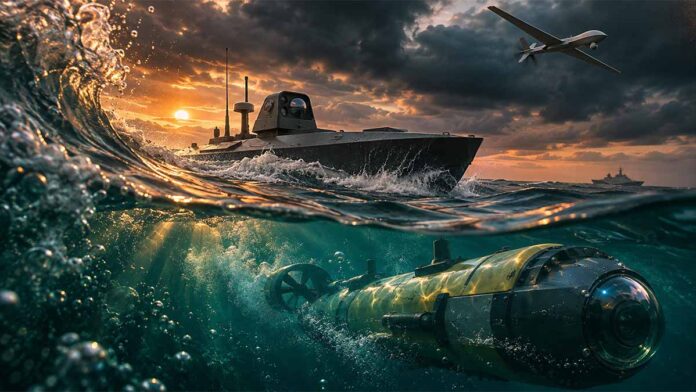

As of: 2026-11-20 | Strategic horizon: 2027–2031
Technology, industrial competition, operational realities, dual-use innovation and the transformation of military power across the air, surface and underwater domains
Scope: A global assessment of unmanned and autonomous defence technologies, centred on maritime and cross-domain systems, their evolving payloads and enabling technologies, the strategic importance of the Middle East and Indo-Pacific, and the implications for the United States, China, Europe and NATO through 2031.
Executive Summary | Bottom Line Up Front
The defence drone sector is undergoing a structural transformation that extends far beyond the introduction of additional unmanned aircraft. The decisive shift is from individual remotely operated vehicles to interconnected, increasingly autonomous, software-defined systems capable of sensing, communicating and operating across multiple military domains. The value of a future drone fleet will depend less on the number of platforms acquired than on the combined effectiveness of its payloads, sensors, communications architecture, autonomy, energy systems and industrial support network.
The emergence of hydrofoiling wing-in-ground-effect vehicles offers a potentially important intermediate capability between conventional maritime drones and aircraft. REGENT’s Squire illustrates the opportunity: a compact maritime platform combining a declared speed of 70 knots with a 50-pound configurable payload and a planned operational range exceeding 100 nautical miles. Its significance lies particularly in cross-domain sensing, distributed logistics and integration with underwater vehicles. However, the complete operational envelope remains to be demonstrated, and the platform should not yet be treated as combat-proven.
The central technological competition is moving towards edge artificial intelligence, resilient navigation, modular payloads, collaborative autonomy, distributed command-and-control and lower-cost production. These capabilities promise greater persistence and reduced personnel exposure, while simultaneously creating new vulnerabilities involving cyber intrusion, electronic warfare, environmental limitations, software reliability and supply-chain dependence.
NATO’s REPMUS 2026 involved more than 300 unmanned systems and representatives of 36 navies. France, Germany and the United Kingdom are advancing different elements of maritime autonomous warfare, while the European Union is developing a more integrated drone and counter-drone industrial and security framework.
Principal assessment: By 2031, the military advantage will belong increasingly to organisations able to combine reliable autonomous platforms with sovereign software, operationally effective payloads, resilient communications and scalable manufacturing. Procurement of drones without this supporting architecture risks producing large inventories with limited operational value.
The Drone Revolution Is Becoming an Industrial Sovereignty Test
Defence budgets are expanding, autonomous systems are entering military service, and governments are discovering that buying drones is easier than controlling the technology, production and infrastructure required to sustain them.
The global competition for autonomous defence systems is entering a phase in which industrial sovereignty matters more than the number of vehicles acquired. The contradiction is increasingly visible: governments are committing billions to unmanned capabilities while the technologies that determine their effectiveness—semiconductors, sensors, mission software, communications and specialised manufacturing—remain distributed across vulnerable international supply chains. The United States is accelerating procurement without complete visibility into its industrial dependencies; China possesses an enormous civilian drone manufacturing base whose military conversion remains difficult to measure; and Europe is increasing defence expenditure without yet overcoming fragmented national procurement. The immediate stakes extend beyond military readiness. Public budgets are being committed to systems whose economic value depends on production continuity, software ownership and operational reliability. The next decisive advantage will belong not to the country purchasing the most drones, but to the one capable of manufacturing, integrating, updating and sustaining them without surrendering control of their critical technologies.
More Defence Spending Does Not Automatically Produce More Capability
European defence expenditure reached €418 billion in 2025, equivalent to approximately 2.2% of aggregate EU GDP, according to the European Defence Agency’s September 2026 assessment. Spending could rise to €547 billion by 2029, but the latter figure remains a projection rather than an approved expenditure total. The distinction matters because the political commitment to spend does not establish the industrial capacity to deliver. Additional appropriations can increase demand for systems already constrained by specialist components, qualified suppliers and limited testing infrastructure. The resulting competition for production capacity may increase costs before it materially improves military readiness.
The United Kingdom illustrates the scale and complexity of this transition. Its June 2026 Defence Investment Plan announced more than £5 billion over four years for drones and autonomous capabilities across the armed forces, including an expenditure allocation of £1.5 billion for the Hybrid Navy between financial years 2026–2027 and 2029–2030. The programme also identifies investments associated with Project PANTHEON, autonomous minehunting and underwater infrastructure protection. These are not interchangeable budget categories. Their significance lies in the attempt to reorganise military capability around interconnected crewed and uncrewed systems rather than acquire drones as additional equipment.
The European Union has adopted a different financing structure. The European Commission’s March 2026 European Defence Industry Programme work programme allocates €1.5 billion for 2026–2027, including €700 million for industrial reinforcement, €325 million for European Defence Projects of Common Interest, €240 million for joint procurement and €100 million in FAST equity support. The political objective is industrial coordination, but the financial instruments operate through different mechanisms. Equity support can help technology companies develop; joint procurement can aggregate demand; industrial reinforcement can expand production capacity. None independently guarantees that a qualified military system will be delivered.
The distinction became particularly clear on 14 October 2026, when the Commission allocated €168.2 million to eight industrial reinforcement projects expected to leverage €1.26 billion in investment across 17 production sites in 14 EU Member States and Norway. Expected output from 2027 includes annual capacity for 3,500 drone and missile propulsion systems and 200,000 loitering-munition warheads. These are projected industrial capabilities, not production already achieved. The financial test is whether public commitments become functioning production lines, qualified components and delivered equipment rather than successive announcements of manufacturing ambition.
Washington Has the Technology but Cannot Fully See Its Supply Chain
The United States possesses sophisticated defence integration capabilities and a substantial private technology sector, yet its industrial vulnerabilities remain significant. In July 2025, the Government Accountability Office reported that the Department of Defense depends on a network of more than 200,000 suppliers, while existing procurement information provides limited visibility into the origins of numerous components and materials. The figure concerns the wider defence industrial base, not drone manufacturers specifically. Its importance lies in exposing the weakness of a sovereignty model based primarily on the nationality of the final contractor.
An autonomous aircraft assembled in the United States can still depend on foreign electronics, batteries, specialised sensors or software components. The strategic consequence becomes apparent when a component must be replaced, upgraded or sourced under disrupted commercial conditions. If the purchasing organisation lacks sufficient technical information or qualified alternatives, domestic assembly provides only partial control over the capability. The GAO’s findings therefore identify a problem that accelerated procurement cannot resolve through faster contracting alone.
The Pentagon’s Replicator initiatives demonstrate the pressure to close the gap between commercial innovation and military deployment. Replicator 2 concentrates on counter-unmanned aircraft capabilities, including protection of military installations and critical infrastructure. In January 2026, an initial acquisition involving two DroneHunter F700 systems was announced, with delivery anticipated during the year. The mechanism is intended to shorten acquisition cycles, but the initial quantity demonstrates a procurement milestone rather than industrial scale. Accelerating acquisition and establishing sustained operational readiness remain different tasks.
China approaches the competition from another industrial position. Official Chinese figures reported more than 3.17 million civilian drones delivered during 2023, alongside more than 2,300 civilian drone research and development enterprises and over 1,000 drone models in mass production. The Civil Aviation Administration separately recorded more than 1.26 million registered unmanned aircraft at the end of 2023. These measures describe different aspects of civilian industry; they are not evidence of equivalent military production.
Their strategic significance is nevertheless substantial. Civilian manufacturing demand supports component suppliers, production expertise and an industrial workforce that may be relevant to defence applications. China’s May 2026 establishment of a dedicated low-altitude safety department within its civil aviation regulator further demonstrates institutional investment in the sector. Military qualification, secure communications, specialised payloads and operational integration remain separate requirements, but a large civilian manufacturing ecosystem offers a production foundation that cannot be ignored.
The American-Chinese competition is therefore not reducible to technological sophistication against numerical manufacturing superiority. It concerns two different industrial strengths, each carrying constraints. Washington must translate advanced innovation into resilient production; Beijing must demonstrate that civilian industrial scale can support the more demanding requirements of military autonomy. Neither civilian production statistics nor defence procurement announcements resolve that comparison.
Europe’s Industrial Strength Is Still Divided by National Procurement
Europe’s difficulty is not the absence of capable companies. It is the dispersion of technological competence across national procurement systems whose requirements, financing structures and industrial priorities do not necessarily coincide. Italy, France, Germany and the United Kingdom are developing different elements of autonomous maritime capability. Their programmes reveal complementary technological strengths, but also the challenge of converting national initiatives into systems that can operate together.
Italy’s Polo Nazionale della Dimensione Subacquea, established at La Spezia in 2023, brings together defence institutions, industry and research organisations around underwater technology. Its activities encompass robotics, acoustic sensing, communications, energy systems, artificial intelligence and cybersecurity. In October 2026, the Italian Navy identified the PNS TARAS initiative, involving WSENSE and other industrial participants, as part of the development of advanced networking technologies for autonomous underwater vehicles. The economic rationale is wider than military procurement: underwater communications and monitoring technologies can serve maritime infrastructure, energy and civilian research. The unresolved issue is whether institutional cooperation can produce qualified systems with sustainable production and export capacity.
France has chosen a more mission-specific approach through the SLAM-F mine-countermeasure programme. On 21 July 2026, the Direction générale de l’armement ordered 12 additional surface and underwater drones. In November, it selected Chantiers de l’Atlantique and Abeilles International to provide two maritime support platforms, designated Protée, with planned availability by 2028. The programme connects vehicles, sonar, command infrastructure and supporting vessels within a defined operational requirement. Its strength lies in procuring an integrated capability rather than expecting a standalone drone to deliver the entire mission.
Germany’s February 2026 acquisition milestone for the Blue Whale unmanned underwater vehicle illustrates the benefits and dependencies of international industrial cooperation. Developed through arrangements involving ATLAS ELEKTRONIK and Israel Aerospace Industries, the 10.9-metre, 5.5-tonne platform demonstrates how a government can accelerate access to specialised technology developed with foreign partners. The enduring questions concern software rights, maintenance, qualified suppliers and future modifications. International cooperation can strengthen national capability without automatically transferring control over every technological component.
The United Kingdom’s Hybrid Navy programme represents a broader attempt to restructure naval capability, while its Project Beehive procurement envisages 20 unmanned surface vessels for training, experimentation and capability development. The initial technology readiness levels identified in the March 2026 procurement record were 4–5. That qualification is revealing: London is acquiring opportunities to develop capability, not simply taking delivery of fully mature systems. The distinction should remain explicit when evaluating the return on public expenditure.
At the European level, the Commission’s September 2026 endorsement of five European Defence Projects of Common Interest, including drones, counter-drone systems and maritime and seabed defence, represents an attempt to reduce these divisions. But EU funding cannot itself eliminate incompatible technical requirements or proprietary software arrangements. National governments remain central to procurement and military employment, while NATO provides mechanisms for interoperability testing. Europe’s problem is therefore institutional as much as technological: the same industrial capabilities can produce collective resilience or expensive duplication depending on how programmes are contracted and integrated.
The Payload and the Software Now Determine the Economics of the Platform
The industrial value of a drone increasingly depends on equipment that may be less visible than its airframe or hull. Sensors, communications, onboard computing and mission software determine what the vehicle can contribute to an operational network. A platform may offer impressive endurance but limited value if its payload produces unreliable information or requires excessive energy. Another may be physically modest yet valuable because it permits data exchange between otherwise disconnected systems.
REGENT’s Squire illustrates the difference. Its manufacturer-published specifications include a maximum speed of 70 knots, a 50-pound configurable payload and electric and hybrid-range figures of 100 and 400 nautical miles. These figures do not establish that maximum speed, payload and range can be achieved simultaneously. The more consequential development occurred on 4 November 2026, when REGENT reported integrating Squire with NSI’s Arowana underwater vehicle during Maritime Big Play Pacific. The experiment demonstrated cross-domain retasking, according to the company, but not sustained combat readiness.
The economic implication is that procurement based principally on platform specifications may misidentify where future value is created. Mission software can require repeated updates; sensors may need replacement; communications protocols can change; and cybersecurity obligations continue throughout the vehicle’s service life. A government purchasing proprietary equipment without adequate integration or maintenance rights risks becoming dependent on the supplier after the initial acquisition. The vehicle may remain physically serviceable while its mission capability becomes increasingly difficult to support.
NATO’s REPMUS 2026 exercise, involving more than 300 unmanned systems and representatives of 36 navies, demonstrated the institutional importance of connecting heterogeneous technologies. The Alliance’s Task Force X-Arctic experimentation similarly concentrated on coordination and retasking across distributed maritime systems. These exercises do not establish equivalent operational readiness across participating equipment, but they confirm that interoperability has become a central military requirement. The commercial consequence is substantial: suppliers offering dependable interfaces and maintainable software may acquire advantages that cannot be measured through vehicle performance alone.
Regulation and Operational Reliability Will Limit the Speed of Adoption
Industrial acceleration encounters two constraints that procurement announcements frequently understate: the physical reliability of unmanned systems and the legal requirements governing their employment. The two are connected. A vehicle operating autonomously near commercial shipping must remain safe under foreseeable environmental conditions, while a military system performing consequential functions must remain subject to the applicable command and legal framework.
On 22 May 2026, the International Maritime Organization adopted a non-mandatory code for Maritime Autonomous Surface Ships, effective from 1 July 2026. The framework addresses operational conditions, remote supervision, connectivity and maritime safety. Further work towards a mandatory code is targeted for July 2030, with potential entry into force in January 2032. The existing instrument does not automatically regulate every military unmanned vehicle, but it demonstrates how autonomous maritime technology is creating requirements that extend beyond software performance.
Military autonomy faces separate accountability obligations. The U.S. Department of Defense’s Directive 3000.09, updated in January 2023, establishes requirements for autonomous and semi-autonomous weapon systems, including appropriate human judgment, testing and safety. These obligations affect procurement and development because they require more than a successful automated function. Systems must operate within authorised boundaries and undergo assessment appropriate to their intended employment.
France’s SLAM-F programme provides a practical distinction between machine-assisted sensing and human responsibility for consequential action. Autonomous systems can collect underwater information and assist classification while separate procedures govern mine neutralisation. This division reduces exposure of personnel during hazardous tasks without assuming that every operational decision should be delegated to software.
The same principle applies to industrial claims. A successful demonstration is not evidence of sustained availability; an order is not a delivery; and a delivered system is not automatically a mission-ready asset. These distinctions will constrain the pace of adoption, but removing them from procurement assessment would transfer technical uncertainty into operational risk and long-term public expenditure.
The Next 24 Months Will Expose the Difference Between Investment and Control
Between November 2026 and November 2028, the consequences of current industrial decisions will become more visible through contract execution, production-site commissioning, delivered equipment and the initial integration of new systems into military organisations. The European Defence Industry Programme’s 2026–2027 commitments will provide an early test of whether shared financing can produce qualified industrial capacity. France’s planned Protée platforms by 2028 and Japan’s intended transition towards Maritime Self-Defense Force operation of MQ-9B SeaGuardian aircraft in fiscal 2028 will offer further indicators of how effectively announced programmes become usable capabilities. These milestones are plans, not assured outcomes.
The cost of inaction will be distributed unevenly. Defence ministries will face the expense of maintaining incompatible equipment and repeated integration programmes. Manufacturers that fail to establish qualified production and dependable software support may lose access to procurement opportunities despite possessing technically promising products. Smaller technology companies may struggle to finance the transition from demonstration to production. Armed forces will bear the operational consequences when acquired platforms cannot be maintained, integrated or made available for the missions that justified their purchase.
European taxpayers will ultimately finance the difference between money committed and capability delivered. Industrial dependence can generate continuing maintenance expenditure, costly redesign and the need to replace equipment before its physical service life has ended. For the United States, incomplete supplier visibility may translate into production disruption or additional qualification costs. For China, civilian manufacturing scale will have to prove its relevance to demanding military requirements rather than serve as a substitute for operational evidence.
The central policy choice is already visible in the 2026 procurement and funding record. Governments can continue treating autonomous systems primarily as products to be purchased, or structure contracts around verified mission performance, qualified supply chains, interoperable software and long-term support. The financial and military consequences of that distinction will begin appearing well before 2031. The cost of failing to make it will fall on public budgets, domestic industry and military units expected to operate systems whose technological sovereignty was never fully secured.
The assessment is organised into three thematic pillars, separating technological fundamentals, operational realities and the industrial-strategic transformation of defence.
PILLAR I — THE TECHNOLOGICAL TRANSFORMATION OF UNMANNED SYSTEMS
Physical platforms, payloads, autonomy and the engineering limits of emerging capabilities.
- Chapter 1. The New Drone Technology Landscape: From Conventional UAVs to Multidomain Autonomous Vehicles
- Chapter 2. Sensors, Payloads and Mission Systems: The Technologies That Determine Operational Value
- Chapter 3. Artificial Intelligence, Navigation, Communications and Distributed Autonomy
- Chapter 4. Propulsion, Energy Storage, Materials and the Physical Limits of Unmanned Operations
PILLAR II — MILITARY EMPLOYMENT AND THE REALITY OF AUTONOMOUS WARFARE
The maritime battlespace, actual military capabilities, threat environments and operational reliability.
- Chapter 5. Maritime Autonomy and Wing-in-Ground-Effect Systems: Technology, Evidence and Operational Feasibility
- Chapter 6. The Middle East, the Indo-Pacific and the Strategic Competition for Maritime Awareness
- Chapter 7. Unmanned Swarms, Counter-Drone Warfare, Electronic Warfare and the Contested Electromagnetic Environment
- Chapter 8. Operational Vulnerabilities, Testing, Legal Accountability and the Gap Between Demonstration and Deployment
PILLAR III — INDUSTRIAL SOVEREIGNTY, DUAL-USE MARKETS AND THE NEXT FIVE YEARS
Defence-industrial capacity, national strategies, procurement, critical dependencies and strategic decisions.
- Chapter 9. The United States, China and the International Competition for Autonomous Systems
- Chapter 10. Europe’s Industrial and Military Transformation: Italy, France, Germany, the United Kingdom and the EU
- Chapter 11. Dual-Use Innovation, Supply Chains, Industrial Economics and Procurement Reform
- Chapter 12. The 2027–2031 Outlook: Scenarios, Strategic Indicators, Investment Priorities and Final Net Assessment
Master Abstract
An emerging military architecture, not merely a new generation of vehicles
The global diffusion of unmanned systems is changing the relationship between military mass, precision, surveillance and operational risk. Conventional defence procurement historically concentrated considerable capability within a limited number of expensive platforms: combat aircraft, warships, submarines and specialist reconnaissance systems. Autonomous technologies increasingly permit selected functions to be distributed across larger numbers of smaller vehicles, some reusable and others intentionally expendable. This does not eliminate the military importance of sophisticated crewed assets. Rather, it changes how those assets can generate operational effects, maintain situational awareness, extend their reach and protect personnel.
The distinction is especially important in the maritime domain, where surface surveillance, mine countermeasures, antisubmarine warfare, logistics and seabed infrastructure protection place different technical demands on sensors, mobility, endurance and communications. A conventional unmanned surface vessel offers persistent access to the water but may be constrained by transit speed. An unmanned aerial vehicle can cover large areas quickly but faces endurance, launch infrastructure and survivability limitations. An autonomous underwater vehicle can operate below the surface, yet its communications with external networks are severely constrained. Hybrid maritime platforms seek to exploit selected advantages of more than one operating environment, although the associated engineering and reliability challenges are substantial.
The evidence from 2026 shows defence organisations increasingly experimenting with systems of systems: configurations in which individual vehicles contribute observations or services to an integrated mission network. During NATO’s REPMUS 2026 exercise, held from 31 August to 25 September, more than 3,700 participants, 300 unmanned systems, 60 research and development companies and representatives from 36 navies participated in a large-scale maritime experimentation environment. Those figures demonstrate the scale of multinational technological activity, not the existence of an equivalent number of operationally certified or combat-ready systems. REPMUS 2026 in Portugal Brings Together NATO Allies to Test Uncrewed Maritime Systems — NATO — Oct 2026
The Squire case: speed, sensing and the difficulty of establishing real capability
REGENT’s Squire represents a technically distinctive attempt to combine the mobility of an aircraft with maritime operating characteristics. The craft is designed to use hydrofoils during acceleration and subsequently transition into flight within the aerodynamic ground-effect region immediately above the sea. Operating close to the surface can improve aerodynamic efficiency by modifying the flow around the lifting surfaces, reducing the penalties associated with induced drag under suitable conditions. The resulting concept offers potential advantages for fast maritime transit without conventional runway infrastructure.
The manufacturer’s published product specifications identify a 50-pound payload, a maximum speed of 70 knots, a 100-nautical-mile electric range and a 400-nautical-mile hybrid-range configuration. These specifications require careful interpretation: the manufacturer has also described the longer-range capability as planned, and published figures do not establish an independently demonstrated endurance, payload-range relationship or operational availability rate. Its product information gives a takeoff-and-landing sea-state figure of two feet, making the distinction between the conditions required to launch, recover and remain airborne essential. Autonomous Squire — REGENT Defense — Undated product specifications, accessed Nov 2026
A particularly consequential development occurred on 4 November 2026, when REGENT announced that Squire had been integrated with NSI’s Arowana unmanned underwater vehicle during Maritime Big Play Pacific near San Clemente Island. According to the company, the demonstration included retasking the underwater vehicle during its mission and transferring control within a mixed fleet of unmanned assets. This represents a more useful indicator of technological progress than flight demonstrations alone: it addresses the problem of connecting different physical domains through a mobile command, communications and sensing node. Nevertheless, a controlled demonstration does not establish resilience against deliberate interference, reliable fleet-level performance or successful integration into sustained combat operations. REGENT and NSI Integrate Squire Seaglider Drone and Arowana UUV in Live Maritime Big Play Scenario — REGENT — Nov 2026
Payloads are becoming more strategically important than platform classifications
The economic and military significance of a drone cannot be inferred from the vehicle alone. A platform carrying an electro-optical sensor performs a different function from the same platform fitted with an electronic-support receiver, communications relay, radar, environmental sensor or specialised logistics payload. For maritime missions, the distinction becomes greater when onboard sensors must detect, classify or locate targets through the water column. Radar and electro-optical systems can contribute surface observations, but neither substitutes for a properly configured underwater acoustic sensing system. Effective antisubmarine or mine-countermeasure operations therefore require a chain of compatible sensing, processing, communications and verification capabilities.
The shift towards payload-centric procurement is already evident in the French SLAM-F mine-countermeasures programme. France’s Ministry of the Armed Forces describes a modular arrangement linking unmanned surface and underwater vehicles, high-resolution multiaspect sonar, artificial-intelligence-assisted classification and remote mine-neutralisation systems. The design objective is not simply to replace a crewed vessel with a drone. It is to distribute the detection and identification process across several platforms while retaining human authority over neutralisation decisions. The programme provides a concrete example of the operational separation between machine-assisted perception and the authorisation of potentially lethal action. SLAM-F: Towards the Drone Transformation of the French Navy’s Mine Warfare Capability — French Ministry of the Armed Forces — Nov 2026
The most significant emerging payload trends are therefore advanced acoustic sensing, compact radar and electro-optical fusion, passive electronic surveillance, adaptable communications gateways, onboard processing and mission-specific modular interfaces. Their actual value depends on physical integration, sensor accuracy, environmental performance and interoperability. A vehicle that can carry several kinds of payload is not automatically capable of employing all of them simultaneously or delivering equivalent performance in every role.
The Middle East demonstrates why maritime geography still determines technological value
The Persian Gulf, the Strait of Hormuz, the Gulf of Oman and the wider Arabian Sea form an operational environment in which maritime traffic, coastal surveillance, mine threats, underwater activity and the protection of strategic infrastructure intersect. The attraction of autonomous systems in this region is not confined to attacking targets. A potentially more durable advantage is the ability to extend maritime awareness while reducing the frequency with which expensive crewed aircraft or warships must perform routine monitoring missions.
On 13 August 2026, U.S. Central Command announced Task Force Falcon Strike, described by the command as a multinational, multidomain attack-drone organisation employing unmanned capabilities operating above, on and below the sea. This development illustrates how military commands are moving from separate drone categories towards coordinated cross-domain employment. The existence of such a force, however, does not establish that every new experimental platform has been assigned to it, nor does it demonstrate that a proposed cross-domain architecture has achieved complete operational integration. CENTCOM Launches First-Ever Multinational Attack Drone Task Force — U.S. Central Command — Aug 2026
For maritime systems relying on ground-effect flight, the region also exposes a significant operational contradiction. Low-altitude flight may reduce exposure to some distant line-of-sight sensors, but operation near the sea surface introduces difficulties associated with waves, spray, wind, obstacles, marine traffic and the limited margin available for trajectory correction. Flying below a radar horizon does not confer general invisibility. Coastal radar geometry, airborne sensors, passive detection and other surveillance systems can fundamentally change the detection problem.
Consequently, a new maritime vehicle should not be evaluated primarily by its theoretical maximum speed or range. The meaningful variables include sensor effectiveness under actual environmental conditions, the probability of completing a mission, recovery reliability, the availability of alternative communications and navigation methods, and the capacity to regenerate sorties after damage or equipment failure.
Industrial capacity and software control are becoming strategic dependencies
The historical distinction between commercial and military technology is becoming less useful for understanding the unmanned-systems industry. Electric propulsion, batteries, embedded processors, machine vision, radio communications, industrial automation and advanced composite materials already support multiple commercial sectors. Defence organisations are increasingly attempting to incorporate these technologies into military systems without inheriting unacceptable vulnerabilities from commercial architectures or opaque supplier relationships.
The industrial implications are substantial. A drone manufacturer can produce an efficient vehicle but remain dependent on foreign batteries, specialised semiconductors, inertial sensors, satellite-navigation components or software maintenance. A country may assemble platforms domestically while lacking effective control over critical firmware, cryptographic systems, mission software or sensor-processing algorithms. Conversely, a technically sophisticated platform can remain operationally irrelevant if its production rate, maintenance architecture and replacement components cannot support sustained use.
The European Commission’s Drone and Counter-Drone Security Action Plan, published on 11 February 2026, explicitly connects technological development, industrial production, trusted equipment, artificial-intelligence-enabled command-and-control, protection of critical infrastructure and European security autonomy. Its proposed measures include a €250 million call concerning land and maritime border surveillance, an EU trusted-drone approach and expanded civil-military technological cooperation. These are policy initiatives and proposed implementation measures, not evidence that a fully integrated European drone industrial base has already been achieved. Action Plan on Drone and Counter Drone Security — European Commission — Feb 2026
The central industrial question for 2027–2031 is therefore whether governments can develop procurement systems that evaluate integrated capability rather than isolated hardware characteristics. Military advantage will increasingly depend on maintaining a continuous cycle of experimentation, software revision, sensor adaptation, operational feedback and industrial replacement.
Europe is converging on autonomy through different national priorities
The European maritime-autonomy landscape shows genuine progress but also significant fragmentation. France is developing modular mine-countermeasure capabilities and dedicated launch-and-recovery infrastructure. Germany is strengthening underwater surveillance and experimenting with hybrid naval formations, including the integration of German and Israeli technologies. The United Kingdom has defined an explicitly ambitious hybrid-fleet transformation encompassing unmanned sensing, mine warfare and maritime strike. Italy is developing a national underwater technology ecosystem relevant to autonomous systems, critical seabed infrastructure and advanced maritime sensing.
These national activities are complementary in some respects, but they do not yet establish a unified European architecture for autonomous maritime operations. Different national procurement systems, operational requirements, security policies, data classifications and industrial interests can delay interoperability even where the underlying technologies appear compatible.
NATO offers an important mechanism for reducing these barriers. Its Task Force X-Arctic work and the REPMUS experimentation series demonstrate the increasing emphasis placed on the capacity to connect, coordinate and dynamically retask heterogeneous unmanned systems supplied by different countries and manufacturers. During REPMUS 2026, NATO reported that the Task Force X-Arctic architecture was tested at scale, including the coordination of autonomous systems responding to changes in command intent. The remaining strategic challenge is converting experimentation into reliable and sustained operational capability across national fleets. Task Force X-Arctic Takes Its Next Step at REPMUS 2026 — NATO Allied Command Transformation — Sep 2026
Key Evidence Table
The following baseline distinguishes demonstrated technical activity, procurement actions, manufacturer specifications and announced strategic objectives.
| Indicator | Value / status | Reference date | Definition / scope | Issuer | Exact source |
|---|---|---|---|---|---|
| Squire configurable payload | 50 lb (22.7 kg) | Nov 2026 | Published payload specification; not proof of every proposed mission configuration | REGENT | Squire Specifications |
| Squire maximum speed | 70 knots | Nov 2026 | Manufacturer specification; not independently established across the full mission envelope | REGENT | Squire Specifications |
| Squire electric / hybrid range | 100 / 400 nautical miles | Nov 2026 | Published configuration figures; complete operational validation not established | REGENT | Squire Specifications |
| Cross-domain vehicle coordination | Squire–Arowana integration demonstration | 4 Nov 2026 | Company-reported experimental retasking and control transfer | REGENT | Maritime Big Play Demonstration |
| Large military WIG technology | DARPA Liberty Lifter programme completed without a demonstrator aircraft | Jun 2025 | Research, simulation and materials validation rather than delivery of an aircraft | DARPA | Liberty Lifter Programme |
| NATO maritime unmanned experimentation | 300 systems; 36 navies; 60 R&D companies; over 3,700 participants | Aug–Sep 2026 | Participating experimental ecosystem, not an operational inventory | NATO | REPMUS 2026 |
| German Blue Whale UUV | 10.9 m length; 5.5 tonnes | Feb 2026 | Large underwater surveillance vehicle introduced into German naval service | Bundeswehr | Blue Whale |
| UK drone transformation | More than £5 billion announced | Jul 2026 | Broad military drone and autonomous-capability investment commitment; not a single maritime procurement | UK Government | UK Drone Transformation |
| French SLAM-F procurement | 12 additional surface and underwater drones ordered | 21 Jul 2026 | Incremental procurement for mine-countermeasure capability | French DGA | SLAM-F Additional Drones |
| European unmanned underwater coordination research | €3.7 million | Feb 2026 | SABUVIS II project budget; four participating EU Member States | EDA | SABUVIS II |
| EU drone and counter-drone security | €250 million call identified | Feb 2026 | Proposed deployment and border-surveillance support, not realised expenditure | European Commission | EU Action Plan |
Quantitative note: Speed, payload and range are different performance dimensions; manufacturer maxima must not be assumed to occur simultaneously. Currency amounts refer to distinct programme scopes and cannot be aggregated into a comparable global drone-investment series.
Competing Technological and Strategic Pathways
Three partly overlapping developmental pathways are supported by the observed programme evidence. They do not represent mutually exclusive futures: defence organisations can pursue all three, but will face competing industrial, budgetary and technical demands.
| Strategic pathway | Diagnostic support | Countervailing evidence or constraints | Indicators for 2027–2031 | Current assessment |
|---|---|---|---|---|
| Distributed autonomous sensing becomes the principal early source of operational value | NATO experimentation, SLAM-F, Blue Whale, cross-domain relay demonstrations | Network resilience, sensor integration and operational endurance remain difficult to prove | Persistent multisystem missions, validated detection performance, routine cross-platform retasking | Strongest near-term pathway |
| Low-cost attritable drones transform the economics of military operations | U.S. Replicator framework and expanding counter-drone investment | Effective payloads, navigation, secure communications and production capacity may limit scalability | Verified unit costs, sustained production, replacement rates and cost per successful mission | Important but mission-dependent |
| Hybrid vehicles create new maritime mobility and logistics categories | Squire demonstrations, commercial seaglider development and military logistics interest | Sea-state limits, certification, propulsion efficiency, maintenance and incomplete operational validation | Mission-ready WIG fleets, demonstrated payload-range performance and sustained military deployments | Technically promising, with substantial execution risk |
The strongest currently supported direction is the gradual integration of autonomous sensing and collaborative mission management into existing military operations. It benefits from established operational needs and can use specialised vehicles without requiring an immediate transformation of every naval platform.
Attritable systems may achieve faster scale in some applications, particularly where payload requirements are modest and operational losses are acceptable. However, treating all drones as inexpensive or expendable would be analytically incorrect. Sophisticated underwater vehicles, long-range reconnaissance systems and specialised electronic-intelligence platforms may have considerable acquisition costs and require extensive maintenance and support.
Hybrid ground-effect craft represent a more uncertain but potentially consequential development. The critical question is whether they can establish a reliable operational niche between conventional surface vehicles, aircraft and helicopters at a competitive lifecycle cost. Historical research provides a warning against assuming that technically attractive aerodynamic concepts necessarily produce sustainable military fleets.
Principal Gaps and Watch Indicators
The most consequential uncertainties concern capability maturity, mission performance and industrial sustainability. They are not secondary procurement details: they determine whether emerging technology becomes an enduring strategic advantage.
Platform maturity and the difference between a prototype and a military capability
A principal unresolved question is how rapidly emerging hybrid maritime vehicles can transition from controlled testing into sustained operational service. REGENT’s publicly available record establishes experimental flight activity and cross-domain integration work. It does not establish an independently validated, mission-ready fleet operating under the complete range of conditions claimed in product specifications.
That distinction is reinforced by DARPA’s Liberty Lifter experience. In June 2025, DARPA completed the programme without building the originally contemplated demonstrator aircraft. The agency reported progress through simulation and materials testing and indicated that its findings could support subsequent industrial development. The programme demonstrated that valuable technological research can occur without delivering the operational platform originally envisaged. Liberty Lifter — Defense Advanced Research Projects Agency — Jun 2025
The most useful subsequent observations would be documented endurance tests with representative mission payloads, independently characterised launch-and-recovery performance, maintainability evidence, mission-completion rates and sustained deployment records.
The payload integration problem
For future maritime drones, a critical engineering question is whether increasingly diverse payloads can be integrated without compromising the vehicle’s flight characteristics, energy budget, communications security or reliability.
A 50-pound payload allowance, for example, does not establish that a vehicle can simultaneously carry a radar, high-performance electro-optical system, acoustic equipment, secure communications relay and sufficient auxiliary power for every intended mission.
The relevant evidence will come from verified payload configurations, measured sensor performance, electrical and thermal integration tests, data-processing performance, and documented results from representative operational scenarios.
Particularly important will be the distinction between collecting data, generating an automated classification and producing an observation reliable enough to support a consequential military decision.
The autonomy and communications reliability problem
Collaborative autonomy promises to reduce the need for continuous human direction of individual vehicles, but it does not eliminate the requirement for accountable command relationships and dependable communications.
This becomes particularly important underwater. The European Defence Agency’s February 2026 assessment of the SABUVIS II project identifies limited communications bandwidth, high latency, the absence of underwater satellite positioning and environmental uncertainty as fundamental constraints on collaborative underwater autonomy. These are physical and technological limitations, not merely software-development problems. EDA Project Develops Technology for Underwater Drones to Move in Swarms — European Defence Agency — Feb 2026
Future readiness assessments should therefore measure whether vehicles can complete authorised missions after communications degradation, preserve navigational integrity, detect system faults and recover safely when the operational environment differs from the original mission assumptions.
The industrial scaling and sovereignty problem
Defence ministries are increasingly using commercial technological development to accelerate procurement. Nevertheless, the ability to order equipment does not automatically establish the ability to produce it in quantity, replace losses or maintain software and hardware over time.
The decisive industrial indicators will include verified delivery schedules, independent component availability, qualified alternative suppliers, production yield, repair turnaround times, the availability of secure software updates and the extent to which national authorities retain operational control over mission-critical systems.
European industrial policy will face an additional challenge: securing enough common standards to permit allied interoperability without erasing the specialised industrial capabilities of individual countries.
The geographic and environmental reality
The military effectiveness of a drone depends heavily on where it operates. A system that performs well in sheltered coastal waters may encounter substantially different physical demands in the North Atlantic, the Baltic Sea, the Indian Ocean or the Persian Gulf.
Wave conditions, sea spray, atmospheric visibility, ambient noise, navigation interference, marine traffic density, energy infrastructure and the availability of forward maintenance all influence the feasibility of operations.
As a result, there is no defensible single ranking of drone technologies based on speed, autonomy or payload capacity alone. The correct unit of evaluation is the complete mission system operating in its intended environment.
Strategic Watchlist: 2027–2031
| Priority | Observable development | Strategic implication |
|---|---|---|
| Critical | Sustained operational deployments of cross-domain drone teams | Evidence that experimental systems can deliver repeatable military effects |
| Critical | Independently validated payload and sensor performance | Ability to distinguish genuine mission capability from promotional specifications |
| Critical | Proven autonomy under communications and navigation degradation | Greater confidence in reliability within contested environments |
| High | Operational integration of WIG vehicles with naval and underwater assets | Potential establishment of a new maritime mobility category |
| High | Standardised command-and-control interfaces across allied fleets | Reduced fragmentation and improved coalition interoperability |
| High | Expansion of domestic production and repair capacity | Greater resilience during prolonged military operations |
| High | Fielded counter-drone technologies that remain cost-effective at scale | Improved survivability against increasingly numerous unmanned threats |
| High | Reliable methods for protecting critical seabed infrastructure | Stronger maritime security and reduced vulnerability of strategic communications and energy networks |
| High | Clearer certification, accountability and operational safety arrangements | Greater legitimacy and practicality of military and civilian deployment |
Preliminary Strategic Implications for Europe
The four major European defence-industrial actors face different but interconnected decisions.
Italy has an opportunity to consolidate its underwater technology ecosystem around autonomous maritime surveillance, acoustic sensing, subsea communications, infrastructure protection and industrial cooperation. Its National Underwater Dimension Hub and associated defence research activities provide an institutional foundation, but the decisive test will be the transition from research programmes to validated capabilities, interoperable systems and sustainable industrial production.
France possesses a more explicitly defined maritime mine-countermeasures transformation. The SLAM-F programme provides a practical framework for integrating remotely operated and autonomous systems, advanced sonar, deployable control centres and specialised maritime infrastructure. Its experience is relevant to NATO’s requirements for keeping ports, strategic approaches and maritime passages accessible under threat.
Germany is developing important competencies in autonomous underwater surveillance and the protection of maritime infrastructure, particularly in the Baltic and North Sea environments. The introduction of Blue Whale is noteworthy because it combines a concrete naval acquisition with established German-Israeli industrial cooperation. Nevertheless, the introduction of a platform and the achievement of a persistent, networked surveillance capability are different milestones.
The United Kingdom has articulated a broader hybrid-fleet transformation. Its announced drone investment programme and emerging unmanned naval categories indicate an ambition to integrate persistent sensing, underwater operations, maritime strike and AI-enabled fleet coordination. The principal challenge is implementation: operational integration, affordability, procurement discipline and the progressive introduction of capabilities into the Royal Navy’s force structure.
At the European Union level, the priority is to reduce fragmentation between civilian innovation, defence research, security regulation and industrial investment. The European Commission’s 2026 action plan provides a policy foundation, while the European Defence Agency’s programmes offer mechanisms for multinational experimentation. Neither eliminates the need for national procurement decisions, compatible technical standards and long-term industrial commitments.
NATO remains the principal environment for testing the practical interoperability of these national capabilities. The lessons of REPMUS and Task Force X-Arctic indicate that operational value will depend increasingly on the management of heterogeneous fleets, not simply on adding more autonomous platforms.
Initial Net Assessment
The defence drone revolution is entering a phase in which technological differentiation will increasingly occur below the visible platform level. The external configuration of a vehicle remains important, but future effectiveness will be determined by the less visible integration of sensors, onboard computing, mission software, communications, propulsion, energy management and maintainability.
Wing-in-ground-effect vehicles illustrate both the potential and the danger of this transition. They offer an opportunity to close selected operational gaps between aircraft and conventional maritime vehicles, particularly where speed, distributed sensing and access to austere coastal locations are important. Yet the available evidence does not support an assumption that the concept has overcome the operational limitations that constrained previous generations of military ground-effect craft.
The larger strategic development is more consequential than any individual design. Defence organisations are moving towards architectures in which air, surface and underwater systems operate as coordinated contributors to maritime awareness, logistics, protection and military operations.
This transformation will generate advantages for countries capable of combining commercial technological innovation with military reliability, industrial sovereignty and operational discipline.
It will also create new risks. Connected fleets increase the consequences of software defects, cyber compromise and communications failures. Greater autonomy expands the requirements for verification, accountability and human oversight. Rapid procurement can accelerate military adaptation, but it can also institutionalise unproven technologies before their operational and economic characteristics are understood.
The fundamental strategic reality is that military autonomy is not primarily a contest to manufacture more drones. It is a contest to develop dependable, adaptable and economically sustainable systems capable of operating together under conditions that may be hostile to every part of their technological architecture.
The period through 2031 will determine which states and industrial organisations can convert today’s technological experimentation into operationally credible, scalable capabilities—and which will remain dependent on sophisticated prototypes, fragmented procurement and externally controlled technological components.
THE AUTONOMOUS BATTLESPACE
An interactive strategic assessment of autonomous systems, maritime drones, AI-enabled payloads, cross-domain networks, industrial sovereignty and emerging operational constraints.
The cross-domain operating architecture
Select a network node to examine its operational function and principal technological constraint. Connections illustrate a conceptual architecture, not a verified operational network.
Interactive multi-domain network
CONCEPTUAL MODELMISSION COORDINATION
The integration layer coordinates tasking, sensor information and platform status. Interoperability and human accountability remain essential.
Three strategic pillars
2027–2031Technology and enabling systems
AI at the edge, sensor fusion, payload modularity, propulsion, navigation and cybersecurity.
Military operating reality
Readiness, sea-state limits, electronic warfare, cross-domain coordination and counter-drone threats.
Industry and sovereignty
Production, resilient supply chains, software ownership, procurement, dual-use technology and allied interoperability.
The technologies shaping the next generation
Vehicle performance must be considered alongside payload capability, communications, energy supply and operational reliability.
Wing-in-ground-effect mobility
Potentially efficient low-altitude maritime transit, constrained by sea state, weather, launch conditions and verification of operational endurance.
EMERGING / TESTINGEdge AI and sensor fusion
Onboard processing can accelerate detection and classification, but performance depends on validated models, sensors, computing resources and data integrity.
MISSION-DEPENDENTCollaborative underwater autonomy
Underwater networks confront limited bandwidth, latency, positioning constraints and uncertain acoustic conditions.
ACTIVE R&DSquire maritime mobility: published specifications
Compare the manufacturer-published electric and hybrid range configurations. This is a specification comparison, not an independently validated mission-performance chart.
Three-dimensional range comparison
NAUTICAL MILESPublished configuration figures; operational ranges, payload dependence and hybrid maturity are not independently established by these specifications.
Manufacturer-published maximum speed
Configurable payload allowance
Electric and hybrid configuration range figures
A specification, demonstration, deployment announcement and combat-proven capability represent different evidence categories.
Evidence, operational constraints and national strategies
Switch between evidence records, strategic limitations and European national priorities.
Documented indicators and programme status
DISTINCT EVIDENCE CLASSES| Indicator | Value / status | Reference | Evidence class | Source |
|---|
The records cover different units, institutions and programme definitions. They must not be summed or ranked as equivalent metrics.
Structural constraints and verification gaps
Environmental reliability
Waves, weather, spray, maritime traffic and launch/recovery conditions can constrain available operating windows.
Electronic and cyber resilience
Jamming, spoofing, software compromise and lost communications can undermine navigation and mission coordination.
Payload-to-mission mismatch
Mass allowance alone does not establish sufficient sensor performance, electrical power, processing or integration.
Production and maintenance
Acquisition announcements do not prove delivery, readiness, spare-part availability or sustainable sortie generation.
Underwater communications
Acoustic propagation, bandwidth and positioning limitations restrict continuous real-time control underwater.
Accountability and human control
Increasing machine autonomy requires clearly defined decision authority, validation, oversight and operational safety.
European defence-autonomy landscape
Italy
Underwater technology, maritime sensing, seabed infrastructure protection and national industrial development.
France
SLAM-F modular mine countermeasures, autonomous maritime vehicles and specialised naval integration.
Germany
Underwater surveillance, Blue Whale, Baltic and North Sea security and collaborative maritime autonomy.
United Kingdom
Hybrid-fleet modernisation, maritime autonomy, unmanned sensing and expanded drone investment.
European Union
Trusted drone supply chains, civil-military innovation, industrial coordination and counter-drone security.
The decisive strategic judgment
Military advantage will increasingly depend on the integration of autonomous platforms, effective payloads, resilient communications, sovereign software and scalable manufacturing. A larger drone inventory does not automatically create a more capable military force.
Analytical judgment for 2027–2031; not a quantified forecast.
OPEN-SOURCE ANALYTICAL ASSESSMENT | 20 NOVEMBER 2026
PILLAR I — THE TECHNOLOGICAL TRANSFORMATION OF UNMANNED SYSTEMS
Physical platforms, payloads, autonomy and the engineering limits of emerging capabilities.
This pillar examines how unmanned technology is changing the underlying architecture of defence capability, moving beyond the familiar distinction between aircraft, surface vessels and underwater vehicles towards increasingly integrated systems in which sensing, computation, communications, propulsion and mission-specific equipment determine operational effectiveness. The assessment covers the technological position as of 20 November 2026, distinguishes demonstrated capabilities from declared industrial objectives, and evaluates the principal development trajectories through 2031.
Chapter 1. The New Drone Technology Landscape: From Conventional UAVs to Multidomain Autonomous Vehicles
The transformation of the platform into a distributed technological system
The most consequential development in unmanned technology is not simply the progressive elimination of personnel from aircraft, ships and underwater vehicles. It is the redistribution of technological functions that were previously concentrated inside complex military platforms. Navigation, surveillance, communications, target recognition, environmental monitoring and mission management can increasingly be assigned to different unmanned systems connected through a common operational architecture. This transformation changes the technological meaning of a platform: an individual vehicle can become a mobile sensor, a communications relay, an autonomous inspection asset or an intermediate coordination point, while the management of the overall mission remains distributed between onboard computers, human operators and external command systems. The military value of this arrangement depends on whether the participating systems can exchange usable information, maintain an accurate understanding of their operating environment and perform authorised tasks when some communication links or individual vehicles become unavailable.
This development also requires abandoning the assumption that autonomy represents a single, uniform technological capability. A vehicle can navigate automatically while remaining dependent on a remote operator for mission decisions; another may autonomously perform a defined survey but require human authorisation to change objectives; a third may independently maintain formation with neighbouring vehicles without possessing sufficient sensor-processing capacity to identify the objects it encounters. These distinctions matter because technologies described commercially as autonomous may differ substantially in their ability to perceive the environment, plan movements, recognise uncertainty, communicate intentions, recover from faults and satisfy the safety requirements of the mission.
The NATO experimentation programme provides an important institutional reference. During REPMUS 2026, held in Portugal from 31 August to 25 September, the Alliance examined the integration of unmanned maritime assets within a multinational operational environment involving 300 systems, 36 navies, 60 research and development companies and more than 3,700 participants. The strategic significance lies not in these figures alone but in the stated purpose of the experimentation: evaluating interoperability and the capacity of multiple independently developed systems to contribute to common maritime awareness. NATO’s Task Force X-Arctic programme has specifically tested a mission-engineering architecture capable of connecting systems contributed by different organisations and retasking participating assets as command requirements change. These activities constitute evidence of advanced multinational experimentation, not proof that the participating technologies have all achieved equivalent operational readiness. REPMUS 2026 in Portugal Brings Together NATO Allies to Test Uncrewed Maritime Systems — NATO — October 2026 Task Force X-Arctic Takes Its Next Step at REPMUS 2026 — NATO Allied Command Transformation — September 2026
The expansion of unmanned systems across physical domains
Conventional unmanned aerial vehicles remain technologically important because aircraft can move sensors between geographically separated areas and offer observation perspectives unavailable to systems operating on or below the water. Nevertheless, the aerial category contains very different engineering architectures, from multirotor vehicles capable of vertical takeoff and landing to fixed-wing aircraft optimised for forward flight, hybrid vehicles combining multiple propulsion configurations and specialised platforms intended for persistent reconnaissance. Their performance cannot be meaningfully compared through a single measure of range or endurance. A multirotor must continuously generate lift through its propulsion system, while a fixed-wing aircraft can use aerodynamic lift during forward flight. The resulting energy requirements, infrastructure dependencies, operating speeds and payload limitations differ substantially.
Unmanned surface vehicles introduce another set of trade-offs. Their principal advantage is the ability to carry maritime-specific equipment and operate continuously at the air-water interface without remaining airborne. They can support surface surveillance, hydrographic measurements, environmental monitoring, infrastructure inspection and the deployment of underwater equipment. Their constraints include hydrodynamic resistance, environmental exposure, navigation around maritime traffic, communications coverage and the ability to remain operational when weather conditions exceed the vehicle’s authorised envelope. An apparently inexpensive surface drone may therefore require a comparatively substantial support infrastructure once launch and recovery, maintenance, remote operation, communications and emergency recovery are included.
Autonomous underwater vehicles operate in a more restrictive physical environment. They can inspect subsea structures, collect oceanographic information and conduct surveys without continuous direct control, but conventional satellite-navigation signals cannot provide ordinary submerged positioning. Radio-frequency communication is also heavily constrained underwater, which makes acoustic communications, inertial navigation, environmental sensing and carefully designed mission autonomy particularly important. The European Defence Agency’s SABUVIS II programme directly addressed these conditions through the investigation of coordinated underwater vehicles and mixed formations involving underwater and surface systems. Completed in early February 2026, the four-year programme involved Poland, Germany, Portugal and Slovenia, with a reported budget of €3.7 million. The Agency describes experiments involving coordinated movements, exchange of information, formation control and adaptive mission execution, while explicitly acknowledging bandwidth, latency and positioning constraints. EDA Project Develops Technology for Underwater Drones to Move in Swarms — European Defence Agency — February 2026
Between these established categories, hybrid vehicles attempt to combine different operating modes within a single physical design. The technological attraction is clear: a vehicle capable of moving efficiently across different environments may reduce the need to transfer equipment between separate platforms or transport assets. Yet every additional operating mode introduces complexity. Structural configuration, control software, propulsion, thermal management and sensor placement must be suitable for different physical regimes, while failure during a transition between regimes may create safety challenges that do not exist in conventional single-mode designs.
Wing-in-ground-effect vehicles as a test of the hybrid-platform proposition
Wing-in-ground-effect technology is particularly revealing because its potential advantages are based on well-established aerodynamic phenomena, while its military adoption has historically been limited. An aircraft operating near the water surface can experience changes in induced drag and lift characteristics associated with the interaction between the wing’s flow field and the surface. Under appropriate conditions, this can make low-altitude transit more energy-efficient than comparable flight outside ground effect. The advantage is not unrestricted: it depends on aircraft configuration, height, loading and environmental conditions, and it does not remove the need to control the vehicle safely around waves and obstacles.
The hydrofoiling architecture introduces a further technological element. During acceleration, hydrofoils lift the hull above much of the water surface, reducing hull-water interaction as speed increases. The vehicle then transitions from hydrodynamically supported motion into aerodynamic flight. This sequence can reduce dependence on conventional runways, but requires coordinated control across a changing combination of forces and operating conditions. The engineering problem is therefore considerably broader than building a small aircraft that flies close to the water. It involves maintaining safe and repeatable transitions, limiting damage from spray and wave impacts, ensuring propulsion reliability and demonstrating that the promised efficiency survives real mission conditions.
REGENT’s Squire provides a contemporary example. Its published specifications identify an 18-foot wingspan, a 13-foot length, a maximum speed of 70 knots, 50 pounds of payload capacity and separate electric and hybrid-range configurations of 100 and 400 nautical miles. The manufacturer’s published launch-and-landing sea-state figure is two feet. These specifications describe the intended or advertised capabilities of the product, not an independently verified operational envelope. REGENT reported a successful Squire flight demonstration in April 2026, and subsequent company materials described continuing work to mature autonomous operations, flight duration and mission-specific integration. Autonomous Squire — REGENT Defense — Product Specifications, accessed November 2026 The Future of Maritime Defense Takes Flight with REGENT’s Squire Seaglider Drone — REGENT — April 2026
The technological distinction between tested behaviour and projected mission performance is essential. A successful transition from hydrofoil operation to controlled flight establishes one important engineering result, but does not establish that a vehicle can sustain its planned range with the full mission payload, operate repeatedly in adverse conditions or maintain a sufficiently high readiness rate for a military fleet. Similarly, the ability to conduct surveillance using one particular sensor installation does not prove the simultaneous integration of more demanding acoustic, electronic or communications equipment.
DARPA’s Liberty Lifter programme illustrates the difficulties of bringing large ground-effect concepts into practical service. The programme investigated affordable maritime transport concepts capable of carrying significant loads while operating at high speed close to the ocean surface. In June 2025, DARPA completed its work after concentrating on high-risk technical areas, using simulations and materials testing rather than constructing the originally contemplated demonstrator aircraft. Its reported findings provide a research contribution, but not proof of an operational large-scale wing-in-ground-effect transport fleet. Liberty Lifter — Defense Advanced Research Projects Agency — Programme Status, June 2025
The resulting technological judgment is that ground-effect platforms may establish useful specialist roles in maritime mobility, distributed sensing and selected logistics missions, but their economic and military significance will depend on demonstrated reliability and lifecycle performance. They should not yet be treated as universal replacements for surface craft, helicopters or conventional aircraft.
Standardisation, interfaces and the emerging modular vehicle economy
An increasingly important technical question concerns the extent to which vehicles can operate with mission equipment, command systems and software developed by different suppliers. Proprietary integration can optimise individual products, but it may also create dependencies that complicate fleet modernisation and restrict the ability to replace components. Open or sufficiently documented interfaces can improve the ability to incorporate new sensors and communications equipment, although interoperability at the software-interface level is not sufficient by itself: mechanical mounting, electrical supply, thermal management, cybersecurity and data semantics must also be compatible.
The practical implications are particularly important for maritime fleets, where specialised payloads may have longer development cycles than the vehicles that carry them. A government might seek to replace a surveillance sensor without replacing its entire drone fleet, or employ the same mission-planning architecture across several classes of vehicles. Such flexibility depends on appropriate configuration management and testing, because an apparently minor hardware or software modification may affect weight distribution, energy requirements, electromagnetic compatibility or the behaviour of autonomous control systems.
The direction indicated by NATO experimentation and EDA research is consequently towards heterogeneous integration rather than universal platform standardisation. A common system architecture need not require identical vehicles. Instead, it must provide reliable interfaces through which different assets can communicate their status, capabilities, uncertainties and mission results. That distinction will be central to future procurement: interoperability should be assessed as a demonstrable system property rather than inferred from a manufacturer’s claim that a platform is compatible with a recognised communications standard.
Regulatory recognition and the commercial foundations of autonomy
Civilian maritime autonomy provides another important indicator of technological maturity. The International Maritime Organization adopted its non-mandatory Maritime Autonomous Surface Ships Code in May 2026, with the framework taking effect on 1 July 2026. The Code addresses the design, operation, approval and safety of qualifying commercial autonomous ships, emphasising operational limitations, cybersecurity, remote operations, navigational safety and human responsibility. The IMO identifies a further roadmap towards a mandatory framework, with adoption targeted by July 2030 and entry into force in January 2032. These dates concern planned regulatory development and do not establish that every autonomous maritime vehicle falls within the same certification category. FAQ — Autonomous Shipping — International Maritime Organization — 2026
This regulatory development matters to defence technology because many enabling systems are inherently dual-use. Collision avoidance, fault detection, communications redundancy, digital system assurance and remote operations are relevant to both civilian and military platforms, although their operational requirements differ. The existence of an evolving civil framework also highlights a persistent technical reality: greater automation does not eliminate responsibility for safe operation, nor does it transform an experimental system into a certified operational product.
The emerging technology landscape is therefore best understood as a combination of increasingly diverse physical platforms and a converging set of enabling technologies. Hardware configurations will continue to differ, but the same underlying questions of software assurance, navigation reliability, sensor integration, communications resilience and maintainability will increasingly determine whether those platforms can fulfil their intended missions.
Chapter 2. Sensors, Payloads and Mission Systems: The Technologies That Determine Operational Value
The payload as the principal determinant of mission effectiveness
The performance of an unmanned vehicle cannot be separated from the equipment it carries. Although range, speed and endurance remain important acquisition characteristics, they describe primarily the vehicle’s ability to transport a payload through an operating environment. The military or security value is created when that payload can detect relevant phenomena, collect sufficiently accurate information, process observations and deliver results to an authorised user in a form suitable for the intended decision. An endurance figure is therefore not equivalent to surveillance effectiveness, and a high-speed maritime platform may be operationally inferior to a slower alternative if it cannot carry the appropriate sensors or provide the stability and electrical power those sensors require.
Payload integration has become a multidimensional engineering problem. Every subsystem occupies physical volume, consumes part of the vehicle’s mass allowance, may generate heat, draws electrical power and introduces requirements for data processing and communications. Certain sensors also require specific mounting positions, calibrated fields of view or separation from sources of mechanical vibration and electromagnetic interference. A manufacturer may publish a maximum payload mass without disclosing the electrical power available to the equipment, the maximum sustainable processing load or the conditions under which the payload can remain active. Consequently, procurement decisions based only on kilograms of carrying capacity risk overlooking the variables that actually determine mission performance.
The issue becomes especially consequential for small maritime vehicles, where the difference between a basic camera and a fully integrated surveillance package may be considerable. Electro-optical systems require optical stability and visibility; infrared systems depend on thermal contrast and sensor characteristics; radar systems introduce antenna, power and signal-processing demands; and acoustic systems must be coupled to the underwater environment through a suitable sensor arrangement. Electronic-support payloads require their own antenna configurations, receiver performance and electromagnetic compatibility. The same platform may be adaptable to several such missions without being capable of undertaking all of them at once.
Electro-optical and infrared sensing: useful but environmentally dependent
Electro-optical and infrared sensors have become widely applicable because they provide detailed spatial observations that can be interpreted by human operators or automated processing systems. Visible-light imaging can support object identification, inspection and the reconstruction of surface activity where illumination and atmospheric conditions permit. Infrared sensing can provide information based on thermal emissions and contrast, potentially contributing to observation outside ordinary daylight conditions. Yet neither modality is independent of weather, atmospheric effects, viewing geometry or the physical characteristics of the object being observed.
For maritime surveillance, an important distinction must be maintained between detection, tracking, classification and identification. A system may detect the presence of an object without establishing its precise class. It may maintain a track without collecting enough information to support reliable identification. Artificial-intelligence processing can improve the efficiency of analysing imagery, but classification confidence cannot be interpreted as a universal measure of truth: it depends on the model, training data, operating conditions and validation methodology.
The incorporation of multiple sensing modalities can improve robustness when their failure mechanisms differ. However, fusion is not automatically beneficial. Combining inaccurate, delayed or incorrectly registered measurements can create greater apparent certainty without improving the quality of the underlying evidence. Defence-grade applications therefore require attention to sensor calibration, timing synchronisation, data provenance and the ability to preserve uncertainty as information passes through successive processing stages.
Radar, passive sensing and the limits of detection assumptions
Radar introduces capabilities that differ fundamentally from optical sensing. Depending on system design, operating frequency, antenna characteristics and environmental conditions, radar can provide information about object position and movement when ordinary visual observation is constrained. Its utility is nevertheless affected by clutter, sea conditions, target characteristics and processing limitations. The engineering significance of a radar payload cannot be inferred simply from its presence on a vehicle: antenna size, power consumption, stabilisation, waveform characteristics and processing resources help determine the actual surveillance function.
Passive electronic sensing presents a different technological proposition. Rather than transmitting an interrogation signal, passive systems attempt to observe signals or emissions already present in the environment. This may reduce the need for the platform to transmit for the purpose of sensing, although its overall detectability still depends on communications, propulsion, electromagnetic emissions and operating conditions. Passive observation also depends on the presence and characteristics of relevant external signals, which means the absence of a detection cannot necessarily be interpreted as evidence that no object or activity is present.
These technologies demonstrate why simplistic claims about a vehicle being invisible to radar or capable of monitoring an entire maritime area should be treated cautiously. Sensor performance is relational: it depends on the characteristics and positions of the sensor, the observed object and the environment. A vehicle operating at low altitude may benefit from the geometry of some line-of-sight detection systems, but the result cannot be generalised to all radar configurations or alternative sensing methods.
Underwater acoustics and the challenge of transforming observations into maritime intelligence
Underwater operations require a separate technical framework because sound is a principal means of transmitting information through seawater over distances relevant to many maritime activities. Active acoustic systems transmit sound and analyse returning signals, while passive systems receive acoustic energy generated by external sources. Their performance depends on environmental conditions, frequency, propagation, ambient noise, sensor characteristics and the physical relationship between the vehicle and objects of interest. Consequently, acoustic sensing should not be treated as a simple underwater equivalent of a camera or airborne radar.
Autonomous underwater vehicles may use sonar and other instruments to map subsea environments, inspect infrastructure or collect information relevant to mine-countermeasure operations. The resulting information often requires substantial processing and interpretation. A sensor may detect an anomalous object without establishing that it is hazardous; a classification system may identify a likely category without providing sufficient confidence for a subsequent operational decision. This distinction is especially important where the consequences of misclassification are significant.
The European Defence Agency’s maritime autonomy work demonstrates increasing institutional attention to integrating underwater vehicles with broader sensing and command arrangements. SABUVIS II investigated coordinated underwater operations and mixed groups of underwater and surface vehicles, including the use of common interfaces and shared information. The programme’s reported outcomes are evidence of research and field experimentation, while its acknowledged limitations show that persistent underwater coordination remains more technically demanding than continuous radio communication between surface vehicles. EDA Project Develops Technology for Underwater Drones to Move in Swarms — European Defence Agency — February 2026
The emergence of communications payloads and mobile information gateways
Some of the most strategically important future payloads may not be primary surveillance sensors. Communications equipment capable of connecting otherwise separated vehicles can create operational value by extending the effective reach of a distributed system, transferring observations and enabling changes to a mission without physically recovering the asset concerned. This is especially relevant at the boundary between underwater and surface operations, where the differences between acoustic and radio-frequency communications complicate continuous coordination.
On 4 November 2026, REGENT announced that its Squire vehicle had been integrated with NSI’s Arowana unmanned underwater vehicle during Maritime Big Play Pacific near San Clemente Island. According to the company, Squire acted as a mobile gateway through which Arowana could be retasked during a mission, with control transferred across a mixed group of unmanned systems. This represents a meaningful integration demonstration because it addresses the exchange of operational instructions between different vehicle categories rather than merely showing the movement of an individual platform. It does not, however, establish the communications architecture’s performance under sustained interference, prolonged deployment or the full range of environmental conditions. REGENT and NSI Integrate Squire Seaglider Drone and Arowana UUV in Live Maritime Big Play Scenario — REGENT — November 2026
The wider implication is that payload technology is evolving towards mission-specific combinations of sensing, computing and connectivity. A communications gateway may have limited value when evaluated as an isolated piece of equipment, but substantial value when it permits an underwater asset to contribute information to a wider maritime network. The relevant performance measures therefore extend beyond vehicle characteristics and include the completeness, timeliness and integrity of information exchanged between platforms.
Payload certification, electromagnetic compatibility and system-level verification
The move towards modularity creates a temptation to assume that any mechanically compatible payload can be installed without further qualification. In practice, payload integration may change a vehicle’s centre of gravity, thermal conditions, vibration characteristics, electromagnetic environment, aerodynamic or hydrodynamic resistance and electrical demand. It may also introduce software dependencies that affect real-time processing or require changes to cybersecurity controls. A modular interface is valuable only when its specifications are sufficiently complete to make these interactions predictable and testable.
For defence procurement, the practical unit of acceptance should therefore be the specific vehicle-payload-software configuration, tested against the requirements of the intended mission. It is insufficient to approve a vehicle in one configuration and assume that every alternative sensor package will behave equivalently. When a payload introduces automated classification or decision-support functions, verification must also consider the behaviour of the processing system and its ability to communicate uncertainty or failure.
The National Institute of Standards and Technology’s AI Risk Management Framework provides a relevant general assurance framework, emphasising validity, reliability, safety, security and resilience, alongside monitoring of AI performance throughout its lifecycle. The framework is voluntary and not a military equipment certification instrument, but its distinction between expected performance and trustworthy operation is directly applicable to the evaluation of AI-enabled payload systems. Artificial Intelligence Risk Management Framework — National Institute of Standards and Technology — AI Resource Center
The substantive technological conclusion is that the payload is no longer merely equipment carried by a drone. It is part of a tightly integrated sensing and information system whose effectiveness depends on the host vehicle, processing architecture, communications network and mission requirements. Investment in a vehicle without corresponding investment in the payload integration and validation environment can produce technological flexibility on paper while creating difficult and expensive operational compromises in practice.
From remotely controlled vehicles to autonomous decision architectures
Artificial intelligence is transforming unmanned systems primarily by changing how information is processed and how limited operational decisions can be executed. In a conventional remote-control architecture, a human operator interprets external observations and provides movement or mission instructions. In a more advanced autonomous architecture, onboard software can process selected observations, maintain an estimate of the vehicle’s state, plan a route and implement predefined responses without requiring continuous external instructions. These capabilities can reduce communication demands and allow operators to supervise several assets, but only where the system has been designed and validated for those particular functions. Autonomy does not necessarily imply machine learning: many critical functions, including flight stabilisation and parts of navigation and safety management, can be implemented through established control techniques that offer different verification characteristics from adaptive statistical models.
The technological challenge is to create a dependable relationship between perception, planning, control and mission authority. Perception estimates the external environment using sensor information. State estimation combines observations with the vehicle’s movement and navigation data to establish its current position and condition. Planning determines an appropriate sequence of actions within permitted constraints. Control translates those decisions into propulsion and steering commands. Supervisory functions monitor system health and determine whether an operation can continue safely. A failure in any part of this chain can compromise the result even when the remaining components operate as designed. A high-performing recognition model, for instance, provides limited operational advantage if the navigation system cannot accurately determine where the observed object is located.
The distinction between autonomous navigation and autonomous mission management is particularly important. A system can navigate to a sequence of waypoints while remaining unable to interpret an unexpected operational event. Conversely, advanced mission software can generate sophisticated task allocations while depending on external vehicles whose physical control systems are relatively conventional. Consequently, the future technological architecture is likely to involve several layers of autonomy, distributed between individual platforms and higher-level coordination systems.
NATO’s Task Force X-Arctic experimentation demonstrates this architectural direction. The programme has investigated a digital mission-management framework capable of connecting heterogeneous unmanned capabilities and adapting their tasking when operational requirements change. The September 2026 REPMUS activity constitutes evidence of network integration at experimental scale, but it does not establish unrestricted autonomous operational performance. Task Force X-Arctic Takes Its Next Step at REPMUS 2026 — NATO Allied Command Transformation — September 2026
Edge computing and the movement of intelligence onto the vehicle
A significant technological trend concerns the migration of processing functions from external computing infrastructure to the vehicle itself. Edge computing allows selected sensor observations to be processed locally, reducing dependence on the continuous transmission of raw information. In a maritime environment, this can be particularly valuable when communications are expensive, intermittent, subject to limited bandwidth or affected by propagation conditions. Instead of transmitting every observation, a vehicle may produce a smaller set of detections, environmental measurements, status changes or mission summaries for subsequent assessment.
Nevertheless, local processing introduces additional engineering requirements. Computing hardware consumes electrical power, produces heat and occupies valuable mass and volume. The algorithms themselves must operate within the platform’s available processing capacity and under the timing constraints imposed by the mission. A neural network that performs satisfactorily in a laboratory computing environment may behave differently after deployment on compact hardware operating under thermal and energy restrictions. Software optimisations, reduced numerical precision and specialised accelerators can improve efficiency, but may introduce new requirements for validation.
Another important distinction concerns model adaptation. Updating an artificial-intelligence model can improve its performance when the operating environment changes, but uncontrolled modification can invalidate previous verification results. Military and safety-critical applications therefore require configuration management, controlled deployment, testing against representative data and mechanisms for detecting performance deterioration. The ability to update a model remotely should not be confused with the assurance that the updated system will remain safe and effective.
The NIST AI Risk Management Framework identifies validity, reliability, safety, security and resilience as fundamental characteristics of trustworthy AI. These principles provide an appropriate analytical foundation for assessing autonomy in defence-related systems, although they do not constitute a military certification scheme. The practical implication is that autonomy should be evaluated through observable behaviour and documented limitations rather than the sophistication of the underlying algorithm alone. AI Risk Management Framework — National Institute of Standards and Technology
Navigation is one of the most consequential technical dependencies in unmanned operations. Satellite-based positioning can provide valuable information in suitable environments, but interference, signal obstruction, propagation limitations and equipment faults may reduce its availability or reliability. A resilient platform therefore requires an understanding of what alternative measurements are available and how navigation accuracy evolves when an external reference becomes unreliable.
Inertial navigation provides estimates based on measured motion, but small measurement errors accumulate over time unless the estimates are corrected using independent observations. Visual or terrain-relative navigation can offer additional information where suitable environmental features are available, but such techniques depend on sensor quality, visibility, processing and the existence of useful reference information. Maritime navigation presents particular difficulties because the sea surface may provide relatively few persistent visual reference features, while underwater navigation lacks ordinary direct access to satellite positioning.
Underwater vehicles consequently require a mission-specific combination of navigation techniques, environmental observations and uncertainty management. The EDA’s SABUVIS II project explicitly identifies the absence of submerged satellite tracking, limited communications bandwidth and substantial latency as important technological obstacles. Its experiments with coordinated autonomous vehicles show why underwater navigation and communications cannot simply reuse the same assumptions as aerial drone networks. EDA Project Develops Technology for Underwater Drones to Move in Swarms — European Defence Agency — February 2026
The strategic significance of navigation resilience lies in the relationship between uncertainty and mission authority. When the accuracy of a vehicle’s location estimate deteriorates, the system may no longer be able to execute a previously authorised operation within acceptable safety margins. Effective autonomy must therefore incorporate mechanisms that recognise uncertainty, adapt behaviour within established limits and avoid continuing a mission on the assumption that degraded information remains accurate.
Communications as a contested and heterogeneous technical environment
The communications architecture connecting autonomous vehicles is not a single network. It is an arrangement of different physical and logical technologies, each with its own coverage, capacity, latency, security and reliability characteristics. Radio communications between aerial and surface vehicles differ from acoustic communications underwater. Satellite links introduce a different infrastructure dependency from local line-of-sight communications. A vehicle may also need separate channels for essential control information, mission data and high-volume sensor output, depending on its design.
This heterogeneity complicates claims about real-time control of a mixed fleet. Information collected underwater may not be available immediately to a surface or aerial platform, and delays can influence the usefulness of an observation. The problem is not merely the quantity of data transmitted. It also concerns timing, synchronisation, message integrity and the ability to establish which platform or operator issued an instruction.
A central engineering objective is therefore graceful degradation: preserving safe and useful functions when parts of the communications architecture become unavailable. A system may be designed to complete a previously authorised survey, preserve collected information, return to a recovery location or enter a defined safe state when communication is interrupted. Which behaviour is appropriate depends on the mission, environmental conditions and regulatory or command restrictions. It cannot be prescribed universally for every drone.
Cybersecurity becomes equally important as connectivity increases. A networked fleet introduces authentication, authorisation, software integrity and access-control requirements that may differ substantially from those of a standalone vehicle. NIST’s Zero Trust Architecture provides a general model for avoiding implicit trust based solely on a system’s network position, emphasising explicit verification and access control. The framework is not a substitute for military communications security, but its underlying distinction between network connectivity and authorised access is relevant to the protection of distributed autonomous systems. Zero Trust Architecture — National Institute of Standards and Technology — August 2020
Collaborative autonomy and the limits of swarm terminology
The term swarm is often used too broadly in discussions of autonomous defence technology. Several drones operated simultaneously do not necessarily constitute a collaborative autonomous swarm. Meaningful cooperation requires some mechanism through which vehicles coordinate their behaviour, share relevant information, distribute tasks or adapt to changes affecting the wider group. The mechanism may be centrally managed, decentralised or hybrid. These arrangements have different requirements for communications, computing, fault tolerance and supervisory control.
Central coordination can provide a coherent representation of the mission and simplify the allocation of some tasks, but it creates dependence on the availability and integrity of the coordinating system. Decentralised coordination can reduce that dependence, but introduces difficulties associated with incomplete information, inconsistent observations and potentially conflicting decisions. A hybrid approach may combine local autonomous behaviour with periodic mission-level instructions. There is no universally superior architecture: its suitability depends on the number and diversity of vehicles, environmental conditions, available communications and the consequences of incorrect coordination.
SABUVIS II provides a documented example of the effort to move beyond simultaneous independent operations. The programme investigated coordinated underwater movements, mixed autonomous systems and the exchange of information through common interfaces. Its reported field demonstrations in Poland, Germany and Portugal during REPMUS 2025 establish research progress in these areas. However, they do not justify assuming that large underwater formations can maintain unrestricted, continuously synchronised communication in every maritime environment. EDA Project Develops Technology for Underwater Drones to Move in Swarms — European Defence Agency — February 2026
The more defensible development trajectory is the progressive introduction of collaborative autonomy into selected missions where the technical and operational constraints can be explicitly defined. That evolution may produce substantial benefits without requiring a universal form of artificial intelligence capable of managing every circumstance independently.
Verification, simulation and the limits of digital testing
As autonomous systems become more complex, testing must account for interactions between sensors, software, communications and physical behaviour. Laboratory tests can establish whether individual components satisfy specified requirements, but they cannot reproduce every environmental condition or system interaction. Simulation and digital environments offer opportunities to examine unusual events, repeat experiments and identify weaknesses before field deployment. Yet their conclusions depend on the accuracy of the models and assumptions used.
A simulated maritime environment may reproduce selected wave conditions, sensor characteristics or communications failures without accurately capturing every physical interaction experienced by a real vehicle. A software model that performs well against representative data may encounter unfamiliar objects or environmental conditions after deployment. Therefore, confidence in autonomous technology should develop through a combination of component testing, integrated system testing, controlled field experimentation and operational monitoring.
For European and NATO institutions, the importance of shared testing environments is particularly significant. Interoperability requires more than independent national certification of individual platforms. It requires evidence that systems can exchange information correctly, preserve operational authority and respond predictably when operating together. The increasing scale of multinational experimentation provides a useful foundation, but the quality of mission-level validation will determine whether these developments produce dependable operational capability.
The central conclusion of this chapter is that autonomy creates value when it reduces operational dependence without creating unacceptable uncertainty. Sophisticated algorithms are only one element of that objective. Resilient navigation, trustworthy information, constrained mission authority, secure communications and repeatable testing are equally important.
Chapter 4. Propulsion, Energy Storage, Materials and the Physical Limits of Unmanned Operations
Energy availability as the underlying constraint on endurance and payload
The future development of unmanned platforms is closely connected to energy storage and propulsion efficiency. Improvements in artificial intelligence, sensing and communications may increase the effectiveness of a vehicle, but every onboard electronic function requires energy, while propulsion normally accounts for a substantial share of the total demand. The practical endurance of a drone is consequently determined by the relationship between stored or generated energy, the power required for movement, the electrical requirements of the payload and the reserves necessary for safe operation.
Different platform categories place different demands on this energy budget. Multirotor aircraft must continuously generate lifting force through powered rotors, making mass and propulsion efficiency especially important. Fixed-wing vehicles can exploit aerodynamic lift during forward flight, but still require sufficient propulsion to overcome drag and maintain controlled movement. Surface vessels experience hydrodynamic resistance that depends on speed, hull characteristics and environmental conditions. Underwater vehicles face different combinations of hydrodynamic resistance, buoyancy management, propulsion requirements and sensor-related energy consumption.
These relationships mean that a nominal range or endurance figure has limited value unless the corresponding mission assumptions are disclosed. Vehicle speed, payload mass, sensor activity, environmental conditions and reserve-energy requirements can materially affect the achievable result. Comparing platforms using their maximum advertised endurance while ignoring these variables may produce misleading conclusions.
Battery-electric propulsion: efficiency and its physical limitations
Battery-electric propulsion offers characteristics attractive to certain autonomous applications. Electric motors can deliver responsive control, integrate with compact propulsion architectures and avoid some of the mechanical complexity associated with conventional fuel-powered systems. The absence of onboard combustion can also be useful for particular operating requirements, although it does not eliminate thermal output, electromagnetic emissions or acoustic noise from moving components.
The fundamental limitation is stored energy per unit of mass and volume. Batteries can provide efficient conversion of stored electrical energy into mechanical work, but the energy stored in commercially available battery systems remains substantially lower, per unit mass, than the chemical energy contained in conventional liquid fuels. This difference can become especially important for vehicles requiring long endurance, high transit speed or substantial payload capacity. The effective comparison must nevertheless consider complete propulsion-system efficiency, because combustion engines and electric motors convert stored energy into useful mechanical output with different efficiencies.
Battery-electric architectures also impose requirements on charging infrastructure, battery management, thermal protection and replacement cycles. A military fleet operating from distributed locations may face difficulties if the energy needed to recharge vehicles exceeds local electrical generation or storage capacity. Fast turnaround therefore depends on more than the vehicle’s charging connector: the entire energy supply and support arrangement must be capable of sustaining the intended operating tempo.
These constraints do not make electric propulsion inherently unsuitable for defence. They indicate that its value depends on the mission. Shorter-range surveillance, inspection, selected logistics and operations supported by dependable local charging infrastructure may benefit considerably. Missions requiring longer endurance or heavier payloads may require different energy architectures or accept other operational compromises.
Hybrid propulsion and the uncertainty behind extended-range claims
Hybrid propulsion is frequently presented as a means of combining the efficiency and control advantages of electric drive with the greater stored energy available from liquid fuels. In general, hybrid architectures may employ different arrangements of engines, generators, batteries and electric motors. The performance of a particular design depends on its configuration, conversion losses, thermal management, mass and reliability.
For an unmanned platform, hybridisation can introduce substantial additional engineering complexity. Energy must be managed across multiple power sources, while the control system must maintain reliable propulsion through changes in demand and possible equipment faults. Fuel supply, maintenance requirements and thermal behaviour may also differ from a fully electric design. Thus, an extended nominal range should not automatically be interpreted as an equivalent improvement in practical endurance, operating cost or maintainability.
The distinction is illustrated by REGENT’s Squire specifications, which publish different electric and hybrid-range configurations. The existence of both figures is relevant to the manufacturer’s technological roadmap, but the specifications do not independently demonstrate that both configurations have achieved the same stage of operational maturity. Nor do the figures establish that maximum speed, maximum payload and maximum range can be achieved simultaneously. Autonomous Squire — REGENT Defense — Product Specifications, accessed November 2026
Aerodynamic and hydrodynamic efficiency as engineering trade-offs
Physical efficiency remains central to the design of hybrid maritime vehicles. For aircraft, drag includes components associated with the vehicle’s shape, surface interactions and the generation of lift. NASA’s Glenn Research Center explains that induced drag results from the aerodynamic processes associated with a finite lifting wing, including the influence of wingtip vortices. Reducing this component of drag can contribute to improved aerodynamic efficiency, although the complete result depends on the aircraft’s geometry and operating conditions. What Is Drag? — NASA Glenn Research Center
Wing-in-ground-effect vehicles attempt to use the changed aerodynamic conditions near a surface to improve selected aspects of flight efficiency. However, the resulting advantage must be assessed together with the vehicle’s ability to maintain its intended flight height and safely manage disturbances. The proximity of the water surface makes wave conditions and variations in vehicle attitude particularly important. A design that is efficient under ideal test conditions may encounter a substantially different operational environment in rough water.
Hydrofoils introduce a corresponding trade-off in the waterborne phase. By lifting a hull above the water, they can reduce some forms of hydrodynamic resistance, but the foils themselves generate forces and resistance and require appropriate control. Their operation is affected by speed, loading and water conditions. In a vehicle transitioning from floating to hydrofoiling and then to flight, these characteristics must be managed as part of one integrated control problem.
The resulting engineering objective is not the maximisation of a single efficiency measure. It is the achievement of reliable performance across the complete mission profile, including launch, acceleration, transit, sensing activity, recovery and periods of degraded operation.
Materials, structural integrity and maritime environmental exposure
The materials used in unmanned vehicles influence mass, manufacturing processes, maintenance requirements and resistance to environmental damage. Advanced composite materials can offer attractive strength-to-weight characteristics and allow complex structural configurations, but they also introduce specific manufacturing, inspection and repair considerations. Metallic structures provide different combinations of strength, fatigue behaviour, corrosion resistance and repairability. Appropriate material selection depends on the operating environment, structural demands, production scale and lifecycle requirements.
Marine environments impose additional challenges because systems may encounter saltwater, humidity, temperature variation, spray, biological contamination and repeated mechanical loads. Electrical connectors, sensor windows, propulsion components, seals and exposed structural elements must remain reliable despite these conditions. The engineering consequences extend beyond initial platform design. Maintenance procedures, replacement components, inspection intervals and the ability to identify hidden deterioration are essential to sustained operational availability.
This is particularly important for dual-use platforms intended to operate from austere coastal locations. Avoiding a conventional runway or permanent port facility does not eliminate the need for technical support. Vehicles still require appropriate recovery arrangements, inspection, power supply, secure software maintenance and the means to handle damaged components. Infrastructure independence is therefore a relative operational advantage rather than an absolute property.
Thermal management and the increasing energy demands of onboard computing
The introduction of more capable onboard computing systems creates an additional energy and thermal-management challenge. Processing hardware may increase the vehicle’s ability to interpret sensor data and operate under intermittent communications, but the resulting electrical consumption and heat must be accommodated within the platform’s physical design.
Thermal limitations can affect both performance and reliability. Electronic equipment may reduce processing performance to remain within safe temperatures, while inadequate cooling can shorten component life or cause operational faults. Sensor systems and batteries have their own temperature requirements, and the suitable thermal solution may differ between an aerial, surface or underwater vehicle.
The relationship between autonomy and energy is therefore reciprocal. More capable onboard processing may reduce communication requirements and allow more efficient mission management, potentially saving energy in some circumstances. However, the computing system itself consumes power and may introduce cooling demands. Whether the net result improves endurance requires measurement under realistic operating conditions rather than general assumptions about the efficiency of artificial intelligence.
Manufacturing capacity, maintenance and the limits of technological scalability
An unmanned platform that performs impressively in a controlled test may still be difficult to manufacture economically or maintain at scale. Complex composite structures, specialised propulsion components, advanced sensors and tightly integrated electronics can create manufacturing bottlenecks. Production may also depend on materials, semiconductors or components supplied through geographically concentrated industrial networks.
Manufacturing scalability therefore requires design decisions that are not always visible in performance demonstrations. Component interchangeability, repeatable assembly procedures, manageable inspection requirements, documented software configurations and efficient repair methods all influence the ability to produce and sustain a fleet. A technically sophisticated vehicle may become economically unattractive if minor component damage requires extensive specialist work or if a unique supplier controls essential parts.
The implications for procurement are substantial. Initial acquisition price provides only a partial view of the resources required to maintain operational capability. A more useful assessment includes maintenance, energy infrastructure, software support, operator training, payload replacement, recovery equipment and the expected availability of vehicles over their service lives. These quantities must be measured in relation to an explicitly defined mission rather than compared through a universal assumption that smaller unmanned systems are necessarily inexpensive.
The larger technological trajectory towards 2031 will therefore depend on a balance between innovation and engineering discipline. The most successful unmanned architectures may not be those incorporating the greatest number of advanced technologies, but those capable of integrating suitable technologies into systems that can be manufactured, operated, repaired and updated consistently.
Pillar I — Integrated Technical Assessment
Across the four chapters, a clear distinction emerges between technological possibility and operationally usable capability. The variety of unmanned platforms is increasing, while the enabling technologies that determine their utility are becoming more interconnected. Physical mobility, payload performance, autonomous navigation, communications and energy management cannot be evaluated independently when their interactions determine whether a mission can be completed.
The most consequential development is the transition towards systems in which information can be collected by one vehicle, processed by another component, transmitted across different communications environments and used to coordinate further authorised actions. This architecture creates opportunities for distributed sensing and operational flexibility, but also increases the importance of interfaces, software assurance, failure management and lifecycle support.
For industrial and government decision-makers, the principal implication is that technological maturity must be established at the level of the complete mission configuration. A successful flight, an advanced recognition model, a large nominal payload or an extended manufacturer-published range is not sufficient evidence of sustained operational effectiveness.
The critical development priorities through 2031 are therefore reliable multimodal vehicle control, validated sensing, resilient positioning, constrained and accountable autonomy, secure interoperability, energy-efficient propulsion and scalable maintenance. These are mutually reinforcing technological requirements rather than independent categories of innovation.
Platform Architecture, Payload Integration and Engineering Constraints
THE ANATOMY OF AUTONOMOUS CAPABILITY
An interactive technical scheme connecting vehicle design, mission payloads, autonomous software and engineering assurance.
Three interacting engineering layers
The architecture is conceptual: each layer contains dependencies whose failure can affect complete mission performance.
Physical vehicle architecture
Structural configuration, propulsion, energy storage, maritime environmental protection and launch/recovery capabilities.
Sensing and mission equipment
Optical, radar, acoustic and communications modules supported by compatible power, mounting and processing.
Autonomy and interoperability
Navigation, state estimation, mission planning, system monitoring, secure messaging and human supervision.
From physical observation to usable intelligence
Each stage introduces different engineering and information-quality requirements.
Sensor validation
Select a technical dependency for additional analysis.
Platform classes and defining physical constraints
Qualitative comparison: no universal numerical ranking is assigned. Performance depends on mission configuration and environment.
| Platform | Technical advantage | Principal constraint | Critical verification |
|---|---|---|---|
| UAV | Mobile aerial sensing | Endurance and airspace | Payload and flight validation |
What technical evidence actually establishes
| Evidence category | Permitted conclusion | Remaining limitation |
|---|
Categories describe engineering evidence, not a formal certification scale.
The engineering comparisons in this component are grounded in the following institutional and technical references: REPMUS 2026 — NATO — October 2026, SABUVIS II Underwater Autonomy — European Defence Agency — February 2026, Artificial Intelligence Risk Management Framework — NIST, Liberty Lifter Programme — DARPA, and Autonomous Shipping — International Maritime Organization — 2026.
OPEN-SOURCE ANALYTICAL ASSESSMENT | 20 NOVEMBER 2026
PILLAR II — MILITARY EMPLOYMENT AND THE REALITY OF AUTONOMOUS WARFARE
The maritime battlespace, actual military capabilities, threat environments and operational reliability.
Principal strategic judgment: The military transformation produced by unmanned systems is no longer confined to experimentation with individual vehicles. It is increasingly visible in force organisation, maritime surveillance, mine countermeasures, counter-drone defence and the integration of uncrewed systems with conventional naval formations. Nevertheless, the evidence available in November 2026 demonstrates a persistent divergence between technological ambition, experimental integration and operationally sustainable capability. The most consequential question is not whether unmanned platforms can perform selected military functions, but whether armed forces can employ, protect, maintain and coordinate them reliably during prolonged operations in environments affected by physical hazards, electronic interference, hostile activity and legal constraints.
This pillar assesses the operational evidence and strategic implications of autonomous maritime systems across the Middle East, Indo-Pacific, North Atlantic and European maritime approaches. It distinguishes official military employment from announced procurement, controlled demonstrations and manufacturer claims, with particular emphasis on the conditions that determine whether experimental capabilities can become dependable operational assets.
Chapter 5. Maritime Autonomy and Wing-in-Ground-Effect Systems: Technology, Evidence and Operational Feasibility
The emergence of a new operational category between aircraft and surface vessels
The growing military interest in wing-in-ground-effect vehicles reflects a wider search for maritime platforms capable of combining rapid movement, flexible deployment and comparatively limited dependence on traditional aviation infrastructure. The attraction of such systems is readily understandable in naval environments where the distance between surveillance areas, the time required to reposition sensors and the physical constraints on deploying conventional aircraft can significantly affect mission planning. Yet the operational value of a ground-effect vehicle cannot be established from aerodynamic efficiency or transit speed alone. Its suitability depends on the relationship between its operating environment, mission equipment, recovery arrangements, command architecture and ability to remain serviceable across repeated missions.
Wing-in-ground-effect craft occupy an unusual position in the established classification of maritime vehicles. Their operation involves aerodynamic lift, while their proximity to the water surface and their dependence on maritime conditions make aspects of their employment closer to those of surface craft. When a vehicle also uses hydrofoils during acceleration, it must operate across distinct hydrodynamic and aerodynamic regimes. This creates a complex control environment in which the aircraft’s configuration, velocity, height above the water and the surrounding sea conditions interact. The resulting engineering opportunity is considerable, but so is the importance of establishing a validated operational envelope rather than assuming that nominal performance figures can be reproduced under all conditions.
REGENT’s Squire is a contemporary expression of this approach. The manufacturer’s November 2026 announcement concerning integration with NSI’s Arowana unmanned underwater vehicle provides a particularly relevant operational indicator. During Maritime Big Play Pacific near San Clemente Island, REGENT reported that Squire functioned as a communications gateway capable of supporting the retasking of an underwater vehicle during a mission, including a transfer of control between participating unmanned systems. This experiment is more consequential than a demonstration of vehicle movement alone because it concerns the integration of air-adjacent maritime mobility with an underwater asset whose communications and operational requirements differ substantially. Nevertheless, the published account remains a company-reported demonstration and does not establish sustained military readiness, reliable operation under deliberate electronic interference or the completion of representative missions across a full operational deployment. REGENT and NSI Integrate Squire Seaglider Drone and Arowana UUV in Live Maritime Big Play Scenario — REGENT — November 2026
The distinction between acting as a mobile gateway and becoming an operational command asset is important. A gateway can transfer information or instructions between otherwise separated systems, but a deployed command architecture requires much more: authenticated control relationships, reliable timing, accurate system status, explicit mission authority, fault management and an effective means of addressing incomplete or inconsistent information. The fact that a vehicle can transmit a retasking instruction during an exercise does not prove that it can manage a larger heterogeneous fleet safely or operate without additional support during an extended maritime mission.
Maritime sensing, logistics and the problem of mission-specific feasibility
The operational uses proposed for ground-effect vehicles encompass different levels of technological maturity and fundamentally different support requirements. Maritime surveillance requires a suitable combination of sensors, data processing, communications and operational coverage. Logistics missions require predictable payload transport, safe recovery, cargo protection and sufficiently repeatable scheduling. Search-and-rescue applications may require detection, localisation, communications and equipment delivery under environmental conditions that are already dangerous. Antisubmarine or mine-related missions introduce additional requirements for underwater sensing and the interpretation of complex acoustic or environmental information.
These missions should not be treated as interchangeable simply because a vehicle has a configurable payload compartment. A surveillance configuration and an underwater-perception configuration can have significantly different mass distributions, energy demands, sensor interfaces and maintenance requirements. The operational environment also changes the meaning of endurance: a vehicle transiting rapidly between observation areas may have enough energy for the transfer but insufficient remaining endurance for prolonged sensing activity. Conversely, a platform optimised for stationary or slow-moving surveillance may provide greater persistence despite a lower transit speed.
The most convincing near-term role for such systems may therefore lie in supporting other specialised assets, rather than replacing them. An autonomous maritime vehicle that can move rapidly between geographically separated locations and provide communications or data collection services could contribute useful flexibility to a broader fleet. Its benefit would depend on measurable improvements in mission completion, information availability or response time. Without such evidence, the proposed operational advantages remain possibilities rather than established results.
The limitations of the low-altitude survivability argument
The proposition that a wing-in-ground-effect vehicle can reduce its exposure to certain radar systems by operating near the water surface is physically plausible under particular geometric conditions. However, the further assertion that such a vehicle can avoid detection in a general sense would be unsupported. Detection depends on the characteristics, location and altitude of the observing system, the electromagnetic environment, the vehicle’s properties and the availability of alternative sensing methods. A platform that is difficult to observe from one sensor position may remain detectable from another.
For military planners, the distinction matters because survivability is not determined by a single sensor interaction. A platform must also remain operational despite navigation uncertainty, weather, mechanical failure, communications degradation and potential hostile interference. In a crowded maritime environment, the low-altitude operating profile can create its own hazards, particularly when the vehicle must distinguish between sea-surface conditions, vessel movements and obstacles while maintaining an appropriate safety margin.
Accordingly, a published maximum speed of 70 knots or a declared range greater than 100 nautical miles should be treated as a platform characteristic requiring mission-level validation, not as evidence of a particular military survivability advantage. REGENT’s own published descriptions identify a planned range and configurable payload but do not provide an independently validated combat performance record for Squire. Autonomous Squire — REGENT Defense — Product Specifications
The transition from successful experimentation to operational fleet employment requires a supporting arrangement that is often less visible than the vehicle itself. Military organisations must establish who owns and operates the systems, how missions are authorised, where vehicles are maintained, which data interfaces they use, how they are recovered and what happens when they fail to return. These issues become particularly important where the platform is designed to operate from locations that lack conventional aviation or naval support infrastructure.
The history of maritime autonomy contains repeated examples of ambitious concepts whose deployment prospects were constrained by integration, logistics or technical maturity. DARPA’s Liberty Lifter programme is a relevant cautionary case. The agency completed the programme in June 2025 after developing technical knowledge through simulation and materials research, without constructing the initially envisaged aircraft. The absence of a completed aircraft does not negate the value of the research, but it prevents the programme from being presented as evidence of a successful operational large-scale military ground-effect transport capability. Liberty Lifter — Defense Advanced Research Projects Agency
A more established operational reference is France’s SLAM-F programme, where unmanned systems are being integrated into a specific and longstanding naval mission: mine countermeasures. On 21 July 2026, the French Directorate General of Armaments ordered 12 additional surface and underwater drones. In November, the DGA also confirmed its selection of Chantiers de l’Atlantique and Abeilles International for the provision of two maritime platforms, named Protée, intended to support the capability by 2028. This demonstrates that a credible naval autonomy programme involves not only unmanned vehicles but also host platforms, command centres, specialised sensors and a clearly defined mission architecture. Programme SLAM-F: La DGA commande douze drones supplémentaires — French Directorate General of Armaments — August 2026 Guerre des mines: La DGA commande une capacité hauturière — French Directorate General of Armaments — November 2026
Mine countermeasures as a more mature operational benchmark
Mine countermeasures provide a particularly useful benchmark for evaluating maritime autonomy because the mission contains observable tasks and identifiable technological dependencies. An autonomous system can survey an area, collect imagery or acoustic information, identify anomalies and transmit the results for further examination. Where required, subsequent identification and neutralisation can be undertaken through separately controlled equipment and authorised procedures. The process offers opportunities to reduce personnel exposure without implying that every stage should be delegated to autonomous software.
France’s DGA has described SLAM-F as an architecture involving surface drones, autonomous underwater vehicles, towed sonar, remotely operated neutralisation equipment, dedicated command centres and supporting vessels. In its November 2026 explanation, the Ministry of the Armed Forces identified a planned depth capability of up to 300 metres for mine-related operations, compared with an existing reference of 120 metres. These figures refer to the stated capabilities and objectives of the programme and should not be generalised to every participating vehicle or mission configuration. The ministry also described underwater vehicles carrying out missions lasting close to twenty hours in certain configurations, with the onboard supervisory system managing energy, sensors and mission execution while communications were unavailable for much of the operation. SLAM-F: Vers une dronisation de la Marine nationale dans la guerre des mines — French Ministry of the Armed Forces — November 2026
The programme illustrates a significant operational principle: autonomous vehicles can reduce the need to expose personnel during dangerous reconnaissance and inspection tasks without removing the requirement for human responsibility over consequential decisions. It also demonstrates why procurement of the vehicle alone is an incomplete measure of capability. The sonar, underwater navigation equipment, mission software, recovery systems, host vessels and personnel arrangements are all necessary elements of the operational outcome.
Chapter 5 assessment: Wing-in-ground-effect vehicles represent a credible specialist area of maritime technological development, but publicly reported Squire evidence supports experimental and integration capability rather than combat-proven maritime service. The stronger institutional evidence for operational maritime autonomy currently comes from defined missions, particularly mine countermeasures, where equipment, procedures, supporting infrastructure and procurement milestones can be examined together.
Chapter 6. The Middle East, the Indo-Pacific and the Strategic Competition for Maritime Awareness
Maritime awareness as a strategic requirement rather than a purely technological objective
Maritime domain awareness is frequently described as a surveillance challenge, but its military significance extends beyond the collection of imagery or vessel-position information. Effective maritime awareness requires the ability to combine observations from different sources, identify the limits of those observations, assess changes over time and communicate findings to organisations responsible for navigation safety, infrastructure protection, military planning or crisis response. Unmanned systems can contribute to this process by operating in locations or for durations that may be difficult or expensive for crewed platforms. They do not, however, automatically resolve the problems of information quality, operational coverage and decision authority.
The changing security environment has increased the military importance of this distinction. In areas where naval forces must monitor commercial shipping, protect strategic infrastructure and respond to a mixture of conventional and unconventional threats, fragmented sensor information can produce a misleading picture of the maritime environment. The addition of more unmanned vehicles may increase the amount of available data without proportionately improving the accuracy or usefulness of the resulting intelligence. A reliable system must therefore manage the relationship between collection, verification, classification and dissemination.
The Middle East: from unmanned surveillance to multidomain military formations
The Middle East provides particularly direct evidence that unmanned maritime technology is becoming part of military force organisation rather than remaining a peripheral research activity. U.S. Naval Forces Central Command established Task Force 59 to accelerate the integration of unmanned systems and artificial intelligence into maritime operations. In January 2024, the command announced Task Group 59.1, explicitly focused on the operational deployment of unmanned systems alongside personnel conducting maritime security activities. The institutional significance was the creation of a dedicated organisational structure responsible for integrating unmanned capabilities into existing regional operations. Task Force 59 Launches New Unmanned Task Group 59.1 — U.S. Navy — January 2024
The region subsequently became a prominent environment for the introduction of one-way attack drones into naval operations. On 16 December 2025, the U.S. Navy reported the successful launch of a Low-cost Unmanned Combat Attack System, designated LUCAS, from USS Santa Barbara in the Arabian Gulf. The launch was performed by Task Force 59 personnel and associated with Task Force Scorpion Strike. It established a documented naval launch milestone, though it did not by itself quantify the system’s overall effectiveness, availability or cost per successful operational mission. U.S. Navy in Middle East Employs Attack Drone at Sea for First Time — U.S. Naval Forces Central Command — December 2025
The development of Task Force Falcon Strike adds a further institutional dimension. On 13 August 2026, U.S. Central Command announced efforts to establish a multinational attack-drone task force employing systems operating above, on and below the sea. The command linked the organisation to the earlier formation of Task Force Scorpion Strike and described a regional approach involving U.S. personnel and partner forces. Crucially, the public announcement concerned a specific attack-drone organisation; it should not be interpreted as evidence that all autonomous maritime platforms in the CENTCOM area have been integrated into a single operational network or that every emerging vehicle is assigned to this force. CENTCOM Launches First-Ever Multinational Attack Drone Task Force — U.S. Central Command — August 2026
These developments show a shift from treating drones primarily as equipment towards treating them as organisational capabilities with dedicated personnel, support processes and assigned operational functions. The distinction is important because a military unit must sustain its activities across changing mission conditions, while an experimental demonstration may depend on a carefully prepared environment and specialist technical support.
Hormuz, maritime chokepoints and the importance of operational continuity
The Persian Gulf and Strait of Hormuz illustrate why unmanned systems must be assessed against strategic geography. Commercial maritime traffic, coastal facilities, energy infrastructure and military activity are concentrated in a relatively constrained environment. Operational challenges include monitoring surface activity, maintaining access to navigational routes, detecting potentially hazardous underwater objects and ensuring that maritime forces can maintain communications and situational awareness during periods of heightened tension.
The relevance of autonomous systems lies in their potential contribution to persistent monitoring and specialised inspection, but their limitations remain substantial. Surface and aerial vehicles face traffic-management requirements, environmental conditions and the possibility that their communications or navigation systems may degrade. Underwater systems can collect information unavailable to surface sensors but often cannot transmit extensive data continuously. The resulting architecture must therefore reconcile information collected at different times and under different conditions.
The existence of hybrid or rapidly repositionable platforms could provide an additional method of connecting separate observation areas or supporting dispersed maritime assets. Nevertheless, the relevant operational comparison is not a hypothetical race between a ground-effect vehicle and a conventional surface drone. It is whether the proposed system improves the total performance of the surveillance and response network, accounting for reliability, maintenance, available information and support infrastructure.
The strategic value of mine-countermeasure capabilities is also particularly evident in maritime chokepoints. The French SLAM-F programme explicitly identifies the security of naval approaches and strategically significant waterways, including the Strait of Hormuz, as relevant operational contexts. Its programme architecture demonstrates why such missions require specialised detection and identification equipment rather than simply a large number of autonomous vehicles. SLAM-F: Vers une dronisation de la Marine nationale dans la guerre des mines — French Ministry of the Armed Forces — November 2026
The Indo-Pacific: distributed systems and the requirements of maritime geography
The Indo-Pacific presents a different operational environment. Its major maritime areas involve very large distances, dispersed islands, strategic passages, coastal waters and competing requirements for surveillance, transport, maritime security and military presence. Unmanned systems may offer opportunities to distribute selected sensing and support functions more widely, but geography introduces considerable demands for endurance, forward support, communications resilience and the availability of replacement equipment.
An important distinction concerns the ability to operate at scale without assuming that every area can receive continuous direct communications. Long-distance maritime operations may require autonomy capable of maintaining an authorised mission under intermittent contact, together with arrangements for data synchronisation and fault recovery. This makes autonomy an operational necessity in certain configurations rather than simply a method of reducing personnel requirements.
Japan’s 2026 Defence White Paper provides concrete evidence of the strategic direction. The Ministry of Defense identifies the acquisition and integration of UAVs, unmanned surface vehicles and unmanned underwater vehicles as part of a multilayered defence approach. The document describes SHIELD — Synchronized, Hybrid, Integrated and Enhanced Littoral Defense — as an initiative intended to establish layered coastal defence using multiple unmanned asset categories in conjunction with crewed forces. The published 2026 budget reference for strengthening unmanned defence capabilities is approximately ¥277.3 billion, while Japan’s September 2025 budget-request documentation recorded a different requested amount of approximately ¥312.8 billion. These figures reflect different budget stages and must not be treated as interchangeable measures of expenditure. Defense of Japan 2026 — Strengthening Unmanned Asset Defence Capabilities — Japanese Ministry of Defense FY2026 Budget Request: Major Projects — Japanese Ministry of Defense — September 2025
Japan’s Ministry of Defense also describes the need to retain crewed assets for missions that unmanned systems cannot yet perform adequately, including selected real-time submarine-tracking functions. This qualification is especially important because it comes from an institution actively investing in unmanned capabilities. It confirms that the intended military transformation is based on the complementary employment of crewed and uncrewed systems, not the assumption that technological development has already made conventional naval assets unnecessary.
The planned introduction of MQ-9B SeaGuardian aircraft provides a further example of staged operational development. Japan’s 2026 Defence White Paper describes plans for initial privately operated flight activity involving two aircraft in fiscal 2027, ahead of planned Maritime Self-Defense Force operations beginning in fiscal 2028. The different dates reflect a deliberate transition from preparatory activity towards intended service operation; they do not represent two separate completed deployments. Defense of Japan 2026 — Japanese Ministry of Defense
China and the distinction between technological observation and operational evidence
China is an indispensable actor in the strategic assessment of maritime autonomous technology because its military modernisation and industrial development affect the technological balance in the Indo-Pacific. However, external observations of an experimental Chinese platform should not be treated as proof of its operational status, manufacturing scale or assigned military mission.
This distinction is particularly relevant to emerging ground-effect concepts. An observed aircraft configuration, apparent mounting position or propulsion arrangement may support hypotheses concerning intended performance, but cannot independently establish the system’s payload, operational endurance, readiness, command architecture or ability to operate under realistic military conditions. The same evidentiary discipline applies to other national programmes, including those pursued by the United States and its allies.
The meaningful comparative questions concern whether China can field operationally reliable heterogeneous fleets, integrate their information with existing naval forces and sustain production and support under the specific demands of the Indo-Pacific environment. The present evidence does not permit a defensible universal ranking of national autonomous maritime capability across these dimensions.
The North Atlantic and European approaches: distributed sensing under different environmental conditions
The North Atlantic introduces a different set of constraints from the Persian Gulf or the coastal waters of East Asia. Large maritime distances, variable sea conditions and the importance of subsea infrastructure and submarine activity create operational demands that favour persistence, dependable navigation and the integration of information across geographically separated assets.
NATO’s Task Force X-Arctic programme addresses this problem through a multinational architecture intended to improve maritime situational awareness across the North Atlantic, Arctic and High North. During REPMUS 2026, NATO’s Centre for Maritime Research and Experimentation reported work on connecting intelligent unmanned systems with conventional assets through a data-centred mission architecture. The experiment contributes evidence regarding interoperability and distributed coordination, while leaving important questions about sustained operation in severe conditions and long-term maintenance unresolved. Task Force X-Arctic Scales Up at REPMUS 26 — NATO Centre for Maritime Research and Experimentation — October 2026
Germany’s introduction of Blue Whale on 25 February 2026 provides a distinct operational example. The German Navy reported the handover of an unmanned underwater vehicle measuring 10.9 metres in length, 1.12 metres in diameter and weighing 5.5 tonnes. Developed through cooperation involving Germany’s ATLAS ELEKTRONIK and Israel Aerospace Industries, the system is intended to support underwater reconnaissance and the observation of naval activity. German testing contributed to the procurement decision, but the announcement does not independently establish a fully mature fleet-wide capability for persistent autonomous submarine surveillance. Blue Whale: Marine erhält neues Unterwassersystem — Bundeswehr — February 2026
The United Kingdom is pursuing another form of naval transformation. Its July 2026 drone announcement describes a Hybrid Navy architecture involving uncrewed sensing and weapons platforms, including the proposed Type 91, Type 92, Type 93 and Type 94 categories. The British government also announced more than £5 billion for broader military drone development and procurement. The figure covers a wider set of defence capabilities and should not be represented as a dedicated expenditure on autonomous maritime systems alone. These announced categories demonstrate strategic intent and planned capability development, rather than completed operational inventories. UK Drone Transformation to Strengthen Armed Forces Backed by More Than £5 Billion — UK Government — July 2026
A particularly useful distinction appears in the Royal Navy’s Project Beehive procurement. A March 2026 contract-award notice described a requirement for 20 unmanned surface vessels to support training, tactical development, warfare development, capability development and operations. The notice explicitly referenced a spiral development approach with initial systems at technology readiness levels 4–5. This shows an institutional willingness to procure relatively immature platforms for structured development and learning, while acknowledging that initial technological readiness does not equate to complete operational maturity. Project Beehive — Unmanned Surface Vessel and Ground Control System Procurement — UK Ministry of Defence — March 2026
Competing operational pathways and geographical limits
The evidence supports three partially overlapping pathways for the future of unmanned maritime operations. The first is the gradual incorporation of autonomous sensing and mission support into existing naval formations. This pathway is already supported by procurement, trials and defined operational requirements, but its success depends on the quality of information exchange and sustained platform availability. The second is the expansion of lower-cost, potentially expendable unmanned systems for particular military tasks. This pathway may be capable of rapid adoption where mission requirements and manufacturing constraints permit, but attritability must not be confused with negligible cost or unrestricted effectiveness. The third is the development of hybrid maritime mobility concepts intended to overcome selected limitations of conventional aircraft and surface vessels. These systems may establish useful niches, but their broader operational value remains more uncertain.
Geography is likely to determine which pathway delivers the greatest value in a particular theatre. The Persian Gulf places considerable emphasis on monitoring concentrated maritime traffic and protecting access through strategic passages. The Indo-Pacific highlights endurance, distributed operating locations and the integration of several physical domains. The North Atlantic places greater emphasis on persistence, severe environmental conditions and underwater surveillance. The Mediterranean combines complex commercial traffic, coastal infrastructure, naval approaches and specialised mine-countermeasure requirements.
Chapter 6 assessment: There is no single global model for autonomous maritime warfare. National programmes are converging technologically while remaining differentiated operationally by geography, force structure, industrial capacity and mission requirements. The most defensible measure of progress is the ability to integrate unmanned systems into repeatable, supportable military operations rather than the number of prototypes or platforms publicly announced.
Chapter 7. Unmanned Swarms, Counter-Drone Warfare, Electronic Warfare and the Contested Electromagnetic Environment
The transition from isolated drone threats to interconnected defensive problems
The proliferation of unmanned systems has introduced a structural challenge for defence organisations: military formations, naval vessels and critical infrastructure must increasingly operate in environments containing many potentially hostile, unidentified or authorised unmanned vehicles. These vehicles differ in size, speed, endurance, sensor capability, communications architecture and intended function. Some may be inexpensive and relatively simple, while others incorporate advanced navigation, sensing and automated coordination. Their operational significance therefore cannot be reduced to the number present in a particular area. The decisive challenge for defenders is to establish which observations are reliable, which objects represent genuine threats, how the situation is changing and what response is legally and technically appropriate.
The consequences are especially significant for maritime security. Naval forces must distinguish between military threats, civilian drones, legitimate shipping activity, environmental phenomena and other objects that may appear in the available sensor information. Sensors designed primarily for conventional military aircraft or larger vessels may not provide equally effective information about small unmanned systems in complex operating conditions. Conversely, systems optimised for detecting small drones may have limitations when confronted with different vehicle classes or environmental interference. This makes a layered approach technologically attractive, but layering creates its own integration and coordination requirements.
The United States formally recognised the need for a comprehensive response in December 2024, when the Department of Defense announced a classified strategy for countering unmanned systems. The public announcement described a framework intended to address threats across domains and identified the Replicator 2 initiative as part of the effort to strengthen protection of critical facilities and force concentrations against small unmanned aircraft. The announcement is evidence of departmental policy and organisational priority, but the classified nature of the underlying strategy prevents independent assessment of its complete technical requirements or implementation. DoD Announces Strategy for Countering Unmanned Systems — U.S. Department of Defense — December 2024
Why coordinated groups are not automatically autonomous swarms
Military and commercial discussions frequently use the term swarm to describe large numbers of drones, but numerical concentration and collaborative autonomy are different characteristics. A group of vehicles may operate simultaneously while retaining completely independent control arrangements. Other groups may follow centrally assigned instructions without sharing information directly. More sophisticated architectures may permit vehicles to exchange observations, coordinate movement or adapt task allocation according to changes in the mission environment.
These arrangements have different operational implications. Centrally coordinated systems depend on an external decision or mission-management function and on the communications necessary to distribute instructions. More decentralised architectures can retain selected collaborative functions when central connections deteriorate, but must manage incomplete or inconsistent information among participating vehicles. The value of decentralisation is therefore conditional: it may reduce certain dependencies while increasing the difficulty of assuring predictable collective behaviour.
For maritime operations, the issue is further complicated by the physical differences between domains. Underwater vehicles may remain unable to exchange extensive information continuously, while aerial and surface assets may experience different communications and navigation conditions. A heterogeneous group can consequently possess useful collaborative capabilities without maintaining the continuous synchronisation sometimes implied by the term swarm.
NATO’s maritime experimentation is relevant because it examines how different unmanned systems can contribute to a common mission architecture without requiring identical hardware. Task Force X-Arctic and REPMUS 2026 provide evidence of experimental progress towards this objective. They do not establish that unrestricted autonomous cooperation has been achieved across all participating vehicle classes. Task Force X-Arctic Scales Up at REPMUS 26 — NATO Centre for Maritime Research and Experimentation — October 2026
Layered counter-drone systems and the importance of the complete defensive chain
An effective counter-drone capability requires more than an individual detection sensor or interception device. It must establish a reliable relationship between observation, classification, tracking, command authority and the selection of an appropriate response. This becomes especially demanding where multiple sensors provide inconsistent or delayed information, or where the consequences of misidentification are substantial.
NATO’s Layered Counter-UAS Initiative, known as LCI-X, directly addresses the integration problem. Allied Command Transformation describes counter-UAS cells containing sensors, command-and-control functions and effectors capable of sharing information beyond the individual cell. During the October 2026 Crucible 4-26 experimentation programme, NATO focused on connecting multiple counter-drone cells and evaluating their interaction across national and technical boundaries. The significance is that defensive capability is being treated as a networked system rather than as a collection of standalone countermeasures. NATO Scales Counter-UAS Experimentation — NATO Allied Command Transformation — October 2026
The NATO Communications and Information Agency also participated in Digital Backbone Experimentation 2026, examining counter-UAS integration with command-and-control systems, satellite communications and 5G-related technologies. The experiments included assessment of data exchange between sensors, defensive systems and wider command architectures. These activities offer evidence of technical development, but they should not be equated with verified protection against every class of unmanned threat. NCIA Tests Technologies to Strengthen NATO’s Digital Backbone at DiBaX 2026 — NATO Communications and Information Agency — 2026
A significant institutional development followed on 5 November 2026, when NATO launched a Counter-Unmanned Aircraft Systems marketplace under the Drone Edge initiative. The NATO Communications and Information Agency reported the selection of 16 solutions from five companies: Alta Ares, Axon Enterprise, Northrop Grumman, OSL UK and Quantum Systems. NATO also allocated €3.1 million for further testing of selected solutions and described an allied commitment to invest more than US$40 billion in counter-drone capabilities over the following five years. These figures represent different categories—selected solutions, testing funds and a forward-looking investment commitment—and must not be combined as realised programme expenditure. NATO Accelerates Procurement for Counter-Drone Technologies — NATO — November 2026
This procurement approach reflects the pressure created by rapidly evolving unmanned threats. Traditional acquisition cycles may produce equipment that requires further modification by the time it enters service, while emergency procurement can increase the risk of fragmentation, inadequate testing and long-term maintenance difficulties. The challenge is to accelerate adoption without abandoning configuration control, interoperability requirements or evidence of effectiveness.
Electronic warfare and the limits of reliance on the electromagnetic spectrum
Electronic warfare is one of the principal factors distinguishing laboratory demonstrations from credible military operations. Unmanned systems may depend on radio communications, satellite navigation, radar and other technologies that interact with the electromagnetic environment. Interference can therefore influence their ability to communicate, navigate or interpret sensor information. The consequences depend on the specific technology, the mission and the resilience built into the platform.
It is important to distinguish between several categories of degradation. A communications interruption can prevent an operator from issuing new instructions without necessarily disabling the vehicle’s onboard navigation. A positioning error can undermine the accuracy of the vehicle’s estimated location while leaving some communications available. Sensor interference may reduce the reliability of observations even when the vehicle remains controllable. Cyber compromise presents a different problem involving unauthorised access, manipulation or disruption of digital functions.
The central technological requirement is not an unsupported promise of immunity to electronic warfare. It is the ability to identify degraded conditions, avoid unsafe behaviour and preserve authorised functions where feasible. For some missions, this may mean continuing a bounded task. For others, it may mean suspending activity or recovering the vehicle. The appropriate response must be established through system design, testing and mission authority.
This distinction is particularly relevant to claims that artificial intelligence can make a drone immune to jamming. Onboard autonomy may reduce dependence on frequent external instructions, but it does not remove every dependency on navigation references, communications, sensors or correctly functioning software. Similarly, a system capable of operating without a live data link does not automatically possess the ability to interpret unexpected events or satisfy the legal requirements applicable to its actions.
The economic asymmetry of counter-drone defence
An important consequence of the proliferation of unmanned systems is the possibility of an unfavourable relationship between the cost of a threat and the cost of defeating it. Nevertheless, this problem should not be reduced to a comparison between the retail price of a drone and the acquisition price of a defensive interceptor. The proper economic unit includes detection, tracking, command infrastructure, maintenance, personnel, consumables, potential damage and the consequences of defensive failure.
A relatively inexpensive drone can impose costs on a defender even when it does not achieve its intended mission, because the defender may need to maintain surveillance, personnel and equipment readiness. Conversely, a defensive system with a higher unit acquisition cost may provide substantial value if it can protect important assets repeatedly with low incremental operating costs. Comparing systems through isolated prices can therefore obscure the economic reality.
The important procurement question is the cost of maintaining a specified level of protection against a defined threat environment. This requires evidence concerning detection reliability, successful defensive outcomes, operating tempo, ammunition or equipment consumption, maintenance and the consequences of false alarms. Public procurement announcements rarely provide enough compatible information to calculate such measures across countries or technologies, making unsupported global rankings particularly unreliable.
Counter-drone defence in civilian maritime environments
Maritime security creates specific difficulties because military and civilian activity often occur in close proximity. Ports, energy installations, commercial shipping routes and coastal infrastructure can contain legitimate aircraft, vessels, communications systems and personnel whose activities must not be indiscriminately disrupted. Consequently, the use of a counter-drone measure may raise safety, regulatory and operational questions even where a potential threat has been detected.
The relevant framework also depends on jurisdiction. Military operations during armed conflict, naval force protection, domestic policing and the security of civilian infrastructure do not necessarily operate under identical legal authorities. The fact that a technology is technically capable of interfering with a drone does not establish that every organisation may lawfully employ it in every environment.
This becomes a significant issue as dual-use counter-drone technology expands beyond the armed forces. Public authorities and private infrastructure operators may share an interest in improved detection, but they can possess different powers concerning surveillance, communications interference and the use of force. A successful counter-drone strategy must therefore connect the technical system to the legal authority and operational procedures of the organisation responsible for using it.
What NATO’s 2026 activities establish—and what remains unproven
By November 2026, NATO’s official record supports a clear finding: counter-drone defence has become a major collective procurement and experimentation priority. The establishment of a dedicated marketplace, the selection of 16 solutions and the allocation of further testing funds are concrete institutional actions. LCI-X and DiBaX demonstrate the Alliance’s emphasis on integration, interoperability and multi-layered defensive architectures.
However, these actions do not prove that NATO possesses a fully interoperable counter-drone network across all members or that the selected technologies provide consistent effectiveness against every threat. Procurement frameworks, successful experiments and operational performance are different evidence categories. The remaining requirements include realistic testing, integration with existing air and maritime defence systems, personnel preparation, sustainable maintenance and the ability to update capabilities as threats evolve.
Chapter 7 assessment: The dominant counter-drone development is the movement from individual defensive technologies towards layered architectures linking sensing, command and response. Their effectiveness will depend on information quality, legal authority, resilient integration and sustainable operating economics. Neither large drone formations nor advanced autonomous algorithms eliminate these requirements.
Chapter 8. Operational Vulnerabilities, Testing, Legal Accountability and the Gap Between Demonstration and Deployment
Why successful demonstrations are insufficient evidence of military readiness
The development of unmanned systems has created a recurring problem for defence procurement: technology can be demonstrated successfully under controlled conditions without possessing the reliability required for sustained military operations. A prototype may accomplish an impressive technical task but remain dependent on specialist engineers, restricted weather conditions, carefully prepared communications infrastructure or support arrangements that would be difficult to reproduce in operational service.
A meaningful readiness assessment must therefore distinguish at least five stages. The first is the existence of a published concept or specification. The second is a successful component or platform demonstration. The third is integrated testing under representative conditions. The fourth is operational employment by an authorised organisation. The fifth is repeatable and supportable operation over time. These stages do not necessarily progress uniformly, and a system may demonstrate certain advanced functions while remaining immature in maintenance, manufacturing or safety.
This distinction is particularly important for platforms intended to operate with little direct human intervention. A successful demonstration of autonomous navigation does not establish reliable behaviour in every environmental condition. Similarly, successful communications between different vehicle types during a field trial does not demonstrate that their information exchange remains accurate under network congestion or prolonged disruption.
The operational question is therefore not whether an unmanned system has worked, but under which conditions it has worked, how frequently it has succeeded, what support it required and what consequences occurred when it failed.
Reliability engineering and the importance of failure behaviour
Reliability cannot be established merely by counting successful missions without understanding their duration, difficulty and operating conditions. Ten short demonstrations under benign conditions are not equivalent to ten prolonged missions in severe maritime environments. Nor can the absence of a recorded failure be interpreted as proof that an unobserved failure mechanism does not exist.
For defence organisations, the evaluation of autonomous systems should include the reliability of propulsion, navigation, communications, sensors, onboard computing, mission-management software and recovery equipment. It should also investigate interactions between subsystems. A vehicle may possess individually reliable components yet encounter system-level failures because of unexpected interactions, incompatible software versions or inadequate handling of degraded sensor information.
Fault detection and recovery are especially significant. A remotely operated system may permit an operator to respond directly to some problems, while a more autonomous vehicle must possess suitable onboard procedures for recognising and managing abnormal conditions. These procedures require testing because a response that is appropriate in one environment may create additional hazards in another.
For maritime systems, the practical consequences of failure extend beyond the loss of an individual vehicle. A disabled platform may create a navigation hazard, require a recovery operation, interrupt the collection of information or expose supporting personnel to additional risk. The total operational cost of a failure can therefore be considerably greater than the vehicle’s replacement price.
Measuring availability rather than counting purchased vehicles
Procurement announcements frequently report quantities of vehicles ordered or delivered, but these measures do not establish how many systems are available for a particular mission. An operational fleet may contain vehicles undergoing maintenance, software updates, inspection, battery replacement or repair. Some may be configured for different payloads, while others require additional preparation before deployment.
The meaningful measure is the relationship between the number of vehicles available, the missions they can perform and the resources required to sustain those missions. Operational availability can change substantially over time, particularly during intensive use. It is therefore insufficient to infer a continuous surveillance capability from the number of platforms in inventory.
A fleet intended to provide persistent coverage must also consider the time vehicles spend travelling to and from operating areas, the duration of useful sensing, environmental interruptions and periods required for maintenance and recovery. These factors can substantially affect the effective contribution of a platform without changing its published maximum endurance.
The resulting assessment should be based on mission records, maintenance data, verified readiness reports and comparable operational definitions. Public announcements rarely supply all of these inputs. Where they are absent, the correct conclusion is that operational availability has not been established from the available record, not that it is either high or low.
The transition from testing to operational doctrine
Unmanned systems cannot be integrated into military organisations solely through equipment acquisition. Commanders must establish how missions are assigned, which personnel supervise the vehicles, how information is distributed, what circumstances permit autonomous continuation and how responsibilities are transferred when systems or operators change.
This requirement becomes more important as a single operator or command centre supervises several vehicles. Increased automation may reduce the need to direct every movement manually, but it can also increase the cognitive demands of supervising multiple autonomous processes. Operators must understand which actions the systems are undertaking, which uncertainties remain and when intervention is required.
The transition also requires training and procedures appropriate to the technological maturity of the system. Personnel accustomed to conventional vehicle operations may need additional skills in software configuration, sensor interpretation, network security and autonomous mission management. Maintenance personnel may require specialised diagnostic capabilities. Command organisations may need to revise reporting and accountability procedures when decisions are distributed between software and humans.
The British Project Beehive procurement illustrates how a navy can treat unmanned platforms as instruments of organisational learning rather than assuming that their acquisition immediately provides a mature capability. Its documented spiral-development approach places training, tactical development and capability experimentation within the intended role of the procured systems. Project Beehive — Unmanned Surface Vessel and Ground Control System Procurement — UK Ministry of Defence — March 2026
Legal accountability and the distinction between autonomous vehicles and autonomous weapons
A critical legal distinction must be maintained between vehicles that navigate autonomously and weapons that independently select and engage targets. A remotely piloted armed drone is not necessarily an autonomous weapon system, and a vehicle with sophisticated navigation or surveillance software does not acquire autonomous targeting authority merely by being described as AI-enabled.
Under international humanitarian law, military operations remain subject to applicable rules concerning distinction, proportionality and precautions in attack. The use of autonomy does not remove these obligations. The International Committee of the Red Cross has emphasised that autonomous weapon systems raise particular concerns when their behaviour or effects cannot be adequately understood, predicted or constrained by humans responsible for their employment. In its March 2026 briefing, the ICRC examined how existing international humanitarian law applies to autonomous weapons and identified areas where further international rules may be required. The ICRC’s recommendations are an institutional position on desirable regulation and should not be presented as universally adopted treaty obligations. Autonomous Weapon Systems and International Humanitarian Law: Selected Issues — International Committee of the Red Cross — March 2026
The U.S. Department of Defense’s Directive 3000.09 provides a separate example of national military policy. Updated in January 2023, the directive establishes requirements concerning autonomous and semi-autonomous weapon systems, including appropriate levels of human judgment over the use of force, realistic testing, safety and compliance with applicable legal obligations. The directive does not prohibit autonomy as a general technological category, but it imposes requirements on the design, review and employment of systems falling within its scope. DoD Announces Update to DoD Directive 3000.09, Autonomy in Weapon Systems — U.S. Department of Defense — January 2023
The legal concern cannot be resolved simply by inserting a human approval step into a complex technical process. Human involvement must be meaningful in relation to the decision being made, the information available, the time permitted for assessment and the operator’s ability to understand the system’s behaviour. A nominally human-controlled process can still be inadequate if the operator lacks sufficient information to evaluate the consequences of an action.
Civilian maritime regulation provides an important complementary perspective because autonomous vessels may operate near commercial traffic and infrastructure regardless of their ownership or intended mission. On 22 May 2026, the International Maritime Organization adopted the non-mandatory International Code of Safety for Maritime Autonomous Surface Ships, effective from 1 July 2026. The framework addresses safety, operational conditions, remote-control centres, connectivity and human responsibilities for qualifying commercial vessels. Its application is primarily associated with cargo ships covered by the relevant SOLAS provisions, with encouragement for states to apply the principles to smaller qualifying systems where practicable. It does not automatically establish a mandatory certification regime for every military drone.
The IMO’s framework is particularly valuable for understanding the importance of defining an operational design envelope. Wind, sea state, visibility, water depth and other conditions can determine whether an autonomous ship may operate safely. The Code also emphasises the responsibilities of masters and remote operators and the need for an effective safety-management arrangement. These requirements demonstrate that advanced automation does not eliminate responsibility for maritime navigation. IMO Adopts First Global Code for Autonomous Ships — International Maritime Organization — May 2026
The IMO’s current roadmap envisages further work towards a mandatory code by July 2030, with potential entry into force in January 2032. These are planned regulatory milestones, not rules already in force. Their significance for defence and dual-use technology lies in the potential convergence of safety assurance, remote operations and operational-envelope management, while military systems remain subject to their applicable national and international legal frameworks.
Cybersecurity, software provenance and lifecycle responsibility
The growing dependence of autonomous platforms on software creates operational responsibilities that continue long after the initial equipment purchase. Mission planning, navigation, sensor interpretation, communications and system monitoring may depend on different software components, including third-party libraries, firmware and proprietary subsystems. Updates can correct defects or improve performance, but may also introduce incompatibilities or change previously validated behaviour.
This creates an enduring configuration-management problem. Defence organisations must know which software versions are installed, which components they depend on, how updates are authorised and whether modifications affect mission-critical performance. The concern becomes particularly significant where commercial technology is adapted for military applications, because the support arrangements and lifecycle expectations may differ from those originally intended by the supplier.
Cybersecurity also requires consideration beyond the protection of communications channels. Software supply chains, maintenance interfaces, update mechanisms and access privileges can create vulnerabilities even when a vehicle’s primary operational link is encrypted. A credible defence architecture therefore requires controls over the complete digital lifecycle, including the ability to investigate faults and preserve records relevant to operational accountability.
These requirements are not unique to autonomous technology, but autonomy increases their importance because software can exercise greater control over physical behaviour. The effect of a defect may therefore extend from information loss to unsafe movement, interrupted missions or unintended interactions with surrounding systems.
The economic and operational consequences of premature deployment
Rapid technological development creates pressure to introduce new capabilities before all questions have been resolved. In some circumstances, accelerated field experimentation can be justified because operational users need experience that cannot be reproduced through laboratory testing alone. Nevertheless, an experimental deployment should retain an explicit understanding of unresolved limitations and should not be represented as proof of full readiness.
Premature procurement can produce several negative consequences. A military organisation may become dependent on proprietary software that is difficult to modify. A platform may require more specialist maintenance than anticipated. Payload integration may prove expensive, or the communications architecture may be incompatible with existing systems. Manufacturing arrangements may support prototype production without being suitable for a larger fleet. These outcomes can create long-term costs even when the initial technology functions successfully.
The central economic question is whether the capability produces sufficient operational benefit over its lifecycle to justify the total expenditure and support burden. This includes not only the acquisition and replacement of vehicles but also training, infrastructure, software maintenance, security, testing and recovery arrangements. The calculation must be based on representative mission requirements and documented performance, rather than arbitrary comparisons between autonomous systems and crewed platforms.
Verification priorities for 2027–2031
The period through 2031 will place increasing importance on evidence gathered during sustained operational use. Procurement authorities should be able to distinguish between vehicle availability, mission completion, sensor effectiveness, communications reliability and the cost of maintaining operational capacity. Such information is essential for identifying systems that can deliver enduring value rather than limited demonstrations.
A particularly important requirement is the standardisation of performance reporting. Different manufacturers may use different definitions of range, endurance, payload and readiness, making direct comparison difficult. Governments and multinational organisations need consistent mission-specific criteria that account for environmental conditions, configuration, operator involvement and system failures.
Legal and operational assurance will also require continuing attention as autonomous functions become more capable. The ability to perform a task automatically is not sufficient evidence that the task should be assigned to a machine under all circumstances. The acceptable degree of autonomy depends on the consequences of errors, the effectiveness of human supervision and the applicable legal framework.
Chapter 8 assessment: The principal obstacle to transforming unmanned technology into reliable military capability is no longer simply the ability to demonstrate an individual function. It is the ability to validate complete systems, establish operational accountability and sustain performance over time. Military organisations that fail to distinguish procurement, testing, deployment and operational readiness risk accumulating equipment without acquiring the capability they intended to purchase.
Pillar II — Consolidated Operational Evidence
The following table brings together distinct evidence categories for the operational assessment. It deliberately avoids ranking platforms whose maturity, mission definitions and published performance measures are not comparable.
| Programme or institution | Documented development | Date | Evidentiary status | Principal operational limitation |
|---|---|---|---|---|
| U.S. Navy Task Force 59.1 | Dedicated unmanned operational task group | January 2024 | Established military organisation | Fleet-level effectiveness requires separate evidence |
| LUCAS / USS Santa Barbara | One-way attack drone launched from a U.S. naval vessel | December 2025 | Officially reported launch | Does not establish complete fleet readiness |
| Task Force Falcon Strike | Multinational multidomain attack-drone organisation announced | August 2026 | Official institutional announcement | Does not prove universal platform integration |
| REGENT Squire–Arowana | Cross-domain retasking demonstrated | November 2026 | Company-reported field demonstration | Sustained operational reliability not independently established |
| French SLAM-F | 12 additional unmanned surface and underwater vehicles ordered | July 2026 | Official procurement action | Delivery and readiness remain separate questions |
| French Protée programme | Two host platforms planned by 2028 | November 2026 | Official procurement arrangement | Planned availability, not completed service |
| German Blue Whale | First vehicle handed over to German Navy | February 2026 | Official acquisition milestone | Fleet-wide persistent surveillance not established |
| NATO REPMUS 2026 | 300 unmanned systems and 36 navies represented | September 2026 | Multinational experimentation | Participation is not operational certification |
| NATO Counter-UAS marketplace | 16 selected solutions from five companies | November 2026 | Procurement framework | Performance varies by mission and threat |
| UK Project Beehive | Requirement for 20 USVs with spiral development | March 2026 | Contract-award record | Initial technology readiness levels 4–5 |
| Japanese SHIELD | Multilayered unmanned coastal defence development | 2026 | Official defence programme | Future delivery and force integration |
| IMO MASS Code | Non-mandatory autonomous commercial shipping framework | May–July 2026 | Adopted international instrument | Limited scope; not a general military certification code |
Primary documentary references: U.S. Naval Forces Central Command — December 2025, U.S. Central Command — August 2026, REGENT — November 2026, French DGA — November 2026, NATO — November 2026, Japanese Ministry of Defense — 2026 and IMO — May 2026.
Final Net Assessment of Pillar II
The operational evidence establishes that unmanned systems have become an important component of contemporary maritime military development, with concrete applications in surveillance, mine countermeasures, naval experimentation, attack-drone operations and counter-drone defence. Their integration into existing force structures is increasingly visible through dedicated military organisations, procurement programmes and multinational exercises. Nevertheless, the available record also demonstrates that operational maturity varies significantly between technologies and missions.
The Middle East shows the acceleration of dedicated unmanned military formations, while the Indo-Pacific highlights the significance of distributed coastal and maritime defence. The North Atlantic and European approaches demonstrate the demand for persistent surveillance, mine countermeasures and interoperability under environmental conditions that differ from those of more geographically constrained theatres. These regional differences limit the validity of universal claims concerning the superiority of any single unmanned platform.
The strategic significance of wing-in-ground-effect vehicles lies in their potential to provide a specialised combination of mobility and cross-domain connectivity. However, the published record supports a cautious assessment: experimental integration is established, while sustained combat effectiveness remains unproven.
Counter-drone defence is undergoing a parallel transformation towards integrated sensing, command-and-control and layered response. NATO’s November 2026 procurement initiative provides concrete evidence of institutional momentum, but the effectiveness of future defensive architectures will depend on realistic validation, interoperability and the ability to adapt to evolving threats.
Finally, legal accountability and technical reliability remain indispensable. Greater autonomy changes how decisions are supported and actions are performed, but it does not eliminate the need for identifiable responsibility, controlled operating conditions or compliance with applicable law.
The decisive conclusion is that the operational value of autonomous military systems must be measured through repeatable mission outcomes, reliability, integration and sustainment—not through platform counts, technological demonstrations or manufacturer specifications alone.
Operational Evidence, Mission Assurance and Autonomous Warfare
AUTONOMOUS WARFARE: THE OPERATIONAL REALITY
Mission assurance, documented deployment milestones, defensive integration and the difference between technical demonstration and military readiness.
The complete operational system
Operational capability depends on the interaction of technical readiness, information integrity, command authority and sustainment.
Vehicle readiness
Environmental envelope, recovery, maintenance and equipment availability.
Mission information
Sensor reliability, verified classification, positioning and communications integrity.
Command and accountability
Human supervision, authorised actions, operational procedures and legal compliance.
Operational availability
Select a critical operational dependency.
Operational milestones and evidence maturity
Filter primary-source records by documented milestone type. Procurement, experiments and operational employment remain distinct.
| Programme | Documented status | Date | Evidence category | Source |
|---|---|---|---|---|
| REPMUS 2026 | 300 unmanned systems | 2026 | Experimentation | NATO |
Figures describe different programmes and are not comparable operational readiness scores.
Five distinct evidence thresholds
These represent progressively more demanding forms of evidence. They are not an official technology readiness scale.
The underlying source records and technical statements are documented through the Markdown hyperlinks provided throughout Chapters 5–8. In particular, the maturity distinctions and accountability requirements are supported by DoD Directive 3000.09 — U.S. Department of Defense — January 2023, IMO MASS Code — International Maritime Organization — May 2026, and Autonomous Weapon Systems and International Humanitarian Law — International Committee of the Red Cross — March 2026.
OPEN-SOURCE ANALYTICAL ASSESSMENT | 20 NOVEMBER 2026
PILLAR III — INDUSTRIAL SOVEREIGNTY, DUAL-USE MARKETS AND THE NEXT FIVE YEARS
Defence-industrial capacity, national strategies, procurement, critical dependencies and strategic decisions.
Principal strategic judgment: The international competition for autonomous defence systems is evolving into an industrial and technological contest in which sovereign access to critical components, scalable production, software control, financing, testing infrastructure and the ability to incorporate operational lessons will increasingly determine military capability. The acquisition of drones is no longer an adequate measure of national preparedness. By 2031, the principal strategic distinction is likely to be between countries capable of sustaining an independently adaptable autonomous-systems ecosystem and those dependent on imported platforms, restricted digital infrastructure or industrial supply chains that cannot respond rapidly to operational requirements.
The evidence available on 20 November 2026 demonstrates that this transformation is already influencing national defence investment and European industrial policy. The European Union adopted a €1.5 billion European Defence Industry Programme work programme for 2026–2027, the United Kingdom announced more than £5 billion for drones and autonomous capabilities across its armed forces, and the United States is pursuing accelerated procurement while confronting documented difficulties in understanding foreign dependencies across its industrial base. China, meanwhile, possesses a substantial civilian unmanned-aviation manufacturing ecosystem and is developing institutional arrangements to support its low-altitude economy. These figures describe different categories of investment, industrial activity and procurement; they cannot be aggregated or interpreted as a comparable ranking of national autonomous military capabilities.
Chapter 9. The United States, China and the International Competition for Autonomous Systems
The international competition is shifting from technological demonstrations to industrial control
The next stage of the unmanned-systems revolution will be determined increasingly by the relationship between industrial organisation and military requirements. During the earlier development of modern drones, technological differentiation frequently depended on the performance of individual aircraft, specialised surveillance equipment and the communications infrastructure required to operate them. The present competitive environment is substantially broader. Governments are attempting to secure access to the industrial processes required to manufacture and update unmanned vehicles in quantity, while simultaneously developing the software and operational architectures through which those vehicles can be integrated into existing forces. This creates a distinction between the country that assembles a platform and the country that controls the technologies upon which the platform depends. A defence contractor may manufacture a drone domestically while relying on imported semiconductors, batteries, optical components, electric motors, software libraries or specialised materials. The resulting platform may satisfy a formal domestic-production requirement without giving the purchasing government effective control over its industrial and technological lifecycle.
This distinction has substantial implications for national security. A government that cannot reliably identify the origin of mission-critical components may have difficulty assessing exposure to export restrictions, industrial disruption, cybersecurity weaknesses or changes in supplier ownership. Conversely, attempts to eliminate every foreign dependency can increase acquisition costs, restrict access to advanced technology and reduce industrial competition. The relevant strategic objective is therefore not complete economic isolation, but an informed and resilient industrial architecture in which essential dependencies are identified, critical functions remain governable and credible alternatives exist where interruptions would create unacceptable operational consequences.
The United States Government Accountability Office provided an important warning in July 2025. Its report Defense Industrial Base: Actions Needed to Address Risks Posed by Dependence on Foreign Suppliers found that the Department of Defense relies on a global network of more than 200,000 suppliers producing both weapon systems and supporting goods. The GAO reported that federal procurement information provided limited visibility into the origin of many materials and components, while initiatives intended to improve understanding of foreign dependencies remained insufficiently coordinated. This figure represents the broader American defence supplier ecosystem, not the number of companies manufacturing drones. Its significance lies in demonstrating the scale of the supply-chain mapping problem facing even a highly developed military-industrial system. Defense Industrial Base: Actions Needed to Address Risks Posed by Dependence on Foreign Suppliers — U.S. Government Accountability Office — July 2025
The underlying vulnerability is particularly relevant to autonomous systems because their development combines physical manufacturing with rapidly changing electronics and software. An airframe may remain structurally useful for years while its communications equipment, onboard computing or sensing package requires successive upgrades. This creates a procurement environment in which the pace of electronic and software obsolescence may differ significantly from the service life of the physical vehicle. Industrial competitiveness will therefore depend not only on production capacity but also on the ability to modify equipment without introducing extensive redesign, recertification or dependence on a single supplier.
The United States: rapid procurement and the challenge of converting innovation into production
The American approach to autonomous defence technology combines substantial military demand, a diverse private technology sector and continuing efforts to shorten the period between experimentation and field deployment. This model offers important advantages. The United States possesses established defence contractors, specialist research organisations, substantial venture-capital activity and access to companies developing artificial intelligence, advanced sensing, communications and autonomous robotics. However, these advantages do not automatically produce affordable or rapidly scalable military equipment. Defence-specific security requirements, acquisition procedures, testing obligations and the fragmentation of industrial supply chains can create significant obstacles between a successful commercial technology demonstration and sustainable military procurement.
The Replicator initiatives illustrate the pressure to accelerate this transition. The first Replicator effort concentrated on the acquisition and fielding of comparatively low-cost autonomous capabilities, while Replicator 2 addressed counter-unmanned aircraft requirements and the protection of military installations and critical infrastructure. In January 2026, the U.S. Joint Interagency Task Force 401 announced an initial Replicator 2 acquisition involving two DroneHunter F700 counter-drone systems, with delivery anticipated during 2026. The announcement demonstrates an accelerated acquisition mechanism, but its limited initial quantity and the distinction between contract award and delivery prevent it from serving as evidence of broad operational saturation.
The strategically important aspect is the institutional attempt to incorporate commercial innovation and nontraditional defence companies into military procurement. This can improve responsiveness where established acquisition arrangements are too slow for rapidly evolving technologies. Nevertheless, accelerating the award of a contract does not necessarily accelerate industrial qualification, software assurance, operator training or the availability of maintenance support. The procurement system must therefore distinguish between speed of acquisition and speed of achieving reliable operational capability.
The United States also faces a structural dependence problem that extends beyond drones. The GAO’s July 2025 findings identified risks associated with foreign suppliers and insufficient transparency into lower tiers of the defence industrial base. Such risks can affect electronics, materials, specialised components and manufacturing equipment, all of which are relevant to autonomous systems. The practical consequence is that the domestic assembly of advanced vehicles cannot alone establish industrial sovereignty. Governments require an understanding of the critical technologies embedded within the equipment, including the origin of essential components, the ability to substitute alternative suppliers and the rights needed to update or maintain mission software independently. Defense Industrial Base: Actions Needed to Address Risks Posed by Dependence on Foreign Suppliers — U.S. Government Accountability Office — July 2025
A further competitive consideration concerns the division between reusable and attritable platforms. An expensive underwater surveillance system, a sophisticated autonomous aircraft and a low-cost expendable drone belong to different economic categories. Their production requirements, expected service lives, support arrangements and replacement strategies differ substantially. A national industrial policy built exclusively around achieving high production volumes could neglect the specialised technologies needed for more demanding missions. Conversely, an industrial base focused only on complex platforms might struggle to deliver sufficient quantities of simpler systems when rapid replacement becomes necessary.
The American strategic challenge is consequently to maintain two forms of industrial capacity simultaneously: the production of technically demanding autonomous systems whose value depends on advanced sensing and software, and the production of lower-cost vehicles whose effectiveness depends on affordability, adaptability and manufacturing scale. The appropriate balance will differ by military mission and cannot be derived from a universal preference for either sophisticated or inexpensive drones.
China: the significance of civilian manufacturing scale and the low-altitude economy
China’s position in the international autonomous-systems competition is shaped by the scale of its civilian manufacturing economy and the institutional attention given to unmanned aviation. The available official record provides substantial evidence of industrial development, although civilian production figures must not be interpreted as direct measures of military readiness.
According to information published by the Chinese government in April 2024, the country’s general aviation manufacturing sector delivered more than 3.17 million civilian drones during 2023. The same government account reported more than 2,300 civilian drone research and development enterprises and over 1,000 drone models in mass production by the end of that year, while general aviation manufacturing output exceeded RMB 51 billion. These are reported industrial figures covering civilian production and should not be converted into estimates of combat drone output. Their relevance lies in the scale of the underlying manufacturing, supplier and engineering ecosystem. China’s General Aviation Manufacturing Industry Burgeons — State Council of the People’s Republic of China — April 2024
The Chinese Civil Aviation Administration also reported more than 1.26 million registered unmanned aerial vehicles at the end of 2023, with civilian drones flying more than 23 million hours during that year. These figures concern registered vehicles and reported flight activity rather than production during the same period. They should therefore not be combined with the 3.17 million annual delivery figure as though they represented the same variable. Their principal value is in establishing that unmanned aviation had already become a significant civilian industrial and operational sector. China Had Over 1.26 Million UAVs by End of 2023 — State Council of the People’s Republic of China — March 2024
Institutional developments in 2026 reinforced this direction. In May, China’s civil aviation regulator announced the establishment of a dedicated low-altitude safety department responsible for developing aviation policy, coordinating safety and expansion, and supporting flight-service infrastructure. The announcement followed the creation in December 2024 of a department within the National Development and Reform Commission dedicated to the low-altitude economy. These measures demonstrate that China is treating low-altitude aviation as a coordinated industrial and infrastructure sector rather than solely as a product category.
The Civil Aviation Administration’s published expectation that the country’s low-altitude economy could exceed RMB 3.5 trillion by 2035 represents a forecast about a much broader economic sector, including associated services and infrastructure. It is not a defence expenditure figure, and its substantial uncertainty should be preserved when discussing future industrial scale. China’s Civil Aviation Regulator Sets Up Low-Altitude Safety Department — State Council of the People’s Republic of China — May 2026
The strategic significance of this civilian ecosystem is the potential for technological spillovers. Commercial demand can sustain manufacturing capacity, encourage supplier competition and support rapid improvements in batteries, electric propulsion, embedded electronics and flight-control systems. These capabilities can be relevant to defence applications even when their original development was civilian. Nevertheless, the conversion of commercial manufacturing into military capability requires additional processes involving security, reliability, specialised payloads, communications and integration with armed forces. A civilian production line cannot be presumed capable of manufacturing certified military equipment without modification.
Chinese military reporting also indicates experimentation with combinations of unmanned equipment. In February 2026, China’s Ministry of National Defense published an account of training by a People’s Liberation Army formation involving unmanned all-terrain vehicles, heavy-lift drones and robotic systems for logistics, reconnaissance and casualty evacuation. This establishes officially reported experimentation involving several vehicle categories, but it does not independently quantify large-scale operational readiness or sustained production. Unmanned Equipment in Coordinated Exercise — Ministry of National Defense of the People’s Republic of China — February 2026
The appropriate assessment is therefore that China possesses a substantial civilian industrial foundation relevant to autonomous systems and is establishing institutional mechanisms to support further development. The public evidence does not justify assuming that civilian manufacturing volume translates directly into equivalent military superiority across maritime, underwater or networked autonomous operations.
The industrial competition between the United States and China
The American and Chinese approaches expose different strategic strengths and vulnerabilities. The United States benefits from advanced defence integration, sophisticated software development and access to established military customers capable of specifying demanding technical requirements. China benefits from the scale of a civilian unmanned-systems production ecosystem and national initiatives supporting infrastructure and industrial development. Neither advantage independently establishes comprehensive military superiority.
A crucial difference concerns the relationship between advanced integration and manufacturing scale. High-end military autonomy may depend on sophisticated sensors, computing systems, secure communications and extensive testing, while less complex drones may depend more directly on production efficiency and component availability. The industrial organisations most competitive in one category may not be equally competitive in the other.
The possibility of export restrictions or politically motivated restrictions on access to technology further complicates this competition. Dependencies involving semiconductors, advanced materials, specialised electronic components and software can influence production and sustainment. However, the direction of dependence varies by component and supplier, making broad claims that one country controls the entire autonomous-systems supply chain analytically indefensible.
The principal strategic issue is whether a state can retain access to essential technological functions when ordinary international commercial relationships become less dependable. That requires knowledge of suppliers, sufficient qualified alternatives and the industrial capacity to adapt production without excessive delays.
The wider international market and the importance of industrial partnerships
Beyond the United States and China, autonomous-systems development is increasingly influenced by industrial partnerships between countries with complementary technological strengths. These arrangements can permit rapid adoption of technologies already developed elsewhere, reduce the cost of independent research and expand access to specialised components. However, they also create questions concerning export permissions, control over software, future upgrades and the ability to maintain equipment if the original partnership changes.
German-Israeli cooperation around the Blue Whale unmanned underwater vehicle illustrates this balance. Germany’s armed forces reported the handover of the first system in February 2026 after earlier testing, including exercises conducted in the Baltic Sea in November 2024. The vehicle was developed through cooperation involving ATLAS ELEKTRONIK, part of TKMS, and Israel Aerospace Industries’ ELTA organisation. Germany’s decision to procure the platform demonstrates the capacity of international industrial partnerships to accelerate access to specialised technology. It does not automatically establish that every underlying component or software element is nationally controlled. Blue Whale: Marine erhält neues Unterwassersystem — Bundeswehr — February 2026
This example is strategically important because sovereignty and cooperation are not mutually exclusive. A government can acquire useful technology through international partnerships while seeking contractual rights, testing access and alternative support arrangements sufficient to retain operational control. The crucial issue is the substance of those arrangements, which cannot be assumed from the nationality of the contracting company or the location of final assembly.
Chapter 9 — Key judgment: The emerging global competition is best understood as a contest between industrial ecosystems rather than a race between individual drone models. American advanced integration, Chinese civilian manufacturing scale and international technology partnerships offer different advantages. The decisive variable through 2031 will be whether governments can convert these advantages into resilient, adaptable and sustainably supported military capabilities.
Chapter 10. Europe’s Industrial and Military Transformation: Italy, France, Germany, the United Kingdom and the European Union
Europe is moving from fragmented innovation towards coordinated defence production
Europe’s transformation in autonomous defence technology is unfolding against a broader increase in military expenditure and an attempt to strengthen industrial readiness. The European Defence Agency reported in September 2026 that defence expenditure by EU Member States reached €418 billion in 2025, equivalent to approximately 2.2% of aggregate EU GDP, and could rise to as much as €547 billion by 2029. The latter is a projection, not an approved or realised expenditure total. The figures refer to defence spending across all capability categories and must not be represented as investment in drones or autonomous systems specifically. Their significance lies in the wider financial environment within which European governments are expanding industrial capacity, accelerating procurement and attempting to address previously identified capability gaps. Ministers Welcome First Annual Defence Readiness Report — European Defence Agency — September 2026
The European problem is not simply insufficient technological research. European countries possess major aerospace, naval, electronics, robotics and software industries, together with universities and specialist research organisations. The more difficult issue concerns the translation of these capabilities into interoperable defence products that can be manufactured and maintained at sufficient scale. National procurement preferences, differing technical standards, export-control arrangements and industrial ownership structures can create obstacles even when several countries are developing technologies intended to perform closely related missions.
The European Commission’s 2026 industrial programme addresses some of these constraints through production financing, joint procurement and cooperative development. Nevertheless, the Union does not exercise the same procurement authority as national defence ministries, and EU financial instruments do not automatically produce common technical requirements or unified operational doctrine. The distinction between European industrial coordination and national military sovereignty remains central to understanding the emerging market.
Italy: underwater technology, the maritime industrial ecosystem and the sovereignty opportunity
Italy’s strategic position differs from that of European countries concentrating primarily on unmanned aerial systems or land-based counter-drone capabilities. The country’s industrial opportunity is strongly connected to maritime systems, underwater robotics, advanced sensing, communications, shipbuilding and the protection of critical subsea infrastructure. This reflects both national industrial capabilities and the importance of maritime transport, energy infrastructure and telecommunications to the Italian economy.
A significant institutional development is the Polo Nazionale della Dimensione Subacquea, established at La Spezia in 2023 as an environment for cooperation between defence institutions, industry and research organisations. Its significance lies in the intention to connect technological development with the requirements of underwater operations rather than treating individual research projects as isolated activities. The Italian Navy identifies the centre as part of a wider effort to improve underwater situational awareness, autonomous maritime operations and the protection of critical infrastructure. It also connects these objectives with the future development of submarines and the integration of advanced autonomous systems. Dimensione Subacquea — Marina Militare
The organisational structure of the national underwater hub demonstrates the breadth of the technological challenge. Official Ministry of Defence records identify specialist functions covering artificial intelligence, propulsion, energy harvesting, marine robotics, underwater command-and-control communications, electroacoustic sensors, cybersecurity, hydro-oceanography and geology. This institutional organisation is important because it recognises that effective underwater autonomy depends on multiple engineering disciplines whose interfaces must be managed coherently. A country possessing advanced subsea sensors but insufficient communications and energy technology may remain dependent on foreign equipment for the integrated system. Similarly, advanced naval construction capacity does not automatically establish sovereign control over autonomous mission software. Polo Nazionale della Dimensione Subacquea — Italian Ministry of Defence
The Italian Navy’s October 2026 account of the Blue Planet Economy Expoforum identified further industrial developments. It discussed the PNS TARAS initiative concerning advanced networking technologies for autonomous underwater vehicles, with the participation of WSENSE and other industrial actors, while emphasising supply-chain resilience and the continuity of underwater systems used for both civil and military purposes. This is a particularly relevant dual-use application because subsea communications and monitoring systems can support energy installations, maritime research, environmental protection and defence-related surveillance. The military requirements are not identical to those of civilian infrastructure, but the underlying technological ecosystem can benefit both sectors. La Marina partecipa al Blue Planet Economy Expoforum 2026 — Marina Militare — October 2026
Italy’s industrial challenge is to prevent a fragmented development environment in which promising research remains disconnected from deployable systems. The national hub can provide an institutional mechanism for cooperation, but operational and commercial success will depend on tested interfaces, qualified suppliers, adequate financing and clear requirements from both military and civilian customers. The commercial market for underwater monitoring may provide useful continuity between defence contracts, while defence requirements can stimulate technologies that later become valuable in civilian infrastructure protection.
A second consideration concerns Italy’s role within European and NATO programmes. National investment in advanced underwater technologies may create value beyond Italian naval requirements if systems can be integrated with allied command architectures and common information standards. Conversely, a purely national development model could limit export opportunities and produce unnecessary duplication of technologies already available through allied cooperation.
The appropriate Italian industrial strategy is therefore not simply to maximise the domestic content of every component. It is to establish national control over selected mission-critical technologies, preserve access to competitive European suppliers and ensure that systems can be supported and updated independently where national security requires it. Priority should be given to underwater sensing, communications integrity, autonomous navigation assurance, software integration, specialised maintenance and the protection of critical maritime infrastructure.
France: mission-specific industrial integration and the importance of complete procurement systems
France’s approach to autonomous maritime capability is particularly relevant because it illustrates the relationship between industrial policy and a defined military requirement. The SLAM-F mine-countermeasure programme is not organised solely around the acquisition of underwater drones. It involves surface vessels, autonomous underwater systems, specialised sonar, control infrastructure and supporting maritime platforms. This arrangement provides a stronger foundation for industrial planning than procurement based exclusively on a platform’s advertised technical characteristics.
On 21 July 2026, the French Directorate General of Armaments ordered 12 additional surface and underwater drones under the programme. The DGA’s announcement, published on 4 August, connected the acquisition to the expansion of mine-countermeasure capacity and the protection of maritime approaches. The procurement represents an order, not proof that every vehicle had been delivered or achieved operational readiness at the announcement date. Programme SLAM-F: La DGA commande douze drones supplémentaires — Direction générale de l’armement — August 2026
A further development occurred in November 2026, when the DGA selected Chantiers de l’Atlantique and Abeilles International to provide two civilian maritime platforms designated Protée, intended to support mine-countermeasure operations by 2028. This arrangement reveals a notable industrial choice: the use of adapted civilian maritime infrastructure to support a specialised military capability. Such an approach may provide greater flexibility than developing an entirely new military ship for every support requirement, although its effectiveness depends on the actual integration, protection and operating characteristics of the selected platforms. Guerre des mines: La DGA commande une capacité hauturière au profit de la Marine nationale — Direction générale de l’armement — November 2026
France’s industrial strength in this field is reflected in the ability to connect a defined military requirement with specialised suppliers and supporting infrastructure. The principal limitation is that this capability remains mission-specific. Success in autonomous mine countermeasures does not automatically establish equivalent maturity in autonomous antisubmarine operations, large-scale unmanned surface warfare or advanced ground-effect transport.
The French model nevertheless offers a valuable procurement lesson for Europe. Technology development can be accelerated when the military customer defines the required operational outcome and the industrial arrangement includes the complete supporting system. This reduces the risk of purchasing technically impressive vehicles whose essential sensors, maintenance infrastructure or command interfaces remain unresolved.
Germany: accelerating acquisition through international industrial partnerships
Germany’s approach to autonomous maritime systems illustrates a different industrial pathway: accelerating access to specialised technology through established international cooperation. The Blue Whale unmanned underwater vehicle, introduced into German naval service in February 2026, was developed through cooperation involving ATLAS ELEKTRONIK and Israel Aerospace Industries’ ELTA organisation. Germany had previously tested the system in the Baltic Sea, including activities during November 2024, before proceeding with procurement. Blue Whale: Marine erhält neues Unterwassersystem — Bundeswehr — February 2026
The system’s published dimensions—10.9 metres in length, 1.12 metres in diameter and a mass of 5.5 tonnes—place it in a substantially different technological and industrial category from small, inexpensive aerial drones. The relevant industrial ecosystem includes specialised underwater engineering, acoustic sensing, pressure-resistant components, energy systems, mission software and maintenance arrangements. Production and support of such a vehicle cannot be evaluated using the same cost and output assumptions applied to small commercial UAVs.
The Bundeswehr’s February 2026 announcement emphasised accelerated acquisition procedures and the contribution of German testing to the decision. This is an important institutional development because it shows a willingness to employ commercially or internationally developed technology to meet defence requirements without waiting for every element to emerge from a prolonged national programme. However, accelerated access introduces different questions: the extent of German control over future upgrades, availability of qualified components, export restrictions and contractual support obligations.
These concerns should not be interpreted as evidence that the particular programme suffers from deficiencies. Rather, they are the industrial questions that any government should resolve when acquiring complex foreign-developed technology for a mission involving national security.
Germany also faces a specific geographical and operational environment in the Baltic and North Sea areas, where underwater infrastructure, commercial shipping and naval activity create a demand for persistent sensing. The industrial importance of Blue Whale will depend partly on whether the initial acquisition leads to a wider ecosystem of compatible sensors, maintenance services, data-processing infrastructure and supporting platforms.
The German model therefore demonstrates the potential advantages of international cooperation, while reinforcing the need to distinguish sovereign operational control from the nationality of the supplier. An internationally developed platform can contribute meaningfully to national defence if the purchasing country retains appropriate control over its deployment, software configuration, maintenance and future development.
The United Kingdom: substantial investment and the transition towards a hybrid force
The United Kingdom has articulated one of the most explicit European strategies for transforming armed forces through autonomous technology. On 29 June 2026, the British government announced more than £5 billion for drones and autonomous systems over four years, subsequently incorporated into the Defence Investment Plan published on 30 June. The programme encompasses multiple military domains and includes autonomous maritime platforms, aerial systems, surveillance capabilities, electronic warfare and expendable technologies. It should not be interpreted as a dedicated investment in maritime drones alone. UK Drone Transformation to Strengthen Armed Forces Backed by More Than £5 Billion — UK Government — June 2026
The Defence Investment Plan provides a more detailed financial structure for the maritime transformation. Its expenditure table identifies £1.5 billion for the Hybrid Navy over financial years 2026–2027 to 2029–2030, while the accompanying explanation describes at least £1.3 billion in specific hybrid-fleet investment. The two figures arise from different presentations within the same planning framework and should not be added together or treated as contradictory without examining their respective coverage. Additional programme references include approximately £240 million for Project PANTHEON, £90 million of additional autonomous minehunting investment and £330 million for critical underwater infrastructure protection. These allocations relate to distinct capability areas, and some sit within broader defence spending categories. The Defence Investment Plan — UK Ministry of Defence and HM Treasury — June 2026
The British approach is especially significant because it attempts to connect future maritime platforms through a networked architecture rather than treating each vessel as an independent unit. The planned Type 91, Type 92, Type 93 and Type 94 unmanned categories are intended to perform different functions involving missile capability, underwater sensing, extra-large underwater vehicles and radar-related surveillance. They form part of a proposed hybrid naval structure involving crewed vessels and increasingly autonomous assets. These categories represent planned capability development and should not be presented as fully delivered classes.
The government also announced the establishment of a major Uncrewed Systems Centre at Swindon and the use of a dedicated task force intended to accelerate technology development and fielding. This reflects recognition that industrial innovation requires suitable testing infrastructure and a mechanism for connecting companies with defence users. Nevertheless, the effectiveness of such institutions will depend on whether procurement processes can support repeatable production and long-term maintenance rather than isolated demonstrations.
The United Kingdom’s principal industrial challenge will be translating financial commitments into consistent technical requirements, qualified suppliers and sustainable production arrangements. Large announced funding totals create opportunities, but also increase the consequences of fragmented procurement or technologies that fail to progress beyond prototype development.
The European Union: the industrial programme is moving from policy formulation to specific allocations
The European Union’s industrial response became more concrete during 2026 through the European Defence Industry Programme. On 30 March, the European Commission adopted a €1.5 billion work programme covering 2026–2027, intended to reinforce production capacity, support joint procurement, promote industrial cooperation with Ukraine and develop European Defence Projects of Common Interest.
The published allocation identified €700 million for industrial reinforcement actions, €325 million for European Defence Projects of Common Interest, €240 million for joint procurement, €100 million in equity support for smaller defence companies through FAST and €35.3 million for BraveTech EU innovation activities. The Commission’s broader description also includes the Ukraine Support Instrument, whose funding is distributed across programme activities; these figures must be interpreted in their official programme structure rather than mechanically summed without accounting for overlapping classifications. EDIP: Commission Adopts €1.5 Billion Work Programme to Boost European and Ukrainian Defence Industry — European Commission — March 2026
The Commission made a further institutional advance on 28 September 2026, when Member States endorsed the first five European Defence Projects of Common Interest. Their priority fields included drones and counter-drone systems, maritime and seabed defence, space, air and missile defence, and security along the Union’s eastern flank. The €325 million allocation associated with these projects represents a programme envelope intended to support future implementation rather than completed procurement or deployment. Commission Welcomes Member States’ Endorsement of Five Joint European Defence Projects — European Commission — September 2026
One particularly important development occurred on 14 October 2026, when the Commission announced the allocation of €168.2 million to eight industrial reinforcement projects expected to leverage €1.26 billion in industrial investment. According to the Commission, the projects are intended to support 17 production sites across 14 EU Member States and Norway. The projected manufacturing outputs include annual capacity for more than 20,000 tonnes of energetic materials, 3,500 drone and missile propulsion systems, 200,000 loitering-munition warheads and 60 million ammunition items. The Commission described these as expected capabilities from 2027, not production already achieved in October 2026. Commission Allocates €168.2 Million to Boost Europe’s Defence Production under EDIP — European Commission — October 2026
This is an important distinction because it demonstrates the movement from general political ambition towards identifiable industrial projects, while preserving uncertainty about delivery schedules and realised production. The Commission’s claim that some projects could reduce manufacturing times by up to 90% should likewise be understood as an announced expectation linked to the selected projects rather than an established sector-wide improvement.
The EU’s February 2026 Drone and Counter-Drone Security Action Plan adds a complementary dimension. It addresses the protection of critical infrastructure, border surveillance, counter-drone readiness and the development of trusted industrial capabilities. The plan includes a €250 million call concerning land and maritime border surveillance and proposals to encourage European AI-enabled command-and-control technology. These measures concern civilian security and dual-use capacity as well as defence-related industrial development; they should not be conflated with the dedicated military procurement programmes of Member States. Action Plan on Drone and Counter Drone Security — European Commission — February 2026
European convergence and the persistence of industrial fragmentation
The European situation presents both a significant opportunity and a persistent structural constraint. Italy is developing a technologically broad underwater ecosystem, France is pursuing integrated mine-countermeasure capabilities, Germany is accelerating acquisition through specialised international cooperation and the United Kingdom is investing in an explicitly hybrid military architecture. The European Union is attempting to support industrial production and collaborative procurement, while NATO provides an environment for interoperability testing and military integration.
These approaches are not inherently contradictory. They can contribute to a more resilient European system if common interfaces and complementary specialisations permit national technologies to operate together. The difficulty arises when different national requirements produce incompatible equipment, when intellectual-property arrangements restrict integration or when procurement programmes fail to provide sufficient market demand for industrial scaling.
European strategic autonomy should therefore be understood as a layered objective. National governments require secure access to capabilities essential to their own armed forces. European institutions can improve production resilience and reduce unnecessary duplication. NATO can support operational interoperability and alliance-level requirements. International industrial partnerships remain valuable where they provide access to technologies that would be costly or slow to reproduce domestically.
Chapter 10 — Key judgment: Europe possesses substantial technological and industrial resources, but its strategic challenge is the conversion of national excellence into interoperable, economically sustainable capability. The most promising development is the emergence of funding and procurement mechanisms connected to identifiable production programmes. The principal risk remains fragmentation between national requirements, suppliers, software architectures and long-term support arrangements.
Chapter 11. Dual-Use Innovation, Supply Chains, Industrial Economics and Procurement Reform
Dual-use technology is becoming a structural feature of the defence market
The distinction between civilian and military technology is becoming increasingly difficult to maintain at the level of individual components, although the distinction remains essential at the level of regulation, operational use and legal authority. Autonomous vehicles depend on industrial technologies that are developed for much broader markets: batteries, electric propulsion, embedded computing, optical sensors, industrial robotics, satellite communications, telecommunications equipment and digital control systems. These technologies may originate in consumer electronics, civilian aviation, maritime inspection, agriculture, logistics or infrastructure maintenance before being adapted to defence requirements.
The economic significance is substantial because civilian demand can support production volumes and investment in manufacturing processes that would be difficult to justify through military procurement alone. A specialised defence customer may require relatively small quantities of a component, while commercial applications create a larger market capable of sustaining supplier investment. This relationship can accelerate technological improvement and reduce certain costs, but it also creates the risk that military systems become dependent on suppliers whose products, design priorities and support policies are determined primarily by civilian markets.
A commercial component may satisfy demanding industrial standards without being suitable for every military environment. Maritime exposure, electromagnetic interference, cybersecurity, mission duration and the consequences of failure may require additional qualification. The resulting adaptation costs can materially alter the apparent economic advantage of using a commercial product. Conversely, excessive insistence on bespoke defence components can increase costs and reduce access to innovations already available through civilian production.
The appropriate objective is therefore selective technological adaptation: using commercial technology where its characteristics satisfy validated requirements, while developing specialised components where mission conditions justify the additional cost.
The supply chain is a network of dependencies, not a simple list of suppliers
Industrial sovereignty is frequently discussed in terms of whether a product is manufactured domestically, but this approach can obscure the complexity of modern technological production. An autonomous vehicle may involve suppliers responsible for materials, printed circuit boards, semiconductors, software, batteries, precision mechanical components, communications equipment and final integration. Some suppliers may themselves depend on multiple subcontractors located in other jurisdictions.
The July 2025 GAO investigation into the American defence industrial base illustrates the difficulty. The agency found that the Department of Defense’s supplier-information activities offered insufficient visibility into much of a network containing more than 200,000 suppliers. The report identified the need for stronger coordination and a clearer understanding of foreign dependency risks. This finding is particularly relevant because it concerns an industrial ecosystem with substantial procurement experience and government oversight resources. Smaller countries and companies may face even greater challenges in identifying dependencies several tiers below their direct contractors. Defense Industrial Base: Actions Needed to Address Risks Posed by Dependence on Foreign Suppliers — U.S. Government Accountability Office — July 2025
A meaningful supply-chain assessment should distinguish between components that are widely available and those that represent critical points of failure. Some items can be replaced with limited redesign, while others are closely integrated into the platform’s control software, physical structure or certification basis. A component may be inexpensive relative to the complete vehicle yet impossible to substitute quickly because of proprietary interfaces or the need to repeat testing. Industrial vulnerability is therefore not proportional to the purchase price of the component.
This observation is especially important for semiconductors and software. A supplier’s control over firmware, cryptographic functions or mission-processing algorithms may create strategic dependence even where the physical component is commercially available. A government may possess a stockpile of replacement hardware while remaining unable to maintain a secure software environment after the original supplier ceases support.
Intellectual property and the distinction between ownership and operational sovereignty
A recurring procurement problem concerns the rights associated with software and technical information. Purchasing a vehicle does not necessarily provide the purchaser with source code, design documentation, manufacturing rights or unrestricted access to diagnostic functions. These rights may be governed by licensing arrangements, intellectual-property protections and contractual restrictions.
The absence of such rights is not automatically unacceptable. Specialist suppliers require incentives to invest in technology, and governments can legitimately purchase proprietary systems where the contractual arrangements provide adequate operational support. The strategic problem arises when the purchasing organisation cannot update, repair, integrate or replace mission-critical functions without continuing access to a supplier that may become unavailable or unwilling to provide support.
This creates several possible approaches to technological sovereignty. Governments may obtain extensive technical rights over particularly sensitive components, require open or documented interfaces, contract for long-term support or maintain qualified alternative suppliers. In some cases, the ability to export operational data and migrate to another mission-management system may be more important than owning every line of software code.
The practical choice depends on the system’s function and the consequences of losing supplier access. A low-cost vehicle used for routine inspection may justify a different contractual arrangement from an autonomous system integrated into national maritime surveillance or defence communications.
The industrial objective should therefore be control over essential operational outcomes rather than indiscriminate ownership of all technology. This requires careful procurement design because contractual decisions made during the initial acquisition can constrain competition and maintenance for years.
Manufacturing economics and the danger of misleading unit-cost comparisons
The cost of an autonomous system is frequently presented through the acquisition price of an individual platform. Such figures can be useful for understanding procurement choices, but they provide an incomplete view of economic performance. The total cost of maintaining capability includes software development, integration, testing, training, energy infrastructure, maintenance, spare parts, recovery arrangements, data processing and the replacement of damaged or obsolete equipment.
The economic distinction between production cost and mission cost is particularly important. A vehicle may be inexpensive to manufacture but costly to operate if it requires substantial operator attention or frequently becomes unavailable. Another vehicle may have a higher acquisition price but lower cost per successful mission because it is reusable, reliable or capable of carrying more effective sensors. These relationships depend on measurable performance and cannot be assumed from initial purchase prices.
Production volume also introduces complex trade-offs. Large manufacturing runs may lower some costs through specialised tooling, procurement efficiencies and repeatable assembly, but only if designs remain sufficiently stable and demand is predictable. Rapid technological change can create the opposite problem: a production line may become economical just as a key component or mission requirement changes. Industrial flexibility is therefore important, particularly for systems whose software and electronics may evolve faster than their mechanical structures.
The European Commission’s October 2026 industrial reinforcement allocation provides a useful illustration of how public policy is addressing manufacturing bottlenecks rather than merely subsidising finished platforms. The eight selected projects concern energetic components and production capacity relevant to missiles, drones and ammunition. Their projected outputs extend across several product categories and indicate that the industrial constraints of unmanned systems are connected to a wider defence supply chain. The €168.2 million EU allocation and expected €1.26 billion industrial investment are financing measures; they do not establish realised production volumes or independently verified cost reductions. Commission Allocates €168.2 Million to Boost Europe’s Defence Production under EDIP — European Commission — October 2026
Industrial conversion and the role of existing civilian manufacturing capacity
One possible response to the demand for more autonomous systems is to adapt existing civilian manufacturing capacity to defence production. This can be attractive where the required processes—precision assembly, electronics manufacturing, battery integration or composite fabrication—are already established in commercial industries.
However, conversion is not merely an administrative decision. Defence production may require different quality-assurance procedures, information-security controls, traceability requirements, specialised testing and regulatory approvals. Manufacturing equipment may be technically capable of producing a component but require modification to meet the relevant standards or volume requirements. The availability of skilled labour and qualified suppliers may also constrain conversion.
The European Defence Industry Programme explicitly recognises this issue. Its industrial reinforcement measures include opportunities related to production capacity, cross-border industrial cooperation and the adaptation of dual-use manufacturing resources. The purpose is to improve responsiveness without assuming that all existing civilian capacity can be converted immediately or at negligible cost. European Defence Industry Programme — European Commission
The strategic benefit of successful industrial conversion would be the ability to expand production without constructing an entirely new industrial ecosystem for every emerging requirement. The principal risk is overestimating the speed with which civilian facilities can satisfy military quality, security and delivery standards.
Financing innovation while maintaining procurement discipline
Autonomous-systems markets contain companies at very different stages of development. Some possess established production facilities and long-term defence contracts, while others are small technology firms developing software, sensors or specialised robotics. These organisations require different financing arrangements. A mature manufacturer may need capital to expand production, whereas an early-stage company may require investment in testing, technical qualification and access to potential customers.
The European Union’s FAST initiative is significant in this context because the EDIP work programme identifies €100 million in equity support for defence start-ups, smaller companies and small mid-caps. Equity financing addresses a different problem from traditional procurement grants: it can support companies whose technological potential has not yet translated into stable revenue or large production contracts. The effectiveness of this approach will depend on whether supported companies can access testing infrastructure, obtain suitable procurement opportunities and scale beyond prototype development. EDIP: Commission Adopts €1.5 Billion Work Programme — European Commission — March 2026
The BraveTech EU initiative, supported through a €35.3 million EDIP Ukraine Support Instrument allocation, similarly reflects the intention to strengthen innovation links between European and Ukrainian companies. Its strategic significance lies in the potential combination of industrial resources with experience derived from rapidly evolving operational requirements. Nevertheless, such collaboration does not automatically guarantee that technologies developed for one operating environment will be suitable for others.
A procurement system seeking rapid innovation must therefore preserve a clear distinction between financing technological development and purchasing a validated military capability. Failure to maintain this distinction can result in repeated investment in promising prototypes without the manufacturing arrangements necessary for deployment.
Procurement reform: the need for continuous but accountable development
The traditional procurement model often assumes that equipment requirements can be defined at the beginning of a programme and remain relatively stable through development and production. This assumption becomes less reliable when software, electronics and operational requirements change rapidly. Autonomous systems create pressure for iterative development in which components can be updated without replacing the entire platform.
The alternative is not procurement without discipline. A continuous development model requires modular interfaces, reliable software configuration, version control, reproducible testing and clear contractual arrangements. Otherwise, rapid modification can produce fleets containing incompatible configurations, uncertain maintenance requirements and inconsistent operational performance.
A useful procurement architecture distinguishes between the relatively stable physical platform, replaceable mission equipment and software functions that may require more frequent updates. The separation is not absolute, because changes to software or payloads can affect physical behaviour, but it can create opportunities for controlled modernisation.
The British Defence Investment Plan demonstrates the ambition to connect procurement reform with military transformation, while the European Defence Industry Programme provides mechanisms for financing production and joint acquisition. Their success will depend on implementation rather than the scale of announced expenditure alone. The Defence Investment Plan — UK Ministry of Defence and HM Treasury — June 2026 EDIP Work Programme Adopted — European Commission — March 2026
The industrial challenge of software updates and technological obsolescence
Software-defined systems introduce a different lifecycle from conventional mechanical platforms. Mission software, AI models, cybersecurity mechanisms and communications protocols can change frequently, while the underlying vehicle may remain structurally serviceable for much longer. This creates pressure to separate software modernisation from complete platform replacement, but such separation requires stable interfaces and extensive regression testing.
A particularly important problem is the management of configuration differences across a fleet. If individual vehicles operate different versions of navigation software, sensor-processing models or communications protocols, their ability to cooperate may deteriorate. A software update that improves one function may also change system behaviour in ways that affect previously validated operations.
The appropriate industrial response is a disciplined approach to software lifecycle management, including secure updates, documented configurations, testing environments and the ability to recover from unsuccessful modifications. These capabilities are essential to maintaining sovereignty because they determine whether a government can continue operating and adapting its equipment over time.
The economic consequences should not be underestimated. Software maintenance and cybersecurity are recurring expenditures, not incidental activities completed at initial delivery. A procurement arrangement that fails to fund them can produce apparent savings at acquisition while generating larger long-term risks.
Chapter 11 — Key judgment: The central industrial transformation is the movement from purchasing individual platforms towards managing complete technological lifecycles. Dual-use innovation can accelerate development, but its benefits depend on reliable component qualification, appropriate intellectual-property arrangements, resilient supply chains, industrial flexibility and procurement systems capable of continuous yet controlled adaptation.
Chapter 12. The 2027–2031 Outlook: Scenarios, Strategic Indicators, Investment Priorities and Final Net Assessment
The strategic outlook: accelerated adoption without guaranteed technological convergence
The five-year outlook for autonomous defence technology is shaped by two developments that are likely to coexist. The first is the continuing expansion of national procurement, multinational experimentation and industrial investment. The second is the persistence of technological, organisational and economic constraints that prevent every successful prototype from becoming an operationally sustainable capability. The central forecasting problem is therefore not whether autonomous systems will become more prominent in defence, but which combinations of technology, procurement and industrial organisation will produce reliable results at a scale sufficient to influence military capability.
The existing evidence supports continued institutional investment. The United Kingdom’s four-year Defence Investment Plan provides a defined financial framework, the European Union’s EDIP programme covers industrial measures through 2027, and Japan’s SHIELD initiative identifies the expansion of unmanned assets within a wider national defence strategy. These commitments make further development highly plausible, but they do not establish the precise rate of delivery, future effectiveness or economic consequences. The same distinction applies to Chinese industrial growth and American accelerated procurement programmes: current manufacturing capacity and procurement mechanisms are relevant indicators, but they cannot be transformed into precise forecasts of future military inventories without additional evidence.
For analytical purposes, three developmental pathways deserve consideration. They are not mutually exclusive and no defensible numerical probabilities can be assigned from the available record. The first involves integrated capability consolidation, under which governments progressively connect autonomous systems with established military structures while improving reliability, maintenance and interoperability. The second involves production-led expansion, where comparatively inexpensive systems are manufactured in greater quantities but improvements in operational integration proceed unevenly. The third involves technological fragmentation, in which rapid development produces incompatible platforms, proprietary dependencies and difficulties sustaining mixed fleets. Different countries and mission categories could exhibit elements of all three pathways simultaneously.
Pathway one: integrated capability consolidation
Under this pathway, autonomous systems become progressively more useful because governments concentrate on reliable mission architectures rather than maximising the number of acquired vehicles. New platforms are introduced through structured testing, integrated with established command arrangements and supported by appropriate maintenance and software-development processes. The resulting progress may appear less dramatic than announcements concerning large quantities of equipment, but it creates stronger foundations for sustained operational capability.
This pathway is consistent with the direction of the French SLAM-F programme, Germany’s introduction of Blue Whale and NATO’s maritime interoperability experimentation. Its principal advantage is the ability to develop a dependable relationship between emerging technology and existing military requirements. Its principal disadvantage is that integration, certification and supporting infrastructure can be expensive and time-consuming, potentially limiting the pace at which new capabilities become available.
The most important observable indicators would be documented increases in operational availability, successful mixed-fleet exercises, reduced integration delays, repeatable software qualification and evidence that new payloads can be introduced without extensive platform redesign.
Pathway two: production-led expansion
Under the second pathway, governments and manufacturers concentrate on increasing the quantity and affordability of unmanned systems. This could be particularly significant for selected aerial drones, logistical vehicles and other applications where relatively modest payload requirements permit high-volume production.
The advantages would include the ability to replace equipment more quickly, distribute capabilities across additional formations and reduce dependence on small numbers of expensive specialised platforms. However, these benefits would be conditional on sufficient production quality and access to compatible components.
The principal risk is that production volume becomes a substitute for operational effectiveness in procurement assessments. A government could acquire large quantities of vehicles that lack suitable sensors, secure communications or reliable maintenance support. Such equipment might provide limited value despite an apparently substantial numerical inventory.
The European Commission’s October 2026 industrial reinforcement measures are relevant because they address production capacity and manufacturing bottlenecks. Their expected outputs provide observable future targets, but actual production must be verified before treating those targets as achieved. Commission Allocates €168.2 Million to Boost Europe’s Defence Production under EDIP — European Commission — October 2026
Pathway three: technological fragmentation and industrial dependency
The third pathway involves substantial investment without corresponding progress in interoperability, lifecycle support or sovereign control over critical systems. Governments may acquire vehicles from different suppliers whose software interfaces are incompatible, while manufacturers could adopt proprietary architectures that complicate subsequent upgrades.
Fragmentation may also arise from differing national procurement regulations, information-security requirements and export restrictions. A technologically capable supplier may be unable to provide its products to every allied customer, or a system may require modifications before it can operate within another country’s command architecture. These problems can reduce the economic benefits of collaboration and create unexpected integration costs.
The GAO’s findings concerning supplier visibility demonstrate why industrial dependency must be treated as a continuing governance problem rather than a one-time procurement check. Without adequate knowledge of lower-tier suppliers and technology ownership, governments may discover vulnerabilities only after disruptions occur. Defense Industrial Base: Actions Needed to Address Risks Posed by Dependence on Foreign Suppliers — U.S. Government Accountability Office — July 2025
This pathway would become more apparent if major procurement programmes experienced recurring integration delays, software support restrictions, component shortages or difficulties delivering planned production capacity.
Strategic indicators and decision thresholds for 2027–2031
A meaningful outlook requires indicators that can be observed and compared against the stated objective. Published procurement quantities are relevant but insufficient. More informative measures concern the proportion of equipment available for authorised missions, the time required to integrate new payloads, the reliability of communications, the ability to recover from software faults and the industrial capacity to replace or repair equipment.
Governments should also distinguish between indicators of innovation and indicators of capability. Research expenditure, patents, demonstrations and prototype deliveries can provide information about technological activity, but do not independently establish operational readiness. Conversely, documented mission performance and reliable maintenance data can provide stronger evidence of realised capability, although such information may not always be publicly available.
The following matrix identifies decision-relevant observations without assigning unsupported numerical thresholds.
| Strategic domain | Observable indicator | Evidence that would strengthen confidence | Development requiring reassessment |
|---|---|---|---|
| Industrial production | Actual deliveries against published schedules | Repeated on-time deliveries and qualified production capacity | Persistent delays or supplier concentration |
| Operational integration | Documented mixed-platform mission results | Repeatable interoperability under realistic conditions | Recurring interface or software failures |
| Supply-chain resilience | Qualified alternative sources for critical components | Verified substitution and production continuity | Export restrictions or unresolved single-source dependencies |
| Software sovereignty | Contractual and technical control over essential functions | Secure updates, documented interfaces and transferable support | Supplier restrictions preventing necessary maintenance |
| Autonomous reliability | Mission-specific failure and recovery records | Predictable behaviour across representative conditions | Unexplained faults or inadequate recovery capability |
| Dual-use commercialisation | Civilian adoption of related technologies | Sustained market demand and qualified components | Commercial products failing defence qualification |
| Defence financing | Contract awards and realised industrial investment | Funded projects progressing into production | Funding announcements without implementation |
| European interoperability | Common interface and testing arrangements | Successful multinational integration and shared qualification | Incompatible national procurement requirements |
Investment priorities: selecting the technologies that determine long-term capability
The evidence does not support a universal allocation of investment across every autonomous technology. A government with a strong naval industrial base, for example, may obtain greater value from advanced underwater sensing and communications than from duplicating an existing foreign aerial drone design. Another country may face urgent gaps in counter-drone protection or the ability to manufacture lower-cost vehicles.
The investment decision should therefore begin with defined operational requirements and existing industrial capabilities. However, several cross-cutting priorities emerge consistently from the assessment.
Secure mission software and interoperable interfaces deserve particular attention because they influence the ability to integrate different platforms and maintain capability as hardware changes. Investment in software architecture can create long-term value across multiple vehicle categories, although it requires continuing cybersecurity and validation expenditure.
Advanced payload integration and sensor assurance are equally important. The military value of an autonomous vehicle is often determined by the quality of the information it can collect and communicate. Governments should therefore avoid procurement arrangements in which platforms are acquired without a clear pathway for integrating and maintaining the required mission equipment.
Industrial qualification and supplier resilience should receive sustained investment because they determine whether production can continue when specific components become unavailable. The objective should be to identify mission-critical dependencies and create credible alternatives rather than impose universal domestic-content requirements without regard to cost or technical performance.
Testing and software-maintenance infrastructure form a further priority. Advanced autonomy requires repeatable validation, and its effectiveness can change when software, sensors or operating conditions change. Shared testing facilities and agreed interfaces could therefore provide substantial benefits across European defence programmes.
Energy systems, maritime materials and maintenance capability remain fundamental because autonomous technology cannot escape physical operating constraints. Research in these fields can improve endurance and reliability, but its value depends on the mission and cannot be represented through a generic expectation of technological progress.
Different policy options entail different costs, implementation periods and strategic risks. The following comparison concerns general institutional choices rather than recommendations to any particular government.
| Policy option | Competent authority | Expected effect | Implementation burden | Time-to-effect | Reversibility and principal risk |
|---|---|---|---|---|---|
| Common technical interfaces | National procurement authorities, NATO and participating industries | Improved interoperability and supplier substitution | Agreement on standards, testing and contractual rights | Medium term | Generally reversible; risk of premature standardisation |
| Domestic critical-component capacity | National governments and industrial funding institutions | Reduced exposure to selected external dependencies | Capital investment, qualification and skilled labour | Medium to long term | Limited reversibility after major investment; risk of inefficient duplication |
| Multinational procurement | Participating national governments, supported where applicable by EU mechanisms | Greater demand predictability and potential scale efficiencies | Coordination of requirements and contracts | Medium term | Contract-dependent; risk of delayed consensus |
| Shared testing infrastructure | Defence ministries, research organisations and authorised partners | Better validation and reduced duplication | Facilities, security arrangements and common procedures | Short to medium term | Relatively reversible; risk of insufficient access or utilisation |
| Modular software and payload acquisition | National military customers | Improved adaptability and technology refresh | Interface governance, cybersecurity and qualification | Medium term | Moderately reversible; risk of new integration complexity |
| Accelerated experimental procurement | Authorised defence acquisition bodies | Faster user feedback and technological learning | Structured testing, oversight and support | Short term | More reversible at small scale; risk of premature deployment |
| Long-term industrial support contracts | Defence procurement agencies | Improved maintenance and software continuity | Lifecycle financing and performance monitoring | Medium to long term | Contract-dependent; risk of supplier lock-in |
The strategic implications for the United States, China and Europe
The United States will remain an important centre of advanced military integration and software-intensive defence technology, but its long-term advantage will depend partly on the ability to resolve industrial visibility and procurement challenges. Continued rapid innovation without improved supplier resilience could leave sophisticated programmes exposed to delays or technology dependencies.
China’s substantial civilian drone ecosystem provides a different foundation, particularly in manufacturing scale and the broader development of low-altitude aviation. Its strategic advantage will depend on the conversion of relevant commercial capabilities into military systems that satisfy more demanding operational and security requirements. Public civilian production data alone cannot determine the outcome.
Europe occupies a more heterogeneous position. It possesses significant expertise distributed across national industrial ecosystems, but the fragmentation of procurement and technological requirements can prevent that expertise from being converted efficiently into shared capability. The European Defence Industry Programme, national modernisation strategies and NATO interoperability initiatives provide mechanisms for improving coordination, although their effectiveness will depend on implementation and measurable results.
For Italy, the national underwater technology ecosystem offers opportunities for specialised industrial development and international cooperation. For France, complete mission-oriented procurement arrangements provide a foundation for further autonomy integration. Germany’s international industrial partnerships demonstrate the value of accelerated access to specialised systems, while the United Kingdom’s substantial investment creates the possibility of a broader transformation in military force structure.
None of these models provides an automatic advantage. Their comparative effectiveness will become clearer through delivery records, operational availability, production performance and the ability to incorporate technological change without excessive disruption.
Final Net Assessment: Industrial sovereignty is becoming the decisive measure of autonomous military power
The transformation of unmanned defence technology is entering a period in which industrial and institutional capacity will increasingly determine the military value of innovation. The technologies underpinning autonomous systems will continue to advance, but the strategic advantage will belong to governments and companies capable of combining those advances within reliable, interoperable and economically sustainable architectures.
The available evidence indicates that this transition is already influencing national policy. The United States is pursuing accelerated acquisition while confronting significant supply-chain visibility challenges. China has developed a large civilian unmanned-aviation industrial base and is expanding the institutions supporting its low-altitude economy. The United Kingdom has committed substantial funding to autonomous military transformation, while the European Union has introduced specific financing and cooperative procurement mechanisms. Italy, France and Germany are developing different but potentially complementary capabilities in maritime and underwater autonomy.
The decisive strategic risk is that technological proliferation creates the appearance of military capability without the supporting infrastructure required to make that capability dependable. Large inventories, ambitious production targets and sophisticated prototypes can all coexist with inadequate interoperability, uncertain readiness and unresolved supply-chain dependencies.
The period from 2027 to 2031 will therefore be defined less by the first appearance of new autonomous vehicles than by the ability to manufacture, integrate, update and sustain them in operationally meaningful numbers. Procurement systems that reward verified performance, software adaptability, supplier resilience and long-term maintenance are more likely to produce durable advantages than those concentrating primarily on platform quantities or announced technical specifications.
The ultimate strategic conclusion is that autonomous defence capability is becoming an industrial system in its own right. Sovereignty will not be measured by whether a country can manufacture a drone, but by whether it can preserve effective control over the technologies, production processes, software and supporting infrastructure upon which that drone—and the wider military network in which it operates—depends.
Industrial Sovereignty, Defence Investment and the 2027–2031 Outlook
THE INDUSTRIAL ARCHITECTURE OF AUTONOMY
Industrial sovereignty, critical dependencies, verified funding allocations and the 2027–2031 decision horizon.
Three layers of industrial sovereignty
These layers interact and cannot be substituted for one another simply through domestic assembly.
Critical manufacturing
Materials, semiconductors, batteries, electronics, propulsion and qualified production capacity.
Software sovereignty
Mission software, update rights, interfaces, cybersecurity, configuration and technical documentation.
Operational continuity
Maintenance, replacement parts, industrial capacity, supplier alternatives and lifecycle support.
Component qualification
EDIP funding allocations, 2026–2027
Selected published allocations in EUR millions. Bars use a common 700-million-euro scale. Categories are not an exhaustive, additive reconstruction of the complete programme.
EDIP programme envelope: €1.5 billion. Funding allocations are not realised expenditure or verified industrial production.
National strategies and measurable constraints
| Actor | Documented industrial position | Strategic dependency | Decision priority |
|---|
2027–2031 strategic monitoring
Observable developments rather than invented probability forecasts or numerical readiness scores.
| Monitoring domain | Decision-relevant evidence | Principal uncertainty |
|---|
The numerical allocations in the chart are based on EDIP Work Programme — European Commission — March 2026. The country comparisons and forward indicators draw on UK Defence Investment Plan — June 2026, Blue Whale Acquisition — Bundeswehr — February 2026, French SLAM-F Procurement — DGA — August 2026, Italian National Underwater Hub — Ministry of Defence, China’s Civilian Drone Manufacturing — State Council — April 2024, and Foreign Supplier Risks — U.S. GAO — July 2025.
Copyright of debugliesintel.com
Even partial reproduction of the contents is not permitted without prior authorization – Reproduction reserved