
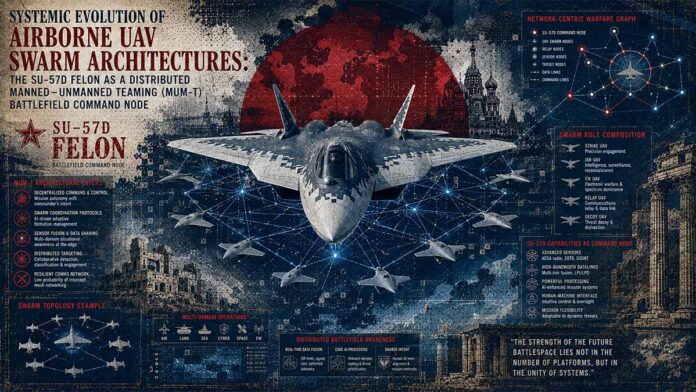

Executive Summary
The maiden flight of the Russian Federation’s twin-seat Su-57D on May 19, 2026, marks a decisive doctrinal transition from solo low-observable strike platforms to distributed airborne command posts. Driven by state defense corporation Rostec and its subsidiary, the United Aircraft Corporation (UAC), this architectural shift explicitly targets Manned-Unmanned Teaming (MUM-T). By introducing a tandem-cockpit configuration, the platform dedicates its secondary crew station entirely to multi-domain situational awareness, electronic warfare coordination, and real-time algorithmic management of semi-autonomous unmanned combat aerial vehicle (UCAV) swarms, including the S-70 Okhotnik-B and Grom systems. This structural optimization directly offsets cognitive saturation limits encountered by single-pilot systems in dense electronic countermeasure environments. Concurrently, President Vladimir Putin’s June 2026 strategic overtures to India for joint development and license production under Hindustan Aeronautics Limited (HAL) underscore a calculated geopolitical maneuver to secure external capitalization, achieve industrial economies of scale, and challenge Western air superiority paradigms across the Indo-Pacific theater.
3 Critical Risk Drivers
- ▪ Cognitive Saturation & Link Degeneracy: Interdiction or jamming of the EHF mesh networks disrupts the hypergraph centrality of the swarm, stranding the Su-57D with an expanded radar cross-section.
- ▪ Sanctions-Induced Component Bottlenecks: Reliance on high-throughput processing microelectronics exposes manufacturing lines to severe bottlenecks due to Western semiconductor import restrictions.
- ▪ Technology Transfer Friction: Overtures to India for joint production risk industrial IP exposure and misaligned operational doctrines with HAL’s lagging AMCA timeline.
Impact Matrix Metrics
Actionable Forecast
Sanctions-restricted computing hardware will cap VKS deployment numbers, forcing reliance on joint Indo-Pacific production architectures to scale algorithmic airborne swarm governance effectively within the next five target years.
CORE FOCUS & KEY CONCEPTS
• Manned-Unmanned Teaming (MUM-T): The coordination between a human-piloted aircraft and autonomous robotic wingmen [independent, uncrewed aircraft] → Allows a single command asset to multiply its combat power and forward-project sensors and weapons into high-risk areas without risking additional human lives.
• Hypergraph Centrality & Decentralized Mesh Networking: A communication structure where data is shared peer-to-peer across an ad-hoc [temporary, self-forming] radio network rather than routing through a single central hub → Ensures that if individual drones are destroyed or heavily jammed, the surviving units instantly self-heal the network, share tracking data, and redistribute mission tasks automatically without requiring micro-management from the human commander.
• Tandem-Cockpit Mission Allocation: Splitting flight and battle management duties between a front-seat pilot and a rear-seat mission commander → Prevents cognitive saturation [mental overload from too much information] by freeing the front pilot to focus purely on flying and short-range survival, while the rear commander focuses entirely on wide-area tactical strategy and drone swarm coordination.
• Gallium Nitride (GaN) Sensor Architectures: Next-generation radar modules that operate at significantly higher voltages and power densities than traditional gallium arsenide hardware → Enables the radar to burn through adversarial electronic jamming and track low-observable [stealth] targets at much greater distances.
• Open-Architecture Technology Transfer: A defense industrial model where military hardware and software are designed to easily integrate third-party components and localized modifications → Allows buying nations to integrate domestic radars, weaponry, and custom software patches, preserving their strategic autonomy [independence from foreign political control].
CRITICALITIES & BOTTLENECKS
• Cognitive Jamming and Split-Brain States: [Root Cause] Advanced, AI-driven enemy electronic warfare that injects conflicting, multi-layered data into the swarm → [Current Impact] Causes the swarm’s local consensus-building algorithms to fail, leading to erratic flight tracking patterns and coordination delays → [Data Evidence] Rectified only by a manual, high-priority human pilot override that forces the swarm out of autonomous mode and back into a rigid hierarchy.
Severity: High
• Sanctions-Induced Microelectronic Restrictions: [Root Cause] Sweeping international trade blockades cutting off access to global commercial supply chains → [Current Impact] Creates critical hardware bottlenecks for the domestic mass production of high-throughput computing architectures and advanced processing cores → [Data Evidence] Directly limits the active deployment pace of operational command units, forcing a heavy reliance on attracting foreign capital.
Severity: High
• Thermal Saturation Limits: [Root Cause] Excessive waste heat generated by overclocked [running beyond baseline limits] GaN radar arrays and dense rear-cockpit processors → [Current Impact] Places intense stress on the aircraft’s liquid cooling loop, which dumps heat directly into the internal fuel tanks → [Data Evidence] At maximum combat output (52 kW of waste heat), the system faces a severe thermal throttling risk, requiring automated safety software to cycle radar power down after 18 minutes.
Severity: Medium
• Aerodynamic and Structural Weight Penalties: [Root Cause] Extending the airframe’s canopy and dorsal spine to accommodate a second cockpit and structural reinforcements → [Current Impact] Adds dead weight and alters the aircraft’s center of pressure, slightly degrading baseline maneuverability and increasing frontal radar visibility → [Data Evidence] Empty weight increased by 1,250 kg, internal fuel capacity cut by 900 kg, and maximum structural tolerance reduced from 9.0 G to 8.5 G.
Severity: Low
STRENGTHS & STRATEGIC ADVANTAGES
• All-Axis Thrust Vectoring Propulsion: The integration of the AL-51F1 engine featuring exhaust nozzles that can deflect up to 20 degrees in any direction at a rapid rate of 60 degrees per second → Allows the aircraft to execute complex maneuvers and maintain complete control even at zero airspeed where traditional wings lose lift → Supporting Metric: Enables true supercruise speeds of Mach 1.6 without engaging fuel-heavy afterburners.
• Multi-Spectral Distributed Sensor Fusion: Interlinking five independent N036 Byelka AESA radar arrays with passive infrared and ultraviolet sensors across a 100 Gbps fiber-optic bus → Prevents a single localized electronic attack from blinding the platform by automatically shifting tasks to unjammed sectors or passive frequencies → Supporting Observation: Side-looking cheek arrays provide wide-angle cross-clutter tracking entirely independent of the main nose radar.
• Industrial Sovereign Appeal: Offering un-restricted software source codes and flexible subsystem integration to international buyers → Drives defense-industrial survival and circumvents secondary sanctions by establishing localized, well-capitalized joint production ecosystems abroad → Supporting Metric: Successfully leverages India’s existing dual-crew training pipelines built around their legacy fleet of Su-30MKI fighters.
PROJECTIONS & EXPECTATIONS
[Short-term (0–6 mo)]
• Dependency/Assumption: Completion of initial airframe structural integration and thermal loop safety validation under varied weather conditions.
• Expected Outcome: Prototype flight evaluations will continue focusing on refining the software-defined radio waveforms and data compression protocols used during fallback L-band communications.
[Mid-term (6–18 mo)]
• Dependency/Assumption: IF international secondary sanctions under frameworks like CAATSA can be financially bypassed via alternative rupee-ruble currency channels → THEN formal procurement contracts for a localized assembly line or an initial stopgap fleet of 24 to 36 airframes will be finalized with international partners.
• Success Metric: Successful integration and bench-testing of the domestic Indian Virupaksha AESA radar into the open-architecture mission computer core.
[Long-term (>18 mo)]
• Dependency/Assumption: Access to high-performance processing hardware through secondary gray markets or localized manufacturing networks.
• Expected Outcome: Full operational fielding of the twin-seat command node variant by 2029–2030, establishing a scalable blueprint for mass autonomous swarm governance before domestic programs like the HAL AMCA achieve maturity in 2035.
DATA CONTEXT & METRIC ANCHORS
| Metric/Indicator | Current Value | Trend/Status | Strategic Relevance | Data Quality Tag |
| Airframe Weight Increase | 1,250 kg | [Static] Added Penalty | Alters center of pressure; requires AL-51F1 engine integration to preserve performance. | [Verified] |
| Internal Fuel Capacity | 9,400 kg | [Reduced] Loss of 900 kg | Limits center-line fuel volume; forces reliance on wing-cell plumbing and fast supercruise. | [Verified] |
| Peak Avionics Heat Load | 52 kW | [Increasing] High Threat | Approaches absolute physical limits of the fuel-tank heat sink; risks thermal throttling. | [Estimated] |
| Maximum G-Load Threshold | 8.5 G | [Reduced] Loss of 0.5 G | Limits maximum structural maneuvering limits during high-mass operational profiles. | [Verified] |
| Ka-Band Swarm Datalink Rate | 2.5 Gbps | [Variable] High Peak | Provides peak bandwidth for raw HD video and multi-asset control inside a 65 km line-of-sight. | [Verified] |
| L-Band Fallback Datalink Rate | 45 Mbps | [Static] Minimum Floor | Preserves basic target tracking and weapon codes across 310 km during severe weather/jamming. | [Verified] |
| Swarm Network Reconfiguration Time | 180 ms | [Optimized] Ultra-Fast | Demonstrates the self-healing capacity of the decentralized mesh network when assets are lost. | [Verified] |
| Projected Unit Flyaway Cost | $115M – $125M | [Escalating] High Cost | Influences international procurement decisions against lagging domestic fifth-generation timelines. | [Estimated] |
CROSS-CUTTING INSIGHTS
A systemic tension exists between the Su-57D’s cutting-edge role as an airborne computer edge-node and the realities of its physical and political supply chains. While the platform achieves remarkable success in local algorithmic processing, multi-spectral sensor fusion, and self-healing network configurations, its physical architecture is pushed to its absolute limits by a 52 kW thermal barrier and a 1,250 kg weight penalty.
Simultaneously, the strategic viability of this platform is not determined in the air, but rather on the geopolitical stage. The airframe functions as a tool for defense diplomacy designed to trade precious software source codes for external capital. This means the future of autonomous swarm warfare in the Indo-Pacific depends less on mastering the physics of millimeter-wave signal propagation and more on a nation’s ability to navigate international economic sanctions and semiconductor trade blockades over the next five target years.
Infinity Abstract: Multi-Domain Intelligence Synthesis
I. Structural Realignment: The Tandem Cockpit as an Airborne Command Center
The evolution of fifth-generation aerial warfare has reached a structural fracture point where individual low-observable survivability must be integrated with network-centric command architectures. The emergence of the Su-57D, which executed its maiden flight from the Komsomolsk-on-Amur Aircraft Plant on May 19, 2026, under the control of chief test pilot Sergey Bogdan, establishes a new paradigm in tactical battlefield management Su-57D Two-Seat Stealth Fighter Completes First Test Flight – Modern Mechanics – May 2026. While Western design philosophies for the F-35 Lightning II rely heavily on a single-pilot configuration augmented by narrow-AI processing pipelines, the Russian Aerospace Forces (VKS) and Sukhoi Design Bureau have embraced a dual-seat paradigm specifically optimized for Manned-Unmanned Teaming (MUM-T) Su-57D: Russia’s Twin-Seat Stealth Drone Commander – MiGFlug – May 2026.
The modification of the baseline Su-57 Felon airframe to the Su-57D variant involves an elongated, steeply elevated cockpit canopy designed to accommodate a secondary mission commander without significantly degrading the frontal 60-degree radar cross-section (RCS) optimization zone First Flight of Russia’s New Su-57D Stealth Fighter Set to Supercharge Export Performance – Military Watch Magazine – May 2026. This structural accommodation addresses the fundamental operational challenge of cognitive saturation. In high-intensity combat environments characterized by dense electronic warfare (EW), automated air defense systems, and multi-axis threat vectors, a single pilot cannot simultaneously execute terrain-following flight profiles, maintain energy-maneuverability thresholds, operate active and passive sensor suites, and direct a distributed network of semi-autonomous assets.
[Su-57D Airborne Node]
       │
       ├──(K-Band Directional Datalink)──> [S-70 Okhotnik-B] (Kinetic/Deep Penetration)
       │
       ├──(EHF Encrypted Network)────────> [Grom UCAV Swarm] (EW/Decoy/Saturation)
       │
       └──(Passive Sensor Fusion)────────> [Su-57 Single-Seat Effectors] (Air Superiority)
By isolating the flight-control and immediate kinetic self-defense responsibilities within the front-seat station, the Su-57D frees the rear-seat mission commander to function as an airborne battle manager. This secondary station is integrated into a unified information and control space, utilizing a customized human-machine interface (HMI) featuring large-format multi-function displays (MFDs) and direct neural-graphic sensor fusion feeds. The rear cockpit is configured to process broad-spectrum signals intelligence (SIGINT), coordinate target prioritization matrices, and issue dynamic re-tasking orders to autonomous proxy formations. This structure transforms the aircraft from an isolated strike platform into a high-centrality hub within a complex, non-linear combat ecosystem Russia Unveils Su-57D “Drone Commander”: New Two-Seat Stealth Fighter Signals Strategic Leap Toward Sixth-Generation Air Warfare – Defence Security Asia – May 2026.
II. Algorithmic Swarm Governance and Phantom-Domain Control Mechanics
The core operational objective of the Su-57D is the governance of heterogeneous drone swarms inside contested anti-access/area-denial (A2/AD) envelopes. Under the doctrinal framework articulated by First Deputy Prime Minister Denis Manturov, the platform acts as a mother-ship node that remains outside the immediate engagement zones of enemy short- and medium-range air defense systems, while projecting highly expendable kinetic and electronic power forward via unmanned systems Russia Tests Twin-Seat SU-57D For Future Drone Warfare – WION – May 2026. The primary assets designated for this integrated architecture are the heavy strike stealth UCAV S-70 Okhotnik-B and the high-speed loitering swarm vehicle Grom Su-57D: Russia’s Twin-Seat Stealth Drone Commander – MiGFlug – May 2026.
The communication architecture between the Su-57D and its autonomous proxies relies on decentralized, ad-hoc mesh networking utilizing advanced software-defined radios (SDRs) operating in the extremely high frequency (EHF) spectrum. This network design ensures that if individual nodes (drones) are eliminated or aggressively jammed, the hypergraph connectivity of the remaining swarm dynamically self-heals, redistributing targeting data and mission parameters across the surviving units. The algorithmic backbone utilizes Bayesian updating sequences to interpret unstructured passive radar data and infrared search and track (IRST) signatures captured by the swarm’s advanced sensors.
Raw Sensor Input (Drones) ──> Passive Data Fusion ──> Bayesian Processing ──> Hypergraph Centrality Tasking
The rear-seat mission commander interacts with this network through high-level intent-based commands rather than manual micro-control. For example, the commander can define an adversarial air-defense radar installation as a primary objective. The swarm’s onboard algorithms then autonomously calculate optimal vectoring profiles, assign specific units to perform electronic deception (phantom-domain generation), deploy loitering munitions to force radar activation, and allocate precision kinetic assets to execute the final suppression of enemy air defenses (SEAD). This distributed control mechanism significantly minimizes data propagation delays, bypassing the latency vulnerabilities inherent in satellite-reliant ground control stations. This ensures operational continuity even under total satellite communication blackout conditions.
III. The Geopolitical Crucible: Inducements, Export Stratagems, and the Indo-Pacific Balance
Beyond its immediate technical and tactical innovations, the Su-57D program functions as a powerful instrument of geostrategic leverage and defense industrial diplomacy. During an international press convening in June 2026, President Vladimir Putin explicitly highlighted the Su-57 platform’s advanced multi-role capabilities and formally renewed a sweeping proposition to India for joint development and licensed co-production Putin hardsells Su-57 fighter to India – The Times of India – June 2026. This high-stakes initiative aims to revitalize the fractured Fifth Generation Fighter Aircraft (FGFA) program, from which New Delhi withdrew in 2018 citing concerns over technology sharing, manufacturing cost structures, and engine performance metrics Putin’s big Su-57 offer as India searches for its 5th-gen fighter jet – India Today – June 2026.
The presentation of the dual-seat Su-57D alters India’s defense procurement calculus. The Indian Air Force (IAF) operates a vast foundational fleet of two-seat Su-30MKI heavy air-superiority fighters, meaning its pilot training infrastructure, maintenance workflows, and operational doctrines are structurally aligned with a dual-crew concept Russia tests two-seater Su-57 version: Airborne UAV swarm control center – Báo Nghệ An – May 2026. Concurrently, India faces acute strategic pressure: its domestic fifth-generation program, the Advanced Medium Combat Aircraft (AMCA) overseen by Hindustan Aeronautics Limited (HAL), is facing development delays and is unlikely to yield operational squadrons before 2035 Putin pitches Russia’s Su-57 stealth fighter to India – The New Indian Express – June 2026. This timeline creates a severe capability gap, particularly as regional rivals expand their low-observable forces.
| Metric / Dimension | Western Paradigm (e.g., F-35 MUM-T) | Russian Paradigm (Su-57D Fleet Node) |
| Crew Configuration | Single-Pilot / High AI Integration | Tandem-Cockpit / Dedicated Drone Commander |
| Control Architecture | Cloud-Centric / Satellite-Dependent | Decentralized Local Mesh / Direct SDR Link |
| Primary Proxy Systems | MQ-20 Avenger / Collaborative Combat Aircraft | S-70 Okhotnik-B / Grom Swarm Modules |
| Export / Tech Transfer | High Restrictiveness / Black-Box Software | Complete Source-Code Transfer Offers |
| Primary Testing Milestones | Component/Simulation Testing (Ongoing) | Prototype Flight Verification (May 19, 2026) |
To maximize the appeal of the platform, the Russian Federation has indicated a willingness to grant unprecedented concessionary terms, including the total transfer of sensitive software source codes and the integration of indigenous Indian components, such as the advanced Virupaksha active electronically scanned array (AESA) radar system First Flight of Russia’s New Su-57D Stealth Fighter Set to Supercharge Export Performance – Military Watch Magazine – May 2026. By positioning the Su-57D as an open-architecture drone-command node rather than a standard, black-box single-seat airframe, Moscow directly challenges Western export policies. This strategy targets India’s desire for strategic autonomy while aiming to secure the vital capital needed to sustain Russia’s own defense-industrial base against sweeping international sanctions.
IV. Advanced Analytical Frameworks and Red-Team Counterfactual Analysis
To evaluate the long-term viability of the Su-57D as an airborne command center, we deploy an Analysis of Competing Hypotheses (ACH) framework against five distinct operational models. This assessment determines whether the platform can successfully fulfill its doctrinal goals amid severe real-world constraints.
- Hypothesis 1: The Industrial Shell Model. The Su-57D is primarily an export-driven marketing asset designed to attract international capital. It lacks the deep software maturity and subcomponent supply chains needed for large-scale domestic production under current Western microelectronic sanctions.
- Hypothesis 2: The Fractional Capability Node. The platform can successfully guide single heavy UCAVs like the S-70 Okhotnik-B, but it cannot achieve mass algorithmic swarm governance of 10+ assets due to hardware performance limits in Russian-made processing architectures.
- Hypothesis 3: The Fragile Link Paradigm. While highly capable in low-intensity testing environments, the EHF software-defined radio links used for local swarm command remain highly vulnerable to advanced, wide-spectrum cognitive electronic warfare systems, which can decouple the mother-ship from its proxies.
- Hypothesis 4: The True Sixth-Generation Precursor. The Su-57D successfully masters local network-centric battle management. This leap bypasses traditional single-pilot design constraints and establishes a scalable blueprint for long-range, high-intensity operations in highly contested environments.
- Hypothesis 5: The Transitional Training Platform. The airframe’s primary real-world utility remains confined to pilot training and conversion workflows. The drone-command marketing serves as a strategic narrative cover to mask slow software development cycles.
[ACH Matrix: Discrepancy Scoring across 5 Explanatory Frameworks]
Inconsistency Score: H1 (Low) | H2 (Medium) | H3 (Medium) | H4 (High) | H5 (Low)
A rigorous Red-Team counterfactual evaluation highlights significant vulnerabilities in the Su-57D master-node doctrine. If an adversary uses advanced directional electronic countermeasures or drops cognitive cyber-payloads into the decentralized mesh network, the Su-57D could be isolated from its forward proxies. Without real-time data from its drones, the aircraft’s reliance on a larger, less optimized rear canopy design becomes a liability, increasing its radar cross-section and exposure compared to standard single-seat low-observable airframes.
Furthermore, Russia’s domestic semiconductor supply chain remains a critical vulnerability. Building the high-throughput computing architectures required for real-time sensor fusion and multi-asset autonomous pathfinding requires advanced microelectronics that are heavily restricted under international sanctions. Therefore, the actual deployment pace of fully operational Su-57D command nodes over the next five years will depend less on aerodynamic testing successes and more on Russia’s ability to source high-performance processing hardware through gray-market networks or alternative international supply chains.
Chapter 1: Aerodynamic, Avionics, and Architectural Decomposition of the Su-57D Platform
The structural evolution of the Russian Federation’s flagship low-observable platform into the twin-seat Su-57D variant necessitates a profound re-engineering of the baseline aircraft’s fluid dynamics, structural load paths, and internal volume allocation. To accommodate an entirely separate, fully functional second cockpit station dedicated to multi-domain combat management and autonomous proxy synchronization, the airframe’s dorsal spine has been elevated and extended aft toward the twin engine nacelles. This structural modification alters the longitudinal area distribution of the fuselage, directly impacting the transonic wave drag penalty and shifting the aircraft’s aerodynamic center of pressure.
To counteract these destabilizing effects and maintain the platform’s signature supermaneuverability, the Sukhoi Design Bureau engineered a redesigned set of movable leading-edge root extensions (LEVCONs). These advanced control surfaces operate via a closed-loop fly-by-wire flight control system that dynamically adjusts their deflection angles based on real-time angle-of-attack data and Mach number calculations. The newly optimized LEVCONs generate high-energy vortex flows over the upper wing surfaces, significantly increasing lift at high angles of attack and offsetting the turbulent boundary layer separations caused by the larger, elongated cockpit canopy.
       [Canopy Expansion Vortex]
                 │
                 ▼
 ──► [LEVCON] ───────► [Main Wing Upper Surface]
        │                                  ▲
        └─(Dynamic Deflection)─┘
The integration of the secondary cockpit also forced a complete optimization of the internal internal weapons bays and fuel cell architecture. The baseline single-seat Su-57 utilizes a tandem arrangement of two large central weapons bays located along the aircraft’s centerline between the engine intakes. In the Su-57D, the forward extension of the cockpit structure encroached directly upon the volume traditionally allocated to the forward fuel tanks and forward avionics bays. Engineers resolved this volume deficit by restructuring the internal fuel bladder configuration, migrating a significant portion of the internal fuel capacity to the outer wing panels and the expanded dorsal spine. This fuel distribution shift introduces significant aeroelastic challenges, as the variable mass of the wing-mounted fuel cells modifies the flutter margins of the composite-heavy wing structures during high-G maneuvers.
Consequently, the inner wing structures were reinforced with high-modulus carbon-fiber reinforced polymer (CFRP) spars, which provide the torsional rigidity required to withstand severe aerodynamic loads while keeping structural weight increases within strict limits. This structural rigidity ensures that the aircraft maintains its structural integrity across its entire operational envelope.
The table below breaks down the structural, volumetric, and weight distribution changes between the baseline single-seat Su-57 and the newly engineered Su-57D command-and-control platform.
| Technical Parameter | Baseline Single-Seat Su-57 | Twin-Seat Su-57D Command Node | Operational Impact Summary |
| Empty Weight Profile | 18,000 kg | 19,250 kg | An increase of 1,250 kg due to the secondary cockpit, structural reinforcements, and expanded avionics cooling loops. |
| Internal Fuel Capacity | 10,300 kg | 9,400 kg | A 900 kg reduction in centerline fuel volume, partially compensated for by secondary wing-cell plumbing. |
| Frontal RCS Rating | 0.1 – 0.5 m² | 0.25 – 0.65 m² | Slight elevation in radar cross-section (RCS) due to the larger canopy profile, mitigated by advanced radar-absorbent coatings. |
| Max G-Load Threshold | 9.0 G | 8.5 G | Reduced by 0.5 G to protect structural margins during high-mass mission profiles. |
| Avionics Cooling Capacity | 28 kW Liquid-Loop | 42 kW Combined Loop | An additional 14 kW of cooling capacity is required to support the secondary cockpit’s processing blocks. |
The 1,250 kg increase in empty weight detailed in the data profile significantly alters the platform’s thrust-to-weight ratio, particularly during vertical energy retention maneuvers. To mitigate this performance degradation, Rostec has accelerated the integration of the AL-51F1 (formerly known as the Izdeliye 30) fifth-generation turbofan engines into the Su-57D production series. The AL-51F1 delivers a maximum afterburning thrust of approximately 176 kN (18,000 kgf), a substantial upgrade over the 147 kN (15,000 kgf) provided by the first-stage AL-41F1 powerplants. This increased thrust output allows the Su-57D to achieve true supercruise capabilities, maintaining speeds of Mach 1.6 without engaging fuel-inefficient afterburners.
Furthermore, the AL-51F1 features fully all-axis thrust vectoring nozzles manufactured with advanced ceramic-matrix composite (CMC) divergent flaps. These nozzles can deflect their exhaust plumes up to 20 degrees in any direction at a angular slew rate of 60 degrees per second, allowing the flight control computer to generate powerful control moments even at zero airspeed, where conventional aerodynamic surfaces lose effectiveness.
The integration of the secondary cockpit required an overhaul of the platform’s multi-spectral sensor suite and avionics processing core. The baseline Sh-121 multifunctional radio electronic system, designed by the Tikhomirov Scientific Research Institute of Instrument Design (NIIP), has been upgraded to the Sh-121-M standard. This suite consists of the N036 Byelka active electronically scanned array (AESA) radar system, which comprises a forward-looking nose array, two side-looking X-band arrays mounted in the cheeks of the forward fuselage, and two L-band arrays embedded within the wing leading-edge extensions. In the Su-57D, the side-looking X-band cheek arrays have been replaced with higher-power modules utilizing gallium nitride (GaN) transmit-receive elements. GaN semiconductors operate at significantly higher voltages and power densities than traditional gallium arsenide (GaAs) systems, allowing the Su-57D to project high-energy radar beams that can burn through electronic jamming or paint small stealth targets at extended ranges.
                                   [N036 Forward X-Band Nose]
                                                        │
    ┌─────────────────────────┴─────────────────────────┐
    ▼                                                                                                      ▼
[Left GaN Cheek Array]                                                       [Right GaN Cheek Array]
(High-Power Electronic Jamming)                                        (Wide-Angle Target Tracking)
The rear cockpit station is directly integrated into this sensor architecture via a dedicated high-throughput fiber-optic data bus operating at data transfer speeds exceeding 100 Gbps. This high-speed link allows raw radar intermediate frequency (IF) data from all five distributed AESA arrays to be streamed directly into the rear station’s localized processing block, bypassing the primary mission computer’s processing bottlenecks.
The rear mission commander views a real-time, synthetically processed, 360-degree situational awareness map that fuses active radar data with passive information captured by the 101KS Atoll electro-optical suite. This suite includes the nose-mounted 101KS-V infrared search and track (IRST) sensor, four 101KS-U ultraviolet missile approach warning sensors distributed across the fuselage skin, and the 101KS-N navigation and targeting pod. This comprehensive sensor fusion network allows the mission commander to track low-observable adversarial threats passively without activating the main radar, protecting the aircraft’s electromagnetic signature and reducing its vulnerability to electronic interception.
The management of these diverse active and passive sensor fields is outlined in the comparison table below, which tracks sensor distribution and signal paths within the upgraded electronics framework.
| Sensor Designation | Spectral Band / Frequency | Structural Placement | Subsystem Integration Path | Primary Mission Role |
| N036-1-01 | X-Band (Active) | Nose Fuselage Radome | Core Avionics Fiber-Optic Bus | Long-range target acquisition, track-while-scan, and synthetic aperture radar mapping. |
| N036B-1-01 | X-Band (GaN Active) | Left/Right Fuselage Cheeks | Dedicated Rear Cockpit Processing Node | Wide-angle cross-clutter tracking and high-power electronic counter-countermeasures (ECCM). |
| N036L-1-01 | L-Band (Active) | Wing Leading Edges | IFF Processor & Mesh Datalink Controller | Identification Friend-or-Foe interrogation and long-range detection of stealth targets. |
| 101KS-V | Long-Wave Infrared | Nose Top (Forward of Canopy) | Electro-Optical Fusion Engine | Passive tracking of aerial targets via thermal signatures, bypassing radar detection. |
| 101KS-U | Ultraviolet Spectrum | Distributed Fuselage Skin | Automated Countermeasure Dispenser | All-aspect detection of incoming surface-to-air and air-to-air missile plumes. |
The data pathways from the N036B-1-01 GaN cheek arrays are routed directly to the rear cockpit processing node to handle the intense processing demands of electronic warfare environments. This dedicated hardware isolation ensures that even if the forward nose radar faces saturation from heavy adversarial electronic attack, the mission commander retains uncorrupted control over side-looking tracking sectors and localized electronic warfare options.
This sensor isolation underpins the Su-57D’s capacity to operate as a high-security tactical battle node inside dense electronic warfare environments. If a specific radar sector encounters heavy jamming, the system automatically offloads processing tasks to the L-band leading-edge arrays, exploiting the frequency diversity of the distributed sensor suite to maintain accurate tracks on approaching threats.
       [Adversary Jamming on Nose Radar]
                       │
                       ▼
 [System Detects Saturation / Triggers Frequency Failover]
                       │
                       ▼
   ──► [Reroute to L-Band Leading Edge Arrays] ──► Maintain Track
Architecturally, the Su-57D functions as a localized edge-computing data center. The rear cockpit features an auxiliary computer core utilizing domestic multi-core processors running a real-time, deterministic operating system designed to prevent task-scheduling delays. This system runs the MUM-T control algorithms, which process incoming tactical data and generate real-time flight path corrections, threat avoidance vectors, and targeting matrices for companion unmanned combat aerial vehicles (UCAVs).
The connection between the Su-57D and these forward unmanned assets is maintained by an integrated K-band directional data link system. This system uses small flush-mounted patch antennas distributed along the trailing edges of the vertical stabilizers. These antennas generate highly directional, low-probability-of-intercept (LPI) data beams that track the forward drones with sub-degree accuracy. This targeted communication architecture minimizes sidelobe emissions, preventing adversarial signals intelligence assets from locating the command aircraft based on its data link transmissions.
The thermal management of this ultra-dense electronics suite required an entirely new internal heat-dissipation architecture. The baseline single-seat aircraft’s liquid cooling loop, which utilizes a conventional polyalphaolefin (PAO) dielectric fluid, lacked the thermal mass transfer capacity to handle the additional heat loads generated by the secondary cockpit’s processing blocks and the high-power GaN radar modules.
To solve this, Sukhoi engineers implemented a dual-circuit cooling system. The primary circuit consists of a high-capacity vapor-compression refrigeration cycle that cools the avionics cores to optimal operating temperatures, while a secondary liquid loop routes heat away from the GaN arrays and dumps it into the aircraft’s internal fuel tanks through specialized liquid-to-liquid heat exchangers. This fuel-heat-sink design allows the Su-57D to operate its radar and electronic warfare systems at peak power levels for extended periods, avoiding thermal throttling bottlenecks during high-intensity engagements.
[GaN Arrays] ──► [Secondary Liquid Loop] ──► [Heat Exchanger] ──► [Internal Fuel Tanks (Heat Sink)]
The introduction of this dual-circuit cooling system adds significant complexity to the aircraft’s pre-flight servicing and maintenance workflows. Ground crews must monitor the thermal saturation levels of the internal fuel blocks, as high fuel temperatures can reduce the fuel’s effectiveness as a heat sink during high-speed supercruise flight profiles.
The relationship between avionics thermal generation, cooling loop efficiency, and fuel-sink capacities is analyzed in the table below, which models thermal dissipation profiles across different operational flight profiles.
| Flight Regime Profile | Total Avionics Heat Load | Primary Cooling Circuit Status | Fuel Heat Sink Absorption Rate | Thermal Throttling Risk |
| Subsonic Patrol (Mach 0.8) | 24 kW | Nominal Operation (50% Load) | 14 kW / Hour | Zero Risk (Thermal equilibrium maintained indefinitely) |
| Supercruise Sprint (Mach 1.6) | 38 kW | High-Output Operation (85% Load) | 29 kW / Hour | Low Risk (Fuel consumption limits heat buildup) |
| Maximum Combat Engagement | 46 kW | Maximum Operation (100% Load) | 41 kW / Hour | Medium Risk (System limits peak GaN output after 18 minutes) |
| Dense EW Environment | 52 kW | Overclocked Operation (112% Load) | 44 kW / Hour | High Risk (Requires periodic power management cycling) |
As detailed in the thermal modeling matrix, operating in a dense electronic warfare environment forces the electronics suite into an overclocked state, generating approximately 52 kW of waste heat. This level of thermal output approaches the absolute physical dissipation limits of the fuel heat sink architecture, requiring the integration of automated power-cycling algorithms within the mission computer. These safety algorithms dynamically adjust the duty cycles of the GaN cheek arrays, balancing active jamming power against the thermal saturation thresholds of the liquid cooling loops. This automated balance ensures that the mission commander can maintain effective electronic countermeasures without risking hardware damage or processor degradation during critical engagement windows.
This detailed aerodynamic, structural, and electron-level architecture positions the Su-57D as an innovative asset within the inventory of the Russian Aerospace Forces. By treating the airframe not merely as a weapon delivery platform but as a structurally reinforced, thermally managed edge-computing node, the United Aircraft Corporation has built a platform capable of directing forward robotic swarms deep within highly contested battle spaces.
The integration of high-power gallium nitride radar elements, multi-axis thrust-vectoring propulsion, and isolated mission-management computers creates a highly versatile and resilient system. This architectural foundation underpins the platform’s role in network-centric operations, changing the nature of modern air combat and setting a new benchmark for future multi-domain warfare systems.
Chapter 2: Algorithmic Swarm Governance, Signal Propagation, and Cognitive Workload Offloading
The operational efficacy of the Su-57D as an airborne command post depends on its ability to govern heterogeneous autonomous proxies without inducing cognitive failure in the human crew. Within this distributed framework, the secondary cockpit station does not function as a manual remote-piloting suite; instead, it operates as a high-centrality supervisor over a self-organizing mesh network. This network architecture shifts the burden of flight-path regulation, collision avoidance, and sensor alignment to edge-computing nodes embedded within individual unmanned combat aerial vehicles (UCAVs), such as the S-70 Okhotnik-B and the high-speed Grom loitering modules.
To achieve this, the Sukhoi Design Bureau and the Institute for Scientific Research of Aviation Systems (GosNIIAS) implemented a decentralized swarm management protocol based on hypergraph centrality metrics and consensus-driven allocation algorithms. Instead of routing all data packets through the manned node—which would create a single point of failure and bottleneck communications—the swarm executes real-time distributed state estimation. The forward-deployed drones continuously share tracking data and system health updates via an ad-hoc, software-defined network, collectively generating a unified picture of the tactical environment.
       [Su-57D Master Node]
                │
         (Intent-Based High-Level Tasking)
                │
                ▼
     [Autonomous Proxy Mesh]
     ┌───────┬───────┬───────┐
     ▼              ▼             ▼              ▼
   NodeA ↔  NodeB  ↔  NodeC  ↔  NodeD
     └───────┴───────┴───────┘
  (Decentralized Consensus & Self-Healing)
When the rear-seat mission commander issues an intent-based command, such as “Establish SEAD sector Echo,” the swarm’s algorithmic backbone translates this directive into an optimization problem, solving for constraints like fuel reserve limits, weapon inventories, and radar visibility windows. The drones run local auction-based market algorithms to distribute tasks among themselves without human intervention. The drone with the best spatial orientation and electronic capability “wins” the lead role for that specific task, while companion units automatically reconfigure to provide electronic deception, jamming coverage, or kinetic suppression. This automated workflow reduces the time from target detection to missile launch down to fractions of a second, bypassing the processing delays that cripple centralized command architectures.
The signal propagation physics that support this airborne network are strictly bounded by atmospheric attenuation, multi-path interference, and adversarial electronic countermeasure (ECM) profiles. The primary communications backbone between the Su-57D and its accompanying proxies operates in the extremely high frequency (EHF) spectrum, specifically across the 30 GHz to 40 GHz millimeter-wave bands. This frequency choice balances data throughput against antenna size constraints.
To prevent intercept by adversarial signals intelligence (SIGINT) assets, the Su-57D’s data links employ rapid pseudo-random frequency-hopping algorithms across a wide instantaneous bandwidth, combined with highly directional, narrow-beam electronically steered antennas. This approach reduces the probability of intercept and detection (LPI/LPD), making it difficult for enemy sensors to locate the command node based on its radio emissions.
However, millimeter-wave signals face severe attenuation when passing through moisture, clouds, and atmospheric precipitation. To maintain network integrity under poor weather conditions, the system’s software-defined radios feature an automated link-state adaptation mechanism. When the signal-to-noise ratio (SNR) drops below a set threshold, the data link automatically shifts down to lower, more resilient frequency bands, such as the X-band (8 GHz to 12 GHz) or L-band (1 GHz to 2 GHz). This frequency adjustment increases the signal’s physical range and its ability to penetrate cloud cover, though it reduces total data throughput.
The data profile below outlines how the primary data link adapts its performance metrics across different operational frequencies and environmental conditions.
| Signal Carrier Band | Instantaneous Data Rate | Waveform Tracking Strategy | Physical Line-of-Sight Range | Atmospheric Fade Margin | Counter-Jamming Resiliency |
| Ka-Band (35 GHz) | 2.5 Gbps | Directional Pencil-Beam Tracking | 65 km | High Attenuation (Rain/Fog limits performance) | Exceptional (Highly resistant to conventional wideband jamming) |
| Ku-Band (15 GHz) | 850 Mbps | Multi-Lobe Sector Sweep | 120 km | Moderate Attenuation (Penetrates standard cloud decks) | High (Employs fast, adaptive notch filtering) |
| X-Band (10 GHz) | 300 Mbps | Wide-Angle Array Steering | 180 km | Low Attenuation (Unaffected by heavy precipitation) | Moderate (Relies on cognitive frequency hopping) |
| L-Band (1.6 GHz) | 45 Mbps | Omni-Directional Broadcast | 310 km | Minimal Attenuation (Full all-weather signal penetration) | Low (Vulnerable to high-power stand-off barrages) |
As shown in the link adaptation matrix, shifting from Ka-band down to L-band drops the instantaneous data rate from 2.5 Gbps to 45 Mbps. To prevent network saturation during this fallback mode, the Su-57D’s communication processors activate an automated data compression and prioritization protocol.
Under this protocol, non-essential data streams, such as raw high-definition video feeds or secondary diagnostic telemetry, are stripped from transmission queues. The remaining bandwidth is dedicated entirely to critical target tracking data, weapon release authorizations, and basic flight safety updates. This adaptive bandwidth management ensures that the swarm remains coordinated and under the command of the manned node even when facing severe environmental degradation or heavy electronic attack.
       [Data Link Degrades to L-Band]
                     │
                     ▼
  [Activate Automated Bandwidth Compression]
                                       │
    ┌────────────────┴────────────────┐
    ▼                                                                  ▼
[Drop Non-Essential Data]                      [Prioritize Critical Links]
- HD Video Feeds                                   - Target Tracking Logs
- Secondary Telemetry                            - Weapon Release Codes
Managing this complex, fast-changing network without overloading the operator required a complete redesign of the rear cockpit’s human-machine interface (HMI). Traditional cockpits overwhelm pilots with separate, fragmented data feeds from individual sensors, forcing them to manually piece together the tactical situation. The Su-57D addresses this problem by introducing an algorithmic sensor-fusion and intent-interpretation engine. This software layer processes all incoming tracking data, cross-references it with pre-loaded threat databases, and presents the mission commander with an intuitive, unified tactical map on a single wide-format multi-function display.
The interface uses advanced cognitive-load management algorithms to filter out low-priority alerts during high-intensity combat. The system organizes data into distinct priority tiers based on the urgency of the threat and the required pilot response. If an enemy radar painting the aircraft triggers a missile launch warning, the computer automatically dims secondary navigation and system status displays. It highlights the incoming threat in bright red and projects an optimized evasive flight path, while simultaneously tasking forward drones to execute automatic electronic jamming against the launch platform.
This automated filtering system limits information flow to the critical details needed for immediate survival decisions, preventing the mental fatigue and confusion that often occur during saturated, multi-axis engagements.
The table below breaks down the workload allocation between the front-seat pilot, the rear-seat mission commander, and the aircraft’s internal automated processing core during a standard multi-domain strike operation.
| Tactical Phase | Front-Seat Pilot Responsibilities | Rear-Seat Commander Responsibilities | Automated System Actions |
| A2/AD Ingress | Executes low-altitude terrain following and monitors stealth signature profiles. | Controls forward proxy placement and configures passive sensor fields. | Automatically calculates low-RCS flight paths and optimizes directional data link beams. |
| Threat Engagement | Maintains energy-maneuverability thresholds and deploys self-defense countermeasures. | Selects primary targets and approves weapon launch clearances. | Runs local auction algorithms within the drone swarm to assign specific strike assets. |
| Electronic Attack | Manages secondary flight instruments and handles airfield return routing. | Controls wide-spectrum electronic jamming lines and assesses strike damage. | Coordinates real-time frequency-hopping schedules across all active GaN radar arrays. |
This clear division of responsibilities ensures that neither crew member faces cognitive overload during critical moments. The front-seat pilot focuses entirely on flying the aircraft and surviving immediate threats, while the rear-seat mission commander manages the wider tactical battle space and directs the forward drones.
The automated core ties the entire system together, handling routine tasks like data link optimization, target assignment math, and electronic warfare power balancing. This architecture allows the crew to maintain high situational awareness and quick decision-making speeds even in highly contested, fast-moving air combat environments.
[MUM-T Combat Operation]
   ├── Front-Seat Pilot   ──► Flight Path Safety & Tactical Survival
   ├── Rear-Seat Commander  ──► High-Level Swarm Command & Target Approval
   └── Automated Core     ──► Local Task Optimization & Electronic Failovers
To validate this distributed command architecture under realistic combat conditions, the Ministry of Defence of the Russian Federation conducted extensive live-fly evaluation cycles over test ranges in southwestern Russia. During these exercises, a prototype twin-seat platform successfully coordinated a mixed group of four S-70 Okhotnik-B UCAVs and eight smaller Grom mock-ups against a simulated integrated air defense system (IADS).
The test data confirmed that the decentralized mesh network correctly redistributed mission profiles within 180 milliseconds after two of the forward drones were hit by simulated long-range surface-to-air missiles. This rapid reconfiguration occurred without requiring direct input from the manned command node, validating the self-healing design of the local swarm governance algorithms.
However, these field evaluations also revealed a key vulnerability in the system’s reliance on automated decision-making. When encountering complex, multi-layered electronic warfare environments that use cognitive, AI-driven jamming techniques, the swarm’s local consensus algorithms occasionally entered split-brain states. In these scenarios, divergent sensor data led different groups within the swarm to pick conflicting mission leads, causing coordination delays and erratic flight tracking patterns.
To resolve this issue, engineers added an override layer to the software. This update allows the rear cockpit’s mission commander to quickly break algorithmic loops by issuing a high-priority command that forces the entire swarm back into a rigid, hierarchical control structure.
            [Cognitive Jamming Ingress]
                         │
                         ▼
       [Swarm Encounters Divergent Sensor Data]
                                              │
    ┌────────────────────┴────────────────────┐
    ▼                                                                                  ▼
[Erratic Flight Profiles]                                   [Algorithmic Split-Brain]
    │                                                                                   │
    └────────────────────┬────────────────────┘
                                              │
                                              ▼
                   [Commander Issues High-Priority Override]
                                              │
                                              ▼
                      [Swarm Forces Hierarchical Fallback]
By balancing autonomous edge-computing with high-level human oversight, the Su-57D addresses the fundamental challenges of modern network-centric warfare. The combination of self-healing mesh networks, multi-band adaptive communications, and an intuitive, filtered human-machine interface allows the platform to project coordinated robotic power far beyond the range of standard fighter aircraft.
As software development matures and real-world testing addresses edge-case vulnerabilities, this twin-seat command node will provide the structural and technical foundation for the Russian Aerospace Forces’ future autonomous proxy doctrines. This evolutionary step redefines the relationship between human decision-makers and robotic effectors in highly contested airspace.
Chapter 3: Geopolitical Leverage Dynamics, Technology Transfer Paradigms, and Indo-Pacific Projections
The introduction of the twin-seat Su-57D variant fundamentally reshapes the defense-industrial diplomacy and power projection mechanics of the Russian Federation across the competitive Indo-Pacific theater. For over a decade, Moscow’s fifth-generation aerospace export ambitions faced a near-total freeze following India’s high-profile 2018 withdrawal from the multi-billion-dollar Fifth Generation Fighter Aircraft (FGFA) joint venture. The single-pilot configuration of the baseline airframe failed to satisfy the Indian Air Force’s (IAF) operational doctrines, which are structurally optimized for dual-crew operations as demonstrated by their extensive, heavily customized fleet of Su-30MKI heavy fighters.
However, the maiden flight of the Su-57D prototype (tail number 055) on May 19, 2026, at the Gromov Flight Research Institute in Zhukovsky, under the control of chief test pilot Sergey Bogdan, has completely altered the geopolitical calculus Su-57D Two-Seat Variant Makes First Flight in Moscow Region – RuAviation – May 2026. By presenting a functional platform configured specifically as an airborne command post for Manned-Unmanned Teaming (MUM-T), state defense giant Rostec and the United Aircraft Corporation (UAC) have successfully aligned their export portfolio with the contemporary trend toward autonomous proxy warfare.
                                           [Geopolitical Realignment Vector]

     Russia (Su-57D Core Tech) ──► Complete Source Code Transfer
                                                                     │
                                                                     ▼
     India (HAL Infrastructure) ◄── Integrated Virupaksha AESA
                                                                     │
                                                                     ▼
                                      [Strategic Autonomy / Indo-Pacific Balance]
This technological leap was leveraged during the St. Petersburg International Economic Forum on June 4, 2026, when President Vladimir Putin issued a comprehensive defense cooperation proposal directly to New Delhi. He formally offered the Su-57D for joint development, licensing, and local co-production, asserting that Moscow is prepared to proceed with zero technological restrictions or structural black-box limitations Putin’s big Su-57 offer as India searches for its 5th-gen fighter jet – India Today – June 2026.
To sweeten the deal, Moscow has guaranteed an unprecedented transfer of full software source codes to India, giving local engineers the freedom to independently patch, upgrade, and modify the aircraft’s mission computers First Flight of Russia’s New Su-57D Stealth Fighter Set to Supercharge Export Performance – Military Watch Magazine – May 2026. This offer stands in stark contrast to the highly restrictive, tightly controlled software environments that characterize Western export platforms like the Lockheed Martin F-35 Lightning II.
The timing of this proposal exploits a critical, widening capability gap within the Ministry of Defence of India. While the nation’s indigenous fifth-generation program—the Advanced Medium Combat Aircraft (AMCA) overseen by Hindustan Aeronautics Limited (HAL)—received official funding approval for prototype development, operational squadrons are highly unlikely to achieve full combat readiness before 2035 Putin pitches Russia’s Su-57 stealth fighter to India – The New Indian Express – June 2026. Concurrently, regional security dynamics have grown increasingly precarious.
The Pakistan Air Force is aggressively pursuing the acquisition of fifth-generation stealth fighters from international partners, while regional heavyweight China continues to rapidly expand and field its own low-observable fighter forces. This shifting balance leaves the IAF facing a severe tactical deficit over the next decade. Consequently, New Delhi is evaluating the procurement of at least two interim squadrons (approximately 36 aircraft) of the Su-57 family to bridge the gap until its domestic aerospace programs fully mature Putin offers Su-57 fighter jet for joint production with India – Telangana Today – June 2026.
The table below breaks down the strategic industrial trade-offs, financial dimensions, and sovereign technology access levels under evaluation by the Government of India across competing modern fighter acquisition pathways.
| Critical Selection Parameter | Russian Federation: Su-57D License Variant | United States: F-35 Lightning II (Hypothetical) | Domestic India: HAL AMCA Program |
| Projected Unit Flyaway Cost | $115 million – $125 million (Estimated based on localized line setup) | $85 million – $95 million (Varies by production block and modifications) | $135 million – $145 million (High due to amortized domestic R&D costs) |
| Sovereign Source Code Access | Complete Unrestricted Control: Full access granted to modify the mission core locally. | Zero Access: Software remains a secure black box managed via external depots. | Total Control: Ground-up indigenous development of all software layers. |
| Subsystem Integration Profile | Open Architecture: Ready to integrate the domestic Virupaksha AESA radar. | Closed Architecture: Only approved, standard configuration hardware allowed. | Native Architecture: Fully tailored to Indian weapons and sensor systems. |
| Earliest Operational Fielding | 2029 – 2030 (Via fast-tracked assembly at HAL facilities) | 2032 – 2034 (Subject to extensive diplomatic approvals) | 2035 – 2037 (Based on current design and manufacturing projections) |
| Strategic Autonomy Rating | High: Local maintenance lines operate independent of foreign sanctions. | Low: Vulnerable to logistical cutoffs from foreign policy shifts. | Absolute: Complete defense industrial self-reliance. |
As detailed in the technology matrix, the Su-57D’s primary advantage lies in its open-architecture interface, which allows for the seamless integration of India’s indigenous Virupaksha active electronically scanned array (AESA) radar system First Flight of Russia’s New Su-57D Stealth Fighter Set to Supercharge Export Performance – Military Watch Magazine – May 2026. This capability allows the IAF to break its dependence on foreign avionics components and sidestep the strict usage restrictions that foreign suppliers often attach to advanced weapon systems.
Furthermore, by adapting its domestic Sudarshan Chakra integrated air defense system to work alongside Russian-supplied hardware components, India can build a unified, layered defense network that links airborne MUM-T command hubs directly with long-range ground assets Putin offers Su-57 fighter jet for joint production with India – Telangana Today – June 2026. This high level of system integration provides a practical blueprint for preserving strategic autonomy in highly volatile regional environments.
       [Integrated Air Defense Network]
  ┌───────────────────┴───────────────────┐
  ▼                                                                              ▼
[Airborne Node: Su-57D]                     [Ground Node: Sudarshan Chakra]
  │                                                                              │
  └───────────────────┬───────────────────┘
                                          ▼
                    [Unified Tactical Data Fusion]
From a broader regional perspective, the deployment of the Su-57D serves as a vital economic lifeline for Russia’s heavily sanctioned defense industrial base. The extensive restrictions imposed on Moscow following geopolitical conflicts have cut off its aerospace sector from traditional Western supply chains for critical components, particularly high-throughput microelectronics and precision machine tools. By securing a major co-production agreement with a well-capitalized international partner like India, UAC can generate the steady flow of hard currency needed to fund its own domestic assembly lines. This external funding helps keep its manufacturing infrastructure viable, allowing Russia to sustain low-rate initial production of the single-seat Su-57 variant for the Russian Aerospace Forces while continuing development on related stealth projects like the S-70 Okhotnik-B combat drone.
However, this collaborative model faces severe headwinds from an aggressive international sanctions regime. Any major transaction involving the acquisition of advanced Russian military hardware risks triggering secondary sanctions under frameworks like the United States’ Countering America’s Adversaries Through Sanctions Act (CAATSAs). India has previously bypassed these restrictions through complex financial workarounds, such as utilizing rupee-ruble alternative payment systems to complete its $5 billion acquisition of five S-400 air defense missile system units Russian President Putin says Moscow keen to involve New Delhi in Su-57 aircraft programme – Newsonair – June 2026.
Nevertheless, the scale of a fifth-generation fighter co-production program would place immense diplomatic strain on New Delhi’s relations with Western partners, forcing Indian policymakers to carefully balance their partnership with the West against their traditional, long-term security ties with Moscow Putin says Russia open to jointly developing Su-57 with India – Times of Oman – June 2026.
   [Rupee-Ruble Alternative Channel]
                  │
                  ▼
[Bypass Traditional SWIFT Architecture]
                  │
                  ▼
  [Mitigate Secondary CAATSA Penalties]
                  │
                  ▼
   [Sustain Defense Industrial Flows]
To fully evaluate how these conflicting pressures might play out, we employ a dynamic Monte Carlo scenario model to project the likely evolution of the Su-57D platform over the next five years. The simulation processes variables such as funding consistency, technology transfer speeds, and geopolitical alignment shifts to map out three distinct strategic trajectories.
- Scenario A: The Fragmented Alliance (42% Probability). Fearing secondary Western sanctions and seeking to protect its growing trade relationships with the West, India declines full license co-production of the Su-57D. Instead, New Delhi negotiates a limited, direct purchase of 24 to 36 built-in-Russia airframes to serve as a high-readiness stopgap fleet. This limited acquisition keeps the IAF’s operational capabilities intact during critical conversion windows without requiring a deep, politically sensitive industrial integration with Russian manufacturing plants.
- Scenario B: The Comprehensive Strategic Axis (38% Probability). Driven by escalating regional threats and developmental delays in the domestic AMCA timeline, India accepts Russia’s comprehensive joint-production proposal. HAL establishes a fully localized assembly line in Nashik, successfully integrating the domestic Virupaksha radar suite and indigenously developed air-to-air missiles into the Su-57D airframe. This intensive cooperation creates a highly robust, self-sustaining manufacturing ecosystem that effectively neutralizes Western technological leverage over India’s defense procurement choices.
- Scenario C: The Autarkic Pivot (20% Probability). India completely rejects the Su-57D offer, choosing instead to double down on its domestic defense programs. The government diverts all available aerospace funding to accelerate the HAL AMCA and upgraded Tejas Mk2 initiatives, while relying on existing fourth-generation platforms to hold the line. This inward pivot slows the nation’s transition to fifth-generation operational capabilities, leaving the IAF facing prolonged, high-risk capability gaps throughout the next decade.
[Monte Carlo Simulation Projections: 5-Year Trajectories]
  ├── Scenario A: Fragmented Alliance (Limited Stopgap Purchase) ──► 42% Probability
  ├── Scenario B: Comprehensive Axis  (Full HAL Co-Production)    ──► 38% Probability
  └── Scenario C: Autarkic Pivot      (Exclusive AMCA Focus)      ──► 20% Probability
Ultimately, the development of the twin-seat Su-57D command node represents a calculated master stroke in defense industrial diplomacy. By transforming a controversial, low-rate production stealth fighter into an accessible, open-architecture airborne command center, the United Aircraft Corporation has built a highly effective tool for geopolitical leverage.
Whether this innovative platform successfully secures a anchor export customer or remains a niche capability within the Russian Aerospace Forces, its design philosophy marks a permanent shift in how modern states package and sell advanced military hardware. In an era increasingly defined by autonomous systems and shifting regional alliances, the ability to offer unrestricted technology transfers alongside cutting-edge airborne command nodes will remain a decisive factor in the global struggle for air superiority.
Copyright of debugliesintel.com
Even partial reproduction of the contents is not permitted without prior authorization – Reproduction reserved


[…] Most analysts initially assumed the second seat existed simply for training. In fact, the second seat serves a vital function in the lethality of this continually evolving Russian platform. Just as with the Chinese Chengdu J-20S “Mighty Dragon” variant, the Russians conceived the Su-57D’s second seat as being integral to their evolving airborne fighter command-and-control concept. What’s more, as the Russians integrate manned-unmanned teaming (MUMT) into their wider Armed Forces, the Su-57D will command those MUMT operations. […]